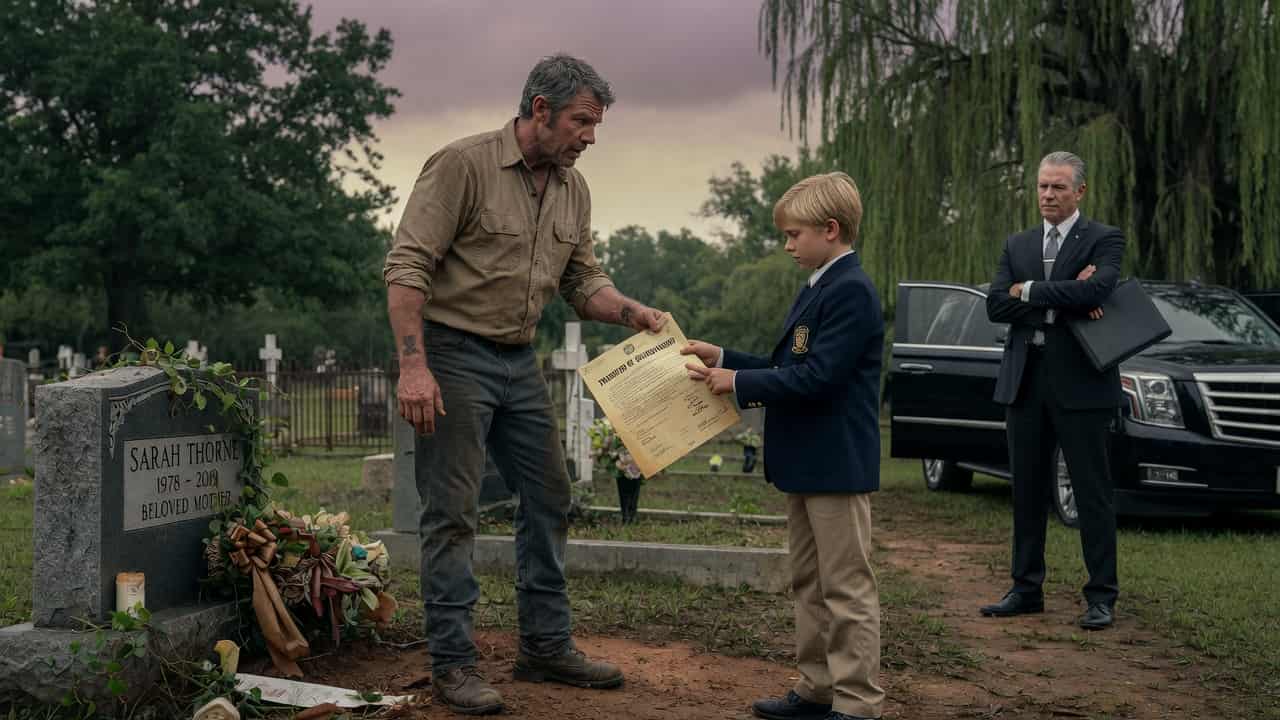
“Is this her name on the stone?”
Elias froze. He’d come to this cemetery every year on the same day, carrying the same heavy silence he’d lived with since his wife passed. He expected the quiet. He expected the ache in his chest. He didn’t expect a ten-year-old boy in a private school blazer standing over Sarah’s grave.
“Son, you shouldn’t be here alone,” Elias said, his voice gravelly from years of working the Texas lumber yards.
The boy didn’t move. He held out a piece of paper, the edges yellowed and the ink faded, but the notary seal was still a bright, mocking red. “My dad said she was a saint. He said she left us because she had to. But I found this in his safe.”
Elias reached out, his calloused fingers trembling. He read the words ‘Transfer of Guardianship.’ He saw Sarah’s signature—the same loops and curves he’d seen on a thousand grocery lists. And then he saw the price. Eighty thousand dollars.
His son hadn’t been lost ten years ago. He’d been sold.
The urn on Elias’s mantle, the one he’d talked to every night for a decade, wasn’t full of his child. It was fireplace ash and old newsprint. The boy standing in front of him wasn’t a stranger. He was the life Elias was never supposed to know existed.
Now, Elias has to decide: does he walk away to protect the boy’s polished life, or does he tear down the powerful man who bought his son?
Chapter 1
The piney woods of East Texas didn’t just grow trees; they grew a specific kind of silence. It was a heavy, resin-scented quiet that settled into the marrow of a man’s bones, especially a man like Elias Thorne. At forty-two, Elias was built like the timber he processed—dense, weathered, and capable of bearing immense weight without snapping. He was the foreman at the Miller Creek lumber yard, a position he’d held for fifteen years, and his life was a study in repetitive, grinding motion.
Every morning at 5:00 AM, he’d wake up in the same small frame house he’d bought with Sarah when they were twenty-four. He’d make coffee in the same chipped percolator, and he’d look at the closed door at the end of the hallway. That door led to the nursery. It had been painted a soft, muted blue ten years ago, and it had stayed that way, the crib still assembled, the mobile of wooden stars still hanging over a mattress that had never felt the weight of a child.
On the mantle in the living room sat a small, sealed brass urn. It was etched with a simple date and no name, because they hadn’t picked one yet when the world ended.
“You’re doing it again,” a voice said from the kitchen doorway.
Elias didn’t turn. He knew the voice. Maria had been in his life for two years now, a patient, grounded woman who worked as a nurse in Lufkin. She was the only person who had managed to wedge a crowbar into the cracks of Elias’s grief and pry him open just enough to let some light in.
“Just finishing my coffee, Maria,” Elias said, his voice a low rumble.
“You’re staring at the urn, Elias. It’s the anniversary, isn’t it?” She stepped into the room, her hand resting gently on the small of his back. She didn’t push. She never pushed. But she was there, a physical reminder that the world was still turning, even if Elias felt like he was standing still.
“Ten years,” Elias muttered. “Seems like a week. Seems like a century.”
“We talked about this,” Maria said softly. “About maybe moving some things. About the nursery. We’re supposed to be looking at rings next month, Elias. I love you, but I can’t be a ghost in this house forever.”
Elias felt the familiar tightening in his chest, the surge of defensive pride that always came when the past was threatened. “It’s not about being a ghost. It’s about respect. Sarah didn’t survive the grief, Maria. I’m the only one left to remember.”
Sarah had been gone for three years. The “stillbirth” had broken something in her that no doctor could stitch back together. She’d turned to the tiny white pills first, then the heavier stuff, chasing a numbness that eventually claimed her in a cheap motel room while Elias was working a double shift to pay off her mounting “medical” debts. He’d forgiven her for the addiction. He’d forgiven her for leaving him alone. He’d even forgiven the mystery of where all their savings had gone, chalking it up to the predatory nature of the dealers she’d fallen in with.
“I know,” Maria said, her voice tinged with a sadness she tried to hide. “But you’re still here. And I’m still here. I’ll see you tonight?”
Elias nodded, grabbing his lunch cooler. He kissed her forehead—a brief, distracted gesture—and headed out to the yard.
The lumber yard was a symphony of industrial violence. The scream of the circular saws, the thud of heavy logs hitting the sorting chains, the bark of orders over the roar of diesel engines. Elias thrived in it. The physical demands of the job were the only thing that could drown out the internal monologue of what if.
He spent the morning supervising the loading of a massive order for a housing development in Houston. The heat was already beginning to shimmer off the asphalt, a thick, wet heat that made your clothes stick to your skin.
“Boss, you got a visitor,” one of the loaders, a kid named Toby, shouted over the noise.
Elias wiped sweat from his brow with a greasy rag and turned. Standing near the office was a man who looked like he’d been imported from another planet. He was in his late fifties, wearing a charcoal suit that probably cost more than Elias made in a quarter. His silver hair was perfectly coiffed, and he held himself with the effortless arrogance of a man who owned the room, even when the room was a dusty lumber yard.
“Elias Thorne?” the man asked as Elias approached.
“That’s me. You lost, Counselor?” Elias didn’t hide the suspicion in his voice. Men in suits didn’t come to Miller Creek unless they were delivering bad news or looking to sue someone.
“My name is Arthur Sterling. I’m an associate of Judge Marcus Caldwell,” the man said, extending a hand that Elias didn’t take.
Elias stiffened at the name. Judge Caldwell was a legend in East Texas—a kingmaker, a man of immense wealth and even deeper reach. He’d been on the bench for thirty years before “retiring” to a mansion that overlooked the bayou.
“The Judge and I don’t move in the same circles,” Elias said. “What does he want with me?”
Sterling withdrew his hand, his expression remains neutral. “The Judge is a man of great charity. He’s been reviewing some… historical records regarding his late wife’s estate. She was a patron of several local clinics ten years ago. It’s come to his attention that there may have been some administrative errors regarding certain… final arrangements.”
Elias felt a cold spike of dread. “Final arrangements? You talking about the clinic where my son was born?”
“The Judge would like to speak with you privately, Mr. Thorne. At your convenience. He believes there is some information you are entitled to.”
“If he’s got something to say, he can say it now,” Elias growled. The air felt thinner. The sound of the saws seemed to recede into a dull hum.
“I’m afraid it’s a sensitive matter. Here is my card. Please, call me. The Judge is very keen on ensuring this is handled with the proper… discretion.”
Sterling handed him a heavy, embossed card and walked away, his polished shoes clicking on the gravel. Elias watched him go, the card feeling like a lead weight in his hand. He looked back at the yard, at the men working, the life he’d built out of the wreckage of his marriage.
He didn’t call the number. Instead, he worked until his muscles burned and his mind was numb. But that night, as he sat in his darkened living room staring at the brass urn, the silence of the piney woods felt different. It felt like a held breath. It felt like a lie.
He looked at the nursery door. He looked at the urn. Then, for the first time in ten years, he reached out and touched the seal on the lid. It was solid. Unmoving.
He thought about Sarah. He thought about her crying in the middle of the night, not for the baby, but for something else. Something she could never name. He’d thought it was the drugs. He’d thought it was the grief.
But as the moon rose over the Texas pines, Elias Thorne felt a truth beginning to stir in the dark—a truth that didn’t smell like incense and lilies, but like old paper and cold, hard cash.
Chapter 2
The anniversary always felt like walking through water. Every movement was slowed, every breath required a conscious effort. Elias had taken the afternoon off—a rare occurrence that had Maria looking at him with worried, searching eyes. He didn’t tell her about the man in the charcoal suit. He didn’t tell her about the card sitting on the dashboard of his truck.
He drove to the St. Jude’s Cemetery, a small, quiet plot of land tucked behind a stand of ancient oaks. Sarah was buried there, under a modest stone that Elias scrubbed clean every month.
He parked the truck and sat for a moment, his hands gripping the steering wheel. The heat was oppressive, the kind of Texas summer afternoon that felt like a physical weight. He grabbed a small bouquet of wildflowers he’d picked from the edge of the yard and stepped out.
The cemetery was empty, or so he thought.
As he rounded the bend toward Sarah’s plot, he saw a splash of color that didn’t belong. A dark blue.
Standing directly in front of Sarah’s headstone was a young boy. He couldn’t have been more than ten. He was dressed in a way that screamed money—a navy blue blazer with a school crest on the pocket, crisp khaki trousers, and leather loafers that had never seen a speck of East Texas red dirt. His blonde hair was combed back, and he stood with a strange, solemn posture, his head tilted as he read the inscription on the stone.
Elias stopped, his heart hammering against his ribs. The boy’s profile… there was something in the line of the jaw, the slight curve of the ear. It was like looking at a ghost through a polished mirror.
“Son?” Elias called out, his voice sounding thin in the open air.
The boy jumped, turning quickly. His eyes were wide, a startling, familiar gray. He didn’t look scared, exactly. He looked caught.
“I’m sorry,” the boy said, his voice high and polite, the product of expensive tutors and gated communities. “I didn’t mean to trespass. I just… I wanted to see.”
Elias stepped closer, his boots crunching on the dry grass. “See what? Do you know who’s buried there?”
The boy looked back at the stone. “Sarah Thorne. My dad said… he said she was a friend of the family. A saint who got sick.” He paused, his lip trembling slightly. “But he lies about a lot of things.”
Elias felt a cold sweat breaking out across his neck. “Who’s your dad, kid?”
“Judge Caldwell,” the boy said.
The world tilted. Elias reached out and steadied himself against the trunk of a nearby oak. The rough bark bit into his palm, the only thing keeping him upright. “The Judge. And what are you doing here, Leo?”
The boy’s eyes widened. “How did you know my name?”
“I… I just guessed,” Elias lied, his mind racing. He’d seen the name in the local papers over the years. Judge Caldwell and son Leo at the Charity Gala. Leo Caldwell wins junior equestrian title. He’d never paid attention. Why would he? He was a lumber foreman with a dead wife and a son in a brass jar.
Leo reached into the pocket of his blazer and pulled out a folded, yellowed piece of paper. “I found this. In the back of the safe in the library. My dad was at the club, and the housekeeper was asleep.” He stepped toward Elias, thrusting the paper forward with a shaking hand. “Is this her name? On the paper?”
Elias took the document. The paper was brittle, smelling of dust and old ink. It was a legal form, notarized and stamped with the seal of the county. At the top, in bold, cold letters: VOLUNTARY TRANSFER OF PARENTAL RIGHTS AND GUARDIANSHIP.
Elias’s eyes blurred as he read. The date was ten years ago. Two days after his son was supposed to have been born “dead.”
The mother: Sarah Thorne.
The father: Unknown/Not Listed.
The adoptive party: Marcus and Elena Caldwell.
And there, at the bottom, was the hammer blow. A handwritten addendum, initialed by Sarah and the Judge: In exchange for the sum of $80,000, to be paid in four installments, all claims, memories, and contact are hereby severed.
Elias felt the air leave his lungs. He looked at the boy—his son. The boy who was supposed to be ash. The boy who had been sold like a piece of livestock to pay off a gambler’s debt.
“Is it her?” Leo whispered, his voice breaking. “Was she my mother? Did she… did she really sell me?”
The humiliation was a physical thing, a wave of heat that burned Elias’s face. He thought of the ten years he’d spent kneeling in the dirt of this cemetery. He thought of the thousands of dollars he’d spent on a headstone for a woman who had betrayed the very core of their life. He thought of the nursery. The wooden stars.
He looked at Leo, and for a second, he saw the Judge’s shadow standing behind the boy—the powerful, wealthy man who had bought a human being because he could.
“Where is your father now, Leo?” Elias asked, his voice a low, dangerous growl.
“He’s in the car,” Leo said, pointing toward the gate.
Elias looked. A black luxury SUV sat idling by the entrance. The tinted window rolled down halfway, and the silver hair of Judge Caldwell was visible in the shadows of the interior. The Judge wasn’t hiding. He was watching. He was waiting to see if the “administrative error” Sterling had mentioned would be resolved quietly.
Elias looked back at the paper in his hand. He looked at the $80,000 figure. Then he looked at the grave of the woman he’d loved.
“She didn’t get sick, Leo,” Elias said, his voice hard as granite. “She was a coward. But she didn’t act alone.”
Elias grabbed Leo’s hand—not roughly, but with a firm, desperate grip. “Come with me, son.”
“Where?”
“To talk to your father,” Elias said. “We’re going to have a conversation about what’s actually inside that safe of his.”
As they walked toward the SUV, Elias felt the ten years of grief falling away, replaced by a cold, sharpened rage. He wasn’t a grieving father anymore. He was a man who had been robbed, and in the piney woods of East Texas, people knew what happened when you tried to steal from a Thorne.
Chapter 3
The drive back from the cemetery was a blur of static. Elias had watched the black SUV peel away the moment he and Leo had reached the gate. The Judge hadn’t stayed for the confrontation. He’d done what men like him always did—he’d retreated to his fortress, leaving the mess for others to clean up.
Elias had put Leo in his truck, the boy sitting silent and stiff in the passenger seat, clutching the guardianship papers like a shield. Elias didn’t take him home. He didn’t know where “home” was for this boy anymore. Instead, he drove back to his own small, quiet house.
He needed to know. The paper was one thing, but the urn… the urn was the center of the lie.
“Stay here,” Elias said as he pulled into his driveway. “Just for a minute, Leo. I need to check something.”
“Is that your house?” Leo asked, looking at the peeling paint and the overgrown yard.
“It was supposed to be yours,” Elias said, the words tasting like copper in his mouth.
He went inside, the air in the house feeling stale and dead. He walked straight to the mantle. The brass urn sat there, catching the afternoon light. It looked so heavy. So significant. He’d polished it once a week for a decade.
He picked it up. He’d always been told it was sealed—a “permanent memorial” the clinic had provided. He’d never tried to open it. Why would you open the remains of your child?
Elias took the urn to the kitchen. He grabbed a heavy screwdriver from the junk drawer and positioned it against the seal of the lid. His hands were shaking so violently he nearly dropped the thing.
“Please,” he whispered to the empty room. “Please let there be something in here.”
He hammered the back of the screwdriver with the heel of his hand. The seal groaned, then popped. He pried the lid back.
It wasn’t bone. It wasn’t ash.
He tipped the urn over onto the kitchen table. Out tumbled a gray, gritty mess. There were charred chunks of pine—fireplace wood. There were scraps of half-burnt newsprint, the dates on the fragments from three weeks after the birth. And at the bottom, a small, heavy lead weight to give the urn the proper heft of a body.
Elias stared at the pile of trash on his table. He started to laugh—a jagged, hysterical sound that tore through his throat. He’d been mourning a lead weight. He’d been talking to a handful of newspaper scraps.
Sarah hadn’t just sold their son; she’d meticulously crafted a stage-play of death to keep Elias from looking for him. She’d watched him break. She’d watched him work himself to the bone to pay for her “recovery” while she had $80,000 hidden away.
A shadow fell across the kitchen floor.
Leo was standing in the doorway, his eyes fixed on the pile of wood and paper on the table. “What is that?”
Elias looked at him. The boy’s face was pale, his blazer rumpled. He looked like a child who had just realized the floor beneath his feet was actually a trapdoor.
“It’s a lie, Leo,” Elias said, sweeping the trash onto the floor with a violent motion. “Everything in this house is a lie. Everything in your house is a lie.”
He walked over to the boy and knelt down, his hands resting on Leo’s shoulders. “Your name isn’t Leo Caldwell. It never was. You were born on June 12th, at the Miller Creek Clinic. Your name… we were going to call you Jack. After my father.”
Leo looked at him, his gray eyes searching Elias’s face. “Why did she do it? Was I… was I bad?”
The question broke what was left of Elias’s heart. “No, Jack. You were perfect. She was just broken. And the man you call father… he’s the one who broke her the rest of the way.”
The front door opened, and Maria stepped in, her keys jingling. “Elias? Why is there a fancy car in the… oh my god.”
She stopped dead, looking from the pile of trash on the floor to the boy standing in the middle of the kitchen.
“Elias, who is this?”
“This is my son, Maria,” Elias said, standing up. “This is the boy we’ve been mourning for ten years.”
Maria’s face went white. She looked at the paper in Elias’s hand, then back at Leo. She was a nurse; she’d seen enough trauma to recognize the thousand-yard stare on the boy’s face. She moved toward him, her instincts taking over, but Elias stepped between them.
“We don’t have time, Maria,” Elias said. “Caldwell knows I know. He sent a lawyer to the yard this morning. He was testing the waters. He didn’t expect the boy to find the papers.”
“Elias, you need to call the police,” Maria said, her voice trembling. “This is kidnapping. This is human trafficking.”
“The police?” Elias scoffed. “In this county? Caldwell owns the Sheriff. He owns the DA. Who do you think signed the ‘transfer’ papers? It was a judge, Maria. A judge who knew exactly what he was buying.”
Elias grabbed his keys. He felt a strange, cold clarity. The lumber foreman was gone. The grieving widower was gone. There was only the man who had been cheated.
“Where are you going?” Maria cried.
“I’m going to see an old friend,” Elias said. “Someone who knows exactly how Sarah spent that eighty thousand dollars. And then I’m going to get my son his life back.”
He looked at Leo—Jack. “Stay with Maria. She’s a nurse. She’ll take care of you. Don’t leave this house. Do you understand?”
Leo nodded slowly. “Are you coming back?”
Elias looked at the boy—the living, breathing proof of his own failure to protect his family. “I’m not going anywhere, Jack. Not ever again.”
Elias walked out the door, the Texas heat hitting him like a physical blow. He didn’t head for the Judge’s mansion. Not yet. He headed for the trailer parks on the edge of town, to a man named Silas who had been Sarah’s shadow in the final years. Silas was a dealer, a bottom-feeder, and the man who had likely brokered the deal that turned a child into a paycheck.
It was time to find out exactly how much a Thorne was worth on the open market.
Chapter 4
The trailer was tucked behind a wall of rusted car parts and waist-high weeds, a skeletal structure that looked like it was being slowly digested by the pine woods. This was Silas’s domain—a place where hope went to die and secrets were the only currency that held value.
Elias didn’t knock. He kicked the door open, the flimsy frame splintering under his work boot.
Inside, the air was thick with the smell of stale cigarettes and something chemical. A man sat on a sagging couch, his skin the color of old parchment, eyes darting toward a shotgun leaning against the wall.
“Don’t even think about it, Silas,” Elias growled, stepping into the room. He looked like a vengeful god of the forest, covered in sawdust and fueled by a decade of repressed agony.
Silas froze, his hand hovering inches from the gun. “Thorne? What the hell… you can’t just bust in here.”
“I can do whatever I want,” Elias said, reaching down and grabbing Silas by the throat, hoisting him up until the man’s toes barely touched the stained carpet. “We’re going to talk about Sarah. We’re going to talk about the eighty thousand dollars.”
Silas’s eyes went wide, his face turning a mottled purple. “I don’t… I don’t know what you’re…”
Elias slammed him back against the wall, the thin paneling groaning. “Don’t lie to me. I found the papers. I found the boy. I found the lead weight in the urn, Silas. You brokered it, didn’t you? You took her to Caldwell.”
Silas started to shake, his bravado collapsing like a house of cards. “It wasn’t my idea, Elias! I swear! Sarah… she owed people. Bad people. Not just me. She had a hole in her heart that nothing could fill, and she gambled it all away in the underground games in Houston.”
“And Caldwell?”
“Caldwell’s wife couldn’t have kids,” Silas wheezed. “He was desperate. He wanted a legacy. He heard about a ‘situation’ at the clinic. He didn’t ask questions. He just provided the solution.”
“The solution was my son,” Elias roared, his grip tightening.
“She told me you knew!” Silas screamed. “She said you were in on it! That you wanted the money to start the yard! I didn’t know she lied to you, Elias! I thought you were just a cold-blooded bastard like the rest of us!”
Elias felt the words hit him like a physical blow. She told him I knew. He let go of Silas, who slumped to the floor, gasping for air. Elias felt a wave of nausea. Sarah had painted him as a monster to justify her own betrayal. She’d made him a co-conspirator in the sale of their own blood.
“Who else was there?” Elias asked, his voice dead.
“The doctor at the clinic… Dr. Aris. He’s the one who signed the stillbirth papers. Caldwell paid him off, too. But Aris is gone now. Moved to Florida years ago.” Silas looked up at Elias, a flicker of genuine pity in his eyes. “You’re never going to win this, Elias. Caldwell has the papers. He has the money. He has the boy’s birth certificate with his name on it. To the world, you’re just a crazy lumberjack trying to kidnap a judge’s son.”
“I’m not trying to kidnap him,” Elias said, looking at his calloused hands. “I’m trying to find him.”
He turned and walked out of the trailer, leaving Silas shivering on the floor.
He drove back toward the center of town, but he didn’t go home. He drove to the courthouse. He sat in his truck, watching the clock. He knew the Judge’s routine. Caldwell liked to have his evening brandy at the Old Hickory Club, a private establishment where the elite of East Texas gathered to decide the fate of the “lessers.”
Elias waited. At 6:30 PM, the black SUV pulled up. Caldwell stepped out, looking regal and untouchable. He paused, his eyes scanning the parking lot. He saw Elias’s truck. He didn’t look surprised. He didn’t look scared. He simply adjusted his tie and walked into the club.
It was an invitation.
Elias followed him. He didn’t care about the dress code. He didn’t care about the stares of the men in silk shirts. He walked through the heavy oak doors, past the startled receptionist, and into the wood-paneled lounge.
Caldwell was sitting in a leather armchair by the fireplace, a glass of amber liquid in his hand.
“Sit down, Mr. Thorne,” Caldwell said, not looking up. “I imagine you have questions.”
Elias stood over him, his presence a jarring contrast to the refined room. “I don’t have questions, Marcus. I have demands.”
Caldwell finally looked up, his gaze cold and calculating. “Demands? You are in no position to demand anything. You are a man with a history of a ‘troubled’ marriage, a wife who was a known addict, and a sudden, violent interest in a child you haven’t seen in a decade. If you go to the authorities, I will destroy you. I will have you committed. I will ensure that Leo—my son—never hears your name except in a cautionary tale.”
“He already knows,” Elias said. “He found the papers. He knows he was sold.”
A flicker of something—anger, perhaps, or frustration—crossed Caldwell’s face. “A childhood curiosity. A misunderstanding of complex legal documents. I will handle Leo. He is a Caldwell. He has a future. What do you have to offer him, Elias? A room in a shack? A life of hauling logs until his back breaks?”
“I have the truth,” Elias said.
“The truth is a commodity,” Caldwell countered, leaning forward. “And I have more of it than you. I have the papers. I have the law. And I have the resources to make sure you disappear into a state facility before the sun comes up.”
Caldwell stood, stepping close to Elias. He was shorter, but his power felt immense, a tangible force in the room. “Leave the boy alone. Go back to your yard. Marry that nurse. Forget today ever happened. If you do, I might even see to it that your yard gets the contract for the new county hospital. You’ll be a wealthy man, Elias. A man with a future.”
Elias looked at the Judge—the man who thought everything, including a father’s soul, had a price tag.
“You think eighty thousand dollars is what a life is worth?” Elias asked softly.
“In this county? It’s a generous offer,” Caldwell said.
Elias didn’t swing. He didn’t shout. He simply leaned in, his voice a whisper that carried more threat than a scream. “I spent ten years talking to a jar of newsprint because of you. I spent ten years thinking I’d failed as a father. You didn’t just buy a kid, Marcus. You bought a decade of my life. And I’m here to collect the interest.”
Elias turned and walked out of the club, his heart pounding a steady, rhythmic beat. He knew what he had to do. He couldn’t fight Caldwell in his world. He had to bring the Judge into his.
As he reached his truck, his phone buzzed. A text from Maria.
Elias, come home. Now. There are men here. They say they’re from Child Protective Services, but they have guns. They’re taking him.
Elias slammed his fist into the steering wheel, the horn blaring a mournful note into the humid Texas evening. The war had started. And he was already losing.
He put the truck into gear and roared toward home, the pine trees blurring into a solid wall of green. He had one chance to save the boy, one secret Sarah had kept even from the Judge. A secret he’d found in the bottom of that urn, hidden beneath the lead weight.
A small, silver thumb drive, wrapped in plastic. Sarah’s insurance policy.
It was time to see what she’d recorded in those final, desperate hours. It was time to see if the saint of the Caldwell family was ready to be a sinner in public.
Chapter 5
The drive from the Old Hickory Club back to the small frame house on the edge of Miller Creek usually took fifteen minutes. Elias did it in nine. He drove the heavy Ford F-150 like a weapon, the tires screaming as he rounded the corners of the narrow county roads, the headlights cutting through the thick, humid Texas night. The text from Maria was a cold stone in his gut. They’re taking him.
He’d spent ten years thinking his son was ash, only to find him standing in a cemetery. He’d spent three hours realizing his wife had sold their blood for eighty thousand dollars. He wasn’t about to let the man who bought him disappear into the shadows again.
When he pulled into the gravel driveway, the dust was still settling. Maria was standing on the front porch, her silhouette framed by the yellow porch light. She looked small, her shoulders hunched. When she saw the truck, she ran toward him, her face streaked with tears and a dark, blooming bruise already forming along her jawline.
“Elias, I tried,” she sobbed as he jumped out of the cab. “They had badges. They said they were CPS. They had an emergency removal order signed by a circuit judge. I tried to call our lawyer, but they just shoved past me.”
Elias grabbed her by the shoulders, his thumbs brushing the edge of the bruise. “Did you see where they went?”
“A black Suburban. No plates. Two men in suits, Elias. They weren’t social workers. One of them… he looked like he wanted me to swing at him so he could pull his piece.”
Elias looked at the empty house behind her. The nursery door was likely still closed, the blue paint mocking him. The boy—Jack, he had to call him Jack—had been in that house for less than an hour, and the silence he’d left behind was heavier than the decade of grief that preceded it.
“They took him back to the mansion,” Elias muttered, his voice a low, vibrating growl. “Caldwell isn’t hiding behind lawyers anymore. He’s cleaning house.”
“What are we going to do?” Maria asked, her voice trembling. “We can’t go there, Elias. He’ll have the Sheriff waiting. He’ll say you kidnapped the boy and I’m an accomplice.”
Elias reached into his pocket and pulled out the small, plastic-wrapped silver thumb drive he’d fished out from the bottom of the brass urn. It was sticky with some kind of residue—probably Sarah’s old perfume or the remains of whatever she’d used to seal the false bottom.
“Sarah left an insurance policy,” Elias said, looking at the drive. “She was a lot of things, Maria. A gambler. A liar. A coward. But she knew men like Caldwell. She knew he wouldn’t let her walk away forever once the money ran out.”
He led Maria inside, locking the door behind them. He grabbed his old laptop from the kitchen table, the screen flickering to life with a mechanical groan. His heart was hammering against his ribs, a frantic, rhythmic beat that felt like it was trying to break through his skin. He plugged the drive in.
The folder that popped up was labeled simply: The Debt.
Inside was a single video file. Elias clicked it.
The quality was grainy, recorded on an old flip-phone or a cheap digital camera. The date stamp in the corner confirmed it: ten years ago, June 14th. Two days after the “stillbirth.”
The camera was positioned on a low shelf, looking into a sterile, dimly lit room. Elias recognized the office. It was Dr. Aris’s private suite at the Miller Creek Clinic.
Sarah was in the frame, sitting in a plastic chair. She looked terrible—pale, her eyes rimmed with red, her hair a matted mess. She was holding a bundle wrapped in a hospital blanket. The bundle moved. A tiny, pink hand reached out, grasping at the air.
Elias let out a jagged, choked breath. He stared at the screen, his hand reaching out to touch the pixelated image of his son.
Then, Marcus Caldwell walked into the frame. He looked younger, his hair more salt than pepper, but the arrogance in his posture was identical. He didn’t look at Sarah. He looked at the baby.
“Is it done?” Caldwell asked. His voice was crisp, even through the tiny laptop speakers.
“The papers are signed,” Sarah said. Her voice was thin, reeking of desperation. “The funeral home thinks it’s a private cremation. Elias thinks… he thinks I’m grieving.”
“What Elias thinks is irrelevant,” Caldwell said, reaching into his suit jacket and pulling out a thick manila envelope. He tossed it onto the desk. “Eighty thousand. In cash. This covers the clinic’s ‘administrative fees’ and your debt to Silas. You leave town for six months. You tell him you need a retreat. A recovery center.”
“He loves me, Marcus,” Sarah whispered, her fingers stroking the baby’s head. “He’s going to notice I’m not the same.”
“Then make sure he doesn’t care,” Caldwell snapped. “Buy him a new truck. Fix the roof. Give him enough of a life that he stops looking at the holes in yours.”
Caldwell reached down and took the baby from her arms. He did it with the clinical efficiency of a man picking up a dry-cleaning order. Sarah didn’t fight him. She just let her arms fall into her lap, her face a mask of hollowed-out defeat.
“One more thing,” Caldwell said, pausing at the door. “If you ever come near this boy, or if you ever mention my name to your husband, I won’t just stop the payments. I’ll make sure the Sheriff finds enough ‘contraband’ in that lumber yard to put Elias away for twenty years. Do you understand?”
Sarah nodded. The camera cut to black.
Elias sat in the flickering light of the laptop, his hands flat on the table. The betrayal was so complete it felt physical, like a layer of skin had been stripped from his body. Sarah hadn’t just sold the boy; she’d used Elias as a hostage to ensure the deal stayed quiet. She’d let him believe his son was dead to save her own skin, and then she’d spent three years watching him drown in a grief she’d manufactured.
“He threatened you,” Maria whispered, her hand over her mouth. “Even back then. He knew you were the only thing that could stop him.”
“He was right,” Elias said. He felt a strange, cold peace settling over him. The rage was still there, but it had sharpened into something structural. He looked at Maria. “He thinks he’s the only one with leverage. He thinks because he’s a Judge, the truth has to follow his rules.”
“Elias, what are you doing?”
He was already standing up, heading toward the hall closet. He reached into the back, past the old winter coats, and pulled out a heavy steel lockbox. He keyed the code and opened it. Inside was a Colt .45—his father’s gun—and a spare magazine.
“I’m going to the yard,” Elias said.
“The yard? Why?”
“Because Caldwell’s men are going to be looking for me at the house, or at the police station, or at the courthouse. They won’t look at the lumber yard. Not until morning. And I have some work to do.”
“You can’t do this alone, Elias,” Maria said, her voice rising in panic. “He has security. He has the law.”
“I’m not doing it alone,” Elias said, looking at the thumb drive. “I’m bringing Sarah with me. And I’m bringing Dr. Aris. And I’m bringing every lie he’s told for ten years.”
He walked over to her and kissed her, a hard, desperate press of lips that tasted like copper and sweat. “Call Toby. Tell him to meet me at the main gate in twenty minutes. Tell him to bring the bolt cutters and the portable PA system we use for the company picnics.”
“The PA system?”
“Caldwell likes a quiet room, Maria,” Elias said, his eyes dark as the pine woods. “I think it’s time we made some noise.”
He stepped out into the night, the air thick and heavy. He didn’t look back at the house. He didn’t look at the nursery window. He drove toward the Miller Creek Lumber Yard, the silhouette of the massive saws rising like the bones of some ancient beast against the moonlit sky.
He had the truth in his pocket, and a lifetime of muscle in his arms. He was a Thorne, and in East Texas, that meant he was built to endure. But as he pulled into the yard, he realized that endurance wasn’t enough anymore. To save his son, he had to be the thing that finally broke the silence.
The yard was a graveyard of shadows at midnight. The smell of fresh-cut pine was overwhelming, a sweet, cloying scent that usually brought Elias peace, but tonight it felt like the smell of a wake. He killed the lights on the truck and rolled to a stop near the main office.
Toby was already there, leaning against his beat-up Chevy, looking nervous. He held a heavy canvas bag. “Boss? Maria called. She sounded… she sounded scared.”
“She has a right to be, Toby,” Elias said, stepping out of the truck. “You get the gear?”
“Yeah. The speakers, the mixer, and the long-range transmitter. What are we doing, Elias? This looks like the kind of thing that gets a man a felony.”
“We’re holding a trial,” Elias said. “And the whole county is invited.”
He spent the next three hours working with a feverish, mechanical precision. He knew every inch of this yard, every electrical junction, every acoustic sweet spot. He rigged the speakers to the top of the drying kilns, pointing them toward the main road and the residential neighborhood that bordered the yard—a neighborhood full of families who worked for the Judge, families who had believed the myth of the Caldwell saint.
He patched the laptop into the transmitter. He tested the levels. The voice of Sarah Thorne echoed through the empty yard, a ghostly, grainy whisper that made the hair on Elias’s arms stand up.
“Is it done?” Caldwell’s voice boomed from the speakers, bouncing off the stacks of lumber.
“Perfect,” Elias muttered.
He checked his watch. 4:30 AM. The sun would be up in an hour. The morning shift would start arriving at 5:30. The Sheriff’s deputies would be doing their final rounds before the shift change.
Elias sat on the bumper of his truck, the Colt heavy in his waistband. He looked at the thumb drive. He thought about the boy—Jack—sitting in some sterile room in the Caldwell mansion, wondering why the man with the sawdust on his shirt had let the suits take him.
“I’m coming for you, Jack,” Elias whispered.
He pulled his phone out and dialed a number he’d memorized from the legal papers. It wasn’t the Judge. It was the local news desk in Houston—the one that specialized in “Investigative Exposés.”
“My name is Elias Thorne,” he said when a tired-sounding producer answered. “And if you want to see how a Judge buys a baby in East Texas, you need to be at the Miller Creek Lumber Yard in sixty minutes. I’m putting on a show.”
He hung up before they could ask questions. He looked at the horizon, the first faint line of gray beginning to bleed into the black. The residue of his life was everywhere—in the wood, in the dirt, in the empty nursery back home. But for the first time in ten years, the weight on his shoulders didn’t feel like grief. It felt like a foundation.
He climbed the ladder to the top of the kiln, looking out over the town of Miller Creek. He could see the lights of the Caldwell mansion on the hill, a shimmering fortress of lies. He reached down and hit the ‘Play’ button.
The silence of the piney woods didn’t stand a chance.
Chapter 6
The sound hit Miller Creek like a physical blow.
It wasn’t just noise; it was the voice of a ghost, amplified to a deafening roar that vibrated through the floorboards of the houses lining the county road. Sarah Thorne’s confession, looped and layered with the cold, clinical bartering of Judge Marcus Caldwell, poured out over the valley.
“Eighty thousand. In cash. This covers the clinic’s ‘administrative fees’ and your debt… Elias thinks… he thinks I’m grieving.”
Elias stood on the roof of the kiln, his boots planted firm on the corrugated metal. He watched the town wake up. Lights flickered on in the small frame houses. Figures appeared on porches, huddled in robes, staring toward the lumber yard where the air was thick with the scent of pine and the sound of a decade-old betrayal.
He saw the first of the headlights five minutes later. Not the news crews, not yet. It was the Sheriff’s cruisers, three of them, their blue and red lights dancing against the dark wall of the trees. They didn’t slow down as they hit the gravel. They swerved into the yard, kicking up a storm of dust, and screeched to a halt in front of the kilns.
Sheriff Miller stepped out, his hand resting on the holster of his belt. He was a man Elias had known since high school, a man who had sat at Elias’s table after Sarah’s funeral and told him that “time heals all wounds.”
“Elias! Shut that damn thing off!” Miller shouted over the roar of the speakers. “You’re disturbing the peace! You’re inciting a riot!”
“I’m just playing music, Sheriff!” Elias yelled back, his voice amplified by the secondary mic he’d rigged to his collar. “Don’t you recognize the tune? It’s called ‘The Price of a Thorne.’ I think the Judge wrote the lyrics!”
“Elias, I’m not kidding! Get down here before we have to come up and get you!”
“You want to stop the sound, Sheriff? You’re going to have to cut the power to the whole yard! And I think the Miller Creek town council might have something to say about you shutting down the biggest employer in the county just because the Judge is having a bad morning!”
Elias looked past the cruisers. More cars were arriving. His crew—Toby, Big John, Mike—they weren’t checking in for their shift. They were standing by their trucks, arms crossed, listening to the recording. They knew Elias. They’d seen him carry that brass urn in his heart for ten years. And as the voice of the Judge played again—”What Elias thinks is irrelevant”—Elias saw the faces of his men harden.
The power asymmetry that had defined Miller Creek for generations was shifting. The Judge had the money, and the Sheriff had the badge, but Elias had the room. And he was filling it with the one thing they couldn’t arrest: the truth.
Then, the black Suburban arrived.
It didn’t stop at the gate. It tore through the yard, scattering the workers, and slammed to a halt inches from the Sheriff’s cruiser. Marcus Caldwell stepped out. He wasn’t wearing a suit this time. He was in a silk robe and trousers, his hair disheveled, his face a mask of pure, unadulterated fury.
He didn’t look at the Sheriff. He looked up at the kiln, at Elias, who stood like a sentinel against the rising sun.
“You’re a dead man, Thorne!” Caldwell screamed, his voice cracking. “I’ll have you buried in the dirt of this yard! I’ll make sure you never see the light of day again!”
Elias leaned into the mic. The sound of his breath was like a gale wind over the speakers. “You already did that, Marcus! You buried me ten years ago! I’m just digging myself out!”
“Shut it off!” Caldwell turned to the Sheriff. “Miller, arrest him! Now! Use force if you have to!”
The Sheriff hesitated. He looked at the crowd of lumber workers, men with calloused hands and heavy boots, men who were moving closer to the cruisers, their eyes fixed on the Judge. He looked at the news van that had just pulled into the lot, the ‘Channel 8’ logo bright in the morning light.
“I can’t, Marcus,” Miller muttered, his voice barely audible over the speakers. “Not with them watching.”
“I don’t care about the cameras! He’s kidnapping my son! He has the boy in that yard!”
“The boy isn’t here, Marcus,” Elias’s voice boomed. “He’s with Maria. And Maria is at the State Trooper barracks in Lufkin. She’s showing them the thumb drive. She’s showing them the ‘Transfer of Guardianship’ you signed. She’s telling them how you used CPS goons to snatch a child from a private home without a warrant.”
Caldwell’s face went from red to a terrifying, sickly white. He looked around the yard, realizing for the first time that he was no longer in a courtroom. He was in the dirt. He was in the world of men who worked with their hands, men who understood the value of a debt.
“You think this changes anything?” Caldwell hissed, looking up at Elias. “I have the papers. I have the legal standing. You’re nothing but a foreman with a grudge.”
“I’m a father,” Elias said. “And a father doesn’t need legal standing to protect his own. You bought a child, Marcus. You treated a human being like a piece of inventory. And now, the inventory is talking back.”
Elias hit a switch on his laptop. The recording changed. It wasn’t the graining office audio anymore. It was a new recording, made only an hour ago in the kitchen of Elias’s house.
It was Jack’s voice.
“My name is Jack Thorne,” the boy’s voice echoed, clear and steady. “And I want to stay with my dad. The real one. The one who didn’t buy me.”
The yard went silent. Even the saws in the distance seemed to stop. The workers, the deputies, the news crew—everyone was frozen, listening to the small, brave voice of a boy who had finally found his name.
Caldwell slumped against the Suburban. The arrogance was gone, replaced by a hollow, desperate realization. The myth of the Caldwell legacy had evaporated in the Texas sun, replaced by the ugly, undeniable reality of a transaction.
Elias climbed down the ladder. He didn’t rush. He moved with the slow, deliberate grace of a man who had finished his work. He walked across the gravel, the crowd parting for him like water. He stopped three feet from the Judge.
“The troopers are on their way, Marcus,” Elias said, his voice quiet now, stripped of the electronics. “They’re not coming for me. They’re coming for the man who brokered a sale in a medical clinic.”
The Sheriff stepped forward, his expression pained. “Elias… you can’t just take the boy. There has to be a process. Social services, the courts…”
“The process started ten years ago, Sheriff,” Elias said, looking him dead in the eye. “And it ended this morning. Jack is coming home. And if anyone tries to stop him, they’re going to have to go through every man in this yard.”
He looked at Toby, at Big John, at the line of workers who had moved in a solid wall behind him. They didn’t say a word. They didn’t have to. The residue of the truth was everywhere, and it was stronger than any badge or bank account.
Caldwell looked at Elias, a flicker of his old venom returning. “You think you won? You think you can just be a father after all this? The boy doesn’t know you. He’s spent his whole life in my house. He’ll hate you for this. He’ll hate you for destroying the only world he knew.”
Elias felt the sting of the words, the grain of truth in the Judge’s malice. He knew it wouldn’t be easy. He knew there would be therapy, and questions, and the long, slow process of earning a trust that had been sold before it was even born.
“Maybe,” Elias said. “But at least he’ll know who he is. And he’ll know that his father didn’t stop looking until the silence was gone.”
Elias walked away. He didn’t look back as the State Trooper cruisers pulled into the yard. He didn’t look back as they handcuffed Marcus Caldwell and led him away from the black Suburban.
He drove back to his small frame house. He walked up the porch steps, his boots heavy on the wood. Maria was there, waiting. And standing beside her, still in his navy blue blazer but with his tie loosened and his blonde hair messy, was Jack.
The boy looked at Elias. He didn’t run to him. He didn’t call him ‘Dad.’ He just stood there, his gray eyes searching Elias’s face, looking for the man who had turned the world upside down.
Elias sat down on the top step. He didn’t reach out. He didn’t try to force the moment. He just looked out at the piney woods, the morning sun finally clearing the trees and bathing the yard in a warm, golden light.
“It’s going to be a long road, Jack,” Elias said softly.
The boy walked over and sat down beside him. He was silent for a long time, the only sound the chirping of the cicadas in the heat. Then, he reached out and touched the calloused, sawdust-stained hand resting on Elias’s knee.
“Can you tell me about the nursery?” Jack asked. “The one with the stars?”
Elias felt a lump form in his throat, a thickness he couldn’t swallow away. He squeezed the boy’s hand—not hard, but firm enough to let him know he wasn’t going anywhere.
“Yeah,” Elias said, his voice thick with a decade of unshed tears. “I can tell you everything.”
The silence of the piney woods was still there, but it was different now. It wasn’t a weight. It wasn’t a lie. It was just the quiet of a house that was no longer empty. Elias Thorne looked at his son, and for the first time in ten years, he didn’t see a ghost. He saw the future.
And in East Texas, that was enough.