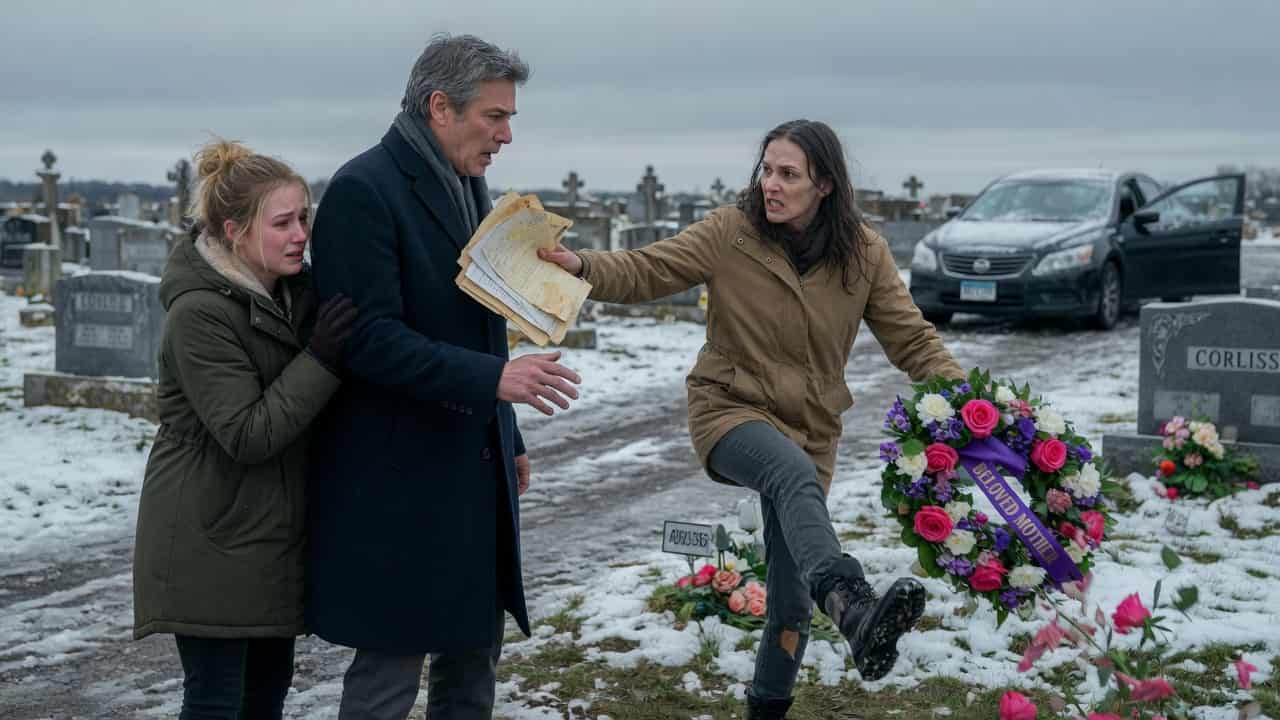
“Get your foot off that, now,” Dean said, his voice shaking as he stood over his wife’s fresh grave. He’d spent two decades protecting Claire from everything—her own anxiety, the world’s noise, the fears that kept her locked inside their house for weeks at a time. He thought he knew every inch of her soul.
The woman standing across from him didn’t look like a threat. She looked like wreckage. She was gaunt, wearing a jacket too thin for a Minnesota winter, and her eyes held a kind of hardness Dean had only read about in history books.
“You’re crying for a ghost, Dean,” the woman rasped. She didn’t move her foot. Instead, she ground the white lilies into the gray slush.
“I’m calling the police,” Dean’s daughter, Sarah, sobbed from behind him.
The stranger laughed, a dry, broken sound. She pulled a crumpled, yellowed packet of papers from her pocket and shoved them hard against Dean’s chest.
“Go ahead. Call them,” she snarled. “Tell them you found the person who actually belongs to the name on that headstone. Tell them the woman you loved was a fugitive who let me rot in a state cell for twenty years while she lived my life.”
Dean looked down at the papers. It was a prison release form. The name at the top was Claire Corliss. His wife’s name. But the photo attached to the ID wasn’t the woman he’d buried yesterday. It was the woman standing in the snow, grinning at his ruin.
Everything he owned, every memory he cherished, was built on a stolen identity. And now, the bill had finally come due.
Chapter 1
The silence in the house was a physical weight, something Dean Corliss felt in the marrow of his bones. It wasn’t just the absence of Claire’s voice or the soft scuff of her slippers on the hardwood; it was the cessation of a twenty-year rhythm. For two decades, Dean’s life had been tuned to the frequency of his wife’s fragility. He was the shock absorber, the man who checked the locks three times, the man who handled the grocery shopping because the crowded aisles made her breath come in short, panicked hitches. He was a high school history teacher by trade, but his real vocation had been the curation of Claire’s safety.
Now, three days after the funeral, the safety felt like a vacuum.
Dean sat at the kitchen table, a mug of black coffee cooling in his hand. The Minnesota winter pressed against the windows, a flat, oppressive gray that threatened snow. He looked at the stack of sympathy cards on the counter. People from the school, neighbors who had only ever seen Claire through the front window, Sarah’s friends from the university. They all said the same thing: She was such a gentle soul. A light taken too soon.
“Dad?”
Sarah stood in the doorway, her puffy eyes a mirror of his own. She was eighteen, a freshman at the state school three hours away, and she had worshipped her mother. To Sarah, Claire was a tragic figure of Victorian proportions—a woman too sensitive for a harsh world, a mother who communicated through hand-knit sweaters and carefully packed lunches.
“I’m fine, honey,” Dean said, the lie coming out practiced and smooth. “Just thinking about the arrangements. There’s a lot of paperwork.”
“You shouldn’t have to do it alone,” Sarah said, sitting across from him. She reached out and touched the sleeve of his flannel shirt. “Mom wouldn’t want you to just sit here in the dark.”
Dean nodded, but he didn’t turn on the light. He liked the shadows. They felt more honest.
He thought about the first time he’d met Claire, twenty-two years ago. He’d been a young teacher then, idealistic and prone to the kind of romanticism that made him see a damsel in every quiet woman. She’d been working at a small-town library three counties over, tucked away in the back stacks. She’d looked at him with eyes that were wide and terrified, and he’d fallen in love with the idea that he could be the one to calm them. She told him she was an orphan, that she’d moved around a lot, that she didn’t have any photos of her childhood because of a fire. He’d believed it all. Why wouldn’t he? People had tragedies. Some people just carried them more heavily.
A flash of movement caught his eye through the window.
A rust-colored sedan, old and dented, was idling at the curb. It was out of place in their tidy, middle-class neighborhood. The car looked like it had been held together by rust and spite. Through the cracked windshield, Dean could see a silhouette. A woman. She wasn’t moving, just staring at the house.
“Is that someone you know?” Sarah asked, following his gaze.
“No,” Dean said, his heart giving a strange, rhythmic thump. “Probably just looking for an address. The GPS is spotty around here.”
But the car didn’t move. It sat there for a full minute, the exhaust pluming white in the freezing air. Then, slowly, it rolled forward and disappeared around the corner.
“People are weird,” Sarah whispered, pulling her cardigan tighter around her.
“Grief makes everything feel weird,” Dean replied.
He spent the rest of the afternoon in Claire’s sewing room. It was the one place in the house that still smelled strongly of her—lavender and old wool. He began the grim task of sorting through her things. It felt like a violation. He found half-finished projects, jars of vintage buttons, and a stack of journals. He opened one, expecting to find the private thoughts of a woman struggling with anxiety. Instead, he found grocery lists, weather reports, and strange, repetitive sentences. Don’t look at the camera. Keep the hair long. If they ask, the fire was in ’84.
Dean frowned, the coffee in his stomach turning acidic. The fire was in ’84. She’d told him it was in ’92.
He closed the journal and set it aside. Memory was a fickle thing, especially for someone as fragile as Claire. He tried to tell himself it was just a symptom of her condition—the way she scrambled dates, the way she created narratives to fill the gaps in her own history. But the seed of unease had been planted.
That night, Dean couldn’t sleep. He lay on his side of the bed, staring at the empty space where Claire should have been. He thought about the way she used to wake up screaming in the middle of the night, her body slick with sweat. He’d hold her and whisper that she was safe, that the past couldn’t reach her. She’d never tell him what she was dreaming about. She’d just cling to him until her heart rate slowed.
Protectiveness, he realized, was a form of blindness. He had been so busy guarding the perimeter of her life that he’d never really looked at the center of it.
At 3:00 AM, he got up and went to the basement. He found his wife’s old trunk, the one she’d brought with her when they first moved in together. She’d always kept it locked, telling him it was just old mementos that were too painful to look at. He’d respected that. He’d prided himself on his respect for her boundaries.
He found a screwdriver and pried the lock. It gave way with a sharp, metallic crack.
Inside were more clothes—dated, cheap things that didn’t match the Claire he knew. At the bottom, tucked under a lining that had been crudely taped back into place, was a small, flat box.
Dean opened it.
There were no photos. No baby teeth or locks of hair.
There was a Social Security card for a woman named Claire Marie Vance. A birth certificate from a hospital in Duluth. And a folded newspaper clipping, yellowed and brittle with age.
The headline read: ARMED ROBBERY IN HIBBING: TWO SUSPECTS AT LARGE.
The date on the paper was October 12, 2004.
Dean stared at the date. Sarah had been six months old then. He remembered that October. Claire had been particularly anxious, refusing to leave the house, insisting they move from their apartment to a more secluded rental. He’d thought it was postpartum depression.
He looked at the birth certificate again. The date of birth was 1981. His Claire—the woman he’d just buried—had told him she was born in 1971. He’d seen her driver’s license. He’d seen her passport. He knew the numbers.
He sat on the cold concrete floor of the basement, the paper trembling in his hand. The numbers didn’t add up. The history didn’t align. As a teacher, Dean knew that when the primary sources contradicted the narrative, the narrative was a lie.
But he loved the narrative. He’d spent twenty years building a life on it.
He went back upstairs as the sun began to bleed a pale, sickly orange over the horizon. He didn’t tell Sarah. He couldn’t. He watched her eat her breakfast, her face still soft with the innocence of a child who believed her mother was a saint.
“We’re going to the cemetery today, right?” Sarah asked. “To put the winter wreaths out?”
“Yes,” Dean said, his voice sounding like it was coming from a great distance. “We’re going.”
He felt a sudden, desperate need to see the headstone. He needed to see her name etched in granite. Maybe if he saw it there, in stone, the lie would turn back into the truth. He wanted to believe that the woman in the basement trunk was a stranger, an old version of Claire she’d outgrown or hidden away for her own protection.
But as they drove through the slush-covered streets of their town, Dean saw the rust-colored sedan again. It was parked two blocks from the cemetery entrance.
The woman was out of the car now. She was standing by the gate, her hands shoved deep into the pockets of a thin tan windbreaker. She looked like she was waiting for a bus that was never going to come. Or like she was waiting for him.
Dean gripped the steering wheel until his knuckles turned white. He didn’t say anything to Sarah. He just drove past, his eyes fixed on the road ahead, trying to ignore the way the woman’s gaze seemed to pierce through the glass of his car.
He was a man of facts, of dates, of documented reality. But as he pulled into the cemetery, Dean Corliss felt like he was driving into a fog. And for the first time in his life, he was terrified of what he might find when it cleared.
Chapter 2
The Pine Ridge Cemetery was a bleak expanse of gray and white. The wind whipped off the open fields, biting through Dean’s heavy coat. He carried the large balsam wreath, the scent of pine sharp and mockingly festive in the dead air. Sarah walked beside him, clutching a smaller bundle of lilies. They moved in silence, their boots crunching through the frozen slush that covered the narrow paths.
Claire’s grave was near the back, under a sprawling oak tree that looked like a skeleton against the sky. The headstone was simple, just as she’d wanted. Claire Corliss. 1971–2026. Beloved Wife and Mother.
Dean looked at the dates. He felt a sickening lurch in his stomach. If the birth certificate in the basement was real, the woman buried here was ten years younger than she’d claimed. Or she wasn’t that woman at all.
“It’s so quiet here,” Sarah whispered, her breath blooming in the air. “I think she’d like that. No one to stare at her. Just peace.”
Dean knelt to place the wreath. His fingers were numb, but the cold felt distant, a secondary concern to the pressure building in his chest. He was thinking about the newspaper clipping. Armed Robbery. He tried to reconcile the image of his soft-spoken, trembling wife with a woman who could hold a gun. It was impossible. It was a glitch in the universe.
“Dad?”
He looked up. Sarah wasn’t looking at him. She was looking past him, her face drained of what little color the cold had left it.
Dean turned.
The woman from the rust-colored sedan was standing ten feet away. Up close, she looked even worse than she had from the car. Her face was a map of hard miles—deep lines around a mouth that looked like it hadn’t smiled in a decade, skin gray and waxy. Her hair was a jagged, home-cut bob of greasy brown. The tan windbreaker she wore was stained and offered no protection against the Minnesota wind. She was shivering, but her eyes were steady. They were a piercing, accusing blue.
“Can we help you?” Dean asked, his voice falling into the polite, authoritative tone he used with difficult parents at school. He stood up, instinctively moving to put himself between the stranger and his daughter.
The woman didn’t answer. She walked forward, her boots dragging in the slush. She stopped at the edge of the grave.
For a long moment, she just stared at the headstone. Her throat worked as she swallowed, a rhythmic motion that looked painful. Then, without a word, she raised her foot and kicked.
She didn’t just nudge the wreath Dean had just placed. She kicked it with a desperate, lunging violence. The balsam and ribbon tumbled through the dirty snow, scattering pine needles across the mound of fresh earth.
“Hey!” Dean shouted, his grief flashing into a hot, protective rage. “What the hell are you doing? Get away from there!”
Sarah let out a small, choked cry. “Why would you do that?”
The woman looked at Sarah, and for a second, her expression softened into something that looked like pity. Then she turned her gaze back to Dean.
“You’re crying for a ghost, Dean,” she said. Her voice was raspy, like she’d spent years screaming or hadn’t spoken at all.
Dean froze. “How do you know my name?”
“I know a lot of things,” she said. She reached into the pocket of her thin jacket and pulled out a crumpled, yellowed packet of papers. “I know who’s in that ground. And I know who isn’t.”
“You’re disturbed,” Dean said, reaching for his phone. “I’m calling the police. You’re desecrating a grave. Leave now, or I’ll have you arrested.”
The woman let out a short, harsh laugh. It sounded like glass breaking in a bag.
“Call them,” she snarled, stepping closer until Dean could smell the stale tobacco and cheap soap clinging to her. “Call the cops. Ask for Detective Vance. Ask him if he remembers the girl he sent up for the Hibbing job twenty years ago. The one who didn’t have a lawyer. The one who sat in a six-by-nine cell for two decades because her ‘best friend’ took her name, her ID, and her life while she was unconscious in a hospital bed.”
Dean’s hand stayed over his pocket, but he didn’t pull the phone out. The name Vance. It was on the birth certificate. It was the name of the detective in the clipping.
“What are you talking about?” Sarah asked, her voice trembling. “My mom was a teacher’s wife. She was… she was sick. She had anxiety. She never hurt anyone.”
The woman turned to Sarah, her eyes blazing. “Your mother was a ghost, kid. She was a shadow. She stole my name, Claire Marie Vance, and she left me to rot. I did twenty years in Shakopee for a robbery she planned. She took the money, she took my identity, and she vanished into some suburban fairy tale with a schoolteacher who was too stupid to ask where she came from.”
“That’s a lie,” Dean said, but the words felt hollow. He thought about Claire’s terror of the police. He thought about her refusal to ever have her picture in the local paper, even when he’d won Teacher of the Year. He thought about the journals. If they ask, the fire was in ’84.
“Is it?” The woman stepped forward and shoved the yellowed papers against Dean’s chest. He didn’t catch them, and they fluttered into the slush. “Look at the release forms, Dean. Look at the date I got out. Last Tuesday. The day she died.”
She leaned in, her face inches from his. “She waited until I was out to die. Like she knew I was coming for her. Like she knew I was going to take back what she stole.”
Dean looked down at the papers. Through the dampness of the snow, he could see the state seal. He could see the name: Claire Marie Vance. He could see the mugshot at the top.
It was the woman standing in front of him. But twenty years younger. She looked exactly like the woman in the basement trunk photos. She looked like the real version of the woman his wife had pretended to be.
“My wife was forty-five,” Dean said, his voice a whisper. “She told me…”
“She told you whatever she had to so she didn’t have to sleep on a thin mattress with a guard watching her through a slot,” the woman said. She looked at the grave and spat into the snow. “She lived my life. She raised a daughter with my name. She slept in a warm bed while I was getting my teeth knocked out in the yard.”
“Get out of here,” Dean said, but there was no strength in it. He felt a sudden, terrifying vertigo, like the ground beneath his feet was no longer solid.
“I’m going,” the woman said. “But I’m not done. You think this ends with a funeral? That house you live in? That car you drive? That college fund you’ve got for the kid? It’s all registered to Claire Vance. And I’m Claire Vance. Which means everything you have… it’s mine. I’ve spent twenty years with nothing. Now it’s your turn.”
She turned and walked away, her thin jacket flapping in the wind. She didn’t look back.
Dean stood there, staring at the grave. Sarah was sobbing now, her hands over her face. The balsam wreath lay face down in the dirt, its ribbons stained with gray slush.
“Dad,” Sarah choked out. “Dad, tell me she’s crazy. Tell me it’s not true.”
Dean looked at his daughter. He wanted to gather her up, to tell her that the world was still the place they thought it was. He wanted to tell her that her mother was the gentle, fearful woman who baked cookies and worried about the rain.
But he looked down at the papers in the snow. He saw the state-issued ID number. He saw the list of prior convictions.
He thought about the twenty years he’d spent “protecting” Claire. Every time he’d shielded her from a stranger, every time he’d handled a legal document for her because it “stressed her out,” every time he’d reassured her that no one was looking for her.
He hadn’t been a protector. He’d been an accomplice.
“We need to go home,” Dean said. His voice sounded dead.
“But the wreath—”
“Leave it,” Dean said. He turned away from the grave, away from the woman he thought he knew.
As they walked back to the car, the wind picked up, howling through the headstones. Dean felt the cold now. It was deep, biting, and permanent. He realized with a jolt of pure, unadulterated fear that the woman wasn’t just talking about money or houses. She was talking about his entire existence.
If Claire wasn’t Claire, then who was Sarah? Who was he?
He got into the car and started the engine. The heater blasted warm air, but Dean couldn’t stop shivering. He looked in the rearview mirror and saw the rust-colored sedan pulling away.
The history teacher in him knew that the past was never truly buried. It just waited for the ground to thaw. And in the cold light of a Minnesota winter, Dean Corliss realized that the woman he had loved for twenty years had been a masterpiece of fiction.
And the real story was just beginning.
Chapter 3
The house felt like a crime scene.
Dean walked through the front door, his boots tracking gray slush onto the entryway rug Claire had picked out three years ago. Or rather, the woman who called herself Claire. Every object he looked at—the ceramic lamp on the side table, the framed photos of their trip to the North Shore, the very walls of the hallway—seemed to vibrate with a new, malignant frequency.
Sarah had bolted upstairs the moment they got home, the sound of her bedroom door slamming echoing like a gunshot. Dean didn’t follow her. He couldn’t offer comfort for a wound he was currently bleeding from himself.
He went straight to the kitchen and spread the damp prison papers out on the island. He took his reading glasses from his pocket, his hands shaking so violently he nearly dropped them.
Name: Claire Marie Vance. DOB: 06/14/1981. Sentence: 20 years. Charge: Armed Robbery, Aggravated Assault.
He stared at the mugshot. The woman in the photo was young, maybe twenty-five. She had the same piercing blue eyes as the stranger at the grave, but her face was fuller, her hair long and dark. She looked like a girl who had been caught in a storm she didn’t understand.
Then he looked at the other documents. There was a copy of a trial transcript fragment. A list of evidence. A mention of a co-defendant who had fled the scene: “Identified by witnesses as Jane Doe, alias ‘Mouse’.”
Dean felt a cold sweat break across his forehead. Mouse. That was what he’d called his wife in their first year of marriage. She was so quiet, so prone to hiding in the corners of rooms. He’d thought it was an endearment. He realized now it might have been a code.
He went to the basement. He didn’t turn on the lights until he was at the bottom of the stairs. The trunk was still open, the false bottom exposed. He began to tear the lining out completely, his fingers catching on the rough wood.
Beneath the fabric, he found a small, leather-bound address book. He flipped through it. Most of the names were unfamiliar, written in a cramped, hurried script. But near the back, under V, was a single entry: Vance. 218-555-0192.
Dean took his phone out. His heart was hammering against his ribs, a frantic, trapped bird. He dialed the number. It was a Duluth area code.
The phone rang four times before a man’s voice answered. It was deep, gravelly, and tired.
“Detective Vance.”
Dean’s throat seized. He had to force the words out. “Is this… is this the Detective Vance who worked the Hibbing robbery in 2004?”
There was a long silence on the other end. Dean heard the sound of a chair creaking, then the click of a lighter.
“Who is this?” the voice asked, suddenly sharp.
“My name is Dean Corliss. I’m a teacher in St. Cloud. My wife… my wife just passed away. Her name was Claire.”
“I’m sorry for your loss, Mr. Corliss,” Vance said, though he didn’t sound sorry. He sounded wary. “What does that have to do with a twenty-year-old closed case?”
“A woman approached me at the cemetery today,” Dean said, his voice cracking. “She had prison release papers. She said my wife stole her identity. She said she did twenty years for a crime my wife committed.”
Another silence. Longer this time.
“Look, Mr. Corliss,” Vance said, and Dean could hear the weary cynicism of a man who had seen too much. “Claire Vance was paroled last week. She’s been writing letters from Shakopee for fifteen years, claiming she was framed by some mystery woman who vanished into thin air. Every con has a story. Most of them involve being innocent. The evidence against her was solid. Eyewitnesses, fingerprints on the getaway car, the whole bit.”
“But the birth certificate,” Dean pressed. “The woman I married… she wasn’t who she said she was. I found papers. I found things in her trunk.”
“People lie about their pasts all the time,” Vance said. “Especially women running from bad situations. It doesn’t mean she’s a master criminal. Maybe she just wanted a fresh start. If I were you, I’d take the win. You had twenty years with a woman you loved. The real Claire Vance is a career loser who’s probably looking for a payout. Don’t let her ruin your memories.”
“She said she’s going to take my house,” Dean whispered.
“She can try,” Vance said. “But it’s a civil matter. I’m a criminal detective, and as far as the state of Minnesota is concerned, Claire Vance served her time and the case is dead. Do yourself a favor, Dean. Hang up the phone and go mourn your wife.”
The line went dead.
Dean stared at the phone. Go mourn your wife.
Which one? The woman who’d held his hand during Sarah’s birth? Or the woman who had effectively murdered a stranger’s future to buy herself a comfortable life?
He heard a floorboard creak upstairs. He looked up, his neck stiff.
Sarah was standing at the top of the basement stairs. She looked small in her oversized hoodie, her face pale in the dim light.
“Who were you talking to?” she asked.
“A detective,” Dean said. He didn’t see any point in lying anymore. The truth was a flood, and the dikes had already burst.
“Is it true?” Sarah’s voice was barely audible. “Did Mom… did she really do that?”
Dean walked up the stairs, each step feeling like he was climbing a mountain. He stood in front of his daughter and saw the wreckage of her world in her eyes. It was the same look he’d seen in the mirror.
“I don’t know the whole truth yet,” Dean said. “But your mother had secrets, Sarah. Darker ones than we thought.”
“She was good,” Sarah hissed, her grief turning into a sudden, defensive anger. “She loved us. She was the best person I knew! That woman at the grave… she was just a junkie, Dad. Didn’t you see her? She was trying to scare us.”
“She had the papers, Sarah. And I found things in the trunk. The dates… they don’t match.”
“I don’t care about dates!” Sarah shouted. “I care about the person who tucked me in every night! Why are you doing this? Why are you taking her side?”
“I’m not taking anyone’s side,” Dean said, his own temper flaring. “But I’m a history teacher, Sarah. Facts matter. If we live in a house bought with stolen money, or if our entire family identity is a lie, we have to face it.”
“I’m not facing anything,” Sarah said, her voice breaking. “I’m going to my room. And if you keep talking about this, I’m leaving. I’ll go back to school. I’ll go anywhere. Just stop it.”
She turned and ran back to her room.
Dean stood in the hallway, the silence returning, heavier than before. He felt a sudden, sharp pang of loneliness. He’d lost his wife, and now he was losing his daughter. All because of a woman he’d never met until four hours ago.
He went to the living room and sat in his armchair. He didn’t turn on the TV. He just sat there in the dark, watching the snow fall outside.
He thought about the “rescue” he’d performed twenty years ago. He’d seen himself as the hero of Claire’s story. He’d given her a name, a home, a life. He’d been so proud of how he’d helped her overcome her “anxiety.”
Now he realized that the anxiety wasn’t a disorder. It was a rational response to the fear of being caught. Every time a police car drove past, every time the doorbell rang unexpectedly, every time he’d suggested they go out to dinner—she hadn’t been suffering from a chemical imbalance. She’d been waiting for the handcuffs.
And he’d been her shield. He’d provided the perfect cover: a respectable, middle-class life with a boring, dependable husband.
The humiliation of it was a dull, thumping ache in his chest. He’d been played. He’d been a tool in a long-term escape plan.
A soft thud against the front door made him jump.
He got up and went to the entryway. He peered through the sidelight.
A small, manila envelope was wedged between the door and the frame.
Dean opened the door. The cold air rushed in, smelling of salt and exhaust. There was no one on the porch. The rust-colored sedan was gone.
He picked up the envelope and brought it into the light of the kitchen.
Inside was a single photograph. It was an old Polaroid, the colors faded and shifted toward yellow.
It showed two young women sitting on the hood of a car. They were laughing, their arms around each other’s shoulders. They looked like sisters. One of them was the woman from the grave—young, vibrant, Claire Marie Vance.
The other woman was his wife.
But she didn’t look like the Claire he knew. She looked hard. Her hair was dyed a brassy blonde, and she was wearing a leather jacket and heavy makeup. She was holding a cigarette in one hand and a thick stack of cash in the other. She looked triumphant.
On the back of the photo, written in the same cramped hand from the address book, were three words:
The Original Sin.
Dean dropped the photo. It landed face up on the counter, the laughing, blonde version of his wife mocking him with her joy.
He realized then that he couldn’t just sit in the dark anymore. He couldn’t wait for the truth to come to him. He had to go find the woman in the windbreaker.
He had to see the wreckage his wife had left behind.
Because if he didn’t, he would never be able to look at his daughter—or himself—ever again.
Chapter 4
The Sunset Motel was the kind of place people went when they ran out of options. It sat on the edge of a commercial strip in St. Cloud, sandwiched between a tire shop and a boarded-up diner. The neon sign buzzed with a dying, rhythmic hum, casting a sickly pink glow over the oil-stained parking lot.
Dean pulled his car into a spot near the back. He felt absurdly conspicuous in his clean, late-model SUV. He adjusted his scarf, feeling the weight of the manila envelope in his coat pocket. He’d spent the last three hours searching the local registries until he found where the rust-colored sedan was registered.
He walked toward Room 114. The air smelled of damp concrete and fryer grease. He knocked on the door, his heart thumping in his throat.
The door opened almost immediately.
The real Claire Vance stood there. She wasn’t wearing the windbreaker now. She was in a thin, ribbed tank top that showed the faded, blurred tattoos on her forearms—barbed wire, a name he couldn’t read, a set of tally marks. Her collarbones jutted out like knives. In the harsh, overhead light of the motel room, she looked even more fragile and dangerous than she had at the cemetery.
“Took you longer than I thought,” she said. She stepped back, gesturing for him to enter. “Come in, Professor. Wipe your feet. I don’t want you tracking your nice life into my hole.”
The room was small and smelled of stale lemon cleaner and cigarette smoke. A single duffel bag sat on the bed, half-unpacked. A carton of cheap eggs and a loaf of bread sat on the dresser next to a flickering tube TV showing a silent weather report.
Dean stood in the center of the room, feeling too tall, too bulky, too excessive.
“I saw the photo,” Dean said, pulling the envelope out. “The one you left on my door.”
Claire sat on the edge of the bed. She picked up a pack of generic cigarettes and lit one, her movements jerky and practiced. She took a long drag and blew the smoke toward the ceiling.
“That was the night before the Hibbing job,” she said. “We were going to go to Vegas. That was the plan. Hit the check-cashing place, drive through the night, and start over. She was the one who found the store. She was the one who stole the plates for the car.”
“Why did you stay?” Dean asked. “In the photo, you look… you look like friends.”
“We were more than friends,” Claire said, her voice dropping into a low, jagged register. “We were everything. I grew up in the system, Dean. Group homes, foster parents who forgot my name the week after I left. She was the first person who ever looked at me like I mattered. I would have followed her into a fire.”
She looked at him, her blue eyes hard and flat. “And I did. When the cops chased us, she crashed the car. I hit the dashboard. My skull was cracked. I was unconscious. She wasn’t. She took my purse, my ID, the cash, and she ran. She left me there to bleed out in a ditch.”
“And you didn’t tell them?” Dean’s voice was a whisper. “When you woke up in the hospital, you didn’t tell the police she was the one who planned it?”
“I couldn’t,” Claire said, a bitter smile twisting her mouth. “By the time I woke up, the news was already reporting that ‘Claire Vance’ had been apprehended. She’d dropped her own ID—her real name, Elena Rossi—next to me. But Elena Rossi was a runaway with no family, no records, nothing. I was the one with the fingerprints on file from a shoplifting charge when I was sixteen. They didn’t care what I said. To them, I was the girl in the car, and the girl in the car was Claire Vance.”
She stood up and walked over to the dresser, picking up a small, plastic-wrapped cup of water.
“She stole my identity while I was in a coma,” Claire said. “She used my clean record—or what was left of it—to become the woman you married. And I spent twenty years in a cage being her.”
The humiliation of his wife’s betrayal hit Dean with fresh force. He thought of the woman who’d pretended to be terrified of the dark, who’d needed him to hold her through every storm. It wasn’t anxiety. it was the cold, calculated performance of a woman who knew exactly how to make men feel like heroes.
“What do you want?” Dean asked.
“I want what’s mine,” Claire said. “I’m forty-five years old, Dean. I have no work history. I have no references. I have no teeth in the back of my mouth because I got jumped in the cafeteria in year six. I have a criminal record that belongs to her, but I’m the one who has to carry it.”
She stepped closer, her face lit by the flickering TV. “The house is in my name. The bank accounts are in my name. Your daughter’s birth certificate lists me as the mother. I’m not here for a handout. I’m here for my life.”
“You’ll destroy Sarah,” Dean said, his voice thick with a desperate plea. “She’s eighteen. She idolized her mother. If you do this publicly, if you sue for the house, the whole town will know. She’ll have nothing.”
“And what do I have?” Claire barked, the volume of her voice suddenly jumping. “I have a motel room that smells like piss! I have twenty years of my life gone! You think I care about your daughter’s feelings? My daughter—if I’d been allowed to have one—would be her age now. But I was in a cell while your wife was playing house.”
She grabbed Dean’s arm. Her grip was surprisingly strong, her fingers like iron bands. “You’re a history teacher, right? You like the truth? Well, here’s the truth: Your wife was a thief. She was a coward. And you’re the man who gave her a place to hide.”
Dean didn’t pull away. He looked at the tattoos on her arm, the jagged lines of a life lived in a box. He felt a wave of profound, nauseating shame. He’d spent twenty years in luxury, subsidized by this woman’s suffering.
“I have money,” Dean said, his mind racing. “Savings. I can give you enough to get a real place. To start over. We can do this quietly.”
“Quietly?” Claire laughed, a harsh, rattling sound. “You want to keep her secret? Even now? Even after you know what she did to me?”
“I want to save my daughter,” Dean said.
“Your daughter is part of the lie,” Claire said. She let go of his arm and turned back to the TV. “I’ll tell you what, Professor. You bring me fifty thousand dollars by Friday. Cash. No banks, no checks. You do that, and maybe I don’t go to the DA. Maybe I don’t call the local news and tell them the ‘Sainted Mother of St. Cloud’ was a common crook.”
“Fifty thousand?” Dean gasped. “I don’t have that kind of cash on hand. I’d have to liquidate my retirement. I’d have to…”
“Then get to work,” Claire said. “Because if I don’t see that money, I’m coming to your school. I’m going to stand in your classroom and tell all those kids exactly what kind of man is teaching them about ‘morality’.”
She walked to the door and opened it. The cold wind swirled into the room, stinging Dean’s eyes.
“Get out, Dean,” she said. “Go home to your stolen house. Look at your stolen daughter. And think about how much my twenty years are worth to you.”
Dean walked out into the parking lot. He felt like he was moving through water. He got into his car and sat there, the engine idling.
He looked at the motel room door. He saw the shadow of Claire Vance through the thin curtains.
He realized with a jolt of horror that he wasn’t just being extorted. He was being forced to choose between two versions of the truth. He could protect the memory of the woman he loved—the woman who had been his entire world—by continuing her lie. Or he could do the right thing and help the woman who had been destroyed, effectively blowing up his own life and his daughter’s future in the process.
He thought of Sarah’s face when she’d shouted at him earlier. “She was good. She loved us.”
If he gave Claire the money, he was buying Sarah’s peace. But he was also becoming the final piece of his wife’s escape plan. He was the one who would ensure the crime was never punished.
He drove out of the parking lot, his eyes blurring with tears he couldn’t explain. As he turned onto the main road, he saw a police cruiser idling at a red light.
For the first time in his life, Dean Corliss didn’t feel safe when he saw the badge. He felt like a man who was already behind bars.
He had four days.
He pulled into his driveway and saw the lights on in Sarah’s room. He sat in the car for a long time, watching the snow pile up on the windshield, wondering if he would ever be able to tell the difference between a sanctuary and a prison ever again.
Chapter 5
The morning air in the kitchen was thick with the smell of burnt toast and the sharp, chemical scent of the floor cleaner Dean had used the night before. He hadn’t slept. He had spent the hours between 2:00 AM and dawn sitting at the island, staring at the digital readout of his retirement portfolio. The numbers were clear, cold, and utterly indifferent to the fact that they represented thirty years of standing in front of chalkboards and grading essays on the Reconstruction Era. To get fifty thousand dollars in cash by Friday, he would have to gut his 403(b), take the massive tax hit, and effectively evaporate the safety net he’d built for Sarah.
He heard the floorboards groan upstairs. Sarah was awake. For the last two days, they had existed in a state of brittle, high-altitude tension. She spoke to him in clipped sentences, her eyes never staying on his for more than a second. She was mourning the mother she remembered, and she was punishing the father who was dismantling that memory.
Dean poured a cup of coffee, his hands steady only because he was gripping the mug with a strength that made his knuckles ache. When Sarah walked into the kitchen, she was dressed for school—a heavy knit sweater and boots—but her face was drawn, her skin sallow in the pale morning light.
“I’m going to the library today,” she said, not looking at him as she reached for a cereal bowl.
“The university library?” Dean asked.
“No. The public one. I want to look at the archives. The ones you didn’t show me.”
Dean felt a flare of panic, followed quickly by a dull, aching exhaustion. “Sarah, I told you. I’m handling it. There are things in those records that aren’t meant for you.”
“Everything in this house was meant for me, wasn’t it?” she snapped, finally looking at him. Her blue eyes—so much like the woman at the grave—were red-rimmed and fierce. “All the clothes, the food, my tuition… it was all bought with Claire Vance’s life. If I’m part of the crime, Dad, I have a right to see the evidence.”
“You are not part of a crime,” Dean said, his voice dropping into the low, authoritative register he used to quiet a rowdy classroom. “You are a child who was loved by a woman who made a desperate, terrible choice a long time ago. Those are two different things.”
“Are they?” Sarah’s voice trembled. “Because that woman at the motel… she doesn’t think so. She looks at me and she sees Mom. She looks at me and sees everything she didn’t get to have.”
She didn’t wait for him to answer. She grabbed her bag and walked out, the front door clicking shut with a finality that left the kitchen feeling suddenly, unnervingly cold.
Dean spent the next three hours on the phone with his financial advisor, a man named Miller who had been a student of Dean’s twenty years ago. The conversation was humiliating. Dean had to lie, inventing a story about an unexpected family medical emergency out of state, something that required immediate liquidity. Miller was sympathetic, but professional.
“Dean, you’re looking at a thirty percent haircut on the withdrawal once the penalties and the federal withholding hit. You’re talking about a hundred-thousand-dollar dent in your principal to get fifty in hand by Friday. Are you sure there isn’t another way? A bridge loan?”
“There isn’t time,” Dean said, his eyes fixed on a small chip in the granite countertop. “Just do it, Mark. Please. I need the wire to hit my checking by Thursday morning.”
When he hung up, he felt a strange sense of lightness, the way a person might feel after losing a limb—a lack of weight where there used to be something vital. He looked around the kitchen. It was a nice kitchen. The cabinets were solid maple. The stove was professional grade. Claire had loved this room. She had spent hours here, humming to herself, baking bread that smelled like yeast and comfort.
He realized now that she hadn’t been humming. She’d been vibrating with the effort of staying still. Every loaf of bread had been an anchor, something to hold her down so she didn’t float away into the ether of her own lies.
He needed to see where it started.
He drove north, toward Hibbing. The landscape shifted from the suburban sprawl of St. Cloud to the rugged, scarred beauty of the Iron Range. The ground was iron-red under the snow, the pits of the old mines looking like giant, frozen bruises on the earth.
He found the public library in Hibbing, a squat brick building that smelled of old paper and damp wool. He spent the afternoon hunched over a microfilm reader, the mechanical whir of the machine the only sound in the quiet room. He found the articles from October 2004. He saw the photos of the getaway car—a silver Ford Taurus wrapped around a telephone pole.
He found a smaller blurb, three weeks after the robbery. It was a human-interest piece about a “missing girl” named Elena Rossi. It was a short, dismissive paragraph. Local authorities believe Rossi, a nineteen-year-old runaway with a history of petty theft and no known family, may have been the second occupant of the vehicle. If you have information…
There was no photo of Elena Rossi. Just a description: Blonde hair, blue eyes, approximately 5’4″.
Dean leaned back, the light of the microfilm reader casting a ghostly blue glow over his face. Elena Rossi. That was her. Not a mastermind. Just a nineteen-year-old girl who had been terrified, who had seen a dying car and a comatose friend and had seen, for the first time in her life, a way to be someone else.
She hadn’t just stolen a name. She had stolen a soul.
He drove back to St. Cloud in the dark. The snow began to fall again, heavy, wet flakes that smeared across the windshield. When he got home, the rust-colored sedan was parked in front of his house.
He pulled into the driveway, his heart hammering. He didn’t wait. He got out of the car and walked straight to the sedan.
Claire Vance was sitting in the driver’s seat, the interior of the car lit by the orange glow of a cigarette. She rolled down the window, the cold air rushing in.
“You’re late, Professor,” she said.
“I went to Hibbing,” Dean said. He stood in the snow, his hands in his pockets. “I read about Elena Rossi.”
Claire’s expression didn’t change, but the hand holding the cigarette gave a tiny, almost imperceptible tremor.
“Elena was a ghost before the crash,” Claire said. “She was nothing. She was a girl who slept in bus stations and stole candy bars because she liked the rush. I gave her a place to sleep. I gave her a coat. And she gave me twenty years in a cage.”
“She was nineteen,” Dean said. “She was a kid.”
“I was twenty-two!” Claire shouted, the volume of her voice making Dean flinch. “I was a kid too! But I’m the one who stayed in the car. I’m the one who woke up with a tube down my throat and a cop sitting by the bed telling me I was going to prison for the rest of my life.”
She leaned out the window, her face inches from his. “You want to pity her? Fine. Pity the woman who lived in your house and slept in your bed. But don’t you dare tell me she was the victim. She had twenty years of your protection, Dean. Twenty years of nice dinners and clean sheets. I had twenty years of women trying to shiv me because I looked like I had something they wanted.”
She flicked the cigarette butt into the snow. It hissed and went out.
“Thursday morning,” she said. “Fifty thousand. Or I go to the school. And then I go to the bank. I’ve already talked to a lawyer, Dean. A real one. Not a public defender. He says that since the identity theft was never prosecuted, the assets in ‘Claire Vance’s’ name are legally mine. I don’t even need to extort you. I can just evict you.”
“Then why the fifty thousand?” Dean asked.
Claire looked at him, and for a second, the hardness in her eyes cracked, revealing a bottomless, jagged well of grief.
“Because I want to leave,” she whispered. “I want to go somewhere where nobody knows my name. I want to buy a life that isn’t a hand-me-down from a dead woman. And I want you to be the one who pays for it. Because you’re the one who kept her safe while I was rotting.”
She rolled up the window and drove away, the taillights of the sedan disappearing into the swirling snow.
Dean stood in his driveway for a long time. He looked at his house. It was a beautiful house. It was a monument to a woman who didn’t exist.
He went inside. The house was silent. Sarah’s door was closed. He went to the kitchen and sat at the table. He picked up the photo Claire Vance had left him—the one of the two girls on the hood of the car.
He looked at his wife’s face—the blonde, hard, triumphant Elena Rossi.
He realized then that the woman he had loved wasn’t a victim of anxiety. She was a survivor of her own choices. And he had been the most successful of those choices.
He didn’t feel like a hero anymore. He felt like a fence for stolen goods.
He reached out and turned off the kitchen light. He sat in the darkness, listening to the house settle, waiting for the money to arrive, and wondering if there was enough cash in the world to buy back the truth.
Chapter 6
Thursday arrived with a brutal, clear cold that seemed to freeze the very light of the sun. Dean sat in his car in the parking lot of the First National Bank, a heavy canvas gym bag resting on the passenger seat. Inside the bag were five stacks of hundred-dollar bills, wrapped in plastic. It was the weight of his future, the weight of Sarah’s education, and the weight of a thirty-year career, all compressed into a few pounds of paper and ink.
He had picked up the money twenty minutes ago. The teller had looked at him with a mix of curiosity and concern, the kind of look people give to those who are clearly in over their heads. He hadn’t cared. He had just wanted to get out of the building, away from the cameras and the polite, institutional silence.
His phone buzzed in the cup holder. A text from Sarah.
I’m at the library still. Don’t wait for me for dinner.
Dean stared at the screen. He wanted to call her. He wanted to tell her to come home, to pack a bag, to get away from the blast radius. But he knew she wouldn’t come. She was digging through the past, trying to find a version of her mother that made sense. He was the only one who knew that the more she dug, the less she would find.
He drove to the Sunset Motel.
The parking lot was empty except for the rust-colored sedan and a salt truck idling near the entrance. Dean parked next to Room 114. He took a deep breath, the cold air stinging his lungs, and grabbed the gym bag.
He knocked.
Claire Vance opened the door. She looked different today. She had put on makeup—a harsh, bright red lipstick that looked like a wound on her pale face—and she had tried to style her jagged hair. She was wearing a new coat, something black and cheap, with a faux-fur collar. She looked like a woman who was trying to remember how to be a person who wasn’t a prisoner.
“You have it?” she asked. Her voice was thin, vibrating with a nervous energy.
“I have it,” Dean said. He stepped inside.
The room was still bleak, but the duffel bag on the bed was packed tight.
“Put it on the table,” Claire said.
Dean set the gym bag down and unzipped it. The sight of the money seemed to take the air out of the room. Claire walked over and touched one of the stacks, her fingers tracing the plastic wrap with a reverence that made Dean’s stomach turn.
“It’s all there,” Dean said. “Fifty thousand. Just like you asked.”
Claire looked up at him. The red lipstick made her teeth look yellow. “You really did it. You really chose the lie.”
“I chose my daughter,” Dean said.
“Same thing,” Claire snapped. She grabbed the bag and pulled it toward her. “Now get out of here. I have a bus to catch. And you have a life to keep pretending is real.”
“Wait,” Dean said.
He reached into his pocket and pulled out the manila envelope. He took out the photo of the two girls on the car.
“Tell me one thing,” Dean said. “In the photo… did she love you? Or was it all a play, even then?”
Claire looked at the photo. Her expression softened for a fleeting second, the jagged lines of her face smoothing into something that resembled the girl she used to be.
“She loved the way I looked at her,” Claire said quietly. “She loved being the one who knew things. But Elena… Elena only ever loved the person she was going to become. The rest of us were just the ladder she used to get there.”
The door to the motel room suddenly swung open, hitting the wall with a hollow thud.
Sarah stood in the doorway.
She was panting, her face flushed with the cold, her eyes wide and wild. Behind her, the salt truck rumbled, its yellow lights strobing against the snow.
“Dad?” she whispered.
She looked at the gym bag on the table. She looked at Claire Vance. She looked at the stacks of cash.
“Sarah, get in the car,” Dean said, his voice cracking. “Go. Now.”
“I followed you,” Sarah said, her voice rising in a jagged, hysterical spiral. “I saw you go to the bank. I saw the bag. I thought… I thought you were being hurt. I thought you were in trouble.”
She walked into the room, her gaze fixed on the money. “Is that for her? Are you paying her to go away?”
Claire Vance let out a short, sharp laugh. “He’s paying for the silence, kid. He’s buying you a mother who didn’t exist. Isn’t that sweet? Thirty years of his life, just to make sure you never have to know who Elena Rossi really was.”
“Shut up!” Dean shouted.
“No!” Sarah screamed, turning on him. “Is it true? Was it all a lie? Everything?”
“Sarah, please,” Dean said, reaching for her.
She backed away, her face contorting with a mix of rage and pure, unadulterated heartbreak. “You were going to pay her? You were going to keep lying to me? You’re just like her! You’re just like Mom! You’re all just ghosts!”
She turned and ran out of the room, her boots slipping on the icy pavement of the parking lot.
“Sarah!” Dean yelled.
He started to follow her, but Claire Vance grabbed his arm.
“Let her go, Dean,” she said, her grip cold and hard. “She has to wake up sometime. We all do.”
Dean looked at Claire. He looked at the money. He looked at the empty doorway where his daughter had just vanished.
He felt a sudden, profound clarity. The kind of clarity that comes only when you have lost everything and there is nothing left to protect.
He reached out and grabbed the gym bag.
“What are you doing?” Claire hissed, clutching at the bag. “That’s mine! You gave it to me!”
“No,” Dean said. He jerked the bag away from her with a strength he didn’t know he had. “I didn’t give it to you. I tried to buy something that wasn’t for sale.”
He walked out of the room, leaving Claire Vance standing in the center of the small, bleak motel room. He didn’t look back.
He found Sarah sitting in her car, her head resting on the steering wheel, her body shaking with sobs. He walked to the driver’s side window and knocked softly.
She didn’t look up.
“I’m calling the DA, Sarah,” Dean said through the glass. “I’m calling Detective Vance. I’m going to tell them everything. About the papers in the basement. About the identity. About all of it.”
Sarah looked up then. Her face was a wreck of tears and snot, but her eyes were steady. “You’ll lose the house, Dad. You’ll lose everything.”
“I’ve already lost it,” Dean said. “I’ve been living in a house owned by a stranger for twenty years. I want to live in a place that belongs to me. Even if it’s a one-bedroom apartment with a view of the highway.”
He got into his own car and sat there for a moment. He looked at the gym bag on the seat. He would take the money back to the bank. He would pay the penalties. He would handle the fallout.
He picked up his phone and dialed the number for the Duluth Police Department.
“Detective Vance, please,” he said when the operator answered. “Tell him it’s Dean Corliss. Tell him the case isn’t closed.”
Two weeks later, the house was sold. The legal proceedings were messy, expensive, and a feast for the local gossip mill. The “Sainted Mother of St. Cloud” was stripped of her name in a series of court filings that made the front page of the Times.
Dean moved into a small, cramped rental near the university. He spent his days at the school, teaching history to kids who looked at him with a new, uncomfortable kind of respect. He was the man who had blown up his own life for the sake of a twenty-year-old truth.
The real Claire Vance disappeared. She didn’t take the money—Dean had returned it to his account—but she had taken her name back. The state had issued her a new ID, a new Social Security card, and a small settlement for the wrongful conviction, though it would never be enough to pay for the two decades she’d lost.
Sarah stayed at the university. She didn’t come home for the weekends anymore, but she called every Sunday. They didn’t talk about her mother. Not yet. They talked about her classes, about the weather, about the mundane, beautiful details of a life that wasn’t a performance.
On a gray Sunday in March, Dean drove out to the cemetery.
The headstone had been removed. In its place was a simple, flat marker that Dean had paid for himself. It didn’t say Claire Corliss. It didn’t have any dates.
It just said: Elena Rossi. 1985–2026.
He stood over the grave, the wind whipping his hair. He didn’t bring a wreath. He didn’t bring flowers. He just stood there in the cold, a man of history, looking at the truth he had finally earned.
He thought about the “Mouse” he had loved. He thought about the girl on the hood of the car. And he realized that for the first time in twenty years, he wasn’t protecting anyone.
He was just standing in the wind, waiting for the spring.