“Whose is this?”
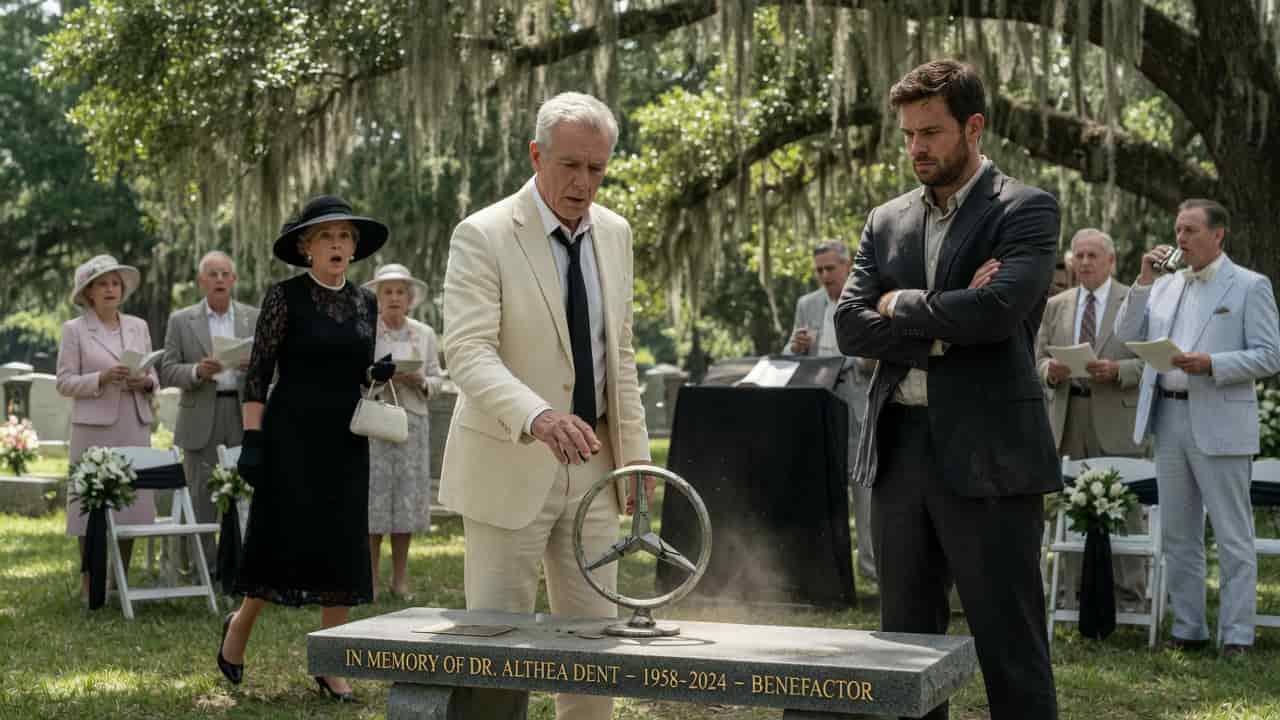
Russell stared at the tarnished silver star sitting on the granite memorial bench. It was cracked, the chrome peeling like old skin, but he’d know that Mercedes hood ornament anywhere. He’d seen it every day for ten years until the night of the accident—the night his son was taken from him.
“My father was the sheriff back then,” the young man in the cheap suit whispered, loud enough for the charity board members to stop their whispering. “He’s the one who found your wife’s car in the woods that night. He’s also the one who helped her hide it while you were at the hospital waiting for news that never came.”
The humid South Carolina air felt like it was turning to ice. Russell looked at the man, a stranger with a face full of his father’s old corruption.
“What are you talking about?” Russell’s voice was a thin wire, ready to snap.
“I’m talking about the ten thousand dollars a month your wife embezzled from your company for twenty years,” the man said, pulling a ledger from his jacket. “She wasn’t paying for charity, Russell. She was paying my dad for his silence. She’s gone now, so the bill belongs to you. Payment is due Friday.”
Russell looked around at the shocked faces of his friends and the legacy his wife had built. Everything he thought he knew about his marriage was a lie, and the cost of keeping that lie was about to ruin him.
Chapter 1: The Silver Star
The humidity in Beaufort didn’t just sit on you; it owned you. It was a thick, wet blanket that smelled of pluff mud and slow-rotting marsh grass, the kind of heat that made a man of sixty feel like his bones were made of wet cardboard. Russell Dent stood under the sprawling canopy of a live oak, the Spanish moss hanging like tattered gray lace above the granite bench he was about to dedicate. He adjusted the knot of his black silk tie, feeling the sweat prickle at the nape of his neck.
In front of him, thirty of the town’s most influential citizens stood in a loose semi-circle. They were the people who mattered—the ones who ran the banks, the law firms, and the charities that Vivian had curated with the precision of a master gardener. They were here to honor her, six months after the cancer had finally finished what it started.
“Vivian believed in roots,” Russell said, his voice steady, practiced in the art of the public eulogy. “She believed that a community was only as strong as the shadows its trees cast. This bench, here in the park where she spent so many mornings, is a place for others to find the same peace she did.”
He saw Eleanor in the front row, her eyes brimming with the kind of performative grief that had become her primary social currency since Vivian’s passing. She nodded, her wide-brimmed hat bobbing. They were all so comfortable in their sadness. It was a well-tailored sorrow, expensive and dignified.
Then he saw the disruption.
At the edge of the manicured lawn, near the rusted iron gates of the cemetery, a man was walking toward them. He didn’t belong. He wore a charcoal suit that was three sizes too big in the shoulders and a pair of scuffed work boots that looked out of place on the hallowed ground of the St. Helena elite. He walked with a heavy, purposeful gait, ignoring the polite, confused glances of the donors.
Russell faltered for a second, his gaze tracking the stranger. The man’s face was a map of hard miles and cheap whiskey—stubble that wasn’t quite a beard, eyes that looked like they hadn’t seen a full night’s sleep since the turn of the century. He looked familiar in a way that made Russell’s stomach do a slow, nauseous roll.
“We remember her not just for her grace,” Russell continued, forcing his eyes back to the crowd, “but for her unwavering integrity. Vivian Dent never saw a problem she couldn’t fix, or a person she wouldn’t help.”
The stranger reached the semi-circle. He didn’t wait for Russell to finish. He shouldered past a local bank vice president, who let out a soft, indignant “Excuse me,” and stepped right up to the granite bench.
Russell stopped talking. The silence that followed was heavy, punctuated only by the distant caw of a crow in the marsh.
The man looked at Russell. He didn’t look impressed by the linen suit or the silver hair or the million-dollar legacy. He reached into the deep pocket of his oversized jacket and pulled out an object wrapped in a greasy rag.
“Nice speech,” the man said. His voice was a low rasp, a sound like gravel being turned in a drum. “Real touching. Almost makes me feel bad for what I’m about to do.”
“Sir, this is a private memorial,” Russell said, his voice dropping into the authoritative tone he’d used for thirty years as a structural engineer. “Whatever you need, it can wait.”
“Can’t, actually,” the man said. “The bank doesn’t like to wait. And neither does my old man.”
With a sudden, violent motion, the man flicked the rag open. Something silver and heavy flashed in the sun before slamming onto the top of the granite bench. The sound—a sharp, metallic clack—echoed through the quiet park.
It was a Mercedes-Benz hood ornament. The three-pointed star was bent at an unnatural angle, the chrome base cracked and pitted with rust, as if it had been ripped from a wreck and left to rot in a damp garage.
Russell felt the blood drain from his face. The air in his lungs suddenly felt too thick to breathe. He knew that star. He knew the specific, jagged crack across the top point.
“Whose is this?” Russell whispered.
The man leaned in, his shadow falling over the ornament and the dedication plaque for Vivian. “You know whose it is, Russ. You were the one who bought the car for her thirty-first birthday. The 500SL. The one she was driving the night your boy didn’t come home from practice.”
A collective gasp went through the crowd. Eleanor took a sharp step forward, her hand flying to the pearls at her throat. “Marcus?” she breathed, her voice trembling. “Marcus Miller? What on earth are you doing?”
Marcus didn’t look at her. His eyes stayed locked on Russell’s. “My dad was the sheriff back then, remember? Big Joe Miller. The man who told you there were no leads. The man who told you it was a professional hit-and-run, likely some trucker passing through on the way to the interstate.”
Russell’s hands began to shake. He shoved them into his pockets, but the motion was too late. Everyone had seen. “Your father was a good man, Marcus. He did everything he could.”
“He did exactly what he was paid to do,” Marcus spat. He stepped closer, invading Russell’s space, the smell of stale tobacco and desperation rolling off him. “He found the car two hours after it happened. It was tucked into a drainage ditch three miles from your house. The front end was stove in, and this little beauty was caught in the grill. Along with some blue paint from your kid’s bicycle.”
“Stop it,” Russell hissed. The world was tilting. The faces of his friends were blurring into a sea of judgmental white dots.
“She called him, Russ. While you were at the hospital, holding your son’s cold hand and screaming at the walls, Vivian was in the back of my dad’s cruiser, shaking like a leaf and asking how much it would cost to make it go away. And my dad, being the civic-minded soul he is, gave her a price.”
Marcus pulled a small, leather-bound ledger from his inner pocket. He flipped it open and held it inches from Russell’s face. The pages were filled with Vivian’s distinctive, elegant handwriting. Dates. Amounts. Ten thousand dollars. Twelve thousand. Fifteen. Every month, for twenty years.
“She was a pillar of the community, alright,” Marcus said, his voice rising so the entire board could hear. “She spent twenty years building this town so nobody would look too closely at what she’d buried under it. She paid for my college. She paid for my dad’s boat. She paid for the silence that let you sleep at night.”
“You’re lying,” Russell said, but the words had no weight. They drifted away like smoke. He looked down at the silver star on the bench. He remembered the night of the accident—the way Vivian had arrived at the hospital three hours late, her eyes bloodshot, her clothes smelling of the marsh. She’d said she was at a charity meeting and her phone had died. He’d believed her. He’d needed to believe her.
“The first payment since she passed is due Friday,” Marcus said, his voice dropping back to a lethal whisper. “The old man is in a nursing home now, and those places aren’t cheap. You keep the legacy, Russ. You keep the bench and the trees and the fake-ass grieving friends. But you pay the bill. Or the Trooper Barnes, who’s been sniffing around the cold case files lately, gets a very interesting package in the mail.”
Marcus turned on his heel and walked away, leaving the silver ornament sitting like a discarded bone on the grave of Vivian’s reputation. Russell stood there, the heat finally winning, his knees buckling until he was forced to sit on the very bench he had built for a woman he realized he had never truly known.
Chapter 2: The Embezzled Ghost
The house on Bay Street had always felt like a sanctuary. It was a sprawling Victorian, meticulously restored, with wrap-around porches that caught the evening breeze off the Beaufort River. But as Russell walked through the front door that evening, the silence of the foyer felt predatory. The high ceilings seemed to be holding their breath, waiting for him to notice the rot he’d been living in for two decades.
He went straight to the library. It was Vivian’s room. The walls were lined with first editions and leather-bound journals she’d kept since their honeymoon. He’d always admired her organization, her ability to manage their personal finances and her various foundations with the same grace she used to host a dinner party for the governor.
He sat at her mahogany desk, the tarnished Mercedes star sitting in front of him. He’d snatched it off the bench before the crowd could recover from their shock, hiding it in his jacket like a piece of contraband. Now, under the glow of the green banker’s lamp, it looked even more sinister.
He opened the bottom drawer of the desk. It was locked. He knew where the key was—a small silver box on the mantel, hidden behind a porcelain figurine of a bird. He’d never touched it. In forty years of marriage, they had operated on a system of radical, if curated, trust. He didn’t check her drawers; she didn’t check his pockets.
The key turned with a soft, mocking click.
Inside the drawer were the files for “The Willow Foundation,” the primary vehicle for Vivian’s local philanthropy. Russell was a board member, but his role had always been ceremonial. He’d signed whatever she put in front of him, trusting the woman who had been his rock since the day their son, Leo, had been born.
He began to pull the bank statements. He didn’t need to be a forensic accountant to see it. The numbers were screaming.
Every month, for twenty-four years, a check had been cut to a company called “Palmetto Property Management.” Sometimes it was for eight thousand dollars. In the months surrounding the anniversary of Leo’s death, it spiked to twenty.
Russell felt a cold sweat break out across his ribs. He grabbed a calculator and began to punch in the numbers. He did it once. Then twice. Then a third time because he couldn’t accept the total.
Four point two million dollars.
Over twenty years, his wife had siphoned four million dollars out of their accounts and the charity’s funds.
He leaned back in the chair, the leather creaking under his weight. He closed his eyes and saw Leo. He saw the boy’s messy blonde hair, the way he’d always forgotten to lace his sneakers, the gap in his front teeth that he was so proud of. Leo had been twelve. He’d been riding home from baseball practice on a Tuesday evening, the sun just beginning to dip behind the pines.
Russell remembered the phone call. The sheriff—Joe Miller—had been the one to deliver the news. He’d been so kind. He’d sat in this very library with a glass of scotch and told Russell that they’d find the bastard who did it. He’d stayed for hours, comforting Vivian while Russell was catatonic with grief.
“You son of a bitch,” Russell whispered to the empty room.
The betrayal wasn’t just the money. It wasn’t even the crime itself. It was the twenty years of shared theater. He remembered the nights he’d woken up screaming, and Vivian had held him, weeping along with him, telling him that it wasn’t his fault, that there was nothing anyone could have done. She had watched him wither. She had watched him give up his career because he couldn’t focus on the math of buildings when the math of his life didn’t add up.
She had comforted him with hands that had been on the steering wheel.
A soft knock at the library door made him jump. He instinctively slammed the drawer shut, covering the ledger with his forearms.
“Russell? Are you in there?”
It was Eleanor. She didn’t wait for an answer before pushing the door open. She had changed out of her funeral attire into a simple silk blouse and slacks, but her face was still tight with the residue of the afternoon’s scandal.
“I brought some tea,” she said, setting a tray on the edge of the desk. She looked at the silver star sitting next to the lamp. “So. It’s true, isn’t it? Marcus wasn’t just acting out. He had the records.”
Russell looked at her, his eyes hard and glassy. “How much did you know, Eleanor? You were her best friend. You were with her every day.”
Eleanor sighed, a long, weary sound that seemed to deflate her. She sat in the armchair opposite the desk and didn’t look at him. “I didn’t know, Russell. Not for sure. But I knew Vivian. I knew she had a bottle of gin tucked in the spare tire well of that Mercedes. I knew she’d been drinking that afternoon because she’d called me from the country club, sounding… blurry.”
“And you didn’t say anything? For twenty years?”
“What was I supposed to say?” Eleanor’s voice cracked. “By the time I realized she’d been out on the road at the same time Leo was, the sheriff had already cleared the scene. He’d already told the town it was a stranger. If I’d spoken up, I would have destroyed you both. And for what? It wouldn’t have brought Leo back.”
“It would have brought the truth back,” Russell shouted, his voice echoing off the book-lined walls. “I’ve been living a lie for two decades, Eleanor! I’ve been paying for his college? I’ve been paying for Joe Miller’s retirement? With my son’s blood money?”
“Vivian was terrified, Russell. She loved that boy more than her own life, and she killed him. Can you imagine the hell she lived in every single morning? Every time she looked at you?”
“I don’t have to imagine it,” Russell said, his voice dropping to a dangerous, low vibrato. “I’m living in it now. And Marcus Miller is coming back on Friday for his next installment.”
Eleanor looked at him, her eyes searching his face. “What are you going to do? If you go to the police, the foundation is gone. Your reputation is gone. Everything Vivian built—the clinics, the scholarships—it all gets clawed back. You’ll be the man who funded a twenty-year cover-up.”
“I didn’t know,” Russell said.
“Nobody will believe that,” Eleanor replied softly. “In this town? They’ll say you paid for it. They’ll say the great Russell Dent bought his way out of a tragedy. Is that the legacy you want for Leo?”
Russell looked down at the silver star. The three points of the Mercedes logo seemed to mock him—one for his wife, one for his son, and one for the man he used to be. He realized then that he wasn’t just a victim. He was the infrastructure that had allowed the lie to stand.
“Get out, Eleanor,” he said quietly.
“Russell—”
“Get out.”
After she left, Russell picked up the silver ornament. He felt the weight of it, the coldness of the metal. He realized Marcus was right about one thing. The bill was due. But Marcus and his father had underestimated one thing: a structural engineer knows exactly how much pressure a foundation can take before the entire building has to be brought down.
Chapter 3: The Ghost of Joe Miller
The Pine Haven Nursing Home was a place where the air smelled of bleach and faded hope. It sat on the outskirts of town, a low-slung brick building tucked behind a row of overgrown azaleas. This was where the once-mighty Joe Miller had come to wait for the end, his body failing him while his mind remained sharp enough to count the coins in other people’s pockets.
Russell walked down the linoleum hallway, his footsteps echoing. He felt like a man walking into a trap, but he had no choice. He needed to look the monster in the eye.
He found Joe Miller in Room 212. The former sheriff was propped up in a hospital bed, his skin the color of old parchment, his eyes clouded with cataracts but still holding a glimmer of the predatory intelligence that had dominated Beaufort for thirty years. A plastic tube ran from his nose to an oxygen tank that hissed rhythmically.
“Russell,” Joe rasped, his voice a dry wheeze. He didn’t look surprised. He looked satisfied. “Took you long enough. I figured Marcus would have sparked a fire under your tail by now.”
Russell didn’t sit down. He stood at the foot of the bed, his hands clenched at his sides. “You’ve been stealing from me for twenty years, Joe. You used my son’s death to build a pension fund.”
Joe chuckled, a wet, rattling sound that turned into a coughing fit. He waited for the oxygen to catch up before speaking again. “I didn’t steal a dime, Russ. Vivian gave it to me. She was a very generous woman. Very concerned about the welfare of my family.”
“She was a murderer who was scared,” Russell spat.
“She was a mother who made a mistake,” Joe countered, his voice gaining a sudden, sharp edge. “And I was the man who made sure that mistake didn’t ruin two lives instead of one. Do you have any idea what would have happened to her in a state facility? A woman like that? She wouldn’t have lasted a month.”
“So you played God? You decided that justice wasn’t as important as your boat?”
Joe leaned forward as much as the wires would allow. “I decided that the town needed the Dents more than it needed the truth. Look at what she did with those twenty years, Russell. Look at the children she helped. The buildings you designed. If I’d arrested her that night, none of that would exist. I didn’t just save her. I saved Beaufort.”
“And you got rich doing it.”
“Service has its perks,” Joe said, a ghost of a smirk appearing on his thin lips. “But the service doesn’t end just because Vivian’s in the ground. My boy Marcus… he’s got his mother’s temper and my appetite. He’s not as patient as I was. He thinks the payments should increase, given the inflation and the… emotional distress of keeping such a heavy secret.”
“There won’t be any more payments,” Russell said.
Joe laughed again. “Is that right? And what happens when the dashcam footage from my old cruiser finds its way onto the internet? Or the signed confession Vivian wrote me ten years ago when she thought she was going to die of a heart-scare?”
Russell felt a jolt of ice go through his chest. “A confession?”
“She wanted to be sure I’d keep taking care of Marcus if something happened to her. She wrote it all down. Every detail. The gin. The curve on Old Shell Road. The way the boy’s bike sounded when it hit the fender. She was real thorough, your Vivian.”
The room seemed to shrink. Russell looked at the frail old man in the bed and realized he wasn’t just dealing with a blackmailer. He was dealing with a curator of misery. Joe Miller had spent two decades polishing this lie, keeping it ready for this exact moment.
“Friday, Russell,” Joe said, his eyes narrowing. “Fifty thousand. Marcus will meet you at the old boat landing. Consider it a legacy tax. You pay it, and the papers stay in my safe deposit box. You don’t, and the Dent name becomes a curse word in this state.”
Russell turned and walked out without another word. He felt the weight of the confession like a physical pressure on his lungs. He drove back toward town, but he didn’t go home. He drove to the old boat landing on the Coosaw River.
It was a desolate spot, a cracked concrete ramp disappearing into the dark, churning water of the incoming tide. This was where the shadow world lived—the place where deals were made and bodies were sometimes found.
He stood on the edge of the dock, watching the sun sink behind the marsh. The sky was a bruised purple, the color of a fresh wound.
He thought about the “The Willow Foundation.” He thought about the clinics. He thought about the library he’d spent his life building. Joe and Marcus were right—exposing the truth would destroy everything. It would erase the good Vivian had done. It would make Leo’s memory a punchline for the evening news.
But then he remembered the way Marcus had slammed that hood ornament onto the bench. He remembered the contempt in the young man’s eyes. They didn’t just want his money; they wanted his dignity. They wanted him to be a co-conspirator, a silent partner in the crime of his own son’s death.
A car pulled up onto the gravel behind him. Russell didn’t turn around. He knew the sound of that engine—a rumbling, rusted-out Chevy that belonged to Marcus.
The car door slammed. Marcus walked onto the dock, the wooden planks groaning under his boots.
“Checking out the drop-off point?” Marcus asked, lighting a cigarette. The orange ember glowed in the gathering dark. “It’s private. No cameras. Just the way my dad likes it.”
Russell turned to face him. “I met your father today. He’s a charming man.”
“He’s a pragmatist,” Marcus said. “And so am I. You’ve got the money, Russ. I know how much you’ve got tucked away in those offshore accounts Vivian set up. Don’t play the poor widower with me.”
“I’m not playing anything, Marcus. I’m just trying to understand the math. If I pay you fifty thousand on Friday, how long until it’s a hundred? How long until you want the house? The company?”
Marcus took a long drag of his cigarette and blew the smoke into the humid air. “As long as it takes for me to feel like we’re even. Your kid got a quick exit. My dad and I? We had to live in the dirt while you played king of the hill. I’d say we’ve got a long way to go before the books are balanced.”
“You think you’re the victim here?” Russell’s voice was dangerously quiet.
“I think I’m the guy with the ledger,” Marcus said, stepping closer. He jabbed a finger into Russell’s chest. “And you’re the guy who’s going to pay for every lie his wife ever told. Fifty thousand. Friday. Don’t be late, or I’ll start calling the newspapers from the dock.”
Marcus laughed and walked back to his car. As the Chevy roared away, Russell looked down at his chest, where Marcus’s finger had left a small, sweaty smudge on his linen jacket. He realized then that he couldn’t negotiate with a cancer. You don’t manage it; you cut it out. Even if you lose a part of yourself in the process.
Chapter 4: The Cold Case
State Trooper Barnes was a man who looked like he’d been carved out of a piece of hickory—hard, straight-grained, and difficult to break. He sat in his small, cramped office at the Highway Patrol substation, his desk covered in files that most people had forgotten existed.
When Russell walked in, Barnes didn’t look up immediately. He was staring at a black-and-white photo of a crime scene. A bicycle, twisted into a figure eight, lying in a patch of weeds.
“Mr. Dent,” Barnes said, finally looking up. His eyes were a piercing, unforgiving blue. “I wasn’t expecting you. I heard the memorial service yesterday had some… complications.”
Russell sat in the metal chair opposite the desk. The room felt small, the air conditioned to a frigid, artificial chill. “News travels fast in Beaufort.”
“The Miller boy has a loud voice and a bad reputation,” Barnes said, leaning back. “I’ve been waiting for him to trip up for a long time. But he’s careful. Like his father.”
“I’m here to talk about Leo,” Russell said.
Barnes went still. The air in the room seemed to vibrate with a sudden, sharp tension. “The case is closed, Russell. Hit-and-run. Unidentified vehicle. Your wife’s foundation even put up a fifty-thousand-dollar reward that went unclaimed for two decades.”
“The vehicle wasn’t unidentified,” Russell said. He reached into his pocket and pulled out the silver Mercedes star. He set it on the desk between them. It looked like a piece of shrapnel from a war that had never ended. “It was a 1998 500SL. Midnight blue. Registered to Vivian Dent.”
Barnes didn’t pick up the ornament. He just looked at it, his jaw tightening. “That’s a heavy accusation to make against a dead woman, Russell. Especially your wife.”
“It’s not an accusation. It’s a fact. Marcus Miller showed up at the memorial with a ledger. Vivian has been paying Joe Miller ten thousand dollars a month since the night Leo died.”
Barnes reached for a file folder on the corner of his desk. He opened it slowly, his fingers tracing the edges of the old reports. “I’ve been looking at this case for three years. Every time I get close to the old evidence lockers, I find a new padlock. Every time I ask about the original forensics, the files are ‘misplaced.’ I knew Joe Miller was dirty, but I didn’t think he was this dark.”
“He has a confession, Barnes. Signed by Vivian. And he has dashcam footage.”
“If that’s true,” Barnes said, his voice dropping to a low, lethal tone, “then we’re not just talking about a hit-and-run. We’re talking about a twenty-year conspiracy to obstruct justice, involving the Sheriff’s office and one of the most prominent families in the state.”
“I know,” Russell said. “And I know what it means for me. I signed the tax returns for the foundation. I signed the checks that Vivian told me were for ‘property management.’ I’m as guilty as she is in the eyes of the law.”
Barnes looked at him, really looked at him, for the first time. “Why are you telling me this now? You could have just paid the kid and kept the secret. You’ve got the money.”
“Because I saw my son’s bike in your photo,” Russell said, his voice breaking. “And I realized that for twenty years, the only person who hasn’t had a voice in this story is the boy in the weeds. Vivian had her legacy. Joe has his pension. Marcus has his greed. But Leo? Leo just has me. And I’ve been failing him for twenty years.”
Barnes nodded slowly. He reached across the desk and picked up the silver star. He turned it over in his hands, feeling the jagged edges. “If we go after them, Russell, it’s going to be ugly. The Millers won’t go quietly. They’ll burn you down to the ground to save themselves.”
“Let them,” Russell said. “I’m a structural engineer, Barnes. I know how to clear a site. You can’t build anything honest on top of a lie this big.”
“I need that ledger, Russell. And I need the confession. Without them, it’s your word against a dead woman and a retired sheriff with a lot of friends in high places.”
“Marcus is meeting me on Friday at the old boat landing,” Russell said. “He wants fifty thousand dollars. He said he’d bring the ledger to ‘prove’ why the price has gone up.”
“Then that’s where we’ll be,” Barnes said. He stood up, his tall frame casting a long shadow over the desk. “But you need to be careful, Russell. Marcus isn’t his father. Joe was a shark, but he was a smart shark. Marcus is a cornered dog. He’s unpredictable, and he’s desperate.”
“I’m not afraid of Marcus,” Russell said.
“You should be,” Barnes replied. “Because by Friday, he’s going to realize that you’re not just a paycheck anymore. You’re a witness. And Marcus knows exactly how his father deals with witnesses.”
Russell walked out of the substation into the blinding South Carolina sun. He felt a strange sense of lightness, as if a physical weight had been lifted from his shoulders, even though he knew he was walking toward the end of his life as he knew it.
He went to the cemetery one last time. He stood by the granite bench, looking at the spot where Marcus had slammed the ornament. He reached out and touched the stone. It was hot from the sun.
“I’m coming for you, Leo,” he whispered. “It took me twenty years to find the right road, but I’m coming home.”
He heard a car pull up behind the cemetery gates. He didn’t have to look to know who it was. The shadow of the Chevy crept across the grass, reaching for him like a dark hand. Marcus was watching. The pressure was mounting, the air thickening with the coming storm. Friday was forty-eight hours away, and in the lowcountry, forty-eight hours was plenty of time for a man to lose everything—or finally find the truth.
Chapter 5: The Weight of the Ledger
Friday arrived with a sky the color of a bruised plum. The storm that had been teasing the coast for days finally broke, but it wasn’t a cleansing rain; it was a hot, miserable drizzle that turned the Lowcountry into a steam bath. Russell sat in his SUV at the edge of the Old Shell Road boat landing, the engine idling, the air conditioning humming a low, synthetic tune that felt like it was vibrating in his teeth.
In his lap sat a leather briefcase. Inside was fifty thousand dollars in banded hundreds—the price of admission for a seat at the table of his own destruction. Next to the briefcase was a small, high-frequency transmitter Barnes had insisted he wear. It was taped to the underside of the center console, a tiny black eye watching him.
“You okay, Russell?” Barnes’s voice came through a discrete earpiece, thin and metallic. “We’re in position. Two units in the tree line, one on the old logging road. Just get him to talk. Get him to show you the documents. We need the physical evidence in his hand before we move.”
“I’m fine,” Russell said, though his heart was hammering against his ribs like a trapped bird. He looked at his hands. They were steady. That was the engineering in him—the part that understood that once the demolition charges were set, there was no use shaking. You just waited for the countdown.
A pair of headlights cut through the gray mist, bouncing over the ruts in the gravel. The rusted Chevy rumbled into the clearing, its engine coughing one last time before falling silent. The headlights stayed on for a long beat, pinning Russell in his seat like a specimen on a board.
Marcus stepped out. He wasn’t wearing the thrift-store suit today. He had on a grease-stained t-shirt and jeans that had seen better decades. He looked more like his father now—the physical threat more apparent without the pretense of respectability. He walked toward Russell’s window, his boots splashing through the oily puddles.
Russell rolled down the window. The smell hit him instantly—salt water, rotting wood, and Marcus’s cheap cigarettes.
“You look like you’re waiting for a funeral, Russ,” Marcus said, leaning his forearms against the door frame. He peered into the car, his eyes landing on the briefcase. “You brought the mail?”
“I brought the money,” Russell said. “But I want to see the confession first. Joe said Vivian wrote it all down. I want to see her handwriting. I want to see the words she used.”
Marcus smirked, a jagged, ugly expression. “Always the engineer. Need to see the blueprints before you pay the crew, huh? Come on out. I don’t like talking through glass. Makes me feel like I’m visiting the old man in the home.”
Russell stepped out of the car, clutching the briefcase. The humidity hit him like a physical blow. He followed Marcus toward the edge of the dock, where the Coosaw River was churning, the tide pushing hard against the pilings.
Marcus reached into his back pocket and pulled out a thick envelope, wrapped in plastic to protect it from the rain. He didn’t hand it over. He held it up, teasing Russell with it. “My dad kept this in a safety deposit box for years. He called it his ‘retirement insurance.’ Vivian was smart, but she was soft. She couldn’t handle the weight of what she’d done. She thought if she wrote it down, if she confessed to someone, it would make the ghost go away.”
“Give it to me,” Russell said.
“Not so fast,” Marcus said, his voice dropping into a mocking, singsong tone. “You know, I remember Leo. He was a year behind me in school. A real golden boy. Everybody loved the Dents. While you were building your bridges and she was cutting ribbons, my dad was coming home with his knuckles bloody because he’d been doing the dirty work to keep your names clean. You think fifty grand covers twenty years of being your family’s personal garbage disposal?”
“I’m paying you what you asked for, Marcus.”
“I’ve decided the price went up,” Marcus said. He stepped closer, his chest nearly touching Russell’s. He was taller, broader, and fueled by a lifetime of resentment that Russell had only just begun to fathom. “I saw the news this morning. The foundation is getting a new wing at the hospital. Another million dollars with Vivian’s name on it. If you’ve got a million for a building, you’ve got more for me. I want two hundred. Fifty tonight, the rest by the end of the month.”
“I can’t do that,” Russell said, his voice straining. “The accounts are being audited because of the memorial. People are asking questions.”
“Then give them an answer they’ll hate,” Marcus snapped. He grabbed Russell by the lapel of his cream-colored linen jacket, his fingers digging into the expensive fabric. “You look at me, you old man. You look at me and you understand something. You’re not a pillar of anything. You’re a hollow shell. Your whole life was a theater production directed by a drunk driver and a crooked cop. You owe me everything you have because without my dad, you’d be the guy visiting his wife in a orange jumpsuit.”
Russell didn’t pull away. He looked directly into Marcus’s eyes, seeing the hollow, desperate greed there. “Is that what you tell yourself? That you’re the victim? Your father didn’t protect Vivian out of the goodness of his heart. He did it because he was a predator who saw a way to own a better man.”
Marcus’s face contorted with rage. He shoved Russell backward, his boots sliding on the slick wood of the dock. Russell stumbled, the briefcase hitting the deck with a dull thud.
“You think you’re better than me?” Marcus screamed, his voice echoing over the water. “You’re the one who lived on the money she stole! You’re the one who slept in the bed with a woman who killed your own son and lied to your face for seven thousand nights! You’re the weakest man I’ve ever met, Russell. At least my dad had the stones to be a villain. You’re just a coward who was too scared to look under his own rugs.”
Marcus reached down and snatched the briefcase. He flicked the latches, the sound like two gunshots in the quiet marsh. He stared at the stacks of cash, his anger momentarily replaced by a sickening, hungry light.
“Now,” Russell said, his voice trembling as he stood up, “the confession. Give it to me.”
Marcus looked up, the envelope still in his hand. He looked at the water, then back at Russell. A cruel, realization-filled smile spread across his face. “You know what? I think I’ll keep it. A little extra leverage never hurt anyone. Consider the fifty grand a late fee for the last twenty years.”
“We had a deal,” Russell said.
“Deals are for people who have power, Russ. You’ve got nothing. You’ve got a dead wife, a dead kid, and a house full of lies. Now get back in your car and go home before I decide to see if you can swim as well as you can talk.”
Marcus turned to walk away, but Russell stepped forward, grabbing Marcus’s arm. “I’m not leaving without that envelope, Marcus. I’m done paying for the silence.”
Marcus spun around, his fist clenching. “Let go of me, you old—”
“Blue lights,” Russell said quietly.
Marcus froze. He looked toward the tree line. In the distance, the faint, staccato pulse of blue and red began to flicker through the moss-draped oaks. The sirens were silent, but the intent was unmistakable.
“You called the cops?” Marcus hissed, his eyes wide with a mixture of shock and animal panic. “You crazy son of a bitch, you’re in this too! They’ll take you down with me!”
“I know,” Russell said. He felt a strange, cold peace settle over him. “That’s the point, Marcus. The foundation is gone. The house is gone. Everything is gone. I’m finally clearing the site.”
Marcus lunged for him, his hands reaching for Russell’s throat, but the first of the black-and-whites roared into the clearing, gravel spraying as it skidded to a halt. Barnes was out of the door before the wheels stopped spinning, his service weapon drawn and leveled.
“Drop the briefcase, Marcus! Hands in the air! Do it now!”
Marcus looked at the briefcase, then at the envelope, then at the water. For a second, it looked like he might jump, like he might try to disappear into the black muck of the Coosaw. But the sight of three more troopers emerging from the trees, their flashlights cutting through the drizzle, broke him.
He dropped the briefcase. The money spilled out into the mud, a hundred years of Dent family prestige literalized as dirty paper in the rain. Marcus threw the envelope at Russell’s feet, his face twisted in a mask of pure, unadulterated hatred.
“You’re dead, Russell!” Marcus screamed as Barnes shoved him against the hood of the Chevy, the handcuffs ratcheting shut with a series of final, metallic clicks. “You’re dead in this town! You hear me? You’ll be nothing!”
Russell didn’t answer. He knelt in the mud and picked up the plastic-wrapped envelope. He didn’t open it. He didn’t need to. He could feel the weight of it in his hand, the physical proof of the twenty years he’d lost.
Barnes walked over, his face grim, his boots caked in pluff mud. He looked at Russell, then at the money scattered on the ground. “You okay?”
“I will be,” Russell said. He looked at the blue lights reflecting in the puddles. “Is it enough?”
“It’s enough to start the fire,” Barnes said, reaching down to help Russell up. “But you know what they say, Russell. Once you start a fire like this, you don’t get to choose what survives.”
“Nothing survives,” Russell said, looking out at the river. “That’s how you know it’s over.”
As they led Marcus away, his screams of “Traitor!” and “Coward!” fading into the sound of the rain, Russell stood alone on the dock. He felt the residue of the confrontation—the bruise on his chest where Marcus had poked him, the ache in his knees, the cold dampness of his ruined suit. But for the first time in twenty years, he didn’t feel the ghost of Leo watching him with disappointed eyes. He just felt the rain. And for now, that was enough.
Chapter 6: The Scorched Earth
The fallout wasn’t a sudden explosion; it was a slow, agonizing erosion. Within forty-eight hours of the arrest at the boat landing, the news had ripped through Beaufort like a hurricane. The headlines in the Gazette weren’t about Vivian’s charity work anymore. They were about the “Dent Conspiracy,” a phrase that made Russell’s stomach turn every time he saw it on a news rack.
The legal process was a grind of cold rooms and fluorescent lights. Russell spent hours in deposition, detailing every check, every “property management” invoice, every conversation he’d ever had with Joe Miller. He didn’t hire a high-priced defense attorney to get him off; he hired a bankruptcy specialist to help him dismantle his estate to pay the restitution and the back taxes the foundation owed.
A week after the arrest, Russell stood in the foyer of the house on Bay Street. The moving trucks were parked out front. Most of the furniture was staying—it was part of the settlement with the charity’s remaining board members, a desperate attempt to keep the clinics open by liquidating the life Vivian had built.
The door chimes rang. It was Eleanor. She looked like she’d aged ten years in seven days. Her social standing, so closely tied to Vivian’s, had evaporated overnight. She was no longer the grand dame of the garden club; she was the woman who had helped hide a child’s killer.
“They’re taking the sign down today,” Eleanor said, her voice hollow. She didn’t come inside. She stood on the porch, looking at the empty spots on the walls where the family portraits used to hang. “The Willow Foundation. They’re renaming it ‘The Leo Dent Memorial Clinic.’ They’re trying to scrub her name off everything, Russell.”
“They should,” Russell said. He was carrying a small box—the only things he was taking. A few of Leo’s trophies, a photo of his parents, and the silver Mercedes star. “The money that built those buildings was stolen from the people they were supposed to help. It was built on a lie, Eleanor. You can’t heal people with blood money.”
“You’ve destroyed yourself,” she whispered. “You could have lived out your life in peace. Now? You’re moving into a two-bedroom rental in North Charleston. You’re going to be the man people whisper about at the grocery store for the rest of your life.”
“I was already that man,” Russell said, stepping out onto the porch and locking the door for the last time. He handed the keys to the court-appointed receiver who was waiting on the sidewalk. “I just didn’t have the guts to admit it. At least now, when people look at me, they’re seeing the truth. That’s a kind of peace you wouldn’t understand.”
He drove out to Pine Haven one last time. He didn’t have a plan, but he couldn’t leave town without seeing the architect of the nightmare.
Joe Miller wasn’t in his bed. He was in the sunroom, wrapped in a faded wool blanket, watching the birds at a feeder. He looked smaller than he had a week ago, the life-support of his corruption finally disconnected. The state had frozen his accounts. Marcus was in the county jail, facing twenty years for extortion and accessory after the fact.
“You really did it,” Joe rasped as Russell sat in the plastic chair beside him. The old man didn’t look angry. He looked tired. “You burnt the whole forest down just to catch one fox.”
“The fox was eating my son’s memory, Joe,” Russell said. “I didn’t have a choice.”
“There’s always a choice,” Joe said, his eyes clouding over. “I chose to give this town a hero. I chose to give you a wife you could love. I gave you twenty years of a life you didn’t deserve, Russell. You think you’re a martyr? You’re just a man who couldn’t handle the truth until it was too late to do anything but break things.”
“Maybe,” Russell said. “But at least I’m the one who broke them. Not you.”
He left Joe Miller in the sunroom, a dying man in a dying world. The drive to the cemetery was the longest of his life. He parked the car and walked past the granite bench. It was covered in dead leaves now, the dedication plaque scratched where Marcus had slammed the ornament.
He didn’t stop at the bench. He walked to the back of the cemetery, to the simple headstone that marked Leo’s grave. For twenty years, he’d come here and talked to the stone, telling Leo about the foundation, about the buildings, about how much his mother missed him.
He felt a wave of shame so intense he had to lean against a nearby cedar tree. Every word he’d spoken over this grave for two decades had been a lie. He’d brought the killer’s excuses to the victim’s doorstep every Sunday morning.
He knelt in the dirt. He reached into his box and pulled out the silver star. He’d thought about throwing it into the river, or smashing it with a sledgehammer. But instead, he dug a small hole in the earth at the base of the headstone.
“I’m sorry, Leo,” he whispered, his voice thick with the kind of grief that doesn’t have a bottom. “I’m sorry I didn’t look closer. I’m sorry I let them turn your life into a balance sheet.”
He placed the silver star in the hole and covered it with the dark, sandy soil of the Lowcountry. It was the only part of the car that remained, the only piece of the night that had been hidden. Now, it was where it belonged. Not in a garage, not in a safe, but in the ground with the truth.
He sat there for a long time, the sun beginning to set over the marsh. The air was finally cooling, a legitimate breeze coming off the water, smelling of rain and salt.
His phone buzzed in his pocket. It was a text from Barnes. Trial dates set for January. State’s attorney is looking at a plea for you, Russell. Your cooperation is the only thing keeping them from the full conspiracy charge. Hang in there.
Russell deleted the message. He didn’t care about the plea. He didn’t care about the trial. The only judgment that mattered was the silence of the graveyard, and for the first time, it didn’t feel deafening. It felt like a rest.
He stood up and brushed the dirt from his knees. His suit was wrinkled, his shoes were ruined, and he had exactly four thousand dollars left in a checking account that the state hadn’t found yet. He was sixty years old, and he was starting over with nothing but the clothes on his back and a clean conscience.
As he walked back to his car, he passed the granite bench one last time. A young couple was sitting on it, the girl leaning her head on the boy’s shoulder. They didn’t know about Vivian. They didn’t know about the money or the sheriff or the boy who had died three miles away. To them, it was just a bench in a pretty park.
Russell didn’t stop to tell them. He didn’t want to ruin their afternoon. He just kept walking, his footsteps steady on the gravel path.
He got into his car and started the engine. He didn’t look back at the house on Bay Street as he drove past. He didn’t look at the empty pedestals or the “For Sale” sign that would soon be hammered into the lawn. He just drove toward the interstate, toward the small apartment in North Charleston, toward the life of a man who no longer had anything to hide.
The road ahead was dark, and the rain was starting again, but Russell Dent didn’t mind. He knew the way home now. And this time, he was driving with both eyes open.