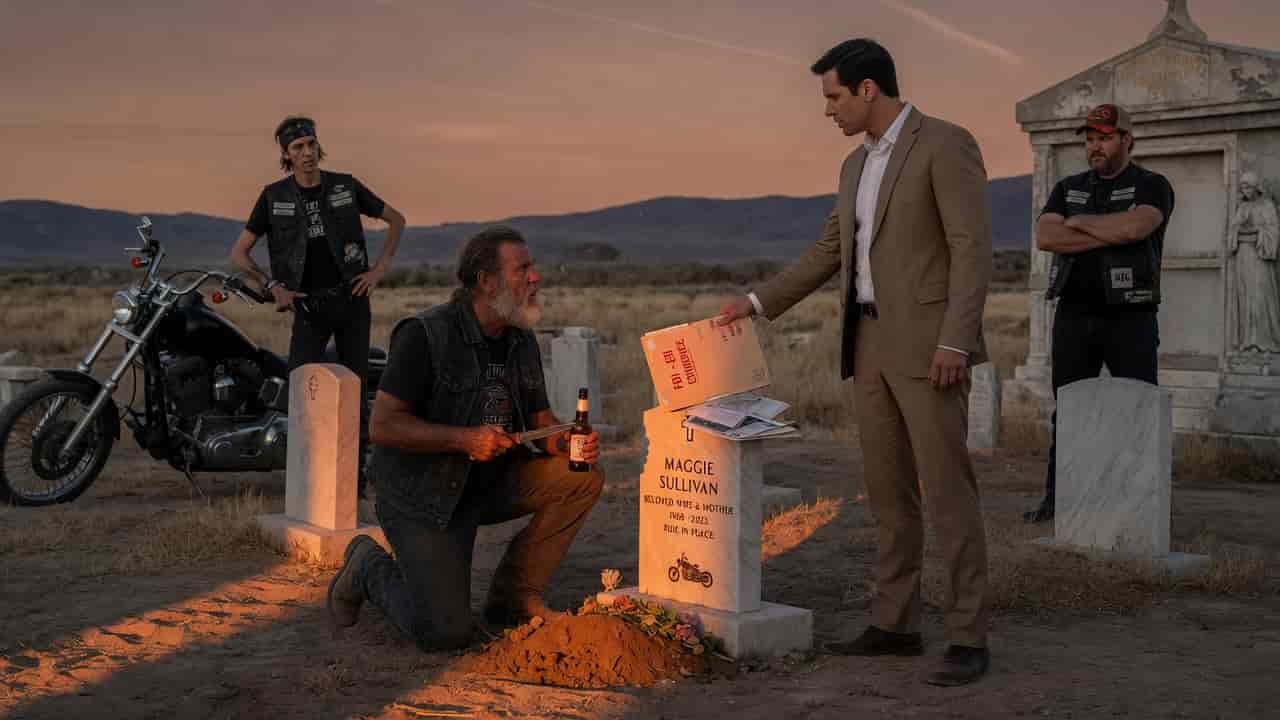
“Open the folder, Grit. Or should I just read the parts where she tells us where you hid the bikes?”
Grit’s hand shook as he reached for the knife in his belt. “You’ve got a lot of nerve coming here today. My wife just passed. She’s not here to defend herself against a liar in a suit.”
“She’s not here because she finished her job,” the agent said, his voice loud enough for the two club prospects watching from the gate to hear every word. “Ten years you gave the state, thinking you were a hero to the club. But Maggie? She was the one signing the checks we sent her. She sold you out so she could put her secret son through law school. You weren’t a martyr, Sullivan. You were her retirement plan.”
Grit looked at the grave, then at the two young bikers who were already reaching for their phones to call the club president. In one minute, his life had gone from a tragedy to a joke. He had a choice to make: protect the son of the woman who betrayed him, or let the club find out who really sent them all to prison.
Chapter 1: The Ghost in the Grease
The heat in Pahrump didn’t just sit on you; it pushed. It was a heavy, invisible hand pressing against the back of Grit Sullivan’s neck as he hunched over the gutted remains of a 2014 Shovelhead. The garage smelled like burnt oil, stale Pall Malls, and the copper tang of old blood that never quite scrubbed out of the floorboards.
Grit wiped a grease-blackened hand across his forehead, leaving a dark streak that matched the circles under his eyes. He was fifty-five, but in the flat, unforgiving light of the Nevada afternoon, he looked seventy. His joints screamed with every turn of the wrench—residue from a decade spent on concrete floors in a facility that didn’t believe in heaters or cushions.
He reached for a lukewarm Coors sitting on the workbench, his fingers stiff. Before he could take a sip, the low rumble of a heavy engine vibrated through the soles of his boots. He didn’t have to look up to know who it was. The cadence was unmistakable. Two bikes. Big bores.
He set the beer down and straightened his back, hearing the vertebrae pop like dry kindling.
Iron rode in first, his custom bagger gleaming with a layer of fine desert dust. Behind him was Snake, a prospect who wasn’t much more than a collection of tattoos and bad intentions. They didn’t park; they just hovered in the mouth of the garage, the exhaust fumes swirling into the workspace.
Iron killed his engine, the silence that followed feeling more aggressive than the noise. He remained seated, his hands resting on the chrome bars. He was sixty, but he looked like he was made of old saddle leather and spite.
“Grit,” Iron said. It wasn’t a greeting. It was a demand for attention.
“Iron,” Grit responded, leaning back against the workbench. He didn’t wipe his hands. He wanted the grease there. It was a barrier. “A bit early for a social call. Thought the club was hitting the run to Vegas today.”
Iron climbed off the bike, his movements slow and deliberate. He walked into the garage, his eyes scanning the walls, the tools, the small cot in the corner where Grit had been sleeping since Maggie passed six months ago.
“The run’s on. But I got a itch I can’t scratch, Grit. It’s been bothering me since we lost the warehouse in ’18. And it’s bothering me more now that the Feds are sniffing around the clubhouse again.”
Grit felt a cold prickle at the base of his spine, but his face remained a mask of weathered stone. “Feds are always sniffing. It’s their job to be pests. Doesn’t mean there’s anything to find.”
“That’s the thing,” Iron said, stepping closer. He smelled of expensive leather and cheap menthols. “They found plenty back then. They found you. You took the fall, and we appreciated it. We took care of Maggie while you were gone. Every month, a brown envelope on her porch. We treated her like royalty because you were a brother.”
“I know how you treated her,” Grit said, his voice dropping an octave. “I saw the receipts. I saw the look in her eyes when I came home. She never wanted for anything. I owe the club for that.”
Iron smiled, but it didn’t reach his eyes. “Do you? Because I started looking at the old logs. The timing of your bust. The way the DA had every single plate number, every drop-off point. It wasn’t just good police work, Grit. Someone had a map.”
Snake, still standing by the bikes, let out a short, sharp laugh. It was the sound of a kid who thought he was in on the joke.
Grit tightened his grip on the wrench he was still holding. “If you’re calling me a rat, Iron, say it. Don’t dance around my shop like a debutante. I did ten years for this patch. I didn’t breathe a word to a soul. Not to the guards, not to the lawyers, not even to Maggie.”
Iron put a hand on Grit’s shoulder. It wasn’t a gesture of friendship; it was a test of weight. “I’m not calling you a rat. If I thought you were the leak, we wouldn’t be talking. But someone close to you was. Someone who knew your schedule. Someone who knew when the shipments were moving.”
“Everyone in the club knew,” Grit countered.
“But not everyone had a reason to talk,” Iron whispered. “The Feds are squeezing again. They’re looking for the old stash. If I find out there’s a ghost in your house, Grit, it won’t matter how many years you did. Loyalty has an expiration date when it’s built on a lie.”
Iron turned and walked back to his bike without another word. Snake followed suit, giving Grit a mocking two-finger salute before kicking his engine over. They roared away, leaving a cloud of dust that settled over the Shovelhead like a shroud.
Grit stood there for a long time, the wrench heavy in his hand. He looked at the photo of Maggie pinned to the wall above the bench. It was an old Polaroid, taken just before his sentencing. She was smiling, her blonde hair caught in a breeze, looking like the only clean thing in his world.
He had spent three thousand nights in a six-by-nine cell staring at that face. He had survived the beatings, the isolation, and the sheer, crushing boredom by telling himself that she was waiting on the other side of the gate. That she was the anchor keeping his ship from drifting into the abyss.
He walked over to the cot and sat down, the springs groaning. He reached under the pillow and pulled out a small, velvet-covered box. Inside was her wedding ring and a single lock of her hair.
He felt a wave of nausea. It wasn’t just the heat. It was the residue of Iron’s words. The suspicion was a poison. It didn’t need proof to kill; it just needed air.
He remembered the way Maggie used to look at him when he came home late, the way she’d wash the grease from his hands with a tenderness that made him feel like a man instead of a criminal. She had been his peace.
But there had been moments. Moments he had pushed down deep. The phone calls that ended abruptly when he walked in. The way she always seemed to have a little more money than the club’s stipends should have allowed. He had told himself she was thrifty. He had told himself she was a saint.
He stood up, his legs shaking. He couldn’t stay in the garage. The air felt too thin. He needed to see her. He needed to stand by the stone and find the quiet again.
He grabbed his denim vest, the “Vice President” patch long gone but the ghost of the stitches still visible, and headed for his old truck. The graveyard was five miles out, tucked into a bend in the road where the desert tried to reclaim the grass every single day.
As he drove, the neon signs of the town flickered to life—the “Nifty Nook,” the “Lariat Lounge,” places where he’d spilled blood and spent thousands. It all felt hollow now.
He pulled into the cemetery, the gravel crunching under his tires. It was nearly dark. The sky was a bruised purple, the stars beginning to poke through the haze.
He walked to her grave, carrying a single bottle of Coors. He didn’t see the man in the tan suit until he was ten feet away.
The man was standing by a marble mausoleum, his hands in his pockets. He didn’t look like he belonged in a graveyard at dusk. He looked like he belonged in an air-conditioned office in D.C.
Grit stopped, his hand going instinctively to the buck knife on his belt. “Cemetery’s closed,” he rasped.
“For most people,” the man said. His voice was smooth, educated, and entirely devoid of fear. “But I figured you’d be here today, Mr. Sullivan. It’s the six-month anniversary, isn’t it?”
Grit didn’t answer. He shifted his weight, his boots digging into the dry earth. “Who are you?”
“My name is Torres. I work for the Department of Justice.”
Grit let out a harsh laugh. “Another Fed. Iron just left my shop. You guys must have a quota to fill today.”
“I’m not here about Iron,” Torres said, stepping into the light of the rising moon. He pulled a manila folder from under his arm. “And I’m not here to arrest you. I’m here to give you something. Consider it a late payment for services rendered.”
“I don’t provide services to the government,” Grit said, his fingers curling around the handle of his knife.
“You don’t,” Torres agreed. “But your wife did. For a very long time.”
The world seemed to tilt. Grit’s heart hammered against his ribs like a trapped bird. “You’re lying. You’re trying to flip me. It won’t work. I already did my time.”
“I know you did,” Torres said, his voice softening with a pity that felt like a slap. “Ten years. For a warehouse you didn’t even own. You took the fall because you thought you were protecting her. But Maggie? She was the one who gave us the warehouse. She gave us the dates, the names, the bank accounts. She even gave us the location of the safe in your own basement.”
Torres stepped forward and dropped the folder onto the flat marble of Maggie’s headstone.
“Why?” Grit whispered, the word barely audible.
“She had a son, Grit. Did you know that? A son from a guy she knew before you. He was in trouble—drugs, debt, the usual. She made a deal. She’d give us the club, piece by piece, and we’d keep her kid clean. We paid his tuition. We moved him to the coast. He’s an accountant now. Very successful. Very respectable.”
Torres looked at the grave, then back at Grit. “She loved that boy more than she loved the life. And, apparently, more than she loved you. She didn’t just wait for you, Sullivan. She managed you. She kept you in line so the information stayed fresh.”
Grit felt the beer bottle slip from his hand. It shattered against a rock, the foam bubbling into the dust. He looked down at the folder. The wind caught the corner, flipping it open to a page with a signature at the bottom.
A signature he knew as well as his own name.
Maggie Sullivan. Confidential Informant #4492.
The residue of his entire life—the loyalty, the sacrifice, the ten years of stolen light—began to burn. It wasn’t a clean fire. It was a slow, agonizing smolder that started in his gut and worked its way up to his throat.
“Get out,” Grit said. His voice was dead.
“There’s more in there,” Torres said, retreating toward his car. “Audio tapes. She recorded your conversations in the kitchen. She recorded you while you were sleeping, Grit. Just so we could be sure.”
The car door slammed. The engine turned over. As the headlights swept across the graveyard, they illuminated the two bikes parked at the gate.
Snake and Huck were leaning against their choppers, their faces illuminated by the glow of their cell phones. They had been close enough to hear. They had seen the folder.
Grit looked at the grave. Then he looked at the folder. Then he looked at the two young men who were about to tell the world that Grit Sullivan’s wife was a rat.
The silence that followed wasn’t deafening. It was a sentence.
Chapter 2: The Sound of a Ghost
The folder sat on the marble like a lead weight. Grit didn’t want to touch it. He wanted to kick it into the weeds, to set it on fire, to pretend it was a hallucination brought on by the heat and the grief. But the white paper stared back at him, the red “EVIDENCE” stamp looking like a fresh wound in the moonlight.
In the distance, the two prospects, Snake and Huck, kicked their bikes into life. The roar of the engines was a jagged edge cutting through the desert air. They didn’t ride toward him. They turned back toward town, their taillights shrinking into two red pinpricks of malice.
Grit knew what that meant. Within twenty minutes, Iron would know. The club would know. The word “rat” would be attached to the Sullivan name like a brand. In the MC world, it didn’t matter that Maggie was gone. It didn’t matter that Grit had done ten years of hard labor without breaking. The blood was tainted.
He reached out, his hand hovering over the manila cover. His skin was mapped with scars—burns from exhaust pipes, cuts from slipped wrenches, a jagged white line from a shiv in the yard at Lompoc. Every one of those marks was a badge of his loyalty. He had worn them with pride.
Now, they just felt like mockeries.
He picked up the folder. It was heavier than it looked. Inside, there were transcripts, bank statements, and a small padded envelope containing three digital voice recorder chips.
He walked back to his truck, his legs feeling like they belonged to someone else. He climbed into the cab, the interior smelling of old upholstery and the vanilla-scented air freshener Maggie had hung there the day he got out. He ripped the air freshener down and threw it out the window.
He drove back to the garage, his mind a chaotic loop of memories. Maggie at the gate when he was released, wearing a yellow sundress, her face streaked with tears of joy. Or so he had thought. Now, he wondered if those tears were of relief that the charade was continuing, or fear that he might see through her.
How many of those nights, lying in her arms, had she been mentally rehearsing her next report?
He pulled into the garage and slammed the door shut, locking the heavy sliding bolt. He went to his workbench and cleared off the parts of the Shovelhead. He laid out the contents of the folder under the harsh fluorescent light.
The first thing he saw was a photograph. It wasn’t Maggie. It was a young man, maybe twenty-eight, with clean-cut hair and a suit that cost more than Grit’s truck. He had Maggie’s eyes. That same slight tilt at the corners, the same bright blue that always seemed to be looking for something on the horizon.
Lucas Thorne. Grit felt a surge of nausea. He remembered the name. Maggie had mentioned a cousin’s kid once or twice. Someone she sent birthday cards to. Someone she claimed was “family she didn’t talk to much.”
She hadn’t just sent cards. According to the bank statements in the folder, she had sent thousands of dollars. The club’s money. His money.
He picked up one of the recorder chips. He had a small digital player he used for diagnostic notes. He slotted the chip in and hit play.
The static was thick for a few seconds, then a voice cut through.
“He’s coming home on Tuesday. They’re giving him early release for the warehouse job. He doesn’t know about the new shipment coming through the docks. He thinks he’s going straight.”
It was her. Her voice was different—flatter, more professional. The warmth she reserved for him was gone, replaced by a cold, clinical precision.
“I’ll keep him occupied at the house. If you want the garage, wait until Friday. He’ll be at the club meeting. I’ve already told him I need him to pick up some parts in Henderson. He’ll be out of the way.”
Grit slumped onto his stool, the plastic cracking under his weight. Friday. He remembered that Friday. He had been so happy to be out, so eager to prove his worth to the club again. He had gone to Henderson, spent four hours looking for a specific carburetor that didn’t exist, and came back to find the club’s main stash house had been raided.
Iron had been furious. They had spent weeks looking for the leak. Grit had been the one to suggest they check the newer members. He had defended the “old guard.” He had defended his home.
He listened to more. It was a catalog of his life, sold off in fifteen-minute increments.
“He’s getting suspicious of the money. I told him I won it at the slots. He’s easy to lead, Agent Torres. He wants to believe in me. It’s his biggest weakness.”
He wants to believe in me. Grit felt a roar of rage build in his chest. He swept his arm across the workbench, sending the folder and the transcripts flying. The player skittered across the floor, still murmuring her betrayals in the corner.
He wanted to go to the graveyard and dig her up. He wanted to scream at the bones until they answered for the ten years of his life she had stolen. He had lived for her. He had survived the hole by reciting her name like a prayer.
And all the while, she had been the one holding the keys to his cage.
A heavy knock sounded on the garage door. Not a knock—a rhythmic, metal-on-metal thud.
“Grit! Open the door!”
It was Iron. And he wasn’t alone. Grit could hear the low murmur of several men outside, the restless shuffling of heavy boots.
Grit looked at the scattered papers on the floor. If he opened the door, they’d see the folder. They’d see the evidence. And then they’d go after Lucas.
He didn’t care about Lucas. The kid was a stranger, the product of a life Maggie had lived before him, a life she had prioritized over everything they had built. But he also knew the club. Iron didn’t believe in “innocent bystanders.” If Lucas was the reason the club lost millions and half its leadership to the Feds, the kid wouldn’t last the week.
Grit stood up, his heart racing. He didn’t know why he did it—maybe it was the residue of the man he used to be, the man who believed in a code—but he started scooping up the papers. He shoved them back into the folder, his hands shaking so hard he tore the edges.
He kicked the voice recorder under the Cot.
“Grit! I ain’t gonna ask again!”
Iron’s voice was tighter now, the sound of a man who was losing his patience.
Grit wiped his face with a rag, trying to compose the shattered pieces of his expression. He walked to the door and pulled the bolt.
The door slid open. Iron stood there, flanked by Snake and Huck. Behind them, three other members of the “Dead Man’s Hand” stood in a semi-circle, their hands tucked into their vests. The atmosphere was thick with a humid, violent tension.
Iron didn’t wait for an invite. He pushed past Grit and walked into the center of the garage. He looked at the cleared workbench, then at the manila folder Grit was holding behind his back.
“The boys tell me you had a visitor at the cemetery,” Iron said. He sounded almost sad. “A man in a suit. Handed you a gift.”
Grit didn’t move. “It wasn’t a gift. It was a taunt.”
“Show me,” Iron said, holding out a hand.
“It’s Fed bullshit, Iron. They’re trying to stir the pot because they can’t get a conviction on the new racketeering charges. They want us fighting each other.”
Snake stepped forward, his eyes bright with the thrill of the hunt. “Looked pretty serious to me, Grit. You looked like you’d seen a ghost. And the suit? He stayed a long time. Talking about your wife.”
Grit turned his gaze on the prospect. It was the same gaze he’d used on the heavy-hitters in prison. Snake flinched, stepping back a half-inch.
“My wife is dead,” Grit said, his voice a low vibration. “Keep her name out of your mouth, kid, or I’ll put you in the ground next to her.”
Iron stepped between them. “Grit, I want to believe you. I really do. You’re a legend in this club. But the boys heard the word ‘informant.’ They heard ‘ten years.’ Now, you can either show me what’s in that folder, or we can do this the hard way.”
Grit looked at the folder. If he gave it to them, he was free. He could say, Look, it was her. She’s dead. It’s over. He could keep his patch, his shop, and his life.
But he saw Maggie’s eyes in that photo of Lucas. He saw the kid in the suit, the kid who had no idea that his respectable life was built on a foundation of betrayal and prison time.
If he gave them the folder, he was signing the kid’s death warrant. And if he didn’t, he was signing his own.
He looked Iron in the eye. “It’s a list of names, Iron. People they want me to testify against. People they think I have dirt on from my time in the VP chair. It’s a fishing expedition.”
“Then let me see the list,” Iron said.
Grit tightened his grip on the folder. “I burned it.”
The silence in the garage became a physical weight. Snake laughed, a jagged, nervous sound.
Iron’s face hardened. The sadness was gone, replaced by the cold, iron-willed pragmatism that had kept him in power for twenty years.
“You burned it?” Iron asked. “In the two minutes it took the boys to ride back here?”
“I don’t keep trash in my shop,” Grit said.
Iron looked around the room, his eyes lingering on the wood stove in the corner. It was cold. No smoke, no smell of burning paper.
He looked back at Grit. “You’re lying to me, brother. And that’s the one thing I can’t forgive.”
Iron nodded to the others. Snake and Huck moved first, grabbing Grit’s arms. Grit fought back, his old strength surfacing in a burst of desperate energy. He slammed his elbow into Huck’s ribs and sent Snake sprawling into the Shovelhead.
But there were too many of them.
They swarmed him, the weight of five men dragging him to the grease-stained floor. Grit felt a boot hit his ribs, the air leaving his lungs in a wheeze. He tasted copper.
Snake reached down and ripped the folder out of Grit’s hand.
“Give it here,” Iron commanded.
He took the folder and walked over to the workbench. He opened it, his eyes scanning the first few pages.
Grit lay on the floor, pinned by Huck and another member. He watched Iron’s face. He watched the realization dawn. The shock. The cold, white-hot fury.
Iron looked down at the photo of Lucas. Then he looked at the CI agreement.
He looked at Grit, and for the first time in thirty years, there was no brotherhood in his eyes. There was only contempt.
“She was a rat,” Iron whispered. The words felt like lead pellets hitting the floor. “The whole time. Everything we did… she gave it to them.”
He turned to the others. “Get the bikes. We’re going to find this Lucas Thorne.”
Grit screamed, a raw, ragged sound. “He didn’t know! He’s just a kid! She did it to protect him!”
Iron walked over and knelt beside Grit. He grabbed him by the hair and pulled his head back.
“She did it by killing us, Grit. And you? You’re the one who let her in. You brought the snake into the garden.”
Iron stood up and looked at the prospects. “Leave him. We got what we need. But Grit? If I see you on the road, if I see you in this town… I’ll finish what the Feds started.”
They walked out, taking the folder with them. The garage was silent again, except for the sound of Grit’s labored breathing and the distant roar of engines as they headed for the coast.
Grit pulled himself up, his body screaming. He looked at the photo of Maggie on the wall. He reached out and ripped it down, tearing it into a dozen pieces.
He had to get to Lucas first. He didn’t know why. He hated the kid. He hated the mother. But he was the only one left who knew the truth.
And in a world built on lies, the truth was the only weapon he had left.
Chapter 3: The Price of a Suit
The drive to Henderson took two hours that felt like twenty years. Grit’s truck rattled and groaned, the engine protesting the speed he was pushing it to. His ribs were a map of fire, and every time he breathed, he felt the jagged edge of a fracture grinding against his lungs.
He didn’t have a GPS. He had the address memorized from the brief glimpse he’d caught in the folder. 1422 Sycamore Drive. It was a suburb. The kind of place Grit usually avoided—lawns that were too green for the desert, houses that all looked like they were made by the same giant cookie cutter, and a silence that felt like a held breath.
He pulled the truck onto the curb three houses down from 1422. He looked like a nightmare in the suburban moonlight. His vest was torn, his face was a collage of bruises and dried blood, and he smelled like a mechanics’ pit.
He climbed out of the truck, his movements stiff and jerky. He walked up the driveway of the neat, beige house. There was a silver Lexus parked in the driveway. A “respectable” car.
Grit pounded on the door. He didn’t ring the bell. He didn’t want to be polite.
A light flickered on inside. A shadow moved across the frosted glass of the door.
“Who is it?” A voice asked. It was the voice from the folder. Younger, thinner, but with that same underlying arrogance of someone who had never had to fight for their space.
“Open the door, Lucas,” Grit rasped. “Now.”
The locks clicked. The door opened a few inches, held by a security chain.
Lucas Thorne looked out. He was wearing a soft grey sweatshirt and expensive-looking glasses. He looked at Grit with a mixture of confusion and immediate, visceral disgust.
“Do I know you?”
“I’m Grit Sullivan. I was married to your mother.”
The confusion on Lucas’s face hardened into a cold, sharp mask. He started to close the door. “I have nothing to say to you. My mother is gone, and her life with people like you is something I’ve worked very hard to forget.”
Grit slammed his palm against the door, preventing it from closing. The force sent a jolt of pain through his shoulder that almost made him black out.
“Listen to me, you arrogant little shit,” Grit hissed. “Men are coming here. Hard men. Men who don’t care about your degree or your Lexus. They think you’re part of a debt your mother owed them.”
Lucas narrowed his eyes. “What are you talking about? My mother was a clerk. She lived a quiet life.”
“Your mother was an FBI informant for ten years,” Grit said, the words tasting like ash. “She sold out the Dead Man’s Hand MC to keep you out of prison and put you through that fancy school. And now the club has the files. They have the tapes. And they’re coming for the only thing she had left to lose.”
Lucas let out a short, mocking laugh. “An informant? My mother? You’re delusional. You’ve spent too much time huffing gas in that garage of yours. My mother hated the Feds. She hated everything about the law.”
“She loved you more,” Grit said. “That’s the part you’re missing. She lied to me, she lied to the club, and she lied to you. But the evidence is real. I saw it.”
Lucas unchained the door and stepped out onto the porch, his face inches from Grit’s. He was taller than Grit, but he lacked the density, the years of hard-won muscle.
“I don’t know what kind of game you’re playing, Sullivan. Maybe you’re looking for money. Maybe you’re just a pathetic old drunk who can’t handle being alone. But if you don’t get off my property in thirty seconds, I’m calling the police.”
Grit looked at the kid. Really looked at him. He saw the pride. He saw the way Lucas carried himself—like a man who believed the world was a safe, orderly place where rules mattered.
Grit reached out and grabbed Lucas by the collar of his sweatshirt. He shoved him back against the doorframe.
“The police won’t get here in time,” Grit said, his voice a low, terrifying rumble. “Iron and his crew are on their way. They don’t call first. They don’t wait for a warrant. They’ll burn this house down with you inside just to send a message to a ghost.”
Lucas tried to push Grit away, but Grit was like a mountain.
“Why would you even care?” Lucas spat, his voice shaking now. “If what you’re saying is true, she betrayed you too. She sent you to prison. Why aren’t you the one trying to kill me?”
Grit let go of the collar. He stepped back, the adrenaline fading and leaving a hollow ache in its place.
“Because I loved her,” Grit said. “Even now, knowing what I know… I can’t let them destroy the only thing she actually cared about. It would make the last ten years of my life completely meaningless.”
He looked down the street. In the distance, he heard it. The low, rhythmic thrum of motorcycles. Multiple bikes.
“They’re here,” Grit said.
Lucas finally heard it too. The sound was alien in this neighborhood, a predatory growl that didn’t belong among the manicured lawns.
“Go inside,” Grit commanded. “Get your keys. We’re leaving through the back.”
“I’m not going anywhere with you!”
“Then you’re dying here,” Grit said. He pulled the buck knife from his belt. “Decide. Now.”
The headlights of the lead bikes swept across the front of the house. Four choppers pulled into the street, their engines idling with a menacing, uneven beat. Iron was in the lead.
Lucas looked at the bikes, then at Grit’s blood-stained face. The reality of the situation finally seemed to penetrate his suburban armor.
“My car keys are on the counter,” Lucas whispered, his face pale.
“Forget the car. They’ll track it. We take the truck.”
Grit grabbed Lucas by the arm and hauled him back into the house. They ran through the kitchen, which was filled with the smell of expensive coffee and fresh paint. It was a world Grit had never known, a world built on the back of his own suffering.
They exited through the sliding glass door in the back, scrambling over a low wooden fence into the neighbor’s yard.
Behind them, the front door of 1422 Sycamore was kicked in with a crash that echoed through the quiet street.
Grit didn’t look back. He pushed Lucas toward the alleyway where he’d left the truck. His ribs were screaming now, a sharp, stabbing pain that made every step a battle.
They reached the truck and scrambled inside. Grit keyed the ignition, the engine roaring to life with a puff of black smoke.
“Keep your head down,” Grit ordered.
He floored it, the truck fishtailing as he tore out of the alley. He didn’t turn on the lights until they were three blocks away.
In the rearview mirror, he saw the orange glow of a fire starting in the window of Lucas’s house. Iron hadn’t wasted any time.
Lucas sat in the passenger seat, his knees pulled up to his chest. He was trembling, a fine, rhythmic shudder that he couldn’t stop.
“Everything,” Lucas whispered. “My house. My job. My life. It’s gone.”
“It was never yours,” Grit said, his voice hard. “It was bought and paid for by a woman who sold her soul to the devil. You’re just finally seeing the bill.”
“Where are we going?”
Grit looked at the dark highway ahead. He didn’t have a plan. He had no club, no home, and a broken body. He was carrying the son of his betrayer into the desert.
“To the only place where the past can’t find us,” Grit said. “The middle of nowhere.”
As they hit the open road, Grit felt the residue of the night settling over him. The outrage was still there, a hot coal in his chest, but it was being joined by a strange, dark sense of purpose.
He had lost his wife. He had lost his brothers.
But he was still standing. And as long as he was standing, the truth wasn’t finished with them yet.
Chapter 4: The Tapes of Truth
The cabin was a rotting splinter of wood tucked into the shadows of the Sheep Range, forty miles north of any paved road. Grit’s father had used it for hunting back when the desert still had water, and Grit had used it as a hideout during the lean years before his first bust.
He pulled the truck into the brush, killing the engine. The silence was immediate and heavy, broken only by the ticking of the cooling metal.
Lucas hadn’t spoken since they left Henderson. He sat huddled against the door, his eyes fixed on the dark horizon. He looked smaller now, the suit-jacket he’d grabbed in the rush looking like a costume that didn’t fit.
“Out,” Grit ordered.
They walked into the cabin. It smelled of dry rot, mouse droppings, and decades of dust. Grit found a kerosene lamp on the scarred wooden table and lit it. The yellow flame flickered, casting long, distorted shadows against the walls.
Grit slumped into a chair, his face grey. He pulled up his t-shirt, revealing a torso that was a map of purple and black bruising. One rib was definitely floating. He took a deep, shuddering breath and pulled a flask of whiskey from his vest pocket.
He took a long pull, the burn settling the tremors in his hands.
“You should see a doctor,” Lucas said, his voice small.
“Doctors ask questions,” Grit rasped. “I don’t have any answers they’d like.”
He reached into his vest and pulled out the small digital player and the remaining voice chips. He’d managed to grab them before the club arrived at the garage.
He looked at the chips. He knew what was on them. More betrayal. More evidence of the woman he loved dissecting his life for the benefit of a government agent.
“What are those?” Lucas asked.
“The reason your house is on fire,” Grit said. He set the player on the table. “Your mother’s legacy. Want to hear what paid for your law degree?”
Lucas looked at the player like it was a live grenade. “I don’t believe you. My mother was a good woman. She was kind. She… she cared about people.”
“She cared about you,” Grit corrected. “Everyone else was just a piece on the board.”
He hit play.
The recording was clearer this time. The sound of a television in the background—an old game show Maggie used to watch.
“He’s getting restless, Torres. He wants to move the club’s money to a new account. He thinks Iron is skimming. If he does that, I won’t have access anymore. You need to pick him up before Tuesday.”
Grit closed his eyes. He remembered that day. He’d been sitting at the kitchen table, talking to Maggie about his suspicions. He’d thought she was listening with concern. He’d thought she was his partner.
“Is he dangerous to you, Maggie?” Torres’s voice was on the tape too.
“Grit? No. He’s a dog. He’ll growl, but as long as I’m the one feeding him, he’ll stay on the leash. He’s too loyal for his own good. It’s pathetic, really.”
Pathetic. The word hit Grit harder than any of Iron’s boots. He felt the air leave his lungs. He’d spent ten years in a cage for a woman who thought he was a dog on a leash.
Lucas reached out and stopped the recording. His hand was shaking so hard the player rattled against the table.
“That’s… that’s not her,” Lucas whispered. But the lie died in his throat. He knew her voice. He knew the cadence.
“It’s her,” Grit said. “And there’s hours more. She sold every secret, every name, every drop-off. She even sold the location of the old man’s grave—the one where the club hid the untraceable’s. They dug it up three years ago. Iron thought it was a rival club. He killed two men from the Vipers over that. They were innocent.”
Grit took another pull of whiskey. The residue of his loyalty was turning into a bitter, oily film in his mouth.
“She did it for me,” Lucas said, his voice rising. “She did it so I wouldn’t end up like you! Look at you! You’re a broken old man in a shack! You have nothing! No family, no honor, no future!”
Grit stood up, the chair screeching against the floorboards. He grabbed Lucas by the front of his sweatshirt and slammed him against the wall.
“I have honor because I kept my word!” Grit roared, his face inches from Lucas’s. “I went to prison for her! I bled for that club! I lived by a code while she was laughing at me with a Fed! You think you’re better than me because you have a degree? That degree was bought with blood and lies! You’re just as dirty as I am, kid. Dirtier. Because at least I knew what I was.”
He let go of Lucas, who slumped to the floor, sobbing.
The outrage Grit felt wasn’t just directed at Maggie anymore. It was directed at the whole world. The Feds who used her. The club that was now hunting them. The kid who sat there in his expensive clothes, reaping the rewards of a betrayal he didn’t want to acknowledge.
Grit walked to the window. The desert was a vast, indifferent blackness. Somewhere out there, Iron and the Dead Man’s Hand were circling. They wouldn’t stop. They couldn’t. Maggie had made the club look weak, and in their world, weakness was a death sentence.
“They’re going to find us,” Lucas said, his voice muffled by his knees.
“Probably,” Grit said.
“What are we going to do?”
Grit looked at the voice chips on the table. He looked at the knife on his belt.
“We’re going to give them what they want,” Grit said.
“You’re going to give me to them?” Lucas looked up, terror etched in his face.
“No,” Grit said. “I’m going to give them the truth. All of it. And then I’m going to see who’s left standing when the smoke clears.”
He turned back to the kid. “You have a phone?”
“They’ll track it.”
“I don’t care. Turn it on. Call Torres. Tell him we’re at the Sheep Range cabin. Tell him to bring a team.”
“Why?”
“Because I’m tired of being the only one holding the bag,” Grit said. “I’m calling a meeting. The Feds, the Club, and the Ghost. We’re going to settle the bill once and for all.”
Grit sat back down and picked up the player. He hit play again.
“I sometimes wonder what he’ll do if he ever finds out,” Maggie’s voice said, sounding almost thoughtful. “He’s a simple man, Torres. He believes in things. I think it would break him. And I can’t have a broken man in my house. It’s too messy.”
Grit smiled. It was a jagged, ugly thing.
“You were wrong about one thing, Maggie,” he whispered to the empty air. “I’m not broken. I’m just empty. And an empty man has nothing left to lose.”
He looked at Lucas. “Call him. Now.”
As the kid fumbled with his phone, Grit reached for his wrench. There was a leak in the kerosene lamp. He could smell it.
The night was far from over. And for the first time in ten years, Grit Sullivan felt like he was the one holding the leash.
Chapter 5: The Weight of the Leash
The darkness in the Sheep Range didn’t just fall; it pooled in the draws and canyons like spilled ink. Inside the cabin, the kerosene lamp hissed, a rhythmic, mechanical whisper that seemed to mock the silence. Grit sat at the scarred wooden table, his hands steady as he worked on the lamp’s brass fitting with a small jeweler’s screwdriver he kept in his vest. He wasn’t fixing the leak anymore. He was widening it, just enough so the smell of fuel began to thicken the air, heavy and sweet.
Across from him, Lucas was a ghost of a man. The accountant’s crisp grey sweatshirt was stained with dirt and sweat, and his glasses were smudged with fingerprints. He held his phone in both hands, staring at the screen as if it were a window into a world that had already closed its doors on him.
“He’s coming,” Lucas whispered. “Torres said twenty minutes. He said to stay low. He said they have a tactical unit in a helicopter coming from Vegas.”
Grit didn’t look up. “Torres says a lot of things. Most of them involve someone else doing the bleeding while he collects the credit.”
“You don’t trust him? He’s federal law enforcement.”
Grit let out a short, dry laugh that turned into a wheeze. He clutched his side, feeling the sharp, grinding heat of his broken rib. “In my world, the law and the club are just two different brands of the same poison. They both want control. They both use people until the gears strip, and then they throw ’em in the scrap heap. Your mother knew that better than anyone. That’s why she played both sides.”
Lucas looked at the digital player sitting between them. The voice chips were scattered like dead insects. “I keep thinking about that word she used. Pathetic. She called you pathetic.”
Grit finally looked up. His eyes were bloodshot, the skin around them sagged with the weight of three thousand nights of stolen sleep. “She wasn’t wrong, kid. I sat in a cell for thirty-six hundred days thinking I was a martyr. I’d walk the yard, chest out, taking the hits from the AB and the guards because I thought I was protecting something sacred. I thought I was the wall between her and the ugliness of the world.”
He tightened the screw, the brass groaning. “But the wall was just a fence she’d built to keep me contained. I wasn’t her husband. I was her insurance policy. As long as I was inside, she had a paycheck from the Feds and a story for the club. I was a dog on a leash, and I liked the collar because I thought she was the one holding the other end.”
“She saved me,” Lucas said, his voice gaining a sudden, desperate edge. “I was nineteen. I was stupid. I got caught up with people who were moving weight across the border. If she hadn’t made that deal, I’d still be in a cage. Or worse.”
“And what did it cost?” Grit leaned forward, the smell of kerosene now sharp enough to sting the eyes. “It cost ten years of my life. It cost the lives of men like Jimmy ‘The Ghost’ and Sarah Vance’s husband. It cost the soul of a club that used to mean something more than just meth and territory. She bought your ‘respectable’ life with the blood of people who thought she was a sister.”
Lucas looked away, his jaw tight. “You can’t expect me to apologize for living.”
“I don’t expect anything from you, Lucas. You’re just the residue of her lie. But Iron? He expects blood. And he’s a lot closer than the FBI.”
Grit stood up, the movement slow and agonizing. He walked to the window, peering through a crack in the shutters. The desert was silent, but he knew the signs. The way the coyotes had gone quiet in the wash. The way the air seemed to vibrate with a low-frequency hum that wasn’t the wind.
He went to the corner of the cabin and pulled an old, oil-cloth wrap from beneath a loose floorboard. Inside was a Remington 870 shotgun, the barrel shortened, the walnut stock scratched and worn. Beside it was a box of double-ought buck.
“Is that… is that legal?” Lucas asked, his voice cracking.
Grit ignored him. He began to load the shells, the metallic clack-slide of the action sounding like a death knell in the small room. “Legal stopped mattering about four hours ago. Right now, we’re in the gap between what’s right and what’s real.”
He handed a heavy iron poker from the fireplace to Lucas. “If someone comes through that door and they aren’t wearing a suit, you use this. Don’t think about law school. Don’t think about your Lexus. Think about the fact that if they get a hand on you, you’ll be wishing for the fire.”
“I can’t kill someone,” Lucas said, staring at the iron bar.
“Then you’ll die polite,” Grit rasped. “Your choice.”
A sudden, sharp light swept across the shutters. Then another. The sound of heavy tires on gravel reached them—not the refined hum of a federal SUV, but the aggressive, uneven roar of bikes.
“They’re here,” Grit said.
He blew out the kerosene lamp. The cabin was plunged into a suffocating darkness, illuminated only by the thin slivers of moonlight and the flickering headlights outside.
The rumble of the engines died down, replaced by the creak of leather and the crunch of boots on the dry earth. There were at least six of them.
“Grit Sullivan!” Iron’s voice boomed through the night. It sounded hollow, amplified by the surrounding canyon walls. “I know you’re in there. And I know you’ve got the rat’s whelp with you.”
Grit moved to the door, his finger resting on the trigger of the Remington. He didn’t answer. Silence was a weapon in the desert; it forced the other man to fill the void with his own nerves.
“You’re making a mistake, Grit!” Iron continued. “You’re dying for a woman who laughed at you. You’re protecting the very thing that sent you to the hole. Come out, give us the kid, and maybe—just maybe—I’ll let you ride out of here with your dignity.”
Grit looked back at Lucas. The kid was huddled in the corner, the iron poker trembling in his grip. He looked pathetic. He looked like exactly what he was—a man whose entire foundation had been revealed as a hallucination.
“Dignity’s a luxury for men who have a home to go to, Iron!” Grit shouted back. “I’m just an old mechanic in a shack. And I don’t like people trespassing on my property.”
“Have it your way,” Iron said. His voice was cold now, stripped of any lingering sense of brotherhood.
The first shot shattered the front window. Glass sprayed into the room like diamond dust. Lucas screamed, a thin, high-pitched sound that made Grit’s skin crawl.
Grit didn’t fire back. He moved to the side of the door, his back against the rough wood. He was waiting for the door to move. He was waiting for the moment of maximum pressure.
Another volley of shots hit the cabin, the heavy rounds punching through the rotting timber like it was cardboard. Dust and splinters filled the air.
“Grit, please!” Lucas sobbed. “Just give them what they want! Tell them I didn’t know!”
“They don’t care what you knew!” Grit roared over the gunfire. “They care what you represent! You’re the proof that they were played! You’re the living receipt of their failure!”
He heard a heavy thud against the door. Someone was using a shoulder.
Grit braced himself. He felt the vibration through his spine. He remembered Maggie’s voice on the tape: He’s a dog. He’ll stay on the leash.
He looked at the door. He wasn’t a dog. And he wasn’t on a leash anymore. He was just a man with a broken body and a clear target.
The door groaned, the hinges screaming. One more hit and it would fly open.
“Get down!” Grit yelled at Lucas.
The door exploded inward. A shadow loomed in the opening—Huck, the stocky prospect, his face twisted in a snarl, a chrome-plated .45 in his hand.
Grit didn’t hesitate. He leveled the Remington and pulled the trigger.
The blast was deafening in the small space, a wall of sound and light that felt like a physical blow. Huck was lifted off his feet, his body thrown back into the night as if by an invisible hand.
The silence that followed was thick with the smell of cordite and copper.
“One down!” Grit screamed, his voice raw. “Who’s next?”
Outside, there was a frantic scrambling as the others retreated into the shadows of the trucks and bikes.
“You’re a dead man, Sullivan!” Snake yelled from somewhere behind a chopper. “You killed a brother!”
“I killed a trespasser!” Grit countered.
But his heart wasn’t in the bravado. He could feel the blood seeping through his shirt from his reopened wounds. His vision was starting to tunnel. He looked at Lucas, who was staring at the doorway where Huck had just been standing. The kid’s eyes were wide, vacant. He was seeing the reality of his mother’s world for the first time, and it was breaking him.
Then, from the distance, came a new sound. A rhythmic, thumping beat that grew louder with every second. A searchlight cut through the darkness, sweeping across the desert floor with a blinding, clinical intensity.
The helicopter.
“Feds!” Iron yelled. “Mount up! Get the hell out of here!”
Engines roared to life. Tires spun in the gravel. Grit watched through the shattered window as the taillights of the MC bikes disappeared into the wash, fleeing the superior technology of the state.
But Iron didn’t leave. His bagger stayed idling near the edge of the clearing, his silhouette dark against the dust kicked up by the others. He looked at the cabin one last time, a silent promise of a reckoning that hadn’t been settled.
Then he, too, was gone.
The helicopter hovered overhead, the downwash rattling the remaining shingles on the roof. Bright, artificial light flooded the cabin through the holes in the walls.
“Grit Sullivan! This is Agent Torres!” The voice came through a loudspeaker, booming and distorted. “Step out with your hands visible! We have the perimeter secured!”
Grit looked at the shotgun in his lap. He looked at Lucas, who was still huddled on the floor, the iron poker lying forgotten beside him.
“It’s over,” Lucas whispered. “They’re here. We’re safe.”
Grit looked at the kid and felt a wave of profound, weary pity. Lucas still thought the cavalry had arrived. He still thought there was a side that was “safe.”
“Nobody’s safe, Lucas,” Grit said, his voice barely a murmur. “They’re just changing the guard.”
He stood up, the shotgun heavy in his hand. He walked to the center of the room, standing in the middle of the searchlight’s beam. He looked like a ghost in the white light, his clothes torn, his face a mask of blood and grease.
The residue of the night was settling into his bones. He had saved the kid. He had stood his ground. But as he looked at the open doorway, he realized that he had nowhere left to go. The leash was gone, but so was the house it had been attached to.
He was just a man in the desert, waiting for the next set of chains to arrive.
Chapter 6: The Ghost in the Mirror
The tactical team moved with a silent, terrifying efficiency. They were shadows in black Kevlar, their movements synchronized and devoid of the chaotic, human heat of the MC. They didn’t shout; they murmured into headsets, their weapons held with a casual, practiced lethality.
Grit sat on the tailpipe of a federal SUV, a thermal blanket draped over his shoulders. He felt like an exhibit in a museum of a dead civilization. Beside him, Lucas was being tended to by a medic. The kid was wrapped in his own blanket, his face pale and eyes glassy, nodding mutely as the medic checked his vitals. He looked like a victim now, a role the world was much more comfortable seeing him in.
Agent Torres walked toward them, his tan suit looking remarkably unwrinkled despite the desert dust. He carried a tablet in one hand and a bottle of water in the other. He looked at Grit with the same clinical interest he might show a piece of forensic evidence.
“You’re a hard man to kill, Sullivan,” Torres said, handing him the water.
Grit took a sip, the cold liquid stinging his throat. “It’s a habit. One I’m starting to regret.”
Torres looked at the cabin, where forensic technicians were already bagging evidence and marking shell casings. “We got four of them on the access road. Iron slipped the net, but we’ll find him. The folder you had? It’s enough to put the Dead Man’s Hand in a cage for twenty years. Racketeering, conspiracy, murder… it’s a clean sweep.”
“And Lucas?” Grit asked, nodding toward the kid.
Torres glanced at Lucas, his expression neutral. “Mr. Thorne is a material witness. We’ll provide him with a new identity, a relocation package. He’ll be fine. He’s got a bright future. His mother made sure of that.”
Grit felt a surge of cold fury. “His mother destroyed dozens of lives to buy that ‘bright future.’ She turned her husband into a pawn and her friends into targets. Don’t talk about her like she’s a saint.”
“I never said she was a saint,” Torres countered, his voice dropping. “She was an asset. And she was effective. In this business, that’s all that matters. You think you’re the only one who got used, Grit? Look around. This whole operation was built on her information. She was the most valuable informant the Vegas office ever had.”
“And you loved every second of it,” Grit spat. “You liked watching her twist the knife. You liked knowing that I was sitting in Lompoc while she was feeding you the club’s secrets over coffee.”
Torres didn’t blink. “I liked the results. I liked seeing the meth trade in Pahrump drop by forty percent. I liked seeing the bodies stop piling up in the desert. If that costs you ten years and a broken heart, Sullivan, I’m okay with that trade.”
Grit looked at the man in the suit. He saw the same cold, calculating light he’d seen in Iron’s eyes. Different goals, same methods. The world was just a collection of people trying to exert their will over others, and the “loyal” ones like him were just the friction in the machine.
He stood up, the thermal blanket sliding from his shoulders. He walked over to Lucas.
The kid looked up, his expression a mixture of fear and a strange, budding resentment. He saw Grit as the man who had dragged the ugliness of his mother’s past into his clean, suburban present.
“You okay, kid?” Grit asked.
Lucas hesitated, then nodded. “They’re taking me to a safe house. They say I can’t go back to Henderson. My job… everything… it’s over.”
“It’s a fresh start,” Grit said, the words feeling like ash in his mouth. “That’s what they call it when they erase the parts of you they don’t like. Take it. It’s the only thing she actually left you.”
Lucas looked at Grit’s scarred, grease-stained hands. “Why did you do it? Why did you save me?”
Grit looked at the desert, the first hint of grey light beginning to touch the tops of the Sheep Range. “Because for ten years, I thought I was a man of honor. I thought loyalty meant something. If I’d let them kill you, then those ten years would have been for nothing. I didn’t save you for your mother, Lucas. I saved you for the man I thought I was.”
He turned away and started walking toward the edge of the clearing.
“Sullivan! Where are you going?” Torres called out. “We need a full statement. You’re still on parole, remember?”
Grit didn’t stop. He didn’t look back. He kept walking into the grey, pre-dawn light. The desert was vast and indifferent, and for the first time in his life, he didn’t have a patch, a shop, or a wife to define him.
He was just a man. Empty, broken, and entirely free.
He walked until the sound of the helicopter and the murmurs of the tactical team faded into the distance. He walked until his legs burned and his breath came in short, jagged gasps.
He found a flat rock near a dry wash and sat down. He pulled a small, crumpled piece of paper from his pocket. It was the photo of Lucas he’d snatched from the folder. He looked at the kid’s face—the same eyes as Maggie, the same tilt of the head.
He remembered the first time he’d seen Maggie. She’d been standing by a broken-down Ford on the side of the highway, her hair a mess, a smudge of dirt on her cheek. He’d pulled over, his bike gleaming in the sun, feeling like a knight in a leather vest. He’d fixed her car, and she’d looked at him with a gratitude that felt like a blessing.
He realized now that she’d probably sabotaged the car herself. She’d probably been waiting for him, knowing his route, knowing his weakness for a woman in trouble. The leash had been draped around his neck before he’d even said hello.
He let the photo go. It fluttered in the light desert breeze, tumbling into the wash where it would eventually be buried by the shifting sands.
He looked at his hands. The grease was deep in the pores, a permanent record of a life spent under the hood of other people’s machines. He started to scrub them against his jeans, but it was no use. The stain was part of him now.
The sun broke over the horizon, a sudden, blinding flash of orange that set the desert on fire. Grit squinted against the light. He felt the residue of the night—the fear, the rage, the crushing weight of the truth—starting to settle, turning into a hard, cold layer of armor.
He had no home. He had no money. He had a club that wanted him dead and a government that wanted him managed.
But as he stood up and started walking toward the distant highway, he felt a strange, quiet sense of peace. He wasn’t a dog on a leash anymore. He was just a ghost in the grease, a man who had seen the bottom of the world and decided to keep walking.
The road ahead was long, and the desert was unforgiving. But Grit Sullivan had spent ten years learning how to survive in a cage. He figured the rest of the world would be easy by comparison.
He reached the edge of the paved road and stopped. A truck was approaching, its headlights dim in the growing morning light. Grit raised a hand, his thumb out, his posture steady.
The truck slowed down, the engine rumbling with a familiar, mechanical rhythm. The driver, a weathered man in a flannel shirt, looked at Grit’s battered face and torn vest. He didn’t ask questions. He just unlocked the door.
Grit climbed in, the interior smelling of stale coffee and old upholstery. He sat back in the seat, feeling the vibration of the road through the soles of his boots.
“Where to?” the driver asked.
Grit looked at the horizon, where the road stretched out like a long, black ribbon into the unknown.
“Just west,” Grit said. “As far as this thing will take me.”
The truck pulled away, leaving a small cloud of dust that was quickly swallowed by the wind. In the rearview mirror, the Sheep Range grew smaller and smaller, until it was just a jagged line against the sky.
The ghost in the grease was gone. And the man who was left didn’t look back.