“Look at the signature on the bottom of this page and tell me again that my father’s disappearance was just a filing error.”
Julian Hayes stood in the center of the Hollywood Forever Cemetery, the midday sun baking the back of his expensive charcoal coat. He’d spent two years and three million dollars building a foundation in his late wife Rosa’s name. She was the hero. She was the lawyer who took the cases no one else would.
But the boy standing over her headstone didn’t see a hero. He saw the person who took a bribe to make sure his family was sent back across the border into a nightmare.
“You need to leave,” Julian whispered, his voice cracking as his junior partner watched from the car. “This is a private moment.”
“It wasn’t private when she took the check from Sterling Corporate,” the boy spat, shoving a crumpled, rejected asylum application into Julian’s chest. “She missed the deadline on purpose. She made sure the cartel knew exactly when the bus was arriving. My father is gone because your ‘saint’ wanted a bigger house in Bel Air.”
Julian looked down at the blue ink signature he’d seen a thousand times on love notes and grocery lists. It was her handwriting. And the date on the rejection was the same day they’d closed escrow on their mansion.
The truth is about to come out, and Julian has to decide if he’s going to protect a ghost or save the boy his wife betrayed.
Chapter 1: The Shrine
The air in the Hollywood Forever Cemetery always tasted like expensive mulch and old money. Julian Hayes stepped out of the black SUV, the heat of the Los Angeles pavement radiating through the soles of his Italian leather shoes. He adjusted his charcoal overcoat, a habit of armor he wore even in the eighty-degree October sun.
In his right hand, he carried a bunch of white roses—long-stemmed, thorns stripped, exactly the way Rosa liked them. Behind him, he heard the soft thump of the car door and the clicking of heels on the gravel.
“We have the press release ready for the anniversary gala, Julian,” Sarah said. She was his brightest junior partner, a woman whose ambition was only matched by her reverence for the Hayes name. She stayed five paces back, respecting the geography of his grief. “The mayor is confirmed. We’ve already raised two million for the Rosa Hayes Sanctuary Project.”
Julian didn’t turn around. He kept his eyes on the marble headstone ahead. Rosa Elena Hayes. 1980–2024. A Voice for the Voiceless.
“Good,” Julian said. His voice was a practiced baritone, the kind that commanded courtrooms and quieted restless boards of directors. “She would have hated the gala, but she would have loved the money going to the families. She always said the law was just a tool to fix what the world broke.”
He reached the grave. It was a prime piece of real estate, shaded by a sprawling oak tree, far from the noise of Santa Monica Boulevard. He knelt, his knees cracking—a reminder that he was forty-five and living a life that felt a decade heavier. He began to arrange the roses.
“She was a saint, Julian,” Sarah whispered, coming to stand at the edge of the grass. “Sometimes I look at her old case files when I’m stuck on a brief. Just to remember why we do this.”
Julian felt the familiar swell of pride, mixed with the hollow ache of his own inadequacy. He was a corporate immigration lawyer. He handled H-1B visas for tech giants and O-1s for starlets. Rosa had been the one in the trenches, working pro-bono for the field hands and the kitchen staff, the people whose names were usually just footnotes in a deposition. He provided the lifestyle; she provided the soul.
He was reaching out to touch the engraved letters of her name when a shadow fell across the marble.
It wasn’t Sarah’s shadow. It was jagged, moving fast.
Thwack.
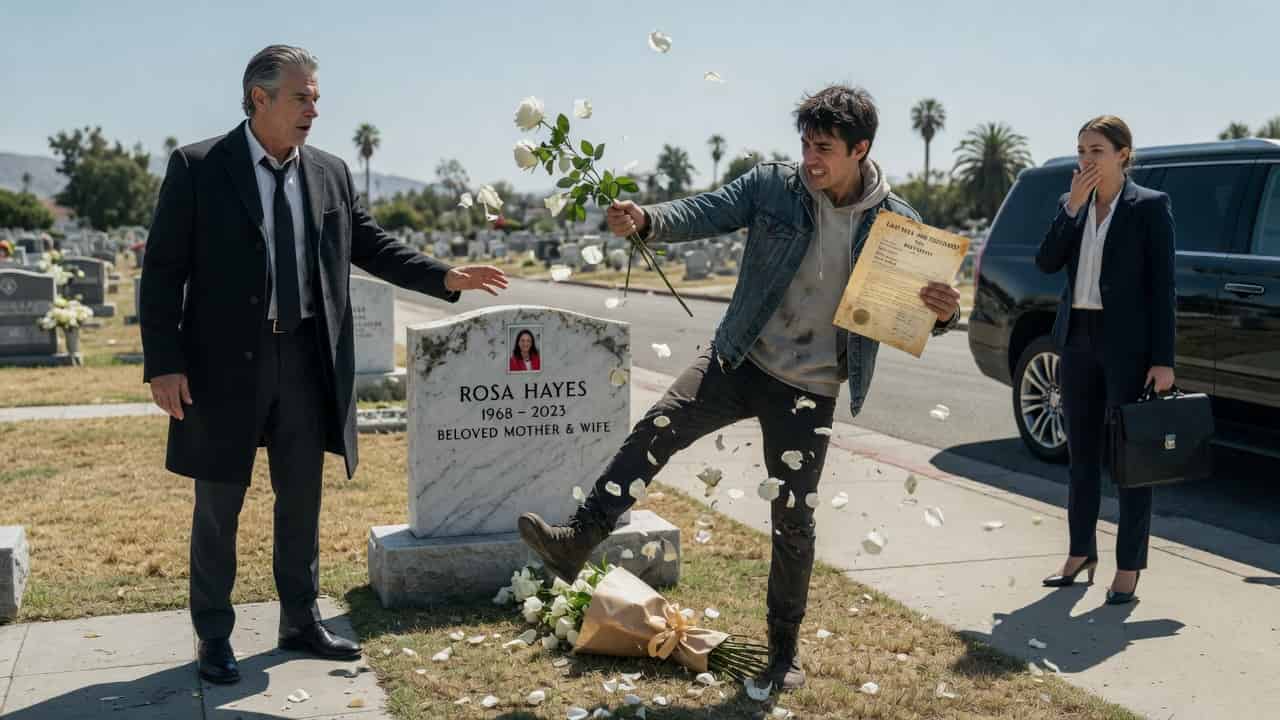
A heavy, mud-caked boot collided with the white roses. The bouquet disintegrated, petals exploding into the air like confetti at a funeral. Julian froze, his hand still hovering over the spot where his wife’s heart would have been.
“Get your foot off that grave,” Julian said, his voice dropping an octave. He didn’t look up yet. He watched a white petal drift down and land on a scuffed, brown leather toe.
“I’m not the one desecrating this place,” a voice spat. It was young, raw, and trembling with a cocktail of exhaustion and pure, unadulterated hatred.
Julian stood up, smoothing his overcoat. He faced the intruder. The boy looked nineteen, maybe twenty. He was thin, his face sun-burnt and peeling, a dark bruise blooming across his left cheekbone like a storm cloud. He wore a frayed denim jacket over a grey hoodie that had seen better years.
“Mateo?” Sarah gasped from behind Julian. “What are you doing here? We told you the office was closed for the anniversary.”
Julian looked at his partner. “You know him?”
“He’s been calling for weeks, Julian. One of Rosa’s old cases. I thought the staff handled it.”
Mateo laughed, a dry, hacking sound. He didn’t look at Sarah. He stared directly into Julian’s eyes. “Handled it? Is that what you call it? Sending a form letter while my father gets hunted?”
“Listen, son,” Julian said, stepping forward, using his height to try and reclaim the room—even if the room was a cemetery plot. “I understand you’re grieving. We all are. But this is my wife’s final resting place. Whatever legal issue you have, take it to the firm on Monday. If you don’t leave now, I’ll have security remove you.”
Mateo didn’t flinch. He reached into the inner pocket of his denim jacket and pulled out a piece of paper. It was crumpled, stained with what looked like coffee and sweat. He shoved it toward Julian’s chest, the paper snapping in the dry air.
“Read it,” Mateo commanded.
Julian didn’t move. “I’m not doing business at a grave.”
“Read the signature, Mr. Hayes. Read the date.” Mateo’s voice broke, a high, panicked note piercing the professional veneer Julian was trying to maintain. “You tell people she was a savior. You tell them she fought for us. But she didn’t miss the filing deadline for my father’s appeal because she was busy. She missed it because she was paid.”
Julian felt a flicker of heat in his chest—not fear, but the defensive reflex of a man whose world was built on a specific, polished narrative. “That’s a lie. My wife worked eighteen hours a day for people like you. She died of an aneurysm caused by the sheer stress of her caseload.”
“She died wealthy,” Mateo countered, his eyes rimmed with red. “My father died in the dirt in Michoacán three days ago. Because the appeal was never filed. Because your wife took a hundred thousand dollars from Sterling Corporate to make sure the key witness in their labor trafficking suit never got his day in court.”
“Julian, don’t listen to him,” Sarah said, her voice rising in alarm. “He’s distraught. The Sterling case was a tragedy, but the court ruled—”
“The court ruled based on the evidence!” Julian shouted, turning on Sarah for a split second before refocusing on the boy. “And there was no witness!”
“Because she let them take him!” Mateo lunged forward, grabbing Julian’s lapel.
Julian reacted instinctively, catching the boy’s wrist, his fingers digging into the thin bone. For a second, they were locked in a grotesque dance over the headstone. The scent of the crushed roses rose up between them, sweet and cloying.
“Look at the paper!” Mateo screamed into his face.
Julian’s eyes dropped. He didn’t want to look, but the paper was pressed against his tie. It was a Notice of Appeal for Guillermo Varga vs. Sterling Industries. At the bottom, in the space for the attorney of record, was a signature in faded blue ink.
It was a looped, elegant ‘R’ followed by a sharp, decisive ‘H.’
Julian knew that signature better than his own. He’d seen it on their marriage license. He’d seen it on the card she’d left him for their tenth anniversary, the one that said ‘Together, we’ll change the world.’
But the date next to the signature was June 14th, 2022.
Julian’s brain, trained for rapid-fire legal analysis, performed a calculation he didn’t ask for. June 14th was the day they’d sat in a sun-drenched office in Pacific Palisades and signed the papers for their new home. He remembered Rosa being giddy, laughing about how they’d finally have a pool. He’d asked her how she’d suddenly closed the gap on the down payment.
‘A private donor, Jules,’ she’d said, kissing him. ‘Someone who finally realized how hard I work.’
Julian let go of Mateo’s wrist. He felt a strange, cold numbness spreading from his fingertips up his arms.
“This doesn’t prove anything,” Julian whispered, but the weight of the paper felt like a lead bar. “A signature on a rejection doesn’t mean—”
“It wasn’t a rejection from a judge,” Mateo said, his voice falling into a deadly, flat calm. “It’s a voluntary withdrawal. She pulled the case, Julian. She told the court my father had fled back to Mexico. She told the court he didn’t want to testify.”
Mateo leaned in closer, his breath smelling of cheap cigarettes and desperation. “And yesterday, they found him. Or what was left of him. The cartel doesn’t like people who almost talk.”
Mateo let the paper go. It fluttered down, landing on the marble headstone, right over Rosa’s name.
“You build your monuments,” Mateo said, stepping back, looking at the SUV, at Sarah, at the expensive watch on Julian’s wrist. “You wear your nice coats. But your life is built on my father’s blood. And I’m not going away until the world knows what kind of saint she really was.”
Mateo turned and walked away, his gait uneven, disappearing into the maze of white crosses and weeping angels.
Julian stood still. The wind picked up, swirling the white rose petals around his feet.
“Julian?” Sarah stepped onto the grass, her face pale. “We should go. The press is going to be at the office in an hour. We need to focus on the gala.”
Julian looked down at the paper on the grave. He didn’t pick it up. He couldn’t bring himself to touch it.
“Did we ever audit the Sterling files, Sarah?” he asked.
“What? No. That was Rosa’s private practice. We merged the names, but those records stayed in her home office. Why would we audit them? The case is closed.”
Julian looked at the headstone. A Voice for the Voiceless.
“Go to the car, Sarah,” Julian said.
“But—”
“Go to the car.”
He waited until he heard her footsteps fade. He waited until he was alone with the dead. Then, slowly, painfully, Julian reached down and picked up the paper. He folded it carefully, tucking it into his inner pocket, right against his heart.
The sun was still shining, the birds were still singing in the oaks, and for the first time in his life, Julian Hayes realized he was standing in a place filled with lies.
He didn’t look back at the grave as he walked away. He didn’t want to see the white roses he’d brought. They looked like teeth scattered in the grass.
Chapter 2: The Cracks
The Hayes & Associates office occupied the thirty-fourth floor of a glass-and-steel monolith on Wilshire Boulevard. It was a space designed to project stability—oak-paneled walls, muted grey carpets, and floor-to-ceiling windows that offered a view of the city as if it were a Lego set Julian had already conquered.
Julian sat at his desk, the crumpled paper from the cemetery smoothed out in front of him. He’d been staring at it for two hours. The “REJECTED” stamp on the top corner was a violent shade of red that seemed to pulse under the fluorescent lights.
“Mr. Sterling is on line one,” his assistant’s voice crackled through the intercom.
Julian didn’t answer. He looked at the signature again. Blue ink. A slight skip in the ‘s’ in Hayes. She always did that when she was in a hurry.
“Julian?” The door opened. It was Richard Sterling.
The man didn’t wait for invitations. At sixty, Richard Sterling looked like a man who had never spent a day in a room he didn’t own. He was dressed in a light grey suit that cost more than Mateo’s denim jacket would in a thousand lifetimes. His hair was a perfect silver mane, and his smile was a masterpiece of manufactured warmth.
“Richard,” Julian said, his voice flat. He didn’t stand up. He slid the legal document into a drawer and locked it.
“I heard there was a bit of a scene at the cemetery,” Sterling said, strolling to the window. He looked out at the L.A. sprawl with the proprietary air of a king. “Some disgruntled kid? Tragic, really. People look for someone to blame when the world doesn’t go their way.”
“He had a document, Richard,” Julian said. “A withdrawal of the Varga appeal. Signed by Rosa.”
Sterling turned, his expression shifting just a fraction. It wasn’t fear—it was the look of a man who had spotted a smudge on an otherwise perfect painting. “Of course she signed it, Julian. We discussed it at the time. The witness—Guillermo Varga—decided the risk was too high. He wanted out. Rosa did the ethical thing. she protected her client’s wishes.”
“The boy says he was murdered three days ago,” Julian said. “He says he never wanted out. He says he was forced out.”
Sterling walked over to the desk and leaned his knuckles on the mahogany. “Julian. Look at me. We have been friends for a long time. I was the first donor to Rosa’s foundation. I’m the lead sponsor for the gala. Do you really want to chase the ghost stories of a traumatized boy?”
The power imbalance in the room was palpable. Sterling wasn’t just a client; he was the firm’s largest revenue stream. He was the man who had sat at Julian’s dinner table and toasted to Rosa’s “indomitable spirit.”
“I want to see the file, Richard,” Julian said.
“The file is closed. It’s archived,” Sterling said, his voice dropping to a low, dangerous purr. “And honestly, Julian, for your own sake—and for Rosa’s—I’d leave it that way. You’re building a legacy. Don’t let a grieving kid kick the legs out from under it. It’s bad for business. It’s bad for the foundation. And it would be a shame to see all that hard work go to waste because of a misunderstanding.”
Sterling straightened up, patting the air as if smoothing down Julian’s ruffled feathers. “I’ll see you at the gala on Friday. Wear the blue suit. Rosa always said it brought out your eyes.”
When the door closed, Julian felt like the air had been sucked out of the room. He felt the weight of the key in his pocket—the key to the storage unit where Rosa kept her private files. She’d always insisted on keeping her “heart work” separate from the firm’s “head work.” He’d respected it then. He’d called it her autonomy. Now, it felt like a bunker.
He grabbed his coat and left. He didn’t tell Sarah where he was going. He didn’t check his messages.
He drove down to a small, nondescript diner in Echo Park. It was a place where the coffee was burnt and the booths were torn, a far cry from the bistros of Wilshire. He was looking for Detective Reyes.
Reyes was sitting in the corner booth, a plate of untouched fries in front of him. He was forty, with a face that looked like it had been carved out of granite and then left out in the rain. He’d been the lead investigator on the Sterling trafficking case before it was shut down for “lack of evidence.”
“You look like hell, Hayes,” Reyes said, not looking up from his coffee.
“I need to know about Guillermo Varga,” Julian said, sliding into the booth.
Reyes finally looked at him. His eyes were cynical, weary. “Varga is dead. You probably know that. Cartel hit in Michoacán. Nasty business.”
“Did he want to leave the US? Did he withdraw his testimony?”
Reyes snorted, a sharp, ugly sound. “Varga was terrified, sure. But he wanted to stay. He had a kid here. Mateo. He knew if he went back, he was a walking target. He told me three days before he disappeared that your wife was working on a miracle.”
Julian felt the ice in his veins again. “A miracle?”
“Yeah. He said she found a way to bypass the Sterling injunction. Then, suddenly, the paperwork comes in. Varga ‘voluntarily’ leaves. The case collapses. Sterling gets a clean bill of health, and your wife gets a seat on the board of three different nonprofits.”
Reyes leaned across the table, his voice a harsh whisper. “I liked Rosa, Julian. Everyone did. But in this city, nobody gets that much grace without paying for it. I tried to tell the DA something was off with the signatures, but your firm has a lot of friends in high places.”
“The signatures?” Julian asked, his heart hammering against his ribs.
“One of them didn’t look like Varga’s. It looked like someone had guided his hand. Or someone had just flat-out signed for him. But who’s going to believe a cop over a saint?”
Julian reached into his pocket and pulled out the paper Mateo had given him. He slid it across the table.
Reyes looked at it for a long time. He pointed to a small smudge near the bottom. “See that? That’s a thumbprint. Not Varga’s. It’s too small. It’s a woman’s print.”
Julian felt a wave of nausea. He remembered Rosa coming home that June evening, her fingers stained with blue ink. She’d laughed it off, saying a pen had exploded in her bag. They’d gone out to celebrate the new house that night. They’d drank a bottle of Krug.
“What are you going to do, Hayes?” Reyes asked. “You have the golden life. You have the reputation. You have the money. If you pull this thread, the whole suit unravels.”
“I don’t know,” Julian said. And it was the first honest thing he’d said in years.
He left the diner and drove to the storage unit. It was a cold, windowless box in a facility near the docks. He turned the key and the heavy metal door screeched open.
Inside, it was a mausoleum of cardboard boxes. Thousands of lives, condensed into Manila folders. He found the box labeled Sterling/Varga – 2022.
He sat on the floor, the dust choking him, and began to read.
He found the bank deposit slips first.
They weren’t in the firm’s name. They were in a shell account Rosa had set up under her maiden name, Elena Gutierrez. Five deposits. Twenty thousand dollars each. All of them dated within a week of a major motion being dropped in the Sterling case.
Then he found the letter.
It was a handwritten note from Richard Sterling, on his personal stationery. ‘For the pool, Rosa. And for the peace of mind. Our friends in the South will take care of Mr. Varga. You just make sure the door stays closed.’
Julian dropped the note as if it were a burning coal.
He looked around the small, dark room. He was surrounded by the evidence of a woman he didn’t know. He’d shared a bed with her for fifteen years. He’d kissed her every morning. He’d cried at her funeral.
The social pressure began to mount in his mind. If he revealed this, he wouldn’t just be ruining his wife’s name. He’d be destroying the foundation. He’d be taking money away from thousands of families who actually needed it. He’d be putting his junior partners out of work. He’d be handing Richard Sterling a reason to destroy him.
He thought of Mateo’s bruised face. He thought of Guillermo Varga, dying in the dirt because a “saint” wanted a pool.
The residue of the confrontation at the cemetery was no longer just an emotional sting. It was a poison.
He heard a sound at the door of the storage unit.
He looked up. A man was standing in the doorway, silhouetted against the dim hall light. He was large, wearing a dark windbreaker. Not Sterling. Not Reyes.
“Mr. Hayes,” the man said. His voice was sandpaper. “Mr. Sterling thinks you should go home now. He thinks you’ve seen enough.”
Julian stood up, clutching the Sterling note in his hand. “Tell Richard I’m not done yet.”
The man stepped into the room, and Julian realized for the first time that being the “husband of a saint” didn’t offer any protection when you started looking at the devils she’d danced with.
Chapter 3: The Ledger
The man in the windbreaker didn’t move like a common thug. He moved like an insurance policy. He stepped into the cramped storage unit, his presence making the stacks of boxes feel like they were closing in on Julian.
“Give me the paper, Julian,” the man said. “Don’t make this a legal matter. Or a medical one.”
Julian felt the raw, cold bite of fear, but beneath it, a slow-burning rage was beginning to overtake his caution. He was a man who had spent his life in controlled environments, where the worst thing that could happen was a lost motion or a bruised ego. Now, he was standing in the dark with a man who likely had a “cleaner” on speed dial.
“Who are you?” Julian asked, his voice steadier than he felt. He tucked the Sterling note into his inner pocket, next to the Varga withdrawal.
“I’m the guy who ensures that generous donors stay generous,” the man said. He reached out a hand. “The note. Now.”
Julian didn’t think. He grabbed a heavy metal hole-punch from a nearby desk—a relic from Rosa’s early days—and swung it with everything he had. It caught the man on the shoulder, a dull thud that made the man grunt and stumble back.
Julian didn’t wait to see if he’d done damage. He lunged past him, his shoulder slamming into the man’s chest, and scrambled out into the hallway. He ran. He didn’t look back until he was in his car, the engine screaming as he peeled out of the facility.
He didn’t go home. He couldn’t. If they knew where he was at the storage unit, they knew where he slept.
He drove to a 24-hour Kinko’s in a part of town where no one wore charcoal overcoats. He spent the next three hours scanning every document he’d taken. He emailed them to himself, to a blind account, and to Detective Reyes with a “delay send” timer.
As the light of Wednesday morning began to gray the sky, Julian sat in a Starbucks, his eyes burning. He looked at the scans on his laptop. The deeper he went, the worse it got.
It wasn’t just the Varga case.
Rosa had a system. She would identify the most vulnerable clients—those with the most damning evidence against Sterling Corporate or its subsidiaries—and she would “file” their cases. She would give them hope, gain their total trust, and then, at the critical moment, she would sabotage them. A missed filing. A “lost” witness. A “voluntary” deportation.
She wasn’t just taking bribes; she was a gatekeeper for a human trafficking empire. She ensured that the “problematic” people disappeared before they could reach a courtroom where Julian or his colleagues might actually see them.
Julian’s entire career—his success, his reputation as the “clean” side of the Hayes name—had been a curated distraction. He handled the high-profile, legitimate cases that gave the firm its luster, while his wife worked the shadows, clearing the path for the monsters who funded their life.
He thought of their house in Bel Air. He thought of the heated infinity pool where they’d hosted the DA and the Chief of Police. Every tile in that pool had been paid for by a family broken apart.
His phone buzzed. It was Sarah.
“Julian, where are you? The board is panicking. Sterling called a private meeting. He says you’re having some kind of breakdown. He’s talking about ’emergency leadership’ for the foundation.”
Julian closed his eyes. Sterling was moving fast. He was going to frame Julian as a man driven mad by grief, a widower who had lost his grip on reality. If Sterling succeeded, no one would believe anything Julian said about Rosa. It would be dismissed as the delusions of a broken man trying to tarnish his wife’s memory.
“I’m fine, Sarah,” Julian said, his voice sounding hollow to his own ears. “I’m coming in.”
“Julian, wait. Mateo is here. At the office.”
Julian sat up straight. “What? Is he okay?”
“He’s in the lobby. He’s… he’s making a scene. Security is trying to get him to leave, but he’s shouting about his father. Julian, the press is downstairs for the pre-gala interview. You need to get here and handle this before it hits the news.”
Julian felt the social pressure like a physical weight on his lungs. This was the moment. He could go in, have Mateo arrested, apologize to the press for the “disturbed young man,” and preserve the lie. He could keep the house, the firm, and the saint. Or he could walk into the fire.
He thought of the look on Mateo’s face at the grave. The raw, unfiltered truth of it.
“Keep him there, Sarah,” Julian said. “Don’t let security touch him. I’m ten minutes away.”
He drove back to Wilshire Boulevard. The sun was fully up now, a blinding, unforgiving light. He parked in the underground lot and took the private elevator.
When the doors opened on the thirty-fourth floor, the lobby was a chaos of muffled shouting and the flash of professional cameras.
Mateo was backed into a corner by two large security guards. He looked smaller than he had at the cemetery, his face bruised and tear-stained. Sarah was standing nearby, her hands fluttering in distress. Richard Sterling was there too, standing near the reception desk, his face a mask of practiced concern.
“There he is,” Sterling said, his voice carrying across the room, calm and authoritative. “Julian, thank God. This young man is clearly in a state. I’ve told him we’ll do everything we can to look into his father’s… situation… but he’s being very difficult.”
Julian walked into the center of the lobby. Every eye in the room—the receptionists, the junior partners, the two reporters from the L.A. Times—turned toward him.
Mateo looked at Julian. There was no hope in his eyes, only a weary expectation of another betrayal. “Go on,” Mateo spat. “Tell them I’m crazy. Tell them your wife was a god.”
Julian looked at Richard Sterling. The older man gave him a subtle, sharp nod—the “handle this” nod. The nod that meant ‘Protect our investment.’
Julian looked at Mateo. He saw the kid’s father, Guillermo, a man he had never met but whose death was now the only real thing in Julian’s life.
Julian reached into his pocket. He didn’t pull out a business card. He pulled out the scanned copies of the bank slips and the note from Sterling.
“He’s not crazy,” Julian said.
The lobby went silent. The only sound was the hum of the air conditioning.
“Julian, be careful,” Sterling said, his voice dropping to a warning whisper.
Julian ignored him. He walked over to the reporters. “My name is Julian Hayes. I am the managing partner of this firm. And for the last fifteen years, I have lived a lie.”
He held up the bank slips. “These are records of bribes paid to my late wife, Rosa Hayes, by Sterling Corporate. They were payments made to ensure that undocumented witnesses in labor trafficking cases were deported before they could testify.”
A collective gasp went through the room. Sarah looked like she was about to faint. Sterling’s face didn’t change, but his eyes turned into two pieces of cold, grey flint.
“My wife wasn’t a saint,” Julian said, his voice cracking but holding. He turned to Mateo. “She was a saboteur. And I was the man who didn’t want to look closely enough at where our money came from because I liked the life it bought me.”
He walked over to Mateo and handed him the original Varga withdrawal. “I can’t bring your father back, Mateo. But I can make sure the man who paid for his death never has another quiet night in this city.”
Julian looked back at the reporters. “The Rosa Hayes Foundation is a fraud. Every cent in its accounts is blood money. And as of this moment, I am turning over all records to the Department of Justice.”
The silence that followed was absolute.
Then, the chaos erupted. The reporters lunged forward, their recorders out. The security guards looked at Sterling, unsure of who they were supposed to protect anymore.
Sterling didn’t move. He just looked at Julian. “You’ve just committed professional suicide, Julian. You’ll be lucky if you’re only disbarred. By the time I’m done with you, you’ll be sitting in a cell next to the people you think you’re saving.”
“Maybe,” Julian said, feeling a strange, terrifying lightness in his chest. “But at least I won’t be sharing a bed with a ghost.”
He turned to Mateo. “Come with me. We’re going to find Detective Reyes.”
As they walked toward the elevator, Julian felt the residue of the humiliation he’d just inflicted on himself, on his firm, and on his wife’s memory. It was heavy, and it was going to cost him everything.
But as the elevator doors closed, shielding them from the screams and the flashes, Julian looked at Mateo. For the first time, the boy didn’t look like an enemy. He looked like a witness.
And Julian Hayes, for the first time in his life, was ready to tell the truth.
Chapter 4: The Humiliation
The fallout was instantaneous and scorched-earth. By Wednesday afternoon, the L.A. Times had a digital headline that read: THE SAINT’S SHADOW: HAYES ADMITS WIFE’S CORRUPTION. Julian sat in a small, cramped interview room at the LAPD’s Central Station. The air was thick with the smell of floor wax and stale coffee. Detective Reyes sat across from him, looking at the mountain of documents Julian had provided.
“You realize what happens now, right?” Reyes asked. He wasn’t gloating. He looked almost sorry for the man.
“I imagine I’m the most hated man in the legal community by dinner,” Julian said. He’d taken off his overcoat. He felt exposed in just his shirt-sleeves, the sweat dampening his collar.
“It’s worse than that,” Reyes said. “Sterling’s lawyers have already filed for an emergency injunction to freeze your assets. They’re claiming you’ve had a psychological break and that you’re embezzling from the foundation to cover up your own ‘secret debts.’ They’re going to paint you as the villain who killed the saint to hide his own tracks.”
Julian leaned back, the plastic chair creaking. “I expected that. But the bank slips don’t lie, Reyes. The signatures don’t lie.”
“In this town, the person with the loudest microphone wins,” Reyes countered. “And right now, the city wants its hero back. They don’t want to hear that Rosa Hayes was a fixer. They want to believe in the lady with the white roses.”
The door opened, and a uniformed officer leaned in. “Detective, he’s got a visitor. A Sarah Miller? Says she’s his partner.”
Julian stood up. “Let her in.”
Sarah walked into the room, but she wasn’t the polished, deferential protégé he’d known. Her hair was coming loose from her bun, and her eyes were red-rimmed. She didn’t sit down. She stood by the door, clutching her briefcase as if it were a shield.
“Julian, the board has voted,” she said, her voice shaking. “They’ve invoked the morality clause in your partnership agreement. You’ve been removed as managing partner. Effective immediately.”
Julian nodded slowly. “I expected as much, Sarah. I’m sorry I put you in this position.”
“Sorry?” Sarah’s voice rose, a sharp, jagged edge of betrayal. “You didn’t just put me in a position, Julian. You destroyed the firm. You destroyed the work we were doing. Do you have any idea what’s happening at the office? People are packing their bags. The donors are pulling out. The families we were actually helping—the ones who had nothing to do with Sterling—they’re being turned away because our accounts are frozen.”
She stepped forward, her face contorting with a mix of anger and grief. “You did this to feel better about yourself. You didn’t do it for Mateo. You did it because you couldn’t handle the guilt of your own life. You burned the whole house down because you found a spider in the basement.”
“It wasn’t a spider, Sarah,” Julian said, his voice low. “It was the foundation of the house.”
“I don’t care!” she screamed. “She was my mentor! She gave me a career! And you just spat on her grave in front of the whole world! You think you’re being a hero? You’re just a coward who couldn’t protect his own wife’s memory.”
She turned and bolted from the room, the sound of her heels echoing like gunfire in the hallway.
Julian sat back down. The silence in the room felt like a physical weight. The residue of her anger hung in the air, a reminder of the social exile he had just entered. He had lost his firm, his reputation, and the respect of the one person who had looked up to him.
“She’s right about one thing,” Reyes said quietly. “Sterling is going to make sure you have nowhere to go. You’re a pariah now, Hayes.”
“I know,” Julian said.
He left the station an hour later. Mateo was waiting for him on the sidewalk. The boy looked lost, his anger replaced by a stunned, hollowed-out silence.
“What happens now?” Mateo asked.
“Now,” Julian said, looking at the city skyline, where the Hayes & Associates logo still glowed in the distance, “we go to the one place Richard Sterling thinks I’m too afraid to show my face.”
“Where?”
“The Rosa Hayes Anniversary Gala,” Julian said. “It starts in two hours. And I still have my invitation.”
They drove to the Millennium Biltmore Hotel. The valet didn’t recognize Julian at first—his car was a rental, his suit was wrinkled, and his face was drawn. But as he walked toward the grand ballroom, the social pressure began to mount.
The lobby was filled with the elite of Los Angeles. Men in tuxedos, women in floor-length gowns, all of them there to celebrate the “Saint of Immigrants.”
As Julian walked through the doors, the room didn’t just go quiet. It curdled.
He could feel the eyes on him—the whispers, the sharp turns of heads, the visible recoil of people he’d known for twenty years. It was a public humiliation so absolute it felt like a cold sweat. He saw Judge Arispe turn her back on him. He saw the District Attorney whisper something to his wife and move toward the far bar.
Julian kept walking, his hand on Mateo’s shoulder. They reached the center of the room, right in front of a ten-foot portrait of Rosa. She looked radiant in the painting, holding a child’s hand, the very image of grace and compassion.
Richard Sterling was on the stage, a microphone in his hand. He stopped mid-sentence as he saw Julian.
“Julian,” Sterling said, his voice amplified, dripping with a terrifying, paternal pity. “I didn’t think you’d come. We were just about to have a moment of silence for Rosa. And for your… health.”
The room erupted in a few scattered, nervous laughs.
“I’m not here for the silence, Richard,” Julian said. His voice was unamplified, but in the hush of the ballroom, it carried to every corner. “I’m here for the truth.”
“Julian, please,” Sterling said, stepping down from the podium, moving toward him with the practiced ease of a man about to “handle” a problem. “You’re making a scene. You’re unwell. Let’s go into the office and talk about this like gentlemen.”
“I’m done being a gentleman,” Julian said. He turned to the crowd, the elite, the powerful, the people who had funded the lie.
“Every one of you in this room knew something was off,” Julian shouted. “You knew how fast she closed those cases! You knew how convenient it was that the witnesses always disappeared! But you liked the galas! You liked the tax breaks! You liked feeling good about yourselves without actually having to change anything!”
He pointed to the portrait of his wife. “That woman was a liar! And so am I! But tonight, the lie ends!”
He pulled out a small, portable projector he’d bought at the Kinko’s. He plugged it into a nearby outlet and aimed it at the white wall next to the portrait.
“Look at the screen!” Julian commanded.
The first image appeared: the Sterling note. The handwriting was unmistakable.
‘Our friends in the South will take care of Mr. Varga.’
The room gasped. The sound of a hundred glasses hitting tables echoed like a landslide.
Sterling lunged for the projector, but Mateo stepped in his way, his body a shield. “Don’t touch it,” the boy growled.
Julian scrolled to the next image: the bank slips. The shell account. The dates matching the deportations.
The public humiliation had shifted. It was no longer Julian’s shame. It was theirs. The room began to fracture. People started moving toward the exits, not in anger, but in a desperate, panicked rush to distance themselves from the wreckage.
Sterling stood in the middle of the shrinking crowd, his face pale, his composure finally, irrevocably shattered.
“You’ve destroyed everything, Julian,” Sterling hissed. “You think you’re a hero? You’re just the man who burned the world to keep from feeling cold.”
“No,” Julian said, looking at Mateo, then back at the portrait of the woman he had loved and never known. “I’m just the man who finally stopped lying to himself.”
As the last of the guests fled and the security guards moved in to finally eject them, Julian felt the residue of the night settling over him. He was broke. He was a pariah. He was likely going to prison for his own role in the firm’s negligence.
But as he walked out of the Biltmore, the cool night air hitting his face, he felt something he hadn’t felt in fifteen years.
He felt like he was finally standing on his own two feet.
“What now?” Mateo asked as they reached the sidewalk.
“Now,” Julian said, “we wait for the police. And then, we start the real work.”
He looked back at the hotel, where the lights were still bright, shining on an empty room and a portrait of a saint whose halo had finally, permanently, slipped.
Chapter 5: The Pariah
The motel was called The Sunset Palms, a name that felt like a cruel joke given that the only greenery in sight was a patch of plastic grass near the vending machine and the palms were distant silhouettes choked by smog. It sat on a grease-slicked stretch of Van Nuys, far enough from Wilshire Boulevard that Julian felt like he had traveled to a different planet.
Julian sat on the edge of a bed that smelled of industrial detergent and old cigarette smoke. He had spent the last four hours on a burner phone, watching his life dissolve in real-time on a cracked laptop screen. The “Saint’s Shadow” story hadn’t just gone viral; it had become a cultural autopsy.
“They’re calling you a ‘disillusioned co-conspirator,'” Mateo said, sitting in the room’s only chair, a bolted-down plastic shell. He was scrolling through a news feed. “Sterling’s PR team is fast. They’re saying you were the one who handled the shell accounts. They’re saying Rosa tried to stop you, and that’s why she had the aneurysm. They’re making her the victim of you.”
Julian rubbed his face. The stubble on his jaw felt like wire. He hadn’t shaved in two days, and the charcoal overcoat—the symbol of his authority—lay crumpled in the corner like a shed skin. “It’s a standard pivot,” Julian said, his voice raspy. “In a he-said, she-said with a dead woman, the public will always side with the one who can’t defend herself. Especially when the one who’s alive is a wealthy lawyer who looks like he’s having a mid-life crisis.”
“But we have the note,” Mateo insisted, leaning forward. “We have the bank slips.”
“We have copies of copies,” Julian corrected. “Sterling’s team will argue they’re forgeries. They’ll say I used my access to the firm’s systems to create them after her death to cover my own embezzlement. And because I waited so long to come forward, I look like a man holding a grudge, not a whistleblower.”
He looked at Mateo. The boy’s bruise had turned a sickly yellow-green. He looked smaller in the harsh fluorescent light of the motel room. “I’m sorry, Mateo. I thought the truth would be enough. I forgot that in this city, the truth is just another piece of evidence you have to pay to admit.”
The residue of the gala was a cold, constant ache in Julian’s chest. He could still feel the weight of those hundreds of judgmental eyes. He had been a king in that world, and now he was a ghost haunting the outskirts of his own life. The humiliation wasn’t just in the loss of status; it was in the realization that his status had been a cage built by the very people he now sought to destroy.
A sharp, rhythmic rapping at the door made them both jump. Mateo reached for a heavy glass ashtray. Julian stood, his heart hammering against his ribs.
“Julian? It’s Sarah.”
Julian exhaled, a long, shaky breath. He gestured for Mateo to step back and opened the door.
Sarah Miller looked like she hadn’t slept since the gala. Her navy blazer was gone, replaced by a generic hoodie and jeans. She looked less like a rising star and more like a fugitive. She slipped into the room, clutching a thick Manila envelope against her chest.
“I had to lose two cars to get here,” she whispered, her eyes darting around the dingy room. “Sterling has people watching the office, the house, even the gym. He’s terrified, Julian. He’s not just trying to discredit you. He’s trying to erase you.”
“Why are you here, Sarah?” Julian asked. “You made it pretty clear whose side you were on at the station.”
Sarah looked at the floor, her shoulders slumped. “I went back to the office after the gala. I wanted to prove you were wrong. I wanted to find the ‘real’ files that would show Rosa was the person I thought she was.”
She looked up, her eyes wet. “I found the digital backups. The ones she thought she’d deleted from the server. She didn’t just sabotage the Varga case, Julian. She had a ledger. A real one. She called it ‘The Insurance Folder.’ It’s a list of every bribe, every contact, every police officer and judge who took a kickback to look the other way when Sterling’s trucks moved through the port.”
She handed the envelope to Julian. “She wasn’t just a saboteur. She was the architect. She was building a safety net for herself in case Sterling ever turned on her. She was going to use this to blackmail him once she retired from the firm.”
Julian opened the envelope. Inside were pages of spreadsheets, handwritten notes, and photos of shipping manifests. It was the “Master Ledger” he had suspected existed but hadn’t found in the storage unit. It was the map of the entire rot.
“Why give this to me?” Julian asked. “You could have taken this to Sterling. He would have made you a senior partner for life to get this back.”
Sarah wiped her eyes with the back of her hand. “Because I saw Mateo at the gala. And I remembered why I went to law school. I didn’t do it to protect billionaires or to worship at the altar of a dead woman who lied to me. I did it because I thought the law meant something.”
She looked at Julian with a mixture of pity and resolve. “You’re a pariah, Julian. But you’re the only one who knows how to use this. If I go to the authorities, I’m just a junior associate with a grudge. If you go, it’s a confession.”
Julian felt the shift in the room. The psychological weight of his wife’s betrayal had reached its final, crushing depth. She hadn’t just been a victim of circumstance or a woman who made a one-time mistake. She had been a calculated, cold-blooded player in a game of human lives.
“Thank you, Sarah,” Julian said.
“Don’t thank me yet,” she said, backing toward the door. “Sterling is moving his assets. He’s planning to leave the country by Friday. If you don’t hit him now, he’ll be in a non-extradition territory before the first subpoena is even typed.”
After she left, the room was silent again. Julian looked at the ledger. It was a suicide note for his career, his freedom, and his name. But it was also the only weapon he had left.
“We can’t go to the LAPD,” Julian said to Mateo. “Reyes is one of the few good ones, but the ledger shows his captain is on the payroll. We need the U.S. Attorney. We need to go federal.”
“Will they listen?” Mateo asked.
“They’ll listen to me because I’m going to offer them a deal,” Julian said. “I’m going to plead guilty to conspiracy and obstruction. I’m going to admit that as managing partner, I was ‘willfully blind’ to the crimes. I’m going to give them the head of the snake, and I’m going to offer my own neck to make sure the blade stays sharp.”
Mateo stood up. “You’d go to prison for this?”
“I’ve been in a prison for fifteen years, Mateo,” Julian said, looking at the photo of Rosa he still kept in his wallet. He pulled it out and, for the first time, didn’t feel the urge to cry. He felt a profound, weary clarity. “I just didn’t realize the walls were made of money.”
The rest of the night was spent in a fever of preparation. Julian used his remaining legal knowledge to draft a formal proffer. He detailed the “willful blindness” of the firm, the specific transactions, and the locations of the remaining physical evidence. Every word he typed was a nail in the coffin of the life he had known.
By 4:00 AM, the document was finished. Julian looked out the window at the flickering neon sign of the motel. The air felt heavy, charged with the residue of a decision that could never be undone. He thought of the house in Bel Air, the pool, the expensive art. None of it felt real anymore. It felt like a movie set he had wandered onto by accident.
“Get some sleep, Mateo,” Julian said. “We move at dawn.”
But Julian couldn’t sleep. He sat in the dark, listening to the distant roar of the 405 freeway. He thought about the man he used to be—the man who thought he was “doing enough” by writing checks and attending galas. He realized that Rosa hadn’t just betrayed the law; she had betrayed the very idea of what it meant to be a person. She had traded the humanity of others for the comfort of her own.
And he had let her.
The humiliation he felt now wasn’t social; it was moral. It was the shame of a man who realized he had been a silent partner in a tragedy.
At 6:00 AM, Julian woke Mateo. They left the motel, the sun beginning to bleed through the smog in a hazy, orange smear. As they drove toward the Federal Building in downtown L.A., Julian saw a billboard for the Rosa Hayes Sanctuary Project. Her face was ten feet tall, smiling down at the commuters.
“Look at her,” Mateo whispered.
“Don’t,” Julian said, focusing on the road. “She’s not there anymore. There’s just the work we have to do.”
They pulled into the parking lot of the U.S. District Court. Julian turned off the engine and sat for a moment, his hands gripping the steering wheel. He looked at Mateo, who was staring at the massive concrete building with a mixture of awe and terror.
“Are you ready?” Julian asked.
“Are you?” Mateo countered.
Julian opened the door. “I’ve been ready since the cemetery.”
As they walked toward the entrance, Julian saw a black SUV pull up at the curb. Two men in dark suits stepped out. They didn’t look like federal agents. They looked like the man from the storage unit.
Julian didn’t stop. He didn’t run. He walked toward the metal detectors, his head held high, the Manila envelope tucked firmly under his arm. The men watched him, their faces masks of professional menace, but they didn’t move. They knew they couldn’t touch him here—not yet.
Julian stepped through the detectors. He felt the hum of the machine, a final, electronic baptism. He walked up to the reception desk and looked at the young woman behind the glass.
“My name is Julian Hayes,” he said, his voice clear and resonant. “I’m here to see the Assistant U.S. Attorney. Tell her I have the Sterling ledger. And tell her I’m here to confess.”
The woman’s eyes widened. She began to type frantically.
Julian stood there, waiting. He felt the eyes of the room on him—the security guards, the lawyers, the people waiting for their hearings. But this time, the humiliation didn’t sting. It felt like a shedding. He was no longer the widower of a saint. He was no longer the managing partner of a prestigious firm.
He was just a man with a heavy envelope and a very long story to tell.
Chapter 6: The Residue of Truth
The meeting with the Assistant U.S. Attorney, a sharp-eyed woman named Elena Vance, lasted fourteen hours. Julian didn’t ask for a break. He didn’t ask for a lawyer. He sat in a windowless room and disassembled his life piece by piece, document by document.
He watched as the federal agents reviewed the “Insurance Folder.” He saw the moment their skepticism turned into a grim, focused intensity. The ledger was undeniable. It wasn’t just evidence of a crime; it was a blueprint of a system.
“You realize that by providing this, you are admitting to a level of negligence that will likely result in a prison sentence, Mr. Hayes,” Vance said, leaning over the table. Her voice was clinical, but there was a flicker of something—respect, or maybe just surprise—in her eyes.
“I am aware,” Julian said. “I’m not looking for a pass. I’m looking for a conclusion.”
By Friday morning, the wheels of federal justice, usually slow and grinding, moved with a terrifying speed. The U.S. Marshals executed search warrants on Sterling Corporate and Julian’s own firm. They arrested Richard Sterling as he was boarding a private jet at Van Nuys Airport.
The news hit the airwaves like a concussive blast. The “Saint” wasn’t just tarnished; she was obliterated. The public narrative shifted again, this time into a frenzy of outrage. The Rosa Hayes Sanctuary Project was shuttered within hours. The gala was canceled, the decorations left to rot in the Biltmore ballroom.
Julian sat in a small holding cell, waiting for his formal arraignment. He was tired, more tired than he had ever been in his life, but for the first time in years, the crushing weight in his chest had eased.
A guard opened the door. “You have a visitor. Ten minutes.”
It was Mateo. The boy looked different. He was wearing a clean shirt, and the bruise on his face had faded to a pale shadow. He sat on the other side of the glass, looking at Julian with a strange, quiet reverence.
“They arrested him,” Mateo said. “Sterling. It was on the news. They’re saying he’s going to be charged with human trafficking and racketeering.”
Julian nodded. “It’s a start.”
“And you?” Mateo asked. “They’re saying you’re going away for five years.”
“Three, if I cooperate fully,” Julian said. “It’s a fair price, Mateo. I helped build the house. I have to help clear the rubble.”
Mateo looked down at his hands. “My father… they found the people who did it. Two men in Michoacán. They were on the Sterling payroll. They’re being extradited.”
Julian felt a surge of something like peace. It wasn’t a “clean” ending—Guillermo Varga was still dead, and Julian was still going to prison—but it was a conclusion. The truth had left its residue, messy and painful, but it had finally cleared the air.
“What are you going to do?” Julian asked.
“Sarah Miller found me,” Mateo said. “She’s starting a new firm. A real one. She said she needs a legal assistant who knows what the world actually looks like. She’s going to help me get into law school.”
Julian smiled. It was a small, genuine thing. “She’s a good lawyer, Mateo. Stay with her.”
“I will,” Mateo said. He stood up, pressing his hand against the glass. “Thank you, Julian. For not being a saint.”
“You’re welcome,” Julian said.
Six months later, Julian Hayes stood in a different cemetery. This one was small, a public plot in a part of the city where the grass was thin and the headstones were simple. He was wearing a plain, dark suit and a white shirt. He wasn’t the managing partner anymore. He was an inmate on a 48-hour supervised release before beginning his sentence.
He stood before a fresh grave. Guillermo Varga. 1975–2024. A Father. A Witness.
There were no white roses. Julian had brought a small, potted cactus—something sturdy, something that could survive the heat and the neglect of the world. He placed it carefully on the dirt.
Mateo stood beside him, silent. The air was still, the only sound the distant hum of the freeway.
“It’s not enough,” Julian said quietly.
“No,” Mateo agreed. “It’s never enough. But it’s real.”
They stood there for a long time, two men bonded by a betrayal and a hard-won truth. The social pressure that had once defined Julian’s life—the need for status, the fear of exposure, the worship of a false legacy—had vanished. In its place was something quieter, more durable.
Julian looked at his watch. His time was up. The marshals were waiting for him at the gate.
“I’ll see you in three years, Mateo,” Julian said.
“I’ll be here,” Mateo said.
As Julian walked toward the gate, he passed a small trash can. He reached into his pocket and pulled out the last thing he had of his old life—a small, gold lapel pin with the Hayes & Associates logo. He looked at it for a second, the light reflecting off the polished surface. Then, he dropped it into the bin.
He didn’t look back. He didn’t think about the house in Bel Air or the pool or the “Saint of Immigrants.” He thought about the long, quiet walk ahead of him. He thought about the weight of the cactus in the dirt.
The residue of the last few weeks was still there, a lingering bitterness at the back of his throat, a dull ache in his bones. But as he stepped into the marshals’ car, Julian Hayes felt the sun on his face. It was harsh, and it was bright, and for the first time in his life, it was telling the truth.
The car pulled away from the curb, merging into the endless flow of the Los Angeles traffic. Julian sat in the back, watching the city go by. He saw the billboards, the glass towers, the sprawling neighborhoods. It was a city of ghosts and saints, of lies and legacies.
But as he closed his eyes, he realized he didn’t need to be any of those things. He was just a man going to pay a debt. And for Julian Hayes, that was more than enough.
The final sentence of the story wasn’t a lesson. it was just a fact. The world didn’t change because of what he’d done; it just became a little more honest about its own damage. And in the silence of the moving car, Julian finally found the one thing he had been looking for in the shadow of his wife’s grave.
He found the floor.