“My sister was playing a game when she married a grease monkey like you. It was a rebellion, Huck. A phase.”
I stood there in the Ohio slush, the knees of my work pants damp with the cold, looking at a man who smelled like private jets and old money. My wife—my Annie—had been gone for three days. I thought we were just two kids who’d made it out of the foster system together. I thought we were just two people struggling to keep a small-town auto shop from going under.
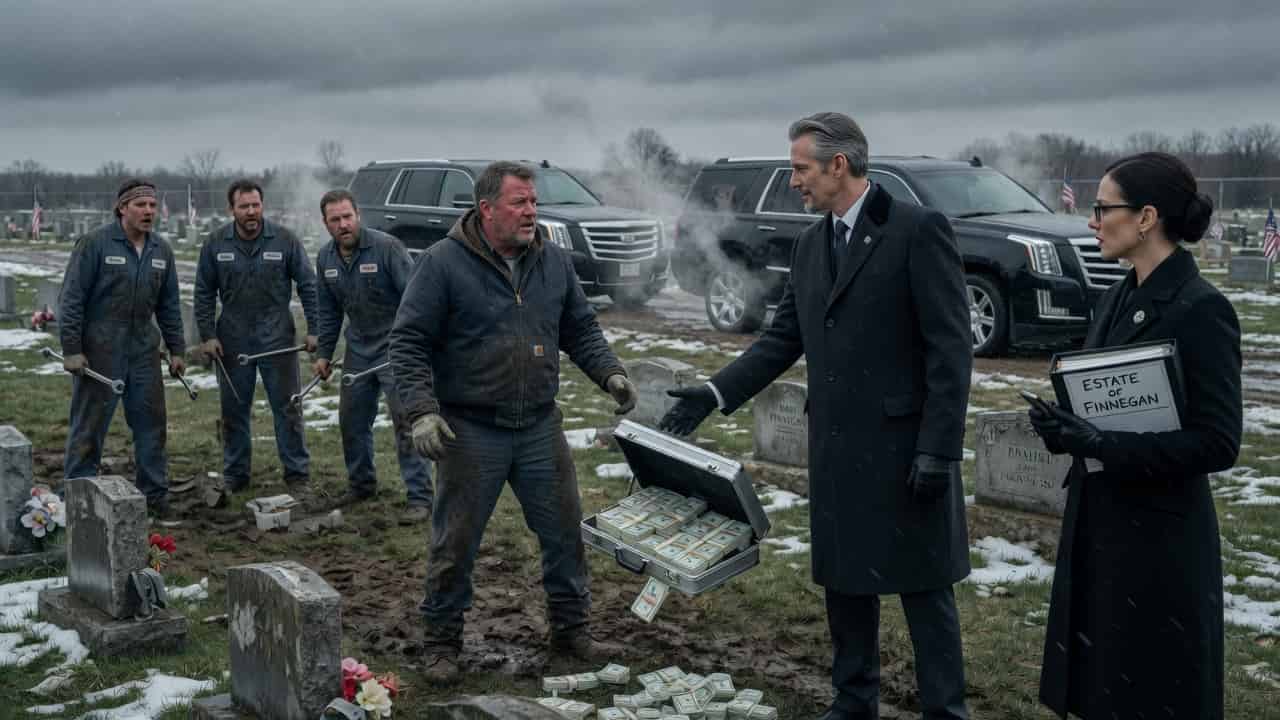
Then the black SUVs rolled onto the cemetery grass.
He tossed the briefcase into the mud. The latches popped. More money than I’d ever see in ten lifetimes sat there, getting wet in the sleet.
“Sign the papers. Take the cash. Walk away and forget you ever knew her,” he said, his voice as cold as the wind coming off the lake. “Or I will spend more money ruining you than it would cost to buy this entire pathetic town.”
I looked at the thick stack of legal documents his lawyer was holding. I looked at my friends, the men I’d worked beside for fifteen years, watching this man treat me like trash in front of the woman I loved.
But then I saw the name on the top of the page. Annie wasn’t a runaway. She was the majority shareholder of the biggest energy empire in the country. And by marrying me, she’d handed me the keys to his kingdom.
He thinks he’s buying my silence. He has no idea I’m about to dismantle his life with a crescent wrench.
Chapter 1
The mud in Northeast Ohio has a specific kind of bite in November. It’s not just wet; it’s a grey, heavy slurry that smells like iron and dying grass. It clings to everything—your boots, your tires, your spirit. I stood by the fresh mound of earth, my hands shoved deep into the pockets of a Carhartt jacket that had seen better decades. The headstone was a temporary thing, a small plastic marker until the real stone could be carved and delivered.
Annie Finnegan.
That was the name we’d lived with for twelve years. It was a name that meant cheap diners on Friday nights, the smell of lavender detergent, and the way she’d laugh when I’d come home with grease smudged across my forehead. To me, that name was everything. To the men in the black SUVs currently idling on the cemetery’s narrow gravel path, that name was an inconvenience.
The engines didn’t stop. They just hummed, a low-frequency vibration that rattled the few remaining leaves on the oaks. Then, the doors opened in perfect synchronization.
Silas Vanguard stepped out first. He looked like he’d been edited into the landscape by someone who hated rural Ohio. His overcoat was a dark, expensive wool that seemed to repel the mist. His shoes, polished to a mirror finish, didn’t seem to touch the slush as he walked toward me. Behind him was a woman in a sharp suit and two men who looked like they were built out of granite and bad intentions.
“Huck, I assume?” Silas said. His voice was cultured, the kind of voice that had never had to shout to be heard.
I didn’t look at him. I looked at the mud. “It’s a private service, pal. You’re about three days late for the public one.”
“There was nothing public about my sister’s life for the last decade,” Silas said, stopping six feet away. He didn’t offer a hand. He just surveyed me with a look of clinical distaste, his eyes lingering on the oil stains on my sleeves and the grit under my fingernails. “She always did have a flair for the dramatic. Living in a trailer, marrying… this. It was the ultimate middle finger to our father.”
I felt the heat rise in my neck. It was a slow, dangerous burn. “Annie didn’t have a brother. She told me she grew up in the system, just like me.”
“Annie lied,” Silas said simply. He gestured to the woman behind him—Brenda, I would later learn. She stepped forward, clicking open a heavy aluminum briefcase. Inside, bound in rubber bands, were stacks of hundred-dollar bills. It looked like a movie prop. It didn’t look real. “She was a Vanguard. One of the Vanguards. And while she might have enjoyed her little vacation into the working class, the vacation is over. She’s gone, and we need to tidy up the mess she left behind.”
He tipped the briefcase forward. A few of the stacks shifted, sliding toward the edge.
“Five million dollars, Huck. It’s more than you’d earn in five lifetimes fixing rusted-out Chevys in this godforsaken hole. All you have to do is sign a few papers stating the marriage was never consummated, a legal formality, and walk away. You forget the name Annie Vanguard, and we forget you ever existed.”
I looked at the money. Then I looked at Silas. I thought about the three years of medical bills sitting on my kitchen table. I thought about the bank’s third “final notice” on the shop. I thought about the way Annie used to hold my hand when the pain got bad, telling me that we were going to be okay because we had each other.
“She wasn’t a hobby,” I said, my voice thick. “She was my wife.”
Silas let out a short, sharp laugh that sounded like a dry branch snapping. “She was playing a part, Huck. She was a billionaire’s daughter slumming it to prove a point. You were the prop. Don’t confuse a summer fling that lasted too long with a life. Look at yourself. Look at this place. You really think a woman like her chose this? She was hiding. And you were the best camouflage money couldn’t buy.”
He stepped closer, the smell of his expensive cologne cutting through the scent of the wet earth. He pointed a gloved finger at the center of my chest, right over my heart. “Sign the papers, grease monkey. Or I will spend ten times that amount making sure you lose the shop, the trailer, and every scrap of dignity you think you have left. Don’t be a hero. You’re out of your depth.”
Behind me, I heard the crunch of gravel. My crew—Arlo, Pete, and Big Sal—had seen the SUVs from the road. They were standing there now, wrenches and crowbars in hand, looking at the suits with the kind of quiet, simmering violence that only comes from men who work for a living.
The power dynamic in the room—well, the field—shifted. Silas glanced at them, his lip curling in contempt, but he didn’t back down. He just looked at me, waiting for the break.
“The money stays in the case,” I said, finally meeting his eyes. “And you get off this grass before I let my boys show you how we handle trash in this county.”
Silas closed the case with a metallic thud. He didn’t look angry; he looked bored. “Fine. We’ll do it the hard way. Brenda, give him the gift.”
The lawyer stepped forward and handed me a thick, white binder. It was five hundred pages if it was one. “What is this?” I asked.
“It’s the reason I’m going to destroy you, Huck,” Silas said as he turned back toward his Escalade. “It’s my sister’s trust. And unfortunately for both of us, she forgot to change the beneficiary before she died. You own forty percent of Vanguard International. But don’t get excited. By this time next week, I’ll have made that paper worth less than the mud on your boots.”
He got into the car. The door shut with a heavy, pressurized seal. As the SUVs roared to life and pulled away, throwing slush onto the plastic marker of Annie’s grave, I stood there holding the weight of a billion dollars in my calloused hands.
Chapter 2
The shop felt smaller that night. Usually, the smell of WD-40 and old oil was a comfort, the scent of a world I understood. But as I sat in my cramped office, the white binder sitting on my desk like an unexploded bomb, the walls seemed to be closing in.
Old Man Miller was leaning against the doorframe, chewing on a toothpick. He’d owned the land the shop sat on for forty years, and he’d been threatening to evict me since the day I took over the lease. But he hadn’t. Not even when I was three months behind during Annie’s chemo.
“Those boys in the suits looked like they meant business, Huck,” Miller said, his voice a gravelly rasp. “You get yourself into some trouble?”
“Inherited it, apparently,” I muttered. I flipped open the binder. The first page was a blur of legalese—Vanguard Family Irrevocable Trust, Section IV, Paragraph 12. It was a foreign language. I’d barely finished high school before hitting the road. I knew how to rebuild a transmission blindfolded, but this? This made me feel small.
“They offered me five million to walk away,” I said.
Miller whistled. “That’s a lot of transmissions, son. Why didn’t you take it?”
“Because he called her a ‘hobby’, Miller. He called me a ‘grease monkey’ and told me she never loved me. He told me the last twelve years were a game she was playing to piss off her old man.”
Miller spat the toothpick onto the concrete. “Rich folks. They think everything’s a transaction. They can’t imagine someone doing something just ’cause it’s right. Or ’cause they love somebody.” He paused, looking at the binder. “So, what’s in the book?”
“Power,” I said, reading a line that Brenda had highlighted in yellow. “Voting rights. It says here that upon the death of the primary beneficiary—that’s Annie—all voting shares and board seats transfer to the legal spouse. Me.”
“A mechanic running a billion-dollar company,” Miller chuckled, though there was no humor in it. “They’re gonna kill you, Huck. Or worse. They’re gonna sue you until you’re living under a bridge.”
“Let ’em try,” I said, but my heart wasn’t in it.
The psychological toll was starting to settle in. Every memory I had of Annie was being rewritten in my head. The time we ran out of gas in Kentucky and had to sleep in the car—did she have a credit card in her shoe she didn’t tell me about? The way she’d insist on mending her own clothes—was that just her playing at being poor? I looked at a photo of us on the desk, taken at a county fair five years ago. She was wearing a five-dollar sundress and eating a corn dog, her eyes bright and genuine.
Was it all a lie?
The bell on the shop door rang, a harsh jangle that set my nerves on edge. I expected Silas, but it was Brenda. She was alone this time, her sharp heels clicking on the oil-stained floor. She looked around the shop with a scripted look of pity.
“Mr. Finnegan,” she said, her voice professional and cold. “I’m here to offer a final chance for a settlement. Silas is… impatient. He’s already filed an injunction to freeze the shares, citing ‘undue influence’ and ‘fraudulent marriage’.”
I stood up, my chair scraping harshly against the floor. “There was no fraud. We were married in a courthouse in Vegas. It’s as legal as it gets.”
“In the world Silas lives in, ‘legal’ is a flexible concept,” Brenda said. She walked over to a half-finished engine block, pulling a white silk handkerchief from her pocket to wipe a smudge of dust from her sleeve. “Look at this place, Huck. It’s a tomb. You’re drowning in debt. We’ve already contacted your bank. They’re calling in your business loan on Monday morning. You have forty-eight hours to vacate the premises.”
The air left the room. “You can’t do that.”
“We didn’t do it. We simply pointed out to the bank that your primary co-signer—your wife—is deceased and had no verifiable income or assets under the name ‘Annie Finnegan’. The risk profile changed. They’re within their rights.” She stepped closer, her eyes scanning the shop. “Your friends are out there watching, aren’t they? The ones with the wrenches? Tell me, Huck, how are you going to pay them on Friday? How are you going to look them in the eye when the locks are changed?”
She was good. She knew exactly where to twist the knife. The humiliation wasn’t just about the money; it was about the social fabric of my life. She was stripping away my standing as a man who took care of his own.
“Get out,” I said, my voice shaking.
“The offer is down to three million now,” Brenda said, turning toward the door. “By tomorrow morning, it will be one. By Monday, it will be nothing but a pile of legal fees you can’t afford. Silas doesn’t just want the shares, Huck. He wants to prove he was right about you. He wants to see you break.”
She left, and the silence that followed was heavier than the engine block. I walked out into the main bay. Arlo and Pete were standing there, their faces shadowed. They’d heard every word.
“Is it true, Huck?” Arlo asked. “The bank’s coming?”
“They’re trying,” I said, wiping my hands on a rag that was already too dirty to do any good. “But they haven’t met me yet. And they sure as hell didn’t know Annie.”
I realized then that Silas had made a mistake. He thought he was fighting a man who wanted money. He didn’t realize he was fighting a man who had nothing left to lose but the memory of the woman who saved him.
Chapter 3
I spent the next morning at the public library in town. It was a brick building that smelled of old paper and damp coats. I sat at a computer in the corner, my large, scarred fingers clumsy on the keyboard.
Vanguard International.
The search results were overwhelming. It wasn’t just a company; it was a ghost. They owned pipelines, shipping lanes, tech patents. And at the center of it was a family tragedy. “The Lost Heiress,” the headlines called her. Anne-Marie Vanguard. Disappeared ten years ago after a blowout fight with her father, the late patriarch. She’d been declared dead in absentia three years back.
There were photos of her. Young, polished, wearing pearls and a smile that didn’t reach her eyes. It was Annie, but it wasn’t. My Annie had messy hair and laughed with her whole body. This girl looked like she was made of glass.
The psychological weight shifted again. She hadn’t just been hiding from her family; she’d been hiding from a version of herself she hated. And she’d chosen me as her sanctuary. The “grease monkey” wasn’t a prop; I was the only thing that was real to her.
A shadow fell over the desk. I looked up to see a man in a rumpled suit. He looked like he’d slept in his car, and he was carrying a stack of files that looked like they were held together by prayer.
“Huck Finnegan?” he asked.
I tensed. “Who’s asking?”
“Name’s Miller. Not the landlord, no relation. I’m a lawyer. Well, I was. Now I’m mostly a nuisance.” He sat down uninvited. “I heard what happened at the cemetery. News travels fast when black SUVs start invading local graveyards.”
“You work for Silas?”
“God, no. Silas Vanguard is the reason I lost my firm ten years ago. I represented a group of landowners he tried to swindle out of mineral rights. He didn’t just win; he erased me.” He tapped the computer screen. “You’re sitting on a nuclear weapon, Huck. That trust? It’s the only thing keeping Silas from total control. He’s the CEO, but the voting power Annie held… it’s the check and balance. If you sign those waivers, he can sell the company off in pieces, fire thirty thousand people, and walk away with a ten-billion-dollar golden parachute.”
“I don’t want to run a company,” I said. “I just want my shop.”
“You can’t have one without the other anymore,” the lawyer said. “Silas has already started the process. He’s not just coming for your business. He’s coming for your reputation. He’s going to paint you as a predator who took advantage of a mentally ill woman.”
I felt a cold shiver go down my spine. “She wasn’t mentally ill.”
“Doesn’t matter what she was. It matters what he can prove in a courtroom he owns.” He leaned in closer. “There’s a board meeting on Tuesday in Chicago. It’s the annual shareholder vote. If you show up—and I mean physically show up—with that binder and the marriage certificate, he can’t move. He’ll be paralyzed.”
“I’ve never been further west than Indianapolis,” I said.
“Then it’s time for a road trip,” he replied.
I went back to the shop that afternoon to pack a bag. But the SUVs were there again. Not just the Escalades this time, but a tow truck. They were hooking up my service van.
“Hey!” I yelled, running toward them. “What the hell are you doing?”
Silas was standing there, leaning against a sleek silver Porsche I hadn’t seen before. He was holding a piece of paper. “Repo order, Huck. Like I said, the bank called the loan. You’re in default.”
A crowd was gathering. People from the diner across the street, the guys from the hardware store. They were watching me get dismantled in broad daylight.
“You’re a real piece of work, Silas,” I said, stopping a few feet away. My breath hitched in my chest. “You really hate that she loved me, don’t you? You hate that she’d rather live in a trailer with a ‘grease monkey’ than spend another minute in a house with you.”
Silas’s face didn’t change, but his eyes darkened. He walked over to the tow truck driver and whispered something. The driver nodded and pulled a lever. My van—the one Annie and I had used to drive to the lake every summer—was hoisted into the air.
“This isn’t about love, Huck. It’s about order,” Silas said. He turned to the crowd, raising his voice so everyone could hear. “This man is a liar! He’s trying to claim he’s the heir to a fortune he didn’t earn! He’s a bottom-feeder trying to pick the bones of a dead woman!”
The humiliation was a physical weight. I could see the doubt in the eyes of my neighbors. They knew me, but the lure of a billion-dollar scandal was too much. They wanted to believe the story Silas was telling because it was more exciting than the truth.
“I have the papers, Silas!” I shouted back. “I have the trust!”
“You have a pile of scrap paper,” Silas sneered. He walked up to me, his face inches from mine. “You’re nothing. You’re a footnote. And by the time I’m done, you won’t even be able to get a job sweeping floors in this county. Sign the papers, or I’ll take the shop next. Then the trailer. Then I’ll dig her up and move her to a grave you’ll never find.”
That was the moment the residue of grief turned into the steel of resolve. I didn’t swing. I didn’t shout. I just looked at him, really looked at him, and saw the panic beneath the polish. He wasn’t powerful; he was desperate.
“Miller,” I called out.
The rumpled lawyer stepped out from behind my shop. “Yeah, Huck?”
“Get the car ready,” I said, never taking my eyes off Silas. “We’re going to Chicago.”
Chapter 4
The diner was called “The Rusty Hub,” and it was the kind of place where the coffee was strong enough to peel paint and the gossip was even stronger. I sat in the corner booth on Sunday morning, the day before we were supposed to leave. I needed to eat, but the eggs on my plate looked like rubber.
I was waiting for Old Man Miller. He’d called and said he had something I needed to see.
The door opened, and a hush fell over the room. It wasn’t Miller. It was Silas. He was alone this time, no lawyers, no guards. He looked out of place in his charcoal suit against the wood-paneled walls and the smell of fried bacon. He scanned the room until he saw me, then walked over and sat down in the booth opposite me.
“You’re persistent, I’ll give you that,” Silas said. He didn’t order anything. He just sat there, looking at me with that same clinical detachment.
“I’m a mechanic, Silas. We don’t stop until the job’s done.”
“The job is over, Huck. I’ve made a few calls. Your lawyer friend? The one with the rumpled suit? He’s currently being investigated for bar violations. If he steps foot in that board meeting, he’ll be arrested.”
I felt the air grow thin again. “You can’t just make things happen because you want them to.”
“Oh, but I can. That’s what you don’t understand. Power isn’t about having the right papers. It’s about having the right people. And I have all of them.” He leaned forward, his voice dropping to a whisper. “Do you know what Annie called you in her journals? The ones I found in the house she kept in Vermont? The one you didn’t know about?”
I froze. “She didn’t have a house in Vermont.”
“She did. A beautiful place on the lake. She went there twice a year while you thought she was ‘visiting her aunt in Dayton’. She called you her ‘anchor’. But not the kind that keeps you safe. The kind that keeps you dragged down in the mud. She wrote about how much she missed the music, the wine, the conversation. She wrote about how hard it was to pretend to be interested in your stories about carburetors and high school football.”
The words hit me harder than any fist. It was the ultimate betrayal of the memory. The idea that she was bored. That she was faking it. The psychological residue of his words began to coat every good memory I had in a layer of grime.
“You’re lying,” I said, but my voice lacked conviction.
“Am I? Go to Chicago, Huck. Show up in that room with your grease-stained hands and your cheap suit. Watch them laugh at you. Watch them look at you and see exactly what you are: a mistake my sister made while she was trying to find herself. You think you’re honoring her? You’re the punchline to her life’s joke.”
He stood up and tossed a single sheet of paper on the table. It was a photo. Annie, in a black dress, standing on a balcony overlooking a lake. She looked beautiful. She looked sophisticated. And she looked completely at home.
“That was taken eighteen months ago,” Silas said. “The week you thought she was at a ‘knitting retreat’. She was at a gala for the symphony.”
He walked out, leaving the photo on the table. I picked it up, my hand shaking. The woman in the photo was a stranger. But then I looked closer. I looked at her wrist.
She was wearing the twenty-dollar copper bracelet I’d made for her in the shop for our tenth anniversary. It was crude, hammered out of an old pipe, but she’d never taken it off. Even in a black silk dress, surrounded by billionaires, she was wearing my work.
I felt a surge of warmth that pushed back the coldness of Silas’s words. He’d tried to use the photo to break me, but he’d accidentally given me the one thing I needed: proof that she hadn’t let go.
I stood up, the photo gripped tight in my hand. The entire diner was watching. I walked over to the counter where Brenda was sitting—she’d clearly been waiting for Silas.
“You can tell your boss something for me,” I said, my voice ringing out in the quiet room.
She looked up, startled. “What’s that?”
“Tell him he’s right. I am a grease monkey. And I’ve spent my whole life taking apart things that were built wrong. On Tuesday morning, I’m going to start taking apart his company. And I’m going to start with him.”
I walked out of the diner, leaving the bill unpaid for the first time in my life. I had a billion-dollar inheritance to claim, and for the first time, I didn’t feel like I was out of my depth. I felt like I was exactly where I was supposed to be.
The rescue force wasn’t coming from Chicago. It was coming from the shop. As I pulled into the lot, I saw Arlo, Pete, and Big Sal. They’d spent the night working on an old 1970 Chevelle that had been sitting in the back of the bay for years. It was polished, the engine humming with a deep, predatory growl.
“We figured if you’re going to a board meeting,” Arlo said, wiping a smudge off the hood, “you should arrive in something they can hear coming from three blocks away.”
I looked at my friends, then at the shop, then at the road leading toward the highway. The war had officially begun.
Chapter 5
The 1970 Chevelle didn’t just drive; it announced itself. The 454 big-block under the hood had a lope to it that vibrated through the floorboards and settled right into my teeth. Arlo and the guys had spent the better part of forty-eight hours tuning it, scrubbing the grime off the chrome, and making sure the black paint shone like a fresh bruise. It was a beautiful, angry piece of machinery, and as we crossed the state line into Indiana, it was the only thing making me feel like I wasn’t heading toward my own execution.
Miller—the rumpled lawyer, not the landlord—was jammed into the passenger seat. He looked even more out of place in the car than I did. He was wearing a suit that looked like it had been folded into a suitcase back in 1994 and never touched again. He spent most of the drive clutching a battered leather briefcase and staring at the passing cornfields with a look of pure, unadulterated terror.
“You okay, Miller?” I asked, shifting into fourth. The car lunged forward, the exhaust note deepening into a growl.
“I’m fine, Huck,” he said, though his voice was an octave higher than usual. “I’m just contemplating the various ways Silas Vanguard can have us disappeared. Did you know he has a private security force that’s larger than the police department of most mid-sized cities? They call them ‘Risk Management’. It’s a very clean name for people who break very dirty things.”
“He’s one man,” I said, though I didn’t believe it. “He puts his pants on one leg at a time.”
“Yeah, but his pants cost more than your shop, and the guy who holds them for him has a black belt in three different ways to kill a man with a fountain pen,” Miller muttered. He reached into his briefcase and pulled out a stack of papers. “We need to go over the strategy again. The Board of Directors meeting is at ten. They’re meeting on the sixty-fourth floor of Vanguard Plaza. It’s a restricted floor. We can’t just walk in.”
“I have the trust document,” I said, glancing at the white binder sitting on the back seat. “The law says I have a seat at that table.”
“The law is a suggestion when you’re dealing with that much zeros, Huck,” Miller said, his face hardening. “Silas has been running that company like a fiefdom since their father died. He’s got half the board in his pocket and the other half scared of their own shadows. He’s going to try to bar you from the building. He’ll claim the marriage is under investigation for fraud. He’ll call the police. He’ll do whatever it takes to keep you from speaking before the vote.”
“What vote?”
“The divestment,” Miller said. “He wants to sell off the domestic energy wing—the part that actually employs people in places like Ohio—to a private equity group in Dubai. It’ll net him and his cronies billions, but it’ll gut the company’s long-term stability. Annie… Anne-Marie… she was the only one who had the voting weight to stop him. That’s why she fled. She knew he’d try to force her to sign off on it.”
I looked out at the flat, grey horizon. The weight of it was starting to press down on me. I wasn’t just fighting for a shop or a house anymore. I was holding the livelihoods of thousands of people in a white binder. I thought about the guys back home. Arlo, whose wife was expecting their third. Pete, who was looking after his sick mother. Big Sal, who just wanted to retire with enough for a fishing boat.
They were everywhere. In every town, in every state. People just trying to keep the lights on while men like Silas moved numbers around on a screen like they were playing a game of Monopoly.
“She knew,” I whispered.
“What?”
“Annie. She knew this was coming. That’s why she lived the way she did. She wasn’t ‘slumming it’, Miller. She was hiding the keys to the kingdom where he’d never think to look. With a guy who didn’t know what a dividend was.”
We hit the Chicago outskirts as the sun began to set, a dull orange glow reflecting off the steel and glass of the skyline. The city felt like a different planet. The traffic was a frantic, aggressive mess of Teslas and Mercedes, all of them swerving around the loud, black Chevelle like it was an invasive species. I felt the insecurity creeping back in—the “grease monkey” shame Silas had tried so hard to cultivate. I looked at my hands, the callouses thick, the faint traces of engine oil that never truly came out of the skin. I didn’t belong here.
We checked into a motel on the edge of the city. It was the kind of place that charged by the hour if you weren’t careful, but it was all we could afford after Silas froze my accounts. We spent the night in a room that smelled of stale cigarettes and industrial cleaner, huddled over the trust documents by the light of a flickering bedside lamp.
“Here,” Miller said, pointing to a clause on page 342. “This is it. ‘In the event of the primary beneficiary’s passing, the successor trustee shall have immediate and irrevocable proxy for all Class A voting shares.’ It doesn’t say ‘after a court hearing’. It doesn’t say ‘pending investigation’. It says immediate.”
“So I just walk in and say I’m the boss?”
“Basically. But you have to get into the room first. Once you’re in, and there are witnesses—other board members, the corporate secretary—it becomes a matter of public record. Silas can’t hide it then. He can’t make you disappear if everyone sees you holding the steering wheel.”
Around 2:00 AM, I went out to the parking lot to check on the car. The city was never quiet; the distant hum of the “L” train and the constant siren wails felt like a headache that wouldn’t quit. I leaned against the fender of the Chevelle and pulled out the photo Silas had given me in the diner.
Annie on the balcony. She looked so far away.
I closed my eyes and tried to remember the last night we’d had together before she went into the hospital for the final time. We’d sat on the porch of the trailer, sharing a single beer because we were broke, watching the lightning bugs. She’d put her head on my shoulder and said, “Huck, if things ever get loud, promise me you’ll just keep turning the wrench. Don’t let the noise stop you.”
I hadn’t understood what she meant then. I thought she was talking about the shop, about the debt. Now I realized she was talking about this. About the sirens and the suits and the billion-dollar lies.
“I promise, Annie,” I whispered to the empty parking lot.
The next morning, I put on the suit Miller had found for me at a thrift shop. It was a dark charcoal, slightly too big in the shoulders, but it was clean. I tied my tie the way my foster father had taught me twenty years ago—clumsy and thick. I looked in the cracked mirror of the motel bathroom. I didn’t look like a billionaire. I looked like a man going to a funeral. Which, in a way, I was.
We drove into the heart of the Loop. Vanguard Plaza was a needle of black glass that seemed to pierce the sky. It was surrounded by a plaza of white marble, guarded by men in tactical gear who looked like they were expecting a small war.
“You ready?” Miller asked. He was sweating, his face pale.
“No,” I said, cutting the engine. The silence that followed the Chevelle’s roar was deafening. “But I’m going in anyway.”
We walked toward the entrance. The air was cold, a sharp wind whipping off Lake Michigan. As we reached the revolving doors, two of the guards stepped forward, their hands resting on their belts.
“Identification,” one of them said. He was younger than me, his eyes hidden behind polarized sunglasses.
“Huck Finnegan,” I said, my voice steadier than I felt. “I’m here for the board meeting.”
The guard didn’t even check his clipboard. He just touched his earpiece. “We have the subject at the south entrance. Moving to intercept.”
Before I could react, four more men in suits appeared from the lobby. They didn’t look like guards; they looked like hunters. They moved with a synchronized efficiency that told me Miller was right—these were the “Risk Management” boys.
“Mr. Finnegan,” the lead man said. He was tall, with a scar running through his eyebrow. “Mr. Vanguard has indicated that you are not permitted on the premises. You are currently trespassing. If you do not leave immediately, we will use force to remove you.”
“I’m a shareholder,” I said, holding up the white binder. “I have a legal right to be in that meeting.”
“We don’t care about the binder,” the man said, stepping into my personal space. He smelled of nothing—no cologne, no sweat, just cold air. “We care about the order. Move.”
Miller tried to step forward. “Now, listen here, according to the Illinois Corporate Act—”
The man didn’t even look at Miller. He just shoved him back, a quick, violent burst of movement that sent the lawyer sprawling onto the marble. The briefcase flew open, scattering papers into the wind.
“Hey!” I yelled, reaching out to help Miller.
The man grabbed my arm. His grip was like a steel vice. “Last warning, grease monkey. Go back to your trailer while you still have all your teeth.”
The humiliation was instant. People in the plaza were stopping to watch. Elegant women in fur coats, men in tailored suits, all of them looking at the rough-looking guy in the ill-fitting suit being manhandled by security. I felt that old familiar shame—the feeling of being the kid with the dirty face in the back of the classroom.
But then I felt the weight of the copper bracelet in my pocket. I’d taken it off Annie’s wrist before they closed the casket.
I didn’t fight him. Not the way he expected. I didn’t swing. I just looked him dead in the eye and leaned in, my voice a low, dangerous rumble.
“You know what happens when a bolt gets stripped?” I asked him.
The man blinked, confused by the question. “What?”
“It gets stuck. And the only way to get it out is to break the whole damn thing. You think you’re holding me back? You’re just making sure that when I move, I’m taking the whole wall with me.”
I didn’t wait for him to respond. I turned and walked back to the Chevelle.
“Huck! What are you doing?” Miller scrambled to his feet, frantically grabbing his papers. “We can’t just leave! The meeting starts in ten minutes!”
“We aren’t leaving,” I said, getting into the driver’s seat. “We’re just changing the entrance.”
I started the engine. The roar echoed off the marble walls of the plaza like a gunshot. The guards moved toward the car, but they were too slow. I shifted into reverse, backed up fifty yards into the center of the street, ignoring the blaring horns of the taxis.
“Huck, no…” Miller whispered, realization dawning on his face. “Huck, that’s a landmark building!”
“Then it’s about to get a new landmark,” I said.
I slammed the car into first, floored the accelerator, and dumped the clutch. The rear tires screamed, sending a cloud of blue smoke into the air as the Chevelle lunged forward. I wasn’t looking at the guards. I wasn’t looking at the glass. I was looking at the sixty-fourth floor.
I hit the plaza curb at forty miles per hour. The suspension groaned, but the heavy American steel held. The guards dived out of the way as the black car tore across the white marble, a dark streak of lightning headed straight for the massive, floor-to-ceiling glass windows of the lobby.
I didn’t flinch. I didn’t brake.
The glass didn’t just break; it exploded. A million diamonds of tempered crystal showered the lobby as the Chevelle skidded across the polished floor, the tires shrieking on the stone before I slammed on the brakes. I came to a stop exactly three feet from the gold-plated reception desk.
The silence that followed was absolute. The lobby was filled with dust and the smell of burnt rubber. The receptionists were frozen, their mouths open in silent screams. The guards were scrambling through the shattered opening, but they were a world away.
I opened the door and stepped out, the white binder tucked under my arm. I straightened my tie.
“I’m here for the board meeting,” I said to the girl behind the desk. “Which way to the elevators?”
Chapter 6
The elevator ride was the longest thirty seconds of my life. Miller was leaning against the back wall, his eyes squeezed shut, his chest heaving. He hadn’t said a word since we crashed through the glass. He just looked like a man who had accepted that his life was over and was now just waiting for the paperwork to be filed.
I watched the numbers climb. 20… 40… 60…
The doors slid open with a soft, expensive chime.
The sixty-fourth floor was a world of hushed tones and deep carpets. The walls were paneled in rare woods, and the air was filtered and cooled to a perfect, lifeless temperature. It felt like the inside of a vault.
A secretary—a woman in her sixties who looked like she’d been carved out of ivory—stood up from a mahogany desk. She looked at me, then at the grease smudge on my cheek, then at Miller’s disheveled suit.
“You can’t be here,” she said, her voice trembling slightly. “The meeting is closed.”
“I’m Huck Finnegan,” I said. “And I don’t think you want to be the one who explains to the SEC why the majority shareholder was kept out of a divestment vote.”
I didn’t wait for her to answer. I walked toward the double oak doors at the end of the hall. I could hear the muffled sound of a man’s voice—Silas. He was giving a speech.
“…and by streamlining our domestic interests, we ensure a leaner, more aggressive Vanguard for the next decade. The legacy of our father isn’t in the oil fields of Ohio; it’s in the global reach of our capital.”
I pushed the doors open.
The room was a cathedral of corporate power. Twenty men and women sat around a table that looked like it had been fashioned from a single redwood tree. At the head of the table sat Silas. He was leaning back, a glass of water in front of him, looking every bit the king of the mountain.
The silence hit the room like a physical blow. Every head turned. Silas froze mid-sentence, his eyes widening as he saw me. He looked at my suit, then at Miller, then at the binder.
“Huck,” he said, his voice dropping to a dangerous whisper. “I believe there’s been a misunderstanding. Security should have escorted you to the exit.”
“The exit was blocked,” I said, walking toward the empty chair at the far end of the table—the one with a small brass plaque that read A. Vanguard. “So I made my own.”
One of the board members—a silver-haired man in a three-piece suit—stood up. “Who is this? Silas, what is the meaning of this interruption?”
“This is the ‘hobby’ I told you about,” Silas said, recovering his composure. He stood up, smoothing his tie. “A local mechanic from Ohio who is under the impression that he has a claim to his late wife’s estate. It’s a tragic situation, really. Grief can do strange things to the uneducated mind.”
The room rippled with a wave of condescending pity. I could see the board members looking at me like I was a stray dog that had wandered into a gala.
“I’m not here for the estate, Silas,” I said, pulling the chair out and sitting down. The wood felt cold beneath me. I placed the binder on the table with a heavy thud. “I’m here for the vote.”
“There is no vote for you, Mr. Finnegan,” Brenda said, appearing from the shadows behind Silas. She looked at me with pure, unadulterated venom. “The shares are frozen. We filed the injunction this morning.”
Miller finally stepped forward, his voice cracking but holding steady. “The injunction was filed on the basis of ‘fraudulent marriage’, which requires a hearing. Under Section 12-B of the Vanguard Trust, the successor trustee holds voting proxy until such time as a court of law—not a corporate board—decides otherwise. You can freeze the dividends, Silas. But you can’t freeze the voice.”
Silas’s jaw tightened. I could see the muscles in his neck cording. He looked around the room, seeing the flicker of doubt in the eyes of a few board members. They were sharks; they smelled blood in the water, even if it was Silas’s blood.
“Even if you have the proxy, Huck,” Silas said, leaning over the table, “you don’t have the standing. You don’t know the business. You don’t know the numbers. You’re going to sit there and tell these people—people who have built empires—how to run a global conglomerate? You can’t even keep your own shop from foreclosure.”
The humiliation was a sharp, cold needle. He was right. I didn’t know the numbers. I didn’t know the strategy. I was just a guy who fixed cars.
“You’re right, Silas,” I said, my voice quiet. The room went still. “I don’t know about global conglomerates. I don’t know about ‘divestment’ or ‘leveraged buyouts’. But I know about Annie.”
I stood up and walked toward him. Silas didn’t move, but he braced himself.
“Annie didn’t leave because she hated the money,” I said, looking at the board. “She left because she hated the lies. She spent twelve years with me in a town you’d never visit, living a life you’d call ‘pathetic’. But in those twelve years, she taught me something. She taught me that the only thing that matters is what you leave behind when you’re gone. Not the money. Not the buildings. The people.”
I reached into my pocket and pulled out the copper bracelet. I laid it on the table in front of Silas.
“You told me she was slumming it. You told me I was a hobby. But she wore this every day for ten years. She wore it when she was sick. She wore it when she was dying. And she wore it in that photo you showed me—the one where she was surrounded by people like you.”
I looked at the silver-haired board member. “You have a vote today to sell off the Ohio plants. To fire four thousand people so you can buy a bigger yacht. My wife—your majority shareholder—would have said no. And since I’m the only one in this room who actually knew what she wanted, I’m saying it for her.”
“This is sentimental garbage!” Silas shouted, his composure finally shattering. He slammed his hand on the table. “He’s a nobody! He’s a grease monkey from a trailer park! Security! Get him out of here!”
The doors opened, and the Risk Management team rushed in. They moved toward me, but before they could reach me, the silver-haired man spoke.
“Wait.”
He was looking at the copper bracelet. Then he looked at the trust binder. Then he looked at Silas.
“The law is clear, Silas,” the man said, his voice cold. “If the proxy is valid, the vote cannot proceed without his consent. And frankly… I’m tired of being told what my conscience should look like by a man who treats his own sister like a line item.”
The room shifted. It was subtle, but I felt it. The power was draining out of Silas and flowing toward the end of the table.
“You’re making a mistake, Arthur,” Silas hissed.
“No,” Arthur said, standing up. “I think we’ve been making the mistake for years. Mr. Finnegan, I believe you have the floor.”
The next hour was a blur. With Miller’s help, we dismantled Silas’s plan piece by piece. We didn’t use corporate jargon; we used the truth. We talked about the families in Ohio. We talked about the long-term debt Silas had hidden. We talked about the legacy Annie actually wanted to build.
By the time we were done, the divestment vote had been defeated 14 to 6.
Silas sat in his chair, his face a mask of pale fury. He’d lost. Not just the vote, but the room. The board members were already moving away from him, gravitating toward Arthur.
I walked over to Silas. He didn’t look up.
“The shop is staying open, Silas,” I said. “And the bank called me an hour ago. Apparently, an anonymous donor cleared my debt. I think it was the ‘hobby’ you mentioned.”
Silas finally looked up at me. There was no residue of the billionaire left. Just a man who had been beaten by the one thing he couldn’t buy: loyalty.
“You think this is over?” he whispered. “I’ll spend the rest of my life making sure you suffer.”
“You do that,” I said, picking up the copper bracelet. “But just so you know… I’m a mechanic. I’m used to working on things that are broken. And I think you’re the most broken thing I’ve ever seen.”
I walked out of the boardroom, Miller trailing behind me with a grin so wide it looked painful. We took the elevator down to the lobby. The Chevelle was still there, sitting in the middle of the shattered glass, surrounded by police and onlookers.
“You’re going to jail for the window, you know,” Miller said, though he didn’t seem to mind.
“I know,” I said. “It was worth it.”
They handcuffed me in front of the cameras. I didn’t fight them. I didn’t look down. I looked straight into the lens, thinking of Annie.
Six months later, I was back in the shop. The legal battle was still ongoing—Silas was fighting the trust in every court from Chicago to D.C.—but the shop was mine. The bank had backed off, and for the first time in years, the “Final Notice” pile was gone.
Arlo was under a truck, yelling for a 10mm socket. Big Sal was at the counter, complaining about the price of coffee. It was loud, it was greasy, and it was perfect.
I walked out to the back of the lot, to the old Chevelle. We’d fixed the frame and replaced the glass. It looked better than ever. I leaned against the fender and looked out at the Ohio horizon. The winter was coming, but the mud didn’t feel so heavy anymore.
I reached into my pocket and pulled out a small velvet box. Inside was a new headstone marker—not plastic, but solid Ohio granite. It was simple, with just two words carved into it.
Annie’s Husband.
I didn’t need the billions. I didn’t need the towers. I just needed the truth. And as I looked at the shop and the men I called brothers, I knew that Annie hadn’t just left me a company. She’d left me the strength to be the man she always knew I was.
I picked up my wrench and went back to work. There was a transmission in the bay that needed me, and in this world, that was the only thing that really mattered.