“Look at you, Elias. Crying over a bag of bones.”
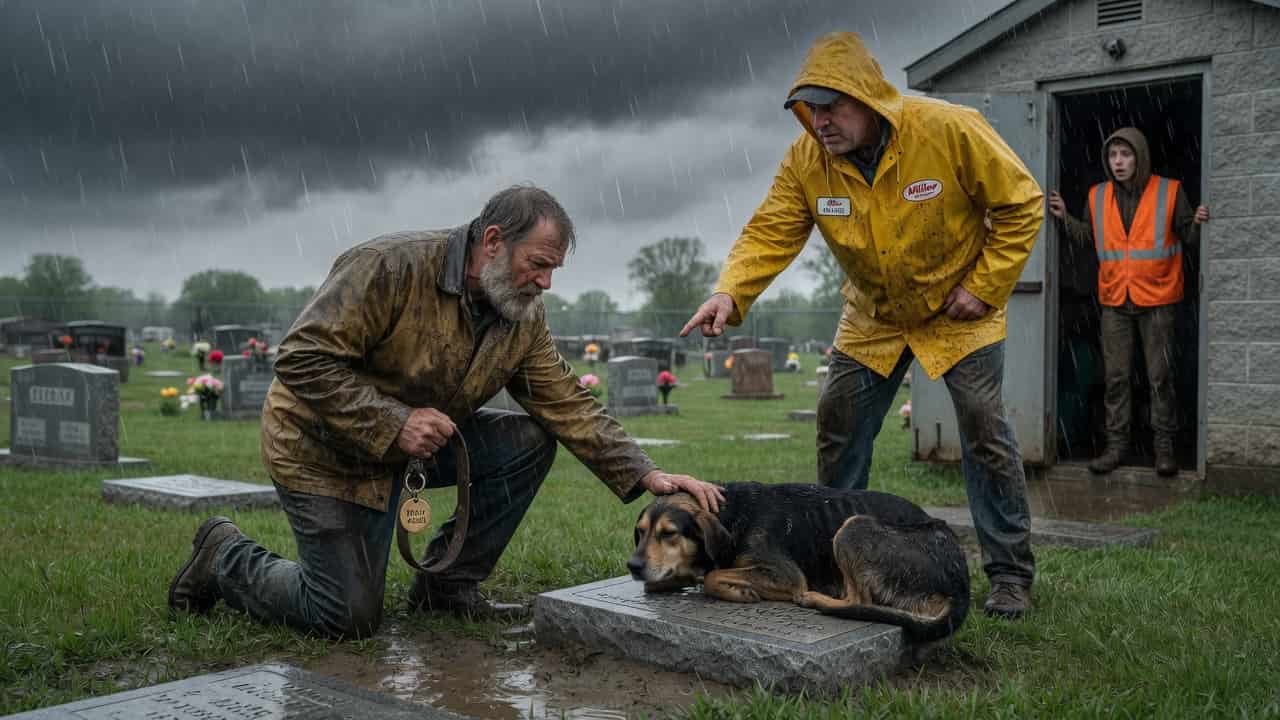
Elias didn’t look up. He couldn’t. His knees were buried in the mud of Section 4, the cold Ohio rain soaking through his canvas coat. Between his trembling fingers was a rusted brass tag, the name ‘Buster’ barely legible under the grime of three long years.
He had lost everything that night on the highway—his wife, his peace, and the dog he had blamed for running away. He had lived in a house of silence, nursing a resentment that had curdled into a slow, rotting shame. But here, curled on top of Martha’s headstone, was a skeleton of a dog that refused to move.
Clyde Miller stood over him, the yellow of his rain slicker a loud, ugly stain against the gray morning. Miller didn’t see a miracle. He saw a broken old man holding onto a lie.
“It’s him, Miller,” Elias whispered, his voice cracking. “Look at the tag. He stayed. He’s been here.”
Miller let out a jagged laugh, glancing back at the young groundskeeper watching from the shed. “It’s trash, Elias. The dog was a coward then, and it’s a stray now. Just like you, hanging around a place where nobody wants you.”
Elias gripped the collar so hard the rusted metal bit into his palm. He had spent three years hating the only thing that had actually stayed loyal to Martha. And now, with the town watching and his own daughter threatening to take his keys, he had to decide if he was strong enough to bring the truth home.
Chapter 1
The knees always went first. That’s what they told you when you started driving the long-haul routes out of Youngstown, but Elias hadn’t really believed them until he hit sixty. Now, at sixty-eight, his joints felt like they were filled with crushed glass and rusted nails. Every morning was a negotiation with his own skeleton. He’d sit on the edge of the mattress, his feet flat on the cold linoleum, and wait for the signal that his legs would actually hold him.
The house was too quiet. It had been too quiet for three years, seven months, and four days. He didn’t count the hours anymore because that was a young man’s game, and Elias was well past the point of pretending time was on his side. He made coffee in the dented percolator Martha had bought at a garage sale in 1994. It hissed and popped, the smell of burnt grounds filling the small kitchen. He took it black, standing by the window that looked out over the gravel driveway and the empty spot where his Peterbilt used to sit.
He’d sold the truck six months after the funeral. He couldn’t stand to look at it, a three-hundred-thousand-mile monument to the life he’d been living while Martha was getting her groceries. He’d been in a diner outside of Des Moines when the call came. A hit-and-run, the deputy had said. She’d been walking Buster along the shoulder of County Road 12. Martha was gone before the ambulance arrived. The dog, the deputy added with a hesitant note, was nowhere to be found.
Elias had spent two days looking. He’d walked the ditches with a flashlight, calling for the black-and-tan hound until his voice was a ragged scrap in his throat. He’d found a tuft of fur on a briar bush and a single paw print in the mud near the creek, but Buster was gone. He’d convinced himself the dog had bolted—that the sound of the impact and the scream of tires had sent the coward running for the woods while Martha lay there in the dark.
He hated the dog for that. He’d nursed that hate like a pilot light for three years. It was easier than hating the ghost of the driver who had never been caught.
“Morning, Elias,” a voice called out as he pulled his old F-150 into the gravel lot of the St. Jude’s Cemetery.
Elias squinted through the windshield. It was Sam, the kid who worked the grounds. He was barely out of high school, all lanky limbs and a nervous habit of kicking at the turf. He was wearing an orange vest that made him look like a wayward pylon against the gray Ohio sky.
“Sam,” Elias grunted, climbing out of the cab. His left knee buckled slightly, and he hissed through his teeth, grabbing the door frame for support.
“Heavy rain coming, sir,” Sam said, tilting his head toward the charcoal clouds rolling in from the west. “Section 4 gets pretty soft. You might want to get your visit in quick.”
“I know how the dirt works, Sam. I’ve been coming here longer than you’ve had a chin-strap.”
It was a sharp response, more than the boy deserved, but Elias felt the pressure of the day building in his chest. It was a Thursday. Thursday was the day they’d usually gone to the Grange for the fish fry. Now, it was just the day he spent an hour talking to a piece of granite.
He walked toward Section 4, his boots sinking into the damp earth. The cemetery was a sprawling, hilly place, filled with the names of families who had mined the coal and tilled the soil until there was nothing left of them but a date and a sentiment. Martha was near the back, under an old oak tree that dropped its leaves like copper pennies in the fall.
As he crested the final rise, he stopped.
There was something on the grave.
At first, he thought it was a pile of wet rags or maybe a dead branch the wind had brought down. But as he got closer, the shape shifted. A head lifted. A pair of milky, clouded eyes caught the dull light of the morning.
It was a dog. But not just any dog. It was a skeletal, shivering wreck of a creature, its ribs pushing against skin that looked like old parchment. It was curled precisely in the center of the mound, its chin resting on the base of the headstone.
Elias froze. His heart hammered a frantic rhythm against his ribs. “No,” he whispered. “No way.”
The dog didn’t growl. It didn’t bark. It just watched him with an exhausted, soul-deep weariness. It was black and tan, or it had been once. Now it was the color of mud and ash. Around its neck was a thin, frayed strip of leather, so tight it looked like it was part of the animal’s throat. Hanging from it was a piece of brass, rusted and green with age.
Elias took a step forward, his breath hitching. The dog shivered, a violent, full-body tremor that made the granite stone rattle.
“Buster?”
The dog’s ears twitched, a tiny, infinitesimal movement. It didn’t wag its tail. It didn’t have the strength. It just closed its eyes, as if the effort of looking at Elias was more than it could bear.
Elias sank to his knees, ignoring the sharp protest of his joints. The mud soaked into his jeans immediately, cold and unforgiving, but he didn’t care. He reached out a hand, his fingers inches from the matted fur.
“You stayed,” Elias breathed, the realization hitting him like a physical blow. “You didn’t run. You’ve been out here this whole time.”
He thought of the three years he’d spent in that silent house, cursing the dog’s name. He thought of the nights he’d sat on the porch, wishing he had something left of her besides a closet full of clothes he couldn’t bear to touch. And all the while, the dog had been here, a ghost in the grass, guarding the only part of Martha that was left.
Behind him, the sound of a heavy engine crunched over the gravel. A bright yellow shape appeared in his peripheral vision. Elias didn’t turn around. He knew that engine. He knew that arrogance.
It was Clyde Miller. And Miller never went anywhere without making sure everyone knew he had arrived.
Chapter 2
Clyde Miller was the kind of man who owned three car dealerships and a thousand-acre farm, yet still felt the need to remind the cashier at the local hardware store that he paid more in taxes than she made in a decade. He was built like a refrigerator with a human head stuck on top, and his voice always sounded like he was trying to talk over a running lawnmower.
He climbed out of his brand-new Silverado, the yellow rain slicker he wore making him look like a bloated canary. He didn’t walk so much as he reclaimed the space around him. He headed toward Section 4, his boots making loud, wet sucking sounds in the mud.
“Elias!” Miller bellowed. “I told you that truck was a piece of junk. I saw you smoking all the way down Main Street. You’re gonna blow a head gasket and end up stranded, and I ain’t sending a tow for free.”
Elias didn’t move. He was still on his knees, his hand hovering over the dog. The dog had tucked its head back into its flank, trying to disappear into the granite.
“I’m busy, Clyde,” Elias said, his voice low and tight.
Miller reached the edge of the grave and stopped, his shadow falling over Elias. He looked down, his lip curling in an immediate, instinctive reflex of disgust. “What the hell is that? You picking up roadkill now? Get that thing off the plot, Elias. This is a respectable cemetery, not a dumping ground.”
“It’s not roadkill,” Elias said, finally reaching out and touching the dog’s head. The fur was coarse, wet, and freezing. The dog leaned into his palm, a slow, desperate surrender. “It’s Buster.”
Miller let out a bark of laughter that sounded like a dry cough. “Buster? The dog that bolted three years ago? Don’t be a fool. That dog is coyote bait by now. This is just some mangy stray looking for a place to die. Look at it. It’s disgusting. It’s got the mange, probably got the rabies, too.”
“Look at the tag, Miller,” Elias said, his voice rising. He gripped the leather collar, his thumb rubbing the brass. “I bought this tag at the feed store in 2018. I know the dent on the corner where I dropped it in the parking lot. It’s him.”
Sam, the groundskeeper, had wandered over from the shed, drawn by the sound of Miller’s shouting. He stood a few feet back, his hands shoved deep into his orange vest pockets. He looked between the two men, his face pale.
“Sir?” Sam said softly. “I’ve seen that dog around. For months. He usually hides in the woods near the back fence. I didn’t know… I thought he was just a stray. He always comes back to this spot at night, though. I’ve had to rake around him more than once.”
Miller turned on the kid, his eyes narrowing. “And you didn’t call animal control? You let a diseased animal hang around the graves? I’m on the board of this cemetery, boy. I pay for the upkeep. I don’t pay for you to house strays on my family’s land.”
“It’s not your land, Clyde,” Elias snapped, finally pushing himself up. His knees screamed, and he stumbled, his hand catching the edge of Martha’s headstone. “It’s Martha’s. And the dog stays.”
Miller stepped into Elias’s space, his chest puffed out. He was a head taller and fifty pounds heavier, and he knew it. He looked over at Sam, then back at Elias, a cruel smile spreading across his face.
“Look at you, Elias,” Miller said, loud enough for the sound to carry across the quiet rows of the dead. “Crying over a bag of bones in the mud. You’ve lost your damn mind. First you sell your truck because you can’t handle the road, then you let your house go to seed, and now you’re out here talking to a coyote like it’s a long-lost friend.”
Elias felt the heat of shame crawling up his neck. He knew what the town said. He knew they called him ‘The Ghost of Section 4.’ He knew they whispered about the way he’d let himself go since the accident. But hearing it from Miller, in front of the kid, felt like being flayed alive.
“He stayed,” Elias said, his voice trembling with a mix of rage and grief. “He stayed with her when I wasn’t there. You think I’m crazy? I think you’re a heartless son of a bitch who wouldn’t know loyalty if it bit you on the ass.”
Miller’s face went a dark, bruised purple. He looked down at the dog, then back at Elias. With a sudden, casual cruelty, he swung his heavy boot, catching a clump of mud and grass and kicking it directly onto Elias’s knee.
“It’s trash, Elias,” Miller sneered. “The dog was a coward then, and it’s a stray now. Just like you, hanging around a place where nobody wants you. You think Martha wants to see you like this? Kneeling in the dirt over a dying animal? You’re pathetic.”
Elias gripped the collar in his hand, the rusted metal biting into his skin. He looked at Sam, who was staring at the ground, too terrified to speak. Then he looked at the dog. Buster hadn’t moved. He lay there, receiving the insults and the rain with the same quiet, devastating dignity he’d used for three years.
“Leave,” Elias said. It wasn’t a shout. It was a cold, hard command.
“Or what?” Miller stepped closer, his breath smelling of stale coffee and peppermint. “You gonna hit me, Elias? You can barely stand up. You’re an old man with nothing left but a dead wife and a diseased dog. I’m doing you a favor. I’m gonna call the warden. Have them come out here and put that thing out of its misery before it bites someone.”
Miller turned on his heel, his yellow slicker rustling like dry leaves. He marched back toward his truck, his laughter trailing behind him like a bad smell.
Elias stood there, the rain turning into a steady, freezing downpour. He felt the weight of every year he’d lived, every mile he’d driven, and every mistake he’d made. He looked down at his hand. He was still holding the collar.
“Sam,” Elias said, his voice hollow.
“Yes, sir?”
“Get me some water. And a blanket. If you’ve got one in the shed.”
“Elias, Mr. Miller is gonna call the sheriff,” Sam whispered, his eyes darting toward the retreating Silverado. “He really will.”
“Let him call,” Elias said, kneeling back down beside the dog. “Let him call the whole damn world. We aren’t going anywhere.”
Chapter 3
The rain didn’t let up. It turned the world into a blurred, gray watercolor, the kind of day that made you feel like the sun had never existed. Elias huddled under the small lean-to Sam had helped him rig up using a plastic tarp and some twine. They’d stretched it between the oak tree and a couple of iron stakes, creating a narrow, dry corridor over Martha’s grave.
Buster hadn’t moved. He’d accepted the water Sam brought, lapping at it with a tongue that looked like a piece of gray felt. He’d even swallowed a few pieces of the ham sandwich Sam had offered, though he’d done it with a painful, slow mechanicalness that made Elias’s heart ache.
Elias sat on an old milk crate, his back against the oak. He watched the dog breathe. It was a shallow, hitching movement, the sound of a machine that was running out of fuel.
“Why’d you do it, Buster?” Elias asked softly. “Why didn’t you just come home?”
The dog shifted, his clouded eyes finding Elias’s face. In the dim light under the tarp, the “Buster” tag gleamed with a dull, stubborn light.
Elias remembered the night of the accident. He’d been in a booth at the Flying J, eating a slice of cherry pie that tasted like cardboard. He’d been thinking about the new tires he needed for the trailer. He’d been thinking about how Martha always complained when he stayed out more than three days. He hadn’t been thinking about County Road 12. He hadn’t been thinking about the way the fog rolled off the creek in October.
When the call came, he’d dropped the fork. It hit the linoleum with a tinny clatter that he could still hear if the room got too quiet.
He’d spent the next three years blaming the dog because it was the only thing that had survived. If the dog had stayed, maybe the driver would have seen him. Maybe the dog would have barked. Maybe the dog could have pulled her out of the ditch. It was a series of ‘maybes’ that built a prison around Elias’s heart, and he’d been happy to lock the door and throw away the key.
“I was wrong,” Elias whispered. “I was so damn wrong.”
The dog let out a long, shuddering sigh. He stretched out a paw, his claws clicking against the granite base of the headstone. He wasn’t guarding the grave anymore. He was resting on it. He’d done his job. He’d stayed until Elias came back.
The sound of another vehicle approached, but this one didn’t have the heavy, aggressive rumble of Miller’s truck. It was a smaller engine, the familiar, slightly-out-of-tune hum of a Honda Civic.
Elias closed his eyes for a second. “Great,” he muttered. “Just what I need.”
The car door slammed. A minute later, a woman appeared at the edge of the tarp. She was in her late thirties, wearing a sensible trench coat and holding a massive umbrella that looked like a black mushroom. Her face was a perfect map of Elias’s own—the same sharp nose, the same stubborn set of the jaw, the same eyes that looked like they were constantly searching for a fight.
“Dad,” Sarah said. She didn’t lead with a greeting. She led with a reprimand. “Sam called me. He said you were out here in a thunderstorm, kneeling in the mud with a rabid animal.”
“He’s not rabid, Sarah. He’s tired.”
Sarah stepped under the tarp, her umbrella shedding water like a waterfall. She looked at the dog, her face softening for a split second before the armor of her clinical concern snapped back into place. Sarah was a nurse at the county hospital, and she saw the world as a series of symptoms to be managed.
“Dad, look at him. He’s dying. He’s a walking infection. And you… you’re shivering. Your lips are blue.” She reached out, her hand cold as she touched his forehead. “You have a fever. You’re going to get pneumonia, and then I’m going to be the one filling out your intake forms.”
“I’m fine,” Elias said, swatting her hand away. “I found him, Sarah. It’s Buster. He’s been here the whole time.”
Sarah looked at the dog, then at the rusted tag. She didn’t scoff like Miller had. She just looked sad. “Dad… even if it is him, what does it change? He’s suffering. You’re suffering. This isn’t a life. It’s a vigil for something that’s already gone.”
“He stayed,” Elias insisted. “Don’t you get it? Everyone else went on. You moved to the city. I went into that house and turned into a ghost. But he stayed. He’s the only one of us who did what he was supposed to do.”
Sarah knelt down, her expensive slacks hitting the mud without a flinch. She was a good nurse, and she knew how to speak to people who were at the end of their rope. “I know you’re hurting. I know you miss her. I miss her too. But this isn’t the way to honor her. Miller called the sheriff, Dad. He’s telling everyone you’re having a breakdown. He’s trying to use this to get you declared incompetent so he can buy the back forty of our farm.”
Elias felt a cold spike of fear. He’d known Miller wanted that land for years—it was the perfect spot for a new showroom—but he hadn’t realized the man would sink this low.
“He can’t do that,” Elias said.
“He can try. And if the sheriff comes out here and finds you like this, looking like a vagrant and guarding a dying dog? It’s not going to look good in front of a judge.” Sarah reached out and took his hand. Her grip was surprisingly strong. “Come home, Dad. Let me call the vet. We’ll have them come to the house. We’ll do this right.”
“No,” Elias said. He looked at Buster. The dog’s eyes were open again, watching the two of them. There was a clarity in those milky depths that Elias hadn’t noticed before. It wasn’t confusion. It was expectation.
The dog wasn’t waiting for a vet. He wasn’t waiting for a home. He was waiting for Elias to stop being afraid of the truth.
“He’s not going to the house, Sarah. He’s not going anywhere.”
“Dad, please. Don’t make me do this.”
“Do what?” Elias asked, his voice sharpening.
Sarah looked away. “I already talked to Dr. Aris. At the assisted living center. They have a room opening up on Monday. I was going to tell you at dinner, but then Sam called…”
The world went silent for Elias. The rain, the wind, the sound of Sarah’s voice—it all faded into a dull roar. His own daughter was trying to put him away. She was the rescue force that was really a cage.
“You think I’m done,” Elias said, his voice flat. “Just like Miller. You think I’m just another piece of junk that needs to be hauled off.”
“That’s not what I said!”
“It’s what you meant.” Elias stood up, his knees cracking like whip-shots. He felt a sudden, strange surge of energy, a clarity that had been missing for three years. “Get out of here, Sarah. Go back to your hospital. I’ve got a dog to take care of.”
Chapter 4
The arrival of the sheriff’s cruiser was almost an anticlimax. The blue and red lights reflected off the wet marble of the headstones, casting a surreal, flickering glow over Section 4.
Sheriff Miller—Clyde’s younger brother, naturally—stepped out of the car. He was a man who had spent his entire career trying to look like he was in a movie, all mirrored aviators and a slow, deliberate walk that suggested he was carrying the weight of the law on his shoulders.
“Elias,” the Sheriff said, stopping ten feet from the tarp. “Clyde called. Said you were causing a disturbance. Said you had a dangerous animal out here.”
Elias didn’t look up from the dog. He was brushing a clump of mud from Buster’s ear. “Does he look dangerous to you, Jim? He can barely lift his tail.”
The Sheriff sighed, the sound lost in the wind. He looked over at Sam, who was standing by the shed, and then at Sarah, who was leaning against her car, crying into a tissue.
“Look, Elias. I don’t want any trouble. But I’ve got a report of an aggressive stray on public property. And I’ve got a family member expressing concern for your mental well-being. I can’t just walk away.”
“Then don’t walk away,” Elias said. “Come under the tarp. Look at the dog. Look at the tag. Tell me you don’t remember Martha walking this dog every morning past your office.”
The Sheriff hesitated. He remembered Martha. Everyone in town remembered Martha. She was the one who brought cookies to the bake sale and always had a kind word for the deputies. He took a slow step forward, his boots squelching. He knelt down under the tarp, his uniform pants tightening over his thighs.
He looked at the dog. He looked at the tag. He reached out a gloved hand and gently lifted the brass disk.
“Buster,” the Sheriff whispered. “Well, I’ll be damned.”
“He’s been here three years, Jim. Sam says he hides in the woods and comes back to the grave every night. He’s been guarding her.”
The Sheriff looked back at the lights of his cruiser. He looked at Sarah, then back at Elias. He was a man caught between his brother’s greed and the undeniable, heartbreaking truth in front of him.
“Elias, he’s in bad shape. Even if I let you take him, he might not make it through the night.”
“Then he’ll die in my house. Not in a kennel. Not on a slab.” Elias looked the Sheriff in the eye. “You gonna arrest me, Jim? You gonna handcuff an old man because he wants to take his wife’s dog home?”
The Sheriff stood up, wiping the mud from his knee. He looked over at the entrance of the cemetery. Clyde’s Silverado was idling near the gate, the headlights cutting through the rain like twin daggers. Clyde was waiting for the show. He was waiting for the victory.
“Sam,” the Sheriff called out.
“Yes, sir?”
“Help Mr. Thorne get that dog into his truck. And Sam?”
“Yes?”
“If anyone asks, I didn’t see a dog. I saw an old man grieving his wife. And I saw a groundskeeper helping him home.”
Sam didn’t wait. He ran to the tarp, his face breaking into a wide, relieved grin. Together, he and Elias gathered the edges of the blanket they’d wrapped around Buster. The dog was surprisingly light, a bundle of feathers and bone. As they lifted him, he let out a soft, high-pitched whimper, his head lolling against Elias’s chest.
“I’ve got you,” Elias whispered. “I’ve got you, boy.”
They walked past the Sheriff, past the flickering lights, and toward Elias’s old F-150. Sarah watched them, her face a mask of confusion and lingering hurt. She didn’t move to help, but she didn’t move to stop them, either.
Elias settled Buster into the passenger seat, tucking the blanket tight around him. He climbed into the driver’s side, his knees screaming, his body shaking with exhaustion. He looked out the window.
Clyde Miller had pulled his truck closer. He was leaning out the window, his face contorted with rage.
“You think this is over, Elias?” Miller shouted over the rain. “You think you won? You’re a dying man with a dead dog! I’ll see you in court on Monday! You’re finished!”
Elias didn’t answer. He didn’t have to. He looked at the dashboard, at the small, faded photo of Martha he’d taped to the glove box. Then he looked at Buster, who had closed his eyes and was breathing in a slow, steady rhythm.
He put the truck in gear and pulled away. As he passed Miller’s truck, he didn’t look over. He just drove. He drove out of the cemetery, past the town limits, and toward the house that had been silent for far too long.
The residue of the day was thick in the cab. The smell of wet dog, the cold dampness of his clothes, the lingering sting of his daughter’s betrayal. But for the first time in three years, the silence didn’t feel like a weight. It felt like a beginning.
He had the dog. He had the truth. And he had a reason to wake up tomorrow.
As the truck climbed the hill toward the farm, the rain began to taper off, leaving behind a world that was bruised, battered, but still very much alive.
Elias reached over and put his hand on Buster’s head. The dog didn’t move, but he felt a tiny, almost imperceptible thrum of a purr or a sigh against his palm.
“We’re home, Buster,” Elias said. “We’re home.”
Chapter 5
The kitchen smelled like cold grease and the sour, metallic tang of the old radiator. Elias sat at the small formica table, his hands wrapped around a mug of tea he’d forgotten to drink. Across the room, on a pile of old moving blankets he’d dragged up from the basement, Buster lay curled in a tight, shivering ball. The dog hadn’t moved since they’d come through the door three hours ago. He was so still that Elias found himself watching the rhythmic, shallow rise and fall of the animal’s ribcage just to make sure the heart inside hadn’t finally called it quits.
Bringing the dog inside had been a clumsy, agonizing ordeal. Elias’s knees had nearly given out on the porch steps, the weight of the dog—though Buster was little more than skin and air—feeling like a sack of lead in his arms. He’d had to lean against the doorframe, gasping, the freezing rain dripping from his beard onto the linoleum. He’d felt a sudden, sharp spike of shame then, wondering if Sarah was right. If a man who couldn’t even carry a medium-sized dog up three steps had any business living alone in a house built in 1920.
He looked around the kitchen. It was a mess. Not a dirty mess, exactly, but a stagnant one. There were stacks of mail on the counter—bills, catalogs for farm equipment he’d never buy, a notice from the county about the property taxes. A fine layer of dust coated the top of the refrigerator. The wallpaper, a faded floral pattern Martha had chosen because it “looked like spring even in February,” was peeling at the corners. The house was a museum dedicated to a life that had ended three years ago, and Elias was the tired curator.
A soft knock at the back door made him jump. He didn’t get many visitors after dark, especially not on a night like this. He pushed himself up from the table, his joints popping like dry kindling, and limped to the door.
It was Sam. The kid was soaked to the bone, his orange vest clinging to his chest, but he was holding a heavy plastic bag and a cardboard box.
“I didn’t want to wake you, Mr. Thorne,” Sam said, his voice barely audible over the wind. “But I stopped at the 24-hour place on the way home. I got some of that high-calorie wet food. And some antiseptic for the cuts on his paws.”
Elias stepped back, gesturing for the boy to come in. “You’re a good kid, Sam. You didn’t have to do that.”
“I wanted to.” Sam stepped into the kitchen, his eyes immediately finding the dog on the blankets. He set the bags on the counter and walked over, kneeling beside Buster with a gentleness that surprised Elias. “He’s still breathing. That’s something.”
“He’s exhausted,” Elias said, leaning against the counter. “He spent three years in a ditch or a thicket, waiting for a dead woman. I reckon he’s earned a nap.”
Sam opened a can of the dog food. The smell hit the air—rich, meaty, and salty. Buster’s nose twitched. He didn’t open his eyes at first, but his tail gave a single, pathetic thump against the blanket. Sam put a small amount on a saucer and pushed it toward the dog’s snout.
“He’s got a lot of fight in him,” Sam said, watching as Buster began to lap at the food with slow, deliberate movements. “To stay out there that long… it’s not just instinct. It’s something else.”
“It’s a curse,” Elias muttered, though there was no heat in it. “Loyalty is just another way of saying you don’t know when to quit.”
They sat in silence for a while, the only sound the click of the dog’s tongue against the saucer and the hum of the refrigerator. Sam didn’t seem to mind the quiet. He was a quiet kid himself, the kind of person who seemed to prefer the company of things that didn’t talk back.
“Mr. Miller was really mad, Elias,” Sam said eventually, not looking up. “He was on the phone in the parking lot before I left. He was calling the county board. He kept saying you were a ‘public health hazard.’ He said the dog was going to start an outbreak.”
“Clyde Miller doesn’t care about public health,” Elias said, his voice hardening. “He cares about that back forty. He’s been trying to buy it since the day after Martha’s funeral. He thinks if he can prove I’m not right in the head, he can get the bank to move on the mortgage or get Sarah to sign off on a conservatorship.”
Sam looked up then, his brow furrowed. “Would she do that? Your daughter?”
Elias looked at the phone hanging on the wall. He remembered the look on Sarah’s face at the cemetery. It hadn’t been malice. It had been a terrifying, clinical kind of pity. “She thinks she’s saving me, Sam. That’s the most dangerous kind of person there is. Someone who thinks they’re doing you a favor by taking away your life.”
The phone rang then, a sharp, jarring sound that made both of them flinch. Elias knew who it was before he even picked it up.
“Dad?” Sarah’s voice was tight, vibrating with a frequency that Elias recognized as a prelude to a lecture. “I’m at the house. Your house. Why are all the lights off?”
“I’m in the kitchen, Sarah. I’m fine.”
“I talked to Clyde, Dad. He’s livid. He said you threatened him. He’s filing a report with the health department first thing in the morning. He says the dog is covered in ticks and mange and God knows what else.”
“Clyde is a liar, Sarah. You know that.”
“It doesn’t matter if he’s a liar if he’s right about the conditions!” Sarah shouted, her voice breaking. “You can’t even take care of yourself, Dad! I found a stack of unpaid bills on your desk last week. You’re not eating. And now you’ve brought a diseased animal into a house that’s already falling apart. Do you want to die in that house? Is that the goal?”
Elias gripped the receiver so hard his knuckles turned white. “If I do, it’ll be my business, not yours. I’m not going to that home, Sarah. I’m not sitting in a sunroom waiting for someone to tell me when I can use the bathroom.”
“I’m coming over,” she said, her voice dropping into a cold, professional tone. “We’re going to talk about this. For real this time. And I’m bringing Dr. Aris’s paperwork. If you won’t go willingly, I’ll have to talk to the county judge about an emergency placement. I can’t let you kill yourself out of spite.”
She hung up before he could answer. Elias stood there, the dead dial tone buzzing in his ear like an angry insect. He looked at Sam, who had heard enough to know the weather was turning.
“You should go home, Sam,” Elias said quietly. “It’s about to get ugly in here.”
“I can stay,” Sam offered, but he looked small, overwhelmed by the weight of the family drama.
“No. You’ve done enough. More than enough.” Elias walked him to the door. “Thank you for the food, kid. And for being a witness. Even if the world thinks I’m crazy, at least you know the dog is real.”
After Sam left, Elias went back to the blankets. He sat on the floor, his knees screaming in protest, and put his hand on Buster’s head. The dog leaned into him, his fur still damp, his skin radiating a faint, feverish heat.
“It’s just you and me, boy,” Elias whispered. “And I don’t think they’re gonna give us much of a head start.”
He spent the next hour cleaning. He moved with a slow, methodical desperation, wiping down the counters, throwing away the old mail, scrubbing the mud off the linoleum. He wanted the house to look like a home again, not a ruin. He wanted to show Sarah—and the world—that he was still the captain of this ship, even if the hull was taking on water.
But as he worked, he kept looking at the door. He knew the headlights would appear soon. He knew the confrontation was coming. And he knew that he was fighting a war on two fronts: one against the man who wanted his land, and one against the daughter who wanted his dignity.
The residue of the cemetery was still on him—the smell of wet earth, the memory of Miller’s boot kicking mud onto his pants. It felt like the world was trying to bury him while he was still breathing. But every time he looked at Buster, he felt a spark of something that wasn’t just anger. It was a cold, hard resolve.
The dog had waited three years in the rain. Elias could wait out one more night.
He went to the closet in the hallway and pulled out Martha’s old sewing kit. He sat at the table and began to work on the rusted collar. He used a piece of steel wool to scrub away the green corrosion on the brass tag, his fingers moving with the precision of a man who had spent forty years maintaining a multi-ton engine.
Bit by bit, the letters began to shine. B-U-S-T-E-R. And underneath, the phone number that had been disconnected for years.
It was a piece of proof. A small, heavy bit of truth in a world that was trying to lie to him. He polished it until it gleamed, then he went back to the blankets and buckled the collar back around the dog’s neck.
“There,” Elias said. “Now you look like you belong somewhere.”
Buster looked up at him, and for the first time, Elias saw a flicker of something that looked like recognition. The dog didn’t just see a man; he saw his master. He saw the person who had finally come to get him.
The headlights cut through the kitchen window then, two bright eyes of judgment sweeping across the peeling wallpaper. Sarah was here. And Elias knew, with a sinking certainty, that she hadn’t come alone.
Chapter 6
The knock on the door wasn’t Sarah’s frantic tapping. It was a heavy, authoritative thud. When Elias opened it, he found his daughter standing on the porch, her face pale and streaked with rain, but behind her stood Clyde Miller and a man in a gray suit Elias didn’t recognize.
“Dad, this is Mr. Henderson from the County Health Department,” Sarah said, her voice trembling. “And Clyde… Clyde is here as a witness.”
“A witness to what?” Elias asked, blocking the doorway. He didn’t invite them in. He stood there like an old oak tree, gnarled and unmoving.
“To the fact that you’re harboring a public nuisance,” Miller barked, stepping forward so his face was inches from Elias’s. He smelled like expensive cigar smoke and desperation. “That animal is a threat, Elias. And this house… look at this place. It’s a fire trap. It’s a health violation. Sarah told me about the state of the plumbing.”
Elias looked at Sarah. The betrayal hit him harder than the mud in the cemetery. “You told him about the pipes, Sarah? You brought him here?”
“I had to, Dad!” she cried, her hands twisting in the fabric of her coat. “He said he was going to file for an emergency injunction unless I helped him document the situation. He said if I cooperated, he’d help me get you into the center without a court fight. He’s trying to help, in his own way.”
“He’s trying to steal my land, Sarah! Open your eyes!”
The man in the gray suit, Henderson, cleared his throat. He looked uncomfortable, like a man who had been dragged into a family feud he didn’t want any part of. “Mr. Thorne, I have a report of a potentially diseased animal on the premises. I am authorized to conduct a visual inspection of the living conditions to ensure they meet basic safety standards.”
“It’s my house,” Elias said.
“And it’s my county,” Miller snapped. “Move aside, Elias. Or the Sheriff will be back, and this time he won’t be doing you any favors.”
Elias looked at the three of them—the greedy neighbor, the bureaucratic pawn, and the daughter who had traded his freedom for her own peace of mind. He felt a wave of exhaustion wash over him, a deep, bone-weary desire to just sit down and let the world take what it wanted.
Then, from the kitchen, came a sound.
It wasn’t a bark. It wasn’t a whine. It was the sound of claws clicking on the linoleum.
Buster appeared in the hallway. He was unsteady, his back legs shaking, but he was standing. He walked toward the door, his head held high. The rusted brass tag on his collar caught the light of the porch lamp, gleaming like a golden coin.
The dog didn’t growl. He didn’t snap. He walked right up to the threshold and sat down beside Elias’s leg. He looked up at Miller with those milky, ancient eyes, and for a second, the big man actually flinched.
“That’s the dog,” Miller said, pointing a shaking finger. “Look at it. It’s half-dead. It’s got the rot.”
“He doesn’t have the rot, Clyde,” Elias said, his voice dropping into a low, dangerous rumble. “He has the truth. He stayed on that grave for three years because he loved my wife more than you love anything in this world. And you want to call him trash? You want to call him a nuisance?”
Henderson leaned in, squinting at the dog. He looked at the collar, then at the way Buster sat perfectly still, guarding the house. “He doesn’t look aggressive, Mr. Miller. In fact, he looks… well-behaved.”
“He’s a stray!” Miller shouted. “He’s a carrier!”
“He’s mine,” Elias said. He reached down and put his hand on Buster’s head. The dog didn’t move. “And this house is mine. And that land out back? That’s for my grandson, if I ever have one. It’s not for a showroom for your overpriced trucks.”
Sarah stepped forward, her eyes fixed on the dog. She looked at the tag, then at the way her father was standing. She saw the clarity in Elias’s eyes, a fire she hadn’t seen since the day of the accident.
“Dad…” she whispered.
“You want to put me away, Sarah?” Elias asked, looking her straight in the face. “You want to tell a judge that a man who can find his way back to himself through a dog is incompetent? Go ahead. Bring the paperwork. But you’re gonna have to look me in the eye when you do it. And you’re gonna have to explain to Martha why you took away the last thing she ever loved.”
Sarah froze. The name Martha hung in the air like a physical barrier. She looked at Miller, who was still fuming, and then at Henderson, who was already closing his notebook.
“Mr. Miller,” Henderson said, his voice flat. “I don’t see a health violation here. I see a dog that needs a vet and a house that needs a little paint. Unless you have proof of a direct threat, I’m done here for the night.”
“This is a joke!” Miller roared. “I’m calling the board! I’m calling the judge!”
“Call whoever you want, Clyde,” Elias said. “But get off my porch. Now.”
Miller looked like he was going to explode. His face was a dark, ugly red, his chest heaving. He looked at Elias, then at the dog, then at Sarah. He realized, in that moment, that he’d lost his leverage. He’d pushed too hard, and the daughter he’d tried to use had finally seen the shape of his greed.
He turned and marched off the porch, his boots thumping like a drumbeat of defeat. Henderson followed him, giving Elias a small, apologetic nod as he passed.
Sarah remained. She stood on the porch, the rain soaking into her hair, looking like a little girl who had realized she’d wandered too far into the woods.
“I’m sorry,” she whispered. “I just… I was so scared, Dad. I didn’t want to lose you, too.”
“I know, Sarah,” Elias said, his voice softening. “But you don’t keep someone by locking them in a room. You keep them by letting them be who they are.”
“Can I come in?” she asked.
Elias looked at her for a long time. The residue of her betrayal was still there—the sting of the “emergency placement” and the talk with Miller. It wouldn’t go away overnight. But she was his daughter. And she was Martha’s daughter.
“Not tonight,” Elias said. “Tonight, I have to take care of my dog. But you can come by tomorrow. Bring some of that soup you make. The kind your mother liked.”
Sarah nodded, a single tear escaping and running down her cheek. “Okay. Tomorrow.”
She turned and walked to her car, her shoulders slumped. Elias watched her pull away, her taillights fading into the gray mist.
He closed the door and locked it. The house was quiet again, but it didn’t feel empty.
He walked back to the kitchen and sat on the floor beside Buster. The dog was exhausted, his head sinking back down onto the blankets. He’d used the last of his strength to stand at that door, to show the world that he was still the guardian he’d always been.
“You did good, boy,” Elias whispered. “You did real good.”
The next few days were quiet. Sam came by with more food and helped Elias patch the leak in the pantry. Sarah came by with the soup, and though the conversation was stiff and careful, they managed to sit in the same room for two hours without mentioning the assisted living center.
Buster didn’t get a miracle recovery. He was an old dog, and the three years on the grave had taken a permanent toll. He moved slowly, his breath was always a little ragged, and most of his days were spent sleeping in the sun that hit the kitchen floor.
But he was home.
And Elias was home, too. He started answering the mail. He paid the taxes. He even bought a gallon of paint for the hallway, though he only managed to do one wall before his knees gave out.
On Sunday morning, the rain finally stopped for good. The Ohio sky cleared into a brilliant, aching blue. Elias opened the back door and let Buster out into the yard. The dog wandered over to the edge of the gravel, sniffing at the damp earth, then he walked to the center of the lawn and sat down, looking toward the horizon.
Elias sat on the porch steps, a cup of coffee in his hand. He looked at the back forty—the rolling hills, the old fence line, the way the light hit the trees. He thought about Martha. He thought about the night of the accident and the three years of silence.
He realized then that the dog hadn’t been waiting for Martha. Not really. Buster had been waiting for the man who was supposed to be there. He’d been waiting for Elias to stop driving the long-haul routes of his own grief and finally pull into the driveway.
He looked at the rusted brass tag on the dog’s collar, shining in the morning light. It wasn’t a piece of trash. It was a beacon.
“Hey, Buster,” Elias called out.
The dog turned his head, his ears twitching.
“Come on back inside. I think it’s time for breakfast.”
Buster stood up, his tail giving a single, slow wag. He walked toward the porch, his movements stiff but steady.
Elias stood up to meet him, his knees cracking, his body aching, but his heart finally, mercifully, at peace. The house was still old, the bills were still there, and the future was still a mystery. But as the dog pushed his cold nose into Elias’s palm, the old man knew one thing for certain.
The truth didn’t just come home. It stayed.
The residue of the past would always be there, like the scent of rain on the grass or the green corrosion on a brass tag. But for the first time in a long, long time, Elias Thorne wasn’t a ghost. He was a man with a dog, and that was enough to start with.