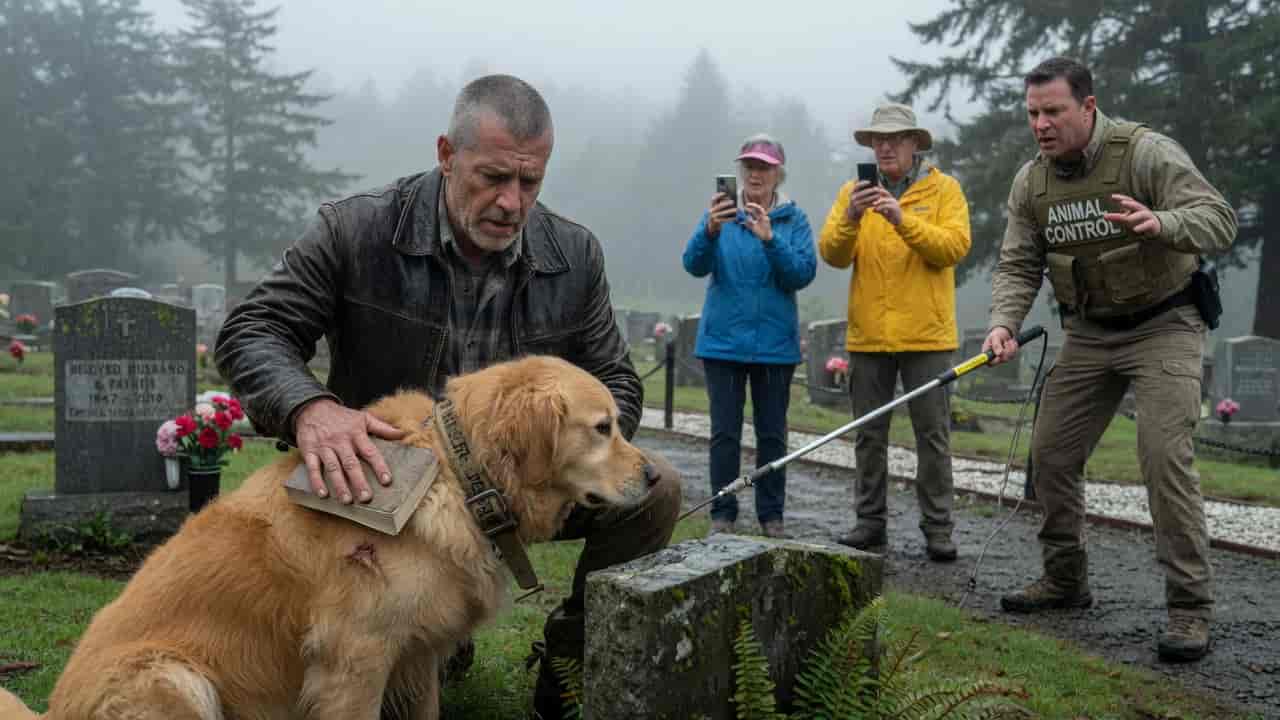
“Don’t touch that collar, sir.”
Mark froze, his fingers still buried in the wet, matted fur of the dog that had belonged to his wife. He felt it then—a hard, square shape hidden beneath the canvas. Something that didn’t belong on a dog.
“He’s my dog,” Mark said, his voice sounding thin against the Oregon wind. He didn’t look up at the man in the tactical vest, or the tourists filming him from the path, treating his grief like a viral moment.
“The city says otherwise,” the officer snapped, stepping closer, the metal of his catch-pole glinting in the rain. “You’re making a scene, and you’re distressed. Just let go of the animal before this gets ugly in front of your audience.”
Mark looked at the tourists. He saw the pity in their eyes, the way they looked at him like a man who had finally lost his mind at his wife’s grave. But as he felt the hidden drive click under his thumb, the grief turned into a cold, hard knot of suspicion. Sarah hadn’t died in an accident. She had sent the dog.
And the man standing over him wasn’t trying to rescue an animal—he was trying to hide the truth.
Chapter 1: The Grave and the Shadow
The rain in Coos Bay didn’t fall so much as it drifted, a heavy, salt-laden mist that clung to the wool of Mark’s coat until he smelled like a wet basement. It was Tuesday. He was always here on Tuesdays, mostly because the cemetery was empty and he didn’t have to explain to the groundskeeper why a fifty-five-year-old man was spending his retirement talking to a slab of granite.
He stood over Sarah’s headstone, his boots sinking slightly into the soft, mossy earth. The stone was simple. Sarah Miller. 1974–2025. She found the way. It was a private investigator’s joke, a nod to her knack for finding missing persons, missing money, and missing motives. She had died a year ago on a coastal highway that had given way under a mudslide. A “routine” drive back from a client meeting in Florence. Or so the police report said. Mark, an ex-cop with twenty years in the department, had read that report forty times. He knew what “routine” looked like, and he knew what “lazy” looked like.
“You’d hate the flowers,” Mark muttered, looking at the bed of damp lilies someone—probably her sister—had left. “They look like they’re giving up.”
He heard the sound then. A low, rhythmic panting.
A large, shaggy shape emerged from the fog near the edge of the cedar grove. It was a Golden Retriever mix, its coat matted with burrs and soaked through with grey rainwater. Mark’s heart did a strange, painful hitch in his chest. He knew that dog. He knew the way it carried its left ear slightly lower than the right.
“Cooper?” he whispered.
The dog didn’t bark. It walked with a purpose that seemed too heavy for an animal, weaving through the headstones until it stopped directly in front of Sarah’s grave. It didn’t wag its tail. It just sat down, its dark eyes fixed on the granite.
Mark felt a sudden, sharp spike of adrenaline. Cooper had been in the car with Sarah. The search and rescue teams had looked for days, but they’d never found the dog. They’d assumed he’d been swept into the Pacific along with the wreckage of the SUV. But here he was, fourteen months later, looking like he’d been living in the woods, yet somehow knowing exactly where to find the woman who had raised him.
“Hey, boy,” Mark said, his voice cracking. He knelt on one knee, ignoring the cold soak of the grass. “Where have you been? How did you get here?”
The dog let out a soft whine, stepping closer to let Mark touch him. The fur was cold and smelled of salt and rotted pine. As Mark’s hand moved over the dog’s neck, intending to check for a tag, his fingers brushed against something hard.
It wasn’t a tag. It was a rectangular lump, about the size of a matchbox, sewn into the underside of the heavy canvas collar. As Mark’s thumb pressed into it, he felt a distinct, mechanical click.
“What the hell is this?” Mark murmured.
“Step away from the animal, sir. Now.”
The voice was sharp, practiced, and loud enough to echo off the nearby mausoleum. Mark looked up. A man was walking toward him from the gravel path. He was younger, mid-thirties, wearing a tan tactical vest with “ANIMAL CONTROL” printed in bold black letters across the chest. He was carrying a long metal catch-pole, the wire loop swinging at the end.
Mark didn’t move. He kept his hand firmly on Cooper’s collar. “He’s not a stray. This is my dog.”
“I have a report of a dangerous animal on the grounds,” the man said. He didn’t slow down. “You’re interfering with a city officer. Step back.”
Mark felt the old cop reflex kick in—the narrowing of the eyes, the shifting of the weight. “I was on the force for twenty years, son. I know what an animal control officer looks like, and they don’t usually wear Grade 4 tactical vests for a retriever. Who are you?”
The man stopped, his jaw tightening. He looked past Mark. A couple of tourists in bright rain gear had stopped on the path, their phones out, filming the drama. The “officer” seemed to realize he had an audience. His tone shifted, becoming patronizingly loud.
“Sir, I understand you’re grieving. I see the headstone. But you’re clearly distressed and you’re acting erratically. This animal hasn’t been vaccinated and could be carrying any number of diseases. For your own safety, and the safety of the public, I need you to release the animal.”
“He’s my wife’s dog,” Mark said, his voice rising. He could feel the eyes of the tourists on him, the silent judgment of people watching a broken man cling to a ghost. The shame of it burned in his throat, but he didn’t let go. He felt the lump in the collar again. It was a USB drive. He was sure of it.
“I won’t tell you again,” the man said, lunging forward. He slammed the metal catch-pole into the grass inches from Mark’s knee, the ring of the metal loud in the quiet cemetery. “Hands off the collar or I’ll cite you for obstruction and have you removed from the grounds.”
Mark looked at the tourists. They were whispering, the woman shaking her head with a look of pity that felt like a slap. He was the “crazy old man” at the grave. He was the nuisance. He felt the humiliation like a weight, the public degradation of being bullied by a man half his age while standing on his wife’s final resting place.
“Fine,” Mark said, his voice dropping to a low, dangerous growl. He stood up slowly, making sure his body stayed between the dog and the man. “But if you hurt him, I’ll find you. And I’m very good at finding people.”
He gave Cooper a subtle nudge toward the cedar grove. The dog, as if understanding the stakes, didn’t run—he vanished. He slipped into the thick fog of the trees with a silent, predatory grace that no house pet should have.
The “officer” swore, turning to chase, but Mark stepped into his path, shoulder-checking him just enough to throw off his balance.
“Oops,” Mark said, his face a mask of blank indifference. “Slippery grass.”
The man glared at him, the pretense of being a city official slipping for a second to reveal something much colder, much more professional. “You have no idea what you just did, Miller.”
“I think I do,” Mark said. “You just called me by name. And I never gave it to you.”
The man froze, then looked at the tourists, who were still filming. He turned on his heel and walked back toward a white truck idling near the gates. Mark stood alone in the rain, his hand still tingling from where he had touched the drive. He didn’t look at the grave. He looked at the trees.
The residue of the confrontation was a thick, oily panic. The dog was alive. The drive was real. And Sarah’s accident was starting to look like a lie.
Chapter 2: The Nephew and the Drive
The drive back to his small house on the cliffside was a blur of wipers and white-knuckled steering. Mark kept checking the rearview mirror, looking for the white truck, but the road stayed empty. When he pulled into his gravel driveway, the dog was already there, sitting on the porch like he’d never been gone.
“Inside. Now,” Mark commanded.
Cooper bolted through the door. Mark locked the deadbolt and pulled the shades. The house felt smaller than usual, crowded with Sarah’s things—the half-finished knitting on the chair, the stacks of folders in the corner. He’d spent a year trying to turn this place into a museum, and now it felt like a bunker.
He grabbed a pair of heavy kitchen shears and lured Cooper to the rug with a piece of leftover ham. The dog ate tentatively, his eyes never leaving Mark.
“Stay, boy. Just stay.”
Mark reached for the collar. It was thick, reinforced with a wire mesh he hadn’t noticed at the cemetery. This wasn’t something you bought at a pet store. He snipped the stitching around the lump. A small, ruggedized USB drive fell onto the rug. It was encased in a custom-molded plastic shell, designed to withstand water and pressure.
Mark stared at it. His hands were shaking. He was an investigator, but he was a hardware man—he liked paper trails and physical evidence. For the digital side, he needed someone he could trust.
He picked up the phone and dialed his nephew, Leo.
“Leo? It’s Mark. I need you at the house. Now. Bring the encrypted laptop. The one you said the government can’t see.”
“Uncle Mark? It’s three in the afternoon on a Tuesday. I have a job, man. I’m literally in the middle of a—”
“Leo,” Mark interrupted, his voice low. “I found Sarah’s dog. He was at the cemetery. He was carrying a drive. And someone tried to take him by force.”
There was a long silence on the other end. “I’ll be there in twenty minutes.”
Leo arrived in fifteen. He was twenty-four, with hair that hadn’t seen a comb in days and a frantic energy that usually made Mark nervous. But today, it was exactly what he needed. Leo didn’t ask questions. He walked into the kitchen, cleared the mail off the table, and set up a laptop that looked like it had been through a war.
“Where is he?” Leo asked, looking at the dog.
“In the bedroom. He’s spooked,” Mark said. He handed over the drive. “What’s on it?”
Leo plugged it in, his fingers flying across the keys. A series of progress bars flickered on the screen. “It’s encrypted with a 256-bit AES key. But look at the file headers… these are log files from a GPS tracker. And video files. High-bitrate.”
“Can you open them?”
“I’m working on it. But Uncle Mark, this drive… it has a hardware signature. This isn’t off-the-shelf. This is the kind of gear private security firms use. The high-end ones.”
Mark leaned against the counter, the smell of salt still clinging to his jacket. “The guy at the cemetery… he called himself animal control, but he was tactical. He knew my name.”
“Maybe he looked you up?” Leo suggested, not looking up from the screen.
“I’m an ex-cop, Leo. My home address is protected. You don’t just ‘look me up’ unless you have access to the state database or you’ve been tailing me.”
Leo’s face went pale. He hit a key, and a window popped up. “I’m in. It’s a sub-folder labeled Project Malestrom. There are hundreds of documents here. Shipping manifests. Port authority records.”
He clicked on a video file. The image was grainy, taken from a low angle—likely the dog’s collar camera. It showed a darkened warehouse, the sound of heavy machinery in the background. Two men were talking, their voices muffled.
“It’s not just the containers,” one man said. “It’s the timing. If the shipment hits the dock before the inspection, we’re clear. If not, the whole thing goes into the bay.”
“What about Miller?” the other man asked.
“She’s getting too close. She was at the docks tonight. She saw the manifest.”
Mark felt the air leave his lungs. He recognized that voice. It was deep, with a slight raspy edge. It belonged to Arthur Vane, the CEO of Vane Maritime—one of the biggest employers in Coos Bay and a man who had donated millions to the police department’s pension fund.
“That’s Sarah’s last case,” Mark whispered. “She was investigating a smuggling ring. She wasn’t just doing a routine background check for a client.”
“There’s more,” Leo said, his voice trembling. “There’s a GPS map. It shows the dog’s movement for the last year. Mark… he wasn’t in the woods. He was being held in a facility near the North Spit. He escaped three days ago.”
A sudden, sharp knock at the door made them both jump. Mark reached into the drawer and pulled out his old service weapon. He didn’t even think about the legality of it.
“Mark? You in there? It’s Miller.”
Mark froze. It was his old partner, Dave Miller. They’d walked the beat together for a decade. Dave was the one who had handled the paperwork for Sarah’s accident. He was the one who had sat at Mark’s kitchen table and told him to let it go, that it was just a tragedy of nature.
“Go to the back room, Leo. Take the laptop,” Mark hissed.
He walked to the door and opened it just a crack. Dave stood on the porch, his rain slicker dripping. He looked tired, his eyes red-rimmed.
“Dave. What are you doing here?”
“I heard there was an incident at the cemetery,” Dave said, his voice soft. “A guy from the city filed a complaint. Said you assaulted an officer and stole a stray.”
“He wasn’t an officer, Dave. And the dog belongs to me.”
Dave sighed, looking past Mark into the darkened house. “Mark, look at yourself. You’re hiding in the dark with a gun in your hand. You’re chasing ghosts. People are starting to talk. They’re worried you’ve finally snapped.”
“Is that what they’re saying? Or is that what Vane told you to say?”
The name hung in the air like a live wire. Dave’s expression didn’t change, but his posture stiffened. “I don’t know what you’re talking about. I’m here as a friend. Give me the dog, Mark. Let me take him to the shelter. I’ll make the complaint go away. We can just put this to bed.”
“I can’t do that, Dave.”
“Mark,” Dave said, his voice dropping to a whisper. “Don’t do this. You have a pension. You have a house. Don’t throw it all away for a dog and a theory that’s going to get you buried right next to her.”
The threat was subtle, but it was there, rooted in years of shared history and mutual secrets. It was a betrayal that felt more intimate than a punch. Mark realized then that Dave hadn’t just been a friend—he’d been a gatekeeper.
“Get off my porch, Dave.”
“Mark—”
“Get off my porch before I decide I’ve ‘snapped’ for real.”
Dave looked at him for a long moment, a flicker of something—regret? fear?—crossing his face. Then he turned and walked back to his cruiser. As the lights disappeared down the drive, Mark felt the residue of the encounter settle over him. It was the feeling of being hunted by the very people he used to call brothers.
He wasn’t an ex-cop anymore. He was a target.
Chapter 3: The Ghost in the Files
By midnight, the rain had turned into a steady, rhythmic drumming on the roof. Leo had set up a makeshift workstation in the guest bedroom, surrounded by empty coffee mugs and the blue glow of his screens. Mark sat in the living room, Cooper at his feet. The dog was finally sleeping, though his paws twitched as if he were running in his dreams.
“I found the audio logs,” Leo called out. “You need to hear this.”
Mark walked into the room. Leo hit play on a file labeled Memo_0412. Sarah’s voice filled the room, crisp and professional, the sound of a woman who was in complete control of her environment.
“I’ve tracked the shipments back to the Port of Coos Bay. Vane Maritime isn’t just moving heavy machinery. They’re using a shell company, ‘Northern Logistics,’ to move undocumented cargo from the Russian Far East. It’s not drugs. It’s something heavier. Industrial-grade. I think it’s related to the new tech corridor they’re building in Portland. I have the manifest numbers, but I need physical proof. I’m taking Buster with me tonight. He can get into the vents where the cameras don’t reach.”
Mark closed his eyes. He could see her—the way she’d tuck her hair behind her ear when she was onto something, the quiet intensity of her focus. She had been so close.
“There’s a second recording,” Leo said quietly. “It’s from the night of the accident.”
The sound was different this time. Windy. The roar of the ocean in the background. Sarah’s voice was breathless, panicked.
“They’re behind me. A white truck. No plates. They saw me at the Spit. If anything happens, the drive is on Buster. He knows the way home. He knows—”
The recording ended with a sharp, metallic screech and the sound of shattering glass. Then, silence.
Mark felt a cold, hard rage settle in the pit of his stomach. It wasn’t an accident. It was an execution. And the “Animal Control” guy, Gault, had been sent to finish the job—to recover the evidence that had been missing for over a year.
“Leo, can you trace those manifests?”
“I’m trying, but the servers are behind a massive firewall. I’d need to be on-site. Or have someone’s credentials.”
Mark looked at his old badge sitting on the dresser. It was a piece of tin now, but it still held a certain weight in this town. “I can get you in. The Port Authority building uses the same security system the precinct used to. My old codes might still work for the external gates.”
“That’s a felony, Uncle Mark. Like, a big one.”
“They killed Sarah, Leo. They turned my partner into a liar and they’re hunting a dog because he’s a witness. I don’t care about felonies anymore.”
Before Leo could answer, the house lights flickered and died. The blue glow of the laptop was the only light in the room. Outside, the sound of gravel crunching under tires broke the silence.
“They’re here,” Mark hissed.
He grabbed his gun and moved to the window. Two vehicles were pulling into the drive—the white truck from the cemetery and a dark SUV. Men were stepping out, moving with the synchronized precision of a strike team. They weren’t hiding. They didn’t have sirens. This was a private cleanup.
“Leo, get the dog and the laptop. Go through the crawlspace. It comes out in the woods behind the shed. Go to the diner in town—Marge’s. Stay in the back booth. Don’t talk to anyone.”
“What about you?”
“I’m going to remind them why they should have checked the body before they left the scene.”
Mark waited until he heard the soft thud of the crawlspace door closing. He moved to the kitchen, his heart hammering against his ribs. He felt old, his knees aching in the cold, but the muscle memory was still there. He took a heavy iron skillet from the stove and set it on the counter, then positioned himself behind the refrigerator.
The back door splintered inward.
The first man through was Gault. He didn’t have the catch-pole this time. He had a suppressed Glock and a professional scowl. He moved into the kitchen, his eyes sweeping the room.
Mark didn’t wait for him to turn. He stepped out and swung the skillet with every ounce of frustration he’d carried for the last year. It caught Gault squarely in the side of the head with a sickening thunk. The man crumpled without a sound.
Mark grabbed the Glock before it hit the floor. He stepped over Gault’s twitching body and moved toward the living room.
“Gault? Report,” a voice called from the front porch.
Mark didn’t answer. He fired two shots through the front door, aimed at waist height. A cry of pain followed, and the sound of heavy boots retreating.
“He’s armed! Fall back to the perimeter!”
Mark didn’t wait for them to regroup. He ran to the back door, slipping into the rain and the dark of the woods. He knew these trees. He’d hunted these hills since he was a boy. He let the shadows swallow him, the adrenaline masking the cold.
As he reached the edge of the property, he looked back. The men were surrounding the house, their flashlights cutting through the mist like searching fingers. They had the power, the money, and the law on their side. But they didn’t have the drive.
And they didn’t know that Mark was no longer interested in justice. He wanted a reckoning.
Chapter 4: The Tracking
Marge’s Diner was a relic of a different era—greasy vinyl booths, neon signs that hummed with a low-frequency buzz, and coffee that could dissolve a penny. It was 2:00 AM. The only other customers were a couple of long-haul truckers and a local drunk sleeping in the corner.
Mark slipped into the back booth, his jacket soaked, his face streaked with mud. Leo was there, huddled over the laptop, Cooper hidden under the table.
“You’re alive,” Leo whispered, his eyes wide.
“For now,” Mark said. He took a seat, his eyes scanning the windows. “Did you get it?”
“I got into the manifest,” Leo said, turning the screen. “It’s worse than we thought. The ‘cargo’ Sarah was talking about? It’s specialized components for sub-aquatic surveillance. Vane isn’t just smuggling. He’s building a private intelligence network under the bay. He’s tracking everything—every ship, every signal, every conversation that passes through this port.”
“Why?”
“Because whoever controls the data controls the coast. He can blackmail the government, front-run the markets, or just make people disappear. Sarah found the hub location. It’s an old decommissioned bunker on the North Spit, right under the lighthouse.”
Mark stared at the map on the screen. The North Spit was a desolate stretch of sand and scrub brush, accessible only by a single narrow road or by boat. It was the perfect place for a secret.
“We need to get that data to the feds,” Leo said.
“The feds won’t move without a smoking gun, and right now, Vane owns the local police. If we try to leave town, they’ll pick us up on the highway. We have to go to the hub. We have to get physical proof of the surveillance equipment.”
“Uncle Mark, that’s suicide. They’ll have a small army there.”
“They think I’m just an old man mourning his wife,” Mark said, his voice hardening. “They think they can humiliate me and I’ll just crawl back into my hole. They’re wrong.”
The diner door creaked open. A man walked in, shaking the rain off a tan tactical vest. It wasn’t Gault, but he had the same cold, vacant eyes. He looked around the room, his gaze lingering on the back booth.
“Leo, close the laptop. Now,” Mark commanded.
The man walked toward the counter, but his eyes stayed on them in the reflection of the pie case. He picked up the wall phone and began to speak in a low voice.
Mark stood up, sliding out of the booth. He felt the weight of Gault’s suppressed Glock in his waistband. He walked toward the man, his steps heavy and deliberate.
“Forget something?” Mark asked.
The man turned, his hand reaching for his belt. Mark didn’t give him the chance. He grabbed the man by the collar of his vest and slammed him face-first into the laminate counter. A sugar shaker shattered, spilling white crystals over the man’s head.
“Who’s on the other end of that phone?” Mark hissed, pressing the man’s face into the counter.
The truckers at the bar stood up, confused. Marge came out of the kitchen, clutching a spatula. “Mark? What the hell are you doing?”
“He’s not who he says he is, Marge! Call the state police. Not the local boys. The State.”
The man under Mark’s hand struggled, his voice muffled. “You’re dead, Miller. Vane already has the dog’s tracker. They’re coming for you.”
Mark felt a cold chill. He looked under the table. Cooper was sitting there, his head cocked. Mark reached down and felt the collar again. There was a second lump. Smaller. Thinner. A passive RFID tag.
“He was the bait,” Mark whispered. “They let him escape so he’d lead them to the drive. And to me.”
The sound of tires screaming on the wet pavement outside told him they were out of time. Mark grabbed Leo by the arm.
“Out the back! To the docks!”
They ran through the kitchen, Marge’s protests fading behind them. They burst into the alleyway, the salt air hitting them like a physical blow. The docks were only two blocks away, a forest of masts and rusting hulls.
As they reached the pier, Mark saw a familiar sight—Sarah’s old skiff, the Lady Luck, still bobbing in its slip. He’d kept it maintained out of habit, never thinking he’d need it for a getaway.
“Get in!” Mark yelled.
He untied the lines as Leo and Cooper scrambled aboard. The engine coughed once, twice, then roared to life, a plume of blue smoke rising into the rain.
Just as they pulled away from the slip, the dark SUV skidded onto the pier. Figures jumped out, their muzzle flashes illuminating the dark. Bullets thudded into the wooden pilings and hissed into the water.
Mark ducked, steering the boat with one hand as he pulled the throttle wide. The skiff surged forward, cutting through the choppy harbor water. He looked back at the receding lights of the town.
The humiliation was over. The hiding was over. The residue of Sarah’s death was no longer a weight—it was a compass.
“Where are we going?” Leo shouted over the engine.
Mark looked toward the dark silhouette of the North Spit, where the lighthouse beam swept across the waves like a warning.
“To finish the case,” Mark said.
Chapter 5: The Concrete Throat
The North Spit was a graveyard of things the Pacific didn’t want. Rusted crab pots, bleached cedar trunks that looked like the ribcages of prehistoric beasts, and the skeletal remains of ships that had misjudged the bar. As the Lady Luck cut its engine and drifted toward the shore, the silence that rushed in was heavy and wet. Mark jumped into the knee-deep surf, the cold water instantly numbing his calves, and hauled the skiff onto the dark, coarse sand.
“Stay low,” Mark whispered, his voice barely audible over the rhythmic thrum of the tide. “Keep the dog close.”
Leo scrambled out, clutching the ruggedized laptop to his chest as if it were a shield. Cooper leaped over the gunwale without a sound, his nose twitching as he sampled the air. The dog didn’t look like a pet anymore; he looked like a soldier returning to a familiar battlefield. He stayed at Mark’s heel, his body tense, his eyes fixed on the dark rise of the dunes.
They began the trek toward the lighthouse. It was a mile of shifting sand and thickets of gorse that tore at their clothes. Mark felt every year of his fifty-five. His knees clicked with every step, and the side of his head—where the adrenaline was starting to wear off—throbbed with a dull, rhythmic ache. He kept his hand on the butt of Gault’s Glock, feeling the cold polymer against his palm. He wasn’t a man who enjoyed violence, but he was a man who understood its necessity. He’d spent twenty years seeing what happens when people believe they’re above the consequences of their own cruelty.
“Uncle Mark,” Leo panted, his breath hitching. “If we do this… if we get inside and there’s nothing there, or if we can’t get the data out… what’s the backup plan?”
Mark stopped, looking back at the boy. Leo’s face was pale, his eyes darting toward the dark line of the woods. He was a kid who lived in the world of code and cooling fans, not in the world of wet sand and suppressed handguns.
“There is no backup, Leo,” Mark said, his voice grounded and flat. “Sarah gave her life to get this drive to me. She didn’t have a backup plan. She had a dog and a hope that I’d be smart enough to listen. We’re here because there’s nowhere else to go. If we turn back now, Vane owns us. He owns the town, he owns the memory of your aunt, and eventually, he’ll own you, too.”
Leo swallowed hard and nodded. They pushed on.
The bunker sat at the base of the old lighthouse, a brutalist slab of concrete that had been built during the Cold War to track Soviet subs. It had been officially decommissioned in the nineties, but as they approached, Mark noticed the signs of a recent “renovation.” The heavy iron doors had been replaced with reinforced steel, and a discreet, high-gain antenna array was tucked behind the old stone parapet. There were no guards on the perimeter—Vane was smart enough to know that a visible security detail would draw the wrong kind of attention. He relied on the desolation of the Spit and the technical sophistication of his locks.
Mark reached the door and looked at the keypad. It was a standard industrial model, the kind used by the Port Authority. He took a breath, his fingers hovering over the buttons. He remembered the night Sarah had mentioned the “old world” codes. She’d joked that the city never bothered to update the legacy overrides because they were too lazy to change the manuals.
He punched in the sequence: the precinct’s old area code followed by the badge number of the first captain he’d ever served under.
The lock let out a heavy, pneumatic hiss. The door swung open an inch.
“I’ll be damned,” Leo whispered.
“Don’t celebrate yet,” Mark said. “Inside is where it gets complicated.”
The interior was a labyrinth of narrow corridors, the air smelling of ozone and expensive air conditioning. It was a jarring contrast to the rusted exterior—a temple of high technology buried inside a tomb of grey concrete. Servers hummed in rack after rack, their tiny blue and green lights flickering like the eyes of deep-sea fish.
They moved deeper into the facility, following the hum of the main processor. Cooper was leading now, his tail low, his ears pinned back. He stopped at a heavy plexiglass door that looked into a central command hub.
Inside, sitting at a console draped in shadows, was Dave Miller.
Mark felt the betrayal all over again, a cold weight in his gut that made it hard to breathe. Dave was staring at a wall of monitors, his face illuminated by the flickering data streams. He looked older than he had three hours ago—haggard, defeated.
“Wait here,” Mark told Leo. “And keep the dog quiet.”
Mark stepped through the door, his boots silent on the raised flooring. He didn’t raise the gun. He just stood there until Dave felt the shift in the air and turned around.
Dave didn’t jump. He didn’t reach for a weapon. He just stared at Mark, a slow, tired smile spreading across his face.
“I knew you’d come here, Mark,” Dave said. His voice was hollow, stripped of the false camaraderie he’d used on the porch. “You always were the most stubborn bastard on the force. Sarah used to say you were like a badger—once you got your teeth into a lead, you’d let the world burn before you let go.”
“Why, Dave?” Mark asked. “Vane? Money? Was the pension not enough to keep your soul intact?”
Dave stood up, gesturing to the screens around him. “Look at this, Mark. Really look at it. Vane isn’t just some smuggler. He’s the only thing keeping Coos Bay on the map. When the mills closed, we were done. When the fishing dried up, we were ghosts. Vane brought the tech. He brought the infrastructure. He brought the security.”
“He brought a surveillance state,” Mark countered, stepping closer. “He’s tracking the people he’s supposed to be saving. He’s holding the whole coast hostage.”
“He’s protecting it!” Dave shouted, his voice cracking. “He knows who’s coming in and out. He knows which ships are carrying what. He’s doing the job the government is too broke and too stupid to do. And yeah, Sarah found out. She wouldn’t listen. I tried to tell her, Mark. I tried to warn her that she was messing with something bigger than a PI’s license.”
“You let them kill her,” Mark said, his voice a low, vibrating chord of rage. “You handled the report. You looked me in the eye at the funeral and told me it was a mudslide. You watched me break for a year, Dave. You sat in my kitchen and drank my coffee while you were helping the man who ran her off the road.”
Dave looked away, his shoulders slumped. “It wasn’t supposed to happen that way. Gault was supposed to just scare her. He was supposed to take the drive and let her go. But she wouldn’t stop. She kept driving, and the rain… it was a mess, Mark. A total mess.”
“The residue of a lie is always a mess,” Mark said. “Move away from the console, Dave.”
“I can’t do that. Vane is on his way. He’s got the whole North Spit locked down. You’re not leaving this bunker, Mark. Neither is the kid or the dog. Just give me the drive. I’ll talk to him. I’ll make sure you get out of town. You can go to Portland, disappear, live your life.”
“You really think I’m that man?” Mark asked. “You think I’m the kind of man who takes a deal from the guy who murdered his wife?”
Mark saw Dave’s hand twitch toward the underside of the desk. He didn’t hesitate. He lunged forward, slamming Dave into the console. The monitors flickered and sparked as Dave’s weight hit the keyboard. Mark grabbed Dave’s wrist, twisting it until the small panic button fell from his fingers.
“Leo! Get in here!” Mark yelled.
Leo ran in, the dog barking now, the sound echoing off the concrete walls. Leo looked at Dave with a mixture of fear and disgust.
“Get to work,” Mark commanded, pinning Dave’s arm behind his back. “Copy everything. The manifests, the surveillance logs, the communications between Vane and the local precinct. All of it.”
“I’m on it,” Leo said, his fingers flying.
Dave struggled, his face pressed against the cold glass of a monitor. “You’re killing yourself, Mark! You think the feds are going to protect you? Vane has friends in D.C. He’s a ‘strategic partner.’ You’re just a disgruntled ex-cop with a grudge.”
“Maybe,” Mark said, leaning in close to Dave’s ear. “But a badger doesn’t care about strategic partners. A badger just wants the truth.”
The room was filled with the frantic clicking of Leo’s keyboard and the heavy, ragged breathing of two men who used to be brothers. Outside, the wind howled against the bunker, a reminder that the world was still cold and indifferent. But inside, the silence of the last year was finally breaking.
Mark looked at the monitors. He saw the map of the harbor, the glowing dots representing every vessel in the water. He saw the faces of people in the town square, captured by high-res cameras they didn’t know existed. He saw the scale of the betrayal. It wasn’t just Sarah. It was everyone.
“Almost there,” Leo whispered. “Eighty percent… eighty-five…”
A red light began to pulse on the main display. A mechanical voice, calm and feminine, filled the room.
Security Breach. Level 1. Lockdown Initiated.
“He’s here,” Dave said, a grim sort of relief in his voice. “Vane is here.”
Mark tightened his grip on Dave. “Then he’s just in time to watch his empire go up in flames.”
The residue of the confrontation stayed in the room—the smell of Dave’s sweat, the heat of the servers, the crushing weight of a friendship that had been nothing but a long-con. Mark didn’t feel victorious. He just felt tired. He felt the specific, sharp pain of knowing that once you see the truth, you can never go back to being the man you were.
He looked at Cooper. The dog was standing by the door, his hackles raised, a low growl vibrating in his chest.
“Ninety-five percent,” Leo cried. “Come on, come on…”
The heavy steel door at the end of the hall let out a dull, metallic boom. The hunt wasn’t over. It was just moving into the final phase.
Chapter 6: The Weight of the Rain
The final door didn’t open with a hiss; it opened with a slow, deliberate grind of heavy machinery. Arthur Vane stepped into the command hub, followed by two men in dark suits who moved with the silent efficiency of professional killers. Vane wasn’t what Mark expected. He wasn’t a monster in a tactical vest or a sweating conspirator. He was a man in an expensive charcoal overcoat, his hair perfectly silvered, his expression one of mild, professional disappointment.
He looked around the room, his eyes lingering on Dave pinned to the console, then on Leo, and finally on Mark.
“Mr. Miller,” Vane said, his voice smooth and resonant, the kind of voice that sold municipal bonds and won elections. “I must admit, your persistence is impressive. Most men in your position would have taken the pension and the quiet life. You’ve chosen a significantly more difficult path.”
“Difficulty is relative,” Mark said, his voice steady despite the hammer of his heart. “I find it difficult to sleep when the man who killed my wife is running the town.”
Vane sighed, stepping into the center of the room. He didn’t look at the gun in Mark’s hand. He looked at the monitors. “You think I’m the villain of this story, don’t you? You think this is about greed. But look at this town, Mark. Look at Coos Bay. Before I arrived, we were a footnote. A dying port with a drug problem and no future. I gave this place a purpose. I turned it into a hub of the new economy. My surveillance network? It’s the price of security. It’s the infrastructure of the twenty-first century.”
“It’s a prison,” Mark said. “And you’re the warden.”
“A prison with high-paying jobs and a stable housing market,” Vane countered. “The world is changing, Mark. Privacy is an antique. Security is the only currency that matters. Sarah… she was a lovely woman, but she was a romantic. She believed in a version of the world that stopped existing thirty years ago. She couldn’t see the forest for the trees.”
“She saw you,” Mark said. “That’s why she’s dead.”
Vane’s expression darkened for the first time. “She’s dead because she was reckless. She was told to stop. Dave told her. I told her. She chose to drive into a storm with a drive she didn’t understand. Her death was a tragedy, yes, but it was a tragedy of her own making.”
“Done!” Leo shouted, slamming the laptop shut. “It’s encrypted and uploaded to the cloud. The feds, the Times, the State Police… they all have the link. It’ll unlock in ten minutes unless I enter the abort code.”
Vane turned his gaze to Leo. It was a cold, predatory look that made the boy shrink back. “A clever trick, son. But ten minutes is a long time in a concrete bunker.”
Vane nodded to the men behind him. They moved forward, but Mark stepped into the center of the room, raising the Glock.
“One more step and Vane finds out if his overcoat is bulletproof,” Mark said.
The room froze. The tension was a physical thing, a vibrating wire that was seconds away from snapping. Cooper moved to Mark’s side, his teeth bared, a sound coming from his throat that wasn’t a growl—it was a promise.
“You won’t shoot me, Mark,” Vane said, his voice returning to its calm, persuasive tone. “You’re a cop. You’re a man of the law. You want a trial. You want a process. If you kill me here, you’re just another murderer in the dark. You’ll lose everything. Your reputation, your nephew’s future… it all goes away.”
“I lost everything a year ago on Highway 101,” Mark said. “Everything I’ve done since then is just house money.”
“Mark, don’t,” Dave pleaded from the console. “Don’t do it. Just let the data go. We can still walk out of here.”
Mark looked at Dave, and for a second, he saw the man he used to trust. He saw the partner who had backed him up in a dozen dark alleys. And then he saw the coward who had let a woman die for a paycheck.
“You already walked out, Dave,” Mark said. “A long time ago.”
Mark looked back at Vane. He felt the weight of the moment, the psychological residue of a lifetime of playing by the rules and watching the bad guys win anyway. He thought about Sarah—the way she laughed at his bad jokes, the way she looked in the morning light, the way she had fought for the truth even when she was alone.
He didn’t pull the trigger.
Instead, he looked at Leo. “Go. Take the dog and get to the boat.”
“But Uncle Mark—”
“Go!” Mark roared.
Leo didn’t argue. He grabbed the laptop and whistled for Cooper. The dog hesitated, looking at Mark, then turned and followed the boy into the hallway.
Vane smiled. “A wise choice. Now, let’s talk about that abort code.”
“There is no abort code,” Mark said, his voice dropping to a whisper. “The data is already live. I lied.”
The smile vanished from Vane’s face. He lunged for his phone, but Mark was faster. He didn’t shoot Vane; he shot the main server rack. The suppressed pops of the Glock were followed by the scream of short-circuiting electronics. Blue sparks showered the room, and the monitors began to flicker and die, one by one.
“You fool!” Vane screamed. “That’s millions of dollars of hardware!”
“It’s junk,” Mark said.
The guards lunged at him. Mark felt a heavy blow to his ribs that sent him sprawling. He fired a shot into the ceiling, the sound deafening in the enclosed space, and used the moment of confusion to scramble toward the door. He wasn’t as fast as he used to be, but he was more desperate.
He ran down the hallway, the sound of boots echoing behind him. He reached the heavy steel door just as a bullet sparked off the concrete beside his head. He threw himself through the opening and slammed the manual override. The door ground shut, sealing the bunker from the outside.
He stumbled out into the night. The rain was still falling, but the wind had died down. He saw the Lady Luck bobbing in the surf, Leo and Cooper already aboard.
Mark ran across the sand, his lungs burning, his legs feeling like lead. He reached the boat and hauled himself over the side just as the first sirens began to wail in the distance—the state police, finally responding to the automated breach alerts.
“We did it,” Leo whispered, staring at the dark silhouette of the lighthouse. “We actually did it.”
Mark didn’t answer. He sat at the helm, his hand resting on Cooper’s head. The dog leaned into him, his wet fur cold against Mark’s skin. Mark looked back at the North Spit. He knew the fight wasn’t over. Vane would have lawyers, Dave would have excuses, and the town would have a long, painful awakening. But for the first time in a year, the air didn’t feel like a lie.
The boat cut through the water, heading back toward the harbor. As they passed the cemetery, Mark looked toward the hill where Sarah was buried. The fog was lifting, and for a brief second, the beam of the lighthouse swept over the headstones, illuminating the grey granite.
He felt the residue of the night—the shame of the cemetery, the betrayal in the bunker, the cold terror of the chase. It wouldn’t go away. It would stay with him, a permanent part of his history. But it was no longer a weight. It was just the price of the truth.
They pulled into the slip just as the sun began to bleed through the clouds, a pale, watery light that turned the bay into a sheet of hammered silver. Mark stepped onto the dock, his body aching, his mind finally quiet.
He walked home, the dog at his side. He didn’t look back. He didn’t have to. The story was finished.
The next Tuesday, Mark was at the grave. The lilies were gone, replaced by a single, sturdy rosebush that he’d planted himself. He stood there for a long time, the silence of the cemetery no longer feeling like a void.
“We found it, Sarah,” he whispered. “We found the way.”
Cooper sat beside him, his ears alert, his eyes on the horizon. The dog didn’t whine. He just watched the rain fall, a loyal partner who had finally come home.
Mark turned and walked toward the gate. He had a house to clean, a nephew to look after, and a life to start living. It wasn’t a perfect ending. It was just a real one. And in a world built on lies, that was more than enough.
The residue of the rain stayed on his coat, a cold, clean reminder of the cost of everything. But as he reached his truck, Mark felt something he hadn’t felt in a very long time.
He felt at peace.