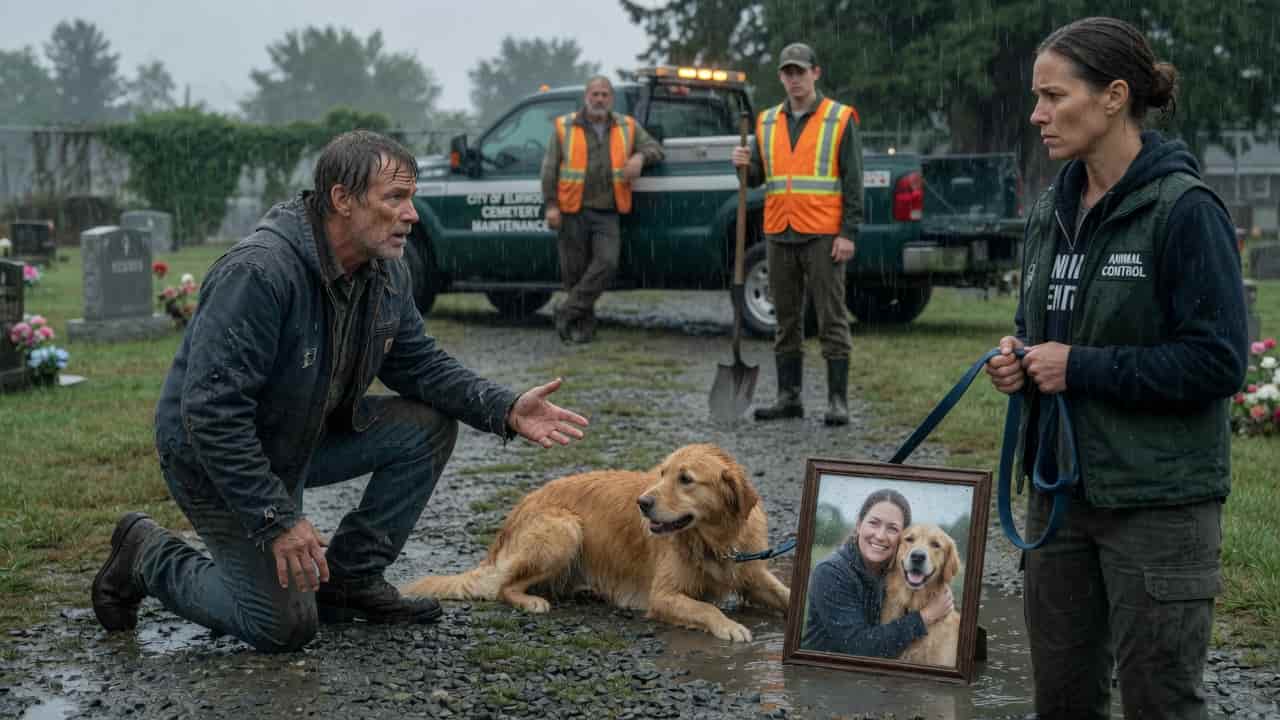
“Tell them the truth, Caleb. Tell these people exactly why that dog is trying to crawl into the dirt just to get away from you.”
Sarah didn’t lower her voice. She wanted the groundskeepers to hear. She wanted the people visiting the nearby graves to turn their heads and see the man who used to be the loudest voice in every bar in the county now kneeling in the mud, begging for a dog that was terrified of his touch.
Caleb reached out, his fingers hovering inches from Molly’s golden fur, but the dog let out a sharp, pathetic whimper and recoiled. It was the sound of a living thing remembering a shadow. It was the sound of the night the screaming finally stopped because there was no one left in the house to yell at.
“I just want to take her home,” Caleb whispered, his voice cracking. He held up the rain-stained photo of his wife—the only proof he had left that he was ever a man worth loving.
But Sarah didn’t look at the photo. She looked at the witnesses watching the scene, then back at Caleb with a cold, jagged smile. “You don’t have a home for her, Caleb. You have a cage with no door. And I’m not letting her back inside.”
The groundskeepers didn’t move. They just watched as the man who used to be a king of the asphalt stood there, broken and exposed, realizing that some things can’t be fixed with an apology—and some doors stay locked forever.
Chapter 1: The Gravel and the Ghost
The mud in Oak Grove Cemetery had a specific, heavy consistency, the kind that clung to the lugs of my work boots and made every step feel like a physical debt. It was a Tuesday, the sky a bruised purple-gray that threatened a cold October soak. I wasn’t supposed to be there. Technically, the grounds were closed for maintenance, but the gate was rusted enough to bypass if you knew which way to lift the chain.
I knelt by the headstone—gray granite, still too clean, still too new to belong in a place this old. Elena Vance. 1982–2025. The dates looked like a typo. They looked like a lie printed in stone.
I didn’t talk to the air. I wasn’t one of those people who believed the dead sat around waiting for updates on the weather or the rising cost of diesel. I just sat there because the silence at the house was worse. The house felt like a lung with the air squeezed out of it.
The sound of a car engine breaking the quiet made me stiffen. It wasn’t the low rumble of a groundskeeper’s truck; it was a smaller, tinny engine. A white crossover with the logo for the County Animal Shelter on the door pulled up to the gravel path fifty yards away. My heart did a slow, painful roll in my chest.
Sarah got out first. She was wearing that green vest she always wore, her hair pulled back so tight it made her eyes look like two flint chips. She didn’t look at the graves. She looked at me. And then, she opened the back door.
Molly jumped out.
For a second, I forgot to breathe. The dog was thinner than she’d been three months ago. Her golden coat was duller, lacking the sheen Elena used to maintain with those expensive brushes I used to complain about. Molly hit the ground and immediately looked for a place to hide, her tail tucking tight against her belly.
“I told you I’d bring her for the evaluation,” Sarah said, her voice carrying easily across the open space. She didn’t walk toward me. She stood by the car, holding the leash like it was a tether to a bomb. “But don’t think this means you’re taking her.”
I stood up, my knees cracking, the dampness of the grass seeping through my jeans. I wiped my hands on my thighs, trying to get the cemetery grit off them. “I have the house ready, Sarah. I fixed the fence. I bought the food she likes.”
“The house isn’t the problem, Caleb,” Sarah said. She started walking toward me, but she kept the leash short. Molly didn’t walk; she skittered, her paws scratching at the gravel, her eyes darting toward the woods.
As they got closer, Molly saw me. She froze.
It wasn’t the happy freeze of a dog recognizing its owner. It was a rigid, tectonic shift in her posture. Her ears went flat against her skull. She didn’t bark. She didn’t wag. She just lowered her head until her chin was almost touching the mud.
“Molly? Hey, girl,” I whispered. I reached out, my hand shaking just enough for it to be visible in the flat light. “It’s me. It’s okay.”
The dog let out a sound—a low, vibrating whimper that seemed to come from her bones. She didn’t look at me. She looked at Sarah’s boots, then at the woods, then back at the car. She was looking for an exit.
“Look at her,” Sarah said, her voice sharp, intended for the two groundskeepers who had stopped their work near the equipment shed to watch us. They were leaning on their shovels, their faces unreadable but their attention absolute. “Does that look like a dog who wants to go home?”
“She’s just confused,” I said, the lie tasting like copper in my mouth. “It’s been a long time. She’s been in a kennel.”
“She’s been in a kennel because the night Elena died, you threw this dog out of a moving vehicle on Highway 12,” Sarah said.
The silence that followed was heavy. The groundskeepers exchanged a look. I could feel the heat rising in my neck, that old, familiar burn of shame that used to turn into anger. But the anger didn’t come this time. There wasn’t enough of me left to build a fire.
“I didn’t throw her,” I said, though my voice lacked the conviction of a man telling the whole truth. “I opened the door. I was… I wasn’t thinking.”
“You were in a rage, Caleb. Like always,” Sarah said, stepping closer, her voice rising so the men by the shed wouldn’t miss a word. “Elena left you a week before the accident because she was afraid of what you’d do to her. And when she wasn’t there to take it, you took it out on the only thing she had left. You drove three miles down the road and dumped a ten-year-old dog in the rain because you couldn’t handle the silence in your own kitchen.”
I looked down at Molly. She was trembling so hard I could see the blue nylon collar vibrating against her fur. She was a living record of my worst ten minutes. Every time I looked at her, I saw the night the world ended.
“I’m different now,” I said.
“People like you don’t get different,” Sarah snapped. “They just get quiet when they’re caught.”
She yanked the leash, and Molly yelped—a short, sharp sound that cut through me. Sarah didn’t care. She was using the dog as a prop, a piece of evidence to prove I was the monster the town gossip said I was.
“I have the photo,” I said, reaching into my jacket pocket. My fingers fumbled with the plastic-wrapped frame. I pulled it out—a picture of Elena on our porch, laughing, with Molly’s head in her lap. “She’s mine, Sarah. Legally, she’s mine.”
“Legally, you abandoned her. That makes her ward of the county,” Sarah said, glancing at the groundskeepers. “What do you think, boys? Should a man who discards his wife’s memory like trash be allowed to have it back?”
One of the groundskeepers, a guy I’d seen at the hardware store for years, just spat into the grass and looked away. The other one stared me down, his jaw set in a hard line of judgment.
“Please,” I said, my voice dropping to a level that was almost a plea. “Just let her smell my hand. Just one minute.”
Sarah looked at the dog, then at me. She saw the desperation in my face, and for a second, I saw something in hers—not pity, but a cold sort of satisfaction. She liked seeing me here. She liked seeing the man who used to own the road reduced to a beggar in a graveyard.
“Fine,” she said, her voice dripping with artificial magnanimity. “One minute. But if she pees or snaps, we’re gone. And I’m filing the permanent termination of ownership papers tonight.”
She loosened the leash by six inches.
I knelt back down, the gravel biting into my shins. “Molly. Come here, girl. I’m sorry. I’m so sorry.”
I extended my hand. My palm was flat, submissive. Molly took one tentative step forward, her nose twitching. She sniffed the air, catching the scent of the house, the scent of the grease from the garage, the scent of the man who had let her down.
Her nose touched my knuckles. For a heartbeat, I thought the world might shift. I thought the stone might roll away.
Then, her body went rigid. She didn’t bite. She didn’t bark. She just leaned back on her haunches and let out a long, mourning howl that echoed off the granite markers. It wasn’t a greeting. It was a funeral dirge.
“Time’s up,” Sarah said, yanking the dog back toward the car.
I stayed on my knees in the mud, holding the photo of my dead wife, watching the only living thing that still knew her name being driven away by a woman who hated me. I didn’t move until the sound of the engine was gone. I just sat there, the weight of the leash I wasn’t allowed to hold still heavy in my hand.
Chapter 2: The Sound of the Light Bill
The house on Miller Road was a three-bedroom ranch that felt like a stadium. It was too much square footage for one man and a bottle of cheap bourbon. I walked through the door, the air inside smelling of stale coffee and the lemon-scented floor wax Elena used to insist on. I hadn’t touched her things. Her coat was still on the hook by the door—a bright red wool thing that looked like a splash of blood against the beige wallpaper.
I went into the kitchen. The mail was piled on the counter, mostly bills and flyers for lawn services I didn’t need. On top was the electric bill, a final notice highlighted in neon pink. I stared at it, the numbers blurring. I had the money—I’d been a lead mechanic at the regional transit hub for fifteen years—but the act of writing the check felt like acknowledging that life was continuing, and I wasn’t ready for that.
I sat at the kitchen table, the same table where I’d sat three months ago, yelling about something that didn’t matter. It was always something that didn’t matter. The price of tires. The way she’d forgotten to close the garage door. The way she looked at me when I’d had a third drink.
The memory of that final night was a loop tape I couldn’t stop.
“You’re just angry at the world, Caleb,” she’d said. She hadn’t been shouting. She’d been beyond shouting. She’d been packed. Two suitcases sat by the door.
“I’m not angry,” I’d roared, slamming my hand into the table hard enough to rattle the salt shakers. “I’m tired. I’m tired of you acting like I’m some kind of animal you have to manage.”
“You are an animal,” she’d said quietly. “And I can’t live in the zoo anymore.”
She’d walked out. Molly had tried to follow her, but Elena had been too fast, the door clicking shut before the dog could slip through. I’d stood there, chest heaving, the silence of the house suddenly feeling like an insult. Molly had sat by the door, whining, scratching at the wood, her eyes fixed on the spot where Elena had vanished.
“Shut up,” I’d told the dog.
Molly hadn’t shut up. She’d kept whining. A thin, high-pitched sound that grated on my nerves like a file on steel.
“I said shut up!”
I’d grabbed her collar—not gently—and dragged her to the truck. I told myself I was taking her to Elena. I told myself she belonged with her. But by the time I was three miles down the highway, the rage had curdled into something darker, something more reckless. I’d slowed down, pushed the passenger door open, and nudged the dog out into the ditch.
“Go find her then,” I’d snarled.
I’d driven away. I hadn’t looked back in the rearview mirror. I’d gone home and slept for twelve hours. When I woke up, the police were at the door. Not about the dog. About the black ice on the bridge over the Creek, and the red car that had spun out of control.
I looked at my hands now, resting on the kitchen table. They were the same hands.
The phone rang, the sound jarring in the empty room. I didn’t want to answer it, but the caller ID said Dr. Aris. My therapist. The court-ordered one.
“Hello,” I said, my voice raspy.
“Caleb. You missed our session this morning,” Aris said. He had one of those voices that sounded like he was always drinking tea. Calm. Measured. Irritating.
“I was at the cemetery. The shelter lady brought the dog.”
There was a pause on the other end. “And how did that go?”
“The dog is scared of me, Aris. She looks at me like I’m the one who killed Elena.”
“You didn’t kill her, Caleb. You know that. The accident was…”
“I killed the man she loved,” I interrupted. “The man who’s sitting here now… he’s not the one she signed up for. And the dog knows it. Sarah knows it. The whole damn town knows it.”
“Sarah is an advocate for the animal,” Aris said. “She’s not the judge of your soul. You’re projecting your guilt onto her.”
“She called me a monster in front of the groundskeepers today,” I said, my voice rising. “She made sure they knew what I did. She stood there and watched me beg.”
“And what did you do?”
“I didn’t hit anything. I didn’t yell. I just… I sat there.”
“That’s progress, Caleb. Even if it feels like defeat, it’s progress.”
“It doesn’t feel like progress,” I said, looking at the empty spot on the floor where Molly’s bowl used to be. “It feels like being buried alive.”
After I hung up, I went into the living room. I turned on the TV just for the noise, but I didn’t watch it. I stared at the wall. The social pressure was a physical weight. I knew what the people in town said. I’d seen the way they moved away from me at the grocery store. The “temper” wasn’t a secret. In a town this size, your character was public property. I was the guy who drove his wife away. I was the guy who broke her heart a week before the universe broke her body.
I was the villain in the local story, and Sarah was the hero protecting the innocent.
I went to the window. The rain was finally starting to fall, a cold, steady drizzle. I thought about Molly in a concrete kennel, listening to the barking of a hundred other lost things. I thought about her waiting for a woman who was never coming back, and being terrified of the man who was.
I grabbed my keys. I couldn’t stay in the house. I drove down to The Rusty Nail, the only bar that still let me in without a sidelong glance from the owner.
The place was half-empty. A few regulars at the far end of the bar, the neon Budweiser sign flickering with a low hum. I sat at the corner, away from the light.
“Double bourbon, Mike,” I said.
The bartender, a man with a face like a crumpled paper bag, set the glass down. He didn’t ask how I was. He knew better.
“Hear you’re trying to get the dog back,” Mike said, wiping the counter.
“Who told you that?”
“Small town, Caleb. Sarah’s sister works at the clinic. Word is, the dog peed itself when it saw you today.”
I felt the familiar heat in my chest. I took a long pull of the bourbon, letting the burn distract me. “She’s just nervous. It’s been a lot for her.”
“Sure,” Mike said, his voice flat. “But maybe it’s better to let it go, man. Start fresh. Move out of that house. Stop trying to dig up things that are already in the ground.”
“She’s not in the ground,” I snapped, my voice a little too loud. The regulars at the end of the bar turned to look.
“The dog, I mean,” Mike said, holding up his hands. “Just saying. Why put yourself through it? Everyone’s watching you, waiting for you to pop off again. Why give ’em the satisfaction?”
“Because she’s the only thing left that Elena loved,” I said, my voice dropping. “If I lose the dog, it’s like Elena never existed. It’s like I’m just a guy in an empty house with a bunch of bills.”
I finished the drink and pushed the glass back. I didn’t want a second one. For the first time in my life, the alcohol didn’t feel like a shield. It felt like a confession.
I walked back out into the rain. The streetlights were halos of yellow mist. I looked down the road toward the animal shelter. It was closed now, dark and quiet behind a chain-link fence. Somewhere in there, Molly was curled up on a thin blanket, shivering every time a door slammed.
I realized then that Sarah wasn’t just being mean. She was being right. And that was the hardest thing to swallow. She was the mirror I didn’t want to look into. She was showing me exactly what I’d built: a world where even a dog knew I wasn’t safe.
I got into my truck and sat there for a long time, the wipers slashing back and forth, clearing the glass just so I could see the empty road ahead of me. I had to get her back. Not because I deserved her, but because if I didn’t, I’d be the monster forever. I had to prove to the dog—and the town, and the woman in the green vest—that I could be the man Elena thought I was when we first met.
Even if it killed me.
Chapter 3: The Lobby of Lost Causes
The County Animal Shelter smelled like a mixture of industrial bleach, wet fur, and desperation. It was a low-slung cinderblock building on the edge of the industrial park, the kind of place people only visited when they were looking for a miracle or trying to get rid of a mistake.
I walked into the lobby at 9:00 AM on Wednesday. There was a young girl behind the desk, maybe nineteen, with dyed purple hair and a nose ring. She was eating a bagel and scrolling on her phone.
“Can I help you?” she asked without looking up.
“I’m here to see Sarah. My name is Caleb Vance.”
The girl’s thumb froze on the screen. She looked up, her eyes widening slightly. She’d heard the name. Of course she had. I was the morning’s gossip, the villain of the week.
“She’s in the back. I’ll… I’ll tell her you’re here.” She stood up quickly, her chair scraping loudly against the linoleum, and vanished through a heavy steel door.
I waited. The lobby was cramped, filled with posters about spaying and neutering and “Success Stories” of dogs that didn’t look like mine. There was an old man sitting in one of the plastic chairs, holding a frayed leash, his eyes red. He looked the way I felt—like he was waiting for a sentence to be carried out.
Five minutes passed. Then ten. I knew what Sarah was doing. She was making me sit in the shame of the room. She was making me wait while the dogs in the back barked their heads off, a constant, echoing reminder of the chaos I’d contributed to.
Finally, the steel door opened. Sarah stepped out, but she wasn’t alone. She was followed by a tall man in a lab coat—the shelter’s veterinarian, I assumed—and another woman holding a clipboard.
“Caleb,” Sarah said, her voice loud enough to fill the lobby. “I told you yesterday. We aren’t doing another evaluation until the board reviews the incident report.”
“I brought the vet records,” I said, stepping toward the desk. I laid a folder down. “Every shot she’s had for five years. The name of the trainer we used when she was a puppy. I have the receipts for the fence I just installed.”
Sarah didn’t touch the folder. She stood behind the counter, flanked by her coworkers, forming a wall of professional disdain.
“The fence doesn’t change the history, Caleb,” the vet said. He looked like a man who had seen too many broken ribs on small animals. “We’ve reviewed Molly’s behavior since she was brought in. She exhibits clear signs of trauma-induced anxiety. High cortisol levels, submissive urination, light sensitivity.”
“She’s a Golden Retriever mix,” I said, my voice tightening. “They’re sensitive dogs. It’s been a traumatic few months for everyone.”
“It was traumatic because you dumped her on a highway!” Sarah snapped.
The old man with the frayed leash looked up, his mouth dropping open. A woman who had just walked in with a cat carrier stopped in her tracks.
“Sarah, please,” I said, trying to keep my voice low. “Can we talk in the back? Privately?”
“No,” Sarah said, leaning forward. “Because there’s nothing private about what you did. You made it public when you left her in that ditch. You made it public when you let Elena drive away in tears that night. Everyone in this town knows you have a problem, Caleb. And until you prove you’ve done more than fix a fence, this dog stays here.”
“I’m in therapy,” I said. It felt like pulling teeth to say it in front of strangers. “I’m doing the work. Ask Dr. Aris.”
“Therapy takes years,” the woman with the clipboard said. “Molly needs a home now. We have an application from a family in the next county. Three kids, an acre of land, a stay-at-home mom. No history of… anger issues.”
The air in the room felt thin. I could feel the eyes of the people in the lobby digging into me. I was the target of a very specific, very deserved kind of bullying. They weren’t hitting me with fists; they were hitting me with the truth, and they were doing it in the one place I couldn’t fight back. If I yelled, I proved them right. If I got angry, I lost the dog forever.
I had to stand there and take it. I had to let them peel back my skin in front of the girl with the purple hair and the man with the cat.
“She doesn’t know them,” I said, my voice thick. “She knows me. She knows the house. She knows the smell of Elena’s perfume on the coats in the closet.”
“She’s terrified of the smell of you, Caleb,” Sarah said. “Did you see her yesterday? She would have rather crawled into a grave than have you touch her.”
“Because she was overwhelmed!”
“She was afraid!” Sarah shouted back. “Don’t you get it? You’re not the hero of this story. You’re the reason she’s here. You don’t get to just apologize and get a prize. You have to earn it, and right now, you’re bankrupt.”
She picked up my folder and shoved it back across the counter. It slid off the edge and hit the floor, papers spilling out. The photo of Elena and Molly slid across the linoleum, stopping at the feet of the old man.
I knelt to pick it up. My hands were shaking so hard I could barely grip the paper. I felt a surge of heat—the old dragon in my gut waking up, wanting to roar, wanting to flip the desk and show them exactly how much damage I could do. I could see the vet tense up, his hand moving toward the phone on the wall. They were waiting for it. They were hoping for it.
I took a breath. A long, slow, shaky breath. I closed my eyes and thought about the red car on the bridge. I thought about the way the house sounded at 2:00 AM.
I didn’t yell.
I gathered the papers. I stood up, tucked the folder under my arm, and looked Sarah right in the eye.
“I’ll be back tomorrow,” I said.
“Don’t bother,” she said.
“I’ll be back every day,” I said, my voice steady, though my heart was hammering against my ribs like a trapped bird. “Until you give me a chance to show her I’m not that man anymore. You can tell the whole town whatever you want. You can keep making me sit in the lobby. But she’s my wife’s dog. And I’m not leaving her behind again.”
I walked out of the shelter. I didn’t look back at the people in the lobby. I didn’t look at the windows. I walked to my truck, sat inside, and gripped the steering wheel until my knuckles turned white.
The social shame was like a layer of grease on my skin. I could feel it. But underneath the shame, there was something else. A small, cold spark of resolve. Sarah was right about who I was, but she was wrong about who I had to stay.
I started the engine. I had to do something. Something that wasn’t just words. Something that proved I could handle the pressure without breaking.
I drove to the hardware store. I didn’t go for tools. I went to the manager’s office.
“Ted,” I said when the man looked up. “You still need help with the night shift loading? I heard you were short-staffed.”
Ted looked at me, then at the clock. “Caleb. I heard you were… having a hard time.”
“I am,” I said. “But I need to be around people. I need to work. And I need the town to see me working without losing my cool. You give me the hardest, most frustrating job you got. I’ll do it for half pay.”
Ted studied me for a long moment. He knew my reputation. He’d probably heard about the shelter lobby ten minutes after it happened.
“Starting tonight?” Ted asked.
“Starting tonight,” I said.
I spent the next eight hours throwing heavy bags of mulch and concrete into the back of trucks for people who looked at me like I was a ticking time bomb. I didn’t say a word. I just worked until my muscles screamed and my hands were raw. I let the fatigue wash over the anger.
When I finally went home, I was too tired to think about the bourbon. I fell asleep on the couch, the photo of Elena still in my hand. For the first time in months, I didn’t dream about the highway. I dreamt about a leash that didn’t feel like a chain.
Chapter 4: The Neutral Ground
Thursday came with a sharp, biting wind that whistled through the gaps in the kitchen window. I didn’t go to the shelter lobby this time. I called Sarah’s supervisor. I spent forty minutes on the phone, my voice calm, my tone respectful, even when the man on the other end was dismissive. I told him about the job at the hardware store. I told him about the therapist. I told him that I was willing to sign a contract: any sign of aggression, any complaint from a neighbor, and the dog would be surrendered immediately, no questions asked.
He agreed to one more meeting. Not at the shelter. Not at the house.
“The cemetery,” he said. “Sarah says the dog is more responsive in open spaces. We’ll meet there at 4:00. If the dog doesn’t move toward you on her own, Caleb, that’s it. We move forward with the other family.”
I was there at 3:30.
I sat on the bumper of my truck, watching the wind whip the dead leaves across the headstones. I’d brought a bag of the high-end salmon treats Molly loved. I’d also brought an old shirt of Elena’s—one she’d worn for gardening, still carrying the faint, earthy scent of her and the lavender soap she used.
When the white crossover appeared, my stomach knotted. Sarah got out, her expression even more guarded than before. She looked tired. Maybe the town was talking to her, too. Maybe being the “hero” was its own kind of weight.
She led Molly out of the car. The dog looked better today—brushed, at least—but the cower was still there. That deep, instinctual hunch of a creature that expects a blow.
“The supervisor told me the terms,” Sarah said as she approached. She stopped twenty feet away. “I think he’s being too soft on you, but I’m a professional. We do this by the book.”
She sat on a stone bench, keeping the leash loose but her eyes fixed on me. “You have ten minutes.”
I didn’t move toward them. I sat on the grass, crossing my legs, making myself as small as a man my size could be. I placed the salmon treat on the ground halfway between us. Then, I laid Elena’s shirt next to it.
“Hey, Molly,” I said softly. I didn’t look at her. I looked at a patch of clover near my knee. “It’s okay. Just a shirt. Just a treat.”
Molly’s ears twitched. She looked at the shirt. She took a step, her nose working.
“She’s not going to fall for it,” Sarah said from the bench. “You can’t buy her back with a snack, Caleb. Trust is a currency you spent a long time ago.”
“I’m not trying to buy her,” I said, still not looking up. “I’m trying to remind her.”
Molly moved closer. She was ten feet away now. She reached the treat, sniffed it, and swallowed it in one gulp. Then, she reached the shirt.
She froze. Her nose buried into the fabric. Her tail gave one, tiny, uncertain flick.
“That’s it,” I whispered. “That’s your mama’s shirt, girl. You remember that.”
Molly looked at me. For the first time, her eyes weren’t darting for an exit. They were curious. She took another step. She was close enough now that I could see the individual whiskers on her snout.
I didn’t reach out. I knew better now. I just waited.
Behind us, a car pulled up. It was a local police cruiser. Deputy Miller got out—a man I’d gone to high school with, a man who had been at the scene of the accident. He didn’t come over. He just leaned against his car, watching.
Sarah saw him and straightened her back. “Even the law is waiting for you to mess up, Caleb. Look at him. He knows what you are.”
“I know,” I said. “He’s doing his job.”
The pressure was immense. The wind, the silent deputy, the judging woman on the bench, the dead wife beneath the soil. It was a theater of my own making, and I was the only performer.
Molly was inches away now. She sniffed my boot. She sniffed my knee. Then, she moved toward my hand, which was resting palm-up on the grass.
She didn’t lick it. She didn’t nuzzle it. She just rested her chin on my thumb.
It was the lightest pressure imaginable, but it felt like a mountain moving. I didn’t grab her. I didn’t cry. I just let her stay there.
“She’s touching him,” the deputy called out, his voice surprised.
Sarah stood up, her face flushing. “It doesn’t mean anything! She’s hungry. She’s smelling the shirt.”
She walked over, her boots heavy on the gravel, and Molly immediately recoiled, backing away from both of us and tucking her tail again.
“See?” Sarah said, pointing a finger at me. “The second there’s any real movement, she panics. You’re a trigger for her, Caleb. Your presence is a stressor. Look at what you’re doing to her right now!”
“I wasn’t doing anything,” I said, my voice rising slightly before I caught it. “You walked up on her.”
“I walked up because the time is almost up!” Sarah yelled. She turned to the deputy. “He’s getting aggressive again, Miller! You hear his tone?”
The deputy started walking toward us, his hand resting near his belt. Not threatening, but ready. The social weight of the room had just doubled. I was being baited. Sarah was cornering me, using my own history as a cage. She wanted me to snap. She wanted the “monster” to come out so she could end this.
“Caleb,” Miller said, his voice cautious. “Maybe you should step back.”
I looked at Sarah. She was grinning—a small, triumphant thing. She thought she had me. She thought the humiliation of being watched by a cop and a shelter worker would be the thing that broke my resolve.
I looked at Molly. She was shaking again, looking back and forth between us, her eyes wide with the same terror she’d had the night I pushed her out of the truck.
In that moment, I realized it wasn’t about the dog. It was about the cycle. If I got angry at Sarah, I was the same man. If I fought the deputy, I was the same man.
“You’re right, Sarah,” I said, my voice cracking.
She blinked, her grin faltering. “What?”
“You’re right,” I repeated, standing up slowly. I didn’t look at the deputy. I looked at the dog. “I’m a trigger. I’m the one who hurt her. And if me being here makes her shake… then I’m not the one who should have her.”
The silence that followed was absolute. Even the wind seemed to die down.
I reached down and picked up Elena’s shirt. I handed it to Sarah.
“Keep the shirt,” I said. “Put it in her kennel. Give her to that family in the next county. The one with the acre of land.”
“You’re… you’re giving up?” Sarah asked, her voice losing its sharp edge, replaced by a sudden, jarring confusion.
“No,” I said, looking at the headstone of my wife. “I’m letting go. There’s a difference.”
I turned and walked toward my truck. I didn’t look back at the dog. I didn’t look at the deputy. I could feel their eyes on my back—pity from the cop, maybe, and something else from Sarah. I’d robbed her of her villain. I’d stepped out of the role she’d written for me.
I got into the truck and started the engine. My hands were steady. My chest felt hollow, but the fire was gone.
I drove away from the cemetery, leaving the dog and the ghost behind. I didn’t know where I was going, only that the house on Miller Road was no longer an option. I had to find a place where the silence didn’t sound like a scream.
But as I reached the gate, I saw something in the rearview mirror.
Sarah was standing by her car, but she wasn’t putting Molly in the back. She was just standing there, holding the leash, looking at the road where I’d vanished. And Molly was sitting on the gravel, her head turned, watching the tail-lights of my truck until they disappeared into the gray October mist.
Chapter 5: The Weight of an Empty Hallway
The silence of the house on Miller Road had changed. Before I walked away from Molly at the cemetery, the silence had felt like a coiled spring—tense, aggressive, and ready to snap at the first sound of a floorboard creaking. Now, it just felt heavy. It was the kind of quiet that had mass, a thick layer of dust that settled over the furniture and into my lungs.
I woke up at 5:00 AM, the habit of a man who spent twenty years answering to a whistle. I lay in bed for twenty minutes, staring at the ceiling fan’s slow, rhythmic wobble. Usually, this was the time Molly would start her routine—the soft click-clack of her claws on the hardwood, the wet huff of her breath against the mattress, the insistent nudge of a cold nose against my hand. I found myself reaching out, my fingers searching the empty air for the coarse fur of her neck. When I hit nothing but the cold quilt, the reality of my choice hit me again, a dull ache right behind my breastbone.
I made coffee, the sound of the machine echoing like a construction site in the hollow kitchen. I didn’t turn on the lights. The gray pre-dawn light filtered through the window, illuminating the stack of mail I still hadn’t dealt with. I sat at the table and stared at the spot where her water bowl used to sit. The linoleum there was a slightly different shade, protected from years of scuffs and sunlight. It looked like a scar.
I thought about Sarah. I thought about the look on her face when I’d handed her the shirt and walked away. I’d expected to feel a sense of noble sacrifice, the kind of thing they show in movies where the hero walks into the sunset. Instead, I just felt hollowed out. I’d spent so long being the man who fought for everything—who fought Elena, who fought the neighbors, who fought the booze—that surrendering felt like losing a limb. But I remembered the way Molly had trembled. If I loved her, or if I loved the memory of the woman who loved her, I couldn’t be the reason she lived in fear.
I went to work early. The hardware store was cold, the scent of sawdust and motor oil a welcome distraction from the lemon-wax smell of the house. Ted was already there, counting out the register drawer. He looked up, his eyes lingering on the dark circles under mine.
“You’re early, Caleb,” he said, his voice cautious.
“Couldn’t sleep,” I said, grabbing my apron. “What’s on the list?”
“Truck’s coming at seven. Pallets of winterizer and salt. It’s gonna be a bear.”
“Good,” I said. “I need the work.”
The morning was a blur of heavy lifting. I welcomed the burn in my shoulders, the way the grit of the salt bags tore at the callouses on my hands. Around 10:00 AM, the floor started to fill up with the Saturday morning crowd—dads looking for plumbing snake rentals, contractors arguing over the price of plywood.
I was at the back of the store, organizing a shelf of galvanized pipe, when I heard a familiar voice. It was Mike, the bartender from The Rusty Nail. He was standing with two other guys from the transit hub, men I’d worked with for a decade. They were laughing about something, their voices loud and confident.
“Hey, look at that,” Mike said, nodding toward me. “The King of the Road has been demoted to the plumbing aisle.”
The other two guys chuckled, but it wasn’t a friendly sound. It was the sound of men who had spent years listening to my rants and were now enjoying the sight of me in a canvas apron, covered in dust.
“Hear you gave up the dog, Caleb,” one of the guys, a mechanic named Walt, said. “Sarah told my wife you finally realized you weren’t fit to keep a goldfish, let alone a retriever.”
The old heat flared in my stomach. It was instantaneous—a rush of adrenaline that made my vision tunnel. I gripped the edge of the steel shelving, my knuckles turning white. The internal dialogue started immediately: Tell them to shut their mouths. Tell them what happened. Show them you aren’t a joke.
I took a breath. I looked at the galvanized pipe in my hand. Then I looked at Walt. He was waiting for it. He wanted me to shout. He wanted to go back to the hub and tell everyone that Caleb Vance was still a ticking bomb.
“She’s going to a good home, Walt,” I said, my voice low and level. “She needs space I can’t give her right now.”
Walt’s smile faltered. He’d expected a confrontation. “Yeah, well. Probably for the best. Elena always did have better taste than you anyway.”
He waited another beat, his eyes searching mine for a flicker of rage. I just turned back to the shelf and began sliding the pipes into their designated slots. One. Two. Three. The rhythmic metal clink was the only response I gave. After a minute of awkward silence, they grumbled something to each other and walked toward the front.
“Nice work,” Ted said from the end of the aisle. I hadn’t realized he was watching. “Most guys would’ve put a pipe through his teeth.”
“Most guys aren’t trying to outrun themselves, Ted,” I said, not looking at him.
The rest of the shift was long, but the anger didn’t return. It was replaced by a strange, numb exhaustion. By the time I punched out at 6:00 PM, my back was screaming. I walked to my truck, the parking lot nearly empty.
A white crossover was idling near the exit.
My heart did a slow, heavy thud. Sarah was leaning against the driver’s side door, her green vest zipped up against the evening chill. She looked different than she had at the cemetery. The sharp, jagged edge of her professional disdain seemed blunted.
I stopped ten feet away. “Sarah. If this is about the paperwork, I’ll sign whatever you need on Monday.”
“It’s not about the paperwork, Caleb,” she said. She didn’t look at me; she was looking at the horizon, where the sun was disappearing behind the water tower. “She won’t eat.”
The air left my lungs. “What do you mean?”
“I took her back to the shelter after you left. I tried the salmon treats you brought. I tried the wet food. I even tried giving her that shirt of Elena’s to sleep on. She just lays there. She hasn’t touched a drop of water in twenty-four hours.”
“Is she sick? Did you have the vet look at her?”
“He looked at her this morning,” Sarah said, finally turning to meet my eyes. “He said she’s physically fine. But she’s pining. She’s staring at the door of the kennel, waiting for something.”
“She’s waiting for Elena,” I whispered.
“Maybe,” Sarah said. She took a step toward me, her boots crunching on the gravel. “But I’ve been doing this for twelve years, Caleb. I know the difference between a dog that’s mourning and a dog that’s waiting for a specific person to come back for them. When you walked away yesterday… she didn’t look relieved. She looked terrified.”
I leaned against the side of my truck, the cold metal biting through my shirt. “I did it for her. You said it yourself, Sarah. I’m a trigger. I make her shake.”
“I know what I said,” Sarah replied, her voice dropping. “And I meant it. You’ve got a history, Caleb. I did my homework. I talked to the neighbors. I know about the shouting and the drinking and the night you dumped her.”
“Then why are you here?”
“Because I saw you walk away,” she said. “I’ve seen a hundred guys like you. Usually, they’re entitled. They scream about their ‘rights.’ They threaten to sue. They act like the dog is a piece of property they misplaced. But you… you looked at her like she was the only thing holding you to the earth, and you still let go. That doesn’t happen often.”
She reached into her vest and pulled out a small, blue nylon leash. She looked at it for a long moment, then held it out to me.
“She’s at my house,” Sarah said. “The shelter was too loud for her. I took her home for the night, but she’s just sitting by my front door. My husband tried to pet her, and she didn’t even flinch—she just didn’t care. It’s like she’s already gone.”
“What do you want me to do, Sarah? If I come over there, it’ll just start all over again. The shaking, the fear.”
“Maybe,” Sarah said. “Or maybe she needs to see that you can come back. Maybe the trauma isn’t just that you left her, Caleb. Maybe the trauma is that you never came back for her until it was too late.”
I looked at the leash. It felt like a trap, but it also felt like a lifeline. “I don’t know if I’m the right man for this, Sarah. I’m still the guy who did those things. I still wake up wanting to punch a hole in the wall.”
“We all wake up wanting to punch something, Caleb,” Sarah said, her voice unexpectedly soft. “The difference is whether you do it. Come by tomorrow morning. Eight o’clock. If she reacts poorly, we follow through with the other family. If not… we’ll talk.”
She didn’t wait for an answer. She got into her car and drove away, leaving me standing in the dark parking lot. I stood there for a long time, the blue leash draped over my palm like a broken promise.
I went home and did something I hadn’t done since the accident. I went into the guest room—the room where Elena had kept her sewing machine and her books. I sat on the floor and looked at the boxes she’d packed the week before she died. I hadn’t been able to touch them. They were the evidence of her departure, the proof that I’d failed.
I opened the top one. It was filled with old photos, mostly from before the drinking got bad. There was one of us at the lake, Molly just a puppy, her ears too big for her head. Elena was laughing, her head back, her hand on my shoulder. I looked at the man in the photo. He looked younger, sure, but he also looked… light. Like he wasn’t carrying a lead weight in his chest.
I stayed in that room all night, surrounded by the cardboard remnants of a life I’d dismantled piece by piece. I didn’t drink. I didn’t yell. I just sat in the dark and waited for the sun to come up, realizing that the house wasn’t empty because Elena was gone. It was empty because I’d chased the life out of it long before she ever reached for a suitcase.
Chapter 6: The Anatomy of a Second Chance
Sarah’s house was a small, well-kept craftsman on the quiet side of town. It had a porch swing and a garden that looked like it actually got cared for. I pulled into the driveway at 7:55 AM, my hands gripped so tight on the steering wheel that my fingers were numb. I’d spent three hours cleaning my truck, scrubbing the old mud and coffee stains out of the upholstery, as if a clean interior could make up for a cluttered soul.
I walked up the path, every step feeling like a walk toward a firing squad. Before I could knock, the door opened. Sarah stood there, a mug of coffee in one hand. She didn’t say hello. She just stepped aside and pointed toward the kitchen.
Molly was there, lying on a rug by the sliding glass door. She wasn’t sleeping. Her head was flat on her paws, her eyes fixed on the backyard. She looked smaller, her golden fur matted in places where she’d been licking herself out of anxiety.
“Molly,” I said.
I didn’t rush in. I stayed by the doorway, leaning against the frame. I didn’t use the high-pitched “dog voice” people use when they want to be liked. I just spoke her name the way I used to when things were quiet.
Her ears shifted. She didn’t look up immediately. It was a slow, agonizing process—a tilt of the head, a slight lift of the brow. Then, she turned her eyes toward me.
She didn’t bark. She didn’t wag. But she didn’t shake, either.
I sat down on the floor, right there in the transition between the hallway and the kitchen. I didn’t look at her. I looked at the baseboards. I pulled Elena’s shirt out of my bag—the one she’d sniffed at the cemetery—and laid it on the floor next to me.
“I’m here, girl,” I said. “I’m not going anywhere.”
Sarah sat at her kitchen table, watching us with a clinical intensity. I could feel the weight of her judgment, but it didn’t feel like bullying anymore. It felt like a witness. She was the one who would decide if I was allowed to be human again.
Ten minutes passed in absolute silence. The only sound was the hum of the refrigerator and the distant chirping of birds outside. Then, I heard the sound I’d been dreaming of.
The soft thump-thump of a tail against the rug.
It wasn’t a full wag. It was a tentative, rhythmic beat. Molly stood up, her legs a bit shaky. She didn’t run to me. She moved like she was walking on thin ice, each paw placement deliberate and careful. She reached the shirt first, sniffing it deeply. Then, she moved to my hand.
I kept it still. I didn’t move a muscle. She licked my knuckles—a quick, sandpaper-rough swipe. Then she did it again. Finally, she let out a long sigh and slumped against my side, her weight leaning into my thigh.
I felt a sob catch in my throat, a hard, jagged thing that I had to swallow back. I rested my hand on her head, my fingers tracing the familiar dip between her ears.
“She hasn’t done that with anyone else,” Sarah said quietly. “Not the volunteers, not the vet, not even me.”
“She’s a loyal dog,” I said, my voice thick. “She doesn’t know how to be anything else. Even when she should.”
Sarah stood up and walked over. She looked down at us—the broken man and the broken dog huddled together on her kitchen floor. She reached into her pocket and pulled out a set of keys with a shelter tag on them.
“The other family… I called them this morning,” Sarah said. “I told them the placement wasn’t going to work out. That there was a prior claim we hadn’t fully processed.”
I looked up at her, stunned. “You did that? After everything you said?”
“I said what I said because it was true, Caleb,” Sarah said, her expression hardening just a little. “You were a disaster. You were a man who let his anger become a weapon. And if you ever, ever go back to being that man—if I hear so much as a whisper that you’ve laid a hand on her or left her in that house alone while you’re out at the Nail—I will be at your door with the sheriff. Do you understand me?”
“I understand,” I said. “I’m not that man anymore, Sarah. I can’t afford to be.”
“Good,” she said. She handed me the keys. “There’s a lot of paperwork to finish. You’ll need to come in on Monday and sign the formal adoption agreement. It’ll be a probationary period. Six months of check-ins.”
“Whatever it takes.”
I stood up, and Molly stood with me. She stayed close, her shoulder brushing against my leg as we walked toward the door. Sarah followed us out to the truck.
“Caleb,” she called out as I opened the passenger door.
I turned back.
“Elena didn’t leave because she hated you,” Sarah said. It was a bold thing to say, a line that stepped over the professional boundary into something raw and personal. “She left because she loved herself enough not to stay. If you want to honor her, you have to do the same. Love yourself enough to be the man she thought you were.”
I didn’t have an answer for that. I just nodded, the weight of the truth sitting heavy on my shoulders. I helped Molly into the truck. She jumped up into the seat—the same seat she’d been pushed out of months ago—and immediately began sniffing the dashboard.
I drove home. The house on Miller Road was still there, still beige, still quiet. But as I pulled into the driveway, it didn’t look like a tomb anymore. It looked like a project.
I let Molly out, and she ran to the front door, waiting for me to turn the key. When we got inside, she went straight to the guest room—the room with Elena’s boxes. She sniffed the air, then walked over to a stack of sweaters and curled up on top of them.
I sat on the edge of the bed and watched her.
“We’re home, girl,” I whispered.
The aftermath wasn’t a clean, happy ending. There were still bills on the counter. There was still a black-iced bridge in my memory. The town would still whisper when I walked down the street, and Sarah would still be watching me from behind her clipboard for a long, long time. I knew that one good day didn’t erase a thousand bad ones. The residue of my temper was still there, a shadow in the corners of the room that I would have to manage every single morning for the rest of my life.
But as the sun began to set, casting long, golden shadows across the floorboards, Molly let out a deep, contented sigh and fell into a heavy sleep. I reached out and touched her fur, feeling the steady, rhythmic beat of her heart.
I wasn’t a hero. I wasn’t a king. I was just a man with a dog and a set of keys, finally learning how to sit in the silence without wanting to break it. And for now, as the house breathed around us, that was enough. It had to be enough.