“He’s not a stray. He’s mine.”
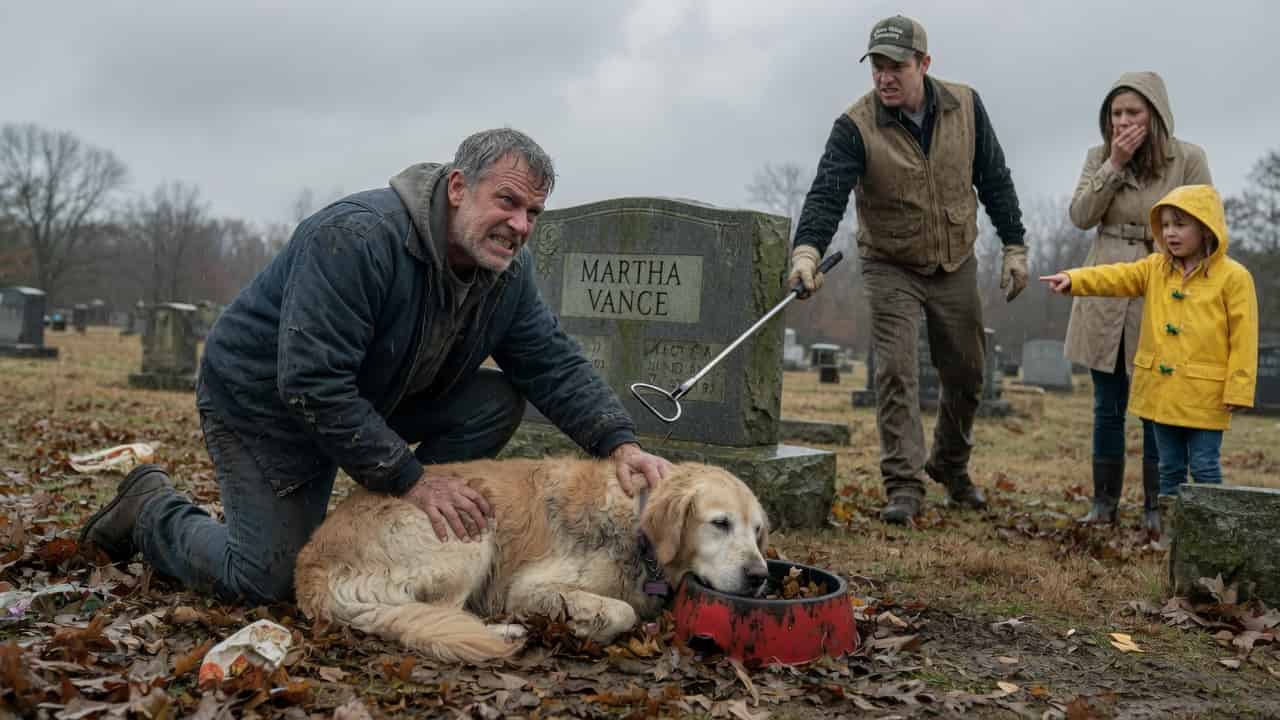
Elias was on his knees in the mud, his hands shaking as he shielded the skeletal, blind Golden Retriever from the groundskeeper’s catch-pole. The dog was barely breathing, his fur matted with five years of Indiana winters, his chin resting right on the name engraved in the granite: Martha Vance.
“It’s a nuisance, Elias,” Blake sneered, loud enough for the families at the nearby Sunday service to hear. “It’s a dying mutt that smells like a sewer. Look at you, crying over a piece of rot. It’s embarrassing.”
The crowd watched as Blake shoved the metal pole toward the dog’s neck again. He didn’t see what Elias saw. He didn’t see the melted blue water bowl tucked under the dog’s paws—the same bowl that had been in the kitchen the night the house went up in flames five years ago.
Elias had spent five years believing his dog had disappeared in the fire. He’d spent five years trying to move on, even getting a new dog he couldn’t bring himself to love. But Cooper hadn’t disappeared. He’d been waiting.
For 1,800 days, this dog had guarded a grave, drinking rainwater and waiting for a man who thought he was gone. And now, the town was watching as the groundskeeper tried to treat him like garbage one last time.
But Elias wasn’t letting go. Not again.
Chapter 1: The Ash in the Air
The smell of smoke never really left the house, even though the house was new. Elias sat at the kitchen island, his hands wrapped around a mug of coffee that had gone cold twenty minutes ago. It was a Saturday in October, the kind of Indiana morning where the sky looked like a wet wool blanket and the wind smelled of damp cedar and woodsmoke from the neighbors’ fireplaces.
Across the linoleum, Buster, a two-year-old Lab mix with too much energy and not enough history, whined and nudged Elias’s knee. Elias didn’t move. He didn’t look down. He knew the dog wanted a walk, wanted a game of fetch, wanted the kind of uncomplicated love that Elias had forgotten how to give.
“Not now, Buster,” Elias said, his voice gravelly.
The dog huffed and settled onto its belly, chin resting on its paws. Elias felt a familiar twinge of guilt—not the sharp, hot kind, but a dull, rhythmic ache. He’d adopted Buster because his sister, Sarah, told him he was “becoming a hermit.” She’d said a dog would help him heal, that a house was too quiet with just one person and the memory of a fire. But every time Elias looked at Buster, he didn’t see a companion. He saw a replacement.
He stood up, the joints in his knees popping. He needed to go. It was the fourteenth of the month.
“Sarah’s coming by at noon to check on you,” he muttered to the dog, though he was really telling himself. He grabbed his navy work jacket from the peg by the door.
The drive to the Oakwood Cemetery took fifteen minutes. He drove his 2012 Ford F-150, a truck that rattled over the potholes of the county road. He kept the windows up. He didn’t like the wind in his face anymore; it reminded him of the draft that had fed the flames five years ago, the way the air had seemed to scream as the roof collapsed.
Oakwood was a sprawling, rolling piece of land on the edge of town. The front sections were manicured—neat rows of marble and granite, American flags fluttering by veterans’ markers, fresh plastic flowers in vivid purples and yellows. But Elias didn’t stop there. He drove to the very back, where the paved road turned to gravel and then to dirt.
This was Section 12. It was the “budget” section, the place where the grass grew long and the headstones were often tilted by the shifting Indiana clay. It was where the cemetery didn’t bother with the leaf blowers or the weed-whackers more than once a month.
He parked the truck under a dying oak tree and stepped out. The silence here was different. It wasn’t peaceful; it was heavy. He walked the familiar path, his boots crunching on the fallen leaves. He was headed for the marker that sat under a low-hanging willow.
Martha Vance. 1974–2021. Beloved Wife.
He’d kept the inscription simple because the grief had been too complicated for poetry.
When he reached the grave, he stopped. He always stopped ten feet away, a habit born of a subconscious fear that if he approached too quickly, the reality of her absence would hit him like a physical blow.
But today, something was different.
There was a shape huddled against the granite.
At first, Elias thought it was a pile of old rags or a discarded mulch bag. But then the shape moved. A long, shuddering breath rattled through the air.
Elias froze. His heart, usually a slow, steady thud of resignation, gave a sharp kick against his ribs.
The shape was a dog.
It was a Golden Retriever, or what was left of one. Its fur was no longer gold; it was the color of a dirty sidewalk, matted into thick, felted dreadlocks that were caked with dried mud and burrs. It was skeletal, its ribs visible even through the thick coat. It was curled so tightly against the headstone that it looked like it was trying to merge with the stone.
“Hey,” Elias whispered.
The dog didn’t bark. It didn’t growl. It slowly, painfully, lifted its head.
The eyes were cloudy, white with cataracts. The dog was blind. It turned its head slightly, its nose twitching, catching the scent of the man standing in the cold.
Elias felt the world tilt. He knew those ears. One of them had a small, jagged notch at the tip where a stray cat had caught him ten years ago. He knew the way the dog’s forehead wrinkled when it was confused.
“Cooper?”
The name felt like a piece of glass in his throat.
The dog’s tail, a thin, matted whip of hair, gave a single, weak thump against the damp earth.
Elias dropped to his knees. He didn’t care about the mud soaking into his jeans. He didn’t care about the cold.
“Cooper?” he said again, louder this time.
The dog let out a sound. It wasn’t a whine. It was a long, broken, human-sounding moan, a vibration of pure, unadulterated grief. It leaned its weight away from the stone and toward Elias, and that was when Elias saw it.
Tucked under the dog’s front paws was a blue plastic water bowl. It was warped, the edges melted into strange, bubbled shapes. It was the bowl that had sat on the back porch of the old house. The bowl Elias had filled every morning for six years.
Elias reached out, his hand trembling so violently he could barely control it. His fingers touched the dog’s head. The fur was cold, damp with the morning mist. Cooper didn’t pull away. He pressed his skull into Elias’s palm, a desperate, starving gesture of recognition.
“You’re alive,” Elias choked out. “How are you alive?”
He looked at the grave. He looked at the dog. He looked at the melted bowl.
The fire had been five years ago. He’d searched for Cooper for weeks. He’d called the shelters, posted the flyers, walked the charred ruins of their life until his shoes were ruined. Eventually, Sarah had told him to stop. She’d said that if Cooper hadn’t come back, he was with Martha. She’d said it was a mercy that they went together.
And Elias had believed her. He’d chosen to believe it because the alternative—that Cooper was out there, alone and terrified—was more than he could bear.
But Cooper hadn’t been with Martha. Not in the way Elias thought.
He’d been here.
Elias pulled the dog into his lap, the smell of rot and wet fur filling his lungs. He wept, his face buried in the matted neck of a ghost that had refused to stay dead.
Behind him, the sound of a heavy engine rumbled. A white cemetery truck pulled up on the gravel path, the yellow light on top flashing lazily.
Chapter 2: The Groundskeeper’s Toll
The truck door slammed with a metallic crack that echoed through the quiet of Section 12. Elias didn’t look up. He couldn’t. He was trying to untangle a particularly nasty burr from the fur behind Cooper’s ear, his fingers fumbling with a tenderness that felt foreign to him.
“Hey! You can’t be doing that,” a voice called out.
It was a young voice, sharp and lacking the weight of experience. Elias recognized it. It belonged to Blake, the kid the county had hired six months ago to oversee the grounds. Blake was twenty-four, wore his baseball cap backward, and looked like he was constantly counting the minutes until his shift ended.
Elias ignored him. He felt Cooper shiver. The dog was a bag of bones, his breathing shallow and rattling.
“I’m talking to you, Vance,” Blake said, his boots crunching closer. “You know the rules. No pets in the cemetery. Especially not that… whatever that is.”
Blake stopped three feet away. He looked down at Elias, his lip curling. He held a clipboard in one hand and a half-eaten granola bar in the other.
“It’s a dog, Blake,” Elias said, his voice flat.
“It’s a nuisance is what it is,” Blake countered. “I’ve been trying to catch that thing for three days. It’s been digging around the markers, scaring the visitors. Mrs. Gable complained yesterday. Said she saw a ‘zombie dog’ lurking by her husband’s plot.”
“He’s not digging,” Elias said, finally looking up. His eyes were red-rimmed, his face tight. “He’s sitting. He’s been sitting right here.”
Blake looked at the dog, then at the headstone, then back at Elias. He let out a short, harsh laugh. “You’re kidding, right? You think that’s your dog? The one from the fire?”
“I know it is.”
“Vance, that was five years ago. Look at that thing. It’s a stray. It’s a mangy, flea-bitten stray that probably has rabies. It looks like it crawled out of the dirt.”
Blake stepped forward, kicking at the melted blue bowl. The plastic skittered across the grass. Cooper flinched, a low, pathetic whimper escaping his throat. He tried to scramble closer to Elias, but his back legs gave out, sliding uselessly in the mud.
“Don’t touch his stuff,” Elias snapped, reaching out to grab the bowl.
“His stuff? It’s trash, Elias! This is a cemetery, not a dump. I’ve got a job to do. I already called Animal Control. They’re on their way to pick up the carcass.”
“He’s not a carcass,” Elias stood up, the dog still huddled at his feet. He was taller than Blake, broader, his years of construction work evident in the set of his shoulders. “And he’s not going with Animal Control.”
Blake didn’t back down. He had the arrogance of someone who felt the badge on his vest gave him more than just a job. “Yes, he is. It’s policy. He’s a public health hazard. Look at him—he’s literally rotting. You want to keep him? You should’ve kept him five years ago. You’re lucky I don’t cite you for littering with that bowl.”
“I told you,” Elias stepped closer, his voice dropping to a dangerous low. “He stays with me.”
“He’s private property of the county now,” Blake sneered. “And you? You look like a damn mess, Elias. People come here to mourn, not to see some crazy guy hugging a diseased mutt in the mud. It’s pathetic. Your wife wouldn’t want you acting like this.”
The mention of Martha felt like a slap. Elias’s jaw tightened. He could feel the heat rising in his neck, a familiar, destructive anger that he usually kept buried under layers of apathy.
“You don’t talk about my wife,” Elias said.
“I’ll talk about whatever I want on these grounds,” Blake said, puffing out his chest. “I’m the one who has to clean up after people like you. Now, move out of the way. I’m going to loop him and put him in the back of the truck until the warden gets here.”
Blake reached into the bed of his truck and pulled out a long, silver catch-pole. The wire loop at the end glinted in the grey light.
Cooper seemed to sense the danger. He let out a high, panicked yelp, trying to tuck his head under Elias’s jacket. He was shaking so hard Elias could feel it through his boots.
“Put that down,” Elias said.
“Make me,” Blake replied, jabbing the pole toward the dog.
It was a small movement, but it was enough. The loop brushed against Cooper’s ear. The dog shrieked—a sound of pure terror that sliced through the morning.
Elias didn’t think. He reached out and grabbed the pole, his hand clamping onto the cold metal just below the handle. He yanked it. Blake, caught off guard, stumbled forward, nearly losing his footing in the mud.
“Hey!” Blake yelled. “That’s county equipment! Get your hands off!”
“Get off my land,” Elias growled.
“This isn’t your land! You bought a hole in the ground, that’s it!”
In the distance, another car was approaching. A black SUV. Elias recognized the license plate. It was Sarah. She must have finished her errands early and come looking for him.
Blake saw her too. He straightened his vest, his expression shifting from anger to a calculated, victimized pout. “Good. Someone else to see how unhinged you are. You’re assaulting a county employee, Elias. That’s a felony.”
Elias didn’t let go of the pole. He looked down at Cooper. The dog had gone still, his blind eyes fixed on nothing, his body leaning against Martha’s stone as if seeking strength from the granite.
The SUV pulled up, and Sarah stepped out, her face pale. She took in the scene—her brother on the verge of a fight, a skeletal dog in the mud, and a groundskeeper holding a catch-pole.
“Elias?” she whispered. “What is going on?”
Chapter 3: The Witness of the Sunday Mourners
The SUV door stayed open, the “door ajar” chime a rhythmic, annoying ping that underscored the tension. Sarah walked toward them, her heels sinking into the soft earth. She was a woman who lived by schedules and tidy solutions, and Section 12 was currently the opposite of tidy.
“Blake, put that thing away,” Sarah said, her voice sharp but controlled. She looked at the groundskeeper with the practiced authority of a former school board member.
“I’m doing my job, Sarah,” Blake spat, though he stopped pulling against Elias’s grip on the pole. “Your brother is interfering with the removal of a stray. A dangerous one.”
“Dangerous?” Sarah looked down at the dog. She froze. Her eyes went wide, and her hand flew to her mouth. “Oh my god.”
“It’s him, Sarah,” Elias said, his voice breaking. “It’s Cooper.”
“Elias… that’s impossible. Cooper died. We searched… the vet said…”
“The vet was wrong,” Elias said, his grip on the pole tightening. “He’s been here. Look at the bowl, Sarah. Look at the bowl.”
Sarah looked at the melted blue plastic lying in the dirt. She remembered that bowl. She remembered Martha laughing as the puppy Cooper tried to carry it around the yard, tripping over the rim.
“But how?” she whispered.
“I don’t care how,” Elias said. “He’s here now. And this kid thinks he’s taking him to the pound to be put down.”
“He’s a liability!” Blake yelled, looking past Sarah toward the road.
A silver minivan had pulled up a few yards away. A young mother in a beige trench coat stepped out, holding the hand of a little girl in a bright yellow raincoat. They were here to visit a grave two rows over—a fresh mound of earth decorated with a small white cross.
The little girl stopped. She stared at the scene—the men arguing, the long metal pole, and the miserable, shivering creature in the mud.
“Mommy?” the girl asked, her voice high and thin. “Why is that dog crying?”
Blake saw his audience. He turned toward the woman, his voice rising, gaining a performative edge. “I’m sorry, ma’am. We’re dealing with a situation. This man is keeping a diseased animal on the grounds. It’s not safe for children.”
The mother pulled her daughter closer, her eyes darting between Elias and the dog. “Is it… is it sick?”
“It’s dying,” Blake said loudly. “It’s been scavenging here for weeks. It’s a health hazard. I’m trying to remove it for the safety of the public, but Mr. Vance here thinks the rules don’t apply to him.”
“He’s not a health hazard!” Elias shouted, his face turning a deep, bruised red. “He’s a grieving animal! He hasn’t moved from this spot in five years!”
“Five years?” the mother whispered, her expression shifting from fear to a tentative, pained curiosity.
“He’s delusional,” Blake told the mother, tapping his temple. “His wife is buried here, and he’s projected his grief onto a stray. It’s sad, really. But I can’t have a rotting animal by the graves. It’s disrespectful to the other families. Don’t you agree?”
The mother looked at Elias. She saw the mud on his knees, the desperation in his eyes, and the way he was physically shielding the dog with his own body. Then she looked at the dog. Cooper had lifted his head again, his cloudy eyes fixed in the direction of the little girl. He let out a soft, rhythmic whine—the sound of a heart that had been breaking for a very long time.
The little girl broke away from her mother’s grip.
“Lily, no!” the mother cried.
But the girl didn’t run. She walked slowly, her yellow boots squelching in the mud. She stopped three feet from Elias. She didn’t look at the men. She looked only at Cooper.
“He’s not a monster,” she said, her voice small but clear. “He’s just lonely.”
She reached into the pocket of her raincoat and pulled out a small, crumpled biscuit—a snack from her lunchbox. She held it out.
Cooper’s nose twitched. He didn’t move toward the biscuit. He didn’t have the strength. But he stretched his neck out, his tail giving one more weak, ghost-like thump against the headstone.
“See?” Blake said, jabbing the pole again. “He’s unpredictable! Get back, kid!”
Elias shoved the pole away with a violence that made Blake stumble back into the side of his truck. “Don’t you dare scream at her.”
“That’s it,” Blake hissed, reaching for the radio on his shoulder. “Dispatch, I need a deputy at Section 12. I’ve got a hostile visitor and a dangerous animal. Now.”
“Sarah, get the truck,” Elias said, his voice strangely calm now.
“Elias, what are you doing?”
“I’m taking him home.”
“You can’t just take him!” Blake yelled. “He’s county property! And he’s probably got enough infections to kill a horse! You take him in that truck, you’re just dragging a corpse around.”
“He’s not a corpse,” Elias whispered, reaching down and sliding his arms under Cooper’s brittle frame.
The dog was lighter than he expected—horrifyingly light, like a bundle of dry sticks wrapped in felt. As Elias lifted him, Cooper let out a sharp gasp of pain, his head falling back against Elias’s shoulder.
“Elias, he’s in bad shape,” Sarah said, her voice trembling. “Maybe… maybe the warden is the right choice. They can… they can make it quick.”
Elias looked at his sister. He looked at the woman in the trench coat, who was now crying silently. He looked at the little girl, who was still holding out her biscuit.
“He’s waited five years for me to come back for him,” Elias said. “He’s not dying in a cage.”
He began to walk toward the SUV, the dog’s weight a cold, heavy truth in his arms.
“You’re not going anywhere!” Blake stepped in front of him, blocking the path with his body. He held the catch-pole like a staff, his face twisted in a mask of petty power. “You move one more step, and I’m charging you with theft.”
Chapter 4: The Residue of the Fire
The wind picked up, swirling the dead leaves around their feet. Elias stood his ground, his boots anchored in the Indiana mud. He could feel Cooper’s heart beating against his chest—a fast, erratic drumbeat, the sound of a creature at the end of its rope.
“Get out of my way, Blake,” Elias said.
“No. You think you’re special? You think because you lost your house and your wife, you get to do whatever you want? Everyone loses things, Vance. It doesn’t give you the right to turn this place into a kennel.”
Blake stepped closer, his face inches from Elias’s. “I’ve seen guys like you before. You’re just looking for an excuse to keep feeling sorry for yourself. You want to save this dog because you couldn’t save her. But guess what? He’s going to die anyway. Probably by tomorrow. And you’ll just be left with the bill and a pile of stinking fur.”
The cruelty was so precise, so targeted, that for a second, Elias couldn’t breathe. It was the truth he’d been telling himself for five years. He was a man who failed. He was a man who stood on a sidewalk and watched his world turn to ash.
“Maybe,” Elias said, his voice low. “But he’s going to die in a warm house. With a full belly. And he’s going to know he wasn’t forgotten.”
“Elias,” Sarah said, stepping between them. She looked at Blake, her eyes cold. “I’m calling Dr. Aris. He’s been our vet for twenty years. If he says the dog can be moved, he’s coming with us. If you have a problem with that, you can talk to the County Commissioner. He’s a first cousin of my husband’s.”
Blake’s bravado flickered. He looked at Sarah, then at the mother and child who were still watching, then at the road. No deputy had appeared yet.
“Fine,” Blake spat, stepping back. He leaned against the truck, crossing his arms. “Call your vet. But the second he says that thing is a hazard, it’s mine. And I’m charging you for every minute I’m standing here.”
Sarah didn’t answer. She was already on the phone, her voice urgent.
Elias didn’t wait. He walked to the back of Sarah’s SUV and laid Cooper down on the cargo mat. The dog groaned as his bones hit the floor, but then he felt the plushness of a blanket Sarah had kept in the back. He let out a long sigh, his head resting on his paws.
Elias sat on the bumper, his hands covered in mud and dog hair. He looked back at Martha’s grave.
The melted blue bowl was still there.
He walked back, ignored Blake’s sneer, and picked it up. He wiped the dirt off the rim with his thumb.
As he turned to leave, the little girl in the yellow raincoat walked up to him. She didn’t say anything. She just reached out and took his hand, her small fingers squeezing his rough, calloused ones.
“He’s happy now,” she whispered.
Elias looked at her, and for the first time in five years, the smell of smoke in his nose was replaced by something else. The smell of damp earth. The smell of rain. The smell of life, however brief it might be.
He walked back to the SUV and climbed into the back beside Cooper. He didn’t care about the mud on the leather seats. He didn’t care about the groundskeeper or the pending police call.
He reached out and stroked Cooper’s head. The dog’s ear flicked.
“We’re going home, Coop,” Elias whispered.
In the front seat, Sarah started the engine. “Dr. Aris is meeting us at the clinic. He sounded… he sounded shocked, Elias. He said if it’s really him, it’s a miracle.”
“It’s not a miracle,” Elias said, looking out the window as the cemetery faded into the mist. “It’s a debt. And I’m five years late on the payment.”
As they drove away, Blake stood in the middle of Section 12, his catch-pole leaning against his shoulder. He looked at the empty space by Martha’s grave, then down at the muddy biscuit the little girl had dropped. He kicked it into the dirt, but he didn’t look like he’d won. He looked like a man who had realized he was the only one left in the cold.
Elias held Cooper’s paw. The dog’s breathing was leveling out, a slow, rhythmic rasp.
The residue of the fire was still there, but as they pulled onto the main road, the heat of the anger began to cool into something else. Something like a plan.
He had to tell Buster. He had to tell Sarah. He had to tell the vet.
But mostly, he had to tell Martha.
He looked at the melted bowl in his lap. He’d never let it go again.
Chapter 5: The Geography of a Ghost
The interior of Sarah’s SUV smelled like vanilla air freshener and expensive leather, a sharp, artificial contrast to the stench of Section 12. Elias sat on the floor of the cargo area, his back against the rear seat, his legs splayed out in the cramped space. He didn’t care about the ergonomics. He only cared about the rise and fall of the matted ribcage beneath his palm.
Cooper was quiet now. The panicked yelps from the cemetery had faded into a low, rhythmic wheeze. Every few miles, the dog’s body would give a sudden, violent shiver, and Elias would press his weight closer, trying to offer a heat he didn’t feel he possessed.
“He’s staring at the door, Elias,” Sarah said from the driver’s seat. Her eyes flickered to the rearview mirror, her knuckles white on the steering wheel. “He knows the window is there, but he isn’t looking out. He’s just… staring.”
“He’s blind, Sarah. I told you.”
“I know. But it’s more than that. He’s listening for the turn. He thinks we’re going back to the old place.”
Elias looked at the back of his sister’s head. She was right, and the realization felt like a fresh bruise. They weren’t going to the house on Miller Road. That house was a scorched rectangle of concrete and twisted rebar, eventually cleared away and sold to a developer who built three identical grey townhomes on the lot. They were going to the “New Place”—a suburban ranch-style house with a manicured lawn and a security system that Elias armed every night out of a habit born of paranoia.
“He won’t know the smell,” Elias whispered. “The furniture, the air… it’s all wrong.”
“He knows you,” Sarah said, though her voice lacked conviction.
They pulled into the parking lot of the Aris Veterinary Clinic. It was a low brick building nestled between a Tractor Supply and a shuttered diner. Dr. Aris was waiting at the side entrance. He was a man who had aged in increments of lost livestock and beloved pets, his face a map of rural Indiana’s biological history. He wore a faded green scrub top and carried a heavy moving blanket.
“Let’s get him inside,” Aris said, skipping the pleasantries. He looked at the dog and his eyes narrowed, a professional mask sliding over his initial shock. “Careful with the hips, Elias. He’s mostly air and prayer at this point.”
The clinic was bright, the fluorescent lights humming with a clinical indifference. They laid Cooper on the stainless-steel exam table. The cold metal made the dog scramble for a second, his dull claws clicking frantically, his head swinging wildly in the dark.
“Easy, Coop. Easy,” Elias murmured, leaning his chest over the dog’s neck, pinning him gently to the table. He felt the dog’s heart racing, a frantic thump-thump-thump that felt like it might shatter the thin ribs.
Dr. Aris began the exam. He didn’t speak for a long time. He moved with a practiced, somber efficiency—checking the gums, the clouded eyes, the temperature, the heart rate. He took a blood sample, the needle sliding into the thin vein with terrifying ease. He ran a comb through a patch of matted fur, and a dozen engorged ticks fell onto the table, small, grey pebbles of misery.
Sarah stood by the door, her arms crossed, her eyes fixed on the linoleum. Elias stayed at the head of the table. He let Cooper lick his thumb, the dog’s tongue feeling like dry sandpaper.
“Well?” Elias finally asked. The silence in the room had become unbearable, thick with the smell of antiseptic and the residue of the five years Elias had spent sleeping in a clean, quiet bed while this dog slept in the mud.
Dr. Aris stepped back, sighing as he rubbed the bridge of his nose. “He’s severely dehydrated. Anemic. The cataracts are total—he’s seeing nothing but shadows, if that. His heart is enlarged, likely from years of untreated heartworm and the stress of the winters. And the hips… they’re shot, Elias. Arthritis has fused half the joints.”
“But he’s alive,” Elias said. It wasn’t a question. It was a demand.
“He is,” Aris said, his voice softening. “But I have to ask you something, and you need to be honest with me, not with the man you were five years ago. Look at him, Elias. Really look at him.”
Elias looked. He saw the way Cooper’s head sagged when Elias wasn’t supporting it. He saw the tremor in the front legs. He saw the raw patches of skin where the fur had simply given up.
“He’s been living on instinct and rainwater,” Aris continued. “He stayed at that grave because it was the last place the world made sense to him. But now that you’ve taken him away from the stone… his body might realize how tired it is. Are you doing this for him, or are you doing it because you can’t say goodbye twice?”
“I didn’t get to say goodbye the first time,” Elias snapped. “I was at work. I came home to a perimeter of yellow tape and a captain telling me they couldn’t find the dog. I spent five years thinking he turned to ash. I’m not letting him turn to ash in a clinic parking lot because it’s ‘convenient.'”
“It’s not about convenience,” Aris said gently. “It’s about mercy.”
“Mercy is a warm bed,” Elias said. “Mercy is a meal that isn’t a discarded biscuit or a dead squirrel. Give him the fluids. Give him the meds. I’m taking him home.”
The drive home from the clinic was slower. Cooper was hooked to a portable IV line, a bag of saline swinging from the garment hook in the back of Sarah’s SUV. He was draped in a heated blanket, his head resting on Elias’s thigh.
When they pulled into the driveway of the ranch house, the sun was beginning to dip below the horizon, casting long, orange shadows across the cul-de-sac. The neighborhood was quiet, save for the distant sound of a lawnmower and the barking of a dog three houses down.
“Do you want me to come in?” Sarah asked, her hand on the gearshift.
“No,” Elias said. “I need to do this.”
“Buster is going to be confused, Elias. He’s a good dog, but he’s territorial. Don’t just throw them together.”
“I know how to handle my dogs, Sarah.”
He lifted Cooper. The dog felt warmer now, the fluids doing their slow, invisible work. Elias carried him up the concrete walk, the motion smooth and steady. He kicked the front door open.
The interior of the house was cool and dark. Buster, the Lab mix, was waiting in the hallway, his tail thumping against the drywall in a frantic greeting. But as Elias stepped inside with the bundle in his arms, Buster stopped. His ears went back. He lowered his head, a low, uncertain rumble starting deep in his chest.
“Easy, Buster. Back up,” Elias commanded.
He carried Cooper into the living room and laid him on the oversized orthopedic bed he’d bought for Buster six months ago. It was the best bed in the house, positioned right in front of the gas fireplace. Cooper sank into the foam, his body letting out a long, shuddering sigh.
Buster approached slowly, his hackles raised. He circled the bed, sniffing the air with a frantic, wet intensity. He smelled the cemetery. He smelled the rot, the medicine, and the ancient, faded scent of a dog that had belonged to this man long before Buster was even a thought.
Cooper didn’t move. He didn’t have the strength to defend the territory. He just lay there, a grey ghost in a modern room, his blind eyes fixed on the ceiling.
Elias sat on the floor between them. He put one hand on Buster’s collar and the other on Cooper’s head.
“This is Cooper,” Elias said, his voice thick. “He was here first, Buster. He was here before the fire. He’s home now.”
Buster stopped growling. He looked at Elias, then at the skeletal creature on his bed. With a huff of resignation, the Lab mix turned and walked to the corner of the room, flopping down on the hardwood floor with a heavy sigh.
Elias stayed on the floor. He watched the clock on the mantle. He watched the IV bag drip. He watched the way the shadows moved across the room, realizing that for the first time in five years, the house didn’t feel empty. It felt crowded with the things he had tried to forget.
He thought of Blake, the groundskeeper, standing in the mud with his silver pole. He thought of the way the boy had looked at Cooper—as a nuisance, a health hazard, a piece of trash. And then he looked at the dog on the bed.
To the world, Cooper was a disaster. A mistake of nature that should have been corrected by a needle and a black trash bag. But to Elias, the dog was a bridge. He was the only living thing that remembered the sound of Martha’s laugh, the way she smelled like lemon soap and woodsmoke, the way she used to whisper “Stay” when she left the room.
Cooper moved his head, his nose nudging Elias’s knee. Elias reached out and touched the dog’s velvet-soft ear.
“I’m sorry,” Elias whispered into the quiet room. “I’m so sorry I stopped looking.”
Cooper didn’t answer. He just breathed. And for now, in the flickering light of the gas fire, that was enough.
Chapter 6: The Last Watch
The first night was a marathon of ghosts.
Elias didn’t go to bed. He dragged an old armchair into the living room and sat three feet from Cooper’s bed. He kept a single lamp on, the yellow light casting long, distorted shadows against the walls. Buster had eventually crept back over, curled up at Elias’s feet, his breathing heavy and rhythmic. But Elias remained awake, his eyes fixed on the slow, shallow rise and fall of Cooper’s chest.
Around 3:00 AM, the house settled into that deep, unnatural silence that always made Elias think of the moments before the fire—the heavy stillness before the first crackle of wood.
Cooper began to move. It wasn’t a wakeful movement, but a dream-tremor. His paws twitched against the orthopedic foam, his muffled whines echoing in the hollow space of his throat. He was running. In his mind, he was no longer a skeletal prisoner of Section 12. He was young, his coat was gold, and he was chasing something through the tall grass of the old Miller Road property.
Elias watched him, the back of his throat aching. He realized then that Cooper hadn’t just been guarding a grave; he had been guarding a timeline. By staying at that stone, the dog had refused to let the fire be the end of the story. He had remained a physical tether to a world that Elias had tried to bury under new furniture and a new dog.
“You’re a better man than me, Coop,” Elias whispered.
He stood up, his joints stiff, and walked to the kitchen. He opened a can of high-calorie wet food the vet had provided. The smell was potent, and it woke Buster, who sat up and licked his chops.
“Not for you,” Elias muttered.
He brought the bowl back to the living room. He sat on the floor and gently nudged Cooper’s shoulder. The dog woke with a start, his head snapping up, his blind eyes wide with a momentary, heart-wrenching terror.
“It’s okay. It’s me. It’s Elias.”
He held the bowl under the dog’s nose. For a second, Cooper didn’t react. Then, the smell hit him. It was a sensory overload—rich, meaty, and abundant. The dog began to eat with a desperation that was painful to witness. He didn’t just lap at the food; he tried to inhale it, his tail thumping weakly against the bed in a frantic, joyous rhythm.
When the bowl was licked clean, Cooper didn’t settle back down. He pushed himself up onto his front paws, his back legs shaking violently as he tried to find purchase on the foam.
“Whoa, easy. You don’t have to get up.”
But Cooper was determined. He sniffed the air, his head swinging left to right. He caught a scent—the familiar, comforting smell of Elias’s work jacket, which was draped over the back of the armchair. He began to crawl, his belly dragging, toward the chair.
Elias moved to help him, but he stopped. He watched as the dog reached the chair and buried his nose in the faded navy fabric. Cooper stayed there for a long time, his eyes closed, his body finally going still. He wasn’t looking for a grave anymore. He had found the man.
The sun rose on Sunday morning with a pale, watery light. At 8:00 AM, there was a knock at the door.
Elias opened it to find Sarah standing on the porch, holding a cardboard carrier of coffee and a bag of groceries. She looked like she hadn’t slept either. Her eyes went immediately to the living room.
“How is he?” she asked, her voice a whisper.
“He ate,” Elias said. “He’s resting.”
They sat in the kitchen, the steam from the coffee rising between them. Sarah looked around the room, her gaze lingering on a framed photo of Martha on the sideboard—one Elias usually kept turned toward the wall.
“I talked to the cemetery board this morning,” Sarah said. “I made sure they knew what Blake did. The catch-pole, the threats in front of the visitors… he’s been suspended, Elias. They were terrified of a lawsuit, but more than that, they were embarrassed. The woman in the yellow raincoat? She posted a video of the argument on the town’s community page. People are… they’re angry.”
Elias took a sip of his coffee. He felt a dull satisfaction, but it was distant. The rage that had fueled him in the cemetery had been replaced by a heavy, somber clarity.
“It doesn’t matter,” Elias said. “Blake was just a symptom. He’s the person the world becomes when you stop caring about the things you lost. He saw a nuisance because that’s all I let Cooper be by not being there.”
“You can’t blame yourself for a fire, Elias. You can’t blame yourself for a miracle.”
“It’s not a miracle, Sarah. It’s a consequence. He stayed because he loved her. I left because I was afraid of the pain. The dog won.”
They sat in silence for a while, the only sound the hum of the refrigerator and the distant clicking of Buster’s nails on the hardwood.
“What are you going to do?” Sarah asked.
Elias looked toward the living room. He could see the tip of Cooper’s grey tail peeking out from behind the armchair.
“I’m going to give him a week,” Elias said. “Maybe two. Dr. Aris is coming by tomorrow to check the heart rate. But I think… I think he just wanted to see me one last time. To make sure I was still here.”
“Elias…”
“It’s okay, Sarah. I’m not the man I was yesterday. I can handle it now.”
The week that followed was the quietest of Elias’s life. He took a leave of absence from the construction firm. He spent his days on the floor. He brushed the mats out of Cooper’s fur, an inch at a time, until the dog looked less like a swamp creature and more like the Golden he used to be. He fed him small, frequent meals. He carried him outside to the backyard, letting the dog feel the grass under his paws and the sun on his face.
Buster became a silent partner in the vigil. The younger dog seemed to understand the gravity of the situation. He stopped trying to play. He simply sat near the bed, a sentinel for the elder statesman of the house.
On Friday evening, the weather turned cold. A frost was creeping across the Indiana fields, and the wind rattled the panes of the ranch house.
Cooper didn’t want to go outside. He lay on the bed, his breathing slow and heavy. He wasn’t in pain—the meds had seen to that—but he was fading. The light in his clouded eyes was dimming, his body finally surrendering to the five years of cold and hunger it had endured.
Elias laid down on the floor beside him. He pulled the heated blanket over both of them. He put his arm across the dog’s chest, feeling the faint, stuttering beat of the heart.
“You did good, Coop,” Elias whispered. “You found me. You can go now. She’s waiting.”
He stayed there for hours. He talked to the dog about the old house. He talked about the way the garden used to look in the spring. He talked about the time Cooper had stolen a whole Thanksgiving turkey off the counter and hidden it under the porch. He talked until his voice was a rasp, until the tears ran hot and silent into the dog’s fur.
Around midnight, Cooper gave a long, deep sigh. His body relaxed, the tension leaving his limbs for the first time in half a decade. The heartbeat under Elias’s palm gave one last, soft flutter and then stopped.
The room was silent.
Elias didn’t move. He stayed there for a long time, holding the ghost of his past, the cold wind howling against the siding of the house. He felt a profound sense of loss, yes, but underneath it, there was a foundation. A solid, unshakable truth.
He had been found.
In the morning, Elias called Sarah. They took Cooper back to the cemetery, but they didn’t go to Section 12. Elias had bought a second plot years ago, right next to Martha’s. He hadn’t intended to use it for a dog, but as he stood there with the shovel in his hand, it was the only thing that made sense.
He dug the hole himself. It was hard work, the clay thick and stubborn, but he welcomed the ache in his shoulders. It felt like a physical shedding of the last five years.
When he was done, he laid Cooper in the earth, wrapped in the navy work jacket. He placed the melted blue bowl at the dog’s feet.
“Stay,” Elias whispered.
As he filled the grave, he looked up. A few rows over, he saw the little girl in the yellow raincoat. She was standing with her mother, watching him. She didn’t wave, and she didn’t approach. She just stood there, a bright splash of color against the grey Indiana sky.
Elias finished the work. He patted the earth down with the back of the shovel. He stood for a moment by the two markers—the granite stone for Martha and the fresh mound of earth for the dog who wouldn’t leave her.
He walked back to his truck. Buster was waiting in the passenger seat, his head out the window, his tail wagging as Elias approached.
Elias climbed in and started the engine. He looked in the rearview mirror, at the fading silhouette of the willow tree and the stones beneath it. The smell of smoke was gone. In its place was the scent of the coming winter—sharp, clean, and full of the promise of a quiet house.
He put the truck in gear and drove toward home. He had a dog to walk. He had a life to live. And for the first time in five years, he wasn’t driving away from anything. He was just going home.