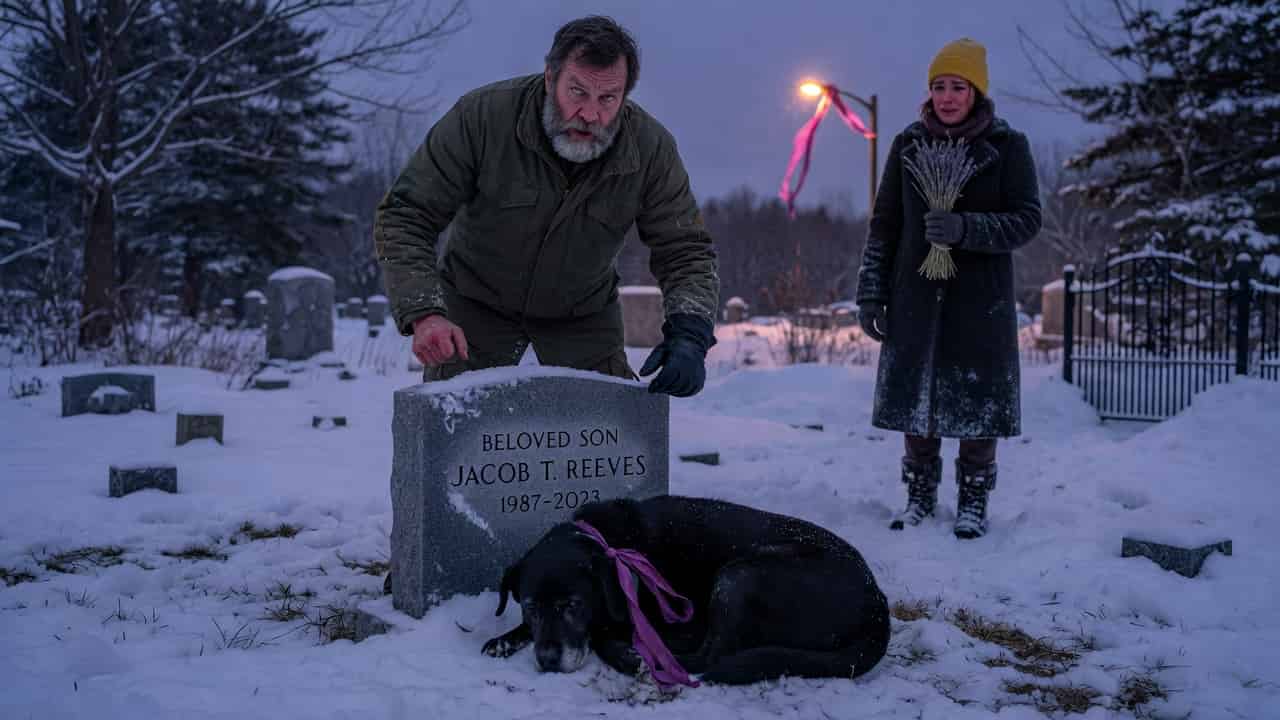
“Get up! You think she cares? She’s gone, you stupid animal! You were supposed to protect her, but you just watched it happen!”
Silas’s voice cracked through the biting Vermont wind, a jagged sound that felt like it was tearing through the very silence of the cemetery. He stood over the matted, shivering black dog, his hands shaking in his pockets. It had been three years since the funeral. Three years since he’d driven this dog to the edge of the county and left him there because he couldn’t stand the sight of the creature that had been in the room when his wife’s heart finally gave out.
He’d told himself it was the dog’s fault. If Duke had barked louder, if he’d scratched at the door, maybe the neighbors would have heard. Maybe Martha would still be making coffee and humming along to the radio. Instead, Silas had come home to a cold house and a dog sitting silently by her side.
But Duke hadn’t stayed at the ridge where Silas dumped him.
“Stop it, Silas! He’s been here every night!”
Elena, the local florist, was standing at the gate, her face pale with a mix of fury and pity. She’d been the one leaving the lavender. She’d seen the dog surviving on scraps and loyalty while Silas hid in a bottle of cheap rye.
When Silas looked down, he saw it. Knotted into the dog’s fur was a tattered, faded purple ribbon—the one Martha used to tie back her hair. The dog hadn’t just survived; he’d remembered. And as Silas reached out, the realization of what he’d truly thrown away hit him harder than the winter gale.
Chapter 1: The Weight of Frozen Earth
The wind in Vermont doesn’t just blow; it hunts. It finds the gaps in your jacket, the cracks in your skin, and the places in your chest where you thought you’d buried the things you couldn’t carry. Silas felt it now, a sharp, icy finger poking at his ribs as he trudged up the gravel path of the Hillside Cemetery. His knees ached with every step, a rhythmic, grinding protest that reminded him he was sixty-eight and made of more regret than muscle.
He wasn’t supposed to be here. He’d told himself that morning, while the coffee was still bitter in the pot and the woodstove was throwing off a meager, sulky heat, that he wouldn’t go. It had been exactly three years. Three years since the ground had opened up and swallowed the only person who ever looked at him like he was something more than a retired Master Sergeant with a permanent scowl and a drinking problem.
“Just a quick check,” he muttered to the empty air, his breath hitching in a white plume. “See if the stone’s settled. That’s all.”
It was a lie, and Silas knew how to spot a lie. He’d spent twenty-two years in the Army training men to spot them. But today, he needed the lie. He needed to believe he was here for maintenance, not for the ghosts.
As he rounded the bend where the old oaks stood like skeletal sentries, he saw it. The granite headstone he’d paid for with his final contract money. Martha Jean Vance. Beloved Wife. Soft in Spirit, Strong in Love. He’d hated that inscription when the mason suggested it, thinking it sounded like a greeting card, but now, seeing it against the gray sky, it felt like the only true thing left in the world.
But something was wrong. There was a dark shape huddled at the base of the stone.
Silas slowed his pace, his hand instinctively reaching for the pocket where he used to keep a sidearm. It was too big for a crow, too still for a stray cat. As he got closer, the shape shifted. A head rose, slow and heavy, as if the neck were made of rusted iron.
Silas froze. The gravel crunched under his boot, a sound like breaking teeth.
“No,” he whispered.
It was a dog. But not just any dog. It was a black Labrador mix, or what was left of one. The fur was a disaster—matted into thick, frozen dreadlocks, caked with mud and ice. The snout was almost entirely white now, and the eyes were filmed over with the blue haze of age and cataracts. But the way those eyes fixed on Silas—the way they held a deep, unblinking recognition—was unmistakable.
“Duke?”
The dog didn’t wag its tail. It didn’t bark. It just shivered, a violent, rhythmic trembling that shook its entire frame. Between its front paws lay a dried, brittle sprig of lavender, the scent long gone, replaced by the smell of wet earth and decay.
A surge of something hot and ugly rose in Silas’s throat. It wasn’t pity. It was a jagged, defensive anger. He’d driven this dog forty miles away to the Ridge, a place where the hunters kept their hounds and the farms were big enough to absorb an extra mouth. He’d left him with a bag of kibble and a swift, silent departure, never looking back in the rearview mirror. He’d convinced himself the dog was better off there. That the dog was a reminder of the silence in the room when Martha died, a witness to Silas’s failure to be there when it mattered.
“What are you doing here?” Silas shouted, the sound echoing off the neighboring headstones. “I left you at the Ridge! You were supposed to stay there!”
Duke flinches, his head sinking lower toward the frozen dirt, but he didn’t move from the grave. He stayed pressed against the granite, his body a living shield for the woman underneath.
“Get up!” Silas stepped forward, his boots heavy on the crusty snow. “You think she cares? You think this helps? She’s gone, Duke! She’s been gone three years, and you’re just sitting here like a pathetic ghost!”
The dog’s ears flattened. Silas noticed something then—a flash of color amidst the grime. Behind the dog’s left ear, knotted so tightly into the fur that it looked like a part of his body, was a tattered strip of purple silk.
Silas felt the world tilt. He knew that ribbon. He’d bought it for Martha at a street fair in Burlington because she said it matched the lilacs in the backyard. She’d worn it every day for a year until it went missing. He’d accused the dog of eating it.
“You had it,” Silas whispered, his voice losing its edge, replaced by a hollow, terrifying clarity. “You’ve had it this whole time.”
He reached down, his fingers trembling, intended to grab the dog by the scruff and haul him away. But as his hand neared that matted fur, Duke didn’t growl. He didn’t snap. He simply looked up, his milky eyes reflecting the gray Vermont sky, and a single, low whimper escaped his throat. It wasn’t a sound of pain. It was a sound of exhaustion.
Silas pulled his hand back as if he’d been burned. He looked around the cemetery, suddenly feeling the weight of the thousands of eyes buried beneath the sod. He was a man who had led platoons, who had survived mortar fire and the crushing boredom of the motor pool, yet here he was, being undone by a creature that didn’t even weigh sixty pounds.
“You should have died at the Ridge,” Silas said, the words cruel and desperate. “It would have been easier for both of us.”
He turned on his heel and began to walk away, his heart hammering against his ribs like a trapped bird. He didn’t look back. He couldn’t. But as he reached the gate, he heard a sound—the soft, rhythmic clicking of claws on frozen gravel.
He didn’t have to turn around to know that the silence of the cemetery had just been broken, and that the past was no longer staying buried.
Chapter 2: The Trial of the Silent Witness
The memory of the day Martha died was like a film Silas had watched so many times the edges were burnt and the sound was distorted. He was in Montpelier, finishing up a security consultation for a firm that didn’t need him but liked his pedigree. The drive home was long, the heater in his old Ford buzzing like a hornet’s nest.
He’d walked through the back door, expecting the smell of pot roast or at least the sound of the evening news. Instead, there was only the hum of the refrigerator and a heavy, suffocating stillness.
He’d found her in the living room, slumped in her favorite wingback chair. She looked like she was napping, except for the way her hand hung limp toward the floor. And there, sitting perfectly still at her feet, was Duke.
The dog hadn’t barked when Silas entered. He hadn’t run to the door. He’d just sat there, his head cocked to the side, watching his master with an expression Silas interpreted as cold indifference.
“Why didn’t you do something?” Silas had screamed at the dog that night, long after the paramedics had taken her away and the house felt like a tomb. “You were right here! You could have barked! You could have woken her up! You just sat there and watched her leave!”
In the weeks that followed, Silas’s grief curdled into a specific, targeted resentment. Every time Duke walked into a room, Silas saw the empty chair. Every time the dog nudged his hand for a pat, Silas felt the coldness of Martha’s skin. The dog was a living ledger of Silas’s absence. If he hadn’t taken that job, if he’d stayed home that day, she’d still be there. But it was easier to blame the dog than to look in the mirror.
One month after the funeral, Silas had loaded Duke into the truck.
“We’re going for a ride,” he’d said, his voice flat, devoid of the warmth he used to show the animal.
Duke had jumped into the cab with a clumsy enthusiasm that made Silas’s stomach turn. He’d driven north, past the familiar landmarks, past the comfort of the town, until the roads turned to dirt and the trees closed in. The Ridge was a place for working dogs, for animals that didn’t need silk ribbons or soft beds. Silas had found a farm with a ‘Help Wanted’ sign in the window and a yard full of barking hounds.
He didn’t talk to the owner. He just let Duke out of the truck, tossed a fifty-pound bag of grain-free kibble onto the porch, and drove away. He remembered the sight of Duke in the side-view mirror, sitting by that bag of food, watching the truck disappear. The dog hadn’t chased him. He’d just waited.
Now, three years later, Silas sat in his kitchen, the silence of the house amplified by the ticking of the clock on the wall. He poured himself a glass of rye—the cheap stuff that bit back—and stared at the back door.
He knew Duke was out there. He’d heard the dog collapse onto the porch ten minutes after Silas had gotten home. The sound of a heavy body hitting the wood had vibrated through the floorboards, a dull thud that felt like a heartbeat.
A knock at the door startled him. It wasn’t the tentative scratch of a dog; it was the sharp, impatient rap of a human.
Silas stood, his joints popping, and opened the door.
Elena stood there, her yellow knit cap bright against the darkening sky. She was the local florist, a woman who had seen Silas at his worst and Martha at her best. She held a small cardboard box, the smell of dried herbs wafting from it.
“He’s back, Silas,” she said, her voice devoid of its usual customer-service softness.
“I have eyes, Elena. I know he’s back.”
“He didn’t just ‘come back,'” she said, stepping past him into the kitchen without an invitation. “He’s been in town for months. I’ve been seeing him at the cemetery since the first frost. I thought… I thought he belonged to someone new. I didn’t realize he was yours until I saw you screaming at him today.”
Silas felt a flush of shame creep up his neck. “He’s not mine. I gave him away years ago. He was supposed to be at the Ridge.”
“The Ridge?” Elena turned, her eyes flashing with a sudden, sharp anger. “You left a house dog at the Ridge? In the winter?”
“He’s a Lab, Elena. They’re hardy. He had food.”
“He had a broken heart, Silas! You dumped him because he reminded you of what you lost, and you expected him to just disappear?” She set the box on the table with a thud. “I’ve been feeding him. Me and the groundskeeper. We called him ‘The Shadow.’ He wouldn’t come near us. He’d only take the food if we left it near her stone.”
Silas looked away, focusing on the amber liquid in his glass. “He’s an animal. He’s driven by instinct, not sentiment.”
“Is that what you tell yourself to sleep at night?” Elena stepped closer, her voice dropping to a whisper that felt more dangerous than a shout. “I saw that ribbon in his ear today. That was Martha’s, wasn’t it? The one she used to wear when she’d come in to buy the lavender sprigs?”
Silas didn’t answer. He couldn’t.
“He’s dying, Silas,” Elena said, her voice breaking. “He’s thin, he’s got a heart murmur you can hear from three feet away, and his paws are cracked from the ice. He came back here to finish what he started. He came back to be with her. And you… you’re still trying to kick him away.”
“You don’t know what it’s like,” Silas growled, his hand tightening around the glass. “You don’t know what it’s like to see him every day and know he was there. To know he watched her die and didn’t do a damn thing.”
“He stayed with her!” Elena shouted. “He stayed with her so she wouldn’t be alone! That’s what dogs do, Silas! They don’t have phones, they don’t have cars, they just have presence! He gave her the only thing he had, and you punished him for it!”
She turned and walked to the door, her hand on the knob. “He’s on your porch. He’s shivering so hard the boards are rattling. If you let him stay out there tonight, you’re not just a grieving man, Silas. You’re a coward.”
The door slammed shut, and the silence rushed back in, colder and heavier than before. Silas sat back down, the rye tasting like ash. Outside, the wind picked up, a long, mournful howl that seemed to find every gap in the old house.
He looked at the door. Then at the empty chair across from him.
“I’m not a coward,” he whispered to the shadows. But the shadows didn’t believe him.
Chapter 3: The Ghost in the Garden
The night was a long, jagged fever dream. Silas slept in fits and starts, his mind weaving together images of the Ridge, the cemetery, and Martha’s smile. Every time the wind rattled the windowpanes, he imagined he heard Duke scratching at the door. But the scratching never came. Duke knew better than to ask for what had been denied him for three years.
When the sun finally clawed its way over the horizon, casting a pale, weak light across the frost-covered yard, Silas got up. His body felt heavy, his bones made of lead. He moved to the window and pulled back the curtain.
Duke was still there.
The dog was curled into a tight ball against the doorframe, his fur covered in a fine layer of rime. He looked like a statue carved from coal and ice. He wasn’t moving.
For a terrifying second, Silas thought the dog was dead. A cold panic flared in his chest—a feeling he hadn’t felt since the day he found Martha. He fumbled with the locks, his fingers stiff and clumsy, and threw the door open.
“Duke!”
The dog’s ears flickered. One eye opened, cloudy and bloodshot. He didn’t get up. He just looked at Silas, a slow, deliberate blink that felt like a dismissal.
“Come on,” Silas muttered, his voice gravelly. “Inside. Now.”
Duke didn’t move. It was as if the years of rejection had finally built a wall that even Silas’s command couldn’t breach. The dog looked past him, into the warm, yellow light of the kitchen, and then looked away, toward the road that led back to the cemetery.
“I said get in here!” Silas reached down and grabbed the dog by the scruff.
Duke let out a sharp, ragged yelp—a sound of pure, unadulterated pain. Silas pulled back, his heart racing. He looked at his hand, then at the dog’s neck. The fur was missing in patches, and the skin underneath was raw and inflamed. The purple ribbon was matted into a nest of infected tissue.
“Oh, God,” Silas whispered.
He didn’t grab the scruff this time. He slid his arms under the dog’s belly, ignoring the smell of rot and old woodsmoke. Duke was lighter than he looked, his ribs a sharp, terrifying cage under the thin skin. Silas carried him into the kitchen and laid him on an old rug near the woodstove.
The dog didn’t try to get up. He just lay there, his breathing shallow and fast, his gaze fixed on the fire.
Silas spent the next hour in a daze of practical duty. He built up the fire until the room was stiflingly hot. He warmed a bowl of chicken broth, adding bits of soft bread. He sat on the floor next to the rug, holding the bowl under Duke’s nose.
“Eat,” he commanded, though the edge was gone from his voice. “You didn’t walk all this way to starve in my kitchen.”
Duke sniffed the broth. He took a tentative lap, then another. Soon, the bowl was empty. The dog let out a long, shuddering sigh and rested his head on his paws.
Silas watched him. He noticed the way the dog’s paws were torn, the pads worn down to the quick. He noticed the scars on his ears—bites from other dogs, likely the hounds at the Ridge. Duke had fought to get back here. He’d survived three winters of Vermont ice, the cruelty of a thousand miles of road, and the predatory indifference of a world that didn’t want him.
And he’d done it all for a woman who couldn’t even say his name anymore.
“Why?” Silas asked, the question hanging in the warm air. “Why didn’t you just stay there? It was a farm, Duke. There were fields. There was food.”
Duke didn’t answer, of course. He just shifted his weight, and as he did, the purple ribbon caught the light.
Silas reached out, his hand steadier now. He took a pair of sewing scissors from the drawer and began to carefully snip at the matted fur. It was slow, delicate work. He had to be careful not to cut the skin, which was paper-thin and fragile.
As the ribbon came free, Silas held it up to the light. It was stained and frayed, but the color was still there—a stubborn, defiant purple. He remembered the day he’d bought it. Martha had laughed, her eyes crinkling at the corners, and tied it into a bow.
“You look like a queen,” he’d told her.
“And you look like a grumpy old bear,” she’d replied, kissing his cheek.
The memory hit him with the force of a physical blow. He slumped back against the cabinets, the ribbon clutched in his fist. He realized then that he hadn’t just been angry at the dog for being there when she died. He’d been angry at the dog for loving her as much as he did. For having a loyalty that didn’t require words or contracts or security clearances.
The social pressure he’d felt the day before—the whispers in town, Elena’s judgment—it all felt small now. The real pressure was inside this room. It was the weight of a three-year-old sin sitting on a threadbare rug.
He looked at Duke. The dog was watching him. There was no judgment in his gaze, no accusation. There was only a profound, weary expectation.
“I’m going to clean you up,” Silas said, his voice thick. “And then we’re going to the vet. And after that… after that, I don’t know.”
He got a basin of warm water and a soft cloth. He began to wash the dirt from Duke’s fur, moving with a gentleness he hadn’t used in years. He talked as he worked—not about the war or the jobs or the drinking, but about Martha. He told Duke about the way she used to sing to the plants, and how she always burned the first pancake of the batch.
The dog listened, his tail giving a single, weak thump against the floor. It was the first sign of life Silas had seen in him, and it felt like a reprieve.
But the reprieve was short-lived. A truck pulled into the driveway, the crunch of gravel sharp in the morning air. Silas stood, his hand dropping to the dog’s head.
Through the window, he saw a familiar vehicle. It was the Sheriff’s department. And behind it, Elena’s flower van.
Silas felt a cold dread settle in his stomach. He’d spent his life thinking he could outrun his consequences. But the town of Oakhaven had a long memory, and they weren’t done with Silas Vance just yet.
Chapter 4: The Public Debt
Sheriff Miller didn’t look like a man who enjoyed his job today. He stood on the porch, his tan hat pulled low against the wind, his hands tucked into his belt. Behind him, Elena was a silent, yellow-capped shadow, her arms crossed over her chest.
Silas opened the door, but he didn’t step out. He stood in the gap, his body blocking the view of the kitchen.
“Joe,” Silas said, nodding at the Sheriff. “A bit early for a social call.”
“It ain’t social, Silas,” Miller said, his voice weary. “I got a call from the Ridge. A farmer up there, name of Halloway. Says you dumped an animal on his property three years ago and never came back for it. Says the dog caused a ruckus with his hounds before it lit out.”
Silas felt the blood drain from his face. “I didn’t dump him. I left him there. With food.”
“Halloway says otherwise. Says he found the bag of food, but no owner. He didn’t report it then because he figured the dog would just move on or join the pack. But he saw your name on the bag’s receipt—it was still in the bottom of the sack. He’s been looking for you ever since he realized the dog was local.”
Elena stepped forward, her voice sharp. “He didn’t just ‘move on,’ Joe. He came back here. He’s been living in the woods near the cemetery for months. Silas found him yesterday and started screaming at him in front of half the town.”
Silas looked at Elena, the betrayal stinging more than he expected. “I brought him inside, Elena. He’s by the stove.”
“Is he?” Miller asked, peeking over Silas’s shoulder. “Because Halloway’s filing a complaint. Abandonment of an animal in winter. It’s a misdemeanor, Silas, but in this county, people take that sort of thing personally.”
“I don’t care about the complaint,” Silas growled. “The dog is fine. He’s eating.”
“He’s not fine!” Elena shouted, her voice echoing across the yard. “He’s a skeleton with fur, Silas! You treated him like trash because you couldn’t handle your own grief, and now you want to act like you’re the hero because you gave him a bowl of soup?”
A car slowed down on the road, the driver leaning out to see what the commotion was. Oakhaven was a small town; news didn’t travel here, it pulsated. Silas could feel the eyes of his neighbors on him—the people who had once respected him, the people who had brought casseroles to Martha’s funeral. Now, he was just the man who broke a dog’s heart.
“Look,” Miller said, stepping onto the threshold. “I don’t want to haul you into the station, Silas. You’re a veteran, and I know things have been hard since Martha passed. But you can’t just leave an animal to rot and then keep it in a house that smells like a distillery.”
“I haven’t had a drink since yesterday,” Silas snapped, though it was a lie. He’d had a glass that morning, just to stop the shaking.
“I can smell it from here,” Elena said, her eyes welling with tears. “You’re drowning, Silas. And you’re taking Duke down with you.”
The humiliation was a physical weight, pressing down on Silas’s shoulders until he felt like he might collapse. He looked back into the kitchen. Duke had pulled himself up. He was standing on shaky legs, his head swaying, his gaze fixed on the open door.
He didn’t look at the Sheriff or Elena. He looked at Silas.
In that moment, Silas realized that the dog wasn’t the witness to his failure. He was the only one who didn’t care about it. Duke didn’t care about the drinking or the anger or the three years of abandonment. He only cared that Silas was there now.
“I’m taking him to the vet,” Silas said, his voice low and steady. “Right now.”
“You don’t have a license for him, Silas,” Miller said. “And technically, since Halloway filed the report, the dog is evidence of a crime.”
“Evidence?” Silas stepped out onto the porch, his face inches from the Sheriff’s. “He’s not a piece of paper, Joe. He’s a living thing. And if you try to take him to the pound, he’ll die before you get to the county line. You know it, and I know it.”
Miller hesitated. He looked at Elena, then at the dog shivering in the doorway. “Fine. You take him to Dr. Aris. But I’m following you there. And Elena’s going too. If that vet says he’s been mistreated while in your care, Silas… I’m going to have to do my job.”
“He was mistreated for three years because I wasn’t there!” Silas shouted. “That’s the crime! Put me in handcuffs for that, and I’ll go quietly! But let me get him to the doctor.”
Elena stepped up to the porch, her expression softening just a fraction. “I’ll drive. Your hands are shaking too much.”
Silas wanted to argue. He wanted to tell them all to go to hell. But he looked at Duke, who had slumped back down onto the rug, his strength spent.
“Fine,” Silas whispered. “Drive.”
The trip to the vet was a blur of silence and the hum of the heater. Duke lay in the back of the van, his head on Silas’s lap. Silas stroked the dog’s ears, his fingers tracing the scars and the place where the ribbon had been.
Every time they passed a neighbor’s house, Silas felt the sting of their judgment. He was the man who had abandoned his wife’s final gift. He was the man who had let a loyal heart freeze in the dark.
As they pulled into the clinic, Silas realized that the vet’s office wasn’t the end of the story. It was just the beginning of the reckoning. Because even if the vet could fix Duke’s body, Silas didn’t know if anyone could fix the hollowed-out ruin of his own soul.
He carried the dog inside, the bell on the door ringing like a funeral knell. He didn’t look at the Sheriff or Elena. He only looked at the matted black fur and the way Duke’s tail gave one last, desperate wag against his arm.
“I’m sorry,” Silas whispered into the dog’s ear, the words lost in the sterile air of the waiting room. “I’m so sorry.”
But the dog didn’t need an apology. He just needed to know he wasn’t alone. And for the first time in three years, Silas Vance was finally, truly home.
Chapter 5: The Clinical Ledger
The air in Dr. Aris’s clinic didn’t smell like the woods or the cold; it smelled of high-grade bleach and the sharp, metallic tang of fear. It was a sterile, unforgiving scent that stripped away the myth of the rugged outdoorsman and left Silas feeling small, dirty, and exposed. He stood in the small examination room, his boots leaking gray slush onto the white linoleum, while Duke lay on the steel table. The dog looked smaller under the harsh fluorescent lights, his matted black fur a jarring contrast to the pristine environment.
Dr. Aris was a man of few words and even fewer smiles. He was younger than Silas, with wire-rimmed glasses and hands that moved with a terrifying, mechanical precision. He didn’t look at Silas as he worked; he looked at the animal. He checked the clouded eyes, ran a thumb over the cracked pads of Duke’s paws, and pressed a stethoscope against the dog’s protruding ribs.
Silas watched the doctor’s face, searching for a sign, a flicker of hope, or even a condemning scowl. But Aris remained a blank slate. Outside the thin door, Silas could hear the muffled murmur of Sheriff Miller and Elena talking in the waiting room. They were the jury, and Silas was the man on trial, waiting for the verdict to be delivered by a man with a heart rate monitor.
“He’s seventy percent scar tissue and thirty percent stubbornness,” Aris said finally, hanging the stethoscope around his neck. He finally looked up, his eyes hard behind the lenses. “You said you left him at the Ridge three years ago?”
“I did,” Silas said, his voice sounding thin in the small room.
“Well, he didn’t stay there. From the look of these pads and the way the muscle has wasted in his hindquarters, he’s been on the move for a long time. This isn’t just winter damage, Mr. Vance. This is systemic neglect followed by a prolonged period of high-stress survival. He’s got a grade-four heart murmur. Every breath he takes is a labor.”
Silas felt a cold lump of lead settle in his stomach. “Can you fix it?”
Aris let out a short, dry laugh that had no humor in it. “Fix it? He’s thirteen, maybe fourteen years old. You don’t ‘fix’ a heart that’s been running on grief and mountain water for three years. You manage the decline. Or you decide it’s time to stop the clock.”
The word euthanasia wasn’t spoken, but it hung in the air like a heavy, suffocating shroud. Silas looked down at Duke. The dog was watching him, his head resting on the cold steel. He wasn’t shivering anymore; he was just still. Too still.
“He walked forty miles to get back to her,” Silas said, his voice cracking. “He didn’t do that just to have a doctor tell him it’s time to quit.”
“The dog doesn’t know about ‘quitting,’ Silas,” Aris said, dropping the professional mask for a second. “He only knows that his joints ache and his heart is slamming against his ribs like a bird in a cage. You’re the one who has to decide if your guilt is worth his pain.”
The door opened, and Sheriff Miller stepped in, followed closely by Elena. The room felt suddenly crowded, the social pressure of Oakhaven squeezing into the twelve-by-twelve space.
“What’s the word, Doc?” Miller asked, his hand resting on his belt.
“The word is ‘precarious,'” Aris said. “He needs high-dose diuretics for the fluid in his lungs, heart meds, a specialized diet, and someone to monitor him twenty-four hours a day. He needs to be warm. He needs to be clean. And he needs to not have people shouting at him in cemeteries.”
Elena looked at Silas, her expression unreadable. “I can take him, Joe. If Silas can’t… if he won’t… I have a back room at the shop. It’s warm.”
Silas felt a flare of that old, defensive pride. “He’s my dog, Elena.”
“He was your dog,” she snapped back. “Then he was a stray. Then he was a ghost. You don’t get to claim ownership now just because you feel bad about the Ridge.”
“I’m not claiming ownership,” Silas growled, stepping toward her. “I’m acknowledging a debt. I’m the one who broke him. I’m the one who has to see it through.”
Sheriff Miller cleared his throat, the sound like a warning shot. “Silas, Halloway is still pushing that complaint. If I leave this dog with you, I need to know you’re not going to hit the bottle the second things get hard. I need to know he’s not going to end up back in a snowdrift.”
Silas looked at the Sheriff, then at the doctor, and finally at the dog. He saw the purple ribbon sitting on the counter where the doctor had placed it after clipping it away. It looked like a piece of trash. But to Duke, it had been a compass.
“I’m done with the rye,” Silas said, and for the first time in three years, he meant it. Not because he wanted to be a better man, but because he couldn’t afford to be a drunk one. Not if he was going to keep this creature alive. “I’ll pay the fines. I’ll take the meds. I’ll do whatever the hell the doctor says. But he stays with me.”
Dr. Aris sighed and began writing on a clipboard. “I’ll give you a week’s worth of samples. If he’s still breathing in seven days, come back for a full script. But Silas—don’t get your hopes up. This isn’t a recovery story. It’s a transition.”
“I’ve seen plenty of transitions, Doc,” Silas said, his mind flashing back to the field hospitals in the desert, the smell of sand and copper. “I know how they go.”
The ride home was quieter than the ride there. Miller followed them all the way to the driveway, his cruisers’ lights reflecting in Silas’s rearview mirror like a reminder of the law’s long reach. Elena stayed in the van while Silas carried Duke back into the house.
He didn’t put the dog on the rug this time. He carried him into the living room and laid him on the sofa—the one Martha used to keep covered in plastic so the dog wouldn’t get hair on it. He stripped the plastic off and tossed it in the corner, letting Duke sink into the soft, faded corduroy.
Elena stood in the doorway, her yellow cap pulled low. “I’ll bring some lavender oil tomorrow. It helps with the breathing. And some proper food. Don’t give him that grocery store crap.”
“Thanks, Elena,” Silas said, not looking at her.
“Don’t thank me, Silas. Just don’t let her down again.”
She left, and the house fell into that familiar, heavy silence. But it was different now. The silence was occupied.
Silas sat in his armchair, the one across from the sofa. He watched the rhythmic, ragged rise and fall of Duke’s chest. Every few minutes, the dog would let out a soft, wet cough, and Silas would lean forward, his heart skipping a beat until the breathing steadied again.
He reached into the kitchen cabinet and pulled out the bottle of rye. He looked at it for a long time, the amber liquid catching the light of the woodstove. He thought about the heat it would bring, the way it would dull the sharp edges of the room and make the memories of Martha feel like a warm hug instead of a cold blade.
Then he looked at Duke, who was watching him with one cloudy, half-open eye.
Silas walked to the sink and poured the bottle down the drain. The smell of it filled the kitchen, pungent and cloying, but he didn’t stop until the bottle was empty. He rinsed it out, dried it, and put it in the recycling bin.
“You win,” he whispered to the dog.
Duke didn’t wag his tail. He just closed his eye and went back to the hard work of living.
That night, Silas didn’t go to bed. He stayed in the chair, wrapped in an old wool blanket, listening to the dog breathe. He realized that the residue of the day wasn’t the shame or the anger; it was the weight of the responsibility. He’d spent three years trying to be unburdened, and all it had done was make him a ghost in his own life. Now, he was tethered again. And for the first time since the funeral, the house didn’t feel quite so empty.
Chapter 6: The Last Scent of Lavender
The final week of Duke’s life was the quietest time Silas could remember. The Vermont winter had settled into a steady, bone-chilling cold, the kind that turned the world into a landscape of white and iron-gray. Inside the house, the woodstove hummed with a constant, hungry heat, and the air was thick with the scent of lavender and antiseptic.
Silas became a man of routine. He woke at four to stoke the fire and give Duke his first round of pills. He learned how to hide the bitter tablets in bits of boiled chicken, and how to lift the dog’s heavy, weakening body to take him outside for a few minutes of cold air.
Duke didn’t get better. The doctor had been right about that. The medication cleared some of the fluid from his lungs, but his heart was a spent engine, stuttering and skipping like a record with a deep scratch. But the dog was comfortable. He spent most of his time on the sofa, his head resting on Silas’s old military fleece, watching the snow fall outside the window.
Elena came by every afternoon. She didn’t stay long, and she didn’t talk about the past. She brought broth, soft blankets, and updates on the town gossip.
“The Sheriff dropped the complaint,” she said on Thursday, sitting at the kitchen table while Silas brushed the remaining mats out of Duke’s fur. “Halloway decided it wasn’t worth the paperwork once he heard the dog was back with you. I think the whole town’s watching, Silas.”
“Let ’em watch,” Silas said, his voice softer than it used to be. “I’m not doing it for them.”
“I know,” Elena said, looking at the dog. “He looks peaceful.”
“He’s tired, Elena. He’s been tired for a long time.”
By Saturday, the breathing had changed. It was no longer the wet, rattling sound of the previous days; it was slow, shallow, and spaced out by long, terrifying pauses. Duke stopped eating. He wouldn’t even take the chicken. He just lay there, his gaze fixed on the front door, as if he were waiting for a signal only he could hear.
“It’s today, isn’t it?” Silas asked, sitting on the floor next to the sofa.
Duke gave a single, almost imperceptible lick to Silas’s hand.
Silas knew what he had to do. He didn’t call the vet, and he didn’t call Elena. He went to the closet and pulled out his heavy field jacket. He wrapped Duke in three layers of wool blankets, creating a warm, soft cocoon. He carried the dog out to the truck, moving slowly, his own joints protesting the weight.
The drive to the cemetery was a slow procession through the snow. The roads hadn’t been plowed since the morning, and the truck fishtailed twice, but Silas kept it steady. He felt a strange, calm clarity. The anger was gone. The rye was gone. Even the sharp, jagged edge of his grief had been blunted by the week of service.
He parked at the gate and carried Duke up the path. The wind was low today, a soft whistling through the bare branches of the oaks. The cemetery was empty, the headstones like white teeth rising from the drifts.
He reached Martha’s grave. The snow had covered the granite again, but Silas brushed it away with his gloved hand. Martha Jean Vance.
He sat down in the snow, leaning his back against the cold stone, and pulled Duke onto his lap. The dog was heavy, his body limp, but his heart was still beating—a faint, erratic thump-thump against Silas’s thigh.
“We’re here, Duke,” Silas whispered. “We’re both here.”
He pulled the tattered purple ribbon from his pocket. He’d washed it and ironed it until it looked almost new. He tied it loosely around the dog’s neck, the silk a bright, defiant splash of color against the black fur.
“You did it,” Silas said, his voice thick with a mix of pride and heartbreak. “You made it back. You stayed with her when I couldn’t. You were the better man, Duke. You always were.”
Duke let out a long, slow sigh. He tucked his snout into the crook of Silas’s arm, right where the lavender-scented blanket was folded. His tail gave one last, soft thump against Silas’s boot.
Then, the shivering stopped.
The silence that followed wasn’t the cold, dead silence of the previous three years. It was a full silence. It was the silence of a debt paid, of a circle closed.
Silas sat there for a long time, the cold seeping through his jacket and into his bones. He watched the sun begin to dip below the horizon, casting long, purple shadows across the snow. He felt Martha’s presence then—not as a ghost, but as a warmth in the air, a memory of softness that didn’t hurt anymore.
He looked down at the dog. Duke looked like he was sleeping, his face finally relaxed, the lines of tension and survival gone from his brow. He looked like the dog Silas used to know, the one that used to chase squirrels and sleep in the sun.
“Sleep well, old man,” Silas whispered.
He stood up, his legs numb, and carried the dog back to the truck. He didn’t leave him there. He took him home, and that evening, with the moon rising over the Vermont hills, he buried Duke in the backyard, under the lilac bush where Martha used to sit.
He didn’t need a headstone for the dog. The lilac would be enough.
The next morning, Silas woke up to a house that was truly empty. There was no rattling breath, no clicking of claws, no smell of antiseptic. But as he sat at the kitchen table, drinking a cup of coffee that wasn’t bitter, he noticed something.
On the counter, near the sink, was a small sprig of dried lavender that must have fallen out of the blankets. Silas picked it up and held it to his nose. The scent was faint, almost gone, but it was there. It was the smell of Martha’s garden. It was the smell of Duke’s loyalty.
He didn’t reach for the rye. He didn’t look for a way to escape the room. He just sat there, breathing in the scent, and for the first time in a long, long time, Silas Vance wasn’t afraid of the silence.
He walked to the window and looked out at the backyard. The snow was falling again, a soft, white blanket covering the world. He saw the spot under the lilac bush, already being hidden by the drifts.
He knew the town would still talk. He knew the Sheriff would still keep an eye on him. And he knew that the hole in his life where Martha had been would never truly be filled. But he also knew that he wasn’t a ghost anymore. He was a man who had been forgiven by a creature that didn’t know how to do anything else.
Silas put on his hat and opened the back door. He had work to do. The woodpile was low, the driveway needed shoveling, and for the first time in three years, he felt like he had the strength to do it.
He stepped out into the cold, the wind hitting his face like a challenge. He didn’t flinch. He just took a breath, tasted the winter air, and began to walk. Every step was a crunch on the frozen ground, a rhythmic, steady sound that said he was still there. He was still standing. And he was finally, truly, at peace.