“You’re still feeding him scraps like he’s a stray, Dad?”
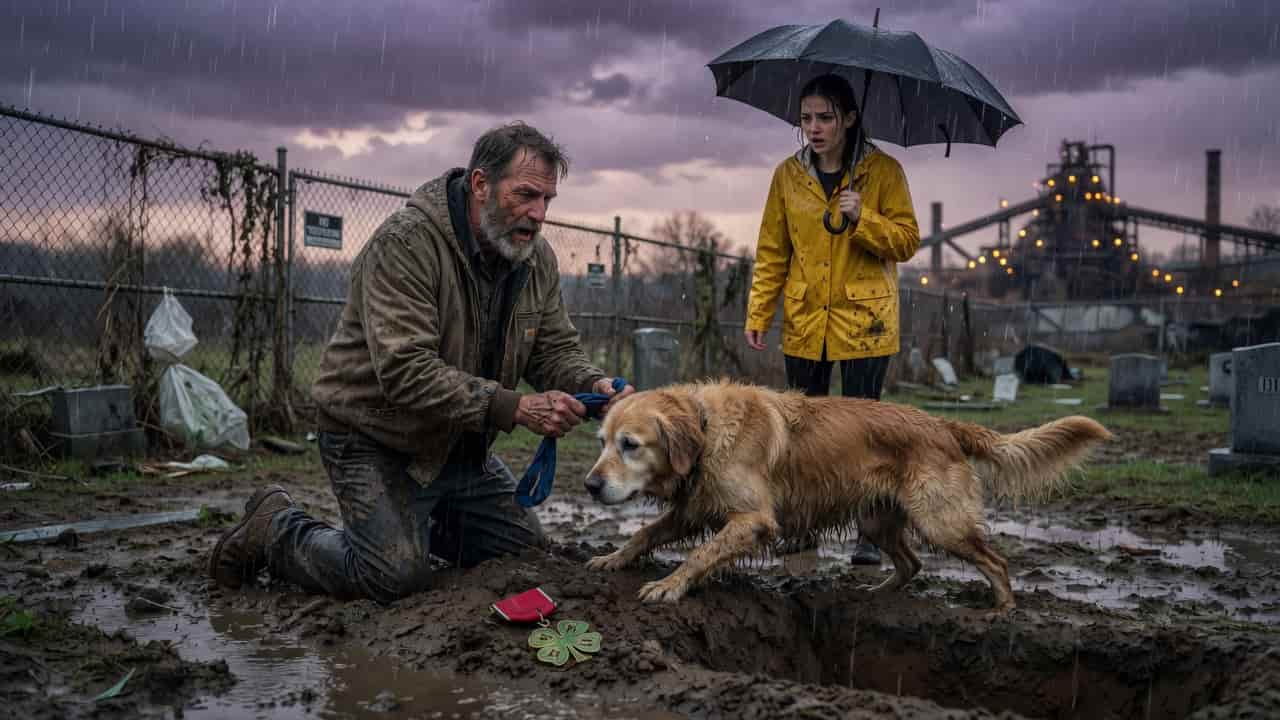
Ben didn’t look up from the mud. His knees were soaked through his work pants, the cold Pennsylvania rain turning the cemetery soil into a thick, gray soup. He held a plastic container of cheap beef tips, his hands shaking—not from the cold, but from the weight of the girl standing behind him in the yellow raincoat.
“He’s not a stray, Chloe,” Ben rasped. “He’s been here a week. He won’t move from her side.”
Buster, or what was left of him, didn’t even wag his tail. The old dog was a skeleton wrapped in matted gold fur, his chin resting directly on the stone where Ben’s wife—Chloe’s mother—was laid to rest.
“You told me he ran away,” Chloe said, her voice cutting through the wind like a serrated blade. “Seven years ago, when you were coming off that bender, you told me the gate was left open. You let me cry for months thinking I’d failed him.”
Ben looked at the dog, then at the tarnished 4-H medal the old retriever had unburied from the grave. He’d sold the kennel, the leash, and the high-end kibble for forty dollars on a Tuesday morning when the itch in his veins was too loud to ignore. He’d driven the dog to the edge of the county and left him.
He thought he’d buried that sin. But the dog had found his way back to the only person who ever truly loved him, even if she was gone.
“I’m sorry,” Ben whispered.
“Sorry doesn’t fix seven years of ‘stay’,” Chloe snapped, stepping into the mud to face the man who had broken every promise he ever made.
Chapter 1
The air in the Monongahela Valley always tasted like wet pennies and old soot, especially when the sky turned the color of a bruised plum. Ben pulled the collar of his Carhartt jacket up against the drizzle, the stiff canvas scraping against the three-day stubble on his jaw. It was four in the afternoon, the shift at the shipyard was over, and the only thing waiting for him at home was a lukewarm carton of egg salad and a television that hummed with a persistent, electric anxiety.
He didn’t go home. He never went straight home on Tuesdays. Tuesdays were for the meeting at the basement of St. Jude’s, and then the long, ritualistic walk past the Iron City gate. But lately, the ritual had changed.
Ben turned off the main road, his work boots crunching on the gravel path that led toward the North Side Cemetery. It was an old place, filled with leaning granite slabs and Victorian angels whose wings had been softened by a century of acid rain. Most people avoided it this late in the day, but Ben liked the silence. It was the only place in Pennsylvania where nobody asked him how many days he had “clean.”
He saw the shape before he reached the crest of the hill. It was a golden-brown smudge against the gray-green grass of Section 4. At first, a week ago, Ben had thought it was a discarded rug or a pile of fallen branches. Then the smudge had lifted a head, ears drooping, eyes reflecting the dim light with a weary, ancient intelligence.
Ben stopped ten feet away. His heart did a slow, heavy roll in his chest, a sensation like a stone settling in a pond.
“Hey, boy,” Ben whispered.
The dog didn’t growl. He didn’t bark. He just watched. He was a Golden Retriever mix, the kind of dog that usually lived on calendars or in the back of clean Suburbans. But this dog was a ruin. His ribs were a visible accordion under skin that seemed three sizes too large. His muzzle was almost entirely white, and his fur was a matted, tangled mess of burrs and dried mud.
He was lying directly across the flat bronze marker of Sarah Miller. 1972–2018. Beloved Wife and Mother.
Ben felt the familiar, sharp ache in his throat—the one he usually drowned in a pint of cheap rye before the sobriety took hold. He reached into his jacket pocket and pulled out a foil-wrapped ham sandwich he’d saved from lunch. He unwrapped it slowly, making sure the crinkle of the foil didn’t spook the animal.
“I brought you something,” Ben said, his voice trembling slightly. “It’s better than the grass, anyway.”
He tossed a piece of ham. The dog didn’t lung for it. He waited, his nose twitching, before leaning forward with a painful, stiff grace to take the meat. He ate it in one gulp and then returned his chin to the cold bronze of Sarah’s grave.
Ben sat down on a nearby stone, ignoring the dampness seeping into his trousers. He knew this dog. He didn’t want to know him. He wanted to believe it was a coincidence, a stray who had wandered in from the industrial park. But the way the dog’s left ear was notched, the specific way he sighed when he settled into the dirt—it was a ghost made of flesh and bone.
Seven years.
Seven years ago, Ben had been a different man. Or maybe he was the same man, just louder and more dangerous. He remembered the morning he’d loaded Buster into the back of the rusted F-150. He remembered the way the dog had licked his hand, trusting him, even as Ben’s vision was blurred by the withdrawal shakes and the desperate need for the next fix. He’d driven forty miles out, past the state line, and opened the door.
“Go on,” he’d yelled, his voice cracking. “Go find someone who isn’t a goddamn mess.”
He’d told Chloe the dog had jumped the fence while he was at work. He’d watched his daughter, then seventeen and already carrying the weight of her mother’s illness, break into a thousand pieces. He’d watched her walk the neighborhood for weeks with a stack of flyers, calling a name that would never answer.
And now, here was the answer. Buster hadn’t found a better life. He’d spent seven years becoming a skeleton, only to find his way back to the only person who had never hurt him. And she was six feet under the Pennsylvania clay.
Ben looked at his hands. They were steady, finally, after three years of meetings and white-knuckled prayers. But looking at the dog, he felt the old instability crawling back. He was a liar. He was a thief who had stolen his daughter’s best friend and sold his own soul for forty bucks and a bag of powder.
The dog looked up, a low whine vibrating in his chest. He began to dig. It wasn’t a frantic digging, just a slow, methodical scraping of the earth near the headstone.
“Stop that, Buster,” Ben said, standing up. “You can’t get to her. She’s gone.”
The dog ignored him. After a moment, something metallic glinted in the mud. Buster nudged it with his nose, pushing it toward Ben.
Ben stepped forward, his breath hitching. He reached down and picked up the object. It was a small brass medal, the ribbon long ago rotted away to a few red threads. On the front, it said 4-H Regional Dog Show – First Place. On the back, scratched in a child’s uneven hand, was the name Chloe.
The dog hadn’t just found the grave. He’d brought the only thing he had left of the girl who used to brush his coat and sleep with her head on his flank.
Ben clutched the medal so hard the edges bit into his palm. He looked at the dog, and for the first time in three years, the sobriety felt like a cage. He wanted to run. He wanted to hide. But the dog just blinked, his eyes cloudy with cataracts, waiting for the man who had abandoned him to finally do something right.
Chapter 2
The Pennsylvania Society for the Prevention of Cruelty to Animals sat in a squat, cinderblock building tucked between a tire fire of a junkyard and a shuttered textile mill. The air inside smelled of bleach, ammonia, and the high-pitched, frantic desperation of a hundred trapped souls.
Ben stood at the front counter, his Carhartt jacket smelling of rain and the ham he’d fed the dog an hour ago. He felt out of place. This was a world for people with organized lives, people who bought flea collars and scheduled dental cleanings for their pets. Ben was a man who still checked his pockets for silver he might have forgotten to pawn.
A woman with a short, sensible haircut and a badge that said MARTHA looked up from a clipboard. She didn’t look mean, just tired in a way that suggested she’d seen too many people trying to dump their problems on her doorstep.
“Can I help you?” she asked, her voice flat.
“There’s a dog,” Ben said. He cleared his throat, trying to find a tone that didn’t sound like he was pleading. “In the North Side Cemetery. He’s… he’s in bad shape. I think he’s been there a while.”
Martha sighed, a long, weary sound that puffed out her cheeks. She tapped her pen against the clipboard. “Is he aggressive?”
“No,” Ben said quickly. “He’s an old Golden mix. He’s gentle. He’s just starving. He won’t move from one of the graves.”
Martha’s expression shifted slightly, a flicker of professional pity. “The ‘grave mutts.’ We get a few of those. They’re the hardest ones. Loyalty is a hell of a drug for a dog.”
Ben flinched at the word drug. He gripped the counter, his knuckles white. “Can you come get him? He needs a vet. He needs… he needs a warm place.”
Martha looked at him, really looked at him this time. She saw the tremor in his hands and the haunted look in his eyes. She leaned back, her chair creaking. “Sir, I’ll be honest with you. We’re at double capacity. If I bring in a senior dog with medical issues—which a dog in that condition definitely has—the outlook isn’t great. Unless there’s an owner or a foster lined up, he’s likely looking at a very short stay here.”
“A short stay?” Ben asked.
“Euthanasia,” she said, not unkindly. “We don’t have the funds to rehab every stray that’s lived on squirrels and rainwater for years. Especially the old ones. People don’t adopt the old ones. They want the puppies, the clean slates.”
Ben felt a surge of heat in his chest, a sudden, sharp anger that tasted like copper. “He’s not a clean slate. He’s lived. He’s stayed loyal to a woman who’s been dead for six years. You’re telling me that doesn’t count for anything?”
“It counts to me,” Martha said, her voice rising to match his. “But it doesn’t pay the vet bill for heartworm treatment or kidney failure. If you care about him so much, why don’t you take him?”
The question hit Ben like a physical blow. He stepped back, his heart hammering against his ribs. Take him? He lived in a one-bedroom apartment with a landlord who checked the mail for “unauthorized occupants.” He worked ten hours a day at the shipyard. He spent his evenings trying not to think about the bottle of Jameson in the back of the liquor store on 4th Street.
But more than that, taking the dog meant taking the truth. It meant looking at those cloudy eyes every morning and seeing the ghost of the man he used to be. It meant the possibility of Chloe seeing him.
“I can’t,” Ben whispered. “I’m not… I’m not the right person.”
“Then he stays where he is,” Martha said, turning back to her clipboard. “At least at the cemetery, he’s got his dignity. If he comes here, he dies in a cage. You decide which is worse.”
Ben walked out of the building and stood in the parking lot. The rain had stopped, replaced by a biting wind that smelled of coal dust. He reached into his pocket and felt the 4-H medal.
He thought about Buster out there, his chin on the cold bronze marker, waiting for Sarah to come back. He thought about the night he’d come home high, screaming about the bills, while Chloe sat on the floor with her arms around the dog’s neck, trying to be invisible. He’d taken everything from her. He’d taken her mother’s health, her father’s sanity, and finally, he’d taken the only thing that made her feel safe.
He got into his truck, the engine turning over with a reluctant, grinding protest. He didn’t head for his apartment. He headed for the supermarket. He bought the most expensive bag of senior dog food they had, a bag of soft jerky treats, and a thick, wool blanket.
He was a coward. He knew that. He couldn’t bring the dog home, and he couldn’t bring himself to tell Chloe. So he would do what he’d always done when things got hard. He would create a secret. He would feed the dog in the dark, in the mud, and hope that somehow, the universe would let him pay off a debt that was already seven years overdue.
As he drove back to the cemetery, he saw a bright yellow flash in his rearview mirror. A car—a little Honda he recognized. Chloe’s car.
His heart seized. She was heading toward the cemetery. Today was the anniversary. It had been six years since Sarah passed. He’d forgotten the date in the fog of his own guilt.
He watched the Honda turn into the cemetery gates. He was a hundred yards behind her, his truck loaded with dog food and a blanket he wasn’t supposed to have. He was about to be caught in the middle of a disaster he’d spent a lifetime building.
Chapter 3
The mud at the cemetery wasn’t just dirt and water; it was a living thing, a heavy, gray sludge that clung to Ben’s boots like a guilty conscience. He parked his truck in the shadows of a large oak tree near the service entrance, far enough away that Chloe wouldn’t spot the rusted Ford, but close enough to see the splash of yellow that was her raincoat moving through the mist.
He stayed in the cab, the engine ticking as it cooled. Through the windshield, he watched his daughter. She walked with a stiff, guarded gait, her shoulders hunched against the damp Pennsylvania air. She carried a small bouquet of grocery-store carnations—pink and white, Sarah’s favorite.
Ben felt a phantom itch in his forearms, the old ghost of the needle. It was in moments like this—moments of pure, unadulterated consequence—that the urge to disappear was strongest. He could just put the truck in reverse, go back to his apartment, and let her find what she found.
But then he saw Buster.
The dog had heard her. Even with his failing ears, he knew that step. Buster was up, his hind legs trembling as he struggled to find purchase in the slick grass. He didn’t bark. He just stood there, his tail giving a single, tentative thump against the headstone.
Chloe stopped dead. From this distance, Ben couldn’t see her face, but he saw the way she dropped the flowers. The carnations scattered across the mud like bright, broken confetti.
“Buster?”
Her voice carried on the wind, thin and shattered.
Ben climbed out of the truck. He didn’t think about it. He just moved. He started down the hill, his boots sliding in the mud. He saw Chloe drop to her knees, not caring about the yellow raincoat or the dirt. She reached out, her hands hovering inches from the dog’s matted fur as if she were afraid he was a hallucination that would dissolve at her touch.
“Oh my god… Buster? Is it really you?”
The dog leaned into her. It wasn’t a joyful reunion; it was a collapse. He let out a long, shuddering sigh and put his heavy, wet head on her shoulder. Chloe let out a sound—a sob that was half-scream—and buried her face in his neck.
Ben was twenty feet away when she looked up. The transformation in her face was terrifying. The grief was there, yes, but it was being rapidly overtaken by a cold, white-hot realization. She saw Ben. She saw the bag of dog food in his hand. She saw the wool blanket draped over his arm.
“How long?” she asked. Her voice was low, vibrating with a lethal kind of calm.
“Chloe, I—”
“How long have you known he was here, Dad?”
Ben stopped. The air felt thick, like he was trying to breathe through wet wool. “A week. I found him a week ago.”
Chloe stood up slowly. She was covered in gray mud, her face streaked with tears and grit. She looked like a survivor of a shipwreck, but her eyes were fixed on him with the precision of a predator.
“A week,” she repeated. “You found him a week ago, and you didn’t call me. You didn’t tell me my dog—the dog you told me was dead or gone for seven years—was starving to death in the mud where Mom is buried?”
“I didn’t know how to tell you,” Ben said. It sounded pathetic even to his own ears. “I didn’t want to… I didn’t want to bring it all back up. Everything I did.”
“You didn’t want to feel the shame,” Chloe snapped. She stepped toward him, forcing him to back up into a row of smaller markers. “This isn’t about me, or Mom, or Buster. It’s about you not wanting to look at the mess you made. You let him rot out here because it was easier than admitting you lied.”
“That’s not true,” Ben said, his voice rising. “I’ve been coming here every night. I’ve been feeding him. I was trying to figure out a way—”
“A way to what? To make yourself the hero? To wait until he was healthy enough that you didn’t look like a monster?” She pointed at the dog, who had slumped back onto the grave, exhausted by the effort of standing. “Look at him, Dad. He’s dying. He’s been waiting for us for seven years, and you were going to let him die in secret just to keep your ‘sobriety’ intact.”
“My sobriety is the only thing I have!” Ben yelled. The words felt like they were being ripped out of his chest. “If I told you, I knew you’d look at me like this. I knew you’d hate me. And I didn’t think I could handle that without… without going back.”
Chloe stared at him, her chest heaving. The silence that followed was worse than the shouting. It was the sound of a final, structural failure.
“You think your sobriety is a shield,” she said quietly. “You think because you stopped drinking, the things you did while you were drunk don’t count anymore. But look at that dog, Ben. Look at the mud in his fur. That’s seven years of your ‘one day at a time.’ He lived every one of those days. And you just watched him.”
She turned away from him and knelt back down by Buster. She reached into the mud and pulled something out. It was the 4-H medal. Ben had dropped it there the day before.
She held it in her palm, her thumb tracing the tarnished brass. “He kept this,” she whispered, more to herself than to him. “He kept this because he remembered who I was. Even when you forgot.”
Ben stood there, the expensive dog food heavy in his hand, feeling like the smallest thing in the world. He was the father, the man who was supposed to protect, to provide, to fix. But in the dim light of the Pennsylvania dusk, he was just a ghost watching a girl and a dog try to find a way back to a life he had dismantled piece by piece.
Chapter 4
The rain started again, a cold, needle-like spray that blurred the edges of the world. Chloe didn’t move. She had wrapped her arms around Buster, her yellow raincoat a bright, defiant stain against the gray landscape. Ben watched them, his heart a dull, rhythmic throb of failure.
“We’re taking him,” Chloe said. It wasn’t a suggestion. It was a command.
“The shelter said—” Ben started.
“I don’t give a damn what the shelter said,” she cut him off. She stood up, her face set in a mask of grim determination. “He’s not going to a shelter. He’s going to my apartment.”
“You have a ‘no pets’ policy, Chloe. Your landlord—”
“Then I’ll find a new landlord. Or I’ll lie. I learned from the best, didn’t I?” She looked at him then, and the contempt in her eyes was like a physical weight. “Help me get him to the car.”
Ben moved forward, but Buster let out a low, guttural growl. It wasn’t a threat, not exactly. It was the sound of a creature protecting its last stand. The dog’s claws were still hooked into the earth of Sarah’s grave.
“He won’t leave her,” Ben said softly. “I tried. He won’t move.”
“He’ll move for me,” Chloe insisted. She pulled on the collar, her voice switching to a soft, pleading tone. “Come on, Buster. Come on, boy. We’re going home. A real home. With a bed and fire.”
Buster whined, a high, thin sound that broke Ben’s heart. He looked at the girl, then at the grave, then back at the girl. He didn’t move. He just pressed his chin harder into the dirt.
“He thinks he’s guarding her,” Ben realized. The weight of it hit him all at once—the absolute, unwavering purity of the dog’s mission. Buster didn’t know about addiction or lies or 4-H medals. He only knew that the woman who had been his world was under this soil, and he was the only one left to watch over her.
“Buster, please,” Chloe sobbed, her strength finally wavering. “Don’t do this. Don’t stay here.”
She pulled harder, her boots slipping in the mud. Ben stepped in, reaching down to help, but his hand had barely touched the nylon when a voice boomed from the path behind them.
“What the hell is going on here?”
Ben turned. It was the cemetery groundskeeper—a man named Miller, a thick-set guy with a face like a slab of granite and a flashlight that cut through the gloom like a searchlight. He’d been working here as long as Ben had been coming, and he didn’t suffer fools.
“We’re just… we’re taking the dog,” Ben said, squinting against the light.
“That dog’s been a nuisance for a week,” Miller said, walking closer. He didn’t look at Ben; he looked at the torn-up earth around Sarah’s headstone. “He’s digging. I told the office. If he’s not gone by tonight, we’re calling animal control to have him removed. Permanently. We can’t have animals desecrating the plots.”
“He’s not desecrating anything!” Chloe screamed, standing up to face the man. “He’s her dog! He’s mourning!”
Miller looked at her, then at the dog, then at the mud-covered medal in her hand. His expression didn’t soften. “I don’t care if he’s the Lassie. He’s a liability. Look at this mess. People pay good money for these plots to stay pristine. Now, you get him out of here, or I’m making the call right now.”
He pulled a radio from his belt, the static loud and jarring in the quiet cemetery.
Ben looked at his daughter. She was trembling, her face pale with a mixture of rage and terror. She looked at Buster, who was now shivering violently, his old body finally giving out under the cold and the stress.
This was the moment. The public humiliation was complete. They were being treated like vagrants, like trash, in the very place they had come to find peace. The witnesses—the groundskeeper, the silent stones, the looming industrial skeletons of the valley—were all watching Ben fail again.
“He can’t walk,” Ben said, his voice suddenly steady. “His hips are gone.”
“Then carry him,” Miller snapped. “Or I call.”
Ben looked at Chloe. She looked back at him, and for a split second, the anger in her eyes was replaced by a desperate, silent plea. She couldn’t do this. She wasn’t strong enough to carry sixty pounds of wet, resisting dog up a muddy hill in the dark.
Ben dropped the dog food. He dropped the blanket. He stepped toward the grave.
“I’ve got him,” Ben said.
He knelt down in the mud, ignored the growl, and slid his arms under Buster’s matted belly. The dog was heavier than he looked, a dead weight of grief and history. Ben felt the wetness of the dog’s fur soak into his shirt, felt the sharp poke of ribs against his chest.
“I’m sorry, boy,” Ben whispered into the dog’s ear. “I’m so sorry.”
He lifted. His back groaned, his knees popped, and for a moment, he thought they would both go down into the gray soup of the grave. But he held on. He tucked the dog’s head against his shoulder, masking the dog’s view of the headstone.
“Walk with her, Chloe,” Ben grunted. “Don’t let her see him like this.”
They started up the hill, a slow, agonizing procession. Chloe walked beside him, her hand on Buster’s flank, her eyes fixed on the path ahead. Behind them, Miller watched with his flashlight, the beam following them like a spotlight on a crime scene.
Ben’s lungs burned. Every step was a battle against the mud and the years of his own weakness. But as he reached the crest of the hill, he felt something he hadn’t felt in a long time. It wasn’t pride—he didn’t deserve that. It was the simple, crushing weight of a responsibility he was finally refusing to drop.
They reached Chloe’s Honda. Ben lowered the dog onto the backseat, which she had hastily covered with a beach towel. Buster didn’t fight anymore. He just lay there, his eyes fixed on the cemetery gates as they began to swing shut.
Chloe stood by the car door. She didn’t thank him. She didn’t hug him. She just looked at the mud on his hands.
“I’m taking him to the 24-hour vet in Wexford,” she said.
“I’ll follow you,” Ben said. “I have money. I’ve been saving. I can pay.”
Chloe looked at him for a long time. The rain was coming down harder now, washing the gray mud from her yellow coat, but the stains underneath—the ones Ben had put there—weren’t going anywhere.
“You can pay for the vet,” she said, her voice like ice. “But that’s all you’re paying for. You’re still not coming inside.”
She got in and drove away, the red taillights disappearing into the Pennsylvania mist. Ben stood alone in the dark, the smell of wet dog and cemetery earth clinging to his skin, wondering if the truth was always this cold.
Chapter 5
The 24-hour veterinary clinic in Wexford was a temple of fluorescent lighting and the muted hum of industrial air filtration. It sat on a hill overlooking the interstate, a clean, white-and-blue box that felt light-years away from the soot-stained gravestones of the North Side Cemetery. Inside, the air didn’t smell like Pennsylvania mud or industrial decay; it smelled of expensive floor wax and the faint, metallic tang of sterilized hope.
Ben sat in a plastic chair in the far corner of the waiting room. He had followed Chloe’s Honda for twenty miles, keeping exactly three car lengths between his rusted Ford and her bumper, a silent, motorized shadow. When she’d pulled into the clinic lot, he’d waited in the truck until she carried Buster through the sliding glass doors. Only then had he followed, slipping into the room like a man who knew he didn’t belong in the light.
He was a mess. The tan canvas of his work jacket was smeared with gray sludge, and his trousers were soaked to the knees. Every time he shifted in the chair, the plastic squeaked, drawing the eyes of a woman sitting across from him with a shivering Chihuahua in a rhinestone-studded bag. She looked at Ben’s muddy boots, then at his weathered, bearded face, and pulled her bag closer.
Ben didn’t blame her. He looked like the kind of man who had spent his life making bad decisions in the dark. He looked like the man he was.
Across the room, Chloe stood at the reception desk. She had her credit card out—the blue one Ben knew was probably close to its limit. Her yellow raincoat was draped over the back of a chair, revealing a thin, gray hoodie underneath. She looked small, her shoulders shaking as she spoke to the receptionist.
“I don’t care about the deposit,” Chloe was saying, her voice thin but sharp. “Just get him back there. He’s struggling to breathe. He’s… he’s been through a lot.”
Ben watched as a technician in teal scrubs emerged from a set of double doors. He took Buster from Chloe’s arms. The dog didn’t fight; he looked like a bundle of wet laundry, his tail limp, his head lolling against the technician’s shoulder. As the doors swung shut behind them, Chloe stood frozen, her hand still reaching out for the space where the dog had been.
Ben stood up. The movement was slow, his joints protesting the cold and the damp. He walked toward the desk, keeping his distance from Chloe, and pulled out his wallet. It was a battered leather thing, held together by a rubber band. Inside was twelve hundred dollars in crisp twenties and fifties—the “emergency fund” his sponsor had insisted he build, the one he’d been adding to for eighteen months, dollar by painful dollar.
“I’m the father,” Ben said to the receptionist, his voice a gravelly rasp. “The dog… Buster. Put whatever she just paid back on her card. I’m taking the bill.”
Chloe turned on him so fast she nearly tripped over the leg of the reception desk. “I didn’t ask you for that, Ben.”
“I know you didn’t,” Ben said, not looking at her. He looked at the receptionist, a young woman with tired eyes who was clearly trying to remain neutral in the face of a family implosion. “Please. Just do it. Everything. The exam, the bloodwork, whatever he needs.”
“Sir, I can’t just refund a transaction without—”
“Do it,” Chloe snapped, her eyes fixed on Ben. “If he wants to pay, let him pay. It’s the least he owes the dog. But it doesn’t mean you’re part of this, Ben. You’re just the bank.”
The receptionist began tapping at her keyboard, the sound like a flurry of tiny hammers. Ben stood there, enduring his daughter’s gaze. He felt the familiar urge to defend himself, to list the days he’d worked overtime at the shipyard, the meals he’d skipped to save that money, the way he’d stared at the liquor store windows and kept walking. But he realized, with a clarity that hurt worse than the cold, that none of that mattered. You didn’t get points for not being a disaster. You didn’t get a trophy for finally acting like a human being.
“I’m going to sit down,” Ben said quietly.
“Go ahead,” Chloe said. She walked over to the vending machine, her movements jerky and uncoordinated. She bought a bottle of water, twisted the cap, and took a long, desperate swallow. Then she sat three rows away from him, staring at the double doors.
The hour that followed was the longest Ben had ever endured. In the shipyard, time was measured in steel plates and weld lines. In the meetings, it was measured in minutes of sharing. But here, in the Wexford vet clinic at 11:00 PM, time was a viscous, stalling thing. Every time the double doors opened, both Ben and Chloe jumped, their eyes searching the face of whoever walked through.
Ben found himself looking at the 4-H medal. Chloe had left it on the chair next to her raincoat. It was a piece of junk, really. A few cents worth of brass and a scrap of ribbon. But it was the only thing that had survived the seven-year blackout of his life. Buster had carried it, buried it, guarded it. The dog had a better memory for love than Ben had for his own sins.
Finally, the vet appeared. She was a middle-aged woman named Dr. Aris, with glasses perched on her head and a look of practiced, gentle honesty. She didn’t go to Ben. She went straight to Chloe.
Ben stood up and moved to the edge of the conversation, hovering like a ghost.
“He’s stable for now,” Dr. Aris said. She held a clipboard, her pen hovering over a chart. “We’ve got him on oxygen and an IV for dehydration. But I’ll be blunt—he’s in rough shape. He has advanced heartworms, his kidneys are beginning to fail, and the arthritis in his hips is so severe he’s likely been in constant pain for months.”
Chloe let out a jagged breath. “Can you fix him?”
“We can treat the symptoms,” Dr. Aris said. “We can make him comfortable. But at his age, and given the level of neglect he’s suffered… we’re looking at palliative care. We can give him a few good weeks, maybe a month, but his body is tired, Chloe.”
The level of neglect he’s suffered.
The words hit Ben like a sledgehammer. He looked down at his boots. He wanted to tell the doctor it wasn’t him—not really. He wanted to say that he’d been sick, that he’d been gone, that he’d left the dog in a different county. But that was the addiction talking, the part of him that was always looking for an exit strategy. The neglect had started the moment Ben chose the bottle over the dog’s dinner. It had started the moment he’d lied to his daughter.
“I want him to come home,” Chloe said. “I don’t want him to die in a cage.”
“We can do that,” the doctor said. “Once he’s finished the first round of IV fluids. But he’ll need round-the-clock care. He can’t climb stairs. He needs to be carried outside. He needs medication every four hours.”
Chloe nodded fervently, but Ben saw the flicker of panic in her eyes. He knew her apartment. It was a third-floor walk-up in a converted Victorian in Millvale. The stairs were steep, narrow, and smelled like old wood and fried onions. She worked ten-hour shifts at the hospital as a billing clerk. She couldn’t do this alone.
“I’ll help,” Ben said.
Chloe didn’t look at him. “No.”
“Chloe, you’re on the third floor. You can’t carry a sixty-pound dog up those stairs three times a day. You have to work. I’m on the first floor. I’ve got the truck. I can take him to his appointments.”
“I said no, Ben! I’m not letting you near him again. You’re the reason he’s like this. You’re the reason he spent seven years in the rain.” She was shaking now, her voice rising, drawing the attention of the Chihuahua woman. “You don’t get to swoop in and be the nurse. You don’t get the redemption arc.”
“It’s not about redemption,” Ben said, his voice dropping to a whisper. “It’s about the dog. Look at the chart, Chloe. The doctor said he’s tired. Do you want his last few weeks to be you struggling to lug him up a staircase while you’re exhausted from work? Or do you want him to have a yard and a porch?”
Chloe bit her lip so hard a tiny drop of blood appeared. She looked at Dr. Aris, who was watching the exchange with a pained, professional neutrality. Then she looked back at Ben.
“You don’t touch him unless I’m there,” she said, her voice trembling with the effort of the concession. “You don’t take him anywhere without calling me. And you don’t think for one second that this makes us okay.”
“I don’t,” Ben said. “I promise.”
The receptionist cleared her throat. “The initial bill is eight hundred and forty dollars, sir. Including the overnight stay and the first round of medications.”
Ben walked back to the desk. He counted out the bills, the money he’d saved for a new transmission, for a better life, for a version of himself that didn’t feel like a hollow shell. He handed it over.
“Keep the change for his next visit,” Ben said.
As he walked back to the chair to wait for the morning, he saw Chloe pick up the 4-H medal. She didn’t put it in her pocket. She held it tight in her fist, her knuckles white, sitting as far away from Ben as the room would allow. The fluorescent lights hummed above them, a steady, indifferent witness to the fact that while the money was paid, the debt was only just beginning to be called.
Chapter 6
The first floor of Ben’s apartment was a cavernous, drafty space that had once been a neighborhood grocery store. It still had the original tin ceilings and a faint, lingering scent of floor wax and old apples. Ben had spent the last three days scrubbing the place, moving his meager furniture into the corners to create a wide, open runway of rugs and blankets.
Buster was lying in the center of it all, on a massive orthopedic bed Ben had bought with the last of his shipyard paycheck. The dog looked better than he had at the cemetery, his fur brushed and his eyes a little clearer, but the weight of his age was undeniable. He moved like a creature made of glass, every shift of his hips accompanied by a low, soft grunt of effort.
Chloe was sitting on a wooden chair by the window, her laptop open on her knees. She’d been coming over every evening after her shift, staying until midnight, watching Ben like a hawk. They rarely spoke. The silence between them was thick and pressurized, filled with the things they both knew could never be unsaid.
“He ate his heartworm pill in the peanut butter,” Ben said, breaking the quiet. He was kneeling by the sink, cleaning a bowl.
“Good,” Chloe said without looking up. “Did he have his water?”
“Yeah. A full bowl.”
Ben walked over to the dog and sat down on the floor a few feet away. Buster’s tail gave a single, weak thump against the rug. It was the most the dog had acknowledged him in four days. Ben reached out, his hand hovering near the dog’s head, but he stopped himself. He remembered the rules.
“You can pet him, Ben,” Chloe said suddenly. Her voice was flat, tired. “He’s a dog. He doesn’t know you’re the villain of the story. He just knows you have the peanut butter.”
Ben slowly laid his hand on Buster’s head. The fur was soft now, smelling of the medicinal shampoo the vet had provided. Buster leaned into the touch, a long, rattling sigh escaping his chest.
“I sold the kennel,” Ben said.
The words came out before he could stop them. He hadn’t planned on saying it. He’d planned on taking that specific, ugly detail to his own grave.
Chloe’s typing stopped. She didn’t look at him, but he saw her jaw tighten. “What?”
“Seven years ago,” Ben said, his voice steady even though his heart was hammering. “I didn’t just leave the gate open. I sold the kennel. And the leather leash with the brass clips. And the big bag of high-protein food your mom bought for his birthday. I sold it all to a guy in a van at the gas station for forty bucks.”
The silence that followed was different from the others. It was heavier, darker.
“Why are you telling me this now?” Chloe asked. She finally turned to look at him, her eyes shining with a fresh, sharp hurt. “You already admitted you left him. Why do you have to make it worse?”
“Because the meetings say the truth is the only way to stay clean,” Ben said, looking at the dog instead of his daughter. “But that’s not why I’m saying it. I’m saying it because I want you to know that I knew exactly what I was doing. I wasn’t just ‘sick.’ I was choosing to destroy something you loved because it was worth forty dollars to me in that moment. I need you to know how low I was, so you don’t ever think any of this was your fault. You didn’t leave the gate open, Chloe. I broke the world on purpose.”
Chloe stood up. She walked over to the bed and looked down at her father and her dog. She looked like she wanted to scream, or hit him, or run out the door. Instead, she just sat down on the rug opposite him.
“I hated you for so long,” she whispered. “Not just for the dog. For the way you looked at me when Mom was dying. Like I was a reminder of everything you were losing. You made me feel like I was part of the tragedy instead of your daughter.”
“I know,” Ben said. “I’m a coward, Chloe. I always have been.”
“You’re not being a coward right now,” she said. She reached out and took Buster’s paw. The dog licked her hand, a slow, sandpaper-rough gesture of devotion. “But it doesn’t fix it. It just makes it a truth we have to live with.”
They sat there for a long time, the only sound the rhythmic, labored breathing of the old dog between them. For the first time in years, the air in the room didn’t feel like it was about to explode. It just felt heavy.
A week later, the end came.
It was a Tuesday—the anniversary of the day they’d found him. Buster hadn’t stood up all morning. He’d refused the peanut butter, refused the water, and his eyes had gone distant, fixed on something beyond the walls of the old grocery store.
Ben called Chloe. She arrived in twenty minutes, still in her work scrubs. She didn’t cry when she walked in; she just went to the bed and lay down next to him, her head on the rug beside his.
“It’s okay, boy,” she whispered. “You can go. You don’t have to stay anymore.”
Ben sat at the head of the bed, his hand on the dog’s shoulder. He felt the life slowing down, the heart beneath the ribs giving a few more tired, stubborn beats. He thought about the cemetery, the industrial sky, and the seven years of “stay” this animal had endured. Buster had done his job. He’d brought the family back to the grave, and he’d forced them to look at each other in the light.
When the last breath finally left the dog, the room seemed to go silent in a way Ben had never experienced. It wasn’t the silence of a void; it was the silence of a completed task.
They didn’t go back to the North Side Cemetery. Chloe didn’t want him near Sarah’s grave anymore—she said he’d earned a place of his own. They drove out to a small, wooded plot of land Ben’s brother owned in the hills.
Ben did the digging. He didn’t let Chloe help. He dug until his hands were raw and his back was screaming, but he didn’t stop until the hole was deep enough to protect the old bones from the winter frost.
They wrapped Buster in the wool blanket Ben had bought that first night. Chloe placed the 4-H medal on top of his chest.
“Goodbye, Buster,” she said softly. “Thank you for waiting.”
Ben stood by the pile of dirt, the shovel leaning against his leg. He looked at his daughter, and for the first time, she didn’t look away. Her face was still guarded, the lines of her mouth still set in a way that suggested forgiveness was a long way off, if it was coming at all. But the lethal coldness was gone.
“You want a coffee?” Ben asked as they walked back to the truck. “There’s a diner down the road. It’s not great, but it’s warm.”
Chloe stopped at the passenger door. She looked out at the rolling Pennsylvania hills, at the skeletons of the old mills in the distance, and the gray, persistent clouds that defined their world.
“I can’t stay long,” she said. “I have a shift at six.”
“I know,” Ben said. “Just a coffee.”
“Okay,” she said. “Just a coffee.”
As they drove down the winding county road, the silence in the cab was still there, but it was different. It was the silence of two people who had survived a wreck and were finally, tentatively, checking for broken bones. Ben kept his hands steady on the wheel, ten and two, his eyes on the road ahead. He was still a liar, and he was still a man who had sold his soul for forty dollars. But as he looked at his daughter in the periphery of his vision, he realized that for the first time in seven years, he wasn’t trying to run away from the man in the mirror.
The dog had taught him how to stay. Now, he just had to figure out how to live with the residue.
The diner was bright, loud, and smelled of burnt grease. They sat in a booth by the window, two cups of black coffee between them. They didn’t talk about the dog, or the kennel, or the cemetery. They talked about the weather, and the shipyard, and the price of rent in Millvale.
It wasn’t a happy ending. It was just a beginning. And in the cold, gray heart of Pennsylvania, that was enough.