
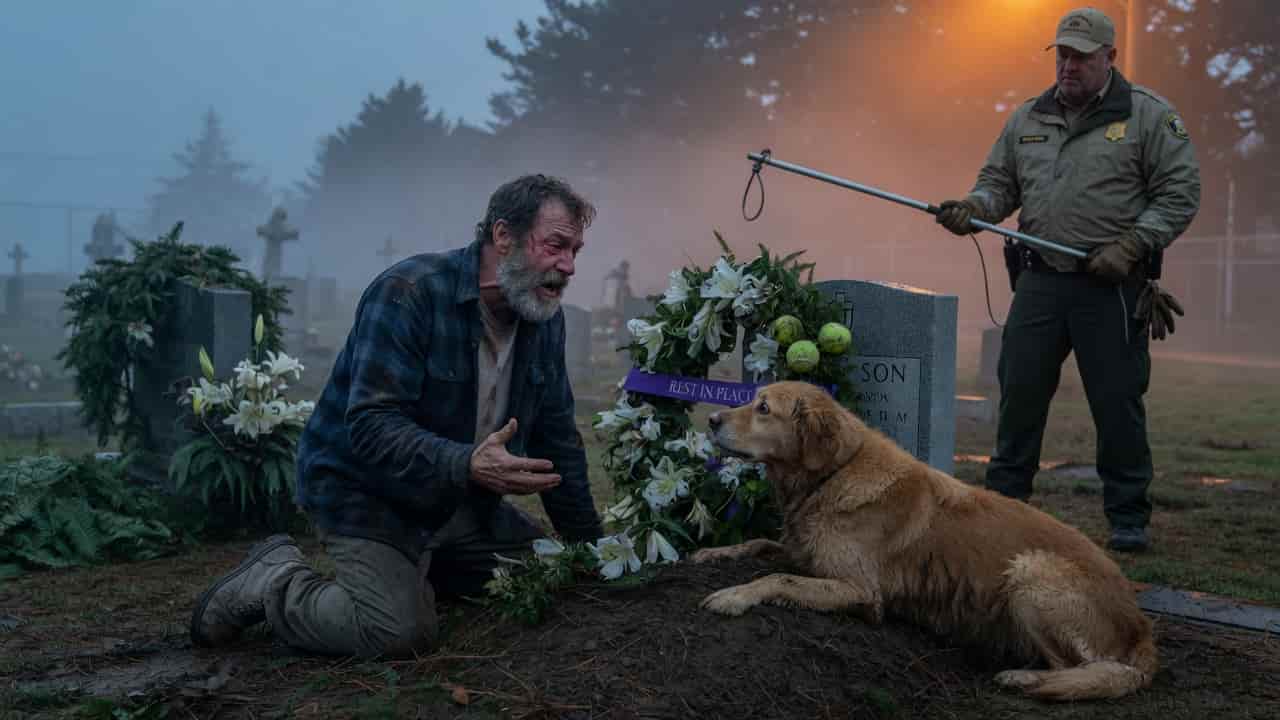
“He’s terrified of you, Sam. Just look at him.”
I didn’t want to look. I didn’t want to see the way Bo, the dog who had spent ten years sleeping at our feet, was now trying to dig a hole into the fresh dirt of Sarah’s grave just to get away from me.
The dog catcher stood behind me, his heavy boots crunching on the wet cemetery gravel. He was holding that silver pole with the wire loop, waiting for me to give up. The whole town thought I was the grieving widower, the man who had lost his wife and his dog in the same week. They felt sorry for me. They brought me casseroles and patted my shoulder at the hardware store.
They didn’t know about the night Sarah stopped breathing. They didn’t hear the way I’d screamed at that dog because he was the one she was touching when she left. I was jealous of a Golden Retriever. I’d looked at his loyal, grieving face and I’d seen a witness to my own inadequacy.
“Bo, come on, buddy,” I whispered, my voice breaking over the salt in the air.
Bo didn’t move toward me. He flinched, his body hitting the wooden base of the funeral wreath. He looked at me with eyes that remembered every word I’d shouted in that dark, hospital-scented bedroom.
“You want me to take him?” Miller asked, his voice low and too kind. “If he won’t come to you, I have to use the net.”
I looked at the faded yellow tennis ball Sarah had thrown a thousand times, now tucked into the lilies I’d paid five hundred dollars for. I realized then that some things can’t be fixed with a whistle or a treat.
Chapter 1
The house didn’t just feel empty; it felt hollowed out, like a rotted log that looked solid until you put your weight on it. Sam sat at the kitchen table, the laminate surface cold against his forearms. He was staring at the spot on the floor where the dog bowl used to be. There was a faint, circular stain on the linoleum, a ghost of a decade of spilled water and eager pacing.
He’d thrown the bowl away three days ago. He’d thrown the bed away the morning after Sarah’s funeral. It had been a reflex, a violent need to purge the evidence of what he’d lost—and what he’d done.
The silence in the house had a texture. It was thick and grainy, smelling faintly of the lavender detergent Sarah had insisted on and the metallic tang of the oxygen tanks that had lived in the corner of their bedroom for six months. He tried to remember her voice, but all he could hear was the rasp of her breath and the low, steady thrum of Bo’s tail hitting the floorboards.
Thump. Thump. Thump.
It had been the rhythm of their lives. Even at the end, when Sarah couldn’t speak, she’d keep her hand draped over the side of the bed, her fingers buried in Bo’s golden fur. The dog had been a fixture, a living extension of her will.
Sam rubbed his face, his skin feeling like sandpaper. He hadn’t shaved since the Tuesday before the service. He closed his eyes and he was back there, in the room that smelled like end-of-life care and stagnant hope.
It was 3:00 AM. The hospice nurse, Elena, had stepped out to the kitchen to make a fresh pot of coffee. The only light came from a small, dimmed lamp on the dresser. Sarah was grey, her skin translucent as parchment. She wasn’t really there anymore, not in the way that mattered. But Bo was. Bo was tucked under the edge of the bed, his head resting on her limp hand, his eyes never leaving her face.
Sam had been sitting in the armchair across the room. He’d been there for twenty hours. His back ached, his head throbbed, and his heart was a jagged mess of grief and something much uglier. Something he couldn’t admit to anyone in town.
He was jealous.
He had watched his wife of twenty-two years drift away, and in her final moments, she wasn’t looking for him. She wasn’t squeezing his hand. Her last ounce of consciousness was focused on the dog. She’d murmured Bo’s name, a soft, exhaled breath, and the dog had whined—a high, thin sound that broke the room’s stillness.
When the final breath came, the long, rattling exhale that signaled the end of the world, Sam hadn’t moved. He’d watched as Bo stood up, put his paws on the mattress, and licked Sarah’s cheek.
“Get down,” Sam had whispered.
Bo hadn’t moved. He’d let out a howl, a raw, primal sound that tore through Sam’s composure like a blade.
“I said get down!” Sam had lunged forward, his voice a jagged roar. He didn’t just want the dog off the bed; he wanted the dog out of the room. He wanted to be the only one there. He wanted to claim the grief as his own, exclusive and untainted.
He’d grabbed Bo by the collar, his fingers digging into the thick fur. He’d yanked him back, and when the dog resisted, Sam had leaned down, his face inches from the animal’s snout.
“It’s your fault,” he’d hissed, the words fueled by a week of no sleep and a lifetime of feeling second-best. “She’s gone, and you’re still here. Why are you still here? Get out! Get out of my sight!”
He’d shoved the dog toward the door, and Bo had looked at him—not with anger, but with a sudden, devastating clarity. The dog had seen the monster Sam was hiding. Bo had bolted then, out of the bedroom, through the kitchen, and out the dog door into the rainy Oregon night.
He hadn’t come back.
Now, Sam stood up from the table, his knees popping. He went to the sink and splashed cold water on his face. He looked at himself in the mirror above the basin. He looked like a man who was haunted. Not by his wife, but by the fact that he was the only one who knew why his “loyal companion” had vanished the moment Sarah’s heart stopped.
He took a breath, reached for his keys, and walked out to his truck. He had a stack of “LOST DOG” flyers on the passenger seat. He felt like a liar every time he taped one to a telephone pole. Missing: Bo. Beloved family pet. He wasn’t missing. He was in exile. And Sam was the one who had sent him there.
The drive through the small coastal town was a gauntlet of pity. He saw Mr. Henderson outside the hardware store, who gave him a slow, somber wave. He saw the girl at the gas station who refused to let him pay for his coffee, her eyes welling up with tears.
“Any word on Bo, Sam?” she asked, her voice hushed.
“Not yet,” Sam said, his throat tightening. “Still looking.”
“He’ll come home,” she said, touching his hand. “He’s just grieving. He’s looking for her.”
Sam nodded, unable to speak, and walked out into the biting wind. He hated the way they looked at him. He hated that they thought his pain was pure. He got into the truck and started the engine, the heater groaning as it tried to fight the damp chill.
He drove toward the edge of town, where the houses thinned out and the forest began to crowd the road. He’d spent the last three days driving these backroads, calling Bo’s name until his voice was a rasp. He didn’t know what he would do if he actually found him. He didn’t know if he could look that dog in the eye.
But he couldn’t leave him out here. Not in the rain. Not with the coyotes. Sarah would never forgive him. That was the real engine behind the search: the terror that Sarah was watching him from wherever she was, seeing the way he’d treated the creature she loved most.
He pulled over near a trailhead and stepped out. The fog was rolling in off the Pacific, a thick, grey blanket that tasted like salt.
“Bo!” he shouted, his voice echoing off the moss-covered firs. “Bo, come on, buddy! I’m sorry! Bo!”
The only answer was the distant crash of the surf and the lonely cry of a gull. Sam leaned against the hood of the truck, his head bowing. He reached into his pocket and pulled out a small, crumpled piece of paper. It was a receipt from the vet, dated two months ago. Patient: Bo. Treatment: Arthritis medication. The dog was twelve years old. He was stiff in the joints and slow to wake up. He wouldn’t survive long on his own.
“Please,” Sam whispered to the empty air. “Just let me find him. I’ll make it right. I promise.”
He knew it was a lie. You couldn’t make it right with a dog once you’d shown him the darkness in your soul. Dogs didn’t understand grief-induced temporary insanity. They only understood the hand that fed them and the voice that turned cruel when the world went cold.
Sam climbed back into the truck and turned around. He had one more place to check, a place he’d been avoiding since the morning of the funeral.
The cemetery sat on a bluff overlooking the ocean. It was a beautiful, lonely place, filled with headstones worn smooth by a century of salt spray. He parked the truck at the gate and sat there for a long time, watching the wipers sweep across the windshield.
Swish. Swish. Swish.
He didn’t want to go in. He didn’t want to see the mound of fresh earth and the fading flowers. He didn’t want to admit that Sarah was really under that dirt.
But as he looked through the gate, he saw a flash of movement near the back of the property. A flicker of gold against the grey stone.
His heart lunged in his chest.
“Bo?” he breathed.
He shoved the door open and started running, his boots slipping on the wet grass. He didn’t care about the cold or the mud. He just needed to see. He needed to know.
He rounded the corner of a large granite mausoleum and stopped.
There, fifty yards away, sitting perfectly still in front of a mound of fresh earth and a wilting pile of lilies, was Bo. The dog looked smaller, his fur matted and dirty, his head bowed. He wasn’t looking for food. He wasn’t looking for a way home.
He was waiting.
Sam took a step forward, his breath hitching. “Bo?”
The dog’s ears twitched, but he didn’t turn around. He stayed pressed against the earth, a silent sentinel in the fog.
Sam felt a surge of relief so sharp it was painful, followed immediately by a crushing weight of shame. He’d found him. But as he looked at the dog sitting by the grave, he realized the search was only the beginning. The real battle wasn’t finding Bo. It was convincing Bo that he deserved to be found.
Chapter 2
The morning light was a pale, sickly yellow, filtering through the blinds of Sam’s bedroom like a warning. He hadn’t slept. He’d spent the night sitting on the back porch, staring into the dark, half-expecting to hear the scratch of paws against the door. But the cemetery was five miles away, and Bo hadn’t followed the truck home.
Bo hadn’t even looked at him.
Sam stood in the kitchen, the coffee pot hissing. He looked at the phone on the counter. He needed help, but he didn’t want to explain why. He didn’t want to tell anyone that he’d driven to the cemetery, seen his dog, and been unable to bring him home because the animal was terrified of his touch.
The doorbell rang, a sharp, intrusive sound that made him jump. He checked the clock. 8:30 AM.
He opened the door to find Elena, the hospice nurse. She was wearing a thick wool coat, her hands tucked into her pockets. Her face was kind, but she had the sharp, discerning eyes of someone who spent her life watching people break.
“I was in the neighborhood,” she said softly. “I wanted to see how you were doing. And if there was any news about Bo.”
Sam stepped back, gesturing for her to come in. The house felt smaller with her in it. She’d been here for the worst of it. She’d seen him cry; she’d seen him fail to find the right words. She was the only person who knew the shape of the house before it became a tomb.
“I found him,” Sam said, his voice flat.
Elena’s eyes lit up. “Oh, Sam! That’s wonderful. Is he in the back?”
“No,” Sam said. He went to the kitchen and poured her a cup of coffee he knew she didn’t want. “He’s at the cemetery. He’s… he’s sitting with Sarah.”
Elena went quiet. She took the mug from him, her fingers brushing his. “He went to her.”
“He won’t come to me, Elena.” Sam sat down at the table, the weight of the last few days finally pulling his shoulders down. “I tried to call him. I tried to walk up to him. He just… he looked at me like I was a stranger. Like I was something dangerous.”
Elena watched him for a long moment. She didn’t offer a platitude. She didn’t tell him it was just the dog’s grief. “What happened that night, Sam? After I went to the kitchen?”
The question was a scalpel, precise and cold. Sam felt his face heat up. He looked at the circular stain on the linoleum.
“I lost it,” he whispered. “I was tired. I was angry that she was leaving. And he was there. He was so close to her, and I felt… I felt like I was being shoved out of my own life. I yelled at him. I told him it was his fault.”
Elena didn’t gasp. She didn’t pull away. She just nodded slowly. “Grief is a fever, Sam. It makes us say things we don’t mean. But dogs… they don’t have the context for our fever. They only know the heat.”
“He hates me,” Sam said.
“He doesn’t hate you,” Elena corrected. “He’s lost. He’s guarding the only thing he has left of her. And he’s guarding it from you because you were the one who broke the peace of that room.”
She set her coffee down, untouched. “You need to get him, Sam. The weather is turning. There’s a storm coming in tonight. An old dog like that… he won’t make it through a coastal freeze.”
“I can’t catch him,” Sam said, desperation creeping into his voice. “If I run at him, he’ll bolt. If he leaves the cemetery, I’ll never find him again. There’s too much woods out there.”
“Then you call Miller,” Elena said. “He’s the County Warden. He’s got the gear, and he knows how to handle scared animals. He’s a good man. He won’t judge you.”
“Everyone judges me,” Sam snapped. “They look at me and they see the grieving widower. If they knew what I said to that dog—if they knew I was jealous of an animal while my wife was dying—they’d turn their backs on me.”
Elena stood up and walked around the table. She put a hand on his shoulder, her grip firm. “Then let them. But don’t let that dog die because you’re afraid of what Miller thinks. You owe Sarah better than that. You owe Bo better than that.”
Sam closed his eyes. She was right. He knew she was right.
He waited until she left before he picked up the phone. His fingers hovered over the keypad. He looked at a photo on the fridge—Sarah, three years ago, laughing at the beach, her arm around Bo’s neck. They both looked so bright, so full of life.
He dialed the number.
Miller answered on the third ring. He sounded like a man who spent too much time alone—brusque, deep-voiced, and efficient.
“County Warden’s office. Miller speaking.”
“Miller? It’s Sam Turner.”
There was a pause. “Sam. I’m sorry about Sarah. Truly. I heard about the dog, too. Any luck?”
“I found him. He’s at the cemetery. But I can’t get near him. He’s… he’s skittish.”
“Common enough,” Miller said. “They get a scent, they hunker down. It’s a mourning behavior. I can come out there with a trap, or a catch-pole if he’s cornered. You want me to meet you?”
“Yeah,” Sam said, his stomach churning. “As soon as you can.”
“I’ll be there in twenty minutes. Meet me at the north gate.”
Sam hung up and went to the closet. He pulled out Sarah’s old gardening jacket. It still smelled faintly of damp earth and her perfume. He folded it carefully and put it in a bag. Maybe the scent would help. Maybe it would be enough to bridge the gap.
He drove to the cemetery with the heater on full blast, but he couldn’t stop shivering.
Miller was already there, leaning against a beat-up tan truck. He was a big man, built like a cider barrel, with a face that looked like it had been carved out of a cliffside. He held a long aluminum pole with a wire loop at the end. It looked like an executioner’s tool to Sam.
“He still there?” Miller asked, nodding toward the bluff.
“He was an hour ago,” Sam said.
They walked in silence through the rows of headstones. Miller moved with a surprising grace for a man his size, his boots barely making a sound on the grass.
When they reached the crest of the hill, Sam’s heart stopped.
Bo was still there. He was curled up in a tight ball, his nose tucked under the edge of the large floral wreath Sam had bought. The lilies were brown and curled now, battered by the wind. The dog was shivering, his gold fur looking grey in the dull light.
“Stay back,” Miller whispered. “Let me see if I can get a read on him.”
Miller moved forward, inch by inch. He wasn’t using the pole yet. He was crouching low, making himself small. He began to whistle—a low, rhythmic sound that was meant to be soothing.
Bo’s head snapped up.
His eyes were bloodshot, his muzzle covered in dried mud. He looked at Miller, then his gaze shifted to Sam, who was standing twenty feet back.
The transformation was instant.
Bo didn’t bark. He didn’t growl. He let out a whimper that sounded like a human sob. He scrambled backward, his arthritic back legs slipping on the fresh grave dirt. He hit the headstone with a dull thud and began to shake so violently that the flowers on the wreath trembled.
“Easy, boy,” Miller said, his voice a low rumble. “Easy now.”
Bo wasn’t looking at Miller. He was staring at Sam. He was looking at the man who had yelled into the dark. He was looking at the man who had turned Sarah’s peaceful departure into a scene of terror.
“He’s terrified, Sam,” Miller said, his voice losing some of its professional distance. “What did you do to this dog?”
The question hung in the air, heavier than the fog. Sam felt the heat of the humiliation rising in his neck. He looked at Miller, then at the dog who was trying to climb over the headstone just to escape him.
“I didn’t do anything,” Sam lied, the words tasting like ash. “He’s just… he’s just grieving.”
“I’ve seen grieving dogs,” Miller said, standing up and reaching for the catch-pole. “They’re sad. They’re slow. They aren’t panicked. This dog is looking at you like you’re the reaper himself.”
Miller adjusted his grip on the silver pole. “I’m going to have to use the noose. If I try to grab him, he’s going to bite me or run into the highway. Stand back, Sam. And for God’s sake, stop looking at him like that.”
Sam stepped back, his chest tight. He watched as Miller began to circle the grave. He watched as the man he’d called for help prepared to treat his “beloved pet” like a dangerous stray. And the worst part—the part that made Sam want to sink into the earth alongside his wife—was that Bo deserved it. He deserved the safety of the noose because the man who was supposed to protect him had become his greatest fear.
Chapter 3
The wire loop of the catch-pole hovered in the air, a silver halo against the charcoal sky. Miller was focused, his eyes locked on Bo’s neck. He was a professional, but Sam could see the tension in his forearms. This wasn’t a normal stray pickup. This was a funeral, and they were desecrating it.
“Don’t hurt him,” Sam whispered, though the words felt hollow.
“I’m not trying to,” Miller grunted. “But he’s not giving me a choice.”
Bo was pinned between the headstone and the large wooden easel of the wreath. He was panting now, a shallow, desperate sound. Every time Sam shifted his weight, Bo flinched, his body hitting the stone again. Thud. Thud. The sound of his own failure, echoing off Sarah’s name.
“Wait,” Sam said, a sudden memory surfacing through the fog of his shame. “Wait, Miller. I have something.”
He ran back to the truck, his lungs burning. He reached into the bag and grabbed the yellow tennis ball. It was old, the felt worn down to the rubber in places. It had been Sarah’s favorite way to play with Bo. She’d sit in her wheelchair on the porch, her arm weak, and just toss it a few feet. Bo would retrieve it with the solemnity of a knight delivering a holy relic.
Sam ran back to the grave, the ball clutched in his hand. “Bo! Look, buddy. Look what I have.”
He held the ball out.
For a second, the panic in Bo’s eyes flickered. He froze. His nose twitched, catching the scent of the rubber, the scent of the house, the scent of a time before the fever took over. He looked at the ball, then he looked up at Sam’s face.
Sam saw the hope in the dog’s eyes—and then he saw it die.
Bo didn’t see the ball as a peace offering. He saw it as a lure. He saw the man who had screamed at him using his favorite memory to trap him. The dog let out a sharp, ragged yelp and lunged to the left, trying to squeeze through the gap between the wreath and a neighboring headstone.
“He’s bolting!” Miller shouted.
The warden moved fast. The catch-pole swung out, and the wire noose snapped shut around Bo’s neck.
The sound that came out of the dog wasn’t a bark. It was a strangled, high-pitched scream. Bo hit the end of the pole and began to thrash, his paws digging into the mud of the grave, kicking up the very dirt Sam had watched the priest bless two days ago.
“Bo! No!” Sam lunged forward, his hands out.
“Stay back!” Miller yelled, bracing his feet. “If you get close now, he’ll tear you apart! He’s in a blind panic!”
Sam stopped. He was forced to stand five feet away and watch as his dog—Sarah’s dog—fought for his life against a wire noose on top of her grave. The lilies were crushed now, white petals ground into the dark muck. The tennis ball had fallen from Sam’s hand and rolled into the hole where the floral arrangement sat.
It was a disaster. A public, ugly, visceral disaster.
Miller was struggling to keep the pole steady. Bo was rolling, his eyes rolling back in his head, his tongue lolling out. He looked like he was being executed.
“Stop it!” Sam screamed. “You’re killing him!”
“I’m trying to save him!” Miller countered, his face red with effort. “But he’s fighting me like a wolf! Help me, Sam! Get the crate!”
Sam didn’t move. He couldn’t. He was looking at Bo’s eyes. Through the terror and the pain, Bo was looking at the grave. He wasn’t trying to escape Miller; he was trying to get back to the dirt. He was trying to get back to her.
And Sam was the one who had brought the man with the pole.
“Let him go,” Sam said, his voice suddenly very quiet.
“What?” Miller gasped, his grip slipping.
“Let him go, Miller. Open the noose.”
“Sam, he’ll run into the woods. He’ll be gone for good.”
“He’s already gone,” Sam said, the truth finally landing in his gut like a stone. “He’s not our dog anymore. He’s hers. And he’d rather die here than go home with me.”
Miller looked at Sam, his eyes searching the younger man’s face. He saw the ruin there. He saw the secret Sam had been trying to hide. Miller didn’t say anything. He slowly reached for the release on the pole.
The wire slackened.
Bo didn’t bolt. He collapsed. He lay on the grave, gasping for air, the matted fur of his neck indented by the wire. He stayed there for a long minute, his chest heaving. Then, slowly, painfully, he crawled back under the lilies. He tucked his nose under a wilted flower and went still.
The silence that followed was worse than the screaming. The wind picked up, whistling through the cedar trees, carrying the scent of the coming storm.
Miller retracted the pole, the metal clinking. He wiped the sweat from his forehead with his sleeve. He looked at the grave, then at Sam.
“I’ve been doing this job for twenty years, Sam,” Miller said, his voice low and heavy. “I’ve seen people hit dogs, starve them, leave them on the side of the road. But I’ve never seen a dog look at a man the way he looks at you.”
Sam looked down at his boots, which were caked in grave mud. He didn’t have a defense.
“He was there when she died,” Sam said, the words forced out through a throat that felt like it was full of glass. “I was… I was mean to him, Miller. I was jealous that he got to be the one she said goodbye to.”
Miller didn’t offer comfort. He didn’t tell Sam it was okay. He just looked at the shivering dog. “You better figure it out, Sam. That storm is coming in in three hours. If he’s still here when the temperature drops, he’s not coming back. And you’ll have to live with the fact that he chose a cold grave over your house.”
Miller turned and walked away, his heavy boots fading into the fog.
Sam was left alone with the dog and the dead. He sat down on the grass, a few feet away from the wreath. He didn’t try to touch him. He didn’t try to call him. He just sat there in the damp, feeling the cold seep into his bones.
“I’m sorry, Bo,” he whispered.
Bo didn’t move.
“I’m a small man,” Sam said to the headstone. “I’m small and I’m scared, and I took it out on the only thing that loved her as much as I did. Maybe more.”
He reached into the mud and picked up the tennis ball. He wiped it on his flannel shirt, cleaning off the dirt as best he could. He set it down on the edge of the grave, right where Bo could see it.
“I’ll stay,” Sam said. “I’ll stay until you’re ready. Or until the cold takes us both. I don’t care anymore.”
He leaned his back against a neighboring stone and watched the clouds darken. The first drop of rain hit his cheek, cold as a tear. He didn’t move. He’d spent his whole life trying to control the room. Now, he was finally ready to just be in it.
Chapter 4
The rain didn’t start as a downpour; it began as a fine, needle-like mist that soaked through Sam’s flannel in minutes. The temperature was dropping fast, the kind of wet cold that gets inside your joints and stays there.
Sam watched Bo. The dog hadn’t moved from his spot under the lilies, but the shivering was worse now. Every few minutes, a violent tremor would wrack Bo’s thin frame, and he would let out a soft, unconscious moan. It was the sound of a body giving up.
“Bo,” Sam said, his voice shaking with the cold. “We have to go. Please.”
The dog’s eyes were half-closed. He wasn’t looking at Sam anymore; he was looking at the tennis ball. His tail gave a single, weak twitch against the mud, but he didn’t have the strength to lift his head.
Sam stood up, his legs stiff. He looked around the cemetery. It was pitch black now, the only light coming from the distant, flickering streetlamp at the gate. He felt a surge of panic. If he left to get help, Bo would be dead by the time he got back. If he stayed, they both might be.
He walked toward the grave, his hands held out where Bo could see them. He didn’t rush. He moved like a man walking on thin ice.
“I’m going to pick you up now,” Sam said, his voice low and steady. “You can bite me if you want. I won’t let go.”
He reached the edge of the wreath. Bo’s eyes opened wide, the whites showing. He tried to scramble back, but his hind legs gave out. He let out a sharp, panicked bark, but it was thin and raspy.
Sam didn’t hesitate. He lunged forward and scooped the dog into his arms.
Bo exploded.
It was a whirlwind of matted fur, snapping teeth, and clawing paws. A tooth grazed Sam’s cheek, drawing blood. A claw caught his thermal shirt, ripping the fabric. Bo was fighting with the strength of a creature that thought it was being dragged to its death.
“It’s okay,” Sam grunted, pinning the dog’s head against his chest to avoid the teeth. “It’s okay, buddy. I’ve got you.”
He turned and started walking toward the gate. Bo was heavy, a solid weight of grief and muscle. He was squirming, his breathing coming in ragged, terrified gasps.
“I’m sorry,” Sam whispered into the dog’s ear, ignoring the rain lashing his face. “I’m so sorry I screamed. I’m sorry I wasn’t enough for her. I’m sorry I made you leave.”
He reached the truck and fumbled with the door handle. He shoved Bo into the passenger seat and slammed the door before the dog could bolt. He ran around to the driver’s side and climbed in, his breath coming in great, heaving gulps.
Bo was huddled against the far door, his chest heaving, his eyes fixed on Sam with a look of pure, unadulterated betrayal. He was trapped again.
Sam started the engine and cranked the heat. He didn’t drive away immediately. He just sat there, the steam beginning to rise from his wet clothes, the smell of wet dog and cemetery mud filling the cab.
“We’re going home,” Sam said.
He drove slowly through the storm. The wind was buffeting the truck, branches scratching against the roof. When he pulled into the driveway of the silent house, he felt a wave of exhaustion so profound he almost couldn’t move.
He carried Bo inside, the dog limp and unresisting now, his energy spent. He took him to the bathroom and closed the door. He spent the next hour washing the grave mud out of Bo’s fur with warm water. He was careful, his hands gentle, even when Bo flinched at the touch of the soap.
When the dog was clean and dry, Sam carried him into the living room. He’d gone to the basement and retrieved the dog bed he’d thrown into the “to-be-donated” pile. He set it down in the middle of the room.
Bo didn’t go to the bed. He went to the front door and sat there, staring at the wood.
“She’s not coming back, Bo,” Sam said, sitting on the floor a few feet away. “She’s not at the cemetery, and she’s not coming through that door.”
Bo didn’t move.
Sam leaned his head back against the wall. He felt the sting on his cheek where Bo had bitten him. He felt the ache in his heart that had been there since the night Sarah died.
“I thought if I found you, it would feel better,” Sam said to the empty room. “I thought I could earn my way back. But look at us. You’re sitting at a door that won’t open, and I’m sitting in a house that isn’t a home.”
He looked at Bo’s narrow back. “You were the best part of her, weren’t you? The part that didn’t care about the money or the mistakes. You just loved her. And I couldn’t even do that right at the end.”
The silence stretched out, punctuated only by the ticking of the grandfather clock in the hallway.
Then, slowly, Bo turned around.
He didn’t come to Sam. He didn’t wag his tail. He walked over to the dog bed, sniffed the edge of it, and then circled three times before lying down. He rested his chin on his paws and looked at Sam.
It wasn’t forgiveness. Not yet. It was a truce.
Sam felt a single tear track through the dried blood on his cheek. He didn’t wipe it away. He stayed on the floor, three feet away from the only witness to his shame, and watched the dog sleep.
The storm roared outside, the wind shaking the rafters, but inside, for the first time in a week, the house was quiet. Not the hollow silence of a tomb, but the heavy, complicated silence of two broken things trying to figure out how to stay in the same room.
Sam knew the morning would bring Miller’s questions. It would bring the pity of the townspeople. It would bring the long, slow work of rebuilding a life he didn’t know if he wanted.
But as he watched Bo’s chest rise and fall, he realized that Elena was right. He owed Sarah better than his own darkness. He looked at the yellow tennis ball he’d tucked into his pocket at the cemetery. He pulled it out and set it on the floor between them.
Bo’s eyes flickered open. He looked at the ball, then at Sam. He didn’t move to take it. But he didn’t look away, either.
“Tomorrow,” Sam whispered. “We’ll try again tomorrow.”
He stayed there until the sun began to grey the edges of the curtains, a man and a dog, tethered together by a ghost and a secret that neither of them could ever quite forget.
Chapter 5
The morning after the storm brought a silence that felt heavier than the wind. Sam woke up on the sofa, his neck stiff and his flannel shirt still damp at the cuffs. The first thing he noticed wasn’t the grey, salt-crusted light filtered through the coastal fog, but the absence of sound. There was no rhythmic clicking of claws on the hardwood, no heavy sigh from the corner of the room where the dog bed sat.
He sat up, his heart hammering against his ribs like a trapped bird. “Bo?”
The dog was still there, tucked into the far corner of the living room, as far from the sofa as the walls would allow. He wasn’t asleep. His eyes were open, fixed on the front door, his body a rigid, golden statue of apprehension. The water Sam had used to wash him had dried, leaving his fur soft but dull.
Sam stood up, moving slowly, keeping his hands visible. He felt the sting on his cheek where the dog had nipped him in the cemetery—a small, jagged reminder of the line he’d crossed. He went to the kitchen, the floorboards groaning under his weight. He reached for the bag of kibble, but his hand stopped inches from the plastic.
He’d thrown the bowl away.
He looked at the empty spot on the linoleum where the ceramic dish had lived for a decade. It was a clean, pale circle surrounded by the scuffs of a life he’d tried to delete in a moment of cowardice. He found a deep Tupperware container in the cupboard, filled it with water, and placed it three feet from where Bo was huddled. Then he measured out a scoop of food and put it on a paper plate.
“Here, Bo,” he whispered. “It’s okay. Eat.”
He backed away, retreating all the way to the kitchen sink. He watched.
Bo didn’t move. He didn’t even sniff the air. He just kept staring at the door, his ears occasionally twitching toward the sound of a passing truck. The dog wasn’t hungry for food; he was hungry for an exit. He was waiting for the person who actually loved him to come back and tell him this was all a mistake.
The doorbell rang at 10:00 AM. It was a sharp, clinical sound that made Bo scramble to his feet, his claws skittering on the wood as he tried to find purchase. He retreated behind the armchair, his eyes wide with that same visceral terror Sam had seen at the grave.
Sam opened the door. It was Miller. The Warden looked different today—not in his uniform, but in a heavy canvas work jacket and jeans. He held a small white paper bag that smelled like the local diner’s bacon.
“Heard the storm took out the power on the bluff,” Miller said by way of greeting. He looked past Sam into the living room, his eyes landing on the golden head peeking out from behind the chair. “How is he?”
“He’s here,” Sam said, stepping back to let the man in. “He hasn’t eaten. He hasn’t moved.”
Miller walked into the room, his presence making the space feel cramped. He didn’t look at Sam; he looked at the dog. He sat down on his haunches, surprisingly nimble for his size, and slid a piece of bacon out of the bag. He tossed it halfway across the room.
Bo didn’t touch it. He watched it land, his nose twitching once, but he stayed behind the chair.
“He’s shut down, Sam,” Miller said, standing up. “That’s not just grief. That’s trauma. I’ve seen it in dogs that have been through house fires or bad wrecks. They lose their anchor, and they don’t know which way is up.”
“I’m trying,” Sam said, his voice rising with a defensiveness he couldn’t control. “I brought him home. I washed the mud off him. I’m doing everything I can.”
Miller turned, his gaze hard and flat. “Are you? Because it looks to me like you’re trying to fix a broken window with a hammer. You can’t force a dog to trust you just because you’re the one holding the leash.”
Miller walked over to the kitchen counter and leaned against it, his eyes scanning the room. They landed on the paper plate of kibble and the Tupperware water bowl. He looked at the spot where the old bowl used to be.
“Where’s his stuff, Sam? His real stuff?”
Sam felt the heat crawling up his neck. “I… I got rid of it. After the funeral. I was… it was too hard to look at.”
Miller let out a short, humorless laugh. “Too hard for you? What about him? You took him from the place his person was buried, brought him to a house that smells like her but has none of his comfort, and you expect him to just wag his tail because you’re sorry?”
“I never said I expected him to wag his tail,” Sam snapped. “I just want him to not look at me like I’m going to kill him.”
“Then stop acting like you might,” Miller said. He reached into his pocket and pulled out a card. “There’s a guy over in Coos Bay. Behavioral specialist. He works with rescues. I told him about the situation—not the specifics, just that the dog was skittish after a loss. He said if the dog doesn’t eat in forty-eight hours, you need to bring him in. Otherwise, his liver starts to go. He’s old, Sam. He doesn’t have the reserves to go on a hunger strike.”
Miller walked back to the door, stopping to look at Bo one last time. The dog was watching him, a faint glimmer of recognition in his eyes that wasn’t there for Sam.
“You know what the hardest part of my job is?” Miller asked, his hand on the knob. “It’s not the rabid raccoons or the deer hit by cars. It’s the dogs that wait. They wait for people who are never coming back, and they refuse to see the hand that’s right in front of them. Usually, it’s because that hand has been heavy in the past. I don’t know what happened in this house the night Sarah died, and frankly, I don’t want to. But that dog remembers. And he’s not going to forget just because you bought a new bag of food.”
The door clicked shut, and Sam was alone again.
He looked at the bacon on the floor. He looked at the dog. He felt a surge of that old, toxic jealousy—the same one that had poisoned the room at 3:00 AM. Even Miller, a man who had put a noose around Bo’s neck, was more trusted than he was.
He went to the bedroom, Sarah’s bedroom, and sat on the edge of the mattress. It was perfectly made, the floral duvet pulled tight. He’d done that, too—erased the mess of her final days, the wrinkled sheets, the smell of illness. He’d tried to make the world look like a catalog because the reality was too jagged to touch.
He reached into the nightstand drawer and pulled out a small, silk-wrapped box. Inside was a lock of Sarah’s hair he’d clipped when the cancer had first started to take it. He held it to his nose, but the scent was gone. It just smelled like the box—cedar and old velvet.
He heard a soft sound from the living room. A whimper.
He walked to the doorway and looked out. Bo had moved. He wasn’t at the food, and he wasn’t at the door. He was standing in the middle of the room, looking at the armchair where Sam had sat for twenty hours while Sarah died.
The dog walked to the chair, sniffed the fabric, and then let out a long, low howl. It was a sound of such profound, unadorned misery that Sam had to lean against the doorframe to keep his balance. It wasn’t a call for help. It was a lament.
“I know, Bo,” Sam whispered. “I miss her, too.”
But as the words left his mouth, he knew they weren’t entirely true. He missed her, yes, but he also missed the man he was supposed to be when she was alive. He missed the version of himself that didn’t yell at dogs. He missed the version that didn’t feel like a fraud every time a neighbor offered a kind word.
He walked toward the chair, intending to sit, to be near the dog’s grief. But as soon as he took a step, Bo’s ears flattened. The howl cut off abruptly. The dog didn’t growl; he simply retreated, his belly low to the floor, back to his corner.
The residue of that night was everywhere. It was in the way the air moved; it was in the way the light hit the floor. It was a permanent fracture in the foundation of the house.
Sam sat on the floor, five feet from the bacon, and put his head in his hands. He thought about the behavioral specialist in Coos Bay. He thought about Miller’s warning. He realized then that he was holding Bo hostage. He was keeping the dog here to prove something to himself, to prove that he could be “good,” that he could “save” the thing Sarah loved.
But you couldn’t save something that didn’t want to be near you.
He stayed there for hours, the house growing cold as the fog pressed against the windows. He watched the bacon go cold. He watched the shadows stretch across the floorboards. He realized that the “truce” he’d felt the night before wasn’t a beginning. It was a stay of execution.
Around 6:00 PM, the phone rang. It was Elena, the nurse.
“Sam? I’ve been thinking about what you said. About the jealousy.” Her voice was gentle, but there was a weight to it. “I’ve seen it before. It’s a way of trying to bargain with the loss. You think if you can have the dog’s loyalty, you’re still connected to her. But loyalty isn’t an inheritance, Sam. It’s a gift. And right now, you’re trying to steal it.”
“What am I supposed to do, Elena? Let him starve? Let him run back to the cemetery and freeze?”
“No,” she said. “But you might have to accept that you aren’t the one who can help him. Sometimes the person who broke the thing isn’t the one who can fix it.”
Sam hung up without saying goodbye. He looked at Bo. The dog was finally sniffing the bacon, his body shaking with the effort of the movement. He took a small bite, swallowed it, and then looked at Sam.
For the first time since the storm, their eyes met and stayed. There was no terror in Bo’s gaze now. Just a vast, empty exhaustion. It was the look of someone who had fought as hard as they could and had nothing left.
Sam felt a lump in his throat that wouldn’t go down. He realized that the dog wasn’t waiting for Sarah anymore. He was just waiting for it to be over. And Sam, in his desperate need to be forgiven, was the only thing standing in the way of that dog’s peace.
Chapter 6
The following morning, the fog lifted, leaving the Oregon coast in a rare, blinding clarity. The ocean was a deep, bruised purple, and the air felt scrubbed clean. But inside the house, the atmosphere was stagnant.
Sam hadn’t slept again. He’d spent the night in the armchair, watching Bo. The dog had eventually eaten the bacon and a few pieces of the kibble, but he hadn’t moved from his corner. He was staring at the wall, his breathing shallow.
Sam knew what he had to do. The realization had come to him in the grey hours before dawn, a cold, hard fact that no amount of wishing could melt.
He went to the garage and found an old, sturdy cardboard box. He lined it with a soft blanket—one of Sarah’s favorites, a thick wool throw with a faded pattern of pine trees. He carried it into the living room and set it down.
Bo didn’t flinch this time. He just watched with a dull curiosity.
“Come on, buddy,” Sam said. His voice was different today. The desperation was gone, replaced by a quiet, somber resignation. “One more ride.”
He didn’t have to scoop the dog up. He opened the front door, and for a moment, Bo hesitated. He looked at the door, then back at the armchair, then at Sam. Slowly, his arthritic legs trembling, the dog walked out onto the porch.
The air was sharp and sweet with the scent of pine. Bo took a long, deep breath, his nostrils flaring. He looked toward the driveway, then toward the woods.
“The truck, Bo,” Sam said.
The dog followed him to the pickup. Sam lifted him into the passenger seat, and this time, Bo didn’t huddle against the door. He sat up, his head resting on the dashboard, looking through the windshield.
They didn’t drive to the cemetery. They drove south, away from the town, away from the neighbors and the hardware store and the “LOST DOG” flyers. They drove to a small, private trailhead that led to a secluded beach Sarah had loved. It was the place they’d gone when they first got Bo, twelve years ago, when he was a ball of golden fluff who didn’t know how to walk on sand.
Sam parked the truck and opened the passenger door. Bo hopped down, his paws hitting the gravel with a soft crunch. He didn’t run. He stayed by Sam’s side as they walked the narrow path down to the shore.
The beach was empty. The tide was out, leaving long stretches of wet, reflective sand that mirrored the sky. The surf was a steady, rhythmic boom that drowned out the noise in Sam’s head.
Bo walked to the water’s edge. He stood there, the foam swirling around his paws, looking out at the horizon. He looked younger here, for a second. The wind caught his fur, smoothing out the mats, and his eyes were clear.
Sam sat down on a piece of driftwood, a bleached-white log that looked like the rib of a giant. He pulled the yellow tennis ball from his pocket.
“She loved you more than anything, Bo,” Sam said. The wind carried the words away, but he didn’t care. “She loved you because you were simple. You didn’t hide anything. You didn’t get jealous. You just… you just stayed.”
He looked at the ball. He thought about the night Sarah died. He thought about the way he’d grabbed Bo’s collar, the heat of his own shame disguised as anger.
“I was wrong,” Sam said. “I wasn’t the one she was leaving behind. I was the one she was trusting you with. And I blew it.”
He held the ball out to the dog. Bo turned his head. He looked at the ball, then he walked over and took it gently from Sam’s hand. He didn’t drop it. He held it in his mouth, the faded yellow felt damp with sea spray.
Bo sat down next to Sam. He didn’t lean against him, but he stayed close enough that Sam could feel the heat of his body. They sat there for a long time, watching the gulls wheel above the surf.
“I’m going to take you to that place in Coos Bay,” Sam said. “Not because you’re broken. But because I can’t be the one to fix you. You need a place where people don’t look at you and see a failure. You need a place that doesn’t smell like her.”
Bo let out a soft whuff, the ball still in his mouth.
“I’ll visit,” Sam said, though he knew it was a lie. He knew that for Bo to heal, Sam had to disappear. He had to be the final ghost to leave the room.
They walked back to the truck. The drive to Coos Bay was quiet. Bo slept most of the way, his head resting on Sam’s thigh—not out of affection, but out of a shared, weary understanding. They were two survivors of a wreck, and they were finally reaching the shore.
The behavioral center was a clean, quiet building surrounded by green fields. A woman met them at the gate—a calm, grey-haired woman with eyes that had seen everything. She looked at Bo, then at Sam’s bruised cheek.
“Warden Miller called,” she said softly.
“He’s a good dog,” Sam said, his voice cracking. “He’s the best dog. He just… he’s had a hard time.”
He handed the woman the leash. He didn’t look at Bo. He couldn’t. He reached into the truck and grabbed the box with Sarah’s pine-tree blanket.
“This is for him,” Sam said. “It smells like home.”
The woman took the box and the leash. “We’ll take care of him, Mr. Turner. He’ll have the fields, and he’ll have the other dogs. He won’t be alone.”
Sam nodded, his chest feeling like it was being crushed by a hydraulic press. He turned to walk back to the truck, but he stopped. He reached into his pocket and pulled out the last thing he had.
A small, silver-framed photo of Sarah. He’d taken it from the nightstand.
“Put this near his bed,” Sam said. “Just so he knows… just so he knows she didn’t leave him because of me.”
He got into the truck and started the engine. He didn’t look back. He drove away from the center, away from the dog, away from the last living piece of his wife.
The drive back to the coastal town felt like it took a lifetime. The house was waiting for him, silent and hollow. He walked through the front door and stood in the living room.
He looked at the armchair. He looked at the empty spot on the floor. He looked at the circular stain on the linoleum.
He went to the kitchen and found a sponge. He got down on his knees and began to scrub the stain. He scrubbed until his knuckles were raw, until the floor was white and clean. But when he stood up, the circle was still there, a phantom mark that would never truly go away.
He sat at the kitchen table and looked at the phone. He thought about calling Elena. He thought about calling Miller. But he didn’t.
He just sat in the silence.
He realized then that the “soul-crushing” truth wasn’t that he’d lost his wife, or that his dog was gone. It was that he was finally alone with the man he really was. There was no one left to lie to. No one left to perform for.
He reached out and touched the laminate surface of the table. It was cold.
In the distance, he heard a sound—a faint, rhythmic thump-thump-thump. For a split second, his heart soared, thinking it was Bo’s tail against the floorboards.
But it was just the house settling in the wind. It was just the sound of a structure trying to hold itself together after the center had been ripped out.
Sam closed his eyes and let the silence take him. He had saved the dog, but in doing so, he had finally lost everything else. He was a man with a clean floor and a quiet house, waiting for a gate to open that had been locked the night the fever took over.
The sun set over the Pacific, casting long, bloody shadows across the cemetery on the bluff. And miles away, an old dog curled up on a pine-tree blanket, a yellow tennis ball tucked under his chin, and finally, mercifully, went to sleep.



