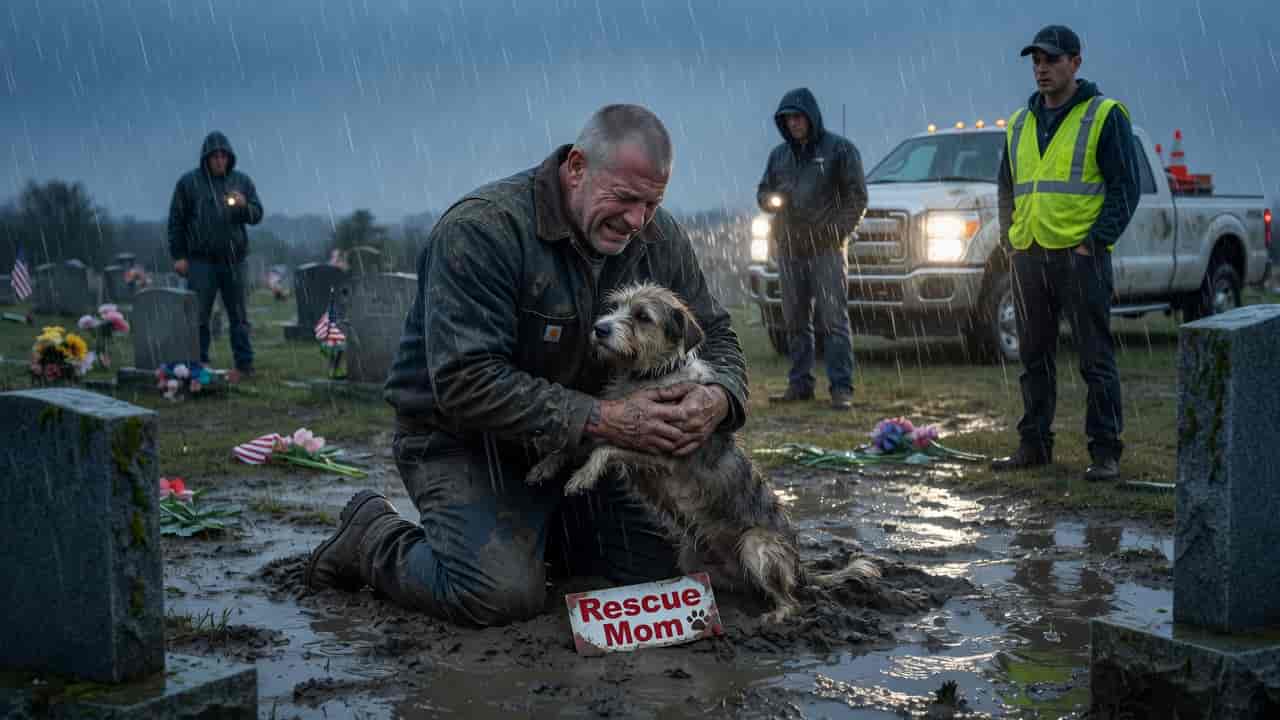
“Look at you, Mike. A grown man crying in the dirt over a mutt.”
Gary’s voice cut through the rain like a dull blade. He was standing there with the rest of the crew, their headlights burning into my back, turning the cemetery mud into something that looked like wet ash. I didn’t get up. I couldn’t.
Buster was tucked under my arm, his wire-haired coat soaked through, his small body vibrating against my ribs. He’d dragged it all the way from the garage—the “Rescue Mom” bumper sticker Sarah used to keep on her old SUV. It was caked in grit now, the red letters fading, but it was the only thing left of her that Buster could find.
“It’s just a dog, man,” Gary laughed, stepping closer, his clean boots mocking my mess. “She’s been gone a year. You’re embarrassing the whole company. Get up and act like a foreman or hand over the keys.”
I looked down at Buster. He was staring at the fresh sod on Sarah’s grave, his nose twitching. I remembered how much I’d hated the noise, the hair, and the way Sarah spent every spare second saving things that the world had thrown away. I’d spent years complaining about this dog.
Now, it was just the two of us left, and the men I’d spent twenty years leading were watching me break.
“I’m not leaving him,” I said, my voice thick.
“Then you’re done,” Gary sneered. “Look at this pathetic mess.”
But then Buster moved. He didn’t run. He didn’t bark. He just dropped the sticker right on the center of the grave and started to dig, trying to get to the only person who ever truly loved him—and the only person I’d ever truly failed.
I didn’t care who was watching anymore.
Chapter 1: The Weight of the Mud
The air at the Miller & Sons job site smelled of diesel exhaust, damp plywood, and the kind of cold that settles into your marrow before the first cup of coffee is even finished. It was a Tuesday in late October, the sky a bruised purple that promised rain it didn’t have the courage to deliver yet.
Mike stood on the edge of the foundation, his boots caked in the orange clay of North Carolina. He was fifty-five, and his knees felt every year of it. He adjusted his hard hat, the plastic inner band digging into a forehead that stayed permanently creased. He was the foreman, the guy who made sure the lines were straight and the hours were billed, but lately, he felt more like a ghost haunted by a clipboard.
“Hey, Mike! The Grade-A delivery is short three pallets!”
Mike didn’t turn around immediately. He recognized the voice. Gary. Gary was thirty, wore his safety vest like it was a suit of armor, and had a way of speaking that made every sentence sound like a challenge. He’d been with the crew for three years, and he spent two of them looking at Mike’s job with a hunger that wasn’t even disguised.
“I heard you, Gary,” Mike said, his voice a low gravel. He finally turned, his eyes squinting against the glare of the morning sun hitting the white siding of the neighboring warehouse. “I already called the yard. They’re on the way. Go check the bracing on the south wall.”
Gary lingered, shifting his weight. He had a smirk that he saved for moments when he thought he’d caught Mike slipping. “You look like hell, Mike. You sleep in your truck again?”
The crew, a handful of guys in their twenties and thirties, went quiet. They were always listening. In a world of hammers and heavy machinery, weakness was a scent. Mike felt the heat rise in his neck, a slow, familiar burn.
“I sleep in a house with a roof, which is more than I can say for the south wall if you don’t get moving,” Mike snapped.
Gary chuckled, a dry, unpleasant sound, and tipped his cap. “Just checking on you, boss. You’ve been a little… distracted. People are noticing.”
Mike watched him walk away. He wanted to say something sharp, something that would remind Gary who signed the timecards, but the words felt heavy in his mouth. He was distracted. He was more than distracted. He was hollow.
It had been fourteen months since Sarah passed. Fourteen months of coming home to a house that was too quiet and too full of things he didn’t know what to do with. Sarah had been a “Saint.” That was what the local paper called her in the obituary. Sarah Miller, the Saint of Section 12. She’d spent twenty years volunteering at the animal shelter, pulling the “un-adoptable” dogs out of the kill-pens and bringing them home to their three-acre lot.
Mike had hated it. He’d complained about the barking, the vet bills, and the way the house always smelled faintly of wet fur and cedar chips. He’d been the “tough guy,” the husband who grumbled while he built the extra-large kennels in the mudroom, the man who pretended to ignore the way Sarah would sit on the porch with a coffee in one hand and a mangy, three-legged stray’s head in the other.
“They just need a place to belong, Mike,” she’d tell him, her eyes bright with a stubborn kind of kindness he never quite understood. “Just a little bit of grace.”
“Grace don’t pay the mortgage,” he’d always answer.
Now, the grace was gone, and only the dogs remained. Or rather, only Buster remained.
Buster was a wire-haired terrier mix that looked like he’d been assembled from spare parts found in a junkyard. He was the last one Sarah had brought home, just six months before the diagnosis. He was a nervous, shivering thing that had been abused by a hunter out in the county. He didn’t bark; he just stared.
When Mike got home that evening, the house felt colder than the job site. He kicked off his boots in the mudroom, the familiar grit scratching against the linoleum. The house was a museum of Sarah’s mercy. There were leashes hanging on the hooks by the door, half-empty bags of specialized kibble, and a “Rescue Mom” bumper sticker she’d never gotten around to putting on her SUV, sitting right there on the kitchen counter next to the fruit bowl.
Buster didn’t greet him at the door. The dog was lying in the corner of the living room, curled into a tight ball on a rug that had once belonged in their bedroom.
“Eat your food, dog,” Mike muttered, glancing at the full bowl in the kitchen.
Buster didn’t move. He just shifted his eyes—yellow, intelligent, and filled with a grief that Mike refused to acknowledge.
Mike went to the fridge, pulled out a beer, and sat at the small kitchen table. He didn’t turn on the lights. He just sat there in the graying dusk, listening to the hum of the refrigerator. His hands were shaking. He told himself it was the vibration of the jackhammer from earlier, but he knew better.
He was failing. He was failing the job, he was failing the crew, and he was failing the one thing Sarah had asked him to do.
“Take care of the boys, Mike,” she’d whispered in the hospital, her voice a thin thread. “Especially Buster. He’s got nowhere else to go.”
“He’s got nowhere to go because nobody wants him,” Mike whispered to the empty kitchen.
He looked at the “Rescue Mom” sticker. He’d meant to throw it away a dozen times. It was a cheap piece of vinyl, red and white, with a little paw print. To Mike, it represented every hour Sarah had spent away from him, every dollar spent on a lost cause. He reached out and touched the edge of it, his calloused thumb catching on the adhesive.
Suddenly, Buster stood up. The dog walked into the kitchen, his nails clicking on the floor. He didn’t go for the food. He walked straight to Mike, stopped, and looked at the sticker. Then, with a slow, deliberate movement, he rested his chin on Mike’s knee.
Mike froze. He wanted to push the dog away. He wanted to yell. He wanted to be the man who didn’t care about “sentimental crap.”
“Get off me,” Mike said, but his voice had no edge.
Buster didn’t move. He let out a long, shuddering sigh, the kind of sound a person makes when they’ve finally given up on a long day.
Mike looked at the dog, then at the empty chair across from him where Sarah used to sit. The silence in the house didn’t feel deafening—it felt heavy. It felt like the mud at the cemetery, thick and inescapable.
“She’s not coming back, Buster,” Mike said, his voice cracking. “You hear me? She’s gone.”
The dog just closed his eyes.
Mike pulled his hand back, leaving the sticker on the table. He stood up, walked to the sink, and splashed cold water on his face. He had to be at the site by 6:00 AM. He had to deal with Gary. He had to keep the world from seeing the crack in the foundation.
But as he walked to the bedroom, he heard a sound he hadn’t heard in weeks. It was the soft scritch-scritch of Buster’s claws on the floor. The dog wasn’t going back to his rug. He was following Mike.
He stayed in the hallway, a dark shadow in the doorframe, watching as Mike laid down in the bed that felt too big. Mike closed his eyes, but all he could see was the orange clay of the cemetery and the way the wind had whipped Sarah’s funeral flowers into the dirt.
He wasn’t a Saint. He was a foreman. And he was starting to realize that the one thing he couldn’t build was a way out of his own regret.
Chapter 2: The Resentment
The next few days were a blur of high-tension cables and low-grade insults. The rain finally arrived, a steady, depressing drizzle that turned the Miller & Sons site into a swamp. Mike spent his hours in the trailer, staring at blueprints that seemed to shift under his gaze.
Gary was everywhere. He was the first one in the trailer in the morning and the last one to leave the site. He started taking over the morning briefings, standing at the head of the table with a thermos of coffee, his voice booming over the sound of the rain hitting the metal roof.
“Mike’s a little under the weather today, boys,” Gary would say, throwing a wink toward the crew. “So I’ll be handling the assignments for the drainage pipes. We don’t want any… mistakes.”
Mike sat in the corner, his jaw tight. He knew what Gary was doing. He was building a case. Every time Mike forgot a tool or hesitated on a measurement, Gary was there to record it, to mention it to the big boss, to whisper it to the guys over lunch.
“You know,” Gary said, leaning against the doorframe of the trailer while the rain poured down outside. “My old man used to say that when a man loses his edge, he’s a danger to everyone around him. He’s like a dull saw. Doesn’t cut, just tears.”
Mike looked up from his paperwork. “Your old man ran a dry-cleaners, Gary. He didn’t know a damn thing about saws.”
Gary’s smile didn’t falter. “Maybe. But he knew when a man was checked out. You’re ghosting us, Mike. You’re physically here, but you’re somewhere else. Probably back in that big empty house with those mangy dogs.”
“It’s one dog,” Mike said, his voice dangerously low.
“Whatever it is,” Gary shrugged. “It’s dragging you down. You’re soft, Mike. You’ve gone soft like a piece of rotted timber. It happens to the best of us, I guess. But Miller & Sons isn’t a retirement home.”
“Get out,” Mike said.
“Sure thing, boss,” Gary said, pushing off the doorframe. “Just remember. The crew is talking. They don’t like working for a guy who looks like he’s about to burst into tears every time a sad song comes on the radio.”
When Gary left, Mike felt a surge of rage so sharp it made his vision blur. He wanted to follow Gary out into the mud and show him exactly how “soft” he was. He wanted to swing a hammer until the noise in his head finally stopped.
Instead, he sat there, his heart hammering against his ribs.
He thought about Sarah. He thought about the year before she died, the year they’d spent fighting. Not about the cancer—they didn’t even know about that yet—but about the dogs.
Buster had been the breaking point. Sarah had found him tied to a tree behind a derelict gas station, his ribs showing, his ears notched from fights he hadn’t won. She’d brought him home, and Mike had lost it.
“Another one? Sarah, for God’s sake, we have four already! The house is falling apart, the yard is a mess, and I’m the one working fifty hours a week to pay for the heartworm pills!”
“He was going to die, Mike!” she’d shouted back, her face flushed. “He was literally starving to death. How can you be so cold?”
“I’m not cold, I’m tired! I’m tired of being the only one who cares about the reality of this life! You’re living in a fantasy where everyone can be saved!”
“Maybe I’m just trying to save one thing that doesn’t ask for a paycheck, Mike! Maybe I just want to feel like there’s more to this world than dirt and concrete!”
He hadn’t spoken to her for three days after that. He’d slept on the couch, and every time Buster tried to come near him, he’d hissed a “no” that sent the dog scurrying back to Sarah’s side.
He’d been right, hadn’t he? He’d been the practical one. The one who kept the lights on.
But as he looked out the trailer window at the mud-slicked site, he realized that being “right” felt a lot like being dead.
That evening, he didn’t go home immediately. He drove to the local pet store. It was a bright, sterile place that smelled of cedar and birdseed. He stood in the aisle labeled Senior Dog Care, feeling completely out of place in his mud-stained work clothes.
A young woman in a green apron approached him. “Can I help you find something, sir?”
Mike cleared his throat, looking down at his boots. “I… the dog isn’t eating. He just sits there.”
The girl’s expression softened. “Has there been a change in the home? A move? A loss?”
“My wife,” Mike said, the word feeling like a stone in his throat. “She was the one who… she handled the dogs.”
“Oh,” the girl whispered. “I’m so sorry. Dogs grieve just like we do. Sometimes even harder because they don’t understand where the person went. They just know the smell is fading.”
She reached out and picked up a bag of high-calorie wet food and a bottle of salmon oil. “Try mixing this in. It smells strong. Sometimes it reminds them that they’re still alive. And… just spend time with him. He’s probably waiting for her to come back. He needs to know he’s not waiting alone.”
Mike took the items, paid in cash, and walked out. He felt like a fraud. Spending time with him. He’d spent the last year trying to avoid the dog.
When he got home, the house was dark. Buster was in the same spot on the rug. Mike went into the kitchen, opened the expensive canned food, and mixed it with the kibble. He carried the bowl into the living room and set it down.
“Here,” Mike said. “Eat.”
Buster lifted his head. He sniffed the air, his tail giving a single, pathetic little thump against the floor. He stood up, walked to the bowl, and began to eat.
Mike sat on the sofa, his head in his hands. He watched the dog. Buster ate with a kind of desperate intensity, as if he were trying to fill a hole that had nothing to do with hunger.
When the bowl was empty, Buster didn’t go back to the rug. He walked over to the kitchen counter. He stood on his hind legs, his front paws scratching against the wood, and reached for the “Rescue Mom” bumper sticker.
“Hey! Get down!” Mike yelled.
Buster ignored him. He nipped at the edge of the sticker, pulled it off the counter, and held it in his mouth. Then, he walked to the back door and scratched at the glass.
“It’s raining, you idiot,” Mike said. “You don’t want to go out there.”
Buster barked. It was the first time Mike had heard him make a sound. It wasn’t a loud bark—it was a high, pleading yip. He looked at Mike, the red and white sticker hanging from his jaws.
“Fine,” Mike sighed, standing up. “Go get wet. See if I care.”
He opened the door, and Buster vanished into the darkness.
Mike waited five minutes. Ten. The dog didn’t come back.
He grabbed a flashlight and stepped out onto the porch. The rain was coming down harder now, turning the backyard into a blur of gray and black.
“Buster! Get in here!”
Nothing.
Mike walked down the steps, his sneakers sinking into the grass. He followed the line of the fence, shining the light into the bushes. He found Buster near the gate. The dog had dug a hole under the fence and was gone.
“Dammit!” Mike yelled into the wind.
He ran to his truck, his heart racing. He knew where the dog was going. He knew it with a certainty that made his stomach turn.
It was three miles to the Hillside Cemetery. Three miles of winding county roads and dark pine trees.
Mike drove like a madman, his windshield wipers slapping against the glass. He pulled into the cemetery gates, the gravel crunching under his tires. The place was a maze of gray stone and weeping willow trees.
He drove toward Section 12.
He found Buster at the edge of the woods, near the fresh mound of earth where Sarah lay. The dog was a muddy, shivering mess. He was lying flat on his belly in the grass, his nose pressed against the base of Sarah’s headstone.
And in front of him, protected from the wind by his paws, was the “Rescue Mom” bumper sticker.
Mike stopped the truck, the headlights illuminating the scene. He sat there, his hands gripping the steering wheel so hard his knuckles turned white.
“You’re just a dog,” Mike whispered, the tears finally breaking through. “You’re just a damn dog.”
He opened the door and stepped out into the mud.
Chapter 3: The Cemetery Trip
The mud at Hillside Cemetery wasn’t like the mud at the construction site. On the job, mud was an obstacle, a nuisance that slowed down the machines and ruined the boots. Here, it felt like something alive, something that wanted to pull you down and keep you there. It was gray and slick, clinging to the hem of Mike’s trousers as he trudged toward Sarah’s grave.
Buster didn’t move when Mike approached. The dog was a statue of misery, his wire-haired coat matted with silt and dead leaves. The “Rescue Mom” sticker was pinned beneath his chin, a bright splash of red and white against the dullness of the earth.
“Buster,” Mike called softly. “Come on, buddy. Let’s go home.”
The dog let out a low, mournful whine. He didn’t look up. He was staring at the headstone, at the name Sarah Miller carved into the cold granite.
Mike knelt beside him. The wetness soaked through his dungarees instantly, a cold shock that made him gasp. He reached out a hand, hesitating, before finally resting it on the dog’s sodden back. Buster was shaking so hard Mike could feel the vibrations through his palm.
“I know,” Mike whispered. “I know, Buster. I miss her too.”
The words felt strange in his mouth. He hadn’t said them out loud to anyone. Not to the guys at work, not to the neighbors who brought over casseroles in the first month, not even to himself. He’d spent fourteen months pretending that he was just “getting through it,” as if grief were a project with a deadline.
He looked at the bumper sticker. Sarah had bought it at a fundraiser two years ago. He remembered her laughing as she showed it to him, her hair messy from a day of washing dogs at the shelter.
“I’m official now, Mike! I’m a Rescue Mom!”
“You’re a lunatic,” he’d told her, but he’d smiled. Just a little.
Now, the sticker was ruined. The edges were curled, and the adhesive was covered in grit. It was a piece of trash, really. But to Buster, it was a relic. It was the only thing that still carried the faint, lingering scent of the woman who had saved him from a tree and a hunter’s belt.
“She’d be so mad at us,” Mike said, a ghost of a laugh catching in his throat. “Look at us. Sitting in the rain like a couple of fools. She’d have us in the tub in five minutes, complaining about the mess.”
Buster finally lifted his head. He looked at Mike with those yellow, soul-weary eyes. He leaned his weight against Mike’s leg, a solid, shivering presence.
Mike sat back on his heels, the mud swallowing his boots. He looked around the cemetery. It was empty, save for the rows of silent stones. He felt a sudden, overwhelming sense of failure. He’d been Sarah’s husband for thirty years, and he’d spent so much of that time being the “sensible” one. He’d built houses, bridges, and strip malls. He’d made sure they had a retirement fund and a reliable roof.
But he’d never built a space for her heart. He’d tolerated her passion, but he’d never shared it. He’d looked at her dogs and seen a burden. He’d looked at her kindness and seen a weakness.
“I’m sorry, Sarah,” he whispered, his voice disappearing into the sound of the rain. “I’m so sorry I didn’t get it.”
He stayed there for a long time, his hand on the dog, his eyes on the stone. The rain turned into a steady downpour, washing the gray silt over the “Rescue Mom” sticker. He felt a strange kind of peace, a quietness he hadn’t known in years. For the first time, he wasn’t the foreman. He wasn’t the “tough guy.” He was just a man in the mud with his wife’s dog.
But the peace didn’t last.
The sound of a heavy engine rumbled through the quiet of the cemetery. Mike stiffened. He saw the flash of headlights bouncing off the wet headstones. A white heavy-duty pickup truck was winding its way up the narrow gravel path toward Section 12.
Mike knew that truck. It was the Miller & Sons foreman’s vehicle—his vehicle—that Gary had been driving since Mike’s own truck had been “in the shop” for a mysterious rattle Mike hadn’t had the heart to fix.
“No,” Mike breathed. “Not now.”
He tried to stand, but his knees locked up, the cold and the mud making him clumsy. He scrambled to his feet, wiping his face with a dirty sleeve, but it was too late.
The white truck skidded to a halt ten feet away, the LED headlights flaring like miniature suns, blinding him. The doors flew open, and Gary stepped out, followed by two of the younger guys from the framing crew—Jason and Miller.
Gary was wearing his neon-yellow safety vest, the color garish and offensive in the sacred quiet of the graveyard. He stood with his hands on his hips, a smirk spreading across his face as the headlights caught Mike in their crosshairs.
“Well, well, well,” Gary called out, his voice echoing off the stones. “We were looking for you, Mike. The boss wanted to know why the site wasn’t locked up properly. We saw your truck at the gate and thought maybe you’d finally lost your mind.”
Jason and Miller chuckled, leaning against the side of the truck. They looked at Mike—kneeling in the mud, covered in filth, clutching a scruffy dog and a piece of plastic trash—and their expressions turned from curiosity to a sharp, mocking amusement.
“What are you doing, Mike?” Gary asked, stepping closer. His boots were clean, his vest bright. He looked like the future, and Mike looked like the past. “Are you having a prayer meeting? Or did the mutt finally kick the bucket?”
“Leave it alone, Gary,” Mike said, his voice trembling with a mix of cold and fury. “Just get out of here.”
Gary walked right up to the edge of the grave. He looked down at the “Rescue Mom” sticker, then at Mike’s tear-streaked face.
“Is that a bumper sticker?” Gary laughed, a high, mocking sound that felt like a slap. “Holy hell, Mike. I knew you were going soft, but this is pathetic. You’re sitting in the dirt crying over a sticker? In front of the guys?”
He turned back to Jason and Miller. “Hey, you see this? Our big, bad foreman is having a breakdown over a piece of vinyl. I guess we know why the drainage pipes were laid crooked last week. He was too busy thinking about his ‘Rescue Mom’ feelings.”
Jason laughed, a short, sharp sound. Miller looked away, but he didn’t stop him.
The humiliation was a physical weight, heavier than the mud. Mike felt the eyes of the younger men on him, seeing his gray hair, his shaking hands, his total collapse. He was the joke of the site now. The story would be all over the county by morning. Did you hear about Mike? Found him in the cemetery, hugging a dog and crying over a sticker. Man’s finished.
“Get up, Mike,” Gary said, his voice losing its humor and turning into something harder, more predatory. “You’re embarrassing the company. You look like a damn girl. Give me the keys to the trailer. You’re done.”
Mike looked at Gary, then at the dog. Buster was growling now, a low vibration in his chest, his hackles raised. The dog was defending the grave. He was defending the only person who had ever been kind to him.
And in that moment, Mike realized that Buster wasn’t the only one who needed saving.
“I said get out,” Mike said, his voice no longer a gravel. It was a roar.
Chapter 4: The Collision
The roar didn’t stop Gary. If anything, it fueled him. He stepped forward, his clean boot landing right on the edge of the “Rescue Mom” sticker, grinding the faded red letters into the gray silt.
“Or what, Mike?” Gary sneered. “You going to hit me? In front of witnesses? Go ahead. Make it easy for the boss to fire you for cause. You’re a liability. You’re a ghost. You’ve been dead since your wife died, you just haven’t had the sense to lay down yet.”
Jason and Miller stepped closer, drawn in by the tension. The headlights of the truck cast their shadows long and jagged across the headstones, making the cemetery feel like a cage.
“You think you’re so tough,” Gary continued, his face inches from Mike’s. “Because you can shout and swing a hammer. But look at you. You’re nothing. You’re a man who spends his nights talking to a dog because nobody else can stand the sight of you. You’re a failure, Mike. You failed her, and now you’re failing us.”
Mike felt the world narrowing. He felt the heat in his chest, the old, familiar pressure of a life spent holding everything in. He looked at Gary’s neon vest, so bright it hurt his eyes. He looked at the smug, entitled face of a man who had never lost anything he couldn’t replace.
And then he looked at Buster.
The dog was still growling, his small body positioned between Gary’s boot and Sarah’s name. He was terrified—Mike could see the tremor in the dog’s legs—but he wasn’t moving. He was staying.
“They just need a place to belong, Mike.”
Suddenly, the anger vanished. It didn’t fade; it was simply replaced by a cold, sharp clarity. Mike realized that Gary wasn’t the opposing force. Gary was just a symptom. The real enemy was the silence. The real enemy was the thirty years Mike had spent pretending that he didn’t need grace.
“You’re right, Gary,” Mike said.
The silence that followed was absolute. Even the rain seemed to quiet. Gary blinked, his smirk faltering for a fraction of a second. “What?”
“You’re right,” Mike repeated, standing up slowly. His joints groaned, and the mud sucked at his boots, but he stood tall. He didn’t wipe the dirt from his face. He didn’t hide his red eyes. “I am a failure. I failed to listen to her. I failed to see what mattered. And I spent a lot of years being a man just like you—thinking that being hard was the same thing as being strong.”
Gary scoffed, trying to regain his footing. “Whatever, man. Save the speech for your therapist. Just give me the keys.”
“The keys are in the truck,” Mike said, gesturing toward the white pickup. “But you won’t be needing them for the Miller & Sons account anymore.”
“What are you talking about?”
“I’m the foreman, Gary. I still carry the license. And I’m shutting down the Section 12 site. Effective immediately. There’s a structural issue with the foundation that I’ve been ‘distracted’ by. Turns out, the soil isn’t stable. Kind of like you.”
Gary’s face went pale. “You’re lying. The foundation is fine.”
“Is it?” Mike stepped closer, his shadow swallowing Gary’s. “You want to bet your career on it? Because I’m the one who signs the inspection report. And right now, I don’t like what I see.”
Gary looked at Jason and Miller. They were no longer laughing. They were looking at the ground, shifting uncomfortably. The power in the room—the room made of rain and headstones—had shifted.
“You’re crazy,” Gary hissed. “You’re ruining a million-dollar contract because I hurt your feelings?”
“No,” Mike said, his voice calm. “I’m doing it because it’s the right thing to do. Something you wouldn’t understand. Now, get off my wife’s grave.”
Gary hesitated. He looked at Mike’s eyes—hard as the granite behind him—and he saw something there that wasn’t weakness. It was a man who had nothing left to lose, and that made him the most dangerous person in the county.
Gary backed away, his boots splashing in the mud. “Fine. Have it your way, old man. But don’t expect a paycheck on Friday.”
He turned and marched back to the truck. Jason and Miller followed him, their heads down. The truck doors slammed, the engine roared, and the white LED headlights swung away, leaving Mike and Buster in the sudden, heavy darkness.
The silence rushed back in.
Mike stood there for a long time, the adrenaline fading into a deep, bone-weary exhaustion. He looked down at the mud. The “Rescue Mom” sticker was gone, buried somewhere beneath the silt and the footprints.
He knelt back down, his hands shaking. He started to dig. Not with a shovel, but with his bare fingers. He clawed at the cold, wet earth, searching for that little piece of red and white vinyl.
Buster joined him. The dog used his paws, his small body working in rhythm with Mike’s.
They found it a minute later. It was torn now, a jagged rip through the word Mom, but it was there.
Mike picked it up and wiped it on his sleeve. He looked at the headstone.
“I’ve got him, Sarah,” he whispered. “I’ve got him.”
He picked up the dog. Buster was heavy, a solid weight of wet fur and heartbeats. Mike carried him back to his old, rattling truck. He put the dog in the passenger seat, right on the leather upholstery he used to be so protective of.
He climbed into the driver’s seat and started the engine. The heater kicked on, blowing lukewarm air into the cab.
He looked at the “Rescue Mom” sticker sitting on the dashboard. It was a mess. The house was a mess. His career was likely over. The guys at the site would never look at him the same way again.
But as he pulled out of the cemetery, he felt a weight lift off his chest that had nothing to do with the mud.
Buster rested his head on Mike’s thigh.
“Hungry?” Mike asked.
The dog didn’t bark. He just let out that long, shuddering sigh.
Mike drove home through the rain, his headlights cutting through the dark. He wasn’t sure what tomorrow would look like. He wasn’t sure how he’d pay the bills or what he’d tell the boss.
But for the first time in fourteen months, he wasn’t a ghost. He was a man with a dog, and a promise to keep.
And as he pulled into his driveway, he saw the light Sarah had always left on over the porch. It was still burning.
He turned off the engine, but he didn’t get out immediately. He sat there in the quiet, watching the rain hit the windshield.
“One more thing, Buster,” Mike said, looking at the dog.
Buster perked up his ears.
“Don’t tell anyone I cried,” Mike said, a small, real smile touching his lips. “I still got a reputation to maintain.”
Buster licked Mike’s hand, his tongue rough and warm.
Mike opened the door, stepped out into the night, and led the way inside.
Chapter 5: The Inspection
The sun didn’t so much rise the next morning as it did leak through the gray overcast like a bad seal on a hydraulic line. Mike woke up at 4:30 AM, his body stiff from the cold he’d invited into his bones at the cemetery. He lay in the dark for a moment, listening to the rhythm of the house. For the first time in over a year, the silence didn’t feel like a vacuum. It felt occupied.
Buster was asleep at the foot of the bed. He wasn’t curled into a ball anymore; he was stretched out, his chin resting on Mike’s ankle.
Mike got up, his knees popping like dry kindling. He moved to the kitchen, the linoleum cold under his bare feet. He didn’t reach for the coffee first. Instead, he went to the mudroom and grabbed a plastic tub, filling it with lukewarm water and a bit of the gentle soap Sarah used for her “special cases.”
He spent forty minutes washing the cemetery out of Buster’s fur. The dog didn’t fight him. He stood in the tub, head low, letting Mike scrub the gray grit from his wire-haired coat. It was a slow, methodical process. Mike’s hands, usually reserved for the rough textures of lumber and steel, were careful. He noticed the small scars on Buster’s ears—notches from a life lived on the defensive. He noticed the way the dog’s ribcage flared with every breath.
“You’re a mess, buddy,” Mike whispered, towel-drying the dog until Buster looked like a sentient tumbleweed. “But I guess we both are.”
He fed the dog, drank two cups of black coffee, and then he looked at the “Rescue Mom” sticker sitting on the kitchen table. He’d cleaned it, too. The rip through the word Mom was still there, a jagged white line, but the red was still red. He picked it up, walked out to his truck, and pressed it onto the bottom corner of his rear window. It didn’t look right on a three-quarter-ton Ford with a headache rack, but he didn’t care.
He arrived at the Miller & Sons headquarters at 7:00 AM. The headquarters was a brick building on the edge of town, surrounded by equipment yards and stacks of concrete pipe.
He didn’t go to the site. He went straight to the main office.
Old Man Miller was already there. He was seventy, with skin like tanned leather and eyes that had seen every scam, every shortcut, and every tragedy in the tri-county area. He was sitting behind a desk cluttered with permits and half-eaten donuts.
Gary was there, too. He was leaning against the filing cabinet, his neon vest still bright, his face flushed with a mixture of triumph and nervous energy.
“Mike,” Miller said, his voice a deep rumble. “Gary tells me you shut down the Section 12 site last night. Tells me you had a… disagreement.”
Mike sat in the wooden chair across from Miller. He didn’t look at Gary. “The site is unsafe, Jim. The drainage we put in on the south slope—the one Gary supervised—is failing. The soil is saturated, and if we pour the foundation today, that whole wall is going to slide into the creek by Christmas.”
Gary let out a sharp, mocking laugh. “That’s a lie and you know it. The drainage is to spec. I checked the levels myself. You shut us down because you were having a meltdown at your wife’s grave and I caught you. You were embarrassed, so you threw a tantrum.”
He turned to Miller, his voice rising. “Jim, the guy was kneeling in the mud, crying over a dog and a sticker. He looked like he’d lost his damn mind. Ask Jason. Ask Miller. We found his truck at the cemetery gate at ten at night. He’s not fit to lead a crew, let alone sign off on an inspection.”
Miller looked at Mike. He didn’t look shocked or disgusted. He just looked tired. “Is that true, Mike? Were you out there?”
“I was,” Mike said. He didn’t flinch. He didn’t lower his voice. “I went to find the dog. He’d run off. And yeah, I was at Sarah’s grave. And yeah, I was upset. It’s been a hard year, Jim. You know that better than most.”
Miller’s wife had passed ten years ago. He nodded slowly. “I do.”
“But that doesn’t change the dirt,” Mike continued, leaning forward. “I stayed out there after Gary left. I walked the south slope. I didn’t need a level to see it. The water isn’t moving through the gravel. It’s pooling behind the silt fence. Gary didn’t account for the runoff from the upper lot. He followed the blueprint, sure, but he didn’t look at the ground.”
“I followed the specs!” Gary shouted.
“The specs are for dry weather, you idiot!” Mike roared, standing up. “We’ve had four inches of rain in three days. You don’t build to the paper; you build to the land! If we pour today, we’re liable for the collapse. Is that what you want? You want to be the guy who cost Miller a million dollars because you were too busy looking at your own safety vest to check the culvert?”
The room went silent. Gary’s mouth opened and closed, but no sound came out. He looked at Miller, searching for support, but the old man was looking at Mike.
“Jim,” Mike said, his voice dropping back to a gravelly calm. “I’ve worked for you for twenty-two years. Have I ever lied to you about a site?”
“No,” Miller said.
“Have I ever cost you a contract?”
“No.”
“Then trust me now. I’m going back out there with a backhoe. I’m going to rip out that drainage and do it right. It’ll take two days. We’ll be behind schedule, but the building will stay where we put it.”
Miller leaned back in his chair, the spring groaning. He looked at Gary, then back at Mike. “Gary says you’re soft, Mike. Says you’re ‘ghosting’ the crew.”
“I’m grieving, Jim. There’s a difference. Being soft means you can’t do the job. Being hard means you think the job is all there is. I’m trying to find something in the middle.”
Miller nodded. He reached into his desk drawer and pulled out a set of keys. Not the trailer keys—the keys to the heavy equipment locker. He tossed them to Mike.
“Two days, Mike. If that wall isn’t dry by Thursday, I’m putting Gary in charge of the site and you’re going on mandatory leave. You understand?”
“I understand,” Mike said.
He stood up and walked toward the door. As he passed Gary, he stopped. Gary was vibrating with rage, his hands clenched into fists.
“You think you won,” Gary hissed, low enough so Miller couldn’t hear. “But you just proved what I said. You’re a wreck. Crying in the mud… the guys are never going to respect you again. You’re a joke, Mike. A walking, talking sob story.”
Mike looked at him. He felt a strange kind of pity for the younger man. Gary was so focused on the hierarchy, on the power, on the “toughness” of the trade, that he’d forgotten what the trade was actually for. It wasn’t about being the biggest man in the room; it was about building something that lasted.
“Respect isn’t something you get because you don’t cry, Gary,” Mike said. “It’s something you get because you stay when things get messy. I’ll see you at the site.”
Mike walked out to his truck. Buster was sitting in the passenger seat, his nose pressed against the glass. When Mike climbed in, the dog gave a short, sharp bark.
“Yeah, I know,” Mike said, starting the engine. “We got work to do.”
He drove back to Section 12. The rain had slowed to a mist, but the site was a disaster. The crew was standing around the trailer, their breath blooming in the cold air. When Mike’s truck pulled in, the conversation died instantly.
He stepped out, Buster following close at his heels. He saw Jason and Miller—the two kids from the night before—watching him with wide, uncertain eyes.
“Alright, listen up!” Mike shouted, his voice carrying over the idling of a nearby generator. “The pour is cancelled. We’re ripping out the south drainage. Gary, get the transit. Jason, I need you on the skid-steer. Miller, grab a shovel.”
The crew didn’t move. They looked at each other, then at Gary, who was stepping out of his own truck, his face a mask of cold fury.
“He’s crazy!” Gary shouted. “The boss is going to fire him in forty-eight hours! You want to spend two days digging in the rain for a guy who’s already out the door?”
Mike didn’t argue. He didn’t shout back. He walked to the edge of the foundation, knelt down, and plunged his hand into the mud near the drainage pipe. He pulled out a handful of gray silt, held it up, and squeezed.
Water poured out of the mud like a squeezed sponge.
“This is supposed to be gravel-fill,” Mike said, his voice quiet but intense. “It’s saturated. If we pour on this, the weight of the concrete will liquefy the soil. The whole south side will slip three feet before the slab even sets. You want to be on the crew that built the Miller Collapse? You want that on your resume?”
Jason looked at the mud in Mike’s hand. He looked at the saturated slope. He was a good kid, a local boy whose father had been a mason. He knew what he was looking at.
“He’s right,” Jason said, his voice small. “Look at the silt fence. It’s sagging.”
“I don’t care about the fence!” Gary yelled. “I care about the schedule!”
“Then go back to the office and check the calendar,” Mike said, standing up. “Because on this site, we build things to stay. Now, are we working or are we standing around?”
Jason was the first one to move. He walked toward the skid-steer, his head down. Miller followed him. One by one, the rest of the crew started moving, grabbing tools, donning their gloves.
Gary stood alone by his truck. He looked at the crew, then at Mike. He looked at the scruffy dog sitting patiently by Mike’s boots.
“You’re a dead man walking, Mike,” Gary said.
“Maybe,” Mike replied. “But at least I’m walking.”
The next twelve hours were brutal. Mike stayed in the mud, working alongside the men. He didn’t stay in the trailer. He didn’t hide behind a clipboard. He dug, he hauled, he laid the new gravel by hand.
Buster stayed on the edge of the site, watching from beneath the eaves of the equipment shed. Every time Mike looked up, the dog was there, his yellow eyes fixed on him.
By sunset, the south slope was stripped bare. The failed drainage pipes lay in a pile like the bones of a dead animal. The new gravel was being trucked in, the headlights of the deliveries cutting through the gathering gloom.
Mike was exhausted. Every muscle in his body ached, and his hands were raw from the grit. But as he stood on the edge of the slope, watching the water finally start to move through the new culvert, he felt a sense of accomplishment he hadn’t felt in years.
He wasn’t just fixing a site. He was fixing a legacy.
He walked back to the truck, his boots heavy with mud. He saw Jason standing by the equipment locker, holding a thermos.
“Hey, Mike,” the kid said.
“Yeah, Jason?”
“I… I’m sorry about last night. At the cemetery. We shouldn’t have been there.”
Mike stopped. He looked at the young man, seeing the genuine shame in his face. “It’s alright, kid. You were just following the loudest voice in the room. Just make sure next time, you listen to the one that’s telling the truth.”
Jason nodded. “Is the dog… is he okay?”
Mike looked at Buster, who was trotting toward the truck. “He’s fine. He’s a rescue. They’re tougher than they look.”
“My mom used to do that,” Jason said softly. “Foster dogs. We always had a house full of ’em. I used to hate the noise.”
“I did too,” Mike said. “Turns out, the noise is better than the silence.”
He climbed into the truck, Buster hopping in beside him. He drove home, the “Rescue Mom” sticker visible in his rearview mirror. He was covered in mud, his career was still on the line, and he was lonelier than he’d ever been.
But as he pulled into his driveway and saw the porch light, he realized that for the first time since Sarah died, he wasn’t afraid to go inside.
He had a dog to feed. He had a promise to keep. And he had a foundation to build.
Chapter 6: The Foundation
Thursday morning came with a sky so clear it looked like polished glass. The rain had finally moved east, leaving the air crisp and smelling of pine needles and damp earth. Mike arrived at the Section 12 site before the sun was up, the headlights of his truck illuminating the south slope.
The water was moving.
The new drainage system was working perfectly. The saturated soil had drained, the gravel was firm, and the silt fence stood straight and dry. The ground was stable.
Mike stood on the edge of the excavation, a cup of lukewarm coffee in his hand. Buster was sniffing around the perimeter, his tail wagging tentatively. The dog had become a fixture on the site over the last forty-eight hours. The crew had stopped making jokes; they’d even started leaving bits of their sandwiches near the equipment shed for him.
At 8:00 AM, Old Man Miller’s black sedan pulled onto the site. He got out, leaning on his cane, and walked toward the south slope. Gary was right behind him, looking pale and desperate.
Miller didn’t say a word. He walked to the edge of the foundation, poked the ground with his cane, and looked at the drainage culvert Mike had rebuilt. He stayed there for ten minutes, his eyes scanning every inch of the work.
Finally, he turned to Mike. “It’s dry.”
“It’s dry, Jim,” Mike said.
Miller looked at Gary. “You told me the drainage was fine, Gary. You told me Mike was hallucinating because he was ‘cracking up.'”
Gary stammered, his face turning a blotchy red. “It… it looked fine on Tuesday, Jim! The rain must have changed the soil composition after I left. I followed the specs!”
“The specs are a guide, son,” Miller said, his voice cold. “The ground is the reality. Mike saw the reality. You saw a promotion. And in this business, that kind of blindness gets people killed.”
Miller turned back to Mike. “Pour the slab. I want this building up by the end of the month.”
“You got it, Jim,” Mike said.
“And Gary?” Miller said, not even looking at the younger man. “Go back to the office. Turn in your vest. You’re not cut out for the field. Maybe you can find a job in sales. They like people who stick to the script regardless of the facts.”
Gary stood there, frozen. He looked at Mike, his eyes filled with a hatred so pure it was almost impressive. He didn’t say a word. He turned on his heel and marched toward his truck. He peeled out of the site, gravel spraying from his tires, and vanished down the county road.
The crew was silent. They watched him go, then they looked at Mike.
“Alright!” Mike shouted, clapping his hands together. “You heard the man! We’re pouring! Jason, get the pump truck in position. Miller, let’s get the rebar checked one last time. We got a building to grow!”
The site exploded into activity. The roar of the cement mixers, the shouting of the men, the rhythmic thumping of the vibrators—it was the music of Mike’s life. He moved through the chaos with a precision he hadn’t felt in years. He wasn’t ghosting anymore. He was the anchor.
By noon, the south slab was poured. It was smooth, gray, and solid. It was the foundation for everything that would come after.
As the sun began to set, the crew started packing up. Jason walked over to Mike, wiping sweat from his forehead with a dirty rag.
“Nice work today, boss,” the kid said.
“You did good, Jason,” Mike said. “You handled that skid-steer like a pro.”
Jason grinned, then looked down at Buster, who was lying in the shade of the trailer. “You think you’ll keep him? The dog?”
Mike looked at the scruffy terrier. He thought about the year he’d spent resenting every bark, every hair, every vet bill. He thought about the way Buster had stood his ground at the cemetery, protecting a name carved in stone.
“No,” Mike said. “I’m not keeping him.”
Jason’s face fell. “Oh. I… I guess I could ask my mom if—”
“I’m not keeping him,” Mike interrupted, a small smile playing on his lips. “Because he’s already kept me. We’re a team now, Jason. Whether I like it or not.”
Jason laughed and slapped Mike on the shoulder. “See you tomorrow, Mike.”
When the site was finally empty, Mike walked back to the south slope. He stood on the edge of the fresh concrete, the smell of curing cement heavy in the air. He looked at the woods beyond the cemetery, where the shadows were growing long.
He reached into his pocket and pulled out the “Rescue Mom” sticker. It was battered, torn, and faded, but he’d kept it safe.
He walked to the corner of the foundation, where the concrete was still slightly tacky. He knelt down and pressed the sticker into the very edge of the slab, right near the corner where the main support pillar would go.
It was a small thing. Nobody would ever see it once the walls went up. It would be buried beneath the flooring, beneath the drywall, beneath the life of the building.
But it would be there. A piece of Sarah’s grace, built into the very bones of the world.
“There you go, Sarah,” Mike whispered. “A place to belong.”
Buster walked up beside him and sat down. He leaned his head against Mike’s knee, his tail giving a single, solid thump against the ground.
Mike stood up, his knees aching one last time. He looked at the dog, then at the moon rising over the trees.
“Come on, Buster,” he said. “Let’s go home.”
They walked back to the truck together. Mike opened the passenger door, and the dog hopped in, claimed his spot, and waited.
As Mike pulled out of the site, he looked in the rearview mirror. He saw the “Rescue Mom” sticker on his window, and he thought about the bridge he’d finally finished building. It wasn’t made of steel or concrete. It was made of mud, regret, and the stubborn kindness of a woman who refused to let anything be thrown away.
He drove through the quiet town, past the diner where the regulars were starting to gather, past the pet store where the girl in the green apron was locking the doors.
He arrived home and pulled into the driveway. The porch light was on, casting a warm, yellow glow over the front door.
Mike stepped out of the truck, but before he went inside, he walked to the back of the house. He stood in the yard, looking at the spot where Sarah used to keep her flower beds. They were overgrown now, filled with weeds and fallen leaves.
“We’ll fix it this spring, Buster,” Mike said. “We’ll plant those peonies she liked. And maybe we’ll build a proper fence. For the next one.”
Buster barked—a happy, confident sound that echoed in the cool night air.
Mike walked into the house. He didn’t turn on the TV. He didn’t open a beer. He went into the kitchen, filled Buster’s bowl, and then he sat down at the table.
He picked up his phone and scrolled through his contacts until he found the number for the county animal shelter. He hesitated for a second, his finger hovering over the screen.
He thought about the silence. He thought about the noise.
He pressed the button.
“Hi,” Mike said when a woman answered. “My name is Mike Miller. My wife… she used to volunteer there. Sarah Miller.”
“Oh, yes,” the woman said, her voice softening. “We remember Sarah. She was a saint.”
“Yeah,” Mike said, his voice thick. “She was. Listen, I’ve got some room in the yard. And I’ve got a dog here who’s looking for a little company. You got anyone who needs a place to belong?”
He listened as the woman started to talk, her voice filled with a familiar kind of hope. Mike leaned back in his chair, watching Buster eat his dinner.
He wasn’t a Saint. He was a foreman. But as he sat there in the quiet house, he realized that he’d finally learned how to build something that would never fall down.
He was home. And for the first time in a long, long time, he wasn’t alone.