“Whose dog is this?”
I froze. The rain was hitting the roof of the car, a steady, rhythmic drumming that usually calmed me down. But hearing my father say those words—standing there in the driveway with his hand on the collar of the Golden Retriever that has slept at the foot of his bed for eight years—made the world go sideways.
“Dad, that’s Buddy,” I said. I tried to keep my voice level, the way the doctors told me to. Like he was a child who’d just forgotten his lunchbox. “He’s your dog. You’ve had him since the year Mom passed.”
My father looked at the dog. Then he looked at me. There was this split second of pure, unadulterated fear in his eyes before the mask slid back on. He’s spent seventy years being the smartest man in the room, and he wasn’t going to let his own son see the floor falling out from under him.
“Don’t be ridiculous,” he snapped, his voice sharp and defensive. “I’ve never seen this animal in my life. Did you bring him here to trick me? Is this part of that ‘home’ you keep talking about?”
He started walking toward the house, leaving the dog standing there in the rain. Buddy didn’t bark. He didn’t even move. He just watched my father’s back with a kind of quiet, devastating patience that broke my heart into a thousand pieces.
I looked at the leash in my hand. I looked at the man I used to call for advice, now a stranger who couldn’t remember the one living thing that still connected him to my mother.
I knew right then that I couldn’t do this alone. But I also knew that if I forced him to go, I’d be losing the last part of him that was still mine.
Chapter 1
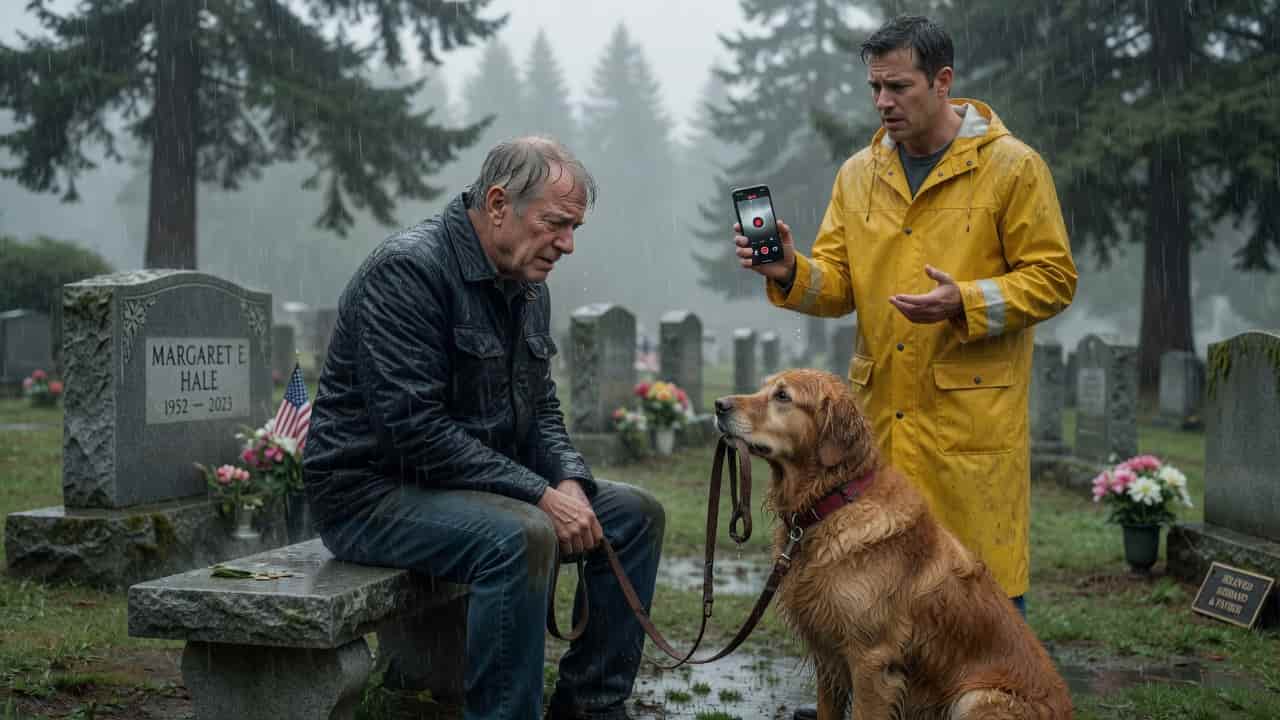
The rain in Western Washington doesn’t fall so much as it occupies the space between things. It’s a fine, grey mist that turns the cedar trees into ghosts and makes the granite of the Pleasant Valley Cemetery look like it’s weeping.
Leo sat on the stone bench, his knees aching with the kind of damp cold that felt permanent. He liked the cold. It was sharp. It gave him something to focus on when the world started to feel soft at the edges, like a photograph left too long in the sun. He reached out and traced the letters on the stone. June Marie Miller. 1956 – 2022.
“I brought the wrong flowers, June,” he whispered. His voice was a dry rasp, barely audible over the patter of the rain on his hood. “The yellow ones. You always said they looked like weeds, but I thought… well, I thought they’d brighten things up.”
He looked down at the bouquet of marigolds sitting on the wet grass. They looked pathetic. Yellow and bright and entirely too loud for a place where people came to be quiet.
A movement at the corner of his eye made him turn.
A dog was standing near the edge of the path. It was a big, blocky-headed Golden Retriever with a face that had gone almost entirely white. It was soaking wet, its fur matted into dark spikes, and it was watching him with an intensity that felt personal.
Leo blinked. He looked around the cemetery. It was Tuesday morning. The only other car in the lot was a silver sedan he didn’t recognize. There were no owners in sight. No kids whistling. Just the dog and the trees and the long, silent rows of the dead.
“Go on, then,” Leo said, waving a hand. “Go find your people.”
The dog didn’t move. It stepped off the gravel and onto the grass, its paws making no sound on the sodden earth. It walked right up to Leo, stopped, and sat down. Then, with a slow, deliberate motion, it lowered its head and dropped something at Leo’s feet.
A leather leash.
The leather was old, cracked in places, and dark with saliva and rain. The brass clip at the end was dull.
Leo stared at it. A strange, cold prickle started at the base of his neck. He knew that leash. Or he thought he did. He reached down, his fingers stiff, and picked it up. The weight of it felt familiar. The way the loop fit around his wrist.
“Whose dog is this?” he asked the empty air.
“He’s yours, Dad.”
The voice was like a bucket of ice water. Leo jumped, the leash slipping through his fingers. He looked up to see David standing a few yards away.
David looked like he’d stepped out of an REI catalog. His yellow rain slicker was crisp and expensive. His boots were clean. He was holding his phone in front of his chest, his thumb hovering over the screen. He looked tired. Not the kind of tired you get from a long day of work, but the kind of tired that comes from dealing with a problem that won’t go away.
“David,” Leo said, trying to steady his breath. He hated being snuck up on. “What are you doing here? This is… this is private.”
“It’s not private when you leave the stove on and drive forty miles in the wrong direction,” David said. He stepped closer, his voice dropping into that tone—the one he used for his toddlers, or for a difficult client at the firm. “Do you have any idea how long I’ve been looking for you?”
Leo felt a flush of heat rise into his face, a sharp contrast to the damp chill. “The stove wasn’t on. I made tea. I turned it off.”
“The kettle was dry, Dad. The bottom was starting to glow.” David pointed a finger at the dog. “And you forgot Buddy. Again.”
Leo looked down at the dog. Buddy. The name tasted like ash in his mouth. He looked at the white-faced retriever, trying to find a spark of recognition. A memory of a puppy, maybe? A bowl in the kitchen? A bag of kibble?
There was nothing. Just a hollow space where a memory should be.
“I didn’t forget him,” Leo snapped, his pride flaring up like a dying ember. “He was… he was running ahead. I was letting him explore.”
“He was sitting in the back of your truck for three hours,” David said. His voice was flat, devoid of the anger Leo could have handled. The pity was worse. “I found the truck in the lot. You left the window down. He’s soaked to the bone.”
David stepped forward, reaching for the leash. Leo gripped it tighter.
“I’ve got him,” Leo said.
“You don’t have him, Dad. You don’t have anything. You’re sitting here talking to a piece of granite while your house almost burns down and your dog almost freezes.” David sighed, a long, theatrical sound that made Leo want to hit him. “We talked about this. The assessment is on Thursday.”
“I’m not going to an assessment,” Leo said. He stood up, his knees popping. He felt small next to David. David was taller, broader, filled with the terrifying certainty of a man in his prime. “I’m fine. I just… I got turned around. It’s the rain. Everything looks the same in the rain.”
“It’s not the rain, Dad. It’s the plaques in your brain.” David reached out and grabbed Leo’s arm. It wasn’t a violent gesture, but it was firm. It was the way you grab a child who’s about to run into traffic. “Come on. Let’s go. I’ll drive you back. We’ll leave the truck here and I’ll have Sarah pick it up later.”
“No,” Leo said, pulling away. He looked at June’s headstone. He felt like he was abandoning her. If he left now, if he let David take him, he was admitting that the man sitting on this bench wasn’t Leo Miller anymore. He was just a body waiting for its mind to finish evaporating.
“Dad, don’t make me do this here,” David said, his voice rising. He looked around. A woman in a black coat was standing fifty feet away, pretending to look at a grave but clearly listening. “Don’t make a scene. People are watching.”
“Let them watch,” Leo said. He looked at Buddy. The dog was still sitting there, looking from Leo to David. “I’m staying. I haven’t finished talking to your mother.”
“Mom is gone, Leo!” David shouted. The name—his father’s first name—hit Leo like a physical blow. David never called him Leo. “She’s been gone for two years. And if you keep this up, you’re going to be gone too, long before they put you in the ground.”
David grabbed the leash, yanking it out of Leo’s hand. He clipped it to Buddy’s collar with a sharp, metallic snap.
“Get in the car,” David said. It wasn’t a request. It was an order.
Leo looked at the dog. Buddy whimpered, a low, miserable sound. He looked at David, then back at Leo. He stayed by Leo’s side, even as David pulled on the leash.
“See?” Leo whispered, his voice trembling. “He knows. He knows I’m not ready.”
“He’s a dog, Dad. He’s confused because you’re acting like a crazy person.” David leaned in close, his face inches from Leo’s. “You’re coming with me. Now. Or I call the sheriff and tell them my father is a danger to himself and the public. Is that what you want? You want to be escorted out of here in handcuffs?”
The humiliation was a physical weight, pressing Leo back down onto the bench. He looked at the woman in the black coat. She had stopped pretending to look at the grave. She was staring openly now, her mouth a thin line of judgment.
Leo looked at his hands. They were spotted with age, shaking uncontrollably. He looked like a victim. He looked like a man who needed to be saved.
“Fine,” Leo said. The word felt like a surrender of everything he had left. “Fine. Just… give me a minute.”
“You’ve had seventy years, Dad,” David said, his voice softening just enough to be cruel. “The minutes are over.”
Chapter 2
The house on Sycamore Street smelled like Pine-Sol and old dust. It was a smell Leo had lived with for forty years, but lately, it felt unfamiliar, like a house he was visiting for a weekend.
David had spent the last two hours “tidying up.” To Leo, it looked more like an interrogation. David moved through the kitchen, opening cabinets, checking the dates on the milk, looking for the small lapses that would build his case.
“When was the last time you ate something that wasn’t out of a can, Dad?” David asked. He was standing at the counter, holding a jar of peanut butter that was nearly empty.
“Last night,” Leo said. He was sitting at the small oak table in the breakfast nook, his hands folded in front of him. Buddy was lying under the table, his chin resting on Leo’s boot. The dog’s fur was still damp, smelling of wet earth and dog shampoo. “I had chicken. And peas.”
“There’s no chicken in the fridge, Leo. There’s a half-empty rotisserie container in the trash that’s been there since Friday. It’s growing hair.” David slammed the cabinet door shut. The sound echoed in the quiet house. “You’re not eating. You’re not bathing. You’re getting lost in the one place you’ve gone every week for two years.”
“I told you, it was the rain,” Leo said. He felt a desperate need to find a lie that worked, something David couldn’t dismantle with his logic and his spreadsheets. “I was thinking about the garden. I was distracted.”
“You were forty miles away!” David shouted, his patience finally snapping. He walked into the living room and grabbed a stack of mail from the coffee table. “You haven’t paid the electric bill in two months. They sent a shut-off notice, Dad. A shut-off notice!”
He threw the letters onto the table in front of Leo. The white envelopes scattered like fallen leaves.
“I forgot,” Leo whispered.
“You forgot the bills. You forgot the stove. You forgot the dog.” David sat down opposite him. He looked smaller now, the anger replaced by a cold, clinical determination. “Sarah and I talked. We found a place. Shady Pines. It’s not… it’s not a hospital. It’s an assisted living community. They have a memory ward. It’s nice. There’s a courtyard. They have activities.”
“A memory ward,” Leo repeated. The words felt like a cage. “A place for the people who don’t know who they are anymore.”
“A place for people who need help,” David corrected. “You can’t live like this. Look at you. You’re wearing two different socks. You’ve got mustard on your shirt from three days ago. You’re disappearing, Dad. And I’m not going to sit here and watch you fade away until there’s nothing left but a shell.”
“I’m still here,” Leo said, his voice rising. He slammed his fist onto the table. The mail jumped. “I’m right here! I know my name. I know my wife’s name. I know your name, even if I wish I didn’t right now.”
Buddy let out a low growl from under the table. It wasn’t directed at David, but at the tension in the room. The dog stood up and moved to Leo’s side, leaning his heavy weight against Leo’s leg.
“What about him?” Leo asked, nodding at the dog. “Do they take dogs at the… the ward?”
David looked at Buddy. There was a flicker of something in his eyes—guilt, maybe? Or just the realization that this was another problem to solve.
“No,” David said. “They don’t allow pets. It’s a liability.”
“Then I’m not going,” Leo said. He felt a sudden, fierce surge of clarity. “I’m not leaving him. He’s the only one who doesn’t look at me like I’m a broken clock.”
“Dad, be reasonable. He’s an old dog. He needs more care than you can give him. Sarah’s sister has a farm out in Yakima. She’s looking for a companion for her lab. He’d have space to run. He’d be happy.”
“He’d be alone,” Leo said. “He’d be with strangers. He’d wonder where I went. He’d wait by the door for a man who’s locked in a memory ward.”
“He’s a dog, Leo! He doesn’t have a concept of ‘waiting by the door’ for months on end. He’ll adjust. Animals are resilient. It’s people who can’t let go.” David stood up and checked his watch. “I have to get back to the office. I have a meeting at four. I’m leaving the groceries on the counter. Eat something. And for God’s sake, take a shower. I’ll be back tomorrow to take you to the appointment.”
David walked to the door. He stopped with his hand on the knob, looking back at the house—the house where he’d grown up, where his mother had taught him to read, where his father had built him a treehouse that was still rotting in the backyard.
“I’m doing this because I love you,” David said.
“No,” Leo said, his voice quiet and sharp. “You’re doing it because you’re embarrassed. You’re doing it because you don’t want to be the son of the man who gets lost in the cemetery. You want to tuck me away where I’m someone else’s problem.”
David’s face went pale. He didn’t answer. He just opened the door and stepped out into the rain, the click of the lock sounding like a gavel.
Leo sat in the silence of the kitchen. The refrigerator hummed, a low, lonely sound. He looked down at Buddy.
“Who are you?” Leo whispered.
The dog looked up, his tail giving a single, tentative thump against the floor.
Leo reached out and stroked the dog’s head. The fur was soft, still a little damp at the roots. He tried to remember the day he’d brought the dog home. He tried to remember June laughing as a puppy chewed on the rug. He tried to remember the name Buddy being shouted across a park.
Nothing.
He was holding onto a ghost. He was fighting for a relationship that only existed on one side.
He stood up, his legs feeling heavy. He walked to the counter and looked at the groceries David had bought. Organic kale. Low-sodium soup. Whole-grain bread. It was the food of a man who was planning to live a long time.
Leo didn’t want to live a long time. He just wanted to remember why he was living.
He saw a photo stuck to the refrigerator with a magnet—a faded Polaroid of a younger Leo and a woman with bright, laughing eyes. They were standing on a mountain trail, the PNW forest thick behind them. Between them was a dog—a smaller, darker version of the one sitting in his kitchen.
Leo stared at the photo. June. He remembered her smell. Lavender and old books. He remembered the way she’d tuck her hair behind her ear when she was frustrated.
But the dog? The dog in the photo looked like a stranger.
He felt a wave of nausea roll through him. He turned away from the photo and looked at the dog on the floor.
“I’m sorry,” Leo whispered. “I’m so sorry.”
Buddy stood up and walked over, nudging Leo’s hand with his wet nose. He wasn’t asking for food. He wasn’t asking for a walk. He was just there.
Leo realized then that the dog wasn’t a memory. He was a witness. He was the only thing left that knew the man Leo used to be. And David wanted to take that away too.
Chapter 3
The Pleasant Valley Public Library was a low, brick building that smelled of floor wax and damp wool. Leo had been coming here for thirty years, but today, the familiar rows of books felt like a labyrinth designed to confuse him.
He walked up to the circulation desk. The librarian, a woman named Martha who had been there as long as the building itself, looked up and smiled.
“Morning, Leo. Here for the history journals again?”
Leo nodded, trying to keep his hands from shaking. “I’m looking for… for a record. From about eight years ago. The local paper.”
“The Gazette? We have the archives on microfilm. Anything specific?”
“A dog,” Leo said.
Martha paused, her glasses slipping down her nose. “A dog?”
“An adoption,” Leo clarified. “Or a lost and found. I think… I think I found him around then. I want to see the date.”
Martha’s expression softened into something that looked like pity. Leo hated it. “Of course, Leo. Follow me.”
He spent the next three hours hunched over the microfilm reader. The light from the screen was harsh, making his eyes ache. He scrolled through pages of local news—obituaries, high school football scores, ads for tractors.
He didn’t know what he was looking for, exactly. A photo? A name?
He stopped on a page from October 2018. There was a small headline: Local Woman Rescues Abandoned Retriever on Highway 12.
He zoomed in. The photo was grainy, but he recognized the dog. It was Buddy. He was younger, thinner, his ribs showing through his coat. Standing next to him was June. She was smiling, her arm around the dog’s neck.
Leo felt a sharp, stabbing pain in his chest. He remembered this. Not the day they found the dog, but the way June had looked when she brought him home. She’d been so proud. “He was just sitting there, Leo. Waiting for someone to notice him.”
He read the article. “Mrs. June Miller says the dog, whom she has named Buddy, will be a permanent member of the family.”
A permanent member.
Leo leaned back, the plastic chair creaking under his weight. He looked at the screen. He hadn’t found the dog. June had. And he had forgotten that. He had forgotten the very beginning of the one thing he was fighting to keep.
“Everything alright, Leo?”
He looked up. A young man was standing nearby, holding a stack of books. He was wearing a college sweatshirt and looking at Leo with a mixture of curiosity and concern.
“I’m fine,” Leo said, his voice louder than he intended. Several people in the quiet library turned to look.
“You’ve been staring at that screen for a long time,” the kid said. “You look a little… pale.”
“I said I’m fine!” Leo shouted. He stood up so quickly the chair flipped over behind him. The sound was like a gunshot in the hushed room.
The library went silent. Martha looked over from the desk, her face filled with alarm.
Leo felt the walls closing in. He felt the judgment of the room, the collective realization that the old man in the corner was “having a moment.”
“Leo, honey, why don’t you sit down?” Martha said, stepping out from behind the desk.
“I have to go,” Leo whispered.
He pushed past the kid, nearly knocking him over. He ran for the door, his heart hammering against his ribs. He burst out into the cool air, his lungs burning.
He didn’t know where his truck was.
He looked at the parking lot. There were twenty cars. None of them looked familiar. He walked up to a blue SUV and tried the door. It was locked. He moved to a white sedan. Locked.
“Hey! What are you doing?” A man’s voice shouted from across the lot.
Leo froze. He looked around, his mind a frantic jumble of colors and shapes. He didn’t know where he was. He didn’t know how he’d gotten there.
“I’m looking for my truck,” Leo said, his voice cracking.
The man, a middle-aged guy in a business suit, walked toward him. He had his keys in his hand, his thumb on the alarm button. “This is my car, pal. Your truck is over there. The red one.”
He pointed to a battered Ford F-150 parked near the exit.
“Right,” Leo said. “The red one. I knew that.”
He walked toward the truck, his legs shaking so badly he had to lean against a lamp post. He got inside and locked the doors.
He sat there for a long time, his forehead resting on the steering wheel.
He was a danger. David was right. He was a man who tried to break into cars in broad daylight. He was a man who screamed at college students in libraries.
He looked at the passenger seat. Buddy wasn’t there. He’d left him at home.
The silence in the truck was deafening. It was the silence of a life that was being erased, one memory at a time.
He reached into his pocket and pulled out his keys. He stared at them. He didn’t know which one started the truck.
He tried the silver one. It didn’t fit. He tried the gold one. It wouldn’t turn.
He started to cry. It wasn’t a loud, dramatic sob. It was a quiet, hopeless leak of tears that ran down his face and dripped onto his flannel shirt.
He was losing. The “opposing force” wasn’t David. It wasn’t the memory ward. It was his own mind, a traitor that was shutting the doors and locking the windows while he was still inside.
He looked at the steering column. There was a small piece of tape stuck to it. On the tape, in June’s neat, cursive handwriting, was a single word: GOLD.
He took the gold key and slid it into the ignition. It turned perfectly. The engine roared to life, a familiar, comforting rumble.
“Thank you, June,” he whispered.
He drove out of the lot, his hands gripping the wheel so hard his knuckles were white. He didn’t go home. He didn’t go to the cemetery.
He drove to the hardware store.
He bought a new lock. A heavy, industrial-grade deadbolt.
If they were going to take him, he was going to make them work for it.
Chapter 4
The confrontation happened on Thursday morning, the day of the “assessment.”
Leo was sitting on the back porch, a cup of cold coffee in his lap. Buddy was lying at his feet, his ears pricking up every time a car drove past.
When David’s silver sedan pulled into the driveway, Leo didn’t move. He felt a strange sense of peace. The panic of the library had faded into a cold, hard resolve.
David got out of the car. He wasn’t wearing his yellow slicker today. He was wearing a suit. He looked like he was going to court.
He walked up the porch steps, his expression tight. He saw the new lock on the door.
“What is that, Dad?” David asked, gesturing to the heavy brass deadbolt.
“Security,” Leo said.
“Security from what? Me? Sarah? The people trying to help you?” David sat down on the railing. He didn’t look at Leo. He looked at the yard, which was overgrown with weeds and tall grass. “We have the appointment at ten. We need to go.”
“I’m not going, David.”
“We’re not doing this again, Leo. The paperwork is already filed. If you don’t show up, they’ll send a social worker to the house. It’ll be much worse.”
“Let them come,” Leo said. He looked at his son. “Tell me something, David. When was the last time you sat in this house and just talked to me? Not about the bills. Not about the stove. Just… talked.”
David’s mouth thinned. “I’m busy, Dad. I have a firm to run. I have kids. I don’t have time for ‘just talking.’”
“Then you don’t have time to be my keeper,” Leo said.
Buddy stood up and walked over to David. He sniffed at David’s polished shoes, then let out a low, mournful howl.
“Shut that dog up,” David snapped.
“He’s not a dog, David. He’s a permanent member of this family. June said so.”
David froze. He looked at Leo, his eyes narrowing. “How do you know what Mom said? You can’t even remember what you had for breakfast.”
“I saw it,” Leo said. “In the paper. She rescued him. She saved him. And now he’s saving me.”
“He’s not saving you, Leo! He’s a parasite! He’s another thing for me to worry about! He’s a senior dog with hip dysplasia and a heart murmur, and you can’t even remember to feed him!” David stood up, his face turning a dark, angry red. “I’m calling Sarah’s sister. She’s coming to get him this afternoon.”
“No,” Leo said. He stood up, the coffee cup falling from his lap and shattering on the porch boards. The dark liquid spread like a stain. “You’re not touching him.”
“Watch me,” David said. He reached for Buddy’s collar.
Leo lunged forward. He wasn’t fast, but he was heavy. He shoved David back, his shoulder hitting David’s chest.
David stumbled, his heel catching on the broken porcelain. He fell back against the railing, his breath huffing out of him.
“Don’t!” Leo shouted.
Buddy was barking now, a loud, deep sound that echoed through the neighborhood.
David stood up, his suit jacket dusty, his face a mask of pure, unadulterated rage. But underneath the rage, there was something else. Fear. He was looking at his father as if he were a wild animal.
“You’re gone,” David whispered. “You’re completely gone.”
He walked past Leo and into the house. He didn’t use the door. He used the kitchen window he’d left unlocked.
Leo followed him, his heart racing.
In the kitchen, David was holding his phone. “Yes, this is David Miller. I need to report a domestic disturbance. My father… he’s having a psychotic break. He’s violent. Yes, Sycamore Street.”
Leo leaned against the doorframe. He felt the weight of the moment. The finality of it.
“Is that what I am now?” Leo asked. “A disturbance?”
David didn’t look at him. He was pacing the kitchen, his hand over his mouth.
Leo looked at Buddy. The dog was standing in the middle of the kitchen, his tail tucked between his legs. He looked from Leo to David, his eyes wide and fearful.
“Come here, Buddy,” Leo said.
The dog walked over, his head low.
Leo reached into the drawer and pulled out the leather leash. He clipped it to the dog’s collar.
“We’re going for a walk,” Leo said.
“You’re not going anywhere, Dad!” David shouted. “The police are on their way!”
Leo didn’t answer. He walked out the back door and toward the truck.
He didn’t need the gold key this time. He knew where he was going.
He drove back to the cemetery.
The rain was heavier now, a torrential downpour that turned the gravel paths into small rivers. He parked the truck and got out.
He walked to June’s grave. He sat on the bench.
Buddy sat at his feet.
Leo took off the leash and held it in his hand. He looked at the leather, the brass clip, the name BUDDY engraved on the underside.
“I remember now, June,” he whispered. “I remember why you brought him home. You knew, didn’t you? You knew I was going to need someone who wouldn’t give up on me.”
He heard the sound of sirens in the distance. They were faint, but they were coming.
He looked at Buddy. The dog was watching him, his eyes filled with a terrifying, beautiful loyalty.
“You have to go,” Leo whispered. “David was right. I can’t take care of you. I’m a danger.”
Buddy didn’t move. He nudged Leo’s knee.
“Go on,” Leo said, his voice breaking. “Find a family. Find someone who can remember your name.”
He threw the leash onto the grass.
Buddy looked at the leash. Then he looked at Leo.
He didn’t run. He didn’t look for a new family.
He picked up the leash in his mouth and climbed onto the bench next to Leo. He laid his head on Leo’s lap and closed his eyes.
The sirens got louder. The blue and red lights started to flash through the trees, reflecting off the wet granite.
Leo put his arm around the dog. He looked at June’s headstone.
“We’re staying,” Leo said.
The rain washed the tears from his face, leaving only the cold, sharp reality of the moment.
He didn’t know what would happen when the police arrived. He didn’t know where he’d be sleeping tonight.
But as he sat there in the rain, holding onto the one thing that still knew who he was, Leo Miller felt something he hadn’t felt in a long time.
He felt like a man.
Chapter 5
The blue and red lights did something strange to the cemetery. They turned the weeping granite and the dark, ancient cedars into a strobe-lit stage, a frantic and artificial world that didn’t belong to the quiet dead. Leo didn’t move from the bench. He felt Buddy’s weight against his thigh—a solid, breathing heat that was the only thing keeping him from floating away into the grey mist. The dog’s chin remained hooked over Leo’s knee, the leather leash still dangling from his jaws like a captured prize.
Two cruisers pulled up, tires crunching over the wet gravel of the narrow perimeter road. One was a local Sheriff’s vehicle, the other a smaller town police car. David’s silver sedan followed them, fishtailing slightly as he took the turn too fast. David was the first one out. He didn’t look like a son anymore; he looked like a man concluding a business transaction that had gone horribly wrong. His suit jacket was damp, and his hair, usually so perfectly structured, was plastered to his forehead.
“There!” David shouted, pointing a shaking finger at the bench. He stayed behind the open door of his car, as if his father—a sixty-eight-year-old man in a quilted flannel jacket—was a sniper in a bell tower. “He’s right there! I told you, he’s dangerous. He’s already attacked me once today.”
Two officers stepped out. One was Sergeant Miller—no relation, though Leo had known him back when the man was just a deputy with a bad haircut and a penchant for speeding tickets. The other was a younger officer, barely twenty-five, with a tactical vest that looked too big for his frame and eyes that were wide with the specialized fear of someone who didn’t know how to handle an old man’s heartbreak.
“Leo,” Sergeant Miller said, his voice low and steady. He walked with his hands visible, palms slightly out. He stopped about ten feet away, his boots sinking into the saturated grass. “How you doing today, Leo?”
“I’m sitting with my wife, Ben,” Leo said. He tried to keep his voice from shaking. He wanted to sound like a man of reason, a man who belonged exactly where he was. “And I’m sitting with my dog. It’s a public place, isn’t it?”
“It is,” Miller agreed. He glanced at David, then back at Leo. “But David here says things got a little physical back at the house. Says you’re not feeling like yourself.”
“I’m feeling exactly like myself,” Leo said, his grip tightening on Buddy’s fur. “That’s the problem. David wants me to feel like a piece of furniture he can just move into a storage unit.”
“He shoved me!” David yelled from the safety of his sedan. “He’s having a psychotic break, Sergeant! Look at him! He’s sitting in a torrential downpour talking to a dog he didn’t even recognize two hours ago! He’s a danger to himself!”
The younger officer shifted his weight, his hand hovering near his belt. Not near his gun, but near his radio, as if he were waiting for instructions on how to arrest a soul.
Leo looked at David. The distance between them felt like more than thirty feet of cemetery grass; it felt like thirty years of misunderstood silences. He saw the way David looked at him—with a mixture of genuine terror and a desperate, clinical need for control. David wasn’t trying to be a villain. That was the most painful part. David truly believed he was the hero of this story, the responsible son saving his father from the indignity of his own fading mind.
“Ben,” Leo said, looking back at the Sergeant. “Look at the dog. Does he look like he’s in danger? Look at me. Do I look like I’m going to hurt anyone?”
“You look cold, Leo,” Miller said softly. “And you look tired. Why don’t we just head back? We can go to the clinic, get you checked out. No sirens, no handcuffs. Just a ride in the warm car.”
“And the dog?” Leo asked.
Miller hesitated. He looked at David, who was already shaking his head vigorously.
“The dog can’t go to the clinic, Leo. David says he’s got a plan for the dog. A farm out in Yakima.”
“A farm,” Leo whispered. The word sounded like an execution. He looked down at Buddy. The dog’s eyes were fixed on Sergeant Miller, his ears pinned back. He knew. Dogs always knew when the air changed from ‘walk’ to ‘threat.’ Buddy let out a low, vibrating growl, a sound that started deep in his chest and seemed to shake the very bench they sat on.
“See?” David cried out, his voice cracking. “The dog is aggressive! He’s feeding off my father’s instability. You need to separate them!”
“Ben, please,” Leo said, his dignity finally beginning to fracture. “Don’t let him take the dog. He’s all I have that remembers her. If you take him, there’s nothing left. It’s just… empty space.”
The younger officer stepped forward, perhaps trying to show initiative. He reached out toward Buddy’s leash, which was still gripped in the dog’s mouth. “Come on, big guy. Let go.”
Buddy didn’t let go. He lunged—not a bite, but a fierce, snapping bark that echoed off the headstones like a gunshot. The young officer jumped back, his boot slipping on the mud, and he went down hard on one hip.
The movement was the catalyst. Sergeant Miller’s face hardened. The ‘old friend’ mask slipped, replaced by the ‘first responder’ protocol.
“That’s enough, Leo,” Miller said, his voice losing its warmth. “The dog stays with David. You’re coming with us. Now. You can walk to the car, or we can make this official. Don’t make me do that in front of June.”
The mention of his wife’s name was the final humiliation. It was a tactical strike, a way to use Leo’s own grief as a leash. Leo looked at the headstone—June Marie Miller—and felt a wave of shame so profound it made his vision blur. He was making a scene. He was turning the place where she rested into a circus of flashing lights and shouting men.
He let go of Buddy.
His hand felt suddenly, terrifyingly light. He stood up, his joints screaming, his wet clothes weighing a hundred pounds.
“It’s okay, Buddy,” Leo whispered, though it was a lie that tasted like poison. “Go with… go with David.”
Buddy dropped the leash. He looked at Leo, his tail giving one final, pathetic thump against the stone. He didn’t understand the betrayal. He only understood the surrender.
David stepped forward then, emboldened by the officers’ presence. He snatched the leather leash from the grass, his fingers avoiding the dog’s head as if Buddy were made of broken glass. He pulled, and Buddy, ever the loyal soldier, followed. He followed David toward the silver sedan, looking back over his shoulder at every step, his white face a blur of confusion in the rain.
Leo watched the taillights of David’s car disappear into the mist. He felt a hand on his elbow—Sergeant Miller, guiding him toward the cruiser.
“You’re doing the right thing, Leo,” Miller said.
“No,” Leo said, his voice flat and dead. “I’m doing the only thing you’ve left me.”
The ride to the county hospital was a blur of wipers and grey pavement. Leo sat in the back of the cruiser, separated from the world by a thick sheet of plexiglass. He looked out at the familiar streets of his town—the diner where he’d taken David for pancakes after every T-ball game, the hardware store where he’d worked for forty years, the park where June had once lost her wedding ring in the tall grass. It all looked like a movie he’d seen a long time ago, a story about a man he used to know.
He tried to find the “Gold” key in his mind. He tried to find the memory of the dog’s first day. He tried to find the smell of June’s lavender perfume. But the plexiglass was everywhere now. It wasn’t just in the car; it was in his head, a thick, cold barrier between him and the life he was trying to hold onto.
By the time they reached the intake at the hospital, the adrenaline had completely drained away, leaving him hollow. He was a ‘patient’ now. He was a ‘case.’ He sat in a small, windowless room with a flickering fluorescent light that made his head ache. A social worker named Sarah—not his daughter-in-law, just another woman with a clipboard and a soft, condescending smile—asked him questions he didn’t want to answer.
“Leo, do you know what day it is?”
“It’s the day I lost everything,” he said.
“Can you tell me the current President?”
“A man who doesn’t know my name,” Leo replied.
“Leo, David told us about the incident on the porch. He said you were confused about the dog. Is that true?”
Leo looked at her. He saw the way she was marking her little boxes. Disoriented. Hostile. Memory deficits. He realized then that there was no “right” answer. If he told the truth—that he forgot the dog but remembered the leash—he was crazy. If he lied and said he remembered everything, he was a liar.
The residue of the day was a heavy, suffocating blanket of defeat. He had shoved his son. He had shouted in a library. He had been escorted by the police from his wife’s grave. He had failed the only test that mattered: he had failed to remain the man June had loved.
“I want to go home,” he said, his voice a whisper.
“We’re going to get you some help first, Leo,” the social worker said. “David has already made the arrangements with Shady Pines. They have a bed ready for you in the Orchard Wing. It’s very peaceful there.”
The Orchard Wing. It sounded like a place where they put old fruit to rot.
They kept him in the hospital overnight for observation. He slept fitfully on a narrow bed that smelled of bleach. In his dreams, he was back in the truck, and the gold key was in the ignition, but the truck wouldn’t move. He kept turning the key, over and over, but the engine only made a sound like a dog whimpering in the rain.
The next morning, David arrived. He wasn’t alone. Sarah, Leo’s daughter-in-law, was with him. She was a kind woman, usually, but today she looked at Leo with the sort of exaggerated pity one might reserve for a wounded bird. She brought a small suitcase—his suitcase.
“We packed some of your things, Leo,” she said, her voice overly bright. “Your favorite flannel. The photo of June from the mantel. Your books.”
“Where’s Buddy?” Leo asked.
David looked at the floor. “He’s on his way to Yakima, Dad. Sarah’s sister picked him up this morning. He’s going to love the farm. Lots of space.”
“You didn’t even let me say goodbye,” Leo said.
“It was easier this way,” David said, his voice hardening. “For everyone. The doctor says transitions are better when they’re clean. No lingering attachments to the old routine.”
A clean transition. Like a surgery. Or an amputation.
They drove him to Shady Pines in David’s car. The facility was a sprawling complex of beige siding and perfectly manicured lawns. There were no fences, but the security cameras at the entrance were unmistakable. It was a beautiful prison.
As they walked through the lobby, a nurse with a squeaky cart of meds passed them. The air smelled of industrial lemon and something underneath it—something sour and old that no amount of cleaning could quite erase.
“Here we are,” David said, stopping in front of a heavy oak door that required a keycard to open. “The Orchard Wing.”
The lock clicked—a sharp, final sound that echoed in Leo’s chest.
David and Sarah stayed for an hour, helping him unpack. They tucked his socks into the dresser drawers. They placed the photo of June on the nightstand. They acted as if they were moving him into a college dorm, rather than a place where people went to wait for the end.
“We’ll visit on Sunday,” Sarah said, kissing his cheek. “The kids want to see you.”
“Don’t bring them here,” Leo said.
David paused at the door, his hand on the handle. He looked at his father, sitting on the edge of the twin bed, his shoulders slumped. For a second, just a second, the ‘responsible son’ mask slipped. Leo saw the little boy who used to cry when he scraped his knee. He saw the man who was terrified that one day, he’d be the one sitting on that bed.
“I’m doing this for you, Dad,” David said.
“You’re doing it for yourself, David,” Leo replied. “So you don’t have to wonder which version of me is going to answer the phone.”
David didn’t answer. He just stepped out, and the door closed with that same, final click.
Leo was alone. He looked at the room. It was clean. It was safe. It was empty.
He reached out and picked up the photo of June. He looked at the younger version of himself, standing on that mountain trail. He looked at the dog—the dog he had forgotten.
The residue of the betrayal was a physical ache in his throat. He had let them take Buddy. He had let them take his truck. He had let them take his name and replace it with a room number.
He sat there for a long time, the afternoon sun tracing a slow path across the linoleum floor. Then, he heard a sound from the hallway—a muffled thump, followed by a low, rhythmic scratching.
His heart leaped. For a wild, impossible moment, he thought Buddy had escaped, that the dog had found his way across forty miles of highway to sit at this door.
He stood up and walked to the door, his hand trembling as he reached for the handle. He pulled it open.
It wasn’t Buddy.
It was an old man in a wheelchair, his legs covered by a tattered wool blanket. He was scratching at the wall with a plastic spoon, his eyes fixed on something only he could see.
“They’re coming,” the man whispered, not looking up. “The dogs. They’re coming to take the leashes back.”
Leo closed the door. He leaned his head against the wood and let out a long, shuddering breath.
He wasn’t in the Orchard Wing. He was in the garden of the forgotten. And he realized then, with a clarity that felt like a blade, that if he didn’t find a way back to the dog, he was never going to find his way back to himself.
Chapter 6
The routine of the Orchard Wing was designed to kill time without the residents noticing the murder. Breakfast at eight—oatmeal that tasted like wet cardboard and orange juice served in plastic cups. Physical therapy at ten—lifting small foam balls that felt like a mockery of the muscles Leo had used to haul timber and fix engines for forty years. Lunch at noon. Nap at one. Activities at three.
Leo participated because it was easier than fighting. He was a ‘good’ resident. He didn’t wander. He didn’t scream. He sat in the common room and stared at the television, which was always tuned to a channel showing nature documentaries or old game shows.
But inside, the pressure was building. Every time a nurse called him “Leo honey,” or every time he saw David’s name on his call log, a small, dark coal of resentment burned hotter in his chest.
His foil in this new world was a man named Arthur. Arthur had been a long-haul trucker, a man who had seen every mile of the American interstate and could still, on his good days, recite the exits from Seattle to St. Louis. But Arthur’s good days were becoming rare. Most days, he sat in the chair next to Leo and talked to a wife who had been dead for a decade.
“She’s bringing the truck around, Leo,” Arthur would say, his eyes bright with a false memory. “We’re heading for the pass. Rain’s coming in, but we’ve got the chains.”
“That’s good, Arthur,” Leo would say. “The chains are important.”
He looked at Arthur and saw his own future. He saw the moment when the “Gold” key wouldn’t just be hard to find, but would cease to exist entirely. He saw the moment when June’s face would become just a shape in a photograph, a stranger he felt a vague, haunting obligation toward.
He couldn’t let that happen.
On Tuesday, exactly two weeks after he’d been admitted, David came to visit. He didn’t bring Sarah or the kids. He brought a manila envelope.
“I have some news, Dad,” David said. They were sitting in the small courtyard, the air smelling of damp mulch and the coming winter. “Sarah’s sister… she called. About Buddy.”
Leo’s heart hammered. “Is he okay? Did he settle in?”
David hesitated. He took a breath, the kind of breath a man takes before delivering a blow. “He’s not eating, Dad. He just sits by the gate. He doesn’t bark. He doesn’t play with the other dogs. The vet says it’s… well, it’s depression. Mixed with the hip issues.”
“He’s waiting for me,” Leo said.
“He’s a dog, Dad. He’s just confused by the change in environment.” David pushed the envelope across the table. “Her sister thinks… she thinks it might be better to put him down. He’s in pain, Leo. He can barely walk. And if he won’t eat…”
“You want to kill him because he misses me?” Leo’s voice was a low, dangerous growl. He felt a surge of strength he hadn’t felt since the day at the cemetery. “You want to erase the last witness because he’s making you feel guilty?”
“That’s not it! I’m trying to be humane!” David shouted. He stood up, his chair scraping loudly against the pavers. A nurse looked out from the glass doors. “I’m trying to handle the things you can’t handle anymore! I’m paying for this place! I’m managing the house! I’m trying to keep your life from falling apart, and all you do is sit here and judge me!”
“I’m judging you because you’re a coward, David,” Leo said, his voice steady and cold. “You’re afraid of the mess. You’re afraid of the grief. You want a clean transition, remember? Well, a clean transition is just another word for a lie.”
David looked at his father. For a moment, the roles reversed. Leo was the one in control. Leo was the one holding the ‘leash.’
“I’m not signing anything,” Leo said, pointing at the envelope. “You want to kill that dog, you do it yourself. And you can tell the kids why their grandfather’s dog isn’t at the farm anymore.”
David snatched the envelope back. “Fine. You want to be difficult? Be difficult. But don’t expect me to come back here and listen to this. I’m done, Leo. I’m done trying to save a man who doesn’t want to be saved.”
David walked away, his strides long and angry. He didn’t look back.
Leo sat in the courtyard. The silence was heavy. He looked at his hands. They weren’t shaking.
He stood up. He didn’t go back to the Orchard Wing. He walked toward the main lobby.
He knew the code for the door. He’d watched the nurses enter it a hundred times. 10-12-56. June’s birthday. It was the kind of detail a facility like this used because it was easy for the staff to remember.
The lock clicked.
He stepped into the lobby. It was busy—families arriving for visiting hours, delivery men with crates of supplies. Nobody looked at the old man in the navy quilted flannel. He looked like he belonged there. He looked like a grandfather waiting for his ride.
He walked out the front doors.
The air was cold, a sharp, bracing shock to his lungs. He didn’t have his truck. He didn’t have his keys.
He started walking.
He knew the way. It was forty miles to Yakima, but it was only five miles to the bus station. He felt the weight of his years, the ache in his knees, the thinness of his breath. But he also felt the “Gold” key in his mind, glowing with a fierce, desperate light.
He reached the bus station an hour later. He had twenty dollars in his pocket—money Sarah had left him for the vending machines. It was enough for a ticket to the valley.
The bus was nearly empty. He sat in the back, his forehead against the cool glass. He watched the landscape change from the manicured suburbs to the wild, dark beauty of the Cascades.
He wasn’t thinking about the “assessment.” He wasn’t thinking about the electric bill. He was thinking about a white-faced dog sitting by a gate, waiting for a man who had promised to never leave him.
He got off the bus at a dusty crossroads ten miles outside of town. Sarah’s sister lived on a ranch at the end of a long, gravel road.
He walked. The sun began to set, turning the sky into a bruised purple and orange. The wind picked up, carrying the scent of pine and horse manure.
He saw the gate from half a mile away. It was a white wooden gate, standing lonely at the edge of a vast, fenced pasture.
And there, sitting in the tall grass just inside the fence, was a yellow shape.
“Buddy,” Leo whispered.
The dog didn’t move at first. He looked like a statue, a monument to a lost world.
Leo reached the gate. He didn’t open it. He just stood there, his hands gripping the wood.
“Buddy,” he said, louder this time.
The dog’s ears flickered. He turned his head slowly. He looked at the man standing in the twilight—the man who had left him in the rain, the man who had forgotten his name.
Buddy didn’t bark. He didn’t jump. He stood up, his legs stiff and shaky. He walked to the gate, his tail giving a single, tentative wag. He pushed his nose through the slats and rested it against Leo’s hand.
Leo sank to his knees in the dirt. He put his face against the dog’s wet nose and sobbed.
“I’m here,” Leo said. “I’m here, Buddy. I remember. I remember everything.”
They sat there for a long time, the man and the dog, as the stars began to poke through the thinning clouds.
An hour later, a pair of headlights appeared at the end of the road. It was David’s car.
Leo didn’t get up. He didn’t try to hide. He sat by the gate, his arm around Buddy’s neck.
David got out of the car. He didn’t look angry anymore. He looked exhausted. He looked like a man who had realized that his maps were all wrong.
“The police called,” David said, walking toward them. “They said you wandered off.”
“I didn’t wander, David,” Leo said. “I came to get my dog.”
David stopped a few feet away. He looked at his father, sitting in the dirt at the edge of a world he no longer controlled. He looked at Buddy, who was leaning his full weight against Leo’s chest.
“The vet says he’s dying, Dad,” David said softly.
“We’re all dying, David,” Leo replied. “The question is how we spend the time we have left. Do we spend it in a room with a plastic spoon, or do we spend it with the people who know who we are?”
David looked at the dog. He looked at the way Buddy’s tail was thumping against the ground—a slow, steady beat of pure, uncomplicated joy.
“I can’t let you go back to the house, Leo,” David said. “It’s not safe. The state… they’ll take you away for good if I don’t follow the rules.”
“Then change the rules,” Leo said.
David was silent for a long time. He looked at the stars, then back at the man who had taught him how to ride a bike, how to drive a car, how to be a man.
“Sarah’s sister has a guest house,” David said, his voice thick. “It’s small. It’s on the ground floor. It has a fence.”
Leo looked up. He saw the shift in his son’s eyes. It wasn’t a clean transition. It wasn’t a perfect solution. It was a mess. It was a compromise. It was real life.
“Does it have a porch?” Leo asked.
“It has a porch,” David said.
David reached down and helped his father up. He didn’t grab him like a child. He held him like a man who was carrying a heavy, precious burden.
They walked to the car together—the son, the father, and the dog.
As they drove back through the valley, the rain started again—a soft, gentle drizzle that blurred the edges of the world.
Leo sat in the back seat with Buddy. He reached into his pocket and pulled out the photo of June. He looked at the three of them—the young man, the laughing woman, and the dog that had started it all.
He didn’t know what tomorrow would bring. He didn’t know if he’d remember the “Gold” key in the morning. He didn’t know how many days Buddy had left.
But as the dog laid his heavy head on Leo’s lap and closed his eyes, Leo felt a sense of peace that no ward or clinical assessment could ever provide.
The residue of the pain was still there, a dull ache in his chest. But underneath it, there was something else. A memory that wouldn’t fade. A truth that wouldn’t break.
He looked out at the rain, and for the first time in years, he didn’t feel lost. He felt like he was exactly where he was supposed to be.
He was Leo Miller. He was June’s husband. He was David’s father.
And he was Buddy’s man.
The car moved forward into the dark, the wipers clearing the glass, one steady, rhythmic beat at a time.