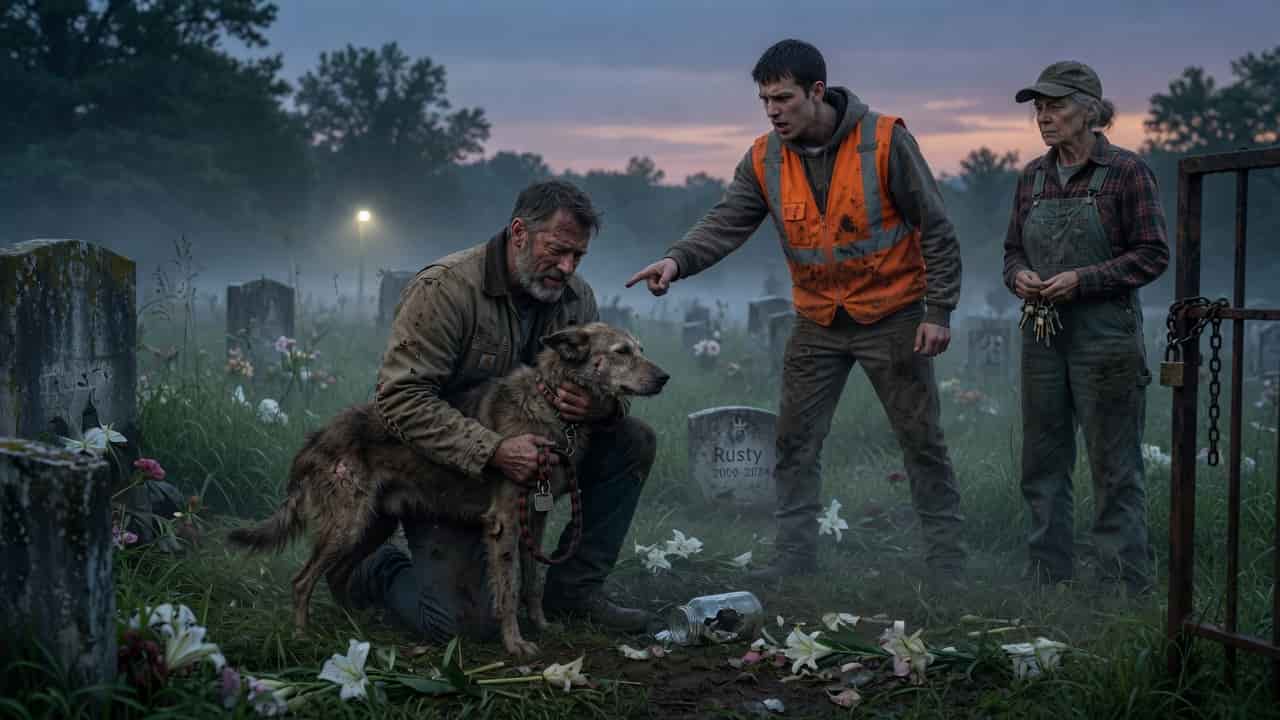
“You don’t get to touch him,” Lucas spat, his voice echoing through the overgrown family resting place.
Caleb stayed on his knees in the mud, his fingers tangled in the matted, filthy fur of the dog he’d claimed was gone forever. For seven years, he’d let his younger brother believe a lie. He’d watched Lucas post flyers, walk the woods until his boots fell apart, and wake up screaming in the middle of the night—all because Caleb couldn’t admit he’d left the animal at a shelter when the money ran out.
Now, the proof was right here. The dog was a skeleton, its ear notched from years of fighting for scraps, but it had remembered the way back. It was resting its chin on Caleb’s boot as if the betrayal had never happened.
“Lucas, look at the collar,” Caleb whispered, his voice breaking. He held out the hand-braided leather. “I made this. You know I did.”
Lucas didn’t look at the collar. He looked at the brother who had let him mourn a living thing for nearly a decade. Behind them, the groundskeeper watched the scene with cold, silent judgment, making the weight of the exposure feel like a physical blow.
“You let me believe he ran away,” Lucas said, his voice dropping to a dangerous, low hum. “You watched me cry for years, Caleb. You sat at the table and watched me lose my mind.”
The truth was finally out, and in this quiet, neglected corner of Pennsylvania, Caleb realized that finding what was lost didn’t mean he was forgiven. It just meant he had nowhere left to hide.
Chapter 1
The vibration of the Kenworth was a dull ache in Caleb’s molars that didn’t stop when he turned the key. It stayed there, a phantom hum in his jaw, as he sat in the cab and watched the rain smear the neon of the Pennsylvania truck stop into long, bleeding streaks of red and amber. He’d been on the road for three weeks, hauling structural steel from Gary to Allentown, and every mile had felt like a slow-motion collision with a version of himself he’d tried to leave in the rearview seven years ago.
He reached into his pocket and felt the corner of the receipt. It was soft now, the ink faded to a ghostly gray, but he didn’t need to look at it to know what it said. Intake #4492. Breed: Mixed. Color: Black/Tan. Owner Surrender. He’d kept it in his wallet like a penance, a serrated edge he could press against his thumb whenever he started to feel too comfortable.
Caleb climbed down from the cab, his knees popping in the damp air. His joints were thirty years older than the calendar said they should be. At forty-two, he walked with the careful, deliberate gait of a man who expected the ground to give way. He headed toward the diner, the smell of diesel and wet asphalt clinging to his Carhartt.
Inside, the air was thick with the scent of burnt coffee and industrial floor cleaner. He saw Sarah sitting in the corner booth, a mug of tea between her hands. She looked tired. Not the kind of tired that a night’s sleep could fix, but the kind that comes from years of managing other people’s disasters. She’d been his wife once, back when they had a house with a porch and a mortgage they could almost afford. Now, she was just the person who called him when his brother, Lucas, went off the rails.
“You look like hell, Caleb,” she said as he slid into the booth opposite her.
“I’ve been driving,” he said. It was his universal excuse. It covered everything from his lack of a haircut to the hollow look in his eyes.
“Lucas is worse,” Sarah said, skipping the pleasantries. She didn’t have time for them anymore. “He’s back at the old house. Well, what’s left of it. He’s been out in the woods every night this week with a flashlight. He thinks he heard something.”
Caleb felt a cold spike of adrenaline hit his stomach. “He’s still looking? It’s been seven years, Sarah.”
“He’s not looking for a dog anymore, Caleb. He’s looking for a reason to stay mad at the world. But he’s convinced himself he heard a bark near the creek. He’s losing it. He hasn’t been to work in three days.”
Caleb looked down at his hands. His fingernails were stained with grease that no amount of orange soap could ever fully remove. “I told him it ran away. The fence was rotten. It was a believable lie.”
“It was a cruel lie,” Sarah corrected, her voice low and sharp. “You knew how much that dog meant to him. It was the only thing he had left after your mom passed. You should have just told him you couldn’t afford the food. He would have understood eventually. But letting him think he failed? Letting him think he left the gate open? That’s what’s killing him.”
“I couldn’t do it,” Caleb said, and for a second, he sounded like the twenty-year-old kid who used to hide his report cards under the mattress. “I couldn’t look at him and say I was taking his best friend to a kill shelter because I spent the grocery money on the mortgage. I was trying to be the man of the house. I was trying to protect him.”
“You didn’t protect him. You just gave him a wound that won’t scab over.” Sarah pushed her tea aside and leaned in. “Go see him, Caleb. He’s at the VFW tonight. Some fundraiser for the volunteer fire department. The whole town will be there. If you don’t pull him back, he’s going to end up in a ward or a cell.”
Caleb didn’t answer. He watched a bead of condensation roll down the side of the sugar shaker. He thought about the dog—Buster. A goofy, high-strung shepherd mix with a notched ear from a fight with a raccoon. He remembered the way the dog had looked at him through the chain-link fence of the shelter, not barking, just watching him walk away with a confused, quiet dignity. He’d told himself it was the only way. He’d told himself that Lucas would forget.
But Lucas was a man who lived in the cracks of things. He didn’t forget; he just deepened the grooves of his resentment.
“I’ll go,” Caleb said.
“Don’t just go,” Sarah said, sliding out of the booth. “Talk to him. Really talk to him. Or don’t bother coming back to this town ever again.”
She left, and Caleb was alone with the hum of the diner and the ghost of the receipt in his pocket. He ordered a coffee he didn’t want and drank it black. It tasted like battery acid and regret. He knew what was waiting for him at the VFW. The judgmental stares of the men he’d grown up with, the heavy silence of his brother, and the weight of a seven-year-old lie that had grown too heavy to carry.
He walked back out to his truck. The rain had turned to a fine, clinging mist. He stood for a moment by the driver’s side door, looking out toward the dark silhouette of the ridge. Somewhere out there, Lucas was wandering through the brush with a flickering Maglite, calling a name that no one was ever going to answer.
Caleb climbed back into the Kenworth. He didn’t start the engine right away. He just sat there in the dark, the smell of his own sweat and old tobacco filling the small space. He was a man who moved things for a living—tons of steel, thousands of miles—but he couldn’t figure out how to move the three ounces of paper in his wallet that proved he was a coward.
He shifted the truck into gear. The VFW was six miles down the road, tucked between a closed-down upholstery shop and the creek. It was a place for men to drink away the parts of themselves they couldn’t stand, and Caleb knew he’d fit right in.
Chapter 2
The VFW Post 412 smelled like stale beer, wet wool, and the desperate, forced cheer of a small town trying to ignore its own decline. Folding tables had been dragged into the center of the hall, covered in paper cloths for the fundraiser. In the corner, a local band was playing a cover of a Springsteen song, the lead singer’s voice cracking on the high notes.
Caleb stood in the doorway, his tan Carhartt standing out against the sea of flannel and camo. He felt the eyes on him immediately. In a town this size, leaving is considered a betrayal, and coming back is treated like an investigation. He saw faces he recognized—men he’d played football with, women who had gone to school with his mother—and he saw the way their gazes shifted to the bar.
Lucas was there. He was wearing a bright orange reflective safety vest over a gray hoodie, a sign he’d come straight from his shift at the county garage—or that he hadn’t bothered to take it off in days. He looked thinner than the last time Caleb had seen him. His face was all bone and shadow, his eyes darting around the room with a frantic, unmoored energy.
He was holding a bottle of Miller High Life, gesturing wildly as he talked to Silas, an older man who had run the local hardware store for forty years.
“I’m telling you, Silas, it was him,” Lucas’s voice rose above the music, brittle and sharp. “I know that bark. It’s got that little break at the end. Like a whistle. He’s out there. He’s been surviving on the ridge all this time.”
Silas sighed, a sound of profound, weary pity. “Lucas, son. It’s been seven years. Even if he survived the winter, he’d be an old dog now. You’re hearing coyotes. Or just the wind in the hollow.”
“It wasn’t the wind!” Lucas slammed his bottle onto the bar. The sound made a few people nearby flinch. “I saw a print by the old well. A big one. The front right paw had that weird slant, just like Buster’s. He’s waiting for me to find him.”
Caleb took a breath and started walking. Every step felt like he was wading through deep water. He reached the bar just as Lucas was calling for another round.
“Hey, Luke,” Caleb said.
Lucas froze. He didn’t turn around immediately. He stared at his own reflection in the mirror behind the bar, his jaw tightening until the muscles stood out like cords. When he finally turned, his eyes weren’t filled with the warmth of a reunion. They were cold, hard, and jagged.
“Look who decided to grace us,” Lucas said, his voice dripping with a rehearsed contempt. “The king of the highway. Come to see the local crazies?”
“I just got into town,” Caleb said, trying to keep his voice steady. “Sarah called. She’s worried, Luke. I’m worried.”
“Oh, Sarah called? Well, then. Everything’s fine now that the big brother is here to fix things.” Lucas turned back to the bar, dismissing Caleb with a flick of his shoulder. “You don’t get to be worried, Caleb. You’re the one who let the fence rot. You’re the one who was too busy thinking about your own life to notice the gate was swinging in the wind.”
A few people at the nearby tables went quiet, their heads tilting toward the bar. This was the show they’d been waiting for—the public airing of the Miller family’s dirty laundry.
“It was an accident, Lucas,” Caleb said, the lie tasting like ash in his mouth. “I told you that a thousand times. I looked for him too.”
“You looked for ten minutes!” Lucas spun around, his face inches from Caleb’s. The smell of cheap beer and unwashed clothes rolled off him. “You looked until you got bored, then you packed your bags and hit the road. You left me here to clean up the mess. You left me here to listen to the silence in that house. You don’t know what it’s like to live with the knowledge that you let the only thing that loved you walk out into the dark.”
“He wasn’t the only thing that loved you,” Caleb said softly.
“Might as well have been,” Lucas snapped. He looked around the room, realizing he had an audience. He raised his voice, his eyes bright with a manic, humiliating light. “Hey, everyone! You remember my brother, Caleb? The guy who was too good for this town? He’s back to tell me I’m crazy. He wants to tell me that the dog he lost isn’t out there. He wants to tell me to get over it.”
Caleb felt the heat rising in his neck. The shame was a physical weight, pressing him down. “Luke, stop. Not here.”
“Why not here? This is where everyone saw me crying like a kid for six months after he went missing. This is where everyone saw me put up the flyers you didn’t help me print.” Lucas stepped closer, poking a finger into Caleb’s chest. “You think you’re better than me because you have a paycheck and a truck? You’re a coward, Caleb. You couldn’t handle the responsibility of a family, so you let it all fall apart. You let the dog go, you let the house go, and you let me go.”
The room was dead silent now. Even the band had stopped playing. Martha, the cemetery groundskeeper, was sitting at a table nearby, her arms crossed, watching Caleb with a look of pure, unadulterated disgust. She’d known their mother. She knew the whole story, or at least the version Lucas had been telling for years.
“I didn’t let you go,” Caleb said, his voice trembling.
“You did. The day you drove out of that driveway, you decided you were done with us.” Lucas’s voice cracked, the anger momentarily giving way to a raw, bleeding pain. “And now you’re here to pity me? I don’t want your pity. I want my dog back. I want the life we had before you ruined it.”
Lucas pushed past Caleb, shouldering him hard enough to make him stumble against the bar. He walked out of the VFW, the reflective vest glowing under the dim lights as he disappeared into the night.
Caleb stood there, the silence of the room ringing in his ears. He looked at Silas, who just shook his head and looked away. He looked at Martha, who spat a piece of tobacco into a cup and narrowed her eyes.
He wasn’t just a trucker anymore. He was the man who had broken his brother. He was the man who had lied to cover his own failure, and the weight of that lie was finally starting to crush the life out of him. He stayed at the bar for a long time, staring at the spot where Lucas had stood, until the bartender finally cleared his throat and asked him if he was going to buy something or just stand there and leak misery all over the counter.
Caleb walked out into the cold Pennsylvania air. He didn’t go to his truck. He started walking toward the ridge, toward the old house, toward the dark woods where his brother was currently losing his mind over a ghost Caleb had created.
Chapter 3
The cemetery sat on a rise overlooking the valley, a jagged collection of slate and granite that had been slowly losing its battle with the weeds for a century. Caleb’s mother was buried in the far corner, under a gnarled oak tree that dropped bitter acorns onto her headstone every autumn.
He arrived there just as the sun was dipping below the ridge, turning the sky the color of a bruised plum. He was carrying a jar of white lilies—the cheap kind from the grocery store, the only thing he could find open. His boots crunched on the gravel path, the sound unnaturally loud in the heavy, damp air.
“Running a bit late, aren’t you?”
Caleb jumped, nearly dropping the jar. Martha was standing by the equipment shed, a pair of rusted loppers in her hand. She looked like she’d been born in that cemetery, her skin the color of old parchment and her eyes as sharp as a hawk’s.
“Just wanted to pay my respects,” Caleb said, his voice sounding thin.
“Respects are usually paid with more than a ten-dollar jar of flowers and seven years of absence,” Martha said, stepping toward him. She didn’t move like an old woman; she moved like someone who was used to clearing brush and digging holes. “Your brother’s been here every day this week. He’s been talking to your mother’s stone like she’s going to tell him where that dog is.”
Caleb felt a familiar tightening in his chest. “He’s not well, Martha.”
“He’s haunted, Caleb. There’s a difference.” She pointed toward the back of the cemetery, where the grass grew waist-high and the older markers had long since tipped over into the mud. “Something’s been living back there in the hollow. Moving between the old crypts. I thought it was a coyote, but it don’t act like one. It don’t run when I start the mower. It just watches.”
Caleb’s heart hammered against his ribs. “What does it look like?”
“Like a shadow with bones,” Martha said. “I tried to catch it once, but it vanished into the briars. If it’s what Lucas thinks it is, then God help you both, because that animal is a testament to everything you let rot.”
She turned and walked away, leaving Caleb alone with the encroaching dark. He made his way to his mother’s grave. The headstone was clean—Lucas had clearly been scrubbing it—but the grass around it was trampled and muddy.
He knelt down, the dampness seeping through his jeans. He set the lilies on the flat stone and closed his eyes. I’m sorry, Ma, he thought. I tried to hold it together. I really did.
A low, guttural whine drifted from the thicket behind the oak tree.
Caleb froze. It wasn’t the howl of a coyote or the cry of a wind-strained branch. It was a three-note melody, a sound he hadn’t heard in seven years but recognized in his marrow. It was the sound Buster used to make when he was waiting for a treat, or when he saw Caleb coming home from work.
“Buster?” Caleb whispered.
The brush rustled. A shape emerged from the shadows, moving slowly, painfully. It wasn’t a dog so much as a collection of angles and matted fur. It was filthy, its ribs standing out like the hull of a wrecked ship, and its coat was a tangled mess of burrs and dried mud. But as it stepped into the faint light, Caleb saw the ear. The top half was gone, a jagged, notched scar that could only belong to one animal.
The dog stopped five feet away. It didn’t bark. It didn’t growl. It just stood there, swaying slightly on its thin legs, its eyes clouded with age but fixed on Caleb’s face. It took one more step, then another, until it was close enough for Caleb to smell the rot and the woods on its skin.
The dog lowered its head and rested its chin on Caleb’s heavy work boot. It let out a long, shuddering sigh and leaned its weight against his leg.
Caleb’s hands shook as he reached down. He expected the dog to snap, to snarl, to remember the man who had left it in a cold metal cage seven years ago. Instead, the dog licked his hand—a slow, raspy movement of a tongue that felt like sandpaper.
“Oh, God,” Caleb choked out. He sank to his knees, his fingers tangling in the matted fur. He felt the animal’s spine, the sharp points of its hips. It was a miracle it was alive, and a curse that it had found its way back here, to the one place where its presence would destroy the last remnants of Caleb’s peace.
He felt something hard under the fur around the dog’s neck. He pulled back the mats and saw it—the hand-braided leather collar he’d made for the dog’s second birthday. It was cracked and weathered, the brass buckle green with oxidation, but it was still there. It was the physical evidence of everything Caleb had tried to erase.
He realized then that he couldn’t just walk away. He couldn’t leave the dog here to die in the grass, and he couldn’t take it home without Lucas finding out. He was trapped between the living proof of his sin and the brother who would never forgive him for it.
He pulled the dog into his lap, the animal’s heat a staggering, painful reality. He didn’t care about the mud or the smell. He just held the dog and cried, the sound muffled by the damp Pennsylvania night. He was still sitting there, cradling the skeletal animal, when he heard the sound of a truck engine cutting out at the cemetery gate.
He knew that engine. He knew the way the door creaked when it opened.
Lucas was here.
Chapter 4
The beams of Lucas’s truck cut through the fog like twin searchlights, illuminating the rows of silent headstones. Caleb didn’t move. He couldn’t. He sat in the mud with Buster’s head in his lap, his fingers still gripped around the weathered leather collar. The dog didn’t move either; it seemed to have used the last of its strength just to reach the grave.
Lucas’s boots hit the gravel. He was moving fast, the orange reflective vest flashing as he passed through the pools of light. He was carrying his big Maglite, the beam dancing over the trees.
“Caleb?” Lucas called out, his voice tight with suspicion. “I saw your truck. What are you doing out here this late?”
Caleb swallowed hard, the lump in his throat feeling like a jagged stone. “I was just… I was talking to Ma, Luke.”
Lucas stepped around the oak tree, his flashlight beam swinging toward the grave. The light hit the lilies first, then the mud, and then it settled on Caleb and the bundle of fur in his arms.
The flashlight dropped. It hit the ground with a heavy thud, the beam rolling across the grass and illuminating the underside of a nearby monument.
For a long minute, neither of them spoke. The only sound was the distant rush of the creek and the ragged, shallow breathing of the old dog.
“Is that…” Lucas’s voice was a whisper, a sound of pure, fragile disbelief. He took a step forward, his knees buckling. He collapsed onto the grass a few feet away, his eyes wide and shimmering in the low light. “Is that him?”
“Look at the ear, Luke,” Caleb said, his voice thick.
Lucas reached out, his hand trembling so violently he had to pull it back twice before he could touch the dog’s head. When his fingers finally brushed the notched ear, he let out a sound—a sob that seemed to come from the very bottom of his lungs, a sound of seven years of grief finally breaking the surface.
“Buster,” Lucas choked out. “Oh, God, Buster. You came back. You really came back.”
The dog didn’t have the strength to lift its head, but its tail gave a single, weak thump against the mud. Lucas crawled closer, pulling the animal’s front paws toward him, burying his face in the filthy, matted fur. He was weeping openly now, his shoulders shaking, the orange vest crinkling with every movement.
Caleb watched him, and the weight of the lie in his pocket felt like it was set on fire. This was the moment he’d been terrified of, the moment where the joy of the return met the ugliness of the departure.
“How?” Lucas looked up, his face smeared with tears and dirt. He looked younger in the dark, stripped of his bitterness for a fleeting second. “How did he survive? Where has he been all this time, Caleb? He’s a skeleton. He looks like he’s been through a war.”
Caleb looked at the collar in his hand. He could tell the truth now. He could say, I left him at the shelter in Oakhaven. He must have escaped. He must have spent years trying to find his way across the county. He could end the lie.
But he looked at the way Lucas was holding the dog, the way he was looking at Caleb with a sudden, desperate hope, and the cowardice won again.
“I don’t know,” Caleb said, his voice a dull monotone. “Maybe he was living in the hollow. Like Martha said.”
Lucas’s eyes narrowed. The softness vanished, replaced by the sharp, accusatory edge that had become his default setting. He reached out and snatched the collar from Caleb’s hand, his fingers brushing Caleb’s skin like ice.
“Wait,” Lucas said, holding the collar up to the light of the fallen flashlight. He turned it over, his thumb tracing the braided leather. “This isn’t… this isn’t weathered enough for seven years in the woods, Caleb.”
“It’s leather, Luke. It lasts,” Caleb said, but his heart was racing.
“No.” Lucas stood up, the dog letting out a soft whine as its head hit the grass. Lucas held the collar inches from Caleb’s face. “The buckle is rusted, yeah. But the leather isn’t rotted. It’s been kept dry. It’s been… it’s been handled.”
He looked down at Caleb, the suspicion hardening into a cold, terrifying certainty. Lucas looked at the mud on Caleb’s boots, then at the way Caleb wouldn’t meet his eyes.
“You found him,” Lucas said, his voice dropping to a dangerous, vibrating hum. “You found him a long time ago, didn’t you? That’s why you’re here. That’s why you came back into town.”
“No, Luke, I just—”
“Don’t lie to me!” Lucas screamed, the sound echoing off the headstones. In the distance, the door to the groundskeeper’s shed creaked open. Martha appeared in the doorway, a dark silhouette against the faint light of the shed. She started walking toward them, her heavy keys jingling at her hip.
“What’s going on out here?” Martha called out, her voice stern.
Lucas ignored her. He stepped into Caleb’s space, towering over him, the reflective vest glowing like a warning sign. He shoved the collar into Caleb’s chest.
“You didn’t lose him,” Lucas said, his voice trembling with a new kind of rage. “The fence wasn’t rotten, was it? You did something. You took him somewhere.”
“Lucas, please, let’s just get him to a vet,” Caleb pleaded, trying to stand up.
“Answer me!” Lucas grabbed Caleb by the front of his Carhartt, hauling him halfway to his feet. “Where was he? Why is he like this? Why did you let me believe he was gone?”
Martha reached them, stopping just outside the circle of light. She looked down at the dog, then at the two brothers locked in a silent, violent struggle. She didn’t look surprised. She looked like she was witnessing the inevitable conclusion of a long-festering wound.
“I searched for years,” Lucas whispered, his face inches from Caleb’s. “I walked until my feet bled. I cried in front of the whole town. I let everyone think I was the failure. And you sat there. You sat there and watched me.”
He shoved Caleb back. Caleb hit the trunk of the oak tree, the rough bark scraping his spine. He looked down at the dog, who was watching them with wide, terrified eyes. He looked at Martha, who was waiting for an answer. He looked at the receipt in his wallet, the paper that had been his only companion on the road for seven years.
The pressure was unbearable. The silence of the cemetery was a physical weight, pressing the truth out of his lungs.
“I couldn’t afford it,” Caleb said, the words finally breaking free. They were small, pathetic sounds in the vast, cold night. “The mortgage was due. Ma’s funeral… I didn’t have the money for the food, Luke. I didn’t have anything left. I took him to the shelter in Oakhaven. I thought they’d find him a better home. I thought someone with money would take him.”
Lucas froze. His hands dropped to his sides. The rage didn’t vanish; it just turned into something colder, something that felt like the end of the world.
“The shelter,” Lucas repeated. “You gave him to a kill shelter.”
“I thought he’d get adopted!” Caleb yelled, his voice cracking. “He was a good dog, Luke! I thought someone would want him!”
“He was my dog,” Lucas said. He looked down at the skeletal animal in the grass, the animal that had spent seven years fighting its way back from a death sentence Caleb had signed. “He waited for you to come back. And you never did.”
Martha shook her head, a slow, rhythmic movement of judgment. “Seven years,” she whispered. “That’s a long time to keep a lie like that, Caleb.”
Lucas didn’t say another word. He knelt back down and gently scooped the dog into his arms. The animal was light, nothing but skin and memory, but Lucas held him like he was made of glass. He stood up, turning his back on Caleb, and started walking toward his truck.
“Lucas!” Caleb called out, taking a step forward.
Lucas stopped. He didn’t turn around. “Don’t come near us, Caleb. If I see your truck in this town tomorrow morning, I’ll give the police a reason to take you away. You’re not my brother. You’re just the man who murdered the only thing I had left.”
He walked away, his reflective vest disappearing into the fog. A moment later, the truck engine roared to life, and the headlights swept across the cemetery before fading into the distance.
Caleb stood alone by his mother’s grave. The lilies were trampled into the mud, their white petals stained brown. He reached into his pocket and pulled out the receipt. He looked at it for a long time, then he let it go. The wind caught the small slip of paper, carrying it off into the dark, where it vanished among the stones and the shadows.
He was finally free of the lie. And he had never been more alone in his life.
Chapter 5
The interior of the Kenworth had always been Caleb’s sanctuary, a vibrating metal box that separated him from the world’s expectations. But as he sat in the driver’s seat in the predawn gray of the cemetery parking lot, the cab felt like a coffin. The silence wasn’t empty; it was pressurized. It pushed against his eardrums, thick with the phantom sound of Lucas’s voice screaming that he wasn’t a brother anymore.
He didn’t start the engine. He couldn’t. His hands were still stained with the graveyard mud and the oily, matted grease of Buster’s fur. Every time he closed his eyes, he felt the weight of that skeletal head resting on his boot. It was a physical brand, a mark of a loyalty he hadn’t earned and a betrayal he couldn’t take back.
He reached for the ignition, then pulled his hand back. He looked at the passenger seat, where Sarah had sat a lifetime ago. He remembered how they used to dream about moving out of the valley, about a life where the mortgage wasn’t a predatory animal waiting at the door. He’d told himself he’d done it for them. He’d sacrificed the dog, the truth, and his own integrity to keep the roof over their heads. But the roof had collapsed anyway, and all he had left was a truck that belonged to a company in Ohio and a reputation that was currently being dismantled in every kitchen and bar in town.
By 7:00 AM, the mist had turned into a steady, freezing drizzle. Caleb finally cranked the engine. He drove toward the center of town, not because he wanted to stay, but because he was running out of fuel and the low-pressure warning light was flickering on the dash like a mocking eye.
He pulled into the Sunoco on Main Street. The town was waking up—diesel mechanics heading to the shops, teachers grabbing coffee, the usual rhythm of a Friday morning. He saw Gary, a man he’d known since Little League, standing by the air pump. Gary looked up, recognized the truck, and then slowly, deliberately turned his back.
It wasn’t a sudden explosion of anger; it was the quiet, systematic removal of belonging.
Caleb walked into the station to pay. The bell above the door chimed, a cheerful sound that felt like an insult. Behind the counter stood Tina, a woman who had once babysat Lucas. She was counting out change for a customer, her face tight. When Caleb approached the counter, she didn’t look up. She just stared at the register.
“Pump four,” Caleb said. His voice sounded like it was coming from a long way off.
Tina didn’t move. She slid a twenty-dollar bill into the drawer and snapped it shut. “Lucas called Sarah last night,” she said, her voice low and brittle. “She called my sister. My sister called me.”
Caleb felt the air in the small shop grow thin. “Tina, it’s not what people think. It was a hard time.”
“A hard time?” Tina finally looked up. Her eyes were hard and judgmental, reflecting the collective moral weight of the town. “My daddy lost his job at the mill in ’08. We ate beans for six months and slept in coats to save on heat. But we didn’t take the cat to the woods and lie about it. We didn’t let our neighbors think they were the reason things went wrong.”
“I was trying to protect him,” Caleb whispered.
“You were protecting yourself,” she snapped. She shoved his receipt across the counter. “You couldn’t stand him looking at you and seeing that you couldn’t provide. So you gave him a ghost to chase instead. You let that boy break his own heart for seven years while you played the hero on the highway.”
The customer behind Caleb, a young guy in a construction hoodie, let out a sharp, mocking huff. “Real brave, man. Hope the truck’s worth it.”
Caleb took the receipt and walked out. The shame was a physical heat in his chest, making it hard to breathe. He climbed back into the Kenworth, but the sanctuary was gone. The world was leaking in through the glass.
He drove to Sarah’s house. He didn’t know where else to go. He needed to know if Buster was alive, if the vet had been able to do anything. He pulled the rig onto the shoulder of the road, the air brakes hissing like a dying animal.
Sarah was on her front porch, wrapped in a heavy wool cardigan, holding a mug of coffee. She didn’t wave. She didn’t invite him in. She just watched him climb down from the cab and walk up the drive.
“He’s at the county clinic,” she said before he reached the steps. “Lucas didn’t sleep. He’s been sitting on the floor of the exam room since midnight. They had to put the dog on an IV. Dehydration, kidney failure, heartworms. He’s a mess, Caleb. He’s a literal walking miracle, and he’s dying.”
Caleb stopped at the bottom step. “Can I see them?”
Sarah let out a short, hollow laugh. “You want to go in there? After what you told him? Lucas told the vet tech that if you showed up, he’d use the fire extinguisher on you. He’s past angry, Caleb. He’s in that place where the world doesn’t make sense anymore.”
“I have money,” Caleb said, reaching for his wallet. “I can pay for the bills. The best specialist, whatever they need.”
“Put your wallet away,” Sarah said, her voice softening just a fraction, though the pity in it felt worse than Tina’s anger. “It’s not about the money. It was never about the money. It was about the fact that you looked him in the eye every Christmas, every birthday, every time he cried about that dog, and you let him believe a lie. You let him think his own negligence was the reason his life fell apart.”
“I know,” Caleb said, his voice breaking. “I know I ruined it.”
“You didn’t just ruin it for him, Caleb. You ruined it for yourself.” Sarah looked out at the gray horizon. “You thought you were carrying the weight for everyone, but all you did was make sure no one could help you lift it. Now you’re alone with it. Is that what you wanted?”
Caleb didn’t have an answer. He stood there in the rain, the sound of the idling truck in the distance a reminder that he was supposed to be somewhere else, hauling someone else’s property to another city where no one knew his name.
“Go to the clinic,” Sarah said. “Don’t go inside. Just go. Sit in the parking lot. Let him know you’re there, even if he hates you for it. It’s the only thing you have left to give him.”
Caleb nodded. He turned and walked back to the truck. As he pulled away, he saw Sarah through the rearview mirror, still standing on the porch, a small, lonely figure in a valley that had forgotten how to forgive.
The county clinic was a low, cinder-block building on the edge of the industrial park. Caleb parked the Kenworth at the far end of the lot, taking up six spaces. He could see Lucas’s beat-up Ford Ranger parked right by the front door. The orange reflective vest was draped over the steering wheel, a bright, mocking splash of color against the drab gray of the morning.
He sat there for four hours. He watched the vet techs arrive, saw a woman bring in a golden retriever that was wagging its tail, saw an old man come out carrying an empty leash. Each movement in the parking lot felt like a needle under his skin. He was the intruder here, the man who had tried to cheat the natural order of grief and had been caught in the act.
Around noon, the front door of the clinic opened. Lucas stepped out. He looked smaller than he had the night before. His movements were slow, his head bowed. He walked to his truck, opened the door, and reached for the orange vest. He held it for a moment, then tossed it into the bed of the truck like it was trash.
He didn’t look toward the Kenworth, but Caleb knew he saw it. The truck was impossible to miss.
Lucas sat on the tailgate of his truck and buried his face in his hands. He didn’t move for a long time. Caleb watched him through the windshield, the wipers clicking back and forth, clearing the rain just enough for him to see the silhouette of his brother’s despair.
This was the residue. This was what was left when the lie was stripped away—not a clean truth, but a jagged, bleeding mess that no one knew how to clean up. Caleb wanted to climb out, to walk over and put a hand on Lucas’s shoulder, to say he was sorry until the words lost all meaning. But he stayed in the cab. He knew that his presence was a poison. He’d already taken seven years; he couldn’t take this moment of quiet, broken peace too.
He watched Lucas stand up, wipe his face with the back of his hand, and walk back into the clinic. He moved with a heavy, grim determination. He was going back to the dog. He was going back to the ghost that had finally become flesh, even if that flesh was failing.
Caleb shifted the truck into gear. He couldn’t stay in the parking lot forever. He had a delivery in Scranton, a schedule to keep, a life of movement that was designed to prevent him from ever having to face the stillness. But as he pulled out onto the highway, the vibration of the engine didn’t feel like a sanctuary anymore. It felt like a heartbeat—slow, mechanical, and entirely alone.
Chapter 6
The old house was a skeletal remain of a life that had once been loud and full. The porch was sagging, the white paint peeling away in long, curled strips like dead skin. It sat at the end of a dirt road that the county had stopped grading years ago, surrounded by maples that were already starting to turn a bitter, dying red.
Caleb pulled the truck onto the grass. He knew he was violating the order Lucas had given him, but he also knew that Buster didn’t have much time left. Sarah had called him an hour ago. He’s home, she’d said. Lucas brought him back to the house. The vet said there’s nothing left to do but keep him comfortable.
Caleb climbed down from the cab. The air was still, the rain finally having moved on, leaving behind a cold, biting clarity. He walked toward the porch, his boots heavy in the mud. He could see a light on in the kitchen—the same yellow, flickering light that had guided him home after football practice twenty years ago.
He didn’t knock. He just pushed the door open.
The smell of the house hit him like a physical blow. It was the smell of damp wood, old grease, and the distinct, metallic scent of a sick animal. Lucas was sitting on the floor in the middle of the living room, leaning against the base of the old sofa. Buster was lying on a pile of blankets between his legs.
The dog looked smaller than he had at the cemetery. His breathing was a wet, rattling sound that filled the quiet room. His eyes were half-closed, but when Caleb stepped inside, the notched ear flickered.
Lucas didn’t look up. He was stroking the dog’s head with a rhythmic, mechanical motion. His hand was steady, but his face was a mask of exhaustion.
“I told you to stay away,” Lucas said. His voice wasn’t angry anymore. It was just flat, drained of everything but the weight of the moment.
“I couldn’t,” Caleb said. He stayed by the door, his hands shoved deep into his Carhartt pockets. “I just wanted to… I brought some things.”
He reached into his pocket and pulled out a small, plastic bag. Inside was a piece of dried steak, something he’d saved from his dinner the night before. He knew the dog probably couldn’t eat it, but he needed to offer something that wasn’t a lie or a check.
Lucas finally looked at him. His eyes were red-rimmed and hollow. “He doesn’t want steak, Caleb. He just wants to stop hurting.”
Caleb walked across the room, every floorboard creaking under his weight. He sat down on the floor a few feet away, mirroring Lucas’s position. The two brothers sat in silence for a long time, the only sound the rhythmic struggle of the dog’s lungs.
“Why did you do it, Caleb?” Lucas asked. He wasn’t looking for a fight. He sounded like a child asking why the sky was blue. “Really. Why did you take him there instead of just telling me?”
Caleb leaned his head back against the wall. He looked up at the ceiling, where a water stain from a leak he’d never fixed was spreading like a map of a lost country. “I was ashamed, Luke. We were losing everything. Ma was gone, the bank was calling every day, and I was the one who was supposed to be in charge. I felt like a failure every time I looked at you. And the dog… he was just one more thing I couldn’t provide for. I thought if I could just make him disappear, I could focus on keeping the house. I thought I was being strong.”
“Being strong means letting people see you bleed,” Lucas said softly. He looked down at Buster. “I would have sold my truck. I would have dropped out of school and worked double shifts at the mill. I would have done anything to keep him. You didn’t give me the choice. you decided my life for me.”
“I know,” Caleb said. “I’m a coward, Luke. I’ve been running from that for seven years. I thought if I drove enough miles, I’d eventually outrun it. But the world’s a lot smaller than I thought.”
Lucas reached out and took the plastic bag from Caleb’s hand. He opened it, took out the piece of steak, and held it near Buster’s nose. The dog’s nostrils flared slightly. He didn’t open his eyes, but he gave a single, weak lick to the meat before turning his head away.
“He appreciates it,” Lucas said. It was the first bridge he’d offered, a tiny, fragile thing that barely spanned the gap between them.
An hour passed. The sun disappeared entirely, leaving the room in a deepening gloom. Lucas didn’t turn on the lamps. They sat in the dark, the brothers and the dog, a triptych of a family that had been broken and put back together with all the wrong pieces.
Buster’s breathing changed. The rattle grew louder, then suddenly stopped. He gave one long, shuddering exhale that sounded like a sigh of relief. His body went still, the tension leaving his thin frame all at once.
Lucas didn’t move. He kept his hand on the dog’s head, his fingers still stroking the matted fur. He sat there for a long time, his eyes fixed on a point somewhere in the middle of the room.
“He’s gone,” Lucas whispered.
Caleb felt a cold wave of grief wash over him, but underneath it, there was a strange, terrible sense of finality. The ghost was finally at rest. The lie had reached its conclusion.
“I’ll help you,” Caleb said. “In the morning. We’ll put him by Ma.”
Lucas nodded slowly. “Yeah. By Ma.”
They stayed there on the floor for the rest of the night. Neither of them spoke. There were no grand speeches of forgiveness, no dramatic reconciliations. There was just the shared weight of a grief that had been delayed for seven years, finally allowed to land.
When the first light of dawn began to creep through the dusty windows, Lucas finally stood up. He walked to the kitchen and started a pot of coffee. The sound of the water running and the clatter of the mugs felt like the beginning of something new, or at least the end of the old.
Caleb stood up, his joints screaming in protest. He walked over to the kitchen doorway. Lucas was standing by the counter, his back to him.
“I have to go,” Caleb said. “The company… they’re going to be looking for the truck.”
Lucas turned around. He looked older, more tired, but the manic light in his eyes had been replaced by a somber, grounded stillness. “Are you coming back?”
Caleb looked out the window at the Kenworth sitting on the grass. It looked out of place here, a giant, restless machine in a valley that demanded you stay still.
“I don’t know,” Caleb said. “Maybe. If you’ll have me.”
Lucas took a sip of his coffee. He didn’t say yes, but he didn’t say no. He just looked at Caleb for a long minute, then looked back at the pot. “The house needs a new roof. The leak is getting worse.”
“I know,” Caleb said. “I’ll bring some tools next time. And some real steak.”
Caleb walked out to the truck. He climbed into the cab and started the engine. The vibration was there, as always, but it didn’t feel like a separator anymore. It felt like a tool. He shifted into gear and slowly pulled the rig back onto the dirt road.
He didn’t look back in the rearview mirror. He didn’t need to. He knew exactly what he was leaving behind—a house that was falling apart, a brother who might never fully trust him again, and a grave that would soon hold the last of his secrets.
He drove toward the highway, the sun rising over the ridge and turning the fog into a golden haze. He had three hundred miles to Scranton, and a lifetime of miles after that. But for the first time in seven years, he wasn’t driving away from anything. He was just driving. And in the quiet of the cab, he could finally hear the road again, clear and steady, underneath the weight of the world.