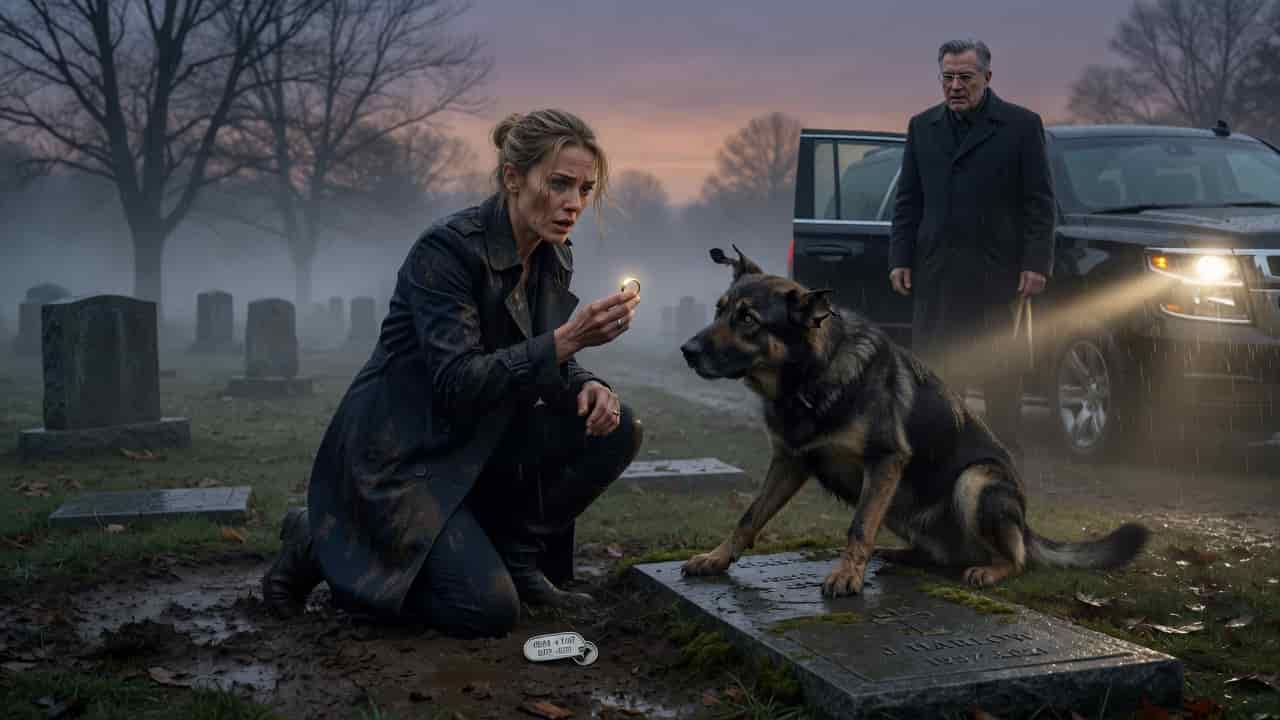
“Get up, Elena. You’re making a scene in front of the whole town.”
My uncle Silas stood by his SUV, his voice booming across the cemetery like he still owned every breath I took. He wanted me to look like the ‘crazy niece’—the grieving girl who couldn’t handle the truth about why her father disappeared a decade ago. He’d spent years telling me my father just walked away, leaving nothing but a missing dog and a mountain of debt.
But as I knelt there in the freezing fog, the old family dog—the one they said was gone forever—pushed his scarred paw into the dirt.
Something glinted. Something gold.
When I pulled the wedding ring from the mud, the air in my lungs turned to ice. It wasn’t just that I’d found it. It was the date engraved on the inside. A date three days after Silas told the police my father had vanished.
“Give me that ring, Elena,” Silas snarled, his voice dropping the polite mask he’d worn for ten years. He took a step toward me, and for the first time, I didn’t see my protector. I saw the man who had been waiting for the frost to cover his tracks.
The whole town thinks they know the story of the man who walked out on his life. They’re about to find out they were lied to by the man who stayed.
Chapter 1: The Weight of the Fog
The state line into Vermont always felt like a door slamming shut behind me. It wasn’t the scenery—the rolling hills and the skeletal hardwoods of late October were objectively beautiful—it was the sudden, oppressive sense of history. My history. The kind that didn’t stay in the past but sat on your chest like a wet wool blanket.
I drove the Lexus with a precision that bordered on the obsessive, my hands locked at ten and two, my eyes scanning the grey ribbon of Route 7. I was Elena Thorne, a senior associate at a firm in Manhattan that billed by the minute and didn’t tolerate ghosts. But as the altitude climbed and the fog began to spill out of the hollows, I felt the sharp edges of my professional life beginning to blur.
Ten years. It had been ten years since my father, Thomas Thorne, walked out of the back door of our estate on Blackwood Hill and simply ceased to exist. He hadn’t taken his wallet. He hadn’t taken his keys. He had, however, taken the dog—a massive, rowdy German Shepherd mix named Bear. Neither of them had been seen since.
Until three days ago.
The voicemail from Deputy Miller had been short, hesitant. “Elena, it’s Miller. Listen, there’s been a sighting. Up near the old quarry. It sounds crazy, I know, but a couple of hikers reported a dog. Big, black and tan, notched ear. They said he was guarding something. You should probably come up. Your Uncle Silas is already making noise about the estate’s final closure.”
I pulled into the long, winding driveway of the Thorne estate, the tires crunching over gravel that hadn’t been replenished in a decade. The house loomed out of the mist—a sprawling Victorian pile of dark wood and stone that looked more like a tomb than a home.
Silas was waiting on the porch. He always seemed to be waiting, a heavy-set man who occupied space with a deliberate, suffocating gravity. He was my father’s younger brother, the one who had stepped in to “manage” the chaos Thomas left behind. He’d managed it right into his own pocket, slowly absorbing the family holdings while I was away at law school, convincing the courts that my father was legally dead so the title could transfer.
“Elena,” he said, his voice a deep, resonant rumble that made my skin crawl. He didn’t move to hug me. He just stood there, his rimless spectacles catching the dim light. “You’re late. The appraiser was here at noon.”
“I’m not here for the appraiser, Silas,” I said, stepping out of the car. The air was bitingly cold, smelling of damp earth and rotting leaves. I grabbed my briefcase, a shield of leather and brass. “I’m here because of the dog.”
Silas let out a short, dismissive huff. “Miller is a fool. He’s chasing shadows. That dog would be fifteen years old by now, Elena. If he didn’t starve in the woods ten years ago, the coyotes got him. It’s a stray, nothing more. Miller just likes to keep the wound open.”
“A notched ear, Silas. How many strays in this county have a notched left ear?”
“Plenty, after a fight,” he snapped, his eyes narrowing. “Don’t do this to yourself. Don’t start digging through the dirt again. We have the final hearing in two weeks. The estate needs to be settled. Your father isn’t coming back, and neither is that animal.”
I walked past him into the house, the familiar scent of old wood and lemon wax hitting me. It was too quiet. The house had always been loud when I was a child—my father’s booming laugh, Bear’s claws clicking on the hardwood, the constant movement of a life being lived. Now, it was just a museum of things Silas hadn’t sold yet.
I went straight to the kitchen, the heart of the house. I remembered the last night I saw my father. He’d been sitting at the table, cleaning his shotgun, Bear resting his heavy head on Dad’s knee. There had been a tension in the room that night, a feeling of things being left unsaid. Dad had looked at me—really looked at me—and said, “Sometimes the only way to protect what you love is to let it think you’re gone.”
I hadn’t understood then. I’d just turned twenty-four, my head full of case law and ambition. I’d gone to bed, and when I woke up, the house was empty.
I walked to the sink and looked out the window toward the woods. The fog was so thick I could barely see the treeline. My hand went to the faucet, my fingers tracing the cold stainless steel. I could still see the image in my mind—the image that kept me awake in my glass-walled apartment in the city.
The morning he disappeared, I had found Bear’s water bowl in the mudroom. It was tipped over, and there was a smear of something dark on the rim. I’d told myself it was mud. I’d taken a rag and washed it off, scrubbing until the plastic was white and sterile. I’d washed away the only evidence that anything violent had happened, because I was terrified that if I didn’t, the truth would be something I couldn’t survive.
“You’re doing it again,” Silas’s voice came from the doorway. He was leaning against the frame, watching me. “The staring. The searching. You were always a high-strung girl, Elena. That’s why you’re so good at the law. You like things in neat little boxes. But this isn’t a box. It’s a hole. Stop looking into it.”
“Why does it bother you so much, Silas? That I’m here?”
“It doesn’t bother me,” he said, stepping into the room. He reached for the kettle, his movements slow and deliberate. “It saddens me. To see you waste your life on a ghost story. You have a career. You have a future. Don’t let Thomas pull you down with him, even from wherever he ended up.”
“Miller said the dog was near the old quarry,” I said, ignoring his condescension. “I’m going up there tomorrow morning.”
Silas paused, his hand on the kettle. For a fraction of a second, the mask slipped. His jaw tightened, a tiny muscle jumping in his cheek. Then, he smiled—a cold, thin-lipped expression.
“Suit yourself. But don’t expect me to come looking for you when you get lost in the fog. Some things stay hidden for a reason, Elena. They’re kinder that way.”
I didn’t answer. I went upstairs to my old bedroom, the floorboards groaning under my feet. The room was exactly as I’d left it, except for the dust. I sat on the edge of the bed and looked at the photo on the nightstand—me and Dad at the lake, Bear soaking wet and shaking water all over us.
I reached out and touched the glass. My fingers were trembling. I wasn’t the twenty-four-year-old girl anymore. I was a woman who knew how to find the cracks in a testimony, how to follow the money, how to see the lie behind the smile. And as I looked out at the darkening Vermont woods, I knew that Silas wasn’t trying to protect me. He was trying to manage me.
Just like he’d managed my father.
I lay down, but I didn’t sleep. Every time I closed my eyes, I heard it—the sound of a heavy paw hitting the porch, and a low, guttural whine that sounded like a warning.
Chapter 2: Red Water and Cold Steel
The morning brought no sun, only a shifting of the grey. The fog had moved from the hollows to the heights, clinging to the eaves of the house like wet smoke. I dressed in layers—heavy wool, leather, things that could withstand the briars of the Vermont backcountry.
Downstairs, the house was silent. Silas was gone, likely to his “office” in town—a local real estate firm that had grown suspiciously fast in the years following my father’s disappearance. I poured myself a cup of black coffee and stood in the mudroom, staring at the spot where Bear’s bowl used to be.
The memory hit me with the force of a physical blow. It was 6:00 AM, ten years ago. I’d come down to make coffee before my drive back to the city. The house was too quiet. I’d walked into the mudroom and seen the tipped bowl. Then I’d seen the dog’s bed. It was shredded, the stuffing scattered like snow. And there, on the white linoleum, were the prints.
Not human prints. Dog prints. But they were dark. Red-black.
I had grabbed a bucket of hot water and a bottle of bleach. I didn’t call the police. I didn’t call Silas. I knelt on that floor and scrubbed until my knuckles bled. I told myself I was cleaning up a mess. I told myself Bear must have caught a rabbit. I told myself a thousand lies in the space of ten minutes because the alternative—that Bear had been hurt, or that he’d hurt someone—was a door I wasn’t ready to open.
I’d spent a decade wondering if that red water down the drain was my father’s life.
I shook the thought away and headed out. The walk to the quarry was two miles of steep, rocky terrain. The trail was overgrown, the markers faded or missing. I moved with a grim determination, my breath blooming in the cold air.
The quarry was a jagged scar on the side of the hill, a place where the granite had been ripped out of the earth a century ago. It was a bowl of grey stone, filled with stagnant green water at the bottom. As I reached the rim, I stopped.
He was there.
He was sitting on a flat ledge of rock about fifty yards away, his back to me. He looked like a statue carved from the same grey granite. Even from the back, I knew the shape of those shoulders. Bear. He was thinner, his coat matted and greyed around the muzzle, but the presence was unmistakable.
“Bear?” I whispered, my voice cracking.
The dog didn’t move. He didn’t bark. He just sat there, staring down into the water.
“Bear, come here, boy.”
Slowly, the massive head turned. The left ear was a jagged ruin, just as Miller had described. But it was his eyes that stopped me. They weren’t the bright, eager eyes of the dog I remembered. They were old. Tired. They looked like they had seen things no living creature should have to carry.
He let out a low, vibrating growl. It wasn’t aggressive; it was a warning. He stood up, his movements stiff and painful, and stepped toward the edge of the ledge. He looked down into the water, then back at me. Then, he vanished into a narrow crevice in the rocks.
“Wait!” I scrambled down the scree, my boots slipping on the loose stone. “Bear, wait!”
By the time I reached the ledge, he was gone. But he’d left something behind. On the flat rock where he’d been sitting, there was a scent. It wasn’t the smell of a wild animal. It was a faint, lingering aroma of cherry-flavored pipe tobacco.
My father’s tobacco.
My heart hammered against my ribs. My father hadn’t smoked in the house—my mother had hated it—but he’d always kept a pouch in his jacket for his walks. I knelt and pressed my hand to the cold stone. The scent was impossible. It had been ten years.
“Elena!”
The voice startled me, making me nearly lose my footing. I looked up to see Deputy Miller standing on the rim of the quarry. He was a man in his fifties, his uniform a bit too tight, his face etched with the weariness of a small-town cop who knew too many secrets.
“Miller,” I panted, climbing back up toward him. “He was here. The dog. He was right there.”
Miller reached out a hand and hauled me up over the edge. “I saw him too, just for a second. He’s like a ghost, Elena. People have been reporting him for years, but nobody believed them until those hikers got a photo.”
“He smelled like my father’s tobacco, Miller. How is that possible?”
Miller looked away, his gaze shifting toward the dark woods. “Look, Elena. I liked your father. He was a good man, even if he was a bit… private. But your Uncle Silas has a lot of influence in this town. He’s the one who pushed for the death certificate. He’s the one who wants this quarry filled in next month for a ‘development project.’”
“He wants to bury this place,” I said, the realization clicking into place. “He’s not developing anything. He’s hiding it.”
“I can’t help you officially,” Miller said, his voice dropping to a whisper. “Silas has the Commissioner in his pocket. But if I were you, I’d look at the old records. Not the police records—the land survey records from the year your father disappeared. There was a dispute about the quarry boundary. Silas and your father were at each other’s throats for months.”
“Why didn’t you tell me this before?”
“Because ten years ago, you were a kid in New York and Silas was the only one paying the bills,” Miller said, his face hardening. “But you’re a lawyer now. You know how to dig. Just be careful. This isn’t a courtroom. There are no rules in these woods.”
I walked back to the house in a daze. The scent of the tobacco was still in my nostrils, a ghost of a man who should have been long gone. As I approached the driveway, I saw Silas’s SUV. He was standing by the mailbox, talking to a man in a dark suit—someone I didn’t recognize.
As I got closer, Silas looked up. He didn’t wave. He just watched me approach, his expression unreadable. The man in the suit got into a car and drove away, leaving a plume of exhaust in the cold air.
“Find your ghost, Elena?” Silas asked as I reached him.
“I found Bear,” I said, my voice steady. “And I found something else. Why are you filling in the quarry, Silas?”
Silas didn’t blink. He reached into his pocket and pulled out a silver tin, popping a mint into his mouth. “Progress, Elena. The town needs the revenue. It’s been a dead weight on the estate for years. I’m doing what Thomas never had the courage to do—making this land work for us.”
“Or you’re making sure nobody ever finds what’s at the bottom of that water.”
Silas took a step toward me, his physical presence suddenly menacing. He was a head taller than me, and twice my weight. He smelled of expensive cologne and cold iron.
“You’re tired, Elena. The altitude is getting to you. Why don’t you go inside, pack your bags, and head back to the city? There’s nothing for you here but old bones and bad memories. Let the dead stay dead.”
He brushed past me, his shoulder hitting mine with enough force to stumble me. It wasn’t an accident. It was a claim of territory.
I stood there, watching him walk toward the house. I thought about the red water in the sink. I thought about the dog’s eyes. And I thought about the fact that Silas hadn’t asked me what I’d found at the quarry.
He already knew.
Chapter 3: The Girl Playing Lawyer
The local diner, The Rusty Spoke, was the kind of place where conversations died the moment the door opened. It was a Thursday morning, the air inside thick with the smell of burnt coffee and diesel exhaust from the truckers on the interstate.
I sat in a corner booth, a stack of land survey maps spread out before me. I’d spent the last four hours at the county records office, and what I’d found was starting to form a very ugly picture.
In the six months leading up to his disappearance, my father had been filing injunctions against Silas. Silas had wanted to sell the quarry to a waste management firm—a deal worth millions. My father had refused, citing environmental concerns, but there was something else in the notes. A hand-written memo from my father to his attorney: “It’s not about the stone. It’s about what’s under the stone. Silas knows. He’s desperate.”
“More coffee, honey?”
The waitress, a woman named Martha who had known me since I was in pigtails, hovered over the table. She looked at the maps, then at me, her eyes full of a pity that made my teeth ache.
“You look just like him, Elena. Thomas had that same way of leaning into a problem. Like he could break it with his forehead.”
“Martha, did you ever see my father and Silas together toward the end?”
Martha’s face clouded. She leaned in, her voice low. “They had a row right here in this booth. Two nights before Thomas went missing. I’ve never seen Silas like that. He was quiet—you know how he gets—but his hands were shaking so hard he spilled his water. He told Thomas, ‘You’re standing in the way of everyone’s future. Don’t be a martyr for a pile of rocks.’”
“What did my father say?”
“He just looked at him. Very calm. He said, ‘The rocks don’t lie, Silas. That’s the problem.’”
The bell over the door chimed, and a gust of cold air swept in. Silas walked in, flanked by Deputy Miller and a man I recognized as the Town Supervisor, Bill Henderson. They were laughing about something, a trio of local power.
Silas spotted me immediately. His smile didn’t reach his eyes. He led the other two men straight to my booth.
“Well, look at this,” Silas said, his voice loud enough to draw the attention of the entire room. “Our big-city lawyer, still playing detective. What have you got there, Elena? Planning to sue the mountain?”
Henderson chuckled, a wet, sycophantic sound. “Careful, Silas. She might find a violation in the way we drink our coffee.”
I didn’t move. I kept my eyes on the map. “I’m looking at the 2014 survey, Silas. The one that shows the quarry boundary was moved forty feet to the east right after Dad disappeared. Why would you need forty more feet of rock?”
The laughter stopped. The air in the diner seemed to thin. Silas leaned over the table, his large, manicured hands resting on my maps.
“Listen to me, Elena,” he said, his voice dropping to a low, dangerous purr. “You’ve been back here for forty-eight hours and you’re already trying to blow up the peace of this town. You think because you have a fancy degree and a suit that you can come back here and question how we do things? You’re a girl playing lawyer in a world you don’t understand.”
“I understand a fraudulent land transfer, Silas. And I understand why someone would be so eager to fill in a quarry that contains evidence of a crime.”
Silas laughed then, a sharp, barking sound. He looked around at the diners, most of whom were now staring. “You hear that? My niece thinks I’m a murderer because I want to bring jobs to this county. She’s had a hard time, folks. Grief does strange things to the mind. First it was a ghost dog, now it’s a conspiracy.”
He leaned closer, his breath hot against my face. “You’re embarrassing yourself. And you’re embarrassing the Thorne name. If you keep this up, I’ll have you committed for a psych eval before you can file your next motion. Miller here would be happy to sign the transport papers, wouldn’t you, Ben?”
Miller looked at his boots, his face a deep, shamed red. He didn’t say anything.
“Go home, Elena,” Silas said, straightening up. “Before you lose the only family you have left.”
They walked away to a table in the center of the room, leaving me sitting in the corner, the object of a dozen judgmental stares. My heart was racing, my skin cold with a mix of rage and genuine fear. Silas wasn’t just threatening my career; he was threatening my freedom. In this town, his word was the only law that mattered.
I gathered my maps, my hands trembling. As I stood up to leave, a young man at the counter caught my eye. He was wearing a grease-stained Carhartt jacket and had a shock of dark hair. He was the one Miller had mentioned—Leo, the local animal rescuer.
He didn’t say anything, but as I passed him, he slid a small piece of paper across the counter toward me.
I didn’t look at it until I was back in my car, the heater blasting.
Cemetery. Old Section. 4:00 PM. He’s there every day.
I looked in the rearview mirror. Silas was standing at the window of the diner, watching me pull away. He didn’t look like a man who had won. He looked like a man who was watching a fuse burn down.
I checked my watch. 3:15 PM.
The old section of the cemetery was on the far side of Blackwood Hill, a place where the headstones were so worn the names had been reclaimed by the moss. It was where my mother was buried. And it was where the empty plot for my father waited.
I drove up the winding road, the fog growing thicker with every turn. The cemetery was a silent city of grey stone, the trees overhead dripping with moisture. I parked the car at the gate and walked in, the dampness seeping into my bones.
I found the Thorne plot. My mother’s stone was clean, a spray of faded plastic flowers at its base—Silas’s version of devotion. Beside it, the earth was flat, waiting for a body that had never been found.
And there, sitting in the middle of the empty plot, was Bear.
He looked even worse in the daylight. His fur was matted with burrs and dried mud, and a long, jagged scar ran down his flank. He was digging. Not a deep hole, but a rhythmic, frantic scraping at the earth right where the headstone would be.
“Bear,” I whispered.
He stopped. He didn’t growl this time. He looked at me, then back at the hole. He whined—a high, thin sound that broke my heart.
“What is it, boy? What did you find?”
I knelt beside him, the mud soaking through my trousers. Bear stepped back, his tail tucked between his legs, his eyes fixed on the dirt.
I reached into the shallow furrow he’d made. My fingers brushed something hard. Something metallic.
I pulled it out. It was a silver dog tag, tarnished and black with age. I rubbed the surface with my thumb, cleaning away the grime.
Bear. 14 Blackwood Hill.
But it wasn’t the name that made me gasp. It was the back of the tag. There was a date etched there—a date I’d never seen before. A date in my father’s precise, architectural handwriting.
11-04-16.
November 4th. Four days after my father had disappeared.
A shadow fell over me, long and distorted in the dying light. I looked up.
Silas was standing at the edge of the plot. He wasn’t in his SUV. He’d followed me on foot, moving through the fog like a predator. He was holding a heavy flashlight, the beam cutting through the mist like a blade.
“I told you to stop digging, Elena,” he said. His voice was no longer the polite rumble of an uncle. It was the cold, dead sound of a man who had reached the end of his patience. “Now, give me what’s in your hand.”
Chapter 4: The Earth Reclaims Its Own
The flashlight beam hit my eyes, blinding me. I instinctively closed my hand around the dog tag, the sharp edges digging into my palm. Bear let out a low, sustained snarl, his hackles rising until he looked twice his size.
“Get away from him, Silas,” I said, my voice shaking but loud.
“You’re trespassing, Elena,” Silas said, stepping into the Thorne plot. The mud sucked at his expensive leather shoes, but he didn’t seem to notice. “This is private property. I’m the executor of this estate. Everything here belongs to the trust. Which means it belongs to me.”
“The dog doesn’t belong to you. And neither does the truth.”
“The truth is whatever I say it is in this county!” he shouted, the sudden explosion of volume making me flinch. He took another step, the flashlight beam dancing over the open earth Bear had cleared. “You think you’re so smart. You think you can come back here with your city ideas and take what I’ve built? I spent ten years keeping this family from rotting. I paid the taxes. I kept the lawyers away. I did what had to be done!”
“What had to be done to my father?”
Silas stopped. He lowered the flashlight slightly, his face illuminated from below, making him look like a gargoyle. A strange, twisted smile touched his lips.
“Thomas was a dreamer. He wanted to keep this place a shrine to a past that was already dead. We were broke, Elena. The Thorne name was the only thing left, and you can’t eat a name. I offered him a way out. A way to make sure you had the money for that law school you loved so much. And he spat in my face.”
“So you killed him.”
“I didn’t kill anyone!” Silas roared. “He fell! We were at the quarry… arguing. He was so angry he couldn’t see straight. He slipped on the wet granite. I tried to reach for him, I swear… but he went over. And the dog—that damn dog—he went in after him.”
“You didn’t call for help,” I said, the horror dawning on me. “You didn’t call the police. You just watched them fall.”
“And what would have happened if I did?” Silas took another step, his presence looming over me. “I would have been the brother who pushed him. I would have lost everything. The estate would have been tied up in probate for twenty years. No. I did the only thing that made sense. I let the water have him. And then I moved the boundary markers. I buried the spot where he fell under forty feet of new stone.”
“But Bear survived,” I whispered, looking at the dog. “He climbed out.”
“I thought he drowned,” Silas said, his eyes darting to Bear. “But then the sightings started. The ‘ghost of Blackwood.’ I knew he’d come back here eventually. He’s like you, Elena. He doesn’t know when to let go.”
Bear suddenly lunged. Not at Silas, but at the ground again. He began to dig with a renewed, frantic energy, his claws tearing through the wet turf.
“Stop it!” Silas lunged forward, swinging the heavy flashlight like a club. He aimed for Bear’s head, but the dog was too fast, dancing back into the fog.
The flashlight hit the ground instead, the beam illuminating the hole Bear had been working on.
There, nestled in the dark Vermont soil, was something else. Not a dog tag.
It was a piece of leather. A wallet. My father’s wallet.
I reached for it, but Silas was faster. He grabbed my wrist, his grip like a vice. He was surprisingly strong, his fingers grinding my bones together.
“Let go, Elena,” he hissed. “This is over. I’m taking that, and you’re going to get in my car, and we’re going to find a way to make this go away. For the sake of the family.”
“You’re hurting me, Silas!”
“You have no idea what hurt is!”
Suddenly, Bear wasn’t snarling anymore. He was standing perfectly still, his ears pricked, staring toward the cemetery gate.
A pair of headlights cut through the fog. A car was coming up the narrow road, the engine whining with the incline. Silas froze, his grip on my wrist tightening.
“Is that Miller?” Silas muttered, his voice laced with panic. “If that’s Miller, I’ll have his badge by morning.”
But it wasn’t a police cruiser. It was an old, battered pickup truck. It screeched to a halt at the edge of the plot, and Leo, the animal rescuer, jumped out. He wasn’t alone. Deputy Miller was with him, but Miller wasn’t wearing his uniform. He was in a hunting jacket, holding a heavy-duty crowbar.
“Let her go, Silas,” Miller said, his voice steady and cold.
“Ben, stay out of this,” Silas warned, though his voice lacked its usual authority. “This is family business.”
“It stopped being family business when you asked me to ‘lose’ the hikers’ report three days ago,” Miller said, stepping into the light of the flashlight. “I’ve been a coward for ten years, Silas. I let you buy my silence because I was afraid of losing my pension. But Leo here… he found something you missed.”
Leo stepped forward, holding a high-definition camera. “I’ve been tracking Bear for weeks, Silas. I set up trail cams all over the quarry. I didn’t just get pictures of the dog. I got pictures of you. Night after night, out there with a shovel, trying to find the exact spot where the markers used to be.”
Silas let go of my wrist, stumbling back. He looked at the three of us, then at the dog, who was now standing protectively in front of me. The mask was gone completely now. He looked small. Old. And utterly defeated.
“It was an accident,” he whispered. “It was just an accident.”
“Then why are you so afraid of what’s in that hole?” I asked, kneeling back down.
With Miller and Leo watching, I reached into the earth and pulled out the wallet. Inside, tucked behind a photo of me as a child, was a folded piece of paper. It was a note, written on the back of a quarry manifest.
Elena, if you’re reading this, it means Bear did his job. I knew Silas was coming for me. I’m heading to the quarry to meet him. If I don’t come back, look under the marker. The dog knows. I love you. Protect the land.
But there was one more thing in the hole. Bear pushed his nose into the dirt one last time, flipping over a clod of earth.
A gold wedding ring.
I picked it up, my heart stopping as I looked at the engraving on the inside.
11-04-16.
The same date as the dog tag.
I looked at Silas. “You said he fell on the night he disappeared. October 31st. But this ring… it was engraved four days later. He didn’t die at the quarry that night, did he? You kept him somewhere. You tried to make him sign the papers.”
Silas didn’t answer. He turned and began to run—a heavy, stumbling gait toward the woods.
“Silas, stop!” Miller shouted, but the fog swallowed him almost instantly.
Bear didn’t chase him. He stayed by my side, his heavy head resting on my shoulder. I sat there in the mud, holding my father’s ring and his last words, while the sirens finally began to wail in the distance.
The truth was out. But as I looked at the scarred, tired dog beside me, I realized the cost. My father hadn’t just died. He’d spent his last days fighting a brother who had become a monster.
And Bear had spent ten years making sure I was the one who finished the fight.
Chapter 5: The Geography of a Lie
The sirens didn’t bring the cavalry; they brought the cold reality of a small town’s complicity. Three cruisers from the county sheriff’s office arrived, their blue and red lights fracturing the fog into a kaleidoscopic nightmare. Deputy Miller stood by the Thorne plot, his posture slumped, the crowbar still gripped in his hand like a heavy, useless relic. He looked like a man who had finally put down a weight only to find his spine had been permanently warped by the effort.
I sat on the tailgate of Leo’s truck, a wool blanket draped over my shoulders that smelled of wet dog and cedar. Bear was at my feet, his breathing heavy and ragged, his eyes never leaving the treeline where Silas had vanished. The dog was a sentinel of a decade-old war, and even now, with the flashing lights and the radio chatter, he didn’t seem to believe the fighting was over.
“Elena,” Miller said, approaching me. He had a Styrofoam cup of coffee in his hand, the steam rising into the damp air. He offered it to me.
I didn’t take it. I looked at the mud on my boots, then up at the man who had been my father’s friend before he became Silas’s employee. “Four days, Ben. The ring says November fourth. The dog tag says November fourth. He was alive for four days while you were filing the initial missing persons report.”
Miller’s face looked grey in the strobe of the police lights. “I didn’t know, Elena. I swear on my life. Silas told me they’d had a fight at the house and Thomas drove off. He told me to wait a few days before making it official so we didn’t ‘embarrass the family.’ I thought I was protecting Thomas’s reputation. I thought he’d just gone on a bender.”
“And when he didn’t come back? When the weeks turned into months and Silas started selling off the timber rights?”
“I started asking questions,” Miller whispered, his voice cracking. “And Silas reminded me about the gambling debts my brother had run up at the casino. He reminded me who paid for my mother’s hospice care. He didn’t just buy my silence, Elena. He bought my soul, one monthly installment at a time.”
I stood up, the blanket sliding off my shoulders. The grief was there, a dull ache behind my ribs, but it was being overtaken by a cold, clinical rage—the kind I used to win cases in Manhattan. “He didn’t keep him at the quarry. Not for four days. It was freezing that year. He would have died the first night.”
“He kept him somewhere close,” Leo said, stepping toward us. He’d been quiet, his attention focused on Bear, but his eyes were sharp. “The dog wasn’t just roaming the hills for ten years. He was circling. Every sighting for a decade has been within a three-mile radius of the estate. Dogs like this… they don’t wander. They guard.”
I looked back toward the house. The Victorian silhouette was dark, save for the porch light. “The fruit cellar,” I said, the memory surfacing like a drowned body. “Under the old summer kitchen. There’s a space behind the foundation wall. Dad used to hide the Christmas presents there.”
We didn’t wait for the Sheriff. Miller, Leo, and I headed back to the house, Bear leading the way with a sudden, purposeful gait. The dog didn’t go to the front door. He went around the side, to the low wooden hatch that led to the basement of the detached summer kitchen—a structure that had been used for canning vegetables back when my grandmother ran the estate.
The hatch was locked with a heavy, modern padlock. It looked out of place against the weathered, grey wood.
“Miller,” I said.
He didn’t hesitate. He stepped forward with the crowbar and jammed it into the hasp. With a grunt of effort and the scream of protesting metal, the lock snapped. He hauled the hatch open, revealing a set of stone stairs that disappeared into a black, earthy-smelling void.
The air that wafted up was freezing, smelling of damp lime and ancient dust. But underneath it, there was a faint, impossible trace of something else. Cherry tobacco.
Miller clicked on his heavy Maglite and led the way down. The basement was small, the walls made of rough-hewn fieldstone. It was empty, save for a few rusted canning jars and a stack of rotted wooden crates. But Bear went straight to the far wall—the one that abutted the hill. He began to scratch at the stones, a low, urgent whine vibrating in his throat.
“There,” Leo said, pointing the beam of his own flashlight at the seam between two large granite blocks. “The mortar is different. It’s newer. It’s been patched.”
Miller handed me the flashlight and took the crowbar to the wall. He began to pry at the stones. They weren’t structural; they were a facade, a thin layer of masonry designed to look like the rest of the foundation. One by one, the stones came loose, clattering to the dirt floor.
Behind them was a heavy steel door, the kind you’d find on a commercial walk-in freezer. It was bolted directly into the rock.
“My god,” Miller breathed. “He built a cage.”
I pushed past him, my hands shaking so hard I could barely grip the handle. It wasn’t locked from the inside, of course. It was a heavy latch, designed to keep things in. I hauled it back and the door swung open with a heavy, muffled thud.
The room was no more than six by eight feet. It was wired with a single, bare lightbulb that flickered to life when Leo found the switch. There was a cot in the corner, a small chemical toilet, and a wooden table. On the table was a stack of legal documents—land transfer papers, estate waivers, all of them bearing my father’s name.
None of them were signed.
I walked into the center of the room, the air feeling heavy, like it was made of lead. I looked at the wall above the cot. There were marks in the soft limestone—notches, one for each day. There were only four.
“He tried to break him,” I said, my voice sounding like it belonged to someone else. “He kept him down here in the dark and the cold, trying to get him to sign over the quarry. And Dad wouldn’t do it.”
“Look at this,” Leo said, pointing to the floor near the cot.
There were deeper scratches in the stone, near the bottom of the door. They weren’t made by a human. They were claw marks.
“Bear was in here?” I asked.
“No,” Leo whispered, his voice full of a sudden, terrible awe. “The dog was outside. He was trying to dig his way in. And look here—at the bottom of the door frame.”
There was a small gap, no more than two inches wide, where the steel hadn’t quite met the uneven stone floor. Spread out around the gap were tiny, shredded fragments of plastic.
“The dog was feeding him,” I said, the realization hitting me like a physical blow. “Bear was bringing him things. Scraps. Rabbits. Whatever he could catch. He was pushing them through the gap.”
I sank onto the cot, the old springs groaning. This was where my father had spent his last four days. Not in a sudden “accident” at the quarry, but in a cold, lonely battle of wills with his own brother. He’d sat on this cot, listening to his dog scratch at the door, refusing to give Silas the one thing he wanted.
On the table, next to the unsigned papers, was a small, empty tin of cherry tobacco. And beside it, a single, handwritten note on a scrap of paper, dated November 4th.
Silas. You can have the stone. You can have the house. But you’ll never have the name. I’m going to the quarry tonight. I’m going to finish this. If I don’t come back, know that I died a Thorne. You’ll just be the man who inherited the dirt.
“He escaped,” Miller said, looking at the latch on the door. “He didn’t just walk out. He must have tricked Silas when he came down to bring more papers. He got out and ran for the quarry.”
“And Silas followed him,” I added. “That’s when the ‘accident’ happened. Silas didn’t expect him to fight back. He didn’t expect the dog to be there.”
I looked at Bear. The dog was standing in the doorway of the cell, his head low, his tail still. He wasn’t looking at me. He was looking at the empty cot. He’d done his job. He’d stayed with his master until the very end, and then he’d stayed with the secret for ten years, waiting for someone to come home who was strong enough to hear it.
“Where is he, Ben?” I asked, turning to Miller. “Where is Silas?”
Miller checked his radio, the chatter more urgent now. “The perimeter units spotted him. He’s headed toward the high ridge. The old logging road that leads to the quarry rim. He’s cornered, Elena. There’s nowhere else to go.”
“I’m going up there.”
“Elena, no,” Miller said, reaching for my arm. “It’s dangerous. He’s desperate. He knows his life is over.”
I pulled away, my eyes hard. “He’s been living my father’s life for ten years. He’s been sleeping in his bed, spending his money, and walking on his land. I’m not staying down here in this hole while he tries to disappear again.”
I walked out of the summer kitchen, the cold night air hitting me like a splash of ice water. The rage was gone now, replaced by a crystalline clarity. My father hadn’t been a victim. He’d been a holdout. He’d won the battle in that cellar, and now it was my turn to win the war.
I got into the Lexus, Leo jumping into the passenger seat before I could lock the door.
“You’re going to need a witness,” he said, his face grim. “And Bear is already in the back.”
I didn’t argue. I threw the car into gear and roared up the driveway, the gravel spraying like buckshot. We headed for the high ridge, the headlights cutting through the fog, chasing the ghost of a man who had finally run out of places to hide.
Chapter 6: The Residue of Truth
The high ridge was a knife-edge of granite and stunted pine, a place where the wind never stopped. By the time we reached the end of the logging road, the fog had thinned, torn apart by the gusts, revealing a moon that hung like a cold, blind eye over the valley.
Silas’s SUV was abandoned in the middle of the track, the driver’s side door hanging open. Beyond it, the land fell away into the black maw of the quarry.
I stepped out of the car, the wind whipping my hair across my face. Bear was out a second later, his nose to the ground, his body low and tense. He didn’t bark. He didn’t hesitate. He headed straight for the rim.
“Silas!” I screamed into the wind.
There was no answer, only the whistle of the air through the pines. We followed Bear to the very edge of the quarry. Below us, the water was a flat, obsidian mirror, reflecting nothing. And there, standing on the very ledge where I had seen Bear the day before, was my uncle.
He looked different. The charcoal overcoat was gone, and his shirt was torn at the shoulder. He was leaning against a large boulder, his chest heaving, his spectacles gone. Without them, his face looked unfinished, vulnerable.
“It wasn’t supposed to be like this, Elena!” he shouted, his voice cracking. He had to scream to be heard over the wind. “It was a business arrangement! A simple transfer! He was always so stubborn. He always had to be the one with the high moral ground!”
“You kept him in a hole, Silas!” I yelled back, stepping closer to the edge. Leo grabbed the back of my coat, steadying me. “You tried to starve him into signing away his soul!”
“I was trying to save us!” Silas lunged forward, his hands clawing at the air. “The estate was failing! We were going to lose the house! I did it for you, too! So you could have that life in the city! So you didn’t have to end up like the rest of the trash in this county!”
“Don’t you dare use me as an excuse for what you did,” I said, my voice dropping to a deadly, quiet level that somehow carried through the wind. “You did it for the power. You did it because you hated being the brother who stayed behind. You hated that he was the one people respected.”
Silas let out a jagged, hysterical laugh. He looked down at the water, then back at me. “Respect? They didn’t respect him. They feared him. They feared his silence. And now? Now they’ll just remember him as the man who was too proud to survive.”
Bear stepped forward then. He moved past me, his claws clicking on the granite. He walked to the very edge of the ledge, directly above Silas. He let out a sound I had never heard a dog make—a deep, chest-vibrating roar that seemed to shake the very rock beneath our feet.
Silas froze. He looked up at the dog, and for the first time, I saw true, unadulterated terror in his eyes. He wasn’t afraid of me. He wasn’t afraid of the police. He was afraid of the animal that had been the only witness to his crime.
“Get him away!” Silas shrieked, cowering against the boulder. “Get that monster away from me!”
“He’s not a monster, Silas,” I said, stepping up beside Bear. I reached out and rested my hand on the dog’s scarred neck. “He’s a Thorne. And he’s the only one left who knows exactly what happened on this ledge ten years ago.”
“I didn’t push him!” Silas cried, his voice breaking into a sob. “He lunged at me! He was trying to take the papers back! He tripped… he just tripped…”
“And then you watched him drown,” I said. “You watched him struggle in that water and you did nothing. You let the dog try to save him while you went back to the house to start the paperwork.”
I pulled a small, silver object from my pocket. My father’s wedding ring. I held it up, the gold glinting in the moonlight.
“The date, Silas. Explain the date. November fourth.”
Silas sank to his knees, his face buried in his hands. The wind seemed to die down for a moment, leaving a heavy, expectant silence.
“He didn’t drown,” Silas whispered, his voice barely audible. “He hit the ledge. He broke both his legs. I… I brought him back up. I put him in the cellar. I thought… I thought if he was hurt, if he was dependent on me, he’d finally listen. I gave him the ring back on the last night. I thought it would remind him of what he had to lose. But he just laughed. He laughed at me, Elena. He said I’d already lost everything that mattered.”
The sirens were closer now, the lights reflecting off the trees behind us. Miller and the other deputies were coming up the road.
“It’s over, Silas,” I said. “Move away from the edge.”
Silas looked up. His eyes were blank, the light behind them gone. He looked at the ring in my hand, then at the dog. He didn’t look at the police.
“He was right,” Silas said, his voice strangely calm. “I did lose everything.”
Before anyone could move, Silas didn’t lunge, and he didn’t fight. He simply leaned back. It was a slow, almost graceful movement, like he was finally letting go of a rope he’d been hanging onto for a decade. He slipped over the edge of the granite ledge, disappearing into the black shadows of the quarry.
There was no scream. Just a dull, heavy splash that echoed up the stone walls, followed by a silence so profound it felt like the world had stopped breathing.
Bear didn’t move. He didn’t bark. He just stood there, looking down into the dark water, his tail giving one, slow wag.
The aftermath didn’t feel like a victory. It felt like a long-overdue cleaning.
The recovery teams found my father’s remains three days later, preserved in the cold, deep silt of the quarry floor. He was laid to rest in the Thorne plot, right where Bear had been digging. The whole town showed up for the funeral—not because they loved Silas or Thomas, but because the secret had finally been lanced, and they wanted to see the wound close.
Silas survived the fall, but only just. He was paralyzed from the waist down, a broken man who spent his days in a state-mandated medical wing, waiting for a trial that everyone knew would be a formality. He never spoke another word to me. He just stared at the walls, a prisoner of the same silence he’d imposed on my father.
I stayed in Vermont for a month. I worked from the old mahogany desk in my father’s study, the windows open to the crisp November air. I sold the rights to the quarry to a conservation land trust, ensuring that the stone would never be moved, that the “forty feet” would remain a monument rather than a development.
On my last night, I sat on the back porch with Leo. He was staying on as the estate’s caretaker, helping me turn the summer kitchen into a local animal sanctuary—a place for the “ghost dogs” that no one else wanted.
“You’re going back?” Leo asked, nodding toward my packed Lexus.
“For a while,” I said. “There are things I need to finish. Partners I need to disappoint. But I think I’ll be spending a lot more time up here.”
“And Bear?”
I looked toward the treeline. Bear was sitting at the edge of the woods, his matted fur finally clean, his notched ear twitching as he listened to the sounds of the night. He didn’t look like a ghost anymore. He looked like a dog who had finally come home.
“He’s staying here,” I said. “He’s done enough traveling.”
I walked down the steps and knelt beside the old dog. He turned his head and licked my hand, his tongue rough and warm. I leaned in and pressed my forehead against his.
“Thank you,” I whispered.
The air around us suddenly filled with a faint, unmistakable scent. It wasn’t the damp earth or the pine. It was cherry tobacco, sharp and sweet, lingering for just a second before the wind carried it away.
I stood up, wiped a stray tear from my cheek, and got into the car. As I drove down the winding driveway, I didn’t look in the rearview mirror. I didn’t need to. I knew exactly what was behind me.
The Thorne name wasn’t a burden anymore. It was a promise. And for the first time in ten years, the fog over Blackwood Hill had finally, mercifully, lifted.