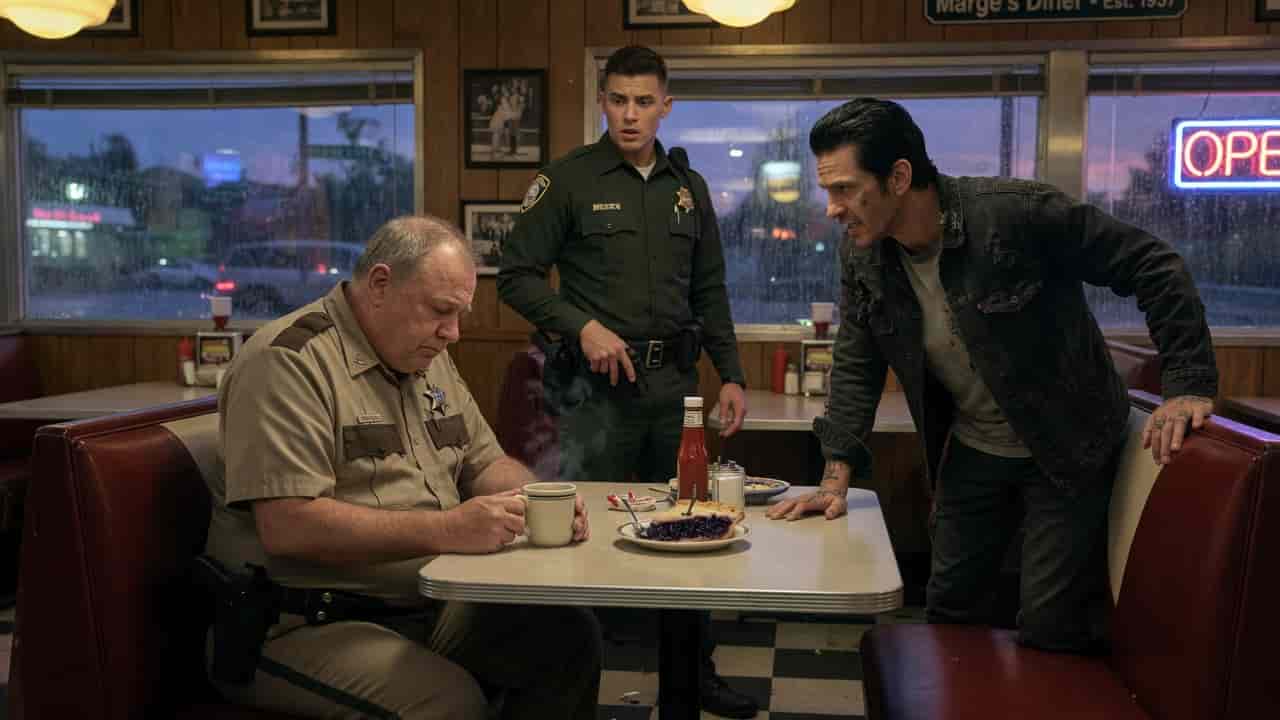
“Five minutes, Dale. That’s all it took for her to stop screaming.”
The diner went so quiet you could hear the hum of the refrigerator in the back. I sat there, my hands shaking around a coffee mug that had gone cold twenty minutes ago. I could feel every eye in the room on us—especially my new Deputy, a kid who still thinks the uniform is a shield.
Ray leaned over the table, smelling like cheap tobacco and the five years he’d just finished serving. He wasn’t just talking to me; he was performing for the room. He wanted everyone to remember the night I arrived at his house five minutes too late. The night the woman I swore to protect was taken from us.
“You still wear that badge like it means something?” he asked, his voice dripping with enough contempt to make my skin crawl.
I looked at my Deputy, Miller. The kid looked like he wanted to help, but he was paralyzed. He was seeing his hero, the legendary Sheriff Dale, being dismantled by a man who should have been afraid of me. But Ray knew the truth. He knew that for five years, I’d been paying for Clara’s headstone in secret because I couldn’t live with the fact that I’d failed her.
He reached out, his finger inches from my badge, and I realized he wasn’t just back for his things. He was back to make sure I never spent a single day of my retirement in peace.
Chapter 1
The badge felt heavier than it had thirty years ago. It wasn’t the metal; it was the way it seemed to pull at the fabric of Dale’s shirt, dragging the whole uniform down toward the floor. He stood in front of the cracked mirror in the station restroom, adjusting the silver pin for the fourth time that morning. In forty-eight hours, he’d be handing it over to Miller.
Miller was twenty-eight, smelled of expensive laundry detergent and ambition, and still believed that “the law” was something you could find in a book. To Miller, a crime was a series of checkboxes. To Dale, a crime was a stain that never quite came out of the carpet, no matter how much you scrubbed.
“Sheriff? We got a call from the groundskeeper over at St. Jude’s,” Miller’s voice echoed off the tile. He sounded crisp. Professional. Like a man who hadn’t yet learned that the most important parts of the job happened in the silences.
Dale sighed, smoothing his hand over his thinning grey hair. “What’s Old Man Henderson complaining about now? Someone leave a gate open?”
“No, sir,” Miller said, appearing in the doorway. He was wearing his tactical vest, looking more like a soldier than a county deputy. “He says there’s a dog. Won’t let him near the North section. Says it’s digging.”
Dale’s hand paused on the door handle. The North section. That was where the newer plots were. That was where Clara was.
“I’ll handle it,” Dale said.
“I can go, Sheriff. You’ve got the retirement luncheon at the Rotary—”
“I said I’ll handle it, Miller. Go finish the inventory on the evidence locker. I don’t want to leave a mess for you on Monday.”
The drive to the cemetery was short, but Dale took the long way, circling the outskirts of town where the cornfields were turning brown and brittle under the October sun. He rolled the window down, letting the cold air hit his face. He needed the bite of it. He needed to feel something other than the dull, rhythmic thud of his own heart, which felt like it was counting down the seconds until he was nobody.
St. Jude’s was a lonely place, tucked into a valley where the fog tended to linger until noon. Henderson was waiting by the main gate, leaning on a rusted shovel.
“About time, Dale,” the old man spat, his breath smelling of peppermint and decay. “Thing’s been there since dawn. Scared the hell out of a widow coming to see her husband. It’s a big one. Black-and-tan, looks like a shepherd mix, but meaner.”
Dale didn’t say anything. He drove the cruiser up the gravel path, the tires crunching like bone. He saw the dog before he saw the grave.
It was sitting perfectly still, a dark silhouette against the grey granite. As Dale got closer, he realized Henderson was wrong. The dog wasn’t mean. It was vibrating. Its whole body was shaking with a tension so profound it looked like it might shatter.
Dale stepped out of the car, leaving the door open. The dog didn’t growl. It didn’t bark. It just turned its head, its amber eyes locking onto Dale’s with a look of recognition that made the Sheriff’s knees feel weak.
“Hey, boy,” Dale whispered.
The dog stood up. It was thin, its ribs visible through a matted coat, but its frame was powerful. It walked to the edge of a fresh patch of dirt—the spot Dale had been paying for in fifty-dollar increments for five years. Clara’s spot.
There was a hole, maybe six inches deep, right at the base of the headstone. The dog hadn’t been digging for a bone. It had been digging toward the voice it remembered.
“Buster?” Dale’s voice cracked.
Five years ago, Buster had been a puppy, a ball of fluff Clara had rescued from a roadside box. The night it happened—the night Dale had been five minutes late because he’d stopped to help an elderly woman change a tire on Highway 4—Buster had been there. When the paramedics finally let Dale into the house, the dog had been gone. Vanished into the woods. Some said the ex-husband, Ray, had killed it. Some said it just ran until its heart stopped.
Now, two days before Dale was set to disappear into the quiet of a porch chair, the dog was back.
Dale knelt in the grass, ignoring the dampness seeping into his trousers. He held out a hand, palm up. Buster didn’t come to him. He just looked at the hole, then back at Dale, and let out a sound—a low, melodic whine that wasn’t a cry for help. It was a witness statement.
“I know,” Dale whispered, the guilt he’d been carrying like a stone in his throat suddenly feeling twice as heavy. “I know I wasn’t there.”
He stayed there for an hour, the Sheriff of a small town and a ghost of a dog, sitting in the silence of the North section. He thought about the secret he’d kept from the town, from the department, and even from Clara’s sister. Every month, he’d go to the monument shop in the next county over and pay a little more on the granite marker. He didn’t want the county to provide a flat bronze plate. He wanted her to have something that stood up. Something that caught the light.
It was his penance. His secret rock.
The radio on his shoulder crackled, breaking the spell. “Sheriff? This is Miller. We’ve got a situation at the station. Someone’s here to see you. Says it’s personal.”
Dale looked at Buster. The dog was staring toward the road, his ears pinned back. A low, guttural growl started deep in the dog’s chest—a sound Dale had never heard an animal make. It sounded like a warning. It sounded like hate.
“Who is it, Miller?” Dale asked, though he already knew.
“A Mr. Ray Vance, sir. Says he just got processed out of state correctional this morning. He’s looking for his property.”
Dale looked at the dog. Buster’s hackles were standing up, a ridge of stiff fur along his spine. The dog knew. Even after five years, the dog knew the sound of the name, or maybe he just knew the shift in the air.
“Stay here, Buster,” Dale said, knowing the dog wouldn’t.
He got back into the cruiser, his hands gripping the steering wheel so hard the plastic groaned. He looked in the rearview mirror as he pulled away. Buster wasn’t digging anymore. He was standing in the middle of the road, watching the cruiser disappear, a silent, starving sentinel waiting for the man who had broken everything.
Dale felt a coldness in his chest that had nothing to do with the October wind. He had forty-eight hours left. He’d spent thirty years trying to keep the peace in a town that didn’t always want it, and now, at the very end, the peace was screaming.
He thought about the “property” Ray was looking for. Ray didn’t have property. He had a trail of broken glass and a woman who wasn’t coming back. But as Dale pulled into the station parking lot and saw the rusted, black pickup truck idling near the entrance, he realized Ray wasn’t there for his things. He was there for his power.
And he knew exactly where Dale was vulnerable.
Chapter 2
The station smelled of burnt coffee and the floor wax Miller insisted on using every Friday. It was too bright, too clean, and it felt entirely too small. Ray Vance was sitting in the wooden chair across from Dale’s desk, his boots tracked with mud, his presence like a smudge on a clean sheet of paper.
Miller was standing by the filing cabinet, his hand resting on his belt, looking like he was waiting for a reason to be a hero. He didn’t understand that men like Ray didn’t give you reasons. They gave you shadows.
“Sheriff,” Ray said, his voice a dry rasp. He didn’t stand up. He didn’t show respect. He just smiled, a slow, yellowed grin that didn’t reach his eyes. “You look old. Retirement treating you well already?”
Dale sat down behind his desk, the familiar creak of the leather chair offering no comfort. He didn’t look at the paperwork Miller had set out. He looked at Ray’s hands—thick, calloused, and restless.
“I’ve got two days, Ray. If you’re looking for trouble, you’ve got a very small window to find it with me,” Dale said, his voice level.
“Trouble? No, sir. I’m a reformed man. State says so. Paperwork says so.” Ray leaned forward, his denim jacket creaking. “I’m just here for what’s mine. I heard my dog was seen roaming around the old place. And I heard you’ve been taking an interest in my late wife’s arrangements.”
Dale felt the temperature in the room drop. Miller shifted his weight, his eyes darting between the two men.
“Your wife’s arrangements are none of your concern, Ray. You forfeited that right five years ago,” Dale said.
Ray’s grin widened. He turned his head slightly to look at Miller. “Hear that, Deputy? The Sheriff here thinks he can just step in and play husband because he couldn’t play cop well enough to get there in time. That’s what they say, right? Five minutes? Five minutes and maybe she’s still breathing?”
Miller’s face went pale. He looked at Dale, waiting for the explosion, for the roar of authority. But Dale just sat there, his heart hammering against his ribs like a trapped bird. The humiliation was a physical weight, a thick, oily film covering his skin.
“Ray,” Dale said, his voice barely a whisper. “Leave.”
“I’m going, I’m going. But I want my dog. I know you know where he is. I saw your cruiser tracks up at the cemetery. You think I don’t know you go up there? You think people don’t talk about the Sheriff’s little secret?” Ray stood up, his movements fluid and dangerous. He leaned over the desk, his face inches from Dale’s. Miller took a step forward, his hand tightening on his belt.
“The dog belongs to the county now, Ray. It’s a stray,” Dale said, his eyes locked on Ray’s.
“Nothing belongs to the county that I paid for, Dale. I’ll find him. And when I do, I’m taking him back. Just like I’m gonna take back everything else this town thinks it took from me.”
Ray turned to Miller, giving him a mocking salute. “Good luck with this one, kid. He’s a hollowed-out tree. One good wind and he’s down.”
Ray walked out, the heavy glass door swinging shut behind him with a thud that echoed through the station.
Silence followed. It was the kind of silence that had teeth. Miller didn’t move for a long time. Finally, he let out a breath and turned to Dale.
“Sheriff… what was he talking about? Five minutes?”
Dale didn’t answer. He opened his desk drawer and pulled out a stack of files that had nothing to do with Ray Vance. He needed to work. He needed to disappear into the mundane tasks of a dying career.
“It’s an old story, Miller. Not worth the breath.”
“He was humiliating you, sir. In your own station. I should have—”
“You should have what? Arrested him for being a prick? That’s not how it works.” Dale looked up, his eyes hard. “Go get the cruiser cleaned. I want it spotless for the parade tomorrow.”
“But the dog—”
“I’ll take care of the dog.”
Dale waited until Miller left before he let his head drop into his hands. The room felt like it was closing in. He could still smell Ray—the scent of prison soap and malice. He thought about the five minutes. He thought about it every night. The woman on the side of the road, crying because her husband’s ashes were in an urn in the backseat of the car he’d just crashed. He’d stayed to comfort her. He’d stayed to wait for the tow truck. He’d thought he had time.
He’d been the Sheriff for twenty-five years at that point. He’d seen a thousand domestic calls. Most of them ended in shouting and a night in the tank. He didn’t know Ray had a knife. He didn’t know Clara had finally told him she was leaving.
He drove back to the cemetery as the sun was dipping below the horizon, casting long, bloody shadows across the graves. Buster was still there, curled up in the hole he’d dug. He didn’t move when Dale approached.
“Come on, boy,” Dale said, opening the back door of his personal truck. “You can’t stay here. He’s looking for you.”
Buster looked at the grave, then at Dale. He didn’t move.
“He’ll kill you, Buster. You know he will. He’ll do it just to hurt me.”
The dog seemed to understand the gravity in Dale’s voice. He stood up slowly, his joints stiff, and walked toward the truck. He paused at the door, looking back one last time at the granite stone that caught the last of the light. Then, he hopped into the backseat and lay down, resting his head on his paws.
Dale drove home in the dark. He lived in a small house at the end of a gravel road, a place he’d shared with a wife who had died of cancer ten years ago. It was a house of ghosts, but it was safe. Or at least, he’d thought it was.
As he pulled into the driveway, he saw the tire tracks in the mud—wide, aggressive treads that didn’t belong to his truck. Someone had been there. Someone had circled the house and waited.
He let Buster into the house. The dog immediately went to the corner of the kitchen and sat, his eyes fixed on the front door. He didn’t sniff around. He didn’t look for food. He just waited.
Dale sat at the kitchen table, his service weapon lying on the wood in front of him. He thought about the moral choice he was facing. In two days, he would be a civilian. He would have no authority, no badge, no backup. He could take the dog to the shelter in the city, sixty miles away. He could give Buster a chance at a new life with a family that didn’t know the smell of blood.
Or he could keep him. He could keep the living, breathing reminder of his greatest failure. He could look into those amber eyes every morning and remember the five minutes he couldn’t get back.
He looked at Buster. The dog’s ears twitched. Somewhere far off, a truck was rumbling down the county road. Buster didn’t bark. He just let out that low, vibrating growl again.
Dale reached out and rested his hand on the dog’s head. The fur was coarse and dirty, but the skin underneath was warm.
“I’m sorry,” Dale whispered.
He wasn’t sure if he was talking to the dog, to Clara, or to himself. But as the sound of the truck faded into the distance, Dale knew one thing for certain: Ray Vance wasn’t done. And the next forty-eight hours weren’t going to be a celebration. They were going to be a reckoning.
Chapter 3
Saturday morning arrived with a thin, sickly light that did little to warm the frost on the grass. Dale woke up on the sofa, his hand still resting on the grip of his Holster. Buster hadn’t moved from the front door. The dog was a statue of vigilance, his eyes bloodshot but open.
“Let’s go, boy,” Dale muttered, his back popping as he stood.
The town was gearing up for the Founders’ Day Parade, which was also serving as Dale’s official retirement ceremony. There would be a flatbed trailer with a bale of hay for the high school band, a few vintage tractors, and Dale in the lead cruiser, waving at people he’d arrested, helped, or ignored for three decades.
He didn’t want to go. He wanted to take Buster and drive until the cornfields turned into mountains. But a Sheriff didn’t just leave. He was escorted out.
He stopped at Marge’s Diner for a final breakfast. It was a tradition. Every Saturday for thirty years, Dale had sat in the same red vinyl booth, eating two eggs over-easy and drinking coffee that tasted like battery acid.
He left Buster in the truck with the windows cracked. “Stay quiet,” he cautioned. The dog just blinked at him.
The diner was packed. The smell of bacon grease and wet wool was thick enough to chew. Marge, a woman who had been eighty for at least twenty years, set a mug in front of him without asking.
“Big day, Dale,” she said, her voice like sandpaper. “Town won’t be the same without you. That young Miller kid… he’s got shiny shoes, but I don’t trust a man who doesn’t have a crease in his face.”
“He’ll do fine, Marge. He’s just new,” Dale said, staring into his coffee.
“He’s a boy playing at a man’s game,” she countered, moving on to the next table.
Dale was halfway through his eggs when the bell over the door chimed. The room didn’t go quiet all at once; it happened in waves, starting from the tables near the entrance and washing toward the back.
Ray Vance walked in. He wasn’t wearing his denim jacket today. He was in a flannel shirt, sleeves rolled up to reveal tattoos that had faded into blue smears. He looked around the room with the casual arrogance of a man who owned the air everyone else was breathing.
He spotted Dale and headed straight for the booth. He didn’t ask to sit. He just slid into the opposite side, his knees bumping against Dale’s under the small table.
“Morning, Sheriff. Hope I’m not interrupting the Last Supper,” Ray said. He looked around at the other patrons. “Don’t mind me, folks. Just catching up with an old friend.”
Dale put his fork down. The eggs suddenly tasted like ash. “What do you want, Ray?”
“I want to talk about property. Again. I went by your place this morning. Nice little house. Private. A bit lonely, though. I noticed some tracks in the mud. Looked like dog paws. Big ones.”
Dale felt the eyes of the room on him. Old Man Henderson was two tables over, his jaw hanging open. Mrs. Gable, who ran the library, was clutching her purse to her chest.
“I told you, Ray. The dog is county business,” Dale said, his voice low and dangerous.
Ray laughed, a sharp, barking sound. He leaned forward, his elbows on the table, invading Dale’s space. “County business? Since when does the Sheriff take county business home to sleep on his rug? You’re losing it, Dale. You’re so desperate to fix what you broke that you’re kidnapping an animal.”
He lowered his voice, but in the silence of the diner, it carried like a gunshot. “Did you tell them? Did you tell these people why you’re so attached to that dog? Because it’s the only thing that saw what happened? The only thing that heard her begging for you while you were out playing Good Samaritan on the highway?”
“That’s enough,” Dale said, his hand tightening into a fist on the table.
“Is it? I don’t think it is. I think the town should know that their hero is a fraud. That he’s been paying for a headstone with blood money because he knows he’s responsible. Five minutes, Dale. If you hadn’t stopped for that flat tire, Clara would be making me breakfast right now instead of rotting in the North section.”
The humiliation was a physical blow. Dale felt the blood rush to his face, a heat that made his vision swim. He looked at the people around him—people he had protected, people whose secrets he had kept. They weren’t looking at Ray with disgust. They were looking at Dale with pity. And pity was worse than hate. It was the sound of his authority evaporating.
“You’re a murderer, Ray. That’s the only truth in this room,” Dale said, but even to his own ears, he sounded weak.
Ray sneered. He reached out and tapped the silver badge on Dale’s chest. “In forty-eight hours, you’re just a sad old man with a dog that hates him. And I’m a man with a lot of time on his hands. I’ll see you at the parade, Sheriff. I want to see you wave.”
Ray stood up, snatched a piece of toast off Dale’s plate, and walked out. The bell chimed again, a mocking little sound.
Dale didn’t look up. He couldn’t. He stared at his plate, at the yellow yolk running into the white, and felt the residue of the encounter clinging to him. He felt smaller. Older. He felt like the “hollowed-out tree” Ray had described.
He stood up, threw a ten-dollar bill on the table, and walked out without looking at Marge.
Outside, the air was cold, but it didn’t help. He got into the truck and looked at Buster. The dog was staring at the diner door, his lip curled back just enough to show the edge of a canine tooth.
“He’s right about one thing, boy,” Dale whispered. “I am a sad old man.”
He drove to the station, but he didn’t go inside. He couldn’t face Miller. He couldn’t face the clinical, by-the-book judgment he knew would be waiting in the kid’s eyes. Miller would ask why Ray wasn’t in handcuffs. He would ask why Dale allowed himself to be spoken to like that. And Dale didn’t have an answer that didn’t involve the weight of five years of regret.
He spent the afternoon in the back of the station, in the small garage where they kept the spare tires and the road flares. He sat on a stack of Michelins and cleaned his service weapon. It was a ritual he’d done a thousand times, but today, his hands were clumsy.
He thought about the parade. The high school band. The tractors. The townspeople lining the streets. He realized he couldn’t do it. He couldn’t lead that parade knowing that Ray was in the crowd, watching him, waiting for the moment the badge came off.
But he also knew that if he didn’t show up, Ray won. The town won. The guilt won.
The garage door creaked open, and Miller stepped in. He looked at Dale, then at the gun, then at the dog sitting at Dale’s feet.
“Sheriff? The Mayor’s looking for you. They’re starting to line up the floats.”
Dale didn’t look up. “Tell them I’m coming, Miller.”
“Sir… I heard what happened at the diner. Henderson came by.” Miller paused, his voice softening. “He’s just trying to get in your head, sir. He’s a convict. Nobody believes him.”
“They don’t have to believe him, Miller. They just have to see me fail to stop him. That’s how it works in a town like this. Power isn’t about the law. It’s about who has the last word.”
Dale stood up, holstering his weapon. He looked at Miller—really looked at him. The kid was a good cop. He was smart, he was fast, and he was clean. But he was about to inherit a world that was messy and gray.
“When I hand you that badge tomorrow, Miller, you remember one thing. The five minutes you miss? Those are the only ones that matter. Everything else is just paperwork.”
Dale walked past him, Buster at his heel. He didn’t go to the cruiser. He went to his truck.
“Sheriff? The parade—”
“I’m leading it in my own truck, Miller. And I’m bringing the dog.”
“The Mayor won’t like that. It’s not protocol.”
“Protocol is for the people who are staying,” Dale said, his voice hard. “I’m leaving.”
Chapter 4
The Founders’ Day Parade was a slow-motion disaster. The wind had picked up, swirling dead leaves into the air and rattling the plastic bunting draped over the storefronts. Dale sat in the cab of his truck, Buster beside him, trailing behind the high school marching band.
The band was playing a brassy, off-key version of a patriotic march, the sound bouncing off the brick walls of Main Street. Dale waved mechanically at the faces in the crowd. He saw the smiles, the hand-drawn “Thank You Sheriff” signs, the kids on their fathers’ shoulders.
But he also saw Ray.
Ray was everywhere. He was standing on the corner by the hardware store. Then he was near the post office. Then he was in front of the diner. He didn’t wave. He didn’t cheer. He just stood there, arms crossed, his eyes following the truck with a predatory focus.
Every time the truck passed him, Buster would go rigid. The dog didn’t bark—he was too smart for that—but the low growl was a constant vibration in the cab.
“Easy, boy,” Dale muttered, his hand on the gear shift.
The parade ended at the town square, where a small wooden stage had been erected. The Mayor, a man who wore his self-importance like a tailored suit, was waiting with a plaque and a commemorative watch. Miller was there, too, standing at the edge of the stage, looking uncomfortable.
Dale stepped out of the truck, leaving Buster inside with the window down just an inch. He walked toward the stage, his boots heavy on the pavement. The crowd gathered around, a sea of flannel and denim.
“And now,” the Mayor boomed into a microphone that squealed with feedback, “to honor a man who has given thirty years of his life to this county… Sheriff Dale!”
The applause was loud, but to Dale, it sounded hollow. He climbed the steps, his knees aching. He took the plaque, shook the Mayor’s hand, and turned to look at the crowd.
Ray was at the very front. He was leaning against a lamp post, a toothpick in the corner of his mouth. He was smiling.
“I’d like to say a few words,” Dale said, leaning into the microphone.
The crowd went quiet. This was the moment for the “hero” speech. The moment to talk about community and service and looking forward to the future.
“I’ve spent a lot of time in this town,” Dale began, his voice rasping. “I’ve seen the best of you, and I’ve seen the worst. I’ve made mistakes. One mistake in particular.”
He looked directly at Ray. The smile on the convict’s face flickered.
“I’ve carried a lot of secrets for this town. But the one I’ve been carrying for myself is the one that’s finally catching up.”
Suddenly, a loud, sharp crack echoed through the square. It sounded like a gunshot, but it was just a backfire from one of the vintage tractors.
The crowd gasped. Miller reached for his weapon.
But Buster—Buster didn’t just react. He exploded.
The dog had heard the sound, and in his fractured, traumatized mind, it was the sound of five years ago. He leaped from the truck window, his powerful body hitting the pavement with a thud. He didn’t go for the crowd. He went for the smell he hated. He went for Ray.
“Buster! No!” Dale shouted, dropping the plaque.
The square devolved into chaos. People screamed and scrambled backward. Ray didn’t move at first—his arrogance held him in place for a second too long. Then, seeing the hundred pounds of muscle and teeth flying toward him, he panicked. He turned to run, but he tripped over the curb.
Buster was on him in an instant. He didn’t bite—not yet—but he pinned Ray against the lamp post, his teeth bared, a terrifying, primal roar coming from his throat.
“Get him off me! Kill it! Kill the damn dog!” Ray screamed, his face twisted in genuine terror.
Miller was there in a heartbeat, his service weapon drawn and aimed at Buster’s head. “Sheriff! Call him off or I have to shoot!”
“Don’t shoot him!” Dale lunged off the stage, pushing through the crowd.
He reached the lamp post and grabbed Buster’s collar. The dog was a cord of vibrating muscle, his eyes fixed on Ray’s throat. Ray was cowering on the ground, his arms over his head, sobbing. The “prison-hard” man had vanished, replaced by a coward who had finally met something he couldn’t bully.
“Buster, heel! Heel!” Dale roared.
The dog hesitated. He looked at Dale, then at Ray, then back at Dale. Slowly, the tension began to drain out of him. He stepped back, though he didn’t stop growling.
Dale stood between the dog and the man. He looked down at Ray, who was trembling, his flannel shirt torn, his dignity scattered across the pavement like the dead leaves.
The crowd was silent. Hundreds of people had just seen the truth. They had seen Ray’s fear, and they had seen Dale’s dog—the dog they all knew belonged to a dead woman.
“He’s dangerous, Dale! That animal is a menace!” the Mayor shouted from the stage, his face red. “Miller, take the dog! Put it down!”
Miller hesitated. He looked at the dog, then at Dale. He saw the way Dale was shielding the animal. He saw the raw, naked pain in the Sheriff’s eyes.
“No,” Miller said, his voice surprisingly steady. He holstered his weapon. “The dog was provoked. Ray was trespassing on the Sheriff’s property this morning. I’ll take a statement from Mr. Vance, but the dog stays with Dale.”
Ray scrambled to his feet, his eyes darting around the crowd. He saw the contempt in their faces. He saw that the “five minutes” didn’t matter anymore. What mattered was the man he was now—a man who had just been humbled by a shadow of the past.
“This isn’t over, Dale,” Ray hissed, though his voice lacked conviction.
“It is over, Ray,” Dale said. “If I see you near my house, or the cemetery, or this dog again… I won’t need a badge to handle it. Do you understand me?”
Ray didn’t answer. He pushed through the crowd and disappeared down a side street.
Dale stood in the center of the square, holding Buster’s collar. He looked at Miller. The young man walked over, reached into his pocket, and pulled out the commemorative watch the Mayor had dropped.
“You forgot this, sir,” Miller said.
“Keep it, Miller. I don’t need to know what time it is anymore.”
Dale walked back to his truck, the crowd parting for him in a heavy, respectful silence. He felt the residue of the moment—the shock, the adrenaline, and the sudden, crushing realization that he had just chosen his path. He wasn’t retiring to a porch chair. He was retiring to a life of protecting a witness.
As he drove away from the square, he looked at the dashboard. There sat the silver badge, catching the afternoon sun. He picked it up and handed it to Miller, who was sitting in the passenger seat to help him get the truck home.
“It’s yours now,” Dale said.
“I don’t know if I’m ready, sir.”
“Nobody is. Just remember… five minutes.”
Dale looked in the rearview mirror. Buster was in the back, his head out the window, the wind whipping through his fur. For the first time in five years, the dog wasn’t growling. He was just watching the town go by, waiting for the next mile.
But as they passed the edge of town, Dale saw a flash of black metal in the trees. Ray’s truck. It wasn’t moving. It was just sitting there, waiting.
The reckoning hadn’t ended. It had just moved out of the light.
Chapter 5
The sound of the truck’s engine cutting out in his own driveway felt like a finality Dale wasn’t ready for. It was the first time in thirty years he had returned to this house without the radio on his shoulder chirping with the low-frequency static of other people’s problems. The silence of the woods, usually a comfort, felt like an accusation.
Miller didn’t get out of the truck immediately. He sat in the passenger seat, his hands resting on his knees, staring through the windshield at the darkened porch. The kid looked exhausted, the adrenaline of the parade having left him hollow and pale.
“You should go home, Miller,” Dale said, his voice gravelly. “You’ve got a big day Monday. You need the sleep.”
“I don’t think I’m going to sleep much, sir,” Miller replied, not looking at him. “I keep seeing the way Ray looked when he was on the ground. He wasn’t just scared of the dog. He looked like he was seeing a ghost.”
“He was,” Dale said. He opened the door and let Buster out. The dog hit the gravel and immediately began a perimeter check, his nose to the ground, his body low and prowling. He headed straight for the spot where Dale had seen the tire tracks earlier. He stayed there for a long time, his hackles rising, a low, rhythmic vibration coming from his chest.
“He’s still out there, isn’t he?” Miller asked, finally stepping out of the truck.
“Ray? He’s out there. He’s the kind of man who needs the last word. Especially after today. You don’t humiliate a man like that in front of a whole town and expect him to go quietly into the night. He’s got five years of prison time to make up for. In his head, he’s the hero of a story where I’m the villain who stole his life.”
Dale walked toward the porch, his boots heavy. He felt the absence of the badge on his chest like a physical wound. It was a phantom limb. He kept reaching for the radio that wasn’t there, wanting to check in, wanting to feel the tether to the station. But the tether was cut. He was just Dale now. A sixty-two-year-old man with a bad back and a dog that carried the trauma of a murder.
“Come inside, Miller. I’ll put some coffee on. You can’t drive back to town like that. You’re vibrating.”
The kitchen was cold. Dale didn’t turn on the overhead light; he just flipped on the small lamp over the stove. The yellow glow hit the worn linoleum and the stack of mail on the counter—bills, retirement brochures, a sympathy card from a cousin in Ohio that he hadn’t opened yet.
Buster came in and sat by the door, his eyes fixed on the darkness outside the window. He didn’t look for a bowl of water. He didn’t look for a place to sleep. He was on duty.
“Sit,” Dale said, gesturing to the table.
Miller sat, but he didn’t relax. He looked around the kitchen, his eyes landing on the framed photo of Dale’s late wife, Sarah, on the windowsill. “How do you do it, sir? How do you just… turn it off? One minute you’re the law, and the next, you’re just a guy in a kitchen.”
“You don’t turn it off,” Dale said, the coffee machine beginning to hiss and groan. “You just learn to live with the noise. The job isn’t the badge, Miller. It’s the things you see when you’re wearing it. Those don’t go away just because you hand the silver back to the Mayor.”
He poured two mugs of coffee and sat across from the young man. “You’re worried about Ray.”
“I’m worried about what happens when the sun goes down,” Miller admitted. “I saw his face, Sheriff. He’s going to come for the dog. Or he’s going to come for you.”
“He’ll come for both,” Dale said. “But he’s a coward at heart. He likes an unfair fight. That’s why he went after Clara. She was small, and she believed him when he said he’d changed. He won’t come through the front door. He’ll wait until he thinks I’m sleeping. He’ll wait until he thinks the ‘law’ has gone home.”
“I should stay,” Miller said, his voice firming up. “I can’t leave you here with just a dog.”
“You have to leave,” Dale countered. “If you stay, you’re making this an official matter. And if it’s an official matter, then everything that happens tonight has to go in a report. And if it goes in a report, then the truth about Clara’s headstone and my ‘five minutes’ becomes public record. I’m not doing that to her memory, Miller. I’m not letting this town turn her tragedy into a political scandal for the next election.”
Miller looked down at his coffee. “He said you were five minutes late. Was it really five minutes?”
Dale closed his eyes. He could see it. The blue lights reflecting off the wet pavement. The smell of the woman’s perfume—something floral and cheap—as she cried on his shoulder about her husband’s ashes. He’d been so patient. So kind. He’d thought he was doing the right thing. He’d even checked his watch. 8:12 PM. He’d figured the call at the Vance house was just another shouting match. Ray was a drunk, but he’d never used a weapon before.
He’d arrived at the house at 8:17 PM.
The front door was open. The silence was the first thing he’d noticed. Not even the crickets were chirping. Just the sound of the wind through the screen door. He’d found her in the kitchen. The dog was gone. Ray was gone. And the clock on the wall had been ticking, every second sounding like a hammer hitting a nail.
“It was exactly five minutes,” Dale said. “If I hadn’t stopped, I would have pulled into that driveway while he was still arguing. I would have been through that door before he reached for the knife. I spent thirty years being the right man in the right place, Miller. But for those five minutes, I was the wrong man in the wrong place. And that’s the only part people remember.”
Miller didn’t have a response for that. There was no “by the book” answer for a five-minute hole in a man’s soul. He finished his coffee in silence and stood up.
“I’ll be patrolling the county road,” Miller said. “I won’t come up the driveway, but I’ll be close. If you need anything… anything at all… you hit that siren on the porch.”
“I won’t need the siren, Miller. But I appreciate the thought.”
Dale watched from the window as the cruiser’s taillights disappeared down the gravel road. He felt a sudden, sharp pang of loneliness. It wasn’t just the house; it was the world. He was officially outside the circle.
He turned back to the kitchen and looked at Buster. The dog hadn’t moved. He was still staring at the door.
“You want to eat, boy?” Dale asked. He opened a can of expensive dog food he’d bought at the grocery store on his way to the cemetery the day before. He set it on the floor. Buster looked at it, then at Dale, and finally began to eat, but he did it quickly, his eyes never leaving the door for more than a second.
Dale spent the next few hours moving through the house, performing the small, mundane tasks of a man who knew he was being watched. He checked the locks on the windows. He drew the curtains. He checked his service weapon—a Smith & Wesson .45—and laid it on the bedside table.
But he didn’t go to bed. He sat in his armchair in the living room, the one that faced the front door, and let the darkness settle in.
Around midnight, the power went out.
It wasn’t a flicker. It wasn’t a surge. It was a clean, deliberate cut. The refrigerator stopped humming. The digital clock on the stove died. The house plunged into a blackness so thick it felt like a weight.
Buster stood up. He didn’t growl this time. He just stood there, his body a dark shape in the center of the room, his breathing shallow and fast.
Dale reached for the .45. He didn’t turn on a flashlight. He knew this house in the dark better than he knew his own face. He knew which floorboards creaked and which door frames were slightly out of alignment. He moved to the kitchen window and eased the curtain back an inch.
The moon was a sliver of white ice in the sky. It cast enough light to see the driveway. Ray’s truck wasn’t there. But there was a shadow moving near the shed—a lean, hungry shadow that didn’t belong to the woods.
Dale felt a cold, familiar clarity settle over him. This wasn’t about the law anymore. It wasn’t about retirement or parades or five minutes of regret. This was about the residue. This was about the man who thought he could break a woman and then come back to break the man who couldn’t save her.
“Buster,” Dale whispered. “Stay.”
He moved to the back door, his heart steady now. The fear was gone, replaced by a grim, professional focus. He had forty-eight hours of retirement under his belt, but the thirty years of being a hunter were still there, buried in his bones.
He stepped out onto the back porch. The air was freezing, the frost crunching under his boots. He stayed in the shadows of the eaves, his eyes scanning the tree line.
“I know you’re there, Ray,” Dale said, his voice carrying through the cold air. “I know you cut the lines. That’s a felony, by the way. Even if I don’t have the badge, Miller does. And he’s not as patient as I am.”
A laugh came from the darkness near the shed. It was a dry, rattling sound.
“Miller is five miles away, Dale. I watched him pass the intersection ten minutes ago. He’s looking for me on the road. He’s not looking for me in your backyard.”
Ray stepped out from behind the shed. He was holding something in his hand—a long, heavy crowbar. It caught the moonlight, a silver sliver of violence.
“I don’t want you, Dale. Not yet. I want the dog. I want to hear it scream the way she did. I want to see you watch it happen. I want you to feel those five minutes every day for the rest of your miserable life.”
“You’re not touching the dog, Ray. And you’re not leaving this property until the police get here.”
“Police?” Ray sneered, stepping closer. “You’re not the police. You’re just an old man in the dark. You can’t even see me, can you?”
Ray lunged. He didn’t go for Dale; he went for the back door. He wanted inside. He wanted the trauma.
But he didn’t count on Buster.
The dog hadn’t stayed. He’d heard the voice. He’d smelled the hate. He’d hit the screen door with the force of a battering ram, the mesh tearing like paper. He launched himself off the porch, a black-and-tan blur of fury.
Ray screamed as the dog hit him, the crowbar clattering to the ground. They went down in the mud, a tangle of limbs and teeth and muffled shouts.
“Buster! Off!” Dale shouted, jumping off the porch.
He reached them just as Ray managed to scramble back, his arm bleeding where Buster had caught him. The dog was standing over the crowbar, his lip curled back, his eyes glowing in the moonlight. He looked like a demon born from the very dirt he’d been digging in at the cemetery.
Ray was gasping, his face contorted in a mask of rage and pain. “I’ll kill it! I’ll kill you both!”
“Sit down, Ray,” Dale said, his .45 leveled at the man’s chest. “Sit down before I decide that retirement starts with a clean slate.”
Ray looked at the gun, then at the dog, then at Dale. He saw the look in the Sheriff’s eyes—the look of a man who had finally stopped counting the minutes and started counting the cost.
But Ray wasn’t done. He reached into his pocket, his hand moving fast. Dale tightened his finger on the trigger.
Then, a pair of headlights swept across the driveway, blinding them both.
The cruiser slid to a halt, the gravel spraying. Miller jumped out, his weapon drawn.
“Drop it! Ray Vance, get on the ground! Now!”
Ray froze. He looked at the blue and red lights reflecting off the trees. He looked at the young deputy who was finally in the right place at the right time.
The weight of the law had returned. But as Dale lowered his gun and watched Miller cuff a sobbing, bleeding Ray Vance, he didn’t feel the relief he’d expected. He looked at Buster, who was still standing guard, his body finally beginning to stop shaking.
“Is everyone okay?” Miller asked, his voice cracking with tension.
“We’re fine, Miller,” Dale said. He looked at the dog. “We’re just fine.”
He looked at his house, dark and cold, and realized that the “five minutes” would never truly be gone. But for the first time in five years, the silence didn’t feel like an accusation. It felt like a beginning.
Chapter 6
The sun rose on Monday morning with a clarity that felt like a fresh coat of paint. Dale sat on his back porch, a mug of coffee in his hand, watching the fog lift off the cornfields. Buster was lying at his feet, his head resting on Dale’s boot. The dog’s coat was still matted with mud from the night before, but he was sleeping—really sleeping—for the first time since Dale had found him.
The power had been restored an hour ago. The house was warm again. The shadows had retreated.
A car door slammed in the driveway. Dale didn’t reach for his gun. He recognized the sound of the engine—the hum of the county’s newest lead cruiser.
Miller walked around the corner of the house. He wasn’t wearing his tactical vest today. He was in his standard tan uniform, his badge polished so bright it hurt to look at. He looked like a Sheriff.
“Morning, sir,” Miller said, stopping at the edge of the porch.
“Morning, Sheriff,” Dale replied, emphasizing the title.
Miller smiled, though it was a tired one. “He’s processed. DA is looking at multiple felonies. Breaking and entering, destruction of property, assault on a peace officer—I’m counting the dog as an officer for that one—and violation of parole. He’s going back for a long time, Dale. He won’t be seeing the outside of a fence for a decade, at least.”
“Good,” Dale said. “He needs the time. Maybe he’ll finally find a version of himself that isn’t built on breaking people.”
Miller looked at Buster. “What are you going to do with him? The Mayor… he’s still making noise about the liability. Says a dog that attacks a citizen—even a convict—is a risk.”
“The Mayor can talk to my lawyer,” Dale said. “Which, as of nine o’clock this morning, is me. I’m keeping him, Miller. He’s the only one who knows the whole story. It wouldn’t be right to let him go now.”
Miller nodded. He reached into his pocket and pulled out a small, folded piece of paper. “I found this in the evidence locker while I was clearing out your old files. It was tucked into the back of the Clara Vance folder. I think you forgot it was there.”
Dale took the paper. His hands trembled slightly as he unfolded it. It wasn’t a police report. It was a handwritten note on a scrap of yellow legal pad.
Dale,
If you’re reading this, it means you finally caught up to us. I know you’re worried. I know you think you need to be everywhere at once. But you’re just one man. Don’t blame yourself for the minutes you can’t control. You’re the only person in this town who ever made me feel like I mattered. Whatever happens, remember that.
— Clara
Dale stared at the words until they blurred. He’d forgotten he’d taken that note from her kitchen table the night she died. He’d hidden it away, unable to face the forgiveness it offered. He’d spent five years punishing himself for the five minutes he’d lost, ignoring the years of protection he’d given her before that.
“She knew, sir,” Miller said quietly. “She knew you were coming. She didn’t die thinking you’d failed her. She died knowing you were the only hope she had.”
Dale folded the paper carefully and tucked it into his shirt pocket, right where the badge used to be. The weight felt different now. It didn’t pull him down. It held him together.
“Thank you, Miller. Truly.”
“I should get going,” Miller said. “I’ve got a meeting with the County Commissioners about the budget. They want to cut the overtime for the night shifts.”
“Don’t let them,” Dale advised. “The night is when the real stories happen. You tell them that from me.”
“I will, sir.” Miller turned to leave, then paused. “One more thing. The headstone… at St. Jude’s. I saw the invoice in the files. I took care of the final payment this morning. Consider it a retirement gift from the department.”
Dale couldn’t speak. He just nodded, his throat tight.
He watched the cruiser pull away, the dust settling back onto the gravel. He was alone again. But the loneliness didn’t feel like a prison anymore. It felt like a choice.
He looked down at Buster. The dog had woken up and was watching him, his amber eyes clear and steady.
“You want to go for a walk, boy?” Dale asked.
Buster stood up, his tail giving a single, tentative wag.
They didn’t go to the cemetery. They went to the woods behind the house, where the trees were thick and the air smelled of damp earth and pine. They walked for hours, moving through the shadows and the light, a man and a dog who had both survived the same storm.
Dale thought about the “five minutes” one last time. He realized that life wasn’t a series of checkboxes. It wasn’t a perfect record of being in the right place at the right time. It was a collection of residues—the things that stayed with you after the sirens stopped and the lights went out.
He had the residue of Clara’s kindness. He had the residue of Sarah’s love. He had the residue of thirty years of keeping a small, broken town from falling apart. And now, he had the residue of a dog that had waited five years to find its way home.
As the sun began to set, casting a golden glow over the hills, Dale stopped by a small creek. He sat on a fallen log and watched Buster drink from the cool water.
The badge was gone. The title was gone. The authority was gone.
But as he sat there in the quiet of the American woods, Dale realized he wasn’t a hollowed-out tree. He was a man who had finally found the peace he’d been trying to give everyone else.
He reached out and patted Buster’s head. The dog leaned into his hand, a warm, solid weight.
“We’re okay, boy,” Dale whispered. “We’re finally okay.”
The first day of retirement ended not with a parade or a plaque, but with a silent understanding between two survivors. The world was still messy. The past was still there. But the clock had finally stopped ticking.
Dale stood up, his back still aching, his knees still stiff. He started the walk back to the house, the dog at his side. He didn’t check his watch. He didn’t look for tire tracks. He just walked, one step at a time, into the rest of his life.
The residue of the job would always be there. But so would the mercy. And in the end, that was the only thing that mattered.