“Dad, please, just get in the car. Everyone is looking at us.”
Lily grabbed my arm, her grip tighter than it needed to be. She smelled like expensive coffee and the kind of impatience that comes with a high-paying job in the city. To her, I was just a problem to be managed—a fading old man who had forgotten how to exist in a grocery store.
“I’m not finished, Lily,” I said, my voice sounding like dry leaves.
“You’ve been standing at Mom’s grave for two hours talking to a stray dog. It’s not healthy. It’s not… normal.” She looked around the cemetery, her face flushing with the shame of having a father who had lost his grip.
I didn’t tell her that the fog in my head had cleared for just one second. I didn’t tell her that the scruffy, starving animal sitting ten feet away had eyes I hadn’t seen in ten years.
I looked at the dog. I pursed my lips and let out that specific, three-note whistle—the one I told Lily was a bird call I’d made up. The one I used to call her dog, Buster, before I told her he had passed away while she was away getting help.
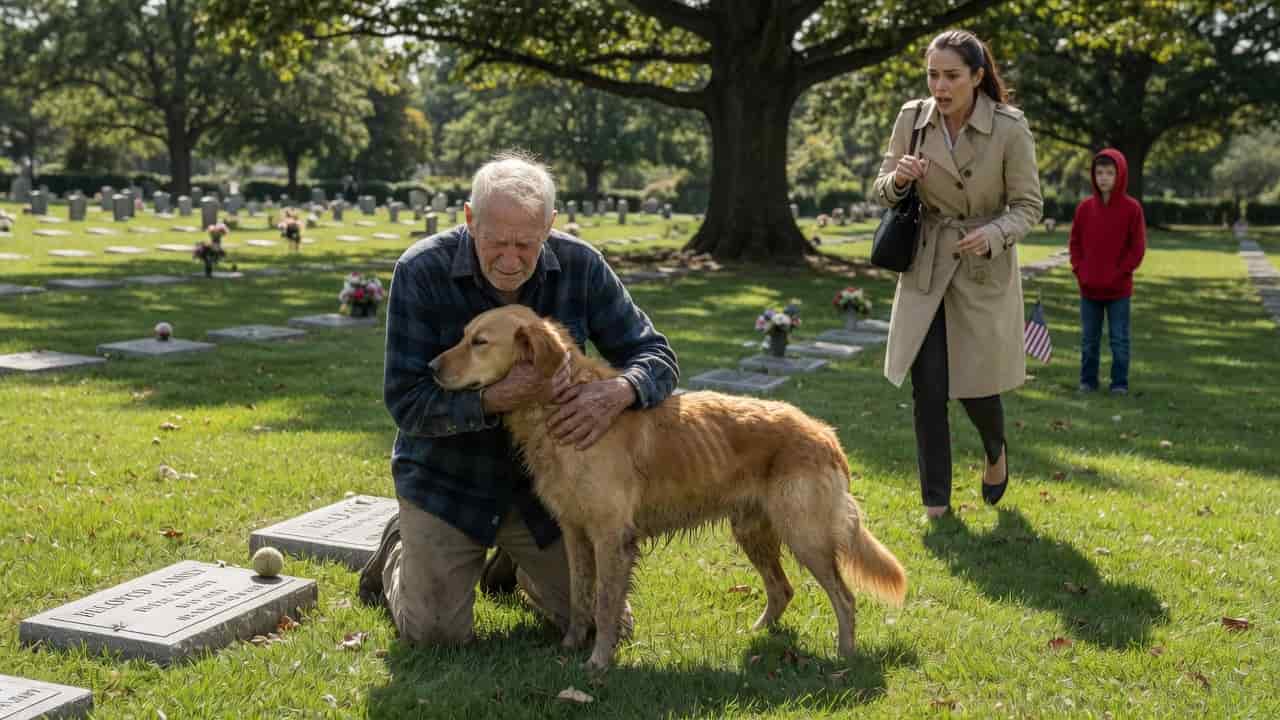
The dog didn’t just move. It shattered. It scrambled across the grass, whimpering a sound that shouldn’t come from a living thing, and practically fell into my lap.
Lily froze. Her hand dropped from my arm. The silence in the cemetery became something heavy, something that tasted like a ten-year-old lie.
“Dad?” she whispered, her voice cracking. “That whistle… why did he do that? Why did you make that sound?”
I looked at her, and for the first time in years, the memory was perfect. It was the only thing I didn’t want to remember.
Chapter 1: The Pavlovian Ghost
The sun over Oakwood Cemetery wasn’t the kind of sun that warmed you; it was the kind that exposed you. It hit the white marble of the newer headstones with a clinical glare, making Henry squint until his eyes watered. He sat on a folding canvas stool he’d brought from the trunk of his Buick, his knees popping like dry kindling every time he shifted his weight.
At seventy-five, Henry felt like a house that was being packed up one room at a time. Some days, the kitchen was gone—he’d stand in front of the stove and wonder why the blue flames were dancing. Other days, the hallway to his childhood was boarded up. But today, standing over Martha’s grave, the house felt strangely full. It was a clarity day. Those were the most dangerous ones because they came with the bills.
“I brought the petunias, Martie,” he murmured, his thumb tracing the rough fabric of his flannel shirt. “The red ones. You said the white ones looked too much like the neighbors’ laundry.”
He looked down at the plastic pot. The flowers were wilting already. He’d forgotten to water them three days ago, or maybe it was yesterday. The timeline of his life had become a deck of cards shuffled by a clumsy hand.
A movement near a large, weeping willow thirty yards away caught his eye. It wasn’t the jerky hop of a squirrel or the heavy lumbering of the groundskeeper’s mower. It was a low, cautious slink.
A dog.
It was a golden-retriever mix, or it had been once. Now, it was a walking collection of bones held together by matted, mud-colored fur. It stopped near a row of headstones, its nose twitching toward the ground. It looked ancient—its muzzle was entirely white, and its back legs trembled with a rhythmic, neurological hitch.
Henry felt a sharp, cold spike in his chest. It wasn’t a heart attack; it was a memory.
Ten years ago. A humid July morning. Lily had been gone six weeks—her first stint in the facility upstate. She’d begged him to take care of Buster. “He’s the only thing that keeps me grounded, Dad. Don’t let him forget me.”
But the dog had been a reminder of everything Henry wanted to forget. The late-night phone calls, the bail money, the way Lily’s eyes looked like glass. The dog had paced the house, whining at her bedroom door, a constant, scratching metronome of her failure.
Henry had waited until the house was silent. He’d loaded Buster into the Buick. He’d driven three towns over, past the county line, to a park where people left their unwanted things. He’d left the leash on a bench, a bag of kibble open on the grass, and he’d driven away without looking in the rearview mirror.
When Lily came home, clean and fragile as a spun-sugar ornament, he’d told her the lie he’d rehearsed. “He got out, Lil. He was chasing a rabbit. A truck… I’m so sorry. I buried him in the woods. I didn’t want you to see.”
He watched the stray in the cemetery now. The dog was sniffing a discarded flower arrangement. It moved with a familiar, lopsided gait. Henry’s heart hammered against his ribs, a frantic, rhythmic thud.
It can’t be, he thought. Ten years. A dog doesn’t live ten years on the street. Not an old dog. Not like this.
He stood up, his canvas stool tipping over. The clatter echoed in the quiet air. The dog bolted upright, its ears tattered and thin, its head cocking to the side.
Henry’s mouth was dry. He felt the fog trying to roll back in, a gray mist at the edges of his vision. He needed to know. He needed to prove to himself that his mind was finally, mercifully, breaking. If this was a hallucination, he could live with it. If it was real, he didn’t know if he could live at all.
He pursed his lips. It was a sound he hadn’t made in a decade. It was a secret code, something he’d developed when Lily was ten, training the puppy in the backyard. Three sharp notes—high, low, high—like the call of a bird that didn’t exist.
The whistle pierced the cemetery air.
The dog didn’t just look. It froze. Every muscle in its emaciated body went taut. Then, it let out a sound—not a bark, but a high-pitched, warbling scream of recognition. It began to run.
It wasn’t a graceful run. The dog’s back legs gave out every few feet, but it scrambled forward on its elbows, its tail whipping back and forth with such violence that it nearly knocked the animal over. It didn’t stop until it hit Henry’s shins.
The dog collapsed. It didn’t try to bite; it didn’t try to play. It simply leaned its entire weight against Henry’s legs and began to sob. It was a human sound, a deep, rattling intake of breath followed by a long, whistling exhale.
Henry sank to his knees. The grass was cool and damp. He reached out with trembling fingers and touched the dog’s head. Underneath the filth and the burrs, he felt the familiar bump of a cyst behind the left ear.
“Buster?” Henry whispered.
The dog looked up. Its eyes were clouded with cataracts, blue-white orbs that saw nothing but the shape of a man. It licked Henry’s hand—a rough, sandpaper tongue that tasted of salt and old age.
“Dad?”
The voice was sharp, a jagged edge cutting through the moment. Henry didn’t turn. He couldn’t. He was holding ten years of guilt in his arms, and it was heavier than he’d imagined.
Lily was standing on the path, her car idling at the cemetery gate. She looked at her watch, then at her father kneeling in the dirt with a mangy stray.
“Dad, what are you doing?” she called out, her voice vibrating with that practiced, condescending patience. “We have the appointment with Dr. Aris in twenty minutes. Get up. You’re going to ruin those pants.”
She started toward him, her heels clicking on the asphalt. She didn’t see the dog yet. She only saw the embarrassment of her father.
Henry gripped the dog’s fur. His knuckles were white. The residue of his lie was warm and breathing against his chest, and he knew, with the terrifying clarity of a dying man, that the house was no longer empty. The ghosts were home.
Chapter 2: The Social Cost of Sanity
Lily’s shadow fell over them before she reached the grave. It was a long, thin shadow that seemed to point accusingly at Henry’s knees. She stopped three feet away, her nose wrinkling as the scent of the dog hit her—a mix of wet earth, rot, and the sharp tang of long-term neglect.
“Oh my god, Dad. Get away from that thing,” she said, her voice dropping into a frantic, hushed tone. She looked around, checking the other plots to see if the young boy by the tree or the groundskeeper in the distance was watching. “It probably has rabies. Or mange. Look at it.”
Henry didn’t move. He felt the dog’s ribcage expanding and contracting against his palms. It was the fastest he’d felt his own heart beat in years. “It’s not a thing, Lily. It’s a dog.”
“It’s a health hazard,” she snapped. She reached down, grabbing Henry’s upper arm. Her fingers were cold. “Come on. We’re already late. Dr. Aris doesn’t like to wait, and I have a conference call at four. I can’t spend the afternoon at a vet because you decided to pet a coyote.”
“He knew the whistle,” Henry said.
The words felt heavy in his mouth, like he was trying to swallow stones. He looked up at his daughter. She looked so much like Martha—the same high cheekbones, the same way her brow furrowed when she was disappointed. But Martha’s disappointment had always felt like a soft rain; Lily’s felt like a hail.
“What whistle?” Lily asked, her grip tightening. She was trying to haul him up, her face red from the effort. “You’re talking nonsense again. This is why we’re going to the doctor, Dad. The confusion is getting worse.”
“The bird call,” Henry persisted. He was fighting his own body now, trying to stay anchored to the ground. The dog whimpered, its head burrowing deeper into the crook of Henry’s elbow. “The one for Buster. I did it, and he came. Look at him, Lily. Look at his ear.”
Lily’s face went through a rapid series of changes. First, annoyance. Then, a flash of genuine concern—the kind you have for a broken appliance. Finally, a cold, hard wall of denial.
“Buster is dead, Dad,” she said, her voice dropping to a whisper. “Buster has been dead for ten years. You buried him. You told me you buried him.”
She looked down at the dog then, really looked. She saw the golden fur under the graying mats. She saw the way the animal was clinging to her father with a desperate, singular focus. For a second, her eyes widened, the pupils pinpricks of sudden, sharp recognition.
Then she shook her head, a violent, jerky motion.
“No. No, that’s impossible. This is just some… some stray that wants food. You’re projecting. Dr. Aris said this would happen. You’re filling in the gaps with old memories because the new ones won’t stick.”
“He responded to the name,” Henry said, his voice gaining a sudden, terrifying strength. “Buster! Look at me!”
The dog’s head snapped up. It let out a short, sharp yip, its tail thumping against Henry’s thigh.
Lily stepped back, her hand flying to her mouth. She looked like she was about to be sick. The social pressure of the cemetery—the quiet, the dignity, the presence of the dead—suddenly felt like a vacuum, sucking the air out of her lungs.
“Stop it,” she hissed. “Just stop it. You’re making a scene.”
“He’s alive, Lily,” Henry said, tears finally spilling over and carving tracks through the dust on his cheeks. “He’s been out here. All this time. He was waiting.”
“He was waiting?” Lily’s voice rose into a shrill, hysterical laugh. “In a cemetery three towns away from where we lived? For ten years? Do you hear yourself, Dad? You’re losing it. You’re completely losing it.”
She grabbed his arm again, this time with both hands, and yanked. Henry’s stool skidded across the grass. He was forced to his feet, his balance wavering. The dog let out a mournful howl as the contact was broken, its weak legs buckling as it tried to follow.
“Get in the car,” Lily commanded. She wasn’t a daughter anymore; she was a warden. She marched him toward the Buick, her hand clamped on his bicep like a shackle.
“We can’t leave him,” Henry pleaded, looking back over his shoulder.
The dog was sitting in the middle of the path, its head low, watching them go. It didn’t try to run after them anymore. It looked as though the effort of the reunion had used up its last ounce of spirit. It was a small, brown smudge against the vast green of the graves.
“It’s a dog, Henry! A stray! I’ll call animal control from the car,” Lily lied. Henry knew it was a lie because he knew the tone. It was the same tone he’d used ten years ago.
He allowed himself to be shoved into the passenger seat. The leather was hot, smelling of stale peppermint and the plastic of his pill organizers. Lily slammed the door and circled to the driver’s side, her movements fast and jagged.
As she backed the car out, the tires crunching on the gravel, Henry watched the dog in the side-view mirror. It didn’t move. It stayed right there, a ghost made of fur and bone, standing on the spot where Henry’s wife was buried.
Lily didn’t look back. She gripped the steering wheel so hard her knuckles were yellow. “We are going to the doctor,” she said, her voice trembling. “And we are going to talk about a full-time facility. This is the end, Dad. I can’t do this anymore. I can’t have you losing your mind in public.”
Henry closed his eyes. The interior of the car felt like a coffin. He could still feel the salt of the dog’s tongue on his hand. He realized then that Lily wasn’t just angry because he was confused. She was angry because she had felt it, too. That spark of recognition. That terrifying possibility that her father wasn’t just a victim of his mind, but a gardener of his own misery.
He didn’t say another word the whole way to the clinic. He just sat there, listening to the hum of the tires, wondering if the dog would still be there when the sun went down, or if he’d finally successfully hallucinated his way into a hell he couldn’t escape.
Chapter 3: The Weight of Small Cruelties
The waiting room at Dr. Aris’s office was a study in beige. Beige walls, beige carpet, beige magazines from three years ago that featured people smiling at things Henry couldn’t identify. It was a room designed to be forgotten.
Lily sat next to him, her legs crossed, her foot tapping a frantic, erratic rhythm against the carpet. She was on her phone, her thumbs flying across the screen. She was “handling things.” That was her superpower. If a problem could be scheduled, emailed, or filed away, Lily could kill it.
Henry sat with his hands folded in his lap. He looked at his fingernails. There was dirt under them—cemetery dirt. He liked the sight of it. it was proof.
“Lily,” he said softly.
“Not now, Dad. I’m trying to move the Henderson meeting.”
“I didn’t bury him.”
The tapping foot stopped. Lily didn’t look up from her phone, but her shoulders went rigid. “We talked about this in the car. It’s a false memory. It’s called confabulation. Dr. Aris explained it last time.”
“I drove him to Miller Park,” Henry said. His voice was flat, devoid of the tremor that usually plagued him. He was back in that Buick, ten years younger, feeling the air conditioning blast his face while the dog panted in the back seat. “I left a bag of Purina. I thought… I thought if he was gone, you’d focus on the program. I thought the dog was a tether to the old life. To the people you bought from.”
Lily finally looked at him. Her face was pale, the fluorescent lights making her skin look like parchment. There was a raw, bleeding wound in her eyes that had nothing to do with her job or her schedule.
“You’re just saying this to hurt me,” she whispered. “Because I’m talking about the home. You’re trying to make me the villain so you don’t have to go.”
“I’m saying it because I can’t remember where I put my keys, Lily, but I remember the way he looked at me through the window when I drove away,” Henry said. “He didn’t bark. He just sat on that bench and watched the car. I’ve spent ten years trying to forget that look, and today, that dog gave it back to me.”
“Mr. Miller?”
A nurse stood in the doorway, holding a clipboard. She offered a professional, empty smile.
Lily stood up so fast her purse slipped off her shoulder, spilling her keys and a lipstick onto the beige carpet. She ignored them. She marched toward the exam room, leaving Henry to follow like a trailing ghost.
The exam room was cold. Dr. Aris was a man who seemed to be made of stainless steel and expensive cologne. He didn’t look at Henry; he looked at Henry’s file.
“So, Henry,” Aris said, clicking a pen. “Lily tells me we’ve had a bit of a localized episode today. Some confusion regarding a… pet?”
“He’s not confused,” Lily interrupted, her voice tight. She was sitting in the corner chair, her arms wrapped around herself as if she were freezing. “He’s having a breakdown. He’s making up these… horrible stories. About the past. He’s trying to rewrite things.”
Dr. Aris nodded, his expression one of clinical sympathy. He turned to Henry. “It’s very common, Henry. As the brain struggles to map the present, it often retreats into the past, but the past gets distorted. We call it ‘retrospective falsification.’ Your mind is trying to protect you from the reality of your decline by creating a dramatic narrative.”
Henry looked at the doctor. He looked at the degree on the wall. He looked at the stethoscope around the man’s neck. “Can the mind make a dog recognize a whistle it hasn’t heard in ten years? Can the mind give a stray a cyst behind its left ear?”
Aris paused, his pen hovering over the paper. He glanced at Lily.
“He’s obsessed with this stray he saw at the cemetery,” Lily said, her voice trembling. “He thinks it’s my dog. The one that died a decade ago. He’s… he’s lost it, Doctor. Completely.”
“Henry,” Aris said, leaning forward. “The odds of a domestic animal surviving ten years in the wild, let alone finding its way to a specific location miles away, are statistically zero. What you saw was a coincidence. Your mind, seeking comfort, latched onto that coincidence and built a bridge to a memory. It’s a defense mechanism.”
“It’s a lie,” Henry said.
“Exactly,” Aris agreed, misunderstanding him. “A lie of the mind.”
“No,” Henry said, standing up. The room felt small, the air thick with the smell of antiseptic and denial. “The lie was the one I told my daughter. I’ve been a good man, Doctor. I paid my taxes. I kept the lawn mowed. I took care of my wife until her last breath. But I did one cruel thing. One small, efficient cruelty. And I’m not going to let you and your medical words turn it into a symptom.”
He turned to Lily. She was crying now, silent, ugly tears that ruined her makeup.
“He’s out there, Lily,” Henry said. “In the rain. In the cold. He’s been out there for three thousand days because I was too proud to let you be weak. You want to put me in a home? Fine. Put me in the best one money can buy. But I am going back for that dog.”
“You’re not going anywhere,” Lily sobbed. “You can’t even drive at night, Dad! You’re dangerous!”
“Then you drive,” Henry said.
The silence that followed was absolute. Dr. Aris looked between them, his professional veneer finally cracking. He saw the residue of a decade of resentment, the way the daughter looked at the father—not with pity, but with a terrifying, budding hope.
Lily wiped her face with the back of her hand. She stood up, her movements slow and deliberate. “I’m going to go to the car,” she said to the doctor. “We’re done here.”
She didn’t wait for Henry. She walked out of the room, her head held high, her pace frantic.
Henry looked at Dr. Aris. “You’re a smart man, Doctor. But you don’t know anything about ghosts. They don’t want your medicine. They just want to be seen.”
Henry walked out, his legs heavy, his mind a flickering lightbulb. He didn’t know if he was right. He didn’t know if the dog was Buster or just a mirror held up to his own dying conscience. But as he stepped out into the afternoon sun, he knew one thing for certain: the fog wasn’t coming back today. He was going to have to see this through to the end.
Chapter 4: The Proof in the Bone
The drive back to the cemetery was different. The sun was lower now, casting long, orange fingers across the suburban landscape. The strip malls and car dealerships looked like ruins in the dying light.
Lily didn’t speak. She drove with a grim, focused intensity, her eyes fixed on the road. She didn’t turn on the radio. The only sound was the hum of the engine and the occasional, wet sniffle from the driver’s seat.
Henry watched the world go by. He felt a strange sense of peace. For the first time in years, he wasn’t afraid of forgetting. He was afraid of being forgiven. Forgiveness was a heavy thing; it required you to admit you were worth the effort.
“If it’s not him,” Lily said, her voice barely audible over the wind, “if we get there and it’s just… a dog… we’re going to the facility tomorrow. No more arguments. No more ‘one more month.’ You sign the papers.”
“I’ll sign them,” Henry said. “I’ll sign whatever you want.”
They pulled into the cemetery gates. The young boy was gone. The groundskeeper’s truck was parked near the shed. The shadows of the headstones had stretched into long, dark spears.
Lily parked the car in the same spot. She didn’t get out immediately. She sat with her hands on the wheel, her chest heaving. “I hated you for a long time, you know. When Buster died. I felt like it was my fault. Like my messiness killed him. Like if I had stayed home, he wouldn’t have run away.”
Henry looked at his daughter. He saw the child she had been, the one who cried over a broken moth wing. He’d tried to toughen her up. He’d tried to build a wall around her, and all he’d succeeded in doing was building a cage.
“I know,” Henry said. “That was the point. I wanted you to hate yourself just enough to stay clean. I didn’t realize you’d hate me, too.”
Lily opened the door. The air was cooler now, smelling of cut grass and coming rain.
They walked toward Martha’s grave. Henry’s heart was in his throat. What if the dog was gone? What if it had wandered off to die in some hedge? What if it had never been there at all, and the dirt under his fingernails was just a hallucination of labor?
They reached the plot.
The dog was still there. It was curled in a tight ball on top of the petunias Henry had brought. It didn’t look up when they approached. It looked like a pile of discarded rags.
“Oh god,” Lily whispered. She knelt down, her expensive coat dragging in the dirt. She didn’t care. She reached out a trembling hand and touched the dog’s matted flank. “He’s so cold.”
The dog stirred. It let out a weak, rattling breath and lifted its head. Its eyes found Lily.
It didn’t jump. It didn’t bark. It just stared at her with a profound, weary recognition. Then, it shifted its weight, exposing its belly.
On the inside of its right hind leg, hidden beneath a decade of grime, was a small, faded tattoo—a series of numbers from the shelter where Lily had adopted him.
Lily let out a sob that sounded like a physical break. She buried her face in the dog’s neck, her hands clutching the matted fur. “Buster. Oh, Buster. I’m so sorry. I’m so, so sorry.”
The dog licked her ear, its tail giving a single, feeble wag.
Henry stood over them, his shadow falling across the three of them. He felt a sudden, sharp pain in his head—the fog was returning. The edges of the cemetery began to blur. He forgot, for a second, why he was standing in a field of stones.
But then he looked down and saw his daughter holding a miracle.
“We have to get him to a vet,” Lily said, her voice frantic, her eyes searching Henry’s face. “He’s starving, Dad. He’s dying.”
“He waited,” Henry said, his voice distant. “He just wanted to tell you it wasn’t your fault.”
Lily stood up, lifting the dog in her arms. The animal was surprisingly light, a hollow shell of a life. She started toward the car, her pace a run, her face set with a new, terrifying purpose.
Henry followed, his steps slow and uncertain. He looked back at Martha’s headstone.
I told her, Martie, he thought. I finally told her.
But as he reached the car, he saw the look in Lily’s eyes. It wasn’t just relief. It was the residue of the truth. She looked at him, and he saw the fracture—the way she would always look at him from now on. He was the man who had saved the dog, yes. But he was also the man who had stolen ten years of its life.
The ride to the emergency vet was a blur of red lights and Lily’s voice on the phone, screaming at someone to stay open. Henry sat in the back with the dog’s head in his lap. He stroked the white muzzle, feeling the heat of the animal’s breath.
“Next 5-6,” Henry whispered to the empty air, the words a fragment of a memory he couldn’t quite place.
The fog was thick now. The kitchen was gone. The hallway was dark. But in the center of the house, there was a dog, and there was a daughter, and for the first time in a long time, the door was unlocked.
Chapter 5: The Clinical Ledger of Betrayal
The fluorescent lights of the North Valley Emergency Pet Clinic didn’t flicker, but they felt like they did. They hummed a low, industrial B-flat that vibrated in the fillings of Henry’s teeth. The air smelled of ozone, heavy-duty floor wax, and the metallic tang of fear—the kind of fear that only comes when you are waiting for a stranger in a white coat to tell you the price of your mistakes.
Lily was a whirlwind of frantic efficiency. She had the dog—Buster—wrapped in her beige trench coat, the expensive wool ruined by mud and the black grease of a decade’s worth of roadside living. She stood at the high laminate counter, her credit card already out, her voice rising in a jagged, staccato rhythm that made the young girl behind the desk flinch.
“I don’t care about the intake form! Look at him! He’s barely breathing!” Lily shouted. Her ponytail had come loose, dark strands of hair clinging to her damp cheeks.
“Ma’am, I need the history,” the girl said, her voice practiced and flat. “Is he on any medication? When was his last vet visit?”
Lily froze. She looked back at Henry, who was sitting on a plastic chair that felt too small for a man of his history. Henry’s hands were tucked into his armpits, trying to hide the tremor that had moved from his fingers to his entire upper body. The fog was thin tonight, a low-hanging mist that allowed him to see every sharp edge of the room. He saw the way the other people in the waiting room—a woman with a shivering Chihuahua, a man with a cat carrier—looked away from them. They smelled the neglect. They saw the ruin Lily was cradling.
“Ten years,” Lily whispered, her voice cracking. “His last visit was ten years ago.”
The girl at the desk paused, her pen hovering over the paper. She didn’t look up, but the silence she left in the room was a heavy, judgmental thing. She tapped a key on her computer. “And the owner’s name?”
“Me,” Lily said, her jaw tightening. “Lily Miller. But my father… he was the one…”
She didn’t finish the sentence. She couldn’t. To explain would be to invite a type of scrutiny that Lily’s carefully constructed life couldn’t handle. She turned away from the desk and walked over to Henry. She didn’t sit down. She stood over him, the dog a heavy, limp weight in her arms. Buster’s eyes were half-closed, the blue-white cataracts dull under the harsh lights.
“They’re going to think I did this,” Lily hissed, her voice a low, lethal vibration. “They’re going to think I let him rot in a field for ten years. Do you understand that, Dad? That’s what this looks like. It looks like animal cruelty.”
“I know what it looks like,” Henry said. He looked at the dog’s tail, which hung out from the bottom of the coat like a piece of frayed rope. “It looks like the truth.”
A door swung open, and a tall man in green scrubs stepped out. Dr. Vance had the tired eyes of a man who spent his nights stitching together things that had been broken by cars or neglect. He didn’t waste time with a greeting. He reached out and took the dog from Lily’s arms with a practiced, gentle strength.
“Bring him back,” Vance said to a technician. He turned to Lily and Henry. “I need one of you in the exam room. Now.”
Lily followed him, her heels clicking on the linoleum like a countdown. Henry stood up, his knees screaming, and trailed behind. He felt like he was walking into a courtroom.
The exam room was cold—brutally cold. Dr. Vance laid Buster on the stainless steel table. The dog didn’t fight. He just lay there, his ribcage moving in shallow, jerky pulses. Vance began his examination, his hands moving with a clinical, terrifying speed. He checked the gums, the eyes, the heart. He ran his fingers over the matted fur, pausing at the joints.
“He’s severely dehydrated,” Vance said, his voice a flat monotone. “Cachectic. Muscle wasting is extreme. He’s got heartworm, almost certainly. The dental rot is… well, it’s advanced. He hasn’t eaten a real meal in weeks.”
He stopped and looked at Lily, then at Henry. He didn’t ask a question, but his silence was a demand.
“He was lost,” Lily said, the lie coming out of her mouth like a reflex. “We just found him. Tonight. At the cemetery.”
Vance’s eyes flickered to Henry’s dirt-stained khakis, then back to the dog. He reached behind the dog’s left ear and felt the cyst Henry had described. He didn’t say anything about it. Instead, he picked up a pair of shears and began to cut away the matted fur around the dog’s neck.
“He’s been out a long time,” Vance said. “Years. You don’t get this kind of systemic breakdown from a few weeks in the woods. This is a decade of survival.”
“I know,” Lily whispered. She was leaning against the wall, her hands trembling so hard she had to shove them into her pockets.
“The question is why he’s still alive,” Vance said, almost to himself. He looked at Buster, who had managed to turn his head just enough to look at Henry. The dog’s tail gave a single, microscopic thump against the metal table. “Dogs don’t usually last this long on their own when they’re this old. It’s like he was holding onto something.”
“He was,” Henry said.
Lily turned on him then, her eyes bright with a sudden, sharp rage. “Shut up, Dad. Just… shut up.”
Vance looked between them, the professional mask shifting just enough to show a sliver of curiosity. “I can stabilize him for the night. IV fluids, some pain management. But we’re looking at a massive bill for a very uncertain outcome. Given his age and the level of internal damage… many people would choose to make him comfortable and say goodbye.”
“No,” Lily said. The word was a gunshot. “Do everything. I don’t care about the cost. Do everything.”
“Lily,” Henry started, his voice soft.
“I said do everything!” she screamed. The sound echoed in the small room, bouncing off the tiled walls. Dr. Vance stepped back, his expression cooling. Lily was shaking now, her face a mask of grief and fury. “I am not losing him twice! I am not letting him die because you decided to play god with my life ten years ago!”
Henry went quiet. He deserved the scream. He deserved the judgment in the doctor’s eyes. He stood there and watched as they hooked Buster up to an IV, the clear fluid dripping into the dog’s withered vein. He watched as the technician took the dog away to the “wards”—a row of metal cages in the back where the air was filled with the smell of bleach and the sounds of suffering.
Lily marched out of the exam room without looking back. Henry followed her to the hallway, where the vending machines hummed and the floor-to-ceiling windows showed the empty parking lot. Lily was pacing, her phone in her hand, her movements jerky and erratic.
“Lily, listen to me,” Henry said.
“Listen to you?” She stopped and turned, her face inches from his. He could smell the cemetery on her—the earth and the petunias. “I’ve spent ten years listening to you. I listened to you tell me he was dead. I listened to you tell me I was a failure who couldn’t be trusted with a living thing. I listened to you talk about ‘character’ and ‘responsibility’ while you knew—you knew—that my dog was out there somewhere, starving.”
“I thought it was the only way to save you,” Henry said. It sounded weak even to him.
“You didn’t save me, Dad. You just made sure that when I did get clean, I had nothing to come home to. You took the only thing that loved me without asking for a sobriety chip first.”
She looked out the window. The rain had started—a slow, miserable drizzle that turned the asphalt into a black mirror. “And now? Now I have to watch him die anyway. Only this time, I get to see exactly what ten years of your ‘mercy’ did to him. I get to see the dental rot and the heartworm. I get to see the way he looks at you like you’re his savior when you’re the one who threw him away.”
She turned back to him, her voice dropping to a whisper that cut deeper than the scream. “You’re not confused, Henry. You’re not a victim of your brain. You’re just a man who lived a long time and decided that your version of the truth was the only one that mattered. And now, you’re losing your mind, and you think that’s an excuse. It’s not. It’s just a way to avoid the bill.”
Henry felt a sharp, cold void opening up in his chest. The fog began to roll in—real fog this time. The hallway seemed to stretch, the vending machines glowing with a ghostly light. He forgot, for a split second, where he was. He looked at the woman in front of him, the one with the ruined coat and the angry eyes, and he didn’t see his daughter. He saw a stranger holding a ledger.
“I need to sit down,” he whispered.
Lily didn’t help him. She watched him stumble back to the plastic chairs in the waiting room. She watched him sink into the seat, his head falling into his hands. She stood there for a long time, the silence between them a living, breathing thing, before she finally turned and walked back toward the nurses’ station to pay for the first of a thousand nights they would never get back.
Chapter 6: The Quiet Architecture of Mercy
Two weeks later, the world had shrunk to the size of Lily’s sunroom.
It was a bright, glass-walled space at the back of her condo, overlooking a small patch of manicured lawn and a bird feeder that never seemed to have enough seed. Buster was lying on a plush orthopedic bed in the center of the room. He was still thin—you could see the ghost of his ribs when he breathed—but his fur had been shaved down to the skin, revealing a map of scars and old injuries that Lily spent her evenings rubbing with expensive salves.
He was alive. The vet had called it a “biological anomaly,” but Henry knew better. The dog wasn’t alive because of the IV fluids or the heartworm medication. He was alive because he was finally indoors. He was alive because the whistle had been answered.
Henry sat in a wicker chair near the door, a blue knitted blanket over his knees. His suitcases were packed and sitting in the hallway. They were old suitcases, the kind with the metal latches that snapped like a gunshot.
“The car will be here at ten,” Lily said. She was standing at the counter, mixing a slurry of wet dog food and crushed pills. Her movements were different now—slower, more deliberate. The frantic energy of the city had been replaced by a weary, grounded focus.
“I’m ready,” Henry said.
“You don’t have to go today, Dad. We can push it to next month. The deposit is already paid.”
Henry looked at her. She wasn’t looking at him. She was focused on the bowl, stirring the food with a silver spoon. They hadn’t talked about the cemetery since the night at the clinic. They hadn’t talked about the lie or the ten years or the three-note whistle. They had lived in a state of clinical truce, bound together by the needs of an old dog.
“I want to go,” Henry said. “The house… the house is getting too big, Lil. I keep getting lost in the pantry. I stood in front of the dryer for twenty minutes yesterday waiting for it to tell me a joke.”
Lily let out a short, dry laugh. It wasn’t a happy sound, but it was honest. She brought the bowl over to Buster and set it down. The dog didn’t rush. He pushed himself up on his front legs, his back end swaying, and began to eat with a slow, methodical rhythmic sound.
“He likes the chicken flavor best,” Lily said, sitting on the floor next to the bed. She leaned her head against the dog’s flank.
“I’m sorry about the coat,” Henry said.
Lily looked down at her leggings. “It was an old coat, Dad. I bought a new one. It’s blue. You’ll like it.”
The silence stretched out, but it wasn’t the jagged, lethal silence of the hospital. It was the silence of a house after a storm—the air was still heavy, but the wind had stopped.
“Lily,” Henry said, his voice low. “The keys. I put them in the vegetable crisper. I remembered this morning.”
Lily looked at him then. She saw the clarity in his eyes, the way the light hit the weathered planes of his face. She saw the man who had raised her, the one who had taught her how to ride a bike and how to tie a tie, and the one who had betrayed her in the name of a love he didn’t know how to handle.
“I found them, Dad. It’s okay.”
“It’s not okay,” Henry said. He leaned forward, the wicker chair creaking under his weight. “I’m going to forget your name soon. The doctor said it. It’s like a tide coming in. I can see the water moving, and I can’t stop it. But I want you to know… I want you to remember that I remembered today. I remembered the dog. I remembered the lie. I remembered that I was wrong.”
Lily’s eyes filled with tears, but she didn’t let them fall. She reached out and took Henry’s hand. His skin felt like old paper, thin and translucent.
“I know,” she whispered.
“You have him now,” Henry said, nodding toward the dog. “He’s a good dog. He was always a better person than me.”
A car horn sounded in the driveway. The transport van for Silver Oaks.
Henry stood up, his legs shaking. He didn’t want the blanket. He didn’t want the cane. He walked to the hallway and picked up his suitcases. He felt a sudden, sharp panic—a flash of “where am I?”—but he fought it back. He focused on the blue of Lily’s new coat hanging on the rack. He focused on the smell of the chicken dog food.
He walked to the front door, Lily following close behind. Buster managed to stand up, his tail giving three slow, deliberate thumps against the floor. He didn’t follow them to the door; he knew his place was in the sunroom now. He watched them with his cloudy eyes, a silent witness to the departure.
At the car, the driver—a young man with a kind face and a uniform that smelled of laundry detergent—took the suitcases and loaded them into the back.
Lily stood on the sidewalk, her arms wrapped around herself. The morning air was crisp, the sky a pale, unblemished blue.
“I’ll come by on Sunday,” she said. “I’ll bring Buster. They said they allow pets in the courtyard.”
“That would be nice,” Henry said. He looked at the van, then back at his daughter. “Lily?”
“Yeah, Dad?”
“The whistle,” he said. “Don’t forget the whistle. If he gets lost in the yard… if he gets confused… just do the bird call. He’ll find his way back. He always finds his way back.”
Lily nodded, her throat working as she swallowed. “I won’t forget.”
Henry climbed into the back seat of the van. The door slid shut with a heavy, mechanical thud. As the van pulled away, he looked out the window. He saw Lily standing in the driveway, her figure getting smaller and smaller. He saw the house he was leaving, and the life he was finally letting go of.
He leaned his head against the glass. The fog was coming now, a soft, white curtain drawing across the room of his mind. He couldn’t remember what he’d had for breakfast. He couldn’t remember the name of the man driving the car.
But as the van turned the corner, Henry pursed his lips. He didn’t make a sound, but in the silence of his own head, he heard three notes—high, low, high. A bird call for a dog that had finally come home.
The residue of the day stayed with him for a few more miles—the feeling of the salt on his hand, the weight of the suitcases, the look in Lily’s eyes when she’d said his name. It was a heavy bill, but as the world blurred into a series of green and gray shapes, Henry felt a strange, quiet lightness.
The house was empty now. The ghosts were gone. And for the first time in ten years, Henry Miller closed his eyes and wasn’t afraid of the dark.