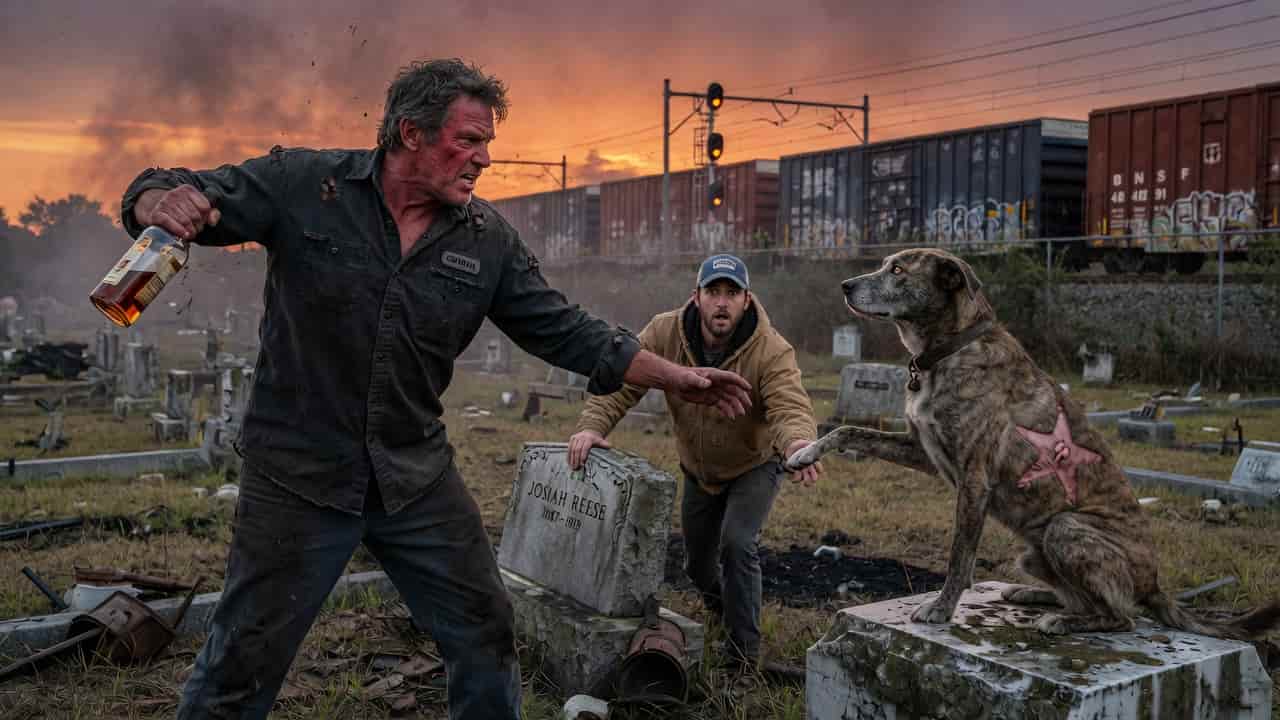
“You think a trick makes up for what happened?” Miller’s voice was a jagged edge, tearing through the quiet of the rail yard. He stood over the scruffy brindle mutt, the whiskey in his hand fueling a decade of buried rage. He wanted the animal gone. He wanted the memory of that night—the night he lost everything—to stop staring back at him with those calm, forgiving eyes.
He pulled his arm back, ready to strike, but the dog didn’t run. It didn’t growl. It just sat there on the cold stone of his father’s resting place and slowly, painfully, lifted a single paw.
“Miller, stop! Look at his side!” Elias’s voice came from the shadows, frantic and thin.
Miller froze. He looked down and saw it for the first time in the harsh moonlight—a jagged, star-shaped burn on the dog’s flank, the exact emblem of the locomotive that had changed their lives forever. The animal hadn’t been a bystander. It had been right there in the heat and the iron, trying to pull their father away while Miller had been too frozen with fear to move.
The bottle stayed in the air, but Miller’s hand began to shake. The whole town thought he was the hero who tried to save his dad, but this dog knew the truth. It was the only witness to the cowardice Miller had hidden for ten years, and now it was offering him a hand… or a paw.
The silence in the cemetery was heavy with the truth. Miller looked from the star-shaped scar to the raised paw, and for the first time since the accident, the anger wasn’t enough to keep the ghosts away.
Chapter 1: The Weight of the Iron
The 4:02 freight didn’t just pass through Oakhaven; it punished it. It was a three-mile-long spine of rusted steel and groaning timber that shook the glass in the windows of the trackside bungalows and sent a fine, grey silt of coal dust onto every porch in the North End. For Miller, the sound wasn’t noise. It was the rhythm of a heartbeat he’d been trying to outrun for ten years, a mechanical pulse that told him exactly how much time he’d wasted.
He stepped off the platform of the maintenance shed, his boots crunching on the oil-soaked gravel. The air smelled of creosote, diesel, and the approaching autumn—a sharp, metallic scent that always made the back of his throat itch. His hands were mapped with the permanent black grease of the yard, the kind that lived in the cuticles and the deep lines of the palms no matter how much orange-scented pumice he used at the sink.
“Easy shift, Miller?” Sully called out from the door of the breakroom. Sully was sixty, with skin like cured leather and a limp that he claimed came from a derailment in ’98, though everyone knew he’d just fallen off a barstool at the VFW.
Miller didn’t look back. He just raised a hand, a blunt gesture that served as both greeting and dismissal. He wasn’t in the mood for Sully’s brand of aimless yard-talk. He wasn’t in the mood for anything other than the pint of Four Roses tucked into his locker and the walk home that took him past the place he hated most in the world.
The cemetery sat on a rise overlooking the main switch. It was a miserable patch of land, hemmed in by a rusted chain-link fence that hummed whenever the heavy coal drags went by. The grass was never quite green, always a thirsty, burnt yellow that looked like it had been toasted by the sparks from the tracks. Miller hated the irony of it—his father, a man who had spent forty years trying to get away from the rail yard, was now spending eternity ten yards from the high iron.
He took the shortcut through the hole in the fence, the one he’d cut himself three years ago. He told himself it was to save time. In reality, it was because he couldn’t stand the sight of the main gate, with its plastic flowers and sentimental plaques.
He reached the headstone—a simple block of grey granite that read THOMAS MILLER: A STEWARD OF THE LINE.
And there, sitting exactly where it had sat every afternoon for the last two weeks, was the dog.
It was a brindle mutt, scruffy and lean, with ears that couldn’t decide whether to stand up or flop over. It was covered in the same grey dust that coated the headstones. When Miller approached, the dog didn’t bark or bolt. It just turned its head, watching him with eyes that were a strange, liquid amber.
“Still here, huh?” Miller muttered, his voice gravelly from a day of shouting over engine noise. “You’re a persistent little bastard, I’ll give you that.”
He sat on the edge of the headstone next to his father’s, pulling the bottle from his jacket pocket. The plastic seal snapped with a sharp crack that felt too loud in the stillness. He took a long pull, the burn of the bourbon a welcome distraction from the tightness in his chest.
The dog shifted, its tail thumping once against the dry earth. It looked at the bottle, then back at Miller.
“Don’t look at me like that,” Miller snapped. “I don’t have any scraps for you. Go find a dumpster behind the diner. Go find someone who gives a damn.”
The dog didn’t move. It just watched. Miller felt a familiar, hot prickle of irritation rising in his gut. This dog was a ghost. It had appeared out of the dark two weeks ago, a stray that seemed to have walked straight out of the woods and decided that Thomas Miller’s grave was the most comfortable bed in the county. To everyone else in town, it was a touching story—the loyal animal guarding the fallen rail-worker.
To Miller, it was a taunt.
He remembered the dog from the night of the accident. Not this dog, of course. That dog—his father’s dog, Buster—had been a golden retriever mix, a happy, useless creature that had followed his father everywhere. On the night the brakes failed on the 912, Buster had been there. Miller had seen him in the glare of the locomotive’s lights, a flash of gold against the black iron. And then the dog had vanished into the woods, leaving Miller alone with the sound of crushing metal and his own screaming.
He’d spent ten years hating that dog for running. He’d spent ten years telling himself that if the dog had stayed, if it had barked louder, if it had done something, maybe his father would have looked up a second sooner.
This new dog, this brindle stray, felt like a replacement he hadn’t asked for. It felt like the universe was trying to give him a second chance he didn’t deserve.
“Go on,” Miller said, standing up and waving the bottle at the animal. “Get. Scram.”
The dog stood up, but it didn’t leave. It walked three paces toward him and stopped, its head tilted. It looked at Miller’s right hand—the one holding the bottle—and then it did something that made the hair on Miller’s neck stand up.
It sat down and slowly lifted its right front paw.
It was a perfect, practiced “shake.” The dog sat there, its paw hovering in the air, waiting for a contact that Miller wasn’t prepared to give.
Miller’s father had spent three months teaching Buster that trick. He’d be sitting on the back porch with a beer, saying, “Come on, son, give us a hand. Be a gentleman.” And Buster would offer that same, tentative paw.
Miller’s hand began to shake. The whiskey in the bottle sloshed against the glass.
“You think you’re smart?” Miller’s voice was a low growl. “You think because you know a trick, you’re special? You’re just a stray. You’re just a piece of trash that found a place to sleep.”
He took another swallow of bourbon, larger this time. He wanted to feel the numbness, but it wouldn’t come. Instead, the memories started to leak out, the ones he usually kept buried under twelve hours of manual labor and a pint of Four Roses.
He saw his father’s face in the cab light. He heard the screech of the wheels. And he felt the cold, paralyzing weight of his own feet, rooted to the spot, unable to move while the dog—the real dog—had at least had the sense to run.
“You’re just a reminder,” Miller whispered, the rage finally bubbling over. “That’s all you are. A damn reminder of what I didn’t do.”
He stepped toward the dog, his shadow long and jagged in the twilight. He expected the animal to cower, to tuck its tail and flee. But the dog stayed. It kept its paw raised, its amber eyes locked on his, steady and unblinking.
It was an offer of peace that Miller wasn’t ready to accept. He raised the bottle, not to drink, but as a weapon, a blunt object to drive the ghost away.
“Get out of here!” he roared.
The dog finally flinched, pulling its paw back and scurrying a few yards away into the tall grass. It stopped near the fence, its silhouette blending into the rusted wire. It didn’t leave the cemetery. It just waited, watching from the safety of the shadows.
Miller sat back down on the headstone, his breath coming in ragged gasps. He looked at his father’s name, the letters filled with the grime of the yard.
“He would have liked you,” Miller said to the empty air, the words tasting like copper. “That’s why I can’t stand the sight of you.”
He finished the bottle in three long, desperate gulps and threw it against the fence. The glass didn’t break; it just thudded against the dirt and rolled into the weeds.
The 5:15 freight rumbled past, the vibration rattling Miller’s teeth. He sat there in the darkening cemetery, a man made of iron and grease, feeling the weight of a secret that was slowly crushing the life out of him. He wasn’t the hero the town thought he was. He wasn’t the man who tried to save his father.
He was the man who had watched, and the dog was the only thing in the world that seemed to know it.
Chapter 2: The Social Cost of Silence
The morning sun in Oakhaven was never bright; it was merely a dull, grey awakening that revealed the same cracks in the pavement and the same rust on the water tower. Miller woke up on his couch with a mouth that tasted like a copper penny and a headache that felt like a spike driven into his left temple.
He rolled off the cushions, his joints popping. His house was a small, two-bedroom ranch that he’d inherited after his mother died three years ago. It was a place where time had stopped. The floral wallpaper in the kitchen was peeling at the corners, and the calendar on the wall still showed November of 2021. He didn’t have the energy to change it. He didn’t have the energy for much besides the yard.
He made a pot of coffee that was strong enough to peel paint and stood by the window. Across the street, Mrs. Higgins was already in her garden. She was seventy-five, with a spine like a yardstick and a way of looking at Miller that made him feel like he was six years old and caught with his hand in the cookie jar.
He saw her stop what she was doing. She was looking at something near her porch.
Miller squinted. It was the brindle dog.
It was sitting at the edge of her driveway, watching his house. It looked worse for wear this morning—its fur was matted with burrs, and its ribs were showing a little too clearly through its coat.
Mrs. Higgins walked toward it with a bowl in her hands. The dog didn’t run. It wagged its tail, a slow, hesitant movement.
Miller felt a surge of irrational anger. He threw on his boots and stomped out onto his porch.
“Don’t feed that thing, Mrs. Higgins!” he shouted across the road. “It’s a stray. You’ll never get rid of it.”
Mrs. Higgins didn’t look up. She set the bowl down and waited for the dog to approach. “He isn’t a ‘thing,’ Miller. He’s hungry. And he seems to have better manners than some of the neighbors.”
Miller walked down his driveway, his hands shoved deep into his pockets. “He’s a nuisance. He’s been hanging around the cemetery, digging up the grass.”
“He isn’t digging,” Mrs. Higgins said, finally standing up to face him. She wiped her hands on her apron. “He’s keeping watch. I’ve seen him every night. He sits by your father’s stone until the sun comes up. He’s a good boy, Miller. He’s got eyes like a person who’s seen too much.”
“He’s a dog, Mrs. Higgins. He doesn’t have eyes like anything other than a predator looking for a handout.”
The dog looked up from the bowl, its muzzle covered in wet kibble. It looked at Miller, and for a second, the amber eyes seemed to hold a challenge. Then, it went back to eating.
“You ought to take him in,” she said quietly. “Lord knows that house of yours is too quiet. It smells like old whiskey and regret, Miller. Even I can smell it from here.”
“I don’t need a dog,” Miller snapped. “I don’t need anything.”
He turned and walked toward his truck, a beat-up F-150 that squealed every time it turned a corner. He headed for the yard, but his mind was elsewhere. He couldn’t shake the image of the dog sitting on the headstone, the way it had offered its paw like a peace treaty.
Work was a blur of heavy lifting and the constant, grinding pressure of the line. At noon, he headed to The Rusty Spike, a diner-slash-bar where the railroad workers went to complain about the foreman and the heat.
Sully was there, along with a few of the younger guys from the maintenance crew. They were huddled around a table near the back, laughing.
“Hey, Miller!” one of the younger guys, a kid named Tyler, called out. “Tell us about your new shadow. I saw the mutt following your truck this morning.”
Miller sat at the bar and signaled for a beer. “He isn’t my shadow. He’s a stray that doesn’t know when to quit.”
“The guys were saying he tried to get in the cab with you,” Sully said, leaning on the counter. “Thought maybe you’d finally found a friend who couldn’t talk back.”
“He’s a nuisance,” Miller repeated, his voice rising. “If he keeps it up, I’m calling animal control. He’s a liability.”
The room went a little quiet. The laughter died down. In a town like Oakhaven, where the railroad was the only thing that kept the lights on, loyalty was a religion. Even loyalty to a stray dog meant something.
“Seems a bit harsh, doesn’t it?” Tyler asked, his tone shifting. “The dog hasn’t done anything but sit there. It’s like he’s paying respects.”
“Respects to what?” Miller slammed his hand on the bar. “To a dead man? To a grave? That dog doesn’t know my father. He’s just an animal looking for a warm place to rot.”
“Take it easy, Miller,” Sully said, sliding the beer toward him. “Nobody’s saying you have to keep him. But you don’t have to be a prick about it.”
Miller felt the eyes of the room on him. He felt the judgment—the same judgment he’d felt for ten years. People looked at him and saw the son of a hero, the man who had tried to pull Thomas Miller off the tracks. They saw a man who had suffered a tragedy and stayed to work the same line that killed his father. They saw a survivor.
And every time they looked at him with pity or respect, Miller felt like he was suffocating. He wanted to scream the truth at them—that he had stood there, ten yards away, paralyzed by the sight of the oncoming lights. That he had watched his father’s eyes widen in the second before the impact. That the dog had done more than he had.
He finished his beer and stood up. “Keep the change, Sully. And tell the boys to mind their own business. If I see that dog in the yard again, I’m putting him in the back of a truck and dropping him off in the next county.”
He walked out, the screen door swinging shut with a violent thwack.
He didn’t go back to work. He drove. He drove out past the town limits, where the tracks followed the river and the trees were thick and dark. He stopped the truck on a gravel shoulder and sat there, his forehead resting against the steering wheel.
He could still feel the vibration of the tracks in his bones.
When he finally headed back toward town, it was late afternoon. He found himself driving past the cemetery again. He told himself it was to check on the headstone, to make sure the dog hadn’t actually dug anything up.
The dog was there. But it wasn’t alone.
A black SUV was parked near the fence, and a man was standing by the grave. He was younger than Miller, dressed in a sharp charcoal suit that looked entirely out of place in the dusty yard.
It was Elias. Miller’s brother.
Elias had left Oakhaven six years ago. He’d gone to the city, got a degree, and became something in logistics—something that didn’t involve grease or coal dust. He came back twice a year, usually for the anniversary of the accident and their mother’s birthday.
Miller pulled the truck in behind the SUV and got out.
“You’re early,” Miller said, his voice flat.
Elias turned around. He looked tired, his face thinner than it had been at Christmas. He looked at the dog, which was sitting at his feet, its tail thumping softly.
“I needed to clear my head,” Elias said. “The city is… it’s a lot right now. And I wanted to see him.” He gestured to the headstone.
The dog looked from Elias to Miller, then back again. It seemed to recognize the shared features, the way their brows furrowed in the same way.
“You’ve got a friend,” Elias said, reaching down to scratch the dog behind the ears.
“He’s not a friend,” Miller said, stepping closer. “He’s a stray. I was just telling the guys at the bar that he’s becoming a problem.”
Elias stopped scratching the dog and looked up at Miller. “A problem? Miller, look at him. He’s practically guarding the place. He wouldn’t let me get within five feet of the stone until I showed him I wasn’t a threat.”
“He’s a dog, Elias. He doesn’t have a job.”
“Maybe he does,” Elias said quietly. He stood up, brushing the dust from his trousers. “Maybe he’s doing what we couldn’t.”
Miller felt a cold spike of dread. “What’s that supposed to mean?”
“It means he’s staying,” Elias said, his voice tightening. “He’s sitting here in the dirt and the smoke, and he’s not leaving. He’s not running away to the city or hiding behind a whiskey bottle, Miller.”
“I’m not hiding,” Miller snarled. “I’m here. I’m working the same damn shift Dad worked. I’m the one who stayed.”
“You stayed,” Elias agreed, stepping into Miller’s space. “But you aren’t here. You’re just a ghost that still breathes, Miller. And everyone in town can see it.”
The dog sensed the tension. It stood up and moved between the two brothers, its hackles slightly raised. It didn’t growl, but it positioned itself firmly, its amber eyes darting between the two men.
“Look at that,” Elias said, a sad smile touching his lips. “Even he knows we’re about to break something.”
“Get him away from me,” Miller said, his voice low and dangerous. “I’m warning you, Elias. Don’t start with the therapy talk. I don’t want to hear it.”
“I’m not talking therapy. I’m talking about the truth. The truth about that night. The truth about why you hate this dog so much.”
“I hate him because he’s a nuisance!”
“No,” Elias said, his voice dropping to a whisper. “You hate him because he looks like the one who ran. And you can’t stand the idea that maybe, just maybe, he’s back to show you how to stay.”
Miller swung. It wasn’t a calculated punch, just a blind, clumsy lunge fueled by ten years of resentment. Elias ducked, and the momentum carried Miller forward. He stumbled against the fence, his hand catching on a jagged piece of wire.
The dog didn’t bark. It lunged. Not at Miller, but between them, its body a solid weight that pushed Miller back.
Miller looked down at his hand. A thin line of red was blooming across his palm, mixing with the black grease. He looked at Elias, who was standing there with his hands up, his face full of a pity that was worse than any insult.
“Go back to the city, Elias,” Miller said, his voice shaking. “Go back to your clean office and your clean life. Leave the dirt to me.”
He turned and walked back to his truck, the dog watching him every step of the way. As he pulled away, he saw Elias reach down and pet the dog again. The image burned into his mind—the brother who left, the dog that stayed, and the man who was trapped in between.
Chapter 3: The Proof in the Iron
The following three days were a descent. Miller didn’t go to the bar. He didn’t speak to Mrs. Higgins. He worked his shift, went home, and drank until the room stopped spinning. But no matter how much he drank, he couldn’t stop seeing the dog’s eyes.
On the fourth day, a storm rolled in from the west. It was a heavy, oppressive thing that turned the sky the color of a bruised plum. The rain started as a fine mist and quickly turned into a deluge that flooded the low-lying areas of the rail yard.
Miller was assigned to the night shift, clearing a blockage on the north spur. The water was knee-deep in places, slick with oil and debris. He was working with Tyler and a few other guys, their yellow rain slickers glowing under the harsh floodlights.
“Think the dog’s still at the cemetery?” Tyler shouted over the roar of the rain.
Miller didn’t answer. He was wrestling with a heavy timber that had washed onto the tracks. His muscles screamed, and his head throbbed. The world felt like it was dissolving into grey water and black iron.
“I heard Elias is staying at the motel,” Tyler continued, oblivious to Miller’s mood. “He was at the diner this morning. Asked if anyone knew where the dog came from.”
“Tell him to ask the woods,” Miller grunted, finally heaving the timber into the mud. “Or ask the devil. I don’t care.”
He stood up, wiping the rain from his face. The floodlights caught something in the distance, near the edge of the yard. A pair of eyes, glowing amber.
The dog was there. It was standing on a pile of rusted ties, its fur plastered to its body. It looked small and fragile against the massive machinery of the yard.
“There he is!” Tyler pointed. “Hey, boy! Come here!”
The dog didn’t move. It was looking at Miller.
Miller felt a sudden, sharp pang of something that wasn’t anger. It was fear. Pure, unadulterated fear. The dog shouldn’t be here. The yard was dangerous enough in the daylight, but in a storm like this, with the slick tracks and the limited visibility, it was a death trap.
“Get him out of here!” Miller yelled. “Tyler, get that dog away from the tracks!”
But before Tyler could move, the whistle of the 10:15 express echoed through the valley. It was the fast one, the one that didn’t stop, the one that tore through the yard like a bullet through paper.
The dog didn’t move. It seemed mesmerized by the oncoming light.
“Get out of there!” Miller screamed. He started running, his boots splashing through the oily water. He didn’t think about his father. He didn’t think about the night ten years ago. He just saw the brindle fur and the amber eyes.
He lunged toward the pile of ties, his hands reaching out. He grabbed the dog by the scruff of its neck and hauled it back just as the express roared past. The wind from the train was a physical blow, nearly knocking Miller off his feet. The ground shook with a violence that felt like the world was ending.
He collapsed into the mud, clutching the dog to his chest. The animal was shaking, its heart beating like a trapped bird against his ribs.
“You idiot,” Miller whispered into the rain. “You absolute idiot.”
He felt something strange on the dog’s side. A texture that wasn’t fur. He pulled back, his hand shaking as he wiped away the mud and water from the dog’s flank.
One of the yard lights swung around, illuminating the animal.
There, on the dog’s right side, was a jagged, hairless scar. It was silver against the dark skin, a raised welt that had healed long ago. It wasn’t just a random injury. It was a perfect, five-pointed star—the exact shape of the iron emblem that sat on the front of the old steam locomotives, the same emblem that had been on the 912.
Miller’s breath hitched. He knew that mark.
On the night of the accident, a piece of the locomotive’s cowcatcher had sheared off. It had been red-hot, a jagged shard of iron that had flown through the air like a shrapnel. Miller had found it the next day, buried in the mud near where his father had fallen.
The dog hadn’t run.
He saw it now, the memory shifting and reforming in his mind. He hadn’t seen Buster run into the woods because he was a coward. He’d seen a flash of gold because the dog had lunged at the train, trying to grab his father’s jacket, trying to pull him back. The dog had been hit by the flying iron. It had been burned, scarred, and thrown into the dark.
And Miller had stood there and watched.
He looked at the brindle mutt in his arms. This wasn’t Buster. Buster was long gone. But this dog—wherever it had come from, whatever path it had taken to get to Thomas Miller’s grave—it carried the mark of the line.
“You were there,” Miller whispered, his voice breaking. “Not you. But you.”
The dog looked at him, and for the first time, it didn’t offer a paw. It leaned its head against Miller’s shoulder, a heavy, wet weight that felt like the first honest thing Miller had touched in a decade.
“Miller! You okay?” Tyler was running toward them, his flashlight beam dancing across the water.
Miller stood up, the dog in his arms. He didn’t care about the grease or the mud. He didn’t care about the guys watching.
“I’m fine,” Miller said, his voice steadying. “I’m taking him home.”
He walked past Tyler, past the maintenance shed, and toward his truck. He put the dog in the passenger seat and climbed in. The interior of the truck smelled like wet dog and old smoke, but for the first time, the air didn’t feel heavy.
He drove home in silence, the windshield wipers slapping a steady rhythm. When he pulled into the driveway, he saw Elias’s SUV parked across the street. Mrs. Higgins’s porch light was on, casting a yellow glow over the wet pavement.
He got out of the truck and opened the passenger door. The dog hopped out, its tail wagging tentatively.
Elias came off the porch, followed by Mrs. Higgins. They stopped at the edge of the driveway, watching as Miller walked toward his house with the dog at his heel.
“Miller?” Elias asked, his voice cautious.
Miller stopped. He looked at his brother, then at the dog. He reached down and ran his hand over the star-shaped scar on the animal’s side.
“He’s staying,” Miller said.
Elias looked at the scar, his eyes widening. He walked closer, his hand trembling as he touched the mark. “Is that…?”
“The 912,” Miller said. “He carries the iron, Elias. Just like we do.”
The two brothers stood there in the rain, the dog between them. The silence wasn’t deafening; it was full of the sound of the world continuing. The 11:00 freight whistled in the distance, a long, mournful sound that echoed through the valley.
“Come on,” Miller said to the dog. “Let’s get you inside.”
He walked onto the porch and opened the door. The dog hesitated for a second, looking back at the cemetery on the hill, then it turned and followed Miller into the house.
Chapter 4: The Ghost in the Glass
The house felt different with the dog inside. The quiet wasn’t as sharp, and the shadows didn’t seem quite as long. Miller found an old wool blanket in the hall closet and spread it out by the radiator in the kitchen. The dog curled up immediately, its breath hitching in its sleep as it dreamt of whatever dogs dream of.
Miller sat at the kitchen table, a single lamp casting a pool of light over the peeling linoleum. He didn’t reach for the whiskey. Instead, he watched the dog.
He thought about his father’s hands—rough, calloused, always smelling of tobacco and engine oil. He remembered the way those hands had looked in the cab light, reaching for the brake, the desperation in the movement.
He’d spent ten years convincing himself that his father’s death was a failure of the machine, a failure of the dog, a failure of the world. He’d built a wall of rage to keep the truth out. But the truth was simple, and it was sitting on his kitchen floor.
His father had died because he’d stayed to try and save the line. The dog had stayed to try and save his father. And Miller had stayed because he didn’t know how to do anything else.
There was a knock at the door. Low and hesitant.
Miller stood up, his joints aching. He opened the door to find Elias standing on the porch. He was holding a cardboard box.
“Mrs. Higgins had some old towels,” Elias said. “And I stopped at the 24-hour place. Got some decent food. Not the cheap stuff.”
Miller stepped aside, letting his brother in. Elias walked into the kitchen and stopped, looking at the dog.
“He looks smaller in the light,” Elias said quietly.
“Most things do,” Miller replied. He sat back down at the table. “You want coffee? It’s probably old enough to vote, but it’s hot.”
“No, thanks.” Elias set the box on the counter and sat across from Miller. He looked at the calendar on the wall, then back at his brother. “How long has it been since you really talked to anyone, Miller? Not just yelling about the yard or the weather.”
“I talk to Sully. I talk to the guys.”
“That’s not talking. That’s just making noise so people don’t notice you’re gone.”
Miller looked at the dog. “I saw him at the tracks tonight. He almost got hit by the express.”
Elias winced. “Is he okay?”
“He’s fine. I got to him. But Elias… when I grabbed him, I felt it. The scar. It’s not just a burn. It’s the emblem. The five-pointed star.”
Elias leaned forward, his face pale in the lamplight. “You think he’s… you think he’s connected to that night? Really?”
“I don’t know how,” Miller said, his voice dropping. “I don’t know why he’s here. But he sits on Dad’s grave like he’s waiting for an apology. And tonight, for the first time, I felt like I was the one who owed it.”
Elias was silent for a long moment. He reached out and touched the edge of the kitchen table, his fingers tracing a deep scratch in the wood. “We both do, Miller. I left because I couldn’t stand the sight of the tracks. I left you here to carry all of it. I thought if I went far enough away, the sound of the 4:02 would stop following me.”
“Did it?”
“No,” Elias said, a bitter laugh escaping him. “It just got quieter. But every time I closed my eyes, I saw you standing there on the platform, covered in grease, looking like you were waiting for a train that was never going to come.”
Miller felt a lump in his throat that he couldn’t swallow. “I thought I was the only one who remembered the golden flash. The dog running.”
“I didn’t see him run,” Elias said. “I was already in the truck. I only heard the sound. But I remember you telling me. You said the dog was a coward. You said he left Dad alone.”
“I lied,” Miller whispered. The words felt like they were being torn out of his chest. “I lied to you. I lied to everyone. I saw him lunging. I saw him try. And I stayed where I was. I didn’t move an inch, Elias. I just watched him die.”
The dog stirred in his sleep, his tail thumping once against the radiator.
Elias didn’t look shocked. He didn’t look angry. He just looked at Miller with a profound, weary sadness. “We were kids, Miller. You were twenty-four. I was eighteen. Nobody expects a person to know what to do when the world falls apart in front of them.”
“Dad did,” Miller said. “He knew exactly what to do.”
“And it killed him,” Elias said firmly. “He chose the line. He always chose the line. But you… you don’t have to keep choosing it, Miller. You don’t have to be the martyr for a railroad that doesn’t even know your name.”
Miller stood up and walked to the window. The rain had stopped, leaving the world shimmering and dark. He could see the lights of the rail yard in the distance, a constellation of harsh, uncaring stars.
“He’s the only one who knows,” Miller said, gesturing toward the dog. “He’s the only one who saw me.”
“And he’s the only one who came back,” Elias said, standing up and joining him at the window. “He’s not here to judge you, Miller. He’s here because he’s the only other survivor.”
They stood there in the quiet of the old ranch house, two brothers tied together by a secret and a scar. The dog let out a long, contented sigh, his body finally relaxing into the warmth of the kitchen.
“I’m staying for a few more days,” Elias said. “I’ll help you fix the porch. Maybe we can finally change that calendar.”
Miller looked at his brother, then back at the dog. He felt the weight of the last ten years shifting, not disappearing, but becoming something he could finally carry without breaking.
“Yeah,” Miller said, his voice rough. “Maybe we can.”
The morning came, and for the first time in a decade, Miller didn’t wake up reaching for the bottle. He woke up to the sound of claws clicking on the linoleum and the feeling of a cold nose pressing against his hand.
He got out of bed and walked into the kitchen. The dog was waiting by the door, its tail wagging with a newfound confidence.
“Alright, alright,” Miller muttered, a small, genuine smile touching his lips. “Let’s go see the old man.”
He walked out onto the porch, the dog at his side. The air was cool and crisp, the grey silt of the coal dust washed away by the storm. He looked toward the cemetery on the hill, and for the first time, it didn’t look like a place of punishment. It just looked like home.
Miller took a deep breath, the scent of the yard still there, but no longer suffocating. He looked down at the dog, at the star-shaped scar that caught the morning light.
“Come on, boy,” he said. “Give us a hand. Be a gentleman.”
The dog sat down and slowly, proudly, lifted its paw.
Miller took it. He shook the dog’s hand, the calloused grease of his palm meeting the rough, honest pad of the animal. It was a simple gesture, a trick learned long ago, but as Miller held on, he felt the last of the iron in his heart begin to soften.
He wasn’t a hero. He wasn’t a coward. He was just a man with a dog, standing in the light of a new day, finally ready to let the ghosts go.
Chapter 5: The House of Rust and Wood
The morning after the storm didn’t bring a miracle, but it brought a different kind of silence. The hangover was there, a dull, rhythmic thumping behind Miller’s eyes, but it lacked the usual serrated edge of self-loathing. He sat at the kitchen table, watching the dog—whom he had tentatively begun to call “Iron” in the privacy of his own mind—systematically dismantle a bowl of kibble. The sound of the dog’s eating was rhythmic, a steady crunch-crunch-crunch that filled the room in a way the hum of the refrigerator never could.
Elias was already on the porch, the screech of a pry bar against ancient wood signaling the start of his promised repairs. Miller stood up, his knees popping like dry kindling. He walked to the sink and splashed cold water on his face, staring at his reflection in the spotted mirror. The man looking back looked tired, his skin the color of wet sidewalk, but the eyes were clearer than they’d been in years.
“You coming out?” Elias called through the screen door. “Or are you planning on supervising from the kitchen?”
Miller grabbed a worn pair of leather work gloves from the counter. “Keep your shirt on, college boy. Some of us actually have to work for a living.”
He stepped out onto the porch. The air was crisp, smelling of damp earth and the distant, ever-present scent of diesel. Elias had already ripped up three of the rotted floorboards, revealing the grey, cobwebbed joists beneath. The house was essentially a collection of memories held together by peeling paint and stubbornness.
“This joist is soft,” Elias said, pointing with the tip of his bar. “We’re going to need to sister it with some fresh two-by-eights. If we don’t, the whole corner is going to sag by winter.”
Miller sat on the edge of the remaining boards, feeling the weight of the house. “Dad always said he’d get to it. Every summer for twenty years, he’d sit right here and say, ‘Next week, Miller. Next week we’ll fix the rot.’”
“He never could admit when things were falling apart,” Elias muttered, wiping sweat from his brow. “He thought if he just ignored the decay, it would stop. In the house, in the yard, in himself.”
They worked in a strange, focused harmony for the next three hours. Miller found his rhythm—the precise swing of the hammer, the measured cut of the circular saw. It was a different kind of labor than the yard. In the yard, you moved things to keep the machine running. Here, you moved things to keep a home from disappearing. The dog, Iron, sat in the grass at the foot of the porch, his head moving back and forth like he was watching a tennis match. Every time Miller moved toward the saw, the dog’s ears would perk up, his amber eyes tracking Miller’s every step.
“He’s obsessed with you,” Elias noted, leaning against a post as Miller hammered in a new board.
“He’s just making sure I don’t mess it up,” Miller grunted, though he felt a warmth in his chest that had nothing to do with the sun.
Around noon, a familiar, squealing truck pulled up to the curb. It was Sully. He hopped out, his limp more pronounced than usual, and hobbled toward the porch. He was carrying a brown paper bag that smelled unmistakably of the diner’s fried chicken.
“Heard the news,” Sully said, nodding to Elias and then looking down at the dog. “So, it’s true. The beast of the North End has been tamed.”
“He’s not a beast, Sully,” Miller said, standing up and wiping his hands on his jeans. “He’s just a dog.”
“And you’re just a rail-worker,” Sully countered, a glint in his eye. “But I saw you run for that mutt last night. Tyler told the whole bar. Said you looked like you were trying to tackle the express itself.”
Miller felt the old heat rise in his neck. “Tyler talks too much.”
“Maybe. But people are talking, Miller. They like the story. The grumpiest man in the county adopts the graveyard ghost. It’s got a certain… I don’t know, poetic justice to it.” Sully handed the bag to Elias. “Thought you boys could use some fuel. And I brought a little something for the hero, too.”
He reached into his pocket and pulled out a large, dried pig’s ear. He tossed it toward the dog. Iron caught it in mid-air with a sharp snap of his jaws and retreated to the shade of a lilac bush to enjoy his prize.
Sully stayed for twenty minutes, leaning against his truck and regaling them with the latest gossip from the yard—who was getting promoted, who was getting fired, and whose wife had finally had enough of the night shift. It was the kind of aimless talk Miller usually hated, but today, it felt like a bridge. He was part of the conversation again, not just a fixture in the background.
When Sully finally left, the silence that returned was heavier. Elias sat on the new boards, his legs dangling over the edge. “He’s right, you know. People notice when the weather changes. And you’re changing, Miller.”
“I’m just fixing a porch, Elias. Don’t make it into a sermon.”
“It’s not a sermon. It’s an observation. You haven’t touched a bottle since the storm. I checked the trash.”
Miller stiffened. “I don’t need you checking my trash.”
“I’m not judging. I’m just… I’m proud of you. I know how hard it is to sit in this house with all these ghosts and not want to drown them out.”
Miller sat down next to his brother. He looked at his hands—the black grease was still there, embedded in the skin, but the shaking had stopped. “The ghosts don’t drown, Elias. They just learn how to swim. The only way to get rid of them is to give them a place to rest.”
He looked toward the cemetery. “I went up there this morning. Before you woke up. I took Iron with me.”
“And?”
“He didn’t sit on the headstone today. He just sat by the fence, watching the trains. Like he was finished with the guarding part. Like he knew Dad was okay.”
Elias reached out and put a hand on Miller’s shoulder. It was a simple gesture, one they hadn’t shared in years. “Maybe he was waiting for you to be okay, too.”
They spent the rest of the afternoon finishing the floorboards. By the time the sun began to dip toward the horizon, the porch was solid. No more rot. No more sagging corners. It was a small victory, but in the context of Miller’s life, it felt monumental.
As Elias packed his tools into his SUV, he looked at the house. “It looks better. Still needs paint, and those shutters are a crime against humanity, but it’s a start.”
“I’ll get to the shutters,” Miller said. “Next week.”
Elias laughed and pulled his brother into a brief, awkward hug. “I have to head back tonight. There’s a board meeting tomorrow I can’t miss. But I’ll be back in a month. We’ll do the roof.”
“The roof is fine,” Miller lied.
“The roof is a sieve, and you know it. One month, Miller. Keep the dog fed. And keep yourself fed, too.”
Miller watched the SUV disappear down the street. The house felt suddenly large and empty, but then he felt a heavy weight lean against his thigh. He looked down. Iron was standing there, his tail wagging once, twice.
“Well,” Miller said, reaching down to scratch the dog’s ears. “It’s just us. You want to go for a walk, or are you too busy being a hero?”
The dog let out a sharp, happy bark and ran toward the truck.
That night, Miller didn’t sit on the couch and wait for the darkness to take him. He sat in his father’s old armchair with a book he’d been meaning to read for five years. The dog was sprawled across his feet, a warm, breathing anchor. For the first time in a decade, Miller felt like he wasn’t waiting for a disaster. He was just living.
But the rail yard has a way of reminding you that peace is a fragile thing. Around midnight, the wind shifted, bringing the sound of the 12:15 coal drag through the open window. It was a heavy, laboring sound, the engines straining against the grade. Miller listened to the rhythm, expecting the familiar surge of anxiety. It didn’t come. Instead, he heard something else—a strange, high-pitched whistling that didn’t sound like an engine.
He stood up, the dog instantly alert. Iron moved to the window, his low growl vibrating in the quiet room.
“What is it, boy?” Miller whispered.
He looked out toward the yard. The floodlights were flickering, casting long, erratic shadows across the tracks. Something was wrong. The rhythm of the train was off—the steady thump-thump of the wheels was replaced by a chaotic, metal-on-metal screeching that set Miller’s teeth on edge.
He grabbed his jacket and his boots. He didn’t know what was happening, but he knew the sound of a failure. And in Oakhaven, a failure on the tracks usually meant blood.
“Stay here,” he told the dog, but Iron was already at the door, his amber eyes fixed on the distant lights of the yard.
“Fine,” Miller muttered, grabbing his keys. “But stay close. I’m not losing you twice.”
Chapter 6: The Final Shift
The rail yard at midnight was a landscape of stark contrasts—the blinding white of the floodlights and the impenetrable black of the shadows between the cars. The air was thick with the smell of ozone and hot metal. As Miller pulled his truck into the maintenance lot, he could see the chaos. Men were running toward the north spur, their voices lost in the roar of a venting steam line.
He hopped out, the dog trailing him like a shadow. He didn’t go to the office; he went toward the sound of the screeching. He found Tyler and a few others huddled near a massive coal hopper that had jumped the track. It was leaning at a precarious angle, its wheels dug deep into the ballast.
“What happened?” Miller shouted over the noise.
“Brake failure on the lead car,” Tyler yelled back, his face pale under his hard hat. “It slammed into the hopper and shoved it off the line. We’ve got a blocked main and a venting line on the 402. The whole yard is a tinderbox, Miller!”
Miller looked at the hopper. If it shifted another inch, it would take out the support pillars for the overhead power lines. “Where’s the foreman?”
“In the city! We’re on our own until the morning crew gets here.”
Miller felt the old instincts taking over. This wasn’t about ghosts or memories; this was about iron and physics. “Tyler, get the jacks from the shed. We need to stabilize that hopper before it goes over. And someone shut down the power on the overheads before we all get fried!”
The men scrambled to obey. For the next hour, Miller was back in his element. He was the man who knew the language of the yard. He directed the placement of the heavy hydraulic jacks, his voice steady and commanding. He didn’t think about the whiskey. He didn’t think about his father. He just focused on the task at hand.
The dog, Iron, stayed at the edge of the light. He didn’t bark, didn’t interfere. He just watched, his amber eyes reflecting the flickering floodlights. Every time Miller looked up, the dog was there, a silent witness to the work.
They had almost stabilized the hopper when the venting line on the 402 finally gave way. It was a deafening explosion of steam and scale that knocked everyone back. The yard was suddenly filled with a blinding white cloud, making it impossible to see more than two feet in any direction.
“Get back!” Miller screamed, shielding his eyes.
He heard a yelp. A sharp, pained sound that cut through the roar of the steam.
“Iron!”
Miller lunged into the cloud, his hands reaching out blindly. The steam was scalding, a wet, heavy heat that made it hard to breathe. He stumbled over a rail, his boots slick with oil.
“Iron! Where are you?”
He heard the sound of the 1:00 express. It was coming in on the adjacent track, unaware of the chaos in the yard. The whistle was a scream in the dark, getting louder with every second.
Miller saw a flash of brindle through the mist. The dog was trapped near the leaning hopper, his leg caught in a twisted piece of the fence that had been crushed by the derailment. He was pulling frantically, his eyes wide with panic as the headlight of the express began to cut through the steam.
It was the same scene. The same lights. The same roar of the oncoming machine.
Ten years ago, Miller had frozen. He had watched the gold flash and the black iron. He had been a spectator to his own tragedy.
This time, he didn’t even think.
He lunged toward the dog, his hands grabbing the twisted wire. The metal was hot, tearing at his gloves, but he didn’t feel the pain. He shoved his shoulder against the fence, using every ounce of his strength to pry the wire apart.
“Come on, boy! Move!”
The wire snapped. Iron pulled his leg free just as the express tore past, the wind from the train nearly throwing them into the leaning hopper. Miller collapsed onto the ballast, his heart hammering against his ribs, his breath coming in ragged gasps.
He felt a wet tongue against his cheek.
He opened his eyes to see the dog hovering over him, his tail wagging with a frantic, desperate energy. Iron was limping, his front paw held at an awkward angle, but he was alive.
“You’re okay,” Miller whispered, his voice cracking. “We’re okay.”
The steam began to dissipate, revealing the other men running toward them. Tyler reached them first, his face a mask of disbelief.
“Miller! My god, man, you almost went under!”
Miller sat up, leaning his back against the cold iron of a stationary car. He looked at his hands. They were shredded, the leather of his gloves melted in places, but they were steady.
“I’m fine,” Miller said, reaching out to pull the dog closer. “Get a medic. The dog’s hurt.”
The rest of the night was a blur of activity. The hopper was eventually stabilized, the tracks were cleared, and the sun began to rise over the Oakhaven valley. Miller sat on the tailgate of his truck, his hands bandaged, watching as the vet from the next town over finished wrapping Iron’s leg.
“It’s a clean break,” the vet said, patting the dog’s head. “He’ll be fine. A few weeks in a cast and he’ll be chasing squirrels again. He’s a tough one.”
Miller nodded. “Yeah. He is.”
Sully walked over, two cups of steaming coffee in his hands. He handed one to Miller and sat on the tailgate next to him. They sat in silence for a long time, watching the morning freight pull out of the yard.
“You did good, Miller,” Sully said finally. “Your dad… he would have been proud. Not just because you saved the dog. But because you moved.”
Miller looked at the dog, who was already trying to hobble around on his three good legs. “I didn’t do it for him, Sully. I did it for us.”
He drove home as the town was waking up. He saw Mrs. Higgins on her porch, her eyes widening as she saw the dog’s cast. He waved, a real wave this time, and she smiled back—a genuine, warm smile that made the morning feel even brighter.
He pulled into his driveway and looked at the house. The new porch boards were pale against the old wood, a promise of what was to come. He got out of the truck and helped Iron onto the grass.
They walked into the house together. The kitchen smelled of coffee and the faint, lingering scent of the lilac bush outside. Miller sat at the table and looked at the calendar on the wall. He stood up, grabbed a pen, and crossed out the dates leading up to today. Then, he tore the page off, revealing the current month.
He sat back down and watched the dog curl up on his blanket by the radiator. Iron looked up, his amber eyes calm and knowing. He let out a long sigh and closed his eyes, his breathing falling into a deep, peaceful rhythm.
Miller reached into his pocket and pulled out his phone. He dialed a number he hadn’t called in months.
“Elias?” Miller said when the voice answered. “Yeah, it’s me. Listen… you were right about the roof. When can you get back here?”
He listened to his brother’s surprised, happy response, a small smile playing on his lips. He looked out the window at the tracks in the distance. They were still there, a permanent part of the landscape, but they didn’t look like a prison anymore. They just looked like a way to get from one place to another.
Miller hung up the phone and leaned back in his chair. He was tired, his body ached, and his hands would carry the scars of the night forever. But as he watched the morning sun crawl across the kitchen floor, he felt a lightness he hadn’t known since he was a boy.
The ghosts were finally resting. The iron was just iron. And Miller was finally, for the first time in ten years, exactly where he was supposed to be.
He closed his eyes and listened to the sound of the 8:00 freight. It was just a train. And he was just a man with a dog, waiting for the rest of his life to begin.