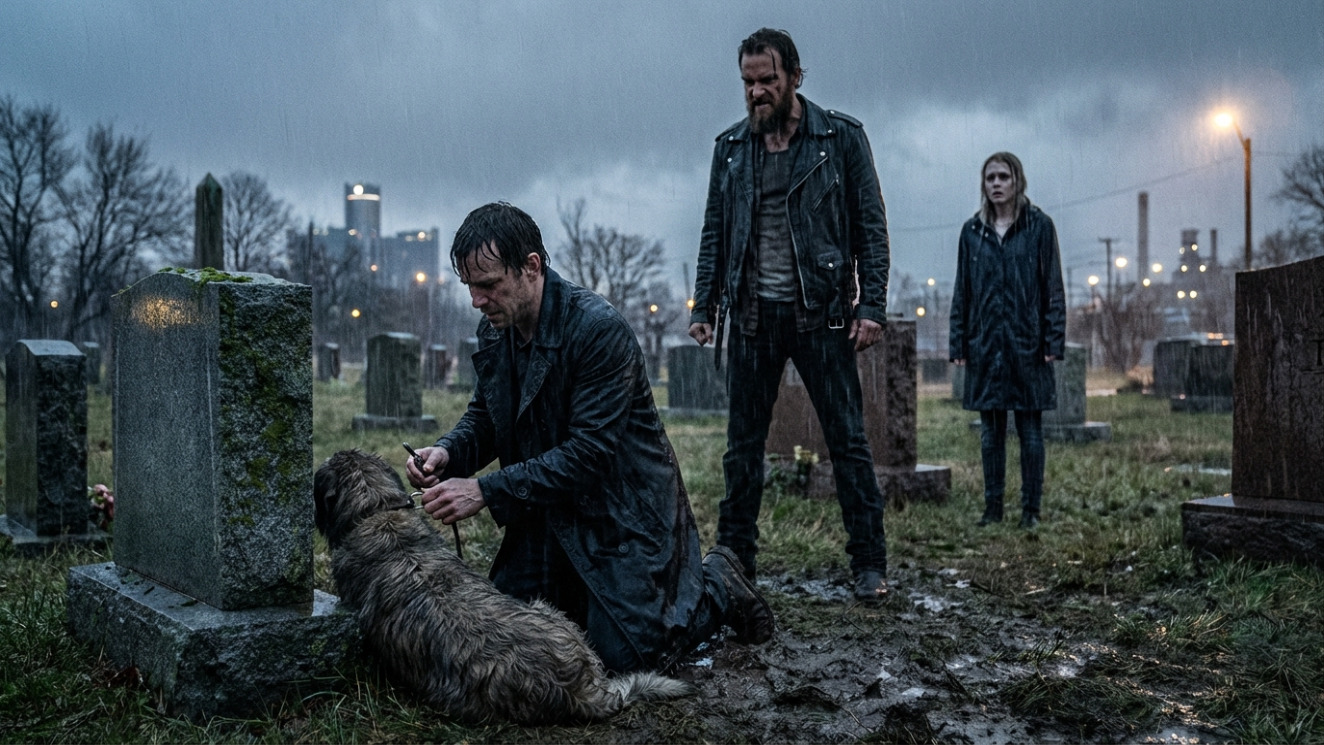
“Tell her the truth, David. Tell her you were the one who made the deal that cost her everything.”
David didn’t look up from the grave. He couldn’t. His knees were sunk into the soft, rain-soaked dirt of the cemetery, and his hands were shaking so hard he could barely feel the cold iron of his lockpicks. Beside him, the dog—the same one that had disappeared the night his partner was taken—lay curled against the headstone, a rusted key tangled in its matted fur.
Slim stood over them, his leather jacket smelling of stale cigarettes and the years he’d spent waiting for this moment. He wasn’t just here for the money; he was here to watch David break in front of the widow who still believed David was a hero.
“She doesn’t want to hear it, Slim,” David whispered, his voice cracking. “Just take what you want and leave the dog out of it.”
“I’ll leave the dog out of it when you open that collar,” Slim sneered, his shadow stretching over the headstone like a stain. “But first, I want her to know. I want her to see exactly what kind of man is kneeling at her husband’s feet.”
The widow stood ten feet away, her face a mask of mounting horror as the lies of the last five years began to crumble. She wasn’t just seeing a confrontation; she was seeing the man she trusted finally exposed by the ghost he couldn’t outrun.
CHAPTER 1: The Weight of Brass
The shop smelled of graphite, WD-40, and the slow, inevitable rot of a Detroit winter. David sat at the workbench, the magnification lamp humming like a low-grade headache. In front of him was a Sargent & Greenleaf vault lock, its brass guts spilled across a green felt mat. To anyone else, it was a puzzle. To David, it was the only thing that made sense. Pins, springs, drivers—they followed rules. If you applied the right tension, the world gave way.
The bell above the door chimed, a thin, tinny sound that cut through the hum of the heater. David didn’t look up immediately. He finished seating a master pin, the tweezers steady in his hand, before he turned.
A man stood in the doorway, framed by the gray light of Michigan Avenue. He was too tall for the space, his shoulders nearly brushing the racks of blank keys that lined the walls. He wore a black leather jacket that had seen better decades and a gray hoodie pulled low. He didn’t look like a customer. He looked like a debt that had finally come due.
“The sign says you’re the best, Dave,” the man said. His voice was like gravel being crushed under a boot. “I heard you can open anything.”
David felt the temperature in the room drop, and it wasn’t because of the draft. He knew that voice. It was the voice of a man who had spent the last five years in a concrete box, a man David had hoped would never find his way back to the surface.
“I do commercial and residential, Slim,” David said, his voice flat. He set the tweezers down. “I don’t do whatever it is you’re looking for.”
Slim stepped further into the shop, his boots clicking on the linoleum. He reached out and ran a finger along a row of high-security Medeco blanks. “I’m looking for something specific. Something we lost five years ago. Something that left with a four-legged friend of ours.”
David stood up, his hand sliding instinctively toward the heavy iron bypass tool on the edge of the bench. It wasn’t a weapon, not really, but it felt solid. “Leo’s dog is gone. It vanished that night. You know that. I searched for three months.”
“Did you?” Slim stopped at the end of the counter, leaning in. His face was gaunt, the skin stretched tight over bone, his eyes yellowed like old parchment. “Because I heard a different story. I heard a story about a locksmith who stayed behind to help his partner, only the partner ended up in the ground and the locksmith ended up with a nice, quiet shop and a clean record.”
“Leo made his choice,” David said, the words tasting like copper. “He stayed to hold the door. I ran because he told me to.”
“He told you to run with the bag, Dave. Only the bag wasn’t with you when the sirens started. It was on the dog’s harness.” Slim smiled, a slow, ugly movement that didn’t reach his eyes. “And I think you know exactly where that dog went. I think you’ve been waiting for the heat to die down so you could go whistling for it.”
David’s heart hammered against his ribs. The secret wasn’t the money—not really. The secret was the key. Leo had been a paranoid bastard. He’d sewn the key to the offshore locker into the dog’s fur, hidden beneath a thick, matted layer of undercoat that nobody would touch. And David had seen that dog, just once, two days ago, haunting the edges of the cemetery where Leo was buried.
“I don’t have the money, Slim. If I did, would I be sitting here fixing a lock for forty bucks an hour?”
Slim reached over the counter, his hand moving with a sudden, predatory speed. He grabbed David’s wrist, his grip like a vice. He squeezed until David’s fingers went numb, forcing his hand flat against the workbench. With his other hand, Slim pulled a heavy brass padlock from his pocket and slammed it onto the table, inches from David’s thumb.
“I don’t care about your forty bucks,” Slim hissed. “I care about the two million that went missing when Leo decided to be a martyr. I’m going to find that dog, Dave. And you’re going to help me. Because if you don’t, I’m going to tell the widow exactly who called the tip in that night.”
David froze. The air in the shop felt thick, suffocating. “I didn’t call anyone.”
“It doesn’t matter what you did. It matters what she believes.” Slim let go of his wrist, leaving deep, white marks in the skin. He picked up the padlock and tossed it in the air, catching it with a heavy thud. “Meet me at the cemetery at sunset. Don’t bring your tools. Just bring your whistle. And Dave? If you’re late, I’ll go to her house first.”
Slim turned and walked out, the bell chiming again, a mocking little sound. David stood there for a long time, his breath coming in ragged hitches. He looked down at his hands. They were shaking. He reached for the brass lock Slim had left on the table—a gesture of ownership, a mark of the cage he was now inside.
He walked to the back of the shop, past the rows of keys, past the heavy safe he’d never been able to fill, and sat on the floor. In the corner, under a pile of old rags, was a bowl of water and a half-empty bag of cheap kibble. He’d been feeding the stray for weeks, never quite catching it, never quite letting it go. He knew what was coming. He knew that the past didn’t stay buried, no matter how much dirt you threw on top of it.
He picked up his phone and looked at the last message from Sarah, Leo’s widow. Thanks for checking in on us, David. The kids miss their ‘Uncle Dave.’ See you Saturday?
He deleted the message. There wouldn’t be a Saturday. Not like the ones before. He stood up, grabbed his canvas jacket, and began to pack a small leather roll of picks. He didn’t do what Slim wanted. He did what he had to. But as he looked at the empty shop, David realized he wasn’t just a locksmith anymore. He was the lock, and Slim was the one with the tension wrench, slowly turning him until he snapped.
He stepped out into the cold, the Detroit wind biting at his neck. The sky was the color of a bruised lung, and far off, toward the East Side, the cemetery waited. He started his truck, the engine turning over with a reluctant groan, and drove. He didn’t look back at the shop. He knew, with a sudden, sickening clarity, that he’d never be going back inside.
CHAPTER 2: The Widow’s Debt
Sarah’s house was a small, well-kept bungalow in a neighborhood that was trying very hard not to fall apart. The porch light was on, casting a warm, deceptive glow over the peeling paint of the railing. David sat in his truck for three minutes, his hands gripped so tight on the steering wheel that his knuckles were white. He shouldn’t be here. Every second he spent near her was a second Slim could weaponize. But he needed to know if Slim had already made good on his threat.
He climbed the stairs, his boots heavy on the wood. Before he could knock, the door opened. Sarah stood there, wearing an oversized sweater that he recognized as one of Leo’s. She looked tired—the kind of tired that sleep doesn’t fix.
“David? It’s not Saturday,” she said, a small, puzzled smile touching her lips. Then she saw his face. “What happened? You look like you’ve seen a ghost.”
“Just work,” David lied, the words coming out too fast. “I was in the neighborhood. Wanted to see if you needed anything. For the kids. Or the house.”
Sarah leaned against the doorframe, her eyes searching his. She’d always been too good at reading him. That was the problem with being an “Uncle.” You became family, and family knew when you were hiding a wound.
“The sink is still leaking,” she said softly. “But I don’t think that’s why you’re here, David. You haven’t looked me in the eye since you walked up the path. Is it about Leo? Did they find something else?”
David felt a surge of guilt so sharp it was physical. He wanted to tell her. He wanted to say, Leo wasn’t a hero, Sarah. He was a thief who died because he couldn’t leave the money behind, and I’m the coward who let him. But if he told her, he’d lose the only light left in his life. He’d lose the kids. He’d lose the only version of himself that was worth a damn.
“No,” David said. “Nothing new. Just… thinking about him. The anniversary is coming up.”
“Is that why you’ve been spending so much time at the cemetery?” she asked.
David flinched. “How did you know about that?”
“Mrs. Gable from church saw your truck there. Said you were sitting by the headstone for an hour. She thought it was sweet. I thought it was… unlike you. You usually avoid that place.”
“I was looking for the dog,” David said, sticking to a partial truth. “I thought I saw him. Scraps.”
Sarah’s expression shifted, a flicker of pain crossing her face. “That dog. Leo loved that animal more than he loved most people. If Scraps is still alive, after all this time… it would be a miracle, wouldn’t it?”
“Something like that,” David said. He looked past her into the warm hallway, where Leo’s old boots still sat by the door. He felt like an intruder. He felt like a man who had stolen a life he didn’t earn.
“David,” she said, stepping onto the porch, closing the door behind her. The cold air swirled around them. “There was a man here earlier. Tall. Wearing a leather jacket. He didn’t come to the door, but he parked across the street and just… watched the house. For twenty minutes. Do you know him?”
The blood drained from David’s face. Slim. He was already circling. He wasn’t just pressuring David; he was stalking the prey.
“No,” David said, his voice trembling. “Probably just someone looking for a house number. Don’t worry about it, Sarah. Just… keep the doors locked tonight, okay? Promise me.”
“You’re scaring me, David.”
“I’m just being a locksmith,” he said, trying for a joke that died in the air. “I see bad locks every day. It makes me paranoid. I’ll come by on Sunday and fix that sink. I promise.”
He turned and practically ran back to his truck. He didn’t look back until he was two blocks away. His heart was a frantic drum in his chest. Slim was going to destroy everything. He wasn’t just looking for the money; he was looking for the leverage.
As he drove toward the cemetery, a white van pulled out from a side street and began to follow him. It wasn’t Slim’s car. It was battered, with a faded logo on the side: City of Detroit Animal Control.
David slowed down, and the van slowed down. He accelerated, and the van stayed a consistent fifty yards behind. At the next red light, David saw the driver—a man in a worn uniform, staring straight ahead with a grim, focused intensity.
The Mirror. The Dog Catcher.
David realized then that he wasn’t the only one hunting the ghost in the graveyard. The city wanted the stray because it was a nuisance. Slim wanted it because it was a vault. And David? David wanted it because it was the only thing that could prove he wasn’t the one who had pulled the trigger on his own soul.
He pulled into the cemetery gates just as the sun began to dip below the horizon, casting long, skeletal shadows across the rows of silent stones. He parked near the back, by the section where the grass grew tall and the headstones were tilted at odd, forgotten angles.
The white van parked a hundred yards away, its engine idling.
David got out of his truck, the leather roll of picks heavy in his pocket. He walked toward Leo’s grave, his feet crunching on the dead leaves. The air was silent, save for the distant hum of the city and the wind whistling through the iron fences.
He reached the grave—Leo Vance. 1980-2021. Beloved Husband and Father.
And there, curled in the hollow of the dirt right above where Leo’s heart would be, was the dog.
It was a mess of gray and brown fur, its ribs showing through its coat, its ears tattered. It didn’t look like the proud, boisterous animal Leo had wrestled with in the backyard. It looked like a survivor of a war that hadn’t ended.
“Scraps?” David whispered.
The dog’s head snapped up. Its eyes were milky with age or injury, but they narrowed as they settled on David. It didn’t wag its tail. It didn’t whimper. It let out a low, guttural growl that started deep in its chest—a sound of pure, unadulterated recognition.
The dog remembered. It remembered the night of the heist. It remembered the sound of the gunshots. And most of all, it remembered David’s face as he turned and ran into the dark, leaving its master to bleed out on the cold concrete.
“I know,” David said, sinking to his knees. “I know, buddy. I’m sorry.”
The dog stood up, its hackles rising. It took a step toward him, and that’s when David saw it. Tangled in the thick, matted fur around the dog’s throat, held by a piece of heavy-duty nylon thread that had grown into the coat over years of neglect, was the iron key.
It glinted in the dying light—a rusted, jagged thing that represented two million dollars and a lifetime of misery.
“Davey. You always were a sentimental prick.”
David didn’t have to turn around to know Slim was standing right behind him.
CHAPTER 3: The Humiliation of the Living
The sound of Slim’s boots on the frozen earth was like the clicking of a lock’s tumblers. David didn’t move. He stayed on his knees, his eyes locked on the dog, who was now bared-teeth and rigid, a low snarl vibrating through the air.
“Look at that,” Slim said, his voice dripping with a cruel, amused irony. “The Prodigal Son returns to the scene of the crime. Or is it the scene of the betrayal? I always get those two mixed up.”
Slim walked around David, his shadow falling over the headstone. He looked down at Leo’s name, then spat on the grass. “He was a fool, Dave. He thought you were his brother. He thought you were the kind of man who stays until the end. But here you are, kneeling in the dirt, still trying to play the part of the grieving friend.”
“Leave him alone, Slim,” David said, his voice sounding thin even to himself. “The dog doesn’t know you. He’ll bite.”
“Let him bite,” Slim said. He reached into his pocket and pulled out the brass padlock, the one he’d used to mark David’s shop. He began to swing it in a slow, rhythmic circle by its shackle. Clack. Clack. Clack. “I’ve dealt with meaner things than a half-dead stray in a cage. But you? You’re the one I’m interested in.”
Slim stopped swinging the lock and suddenly lashed out, the heavy brass hitting the top of Leo’s headstone with a bone-jarring crack. David flinched, pulling his hands back. The dog barked once—a sharp, desperate sound—and retreated a few feet, its eyes darting between the two men.
“You see that, Sarah?” Slim called out, his voice raised.
David’s heart stopped. He turned his head and saw her. Sarah was standing near the stone mausoleum fifty yards away, her dark coat a smudge against the gray stone. She had followed him. Or maybe Slim had led her here. She looked small, fragile, and utterly confused.
“Sarah, go home!” David shouted.
“Stay right there, Mrs. Vance!” Slim barked, his voice commanding. He turned back to David, his face twisted into a grin. “She deserves to know the truth, don’t you think? She deserves to know why her husband is under six feet of dirt while you’re still breathing the free air.”
Slim stepped closer, looming over David. He reached down and grabbed David by the back of his neck, his fingers digging into the muscles there. He forced David’s face down toward the dirt of the grave.
“Tell her, David,” Slim hissed. “Tell her whose name was on the warrant that the cops found in the glove box. Tell her who did a deal with the D.A. to walk away clean while Leo stayed to face the music.”
“I didn’t!” David gasped, his face inches from the cold earth. “I never talked to them!”
“Liars always say that,” Slim said. He looked over his shoulder at Sarah, who was frozen in place. “He sold your husband for a locksmith shop and a quiet life, Sarah! He let Leo die so he wouldn’t have to go back to the hole!”
“David?” Sarah’s voice was a high, thin thread of panic. “Is he… is he telling the truth?”
David felt a wave of shame so powerful he thought he might vomit. He couldn’t look at her. He couldn’t look at the dog. He was trapped in the gravity of his own cowardice. He hadn’t talked to the cops, but he had run. He had seen the light of the cruisers and he had made a choice. He had chosen himself. And in this light, in this place, there was no difference between running and betraying.
“He’s lying, Sarah,” David choked out, but the words felt like lead in his mouth.
Slim laughed and let go of David’s neck, giving him a shove that sent him sprawling onto his side. Slim then turned his attention to the dog. The animal was cornered against a large, ornate monument of a weeping angel.
“Now, the dog,” Slim said. He stepped toward the animal, the brass lock held like a weapon. “I see the key, Dave. It’s right there. Stitched into that nasty, matted fur. You were going to take it for yourself, weren’t you? Leave the widow with nothing while you lived high on Leo’s blood.”
“Don’t touch him,” David said, scrambling to his feet.
Slim ignored him. He lunged at the dog, but the animal was faster than it looked. It snapped at Slim’s hand, its teeth grazing the leather of his jacket. Slim cursed and swung the padlock, narrowly missing the dog’s head.
“You want to play, you mutt?” Slim snarled. He reached into his hoodie and pulled out a heavy coil of wire—a makeshift snare. “I’ll choke the life out of you right here on Leo’s lap.”
“Stop!” Sarah was running toward them now, her boots tripping over the uneven ground. “Leave that dog alone! David, do something!”
David stood between them, his chest heaving. He looked at Slim, then at Sarah, then at the dog. The Dog Catcher’s van was still sitting at the gate, the headlights suddenly flicking on, cutting through the dusk like searchlights. The pressure was mounting from every side.
“Give me the picks, David,” Slim said, his voice dropping to a low, dangerous rumble. “Open the dog’s collar and give me that key. Or I’ll tell her the rest. I’ll tell her about the money Leo hid for the kids. The money you’ve been sitting on.”
“There is no money!” David cried.
“Open it,” Slim commanded, stepping forward, his eyes full of a psychotic light. “Open the dog or I’ll open you right here in front of her.”
David looked at the dog. The animal was trembling, its eyes fixed on David. For a second, the growling stopped. The dog looked at him with a profound, weary sadness, as if it was tired of carrying the secret, tired of being the only thing left of a dead man’s love.
David reached into his pocket and pulled out the leather roll. His fingers were numb, but his muscle memory took over. He unrolled the picks. The silver tools caught the light of the van’s headlamps.
“David, what are you doing?” Sarah asked, reaching them, her face streaked with tears. “Who is this man?”
“He’s a ghost, Sarah,” David said, his voice finally steadying. “And it’s time he went back to the dark.”
David didn’t move toward the dog. He moved toward Slim. But as he did, the white van roared to life, tires screaming on the cemetery gravel, heading straight for the center of the conflict. The Mirror was coming to claim the prize, and the room was about to explode.
CHAPTER 4: The Key and the Consequence
The van skidded to a halt ten feet from the grave, kicking up a cloud of dust and dead grass. The driver’s side door flew open, and the man David had seen following him—the Dog Catcher—stepped out. He wasn’t carrying a net. He was carrying a long, heavy-duty catch pole with a wire noose at the end.
“Back away from the animal,” the man said. His voice was tired, official, and utterly devoid of empathy. “This stray has been reported as aggressive. I have orders to remove it.”
Slim didn’t even look at the man. “Get lost, city boy. This is private business.”
“It’s a public hazard,” the Catcher replied, stepping forward. He was a foil for David—a man who spent his life catching things that didn’t want to be caught, a man who saw no soul in the eyes of the hunted. He moved with a clinical precision that made David’s skin crawl.
Sarah was standing between David and Slim now, her eyes darting between the three men. “This was Leo’s dog! You can’t just take him!”
“Leo Vance?” The Catcher stopped, his eyes flicking to the headstone. “The name’s on the report. The dog’s been seen here every night for a month. Neighbors are complaining about the howling. It ends tonight.”
Slim lunged. He didn’t go for the dog; he went for the Catcher. He slammed his shoulder into the man’s chest, sending him reeling back against the van. “I said get lost!”
In the chaos, the dog bolted. It didn’t run toward the gate; it ran deeper into the old section of the cemetery, where the mausoleums stood like silent stone houses.
“Scraps!” David yelled, his heart leaping.
He didn’t think. He ran after the dog. He could hear Slim’s heavy footfalls behind him, and the metallic clank of the Catcher’s pole. He could hear Sarah calling his name, her voice full of a terror he couldn’t soothe.
David scrambled over a low iron fence, his jacket catching on a decorative spike. He ripped it free, the fabric tearing with a sharp sound. He saw the dog’s gray shape disappear behind a massive Victorian tomb.
He rounded the corner and skidded to a stop. The dog was backed into a corner between two stone walls. It wasn’t growling anymore. It was whining, a high, thin sound of pure distress. It looked at David, then it nuzzled its neck against the cold stone, trying to scratch at the key that was causing it so much pain.
David sank to his knees. “I’ve got you. I’ve got you, buddy.”
He reached out. This time, the dog didn’t snap. It let out a long, shuddering breath and leaned its head into David’s palm. The fur was thick, filthy, and matted with burrs and old blood. David felt the hard, cold shape of the iron key.
He pulled his small tension wrench and a hook pick from his roll. He didn’t need to pick a lock; he needed to perform surgery on a memory.
“Hold still,” David whispered.
He began to work the tools into the mat of fur, his fingers moving with the delicate precision of a man who had spent twenty years feeling for the subtle click of a pin. The nylon thread was buried deep, almost integrated into the dog’s skin. Every time he moved it, the dog flinched, but it didn’t move away.
“You stayed,” David murmured, his eyes stinging. “You stayed when I didn’t. You’re better than me, aren’t you?”
The thread gave way with a soft snap.
The key fell into David’s hand. It was heavier than it looked, a skeleton key with a complex, notched bit. It was the key to a locker in a marina three miles away—the place where Leo had hidden the life he wanted for his family.
“Give it to me, Dave.”
Slim was there, standing at the entrance to the narrow alley between the tombs. He was breathing hard, his face smeared with dirt. Behind him, the Catcher was visible, struggling to get back to his feet, and Sarah was just reaching the corner, her face pale in the moonlight.
David stood up, the key clutched in his fist. “No.”
“No?” Slim laughed, a harsh, jagged sound. “You think you can walk out of here with that? You think I’m going to let you go back to your little shop and pretend this never happened?”
Slim pulled a knife from his pocket—a folding blade that clicked into place with a sound that David knew all too well. It was the sound of a final choice.
“David, please,” Sarah cried, catching up, her eyes fixed on the knife. “Just give him whatever he wants! It’s not worth it!”
“She’s right, Dave,” Slim said, stepping closer. “It’s just metal. Give it to me, and I’ll walk away. I’ll leave you with your guilt and your widow and your mangy dog. We’ll call it even for the five years I did for you.”
David looked at the key, then at Sarah. He saw the fear in her eyes—the same fear she’d had the night the police came to her door to tell her Leo was gone. If he gave Slim the key, Slim would disappear, and the money would be gone forever. Sarah would stay in her crumbling neighborhood, the kids would struggle, and the lie of Leo’s ‘heroism’ would eventually rot away into nothing.
But if he kept it…
“The money belongs to her, Slim,” David said, his voice cold. “It’s the only thing Leo left her besides a hole in the ground. And you’re not taking it.”
“Then I’ll take it off your corpse,” Slim said.
He lunged.
David didn’t have a knife. He didn’t have a gun. He had a leather roll of locksmith tools. As Slim swung the blade, David stepped inside the arc, slamming his heavy brass bypass tool into Slim’s wrist. The knife clattered to the stone floor.
Slim roared in pain and grabbed David by the throat, slamming him back against the mausoleum wall. The air left David’s lungs in a rush. He saw stars, the world blurring at the edges. Slim’s face was inches from his, a mask of pure, murderous rage.
“I’m going to kill you, and then I’m going to kill that dog, and then I’m going to tell her exactly how you watched him die!” Slim hissed.
David felt his hand find the catch-pole the Catcher had dropped earlier. He gripped the heavy metal handle and swung it with everything he had left, catching Slim across the side of the head.
Slim’s grip loosened. He stumbled back, his eyes rolling in his head, before his knees buckled and he collapsed into the dirt.
The silence that followed was deafening.
David leaned against the stone wall, gasping for air, his chest burning. He looked down at his hands. The key was still there.
Sarah was staring at him, her hands over her mouth. The dog had moved to her side, leaning against her leg as if it had found its new anchor.
“David?” she whispered. “What is that? What is that key?”
David looked at the rusted piece of iron. He looked at the grave of his best friend, then at the woman he had lied to for five years. The pressure was gone, but the residue was everywhere. The truth was out, and nothing would ever be the same.
“It’s Leo’s,” David said, his voice a ghost of itself. “It’s everything he wanted for you. And I’m going to show you where it is.”
But as he spoke, he saw the Dog Catcher standing at the end of the alley, his radio crackling with the sound of approaching sirens. The law was coming, and David knew that even with the key in his hand, the lock on his own life was finally about to turn.
CHAPTER 5: The Marina of Ghosts
The flashing blue and red lights did more than illuminate the cemetery; they carved it into jagged, hyper-real slices of gray stone and black shadow. David sat on the bumper of the animal control van, his hands wrapped in a rough paper towel the Catcher had handed him with a grunt of professional indifference. The brass bypass tool—the thing that had likely saved his life—sat on the pavement between his boots, looking like a discarded piece of plumbing.
Officer Miller, a man whose face was a roadmap of twenty years on the Detroit night shift, stood over Slim. Slim was conscious now, but barely. He was zip-tied and leaning against a headstone that wasn’t Leo’s, his breath coming in shallow, ragged whistles.
“He says you attacked him, Dave,” Miller said, not looking up from his notepad. He’d known David for a decade. David had opened Miller’s cruiser twice when the locks jammed, and his house once after a messy divorce. “Says you were out here trying to rob a grave and he tried to stop you. Sounds like a load of shit, but I gotta ask.”
David looked over at Sarah. She was sitting in the cab of his truck with the heater blasting, the dog—Scraps—curled on the floorboards at her feet. She was staring through the windshield, her eyes fixed on nothing. The silence between them since the fight had been a physical weight, a wall of unsaid things that made the cold air feel even thinner.
“He followed me here, Miller,” David said, his voice sounding like it was being dragged over broken glass. “He’s been out for three days. He came to my shop, threatened my business, and then followed her. You check his jacket, you’ll find a folding blade. It’s on the ground by the mausoleum.”
“I found it,” Miller said. He finally looked up, his eyes weary. “I also found the Dog Catcher over there with a concussion and a story about you three fighting over a stray. What’s in the cemetery, Dave? Why is a high-level muscle like Slim bothering with a locksmith and a widow?”
David felt the iron key in his pocket. It felt hot against his thigh, a brand. He could tell Miller the truth. He could hand over the key, let the police process the locker, and maybe—just maybe—he’d get a lighter sentence for the original heist once the whole story came out. But if he did that, the money would be seized. It would go into an evidence locker, then a state fund, and Sarah would be left with the same pile of bills and the same leaking sink.
“It’s old history, Miller. Slim thinks Leo left something behind. He’s wrong. He’s just a desperate man looking for a payday that isn’t there.”
Miller stared at him for a long beat. He didn’t believe him. Men like Miller made a living out of not believing men like David. But Miller also knew that Slim was a Tier-1 prick and David was a man who worked for his living.
“Get out of here,” Miller said, snapping his notepad shut. “Take the woman home. I’m taking this one down to the Ninth. But Dave? If I hear you’re back in the weeds, I can’t help you. My shift ends at six. After that, you’re just another file.”
David didn’t wait for a second invitation. He stood up, his knees popping, and walked toward the truck. He picked up his bypass tool, the cold metal biting into his palm, and climbed into the driver’s seat.
The interior of the truck smelled like wet dog and Sarah’s perfume—a faint, floral scent that felt hopelessly out of place in the middle of a crime scene. Sarah didn’t look at him when he started the engine. She waited until they were through the cemetery gates and turning onto Jefferson before she spoke.
“He said you sold him out,” she said. Her voice was flat, devoid of the warmth he’d spent five years relying on.
“Slim is a liar, Sarah.”
“He said you did a deal with the D.A. He said you watched Leo die so you could walk away.” She turned to him then, her face illuminated by the passing streetlights. “The man had a knife, David. He was ready to kill you. People don’t do that over a ‘liar’s story.’ They do it over the truth.”
David gripped the steering wheel, his mind racing. He could keep the lie going. He could tell her Slim was just crazy, that the key was just a sentimental trinket Leo had kept. But as he looked at the dog—Scraps was watching him with those milky, judgmental eyes—he knew the lock had finally snapped.
“I didn’t sell him out,” David said, and for the first time in five years, the words didn’t feel like a performance. “I never talked to the cops. But I didn’t stay, Sarah. When the sirens started, I saw the exit. Leo was hit in the first thirty seconds. He was slumped against the vault door, and he looked at me and told me to take the dog and run. And I did. I ran until my lungs burned, and I didn’t look back once. Not when the shots started again. Not when I heard the tires scream.”
Sarah let out a shaky breath, her hand going to her mouth. “You left him there to die alone.”
“Yes,” David said. The word was a confession and a death sentence. “I spent five years trying to make it up to you, being the ‘Uncle,’ fixing the things he couldn’t. But I was just paying a debt I knew I could never clear.”
The truck was silent for three miles. They passed the shuttered factories and the neon glow of the liquor stores, the skeletal remains of a city that understood better than anyone what it meant to be abandoned.
“And the key?” she asked finally. “What is it?”
“Leo was smarter than Slim,” David said. “He knew Slim would flip or kill us both if he got his hands on the cash. So he moved it. He put it in a locker at the River’s Edge Marina. He gave the key to the only creature he knew would never talk. He knew I’d find Scraps eventually. He knew I’d be the only one who could open the lock.”
“How much?”
“Enough to make sure the kids never have to live in this zip code again,” David said. “Enough to fix more than a sink.”
Sarah looked down at the dog. She reached out and ran a hand over Scraps’ matted head. The dog leaned into her touch, a small, wet whimper escaping its throat.
“I don’t want his blood money, David.”
“It’s not blood money,” David said fiercely, turning the truck toward the river. “It’s the price of his life. He died for it, Sarah. If you don’t take it, then he died for nothing. He died so a locker could sit and rot while his children struggle. Is that what you want for him?”
She didn’t answer, but she didn’t tell him to turn around.
They reached the marina at 4:00 AM. It was a ghost town of white fiberglass and creaking docks. The Detroit River was a black, oily expanse that seemed to swallow the light from the moon. David parked the truck near the back of the lot, away from the security cameras that he knew were mostly decorative anyway.
The cold here was different—wet and biting, smelling of gasoline and dead fish. David grabbed his leather pick roll and his flashlight. Sarah got out of the truck, the dog following her with a stiff, limping gait.
“Stay close,” David whispered.
They walked down the line of storage lockers—corrugated metal boxes that held the summer dreams of people who couldn’t afford them anymore. David counted the numbers. 112… 114… 116.
He stopped at 118. It was a standard roll-up door with a heavy-duty Master Lock shrouded in a protective steel casing. To a normal thief, it was a nightmare. To David, it was a formality.
He knelt in the salt-stained gravel, his flashlight held between his teeth. He felt Sarah standing behind him, her presence a heavy shadow. He felt the weight of the iron key in his hand.
He didn’t use the picks first. He inserted the iron key Scraps had carried for five years. It slid into the lock with a smooth, oiled precision that made David’s heart ache. Leo had kept this lock clean. He had prepared for this.
He turned the key. The shackle popped with a loud, metallic clack that sounded like a gunshot in the stillness of the marina.
David gripped the handle of the roll-up door. He looked at Sarah. Her face was pale, her lips trembling. She looked like she was standing on the edge of a cliff, waiting for the wind to decide which way she fell.
“Whatever is in here,” David said, his voice a low rumble, “it doesn’t change who he was to you. But it changes who you have to be for the kids. You understand?”
She nodded, a single, jerky movement.
David pulled the door up. The metal screeched against the tracks, a raw, protesting sound that echoed off the water. He flicked the flashlight beam into the dark.
Inside, there were no boats. No fishing gear. No life jackets.
There was a single, rusted locker, a stack of old tires, and a large, black duffel bag sitting in the center of the concrete floor. The bag was covered in a fine layer of dust, but it was unbothered, a silent witness to a five-year-old sin.
David stepped inside, his boots echoing. He reached for the zipper of the bag. His hands were shaking again, the adrenaline of the cemetery finally wearing off, leaving behind a cold, hollow dread.
He pulled the zipper back.
The green of the cash was dull under the flashlight, the stacks of twenties and fifties bound with thick rubber bands. It wasn’t like the movies; it didn’t glow. It looked heavy. It looked like a burden.
“My god,” Sarah whispered from the doorway.
David reached into the bag and pulled out a small, laminated photo that had been tucked into the side pocket. He held it up to the light. It was a picture of Sarah and the kids at a park, Leo’s thumb visible in the corner of the frame where he’d been holding the camera. On the back, in Leo’s cramped, messy handwriting, were four words:
For when I’m gone.
David handed the photo to Sarah. She took it, her fingers brushing his, and as she looked at it, the first sob broke through her composure. She sank to the floor of the locker, clutching the photo to her chest, her grief finally catching up to the reality of the windfall.
David stood over her, feeling like a ghost himself. He had delivered the message. He had turned the key. But as he looked out at the black river, he realized the hardest part wasn’t finding the money. It was finding a way to live in the world now that the secret was out.
And then, from the darkness of the marina parking lot, he heard the sound of a car door closing. A heavy, solid sound that didn’t belong to the wind.
David’s hand went to the heavy bypass tool in his pocket. He realized then that Officer Miller’s shift hadn’t ended at six. And Slim wasn’t the only one who knew how to follow a trail.
CHAPTER 6: The Price of the Turn
The sound of the car door was followed by the low, rhythmic thrum of an engine. David stepped out of the locker, his eyes squinting against the darkness. A black sedan was idling near his truck, its headlights off, the silhouette of a man visible behind the wheel.
It wasn’t a police cruiser. It was too sleek, too expensive.
“Sarah, get back,” David hissed, his hand tightening on the bypass tool.
The driver’s side door opened, and a man stepped out. He wasn’t Slim, and he wasn’t Miller. He was younger, wearing a tailored wool coat that cost more than David’s shop. He moved with a quiet, practiced confidence that suggested he didn’t need a brass padlock to make a point.
“Mr. Vance was always a very thorough man,” the stranger said. His voice was smooth, educated, and carried across the water like a chill. “It took us five years to find the right connection. We knew the locksmith would be the one to eventually lead us to the dog.”
David felt a cold sweat break out on his neck. “Who are you?”
“I represent the people Leo was working for before he decided to go into business for himself,” the man said, walking slowly toward the locker. “The two million in that bag? It was never his to hide. It was a commission that he chose to steal.”
Sarah stood up, the photo still clutched in her hand. She stepped out of the locker, her eyes red-rimmed but her jaw set. “The money is mine. My husband died for it.”
The man smiled, a thin, clinical expression. “Your husband died because he broke a contract, Mrs. Vance. And while we have a certain respect for the drama of the situation, we are a business. We don’t deal in ‘blood money’ or ‘legacy.’ We deal in returns.”
He stopped ten feet away. He didn’t pull a gun, but he reached into his coat and produced a high-end smartphone. He tapped the screen and turned it toward them.
The screen showed a live feed of Sarah’s bungalow. A man in a dark hoodie was standing on the porch, his hand on the doorknob.
“The children are asleep, I assume?” the man asked softly. “My associate is very patient, but he has a schedule to keep. Give us the bag, Mr. David, and we’ll consider the debt settled. The interest has already been paid in five years of anticipation.”
David looked at Sarah. He saw the realization hit her—the crushing weight of a world that didn’t care about her grief or Leo’s sacrifice. He looked at the dog, Scraps, who was growling again, a low, desperate sound that seemed to come from the very ground.
David looked at the bag of money. Two million dollars. A new life. A way out. And it was all gone before he could even lift the weight.
“If I give you the bag,” David said, his voice trembling, “how do I know you leave them alone?”
“You don’t,” the man said. “But you know what happens if you don’t. And I think you’ve had enough of watching people you care about pay for your mistakes.”
The residue of the cemetery, the years of lying, the fight with Slim—it all converged in that moment. David realized he had been trying to pick a lock that was already welded shut. You couldn’t buy your way out of a betrayal. You could only survive it.
“David, don’t,” Sarah whispered.
“He’s right, Sarah,” David said. He walked back into the locker and grabbed the duffel bag. It felt heavier than it had a minute ago. It felt like the weight of Leo’s corpse.
He dragged the bag out and threw it onto the gravel between him and the stranger. The sound of the money hitting the ground was a dull, unceremonious thud.
“Take it,” David said.
The man nodded, his eyes never leaving David’s. He spoke into a small microphone on his lapel. “The asset is secured. Stand down.”
On the phone screen, the figure on the porch turned and walked away, disappearing into the shadows of the neighborhood.
The stranger stepped forward, picked up the bag, and tossed it into the trunk of the black sedan. He didn’t say thank you. He didn’t offer a final warning. He simply climbed back into the car and drove away, the taillights disappearing into the Detroit night.
The marina was silent again, the only sound the lapping of the river against the pilings.
Sarah stood by the locker, her shoulders slumped. She looked at the empty space where the bag had been, then at the photo in her hand. She began to laugh—a soft, bitter sound that turned into a sob.
“All of it,” she whispered. “All of it for nothing.”
David walked over to her. He didn’t try to hug her. He didn’t try to offer a platitude. He just stood there, a locksmith with no locks left to turn.
“Not for nothing,” David said. He reached into the side of the locker, behind the stack of old tires. He pulled out a smaller, beat-up metal toolbox he’d noticed earlier but hadn’t opened.
He set it on the gravel and used his pick to flick the simple latch.
Inside the toolbox wasn’t money. It was a collection of things. A set of high-quality locksmithing tools—the ones Leo had used when they were kids. A handwritten ledger of every job they’d ever done. And a small, thick envelope with David’s name on it.
David opened the envelope. Inside were five thousand dollars in cash—the “emergency fund” they’d always joked about—and a note.
Davey. If you’re reading this, I didn’t make it. The big bag is for Sarah. This is for you. Buy a new van. Fix the shop. And tell Scraps I’m sorry about the fur. You were always the better man, even if you didn’t believe it. See you on the other side. – L.
David felt a lump in his throat that he couldn’t swallow. Leo had known. He had known David would run. He had known Slim would come. And he had planned for the only thing that actually mattered—the chance to start over without the weight of a two-million-dollar ghost.
“He left this for me,” David said, showing her the money. He handed the five thousand to her. “Take it. Fix the sink. Pay the mortgage for a few months. It’s not a fortune, but it’s clean.”
Sarah took the money, her fingers trembling. She looked at David, and for the first time, the wall between them seemed to crack. Not enough to let him back in, but enough to let the light through.
“What are you going to do?” she asked.
David looked at his truck, where Scraps was waiting by the door. He looked at the rusted tools in the toolbox—the legacy of a man who had been a thief, but had tried to be a friend.
“I’m going to go back to the shop,” David said. “I’m going to change the sign. And I’m going to take the dog home.”
They walked back to the truck together. The sun was just beginning to touch the horizon, a thin line of orange over the Canadian shore. The city was waking up—the sound of sirens, the roar of the morning shift, the grinding gears of a place that never stopped struggling.
David drove Sarah home. He watched her walk up the porch steps, the dog limping beside her. She stopped at the door and looked back at him. She didn’t wave, but she didn’t turn away.
David drove back to Michigan Avenue. He parked in front of his shop. The bell chimed as he walked inside, the sound no longer mocking, just a simple announcement of his arrival.
He sat at his workbench. He picked up the Sargent & Greenleaf lock, the one he’d been working on before Slim arrived. He began to put the pins back in, one by one.
The shop still smelled of graphite and WD-40. The heater still hummed. But the weight in David’s chest had shifted. He wasn’t a hero, and he wasn’t a martyr. He was just a man with a set of tools and a debt that was finally, painfully, settled.
In the corner, he set down a new bowl of water and a fresh bag of kibble.
Scraps walked over, sniffed the bowl, and then sat down, resting his chin on David’s boot. The dog looked up at him, the milky eyes clear in the morning light.
David reached down and scratched the spot on the dog’s neck where the key had been—the spot that was finally free of the matted fur and the heavy iron.
“We’re okay, buddy,” David whispered.
He picked up a new blank key and began to cut. The scream of the machine filled the shop, a sharp, industrial sound that drowned out the ghosts. David watched the brass shavings fall like gold dust onto the floor, each one a tiny piece of the man he was trying to become.
He wasn’t looking for a payday anymore. He was just looking for the next lock. And for the first time in five years, he knew he had the right tension to open it.
The final sentence of the ledger in the toolbox came back to him as he worked.
The door is always open if you know how to look.
David turned the key in the new lock. It clicked. It held. It was true.