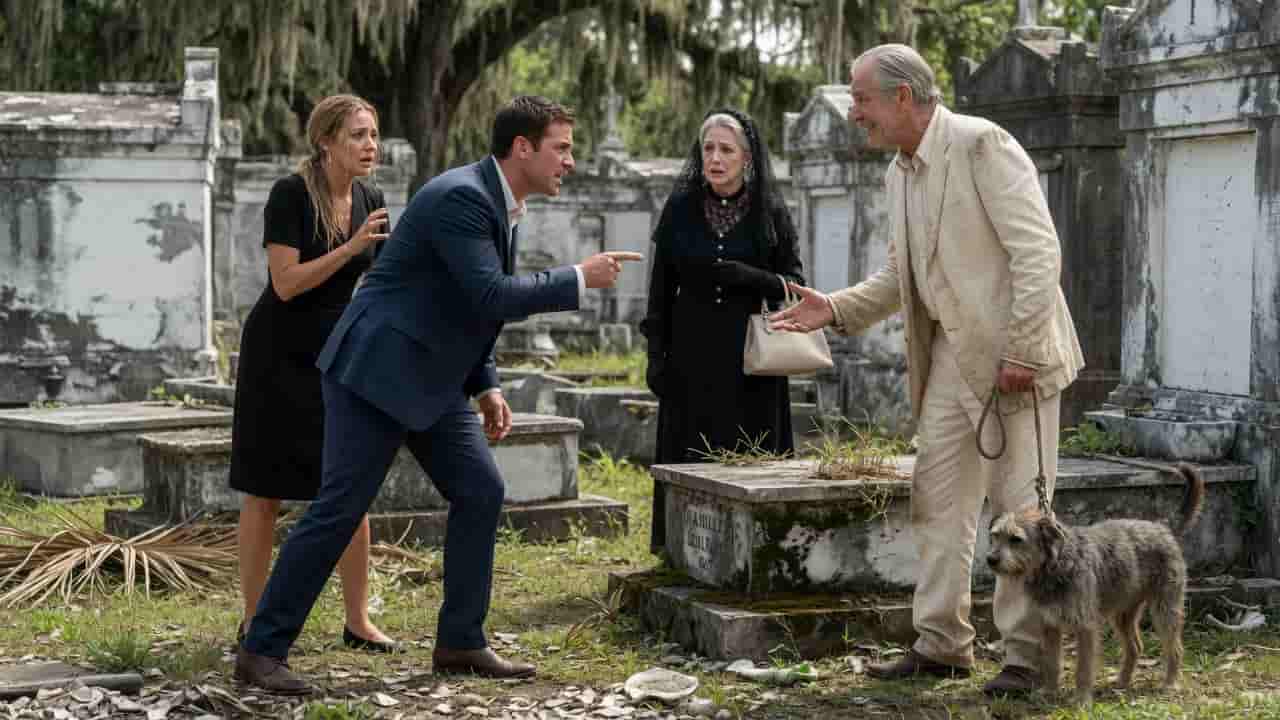
“He’s been lost for three years, Ma’am. My boy Gabe here can tell you how much we cried.”
I watched my father wipe a fake tear while holding a scruffy dog on a rope. He was standing right in front of a grieving stranger, less than twenty feet from where we had just finished the memorial service for my mother.
He wasn’t there to mourn. He was looking for his next victim. And he was using the same cruel trick that broke our family twenty years ago.
“Stop it, Dad,” I said, my voice shaking. My wife, Elena, was standing right behind me. She’d always known my father was “difficult,” but she didn’t know the truth. She didn’t know that my childhood was built on the backs of people just like this woman—vulnerable, hurting, and looking for a sign.
My father didn’t even look at me. He just leaned closer to the woman, his voice dropping into that smooth, comforting tone that used to make me feel safe before I knew better. “My Gabe is just emotional. This dog was his best friend. We thought he was gone forever until today.”
He looked at me then, his eyes cold and mocking. He was daring me to ruin the “play.” He was daring me to tell my wife exactly how we used to pay the rent.
I looked at the dog, shivering at his feet. I looked at the woman’s hopeful face. Then I looked at my father and realized the scam hadn’t changed, but I had.
“He’s not lost, Dad,” I said, loud enough for the whole cemetery to hear. “He’s hiding from you.”
The silence that followed was heavy enough to break bone. My father’s smile didn’t just fade—it curdled. And that’s when I realized he wasn’t just looking for money anymore. He was looking to take me down with him.
Chapter 1
The humidity in Lafayette Cemetery No. 1 didn’t just sit on you; it owned you. It was a thick, wet wool blanket that smelled of rain-soaked granite, rotting gardenias, and the slow, inevitable collapse of history. I stood by the whitewashed crypt of the St. Germaine family, my navy suit jacket already sticking to the small of my back. I hated this place. I hated the way the tombs looked like tiny, cramped houses for people who couldn’t leave, and I hated that I was standing here, pretending that a pile of stones could hold the memory of my mother.
Elena stood beside me, her hand tucked into the crook of my elbow. Her skin was cool, a sharp contrast to the feverish air. She was the only thing in this city that felt clean to me. She’d spent the morning organizing the small memorial, making sure the florist brought the right lilies, making sure the few distant cousins who bothered to show up had water. She thought she was helping me heal. She thought this was about closure.
“You’re shaking, Gabe,” she whispered, her voice barely carrying over the distant hum of a gardener’s weed-whacker.
“Just the heat,” I lied.
It wasn’t the heat. It was the man standing forty yards away, leaning against a rusted iron gate. Silas. My father. He hadn’t approached the crypt yet. He was waiting. He’d always been a master of the “entry”—knowing exactly when the emotional gravity of a room or a scene had reached its peak so he could swoop in and claim the center. He wore a cream linen suit that had seen better days, the fabric wrinkled in a way that suggested he’d slept in a car or a very cheap motel. But he carried it like he was the King of Magazine Street.
He was watching us, but more specifically, he was watching the woman two tombs over.
Mrs. Gable. I knew her name because Elena had pointed her out earlier—a wealthy widow who spent every Wednesday morning talking to a husband who’d been under the marble for five years. She was the “mark.” I could see it in the way Silas tilted his head, the way he cataloged the height of her heels, the quality of her veil, the way she clutched her handbag. He wasn’t mourning my mother. He was hunting.
The service was short. The priest said some words about “eternal rest” and “the peace that surpasses understanding.” I didn’t listen. I was too busy watching Silas. When the priest finished and the cousins started to drift away toward the gate, Silas made his move. But he didn’t come toward me.
He walked toward Mrs. Gable.
He had a dog with him. A scruffy, wire-haired terrier mix with one notched ear and eyes that looked like they’d seen too many bus stations. It was a “prop dog.” I felt a sick, oily slide of recognition in my gut. Twenty-five years ago, it had been a Golden Retriever named Buster. Twenty years ago, it had been a Beagle named Scout. Now, it was this poor, shivering creature on a frayed rope.
“Gabe? Where are you going?” Elena asked as I stepped away from her.
I didn’t answer. I couldn’t. I was back in 1998, sitting in the back of a rusted Ford F-150, holding a bag of cheap kibble while my father explained the “Lost Pet Play.” It’s not stealing, Gabe, he’d told me, his voice as smooth as bourbon. It’s providing a service. We give them hope, then we give them a miracle. The money is just a thank-you note.
I reached the space between the crypts just as Silas intercepted Mrs. Gable. He didn’t rush. He stumbled, just a little, looking down at the dog with an expression of profound, soul-crushing relief.
“Oh, excuse me, Ma’am,” Silas said, his voice cracking perfectly. It was the “Old Man in Transition” voice—vulnerable, slightly confused, deeply grateful. “I’m so sorry. I just… I can’t believe it. I’ve been looking for him for so long.”
Mrs. Gable stopped. She was a kind-faced woman, the type who probably donated to every charity that mailed her a calendar. “Is everything alright, sir?”
“It’s him,” Silas whispered, kneeling down in the dirt, ignoring the stains on his linen pants. He petted the dog’s head with a trembling hand. The dog didn’t wag its tail. It just froze. “We lost him near the Garden District three years ago. I thought… I thought he was gone. But I found him wandering near the gates just now. It’s a miracle. A literal miracle.”
I was ten feet away now. I could see the sweat on Silas’s neck. I could also see Elena catching up to me, her brow furrowed in confusion.
“Dad,” I said. The word felt like a stone in my mouth.
Silas looked up, and for a fraction of a second, the mask slipped. His eyes were hard, calculating, and dangerously sharp. Then, the warmth flooded back in.
“Gabe! Oh, thank God. Look! Look who I found!” Silas gestured wildly at the dog. “He’s been lost for three years, Ma’am. My boy Gabe here can tell you how much we cried. Tell her, Gabe. Tell the lady about the nights we spent driving the streets looking for poor Barnaby.”
He said the name Barnaby with such conviction I almost believed him myself. That was his gift. He could lie until the truth felt like the intruder.
Mrs. Gable’s hands went to her throat. “Oh, you poor things. After three years? That really is a miracle.”
“It’s a sign,” Silas said, standing up and wiping his eyes. He looked at Mrs. Gable with a predatory softness. “My wife… we just buried her today. Right over there. I was walking out, feeling like my whole world was empty, and then I saw him. Like she sent him back to me so I wouldn’t be alone.”
The lie was so audacious, so filthy, it made my skin crawl. He was using my mother’s fresh grave as a stage prop for a “lost pet” scam. He was doing it in front of me. He was doing it in front of my wife.
“He’s not yours, Silas,” I said, my voice low and dangerous.
Silas’s smile didn’t falter, but his hand tightened on the rope leash until his knuckles turned white. “Now, Gabe. Don’t be like that. I know you’re upset about your mother, but don’t take it out on the dog. He’s family.” He turned back to Mrs. Gable, his voice dropping. “He’s a little shell-shocked. He’s got a microchip, of course, but I don’t even have the money for the vet fees to get him scanned and checked out. I spent every dime I had on the funeral.”
He was setting the hook. The “vet fee” bait. Mrs. Gable was already opening her handbag.
“Please,” she said, her voice thick with sympathy. “Let me help. It’s the least I can do on a day like today.”
“Stop it, Dad,” I said, stepping between them. “Right now. Or I swear to God, I’ll call the police.”
Silas finally looked at me—really looked at me. The charmer was gone. In his place was the man who had left me in a motel room in Biloxi for three days when I was twelve because I’d messed up a “Short Change” routine at a gas station.
“You want to talk about the police, Gabriel?” Silas whispered, leaning in close enough that I could smell the stale peppermint and cigarettes on his breath. “You want to talk about where that down payment for your fancy house in Metairie came from? You want to tell your lovely wife about the ‘inheritance’ you actually spent?”
The air left my lungs. Elena was standing right behind me. I could feel her presence like a physical weight. She didn’t know. She thought the fifty thousand dollars I’d used to start our life had come from a life insurance policy my mother had kept hidden. She didn’t know it was the “Rainy Day” fund Silas and I had built through a hundred different rooms, a thousand different lies.
“Don’t be shy, Gabe,” Silas said, his voice rising again, reclaiming the audience. “Tell the nice lady what we did to find him. Tell her how much he means to us.”
I looked at the dog. It was shaking so hard its teeth were practically chattering. It wasn’t Barnaby. It was a stray he’d probably picked up behind a dumpster an hour ago.
“He’s not lost, Dad,” I said, my voice cracking with a rage I couldn’t contain. “He’s hiding from you.”
Silas’s eyes turned into two pieces of black glass. The cemetery went silent. Even the weed-whacker stopped. In the distance, a crow landed on a tomb and shrieked.
“I think,” Silas said, his voice deathly quiet, “that we need to have a private family conversation. Don’t you, Elena?”
He looked past me, right at my wife. And for the first time in my life, I saw my father look at someone I loved and see nothing but another mark.
Chapter 2
The memory of the dog always started with the smell of the truck.
It was 1998, and the cab of the Ford F-150 smelled like wet dog, McDonald’s wrappers, and the cheap, metallic scent of my father’s cologne. I was ten years old, and my job was to sit in the passenger seat and look “shattered.” That was the word Silas used. Gabe, you don’t just look sad. You look shattered. Like your heart is a dropped plate and the dog was the only thing holding the pieces together.
Buster was a Golden Retriever mix we’d picked up from a “Free to Good Home” ad in the back of a rural newspaper. He was a good dog—too good for us. He had big, soulful eyes and a tail that thumped against the floorboards whenever I whispered his name.
We were in an upscale suburb of Houston, the kind of place where the lawns looked like they were groomed with scissors. Silas had spent three days scouting. He’d found our target: a woman named Mrs. Henderson who lived in a house with a wraparound porch and a “God Bless Our Home” sign in the window. She’d lost her own Golden Retriever two weeks prior. Silas knew because he’d seen the “Missing” posters at the local grocery store.
“Ready, kiddo?” Silas asked, checking his reflection in the rearview mirror. He smoothed his hair, touched the corners of his eyes to make them look red, and practiced a shaky breath.
“I don’t like this one, Dad,” I whispered, hugging Buster.
Silas reached over and gripped my chin, not hard, but firm enough that I couldn’t look away. “We’re not hurting her, Gabe. We’re giving her a happy ending. She’s grieving. We’re providing the cure. And in return, she’s helping us get to the next town. It’s a trade. Now, look shattered.”
We walked up to the porch. Silas held the leash—a brand new one we’d bought so it wouldn’t look “used.” He knocked on the door, and when Mrs. Henderson opened it, he didn’t say a word. He just looked at her, then looked at the dog, then looked at me.
“Is… is that him?” she whispered, her hands flying to her mouth.
“We found him by the interstate,” Silas said, his voice a masterpiece of weary relief. “He was wandering near the fast lane. My son jumped out of the truck before I could even stop. He almost got hit, but he wouldn’t let this dog go. He’s been calling him ‘Buddy’ all the way from the border.”
I did my part. I looked at the ground. I let a tear fall—it wasn’t hard, because I was actually crying for Buster, who was about to be left with a stranger.
Mrs. Henderson fell to her knees. She called the dog by a different name—Cooper—and Buster, being a Golden Retriever, licked her face because that’s what Golden Retrievers do. To her, it was a sign of recognition. To me, it was just Buster being a dog.
“I have to reward you,” she said, sobbing. “I have to give you something. I had a five-hundred-dollar reward posted, but please, take more. You saved his life.”
Silas did the “Humble Refusal” first. That was part of the play. Oh no, Ma’am, we couldn’t. Seeing the boy smile is enough. He waited for her to insist. He waited until she was practically begging him to take the money.
We walked away with eight hundred dollars. I left Buster on that porch. I looked back through the rear window of the truck and saw him sitting there, looking confused, watching the truck pull away. I cried for three counties.
“That’s the business, Gabe,” Silas had said, lighting a cigarette. “People want to believe in miracles. We just make them happen.”
Now, standing in the New Orleans heat twenty-six years later, that same oily feeling was back. Silas was still “making miracles,” and he was using my mother’s death as the lubricant.
“Elena, honey,” Silas said, stepping around me like I was a piece of furniture. “I’m sorry you had to see this. Gabe has always been… sensitive. He gets these ideas. He thinks everyone is out to get him.”
Elena didn’t move toward him. She stayed rooted to the spot, her eyes darting between Silas and the shivering dog. “Gabe said the dog isn’t yours, Silas. Is that true?”
Silas let out a long, weary sigh. He looked at Mrs. Gable, who was standing there with a hundred-dollar bill in her hand, looking confused. “He’s confused, Elena. The grief… it does things to a man’s mind. He wants to believe his mother is still here, and he can’t handle that she’s gone. So he lashes out. He’s been like this since he was a boy.”
The reversal was perfect. He was painting me as the unstable one, the grieving son who had lost his grip on reality. It was a classic “Gaslight Pivot.”
“I’m not confused, Dad,” I said, my voice dangerously steady. “I know exactly what you’re doing. You found that dog in an alley. You saw Mrs. Gable mourning her husband, and you saw an opportunity. You’re doing the ‘Lost Pet Play’ at your own wife’s funeral.”
Mrs. Gable stepped back, her face pale. “The what? What is he talking about?”
Silas ignored her. He looked at Elena. “Elena, I think Gabe needs to go home. He’s making a scene. People are staring.”
He was right. A few of the cemetery tourists—the ones who pay to see the “Cities of the Dead”—were slowing down, sensing the friction. A tour guide in a black parasol was pointing toward us.
“I’m not going anywhere,” I said. I turned to Mrs. Gable. “Ma’am, put your money away. That man is a con artist. He’s been doing this for forty years. He doesn’t have a dog. He doesn’t have a vet fee. He has a script.”
“Gabriel,” Silas said, his voice dropping an octave. It was the “Warning” tone. The one that used to mean I was about to get a lesson in the “Price of Disloyalty.” “You really want to do this here? In front of your wife? You want me to tell her about the ‘Special Account’ in the Cayman Islands? The one you used to buy her that engagement ring?”
I felt a cold sweat break out on my forehead. The ring on Elena’s finger—a two-carat vintage diamond—had cost twelve thousand dollars. I’d told her I’d saved it from my salary as a logistics manager. The truth was, it was the last of the “Rainy Day” money. The money we’d made from a “Slip and Fall” scam in a Vegas casino when I was twenty-two.
I’d tried to be clean. I really had. After I met Elena, I got a real job, paid my taxes, lived the life of a “regular Joe.” But the past wasn’t a room you could just walk out of. It was a basement, and I was still standing in the dark.
“What special account, Gabe?” Elena asked. Her voice was small, but it cut through the humidity like a blade.
I looked at her, and my heart broke. She looked so small against the backdrop of the massive stone crypts. She looked like someone who had just realized the floor beneath her was actually a trapdoor.
“It’s nothing, El,” I whispered.
“It’s not nothing!” Silas barked, sensing the fracture. He stepped toward her, his voice dripping with faux-concern. “He’s been lying to you, Elena. From the day you met him. He’s not a logistics manager. He’s a thief. He’s my partner. Always has been.”
He reached out and grabbed the dog by the scruff of its neck, lifting it up so its paws dangled in the air. The dog let out a sharp, pathetic yelp. “He’s no better than me. He just wears a better suit.”
I lunged for the dog. I didn’t think about the scam or the money or the lies. I just saw that animal dangling in the air, its eyes rolling back in terror, and I saw Buster on that porch in Houston.
“Let him go!” I screamed.
I grabbed Silas’s wrist, and for a second, we were locked in a grotesque dance. The old man was stronger than he looked, his wiry muscles fueled by a lifetime of spite. Mrs. Gable shrieked and dropped her purse. Elena screamed my name.
And then, Silas did something I’ll never forget. He leaned in, his face inches from mine, and whispered, “If I’m going down, kiddo, we’re going down together. I’ll burn your whole life to the ground before I let you pretend you’re better than me.”
He let go of the dog. It hit the gravel and bolted, disappearing into the maze of white tombs.
Silas stood back, smoothing his linen jacket, his breathing heavy but his eyes triumphant. He looked at Elena, then back at me. “Now,” he said, his voice loud enough for the gathering crowd to hear. “Does anyone else want to talk about miracles?”
Chapter 3
The aftermath of the cemetery was a blur of humid silence and the rhythmic clicking of the turn signal in my car. I drove toward our house in Metairie, the air conditioner blasting cold air that felt like needles against my skin. Elena sat in the passenger seat, staring out the window at the passing swamp oaks and strip malls. She hadn’t said a word since we left the cemetery.
The silence was worse than the shouting. It was the silence of a house that had just had its foundation removed.
“El,” I started.
“Don’t,” she said. She didn’t look at me. “Don’t say a word until we’re inside.”
We got home—a charming, three-bedroom cottage with a white picket fence that I’d paid for with blood and lies. I followed her into the kitchen. She stood by the island, her hands flat on the granite, her head bowed.
“Who was Buster?” she asked.
The question caught me off guard. “What?”
“In the cemetery,” she said, finally looking at me. Her eyes were red, but her face was set in a mask of cold, hard clarity. “Before you grabbed him. You whispered a name. You said ‘Buster.’ Who was he?”
I sat down at the kitchen table, the weight of the last twenty years finally dropping onto my shoulders. “He was a dog. From a long time ago.”
“Another scam?”
I nodded. “The first one I really remember. I was ten. My father… he taught me how to cry on cue. He taught me that people’s grief is just a door you can walk through if you have the right key. Buster was the key.”
Elena let out a shaky breath. She pulled the diamond ring off her finger and set it on the granite. It made a sharp, clinking sound that felt like a gunshot. “And this? Is this a key too?”
“I wanted to give you something beautiful,” I said, my voice cracking. “I wanted you to have a life that wasn’t… like mine. I thought if I used the last of the money to build a real life, it would cancel out where it came from. I thought I could outrun him.”
“You can’t outrun a ghost, Gabe. Especially not one you’re still carrying in your wallet.” She leaned forward, her voice dropping to a whisper. “He said you were his partner. He said you did a ‘Slip and Fall’ in Vegas. Is that true?”
“I was twenty-two, Elena. I was broke, he was my father, and he told me it was the only way to save the house. I was stupid. I was a kid who wanted his dad to love him.”
“And the logistics job? Is that even real?”
“The job is real,” I said, reaching for her hand. She pulled away. “I swear to God, the job is real. I’ve worked forty hours a week for five years. I’ve done everything right. I just… I couldn’t tell you the truth about the beginning. How could I? Who marries a guy who tells them his father used to pimp out the family dog for grocery money?”
Elena looked at the ring on the counter. “My father was a schoolteacher, Gabe. My mother worked at the library. We didn’t have much, but when we sat down to dinner, I didn’t have to wonder if the steak was stolen. I didn’t have to wonder if the man across the table was a predator.”
She walked out of the kitchen. A moment later, I heard the bedroom door click shut.
I sat there in the dark for a long time. I thought about the dog in the cemetery. The way it had bolted. I hoped it found a place to hide. I hoped it found someone who didn’t see it as a “prop.”
Around 10:00 PM, my phone buzzed on the table. An unknown number.
Meet me at The Rusty Nail. 30 minutes. Or I call the police and tell them about the “Gable Woman” you harassed today. I’ve got witnesses, kiddo. And I’ve got the dog.
It was Silas. Of course it was Silas. He was never done. He didn’t just want a payout; he wanted a “Return to Form.” He wanted his partner back.
I drove back toward the city, the neon lights of the bars reflecting off the wet pavement. The Rusty Nail was a dive bar on the edge of the Warehouse District, the kind of place where the floor was always sticky and the lighting was designed to hide bruises.
I found him in a corner booth, the cream linen suit now hopelessly stained with red wine and sweat. He had a glass of bourbon in one hand and the dog’s rope leash tied to the leg of the table. The dog was curled into a ball under his chair.
“You came,” Silas said, gesturing to the seat across from him. “I knew you would. You’ve always been a loyal boy, Gabe. Deep down, past all that suburban starch.”
I didn’t sit. “What do you want, Silas? Money? I don’t have it. I spent it all on the house and the ring and the life you’re currently trying to ruin.”
Silas laughed, a dry, rattling sound. “Oh, I don’t want your pittance, Gabe. I want your expertise. I’ve got a play. A big one. The kind of play that lets us both retire to a beach in Costa Rica and never look at a cemetery again.”
“I’m done, Dad. I told you. I’m out.”
“Are you?” Silas leaned forward, his eyes gleaming in the dim light. “You think that girl is going to stay with you now? You think she can look at you without seeing a thief? You’re already ‘out’ of that life, Gabe. You just haven’t realized it yet. You’re back on the street. With me.”
He reached down and yanked the dog’s leash. The dog whimpered, a sound that made my teeth ache.
“This little guy?” Silas said, nodding at the terrier. “He’s got a microchip. I checked it at a 24-hour vet after you left. And guess who he belongs to? A very wealthy, very desperate man in Uptown. A man who happens to be the CEO of a company currently being investigated for some very interesting tax problems. A man who would pay a lot of money to have a ‘discreet’ friend find his dog—and maybe lose a certain hard drive while he’s at it.”
I looked at the dog. It was just an animal. It didn’t know it was a pawn in a game of high-stakes blackmail. It just wanted to be safe.
“You’re going to jail, Silas,” I said.
“Maybe,” Silas shrugged. “But you’re coming with me. Because I took the liberty of registering that microchip scan under your name, Gabe. And I left a little ‘thank you’ note in Mrs. Gable’s mailbox tonight, telling her exactly where to find the man who tried to rob her at the cemetery.”
He took a slow sip of his bourbon. “So here’s the play. You help me with the CEO. You use your ‘logistics’ skills to get us into his office. We get the money, we get the drive, and we vanish. Or, you go home to an empty house and wait for the NOPD to knock on your door.”
I looked at my father—the man who had taught me to ride a bike, the man who had taught me to lie, the man who was currently holding my life over a flame. And I realized that the only way to stop a fire is to let it burn everything down.
“The dog stays with me,” I said.
Silas smiled. “Deal. He’s a lousy actor anyway.”
Chapter 4
The heat of the New Orleans morning was even worse than the day before. It was the kind of heat that made the pavement shimmer and the air taste like exhaust. I was standing in front of a glass-and-steel office building in the CBD—the headquarters of Vane Logistics. The irony wasn’t lost on me.
I had the dog in the back of my SUV, the windows cracked and the engine running so the AC would keep him cool. I’d named him “Ghost.” Because that’s all he was—a remnant of a life I thought I’d buried.
Silas was standing next to me, wearing a fresh suit he’d clearly stolen or bought with the last of his “travel money.” He looked sharp, professional, and utterly untrustworthy.
“Remember,” Silas whispered as we approached the security desk. “You’re the grieving son, and I’m your distraught uncle. We’re here to return the dog to Mr. Vane personally. It’s a ‘Family Matter.’ Use the voice, Gabe. The one that makes people feel like they’re doing a good deed just by letting you in the door.”
I didn’t use the voice. I didn’t have to. The security guard saw the navy suit, the tired lines around my eyes, and the sheer, vibrating tension in my body and assumed I was exactly who I said I was: a man on a mission of mercy.
We were buzzed up to the 14th floor. The elevator ride was silent, the only sound the mechanical hum of the cables. I looked at my reflection in the polished brass doors. I looked like a man who was about to commit a crime. Or a man who was about to commit a sacrifice.
The doors opened to a lobby that smelled of expensive leather and air-freshener. Mr. Vane’s secretary, a woman with a sharp bob and a sharper gaze, looked up from her desk.
“Can I help you?”
“We’re here for Arthur Vane,” Silas said, stepping forward. He didn’t wait for her to answer. He walked toward the large mahogany doors of the inner office. “Tell him we found his ‘Special Friend.’ And tell him we have the dog.”
The secretary started to protest, but Silas was already through the door. I followed him, my heart hammering against my ribs like a trapped bird.
Arthur Vane was a man who looked like he’d been carved out of a very expensive piece of driftwood. He was in his sixties, with a tan that suggested a lot of time on a yacht and eyes that suggested he’d never spent a single second worrying about anyone but himself. He was sitting behind a desk that probably cost more than my house.
“Who the hell are you?” Vane barked.
Silas didn’t answer. He just walked to the window, looking out over the city. “Beautiful view, Arthur. You can see the cemetery from here, did you know that? It’s a very quiet place. Very good for keeping secrets.”
Vane’s face went pale. “What do you want?”
“I want to talk about your dog, Arthur,” Silas said, turning around. “And I want to talk about the drive you tucked into his collar before you sent him out with the dog walker yesterday. The one you thought the feds wouldn’t find because they’d be too busy looking in your safe.”
I stood by the door, my hands clenched at my sides. This was the “Hook.” The moment where the scam turned into something much more dangerous.
“I don’t know what you’re talking about,” Vane said, but his hand moved toward a drawer in his desk.
“Don’t,” I said.
Vane looked at me. He saw the navy suit, the logistics manager posture. He saw the man who knew how to move things, how to hide things, how to make things disappear.
“Your dog is in my car,” I said, my voice flat. “And my father has the drive.”
That was the lie. We didn’t have the drive. The dog hadn’t had anything on its collar when Silas found it. Silas had made that part up, a “Phantom Play” to see if Vane would bite.
Vane bit. He slumped back in his chair, his face aging ten years in a second. “How much?”
“A million,” Silas said, his voice casual. “Five hundred thousand for the dog, and five hundred thousand for the drive. And we want it in cash. By tonight.”
I looked at Silas. He was glowing. This was his masterpiece. The biggest “miracle” he’d ever performed.
But then, the door behind us opened.
It wasn’t a secretary. It wasn’t a security guard.
It was Elena.
She was standing there, her eyes red, her face pale. She was holding a manila envelope.
“Gabe,” she whispered.
I turned around, my world tilting on its axis. “Elena? What are you doing here?”
“A woman came to the house,” she said, her voice shaking. “Mrs. Gable. She felt bad about what happened at the cemetery. She wanted to give you this. She said your mother left it for you in her will, but the lawyer couldn’t find you.”
She held out the envelope. “I opened it, Gabe. I had to know.”
I took the envelope with trembling hands. Inside was a single piece of paper—a letter from my mother, dated three days before she died. And a USB drive.
Gabriel, the letter began. I know what your father is. I know what he’s made you. But I also know what you could be. I took this from his desk ten years ago. It’s his life, Gabe. All the scams, all the money, all the names. Use it. Not to get rich, but to be free.
I looked at Silas. He was staring at the USB drive in my hand, his face a mask of dawning horror.
And then, I looked at Arthur Vane. He was staring at the drive too.
The room went deathly silent. The only sound was the distant hum of the city below.
“Is that it?” Vane whispered. “Is that the drive?”
I looked at Elena. I looked at the woman who had walked into the middle of a war zone because she loved me. And I realized that the “Rainy Day” fund wasn’t a pile of cash. It was the truth.
“No,” I said, looking right at my father. “This isn’t his drive, Arthur. This is my father’s life.”
I turned back to Silas. “And I’m giving it to the police.”
Silas didn’t lunged. He didn’t scream. He just sat down in one of the leather chairs, his cream linen suit looking small and pathetic against the backdrop of the city. He looked like an old man who had finally run out of miracles.
“You’re going to destroy us both, Gabe,” Silas whispered.
“No, Dad,” I said, taking Elena’s hand. “I’m just letting the dog go.”
I walked out of the office, Elena at my side. We went down the elevator, out into the harsh New Orleans sun, and back to the car.
Ghost was waiting for us. He wagged his tail—just a little—when I opened the door.
I looked at Elena. “I’m sorry. For everything.”
She looked at me for a long time. She didn’t say it was okay. She didn’t say she forgave me. She just reached out and took the USB drive from my hand.
“Let’s go to the station,” she said.
I started the car and drove. I didn’t look back at the office building. I didn’t look back at the cemetery. I just looked at the road ahead, and for the first time in thirty-four years, I didn’t feel like I was running.
I was just driving.
Chapter 5
The drive from the Central Business District to the New Orleans Police Department headquarters on Broad Street felt like it took three lifetimes, even though it was barely two miles. The humidity had peaked, turning the city into a pressurized steamer. Inside the SUV, the air conditioning hummed a low, desperate tune, struggling against the heat radiating off the windshield.
Elena sat in the passenger seat, the manila envelope resting on her lap like a live grenade. She wasn’t looking at me. She was watching the city move past—the colorful, crumbling shotgun houses, the tourists huddled under umbrellas that offered no real protection from the sun, the stray cats darting into the shadows of overgrown alleys. Every few blocks, I’d glance in the rearview mirror at the dog, Ghost. He was curled into a tight ball on the leather seat, his chin resting on his paws, his eyes wide and unblinking. He looked exactly like I felt: waiting for the next blow to land.
“We don’t have to do it this way,” I said, my voice sounding thin in the cramped space. “We could go to a lawyer first. Protect ourselves. Protect you.”
Elena finally turned her head. Her face was pale, her eyes rimmed with a redness that wasn’t just from the heat. “Protect me from what, Gabe? The truth? That ship sailed at the cemetery. And it sank in that office back there.”
“I just meant—”
“I know what you meant,” she interrupted, her voice gaining a sharp, jagged edge. “You’re still looking for the ‘play.’ You’re still looking for the angle where we come out clean. But there is no clean, Gabe. There’s just what’s right and what’s easy. You’ve been doing ‘easy’ your whole life.”
I gripped the steering wheel until my knuckles turned white. I wanted to defend myself, to tell her that ‘easy’ wasn’t the word for a childhood spent in motels and the backseats of stolen trucks, but I knew she was right. Every choice I’d made since I was ten years old had been about survival, which was just another way of saying I’d chosen the path that kept the lights on, no matter who got left in the dark.
We pulled into the parking lot of the precinct. The building was a brutalist slab of concrete, grey and uncompromising. It looked like a place designed to swallow secrets and spit out cold, hard facts. I killed the engine, and the silence that followed was heavy, filled with the ticking of the cooling metal and the distant sound of a siren.
“If we walk in there,” I said, looking at the envelope, “there’s no taking it back. Silas goes away. And I probably go with him. The ‘Rainy Day’ money… it’s all in there. The Vegas job, the casinos, the insurance scams. Everything.”
Elena looked at the building, then back at me. “Do you think I care about the money, Gabe? Do you think I want a house built on ‘Rainy Day’ funds? I’d rather live in a one-bedroom apartment in Gentilly with a man I actually know than stay in that house with a stranger.”
She opened the door and stepped out into the thick, soupy air. I grabbed the envelope, checked on Ghost, and followed her.
The lobby of the precinct was exactly what you’d expect—linoleum floors scuffed by a thousand desperate pairs of shoes, the smell of burnt coffee and floor wax, and a buzzing fluorescent light that seemed to be humming at the exact frequency of my anxiety. We waited for twenty minutes at the front desk before a detective came out to meet us.
Detective Miller was a man in his fifties with a face that looked like it had been carved out of old saddle leather. He had tired eyes and a suit that didn’t quite fit his slumped shoulders. He led us back to a small, windowless interview room that contained nothing but a metal table and three plastic chairs.
“Mr. St. Germaine,” Miller said, sitting down and opening a notebook. “Your wife says you have some information regarding a series of financial crimes and… well, quite a few other things. She mentioned a USB drive.”
I set the envelope on the table. My hands were shaking, and I tucked them under my thighs to hide it. “My mother passed away a few days ago. This was in her will. It’s… it’s a record. Of everything my father, Silas St. Germaine, has done for the last thirty years.”
Miller raised an eyebrow. “And why are you bringing this to us now?”
“Because he’s back,” I said. “And he’s trying to start again. He’s targeting Arthur Vane. The CEO of Vane Logistics.”
The detective’s expression didn’t change, but I saw a flicker of interest in his eyes. The NOPD had been circling Vane for months on tax evasion charges. This was the missing piece of the puzzle.
For the next four hours, I talked. I didn’t use the “voice.” I didn’t look for an angle. I just told the truth. I told him about the Golden Retriever in Houston, the “Slip and Fall” in Vegas, the insurance scams in Biloxi. I told him about the fifty thousand dollars I’d used for the down payment on my house. I told him how my father had used my mother’s grief and my own fear to keep us in the life.
Elena sat beside me the whole time, her hand resting on the table but never touching mine. She listened to every word, every sordid detail of the life I’d hidden from her. I watched her face as I described the way we’d left people—good, kind people—broken and penniless. I saw the horror dawn in her eyes, followed by a deep, hollow sadness that was harder to watch than her anger.
“You realize,” Miller said, leaning back after I finished, “that by giving us this, you’re admitting to multiple felonies. Even with your cooperation, the DA is going to have a field day with this.”
“I know,” I said.
“And your father? You know he’s not going to take this quietly.”
“He never does,” I replied.
As if on cue, the detective’s phone buzzed on the table. He glanced at the screen, then at me. “Speaking of your father. We just got a report of a disturbance at Vane Logistics. Security called it in. A man matching your father’s description was found in the CEO’s office. He was… agitated. Claiming he’d been robbed by his own son.”
A cold shiver ran down my spine. Silas was cornered. And a cornered Silas was a man who would set the world on fire just to see his enemies burn.
“Is he in custody?” I asked.
“He is now,” Miller said, standing up. “We’re going to need you to stay here for a while longer. We have to verify the contents of that drive and get a formal statement from the DA’s office. Your wife can go, if she wants.”
Elena stood up. She looked exhausted, her shoulders slumped under the weight of the day. “I’m staying,” she said.
We were moved to a slightly more comfortable waiting area, a room with a vending machine and a stack of old magazines. The hours crawled by. Around 8:00 PM, Miller came back in. He looked even more tired than before.
“The drive is everything you said it was,” he said, sitting down across from us. “Your mother was thorough. She kept logs, receipts, even recordings. It’s enough to put Silas away for the rest of his life. And it’s enough to link Vane to a dozen different money-laundering schemes.”
He paused, looking at me with something that might have been pity. “The DA is willing to offer you a deal, Gabe. Full immunity in exchange for your testimony against Silas and Vane. But there’s a catch.”
“What catch?”
“The ‘Rainy Day’ money. You have to forfeit everything. The house, the car, the savings. Every cent that can be traced back to the scams. You’ll be starting from zero.”
I looked at Elena. She was watching me, her expression unreadable. I thought about the house in Metairie, the white picket fence, the crown molding I’d spent weekends painting. I thought about the life I’d tried to build on a foundation of sand.
“Zero sounds like a good place to start,” I said.
Elena didn’t smile, but for the first time that day, the tension in her jaw seemed to ease.
But the “residue” of the day wasn’t over. As we were being escorted out of the building to get some air before the final paperwork was signed, a transport van pulled into the sally port. Two officers stepped out, leading a man in handcuffs.
It was Silas.
He looked different without the cream linen suit. They’d put him in a standard-issue orange jumpsuit, and the fluorescent lights of the garage made his skin look grey and papery. But his eyes—those sharp, predatory eyes—were still the same.
He saw me. He stopped, forcing the officers to tug at his arms.
“You did it, didn’t you, kiddo?” he rasped, his voice echoing off the concrete walls. “You finally pulled the ‘Grand Finale.’ You traded your old man for a clear conscience and a pat on the back from a girl who doesn’t even know who you are.”
“I know exactly who he is, Silas,” Elena said, stepping forward. Her voice was steady, filled with a quiet strength that made Silas blink. “He’s the man who just chose the truth over you.”
Silas let out a harsh, mocking laugh. “The truth? There is no truth in this city, Elena. There’s just the lie you tell yourself so you can sleep at night. And Gabe? He’s the best liar I ever met.”
He leaned toward me, as much as the handcuffs would allow. “You think you’re free, Gabriel? You think you can just walk away? Look at your hands. Look at the way you move. You’re me. You’ll always be me. And every time you look in the mirror, every time you touch that girl, you’ll see my face looking back at you.”
The officers pulled him away, his laughter trailing off as they led him into the bowels of the building. I stood there, the heat of the garage pressing in on me, feeling the weight of his words.
He was wrong, I told myself. I wasn’t him. I had Ghost. I had Elena. I had the truth.
But as I looked down at my hands, I realized they were still shaking. And I realized that the hardest part of the scam wasn’t pulling it off. It was living with the fact that it had worked for so long.
Chapter 6
Three months later, the New Orleans humidity had finally broken, replaced by the crisp, biting air of a late November morning. The city felt different in the cold—sharper, less forgiving, the shadows deeper against the white stone of the tombs.
I stood on the sidewalk in front of a small, two-bedroom apartment in Mid-City. It wasn’t the house in Metairie. The floors creaked, the windows rattled in the wind, and the neighborhood smelled like diesel fumes and woodsmoke instead of gardenias. But the rent was paid with a paycheck from a warehouse job I’d found through a temp agency—a job where I spent eight hours a day moving boxes and checking manifests. It was honest work, and it left me exhausted in a way that had nothing to do with guilt.
Ghost was sitting on the porch, his wire-haired coat thick and healthy now. He’d stopped shivering weeks ago. He watched me with a quiet, steady gaze, his tail giving a single, tentative thump against the wood.
Elena came out of the front door, wearing a heavy sweater and carrying two mugs of coffee. She looked tired—she’d been working double shifts at the library to help keep us afloat—but the redness in her eyes was gone. She set the mugs on the porch railing and stood beside me, looking out at the street.
“The lawyer called,” she said softly. “The plea deal is finalized. Silas is going to Angola. Twenty years. With his health… he won’t be coming out.”
I took a sip of the coffee. It was hot and bitter, just the way I liked it. “And Vane?”
“Fifteen years. The feds found the real drive in a safe deposit box in the Caymans. Your mother’s records led them right to it. It turns out Silas wasn’t the only one keeping a ‘Rainy Day’ fund.”
We stood in silence for a moment, the only sound the wind whistling through the power lines. The “Rainy Day” fund was gone. The house had been seized, the car sold at auction, the savings account emptied. We had four thousand dollars in a joint checking account and a mountain of legal fees, but for the first time in my life, I didn’t feel like I was waiting for a knock on the door.
“I went to see him,” I said. “Yesterday. At the parish prison before they move him.”
Elena didn’t look surprised. She just nodded. “What did he say?”
“He didn’t say much,” I lied.
The truth was, the meeting had been devastating. Silas had sat behind the plexiglass, looking smaller and more fragile than I’d ever seen him. He hadn’t tried to con me. He hadn’t tried to use the “voice.” He’d just looked at me with a cold, hollow hatred that felt like a physical blow.
You think you won, Gabriel? he’d whispered into the handset. You think you’re the hero of this story? You’re just the guy who turned in his own father to save his skin. That’s the ultimate con, kiddo. Convincing yourself you’re a good man while you’re holding the knife.
He’d hung up before I could answer. I’d watched him walk away, a thin, broken man in an orange jumpsuit, and I’d realized that he was right about one thing: I would never be “clean.” I would always be the man who grew up in the shadows. I would always be the man who knew how to lie.
But as I looked at Elena, I realized that Silas was wrong about everything else.
“He tried to tell me I was him,” I said, finally looking at her. “He tried to tell me that I’d never be free.”
Elena reached out and took my hand. Her skin was warm, her grip firm. She didn’t offer a platitude. She didn’t tell me he was wrong. She knew me too well for that.
“Maybe you’ll always have a bit of him in you, Gabe,” she said, her voice steady. “But you’re the one who decided what to do with it. You’re the one who let the dog go. That’s the difference.”
We went back inside the apartment. It was small and cramped, filled with mismatched furniture we’d bought at thrift stores and boxes we still hadn’t unpacked. But as I sat on the sofa with Ghost at my feet and Elena beside me, the room didn’t feel like a cage. It felt like a beginning.
The trial started in January. I spent three weeks on the witness stand, detailing every scam, every lie, every person we’d hurt. I looked Silas in the eye every day, and every day, I felt the weight of his hatred. But I also felt something else: a slow, steady peeling away of the mask I’d worn for thirty-four years.
When the final verdict was read, I didn’t feel triumphant. I didn’t feel like a hero. I just felt empty, like a vessel that had been scrubbed clean and was waiting to be filled with something new.
A year later, the city was back in the grip of the summer heat. I was walking Ghost through City Park, the moss-draped oaks offering a meager respite from the sun. We passed a man sitting on a bench, a scruffy dog at his feet, talking to an elderly woman with a kind face.
I stopped. I watched them for a moment. The man was leaning in, his voice low and comforting, his hand gesturing toward the dog. The woman was reaching for her purse, her eyes filled with sympathy.
It was the “Lost Pet Play.” A different man, a different dog, a different mark. But the script was the same.
Ghost tensed beside me, his low growl vibrating through the leash. I looked at the man, then at the woman. I could have walked over. I could have exposed him. I could have stopped the scam.
But then I saw the man’s eyes. They weren’t sharp and predatory like Silas’s. They were desperate. They were the eyes of a man who was hungry, a man who was terrified, a man who had run out of options.
I thought about the night Silas had left me in that motel in Biloxi. I thought about the hunger and the fear and the way the world looks when you have nothing but a lie to sell.
I didn’t walk over. I didn’t make a scene. Instead, I walked to a nearby payphone and called the local animal shelter.
“There’s a man in the park,” I said, my voice quiet. “He’s got a dog that looks like it needs some help. Near the Peristyle. Just… keep an eye out, okay?”
I hung up and walked back to Ghost. I pet his head, feeling the coarse hair beneath my fingers. He licked my hand, a simple, honest gesture that didn’t cost a dime.
“Let’s go home, Ghost,” I said.
We walked out of the park, back toward our creaky apartment in Mid-City. The heat was heavy, the air was thick, and the city was as messy and beautiful and broken as it had ever been.
I wasn’t a hero. I wasn’t a “good man.” I was just a man who had stopped running. And as I turned the corner and saw Elena waiting for me on the porch, I realized that for the first time in my life, I didn’t need a miracle.
I just needed the truth. And the truth, I realized, was that the only way to truly leave the past behind is to carry it with you—not as a weapon, but as a map. A map that shows you exactly where you never want to go again.
The final sentence of my mother’s letter came back to me then, a quiet whisper in the back of my mind. Be free, Gabe. Not because the world is kind, but because you are.
I walked up the stairs, took Elena’s hand, and walked through the door. The “Rainy Day” was over. And for the first time, I didn’t mind the sun.