“Where did you get that ring, kid?”
I shouldn’t have been at the cemetery that late. The Ohio humidity was thick enough to swallow a man whole, and the grease under my fingernails was never going to come out, no matter how hard I scrubbed. I just wanted five minutes with Clara. Five minutes to tell her that the garage was failing and that I still hadn’t moved her shoes from the back door.
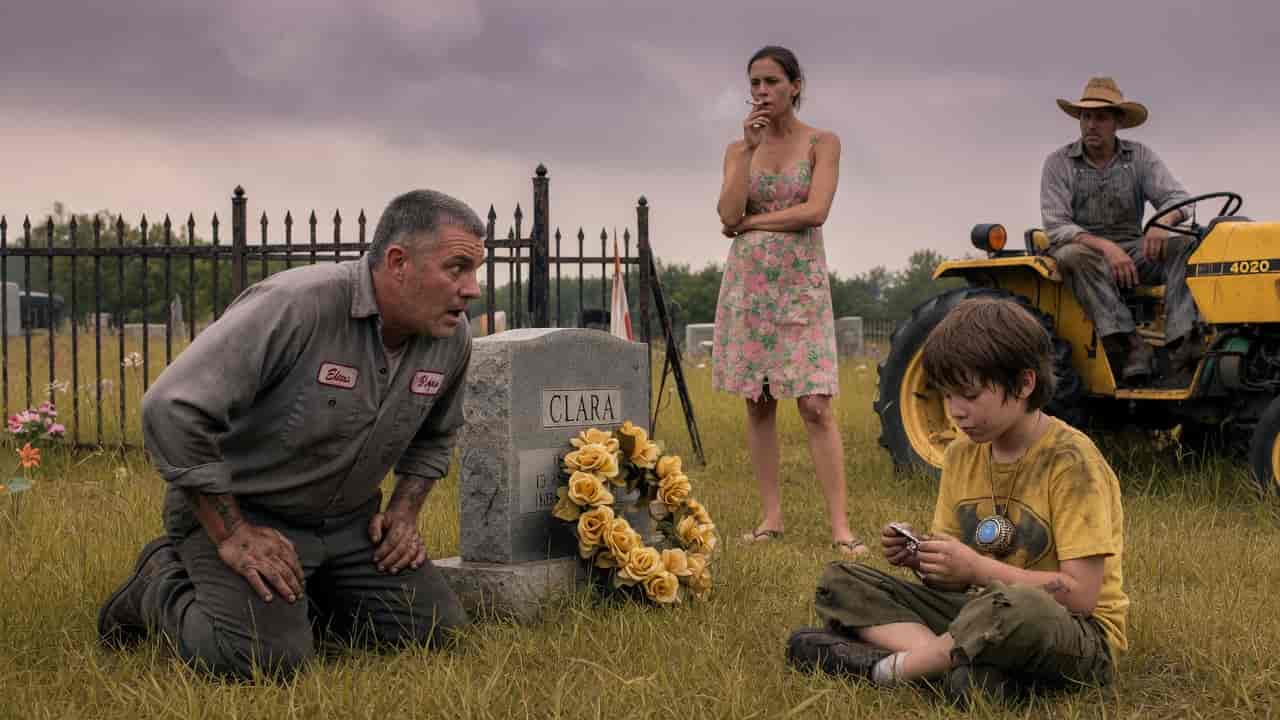
But there was a boy there. Seven, maybe eight years old. He was sitting in the tall grass, humming a tune Clara used to sing when she thought I wasn’t listening.
Then I saw it.
Hanging from a piece of dirty twine around his neck was my high school class ring. The one I’d given Clara twenty years ago. The one she told me she lost during those long, bitter months when the IVF treatments failed and our world fell apart.
“Mommy said it belonged to a ghost,” the boy whispered, his eyes never leaving the silver locket in his hand.
I didn’t even hear Sarah’s car pull up. I didn’t see my sister-in-law marching through the headstones until her hand caught me across the face, the sting of it echoing in the silence of the graveyard.
“Don’t you touch him,” Sarah spat, her voice loud enough for the groundskeeper to stop his tractor and stare. “You were the reason she had to hide him, Elias. You and that patched jacket you used to wear. You think you deserve a son? You couldn’t even keep your wife alive.”
The whole town thinks Toby is Sarah’s nephew. They think he’s just a stray she took in. But as I looked at that locket—at the photo of me Clara had kept hidden for eight years—I realized the boy wasn’t an orphan.
He was the life I was never supposed to know about.
Chapter 1: The Humming in the Grass
The heat in Athens County didn’t just sit on you; it owned you. It was a wet, heavy blanket that smelled of damp earth and the slow rot of fallen timber. I leaned against the rusted tailgate of my Ford, my lungs burning with the kind of air that felt like it had already been breathed by a dozen other people. I’d spent twelve hours under the chassis of a Peterbilt, and my back felt like a collection of broken glass. My hands were worse—blackened with oil that had worked its way into the very grain of my skin, a permanent map of a life spent turning wrenches and losing fights.
I walked the path toward the back of the cemetery, where the grass grew taller and the headstones leaned like tired old men. This was the cheap section, far from the polished marble and manicured lawns near the gate. This was where the families who counted pennies buried their people.
Clara’s stone was simple granite. No angels, no poetry. Just her name and the dates that bookended the ten years we’d spent trying to build something out of nothing.
I stopped ten feet away.
Someone was there.
He was small, huddled in the weeds like a startled fawn. A boy, maybe seven years old, with hair the color of unpolished copper and a yellow shirt that had seen better days. He didn’t hear me. He was too busy. He was sitting cross-legged in front of Clara’s grave, his head tilted back, humming.
It wasn’t just any tune. It was Blackbird. The way Clara used to hum it—slightly off-key on the high notes, a little breathy, like she was trying to keep a secret from the lyrics. My heart did a slow, painful roll in my chest.
“Hey, kid,” I said. My voice was gravelly, unused to anything but barking orders at the shop.
The humming stopped. The boy didn’t jump, though. He just turned his head slowly, looking at me with eyes that were a startling, familiar shade of hazel. He looked like he’d been dragged through a hedge backward. There was mud on his shins and a smudge of grease on his cheek that made me want to reach out and wipe it away.
“You’re the man from the garage,” he said. It wasn’t a question.
“I’m Elias,” I said, taking a cautious step forward. “This is my wife’s spot. You lost, or just taking a shortcut?”
He looked back at the headstone, then down at his hands. He was clutching something silver, something small. A locket.
“I’m not lost,” he whispered. “I’m visiting.”
“Visiting who?”
“The lady who lived in the light.”
I felt a chill that had nothing to do with the humid air. Clara had always talked like that. She’d see the sun hitting the creek and tell me the water was ‘living in the light.’ I’d always just laughed and told her it was physics.
I moved closer, my boots crunching on the dry stalks of grass. That’s when I saw it.
Tied around his neck with a piece of grimy butcher’s twine was a ring. A heavy, silver high school class ring with a blue spinel stone that had been chipped on the edge from the time I’d dropped it on the floor of my father’s workshop. My ring.
The air left my lungs. I reached out, my fingers trembling. I didn’t ask permission. I just leaned down and lifted the ring, feeling the cold metal against my calloused palm.
“Where did you get this, kid?” I asked. My voice was a ghost of itself. “Tell me where you got this ring.”
Toby—I knew his name was Toby, I’d seen him around town with Sarah, Clara’s sister—didn’t pull away. He looked at the ring, then back at me.
“Mommy gave it to me,” he said. “Before she went away. She said it belonged to a ghost who was too brave to stay, but too broken to leave.”
“Your mommy?” I asked, the world beginning to tilt. “You mean Sarah?”
The boy hesitated. A flicker of something—fear? confusion?—crossed his face. He looked down at the silver locket in his hand and clicked it open. I leaned in, my shadow falling over him.
Inside the locket was a photograph. It was a grainly, cropped image from our wedding day. It was me. I was laughing, my face younger, cleaner, looking at someone off-camera with a kind of hope I’d forgotten I ever possessed.
“Mommy said if I ever got scared, I should look at the ghost,” Toby whispered. “She said the ghost would protect me.”
The sound of a diesel engine cutting out echoed across the valley. I looked up. Doc, the cemetery groundskeeper, was sitting on his old John Deere about fifty yards away. He’d stopped the blades. He was just sitting there, his straw hat pulled low, watching us. He’d known Clara. He’d known me since I was a kid coming home from the service with a chip on my shoulder and a tattoo of a scorched earth on my forearm.
I looked back at the boy. The resemblance wasn’t just in the eyes. It was the set of his jaw. The way his ears tucked in. The way he held his shoulders—square and defensive, like the world was a punch he was waiting to take.
“Elias!”
The voice was a whip-crack.
Sarah was marching across the lawn, her flip-flops slapping against the dirt. She looked like she’d been carved out of sour wood. Her hair was pulled back so tight it made her eyes look permanent startled, and she was clutching a pack of Marlboro Reds like a weapon.
“Toby! Get away from him!” she screamed.
She reached us in a blur of floral print and nicotine. She didn’t hesitate. She lunged between us, her hand coming up in a frantic, uncoordinated swing.
Smack.
The sound of her palm hitting my cheek was loud in the sudden silence of the graveyard. My head didn’t even move. I’ve been hit by better men with heavier objects, but the sting was deeper than the skin. It was the look in her eyes—pure, unadulterated terror masked by a layer of jagged hate.
“Don’t you touch him!” she shrieked, grabbing Toby by the arm and yanking him behind her. “Don’t you even look at him!”
“Sarah,” I said, my voice steady, though my heart was hammering a rhythm of pure panic against my ribs. “The ring. Why does he have my ring?”
“It’s not your ring,” she lied. It was a pathetic, transparent lie. “I found it in a drawer. I gave it to him to keep him quiet.”
“He said his mommy gave it to him,” I said, stepping toward her. “He said his mommy told him it belonged to a ghost.”
Sarah backed up, her heels catching on the edge of Clara’s grave. She nearly fell, her face turning a sickly shade of gray. Behind her, Toby was clutching her dress, his eyes wide, looking at me like I was the monster in a story he’d been told a thousand times.
“He’s confused,” Sarah hissed. “He’s a child. He doesn’t know what he’s saying.”
“Is he mine, Sarah?” I asked. I could feel Doc’s eyes on us. I could feel the weight of the silver ring still hanging around the boy’s neck. “The IVF… Clara said it failed. She said we lost the baby. She sat in that house for three months and didn’t speak a word because she said our child was gone.”
Sarah’s lip curled into a sneer that was more of a sob. She looked at Clara’s headstone, then back at me, her eyes darting to my grease-stained clothes and the faded scars on my knuckles.
“She did lose the baby, Elias,” Sarah said, her voice dropping to a lethal, quiet hiss. “She lost the chance to have a life with a man who wasn’t going to end up in a ditch or a cell. She looked at you—at the club, at the bikes, at the blood you brought home on your boots—and she realized that bringing a child into your world was a sin. So she gave him to someone who could actually keep him safe. She gave him to me.”
The world didn’t shatter. It just went very, very still. The cicadas in the trees seemed to scream louder, a vibrating wall of sound that filled my head.
“You’re lying,” I whispered.
“Am I?” Sarah gestured wildly toward Toby. “Look at him, Elias. Really look at him. He hums when he’s nervous. He has your temper and her heart. And she died keeping him away from you because she knew exactly what you’d do to him. You’d turn him into you.”
She grabbed Toby’s hand and started dragging him toward the parking lot. The boy stumbled, looking back over his shoulder at me. He didn’t cry. He just watched me with those hazel eyes, the silver locket swinging against his chest.
I stood there by Clara’s grave, my boots sunk into the mud, my hands hanging uselessly at my sides. I looked down at the granite stone.
Clara Vance. 1982–2024. Beloved Wife.
It was a lie. All of it. The grief I’d carried, the emptiness of the house, the way I’d blamed myself for her broken heart. She hadn’t been broken. She’d been hiding.
“Elias?”
I turned. Doc was walking toward me, his boots heavy in the grass. He stopped a few feet away, his old face etched with a pity I didn’t want.
“I seen ‘em here before,” Doc said softly. “The boy. He comes once a week. Sarah brings him, but she stays in the car. He sits there and talks to her. I thought… well, it wasn’t my business what a sister-in-law does with her nephew.”
“He isn’t her nephew, Doc,” I said.
Doc nodded slowly, looking toward the dust cloud Sarah’s car was kicking up as she tore out of the lot.
“I reckon I know that now,” he said. “Clara… she was a good woman, Elias. But she was scared. Scared of the shadows you lived in.”
I looked at my hands. The grease. The scars. The residue of a life I’d tried to bury for her. I’d quit the MC. I’d sold the bike. I’d opened the shop. I’d done everything she asked to be ‘clean.’
And all the while, she’d been raising my son in the house five miles down the road, telling him I was a ghost.
I didn’t feel anger. Not yet. I just felt a cold, hard clarity settling into my bones.
“He’s got my ring, Doc,” I said.
“I saw,” Doc replied.
I turned and walked toward my truck. The humidity didn’t feel heavy anymore. It felt like a challenge.
Clara was gone, but the boy was real. And Sarah was broke, bitter, and holding onto a secret that didn’t belong to her anymore. I had eight years of silence to make up for, and I didn’t care who I had to break to get to the truth.
As I pulled out of the cemetery, I saw the silver locket in my mind. The photo of me, laughing.
She hadn’t hated the ghost. She’d just been terrified of the man.
Chapter 2: The Smell of Stale Smoke
Sarah lived in a trailer park on the edge of Glouster, a place where the gravel was gray and the dreams were grayer. The units were packed together like rusted sardines, separated only by patches of dirt and the occasional plastic pink flamingo that had lost its color years ago. It was the kind of place people ended up when the options ran out and the bills started coming in red envelopes.
I pulled my Ford into the lot, the engine ticking as it cooled. I sat there for a minute, my hands gripping the steering wheel so hard the skin across my knuckles turned white. I could still feel the smack of Sarah’s hand on my face. It was a physical reminder of the wall she’d built between me and the truth.
The trailer was a double-wide with peeling cream siding and a porch that groaned under the weight of a rusted washing machine and three bags of trash. I stepped out of the truck, the evening air starting to cool, though the dampness remained.
I didn’t knock. I pushed the door open.
The smell hit me first. Stale cigarettes, cheap laundry detergent, and the underlying scent of something scorched—probably the generic mac-and-cheese I could see in a pot on the stove.
Sarah was standing at the small kitchen counter, her back to me. She was pouring something into a glass—clear liquid, smelled like the kind of vodka that came in a plastic handle. Toby was sitting at a laminate table in the corner, a coloring book open in front of him. He looked up when I entered, his eyes widening. He didn’t look scared this time. He looked curious.
“Get out, Elias,” Sarah said without turning around. Her voice was flat, exhausted. “I’ll call the deputies. I swear to God.”
“Call them,” I said, closing the door behind me. The latch clicked with a finality that made Toby flinch. “I’d love to talk to Miller. I’d love to ask him how a woman who’s been unemployed for six months is suddenly raising a kid on a ‘nephew’s’ social security that doesn’t exist.”
Sarah turned then. Her face was haggard in the harsh fluorescent light of the kitchen. She looked older than forty-two. She looked like she’d been running a race she knew she was losing.
“You don’t know anything,” she spat.
“I know what I saw at the grave,” I said, moving into the room. I kept my eyes on her, but I was acutely aware of the boy in the corner. “I know the ring. I know the humming. And I know Clara didn’t give you that boy because she wanted him ‘safe.’ She gave him to you because she was dying and she didn’t know how to tell me she’d lied for seven years.”
Sarah laughed, a jagged, ugly sound. She took a long pull of her drink.
“She wasn’t dying when she gave him to me, Elias. She was living. She was living a lie because you were too busy being a ‘brother’ to a bunch of thugs to notice your wife was falling apart. She had that baby in a clinic three counties over. She stayed with me for a month. We told you she was visiting our aunt in Kentucky. Remember that? You were so busy with some shipment of ‘parts’ you didn’t even call her once.”
The memory hit me like a physical blow. The Kentucky trip. 2018. I’d been deep in the MC’s business, trying to secure a deal that would finally give us enough cash to go legitimate. I’d told myself it was for Clara. For our future. I hadn’t called. I’d texted once. Be safe. Love you.
I looked at Toby. He was watching us, his crayon frozen over a picture of a dragon.
“Is it true?” I asked softly, looking at the boy. “Did your mommy tell you about me?”
Toby looked at Sarah, then back at me. He reached up and touched the ring around his neck.
“She said the ghost was a good man who got lost in the woods,” Toby said. His voice was small but clear. “She said he’d come looking for us one day, but we had to stay quiet so the wolves wouldn’t hear.”
Sarah’s face crumpled. She set the glass down hard enough to splash vodka onto the counter.
“The wolves, Elias,” she whispered. “That’s what she called your friends. Miller. Jax. The whole lot of them. She saw what they did to people. She saw what they did to you. She didn’t want him to be a wolf.”
“I left, Sarah,” I said, my voice rising. “I’ve been out for three years. I have a shop. I have a house. I’m not a wolf anymore.”
“Once a wolf, always a wolf in this town,” Sarah snapped. She walked over to Toby and put her hands on his shoulders, a protective gesture that felt more like a claim of ownership. “You think you can just walk in here and play daddy? You haven’t paid for a single diaper. You haven’t stayed up for a single fever. You weren’t there when he lost his first tooth or when he cried because he missed a mother who was too sick to hold him.”
The shame was a cold weight in my gut. She was right. I hadn’t been there. I’d been living a life of quiet, solitary mourning, thinking I was the victim of a cruel universe that had denied me a child. I’d spent my nights drinking in the garage, staring at the empty nursery we’d never filled.
And all the while, my son was five miles away, being raised in a trailer by a woman who hated me.
“How much, Sarah?” I asked.
She blinked. “What?”
“How much have you been living on? I know Clara’s life insurance didn’t go to you. I know you’re behind on the lot rent. I saw the notice on the door when I walked in.”
Sarah’s grip on Toby’s shoulders tightened. Her knuckles were white.
“I’m doing fine,” she said, her voice trembling.
“You’re drowning,” I countered. “And you’re taking him down with you. This place… the smell, the trash, the way he looks at you like he’s waiting for the next explosion. This isn’t what Clara wanted for him. She wanted him safe. Is he safe here, Sarah? When you’re three drinks deep and the power gets cut off?”
Sarah’s eyes filled with tears, but they weren’t tears of sadness. They were tears of pure, concentrated rage.
“He’s mine!” she screamed. “She gave him to me!”
Toby flinched, pulling away from her. He stood up, the chair scraping loudly against the laminate floor. He looked at Sarah, then he looked at me.
“I want to see the garage,” he said.
The room went silent. Sarah froze, her mouth open, the scream still dying on her lips. I looked at the boy. He was standing straight now, his chin tilted up. He had Clara’s defiance and my stubbornness.
“The garage?” I asked.
“The place where the ghost lives,” Toby said. “I want to see if there are really wolves there.”
I looked at Sarah. She was shaking, her face a mask of defeat. She knew she’d lost the moment. She knew that no matter how much she hated me, the boy’s blood was calling to mine.
“Five minutes,” I said to Sarah. “I’ll bring him back in an hour.”
“Elias, if you take him—”
“I’m not taking him,” I said, though the lie felt heavy in my mouth. “I’m just showing him the lights.”
I held out my hand. It was stained with grease, scarred from years of hard labor, and it was shaking. Toby didn’t hesitate. He walked across the small, cramped kitchen and placed his hand in mine. His skin was warm, soft, and so incredibly small.
As we walked out the door, Sarah slumped against the counter, her head in her hands. She didn’t follow us. She didn’t scream anymore. She just stayed there in the dark, surrounded by the smell of stale smoke and the ruins of a secret she’d guarded like a dog with a bone.
I led Toby to the truck. I lifted him into the passenger seat, the same seat where Clara used to sit and tell me about the light. I buckled him in, my fingers fumbling with the latch.
“You have a big truck,” Toby said, looking around the cab.
“It gets the job done,” I said, climbing into the driver’s side.
I started the engine. The roar of the V8 filled the quiet night. I looked at my son—my son—and for the first time in years, the air in my lungs didn’t feel like fire. It felt like a beginning.
But as we pulled out of the trailer park, I saw a set of headlights in my rearview mirror. A black SUV, parked by the entrance. It didn’t have its lights on, but I knew the silhouette.
Miller.
The wolves were still watching. And they didn’t like it when a ghost started walking.
Chapter 3: The Ghost of the Road
The garage was a cavernous space of corrugated metal and concrete, lit by the buzzing hum of overhead fluorescents that cast long, distorted shadows across the floor. It smelled of gear oil, old rubber, and the sharp, metallic tang of welding sparks. To me, it was home. To a seven-year-old boy, it was a cathedral of giants.
I watched Toby walk between the lift bays, his eyes wide. He reached out to touch the chrome bumper of a ’68 Chevelle I’d been restoring for six months. He ran his fingers over the polished metal with a reverence that made my throat tight.
“Is this where you fix the wolves?” he asked.
I sat on a rolling stool, my hands resting on my knees. “I fix things that are broken, Toby. Machines don’t have hearts, so they’re easier to handle. People… well, I’m not as good at fixing them.”
He turned to look at me, the silver locket swinging against his chest. “Mommy said you had a heart like a storm. She said it was loud and scary, but it brought the rain when the ground was dry.”
I closed my eyes for a second, seeing Clara’s face in the dark. She always had a way of making my worst traits sound like a necessity.
“Your mommy was a very smart woman,” I said. “And I’m sorry I wasn’t there to hear her say those things.”
I spent the next hour showing him the tools. I let him hold a torque wrench, his small hands barely able to wrap around the grip. I showed him how the hydraulic lift worked, the heavy steel arms rising with a hiss of air. He asked a thousand questions, his voice filled with a curiosity that seemed to push back the shadows of the garage.
But the peace didn’t last.
The sound of a heavy motorcycle engine vibrated through the metal walls before I even saw the headlights. It was a low, guttural growl that I’d know anywhere—a custom-built Harley with a bored-out engine and short-shot pipes.
Miller.
I stood up, my body automatically tensing, my shoulders squaring. It was a muscle memory I couldn’t erase, a relic of a decade spent as the ‘Enforcer’ for the Iron Reapers.
“Toby, go into the office,” I said, my voice low and urgent. “Now.”
“Why?”
“Just do it, kid. There’s a TV in there. Some cartoons. Go.”
He saw the look on my face and didn’t argue. He scurried into the small, glass-walled office and shut the door. I watched him sit in my swivel chair, his small form swallowed by the cracked leather.
The bike roared into the shop, the rider kicking the stand down before the engine had even fully died. Miller hopped off, his boots clattering on the concrete. He was a big man, older than me, with a beard that was more gray than black and a leather vest covered in patches that told a story of violence and questionable loyalty.
“Elias,” Miller said, pulling off his gloves. His eyes scanned the garage, landing on the office door. “I heard a rumor down at the Lucky Duck. People saying you were seen at the cemetery with Sarah’s kid. People saying you look like you’ve seen a ghost.”
“What do you want, Miller?” I asked, stepping between him and the office.
Miller chuckled, a dry, raspy sound. He pulled a pack of cigarettes from his vest and lit one, the smoke curling toward the ceiling.
“I want to know why you’re suddenly interested in family values. When you left the club, you said you wanted a ‘quiet life.’ You said you were done with the noise. But taking a kid that isn’t yours… that sounds like a lot of noise, brother.”
“He is mine,” I said. I didn’t mean to say it. The words just tore themselves out of me, a confession and a challenge all at once.
Miller froze, the cigarette halfway to his mouth. He looked at the office, then back at me, his eyes narrowing.
“Yours? Clara told everyone—”
“Clara lied,” I snapped. “She lied to me, she lied to you, and she lied to the whole damn town. That boy in there is my son. And I’m done letting people tell me otherwise.”
Miller took a long drag of his cigarette, his gaze turning cold. He walked closer, until he was just a foot away, the smell of leather and exhaust fumes clashing with the oil in the shop.
“You think this is a good idea, Elias? You think the world you left is just going to let you raise a mini-version of yourself in peace? You owe the club, remember? You left under a ‘gray cloud.’ You never finished that business with the Dayton crew. If they find out you have a legacy… something they can use to pull you back in…”
“They won’t find out,” I said, my voice a lethal whisper. “Because you’re not going to tell them.”
Miller smirked. “And why wouldn’t I? I’m a loyal brother, Elias. Unlike some.”
I reached behind me, my hand finding the heavy iron pipe I kept under the workbench. I didn’t pull it out, but the movement was enough.
“Because if you do,” I said, “I’ll go to the Sheriff. I’ll tell him exactly where the Dayton shipment ended up. I’ll tell him about the ledger you keep in the floorboard of your garage. I’ll burn the whole club down, Miller. I’ve got nothing left to lose but that boy, and I will kill every single one of you to keep him.”
The silence that followed was heavy, pregnant with the threat of violence. Miller stared at me, searching for a bluff. He didn’t find one. He knew me. He knew I didn’t make threats I wasn’t prepared to execute.
Finally, Miller spat on the floor. He stepped back, crushing his cigarette under his boot.
“You’re a fool, Elias. You think you can protect him? You can’t even protect yourself from the memory of what you are.”
He climbed back onto his bike, the engine roaring to life with a defiant scream. He backed out of the shop, the taillight a disappearing red eye in the darkness.
I stood there for a long time, my heart hammering against my ribs, my hand still gripping the iron pipe. The residue of the encounter felt like a layer of filth on my skin. Miller was right—I was a wolf. And the more I tried to claim the boy, the more I exposed him to the pack.
I walked over to the office door and opened it. Toby was asleep in the chair, his head tilted to the side, the silver locket resting on his chest. He looked so peaceful, so untainted by the conversation that had just occurred three feet away.
I picked him up, his small body surprisingly light. He stirred, murmuring something about ‘the light,’ and tucked his head into the crook of my neck.
I carried him to the truck, my mind racing. I couldn’t just give him back to Sarah. She was drowning, and she was vulnerable. Miller would go to her next. He’d use her debt, her addiction, her fear to get to the boy.
I had to move. I had to find the proof. I had to find the actual records of Toby’s birth, the things Clara had hidden to keep me from knowing the truth.
I drove back to the trailer park, my eyes scanning the road for headlights. I felt like I was back in the service, patrolling a perimeter that was constantly shrinking.
When I pulled up to Sarah’s trailer, the lights were off. I carried Toby to the door, my boots silent on the gravel. I knocked softly.
Sarah opened the door, her face pale, her eyes red-rimmed. She saw me holding the boy and her expression softened for a fraction of a second before the walls went back up.
“Did he… did he have fun?” she asked, her voice barely a whisper.
“He liked the tools,” I said, handing him to her. Our hands brushed, and she flinched as if my skin were electric. “Miller was there, Sarah.”
She froze, her grip on Toby tightening. “What did he say?”
“He said the wolves are hungry,” I replied. “He knows, Sarah. He knows who Toby is. You can’t stay here. Not alone.”
Sarah looked over her shoulder into the dark, cramped interior of her home. She looked back at me, a flicker of genuine terror in her eyes.
“I have nowhere else to go, Elias. I have nothing.”
“You have me,” I said. It was the hardest thing I’d ever said. “For better or worse, you have me. I’m going to find the papers. I’m going to make this legal. And then I’m going to take you both somewhere they can’t find us.”
Sarah didn’t answer. She just stepped back and closed the door, the lock clicking with a sound that felt like a countdown.
I walked back to my truck, the moon hanging low over the Ohio hills. I wasn’t just a mechanic anymore. I wasn’t just a ghost. I was a man with a target on his back, and for the first time in my life, I had something worth dying for.
But as I drove away, I realized I hadn’t asked the one question that mattered: Did Clara hide him because she hated me, or because she loved him more than she ever loved herself?
Chapter 4: The Social Disaster
The following afternoon, the heat had reached a breaking point, culminating in a sky the color of a bruised plum. I was at the local diner, The Rusty Spoon, a place where the coffee was burnt and the gossip was the primary currency. I’d come to find Miller or anyone who might know where Sarah had gone. She wasn’t at the trailer this morning. The place had been tossed—not by a thief, but by someone looking for something specific.
I sat at the counter, my back to the door, a cup of lukewarm black coffee in front of me. The diner was half-full—the usual crowd of retirees, a few deputies on their lunch break, and Doc, who was sitting in a booth by the window.
The bell above the door jingled, and the room went suddenly, unnervingly quiet.
I didn’t have to turn around. I could smell the cheap perfume and the desperation.
“There he is,” Sarah’s voice rang out, shrill and trembling. “The big man. The hero of Athens County.”
I turned slowly. Sarah was standing in the center of the diner, her face a mask of frantic, jagged emotion. She was disheveled, her hair matting at the neck, her floral dress wrinkled. In her hand, she was clutching a folder—the silver locket I’d seen Toby holding was draped over her fingers like a rosary.
Behind her, Miller leaned against the doorframe, his arms crossed, a smug, dark satisfaction on his face.
“Sarah, what are you doing?” I asked, standing up.
“I’m telling the truth, Elias!” she screamed. The regulars at the counter shifted uncomfortably. One of the deputies, a man named Vance (no relation to Clara, just a local name), set his fork down and watched us. “I’m telling everyone what you really are!”
“Sarah, come outside,” I said, my voice low. “Let’s talk about this.”
“No! You want to talk about family? You want to talk about your son?” She held up the folder. “I found the letters, Elias. The ones Clara wrote. The ones she was going to send you before she realized you were never going to change.”
She marched toward me, her heels clicking like gunfire on the linoleum. She stopped three feet away, the folder shaking in her hand.
“She didn’t hide him because she was scared of the ‘wolves,’ Elias. She hid him because she was ashamed of you. She wrote it right here.” She slapped the folder against my chest. “She said you were a hole in the world that swallowed everything good. She said if Toby ever knew you, he’d end up just like your father—a drunk with a mean streak and a handful of regrets.”
The room was deathly still. I could feel the eyes of every person in that diner on me. The weight of my father’s reputation—a man who’d spent more time in the county lockup than in our house—was a shadow I’d spent twenty years trying to outrun.
“Is that what she said?” I asked, my voice a low rumble.
“Every word,” Sarah hissed. “And Miller here… he told me what you did last night. How you threatened him. How you said you’d burn the town down. You haven’t changed. You’re just the same violent thug you were when she left you.”
She turned to the room, her voice rising to a fever pitch of public humiliation.
“Look at him! He wants to take a seven-year-old boy and raise him in a garage! He wants to teach him how to hide from the law and how to use a pipe to get what he wants! Is that what we want for Toby?”
A murmur of disapproval rippled through the diner. People I’d known for years, people whose cars I’d fixed for next to nothing, were looking at me with a mixture of pity and disgust.
I felt the shame rising in me, a hot, suffocating tide. I looked at Miller. He was grinning. He’d weaponized Sarah’s grief and my past, and he was doing it in the most public way possible.
“Where is he, Sarah?” I asked. “Where is Toby?”
“He’s safe,” she said, her voice cracking. “He’s where you can’t get to him.”
“Where?” I stepped forward, my patience finally snapping. I grabbed her by the wrist—not hard, but enough to stop her from waving the locket around. “Where is my son?”
“Let her go, Elias.”
The deputy, Vance, was standing now. His hand was resting on his holster. He wasn’t drawing, but the threat was there, clear and cold.
“She’s just talking,” Vance said. “You’re the one making it physical.”
I looked at Sarah’s wrist in my hand, then at the room full of witnesses. I was the aggressor. I was the wolf. Miller’s grin widened.
I let go of her. I felt like I was shrinking, the space in the diner becoming too small for a man of my size.
“He’s with his real family, Elias,” Sarah spat, rubbing her wrist. “He’s with people who don’t have to hide who they are.”
She turned and walked toward the door, Miller stepping aside to let her pass. As she reached the exit, the silver locket slipped from her fingers and hit the floor with a dull clink.
She didn’t stop to pick it up.
I walked over and knelt down, my grease-stained fingers fumbling with the delicate chain. I picked it up, the cold metal a sharp contrast to the heat in my face. I clicked it open.
Inside, the photo of me was gone. In its place was a tiny, handwritten note in Clara’s elegant script.
Protect the light, Elias. Even from yourself.
I looked up. Miller was still in the doorway.
“You lost the room, brother,” Miller said softly. “And you lost the kid. Maybe it’s time you just went back to the shadows.”
He turned and followed Sarah out into the humid afternoon.
I stood in the center of the diner, the locket clenched in my fist. The silence was heavy, filled with the residue of the humiliation Sarah had heaped upon me. I could feel Doc watching me from the booth, his expression unreadable.
I didn’t say a word. I walked out of the diner, the bell jingling behind me like a funeral knell.
I got into my truck and sat there, the heat pressing in through the windows. I looked at the folder Sarah had dropped. I opened it.
There were no letters.
The pages were blank.
Sarah had been bluffing. She didn’t have Clara’s words—she only had her own hate. And Miller had used that hate to stage a public execution of my character.
But as I looked at the blank pages, I realized something. If Sarah didn’t have the letters, and I didn’t have them… then Clara must have hidden them somewhere else. Somewhere only I would think to look.
I looked toward the hills, toward the old farmhouse where we’d spent our first year together. It was a ruin now, abandoned and overgrown.
The light. She said to protect the light.
I started the engine. I wasn’t going back to the garage. I was going to the house. And if Toby was there, I didn’t care how many deputies or bikers were waiting for me.
The wolf was done hiding. It was time to hunt.
Chapter 5: The Glass House
The road to the old Miller farm wasn’t a road anymore. It was a memory of one, choked with ironweed and Queen Anne’s lace, the gravel long ago swallowed by the red Ohio clay. I shifted the Ford into four-low, the transmission groaning as the tires fought for purchase on the incline. The heat was a living thing now, a wet, heavy weight that made the dashboard sweat. My hands were slick on the wheel, the silver locket heavy in my pocket, a cold coin against my thigh.
The house sat on the ridge, overlooking a valley that used to be full of corn but was now just a graveyard of rusted machinery and skeletal barns. It was a Victorian-style wreck, the white paint graying and peeling like dead skin. But the sunroom—the “glass house” as Clara called it—still caught the dying afternoon light. It was on the south side, a protrusion of windows and wrought iron where she’d kept her herbs and her hopes.
I killed the engine. The silence that rushed in was absolute, broken only by the tink-tink-tink of the cooling manifold. I stepped out, my boots sinking into the soft earth. The air smelled of cedar and old, wet dust.
I walked toward the porch, the boards screaming under my weight. The front door was hanging by a single hinge. I didn’t need to force my way in; the house had already given up. Inside, the air was stagnant. Dust motes danced in the shafts of light that pierced through the holes in the roof. There was a stack of old newspapers in the corner, yellowed and brittle, and a single high-heeled shoe—Clara’s—lying on its side near the stairs. It looked like a discarded bone.
“Toby?” I called out. My voice sounded small, muffled by the decay.
No answer.
I moved through the kitchen, where the wallpaper was curling off the walls in long, floral strips. I remembered standing here, watching Clara paint those walls, her hair tied back with a bandana, a smudge of “Eggshell White” on her nose. She’d been so happy then. Or maybe she’d just been good at faking it. Maybe the fear had always been there, a slow-growing mold behind the drywall.
I reached the sunroom.
The door was closed, the glass panes cracked but intact. I pushed it open.
The heat in there was intense, a greenhouse effect that made my head swim. But it was clean. Someone had swept the floor. Someone had cleared away the dead vines. And sitting in the center of the room, on a pile of old moving blankets, was Toby.
He was holding a flashlight, even though the sun was still up. He was shining it onto the wall, watching the beam move over the cracked plaster. When he saw me, he didn’t flinch. He just lowered the light.
“The ghost found the light,” Toby said.
I leaned against the doorframe, my chest heaving. “I found you, kid. That’s what matters.”
“Sarah told me to stay here,” he whispered, his eyes fixed on the floor. “She said the wolves were coming to the trailer and I had to be a secret again.”
I walked over and sat on the blankets beside him. I felt like a giant in a dollhouse. My boots were covered in mud, my shirt was soaked with sweat, and I probably looked like the very thing Clara had been terrified of.
“You’re not a secret, Toby,” I said. “Not to me. Not anymore.”
“Why did Mommy leave?” he asked. He looked at me then, his hazel eyes searching mine for an answer I didn’t know if I had the right to give. “She said she was going to get medicine for the light, but she never came back.”
I looked at the silver locket in my palm. “She was tired, Toby. She had a heart that was too big for this world, and it just… it stopped being able to carry everything.”
“Sarah says it was your fault.”
“Maybe it was,” I admitted. The honesty felt like a serrated blade in my throat. “I wasn’t a good man for a long time. I lived in the dark, and I brought that dark home with me. I think she thought if she kept you away from me, the dark wouldn’t be able to find you.”
Toby reached out and touched the grease-stained cuff of my shirt. “You smell like the garage. I like the garage. It smells like things getting fixed.”
I felt a lump in my throat so large I couldn’t swallow. I reached out, my hand hovering over his hair, before I finally let it rest there. It was soft, like corn silk.
“Elias.”
I didn’t turn around. I knew the voice. I knew the footsteps.
Sarah was standing in the doorway of the sunroom. She looked like a ghost herself, her skin translucent in the harsh light, her eyes sunken. She was holding a heavy manila envelope, her knuckles white.
“I knew you’d come here,” she said. Her voice wasn’t shrill anymore. It was just hollow. “This was the only place she ever felt like she could breathe.”
“You took him, Sarah,” I said, my hand staying on Toby’s head. “You let me grieve a son who was still breathing five miles away. Do you have any idea what that does to a man?”
“I know what you did to her, Elias,” Sarah stepped into the room, the heat making her sway. “I saw the bruises on her soul. I saw the way she looked at the door every time a bike went past, her hand over her stomach, praying that the world you lived in wouldn’t swallow the only good thing she had left.”
She threw the envelope onto the blankets between us. It slid across the fabric and hit my knee.
“Read them,” she said. “The real ones. I found them under the floorboards in her old bedroom. She wasn’t bluffing, Elias. She was documenting.”
I picked up the envelope. My hands were shaking. I pulled out a stack of loose-leaf paper, covered in Clara’s tight, frantic handwriting.
October 12, 2017. Elias came home tonight with blood on his jacket. He said it was an accident at the shop, but he wouldn’t look at me. I can feel the Reapers in our house. They’re in the walls. I’m three weeks along, and I’m terrified that if he knows, he’ll think the baby belongs to the club, too. I can’t let my son be a Reaper. I’d rather he be an orphan.
I skipped ahead, the words blurring.
January 4, 2018. The IVF failed. That’s what I told him. He cried, Sarah. He actually cried. It almost made me tell him the truth. But then Miller called, and Elias was out the door in five minutes, his face turning back into that stone mask. I saw his gun on the nightstand. I can’t do it. I’m going to Sarah’s. I’m going to disappear while I still have a choice.
I dropped the papers. The silence in the sunroom was heavy, suffocating. I looked at Toby, who was watching me with an expression of quiet, ancient understanding. He didn’t know the words, but he knew the weight.
“She wasn’t hiding him from the world, Elias,” Sarah said softly. “She was hiding him from the version of you that didn’t know how to say no to the wolves.”
“I left, Sarah,” I whispered. “I’m out. I’ve been out for years.”
“But the wolves aren’t out of you,” a new voice boomed from the kitchen.
I stood up, pushing Toby behind me. My hand went to the heavy wrench I’d tucked into my waistband back at the shop.
Miller stepped into the sunroom. He wasn’t alone. Two other men—younger, hungrier, wearing the same black leather vests with the scorched-earth patch—stood behind him. Miller was holding a short-barreled shotgun, the blue steel glinting in the afternoon sun.
“Hell of a place for a reunion, Elias,” Miller said. He looked at the papers on the floor, then at Toby. “Cute kid. He’s got your eyes. Shame they’re going to be full of tears in a minute.”
“Get out of here, Miller,” I said, my voice dropping into that low, dangerous register that used to keep the club in line. “This is family business. It’s got nothing to do with the Reapers.”
“It’s got everything to do with us,” Miller countered, stepping further into the room. The floorboards groaned under his boots. “You threatened me in your shop. You talked about ledgers and sheriffs. You broke the code, Elias. And when someone breaks the code, we take what’s ours.”
He pointed the shotgun toward Toby. Sarah screamed, lunging for the boy, but one of the younger bikers grabbed her by the hair and yanked her back.
“Don’t touch her!” I roared, stepping forward.
Miller leveled the shotgun at my chest. “Stay back, Enforcer. You’re a civilian now, remember? You don’t have the patch. You don’t have the backup. All you’ve got is a dead wife’s secrets and a kid who doesn’t even know your name.”
“I know his name,” Toby’s voice was small but steady. He stepped out from behind my legs, his silver locket clutched in his hand. “He’s the ghost. And he fixes things.”
Miller laughed, a dry, rattling sound. “He doesn’t fix things, kid. He breaks them. That’s all your daddy ever was—a hammer for people like me.”
“I’m more than that,” I said. I looked at Miller, really looked at him. I saw the greed in his eyes, the desperation. The MC was failing. The feds were closing in, and they were looking for a way out. They thought Toby was leverage. They thought I’d do anything to protect him.
And they were right. But they were wrong about what I’d do.
“You want the ledger, Miller?” I asked. “The one in the floorboard of your garage?”
Miller’s eyes narrowed. “You told me you were going to the sheriff.”
“I lied,” I said. “I didn’t go to the sheriff. I went to the Feds. Three weeks ago. I gave them everything, Miller. Every shipment, every name, every drop of blood we spilled for that club. I made a deal to keep Clara’s name out of the papers. I made a deal to keep myself out of a cell so I could find the boy.”
Miller’s face went from smug to pale in a heartbeat. The shotgun trembled in his hands. “You… you ratted?”
“I protected my family,” I said. “Something you wouldn’t know anything about. Right now, there’s a task force moving into the Lucky Duck. There are cars headed to your house. And the only reason I’m standing here instead of in a safe house is because I had to make sure Sarah didn’t do something stupid.”
One of the younger bikers looked at Miller, his face full of panic. “Miller? If he’s telling the truth…”
“He’s lying!” Miller screamed. “He’s trying to spook us!”
“Look out the window, Miller,” I said. “The ridge. See the dust?”
Miller glanced toward the window. Far off on the county road, a line of black SUVs was kicking up a storm of red clay. They weren’t moving slowly.
“You son of a bitch!” Miller turned the shotgun back toward me, his finger tightening on the trigger.
I didn’t wait. I lunged.
I wasn’t a hammer anymore. I was a storm. I slammed into Miller, my weight carrying us through the glass panes of the sunroom door. We hit the kitchen floor in a spray of shattered glass and rotted wood. The shotgun went off, the blast shattering a cabinet above my head, showering us in porcelain shards.
I didn’t feel the pain. I didn’t feel the glass cutting into my arms. I just felt the raw, primal need to end this. I grabbed Miller’s wrist, twisting it until the bone snapped, the shotgun clattering across the floor. I rained blows down on his face—hard, rhythmic strikes that weren’t about the club or the code. They were about the eight years I’d lost. They were about the fear in Toby’s eyes.
“Elias! Stop!”
It was Sarah. She was standing in the doorway, holding Toby against her. She was looking at me with the same terror I’d seen in Clara’s letters.
I stopped. My hand was raised, my knuckles split and bleeding, my chest heaving. Miller was slumped beneath me, his face a ruin of purple and red. He wasn’t moving.
I looked at my hands. The grease was gone, replaced by blood. I looked at Toby. He wasn’t crying. He was just watching me, his face pale, his eyes wide.
“Protect the light, Elias,” I whispered, the words from the locket echoing in my head. “Even from yourself.”
I climbed off Miller, my legs shaking. I didn’t look at the other bikers; they’d already bolted, the sound of their motorcycles fading as they tore down the driveway, fleeing the sirens that were now audible in the distance.
I walked toward the sunroom, every step a struggle. I stopped in front of Sarah and Toby.
“I’m sorry,” I said. “I’m so sorry you had to see that.”
Sarah looked at me, then at the man on the floor. She didn’t say anything. She just reached out and took my hand. Her grip was tight, desperate.
“He’s okay,” she whispered. “He’s okay.”
Toby stepped forward and wrapped his arms around my waist. He didn’t say anything, either. He just held on, his small head resting against my stomach.
Outside, the first of the black SUVs pulled into the yard, their blue and red lights flashing against the graying walls of the farmhouse. The wolves were gone. The ghost had done his job.
But as I stood there, holding my son in the ruins of the house where he should have been raised, I realized the hardest part wasn’t the fight. It was the aftermath. It was learning how to be a man who didn’t need a hammer to protect the light.
Chapter 6: The Residue of Truth
The federal building in Columbus was a fortress of glass and air-conditioned silence, a world away from the humid decay of Athens County. I sat in a hard plastic chair in the hallway, my hands bandaged, my face a map of bruises. I was wearing a clean shirt Sarah had bought me—a blue button-down that felt stiff and wrong against my skin.
I could hear the low murmur of voices from behind the heavy oak doors of the hearing room. My lawyer—a man the Feds had provided as part of the deal—was in there with the U.S. Attorney, ironizing the details of my cooperation. They called it “Total Immunity.” I called it a second chance I didn’t deserve.
The door opened, and Sarah walked out. She looked tired, but for the first time since I’d known her, she didn’t look hunted. She sat down in the chair next to me, her flip-flops echoing on the tile.
“Toby’s with the social worker,” she said. “They’re giving him ice cream and letting him watch cartoons. He asked if you were going to fix the TV.”
I let out a breath I’d been holding for an hour. “Is it done?”
“The emergency custody is approved,” Sarah said, looking at her lap. “He stays with me for the next thirty days while they do the home study. But you have visitation. Three days a week. Supervised at first.”
I nodded. It was more than I’d hoped for. I’d expected a cell. I’d expected to be told I was too dangerous to be a father.
“They found the rest of it, Elias,” Sarah said softly. “The papers Clara hid. They were in a safety deposit box in Logan. She’d left a video, too. For the court. In case she… in case something happened.”
“What did she say?”
Sarah looked at me, her eyes filling with tears. “She told them the truth. All of it. She said she loved you more than anything in the world, but she loved Toby more. She said you were a good man caught in a bad life, and she hoped that by the time Toby saw the video, you’d found your way back to the light.”
I closed my eyes, leaning my head against the cold wall. I could see her. I could see Clara sitting in that bank, staring into a camera, her heart breaking as she planned for a future she wouldn’t be part of. She’d saved me, even when she was terrified of me.
“Miller’s taking a plea,” Sarah added. “He gave up the rest of the chapter. The Iron Reapers are done in Ohio, Elias. You really did burn it down.”
“It needed to burn,” I said.
Two weeks later, the humidity had finally broken, replaced by a crisp, clear September air that smelled of woodsmoke and turning leaves. I was back at the garage, but the doors were closed. I wasn’t fixing trucks today. I was painting.
I’d decided to turn the office into a room for Toby. I’d scraped away the old grease stains and was rolling on a coat of “Morning Sunlight”—the closest color I could find to the light in Clara’s sunroom.
The bell at the door jingled.
I put down the roller and wiped my hands on a rag. Doc was standing there, his straw hat in his hand. He looked around the clean, bright space with a slow nod of approval.
“Heard you’re putting in a play area,” Doc said.
“Thinking about it,” I replied. “Maybe a sandbox out back. If the EPA doesn’t complain about the soil.”
Doc chuckled. He walked over to the workbench and set down a small, wooden box.
“Found this while I was clearing out the old shed at the cemetery,” Doc said. “Thought it might belong to you.”
I opened the box. Inside was a collection of small treasures. A dried flower. A smooth river stone. A drawing of a truck, done in crayon, with “Daddy” written across the top in a child’s messy hand.
And at the bottom, another locket. This one was gold, old and tarnished.
“That was Clara’s grandmother’s,” Doc said. “She used to bring it to the grave every week before she got too sick. She told me once that it was for the boy when he was old enough to understand that love isn’t always easy.”
I picked up the locket. I didn’t open it. I didn’t need to. I knew what was inside—the residue of a life that had been messy, beautiful, and profoundly complicated.
“Thanks, Doc,” I said.
“You’re doing alright, Elias,” Doc said, patting my shoulder with a heavy, calloused hand. “The town… they’re talking. But they’re talking different now. They see you with the boy at the diner. They see the way he looks at you.”
“He looks at me like I’m a ghost,” I said.
“No,” Doc corrected. “He looks at you like you’re the man who brought the rain. And the ground’s starting to turn green again.”
Doc tipped his hat and walked out, leaving me alone in the quiet, sun-drenched garage.
An hour later, Sarah’s car pulled into the lot. Toby hopped out before she’d even come to a full stop. He was wearing a new shirt—a blue one that matched mine—and he was carrying a backpack shaped like a turtle.
“Elias!” he shouted, running across the concrete.
I knelt down, catching him in my arms. He smelled like soap and strawberry jam. He was solid, real, and he was mine.
“Hey, kid,” I said, my voice thick. “Ready to see your room?”
“Is it full of light?” he asked.
“Every bit of it,” I said.
I looked up at Sarah. She was leaning against the car, watching us. She didn’t look like a bully anymore. She looked like a sister. She gave me a small, tentative smile—the first real one I’d ever seen from her.
“I’ll be back in two hours,” she said. “Don’t let him eat too much candy.”
“No promises,” I said.
I took Toby’s hand and led him into the garage. We spent the afternoon together, me showing him how to use a screwdriver, him telling me stories about the “ghost” that sounded remarkably like the life I was trying to build. We didn’t talk about the MC. We didn’t talk about the night at the farmhouse. We just lived.
As the sun began to set, casting long, golden shadows across the floor, I took Toby to the back of the garage. I’d cleared away a patch of weeds and set up a small bench overlooking the creek.
I pulled out the silver high school ring, the one he’d been wearing on the twine.
“I want you to have this,” I said, placing it in his small hand. “But not on a string. I want you to keep it in the box. And when you’re big enough, when you’re a man… you decide what it means.”
Toby looked at the blue stone, then at me. “Does it belong to the ghost?”
“The ghost is gone, Toby,” I said, looking out at the water. “He found what he was looking for. Now, there’s just us.”
Toby nodded, clutching the ring. He started to hum—Blackbird—and for the first time, he hit the high notes perfectly.
I sat there with my son, the grease finally gone from my nails, the blood finally washed from my hands. The residue of the past would always be there, a faint scar on the surface of our lives. But as the light faded over the Ohio hills, it didn’t feel like an ending. It felt like the first quiet, honest breath of a man who had finally come home.
I looked at the silver locket Doc had given me. I clicked it open. Inside was a photo I’d never seen. Clara, holding a newborn baby, her face glowing with a fierce, terrifying love. And on the back, in her handwriting, were four simple words:
Worth every single lie.
I closed the locket and tucked it into my pocket, right next to my heart.
“Come on, kid,” I said, standing up. “Let’s go get some dinner. I think the Rusty Spoon owes us a decent meal.”
Toby laughed and grabbed my hand, his small fingers interlacing with mine. We walked out of the garage and into the cooling night, two ghosts who had decided to stop haunting the past and start living in the light.