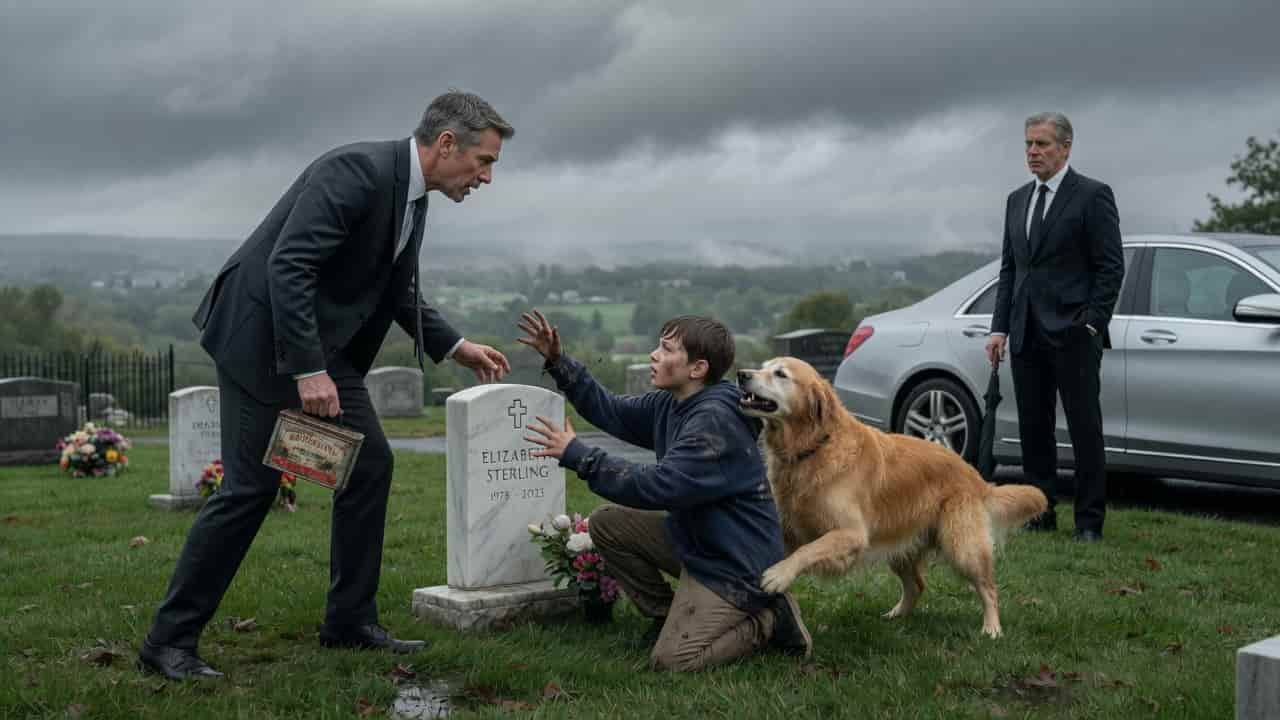
“What are you doing at my wife’s grave?”
Jack didn’t expect an answer. He expected the kid to run. The boy was maybe ten, wearing a hoodie that had seen too many washes and shoes held together by hope. But the kid didn’t move. He just stood there over the fresh dirt of the most expensive plot in Connecticut, holding a rusted tin box like it was made of gold.
Then the dog stepped out from behind a marble angel. A Golden Retriever, gray-faced and limping. Jack’s heart stopped. He’d paid the vet to cremate that dog a decade ago. He’d seen the ashes.
“She told me to bring it,” the boy said, his voice shaking but his eyes locked on Jack’s sharp suit. “She said if she didn’t come back, I had to put it here.”
When Jack snatched the box away, the boy didn’t cry. He just looked at Jack with a terrifying kind of pity. Inside, nestled under a stack of old photos, was a birth certificate. It didn’t list the name of anyone Jack knew from their country club or the firm. It listed his wife as the mother—and the father’s name was a blank space that felt like a hole in the world.
Now, Jack has to decide: does he protect the pristine memory of the woman he loved, or does he listen to the boy who just destroyed his life?
Chapter 1: The Ghost at the Hilltop
The Connecticut mist didn’t care about the price of the wool in Jack’s suit. It settled into the fibers, heavy and damp, turning the charcoal fabric into a cold second skin. Jack stood at the edge of the open plot, his shoes sinking slightly into the soft, expensive turf of the Ridgecrest Cemetery. It was the kind of place where people paid six figures to ensure their silence would never be interrupted by the sound of a highway or the sight of a strip mall.
Elena would have liked the view, he supposed. Or maybe she would have hated it. That was the problem with the last six months—the more Jack looked at the life they’d built, the more it felt like a house he’d rented but never actually lived in.
“A beautiful service, Jack,” Sterling said, stepping up beside him. Sterling was the senior partner at the firm, a man whose voice always sounded like it was being filtered through a glass of expensive scotch. He didn’t look at the grave. He looked at his watch. “The firm is behind you. Take the week. Maybe two. We’ve got the Kensington merger under control.”
“I’m fine, Sterling,” Jack said. His voice was a flat, dry thing. He was a fixer. He spent his days making sure other people’s scandals didn’t end up on the front page. He knew how to compartmentalize. He knew how to treat grief like a line item on a balance sheet.
“You’re a titan, Jack. But even titans need to mourn.” Sterling patted his shoulder, a gesture that was less about comfort and more about checking the structural integrity of his investment.
The other partners were already drifting back toward the fleet of black Audis and silver Mercedes lined up along the winding gravel path. They moved in a phalanx of polished leather and hushed tones, a social machine that knew exactly how much sympathy to deploy before transitioning back to billable hours.
Jack stayed. He wanted to see the dirt hit the lid. He wanted the finality of it. He needed the closure that the paperwork promised but his head refused to acknowledge.
That was when he saw the dog.
It came out from behind a massive granite monument dedicated to a family of railroad magnates. It was a Golden Retriever, but barely. Its coat was matted and dull, and its muzzle was so white it looked like it had been dipped in flour. It walked with a heavy, hitching limp in its hindquarters, each step a visible struggle against the damp grass.
Jack froze. His breath hitched in a way that had nothing to do with the cold.
“Goldie?” he whispered.
It was impossible. Goldie had been Elena’s dog when they first met. A wedding gift to herself. Ten years ago, the dog had developed a mass in its chest. Jack remembered the vet’s office, the smell of antiseptic, the heavy weight of Elena sobbing into his chest. He’d handled the bill. He’d handled the cremation. He’d even picked out the ceramic urn that sat on the mantel in their summer house.
The dog didn’t wag its tail. It didn’t bark. It just sat down ten feet away, its clouded eyes fixed on the mahogany casket.
“Hey!” a voice cracked through the silence.
A boy was following the dog. He couldn’t have been more than ten. He was wearing a navy blue hoodie three sizes too big for him, the sleeves rolled up into thick donuts at his wrists. His jeans were frayed at the hems, soaked through with mud. He looked like he belonged in a grocery store parking lot in a different part of the state, not here, among the silent millionaires.
The boy didn’t see Jack at first. He was focused on a small, rectangular tin box he held against his stomach. He approached the grave with a frantic, bird-like urgency.
“Stop right there,” Jack said, his fixer voice snapping out before he could think.
The boy jumped, nearly dropping the tin. He looked up, his face pale and sharp-featured, his eyes wide with a mixture of terror and defiance. He didn’t run. He looked at the grave, then at Jack, then at the dog.
“Who are you?” Jack asked, stepping toward him.
“I have to put it in,” the boy said. His voice was high and thin, vibrating with a desperate kind of pressure. “She said it had to go in with her.”
“Who said?”
“My mom.”
Jack felt a strange, cold prickle at the base of his neck. “Kid, you’re trespassing. This is a private service.”
Sterling had stopped by his car. He was looking back, his brow furrowed. “Jack? Is there a problem?”
Jack ignored him. He was looking at the dog. The dog was looking at him now, and for the first time, it growled. It was a low, guttural vibration that seemed to come from the earth itself.
“That’s enough,” Jack said, reaching for the boy’s arm.
The boy lunged toward the grave, trying to toss the tin box onto the lowered casket. Jack was faster. He caught the boy by the hood, his fingers tangling in the cheap fabric. The boy spun, kicking out, his sneakers catching Jack’s shins.
“Give it back!” the boy screamed.
“Jack, what on earth is happening?” Sterling was walking back now, his face a mask of pinched annoyance. Behind him, two other partners hovered, their expressions ranging from curiosity to blatant disgust.
“Get a hold of yourself, son,” Sterling said, directed at the boy. “This is a funeral, not a playground. Where are your parents?”
“He’s a gutter-thief, Sterling,” one of the other partners muttered, eyeing the boy’s muddy shoes. “Look at him. Probably looking for jewelry.”
The boy stopped struggling. He stood there, held by the scruff of his neck by a man in a thousand-dollar suit, surrounded by people who looked at him like he was a stain on the carpet. His lower lip trembled, but he didn’t cry. He looked at Jack with a terrifying, adult-like clarity.
“She said you were mean,” the boy whispered. “She said you wouldn’t understand.”
Jack’s hand tightened on the boy’s hoodie. “Who said that? Tell me her name.”
The boy didn’t answer. He looked at the dog. The dog moved then, stepping between the boy and Jack, its lip curled back to show yellowed teeth.
“Jack, let him go,” Sterling said, his voice dropping into that dangerous, corporate-hush tone. “This is a spectacle. The police can handle this. Don’t soil your hands.”
“What’s in the box, kid?” Jack asked, his voice low.
He reached down and snatched the tin from the boy’s hand. It was an old tobacco tin, the kind men used to keep in their sheds. The edges were rusted shut.
“Give it back!” the boy cried, reaching for it.
Jack ignored the witnesses. He ignored Sterling’s mounting outrage. He used his thumb to pry the lid. It resisted for a second, then popped with a sharp, metallic crack.
Inside, there was a stack of Polaroids. They were old, the colors fading into that hazy sepia of the late nineties. The first one showed a younger Elena. She wasn’t wearing the designer pearls or the silk blouses Jack had bought her. She was wearing a flannel shirt, sitting on the tailgate of a rusted pickup truck, laughing. She was holding a puppy. A Golden Retriever puppy.
Jack’s breath left him in a ragged huff.
Under the photos was a piece of paper, folded into a tight square. Jack unfolded it. His hands were shaking now, a fine, rhythmic tremor he couldn’t stop.
It was a birth certificate. State of Connecticut.
Mother: Elena Catherine Thorne.
Father: [Blank].
Child: Leo Silas Thorne.
The date was ten years ago. Almost to the day.
“Jack?” Sterling’s voice was right in his ear now. “What is that? If this boy is trying to extort you, we need to handle it legally. We don’t talk to people like this.”
Jack looked at the paper, then at the boy. Leo. The boy had Elena’s eyes. Not the guarded, polished eyes she’d shown Jack across the dinner table for fifteen years. He had the eyes from the photograph. The eyes of the woman on the tailgate of the truck.
“Is this yours?” Jack asked, holding up the paper.
The boy didn’t answer. He just reached out, his small hand open, waiting.
“Jack, for God’s sake,” Sterling snapped. “Look at the way he’s dressed. Look at that animal. This is a shakedown. I’ll call the precinct. They’ll have them both cleared out in ten minutes.”
“No,” Jack said. He stood up, the paper clutched in his fist. He felt like he was standing on the edge of a tall building, the wind pulling at his clothes, waiting for the first step into the air.
He looked at the dog—the dog he had ‘cremated’ ten years ago. It sat there, ancient and broken, watching him with a weary kind of judgment.
“No police,” Jack said. He looked at the boy. “Where do you live, Leo?”
“I’m not supposed to tell you,” Leo said.
“Jack,” Sterling warned, his voice hardening. “You are representing the firm. This is a public place. Think about the optics. Think about what people will say if they see you fraternizing with… this.”
Jack looked at Sterling. He saw the charcoal suit, the silver hair, the absolute certainty of a man who believed the world could be managed with the right contract. He saw the person he had been an hour ago.
“The optics are dead, Sterling,” Jack said.
He reached into his pocket, pulled out a wad of cash, and handed it to the boy. “Take the dog. Go to the gate. I’ll be right behind you.”
The boy hesitated, looking at the money, then at Jack’s face. He whistled low, a sound that made the dog’s ears twitch. Together, the boy and the ghost-dog began to walk toward the cemetery exit.
“Jack!” Sterling shouted. “If you leave now, if you follow that kid, you are making a massive mistake. We have a board meeting at four. You have a reputation to protect.”
Jack didn’t look back. He followed the boy. Behind him, he could hear the murmurs of the witnesses, the rustle of expensive wool, the sound of his old life trying to call him back. But all he could see was the birth certificate in his hand, and the blank space where a father’s name should have been.
Chapter 2: The Tobacco Tin
The drive away from the cemetery felt like a fever dream. Jack’s Mercedes-Benz hummed with a quiet, expensive precision that seemed insulting in the face of what was happening. In the passenger seat, Leo sat as far away from Jack as possible, his small body pressed against the door. In the back, Goldie lay across the leather upholstery, her heavy, wet-dog scent filling the cabin. Every time the car hit a bump, the dog groaned, a sound of deep-seated joint pain that made Jack’s chest tighten.
“You really thought she was dead?” Leo asked. He was looking out the window at the passing woods of suburban Connecticut.
“I saw the ashes, Leo,” Jack said. “I paid for the box.”
“She said you liked boxes,” the boy whispered. “She said you liked things to be neat.”
Jack gripped the steering wheel until his knuckles went white. “Where are we going?”
“The Pines. Off Route 12.”
Jack knew the area. It wasn’t ‘The Pines’ in the way the developers meant it. It was a trailer park tucked behind a gravel pit, a place the local zoning board had been trying to erase for decades. It was exactly six miles from the gated community where Jack and Elena had lived. Six miles and a different universe.
As he drove, Jack’s mind raced through the last fifteen years. Every business trip Elena had taken to “visit her sister in Maine.” Every weekend she’d spent at the “yoga retreat” in the Berkshires. He’d never questioned it. Why would he? He was the man who fixed other people’s lies; he assumed his own life was the one thing that didn’t need repair. He’d provided the house, the cars, the status. He thought that was the contract.
He pulled into the trailer park. The gravel crunched under his tires, a harsh, abrasive sound. The trailers were a patchwork of rusted aluminum and faded siding, surrounded by leaning fences and overgrown weeds.
“Number 42,” Leo said.
Jack stopped the car in front of a double-wide that had seen better days. The porch was sagging, held up by cinder blocks. A woman was standing there, her arms crossed over a faded sweatshirt. She had a face like a dried apple—wrinkled, tough, and sour.
“Stay here,” Jack told Leo.
He got out of the car. The woman watched him approach with the kind of gaze people usually reserved for process servers or debt collectors.
“You must be the husband,” she said. Her voice was like gravel in a blender.
“I’m Jack Thorne. And you are?”
“Martha. I’m the one who’s been raising that boy while your wife was playing house in Greenwich.”
The word ‘Greenwich’ sounded like an insult coming out of her mouth. Jack felt the first surge of real, hot anger. “My wife was paying you. I found the records. ‘Hush money,’ she called it in her ledger.”
Martha laughed, a short, sharp sound. “Hush money? Is that what you think? That woman spent every spare dime she had on Leo’s treatments. The boy’s got a heart condition, Mr. Thorne. Not that you’d know. You were too busy fixing mergers to notice your wife was stealing from her own jewelry box to keep her son alive.”
Jack felt the ground tilt. “Her son?”
“Our son,” Martha said, her eyes narrowing. “She birthed him. I raised him. That was the deal. She couldn’t bring a kid like him into your world, could she? A fixer’s wife having a kid with a hole in his heart from a father who wasn’t you?”
Jack stepped back, his hand hitting the hood of the Mercedes. The heat from the engine felt miles away. “Who is the father?”
Martha spat on the gravel. “Doesn’t matter now. He’s gone. Same as her. But the bills aren’t gone. And the boy needs his meds.”
Jack looked back at the car. He could see Leo’s silhouette through the tinted glass. The boy was leaning back, petting the dog. The dog he’d thought was ashes. Everything he believed about Elena was dissolving, leaving behind a woman he didn’t recognize.
“How much?” Jack asked.
“How much what?”
“How much to keep this quiet? How much to make sure the boy is taken care of?”
Martha stepped off the porch, her face inches from his. She smelled like cheap cigarettes and laundry detergent. “You think you can just write a check and make him disappear again? Your wife tried that. She spent ten years trying to buy a second life. Look where it got her.”
“I’m a fixer, Martha. It’s what I do.”
“You can’t fix a human being, Mr. Thorne. You can only hide them.” Martha leaned in closer, her voice dropping. “But the neighbors saw your fancy car. And the boy’s already been seen at the cemetery. People talk. They talk about the wealthy Mrs. Thorne and the kid who looks just like her.”
“I’ll sue for extortion,” Jack said, the threat coming out as a reflex.
Martha didn’t flinch. She just smiled, and it was the most terrifying thing Jack had ever seen. “Go ahead. File the papers. But while you’re doing that, I’ll be calling the local news. I’ll tell them all about the boy in the trailer park and the man in the mansion who wants to bury him.”
Jack looked at the rusted tin box he’d left on the dashboard. He thought about Sterling. He thought about the partners. He thought about the reputation he’d spent twenty years building. If this came out, he wasn’t just a widower. He was a fool. A man who didn’t know his own wife. A man whose life was built on a foundation of air.
“I need time,” Jack said.
“Time’s the one thing you don’t have,” Martha said. “The boy needs his appointment in the city tomorrow. And Goldie needs a vet who doesn’t mind a dog that’s legally dead.”
Jack turned back to the car. He opened the door. Leo looked up at him, his expression unreadable.
“Come on,” Jack said.
“Where?” Leo asked.
“My house. Just for tonight.”
“What about Martha?”
“Martha’s staying here,” Jack said, looking at the woman on the porch. “I’m taking the boy. And the dog.”
Martha didn’t move. She just watched them. As Jack backed the Mercedes out of the gravel driveway, he saw her pull a cell phone from her pocket. She wasn’t calling the news. She was calling someone else.
Jack drove in silence, the weight of the tobacco tin sitting in his lap like a live grenade. He had spent his life making sure other people’s secrets stayed buried. Now, he was driving home with his wife’s biggest secret sitting in the passenger seat, and he had no idea if he was the rescuer or the next victim.
Chapter 3: The Class Fracture
The Thorne estate was a fortress of limestone and glass, perched on a ridge that looked down on the rest of the world. As Jack pulled the Mercedes through the wrought-iron gates, the security lights flickered on, bathing the driveway in a cold, artificial white.
Leo was staring out the window, his mouth slightly open. “Is this a hotel?”
“It’s a house, Leo,” Jack said.
“It’s too big,” the boy whispered.
Goldie scrambled out of the back seat as soon as the door opened, her claws clicking loudly on the marble foyer floor. She didn’t look like a ghost anymore; she looked like an intruder. She immediately went to the velvet rug in the center of the hall and began to lick a sore on her paw, the sound wet and rhythmic in the vast, silent space.
Jack watched her. He remembered Elena sitting on that same rug, laughing as she decorated the house for Christmas. Was she thinking about the trailer park then? Was she wondering if Leo had a tree?
“I’ll show you to a guest room,” Jack said, his voice echoing.
“I want to stay with Goldie,” Leo said, his hand buried in the dog’s fur.
“Fine. There’s a sofa in the library. I’ll get some blankets.”
Jack went to the linen closet, his movements stiff and mechanical. He felt like he was playing a role in a play he hadn’t rehearsed. When he returned to the library, he found Leo sitting on the floor next to the dog, looking at the rows of leather-bound books.
“Did she read all of these?” Leo asked.
“Some of them,” Jack said. He realized he didn’t actually know which ones. He’d bought them by the yard to fill the shelves.
He handed the blankets to the boy. Leo took them without a word and began to make a nest for himself on the floor beside the dog. He didn’t ask for food. He didn’t ask for a TV. He just curled up, his small frame disappearing into the shadows of the room.
Jack went to his study and poured a drink. He sat at his mahogany desk and stared at the tobacco tin. He opened it again, spreading the Polaroids out under the desk lamp.
There was one he hadn’t seen before. It was Elena, much older, maybe only a year ago. She was standing in a small kitchen—the kitchen of the double-wide, he realized. She was wearing an apron, and she was laughing as she helped Leo blow out candles on a birthday cake.
The joy in her face was a physical blow. It was a raw, unmanufactured happiness that Jack hadn’t seen in years. With him, she had been elegant. She had been supportive. She had been the perfect partner for a man of his standing. But she had never laughed like that.
The phone on his desk buzzed. It was Sterling.
“Jack. I’ve been thinking about this afternoon. I’ve already spoken to our head of security. If that woman or the boy tries to contact you again, we have a restraining order ready to file. We can have them moved out of that park by Monday. There are ways to handle these types, Jack. Quietly.”
Jack looked at the photo of Elena and the birthday cake. “What if they aren’t ‘those types,’ Sterling?”
“Don’t be naive,” Sterling’s voice was sharp. “You’re grieving. You’re vulnerable. These people smell money like sharks smell blood. That kid is a prop. A well-placed piece of theater. You of all people should know how the game is played.”
“The dog isn’t a prop,” Jack said.
“The dog is an animal. Animals die. New ones look like old ones. It’s an old trick, Jack. Don’t let your emotions cloud your judgment. We have the Kensington merger. We have your career. Don’t let a trailer-park hustle ruin everything.”
Jack hung up without answering. He felt a sudden, violent urge to sweep everything off his desk—the scotch, the lamp, the expensive pens.
He walked back to the library. The room was dark, save for the glow of the security lights outside. He could hear the low, rhythmic breathing of the dog and the shallower, faster breath of the boy.
He sat in the armchair across from them. “Leo?”
“Yeah?” The boy’s voice was tiny in the dark.
“Why didn’t she tell me?”
There was a long silence. The dog shifted, her tail thumping once against the floor.
“She said you were too busy fixing the world to live in it,” Leo whispered. “She said if you knew about me, you’d try to fix me, too. And she didn’t want me fixed. She just wanted me to be.”
Jack closed his eyes. The words felt like a scalpel, cutting through the layers of his pride. He’d spent his life making sure things were perfect, making sure the ‘optics’ were right. And in the process, he’d become a man his own wife had to hide her heart from.
“She loved you,” Leo said. “She just… she had to keep us separate. Like two different books.”
“Which one was the real one, Leo?”
“I don’t know,” the boy said. “But she cried every time she had to drive back to the big house.”
Jack sat in the dark for a long time after the boy fell asleep. He thought about the car accident. The police said she’d drifted over the center line. No brake marks. No signs of a struggle. A “random” tragedy.
But now, Jack wondered. Had she finally run out of room between the two books? Had the weight of the secret finally become too much to carry?
He stood up and walked to the window. In the distance, he could see the lights of the valley. Somewhere down there was the trailer park. Somewhere down there was Martha, and whoever she had called.
He knew what Sterling would do. Sterling would pay the money, sign the NDAs, and have the boy moved to a facility in another state. He would erase the evidence and call it a ‘fix.’
But Jack looked at the boy sleeping on the floor, and for the first time in his life, he didn’t want to fix it. He wanted to know the truth, even if it burned his whole world down.
Chapter 4: The Public Fracture
The next morning, the glass-and-steel lobby of Thorne, Sterling & Vance was a cathedral of corporate power. Jack walked through the front doors, his stride purposeful, but his eyes were tired. Behind him, Leo shuffled in his oversized hoodie, his sneakers squeaking on the polished stone. Goldie followed, her head low, looking overwhelmed by the vast, echoing space.
The receptionist, a woman whose job was to be perfectly polite and entirely invisible, froze. Her gaze darted from Jack to the muddy boy and the limping dog.
“Mr. Thorne?” she stammered. “Mr. Sterling is expecting you in the boardroom. But… the guests?”
“They’re with me, Sarah,” Jack said, not slowing down.
He led them toward the private elevators. As the doors slid shut, he could see the staff whispering. By the time they reached the 40th floor, the news would have traveled through the entire building. The fixer had brought a stray into the inner sanctum.
Sterling was standing at the head of the long mahogany table, surrounded by three other partners and a woman in a sharp navy suit Jack recognized as the firm’s lead litigator. They all stopped talking as Jack entered.
“Jack,” Sterling said, his voice tight. “What is this?”
“This is Leo,” Jack said, gesturing to the boy. “And this is Goldie. They’re staying with me.”
Sterling’s face went from pale to a dangerous shade of red. He stepped away from the table, his eyes fixed on the dog, who was currently sniffing the corner of a $50,000 rug.
“Have you lost your mind?” Sterling hissed, stepping close to Jack. “The Kensington board is coming in an hour. We are finalizing a three-billion-dollar merger. You cannot have… this… in the office.”
“The boy needs a doctor, Sterling. I’m taking him to the specialist we use for the partners’ families. I needed to pick up the files for the merger first.”
“You are not taking that child to our doctors,” Sterling said, his voice rising. “You are going to take him back to whatever hole you found him in, and you are going to let us handle the legal fallout. You are compromising the firm’s reputation. Look at him, Jack! He’s a liability!”
Leo shrank back, his hand gripping the hem of his hoodie. Goldie sensed the tension and let out a sharp, echoing bark that bounced off the glass walls.
“He’s a child,” Jack said, his voice dangerously low. “And he’s Elena’s son.”
The room went dead silent. The litigator dropped her pen. Sterling stared at Jack, his mouth slightly open.
“Elena… had a son?” the litigator whispered.
“Yes,” Jack said. “And for ten years, she kept him hidden because she knew exactly how people like you would look at him. She knew you’d call him a ‘liability.’ She knew you’d try to ‘fix’ him out of existence.”
Sterling recovered quickly, his corporate armor sliding back into place. “If this is true, Jack, then the scandal is even worse than we thought. A secret child? A second life? This destroys your credibility. It destroys the firm’s image of stability. We represent the most powerful families in the country. We can’t have our senior partner tied to a… a trailer-park secret.”
He turned to the boy, his expression twisting into something cruel. “Listen to me, son. You’re going to go with our security team. They’ll take you back to Martha. We’ll make sure your ‘medical bills’ are paid, but you are never to come near this building or Mr. Thorne again. Do you understand?”
Leo didn’t answer. He looked at Jack, his eyes searching for the man who had promised him a place to stay.
“Don’t touch him,” Jack said.
“Jack, be reasonable,” Sterling snapped. “Think about your life. Think about your house, your car, your standing in this city. Is a ten-year-old mistake worth losing all of it? Because I promise you, if you walk out of here with him, you are done. The board will vote you out by noon.”
A security guard appeared in the doorway, a large man in a dark suit who looked ready for a physical confrontation. Sterling nodded to him. “Remove the boy and the animal. Quietly.”
The guard stepped toward Leo. The boy backed away, his heel catching on the rug, and he fell. Goldie immediately lunged forward, her hackles raised, a low, savage growl erupting from her throat.
“I said don’t touch him!” Jack roared.
He stepped between the guard and the boy, his hand slamming into the guard’s chest, pushing him back. The partners scrambled away from the table, chairs scraping loudly.
“You’re making a scene, Jack!” Sterling shouted. “In front of the whole firm! Look at yourself! You’re defending a brat who was born from a lie!”
“The lie wasn’t him, Sterling,” Jack said, his breath coming in ragged gasps. “The lie was us. The lie was this office, and these suits, and the idea that we’re better than the people we ‘fix.’ My wife lived two lives because the one I gave her was a cage. I’m not letting him live in a cage, too.”
He reached down and helped Leo to his feet. The boy was trembling, his face white with terror. Jack looked at the partners, at the expensive art on the walls, at the city skyline visible through the floor-to-ceiling windows. It was everything he’d ever wanted. And it felt like ash.
“I’m resigning,” Jack said.
“You can’t resign,” Sterling scoffed. “You have a contract. You have obligations.”
“I’m done fixing your messes, Sterling. I’ve got my own to deal with.”
Jack turned and walked toward the door. Leo followed, his hand buried in Jack’s jacket. Goldie walked beside them, her limp pronounced but her head held high.
As they walked through the lobby, the silence was absolute. Every employee, every client, every messenger was watching. The fixer was leaving, and he was taking the truth with him.
Just as they reached the revolving doors, a man stepped out from the shadows of the parking garage. It was Detective Reed, the man who had handled Elena’s accident. He looked at Jack, then at the boy, then at the dog.
“Mr. Thorne,” Reed said, his voice gravelly. “I think we need to talk about your wife’s car. I finally got the data from the onboard computer.”
Jack stopped, the cold air of the street hitting his face. “What did it say?”
“She didn’t drift over the line, Jack,” Reed said, his eyes on the boy. “She was run off the road. Someone was chasing her.”
Jack felt the world tilt again. He looked back at the glass tower, where Sterling was watching them from the balcony. The fix wasn’t over. It was just beginning.
“Let’s go,” Jack said to the boy. “We’ve got work to do.”
Chapter 5: The Mechanics of the Chase
The wind off the Long Island Sound didn’t just blow; it searched. It found the gaps in Jack’s coat and the cracks in his composure as he stood in the shadow of his own office building, watching Detective Reed lean against a battered Ford Taurus that looked like it had been through a car wash exactly once in the last decade.
“Get the boy in the car, Jack,” Reed said. He didn’t look at Leo. He looked at the traffic on Atlantic Street, his eyes tracking every black SUV and tinted window that passed.
Jack didn’t argue. He ushered Leo into the back of the Mercedes, the boy’s small hand still clutching the hem of Jack’s charcoal jacket. Goldie scrambled in after him, her joints popping with a sound like dry kindling. Jack shut the door and turned back to the detective.
“What are you telling me, Bill?” Jack asked. He used Reed’s first name for the first time in three years. It was a play for intimacy, a fixer’s reflex, but his voice lacked its usual surgical precision.
Reed pulled a manila envelope from his dash. He didn’t hand it over. He tapped it against his thumb. “The onboard computer on Elena’s car—the BlackBox data—it doesn’t lie. She wasn’t distracted. She wasn’t tired. She was at a full gallop, Jack. One hundred and four miles per hour on a stretch of Route 7 that’s rated for fifty-five. And she wasn’t alone.”
“Who was with her?”
“The proximity sensors picked up another vehicle. Tailgating. Less than three feet from her rear bumper for four miles. Then, at the curve near the quarry, the other car didn’t just clip her. It PIT-maneuvered her. Precision hit. The kind of thing you learn at a tactical driving school, not a suburban high school.”
Jack felt a cold, oily sensation in his stomach. He’d sent three of the firm’s junior associates to tactical driving schools last year. It was a standard perk for the high-level security details the firm provided for its Tier-1 clients.
“Did you get a plate?” Jack asked.
“The bridge cameras caught a glimpse of a black Suburban. No plates. But I ran the VIN on the frame through a friend at the DMV. It’s a ghost car, Jack. Registered to an LLC called ‘Blue Ridge Holdings.’”
Jack’s breath hitched. He knew Blue Ridge. He’d drafted the incorporation papers himself six months ago. It was a shell company designed to hold the private security assets for Thorne, Sterling & Vance. It was the company that paid the salaries of the men Sterling called his “personal facilitators.”
“Jack?” Reed’s voice was cautious. “You know that name?”
“I know it,” Jack whispered. He looked up at the skyscraper he had just walked out of. The glass was dark, reflecting the gray sky, making the building look like a monolithic tombstone. Sterling wasn’t just trying to bury the secret; he was the one who had made the secret necessary.
“I need the car, Bill,” Jack said. “I need to know who was behind the wheel.”
“I can’t give you that yet. But I can tell you this: that car was logged out of a private garage in Stamford at 9:00 PM the night she died. It was logged back in at 11:30 PM with a fresh coat of paint on the front fender. Someone at that garage is on a payroll, and it isn’t the city’s.”
Jack reached into his pocket and pulled out his phone. He had seventeen missed calls from Sterling. One from the firm’s head of security. None from Martha.
“Go home, Jack,” Reed said, finally handing over the envelope. “Lock your doors. I’ll see what I can find out about the garage, but if this goes where I think it’s going, I can’t protect you. Not from the people you work for.”
Jack didn’t go home. He drove. He drove away from the ridge, away from the limestone fortress, and back toward the valley. He needed to talk to Martha. He needed to know what Elena was carrying that night—the thing that was worth a hundred-mile-per-hour chase on a rain-slicked highway.
The trailer park felt different in the fading light. The air was thick with the smell of woodsmoke and damp earth. When he pulled up to Number 42, the porch light was off. The cinder blocks that held up the steps looked like they had shifted.
“Wait here,” Jack told Leo.
“Don’t leave me,” the boy said. His voice was flat, devoid of the panic he’d shown earlier. It was the voice of a child who had already learned that adults were temporary.
“I’m just going to the door. Keep the dog close.”
Jack stepped onto the porch. The door was unlocked. It swung open with a slow, heavy groan. The interior of the trailer was a disaster. The sofa had been ripped open, the yellow foam spilling out like entrails. Drawers were dumped on the floor. The small kitchen table where Elena had presumably sat to help Leo with his homework was overturned.
Martha was gone.
Jack walked into the small bedroom at the back. On the floor, next to a pile of Leo’s clothes, he found a single object that hadn’t been destroyed. It was a small, leather-bound ledger. He opened it.
It wasn’t a record of hush money. It was a diary.
June 12th, the entry read. Jack asked about the jewelry again. I told him I lost the diamond tennis bracelet at the club. I didn’t tell him I traded it for three months of Leo’s beta-blockers. He’s looking at me more lately. Like I’m a case he can’t quite close. I’m scared, Martha. Sterling called the house today. He didn’t ask for Jack. He asked for me. He said he knew about the ‘extra expenses.’ He said a man in Jack’s position can’t afford a distraction like a sick bastard child.
Jack dropped the ledger as if it were white-hot. Sick bastard child. Sterling’s words. Sterling had known. He hadn’t just known; he’d been weaponizing the secret against Elena for months.
“Jack?”
He turned to see Leo standing in the doorway. The boy was looking at the trashed room, his eyes lingering on the overturned kitchen table.
“Where’s Martha?” Leo asked.
“She’s… she’s not here, Leo.”
“Did the bad men take her?”
Jack knelt in the middle of the wreckage. He looked at the boy—the child he’d spent fifteen years not knowing he had. The child his wife had died to protect from the very man Jack called his mentor.
“I don’t know,” Jack said, and for the first time in his professional life, the honesty felt like a physical weight. “But we’re going to find her. And then we’re going to leave.”
“Where?”
“Somewhere the optics don’t matter.”
He stood up and ushered Leo back to the car. As he backed out of the gravel driveway, a pair of headlights appeared at the entrance of the park. A black SUV. It didn’t turn. It just sat there, idling, its high beams cutting through the gloom.
Jack didn’t wait to see who was inside. He slammed the Mercedes into gear and tore across the grass, bypassing the main exit. He knew these roads. He’d spent years scouting them for clients who needed to disappear. He took a back trail that led to a construction site, his tires churning up mud, the expensive suspension of the car screaming in protest.
He didn’t stop until he reached a small, nondescript motel on the edge of the state line. It was a place where people paid in cash and didn’t leave names.
Inside the cramped, wood-paneled room, Jack sat on the edge of the bed while Leo slept in the chair, his head resting on Goldie’s flank. Jack opened the tobacco tin again. He looked at the birth certificate.
Father: [Blank].
He picked up a pen from the nightstand and looked at the space. He thought about Sterling’s voice in the boardroom. He thought about Elena’s laughter in the photo. He thought about the man he had been—the fixer who could make anything go away.
He didn’t write his own name. He wasn’t ready for that. Instead, he wrote one word in the margin of the paper: Witness.
The phone in his pocket buzzed. A text from an unknown number.
The garage is at 440 Canal Street. The SUV is still there. Don’t go alone, Jack.
It was Reed.
Jack looked at the sleeping boy. He realized then that he couldn’t just run. If he ran, Sterling would find them. If he ran, the secret would stay buried, and Elena would just be another statistic on a rain-slicked highway.
He stood up and checked his reflection in the cracked mirror over the dresser. His suit was ruined. His face was lined with a exhaustion that went deeper than bone. He looked like a man who had lost everything.
And for the first time, he felt like he was finally in the right room.
He grabbed the car keys and looked at the dog. Goldie lifted her head, her clouded eyes tracking his movement. She didn’t bark. She just watched him with a weary, knowing patience.
“Stay with him,” Jack whispered.
He walked out into the cold Connecticut night, the sound of the highway a distant, rhythmic hum. He was going to the garage. He was going to find the man who ran his wife off the road. And then he was going to show Sterling what happened when a fixer stopped fixing and started breaking.
The drive to Canal Street was a blur of neon and shadow. The industrial district of Stamford was a graveyard of old factories and shipping containers, the kind of place where silence was a commodity.
He found the garage. It was a low-slung brick building with a rolling steel door and no signage. A single light flickered over the entrance. Jack parked two blocks away and walked the rest of the distance, his footsteps muffled by the damp pavement.
He found a side door that had been left ajar. He slipped inside, the air smelling of oil and fresh paint. In the center of the room, under a single hanging bulb, sat the black Suburban.
The front fender was indeed fresh. The paint was a slightly different shade of black, the gloss too high compared to the rest of the matte body.
Jack walked to the driver’s side window. It was tinted, but he could see a silhouette inside.
He reached for the door handle. It was unlocked.
He pulled it open, expecting a fight, expecting a hired gun, expecting the face of a stranger.
Instead, he found Sterling’s head of security, a man named Vance. He was slumped over the steering wheel, his eyes open and glassy. There was no blood. No sign of a struggle. Just a small, purple bruise at the base of his neck.
A professional hit.
“You’re late, Jack,” a voice said from the shadows.
Sterling stepped into the light. He wasn’t wearing his charcoal suit. He was wearing a Barbour jacket and corduroy trousers, looking like a man out for a weekend in the country. He held a small, silver flask in one hand.
“I told you to go home,” Sterling said. His voice was disappointed, almost fatherly. “I told you we had this under control.”
“You killed her,” Jack said. The words felt thin, inadequate.
“I didn’t kill her, Jack. I tried to stop her. She was going to the D.A. with the Blue Ridge files. She was going to blow the Kensington merger out of the water to get enough money to take that boy to Switzerland for his surgery. She was going to ruin you, Jack. I was protecting you.”
“By running her off a cliff?”
“Vance got carried away. He was supposed to bring her in. But Elena… she always was a runner. She didn’t know when to fold.” Sterling took a sip from the flask. “And now, you’re doing the same thing. You’re holding onto a losing hand, Jack. The boy is a liability. The dog is a ghost. Let them go. We can still fix this.”
Jack looked at the dead man in the car. He looked at the man who had been his mentor for twenty years. He realized that the residue of this night would never wash off. He was standing in the middle of a disaster he had helped build, one billable hour at a time.
“I’m not a fixer anymore, Sterling,” Jack said.
“Then what are you?”
Jack reached into his pocket and pulled out the tobacco tin. He held it up, the rusted metal catching the light.
“I’m a father,” Jack said. “And I’m going to make sure everyone knows what you did to his mother.”
Sterling laughed, a cold, hollow sound. “With what evidence, Jack? A dead security guard? A rusted tin? You’re a corporate lawyer. You know how the world works. Without proof, you’re just a grieving man with a breakdown. The board will have you committed before you can file the first motion.”
“I don’t need a motion,” Jack said.
He reached into the tin and pulled out the final Polaroid—the one he’d found in the trailer. He turned it over.
On the back, in Elena’s precise, elegant handwriting, was a list of dates and account numbers. Blue Ridge Holdings. Off-shore transfers. Payments to a private garage on Canal Street.
“She didn’t just have a son, Sterling,” Jack said. “She had the books. And she gave them to the only person she knew who could never be bought.”
“Who?”
Jack looked at the door. Detective Reed stepped into the garage, his service weapon drawn, his face a mask of cold, professional fury.
“Me,” Reed said.
Sterling’s face finally cracked. The silver flask fell from his hand, clattering against the concrete floor. The sound echoed in the empty garage, a final, metallic period at the end of a twenty-year sentence.
“Jack,” Sterling whispered. “Think about the firm.”
“The firm is dead, Sterling,” Jack said. “I’m just here for the burial.”
He walked out of the garage, leaving Reed to handle the arrest. He didn’t look back at the black SUV or the man who had tried to buy his silence. He walked back to the motel, the cold air feeling like a blessing on his skin.
He had one more thing to fix. And this time, he was going to do it right.
Chapter 6: The Silent Inheritance
The morning after the arrest, the Connecticut sky was a pale, fragile blue. The mist had finally lifted, revealing the sharp, skeletal beauty of the winter trees. Jack sat in the diner across from the hospital, a cup of lukewarm coffee in front of him.
Leo was in the pediatric ward, undergoing the first of a series of tests. Goldie was in the back of the Mercedes, asleep under a pile of blankets Jack had bought at a gas station.
The news was already breaking. TITAN OF THE BAR ARRESTED IN HIT-AND-RUN PROBE. The headlines were a flurry of scandal and speculation, but they didn’t mention the boy. They didn’t mention Elena’s second life. Jack had made sure of that. He’d used the last of his influence to keep Leo’s name out of the press. It was the only fix he didn’t regret.
Detective Reed slid into the booth across from him. He looked like he hadn’t slept in forty-eight hours.
“Sterling’s talking,” Reed said. “He’s trying to pin the whole thing on Vance, but the ledger Elena left… it’s a roadmap, Jack. It’s got everything. The kickbacks, the shell companies, the intimidation tactics. The firm is going to be dismantled by the end of the month.”
“Good,” Jack said.
“What about you?”
“I’m moving. I’ve got a house in Maine. Elena’s sister lives up there. She doesn’t know about Leo yet, but she will. We’re going to give him the surgery. And then we’re going to figure out how to be a family.”
Reed looked at him, his eyes lingering on the way Jack’s hands were shaking. “It’s not going to be easy, Jack. That boy has spent ten years being a secret. He’s going to have questions.”
“I know,” Jack said. “And for the first time, I don’t have the answers. But I’m going to stay in the room until I find them.”
Reed nodded, a short, sharp motion of respect. He stood up and left a ten-dollar bill on the table. “Take care of him, Jack. He’s the only part of her that’s left.”
Jack watched the detective walk away. He thought about the Hilltop cemetery. He thought about the mahogany casket and the expensive turf. He realized that the closure he’d been looking for wasn’t in the dirt. It was in the boy.
He went back to the hospital. He found Leo in a small, sterile room, looking dwarfed by the white sheets and the buzzing monitors. The boy looked up as Jack entered, his face still pale but his eyes clear.
“Am I going to die?” Leo asked.
Jack sat on the edge of the bed. He didn’t use his corporate voice. He didn’t try to manage the situation. He just took the boy’s hand—a small, warm thing that felt like the most important thing he’d ever touched.
“No, Leo,” Jack said. “You’re going to live. We’re going to get you fixed. But not in the way your mom was afraid of. We’re going to make your heart strong.”
“What about Goldie?”
“She’s coming with us. We’re going to a house with a big yard. Near the ocean. She can sleep on the porch and watch the waves.”
Leo looked at him for a long time. “She said you were a man who lived in a box. But you don’t look like a box anymore.”
“I’m not,” Jack said. “I’m just a man, Leo. And I’m sorry it took me so long to find you.”
The boy didn’t say anything. He just leaned forward and rested his head against Jack’s chest. Jack could hear the uneven, fluttering rhythm of Leo’s heart—the silent inheritance that Elena had spent her life trying to protect. It was a broken sound, a fragile sound, but it was real.
Six months later, the coast of Maine was a riot of green and blue. The air smelled of salt and pine, a sharp, clean scent that seemed to scrub the lungs of everything that had come before.
Jack stood on the deck of the small cedar shingle house, watching Leo and Goldie on the beach below. The boy was running—actually running—his laughter lost in the sound of the surf. Goldie was trotting behind him, her limp still there but her tail wagging with a slow, steady rhythm.
The surgery had been a success. The recovery had been long, marked by quiet nights and difficult conversations, but the hole in Leo’s heart was closed.
Jack picked up the tobacco tin from the table. It was empty now. The Polaroids were framed in the hallway. The birth certificate was in a safe-deposit box, now bearing Jack’s name as the father. The ledger had been turned over to the authorities.
He looked at the final object in the tin. A small, silver key. He’d found it in the back of the ledger. It belonged to a safety deposit box in a small town in Vermont.
He’d gone there a month ago. Inside, he’d found a single letter from Elena.
Jack, it began. If you’re reading this, it means the secret is out. I’m sorry. I’m sorry I didn’t trust you enough to let you in. I was so afraid that if you saw the messiness of my life, you’d try to fix it until there was nothing left of the woman you loved. But I see the way you look at the world, Jack. I see the man beneath the suit. I hope you found Leo. I hope you found yourself. Give him the life I couldn’t. Tell him his mother loved him more than she loved the light.
Jack closed the tin. He looked out at the ocean, at the vast, uncaring horizon. He realized that he would always carry the residue of the life he’d left behind. The guilt, the shame, the memory of the woman he’d never truly known. But he also carried the boy.
Leo came running up the steps, his face flushed with the sun, his hair matted with salt.
“Jack! Look!” He held up a smooth, gray stone, its surface polished by the tide. “It looks like a heart.”
Jack took the stone. It was cold and solid in his palm.
“It does, Leo,” Jack said. “It really does.”
He looked at the boy—his son—and for the first time in his life, Jack Thorne didn’t see a problem to be solved. He didn’t see a liability to be managed. He saw a future.
He reached out and ruffled Leo’s hair, the gesture natural and easy.
“Come on,” Jack said. “Let’s go find some more.”
Together, they walked back down to the beach, leaving the boxes and the ledgers and the ghosts behind. They walked into the wind, two people built from the wreckage of a lie, finally finding the truth in the sand.
As the sun began to set, casting long, golden shadows across the water, the dog followed them. Goldie didn’t bark. She didn’t growl. She just walked beside them, a silent witness to the life that had finally begun.
The inheritance was no longer one of silence. It was one of breath, and laughter, and the messy, beautiful reality of a heart that was finally, truly, fixed.