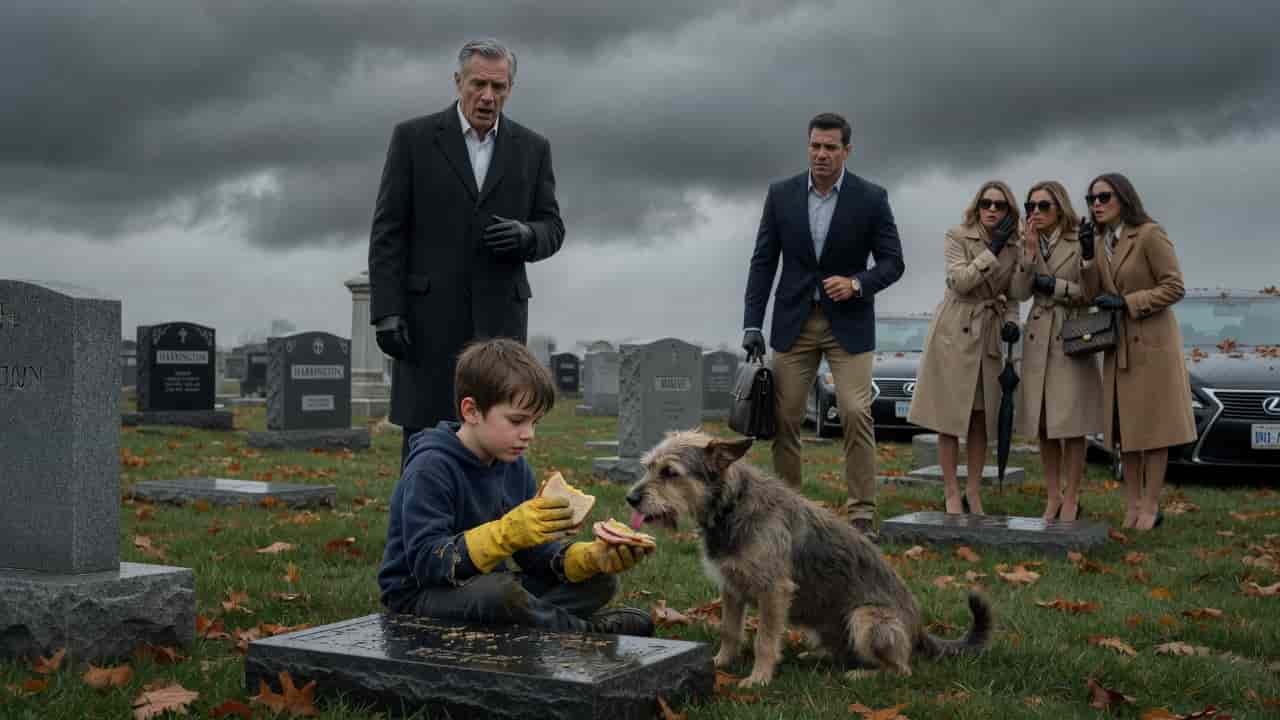
“He’s just a child, Marcus,” I said, but my voice felt thin, like old paper. I was a judge for thirty years. I knew how to control a room, a court, a life. But looking at the boy sitting in the dirt, I felt the bench beneath me start to rot.
“He’s a stray, Dad. Look at him. He’s wearing gardening gloves that don’t fit and he’s feeding a mutt on the spot where we just put Mom to rest. It’s a disgrace.” Marcus stepped forward, his hand reaching for the boy’s hood, ready to drag him out of the cemetery like a piece of trash.
The boy didn’t move. He just looked up, his eyes a color I hadn’t seen in three years—the exact, haunting grey of the daughter I had disowned. He didn’t look at Marcus. He looked at me.
“She said I could stay,” the boy whispered.
The air in the cemetery turned to ice. My wife, Mary, had been gone for two weeks. I thought I knew every second of her final years. I thought she was at the library, at her garden club, at the florist. I never asked why she was buying extra groceries. I never asked why she kept a set of yellow gardening gloves in her car when she hadn’t touched our rosebushes in a decade.
“Who said you could stay?” I asked, my heart hammering a rhythm of pure dread against my ribs.
The boy pointed a dirt-stained yellow finger at the fresh granite headstone. At the name of the woman I had shared a bed with for forty-four years.
The socialites from the Garden Club were watching from the path, their whispers rising like smoke. Marcus was red-faced, desperate to preserve the family name. But all I could see was the DNA test result I’d eventually find tucked inside Mary’s Bible, and the letters I’d written to a daughter I told never to come back.
I had spent my life judging others. Now, the smallest witness was about to take the stand.
Chapter 1: The Silence of the Bench
The air in the house was a physical weight. It was the kind of silence that didn’t just indicate a lack of sound; it was an active force, pressing against the walls, settling into the upholstery of the high-backed Queen Anne chairs, and layering itself over the mahogany surfaces like fine, invisible dust. Frank sat in his study, the room where he had spent three decades weighing the lives of others, and realized that for the first time in his seventy-two years, he had no verdict to deliver.
He looked at his hands. They were steady. They were always steady. That was the hallmark of Judge Frank Sterling—a man of icy composure and absolute, unwavering fairness. But fairness was a cold comfort when the other side of the bed had been empty for fourteen days.
Mary had been the noise of the house. Not loud, but constant. The clinking of a tea stirrer, the rustle of the morning paper, the humming of some nameless tune as she deadheaded the geraniums on the back porch. Without her, the house felt less like a home and more like a museum dedicated to a man who had forgotten how to live in the present.
He stood up, his joints protesting with a dull ache that he refused to acknowledge. He smoothed his charcoal wool trousers and reached for his overcoat. It was Tuesday. Mary liked fresh flowers on Tuesdays. It was a routine he had adopted with the same grim discipline he applied to his morning exercise. He didn’t go to the cemetery to grieve—grief was for people who didn’t understand the finality of the law. He went because it was the correct thing to do.
Driving through the winding, tree-lined streets of Arlington, Frank watched the world move past his windshield with the detachment of a man watching a silent film. The Virginia autumn was in full, bruised glory—deep reds and dying golds. He pulled the Mercedes into the gates of Cedar Grove, a place where the grass was kept at a uniform two inches and the silence was institutional.
He parked near the Sterling family plot, a prime piece of real estate on a gentle rise. As he stepped out, the wind caught his coat, the chill biting through to his ribs. He gripped the bouquet of white lilies—Mary’s favorite—and began the walk up the path.
He saw the boy before he reached the grave.
At first, Frank thought it was a trick of the light, or perhaps some local child who had wandered away from a nearby funeral. The boy was small, no more than six, huddled on the grass right beside Mary’s headstone. He was wearing a navy hoodie that had seen better days, the elbows worn thin and the hem frayed. But it was the gloves that stopped Frank in his tracks.
They were yellow. Bright, garish, oversized gardening gloves, the kind Mary used to wear when she spent hours in the dirt. They were stained with old earth, the fingers flopping uselessly past the boy’s small hands.
The boy was sitting cross-legged, sharing a ham sandwich with a scruffy, wire-haired terrier that looked like it had been assembled from leftovers at a taxidermist’s shop. The dog wagged its tail as Frank approached, but the boy didn’t look up. He was carefully tearing off a piece of crust and handing it to the animal.
“Excuse me,” Frank said, his voice carrying the practiced resonance of the courtroom.
The boy flinched, his shoulders hiking up toward his ears. He turned his head slowly. His face was smudged with dirt, but his eyes—grey, piercing, and startlingly familiar—hit Frank like a physical blow. They were Sarah’s eyes.
Sarah. The name felt like a forbidden word, a legal document he had sealed and buried twenty years ago when his daughter had walked out of the house and into a life he couldn’t approve of. He had told her then, in a voice that didn’t tremble, that if she chose that path, she chose it alone. He had never looked back. He prided himself on that.
“This is a private plot, son,” Frank said, though the ‘son’ felt clumsy on his tongue. He fought the urge to reach out and touch those yellow gloves. He knew those gloves. He had bought them for Mary at the hardware store three years ago. Or had he?
The boy didn’t speak. He just stared at Frank, his small jaw set in a line of stubbornness that was also, painfully, a Sterling trait.
“Who are you?” Frank asked, stepping closer. The lilies felt heavy in his hand.
The boy looked down at the grave, then back at Frank. “I’m Leo,” he whispered. “She said I could stay here.”
“She?” Frank’s heart gave a strange, erratic thump.
“The lady,” Leo said, pointing a yellow-gloved finger at the name Mary Sterling carved into the granite. “She said if I ever got lost, I should come here and wait. She said this was where the quiet was.”
Frank felt the world tilt. Mary. Mary had known this boy. She had given him her gloves. She had told him to wait here. The implications began to cascade through Frank’s mind, a series of logical deductions leading to a conclusion he wasn’t prepared to face.
Before he could speak, the sound of a car door slamming echoed through the quiet. Marcus, Frank’s son, was walking up the path, his stride aggressive and his face set in the permanent mask of irritation he wore like a second skin. Marcus was a man of balance sheets and social standing, a man who viewed his father’s legacy as a ladder and his mother’s passing as a logistical hurdle.
“Dad,” Marcus called out, his eyes already sweeping past Frank to the intruder on the grass. “What the hell is this?”
Frank didn’t answer. He couldn’t. He was still looking at the boy’s eyes, trying to find the lie, trying to find any reason why this child shouldn’t be sitting on his wife’s grave.
“Get this little rat away from my mother’s grave,” Marcus snapped, reaching the plot and looming over Leo. “Is this some kind of joke? Where are your parents, kid?”
Leo shrank back, the terrier letting out a low, protective growl. The yellow gloves clutched the remains of the sandwich as if it were a shield.
“Marcus, leave him be,” Frank said, though it sounded weak even to his own ears.
“Leave him be? Dad, look over there.” Marcus pointed toward the Lexus parked fifty yards away. Three women from the local Historical Society were standing by the car, their heads together, their eyes fixed on the spectacle. “The Millers and the Wentworths are right there. You want the whole town talking about how the Sterling plot has become a hangout for homeless runaways?”
Marcus stepped toward Leo, his hand outstretched to grab the boy’s arm. “Come on, kid. Out. Now.”
“No,” Leo said, his voice small but steady. He looked at Frank, a desperate, silent plea for the fairness the Judge was so famous for. “She told me I belonged here.”
Frank looked at the socialites, then at his son’s reddening face, then at the boy in his wife’s gloves. The silence of the bench was over. The trial had begun.
Chapter 2: The Intruder in Yellow Gloves
Marcus was not a man of subtlety. He was a man of leverage. He saw the world as a series of assets to be managed and liabilities to be liquidated. To him, the boy on the grass was a liability of the highest order—a stain on the carefully curated image of the Sterling family.
“I said move!” Marcus reached down and snagged the fabric of Leo’s navy hoodie.
Leo let out a sharp cry, dropping the sandwich. The terrier snapped at Marcus’s hand, a flurry of brown fur and teeth. Marcus cursed, pulling back, his face turning a dark, dangerous shade of purple.
“You little—” Marcus raised his hand, a briefcase swinging dangerously close to the boy’s head.
“Marcus!” Frank’s voice cracked like a gavel. It was the tone that had silenced rowdy courtrooms for decades. It stopped Marcus mid-swing.
“Dad, he’s a stray. He’s got a mangy dog on Mom’s grave. Do you have any idea how this looks?” Marcus adjusted his navy blazer, his chest heaving. He looked toward the socialites again, who were now openly staring, one of them holding a phone as if contemplating a photo.
Frank stepped between his son and the boy. He felt a strange, cold heat rising in his chest. It wasn’t just anger; it was the sudden, sharp realization that he had been blind. He had spent forty years believing he knew his wife’s heart, but the boy in the yellow gloves was a piece of her life that had existed entirely outside the boundaries of his knowledge.
“Look at his hands, Marcus,” Frank said quietly.
Marcus looked down, his lip curling. “Yeah, he stole some gloves. Big deal. Probably took them out of the shed before the service.”
“Those gloves haven’t been in the shed in three years,” Frank said. “I looked for them last spring when I was moving the mulch. Mary said she lost them at the park.”
He turned back to Leo. The boy was trembling now, his small frame vibrating with a fear he was trying manfully to hide. He had pulled the oversized yellow fingers of the gloves up to his chin, his eyes darting between the two tall, imposing men.
“Leo,” Frank said, softening his voice. It felt like a foreign language. “Where is your mother?”
Leo looked away, his gaze fixing on the dirt beneath his fingernails—dirt that Mary’s gloves were supposed to protect from. “She’s… she had to go away. She said the Judge would know what to do.”
The word ‘Judge’ hit Frank with the force of a physical assault. Sarah had always called him that. Even as a child, when she was upset, she’d say, ‘Is that your final ruling, Judge?’ It had been her way of mocking his rigidity, his inability to just be a father.
“Who is your mother?” Frank asked, his voice barely a whisper.
“Dad, don’t engage with him,” Marcus hissed, stepping closer to Frank’s ear. “This is a scam. Some grifter heard about the funeral and sent their kid here to tug at your heartstrings. It’s a classic play. We need to call the police and have them cleared out.”
“He’s not a grifter, Marcus,” Frank said, his eyes never leaving Leo. “He’s six years old.”
“He’s a prop!” Marcus snapped. “Look at the ladies, Dad. They’re practically calling the Gazette. If we don’t handle this now, the headline tomorrow will be ‘Sterling Family Turns Back on Orphan at Graveside.’ Is that the legacy you want?”
Frank looked at the socialites. Mrs. Wentworth was a woman who lived for the moral failings of others. She had been a friend of Mary’s for years, but Frank knew that loyalty in their circle was a currency spent quickly. If he drove this boy away, he was the cold, heartless judge everyone already suspected he was. If he took him in, he was admitting to a secret that could dismantle the very foundation of his respectability.
“Leo,” Frank said, ignoring Marcus. “Did the lady… did she give you those gloves?”
Leo nodded slowly. “She said they were magic. She said if I wore them, I’d be brave.”
Frank felt a lump in his throat that felt like a stone. Magic. Mary had always been full of those little whimsies, things Frank had dismissed as ‘feminine sentimentality.’ He realized now that those whimsies were the bridge she had built to the world he had burned down.
“She’s gone, isn’t she?” Leo asked, his voice breaking for the first time. “The lady. She didn’t come back to the apartment.”
Frank closed his eyes. The apartment. Mary had told him she was volunteering at the literacy council three afternoons a week. He had never checked. Why would he? He trusted her. Or rather, he trusted the routine he had created for her.
“Yes, Leo,” Frank said. “She’s gone.”
Marcus let out an exasperated groan. “Unbelievable. You’re actually doing this. You’re letting this brat colonize Mom’s memory.” He turned toward the boy, his voice dripping with contempt. “Listen to me, you little parasite. I don’t care what lies you were told. You aren’t staying here. This is our property. Our name. You are nothing to us.”
Leo flinched as if Marcus had struck him. He scrambled to his feet, the terrier barking shrilly. The yellow gloves flailed as he tried to keep his balance. He didn’t run, though. He stood his ground, a tiny, Navy-hoodied sentinel in front of Mary’s headstone.
“She said I was a Sterling,” Leo yelled, his voice cracking with a desperate, childish defiance. “She said I have his nose!”
The silence that followed was absolute. Even the wind seemed to hold its breath. Marcus froze, his mouth hanging slightly open. The socialites in the background were perfectly still, like statues in a garden of secrets.
Frank looked at the boy. He looked at the bridge of the nose, the slight flare of the nostrils, the way the brow hooded the eyes. It was his nose. It was Marcus’s nose. It was the nose that had been carved into the faces of three generations of Virginia jurists.
“Marcus,” Frank said, his voice cold and hard as the granite beside them. “Go back to the car.”
“Dad, you can’t be serious—”
“Go. To. The. Car.”
Marcus stared at his father, the realization finally sinking in that the leverage had shifted. He looked at Leo with a hatred so pure it was almost beautiful, then turned and stalked down the path, his leather briefcase swinging like a weapon he hadn’t had the chance to use.
Frank was left alone with the boy and the dog. He looked at the lilies in his hand. They seemed foolish now. He walked over to the grave and laid them carefully at the base of the stone.
“Leo,” Frank said, turning to the boy. “Show me where the apartment is.”
Leo looked at the yellow gloves, then at the man who looked like the law. He reached out a small, dirt-caked hand—not the glove, but the bare wrist beneath it.
“Okay, Grandpa,” he said.
The word was a sentence. A life sentence. Frank took the boy’s hand and began the long walk toward the truth.
Chapter 3: The Secret Room in Richmond
The drive to the address Leo provided took them into a part of Richmond that Frank hadn’t visited in years—a neighborhood of fading brick row houses and corner bodegas where the streetlights hummed with a low, nervous energy. This was not the Virginia of manicured lawns and legacies. This was the Virginia of the struggle.
Leo sat in the back of the Mercedes, the terrier perched on his lap. The dog was surprisingly quiet, its eyes fixed on the back of Frank’s head. Frank drove in a state of clinical numbness. He was processing evidence. Entry one: The yellow gloves. Entry two: The nose. Entry three: The word ‘Grandpa.’
“It’s the blue door,” Leo said, pointing as they pulled onto a narrow street lined with parked cars that had more rust than paint.
Frank parked. He looked at the house. It was a three-story walk-up, the paint peeling in long strips like dead skin. This was where Mary had been going. While he was presiding over cases of corporate malfeasance and property disputes, his wife had been climbing these stairs.
They walked up to the second floor. Leo pulled a key from a string around his neck—a simple brass key that looked exactly like the one Frank had on his own ring for the garden shed.
The apartment was small, smelling of lavender and old paper. It was clean, but the kind of clean that required constant effort against the encroachment of age. And everywhere he looked, Frank saw Mary.
A knitted throw rug on the sofa that he recognized from their mountain cabin years ago. A set of teacups that had “mysteriously” broken during the move five years prior. A framed photograph of a young Sarah, the one Frank had ordered removed from the house after she left.
“She used to bring cookies,” Leo said, wandering into the small kitchen. “And books. She taught me how to read the big words.”
Frank walked to the small desk in the corner. There was a Bible sitting there, a well-worn leather edition that had belonged to Mary’s mother. He opened it, his hands finally beginning to tremble.
Tucked between the pages of the Book of Job was an envelope. Inside was a single sheet of paper—a DNA test result from a lab in Maryland. Frank didn’t need to read the technical jargon. He saw the names: Leo Sterling Vance and Mary Elizabeth Sterling. Relationship probability: 99.9%.
Beneath the test result were the letters.
Frank felt a cold sweat break out on his forehead. They were his letters. The ones he had sent to Sarah over the years, return-addressed from his office at the courthouse. He hadn’t sent them to offer a hand; he had sent them to document his disapproval.
“Your choices have consequences, Sarah. You have forfeited your place in this family.”
“Do not contact us again until you have rectified your living situation.”
“The law does not recognize sentiment, and neither do I.”
Mary had saved them. She had kept the evidence of his cruelty in the same place she kept her faith.
“Grandpa?”
Frank turned. Leo was standing in the doorway, the yellow gloves still on his hands. He looked so small against the backdrop of the life Frank had tried to erase.
“Where is she, Leo? Where is your mother?”
Leo looked at the floor. “The men in the uniforms came. A long time ago. They said she had to go to the hospital. She told me to wait for the lady. The lady said she was trying to get Mom better, but it was taking a long time.”
Frank realized with a sickening jolt that Sarah wasn’t just gone; she was lost. Likely in the system he had helped build—a system that didn’t have much room for women with ‘lifestyle choices’ and no money. Mary had been the only thing keeping this child from the foster care machine.
He sat down on the small sofa, the lavender scent of his wife rising up to haunt him. He had been a judge for thirty years, and he had never been more guilty.
“She said you were a good man,” Leo said, stepping closer. “She said you were just… busy. Being important.”
Frank looked at the boy. He saw the hope in those grey eyes, a hope that was entirely unearned. He thought of Marcus, waiting back at the house, already drafting the legal maneuvers to protect the estate. He thought of the socialites and the gossip.
“I wasn’t busy, Leo,” Frank said, his voice cracking. “I was wrong.”
He reached out, and for the first time, he touched the yellow gloves. They were rough and cold, but the small hands inside them were warm.
“We have to go,” Frank said. “We can’t stay here.”
“Are we going to see the lady?” Leo asked.
“No,” Frank said, standing up and tucking the DNA results into his coat pocket. “We’re going to find your mother. And then we’re going to go home.”
But as he said the word ‘home,’ Frank knew it wouldn’t be the house in Arlington. Not yet. That house was still full of the man he used to be.
As they walked out of the apartment, Frank noticed a small pile of mail near the door. On top was a notice of eviction. Date: three days ago. Mary had been the one paying the rent. With her gone, Leo had been days away from the street.
The weight of it almost brought Frank to his knees. He had been mourning a wife he didn’t even fully know, while she had been saving the only part of him worth keeping.
He took Leo’s hand and led him down the stairs. The terrier followed, its tail low but steady. As they reached the car, a black SUV pulled up across the street. Marcus.
He hadn’t gone home. He had followed them.
Chapter 4: The Price of a Name
The Virginia Country Club was an fortress of white linen and whispered influence. It was the kind of place where a man’s reputation was his only real currency, and Frank Sterling had been a billionaire in that regard for decades.
Tonight was the Founder’s Dinner. It was a mandatory event for the board, and Frank, as a legacy member, was expected to be there. Usually, he attended with Mary on his arm, the perfect picture of judicial dignity. Tonight, he was walking in alone.
Or so the members thought.
Frank stood in the foyer, the scent of expensive cigars and prime rib thick in the air. He could hear the low hum of conversation from the dining room—the sound of the world he had spent his life protecting.
“Dad, thank God you’re here.” Marcus appeared from the bar, a scotch in his hand and a look of frantic calculation on his face. He leaned in close, his voice a sharp whisper. “I saw you at that… place in Richmond. I don’t know what you think you’re doing, but this has to stop. I’ve already spoken to a friend in Child Protective Services. They can have the boy picked up tonight. Discreetly. No one has to know.”
Frank looked at his son. He saw the navy blazer, the perfectly knotted tie, the ambition that burned like a cold fire in his eyes. He saw himself, thirty years ago.
“The boy’s name is Leo, Marcus,” Frank said. “And he’s not going anywhere.”
“He’s a bastard child of a disgraced daughter!” Marcus hissed, his face reddening. “If this gets out, if people find out you’ve been hiding an illegitimate heir while you were preaching ‘family values’ from the bench, you’re finished. And so am I. I’m up for the partnership at Miller & Finch, Dad. I can’t have this.”
“The truth isn’t a liability, Marcus. It’s a fact,” Frank said.
“It’s a scandal!” Marcus countered. “Look around you. These people don’t want facts. They want stability. They want the Judge Sterling who puts people like that behind bars, not the one who brings them to dinner.”
Frank felt the pressure of the room—the weight of three hundred years of Virginia pride. He knew that Marcus was right about one thing: the moment he stepped through those doors with the truth, the life he had known was over.
“He’s in the car, Marcus. With the dog.”
“In the car?” Marcus nearly choked on his scotch. “You brought him here? To the club?”
“He was afraid to stay at the house,” Frank said. “He thinks the ‘men in uniforms’ are coming for him.”
“They should be coming for him!” Marcus snapped. “Dad, listen to me. I’m your son. Your real son. I’ve done everything you ever asked. I went to the right schools, I married the right woman, I’ve kept the name clean. Don’t throw it all away for a stray kid who probably isn’t even Sarah’s.”
Frank reached into his pocket and pulled out the DNA results. He handed them to Marcus.
Marcus scanned the paper, his eyes darting back and forth. For a second, his composure broke, a flicker of genuine shock crossing his features. Then, he crumpled the paper in his fist.
“This doesn’t change anything,” Marcus said, his voice trembling with rage. “Mom was old. She was grieving. She was manipulated. This wouldn’t hold up in a real court and you know it.”
“It holds up in the only court that matters now,” Frank said.
He turned away from Marcus and walked toward the entrance. He didn’t go into the dining room. Instead, he walked back out the front doors, past the valet who stood at attention.
He reached the Mercedes. Leo was sitting in the front seat, the yellow gardening gloves still on his hands. He looked small and terrified, silhouetted against the bright lights of the club.
“Leo,” Frank said, opening the door. “Come with me.”
“Is it time?” Leo asked, his voice trembling.
“Yes,” Frank said. “It’s time.”
He took the boy’s hand. He didn’t ask him to take off the gloves. He didn’t ask him to hide the dog, which Leo tucked under his arm. Together, they walked back toward the club.
As they reached the foyer, the doors to the dining room opened. The Founder’s Dinner was beginning. The room fell silent as Frank Sterling, the most respected judge in the county, walked in with a dirt-smudged child in oversized yellow gloves and a scruffy terrier.
Marcus was standing by the bar, his face a mask of pure, humiliated horror. Mrs. Wentworth and the socialites from the cemetery were at the head table, their forks frozen halfway to their mouths.
“Good evening,” Frank said, his voice echoing in the sudden, vacuum-like silence. “I’d like to introduce you all to someone.”
He looked down at Leo, then back at the room full of his peers. The residue of thirty years of pride was finally washing away, replaced by a terrifying, beautiful clarity.
“This is my grandson, Leo Sterling,” Frank said, his voice steady and clear. “And he’s finally come home.”
The silence that followed was the loudest thing Frank had ever heard. It was the sound of a legacy shattering. And as he felt Leo’s small, gloved hand tighten around his own, Frank realized that for the first time in his life, he wasn’t just a judge.
He was a witness.
Chapter 5: The Weight of the Gavel
The drive back from the Country Club was a masterclass in atmospheric pressure. Frank sat behind the wheel of the Mercedes, his eyes fixed on the ribbon of dark asphalt illuminated by the headlights, while Marcus vibrated with a silent, kinetic rage in the passenger seat. In the back, Leo had fallen asleep against the door, the scruffy terrier curled into a tight ball against his hip. The yellow gardening gloves were tucked into the boy’s waistband like a trophy of a war that hadn’t ended yet.
“You’ve destroyed it,” Marcus said finally. His voice wasn’t a shout; it was a thin, strangled rasp, the sound of a man watching his life’s savings vanish into a sinkhole. “Thirty years of prestige. The Sterling name. You threw it on the floor for a kid who was eating a ham sandwich on a grave.”
Frank didn’t look at him. He adjusted the rearview mirror, checking on the boy. “I didn’t throw it away, Marcus. I just stopped pretending it was the only thing that mattered.”
“Stop with the Hallmark sentiments, Dad. It doesn’t suit you,” Marcus snapped, his hands gripping the leather of his briefcase so hard the knuckles were white. “The Wentworths are already calling the board. By morning, every person we know will be discussing your ‘unfortunate mental decline.’ They’ll say the grief got to you. They’ll say you’ve lost your grip on reality.”
“Let them,” Frank said. “I’ve spent half my life caring about what people in that room thought. It turns out, most of them don’t think much at all.”
“I have a partnership meeting on Monday!” Marcus’s voice finally broke into a jagged yelp. “I was supposed to be the legacy. I was supposed to be the one who carried the Sterling brand into the next generation. And now? Now I’m the son of the crazy judge who’s raising a Richmond street rat.”
Frank pulled the car into the long, gravel driveway of the Sterling estate. The house loomed ahead, a massive Colonial structure of white brick and dark shutters, looking more like a mausoleum than a home in the moonlight. He killed the engine, but he didn’t get out. He let the silence settle—the real kind of silence, the kind that follows a massive explosion.
“If you move against me, Marcus,” Frank said, his voice dropping into the low, terrifying register he’d used to sentence men to life without parole, “if you try to use my grief or your ambition to take this boy away, I will dismantle you. I know every secret of every firm in this county. I know which judges owe favors and which lawyers hide their receipts. Do not mistake my sudden change of heart for a softening of my spine.”
Marcus stared at him, his mouth agape. For a second, the greedy son looked like the small, insecure boy who had always been terrified of disappointing his father. Then, the mask of corporate entitlement slid back into place. Marcus climbed out of the car, slamming the door with a force that made the windows rattle, and disappeared into the night, his tail-lights screaming red as he sped away in his own vehicle.
Frank sat in the dark for a long time. He felt the cold seeping in through the glass. He felt the weight of the house—the eleven rooms, the antique furniture, the history of a “perfect” family that had been built on a foundation of silence and disowned children.
“Grandpa?”
Leo’s voice was small, thick with sleep. He was rubbing his eyes with the back of a yellow glove.
“We’re home, Leo,” Frank said.
“Is this the lady’s house?”
“It was,” Frank said, getting out and opening the back door. He scooped the boy up. Leo was heavier than he looked, a solid weight of bone and potential. The terrier hopped out, sniffing the manicured grass with a suspicious air. “Now it’s yours, too.”
Inside, the house felt different. The air was still thin, but the presence of the boy changed the geometry of the rooms. Frank led him upstairs to the guest suite—the room that had stayed exactly the same since Sarah was eighteen. He hadn’t let Mary change the wallpaper or the curtains, even after the letters stopped coming. It was a monument to his own stubbornness.
He tucked Leo into the bed, the boy not even waking fully as Frank pulled the heavy wool blankets up to his chin. The dog jumped onto the foot of the bed, circling three times before settling in.
“Where are you going?” Leo murmured.
“I have to make some phone calls, Leo. Go to sleep.”
Frank went downstairs to his study. He poured himself a glass of neat bourbon, but he didn’t drink it. He sat at his mahogany desk and pulled out a leather-bound address book. It was a relic of an era before digital contacts, filled with names of men who held the keys to the city’s darker corners.
He started with Bill Henderson, a retired Chief of Police who owed Frank his career after a messy internal affairs investigation twenty years ago.
“Frank? It’s nearly midnight,” Bill’s voice was gravelly and confused.
“I need to find someone, Bill. And I need it done tonight.”
“Is this about the club? I heard—”
“I don’t care what you heard,” Frank interrupted. “I need the location of Sarah Sterling. She was last seen in Richmond. She likely had a medical emergency or a legal encounter within the last six months. Check the state hospitals, the indigent wards, and the county intake centers. Don’t use the name Sterling. Check for Sarah Vance.”
“Frank, if she’s in the system, it’s not going to be pretty.”
“I know exactly how ugly it’s going to be,” Frank said. “Call me back.”
He hung up and waited. He sat in the high-backed chair, the same one he’d sat in when he wrote those letters to Sarah—those cold, precise legal documents masquerading as fatherly advice. He looked at the shadows on the wall and realized that he had spent his life building a cage out of the law, and now he was trying to pick the lock from the inside.
Two hours later, the phone rang.
“She’s at St. Jude’s County Infirmary,” Henderson said, his voice heavy with pity. “She’s been there for four months. They have her under ‘Jane Doe’ because she refused to give a name when she collapsed at a bus station. A nurse finally identified her from an old ID in a bag she was carrying. Frank… it’s a psych ward. Drug-induced psychosis and severe malnutrition. She’s not… she’s not the girl you remember.”
“Thank you, Bill,” Frank said.
“Do you want me to send a car?”
“No,” Frank said. “I’ll drive myself.”
He didn’t wake Leo. He called a neighbor—a woman who had been Mary’s friend for years, someone who didn’t care about the club gossip—and asked her to come over and sit in the kitchen until he returned.
The drive to the county infirmary was a journey through the consequences of his own judgment. St. Jude’s was a grey, concrete slab of a building on the edge of the city, a place where people went when they had run out of luck and family. It was the physical manifestation of everything Frank had spent his career “cleaning up” from the bench.
He walked through the sliding glass doors, the smell of industrial bleach and unwashed bodies hitting him like a physical blow. The fluorescent lights flickered overhead, casting a sickly green hue on the linoleum.
“I’m here to see Sarah Vance,” Frank said to the tired-looking woman behind the plexiglass.
“Are you family?”
Frank hesitated. For thirty years, his answer would have been a firm, legalistic no. He had disowned her. He had stripped her of the name. He had made her a stranger.
“I’m her father,” Frank said.
The woman looked at him—at the charcoal wool coat, the silver hair, the expensive leather shoes—and then looked at the flickering lights. She sighed and buzzed him through.
The ward was a nightmare of muffled screams and the shuffling of slippered feet. He was led to a small, cramped room at the end of a long hallway. There were two beds, separated by a thin, yellowed curtain.
Sarah was in the bed by the window.
She looked eighty years old. Her hair, once a vibrant, honeyed blonde like Mary’s, was a thin, greyish mat. Her skin was translucent, stretched tight over a skeletal frame. Her eyes were open, staring at the ceiling with a vacant, terrifying intensity.
Frank stood at the foot of the bed. He felt a wave of nausea so strong he had to reach out and grab the metal railing. This was the ‘consequence’ he had written about in his letters. This was the ‘result of her choices.’
“Sarah?” he whispered.
She didn’t move. She didn’t blink.
“It’s Frank. It’s… it’s your father.”
A slow, jagged tremor ran through her hand. She turned her head, her eyes focusing on him with a slow, agonizing effort.
“The Judge,” she rasped. Her voice sounded like dry leaves skittering across a sidewalk. “Did you come… to give me… my sentence?”
Frank felt a crack in his heart so deep he thought he might actually collapse. He walked to the side of the bed and sat on the plastic-covered chair. He reached out to take her hand, but she flinched, pulling her arm away as if his touch were fire.
“I came to take you home, Sarah,” he said.
She let out a short, hysterical laugh that turned into a coughing fit. “Home. There is no home. You burned it. You sent me the ashes in the mail.”
“I was wrong,” Frank said. The words felt like lead in his mouth. “I have Leo. He’s at the house. Mary… your mother… she saved him.”
At the mention of Leo, Sarah’s eyes cleared for a fleeting second. A flicker of the daughter he knew—the stubborn, brilliant, difficult girl—returned to the surface.
“Leo,” she whispered. “Is he… did she… is he okay?”
“He’s wearing your mother’s gardening gloves,” Frank said, a tear finally escaping and tracking through the deep lines of his face. “He’s waiting for us.”
Sarah looked at him, and for the first time in twenty years, the silence between them wasn’t a weapon. It was a bridge.
“He likes… ham sandwiches,” she said, her voice fading. “With the crusts cut off.”
“I know,” Frank said. “I’ll make sure he has as many as he wants.”
As he sat there in the dim, flickering light of the county ward, Frank realized that the residue of his life wasn’t the honors he’d received or the rulings he’d made. It was this broken woman in a stained hospital gown, and the boy waiting in a house that was finally starting to breathe.
He stayed with her until the sun began to bleed through the grime-streaked window. He didn’t leave until he had spoken to the chief of medicine, until he had arranged for a private ambulance and a transfer to a facility that didn’t smell like despair. He used his name, his influence, and his money—not to protect his legacy, but to buy back the soul of his family.
When he finally walked back out to the parking lot, the world felt sharp and cold. He saw Marcus’s car parked at the far end of the lot. His son was sitting inside, watching him through the windshield.
The war for the Sterling name was just beginning. But as Frank climbed back into his Mercedes, he realized he didn’t care about the name anymore. He cared about the people who carried it.
Chapter 6: The Last Verdict
The final week of autumn arrived with a brutal frost that turned the Virginia hills into a landscape of silver and iron. The Sterling estate, once a bastion of silent order, was now a staging ground for a messy, complicated, and deeply human reconstruction.
Sarah had been moved to a private recovery wing at the university hospital, a place of soft carpets and quiet nurses. She was still frail, her mind still prone to wandering into the dark woods of her past, but she was eating. She was sleeping. And she was asking for Leo.
Frank sat in his study, the room now cluttered with Lego bricks and a dog bed that the scruffy terrier had claimed as its primary residence. On the desk, beside the leather-bound law books, sat the DNA results and a stack of legal documents that Marcus had delivered that morning via a courier.
The documents were a formal petition for a competency hearing. Marcus was going for the throat. He was arguing that Frank’s recent “erratic behavior”—the public scene at the club, the acquisition of an “alleged” grandson, and the exorbitant medical expenses for a “stranger”—were evidence of a cognitive decline that required the appointment of a legal guardian. Specifically, Marcus.
“He doesn’t stop, does he?”
Frank turned to see Mrs. Gable, the neighbor who had been helping with Leo. She was holding a tray of tea and looking at the legal papers with a mixture of pity and disgust.
“Marcus was always a boy who liked to win,” Frank said, his voice tired. “I taught him that. I told him that the law is a game of territory. I just didn’t realize he’d try to claim mine.”
“What are you going to do, Frank? The hearing is on Friday.”
“I’m going to do what I’ve always done,” Frank said, standing up and reaching for his coat. “I’m going to present the evidence.”
He spent the next three days in a whirlwind of activity that had nothing to do with the law and everything to do with truth. He visited the library where Mary had volunteered. He spoke to the librarian who had seen Mary and Leo together for three years. He visited the Richmond apartment one last time, collecting the letters, the photos, and a small, hand-drawn map Mary had made for Leo, showing him exactly how to get to the cemetery if he ever got lost.
He didn’t hire a high-priced defense attorney. He didn’t call in favors. He showed up to the courthouse on Friday morning alone, save for a small, manila folder and a sense of calm he hadn’t felt in decades.
The courtroom was small, a private chamber for family matters. Marcus was there, flanked by two sharp-faced lawyers from Miller & Finch. He looked polished, grieving, and entirely full of shit.
“Your Honor,” Marcus’s lead attorney began, “we are here out of a place of deep concern for a distinguished member of our legal community. Judge Sterling’s recent actions suggest a profound detachment from reality, likely exacerbated by the tragic loss of his wife.”
Frank sat at the defense table, his hands folded. He watched Marcus, who wouldn’t meet his eye. He listened as they detailed his “obsession” with the boy, his “unauthorized” use of estate funds, and the “disreputable” nature of the woman he claimed was his daughter.
“Does the respondent wish to speak?” the presiding judge asked—Judge Miller, a man Frank had mentored ten years ago. Miller looked pained, his eyes darting between Frank and the ceiling.
Frank stood up. He didn’t walk to the lectern. He stayed behind the table, grounded by the physical presence of the manila folder.
“I have spent forty years in this building,” Frank said, his voice echoing in the small room. “I have heard every argument for the preservation of property, the protection of reputation, and the letter of the law. I have delivered thousands of verdicts based on those principles. And today, I realized that I have been a very poor judge of what actually matters.”
He opened the folder and pulled out a photograph. It was a polaroid he had found in Mary’s Bible. It showed Mary, Sarah, and a three-year-old Leo sitting on a park bench. They were laughing. They looked like a family.
“This is the evidence Marcus claims doesn’t exist,” Frank said. “This is my wife, who spent the last three years of her life rectifying the cruelty of my silence. She didn’t have a ‘mental decline.’ She had a heart. And she knew that a name is only as good as the people who bear it.”
He turned to look directly at Marcus.
“My son wants you to believe I am incompetent because I have chosen a child over a portfolio. He wants you to believe I am crazy because I have chosen a broken daughter over a clean reputation. If that is the definition of incompetence in this court, then I am guilty as charged.”
He laid the DNA results on the table.
“But the law also recognizes the right of a man to dispose of his own assets as he sees fit. This morning, I signed the deed of the Sterling estate over to a trust. That trust is for the care and education of Leo Sterling Vance and the medical rehabilitation of Sarah Vance. I have retained enough for my own modest needs, and not a penny more.”
Marcus’s face went white. The two lawyers beside him shifted uncomfortably.
“The legacy Marcus is so desperate to protect,” Frank continued, “doesn’t exist anymore. There is no ‘Sterling Empire.’ There is only a house, a boy, and a woman who is trying to find her way back to the light. If Marcus wants to be a guardian, he can start by being a brother. But I suspect he’ll find the salary for that position to be insufficient.”
The courtroom went silent. Marcus stood up, his chair screeching against the floor. He looked at Frank, his face twisted in a mixture of shock and a realization that he had been outplayed in the only arena he understood. He didn’t stay for the ruling. He walked out of the room, his lawyers trailing behind him like discarded shadows.
Judge Miller looked at Frank for a long time. He didn’t say anything for nearly a minute. Then, he picked up his gavel.
“Petition for guardianship is dismissed,” Miller said. “And Frank… it’s good to have you back.”
Frank walked out of the courthouse into a crisp, bright afternoon. The air felt thin and clean. He drove to the hospital to see Sarah. She was sitting up in a chair by the window, her hair brushed, her eyes clearer than they had been in weeks.
Leo was there, sitting on a stool beside her. He was reading to her from a book about dinosaurs, his small voice steady and patient. The yellow gardening gloves were on the table beside them.
“Grandpa!” Leo called out as Frank entered.
“Hello, Leo,” Frank said. He walked over and kissed Sarah on the forehead. She didn’t flinch this time. She reached out and squeezed his hand, her grip weak but certain.
“We’re going to the cemetery later,” Frank said. “To bring Mom some fresh lilies. Do you want to come?”
Sarah nodded. “I think… I think I’d like to say goodbye. Properly.”
That evening, the three of them—and the scruffy terrier—stood by the Sterling headstone. The wind was biting, but nobody seemed to mind. Frank looked at the name Mary Sterling and realized that he finally understood the secret she had kept. She hadn’t been hiding a scandal; she had been preserving a future.
Leo stepped forward and laid a single, bright yellow gardening glove on the base of the stone.
“What are you doing, Leo?” Frank asked.
“She said they were for being brave,” Leo said. “I don’t need them anymore. I have you.”
Frank felt the last of the ice in his chest melt away. He looked at the boy, at his daughter, and at the grey Virginia sky. The Sterling name had been tarnished, the reputation was in ruins, and the money was gone.
He had never felt more like a success.
As they walked back toward the car, the sun dipped below the horizon, casting long, golden shadows across the grass. Frank took Leo’s hand on one side and Sarah’s arm on the other. They moved slowly, a mismatched, battered, and beautiful collection of people who had survived the law and found their way back to the truth.
The silence of the house was waiting for them, but it wouldn’t be the silence of the bench. It would be the silence of a home—messy, loud, and full of the kind of justice that doesn’t need a gavel to be heard.
Frank opened the car door, the terrier jumping in first. He looked back at the cemetery one last time and smiled. The verdict was in. And for the first time in his life, everyone had won.