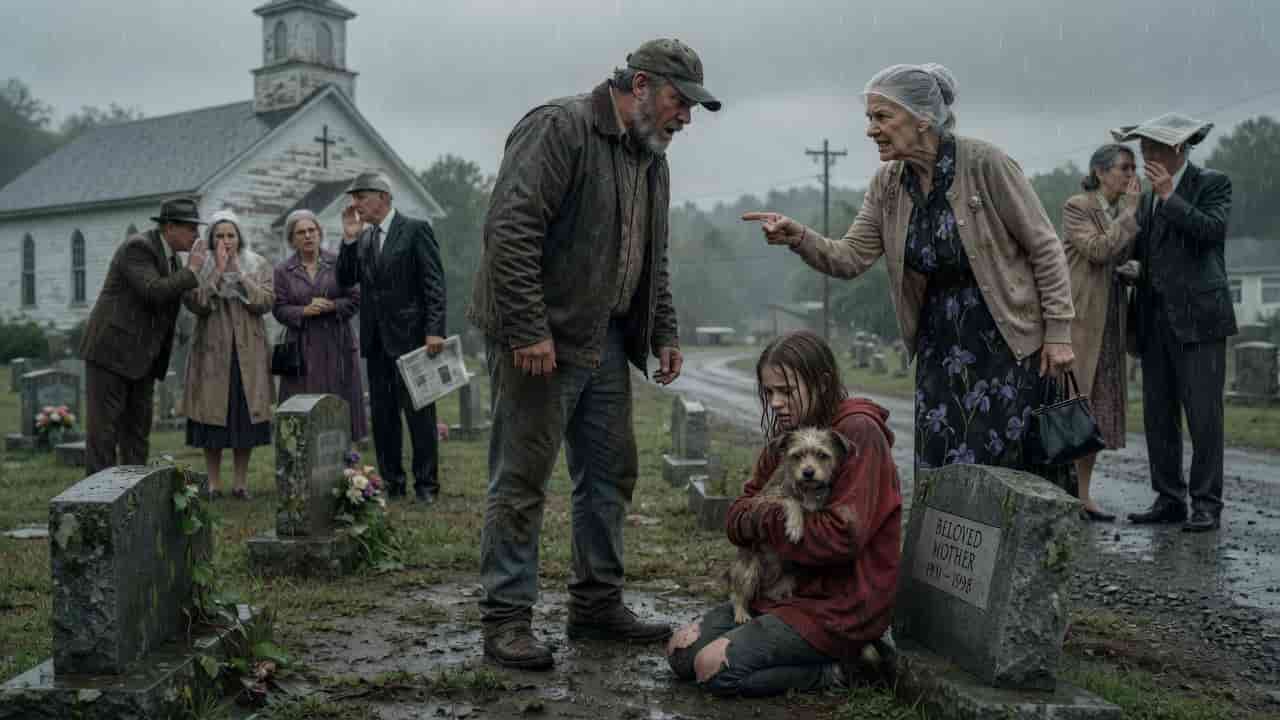
“Get up, you little thief,” the old woman hissed, her voice cutting through the quiet of the church parking lot.
I didn’t know who the girl was. I just knew she had been sleeping on Diane’s grave for two nights, huddled under a red hoodie that looked two sizes too big. She had a dog the size of a loaf of bread and eyes that made my chest ache.
But when Mrs. Gable grabbed that girl by the hair, I didn’t think. I just moved.
“She’s a stray, Mark,” Mrs. Gable shouted, looking at the neighbors who were already gathering to watch the show. “Just like her mother. Sneaking around, taking what isn’t hers. Show them what you have!”
The old woman yanked a silver locket from the girl’s neck. I recognized it instantly. It was the one I’d bought Diane for our fifth anniversary. The one she’d told me she lost in a lake ten years ago.
“Open it,” Mrs. Gable commanded, shoving the locket toward my face. “See whose face is inside. Then tell me if you still want to play hero.”
The whole town was watching. I could see Silas at the diner window, the sheriff by his cruiser, and the ladies from the altar guild. My hands were shaking as I reached for that silver heart. I thought I knew everything about my wife. I thought our only tragedy was the child we never had.
I was wrong.
Chapter 1: The Wet Earth of Blackwood
The dampness in the air always settled in Mark’s knees before the rain actually started. It was a dull, rhythmic throb, a reminder of thirty years spent on scaffolding and the two years since he’d buried Diane. He pulled the black F-150 onto the shoulder of Bluebird Lane, the gravel crunching under the tires with a sound like grinding teeth.
The cemetery wasn’t much—just a sloped acre of Pennsylvania hillside where the grass grew too fast and the headstones leaned away from the wind. He grabbed the small bundle of grocery-store carnations from the passenger seat. Diane had hated carnations, called them “the funeral flower for people who didn’t care,” but they were all the Sunoco station had on Tuesday mornings.
“I’m here, Di,” he muttered, the words catching in the humidity. He stepped over a fallen branch, his work boots sinking into the soft turf.
He didn’t see the girl until he was ten feet away.
She was a splash of violent red against the gray granite of the Miller family plot. She wasn’t just visiting; she was part of the landscape, curled into a tight ball in the lee of Diane’s headstone. A red hoodie, stained with mud and grease, was pulled low over her head.
Mark stopped. His first instinct was the one he used on the job site when a teenager tried to hop the fence: a sharp, authoritative bark to move them along. But then he saw the dog.
It was a scrawny thing, mostly ribs and wiry white fur, tucked into the crook of the girl’s arm. The dog’s ears perked up, and a low, tremulous growl vibrated through its tiny frame.
“Hey,” Mark said, his voice gravelly.
The girl flinched so hard she hit her head against the stone. She scrambled backward, her sneakers slipping on the wet grass. The dog tumbled out of her lap, yapping with a high-pitched, frantic sound that echoed off the trees.
“I’m not gonna hurt you,” Mark said, holding up his hands, the carnations dangling like a peace offering. “You can’t be sleeping here, kid. It’s supposed to pour by noon.”
The girl didn’t speak. She pushed the hood back, and for a second, the breath left Mark’s lungs.
It wasn’t that she was beautiful; she was dirty, her face smudged with soot, her eyes rimmed with the kind of dark circles you only see on people who haven’t slept in a bed for a week. It was the shape of her jaw. The slight upward tilt of her nose. The way her hair—a messy, matted blonde—fell across her forehead.
She looked exactly like a Polaroid Mark kept in his visor, a photo of Diane at seventeen, sitting on the tailgate of her father’s truck.
“What’s your name?” he asked, his heart hammering against his ribs in a way that felt dangerous.
The girl’s throat moved as she swallowed. She reached out and scooped up the dog, holding it like a shield. “Lily,” she whispered.
“You from around here, Lily?”
She shook her head, a quick, jerky motion. She looked at Diane’s headstone—Diane Louise Miller, 1974–2024. Beloved Wife.—then back at Mark. Her eyes were wide, panicked.
“I was just leaving,” she said, her voice cracking.
“Wait,” Mark said. He reached into his pocket and pulled out his wallet. It was a reflex, the way people in Blackwood handled problems—throw a twenty at it and hope it goes away. “You got a place to go? A bus ticket?”
“I don’t need your money,” she said, her voice suddenly sharp, layered with a pride that didn’t match her tattered clothes.
“Look, kid, I’m the foreman for the bridge project down on Route 4. I see people in trouble all day. You’re in trouble.” Mark took a step closer, and the dog bared its teeth. “You look like you haven’t eaten since the weekend. There’s a diner two miles down. Mary’s. Best coffee in the county, even if the eggs are greasy. Come on. I’ll buy you a meal, and we’ll figure out where you belong.”
Lily looked at the truck, then back at the grave. She touched the granite with her fingertips, a gesture so intimate it made Mark flinch. It wasn’t the touch of a stranger. It was a goodbye.
“I don’t belong anywhere,” she said.
“Everyone belongs somewhere,” Mark replied, though as he looked at the empty passenger seat of his truck, he wasn’t sure he believed it himself.
He managed to get her into the truck, mostly because the dog started shivering so hard it looked like it might vibrate apart. He threw his tool bag into the bed to make room. Lily sat as far against the passenger door as she could, the dog—who she called ‘Scraps’—tucked under her chin.
The silence in the cab was thick. Mark wanted to ask a thousand questions. He wanted to ask why she was at Diane’s grave. He wanted to ask who her mother was. But the look on her face was one of absolute, brittle exhaustion. If he pushed, she’d shatter.
He turned the heater on, despite the humidity. The girl didn’t move, but after a few minutes, he saw her shoulders drop an inch.
“Diane was my wife,” he said, staring straight through the windshield.
Lily didn’t look at him. She stared at the glove box. “I know.”
“How do you know?”
“I just did.”
Mark gripped the steering wheel. The residue of the encounter was already starting to coat him. It was a familiar feeling—the same leaden weight he’d felt the day the doctor told them Diane’s ovaries were “non-functional.” The same hollow ache of the years they spent trying to fill a house with furniture because they couldn’t fill it with people.
He pulled into the gravel lot of Mary’s Diner. It was the mid-morning lull, the breakfast crowd gone and the lunch rush an hour away. Only one other vehicle was there—a battered silver sedan Mark recognized instantly.
“Great,” he muttered. “Silas is here.”
Silas was the kind of friend who was more like a scar—something you’d had so long you forgot how you got it, but it still throbbed when the weather changed. They’d worked together for twenty years. Silas knew the truth about Mark and Diane—the fights, the silence, the way Mark had spent the last year of Diane’s life sleeping on the sofa because he couldn’t stand the way she looked at him with those apologetic eyes.
“Listen,” Mark said, turning to Lily. “The man inside… he talks a lot. You just eat. Don’t worry about him.”
Lily finally looked at him. Her eyes were a pale, startling blue. Diane’s eyes.
“Why are you helping me?” she asked.
Mark looked at his hands, calloused and stained with diesel. “Because you’re sitting on my wife’s grave, and you’ve got her face,” he wanted to say.
Instead, he said, “Because I’m a fool for a shivering dog. Now get out of the truck.”
Chapter 2: The Heart in the Locket
The bell above the diner door let out a tinny chime that felt too loud for the empty room. Mary’s Diner smelled of burnt chicory and floor wax. Behind the counter, a woman with a beehive of gray hair and a “Hello, My Name is Martha” tag didn’t even look up from her crossword.
“Table in the back, Mark,” she called out. “I’ll be there when I finish 14-across. Seven letters for ‘unending grief’?”
“Life,” Silas shouted from the corner booth. He had a mug of coffee in one hand and a local paper in the other. He looked up, his eyes narrowing as they landed on Lily. “Well, look what the cat dragged in. And the kitten. And… whatever that rat-thing is.”
Lily bristled, her grip tightening on Scraps. Mark steered her toward a booth as far from Silas as possible.
“Sit,” Mark commanded gently.
“Mark, what are you doing?” Silas asked, sliding out of his booth and sauntering over. He smelled of menthol cigarettes and sawdust. He leaned against the laminate table, staring at Lily with a mixture of curiosity and suspicion. “You picking up strays now? You know the shelter is only open on Thursdays.”
“She was at the cemetery, Silas. Leave it alone.”
Silas’s eyebrows shot up. He looked at Lily again, really looked at her this time. His smirk faltered. He looked at Mark, then back at the girl. The recognition hit him like a physical blow. Silas had been the best man at their wedding. He’d seen Diane in her prime.
“Jesus, Mark,” Silas whispered.
“Martha!” Mark shouted, his voice a little too loud. “Get the kid a burger. A big one. And a bowl of water for the dog.”
Martha looked up, saw Lily, and dropped her pen. She didn’t say a word. She just headed into the kitchen.
Lily sat stiffly, her eyes darting between the two men. She looked like she was ready to bolt through the window. Scraps was shivering again, his little nose twitching at the smell of frying grease.
“Where you from, kid?” Silas asked, his voice losing its edge.
Lily looked at the table. “North. Near the border.”
“You walk all that way?”
“Bus. Then I walked.”
“Why Blackwood?”
Lily didn’t answer. She reached into the front pocket of her hoodie and pulled out a small, crumpled piece of paper. She smoothed it out on the table with a trembling hand. It was a clipping from a newspaper—an obituary. Diane’s obituary.
Mark felt the air leave the room again. “Why do you have that, Lily?”
She didn’t look at him. She reached up to the neck of her hoodie. For the first time, Mark noticed the thin, tarnished silver chain. She pulled out a heart-shaped locket. It was scratched, the silver dull from years of wear, but the filigree was unmistakable.
“She told me to find the man who bought this,” Lily said, her voice barely audible over the hum of the refrigerator. “She said if anything happened, I should go to Blackwood. She said… she said you were a good man.”
Mark reached out, his hand hovering over the locket. He remembered the day he’d bought it. A rainy Saturday in Pittsburgh. He’d spent two weeks’ pay on it, thinking it would make up for the fact that they’d just had their third failed round of IVF. Diane had cried when she opened it. She’d worn it every day for five years.
Then, one day, it was gone. She told him it had slipped off while she was swimming in the lake. He’d spent three days diving in the murky water, searching for it until his lungs burned. He’d eventually given up, bought her a gold one, but she’d never liked it as much.
“Who gave this to you?” Mark asked, his voice a low growl.
“My mom,” Lily said.
“And who is your mother?”
“Her name was Sarah,” Lily said. “Sarah Gable.”
Silas made a sound like he’d been punched in the gut. “Sarah? Martha Gable’s girl? The one who ran off when she was sixteen?”
Mark felt the world tilt. He remembered Sarah. She was Diane’s younger cousin, a wild, quiet girl who lived with her mother, Martha—a woman whose heart was made of vinegar and spite. Sarah had disappeared nearly fifteen years ago. The town gossip was that she’d gone to find a life that didn’t involve her mother’s belt and the stifling air of the Pentecostal church.
“Sarah was Diane’s cousin,” Mark said, his brain trying to bridge the gap. “But… Diane told me she hadn’t heard from Sarah in a decade.”
“They wrote letters,” Lily said. She opened the locket.
Inside, there was no picture of a husband or a boyfriend. On one side was a tiny, faded photo of Diane, laughing, her hair caught in the wind. On the other side was a photo of a newborn baby, wrapped in a hospital blanket.
“My mom died three weeks ago,” Lily said, her voice finally breaking. “The cancer. She told me to stay with Grandma until I could get to you. But Grandma… she said I was a burden. She said I was a mistake that should have been erased. She took my bus money. She took everything.”
Mark looked at the photo of the baby. The date on the back of the locket—the one he’d had engraved—was their anniversary. But underneath it, someone had scratched in a new date. A birth date.
“Sarah didn’t have a kid,” Silas said, shaking his head. “Everyone in town would have known if Martha Gable’s daughter was pregnant.”
“She wasn’t,” Lily said, looking at Mark with a terrifying clarity. “My mom didn’t give birth to me. She just raised me.”
The burger arrived, but nobody moved. Martha stood there, the plate in her hand, her eyes fixed on Mark.
“Mark,” Martha whispered. “Look at the girl. Look at her.”
Mark was looking. He was looking at the way she held her head. He was looking at the mole just above her left eyebrow. He was looking at the girl he’d spent twenty years dreaming of, the one he’d convinced himself was an impossibility.
“Diane went away for three months,” Silas said, his voice dropping to a whisper. “Back in ’10. She said she was helping her aunt in Ohio after a surgery. Remember?”
Mark remembered. He’d stayed behind to finish the warehouse job. He’d talked to her every night on the phone. She’d sounded tired. Distant.
“She told me she couldn’t have kids,” Mark said, the words feeling like shards of glass in his throat. “We went to the doctors. We spent every cent we had.”
“Maybe she couldn’t have them with you,” Silas said, then winced as he realized what he’d said. “I mean… maybe the doctors were wrong. Or maybe…”
“Or maybe she had one, and she was so scared of you leaving her, or so scared of this town, that she gave it to the only person she trusted to keep a secret,” Martha said, setting the plate down with a definitive clack.
Mark looked at Lily. “Is that what Sarah told you? That Diane was your mother?”
Lily nodded. “She said Diane loved me so much she gave me away to keep me safe. From the ‘black dog,’ she called it. She said Diane was always sad, and she didn’t want the sadness to touch me.”
Mark sat back, the vinyl of the booth groaning. The ‘black dog.’ That was what Diane called her depression. The heavy, suffocating cloud that had settled over their marriage after the third year of trying. He’d thought it was about the infertility. He’d thought he was the one failing her because he couldn’t give her a child.
All the while, she’d had one. And she’d given it to a runaway teenager to raise in a trailer park three hundred miles away.
The residue was thick now, a suffocating layer of betrayal and grief. He looked at the girl—his daughter—and felt a wave of such intense, visceral anger that he had to grip the edge of the table to keep from flipping it.
She’d lied to him. For fourteen years. She’d watched him cry in the middle of the night. She’d watched him work double shifts to pay for treatments she knew wouldn’t work because the problem wasn’t her body—it was her soul.
“Mark,” Silas said, his voice cautious. “What are you gonna do?”
Before Mark could answer, the diner door swung open. The chime didn’t just ring this time; it shrieked.
Martha Gable stepped into the room. She was wearing her Sunday best, a dark floral dress that smelled of mothballs and righteous indignation. Behind her stood the local sheriff, a man named Miller who owed his job to the Gable family’s influence.
Mrs. Gable didn’t look at Mark. She didn’t look at Silas. Her eyes locked onto Lily like a hawk onto a field mouse.
“There you are,” she hissed. “You little thief. I should have known you’d come sniffing around here.”
Chapter 3: The Public Shaming
The air in the diner turned brittle. Martha Gable didn’t walk; she marched, her orthopedic shoes clicking like a countdown on the linoleum. She stopped three feet from the table, her shadow falling over Lily. The girl seemed to shrink, her spine curving as she tried to disappear into the red hoodie. Scraps let out a whimper and dove under the bench.
“Martha,” Mark said, his voice low, vibrating with a warning he didn’t even know he had in him.
“Don’t you ‘Martha’ me, Mark Turner,” she snapped. She didn’t look at him. Her gaze stayed fixed on Lily. “Get up. Now. You stole from my house, you ran off like a coward, and you’ve got half the county looking for you.”
“I didn’t steal anything,” Lily whispered, her voice trembling. “It was my mom’s. She said—”
“Your mother was a tramp who died in a gutter!” Mrs. Gable shouted.
The diner went silent. Even the sizzle of the grill seemed to stop. Two construction workers at the counter turned around, their forks halfway to their mouths. Silas stood up, his face hardening.
“That’s enough, Martha,” Silas said. “The kid’s eating.”
“She’s eating on Mark’s dime, just like she lived on my daughter’s lies,” Mrs. Gable said, turning her venom toward the room. She was a woman who lived for the theater of the grievance. “You all see this? This is what happens when you let sin go unpunished. My Sarah runs off, lives a life of filth, and leaves me with this… this remnant.”
She reached out and snatched Lily’s arm, yanking the girl upward. Lily cried out, her sneakers skidding on the floor.
“She’s coming back with me,” Mrs. Gable said to the Sheriff, who was standing awkwardly by the door. “She’s a minor, she’s a runaway, and she belongs to her next of kin.”
“She belongs to me,” Mark said.
He didn’t mean to say it. The words came out of a place he hadn’t explored yet—a raw, bleeding part of his heart that was still processing the betrayal of the last hour. But as soon as he said it, he knew it was the only truth that mattered.
Mrs. Gable laughed, a sharp, barking sound. “To you? You’re nothing to her, Mark. You’re just the man who was too stupid to see what his wife was doing under his own roof.”
She leaned in closer to Lily, her face inches from the girl’s. “You think he wants you? Look at him. He’s a broken-down old man who couldn’t even keep his wife happy. You’re just a reminder of the lie she told him every night for fourteen years. You think he can look at your face without seeing her betrayal?”
Lily’s eyes filled with tears. She looked at Mark, and for a second, he saw the doubt flicker in her expression. The old woman was hitting the exact nerve Mark was already rubbing raw.
“You’re a mistake, Lily,” Mrs. Gable hissed, her voice loud enough for the whole diner to hear. “A shameful secret. Your mother didn’t want you, Diane didn’t want you, and God knows this town doesn’t want you. You’re just a burden with a dead woman’s face.”
She spotted the silver locket hanging from Lily’s neck. Her eyes lit up with a predatory gleam.
“And you stole this, too,” she said, reaching out.
She didn’t just take it; she ripped it. The thin silver chain snapped with a sharp ping. Lily let out a sob, reaching for the heart, but Mrs. Gable held it high, out of reach.
“This is Gable silver,” she said to the room. “Stolen by a girl who doesn’t even have a real name.”
Mark moved.
He didn’t think about the Sheriff. He didn’t think about the fact that Martha Gable was a seventy-year-old woman. He just saw his daughter—the daughter he’d spent half a lifetime mourning—being broken in front of a room full of people he’d known his whole life.
He lunged across the table, his hand clamping onto Mrs. Gable’s wrist. He squeezed, not enough to break bone, but enough to make her gasp.
“Give it back,” Mark said.
“Mark, easy,” the Sheriff said, stepping forward, his hand hovering over his holster.
“Give. It. Back.” Mark’s voice was a low, terrifying rumble.
Mrs. Gable’s face paled, but her eyes remained defiant. “You’re making a mistake, Mark. She’s nothing but trouble. She’s got that Miller blood—weak and deceitful.”
“I said give it back, or I’m going to forget you’re an old woman and start treating you like the bully you are,” Mark said.
Mrs. Gable’s hand shook. She dropped the locket onto the table. It hit the laminate with a dull thud.
Mark didn’t let go of her wrist. He turned his head toward the Sheriff. “Jim, you want to do your job? This woman just assaulted a minor and stole her property in front of five witnesses. You want to take her out of here, or do I need to call the State Police?”
The Sheriff looked at the construction workers. He looked at Silas. He looked at Martha behind the counter, who was holding a heavy glass coffee pot like she was ready to swing it.
“Martha,” the Sheriff said, his voice weary. “Maybe you should head home. Let’s talk about this at the office.”
“I’m not going anywhere without that girl!”
“She’s staying with me,” Mark said. He finally released her wrist. He stepped around the table and put a hand on Lily’s shoulder. She was shaking so hard he could feel it through the thick canvas of his coat. “She’s my wife’s kin. That makes her mine.”
Mrs. Gable straightened her dress, her dignity ruffled but her malice intact. She looked at Lily one last time. “You’ll see,” she said. “You’ll look at her every day and you’ll remember the lie. You’ll hate her for it. And when you do, don’t come crying to me.”
She turned and walked out, the Sheriff trailing behind her like a kicked dog.
The diner remained silent for a long time. The residue of the confrontation was like smoke in the air—acrid and stinging. Mark looked down at Lily. She was staring at the locket on the table, her face a mask of shame.
“Is it true?” she whispered.
“Is what true?”
“That you’ll hate me. Because of the lie.”
Mark looked at her—really looked at her. He saw the way she was holding Scraps, the way her knuckles were white. He saw the girl who had slept on a grave because she had nowhere else to go.
He reached out and picked up the broken locket. He held it in his palm, the silver heart feeling heavy.
“I’ve spent a long time hating things I couldn’t change, Lily,” Mark said. “I’m tired of it. I’m real tired of it.”
He looked at Silas. Silas nodded, a slow, solemn movement.
“Come on,” Mark said, gently nudging Lily. “Let’s get your dog in the truck. We’re going home.”
As they walked out, Mark felt the eyes of the town on his back. He knew this wasn’t over. Martha Gable wouldn’t stop. The gossip would spread through Blackwood like a brushfire. But as he opened the truck door for the daughter he’d never known he had, he felt something he hadn’t felt in two years.
He felt like he had a reason to get up tomorrow morning.
Chapter 4: The Ghost in the Kitchen
The house on Bluebird Lane was a small, neat rancher with a wraparound porch that Mark had built himself. It was a quiet house—too quiet. Since Diane died, the only sounds were the hum of the refrigerator and the occasional creak of the floorboards.
Lily walked through the front door like she was entering a cathedral. She kept her hands tucked into her sleeves, her eyes wide as she took in the framed photos on the walls, the lace doilies Diane had insisted on, and the smell of cedar and stale coffee.
Scraps, sensing the change in environment, jumped out of her arms and began a frantic, sniffing tour of the living room.
“Don’t worry about the dog,” Mark said, tossing his keys onto the counter. “The rugs are old. He can’t do much damage.”
Lily stood in the center of the kitchen. She looked at the stove, then at the empty chair at the small oak table. “This is where she lived?”
“Every day for twenty years,” Mark said. He felt a sudden, sharp pang of guilt. He’d spent the last year of those twenty years being angry. He’d been short with her. He’d stayed late at the site just to avoid the quiet tension of their dinner table.
He walked over to the cabinet and pulled out a box of pasta. He needed to do something with his hands. “You like spaghetti? It’s about the only thing I can cook that doesn’t come out of a microwave.”
“I like anything,” Lily said. She sat down on the edge of the chair—Diane’s chair.
Mark watched her. The resemblance was so jarring it felt like a haunting. It wasn’t just the face; it was the way she tapped her fingers on the table when she was nervous. It was the way she tucked her hair behind her ear.
“Lily,” Mark said, leaning against the counter. “I need to ask you something. And I need the truth.”
The girl stilled. “Okay.”
“Did Sarah… did she tell you why Diane did it? Why she didn’t tell me?”
Lily looked down at her lap. She was quiet for so long Mark thought she wasn’t going to answer. Then, she reached into her hoodie and pulled out a small, tattered envelope. It was addressed to Mark Turner, but it had never been mailed.
“Mom told me to give this to you only if I was sure you wanted me to stay,” Lily said. “She said if you were mean, I should just go to the social workers and keep the letter.”
Mark’s hand trembled as he took the envelope. The handwriting was Diane’s—the loops of the M, the sharp cross of the t. He’d seen it on a thousand grocery lists and birthday cards.
He sat down across from Lily and opened the letter.
Mark,
If you’re reading this, it means I’m gone, and Sarah’s done what I asked. I know what you’re thinking. I know the anger that’s probably burning in your gut right now. You have every right to it.
I didn’t keep her from you because I didn’t love you. I kept her because I loved you too much to see you break. You remember how you were when the first treatment failed? You didn’t eat for a week. You sat on that porch and stared at the hills like you were looking for someone to fight. You wanted to be a father so bad it was killing you.
When I found out I was pregnant—after they told us it was impossible—I was terrified. I thought it was a miracle. But then I saw the way you looked at the bills. I saw the way you looked at me when I cried. I was so depressed, Mark. The ‘black dog’ was always there, waiting. I was scared that if I had the baby, I’d lose my mind. I was scared I’d be like my mother. Cold. Cruel. Breaking everything I touched.
Sarah was leaving. She was young, and she was strong, and she didn’t have the shadow on her that I did. She offered to take the baby. She said she’d give her a life where she didn’t have to watch her mother cry every day. And I let her. I lied to you because I couldn’t bear to see the look on your face if I told you I was giving our daughter away.
Please don’t hate her, Mark. She’s the best part of me. She’s the part of me that isn’t broken. If you can find it in your heart, just look at her. Really look at her. You’ll see the man you were before the silence started.
I’m sorry, Mark. I’m so sorry.
Diane.
Mark finished the letter, the paper fluttering to the table. He felt like he was suffocating. All those years. All that pain. He’d blamed himself. He’d blamed her. He’d let the silence grow until it was a wall between them, a wall that stayed until the day she died.
And all the while, the answer was out there, living in a trailer with a runaway girl.
He looked up at Lily. She was watching him, her eyes wide and wet.
“She wasn’t broken,” Lily whispered. “She was just scared.”
Mark didn’t answer. He couldn’t. He got up and walked to the window, staring out at the darkening hills. The rain was finally starting, a soft patter against the glass.
He thought about the plan he’d had, two years ago. He’d been looking at apartments in the city. He’d been drafting a letter of his own, telling Diane he couldn’t do the silence anymore. He’d been ready to walk away from twenty years of marriage because he thought it was a dead end.
Then she got sick. And he stayed because he was a ‘good man.’ He’d stayed out of duty, not out of love.
The residue of that realization was the heaviest of all. He hadn’t been a hero. He’d just been a man waiting for an exit.
“Mark?”
He turned. Lily was standing behind him. She’d picked up Scraps.
“If you want me to go… I can,” she said. “I can find a bus. Grandma was right. I’m just a reminder.”
Mark looked at the girl—his daughter. He saw the locket he’d bought for a wife he didn’t really know. He saw the child he’d spent a lifetime grieving.
“No,” Mark said, his voice thick. “No more running, Lily. You’re home.”
He reached out, and for the first time, he didn’t just touch her shoulder. He pulled her into a clumsy, awkward hug. She stiffened for a second, then collapsed against him, her small frame shaking with the weight of everything she’d been carrying.
The dog let out a small, muffled bark from between them.
Outside, the storm broke, the rain lashing against the house. But inside, for the first time in fourteen years, the silence was finally gone.
Mark knew it wouldn’t be easy. He knew Martha Gable would be back. He knew the town would talk. He knew he had to figure out how to be a father to a teenager who looked like a ghost.
But as he held his daughter in the kitchen Diane had built, Mark Turner felt the first stirrings of a peace he hadn’t known since he was a boy.
“Let’s get that spaghetti started,” he said, wiping his eyes with his sleeve. “I think the dog’s hungry, too.”
Lily wiped her face and gave him a small, watery smile. It was a start. It was more than a start. It was a life.
Chapter 5: The Weight of Whispers
The morning after the storm brought a sun that was too bright, casting sharp, unforgiving shadows across the kitchen floor. Mark woke up at 5:00 AM, a habit thirty years of construction had hammered into his marrow, but for the first time in two years, he didn’t head straight for the coffee pot in a daze of half-remembered grief. He stood in the hallway, listening.
From behind the closed door of the guest room—the room Diane had once insisted on decorating with pale lavender paint for a “maybe” that never came—he heard a soft, rhythmic thumping. It was Scraps, wagging his tail against the floorboards. Then, the low, muffled sound of a girl’s voice, a drowsy murmur.
Mark retreated to the kitchen, his boots heavy on the linoleum. He felt like an intruder in his own home. He started the coffee, the machine’s hiss and gurgle feeling like a roar in the early morning stillness. He stared at the empty chair where Lily had sat the night before, the chair where she’d handed him a letter that had systematically dismantled everything he thought he knew about his marriage.
The betrayal was a cold thing, sitting right behind his ribs. It wasn’t just that Diane had hidden a child; it was that she had looked him in the eye for fourteen years and watched him mourn a void she knew wasn’t there. He’d spent thousands on doctors. He’d held her while she sobbed after every negative test. And all the while, she’d been writing letters to a runaway cousin, tracking the growth of a daughter she’d deemed him too fragile to know.
“You thought I’d break, Di,” he whispered to the empty room. “But you’re the one who snapped.”
He was halfway through his second cup when Lily appeared in the doorway. She was still wearing the oversized red hoodie, though she’d clearly tried to wash some of the mud off her face. Her hair was a tangled nest, and she looked small—dangerously small—against the doorframe. Scraps trotted out past her, immediately heading for the back door.
“Morning,” Mark said, his voice sounding like gravel being crushed.
“Morning,” Lily replied. She didn’t come into the kitchen. She stayed in the doorway, her hands buried in her sleeves. “I… I can leave if you need to go to work. I don’t want to be in the way.”
“You’re not in the way, Lily. I’m the foreman. I set the schedule. The bridge isn’t going anywhere if I’m an hour late.” He gestured to the table. “There’s cereal. Milk’s in the fridge. Not much else, honestly. I usually eat a breakfast burrito from the gas station.”
Lily walked to the table and sat. She moved with a strange, watchful grace, like a deer sensing a predator in the tall grass. Mark realized with a jolt of shame that she was waiting for the other shoe to drop. She was waiting for the moment the “good man” Diane had described turned into the man Martha Gable said he was—a broken-down old man who couldn’t handle the truth.
“I have to go into town for a few hours,” Mark said, leaning against the counter. “I need to talk to a lawyer. And I need to get you some clothes that actually fit. You can’t keep wearing that hoodie until it falls apart.”
Lily’s hand went instinctively to the broken locket, which she’d tied back together with a piece of black thread. “I like this hoodie. It was my mom’s. Sarah’s.”
Mark felt the sting of that. To Lily, Sarah was the mother. Diane was just the ghost who’d started the story. “I know. But you need more than one shirt, kid. And shoes that don’t have holes in the soles.”
He left her with a bowl of Cheerios and a sense of mounting dread. As he drove his truck down Bluebird Lane toward the center of Blackwood, he could feel the town watching. In a place this small, secrets didn’t just leak; they flooded. By now, everyone from the deacon at the church to the guys at the lumberyard knew that Mark Turner had found a girl on his wife’s grave. They knew about the scene at the diner. And they knew Martha Gable was sharpening her knives.
He pulled up in front of a small brick building with a gold-leaf sign that read Benjamin Vance, Attorney at Law. Ben was an old friend, a man who had handled the closing on Mark’s house and the probate for Diane’s meager estate.
The waiting room smelled of old paper and peppermint. Ben’s secretary, a woman named Mrs. Higgins who had taught Mark in third grade, looked up from her desk. Her eyes were wide, her expression a mix of pity and morbid curiosity.
“He’s in, Mark,” she said, her voice hushed. “Go on back.”
Ben Vance was sixty, with a bald head that caught the morning light and a penchant for expensive ties that didn’t match the dusty reality of Blackwood. He didn’t look up when Mark entered. He was staring at a file on his desk.
“You’ve got a mess on your hands, Mark,” Ben said without preamble.
“I know I’ve got a mess, Ben. I need to know how to clean it.”
Ben sighed and leaned back, his chair creaking. “Martha Gable was here twenty minutes ago. She’s filing for emergency custody of the girl. She’s claiming you’re an unrelated male with no legal standing, and that Lily is a ‘troubled runaway’ who stole heirlooms from her home.”
“She didn’t steal anything. That locket was mine. I bought it.”
“Doesn’t matter who bought it fifteen years ago. Matters who has the title to the property and who the girl belongs to now. On paper, Lily is the daughter of Sarah Gable. Sarah is dead. Martha is the grandmother. In the eyes of the Commonwealth of Pennsylvania, that makes Martha the next of kin.”
Mark felt a surge of heat in his neck. “The girl is Diane’s, Ben. I have a letter. I have a photo of her as a newborn in Diane’s locket. I have the dates.”
“A letter from a dead woman and a grainy photo aren’t a birth certificate, Mark. If Diane gave that baby away and Sarah signed the papers as the mother, the legal trail stops there. To change it now, you’d need a DNA test, a court order to exhume Diane—which no judge in this county is going to grant without a damn good reason—and a mountain of legal fees you don’t have.”
Mark slammed his fist onto the desk. A pen jar rattled. “She’s my daughter, Ben! I spent fourteen years thinking I was a failure because I couldn’t give Diane what she wanted, and the whole time, she was out there. I’m not letting that old woman break her. You saw what she did at the diner. She wants that girl for the Social Security checks and someone to kick when the sun goes down.”
Ben looked at him, his eyes softening. “I know. But the law doesn’t care about ‘should.’ It cares about ‘is.’ If you keep that girl in your house without a court order, Martha can call the Sheriff and have you charged with kidnapping. And Jim Miller will do it, Mark. He’s terrified of the Gables.”
“So what do I do?”
“You play her game. But better. We file a counter-petition for guardianship based on ‘loco parentis’—the idea that you are the de facto father. We use the letter to show Diane’s intent. And we pray to God that Lily is old enough for the judge to ask her what she wants.”
Mark left the office feeling like he was walking through knee-deep mud. He stopped at the local Walmart and bought three bags of clothes—jeans, t-shirts, a warm jacket, and a pair of sturdy boots. He bought a new bedspread for the guest room, one with blue flowers that reminded him of the sky over the ridge.
When he got back to the house, there was a black sedan parked in his driveway.
Two women were standing on his porch. One was a younger woman in a sharp gray suit, clutching a clipboard. The other was Martha Gable.
Martha looked triumphant. She had her arms crossed, her chin tilted up. She looked like she’d already won.
“Mark Turner,” the woman in the suit said. “I’m Sarah Jenkins with County Children and Youth Services. We’ve received a report of an unregistered minor staying at this residence.”
“She’s my kin,” Mark said, his voice tight. He stepped out of the truck, the bags of clothes feeling like lead in his hands.
“Mr. Turner, Mrs. Gable has provided documentation that she is the legal guardian of Lily Gable. We need to see the child.”
“She’s inside,” Mark said, his heart hammering. “And she’s safe. She was sleeping on a grave when I found her. You want to talk about safety? Ask Mrs. Gable why the girl ran away in the first place.”
“I told you,” Martha hissed, pointing a finger at him. “He’s unstable. He’s obsessed with my niece’s memory. He’s using that poor girl to play house.”
The social worker looked at Mark, then at the house. “Mr. Turner, I have to follow protocol. If you don’t let us in, I’ll have to return with the Sheriff.”
Mark looked at Martha. She was smirking. She wanted this. She wanted the spectacle. She wanted the town to see Mark Turner’s house being raided.
“Fine,” Mark said. “But Martha stays on the porch.”
“I have every right—” Martha started.
“You stay on the porch or I lock the door and we wait for the Sheriff,” Mark barked. “And I’ve got three guys from my crew who live on this road. They’ll be here in five minutes to watch you get humiliated when the girl tells the truth.”
Martha bristled, but the social worker nodded. “Stay here, Mrs. Gable.”
Mark led the woman inside. The house was quiet. Too quiet. He walked into the kitchen, his pulse thrumming in his ears. “Lily?”
No answer.
He checked the guest room. The bed was made—the old lavender spread pulled tight. Scraps was nowhere to be seen. He checked the bathroom. Empty.
His heart plummeted. He ran to the back door. It was unlocked, swinging slightly in the breeze.
“Lily!” he shouted, stepping out onto the back porch.
He saw her then. She was at the edge of the woods, crouching near the old creek bed. She’d heard the cars. She’d seen Martha. She was doing the only thing she knew how to do when the world came for her. She was hiding.
“Lily, it’s okay,” Mark said, walking toward her, his hands out. “It’s just a lady from the county. She needs to talk to you.”
Lily looked up, her face pale, her eyes darting toward the house. She was clutching Scraps so hard the dog was gasping. “She’s going to take me back, isn’t she? She’s going to put me in the cellar again.”
The social worker, who had followed Mark out, stopped in her tracks. “The cellar, Lily?”
Lily looked at the woman, then back at Mark. The residue of her life with Martha Gable was written in the way she trembled. “She says I’m dirty. She says I’m like the ‘black dog.’ She says I have to stay in the dark until the sin goes away.”
Mark felt a cold, murderous rage settle over him. He looked at the social worker. The woman’s professional mask had slipped. She looked horrified.
“Mr. Turner,” she said softly. “I think we need to have a very long conversation.”
They spent the next two hours in the living room. Mark sat on the sofa, Lily tucked beside him, Scraps finally asleep on the rug. The social worker took notes, her pen scratching against the paper. Lily talked—not about Diane, but about Sarah. She talked about the trailer in Ohio, about the way Sarah had worked three jobs to keep them fed, and about the day the “sickness” took her mother’s breath away.
She talked about going to Martha’s house. She talked about the belt. She talked about the cold concrete floor of the basement and the way Martha would stand at the top of the stairs and recite verses about the “sins of the fathers.”
“She said I wasn’t even supposed to be born,” Lily whispered. “She said I was a ghost that forgot to die.”
Mark gripped her hand. “You’re not a ghost, Lily. You’re my daughter.”
The social worker looked up. “Legally, Mr. Turner, that’s a complicated claim. But in terms of immediate safety… I cannot in good conscience return this child to Mrs. Gable’s care today. I’m going to file for a temporary protective order.”
When they walked back out to the porch, Martha Gable was still there. She stood up, her eyes narrowing. “Well? Bring her out. We’ve got chores to do.”
“Mrs. Gable,” the social worker said, her voice like ice. “Lily will be staying with Mr. Turner for the time being. We’ll be conducting a full investigation into your home environment. And I suggest you find yourself a very good lawyer, because ‘the cellar’ is a word that tends to interest the District Attorney.”
Martha’s face went from pale to a mottled, ugly purple. She looked at Lily, her eyes burning with a hatred that felt ancient. “You little brat. You think this man wants you? You’re just a reminder of the woman who lied to him every day of her life. He’ll get tired of you. Everyone gets tired of you!”
“Get off my property, Martha,” Mark said. He stepped forward, his bulk casting a long shadow over the old woman. “And if I see your car on this road again, I won’t call the Sheriff. I’ll call the man who built the cellar you’re so proud of and have him testify about the locks you had him put on the outside of the door.”
Martha gasped, her mouth working like a landed fish. She turned and fled to her car, the tires spitting gravel as she tore away.
The silence that followed was different. It wasn’t the heavy, suffocating silence of Mark and Diane’s marriage. It was the quiet after a storm—raw, messy, but clear.
Mark looked at Lily. She was staring at her boots—the old ones with the holes.
“I bought you new ones,” Mark said, gesturing to the bags in the truck. “And some shirts. And a blue blanket.”
Lily looked at him, and for the first time, the blue in her eyes didn’t look like a haunting. It looked like a beginning.
“Thank you, Mark,” she said.
“Dad,” Mark said, the word feeling strange and heavy in his mouth. “You can call me Dad, Lily. If you want.”
She didn’t say it. Not yet. But she didn’t walk away either. She just stood there in the sun, holding her dog, while the whispers of Blackwood began to fade into the sound of the wind through the pines.
Chapter 6: The Bluebird’s Song
The hearing was held on a Tuesday, exactly one month after Mark had found Lily in the cemetery. The courthouse in Blackwood was a Victorian monstrosity of dark wood and high ceilings, a place where the air felt like it had been trapped since 1950.
Mark sat at the petitioner’s table, wearing the suit he’d bought for Diane’s funeral. It felt tight across the shoulders, a reminder of how much of himself he’d tried to shrink over the last two years. Beside him sat Ben Vance, shuffling papers with a rhythmic, nervous energy.
Across the aisle, Martha Gable sat with a lawyer from the city—a man in a three-thousand-dollar suit who looked like he’d rather be anywhere else. Martha was dressed in black, her face a mask of tragedy and wronged grandmotherhood. She’d spent the last month spreading rumors that Mark was a drunk, that he was “unfit,” and that he’d coerced Lily into lying about the cellar.
The gallery was full. Half the town had shown up. Silas was in the front row, his trucker hat in his lap, looking like he was ready to jump the railing if things went south.
Judge Halloway was a man who looked like he’d been carved out of an oak stump. He didn’t like drama, and he didn’t like his courtroom being used for small-town vendettas. He peered over his glasses at the two tables.
“This is a hearing for the permanent guardianship of Lily Gable,” Halloway began. “Mr. Turner, you are requesting guardianship based on a claim of biological paternity and ‘loco parentis’ status. Mrs. Gable, you are requesting custody as the legal next of kin.”
The city lawyer stood up. “Your Honor, Mr. Turner’s claim is based on hearsay and a letter that has not been authenticated. There is no biological proof. My client is the child’s grandmother. She is a pillar of this community—”
“I’ve lived in this community sixty years, counselor,” Halloway interrupted. “I know who Martha Gable is. Sit down.”
The judge turned his attention to Mark. “Mr. Turner. You have anything to say before I hear from the social worker?”
Mark stood up. His knees popped, the sound echoing in the silent room. He looked at the judge, then at the gallery, then finally at the small door at the side of the room where Lily was waiting.
“Your Honor,” Mark started, his voice steady. “I’m not a man of many words. I’ve spent my life building things. Bridges, warehouses, houses. I know how to look at a foundation and tell if it’s going to hold. For twenty years, I thought the foundation of my life was a lie. I thought I was a man who couldn’t have a family. I thought my wife didn’t trust me enough to tell me the truth.”
He paused, glancing at Martha, who was staring at him with pure, unadulterated venom.
“I was wrong,” Mark continued. “Diane didn’t keep Lily from me because she didn’t trust me. She kept her because she was scared. She was scared of the ‘black dog’ that lived in her family. She saw what Martha Gable did to Sarah. She saw how that house was a place where joy went to die. She gave her daughter away to save her. It was the bravest thing she ever did, and I was too blind to see it.”
A murmur went through the room. Mark ignored it.
“I don’t have a birth certificate,” Mark said, his voice dropping an octave. “But I have a month of mornings. I have the way that girl looks at the hills exactly like her mother did. I have the way she trusts me to keep the lights on at night because she’s spent too many years in the dark. You can call it whatever you want in a law book, but that girl is mine. And I’m not letting her go back to a place where she’s treated like a sin.”
“Your Honor!” the city lawyer shouted. “This is emotional grandstanding!”
“Quiet,” Halloway said. He looked at Mark for a long moment, then nodded. “Bring in the child.”
Lily walked in, escorted by Sarah Jenkins. She was wearing a new blue dress Mark had bought her, her hair braided neatly. She looked older than fourteen. She looked like a woman who had already survived a war.
She didn’t look at the gallery. She didn’t look at Martha. She looked straight at Mark. He gave her a small, tight nod.
The judge spoke to her for twenty minutes. He asked her about Sarah. He asked her about Martha. He asked her about the house on Bluebird Lane. He didn’t ask her about the “black dog” or the letters. He asked her where she felt safe.
“With him,” Lily said, pointing to Mark. Her voice was clear, ringing through the vaulted room. “He bought Scraps a bed. And he listens to the wind with me. He doesn’t make me hide.”
Halloway leaned back. He looked at Martha Gable. “Mrs. Gable, I’ve reviewed the report from Children and Youth Services. The description of your basement is… troubling. The fact that you failed to report the child’s mother’s death to the state for three months while continuing to collect her disability checks is even more troubling.”
Martha’s face went white. She opened her mouth to speak, but her lawyer grabbed her arm, shaking his head.
“This court finds that it is in the best interest of the minor that she remain in the care of Mark Turner,” Halloway announced. “I am granting Mr. Turner permanent legal guardianship. As for the paternity claim, I’m ordering a DNA test to settle the matter for the record. But regardless of the results, Lily stays where she is.”
The gavel hit the desk with a sound like a thunderclap.
The room erupted. Silas was cheering. Martha Gable was being ushered out by her lawyer, her face twisted in a silent scream of rage. Mark felt the breath rush out of him, a weight he’d been carrying for half a century finally falling away.
Lily didn’t run to him. She walked, her steps deliberate. When she reached him, she didn’t say anything. She just wrapped her arms around his waist and buried her face in his suit jacket.
Mark held her, his large, calloused hands resting on her shoulders. He felt the residue of the past—the grief for Diane, the anger at the years lost, the shame of his own failures. It was still there. It wouldn’t ever truly go away. But it was no longer the only thing he had.
They drove home in silence. The afternoon sun was setting over the ridge, turning the trees into silhouettes of gold and orange. When they pulled into the driveway, Scraps was waiting at the window, his tail a blur.
Mark stepped out of the truck and looked at the house. It was just a small rancher on a dirt road. But it didn’t feel empty anymore.
“Hey, Lily,” Mark said as she climbed out.
“Yeah?”
“We need to go back to the cemetery tomorrow. To see your mom. Both of them.”
Lily nodded. “I’d like that.”
They walked onto the porch together. Mark stopped at the door, looking out at the valley. He could hear a bird singing somewhere in the pines—a bluebird, high and clear.
“You okay, Dad?” Lily asked.
Mark smiled—a real smile, one that reached his eyes and stayed there. “Yeah, Lily. I’m okay.”
The residue remained—the ghosts of Sarah and Diane, the whispers of the town, the scars of the cellar. But as Mark opened the door and let his daughter inside, he knew that the foundation was finally solid. The black dog was gone, chased away by the light of a truth that had been fourteen years in the making.
He followed her into the kitchen, the sound of the bluebird’s song following them in, and for the first time in his life, Mark Turner wasn’t just building a house. He was finally living in a home.