“Where did you get this?”
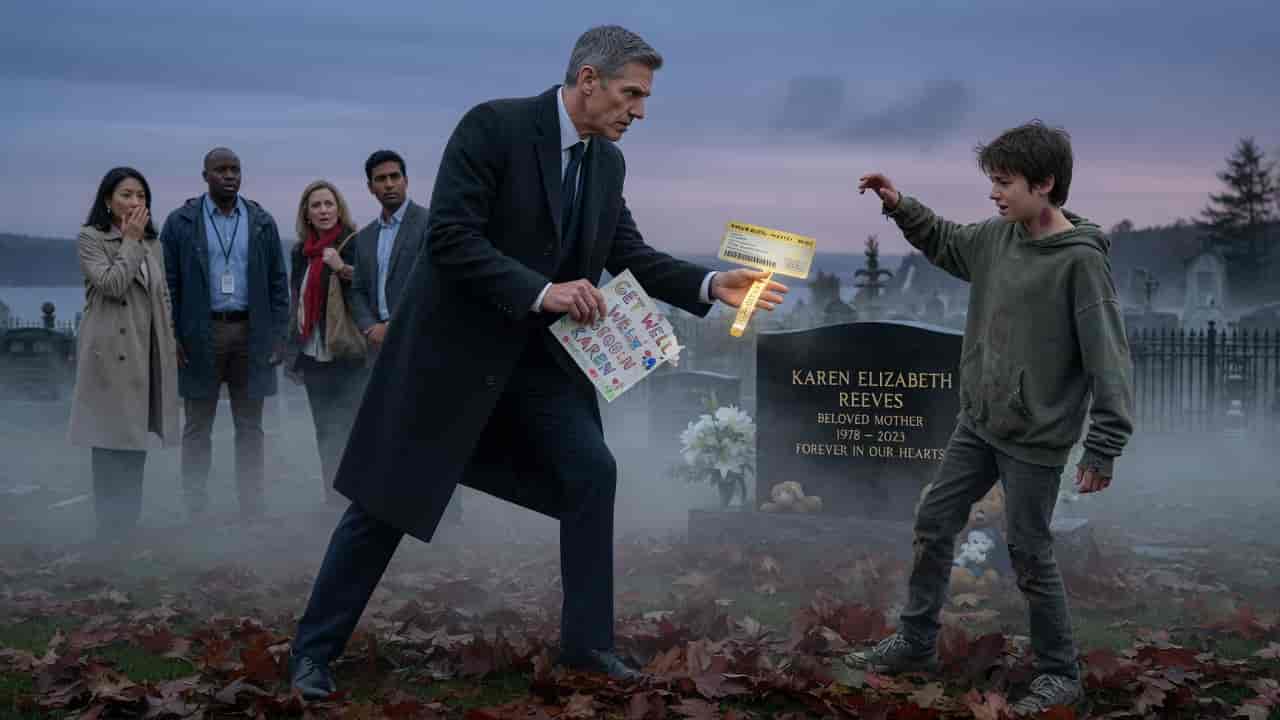
Thomas’s voice was a scalpel, cutting through the cemetery mist with a precision that made the medical residents behind him flinch. He didn’t care that they were watching. He didn’t care that he looked like a madman, looming over a scruffy twelve-year-old boy in a frayed hoodie.
All he saw was the card in the boy’s hand—and the faded hospital ID bracelet Thomas was clutching in his own.
“It’s for the lady,” the boy whispered, cringing back against the cold granite of Karen’s headstone. “Please, sir. I just wanted to leave it for her.”
“You don’t belong near her,” Thomas spat, his hand snapping out to snatch the crumpled paper. “You don’t belong in this zip code. Now, tell me who gave this to you before I call the deputies.”
Thomas had spent a decade as the most respected thoracic surgeon in the state. He dealt in facts, in biology, in the cold truth of the operating room. But the DNA test sitting on his desk at home had just informed him that the daughter he’d buried years ago wasn’t his—and the boy standing in the mud, being treated like a gutter rat, had the exact same birthmark Thomas carried on his own neck.
The residents stood frozen, watching their mentor humiliate a child who had nothing. They didn’t know about the switch. They didn’t know about the secret Karen took to her grave. They only saw a powerful man breaking a boy who was just trying to say goodbye.
Chapter 1
The rain in Portland, Maine, didn’t fall so much as it drifted, a fine, saline mist that clung to the wool of Thomas’s overcoat and the polished mahogany of the casket. As a surgeon, Thomas appreciated the physics of the weather. It was predictable. It followed the laws of pressure and temperature. Unlike the crowd gathered around the open grave, the mist didn’t perform. It didn’t pretend to be more than it was.
Thomas stood at the head of the site, his posture a masterpiece of clinical restraint. People expected a widower to collapse, or at least to sag under the weight of “unbearable grief,” but Thomas remained upright, his hands clasped behind his back. He looked less like a mourning husband and more like a Chief of Surgery reviewing a particularly difficult case.
Karen was gone. Cancer, the great entropic engine, had finally finished its work. For eighteen months, Thomas had watched her cells betray her, a slow-motion biological coup that no amount of his professional influence could stop. He had spent his career fixing the broken machinery of the human chest, but Karen’s failure had been systemic, a quiet, cellular rebellion.
“She was a saint, Thomas,” a woman whispered, squeezing his elbow. It was Sarah, Karen’s sister. Her eyes were puffy, her makeup a smeared map of performative distress.
“She was a human being, Sarah,” Thomas replied, his voice flat. “Let’s not overcomplicate the biology.”
Sarah flinched, withdrawing her hand as if he’d burned her. Thomas didn’t care. He was tired of the adjectives. Sweet. Kind. Devoted. None of those words described the woman he’d lived with for twenty years. They described a character in a play. The real Karen had been a woman of sharp silences and hidden corners, a woman who had, in the final weeks of her life, looked at him with a brand of terror that didn’t seem to belong to the fear of death.
As the priest droned on about heavenly mansions, Thomas’s eyes wandered. He wasn’t looking at the flowers or the weeping friends. He was looking at the tree line, where the cemetery met the dense, scrubby woods that bordered the coastal road.
There, standing partially obscured by a leaning oak, was a boy.
The boy looked to be about twelve. He was wearing an olive-green hoodie that was at least two sizes too large, the sleeves swallowing his hands. He stood perfectly still, his gaze fixed on the casket with an intensity that felt jagged and wrong. This wasn’t a neighbor’s kid or a distant relative. Thomas knew every branch of their sparse family tree, and this boy wasn’t on it.
Thomas adjusted his glasses. He felt a strange, cold prickle at the base of his skull. The boy’s face was pale, almost translucent in the gray light, but it was the posture that struck him. The boy stood with his shoulders squared and his chin tucked—a mirror image of Thomas’s own defensive stance.
Then, the boy moved. He raised a hand to push a lock of dark hair away from his face, and for a fleeting second, the mist cleared.
Thomas felt the air leave his lungs. On the side of the boy’s neck, just below the jawline, was a small, irregularly shaped red birthmark. A strawberry hemangioma.
Thomas reached up instinctively, his fingers brushing the exact same mark on his own neck, hidden beneath his silk tie.
“Thomas? It’s time.” Sarah was tugging at his sleeve again. The service was over. People were moving toward their cars, their heads bowed against the thickening rain.
“Who is that?” Thomas asked, pointing toward the oak tree.
Sarah squinted through the mist. “Who? I don’t see anyone, Thomas. It’s just the trees.”
Thomas looked back. The spot beneath the oak was empty. The boy was gone, leaving nothing behind but the gray curtain of the Maine afternoon.
“You’re exhausted,” Sarah said, her voice softening into that patronizing tone people used for the bereaved. “Come back to the house. We have the catering set up. You need to eat.”
“I have rounds in the morning,” Thomas said.
“Thomas, your wife was buried twenty minutes ago. The hospital can survive one day without you.”
“The hospital operates on schedules, Sarah. Not on sentiment.”
He walked away before she could respond, his polished shoes crunching on the gravel path. He didn’t go to the house. He didn’t go to the reception where people would drink cheap sherry and trade curated memories of a woman they barely knew.
He drove back to their house in Cape Elizabeth, a sprawling, glass-fronted fortress overlooking the Atlantic. The house felt like a museum now—clean, cold, and filled with objects that no longer had a function. He walked into the kitchen and saw a half-empty soda can on the counter. It was a brand Karen never drank. It was generic, cheap stuff.
He stared at the can. He remembered seeing it yesterday, sitting near the back door. He’d assumed one of the hospice nurses had left it.
He picked it up. His hands, usually as steady as stone, had the slightest tremor. He looked at the rim of the can. There was a faint smudge of dried saliva.
Thomas was a man of science. He didn’t believe in ghosts, and he didn’t believe in coincidences. He believed in data.
He walked down to his basement office, where a small, high-end medical refrigerator hummed in the corner. He opened a drawer and pulled out a sterile buccal swab kit—something he kept for occasional research projects.
He carefully swiped the rim of the soda can, capturing the biological residue. Then, he sat at his desk and opened a hidden file on his computer.
Years ago, when their daughter Julie was born, there had been a complication. A rare genetic blood disorder. Thomas had been the one to catch it—his analytical mind seeing the patterns the pediatricians missed. Julie had lived for only six months, her tiny body failing in a sterile plastic bassinet while Thomas watched, helpless for the first and only time in his life.
Karen had never recovered. She’d become a shadow, a woman who moved through the world as if she were already half-buried. Thomas had buried his grief in the surgical theater, cutting into other people’s chests to avoid feeling the hollow space in his own.
But something had always nagged at him. A clinical inconsistency. Julie’s blood type hadn’t quite aligned with the statistical likelihood of his and Karen’s phenotypes. It was possible, but improbable. At the time, he’d been too shattered to pursue it. He’d written it off as a mutation, a fluke of the genetic lottery.
Now, he looked at the buccal swab. He looked at the empty house.
He remembered the boy in the woods. The birthmark. The posture.
He sealed the swab in a transport vial and labeled it with a fake patient ID. He would drop it off at the lab tomorrow. He would tell them it was for a private study. They wouldn’t question him. Nobody questioned Dr. Thomas Thorne.
As he turned off the office lights, his gaze fell on a photograph on his desk. It was Karen, holding Julie in the hospital, just hours after the birth. Karen looked terrified. Not the exhaustion of a new mother, but the raw, frantic look of a cornered animal.
“What did you do, Karen?” he whispered to the empty room.
The only answer was the sound of the Atlantic crashing against the rocks below, a rhythmic, indifferent force that cared nothing for the secrets of men.
Chapter 2
The lab results arrived forty-eight hours later. Thomas sat in his private office at the hospital, the door locked, the blinds drawn. The digital file sat on his screen, a series of graphs and percentage markers that held the power to incinerate his entire life.
He didn’t click it immediately. He performed a mental surgical prep, calming his breathing, slowing his heart rate. He told himself this was just data. Data couldn’t hurt him.
He clicked.
The comparison was between the DNA from the soda can and the genetic profile Thomas had kept of himself for a research project on hereditary cardiac markers.
Probability of Paternity: 99.998%.
Thomas didn’t move. He didn’t gasp. He simply stopped being a person and became a computer, processing the impossible.
The boy with the soda can—the boy in the olive hoodie—was his biological son.
But Thomas didn’t have a son. He had a daughter, Julie, who had died twelve years ago.
He stood up and walked to the window, looking out over the hospital parking lot. His mind raced back to the night of the birth. It had been a chaotic night. A massive multi-car pileup on I-95 had flooded the ER and the surgical suites. Thomas had been in the OR for fourteen hours straight, repairing shattered ribs and punctured lungs. He’d barely made it to the maternity ward in time to see the nurse carrying a bundled infant toward Karen.
He remembered the nurse. A woman named Martha. She had worked at the hospital for thirty years, a fixture of the labor and delivery ward. She’d been a friend of Karen’s family.
He remembered how Karen had gripped the baby, her knuckles white, her eyes darting toward the door every time it opened. He’d attributed it to the trauma of a difficult labor.
Now, the clinical picture was shifting.
If the boy was his son, then who was Julie?
He left his office and walked toward the medical records department. His status gave him unrestricted access to the archives. He told the clerk he was reviewing old cases for a retrospective study on neonatal outcomes.
It took him three hours to find the records from that night.
October 14, 2014.
Two male infants and three female infants had been born within a four-hour window. One of the female infants—recorded as “Baby Girl Thorne”—had been diagnosed with a rare genetic anemia within forty-eight hours.
But there was another record. A male infant, born to a woman named Maria Esposito. The record showed the boy was healthy, but the mother had died of a sudden pulmonary embolism shortly after delivery. The father, a man named Elias Vance, had been a local laborer with no insurance and a history of minor legal trouble.
Thomas pulled the file for the Vance baby. He looked at the birth weight. The Apgar scores.
Then he saw it. A note in the margins, written in a cramped, hurried hand: Infant transferred to NICU for observation. Slight respiratory distress.
Thomas checked his own daughter’s record. Infant in NICU. Respiratory distress.
The records were a mess. In the chaos of the mass casualty event that night, the hospital had been operating on skeleton crews in the non-emergency wards.
He sat back in the hard plastic chair, the fluorescent lights humming overhead.
Karen had known. The terror in her eyes during those final weeks wasn’t about the cancer. It was about the boy. She had somehow switched a dying baby for a healthy one, taking advantage of a grieving, distracted father and a hospital in crisis. She had stolen a son and given Thomas a daughter who was destined to die.
And he had let her. He had been so focused on the “logic” of the situation that he had missed the most basic human theft.
He needed to find Martha, the nurse.
She had retired three years ago. According to the hospital directory, she lived in a small cottage in Harpswell, about forty minutes up the coast.
He drove there through a worsening storm. The Maine coast was jagged and unforgiving, much like the thoughts clawing at his brain. He found the cottage at the end of a long, gravel drive. It was a modest place, overgrown with salt-grass and wild roses.
Martha opened the door before he could knock. She looked older than he remembered—stooped, her face a map of deep-set lines. She saw him, and her hand went to her throat.
“Dr. Thorne,” she whispered.
“We need to talk, Martha. About the night my daughter was born.”
She didn’t invite him in. She simply stood there, the wind whipping her gray hair across her face. “I told her it wouldn’t stay buried. I told Karen that the truth has a way of breathing, even under all that dirt.”
“Where is the boy?” Thomas asked, his voice low and dangerous.
“With his father. Elias. He’s a good man, Thomas. A hard man, but he loved that boy even when he thought he wasn’t his own. Elias thinks his real son died in that hospital. He thinks the boy he’s raising is just a miracle that survived while his wife didn’t.”
“He’s my son, Martha.”
“Is he?” Martha looked him in the eye, and for the first time, Thomas felt his professional armor crack. “You haven’t seen him in twelve years. You didn’t feed him or change him or hold him while he cried. You buried a girl you called your own and moved on. Elias Vance worked three jobs to keep a roof over that boy’s head. He’s the father. You’re just the donor.”
“I want to see him,” Thomas said.
“He’s at the cemetery most days,” Martha said, her voice filled with a weary pity. “He saw the obituary for Karen. He remembers her, you know. She used to watch him from the car when he was at the park. She’d leave envelopes of cash in Elias’s mailbox. The boy thinks she was a guardian angel. He doesn’t know she was the woman who stole his life.”
Thomas turned and walked back to his car. He didn’t look back.
He drove to the cemetery.
The rain had turned into a cold, persistent drizzle. He walked through the gates, his heart hammering a frantic rhythm against his ribs. He found the section where Karen was buried.
The boy was there.
He was kneeling in the mud in front of the headstone, holding a crumpled piece of paper. He looked small, fragile, and utterly out of place among the expensive granite monuments.
Thomas felt a surge of something he couldn’t name. It wasn’t love. It was a violent, possessive rage. This boy was his. His blood. His legacy. Everything else was a lie.
He stepped out from behind a large crypt, his shoes squelching in the mud.
The boy looked up, his eyes widening in alarm. He began to scramble to his feet, tucking the paper into his pocket.
“Wait,” Thomas said, his voice sounding harsh and foreign in the quiet air.
The boy didn’t wait. He began to back away, his gaze darting toward the woods.
“I said wait!” Thomas shouted.
He reached out and grabbed the boy’s arm, his fingers digging into the thin fabric of the olive hoodie. The boy let out a sharp, frightened cry and tried to pull away.
“Let go of me!”
“Who are you?” Thomas demanded, though he already knew the answer. “What are you doing at my wife’s grave?”
He was acting like a predator, and he knew it. He was a wealthy, powerful man manhandling a child in a graveyard. But the logic was gone. The surgeon was gone. There was only the man who had been cheated, and the boy who was the evidence of the crime.
Chapter 3
The boy, Leo, didn’t fight like a child. He fought like a creature that had spent its life expecting to be hit. He went limp for a second, then twisted with a sudden, wiry strength that nearly caught Thomas off guard.
“Let him go!”
The voice came from the road. A man was climbing over the low stone wall of the cemetery. He was in his late forties, wearing a stained canvas work jacket and heavy boots caked with dried cement. His face was weathered, his hands calloused and thick.
Elias Vance.
Thomas released the boy’s arm. Leo scrambled toward the man, hiding behind his bulk. Elias put a hand on the boy’s shoulder, his eyes fixed on Thomas with a mixture of confusion and simmering violence.
“Who the hell are you?” Elias asked. “Why are you putting your hands on my son?”
Thomas straightened his overcoat, regaining a fraction of his composure. He looked at Elias—this man who lived in the shadows of the economy, who probably struggled to pay his electric bill—and felt a wave of icy contempt. This man was a placeholder. A biological squatter.
“I am Dr. Thomas Thorne,” he said, his voice regaining its clinical edge. “This is my wife’s grave. Your son was… trespassing.”
“Trespassing?” Elias let out a harsh, dry laugh. “It’s a cemetery, Doc. It’s public ground. And the ‘lady’ who’s buried there? She was the only person in this town who ever gave a damn about us. She helped us out when Leo was sick. She was a friend.”
“She wasn’t your friend,” Thomas said, the words tasting like copper. “She was a thief.”
Elias stepped forward, his jaw set. “Watch your mouth. I don’t care how much that coat cost you. You don’t talk about her that way. Not in front of the boy.”
Thomas looked at Leo. The boy was staring at him, his dark eyes filled with a terrifyingly familiar intelligence. He wasn’t crying. He was observing. He was diagnosing Thomas just as Thomas was diagnosing him.
“Go to the truck, Leo,” Elias muttered.
“But Dad—”
“Go. Now.”
The boy turned and ran toward a battered Ford F-150 idling by the gate.
Thomas watched him go, feeling a desperate urge to call him back. That’s not your father, he wanted to scream. He lives in a shack. I can give you the world. I am your blood.
But he stayed silent. The surgeon in him knew that a premature incision only led to uncontrolled bleeding.
“What do you want, Dr. Thorne?” Elias asked, his voice dropping to a low, dangerous rumble. “I’ve seen your name on the hospital buildings. I know who you are. Why are you bothering us?”
“I’m not bothering you, Mr. Vance. I’m investigating a… medical discrepancy.”
Elias narrowed his eyes. “A discrepancy? My wife died in your hospital. My son nearly died in your hospital. The only ‘discrepancy’ is why people like you get to live in glass houses while people like me spend their lives digging holes for them.”
“You think Leo is your son,” Thomas said. It wasn’t a question.
Elias froze. The air between them seemed to solidify. “What did you just say?”
“I saw the birthmark on his neck, Elias. It’s a very specific genetic trait. I have the same one. My father had it. My grandfather had it.”
Elias’s face went pale under the grime of his workday. He took a half-step back, his hands trembling. “You’re crazy. You’ve lost your mind because your wife died. Leo is mine. I was there when he was born. I saw him.”
“No,” Thomas said, stepping closer. “You saw a baby in a blanket. You were grieving your wife. You were overwhelmed. And my wife… my wife was desperate. She took your healthy son and gave you her dying daughter.”
The silence that followed was heavy, filled with the smell of wet earth and old stone.
Elias looked like he was about to vomit. He looked at the truck, where Leo was waiting. Then he looked back at Thomas, his eyes filling with a raw, agonizing terror.
“You’re lying,” Elias whispered. “You’re a liar.”
“I ran a DNA test, Elias. I have the proof.”
“How? How did you get his—” Elias stopped, his gaze falling on the generic soda can sitting in the cup holder of his mind’s eye. He remembered Leo bringing a soda to the cemetery yesterday. He remembered a tall man in a suit watching them from a distance.
“You stole from a child,” Elias said, his voice breaking. “You’re a doctor, and you stole from a twelve-year-old boy so you could ruin his life.”
“I’m giving him his life back,” Thomas snapped. “Look at you, Elias. You’re a laborer. You live in a rental. What kind of future does he have with you? He’s brilliant. I can see it in his eyes. He belongs in private schools. He belongs in a world where he doesn’t have to worry about where his next meal comes from.”
“He has a father who loves him!” Elias roared, moving so fast that Thomas didn’t have time to react. Elias grabbed the lapels of Thomas’s expensive coat and shoved him back against a stone angel. “He has a home! He has a life! You don’t get to come in here with your fancy words and your tests and take him away!”
Thomas felt the cold stone pressing into his spine. He looked at Elias’s face—the desperation, the love, the primal need to protect. For a second, he felt a flicker of doubt.
But then he remembered the lab report. 99.998%.
“The law won’t care about your feelings, Elias,” Thomas said, his voice a cold hiss. “The law cares about biology. If I take this to court, I will win. I have the money, the influence, and the truth. You will lose him. And you might go to jail for being an accomplice to what Karen did.”
Elias released him as if he’d been burned. He backed away, his chest heaving. He looked broken, a man who had just realized he was standing on a trapdoor.
“Please,” Elias whispered. “Don’t do this. He’s all I have. Maria is gone. If you take Leo… I have nothing.”
“You should have thought about that before you raised another man’s son,” Thomas said.
It was a cruel thing to say. It was a line intended to humiliate, to establish dominance, to remind Elias of his place in the hierarchy.
Elias didn’t answer. He turned and stumbled toward his truck. He climbed in, slammed the door, and drove away, the tires spitting gravel into the mist.
Thomas stood alone in the cemetery. He felt a strange sense of triumph, but it was hollow. He looked down at his hands. They were covered in mud from where Elias had grabbed him.
He walked back to his car. As he drove home, he saw a group of his medical residents walking along the road toward the cemetery gates. They were on a historical tour, part of the hospital’s “Humanities in Medicine” initiative. They saw him and waved.
Thomas didn’t wave back. He was already thinking about the next step. He needed a lawyer. He needed a plan. He needed to bring his son home.
Chapter 4
The following Tuesday, the fog over the cemetery was so thick that the headstones looked like teeth rising from the throat of the earth. Thomas arrived early. He knew Leo would be there. According to the hospice records, Karen had made a final, cryptic request to the boy: “Visit me on Tuesdays. Bring me something from the woods.”
Thomas waited near the granite headstone, his charcoal coat a dark blot against the gray. He wasn’t alone. About twenty yards away, the group of medical residents he’d seen before was gathered around the grave of a famous 19th-century surgeon. They were listening to an older doctor lecture about “The Ethics of Legacy.”
Thomas saw Leo emerge from the mist. The boy was carrying a small, handmade card. He looked wary, his eyes scanning the area for Thomas’s car. When he saw Thomas standing by the grave, he froze.
Leo turned to run, but Thomas was faster. He intercepted the boy near a low-hanging willow.
“We need to talk, Leo,” Thomas said.
“My dad says I’m not supposed to talk to you,” Leo said, his voice small but defiant. He was clutching the card to his chest.
“Your ‘dad’ is lying to you,” Thomas said. He felt a cold, surgical detachment taking over. He needed to break the boy’s bond with Elias. It was the only way to make the transition work.
“He’s not a liar!” Leo shouted.
The residents nearby stopped talking. They turned, their faces pale circles in the fog. They saw their prestigious mentor, Dr. Thorne, standing over a shivering, poorly dressed child.
Thomas didn’t care. He felt the yellowed plastic hospital bracelet in his pocket—the one he’d found in Karen’s jewelry box. The final piece of the puzzle.
“What is that in your hand?” Thomas demanded, reaching for the card.
“It’s for the lady!” Leo cried, cringing back. “Please, sir. I just wanted to leave it for her.”
Thomas’s hand snapped out. He grabbed the boy’s wrist, his fingers like iron bands. With a sharp tug, he ripped the crumpled paper from Leo’s grip.
“You don’t belong near her!” Thomas barked. He felt the eyes of the residents on him—shocked, judging, horrified. It fueled his rage. How dare they look at him that way? They didn’t know the truth. They didn’t know the humiliation he’d endured, living a lie for twelve years.
“Give it back!” Leo pleaded, tears finally spilling over his cheeks. He looked small and broken, his oversized hoodie damp from the mist.
Thomas loomed over him, his face inches from the boy’s. He shook the card in Leo’s face. “Where did you get this? Did Elias tell you to bring this here? Is this some kind of game to get more money out of my family?”
“No! I just… she was nice to me. She brought me books.”
“She was a thief, Leo. And you’re the stolen property.”
Thomas used his palm to shove the boy’s shoulder, a sharp, dismissive movement that sent Leo stumbling back against the cold granite of Karen’s headstone.
“You don’t belong in this zip code,” Thomas spat, his voice carrying clearly to the huddle of residents. “You’re a gutter rat from a trailer park. You think because my wife had a momentary lapse in judgment and felt sorry for you that you have a right to be here? Get out. Now, before I have the police remove you.”
Leo stared at him, his face a mask of pure, unadulterated shame. He looked at the residents, who were watching the scene with wide, disbelieving eyes. He looked at the card in Thomas’s hand—a drawing of a bird, probably meant to represent the one Karen used to watch from her window.
The boy turned and ran. He didn’t look back. He vanished into the fog like a ghost.
Thomas stood by the grave, the card clutched in his hand. He could feel the silence of the residents behind him—a heavy, suffocating weight.
“Dr. Thorne?”
It was one of the senior residents, a young woman named Miller. She stepped forward, her face pale. “Is… is everything alright?”
Thomas turned to her. His eyes were cold, his jaw set. “The boy was trespassing. I’ve had issues with his family before. Go back to your tour, Dr. Miller. This doesn’t concern you.”
“But you… you hit him,” she whispered.
“I removed him from my wife’s grave,” Thomas snapped. “If you find that ‘unethical,’ feel free to include it in your report. Otherwise, get back to work.”
He walked away, leaving them standing in the mist. He felt a surge of adrenaline, a dark, pulsing power. He had established the truth. He had marked his territory.
But as he reached his car, he looked down at the card. He smoothed out the crumpled paper.
Inside, in a shaky, child’s hand, were the words: Thank you for being my secret mother. I’ll never tell.
Thomas felt a sudden, violent chill. Secret mother.
Karen hadn’t just watched the boy. She had spoken to him. She had told him.
The betrayal went deeper than he’d imagined. It wasn’t just a switch in a hospital. It was a twelve-year conspiracy of silence.
He climbed into his car and slammed the door. He looked at himself in the rearview mirror. He looked old. He looked cruel.
He didn’t care.
He was going to get his son. And he was going to burn everything Elias Vance loved to the ground to do it.
He started the engine and drove toward the poor side of town, the “gutter” where his son was currently sleeping. He had the DNA. He had the hospital bracelet. He had the power.
But as he drove, he couldn’t shake the image of Leo’s face when he’d shoved him. The shame. The fear.
The boy didn’t look like a Thorne in that moment. He looked like a victim.
Thomas tightened his grip on the steering wheel until his knuckles turned white. It didn’t matter. Biology was the only truth. Everything else was just noise.
He reached the trailer park at the edge of the marshes just as the sun began to set. He parked his car in the mud and stepped out.
The air smelled of salt and woodsmoke. He walked toward the battered silver trailer at the end of the line.
He wasn’t here to talk. He was here to end it.
He reached the door and hammered on it with his fist.
“Elias! Open the door!”
There was no answer. Only the sound of the wind whistling through the marsh grass.
Thomas tried the handle. It was unlocked.
He stepped inside.
The trailer was small, cramped, and smelled of stale coffee and sawdust. There were books everywhere—science books, history books, medical textbooks.
Thomas picked one up. Anatomy and Physiology, 10th Edition.
Inside the cover, in Karen’s elegant script, was a note: To Leo. For the doctor you will become. Love, K.
Thomas felt a wave of nausea. She had been grooming him. She had been building a life for him right under Thomas’s nose.
“They’re gone, Doc.”
Thomas whirled around. Martha, the nurse, was standing in the doorway, her raincoat dripping onto the linoleum floor.
“Where are they?”
“Elias took him. He knew you’d come. He knew a man like you doesn’t stop until he owns what he wants.”
“I have the DNA, Martha! He can’t run from the truth!”
“The truth?” Martha let out a soft, sad laugh. “You don’t know the first thing about the truth, Thomas. You think it’s in a test tube. But the truth is in that boy’s heart. And right now, all he knows is that his biological father is a monster who humiliated him in front of a crowd.”
Thomas stepped toward her, his face contorted. “I am his father!”
“Then go find him,” Martha said, stepping aside to let him pass. “But remember this: you can buy a child, Thomas. But you can’t buy a son.”
Thomas ran to his car. He drove back toward the highway, his mind a whirlwind of rage and desperation. He had to find them. He had to fix this.
But the fog was closing in again, erasing the road, erasing the trees, erasing everything but the cold, clinical silence of the life he’d built.
Chapter 5
The administrative wing of Portland General Hospital always smelled of expensive floor wax and filtered air, a scent that Thomas usually found soothing. It was the smell of order, of hierarchies maintained and protocols followed. But on Wednesday morning, as he walked toward the boardroom, the scent felt clinical in a way that suggested a sterile field about to be breached.
He had spent the night in his car, parked near the edge of the marshes where the silver trailer sat empty. He hadn’t slept. His eyes felt like they had been scrubbed with volcanic ash, and his hands were steady only through a sheer, punishing act of will. He had changed into a fresh suit in the hospital locker room, but he could still feel the mud of the cemetery under his fingernails.
“Dr. Thorne, they’re ready for you,” the assistant said. She wouldn’t look him in the eye. Usually, she was chirpy, offering him coffee and asking about his weekend. Today, she was a statue.
Thomas entered the room. The board consisted of six people—three administrators, two senior surgeons, and a legal representative from the hospital’s insurance carrier. At the head of the table sat Dr. Aris Thorne (no relation), the Chief Medical Officer and a man Thomas had known for twenty years.
“Thomas,” Aris said, gesturing to a chair. “Please, sit.”
Thomas remained standing. He placed his hands on the back of the leather chair, gripping the wood until his knuckles turned white. “I have a full surgical slate this afternoon, Aris. Let’s make this efficient.”
“The efficiency of your schedule is the least of our concerns right now,” Aris replied, his voice heavy with a disappointment that felt like a physical weight. He turned a laptop screen toward Thomas.
It was a video. Grainy, shot on a smartphone from twenty yards away. It was the scene at the cemetery. Thomas saw himself—a dark, looming figure—snatching the card from Leo’s hand. He saw the shove. He heard his own voice, distorted by the wind but unmistakably his, calling the boy a “gutter rat.”
The video had been posted to a local community group by one of the residents. It had three thousand shares. The comments were a landslide of outrage.
“One of your residents, Dr. Miller, came to me this morning,” Aris said. “She was shaking, Thomas. She said she’s never seen a more calculated display of cruelty in her professional life. She’s requested a transfer out of your rotation.”
“She’s sensitive,” Thomas said, his voice a cold rasp. “The boy was a trespasser. He’s been harassing my family since my wife’s funeral.”
“He’s twelve years old, Thomas,” the legal representative interrupted. “And according to the police report Elias Vance filed this morning, you’ve been stalking the child for nearly a week.”
“I am conducting a private medical investigation,” Thomas snapped. “I have reason to believe that boy is—”
He stopped. The logic of the boardroom was different from the logic of his heart. If he told them the truth—that Karen had switched the babies—he would be exposing the hospital to the largest malpractice lawsuit in Maine history. He would be incinerating his own career and the reputation of the institution he had helped build.
“You have reason to believe what?” Aris prompted.
“That the boy’s family is attempting to extort me,” Thomas lied. It felt like ash in his mouth. “They knew Karen was wealthy. They’ve been using the boy to gain access to my property.”
“By leaving cards at a grave?” Aris sighed, rubbing his temples. “Thomas, look at yourself. You’re grieving. We all understand that. Losing Karen was a blow. But this… this is a breakdown. You’ve assaulted a minor in front of your students. You’ve used hospital resources to run unauthorized DNA tests on a ‘Patient X’ that we’ve traced back to a soda can you brought into the lab.”
Thomas felt the room tilt. He hadn’t covered his tracks as well as he thought. In his arrogance, he had assumed no one would dare look at his digital footprint.
“We’re placing you on administrative leave, effective immediately,” Aris said. “Your cases are being reassigned to Dr. Vance.”
The irony of the name hit Thomas like a physical blow. Different Vance, but the same erasure.
“You can’t do that,” Thomas said.
“We just did. Security will escort you to your office to collect your personal items. I suggest you go home, Thomas. Hire a good lawyer. And for God’s sake, stay away from that boy.”
Thomas didn’t wait for the security guard. He turned and walked out, his stride long and rigid. He didn’t go to his office. He went straight to the parking garage. The hospital was no longer his sanctuary. It was a cage.
He drove to the office of a private investigator he’d used once for a messy estate issue. The man’s name was Halloway, a former state trooper who operated out of a cramped office above a bait shop in South Portland.
“I need them found,” Thomas said, slamming a folder onto Halloway’s desk. It contained everything he had on Elias Vance. “They left the trailer park last night. Blue Ford F-150. Old model.”
Halloway looked at the photo of Leo. He looked at the distress in Thomas’s eyes. “This a custody thing, Doc? Because if there’s no court order, I’m just a guy helping you stalk a kid.”
“It’s a kidnapping,” Thomas said. “That boy is my son. My biological son. I have the DNA proof right here.”
Halloway went quiet. He scanned the lab report, then looked back at the photo of the boy in the olive hoodie. “DNA don’t lie. But the law takes its sweet time catching up to it. If the other guy has been the father on record for twelve years, you got a mountain to climb.”
“I don’t want a mountain. I want a location. Now.”
“I’ll check the tolls. If he’s got a cell phone, I can try to ping it, but guys like Vance usually use burners when they’re spooked. Give me six hours.”
Thomas spent those six hours in a state of hyper-focused mania. He went to his bank and withdrew twenty thousand dollars in cash. He went to his house and packed a bag—not for a trip, but for a relocation. He looked at the nursery he’d never dismantled, the room where Julie had spent her short, painful life. He realized now that the room was a monument to a lie.
He found Karen’s old journals in the back of her closet. He had never read them; he’d respected her privacy with a clinical coldness. He opened one from twelve years ago.
October 16, 2014. The other baby is so strong. He breathes so loudly, it fills the room. My girl… she’s so quiet. She’s fading, and Thomas is in the OR, and Martha says it’s God’s will. But I don’t believe in God. I believe in the sound of that boy’s lungs. I did it while the alarms were going off down the hall. I just walked into the NICU and took him. Nobody saw. The other mother is gone. She doesn’t need him. I need him. I need to give Thomas something that won’t break.
Thomas dropped the journal. The words were a confession of love and madness. Karen hadn’t done it to hurt Elias Vance. She had done it to “fix” Thomas. She had seen his inability to handle failure and had reached into the world to steal him a success.
He felt a wave of nausea. He had loved a woman who thought he was so fragile that he needed a stolen child to stay whole. And he had proven her right. He had spent the last week acting like a man whose only value was in what he owned, not who he was.
His phone buzzed. It was Halloway.
“They’re in a town called Greenville. Way up by Moosehead Lake. Elias has a cousin with a seasonal cabin up there. I tracked a credit card hit at a gas station in Newport. He used his real card—guess he was too tired to think straight.”
“Send me the coordinates,” Thomas said.
“Doc, listen to me. Don’t go up there alone. You’re wound too tight. Call the State Police. Let them handle the recovery.”
“I’m not calling anyone,” Thomas said.
He drove north. The highway transitioned from the coastal bustle of Portland to the pine-choked isolation of central Maine. The air turned colder, the mist becoming a steady, biting rain.
As the miles clicked by, Thomas found himself thinking about the books he’d seen in the trailer. Anatomy and Physiology. Leo wanted to be a doctor. The boy had the same analytical mind, the same drive for understanding. Thomas had seen it in the way Leo watched him at the cemetery. The boy wasn’t just scared; he was studying the man who was hurting him.
Thomas reached Greenville as the sun was disappearing behind the mountains. The town was mostly shuttered for the season, a collection of dark storefronts and empty docks. He followed the GPS coordinates down a long, rutted logging road. The trees pressed in on both sides, their branches scraping against the sides of his Mercedes like skeletal fingers.
He saw the cabin. It was a small, cedar-shingled structure perched on a ridge overlooking the black water of the lake. The blue Ford truck was parked out front, half-hidden under a tarp.
Thomas parked his car and stepped out. The silence was absolute, broken only by the distant cry of a loon. He walked toward the cabin, his heart pounding a frantic rhythm. He didn’t have a plan. He only had the desperate, jagged need to stand in front of his son and demand recognition.
He reached the porch. The wood creaked under his weight. He didn’t knock. He pushed the door open.
The cabin was lit by a single kerosene lamp. Elias was sitting at a small wooden table, a shotgun resting across his knees. He looked older, his face gaunt in the flickering light.
Leo was sitting on a cot in the corner, his knees pulled up to his chest. He saw Thomas and let out a small, choked sound of terror.
“I told you,” Elias said, his voice a dry whisper. “I told you he wouldn’t stop.”
“Put the gun down, Elias,” Thomas said. He stepped into the room, his hands held out at his sides. “I’m not here to fight you.”
“Then why are you here?” Elias stood up, the shotgun leveled at Thomas’s chest. “You took my name. You took my reputation. You humiliated my boy in front of the whole world. What’s left to take, Doc? You want the skin off my back?”
“I want the truth,” Thomas said. He looked at Leo. “Leo, I need you to listen to me.”
“Don’t talk to him!” Elias roared.
“Leo,” Thomas continued, his voice shaking. “The lady in the cemetery… Karen. She was my wife. And she did something very wrong twelve years ago. She switched you with her own baby because she was afraid of losing everything. She loved you, in her own broken way. But she stole you.”
Leo looked from Thomas to Elias. The boy’s face was a map of confusion and dawning horror. “Dad? What is he talking about?”
“He’s lying, Leo,” Elias said, though his eyes were brimming with tears. “He’s a crazy man. Don’t listen to him.”
“I have the papers, Leo,” Thomas said, reaching into his coat.
Elias tightened his finger on the trigger. “Don’t move.”
“It’s just paper, Elias,” Thomas said. He pulled out the lab report and the hospital bracelet. He laid them on the table. “Look at them. Look at the dates. Look at the blood types.”
Elias didn’t look. He kept his eyes on Thomas. But Leo stood up. He walked slowly toward the table, his gaze fixed on the yellowed plastic of the ID bracelet.
“That’s from the hospital,” Leo whispered. “My dad… he told me the hospital burned down. He said my records were gone.”
“He was trying to protect you,” Thomas said. “But he was protecting a lie.”
Leo picked up the bracelet. He read the faded ink. Baby Boy Vance. 10/14/14. Then he looked at the lab report. He saw the word Paternity. He saw Thomas’s name.
The boy looked at Thomas, and for the first time, the distance between them vanished. In the dim light of the cabin, the resemblance was undeniable. The same brow, the same set of the mouth, the same analytical stillness.
“You’re my father?” Leo asked.
“I am,” Thomas said. “And I can give you the life you were supposed to have. I can take you home. You can have the best schools, the best books. You’ll never have to hide in a trailer again. You’ll be a Thorne.”
Leo looked at the expensive watch on Thomas’s wrist. He looked at the charcoal coat. Then he looked back at Elias, who was now weeping openly, the shotgun dipping toward the floor.
“If I go with you,” Leo said, his voice surprisingly steady, “what happens to my dad?”
“He goes back to his life,” Thomas said. “And he stays away from us. It’s the only way, Leo. The law will see to it.”
Leo looked at Elias—the man who had worked three jobs, the man who had stayed up all night when Leo had the flu, the man who had taught him how to fish and how to stand up for himself. Then he looked at Thomas—the man who had shoved him in the mud, the man who had called him trash, the man who saw him as a biological trophy.
“You called me a gutter rat,” Leo said.
Thomas flinched. “I was angry. I didn’t know—”
“You knew I was a kid,” Leo said. “And you didn’t care. My dad… he didn’t care whose blood I had. He just cared about me.”
Leo walked over to Elias and took the shotgun from his hands. He set it on the floor. Then he turned to Thomas, his face hardening into a mask of cold, surgical clarity.
“I don’t want to be a Thorne,” Leo said. “I want you to leave.”
“Leo, you don’t understand—”
“I understand that you’re a bully,” the boy said. “And I don’t care what the paper says. You aren’t my father. You’re just a man with a lot of money and a very lonely house.”
Thomas stood frozen. The rejection was more painful than any physical blow. He looked at the two of them—the laborer and the stolen boy—and realized that they were a family in a way he and Karen had never been. They were held together by choice, not by biology.
He looked at the lab report on the table. It was just paper. It was just data. And in the face of the boy’s quiet dignity, the data was worthless.
“Go,” Elias whispered. “Please. Just go.”
Thomas turned. He walked out of the cabin and into the freezing rain. He climbed into his car and sat there for a long time, watching the light of the kerosene lamp through the window.
He had won the argument. He had proven the truth. And he had lost everything.
Chapter 6
The drive back to Portland took a lifetime. Thomas moved through the dark landscape like a ghost, his mind finally, mercifully, beginning to quiet. The rage had burned itself out, leaving only the cold, gray ash of reality.
He didn’t go home. He drove to the hospital. It was three in the morning, the hour of the “soul’s midnight,” as the old poets called it. He bypassed the main entrance and went to the back docks, using his emergency override key to enter the building.
He walked through the darkened corridors, his footsteps echoing on the linoleum. He reached the neonatal unit. He stood at the glass partition, looking at the rows of plastic bassinets. There were three infants in the unit tonight. Tiny, fragile lives, wrapped in striped blankets, their futures yet to be written.
He thought about Julie. He thought about the six months he’d spent watching her struggle for breath. He realized now that his grief hadn’t been for her, not really. It had been for his own failure to save her. He had treated his daughter like a surgical complication.
He walked to his office. He sat at his desk and opened a new document on his computer.
To the Board of Trustees, Portland General Hospital.
I am writing this to formally confess to a series of ethical and professional violations dating back to October 2014…
He wrote for four hours. He detailed Karen’s actions, Martha’s silence, and his own discovery. He didn’t ask for mercy. He didn’t make excuses. He laid out the facts with the same precision he used to dictate a surgical report.
He hit “Send” at 7:15 AM.
Ten minutes later, he called Halloway.
“Stop the search,” Thomas said. “And delete everything. The location, the photos, the DNA results. All of it.”
“You sure, Doc? You sounded like a man on a mission last night.”
“The mission is over, Halloway. I’m sending you a wire for double your fee. Consider it a non-disclosure agreement.”
“Understood. Take care of yourself, Thorne.”
Thomas walked out of the hospital for the last time. He didn’t take his personal items. He didn’t say goodbye. He drove to the local police precinct and handed them a copy of his confession.
The next three months were a blur of legal proceedings, depositions, and public shaming. The story of “The Stolen Son” became a national sensation. Thomas was stripped of his medical license. The hospital faced a massive class-action suit. Martha was charged with conspiracy, though she received a suspended sentence due to her age and cooperation.
Thomas sold the house in Cape Elizabeth. He sold the Mercedes. He moved into a small apartment in a part of the city where no one knew his name. He spent his days working as a volunteer at a free clinic, doing the paperwork he used to despise. He was no longer a surgeon. He was a clerk. And for the first time in his life, he felt a strange, quiet peace.
He didn’t try to contact Leo. He knew that the greatest gift he could give the boy was his absence.
In late August, a package arrived at his apartment. It had no return address.
Thomas opened it. Inside was a book—a worn, second-hand copy of Gray’s Anatomy.
He opened the cover. There was a new note, written in a confident, maturing hand.
I’m still studying. I’m going to be a surgeon. Not because of the blood, but because I want to be better at it than you were. My dad says I should thank you for the books. So, thank you. – Leo.
Thomas sat on his worn sofa, the book heavy in his lap. He looked out the window at the city streets. The sun was setting, casting long, golden shadows over the brick buildings.
He reached up and touched the birthmark on his neck. It was still there. It would always be there. A mark of his history, his failures, and his legacy.
But as he closed the book, he realized that the legacy wasn’t in the name or the money or the blood. It was in the boy’s choice to keep going.
Thomas Thorne had lost his son, his career, and his reputation. But as he sat in the deepening shadows, he realized he had finally found his humanity.
He picked up a pen and began to fill out a requisition form for the clinic’s medical supplies. He worked slowly, carefully, ensuring every detail was correct.
The mist was rolling in from the harbor, but Thomas didn’t mind. He wasn’t afraid of the gray anymore. He had learned that the truth didn’t need a lab report to be real. It just needed someone to stand in it, even if they stood alone.
He looked at the book one last time before placing it on the shelf. Leo was going to be a great surgeon. Thomas could see it in the boy’s handwriting. The precision. The lack of tremor.
He went to the kitchen and made a pot of coffee. The apartment was quiet, but it didn’t feel empty. It felt like a room where a man was waiting for the next day to begin.
The Atlantic was still crashing against the rocks a few miles away, but Thomas wasn’t listening to the waves anymore. He was listening to the sound of his own breath—steady, rhythmic, and for the first time, honest.
He sat at his small table and began to read the clinic’s patient files. There was a young woman with a persistent cough. A man with a recurring infection. Small problems. Human problems.
Thomas took a sip of his coffee and picked up a red pen. He began to mark the charts.
The surgeon was gone. But the man was still there. And that, he decided, was enough.
He worked late into the night, the light of his small desk lamp the only glow in the room. Outside, the world continued its messy, beautiful, and unpredictable dance. People lied, people loved, and babies were born into a world that promised them nothing but the chance to choose who they would become.
Thomas smiled—a small, tired movement of his lips. He thought about Leo, somewhere up north, probably studying by the light of a kerosene lamp.
“Good luck, Leo,” he whispered.
Then he turned the page and kept working.
The residue of the past was still there—the shame, the memory of the cemetery, the face of the boy in the mist. But the residue wasn’t a weight anymore. It was a foundation.
He had finally earned the right to be a Thorne. Not because of his father or his grandfather, but because he had finally learned how to lose.
The clock on the wall ticked toward midnight. Thomas finished the last chart, closed his eyes for a second, and then stood up to get ready for bed.
He had to be at the clinic by eight. People were waiting.
And for the first time in twelve years, Thomas Thorne knew exactly where he belonged.