Chapter 1: The Last Supper
The crystal didn’t just break; it exploded.
A hundred shimmering shards of Riedel glass skittered across the reclaimed oak floor of our dining room, settling into the Persian rug like fallen stars. The wine—a 2012 Petrus that David had been “saving for a special occasion”—bled into the wood, a dark, viscous puddle that looked hauntingly like the mess I’d seen in the garage four hours ago.
“Sarah, honey,” David said, his voice as smooth as the silk tie I’d straightened for him before our guests arrived. “You’re shaking. It’s just a glass.”
He moved toward me, his hand outstretched, that practiced “trust me” smile firmly in place. It was the smile that had sold three-hundred-million dollars in real estate last year. It was the smile that had convinced me to move to this secluded, gated fortress in the hills of Connecticut.
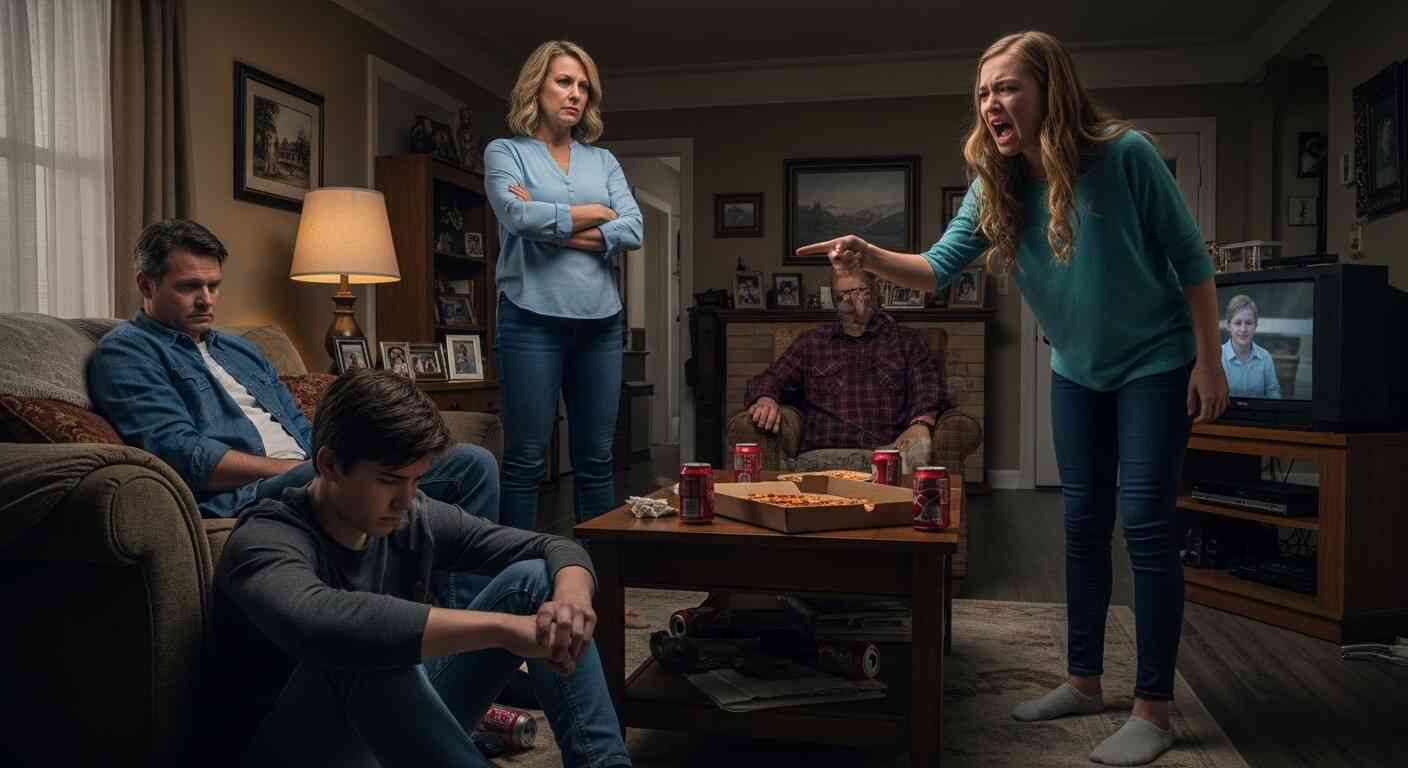
I stepped back, my heels clicking sharply against the floor. The sound was like a gunshot in the sudden silence of the room. Around the table, our friends—the “inner circle”—watched us with the kind of frozen, polite curiosity that only the very wealthy can manage.
Marcus, David’s business partner, held a forkful of roasted duck halfway to his mouth. His wife, Grace, adjusted her diamond necklace, her eyes darting between us like she was watching a tennis match she hadn’t bet on.
“Don’t touch me,” I whispered. My voice felt thin, like a wire pulled too tight.
“Sarah?” Grace chirped, her tone a forced blend of concern and social obligation. “Are you alright? Maybe it’s the heat? This humidity is simply dreadful for everyone’s nerves.”
I looked at Grace. She was my “best friend,” a woman who spent forty-thousand dollars a month on “self-care” to hide the fact that her husband was a serial philanderer. We were all experts at hiding things here. We lived in a neighborhood of high fences and even higher secrets.
“I saw it, David,” I said, louder now. I didn’t care about the duck. I didn’t care about the guests. “The garage. I went looking for my gardening shears. I moved the heavy tarp you told me never to touch.”
David’s smile didn’t falter, but his eyes changed. They didn’t go cold; they went empty. It was like someone had suddenly turned off the lights in a room he’d been standing in for years.
“We have guests, Sarah,” he said, his voice dropping an octave. A warning. “Let’s not do this now. Why don’t you go upstairs and splash some water on your face? I’ll apologize to everyone for the… excitement.”
“Excitement?” I laughed, a jagged, hysterical sound that tore through the room. “Is that what we’re calling it? I saw the blood, David. I saw the way the concrete was stained. I saw the gold watch—the one with the ‘L’ engraved on the back—sitting in the drain. Leo’s watch.”
The name hit the room like a physical blow. Leo had been David’s junior associate. He’d gone “missing” three weeks ago. The police had been by the office, and David had given a moving, tearful interview to the local news about how Leo was like a younger brother to him.
Marcus dropped his fork. It clattered against the fine china with a sound like a breaking bone. “David? What is she talking about?”
“She’s tired, Marcus,” David said, turning to his partner with effortless grace. “The stress of the move, the renovation… Sarah has always had a bit of an overactive imagination when she’s overwhelmed. Haven’t you, darling?”
He looked back at me, and for a second, I saw the threat. It wasn’t just in his eyes; it was in the way he stood, balanced on the balls of his feet, ready to move.
But then, the air in the room changed.
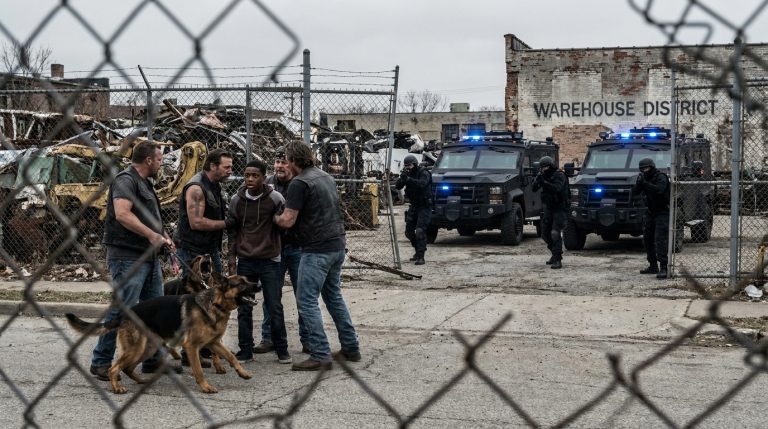
It started as a low vibration, a hum that shook the heavy windows in their frames. Then came the strobes—blue and red, blue and red—slicing through the expensive linen curtains and painting the room in the colors of a disaster.
The sirens didn’t fade away. They grew louder, screaming up our long, winding driveway until they died with a sudden, ominous chirp right outside our front door.
“The FBI is at the door, David,” I said, my heart hammering against my ribs so hard I thought it might bruise. “And the dinner party is over.”
A heavy thud echoed from the foyer. The sound of a battering ram meeting solid mahogany.
“I know it was you, David,” I screamed over the rising chaos. “I saw the blood on the garage floor!”
The front door gave way. Shouts of “Federal Agents! Stay where you are!” flooded the house. Boots thundered on the hardwood.
David didn’t run. He didn’t even look at the door. He just looked at me, a strange, sad sort of pity crossing his face.
“You should have stayed in the garden, Sarah,” he whispered.
As the first tactical light hit the room, blinding us all, another wine glass shattered. But this time, the sirens drowned out the screams.
FULL STORY
Chapter 2: The Architecture of a Lie
David hadn’t always been a man who could afford $500 bottles of wine. When I met him fifteen years ago, he was a struggling architect with a single suit and a vision of the world that was so bright it was almost blinding. I was a third-grade teacher, living in a cramped apartment in Queens, dreaming of a life that felt significant.
He didn’t just sweep me off my feet; he built a world around me.
“I’m going to build us a castle, Sarah,” he’d told me on our third date, sitting on a park bench and sharing a hot dog. “A place where the world can’t touch us. A place where you’ll never have to worry about the rent or the radiator breaking or the noise from the street.”
And he did. Year by year, brick by brick, he climbed the ladder of New York real estate. He was brilliant, yes, but he had something else—an uncanny ability to make people believe in him. He could walk into a room of cynical investors and, by the time he left, they’d be handing him their checks and their trust.
We moved from Queens to a brownstone in Brooklyn, then to a penthouse in Manhattan, and finally, three years ago, to “The Sanctuary”—our estate in Connecticut.
But as the houses got bigger, the rooms between us grew colder.
David started staying late at the office. There were “emergencies” on job sites, “last-minute closings,” and “investor retreats.” I accepted it. That was the price of the ivory tower, wasn’t it? I spent my days decorating rooms we never sat in and planning dinners for people we didn’t actually like.
Then came Leo.
Leo was twenty-four, ambitious, and looked at David with the kind of hero-worship that David craved. He became David’s shadow. He was at our house for Sunday brunches, helping David with the grill. He was the one who ran the errands David didn’t have time for.
But six months ago, I started noticing things.
It started with the whispers. I’d walk into David’s home office, and he and Leo would stop talking instantly, their faces pale and rigid. There were phone calls in the middle of the night—calls David would take in the bathroom with the shower running.
“It’s just work, Sarah,” he’d say when I questioned him. “A big project in the city. Lots of moving parts. Don’t worry your pretty head about it.”
That phrase—don’t worry your pretty head—became the mantra of our marriage. It was the silk scarf he used to blindfold me.
But the blindfold started to fray when Leo disappeared.
The official story was that Leo had been struggling with “personal issues” and had decided to take a sudden leave of absence. But Leo’s mother called me, sobbing. She said Leo would never just leave. He hadn’t taken his clothes. He hadn’t touched his bank account.
David comforted her. He offered a fifty-thousand-dollar reward for information. He was the grieving mentor, the pillar of the community.
But I knew David. I knew the way his jaw tightened when he was lying. I knew the way he tapped his wedding ring against the table when he was agitated. And since Leo’s disappearance, he hadn’t stopped tapping.
The “Old Wound” in our marriage had always been the child we lost in our fifth year. A little boy named Julian. David had blamed himself for not being home when I went into labor early—for being at a meeting that “couldn’t wait.” He’d spent the last decade trying to “buy” his way back into my forgiveness, building bigger and bigger houses to fill the hole Julian left behind.
I realized, standing in that dining room with the FBI breaking down our door, that David hadn’t been building a sanctuary for me.
He’d been building a cage to keep his secrets in. And Leo had found the key.
Chapter 3: The Tarp in the Corner
The garage of The Sanctuary was a cathedral of German engineering. It housed David’s vintage Porsche, my Range Rover, and a collection of tools he never used but insisted on owning because “a man should be prepared.”
It was a Tuesday, the day of the dinner party. I was supposed to be at the florist picking up the centerpieces, but I’d forgotten the specific shears I liked to use for the arrangements.
The garage was quiet, smelling of expensive leather and floor wax.
I went to the back corner, near the heavy industrial shelving. That was where David kept his “project” materials. For the last month, he’d been doing some “minor repairs” to the concrete flooring in the back. He’d told me to stay away because of the fumes.
But there, tucked behind a stack of unopened boxes, was a heavy blue tarp.
It wasn’t the fumes that caught my attention. It was the fly.
A single, fat black fly was buzzing insistently around the edge of the plastic. Then another. And another.
My heart began a slow, rhythmic thud against my ribs. Don’t look, Sarah. Go to the florist. Pick up the lilies. Don’t worry your pretty head.
I reached out. My fingers felt cold, numb. I pulled back the edge of the tarp.
At first, I didn’t see anything but the concrete. It looked new, a slightly different shade of gray than the rest of the floor. But then I saw the smear.
It was a dark, brownish-red streak, barely three inches long, tucked right against the baseboard where the power buffer couldn’t reach. It looked like a rust stain. But I knew it wasn’t rust.
I looked closer. Near the drain in the center of the floor, something caught the light. A glint of gold.
I knelt down, my knees protesting against the hard floor. I used a screwdriver to fish the object out of the grate.
It was a watch. A Rolex Submariner. The glass was cracked, and the band was twisted as if it had been pulled with immense force. I turned it over.
To L, keep timing the future. Love, Mom.
I dropped the watch. It hit the floor with a hollow clink.
Leo.
The “personal issues.” The “leave of absence.”
I felt a wave of nausea so violent I had to lean against the wall to keep from vomiting. My mind raced, trying to find a logical explanation. Maybe Leo had dropped it? Maybe he’d gotten into a fight with someone else?
But I remembered the night Leo disappeared. David had come home late, his shirt torn, his knuckles bruised.
“A minor scuffle at the job site,” he’d said. “Some union guys getting rowdy. Don’t worry, honey.”
I looked at the concrete patch again. It was roughly six feet long. Three feet wide.
I realized then that I wasn’t living in a mansion. I was living on a graveyard.
I didn’t call the police. Not yet. I was a coward. I went back into the house, washed my hands until they were raw, and started getting ready for the dinner party.
I had to be sure. I had to see his face when I told him.
Because if I was wrong, I was a madwoman. And if I was right… I was the wife of a murderer.
I spent the next three hours in a trance. I put on my favorite black silk dress. I applied my makeup with surgical precision. I welcomed Marcus and Grace with a smile that felt like it was made of glass.
But as I poured the wine, as I looked at David laughing at one of Marcus’s jokes, I saw the truth. He wasn’t the man I loved. He was a predator who had spent fifteen years perfecting the art of the camouflage.
The secret wasn’t just the blood. The secret was that I had always known he was capable of this. I had just chosen not to see it because the ivory tower was too comfortable to leave.
Chapter 4: The Moral Choice
The dinner was a nightmare of civility.
“So, David,” Marcus said, leaning back with a glass of scotch. “The harbor project. Are we still on track for the June opening?”
David nodded, swirling his wine. “Absolutely. We’ve hit a few snags with the foundation—unexpected rock formations—but we’ve cleared them. We’re pouring the final slabs next week.”
Foundation. Slabs. The words felt like stones in my mouth.
“I heard the FBI was asking questions about the permits,” Grace said, her voice dropping to a conspiratorial whisper. “Something about a discrepancy in the environmental impact reports?”
David didn’t miss a beat. “Bureaucracy, Grace. Just some paper-pushers trying to justify their salaries. We’ve played by the rules.”
I looked at Marcus. He was David’s partner, but he was also the man who handled the “off-the-books” financing. He knew about the debt. He knew that the harbor project was overleveraged. If the project failed, they were both going to prison for fraud.
Leo had been the accountant.
The realization clicked into place like a key in a lock. Leo hadn’t just been an associate; he’d been the one with the ledger. He’d found the “discrepancy.”
He’d probably come to David, thinking he was doing the right thing. He’d probably thought David would thank him.
Instead, David had invited him to the house.
I looked at the garage remote sitting on the sideboard near David. There was a tiny, dried speck on the plastic. I hadn’t noticed it before, but now it was all I could see.
I had a choice.
I could stay silent. I could let the dinner end, let the guests leave, and then… what? Help David “fix” the problem? Become an accessory? If I stayed silent, the ivory tower remained. The silk sheets, the Ferragamo shoes, the status—it all stayed.
If I spoke, I was destroying my life. I would be the woman whose husband killed a boy in their garage. I would be the one the tabloids hunted. I would be alone.
I thought about Leo’s mother. I thought about the way she’d looked at me, her eyes red-rimmed and hollow, begging for a sign of hope.
And then I thought about Julian. Our son.
If Julian had lived, would he have grown up to be like Leo? Ambitious, trusting, and ultimately disposable to a man like David?
I realized that by staying with David all these years, by accepting the “don’t worry your pretty head” lies, I had been killing a part of myself every day.
The choice wasn’t about David. It was about me.
I reached for the Petrus. My hand was shaking so hard the bottle clinked against the glass.
“David,” I said, my voice cutting through Marcus’s story about his new yacht.
The room went still.
“What is it, Sarah?” David asked, his tone indulgent, patronizing.
“I called the Detective this afternoon,” I said.
David’s hand froze on his glass. “What Detective, darling?”
“Miller,” I said. “The one investigating Leo’s disappearance. I told him he should come by. I told him there was something he needed to see in the garage.”
The silence that followed was absolute. It was the silence of a vacuum, sucking the air out of the room.
Marcus looked at David. Grace looked at me.
David didn’t scream. He didn’t move. He just stared at me, and for a split second, I saw the monster. Not a man with a vision, but a cornered animal with nowhere to go.
“You did what?” he whispered.
“I saw the watch, David,” I said, my voice gaining strength. “I saw the blood. I saw what you did to him.”
That was when the wine glass shattered. That was when the sirens began.
I had made my choice. And as the blue lights began to pulse against the walls, I knew there was no going back. The ivory tower was falling, and I was going to let it crush us both.
Chapter 5: The Cracks in the Facade
The dinner party didn’t end; it evaporated.
The moment the FBI tactical team breached the front door, Marcus and Grace were shoved aside by men in “POLICE” jackets and Kevlar vests.
“Hands in the air! Get on the ground! Now!”
Marcus didn’t argue. He dropped to the floor like a sack of grain, his face pressed against the expensive rug he’d admired only minutes before. Grace screamed, a high, thin wail that seemed to go on forever until a female agent guided her out of the room.
I stood my ground. I didn’t move. I watched David.
He didn’t drop to the floor. He stood behind his chair, his hands gripped so tightly on the mahogany that his knuckles were white.
“David Evans,” a voice boomed.
Detective Miller stepped into the dining room. He didn’t look like a hero. He looked tired. He looked like a man who had seen too many “perfect” families with blood on their hands.
“Detective,” David said, his voice eerily calm. “This is quite an entrance. I trust you have a warrant for this… intrusion?”
Miller held up a folder. “Search warrant for the premises, including the detached garage and the harbor project site. And an arrest warrant for you, David. Murder in the first degree. Obstruction of justice. Tampering with evidence.”
“Murder?” David chuckled, a dry, hollow sound. “On what grounds? My wife’s hysterics? Sarah hasn’t been herself lately, Detective. Ask our guests. She’s been under a lot of strain.”
Miller looked at me. Then he looked back at David.
“We didn’t just come here because of your wife’s call, David,” Miller said. “We’ve been tracking the GPS on Leo’s phone. It pinged at your harbor site the night he disappeared. And we found the foreman you paid to pour that extra slab of concrete at 2:00 AM. He’s a talker, David. Especially when facing twenty years for conspiracy.”
The empty look in David’s eyes finally turned to fear.
The facade didn’t just crack; it pulverized. He looked around the room—at the broken glass, at the wine-stained rug, at his partner on the floor—and he realized the game was over.
“I did it for us, Sarah,” he said, turning to me. “The debt… the project… if Leo had gone to the authorities, we would have lost everything. You would have been back in that apartment in Queens. I couldn’t let that happen to you. Not again.”
“Don’t lie to me,” I said, my voice trembling. “You didn’t do it for me. You did it for you. You did it because you couldn’t stand the thought of being a failure. You’d rather be a killer than a commoner.”
He took a step toward me, but Miller was faster. He grabbed David’s arm and spun him around, slamming him against the dining table.
The fine china rattled. A silver platter of duck fell to the floor.
“David Evans, you are under arrest,” Miller intoned the Miranda rights, but the words felt like background noise.
I watched as they cuffed him. I watched as the man I had loved, the man I had built a life with, was led out of our sanctuary in plastic zip-ties.
As he passed me, he stopped. The agents tried to pull him forward, but he resisted for a second.
“You’re going to lose the house, Sarah,” he whispered, his voice jagged and cruel. “You’re going to lose everything. Was his life really worth that much to you?”
I looked him in the eye—the first time I had really seen him in years.
“Yes,” I said. “It was.”
He was dragged out into the night, into the sea of blue and red lights.
I was left standing in the dining room. The silence was deafening. Marcus was still on the floor, weeping quietly. The smell of the roasted duck was sickening.
I walked to the window and watched the police cars pull away. The “Sanctuary” was silent now, but it wasn’t a home anymore. It was a crime scene.
I realized then that the most dangerous thing about a man with a vision isn’t what he’s willing to build—it’s what he’s willing to destroy to keep it standing.
Chapter 6: The Shattered Glass
The aftermath was a slow, agonizing funeral for a life I no longer recognized.
David was right about one thing: I lost the house.
The lawyers, the creditors, the civil suits from Leo’s family—they picked the estate clean like vultures. Within three months, the ivory tower was sold at auction. The Persian rugs, the Riedel glass, the Porsche—it all went to pay for a defense that didn’t even work.
David was sentenced to life without parole. He never confessed, not really. He maintained to the end that it was an “accident” that got out of hand.
I moved back to a small apartment. Not in Queens—I couldn’t go back there—but a quiet town in Vermont where nobody knew my name or my husband’s face.
I spent a lot of time in the garden.
People ask me sometimes—the few friends who stayed, the ones who didn’t care about the scandal—if I regret it. If I wish I’d just stayed in the house and kept my head down.
I look at my hands, stained with soil instead of expensive lotion, and I think about that night.
I think about the sound of the glass shattering.
It wasn’t just a wine glass. It was the sound of a lie being broken. It was the sound of a woman finally waking up from a fifteen-year sleep.
I’m poorer now. I drive an old Subaru that smells like wet dog and compost. I teach at a local community center. My life is small, and quiet, and real.
But every night, when I lay my head down on my pillows, I don’t have to listen for the sound of someone taking a shower to hide a phone call. I don’t have to wonder why my husband’s knuckles are bruised.
I went to visit Leo’s mother once.
She didn’t thank me. She didn’t forgive me for being the woman who lived with a monster while he killed her son. But she held my hand for a long time, and we sat in a silence that didn’t feel like a vacuum. It felt like peace.
I realized that the “difficult moral choice” wasn’t a choice at all. It was a requirement. To be human is to be able to see the blood on the floor, even when it’s covered by a beautiful rug.
I looked at the garage of my new little house the other day. It’s small, cluttered with rakes and bags of potting soil. The floor is cracked concrete, old and weathered.
There are no tarps in the corner. There are no secrets buried beneath the foundation.
I still have a scar on my hand from that night—a tiny, jagged line where a piece of the Petrus glass caught me when I dropped it. I look at it whenever I feel myself missing the “ivory tower.”
It’s a reminder that beauty built on a lie is just a more expensive way to be miserable.
The sirens have long since faded, and the screams have gone quiet, but the truth remains, clear and unbreakable as the very thing that started it all.
In the end, it’s better to live in the wreckage of the truth than in the palace of a lie.