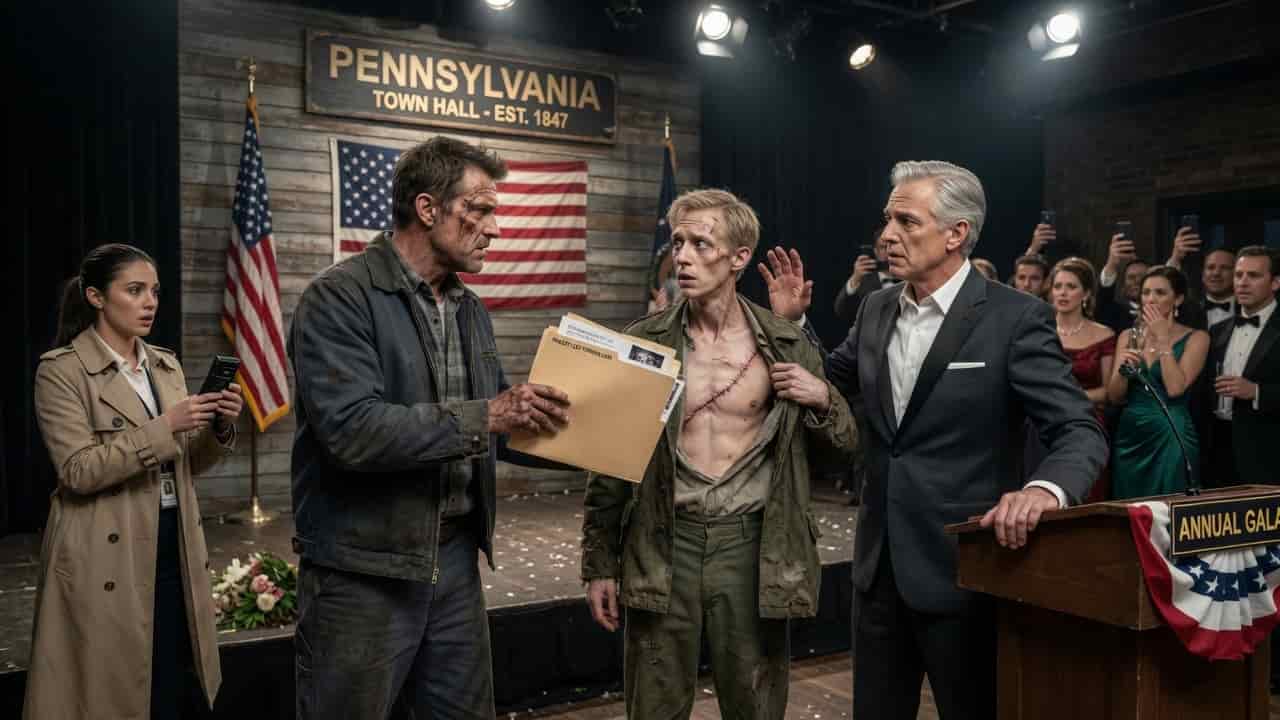
“Look at the scar, Sterling. Tell this whole room exactly what you paid for.”
Miller stood on the velvet-draped stage, his grease-stained work jacket a jagged tear in the fabric of the high-society gala. He held his brother, Leo, by the shoulder. Leo was shivering, his eyes darting around the room like a trapped animal, his skeletal frame barely filling out the thrift-store coat Miller had found for him.
Sterling, the billionaire philanthropist the town treated like a god, didn’t even flinch at first. He just leaned into the microphone with a cold, pitying smile. “Miller, we all know your family has struggled. But bringing a vagrant up here to disrupt a charity event? It’s pathetic, even for you.”
The room erupted in hushed, cruel titters. The women in silk dresses looked away in disgust, and the men in the front row signaled for security. Miller felt the heat of the shame crawling up his neck, the same way it had fifteen years ago when the Sterlings took Leo and left Miller in the dirt.
But this time, Miller didn’t back down. He reached out and yanked up the hem of Leo’s shirt.
The laughter stopped. A woman in the third row gasped, her hand flying to her mouth. There it was—a thick, ropy surgical scar carved into the boy’s side.
“He wasn’t a vagrant when you took him,” Miller’s voice cracked through the silence. “He was my brother. And you didn’t adopt him to give him a home. You adopted him because your own son’s liver was failing, and my brother was a match.”
He shoved a manila folder onto the podium, the confidential medical files spilling out for the cameras to see. Sterling’s face didn’t just go pale; it went hollow.
“You used him up and threw him away,” Miller said, his voice dropping to a terrifying whisper. “And now the whole world is going to see the bill.”
Chapter 1: The Ghost in the Bay
The air in the garage tasted like cold iron and old oil. It was February in Oakhaven, Pennsylvania, the kind of month that turned the slush in the gutters into grey concrete and made your joints ache before you even got out of bed. Miller leaned under the hood of a rusted-out ‘09 Silverado, his knuckles barked raw from a stubborn manifold bolt.
He liked the work. It was honest, and the metal didn’t lie to you. If a part was broken, you replaced it. If a line was clogged, you cleared it. People, though—people were a mess of stripped threads and hidden cracks you didn’t find until the whole engine seized up.
The bell above the shop door jingled, a thin, tinny sound that barely cut through the low hum of the space heater in the corner. Miller didn’t look up.
“Be with you in a second,” he grunted, bracing his boots against the concrete and giving the wrench one last, violent heave. The bolt snapped loose with a crack that echoed off the corrugated tin walls. Miller wiped his hands on a rag that was more black than red and stepped out from under the lift.
The man standing in the doorway wasn’t a customer. He was a ghost.
He was thin—not runner thin, but the kind of thin that suggested his body was slowly eating itself from the inside out. He wore an olive drab army coat that was three sizes too big, the hem frayed and stained with road salt. His hair was a matted nest of blonde, and his skin had the grey, translucent quality of a man who spent too much time in the shade.
But it was the eyes that stopped Miller’s heart. They were the same deep, startled blue as their mother’s.
“Miller?” the ghost whispered.
Miller dropped the rag. It hit the floor with a wet thud. “Leo?”
The boy—man, he was twenty-two now, Miller realized with a jolt—didn’t move. He stood there shivering, his hands shoved deep into the pockets of that oversized coat. He looked like he might blow away if Miller breathed too hard.
“I didn’t know where else to go,” Leo said. His voice was thready, punctuated by a wet, rattling cough that shook his entire frame. “They said… someone in town said you were still here.”
Miller took a step forward, his heavy work boots sounding like thunder in the quiet shop. He wanted to reach out, to grab the kid and see if he was actually solid, but he stopped six feet away. The last time he’d seen Leo, his brother had been seven years old, clutching a stuffed bear and being led into the back of a black Mercedes while a social worker told Miller it was “for the best.”
“Where have you been, Leo?” Miller asked. The words felt like gravel in his throat. “The Sterlings… they said you went to a boarding school in Switzerland. They said you didn’t want to see me. They sent letters. Well, lawyers sent letters.”
Leo let out a short, jagged laugh that turned into another coughing fit. He doubled over, clutching his right side. “Switzerland? Is that what they told you?”
Miller moved then, his instinct to protect override the shock. He caught Leo before the kid’s knees hit the concrete, guiding him toward a plastic lawn chair near the workbench. Leo was light—terrifyingly light. It felt like holding a bundle of dry sticks.
“Easy, easy,” Miller muttered. He grabbed a bottle of water from the desk and handed it over. Leo took a sip, his hands shaking so badly the water spilled down his chin.
“They dumped me, Miller,” Leo rasped, wiping his mouth with a trembling hand. “Two years after they took me. They put me back in the system. But not here. Three counties over. Under a different name.”
Miller felt a coldness that had nothing to do with the Pennsylvania winter. “A different name? Why?”
Leo looked up, and for a second, the dazed fog in his eyes cleared, replaced by a raw, naked terror. “Because of the surgery.”
“What surgery? You were a healthy kid, Leo. You never had a sick day in your life.”
Leo didn’t answer with words. He reached for the zipper of the army coat, his fingers fumbling. He pulled it down, then hiked up the tattered grey t-shirt underneath.
Miller froze.
There, carved into the pale skin of Leo’s right side, was a jagged, silver scar. It started under the ribs and curved around toward his spine, a long, thick rope of keloid tissue that looked like it had been sewn by a drunkard. It was a massive, invasive incision.
“What is that?” Miller whispered, his voice trembling with a sudden, violent heat.
“I don’t remember much,” Leo said, his voice drifting again. “I remember a white room. I remember the man—the one from the Mercedes—telling me I was going to help his son. He said we were going to be brothers forever. And then I woke up, and it hurt so much, Miller. It hurt for years.”
Miller stared at the scar. He was a mechanic. He knew how systems worked. He knew about parts and compatibility. And he knew that the Sterlings’ only son, Julian, had been born with a biliary atresia—a failing liver. He remembered the headlines in the local paper sixteen years ago: Local Philanthropist’s Son Receives Miracle Transplant.
The paper had said the donor was anonymous.
Miller’s stomach turned over. He looked at his brother—this broken, discarded thing—and then he looked at the scar again. The timeline clicked into place with the sickening precision of a locking gear.
The Sterlings hadn’t adopted Leo to save him. They had scouted him. They had found a healthy, unrepresented orphan with no family left but a teenage brother they could intimidate into silence. They had bought him, harvested him, and when the “part” had been successfully installed in their own child, they had thrown the packaging away.
“They told me you were dead,” Leo whispered, looking at the floor. “They said you didn’t want me anymore. That you sold me to them.”
Miller felt a roar of grief and rage so loud he thought his ears might bleed. He fell to his knees in front of the chair, grabbing Leo’s thin, cold hands in his own grease-stained ones.
“I never stopped looking for you,” Miller choked out. “I wrote every month. I went to their house until the police threatened to throw me in jail. I thought you were living a life I couldn’t give you. I thought you were happy.”
Leo looked at him then, really looked at him. A single tear tracked through the grime on his cheek. “I’m not happy, Miller. I’m just… tired.”
Miller pulled his brother into a hug, feeling the sharp press of Leo’s ribs against his chest. He looked out the open garage door toward the hills, where the Sterling mansion sat like a glass-and-steel fortress overlooking the town.
The world thought Sterling was a saint. They thought he was the man who saved Oakhaven. But Miller knew better now. He knew what kind of man built a kingdom on the blood of a child.
“It’s okay,” Miller whispered into Leo’s hair, his eyes fixed on the distant lights of the mansion. “I’ve got you now. And I’m going to fix this. I’m going to fix all of it.”
But even as he said it, he felt the weight of the truth. You don’t just fix a life like you fix a truck. Some things are broken too deep for parts.
Chapter 2: The Paper Trail
The basement of the Oakhaven Public Library smelled of damp paper and forgotten things. Miller sat at a flickering microfilm reader, his eyes burning from six hours of staring at grainy black-and-white newspaper archives.
Beside him, Sarah Miller—no relation, just a woman he’d gone to high school with who now ran the local weekly—was flipping through a stack of old property records. She was the only person in town Miller trusted not to run straight to the Sterlings the second he started asking questions.
“Here,” Sarah whispered, sliding a photocopied sheet over to him. “The adoption records for the Sterling family were sealed, obviously. But look at the date on the private medical transport to the University Hospital in Pittsburgh.”
Miller looked. June 14th, 2011.
“That was three days after they took Leo,” Miller said. His voice was flat, the anger having settled into a cold, hard lump in his gut.
“And look at this,” Sarah pointed to a line further down. “The donor surgery and Julian Sterling’s transplant were performed in the same wing, by the same surgical team. The lead surgeon was a Dr. Aris Thorne. He retired six months later and moved to a private island in the Caribbean. Guess who funded his retirement?”
“Sterling,” Miller muttered.
“A ‘charitable grant’ through the Sterling Foundation,” Sarah confirmed. She looked at Miller, her expression a mix of pity and professional curiosity. “Miller, if this is true… it’s not just a scandal. It’s human trafficking. It’s a literal harvest. But you’re talking about the man who owns the police department, the town council, and the bank that holds the mortgage on your shop.”
“I don’t care what he owns,” Miller said.
He stood up, the chair screeching against the linoleum. He hadn’t slept in forty-eight hours. He’d spent the last two days hiding Leo in the small apartment above the garage, feeding him soup and watching him shake through what looked like a combination of malnutrition and drug withdrawal. Leo hadn’t said much more, but he didn’t have to. The scar said everything.
“You can’t just walk into the police station with this, Miller,” Sarah said, grabbing his arm. “Deputy Vance is on Sterling’s payroll. Everyone knows it. You go to them, that file disappears, and you and Leo disappear right along with it.”
“I’m not going to the police,” Miller said. He looked at the file in his hand. “I’m going to the source.”
He left the library and drove his beat-up Ford back to the shop. The sky was a bruised purple, the sun dipping behind the mountains. As he pulled into the gravel lot, he saw a black SUV idling near the bays.
Miller’s hand went to the heavy iron tire iron he kept under the seat.
He climbed out of the truck, his heart hammering against his ribs. The SUV door opened, and a man stepped out. He was tall, wearing a tan windbreaker that didn’t quite hide the bulk of a holster at his hip. Deputy Vance.
“Miller,” Vance said, leaning against the hood of the SUV. He didn’t look like a man making a social call. “Hear you’ve been doing some research at the library. Sarah’s been talking, or maybe the librarian just likes to gossip.”
“Since when is reading the news a crime, Vance?” Miller asked, his grip tightening on the tire iron behind his back.
“It ain’t. But bothering Mr. Sterling’s past… that’s a different story. Mr. Sterling is a sensitive man. He likes his privacy. He likes his legacy. And he doesn’t like people digging up old grief.”
Vance took a step closer, his eyes scanning the windows of the apartment above the shop. “I also hear you’ve got a guest staying with you. A vagrant. Someone who looks a bit like family.”
Miller felt the air leave his lungs. They already knew.
“He’s my brother,” Miller said, his voice dropping into a dangerous growl. “And he’s not a vagrant. He’s a victim.”
Vance sighed, a sound of genuine disappointment. “See, that’s the kind of talk that gets people hurt, Miller. Mr. Sterling did a lot for that boy. He gave him a chance. If the boy couldn’t handle the pressure and ran away, that’s on him. You start making accusations about things you don’t understand, and you’re going to find out how small this town really is.”
“Is that a threat?”
“It’s a forecast,” Vance said. He reached into his pocket and pulled out a thick envelope. He tossed it onto the hood of Miller’s truck. “Mr. Sterling wants you to be happy. He knows the shop is struggling. There’s fifty thousand in there. Take the boy, get out of Oakhaven, and don’t come back. Consider it a ‘severance package’ for the years of service your family gave.”
Miller looked at the envelope. It was enough to move Leo to a clinic, to buy a new life, to get away from the cold and the grey. It was the easy way out.
He picked up the envelope. Vance smiled, a greasy, self-satisfied look.
Miller walked over to the shop’s waste oil barrel—a 55-gallon drum half-filled with the black, sludge-like remains of a dozen engine changes. He dropped the envelope in. It vanished into the black muck with a quiet splash.
Vance’s smile died.
“Tell Sterling he’s going to need a bigger barrel,” Miller said.
Vance stared at him for a long beat, his face hardening into something ugly. “You’re a fool, Miller. Just like your old man. He died in a ditch because he didn’t know when to take the hand that was fed to him. Don’t make the same mistake.”
The SUV roared to life, kicking up gravel as Vance sped away.
Miller stood in the dark, the smell of waste oil heavy in his nose. He looked up at the light in the apartment window. Leo was up there, probably staring at the wall, his body ruined by the man who just tried to buy Miller’s silence.
He realized then that he couldn’t win this way. He couldn’t fight Sterling with lawyers or police or libraries. He had to hit him where it hurt—in the middle of his carefully polished, public-facing lie.
But first, he had to prove he was serious.
Miller went into the shop and grabbed his heavy-duty bolt cutters and a set of zip ties. He didn’t think about the consequences. He didn’t think about the law. He only thought about the look on Sterling’s face when he realized that not everything in this world has a price tag.
Chapter 3: The Price of a Seat
The Oakhaven Country Club was a palace of glass and stone, perched on the highest ridge in the county. Tonight, it was glowing like a jewel, the parking lot filled with Mercedes, BMWs, and the occasional vintage Jaguar. It was the night of the Sterling Foundation’s Annual Winter Gala, the social event of the year.
Miller stood at the edge of the woods, a hundred yards from the service entrance. He was wearing his “good” clothes—a pair of dark slacks and a button-down shirt that he’d spent an hour ironing in the shop’s breakroom. He still looked like a mechanic. His hands were too big, his skin too weathered, his presence too heavy for a room filled with people who traded in shadows and handshakes.
He wasn’t alone. Leo was beside him, wrapped in a clean coat Miller had bought at the Sears in the next town over. Leo was shaking, his eyes wide and glassy.
“I don’t want to go in there,” Leo whispered. “He’ll see me. He’ll put me back in the room.”
“He’s not putting you anywhere,” Miller said, his hand firm on Leo’s shoulder. “You’re the one who’s going to show them, Leo. You’re the proof.”
Miller had spent the afternoon talking to Sarah. She’d told him that Sterling was receiving the ‘Citizen of the Decade’ award tonight. The press would be there. The cameras would be rolling. It was the perfect stage.
But Miller had underestimated the gatekeepers.
He tried to walk through the front entrance, Leo trailing behind him. The doorman, a man in a ridiculous gold-trimmed coat, stepped into his path immediately.
“Invitation, sir?”
“I’m here to see Sterling,” Miller said. “Tell him it’s Miller. From the garage.”
The doorman’s eyes flickered over Miller’s cheap shirt and Leo’s gaunt, haunted face. A sneer touched his lips. “Mr. Sterling is busy with invited guests. If you have a delivery, please use the rear entrance.”
“This isn’t a delivery,” Miller said, his voice rising. “It’s a reckoning.”
Before the doorman could respond, the heavy oak doors opened and Sterling himself stepped out, flanked by a group of men in tuxedos. He was laughing at something one of them said, looking every bit the benevolent king.
He saw Miller. He saw Leo.
The laughter died. Sterling didn’t look afraid. He looked annoyed. He stepped away from his friends and walked toward the edge of the portico, looking down at Miller like he was a stain on the carpet.
“Miller,” Sterling said, his voice smooth as silk. “I thought we’d reached an understanding. The Deputy told me you were… less than cooperative.”
“You thought fifty grand would make me forget you carved up my brother?” Miller shouted.
A few of the guests near the door stopped to look. Sterling’s expression didn’t change, but his eyes went cold—a predator’s eyes.
“Look at him, Sterling!” Miller grabbed Leo’s arm and pulled him forward. “Look at what you did to him! You used him like a scrap heap for your own kid!”
Sterling sighed, a soft, patronizing sound. He looked at the guests who were now whispering. He turned back to Miller, his voice projecting just enough for everyone to hear.
“Miller, I understand you’re grieving. I understand the tragedy of your brother’s… condition. We tried to help him. We took him in, gave him the best medical care money could buy. But you can’t cure a broken mind. We had to let him go when he became a danger to our family.”
“You’re lying!” Miller lunged forward, but two security guards appeared from the shadows, grabbing his arms and pinning them behind his back.
“It’s sad, really,” Sterling continued, looking at Leo with a fake, watery pity. “The boy was always unstable. Drug use, even at that age. We spent hundreds of thousands on rehab for him. And now you’re here, using his trauma to try and extort more money from a foundation that gives everything to this town.”
“You stole his liver!” Miller screamed, struggling against the guards. “I have the files!”
Sterling stepped closer, leaning in until he was inches from Miller’s face. The smell of expensive cologne was nauseating.
“You have nothing,” Sterling whispered, so low only Miller could hear. “You’re a grease monkey from a dead-end town. Nobody is going to believe a word you say over me. Look at you. You’re dirt. And your brother? He’s a ghost. Now, take him and crawl back into your hole before I have the Deputy find a reason to put you both in a cell where nobody will hear you scream.”
Sterling pulled back and addressed the guards. “Get them off the property. And if they come back, use whatever force is necessary.”
The guards didn’t just lead them away. They dragged Miller down the stone steps and shoved him into the gravel. One of them kicked Miller in the ribs for good measure, a sharp, professional blow that left him gasping.
Leo was standing a few feet away, trembling so hard he could barely stay upright. He looked at the beautiful people in the doorway, then at his brother lying in the dirt.
“They won’t listen, Miller,” Leo sobbed. “They think he’s a god.”
Miller pushed himself up, his side burning, his mouth tasting of copper. He looked at the glowing palace on the hill. Sterling had humiliated him. He had turned the truth into a “sad story” of a crazy brother and a greedy mechanic. He had used his power to erase the crime before it was even spoken.
But as Miller watched Sterling turn and walk back into the ballroom to the sound of applause, something shifted inside him. The moral lines he’d lived by his whole life—the ones about being honest and working hard—they didn’t apply here. You don’t out-argue a man who owns the air you breathe.
You take what he loves.
“Wait in the truck, Leo,” Miller said, his voice dead and cold.
“What are you going to do?”
“I’m going to make sure he pays attention.”
Miller didn’t go back to the garage. He drove to the back of the property, where the service road led to the private residence. He knew the schedule. He knew that Julian Sterling—the boy living on Leo’s blood—would be coming home from his private tutor’s session in twenty minutes.
Miller sat in the dark, the engine off, the tire iron heavy in his hand. He wasn’t a mechanic anymore. He was a man who had run out of things to lose.
Chapter 4: The Leverage
The black sedan slowed as it approached the iron gates of the Sterling estate. The driver—a young guy in a suit who looked more like a valet than a bodyguard—reached out to punch the code into the keypad.
Miller didn’t give him the chance.
He rammed his Ford into the side of the sedan, the impact jarring his teeth. Before the driver could even register what had happened, Miller was out of the truck. He smashed the driver’s side window with the tire iron, reached in, and hauled the man out by his collar.
The kid was terrified, stammering, his hands up. Miller didn’t care. He shoved him toward the ditch.
“Run,” Miller growled. “Run and don’t look back.”
The kid ran.
Miller turned to the back seat. Julian Sterling was sixteen, pale and thin, but with a glow of health that Leo hadn’t seen in a decade. He was wearing a school blazer and holding a tablet. He looked at Miller with wide, confused eyes.
“Who are you?” the boy asked. He didn’t sound scared yet. He sounded like a kid who had never been told ‘no’ in his entire life.
“I’m the guy your father owes a debt to,” Miller said.
He grabbed Julian by the arm and pulled him out of the car. He wasn’t rough, not like the guards had been to him, but he was firm. He led the boy to his truck and shoved him into the passenger seat, zip-tying his hands to the door handle.
Miller drove back to the garage. He pulled the truck inside the bay and slammed the heavy rolling door shut, locking it from the inside.
He climbed out and walked around to the passenger side. Julian was crying now, the reality of the situation finally sinking in.
“Please,” Julian sobbed. “My dad… he’ll give you whatever you want. Just let me go.”
“He already gave me what I wanted, Julian,” Miller said, looking at the boy’s healthy, rhythmic breathing. “He gave me the truth.”
Miller went upstairs. Leo was sitting on the edge of the bed, his head in his hands. He looked up as Miller entered, his eyes widening as he saw the blood on Miller’s knuckles.
“Miller? What did you do?”
“I got us some leverage,” Miller said. “Come downstairs.”
They went into the bay. Julian saw Leo, and for a second, the boy stopped crying. He stared at Leo’s gaunt face, at the oversized coat, at the way Leo’s hands wouldn’t stop shaking.
“You,” Julian whispered. “I remember you. From the hospital.”
Leo froze. He walked closer to the truck, his movements slow and uncertain. “You were the boy in the other bed. The one with the puzzles.”
Julian nodded, tears streaming down his face. “My dad said… he said you went to live with a new family. He said you were happy.”
“I wasn’t happy,” Leo said, his voice barely a breath. He reached out and touched the window of the truck. “They took it, didn’t they? They took the part of me and gave it to you.”
Julian didn’t look away. “I didn’t know. I swear, I didn’t know.”
Miller watched them—the two boys whose lives had been twisted together by a monster. One was a shell, the other a masterpiece built from stolen parts. The injustice of it was a physical weight in the room, heavier than the engines hanging from the lifts.
Miller’s phone buzzed in his pocket. He pulled it out. It was a restricted number.
He answered.
“Miller,” Sterling’s voice was like ice. No pity now. No fake concern. Just the sound of a man who was used to winning. “If you’ve harmed my son, I will make sure you don’t live long enough to see a courtroom.”
“He’s fine,” Miller said, looking at Julian. “For now. But we’re going to have a talk, Sterling. A real talk. And this time, there aren’t going to be any guards to protect you.”
“What do you want?”
“I want the truth,” Miller said. “I want you to come to the town hall tomorrow morning. 10:00 AM. They’re holding that public forum about the new development project. Everyone will be there. The press, the council, the whole town.”
“You’re insane,” Sterling spat. “You think I’m going to confess in public?”
“I think you’re going to walk onto that stage,” Miller said, his voice steady. “And you’re going to tell everyone exactly what you did to Leo. You’re going to admit to the illegal transplant. You’re going to admit to the bribery. You’re going to name every person who helped you hide it.”
“And why would I do that?”
“Because if you don’t,” Miller looked at Julian, his heart breaking for the kid even as he used him as a weapon. “I’m going to tell your son the truth myself. And then I’m going to take him to the same hospital where you had the surgery, and I’m going to let the doctors explain to him exactly who had to die so he could live.”
There was a long silence on the other end of the line.
“He’s an innocent boy, Miller,” Sterling whispered.
“So was Leo,” Miller said.
He hung up.
He looked at his brother and the boy in the truck. The room was silent, save for the hum of the heater and the sound of Julian’s muffled sobs.
Miller felt a deep, hollow ache in his chest. He had the leverage. He had the truth. But as he looked at Leo—who was now sitting on the floor, staring at nothing—he realized that even if he won, the damage was already done. The residue of Sterling’s cruelty was everywhere, in every breath Leo took, in every tear Julian shed.
He had started a fire. And tomorrow, he was going to find out if he was the one who was going to burn in it.
Chapter 5: The Longest Night
The silence in the garage was heavy, an oily, suffocating blanket that pressed against Miller’s lungs. He sat on a stack of tires, his hands dangling between his knees, staring at the grease-darkened concrete. A few feet away, Julian Sterling was slumped against the passenger door of the truck, his head back, his breathing ragged and shallow. The zip ties around his wrists were tight, but not enough to cut the skin. Miller wasn’t a monster, even if he was currently doing a monster’s work.
Upstairs, Leo was pacing. Miller could hear the rhythmic creak-thud, creak-thud of the floorboards. It was the sound of a man who didn’t know how to exist in a still room. For ten years, Leo had been moving—running from foster homes, running from the memory of the white room, running from the phantom pain in his side that never truly went away.
“You can’t keep me here,” Julian whispered. His voice was raw from crying. He looked at Miller with a mixture of terror and a strange, budding curiosity. “My dad… he’s going to find us. He has people. He has everyone.”
“He has people he pays, Julian,” Miller said without looking up. “There’s a difference. When the money stops, or when the truth gets too loud, those people disappear. They’re like shadows—they only exist when the sun is shining on him.”
“My dad isn’t who you say he is,” Julian insisted, though the conviction in his voice was fraying at the edges. “He builds parks. He saved the library. He pays for the hospital’s pediatric wing.”
Miller finally looked at him. The boy’s face was a mirror image of Sterling’s—the same sharp jaw, the same clear eyes—but there was a softness there that hadn’t yet been hardened by the habit of command.
“He pays for the pediatric wing because he used it as a butcher shop,” Miller said, his voice flat. “He didn’t build those things out of the goodness of his heart, kid. He built them to buy the silence of the town. He bought the judges, the cops, and the papers. And then he bought my brother.”
The door to the stairs creaked open, and Leo descended. He looked even smaller in the dim light of the shop, his army coat hanging off his frame like a shroud. He walked over to the truck, ignoring Miller, and looked through the glass at Julian.
“Does it hurt?” Leo asked.
Julian blinked, startled. “What?”
“The liver,” Leo said, pointing vaguely at Julian’s torso. “Does it ever feel like… like it doesn’t belong? Like there’s something inside you that’s trying to get out?”
Julian stared at Leo, his mouth working but no sound coming out. He looked down at his own body, then back at the skeletal man standing in front of him. For the first time, the boy didn’t look scared of being kidnapped. He looked scared of the truth sitting in his own ribcage.
“Sometimes,” Julian whispered. “When I’m tired. It feels heavy.”
“It’s because it’s lonely,” Leo said, a ghostly smile touching his lips. “It wants to come home.”
Miller stood up, the movement abrupt. He couldn’t listen to this. The psychological weight of it was starting to crush him. He’d spent his whole life trying to be the man his father wanted—the one who worked hard, didn’t complain, and took care of his own. But now he was a kidnapper, and his brother was talking to his own stolen organs through a truck window.
He walked to the back of the shop and pulled out a burner phone he’d bought at a gas station three towns over. He dialed Sarah’s number.
“Miller?” her voice was frantic. “Where are you? Vance has been at the library. He’s looking for you. He says you’re wanted for questioning in a hit-and-run.”
“I’m safe,” Miller said. “For now. Did you get the documents to the city papers? The ones in Pittsburgh?”
“I sent them,” Sarah said, her voice dropping to a whisper. “But Miller… Sterling has connections there, too. They’re not going to run a story like this without a face. Without a witness who can stand up to a defamation suit. They need Leo.”
“They’ll have him,” Miller said. “Tomorrow. At the town hall.”
“Miller, don’t go there. It’s a trap. Sterling isn’t going to confess. He’s going to have the police waiting to take you down the second you step onto that stage.”
“He won’t,” Miller said, looking at Julian. “He loves his son more than he loves his reputation. At least, that’s what I’m betting on.”
“And if you’re wrong?”
“Then I’ve already lost everything anyway,” Miller said. He hung up before she could respond.
He spent the rest of the night prepping the “fixed” truck. He checked the fluids, the brakes, the tires. It was a nervous habit, a way to keep his hands moving so his mind wouldn’t start playing out the hundred ways the next morning could end in a bloodbath.
Around 3:00 AM, Julian fell into a fitful sleep, his head lolling against the seat. Leo sat on the floor next to the truck, his back against the tire, humming a tuneless song their mother used to sing.
Miller sat in his office, the light from the desk lamp casting long, jagged shadows across the room. He took out his father’s old pocket watch. It had stopped working years ago—a broken mainspring—but he still carried it. He remembered his father telling him that a man’s word was his bond, and that the only thing you could truly own in this world was your name.
Sterling had stolen Leo’s body, but he’d also stolen the Miller name. He’d turned them into “troubled” and “greedy” and “unstable.” He’d rewritten their history to fit his narrative of the benevolent savior.
Miller realized then that he didn’t just want justice. He wanted his name back. He wanted the town to see that the man under the hood was the one telling the truth, and the man in the tuxedo was the one covered in grease.
As the sun began to bleed over the horizon, turning the grey slush of Oakhaven into a dull orange, Miller stood up. He woke Julian. He helped Leo into the cab.
“Is it time?” Leo asked, his voice steady for the first time since he’d walked into the shop.
“It’s time,” Miller said.
He opened the garage door. The cold air rushed in, smelling of pine and impending snow. Miller looked at the Sterling mansion on the hill. It looked smaller now, less like a fortress and more like a tomb.
He climbed into the driver’s seat. He didn’t feel like a hero. He felt like a man who had finally stopped trying to fix a machine that was designed to fail. He was just going to drive it until the wheels came off.
The drive to the town hall was short. The streets were quiet, the early morning commuters huddled in their cars, oblivious to the three men passing them in the battered Ford. Julian stared out the window, his face pale and set. Leo watched the trees go by, his fingers tracing the scar through his shirt.
Miller parked in the lot behind the municipal building. He could see the news vans already set up, the long cables running like black snakes across the pavement. He saw Sterling’s black Mercedes idling near the front entrance.
“Listen to me,” Miller said, turning to Julian. “I’m going to let you go. You’re going to walk into that building, and you’re going to find your father’s assistant. You tell her you’re fine. But you tell her that if your father doesn’t walk onto that stage and tell the truth, I’m going to release the medical files to every news outlet in the state.”
Miller cut the zip ties. Julian rubbed his wrists, looking at Miller with a strange, lingering intensity.
“He really did it, didn’t he?” Julian asked. “The surgery.”
“He did it,” Miller said.
Julian nodded slowly. He opened the door and stepped out. He didn’t run. He walked toward the building with a heavy, measured gait that looked remarkably like Miller’s.
Miller watched him go, then turned to Leo.
“You ready?”
Leo nodded. “Let’s go show them the bill, Miller.”
Chapter 6: The Residue of Mercy
The town hall was packed. The air was thick with the scent of damp wool, cheap coffee, and the electric hum of anticipation. This wasn’t just a public forum; it was a coronation. Sterling sat in the front row, his silver hair gleaming under the fluorescent lights, his face a mask of practiced humility. Beside him sat his wife, her hands clasped tightly in her lap, her eyes fixed on the podium.
When Julian walked into the room, a collective gasp rippled through the crowd. He was disheveled, his blazer wrinkled, his face marked by the grime of the garage. He walked straight to his father, leaned down, and whispered something in his ear.
Sterling’s face didn’t just go pale; it seemed to collapse from within. He looked at his son, then at the doors at the back of the hall.
That’s when Miller walked in.
He was holding Leo by the arm, guiding him down the center aisle. The room went silent. The only sound was the heavy thud of Miller’s work boots and the soft scuff of Leo’s surplus coat.
Sarah was in the third row, her camera raised, her face a pale moon in the sea of spectators. Deputy Vance stood by the side exit, his hand hovering near his belt, his eyes darting between Sterling and Miller.
Miller didn’t stop until he reached the edge of the stage. He didn’t wait for an invitation. He stepped up, pulling Leo with him, and walked straight to the microphone.
“Mr. Sterling,” Miller’s voice boomed through the speakers, echoing off the high ceiling. “I believe you were about to give a speech about the future of this town. About how much you care for its children.”
The moderator, a small man in a frantic bow tie, tried to intervene. “Sir, this is a scheduled forum. You can’t just—”
“Let him speak,” Sterling said. His voice was cracked, a thin, dry sound. He stood up slowly, his eyes never leaving Julian, who was now sitting in the chair his father had just vacated.
Miller looked at the crowd. He saw the faces of the people he’d known his whole life—the shop owners, the teachers, the mechanics. He saw the doubt in their eyes, the way they were already looking at Leo with the same disgust Sterling had cultivated.
“You all know the Sterling story,” Miller said, gesturing to the man in the tuxedo. “The philanthropist. The man who saved Julian. The man who adopted a poor orphan and tried to give him a life.”
He turned to Leo. “Show them the life he gave you, Leo.”
Miller reached out and grabbed the hem of Leo’s shirt. With one violent tug, he pulled it up.
The gasp that followed was physical, a wall of sound that seemed to push Miller back. The cameras flashed, a strobe-light assault that illuminated the jagged, silver scar in terrifying detail. In the silence that followed, the hum of the air conditioner sounded like a roar.
“This wasn’t an adoption,” Miller said, his voice trembling with a rage that had been fifteen years in the making. “It was a harvest. This boy was seven years old when Mr. Sterling decided that his life was worth less than the life of his own son. He didn’t take him in to love him. He took him in to part him out.”
He slammed the manila folder onto the podium. The confidential medical records spilled out, the signatures of Dr. Thorne and Sterling visible to the front row.
“Here are the dates,” Miller shouted. “Here is the blood type match. Here is the ‘charitable grant’ paid to the surgeon the day after Leo was dumped back into foster care. Look at it! Look at the man you’re about to give an award to!”
The room erupted. People were standing, shouting, some weeping. Sterling stood frozen, his eyes fixed on the folder. He didn’t look at the cameras. He didn’t look at the crowd. He looked only at Julian.
Julian stood up and walked to the edge of the stage. He looked at the scar on Leo’s side, then at his father.
“Is it true?” Julian asked. His voice was small, but in the chaos of the hall, it carried like a bell.
Sterling tried to speak, his mouth opening and closing. The mask of the benevolent king was gone, replaced by the hollow, terrified face of a man who had finally run out of lies to tell.
“I did it for you,” Sterling whispered. “I did it to save you.”
“You didn’t save me,” Julian said, his voice hardening. “You just stole from him.”
Julian turned and walked out of the hall. He didn’t look back.
The aftermath was a blur. The police moved in, but they weren’t there for Miller. Deputy Vance tried to slip out the side door, but he was intercepted by a pair of state troopers who had been alerted by Sarah’s contacts in the city. Sterling was led away in handcuffs, his tuxedo jacket draped over his head to hide from the cameras he had spent a lifetime courting.
Miller sat on the edge of the stage, his head in his hands. Leo was sitting beside him, his shirt pulled back down, his expression one of strange, hollow peace.
“Is it over?” Leo asked.
“It’s over,” Miller said.
But as he looked around the empty hall an hour later, the smell of stale coffee and sweat still lingering in the air, Miller didn’t feel like he’d won. The truth was out, the monster was in chains, and the name Miller was finally restored to its proper place. But the residue of the crime was everywhere.
Leo was still broken. The scar would never fade, and the years lost to the “system” could never be returned. Julian was a boy whose entire world had been revealed as a lie built on the suffering of another. And Miller—Miller was a man who had discovered that he was capable of kidnapping a child to find his own version of mercy.
Six months later, the garage was quiet. The Oakhaven winter had finally broken, and the first green shoots of spring were pushing through the grey Pennsylvania mud.
Miller was working on an old Mustang, the engine block suspended from a chain. He heard the door jingle and looked up.
It was Leo. He was wearing a clean shirt, and his face had filled out a little. He was working part-time at the library now, helping Sarah organize the archives. He still had the rattle in his chest, and he still walked with a slight limp, but the terror in his eyes had been replaced by a quiet, watchful presence.
“Hey,” Leo said, leaning against the workbench.
“Hey,” Miller replied, wiping his hands. “How’s the archive project?”
“It’s good. We found some old photos of the town from the twenties. Before the mills closed. It looked… different back then.”
They stood in the quiet of the shop for a moment, the sun streaming through the skylight, illuminating the dust motes dancing in the air.
“I saw Julian today,” Leo said. “At the post office.”
Miller paused. “How is he?”
“He’s staying with his aunt in Ohio. He was back for the final court hearing. He looked… okay. He asked about you.”
“What did you tell him?”
“I told him you were still fixing things,” Leo said.
Miller looked at the Mustang. The engine was back in place, the lines were clear, and the bolts were tight. It was a good job. It was a job that would last.
But as he looked at his brother, he realized that the most important things in life aren’t the ones you fix. They’re the ones you carry. The scars, the memories, the hard choices—they don’t go away. You just learn to build around them. You learn to make the machine run even when the parts don’t quite fit.
Miller picked up his wrench and turned back to the car.
“Lunch is at noon,” he said. “Don’t be late.”
“I won’t,” Leo said, turning to walk back out into the sun.
Miller watched him go, then leaned back under the hood. The metal was cold, the oil was dark, and the work was honest. It was enough. For now, it was enough.