“How much did they pay you for her, Mom?”
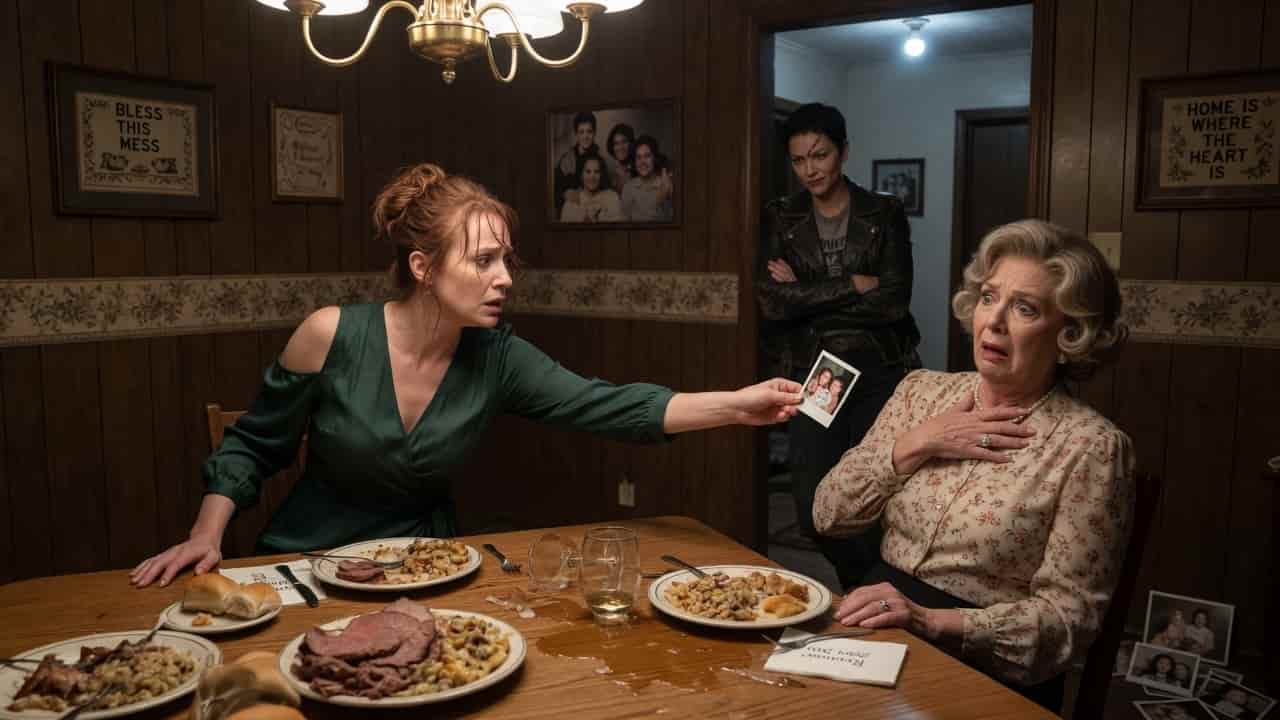
Sarah’s voice didn’t just shake; it tore through the quiet of the family reunion like a blade. She didn’t care about the wine glasses or the neighbors watching from the porch. She only cared about the yellowed Polaroid in her hand—the one she’d found hidden in the back of a Bible.
For thirty years, Diane had been the grieving mother of the Maine coast. She’d raised Sarah with stories of the “drowning,” the “accident,” and the empty grave she visited every Sunday. She’d built a life on being the victim of a tragedy that never actually happened.
But the photo didn’t show a drowning. It showed a transaction. It showed a dark car, a man in a suit, and Diane handing over a small, bundled-up girl in exchange for a thick envelope.
“Sarah, stop this,” her husband whispered, reaching for her arm. “You’re confused. Your sister is gone.”
“She’s not gone, Mark,” Sarah said, her eyes locked on her mother’s pale, frozen face. “She was sold. And she’s standing right behind you.”
When the woman in the leather jacket stepped out of the shadows, the silence in the room didn’t just feel heavy—it felt like the end of the world.
Chapter 1: The Weight of Living
The air in the basement of the Portland Records Office always smelled like damp cardboard and the slow, acidic rot of paper that had been forgotten by everyone but the state. It was a smell Sarah usually found comforting. It was the smell of facts. Facts didn’t change their story based on who was asking. Facts didn’t have feelings, and they certainly didn’t lie to make you feel better about your own survival.
Sarah adjusted her glasses, the bridge of her nose aching from the weight of six hours of microfiche. She was a forensic genealogist—a title that sounded more glamorous than it was. Most days, it meant tracing the lineage of property disputes or helping the probate court find distant cousins of the lonely dead. But lately, Sarah had been using her professional access for a different kind of excavation.
She scrolled through the digitized records of the Portland General Hospital, 1996. There it was again. Her own name.
Sarah Miller. Admitted July 14, 1996. Diagnosis: Acute Lymphoblastic Leukemia. Treatment: Bone Marrow Transplant. Status: Successful.
She’d seen the record a hundred times. It was the foundation of her life. She was the miracle child. The one who had survived the impossible while her twin sister, Becca, had been taken by the cold, grey waters of Lake Sebago. It was the central myth of the Miller family. Sarah got the life, and Becca got the water.
“Working late again?”
Sarah jumped, her hand twitching on the mouse. Mark was standing in the doorway, his silhouette framed by the harsh fluorescent light of the hallway. He looked tired. His scrubs were wrinkled, and there was a faint smudge of something dark on his left sleeve. He was a nurse in the ICU, a man who spent his days wrestling with the same mortality that Sarah spent her nights researching.
“Just finishing up a client report,” Sarah lied. The lie tasted like copper in her mouth. She hated lying to Mark, but Mark didn’t understand the itch. He thought the past was a place you moved away from, not a place you dug up.
Mark walked over and put his hands on her shoulders. He squeezed gently, but Sarah felt the tension in his grip. “It’s after eight, Sar. You’ve been in this hole since nine this morning. Let’s go get some dinner. There’s a new Thai place in the Old Port.”
“I’m almost done, Mark. Five minutes.”
“You said that at six,” Mark said, his voice dropping an octave. He leaned over, his eyes drifting to the screen. Sarah instinctively tried to minimize the window, but she was too slow. Mark saw the hospital records. He saw the dates. He saw the name Miller.
He let out a long, slow exhale that sounded more like a deflation. He pulled his hands back as if the green silk of her blouse had suddenly turned into ice. “Again, Sarah? We talked about this. Your mom’s reunion is in three days. Do you really want to be doing this right now?”
“Doing what, Mark? Looking at my own medical history? Is that a crime now?”
“It’s an obsession,” he said, and the word landed with a dull thud between them. “You’ve been chasing this ghost for two years. Your sister drowned. It was a tragedy. It tore your family apart, and your mother spent thirty years putting the pieces back together. Why can’t you just let it be?”
Sarah stood up, her chair scraping harshly against the concrete floor. “Because the math doesn’t work, Mark! My transplant cost two hundred thousand dollars in 1996. My dad had been laid off from the mill six months before I got sick. We had no insurance. None. My mom says a ‘private donor’ from the church paid for it anonymously.”
“And you think she’s lying?”
“I think people in this town don’t give away two hundred thousand dollars without a name attached to it. Not in 1996, and definitely not to a family that was already circling the drain.”
Mark rubbed his face with his hands. “So what’s the alternative, Sarah? You think she robbed a bank? You think she found buried treasure?”
“I think she made a deal,” Sarah whispered.
The room went quiet, save for the hum of the old computer tower. It was the kind of silence that had residue—the kind that stuck to your skin and made you want to scrub it off. Sarah looked at Mark, wanting him to see the logic, the cold, hard numbers that didn’t add up. But all she saw in his eyes was pity. And Sarah hated pity more than anything else in the world.
“Let’s go home,” Mark said softly.
They drove back to their small house in Cape Elizabeth in a silence that felt like a third passenger. The Maine coast was beautiful in the early spring, all jagged rocks and crashing surf, but to Sarah, it just felt cold. Every time she looked at the water, she didn’t see beauty. She saw the thing that had supposedly swallowed half of her.
When they got home, Sarah waited for Mark to fall asleep. She listened to the steady rhythm of his breathing, the sound of a man who was at peace with the world. Then, she got out of bed, her feet silent on the hardwood floors. She went to the guest room—the room she’d turned into her unofficial office—and opened her laptop.
She didn’t look at hospital records this time. She looked at a folder titled B.M.
Inside were screenshots from a private investigator’s database she’d paid a month’s salary to access. There were photos of a woman in Boston. A woman with a scarred eyebrow and a way of leaning against a car that made Sarah’s heart hammer against her ribs. The woman’s name was Rebecca Thorne. She was thirty-five years old. She worked as a skip-tracer for a bail bondsman.
Sarah stared at the woman’s face. It was her own face, but harder. The eyes were the same shade of sea-glass green, but they were filled with a cynical edge that Sarah didn’t possess.
She reached out and touched the screen, her fingertip resting on Rebecca’s cheek.
“Where did you come from?” she whispered to the empty room.
She thought about her mother, Diane. Diane, who was the head of the altar guild. Diane, who baked pies for every funeral in town. Diane, who had wept at the edge of Lake Sebago for three days straight until the police told her the current had likely swept the body into the deep channels.
If Rebecca Thorne was real, then Diane Miller was a monster.
And if Diane Miller was a monster, then Sarah was the reason the monster had been born. Sarah was the girl who lived because her sister was gone. If the “deal” was what Sarah suspected, then her very blood—the marrow that had been pumped into her bones to save her life—was the price of a betrayal so deep it made her feel sick to her stomach.
She closed the laptop and walked to the window. In the distance, she could hear the rhythmic tolling of a buoy out in the bay. It sounded like a bell. A funeral bell that had been ringing for thirty years, waiting for someone to finally hear it.
Sarah knew she couldn’t go to the reunion and just eat potato salad. She couldn’t watch her mother receive the “Saint of the Parish” award while this woman in Boston lived a life that had been stolen from her.
She went back to her desk and opened her drawer. Hidden beneath a stack of tax returns was a small, plastic baggie. Inside was a single strand of hair she’d pulled from her mother’s hairbrush three weeks ago. And next to it, an old, grainy Polaroid she’d found in the crawlspace of her childhood home—a photo of a dark car she didn’t recognize, parked by a lake she knew all too well.
The residue of that night’s conversation with Mark lingered like smoke in the room. He didn’t believe her. He wanted her to be whole. But Sarah knew she was only half a person. And she was going to find the other half, even if it meant burning her entire world to the ground.
Chapter 2: The Ghost of Sebago
The drive to Sebago Lake was a journey through a landscape of manufactured memories. Every roadside diner and bait shop felt like a landmark in a story Sarah had been told so many times she no longer knew if she actually remembered it.
This is where we bought the blue inner tubes. This is where Becca dropped her ice cream. This is where the world ended.
Sarah pulled her car into the gravel lot of “Elias’s Tackle & Gear.” The building was a sagging structure of salt-bleached cedar, decorated with rusted lures and faded photos of men holding up monster bass. Elias was eighty now, a man who had spent sixty years on the water. He was also the man who had been the first on the scene the day Becca disappeared.
The bell above the door chimed—a tinny, lonely sound. The air inside smelled of gasoline, dried fish scales, and old tobacco. Elias was sitting behind the counter, his hands gnarled like driftwood, slowly winding line onto a reel.
“Help you?” he asked, not looking up.
“Elias, it’s Sarah Miller. Diane’s daughter.”
The winding stopped. Elias looked up, his eyes milky with cataracts but still sharp enough to pierce. He stared at her for a long beat, his gaze lingering on the shape of her jaw, the color of her hair.
“You look just like her,” he muttered. “The other one.”
Sarah felt a chill that had nothing to do with the spring air. “You remember that day, Elias. I know everyone asks you, but I need to know something. Something specific.”
Elias sighed, a sound like sandpaper on wood. “I told the sheriff everything back then, Sarah. I saw the girl on the dock. I turned to haul in my net, and when I looked back, she was gone. Just a ripple in the water.”
“Did you see a car?” Sarah asked, leaning over the counter. Her voice was low, urgent. “A dark car? Maybe a Lincoln or a Cadillac? Parked up by the old logging road, near the north cove?”
Elias’s hands began to tremble. He reached for a tin of tobacco, his movements jerky. “There were lots of cars back then, Sarah. It was mid-July. Tourists everywhere.”
“Not in the north cove,” Sarah pressed. “That’s private land. My grandfather’s land. You told the police you heard a door slam. It’s in the report, Elias. You said you heard a door slam right before you saw the ripple.”
Elias looked away, his eyes fixing on a dusty mounted pike on the wall. “The police said it was a backfire. Or maybe just the wind catching the boathouse door.”
“Was it the wind, Elias? Or did you see my mother?”
The old man flinched. He finally looked at her, and for the first time, Sarah saw the fear. It wasn’t the fear of a man who had seen a ghost; it was the fear of a man who had been carrying a secret that was finally starting to rot.
“Your mother was a saint,” Elias whispered, but the words sounded rehearsed, like a prayer said by someone who no longer believed in God. “She was hysterical. She was screaming for that girl until her throat bled. I had to hold her back from jumping in herself.”
“And what about the man?” Sarah asked, her heart racing. “The man in the suit? Did you see him talk to her?”
Elias stood up, his knees popping. “I’m an old man, Sarah. My memory isn’t what it used to be. You should go home. Your mother’s got that big party coming up. Don’t go stirring up the mud. When you stir up the mud in a lake this deep, you never know what’s going to float to the top.”
Sarah didn’t move. She reached into her bag and pulled out the Polaroid. She laid it on the glass counter between them. The photo was blurry, taken from a distance, but the silhouette of the dark car was unmistakable. And next to it, two figures—a woman in a sundress and a man in a dark suit, their hands meeting between them.
Elias stared at the photo. His face didn’t just go pale; it went grey. He backed away from the counter, his breath coming in ragged hitches.
“Where did you get that?” he hissed.
“I found it in the crawlspace,” Sarah said. “Inside an old tackle box. Your tackle box, Elias. My dad bought it from you at a yard sale twenty years ago. You must have dropped it in there by mistake.”
Elias sank into his chair, his head dropping into his hands. “I didn’t want to see it,” he moaned. “I was out there looking for the girl. I thought maybe she’d wandered into the woods. I saw them. I took the picture because I thought… I don’t know what I thought. I thought maybe he was a kidnapper. I was going to take it to the sheriff.”
“But you didn’t,” Sarah said.
“I went to the house first,” Elias said, his voice muffled by his palms. “I went to tell Diane I saw the car. And she… she fell to her knees. She told me if I showed that picture to anyone, they’d take you, too. She said you were dying. She said the money was the only way to keep the doctors from turning you away.”
Sarah felt the world tilt. The “Saint of the Parish.” The woman who had been the pillar of the community for thirty years had bought her daughter’s life with the body of her other child.
“She told me it was a closed adoption,” Elias continued, his voice cracking. “She said the man was a lawyer for a wealthy family who couldn’t have kids. She said Becca would have a better life. A life with doctors and schools and everything we couldn’t give her. And she said if I spoke up, I’d be the one who killed you. Because without that money, you’d be in the ground by Christmas.”
Sarah backed away from the counter, the smell of gasoline and fish suddenly making her want to gag. The residue of the truth was thick and oily, coating everything. She had spent thirty years grieving a sister who wasn’t dead, and thirty years loving a mother who was a trafficker.
“She’s in Boston, Elias,” Sarah said, her voice sounding like it belonged to someone else.
Elias looked up, his eyes wide. “Who?”
“Becca. She’s alive. Her name is Rebecca Thorne.”
Elias let out a sob—a harsh, dry sound. “God help us all,” he whispered.
Sarah grabbed the Polaroid and walked out of the shop. She didn’t go back to Cape Elizabeth. She drove south, toward the Maine-Massachusetts border. She had a name, she had a face, and now she had the “why.”
But as she drove, a new kind of pressure began to build in her chest. It wasn’t just the anger, and it wasn’t just the betrayal. It was the crushing weight of her own existence. She was the proof of the crime. Every breath she took, every beat of her healthy heart, was a reminder of what had been stolen from her twin.
She pulled over at a rest stop near Kennebunk and sat in the dark car, her hands gripping the steering wheel until her knuckles went white. She thought about her mother’s face—the serene, patient face she showed the world. She thought about the way Diane would tuck her in at night when she was a child, whispering that Becca was an angel watching over them.
It hadn’t been an angel. It had been an invoice.
Sarah picked up her phone and dialed the number she’d found in the skip-tracer database. Her heart was a frantic, trapped thing.
The phone rang once. Twice. Three times.
“Thorne,” a voice answered. It was a voice that sounded like Sarah’s, but cured in smoke and grit. It was a voice that didn’t expect anything good from a ringing phone.
Sarah opened her mouth, but for a moment, nothing came out. The silence stretched between them, three hundred miles of highway and thirty years of lies compressed into a few seconds of cellular static.
“Hello?” the voice said, sharper now. “If this is a collection agency, you’re wasting your time.”
“Becca?” Sarah whispered.
There was a sharp intake of breath on the other end. A long, agonizing pause.
“Who is this?”
“It’s Sarah,” she said, and as the name left her lips, she felt the last piece of her childhood identity shatter. “I think… I think I’m your sister.”
The silence that followed wasn’t just deafening. It was the sound of a grave opening up.
Chapter 3: The Price of Marrow
The diner in Revere, Massachusetts, was the kind of place where the coffee tasted like battery acid and the booths were patched with duct tape. It was three in the morning, the dead hour where only the desperate and the haunted were awake. Sarah sat in the back booth, her forest-green dress looking absurdly formal against the grime of the setting.
She watched the door. Every time it swung open, she felt a jolt of electricity that made her hands shake.
Then she saw her.
Rebecca Thorne didn’t walk into the room; she invaded it. She was wearing a scuffed leather jacket, heavy boots, and a look of profound irritation. She scanned the diner with the practiced eye of someone who was always looking for an exit. When her eyes landed on Sarah, she stopped.
It was like looking into a distorted mirror. The resemblance was terrifying, but the differences were what hurt. Rebecca’s hair was short, dyed a jagged black that made her pale skin look almost translucent. The scar on her eyebrow—a thin, white line—gave her a permanent look of skepticism.
She walked over to the booth and slid in opposite Sarah. She didn’t say hello. She didn’t reach out. She just stared.
“You’re late,” Sarah said, her voice small.
“I had to make sure you weren’t a setup,” Rebecca said. Her voice was lower than Sarah’s, raspier. “I’ve spent ten years hunting people who don’t want to be found. Usually, when someone calls me out of the blue claiming to be family, they’re looking for a kidney or a loan.”
“I don’t want your kidney,” Sarah said, a hysterical laugh bubbling up in her throat. “I already took your life. I think that’s enough.”
Rebecca leaned back, her eyes narrowing. “You sounded crazy on the phone. You still sound a little crazy. Start from the beginning. And make it quick. I’ve got a skip to catch in East Boston at six.”
Sarah reached into her bag and pulled out the medical records, the Polaroid, and the strand of her mother’s hair. She laid them out on the sticky table like she was performing a ritual.
“I’m a genealogist, Becca. I deal in DNA and paper trails. I started looking into my own history because the numbers didn’t make sense. My leukemia treatment in ’96… it was paid for by an anonymous donor. Two hundred thousand dollars.”
Rebecca looked at the Polaroid. She didn’t pick it up, but her gaze lingered on the dark car. “My parents… the people who raised me… they told me I was a private adoption. They were older. Wealthy. My dad was a corporate lawyer in Brookline. They weren’t bad people, Sarah. They gave me everything. Private schools, horseback riding, a trust fund I blew through by the time I was twenty-two.”
“Did they tell you where you came from?”
“A ‘difficult situation’ in Maine,” Rebecca said, her voice flat. “They said my mother was a young girl who couldn’t keep me. They said they saved me from the foster system.”
“She wasn’t a young girl,” Sarah said, the anger finally breaking through the shock. “She was thirty-two. She was married. And she had another daughter who was dying. She didn’t save you from the foster system, Becca. She sold you to pay for my surgery.”
Rebecca’s face didn’t change, but Sarah saw her hands clench into fists beneath the table. The residue of that revelation seemed to settle over the diner like ash.
“You have proof?” Rebecca asked.
“The fisherman who saw the car. The records of the hospital payments. And this.” Sarah pointed to the hair. “I’m going to run a comparison. But I don’t need the results, and neither do you. Look at us.”
Rebecca finally picked up the Polaroid. She held it with two fingers, staring at the blurry figure of the woman by the lake. “Diane Miller. That’s her name, right? The Saint of Sebago?”
“That’s what they call her,” Sarah said. “She’s getting an award this weekend. A ‘Lifetime of Service’ award from the parish. There’s going to be a big dinner. All the town bigwigs, the priest, the neighbors. Everyone who thinks she’s the bravest woman in Maine because she ‘lost’ her daughter and still kept her faith.”
Rebecca let out a sharp, cold bark of a laugh. “A lifetime of service. That’s rich. She sold one twin to fix the other. Like she was parting out a car.”
“I didn’t know,” Sarah whispered. “Becca, I swear to God, I spent my whole life feeling guilty that I was the one who survived. I thought the universe just picked me and rejected you. I didn’t know it was a choice.”
Rebecca looked at Sarah, and for a fleeting second, the hardness in her eyes softened into something that looked like grief. But then it was gone, replaced by a cold, predatory light.
“A choice,” Rebecca repeated. “Yeah. She made a choice. And now I’m going to make one.”
“What are you talking about?”
“I’m coming to that dinner, Sarah.”
Sarah felt a surge of panic. “Becca, wait. We need a plan. We can’t just—”
“I’ve spent fifteen years finding people who didn’t want to be found so I could drag them back to court or a jail cell,” Rebecca said, leaning across the table. Her voice was a low, dangerous hum. “I’m very good at my job. And I’ve never had a client who deserved a reckoning more than Diane Miller.”
“She’s my mother,” Sarah said, though the word felt like a lie now.
“She’s the woman who put a price tag on my head,” Rebecca countered. “And you’re the one who found me, Sarah. You opened the box. You don’t get to close it now just because you’re scared of what’s inside.”
Rebecca stood up, tossing a five-dollar bill onto the table. “I’ll be in Maine on Friday. Don’t tell her I’m coming. If you tip her off, I’ll know. And then we’ll find out just how much ‘marrow’ is left in this relationship.”
She walked out of the diner without looking back. Sarah sat in the booth, surrounded by the physical evidence of her mother’s sins. She felt a strange, terrifying sense of vertigo. She had spent her life trying to find the truth, but now that she had it, she realized the truth wasn’t a destination. It was an explosion.
She thought about Mark, asleep in their bed in Cape Elizabeth. She thought about her mother’s kitchen, the smell of cinnamon and the bright, cheery curtains. She thought about the empty grave in the Sebago cemetery, the one she’d laid flowers on every year on their birthday.
She picked up the Polaroid. The dark car was still there, waiting.
Sarah knew she was no longer the victim of this story. By finding Becca, she had become the architect of her mother’s destruction. And as she watched the sun begin to bleed over the horizon of the Atlantic, she realized she didn’t know if she was doing this for justice, or if she was doing it because she couldn’t stand being the only one who had to carry the weight of living.
She drove back to Maine in a daze, the miles blurring together. When she pulled into her driveway, Mark was standing on the porch, a cup of coffee in his hand. He looked relieved to see her, then immediately concerned as she stepped out of the car.
“Sarah? Where have you been? I woke up and you were gone. Your phone was off.”
Sarah walked up the stairs, her legs feeling like lead. She looked at her husband—the man who loved her, the man who wanted her to be whole—and she felt like a stranger.
“I found her, Mark,” she said.
Mark’s face went still. “Who?”
“Becca. She’s alive. And she’s coming to the reunion.”
Mark dropped his coffee cup. The ceramic shattered on the porch, a dark stain spreading across the wood like blood.
“Sarah, what have you done?” he whispered.
“I stopped the lying,” Sarah said. “Whatever happens next… that’s not on me. It’s on the woman who started it.”
But as she walked past him into the house, Sarah knew that wasn’t true. The residue of a secret this big didn’t just stay with the person who told it. It stained everyone it touched. And by Friday night, there wouldn’t be a clean soul left in the state of Maine.
Chapter 4: The Altar of Saint Diane
The Miller family home was a sprawling Victorian on the edge of the lake, a house that breathed with the history of four generations. For the reunion, Diane had gone all out. The wrap-around porch was lined with white hydrangeas, and a large tent had been set up on the lawn, though the main dinner was to be held in the formal dining room.
Sarah stood in her childhood bedroom, staring at her reflection in the oval mirror. The forest-green dress fit her perfectly, but her face looked gaunt, her eyes shadowed by three days of no sleep. Downstairs, she could hear the muffled sounds of laughter, the clinking of silverware, and the booming voice of Father O’Malley.
She felt like an intruder in her own life.
There was a soft knock on the door. Mark stepped in, looking sharp in a navy blazer, though his expression was tight with anxiety. He hadn’t stopped trying to talk her out of it since she’d come home from Massachusetts.
“Sarah, please,” he said, his voice a low plea. “Look at the guest list. The Mayor is down there. The Chief of Police. If you do this publicly, there’s no going back. You’ll destroy her. You’ll destroy this family’s name.”
“The name is built on a lie, Mark,” Sarah said, her voice devoid of emotion. “Do you think Becca cares about the family name? She spent thirty years being ‘Rebecca Thorne’ because her own mother didn’t want her.”
“She did want her, Sarah! She did it to save you!” Mark grabbed her shoulders, forcing her to look at him. “It was a horrific choice, but it was a choice made out of love. Can’t you see that? She sacrificed one to save the other.”
“You don’t sacrifice a human being like a pawn in a chess game, Mark. That’s not love. That’s math. And I’m the remainder.”
Sarah pulled away and picked up her clutch. Inside, the Polaroid was tucked into a side pocket, a jagged piece of the past ready to be deployed.
“Is she here?” Mark asked, his voice trembling.
“She’s waiting for my signal,” Sarah said.
They walked downstairs together, a couple performing the role of the dutiful daughter and son-in-law. The dining room was a sea of familiar faces. There was Aunt Martha, who had brought her famous potato salad; Elias, who sat in the corner looking like he wanted to crawl into the floorboards; and at the head of the table, Diane.
Diane looked radiant. She was wearing a cream floral blouse, her pearls glowing against her skin. She was holding court, telling a story about the parish fundraiser, her laughter light and melodic. When she saw Sarah, her face lit up with a warmth that, for the first time in thirty years, made Sarah’s skin crawl.
“There she is!” Diane exclaimed, standing up to embrace her. “My miracle girl. Come, sit. Father O’Malley was just saying how much you’ve grown into your father’s eyes.”
Sarah let her mother hug her. She felt the softness of Diane’s sweater, the scent of lavender and expensive flour. She felt the lie vibrating between their bodies like a live wire.
“Thanks, Mom,” Sarah said, her voice tight.
The dinner was an exercise in psychological torture. Sarah sat opposite her mother, watching as one person after another stood up to offer a toast. They spoke of Diane’s resilience. They spoke of her “unwavering strength” after the tragedy of 1996. They spoke of how she was a beacon of hope for every parent who had ever known loss.
Each word was a stone being piled onto Sarah’s chest. She looked at Elias. The old fisherman wouldn’t meet her eyes. He was staring at his plate, his hands shaking as he tried to cut his roast beef. He knew. He was a witness to the altar of Saint Diane, and he was too cowardly to tear it down.
Finally, it was Diane’s turn to speak. She stood up, her wine glass raised, her expression one of humble grace.
“I want to thank you all for being here,” Diane said, her voice carrying across the room with effortless poise. “Life hasn’t always been easy in this house. We’ve known deep shadows. But I’ve always believed that even in the darkest water, there is a light that guides us back. My Sarah is that light. And though her sister isn’t with us tonight, I know she’s watching over this table, smiling at the love we share.”
A murmur of “Amen” and “So true” rippled through the guests.
Sarah felt a cold, sharp snap inside her. The residue of thirty years of silence evaporated, replaced by a white-hot clarity. She stood up before Diane could sit down.
“Actually, Mom,” Sarah said, the room falling silent. “I have a gift for you. Something I found that I think everyone should see. Especially since we’re talking about lights in the darkness.”
Diane’s smile faltered, just for a fraction of a second. “Sarah, honey, let’s wait for dessert. We have so many guests—”
“I don’t want to wait,” Sarah said. She reached into her clutch and pulled out the Polaroid. She walked around the table, her heels clicking like a countdown on the hardwood.
She slammed the photo onto the table directly in front of Diane.
“Look at the car, Mom,” Sarah said, her voice loud enough to reach the hallway. “Tell everyone who was inside.”
Diane looked down. The transformation was instantaneous. The “Saint” vanished, replaced by a woman whose very foundation had just turned to sand. Her face went ashen, the color draining from her lips until they were almost blue. She recoiled, her hand flying to her throat, her eyes darting around the room like a trapped animal.
“Sarah, please,” Diane whispered, her voice a ghost of its former self. “You’re making a scene. This isn’t the time.”
“Then when is the time, Mom?” Sarah leaned in, her hands flat on the table, her face inches from her mother’s. “When is the time to talk about the two hundred thousand dollars? When is the time to talk about the man in the suit? Answer me. In front of Father O’Malley. In front of Mark. How much did they pay for her?”
The room was so quiet Sarah could hear the ticking of the grandfather clock in the hall. The neighbors were frozen, forks suspended in mid-air. Mark had his head in his hands.
“I don’t know what you’re talking about,” Diane stammered, her voice rising in a desperate, brittle pitch. “That’s just an old photo. It’s nothing. You’re confused, Sarah. Your illness… it’s the stress. You’re not thinking clearly.”
“I’ve never been clearer,” Sarah said. She turned toward the dark hallway. “Becca? You can come in now.”
The silence that followed was the heaviest thing Sarah had ever felt. It was the sound of thirty years of social standing, religious devotion, and family myth collapsing into a pile of rubble.
Rebecca Thorne stepped into the dining room.
She was exactly as she had been in the diner—hard, cynical, and unmistakably a Miller. She stood in the doorway, the hall light silhouetting her leather jacket, her scarred eyebrow raised in a mocking salute.
The gasp that went through the room was collective. Aunt Martha dropped her glass, the red wine splattering across the white tablecloth. Father O’Malley stood up, his face a mask of confusion and dawning horror.
Diane didn’t scream. She didn’t cry. She just stared at the woman who was the living, breathing evidence of her greatest sin. She looked at Becca, then at Sarah, then back at Becca.
“She can’t hear you, Sarah,” Becca said, her voice cutting through the room like a winter wind. “She’s too busy lying. It’s a habit once you’ve been doing it for three decades, right, Diane?”
Diane’s wine glass slipped from her fingers. It hit the edge of the table and shattered, the shards skittering across the floor.
“Becca?” Diane whispered, the word sounding like a plea and a curse all at once.
“Not Becca,” the woman said, stepping closer to the table, her boots thudding on the rug. “My name is Rebecca Thorne. And I’d like to know if the ‘Saint of the Parish’ has a refund policy for children sold in the north cove.”
The residue of the confrontation was instantaneous. The room didn’t just feel dangerous; it felt like a crime scene. Sarah looked at her mother—really looked at her—and saw the smallness of the woman. The “Saint” was gone. There was only a terrified old woman who had traded a soul for a life and was finally being presented with the bill.
Sarah stood between them, the twin she’d saved and the mother who had saved her. She felt the weight of the Polaroid, the weight of the marrow in her bones, and the weight of the wreckage she’d just created.
She had found the truth. But as she looked at the shattered glass and the horrified faces of her neighbors, she realized she had no idea how to live in the world she had just unmade.
Chapter 5: The Social Death of a Saint
The sound of the glass shattering was more than a break; it was a punctuation mark at the end of a thirty-year sentence. For a few seconds, the only noise in the room was the rhythmic, frantic panting of Diane Miller. It was the sound of a woman who had run out of air, out of room, and out of lies.
The guests—the pillars of the Sebago community—remained frozen like figures in a wax museum. Father O’Malley was the first to move, his hand trembling as he reached for the edge of the table. He was a man who had spent his life hearing confessions, but he had never heard one delivered with the cold, surgical precision of Sarah Miller’s voice. He looked at Diane, his eyes searching for the woman who had organized the Christmas food drives and the summer bake sales, but she wasn’t there. There was only a hollowed-out shell in a floral blouse.
“Diane?” O’Malley’s voice was a ragged whisper. “Is this… is there any truth to this?”
Diane didn’t look at him. Her eyes were locked on Rebecca—on the black leather jacket, the jagged hair, and the face that was a jagged, angry echo of her own “miracle” daughter. She looked like she was waiting for the ground to open up and swallow her. When it didn’t, she turned her gaze toward Sarah, and for a second, the old Diane flickered back to life—the one who could weaponize guilt like a stiletto.
“You’ve ruined it,” Diane breathed, her voice so low it barely carried across the table. “Everything I built for you. Every sacrifice I made to keep you alive. You’ve thrown it all into the mud because you wanted to play detective.”
“I didn’t play detective, Mom,” Sarah said, her voice steady despite the hammer of her pulse in her throat. “I did your job. I found the truth. I found the daughter you sold so I could have a bone marrow transplant.”
Aunt Martha let out a high, thin wail and buried her face in her napkins. The neighbors began to stir, a collective, uncomfortable shifting of chairs. The “Saint of the Parish” was rotting in front of them, and the stench was unbearable. One by one, they began to stand. They didn’t offer comfort. They didn’t ask questions. They moved toward the door with the hushed, panicked urgency of people fleeing a burning building.
“I think we should go,” one of the neighbors said, his voice flat and devoid of the warmth he’d shown ten minutes ago.
Diane didn’t try to stop them. She sat paralyzed as her social world evaporated. The prestige, the respect, the years of carefully curated sympathy—it was all gone. In its place was the residue of a crime that no amount of church service could wash away.
Mark stood up, his face ashen. He looked at Sarah, and the disappointment in his eyes was a physical blow. He didn’t see a truth-seeker; he saw a woman who had just detonated a nuclear bomb in the middle of a dinner party. He walked toward the door without a word, his silence a sharp, final rejection of the chaos she had invited into their lives.
“Mark, wait,” Sarah started, but Becca stepped into his path.
“Let him go, Sarah,” Becca said. Her voice was the only thing in the room that felt grounded. “He’s part of the furniture. He doesn’t want to see the termites.”
Mark pushed past her, the screen door slamming behind him. The sound echoed through the nearly empty house. Only Sarah, Becca, Diane, and a shell-shocked Father O’Malley remained.
O’Malley stood up slowly, his robes rustling. He looked at Diane with a mixture of pity and profound revulsion. “I will pray for you, Diane. But I cannot stay in this house. Not tonight.”
He followed the others out, leaving the three women in the wreckage of the celebration. The smell of the roast beef and the expensive wine felt sickening now—a reminder of the luxury bought with a betrayal.
Becca walked over to the table and picked up a piece of bread, chewing it slowly as she looked at Diane. “So. 1996. The north cove. Who was the guy in the suit? I’ve spent my whole life wondering why my ‘parents’ were so weird about my birth records. They were good to me, Diane. They gave me a life. But they were always terrified I’d find out they’d bought me like a used car.”
Diane finally looked up. The tears were coming now—thick, ugly sobs that tore at her throat. “You were going to die, Sarah! The doctors said we had weeks. The mill was closed. Your father was a broken man. I did what I had to do. I didn’t want to lose both of you.”
“You didn’t lose her, Diane,” Becca said, her voice dropping to a dangerous, low hum. “You sold her. There’s a difference. Losing someone is an accident. Selling someone is a transaction. You looked at the two of us and decided which one was worth keeping and which one was worth the cash.”
“It wasn’t like that!” Diane shrieked, her hands slamming onto the table. “The Thornes were good people! They couldn’t have children! I knew they would love you. I knew you’d have a better life than I could ever give you in this dying town.”
“And what about me?” Sarah asked, her voice cracking. “Did you ever think about what it would do to me? To know that I’m only alive because you traded my sister for a check? You let me live a lie for thirty years. You let me mourn a girl you knew was alive and well in Boston.”
“I did it for you,” Diane whispered, the words a pathetic, repetitive mantra. “Everything was for you.”
The residue of that statement was like poison. Sarah looked at her mother and realized that Diane didn’t feel guilty for what she’d done; she felt persecuted for being caught. The “sacrifice” was her shield, and she was going to hide behind it until the end.
Becca walked around the table and stood directly behind Diane. She leaned down, her black hair brushing against Diane’s grey bob. “I’m a skip-tracer, Diane. I find people who run. I find people who think they can hide their debts. And you owe me thirty years. I’m not going to the police. The statute of limitations on what you did is a messy thing, and frankly, I don’t want the paperwork.”
She reached into her jacket and pulled out a small, digital recorder. She tapped the screen.
“But I’m going to tell your story,” Becca said, her eyes flashing with a cold, predatory light. “Not the saint version. The real version. Every newspaper in this state is going to know exactly how Diane Miller paid for her daughter’s life. You wanted Sarah to have a future? Well, yours is over.”
Diane collapsed into her chair, her head falling into her hands. The silence that followed was thick with the weight of the social death she had just suffered. The house, once a symbol of her status, now felt like a tomb.
Becca turned to Sarah. “I’m staying at the motel on the highway. If you want to talk—really talk—come by tomorrow. If not… well, we’ve already shared enough marrow to last a lifetime.”
Becca walked out, her boots echoing on the porch. Sarah stood in the dining room, looking at the woman who had raised her. She wanted to feel something—pity, anger, even love—but all she felt was a profound, aching emptiness. She was the miracle girl. She was the one who survived. And she realized, with a clarity that made her knees weak, that she would have preferred the water.
She walked out of the house, leaving Diane alone in the dark. The lawn was littered with the remnants of the party—napkins blowing in the wind, a forgotten shawl on a chair. Sarah walked toward the lake, the sound of the water hitting the stones a rhythmic, indifferent pulse.
She stood on the dock where it had all supposedly happened. The air was cold, smelling of pine and damp earth. She thought about the “ripple” Elias had seen. It hadn’t been a girl drowning. It had been the sound of a family being torn apart for the sake of a transplant.
The residue of the night clung to her like the humidity. She had found her sister, but she had lost her mother and her husband in the process. She had traded a comfortable lie for a devastating truth, and she wasn’t sure if the exchange was worth it.
She looked out over the dark water of Sebago. Somewhere in the deep channels, the myths of her childhood were sinking. Sarah reached into her pocket and found a single shard of the glass that had shattered at dinner. She squeezed it until her palm bled, the sharp, clean pain the only thing that felt real.
She wasn’t a miracle. she was a consequence. And for the first time in thirty years, she finally knew exactly what she was worth.
Chapter 6: The Residue of the Miracle
The motel on Highway 302 was a collection of peeling paint and flickering neon that looked like it had been designed for people who were halfway to somewhere else. Sarah pulled her car into the lot at six in the morning, the sky a bruised purple that promised rain. Her green silk dress was wrinkled and stained at the hem, a relic of a night that felt like it had happened a lifetime ago.
She found Room 14. She didn’t knock. She just sat on the plastic chair outside the door and watched the trucks roar past on the highway. The noise was a relief—a constant, unthinking roar that drowned out the echoes of her mother’s sobbing.
Ten minutes later, the door creaked open. Becca stood there, wearing a grey undershirt and flannel pajama pants. She looked tired, her eyes rimmed with red, but the hardness was still there, etched into the line of her jaw.
“You look like hell,” Becca said, leaning against the doorframe.
“I feel like I’ve been hit by a train,” Sarah replied. “Mark didn’t come home last night. He’s staying at a hotel near the hospital. He sent me a text. He says he needs space.”
“Space is what people ask for when they’re too cowardly to say goodbye,” Becca said, stepping back to let Sarah inside.
The room smelled of stale cigarettes and cheap coffee. A laptop was open on the small desk, the screen glowing with a half-written document. Becca sat on the edge of the bed and lit a cigarette, the smoke curling around her face like a veil.
“Are you really going to do it?” Sarah asked, nodding toward the laptop. “Are you going to go to the papers?”
Becca exhaled a long cloud of smoke. “I don’t know. Last night, I wanted to burn her alive. I wanted everyone to see her the way I saw her—a woman who looked at her own kids and saw a ledger. But this morning… I don’t know. It’s a lot of work for a woman who’s already dead in every way that matters.”
“She’s not dead, Becca. She’s my mother.”
“She’s the woman who raised you,” Becca corrected. “There’s a difference. My mother was a woman who lived in Brookline and died of breast cancer five years ago. She was a lawyer. She was a bitch, sometimes, but she never would have sold me. She loved me because she chose me.”
Sarah felt a pang of jealousy that was so sharp it made her gasp. “You were lucky.”
“Lucky?” Becca’s laugh was a harsh, dry sound. “I spent thirty years feeling like a permanent guest in my own life, Sarah. I never felt like I belonged in that house. I had the best clothes, the best education, and a void in the middle of my chest that I tried to fill with whiskey and bad decisions. I’m a skip-tracer because I spent my whole life looking for myself.”
She stood up and walked over to Sarah, standing so close their shoulders almost touched. In the dim light of the motel room, the resemblance was haunting. Two versions of the same soul, separated by a transaction and thirty years of geography.
“We’re the same, you and me,” Becca whispered. “We’re both the residue of her ‘miracle.’ You got the life, and I got the displacement. But neither of us got to be who we were supposed to be.”
“What do we do now?” Sarah asked.
“We survive,” Becca said. “That’s what Millers do, apparently. We survive the water, the cancer, and the truth.”
They spent the morning talking—not about the “drowning” or the money, but about the small things. Sarah told her about the way the light hit the lake in October. Becca told her about the grit of the Boston docks. They searched for commonalities in their tastes, their habits, the way they both tended to chew on their lower lip when they were thinking. It was a slow, painful process of stitching together a relationship that had been ripped apart before it could even begin.
But the residue of the past was always there, lurking in the corners of the conversation. Every time Sarah looked at Becca’s scarred eyebrow, she thought about the life she had lived while Becca was being raised by strangers. Every time Becca looked at Sarah’s healthy glow, she thought about the marrow that had been the price of her own exile.
Around noon, Sarah’s phone buzzed. It was a message from her mother.
I’m at the cemetery. Please come. Just you.
Sarah showed the screen to Becca. “She’s at the grave. The empty one.”
“Of course she is,” Becca said, her voice dripping with cynicism. “She’s going back to the site of the lie. She wants to see if the ghost is still there.”
“I have to go,” Sarah said. “I have to finish this.”
“Go,” Becca said. “I’m heading back to Boston this afternoon. I’ve got a job in Chelsea tomorrow. But… keep the number. Don’t be a stranger, Sarah. We’ve already missed enough.”
Sarah hugged her sister—a stiff, awkward embrace that felt like it was breaking something inside her. Then she walked out into the rain and drove toward the Sebago cemetery.
The cemetery was an old, overgrown place on a hill overlooking the water. Sarah found her mother sitting on a stone bench next to a small, grey headstone.
Rebecca Miller. 1990–1996. Safe in the arms of Jesus.
The irony of the inscription was almost unbearable. Diane was dressed in black, her hair matted by the rain. She looked smaller than she had the night before, her shoulders slumped, her face a map of exhaustion.
“I used to come here and talk to the stone,” Diane said, not looking up as Sarah approached. “I’d tell her I was sorry. I’d tell her I hoped she was happy. I convinced myself that if I believed the lie hard enough, it would become the truth.”
“It never does, Mom,” Sarah said, standing a few feet away.
“I loved you both,” Diane said, her voice a hollow rasp. “People think a mother’s love is a bottomless well, but it’s not. It’s a resource. And mine was running out. I was a desperate woman, Sarah. And desperate people do things that haunt them until they die.”
“You didn’t just haunt yourself, Mom. You haunted me. You let me live in a world where I was a survivor and she was a victim. You let me build my identity on a tragedy that was actually a business deal.”
Diane finally looked up, her eyes filled with a desperate, pathetic hope. “Can you forgive me? Not today. But someday? I saved you, Sarah. Look at you. You’re healthy. You’re beautiful. You have a husband. You have a life.”
“I don’t have a husband, Mom. Mark left. And the life I have… it feels like it belongs to someone else.”
Sarah looked at the headstone. She thought about the thirty years of flowers she’d laid here. She thought about the tears she’d shed for a girl who was currently driving a beat-up Toyota back to Boston.
“I can’t forgive you,” Sarah said, the words landing with the finality of a gavel. “Maybe Becca can, because she got the better end of the deal. She got out of this house and away from your lies. But I stayed. I lived in your ‘miracle.’ And I can’t live in it anymore.”
Sarah turned and walked away. She didn’t look back at the woman on the bench. She didn’t look at the empty grave. She walked down the hill toward her car, the rain washing the last of the dinner party residue from her skin.
She drove back to her house in Cape Elizabeth. It was empty and quiet. She went into the guest room, picked up the files, the records, and the Polaroid, and put them all into a cardboard box. She walked out to the backyard, where a small fire pit sat cold and grey.
She started a fire. She watched as the hospital records curled and turned to ash. She watched the yellowed Polaroid of the dark car blacken and disappear. She watched the name Miller vanish in a puff of smoke.
When the fire was dead, Sarah went inside and called a realtor. She didn’t know where she was going, but she knew she couldn’t stay in a house built on the price of a sister.
She thought about Becca, somewhere on the I-95, headed back to a life that was hard and honest and entirely her own. She thought about the “wrong grave” on the hill.
The miracle was over. The lie was gone. And in the silence of the empty house, Sarah Miller finally began to breathe. It was a cold, lonely air, but for the first time in thirty years, it was her own.
The truth hadn’t set her free; it had just left her standing in the wreckage. But as she looked at her reflection in the darkened window, she realized she preferred the ruins to the cathedral. She was alive. Not because of a saint, and not because of a sacrifice. She was alive because she was the one who was left to tell the story.
And as the sun finally broke through the Maine clouds, Sarah walked out the front door and didn’t look back.