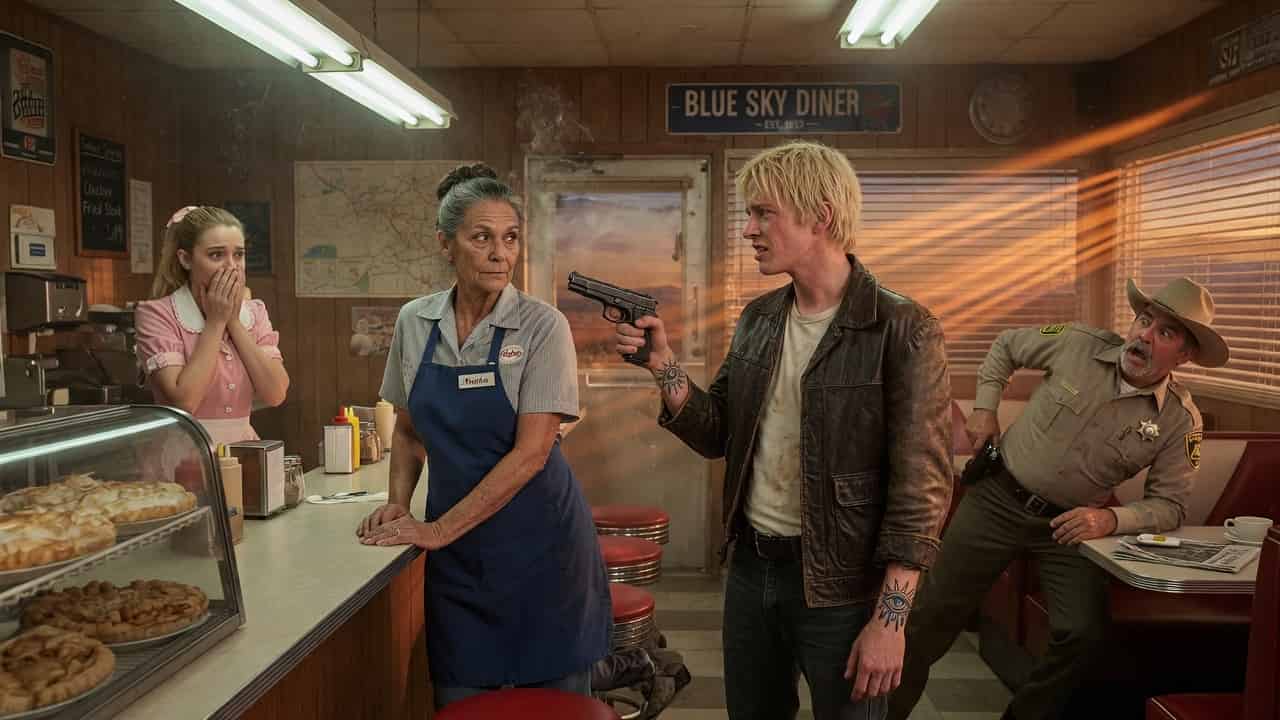
“Open the register, lady. I’m not asking twice.”
The kid’s hand was shaking so hard the barrel of the .38 was rattling against the glass of the pie case. He looked like he hadn’t slept in a week and hadn’t eaten in two. He had that desperate, feral stink of the high desert on him, but it was the ink on his wrist that made the world go quiet.
I didn’t reach for the silent alarm. I didn’t look at Ray, who I knew was about to unholster his service weapon from the corner booth. I just looked at that tattoo—the weeping eye, the mark of a place I’d spent forty years trying to forget.
“The sun sleeps in the well, little bird,” I said. My voice didn’t shake. It was the lullaby from the Sanctuary. The one I’d hummed into the hair of a three-day-old infant before I’d been forced to leave him on a stone altar and run for the fence.
The kid flinched like I’d slapped him. The cruelty in his eyes vanished, replaced by a raw, naked terror that made him look exactly like the boy I’d seen in my dreams every night since 1992.
“Shut up,” he choked out, the gun dipping. “How do you know that? Who told you that song?”
Ray was on his feet now, his voice booming through the diner, but I didn’t hear him. I was looking at my son. I was looking at the monster the world had made out of the heart I’d had to give away.
“I didn’t have to be told, Shane,” I whispered.
The whole room went still. Ray froze. The kid’s finger went slack on the trigger. He didn’t know his own name was Shane. Nobody in this state knew his name. Except for me.
Chapter 1
The heat in Goldfield didn’t just sit on you; it pressed. It was a physical weight, a thick, invisible hand pushing against the windows of the Sagebrush Diner, trying to find a crack in the seal. Martha shoved a tray of sourdough rolls into the industrial oven and felt the sweat map the lines on her forehead. At sixty-two, her joints performed a slow, rhythmic protest every time she moved, but she ignored them. In this part of Nevada, if you stopped moving, the desert reclaimed you.
“Martha, the fan’s rattling again,” Jessie called out from the front.
Jessie was nineteen, with a ponytail that never stayed tight and a habit of looking at the highway like it was a rescue ship. Martha wiped her hands on her navy blue apron and stepped out from the kitchen. The diner was mostly empty, the way it usually was at 10:00 AM on a Tuesday. The only sound was the low hum of the refrigerator and the frantic, rhythmic tick-tick-tick of the ceiling fan.
“It’s been rattling since the Reagan administration, Jess. Just ignore it,” Martha said, her voice like gravel being turned in a bucket. She walked behind the counter, her eyes instinctively checking the room.
Ray Miller sat in his usual spot—the far corner booth, facing the door. He’d been the Sheriff of Esmeralda County for twenty years and Martha’s “something-or-other” for nearly thirty. They didn’t label it. Labels were for people with futures. They were just two people who knew where the other’s scars were.
“Morning, Martha,” Ray said, not looking up from his coffee. He was a big man, filling out his tan uniform with a sturdiness that was starting to soften into age. He had his Stetson on the seat beside him, and his silver badge caught the harsh morning light.
“Coffee’s old, Ray. I’ll bring you a fresh pot,” Martha said.
“Old’s fine. Matches the company.” Ray finally looked up, his eyes crinkling. “You look like you didn’t sleep.”
“I slept fine. Just the heat.”
It was a lie. Martha hadn’t slept a full night since the wind started picking up three days ago. The wind always brought things. Dust, tumbleweeds, and memories she’d buried under layers of grease and hard work.
The bell above the door chimed. It was a thin, tinny sound that made Martha’s spine go rigid.
A young man walked in. He was thin—the kind of thin that suggested long stretches of hunger—and he moved with a nervous, twitchy energy. He wore a brown leather jacket that was too heavy for the hundred-degree weather, the collar turned up to hide a neck that looked like a bird’s. His hair was a matted, sun-bleached blonde, and his boots were caked in white alkali dust.
He didn’t look at the menu. He didn’t look at Jessie, who was already reaching for a glass of water. He looked at the cash register. Then he looked at Ray.
Martha felt a cold needle of dread prick the base of her neck. She’d seen a thousand drifters come through Goldfield. Most were just looking for a way out, heading toward Reno or Vegas. But this one had a different vibration. He looked like a cornered animal trying to decide whether to run or bite.
“Table or counter?” Jessie asked, her voice bright and oblivious.
“Counter,” the kid said. He sat three stools down from where Martha stood. His voice was higher than she expected, cracked and dry.
He reached up to push his hair back, and that’s when she saw it.
His right sleeve slid down just a few inches. On the pale skin of his inner wrist, there was a tattoo. It wasn’t professional. It was the blue-black ink of a needle and a thread, a stylized sun with a single weeping eye in the center.
The world didn’t stop, but Martha’s heart did. The Sanctuary of the Eternal Light.
She felt the air leave her lungs. The smell of the diner—the burnt coffee, the floor wax, the lingering scent of bacon—vanished, replaced by the suffocating smell of sage and incense and the damp earth of the cellar. She saw herself at sixteen, clutching a bundle of blankets, the desert wind screaming through the Joshua trees as she ran toward the fence. She remembered the man with the gold robe and the weeping-eye ring, the man who told her that her child belonged to the Light, not to her.
She’d left the child. She’d had to. If she hadn’t, they both would have died in that cellar. She’d spent forty-four years telling herself he was better off, that he’d grown up in the cult and become one of them, or that he’d been adopted out and was living a quiet life in some green suburb in Oregon.
But the boy sitting at her counter wasn’t living a quiet life. He was starving, he was shaking, and he was marked with the brand of the people who had broken her.
“Ma’am?” the kid said. His eyes were a startling, piercing blue. Her eyes. “Can I get a coffee?”
Martha’s hands were under the counter, gripping the shelf so hard the wood bit into her palms. She couldn’t speak. She couldn’t breathe.
“Martha?” Ray’s voice came from the corner. It was sharp. He’d noticed her freeze. He was looking at the kid now, his hand moving instinctively toward his belt.
“I’ve got it,” Martha managed to say, her voice a hollow rasp. She turned away, her back to the kid, and reached for a mug. Her hands were shaking. She had to use both to keep the coffee from spilling as she poured.
She turned back and set the mug down in front of him. She didn’t look at his face. She looked at the tattoo again. It was scarred, as if someone had tried to burn it off once and given up.
“Anything else?” she asked, her eyes fixed on the coffee.
“Whatever’s cheap,” the kid said. He reached for the sugar, his movements jerky. “And a pack of Camels if you got ‘em.”
“We don’t sell cigarettes,” Martha said.
“Right. Figures.” He took a long, desperate gulp of the hot coffee, wincing as it burned his throat.
Martha felt Ray’s presence before he even stood up. The Sheriff slid out of his booth and walked toward the counter, his boots thudding heavy on the linoleum. He stopped a few feet from the kid, leaning one elbow on the counter.
“Passing through?” Ray asked. His tone was casual, but it was the kind of casual that meant I’m counting the seconds until you leave my town.
The kid didn’t look at him. “Just getting a drink.”
“Hitchhiking?”
“Walking.”
Ray nodded slowly. He looked at the kid’s leather jacket, then at his caked boots. “Lot of desert between here and anywhere. You got an ID on you, son?”
The kid stiffened. He slowly lowered the mug. “Didn’t know I needed a permit to buy coffee.”
“You don’t. But you look like you’ve been traveling hard. Just making sure you’re not someone people are looking for.”
Martha watched the kid’s jaw tighten. There was a flicker of something in his eyes—a flash of pure, unadulterated rage that vanished as quickly as it appeared. It was the look of someone who had spent their entire life being told they didn’t belong anywhere.
“I’m not looking for trouble,” the kid said.
“Good,” Ray said. “Because Goldfield is a very small town. Trouble stands out. You finish that coffee, and then I suggest you find yourself a ride before the sun goes down. The nights get cold out there.”
Ray looked at Martha. He saw the way she was holding the counter. His eyes softened for a fraction of a second, a silent question passing between them. Are you okay?
Martha nodded, a tiny, jerky movement. She couldn’t tell him. Not here. Not with the boy sitting there.
The kid reached into his pocket and pulled out a crumpled five-dollar bill. He slapped it onto the counter and stood up. He hadn’t touched the coffee since the first sip.
“Keep the change,” he said. He turned and walked toward the door, his leather jacket creaking.
Martha watched him go. She watched him walk out into the shimmering heat of the parking lot, heading toward the rusted-out gas station across the road.
“Kid’s wrong,” Ray muttered, sliding back into his seat. “He’s got that look. Like a fuse that’s already been lit.”
“He’s just a boy, Ray,” Martha said, her voice trembling.
“He’s a boy with a habit of looking at the register more than his drink, Martha. I don’t like it. I’m gonna keep an eye on him.”
Martha didn’t answer. She walked back into the kitchen, her legs feeling like they were made of water. She reached the prep table and sank into a chair, her chest heaving.
She pulled her apron up, revealing the pale, wrinkled skin of her right hip. There, faded and blurred by time, was the same tattoo. The sun. The weeping eye.
She had run. She had changed her name. She had built a wall of grease and silence around her life. And after forty-four years, the wall had just come crashing down.
Chapter 2
By noon, the Sagebrush Diner felt like a pressure cooker. The lunch rush was thin—mostly truckers who didn’t talk and local miners who talked too much—but the atmosphere was jagged. Martha moved through the motions of flipping burgers and dropping fries, her mind a frantic loop of “what ifs.”
She kept looking out the window. The kid was still there. He was sitting on a concrete pylon near the abandoned gas pumps across the street, his head down, shoulders hunched. He looked like a piece of debris the desert had coughed up and forgotten to bury.
“He’s still there,” Jessie whispered, leaning over the pass-through window. She was staring out at the parking lot, her eyes wide with a mix of fear and curiosity. “Ray told him to move on, but he’s just sitting there. Like he’s waiting for something.”
“He’s waiting for a ride, Jess. Mind your tables,” Martha snapped.
Jessie flinched. Martha was usually gruff, but she was rarely sharp. The girl grabbed a bottle of ketchup and scurried away, leaving Martha alone with the heat of the grill.
Martha’s mind drifted back to the cellar. 1982. She could still feel the dampness of the stone walls against her back. She had been seventeen, and the Sanctuary had been her whole world. They told her she was special. They told her the “Light” had chosen her to carry the next generation of the faithful. Then they took the baby.
“He is not yours, Martha,” the Elder had said. His voice had been so kind, so reasonable. “He belongs to the sun. He is the weeping eye that sees the truth. You are merely the vessel.”
She had managed to get him back for one night. One night in the nursery before the ritual of dedication. She had held him, his skin smelling of milk and the cheap soap they used, and she had whispered the only thing she had left to give him. A song. A lullaby her own mother had sung to her before they’d joined the cult.
She’d left him because she thought he’d be safe. She thought the cult, for all its madness, took care of its own. Seeing that boy across the street—starving, hunted, marked—proved she was a fool.
The diner door opened again, and a man walked in. He wasn’t the kid. He was older, maybe thirty, with a thick neck and a military-style haircut that didn’t hide the scar running through his left eyebrow. He wore a grease-stained t-shirt and work pants. He didn’t look at Martha. He looked at Ray, then he looked out the window at the kid. He gave a small, almost imperceptible nod.
The kid across the street stood up.
Martha felt her stomach drop. The man—the one with the scar—sat down at the counter.
“Burger and a Coke,” he said. His voice was a low rumble, devoid of any inflection.
“Coming up,” Martha said. She moved to the grill, her heart hammering against her ribs.
She watched the interaction through the reflection in the stainless steel backsplash. The man with the scar—Vince, she’d hear the kid call him later—wasn’t eating. He was watching the room. He was mapping it. He looked at the security camera that hadn’t worked since the 90s. He looked at the back exit. He looked at Ray’s holster.
Ten minutes later, the kid walked back in.
This time, he didn’t sit down. He walked straight to the man with the scar and stood behind him.
“I’m hungry, Vince,” the kid said. His voice was different now. It was smaller, subservient.
“I told you to wait outside, Shane,” the man replied. He didn’t turn around.
Shane. The name hit Martha like a physical blow. She’d named him Shane. Not the “Brother Light” or “Sun-Seeker” the cult would have used. She’d whispered the name Shane into his ear that one night. It was a name from a movie she’d seen as a girl, a name that sounded like freedom.
The kid—Shane—looked at Martha. His eyes were haunted, filled with a deep, vibrating shame. He looked at the man, Vince, then back at Martha.
“Vince, I’m starving. Please,” Shane whispered.
Vince sighed, a sound of heavy, performative patience. He reached into his pocket, pulled out a handful of loose change, and dropped it onto the counter. The coins clattered and rolled, one of them falling off the edge and spinning onto the floor.
“Buy some fries, kid. And stop whining. You’re embarrassing me.”
Shane knelt down to pick up the fallen dime. He stayed on the floor for a second too long, his head bowed. Martha could see the back of his neck, thin and vulnerable, the vertebrae sticking out like a string of pearls.
It was a bullying dynamic. Martha knew it because she’d lived it. The Sanctuary was built on it—the subtle degradation, the way they made you feel like you were lucky to even have the coins they threw on the floor. Vince wasn’t Shane’s friend. He was his handler.
Ray stood up from his booth.
“I thought I told you to find a ride, son,” Ray said, his voice dropping into that official register that meant he was done being polite.
Shane stood up, clutching the dime. He didn’t look at Ray. He looked at Vince.
“He’s with me,” Vince said, finally turning his stool around to face the Sheriff. He didn’t look intimidated. He looked bored. “Is there a law against eating fries in this county, Sheriff?”
Ray stepped closer, his thumbs hooked in his belt. He was a head taller than Vince, but Vince had the solid, immovable weight of a man who had been in a lot of fights and won most of them.
“There’s a law against loitering and a law against being a nuisance,” Ray said. “Your friend there looks like he’s having a hard time following instructions.”
“He’s just tired,” Vince said. He looked at Shane. “Aren’t you, Shane? Tell the Sheriff how tired you are.”
Shane looked at the floor. “I’m tired, sir.”
The humiliation in the room was thick enough to taste. Jessie was hovering by the pie case, her face pale. Ray was trying to be the protector, but his presence was only making it worse. He was forcing the kid to choose between the law and the man who clearly controlled his life.
“Sit down, Shane,” Martha said. Her voice was sharp, cutting through the standoff.
Everyone looked at her.
“I said sit down,” she repeated, pointing to the stool next to Vince. “Jessie, get the boy a double cheeseburger and a large order of fries. It’s on the house.”
“Martha, you don’t have to do that,” Ray said, his brow furrowed.
“It’s my diner, Ray. I’ll feed whoever I want.” She looked at Vince, her eyes hard and cold. “And you. If you’re gonna eat, eat. If you’re gonna talk, do it somewhere else. I don’t like the noise.”
Vince smirked. It was a slow, oily expression. “You heard the lady, Shane. Sit. Eat your charity burger.”
Shane sat. He looked at Martha, and for a heartbeat, the mask of the drifter slipped. He looked terrified. Not of Ray, and not even of Vince. He looked terrified of her.
He knew. Martha felt it in her bones. He didn’t know who she was, but he knew she was different. He knew she was looking at him with eyes that saw more than a hungry kid in a leather jacket.
She turned back to the grill, her hands moving with a frantic, desperate precision. She made the burger. She piled the fries high. She put a slice of pie on the plate, too.
As she handed the plate to him, her thumb brushed the edge of his hand. He flinched, but he didn’t pull away.
“Eat,” she whispered.
She went back to the kitchen and leaned against the sink, the sound of the grill sizzling in the background. She felt like she was standing on a fault line, waiting for the earth to open up.
She had a son. He was twenty-four years old, he was being bullied by a thug in a grease-stained shirt, and he was sitting thirty feet away from her.
And she knew, with the terrifying clarity of a woman who had seen the worst of the world, that he wasn’t here for the burgers. He and Vince were looking at the register. They were looking at the Sheriff. They were waiting for the sun to go down.
Chapter 3
The afternoon stretched into a long, agonizing crawl. The heat outside hit its peak at four o’clock, turning the horizon into a shimmering, distorted mess of grey and gold. Inside the Sagebrush, the atmosphere had shifted from tense to suffocating.
Shane and Vince didn’t leave. After the burger, they moved to a booth in the far back—the one where the shadows were deepest. They sat in silence, Vince picking at his teeth with a matchstick, Shane staring out the window at the empty highway.
Ray had stayed as long as he could, but a call about a jackknifed semi on Highway 95 had forced him to leave an hour ago.
“I don’t like leaving you here with them, Martha,” Ray had said, his hand lingering on the door handle. “I’ll send Deputy Miller by to check in.”
“I’m fine, Ray. I’ve been running this place since before you had a badge. Go do your job.”
She’d pushed him out, but the moment the door closed, she felt the vulnerability of the diner. It was just her and Jessie. And them.
Martha started the closing prep early. She wiped down the counters, refilled the salt shakers, and moved with a heavy, deliberate rhythm. She needed to talk to him. She needed to get Shane alone, even for a second.
An opportunity came at five-thirty. Vince stood up and headed toward the restrooms in the back.
Martha didn’t hesitate. She grabbed a pot of coffee and walked toward the booth. Shane didn’t look up as she approached. He was tracing a scratch in the Formica table with a dirty fingernail.
“You want a refill?” Martha asked.
Shane started, his shoulders jerking. He looked up, his blue eyes wide and bloodshot. “No. I’m good.”
“You don’t look good, Shane.”
He froze at the mention of his name. He looked toward the restroom door, then back at her. “How do you know my name?”
“Vince said it,” she lied smoothly. She leaned in closer, her voice dropping to a whisper. “Where are you from, son?”
Shane looked away. “Nowhere. Everywhere. I don’t know.”
“You’re a long way from the Sanctuary,” she said.
The silence that followed was heavy. Shane’s hand, the one with the tattoo, slowly clenched into a fist. He looked at her then, and the fear in his eyes was replaced by a sharp, defensive prickliness.
“I don’t know what you’re talking about,” he hissed.
“The eye that weeps for the world,” Martha whispered, quoting the first verse of the cult’s scripture. “I know the mark. I know the people who put it there.”
Shane’s breathing hitched. He looked at her apron, then up at her face. “You… you were there?”
“A long time ago. Before you were born.”
“Then you know,” Shane said, his voice cracking. “You know why I can’t go back. You know what they do to people who leave.”
“I know,” Martha said. She reached out, her hand trembling, wanting to touch his cheek, to feel the warmth of the skin she hadn’t seen in two decades. “Did they hurt you, Shane?”
Shane let out a short, jagged laugh that sounded like a sob. “They didn’t have to. The world did that just fine. I was in foster care from the time I was six. Eleven houses in twelve years. You know what happens to kids with a ‘cult mark’ on their wrist? People think you’re cursed. They think you’re broken.”
Martha felt a wave of nausea wash over her. She’d pictured him in the Sanctuary, protected by the very walls she hated. She’d never considered that the cult might have collapsed, or that he’d been taken by the state. She’d spent forty years imagining him safe in a lie, while he was living a nightmare in the truth.
“I’m sorry,” she whispered. “I am so, so sorry.”
“What are you sorry for?” Shane snapped, his voice rising. “You don’t even know me.”
“I know enough.”
The restroom door creaked open. Vince stepped out, wiping his hands on his pants. He saw Martha standing at the booth and his eyes narrowed. He walked over, his movements heavy and predatory.
“Is there a problem here, Ma’am?” Vince asked. He stepped between Martha and the table, effectively shielding Shane from her.
“Just offering more coffee,” Martha said, her face hardening into a mask of professional indifference.
“We’re done with coffee,” Vince said. He looked at Shane. “Aren’t we, kid?”
Shane nodded quickly, looking at the table. “Yeah. We’re done.”
“Good.” Vince looked at Martha. “What time do you close?”
“Seven,” Martha said.
“Seven. Right.” Vince smiled. It wasn’t a pleasant look. It was the look of a man who had just finished a calculation. “We’ll be out of your hair by then.”
Martha walked back to the counter, her heart hammering. She looked at Jessie, who was polishing glasses with a frantic, nervous energy.
“Jess,” Martha said. “I want you to head out early.”
“What? But we still have an hour—”
“I don’t care. Go home. Tell your mom you’re helping her with dinner.”
“Martha, is everything okay?” Jessie looked toward the back booth. “Are they… are they gonna do something?”
“Just go, Jess. Now.”
Jessie didn’t argue. She grabbed her purse, her hands shaking, and slipped out the side door. Martha watched her car pull out of the lot, the dust trailing behind it like a funeral shroud.
Now it was just her. And them.
Martha went to the back of the kitchen. She reached into the cupboard above the stove and pulled out a heavy iron skillet. Beneath it, wrapped in a faded yellow dishcloth, was a small, dusty box.
She opened the box and pulled out a matching weeping-eye ring—the one she’d stolen from the Elder’s office the night she’d escaped. It was silver, heavy and ornate. She slipped it onto her finger.
She wasn’t just a diner owner anymore. She was a mother whose son was trapped in a room with a wolf. She was a woman who had spent forty years running from a secret, and she was tired of running.
She walked back out to the counter. The sun was dipping below the mountains now, casting long, bloody shadows across the floor.
Vince and Shane stood up.
Vince didn’t go for the door. He walked toward the counter. He reached into his waistband and pulled out a black handgun. He didn’t point it at her—not yet. He just laid it on the Formica, his hand resting on top of it.
“Alright, Ma’am,” Vince said, his voice smooth and cold. “Let’s make this easy. Open the register, and nobody has to get hurt.”
Martha didn’t move. She didn’t look at the gun. She looked at Shane, who was standing five feet behind Vince, his face pale, his eyes wide with a horrific, soul-crushing realization.
“Shane,” Martha said, her voice steady. “Don’t do this.”
“Shut up, lady!” Shane screamed. He lunged forward, pushing past Vince. He grabbed the gun from the counter and pointed it directly at Martha’s chest. His hand was shaking so hard the barrel was dancing. “Just open it! Give him the money! Please, just give him the money!”
He wasn’t a robber. He was a victim trying to protect her from the man behind him. He thought that if he did it—if he took the money—Vince wouldn’t hurt her.
Martha looked into the barrel of the gun. She looked at the weeping eye on Shane’s wrist.
“You have your father’s eyes, Shane,” she said.
The room went deathly silent.
Chapter 4
The air in the diner felt like it had been sucked out by a vacuum. The only sound was the frantic, uneven breathing coming from Shane. He held the gun with two hands now, the metal glinting under the flickering fluorescent lights.
“What did you say?” Shane whispered.
“I said you have your father’s eyes,” Martha repeated. She didn’t flinch. She didn’t move away from the barrel. She leaned her weight onto the counter, looking at him with a tenderness that was more terrifying than any threat. “His name was Elias. He was a good man before the Sanctuary got hold of him. He liked to draw. He’s the one who designed that tattoo.”
Shane’s arms dropped an inch. His face was a mask of pure, agonizing confusion. “You’re lying. You’re just… you’re just trying to mess with my head.”
“I’m not lying, Shane. I was sixteen. You were born on a Tuesday. It was raining, which is rare for the high desert. I held you for exactly four hours before they took you to the nursery.”
“Kid, don’t listen to her!” Vince barked from behind him. Vince stepped forward, his face twisted in a sneer. “She’s playing you. She’s stalling for the Sheriff. Just grab the bag and let’s go!”
Vince reached for Shane’s shoulder, but Shane shoved him off, his eyes never leaving Martha’s.
“How do you know my name?” Shane asked, his voice breaking. “Nobody knew that name. They called me Brother Silas in the Sanctuary. How do you know Shane?”
“Because I’m the one who gave it to you,” Martha said.
She reached down and untied the strings of her navy blue apron. She let it fall to the floor in a heap. She unbuttoned the bottom two buttons of her grey shirt and pulled the fabric aside, revealing her right hip.
The tattoo was there. Faded, scarred, but unmistakable. The sun. The weeping eye.
Shane let out a low, whimpering sound. The gun dipped further, pointing now at the floor. He looked at the mark on her hip, then at the mark on his own wrist. The connection was undeniable, a physical bridge across twenty-four years of silence.
“No,” he breathed. “No, no, no.”
“I ran, Shane. I thought you were safe. I thought they’d take care of you.”
“They didn’t!” Shane screamed. He was crying now, the tears carving clean tracks through the dust on his cheeks. “They sold me! When the feds came, the Elders sold the kids to foster families for cash! I was a paycheck, Martha! I was a goddamn paycheck for twenty years!”
The humiliation he’d suffered—the years of being treated like a broken thing, a curse, a commodity—poured out of him in a raw, jagged wave. Martha felt every word like a stone hitting her chest. She had survived, she had built a life, and she had done it on the back of his suffering.
“I know,” she whispered. “And I will spend the rest of my life making it up to you. But you have to put the gun down, Shane. You aren’t a thief. You aren’t him.”
She pointed at Vince.
Vince realized the room had turned against him. He wasn’t the one in control anymore. He wasn’t the big man bullying a drifter; he was a witness to a ghost story, and he was losing his leverage.
“Enough of this soap opera!” Vince lunged.
He didn’t go for Martha. He went for the gun in Shane’s hand. They collided in a mess of limbs and leather. Shane was thin, but he was fueled by a lifetime of repressed rage. They crashed into the counter, sending the napkin dispensers and salt shakers flying.
“Give it here, you little brat!” Vince roared, slamming his elbow into Shane’s ribs.
Shane groaned, his face contorting in pain, but he didn’t let go. He was fighting for more than the gun. He was fighting for the only truth he’d ever been given.
Martha didn’t think. She didn’t hesitate. She grabbed the heavy iron skillet from the stove and swung it with every ounce of strength she had left in her sixty-year-old bones.
The crack of iron against Vince’s skull was sickeningly loud.
Vince crumpled. He hit the floor like a sack of wet grain, his head bouncing once against the linoleum. He didn’t move.
The silence returned, heavier than before.
Shane sat on the floor, his back against the counter, the gun lying a few feet away. He was clutching his ribs, his breath coming in short, painful gasps. He looked up at Martha, his blue eyes wide and terrified.
Martha walked around the counter. She didn’t look at Vince. She knelt down in the dust next to Shane.
She reached out and took his hand—the one with the tattoo. She didn’t say anything at first. She just held it, feeling the tremors running through his fingers.
Then, she began to sing.
Her voice was low, a bit raspy, but the melody was as clear as it had been in 1982.
“The sun sleeps in the well, little bird… The stars are the seeds in the field… Don’t cry for the light, for the light is in you… And the mother’s love is the shield…”
Shane’s head fell onto her shoulder. He didn’t sob; he just deflated, the tension leaving his body as if a plug had been pulled. He smelled of sweat and old leather and a deep, ancient loneliness.
“You came back,” he whispered into her shirt.
“I never really left,” Martha said, her tears finally falling, hot and thick, onto his hair.
The bells above the door chimed.
Martha didn’t look up. She knew the sound of those boots.
Ray Miller stood in the doorway, his silhouette framed by the deep indigo of the Nevada night. He took in the scene—the unconscious man on the floor, the gun, the overturned stools, and Martha, sitting in the dirt, cradling the drifter like a holy relic.
Ray didn’t draw his weapon. He didn’t shout. He just looked at Martha, his face unreadable in the shadows.
“Martha,” Ray said softly. “What have you done?”
Martha looked up at him. She didn’t let go of Shane. She held him tighter, her hand covering the weeping-eye tattoo on his wrist.
“I’m taking my son home, Ray,” she said. “And if you want to stop me, you’re gonna have to use that gun.”
The Sheriff stood still, the badge on his chest glinting in the dying light. Outside, the desert wind began to howl, kicking up the white dust of Goldfield, ready to bury everything that had happened.
Chapter 5
The silence that followed Martha’s declaration wasn’t the peaceful kind. It was the heavy, ionized silence that sits in the air right before a transformer blows. Ray didn’t move. He stood in the doorway of the Sagebrush, his silhouette cutting a hard, rectangular hole into the purple Nevada dusk. His hand was still hovering near his holster, not because he was going to draw on Martha, but because his body didn’t know how else to process a threat. And to Ray Miller, a forty-year-old secret suddenly standing in the middle of his diner was the biggest threat he’d faced in a decade.
Vince groaned on the floor, a wet, rattling sound that made Shane flinch. The kid was still huddled against the base of the counter, his fingers dug into the linoleum like he was trying to keep from being swept away by a flood. He looked up at Ray, then at Martha, his eyes darting back and forth with the frantic rhythm of a bird trapped in a garage.
“Ray, put the radio away,” Martha said. Her voice was thinner now, the adrenaline starting to leak out of her, leaving behind a cold, shaky exhaustion. She didn’t move away from Shane. She stayed on the floor, her shoulder pressed against his.
Ray finally stepped into the room. He kicked the .38—the gun Shane had been holding—away from the kid’s reach. It skittered across the floor, spinning until it hit the base of a booth. Then he looked down at Vince. The man was breathing, but his eyes were rolled back, and a dark, sticky pool was starting to spread from beneath his head.
“He needs a medic, Martha,” Ray said. His voice was flat, professional, and entirely devoid of the warmth he’d shown her for thirty years. That was the first bit of residue. The bridge between them hadn’t burned yet, but the supports were screaming.
“He needs a jail cell,” Martha countered. “He’s been hauling this boy across three states, Ray. Bullying him into hitting marks. Look at him.” She gestured to Shane, who looked less like a robber and more like a pile of laundry.
Ray didn’t look at Shane. He looked at Martha’s hip—at the sliver of skin she’d exposed to prove her point. He looked at the weeping-eye tattoo, then back at her face.
“You told me you were from Vegas,” Ray said. It wasn’t a question. It was a tally of all the lies he was suddenly forced to count. “You told me you worked the kitchens at the Sands until they tore it down. You told me your parents died in a car wreck in ’79.”
“I told you what I needed to tell you to stay alive, Ray. The Sanctuary doesn’t let people go. You know that. You’ve seen the bulletins from the feds over the years.”
“I didn’t know I was sleeping next to one of them,” Ray snapped. He reached for his belt and pulled out a pair of heavy steel handcuffs. He knelt over Vince, wrenching the man’s arms behind his back with a jerk that made Vince hiss in pain. The click-click of the ratchets sounded like bone breaking in the quiet room.
Shane finally spoke. His voice was a tiny, jagged thing. “He’s gonna kill me.”
Ray looked at him then. Really looked at him. “Nobody’s killing anyone tonight, son. You’re under arrest for attempted armed robbery.”
“No, he isn’t,” Martha said, standing up. She leaned heavily on the counter, her legs vibrating. “He was protecting me, Ray. Vince was the one with the gun. Shane took it to keep him from shooting. You didn’t see the start of it.”
“I saw him pointing a barrel at your heart, Martha! I saw his finger on the trigger!” Ray was shouting now, his face flushing a deep, angry red. He stood up, towering over her. “Don’t you dare lie to me now. Not now.”
“It’s not a lie. It’s the truth you didn’t see.”
The back door of the diner creaked open. Jessie stood there, her face tear-streaked and pale. She’d clearly been lurking in the shadows of the parking lot, unable to stay away, and she’d brought reinforcements. Standing behind her was her mother, Sarah, who worked the morning shift at the Goldfield post office. Sarah was a woman whose primary hobby was the curation of local scandal, and her eyes were currently wide enough to take in every detail—the blood on the floor, the handcuffs, and the way Martha was standing protectively in front of the drifter.
“Oh my god,” Sarah breathed. She didn’t look at the criminal on the floor. She looked at Martha. “Martha, what happened? Jessie said… she said you knew him.”
The public humiliation began right then. It wasn’t a loud mockery; it was the way Sarah’s eyes traveled from Martha’s face down to her exposed hip, then to Shane. It was the way she pulled Jessie back a step, a protective, instinctive movement that labeled Martha and the boy as other. As dangerous. As part of that “cult thing” people only whispered about in the high desert.
“Get out of here, Sarah,” Ray ordered, turning his frustration on the newcomer. “This is a crime scene. Take the girl and go home.”
“Is it true?” Sarah asked, her voice hushed with a terrible kind of excitement. “Is that the boy from the cellar? The one the papers talked about back in the eighties?”
Martha felt the shame hit her like a physical weight. For forty years, she had been the rock of Goldfield. She was the woman who made the best pie in the county, the woman who donated to the school fundraisers, the woman who kept the town fed. In ten minutes, she had become a freak. A woman who had been “marked.” A mother who had abandoned her child to a house of monsters.
Shane saw it too. He saw the look on Sarah’s face—the pity mixed with disgust. He stood up slowly, his ribs clearly hurting him. He didn’t look at Martha with love. He looked at her with a fresh, sharp resentment.
“See?” Shane whispered to Martha, ignored by the others. “I told you. Cursed.”
“You aren’t cursed, Shane,” Martha said, but her voice lacked conviction.
Ray was on his radio, calling for the county ambulance and a deputy. He stayed near the door, keeping his distance from Martha. The residue of his betrayal was visible in the way he wouldn’t meet her eyes. He was the Sheriff now, and she was a person of interest.
The ambulance arrived twenty minutes later, its red and blue lights painting the interior of the diner in rhythmic, nauseating flashes. The paramedics worked on Vince, their movements efficient and bored. They’d seen enough desert violence to be unimpressed by a skillet-sized head wound.
Deputy Miller—Ray’s nephew, a thick-necked kid with a permanent scowl—arrived shortly after. He took Shane by the arm. He wasn’t gentle. He shoved the kid toward the patrol car, his hand heavy on Shane’s head to force him into the back seat.
“Ray, don’t put him in the car,” Martha pleaded, following them out into the dusty lot. The wind was picking up, swirling white alkali dust around their ankles. “He’s injured. He needs to sit down.”
“He’s a suspect, Martha. He’s going to the station,” Ray said. He paused by the door of his own truck, looking at her over the roof. “And you’re coming too. We need a statement. A real one this time.”
The ride to the station was silent. Martha sat in the passenger seat of Ray’s truck, the smell of his old upholstery—coffee and leather and gunpowder—usually a comfort, now felt like a cage. She looked out the window at the dark expanse of the desert. The Joshua trees looked like twisted, reaching hands in the moonlight.
At the station, a small brick building that doubled as the county jail, the atmosphere was clinical. They put Shane in one of the two holding cells in the back. Martha could see him through the reinforced glass—a small, broken figure sitting on a metal cot, staring at the weeping-eye tattoo on his wrist.
Ray took Martha into his office. He didn’t offer her coffee. He sat behind his desk and pulled out a yellow legal pad.
“From the beginning, Martha,” he said. “And don’t leave out the parts that hurt.”
She told him. She told him about Elias, the boy who drew in the dirt. She told him about the Elder’s “Light” and the way they’d used fear like a whetstone to sharpen their control. She told him about the night she’d escaped, how she’d crawled through a drainage pipe and run until her feet were bloody, leaving her heart behind in a wooden crib.
Ray listened, his pen scratching against the paper. He didn’t interrupt. But as she spoke, the man she’d known for thirty years seemed to recede, replaced by a cold, institutional wall.
“So you’ve known since he walked in this morning?” Ray asked when she finished.
“I knew the second I saw the ink.”
“And you didn’t tell me. You let me sit there, drinking my coffee, while an armed robber—your son—was mapping out the place?”
“I was trying to save him, Ray! If I’d told you, you would’ve done exactly what you’re doing now. You would’ve seen a criminal instead of a boy who never had a chance.”
“He had a gun, Martha! He pointed it at you!”
“Because he’s scared! He’s been bullied his whole life by men like Vince and men like that Elder. He doesn’t know any other way to be.”
Ray leaned back, the chair creaking. He looked at the legal pad, then at her. “The law doesn’t care if you had a hard childhood, Martha. The law cares about the .38 in his hand and the witness statement Jessie’s mother is currently giving to my deputy.”
“You can fix this, Ray. You’re the Sheriff.”
“I’m the Sheriff,” he agreed, his voice dropping to a whisper. “And you’re the woman I was going to ask to marry me next month. But now? Now I don’t even know who you are. I don’t know if anything you’ve told me in thirty years was real.”
The residue of the secret had finally poisoned the well. Martha looked at him, and for the first time, she saw the consequence of her survival. She had saved herself, but in doing so, she’d created a life built on a foundation of sand. And now, the wind was blowing it all away.
“I’m still Martha,” she said, her voice cracking.
“No,” Ray said, standing up. “Martha didn’t have a cult mark on her hip. Martha didn’t have a son who tries to rob diners. You’re someone else. And I think you should go home and decide who that is.”
He didn’t let her see Shane. He had the deputy drive her back to her small, quiet house on the edge of town. As the patrol car pulled away, Martha stood on her porch, looking at the dark mountains. She could still hear the lullaby in her head, but for the first time, it didn’t sound like a shield. It sounded like a mourning song.
Chapter 6
The morning light in Goldfield felt accusatory. It poked through the blinds of Martha’s bedroom, highlighting the dust she usually kept at bay. She hadn’t slept. She had spent the night sitting at her kitchen table, a cold cup of tea in front of her, staring at an old photograph she’d kept hidden in the back of her Bible. It was a photo of her at fifteen, before the Sanctuary had stripped the light from her eyes. She looked so much like Shane it made her chest ache.
She got to the diner at 6:00 AM, the same as always. But the rhythm was gone. Usually, she’d find a few regulars waiting at the door—Old Man Henderson or the guys from the road crew. Today, the parking lot was empty.
She unlocked the door and stepped inside. The smell of bleach was overwhelming; she’d spent an hour the night before scrubbing Vince’s blood off the linoleum, but the stain of what had happened remained in the air.
At 7:00 AM, Jessie didn’t show up.
At 7:30 AM, Martha’s phone rang. It was Jessie’s mother, Sarah. Her voice was brittle, coated in a layer of fake politeness that was worse than an insult.
“Martha, honey, Jessie’s just not feeling up to coming in today. After… well, after everything. You understand.”
“I understand, Sarah,” Martha said, her voice flat. “Tell her to take as much time as she needs. Or don’t bother coming back at all.”
She hung up before Sarah could respond. The social exile had begun. In a town of two hundred people, a secret wasn’t just information; it was a contagion. She was the woman from the “Weeping Eye,” and her diner was the place where it all came to light.
She was halfway through a batch of biscuits when the bell chimed.
It wasn’t a customer. It was Ray. He looked like he hadn’t slept either. His uniform was wrinkled, and there were deep, grey circles under his eyes. He didn’t sit in his usual booth. He stayed by the counter, his hat in his hand.
“Vince woke up,” Ray said. “He’s talking. Mostly about how he’s going to sue the county for the head injury, but he also admitted they’ve hit three other roadside stops in the last month. He says Shane was the trigger man for all of them.”
Martha’s heart sank. “Vince is a liar, Ray. He’s trying to shift the weight.”
“Maybe. But we found the ledger in their truck. Dates, amounts, locations. It matches perfectly. Shane’s fingerprints are all over the gun we recovered last night.”
Martha leaned her flour-covered hands on the counter. “What’s going to happen to him?”
“The DA in Tonopah is looking at it. Given the circumstances—the coercion, the history with the cult—he might get a plea. But he’s going to do time, Martha. A lot of it.”
Ray paused, looking at his hat. “He’s asking for you.”
Martha’s breath hitched. “He is?”
“He won’t eat. He won’t talk to the deputy. He just sits there and hums that damn song you were singing. It’s driving my nephew crazy.” Ray looked up, and for a second, a flicker of the old Ray—the man who loved her—surfaced. “Go see him, Martha. I’ll keep the door locked for twenty minutes.”
The county jail was cold. The air smelled of floor wax and stale cigarettes. Ray led her to the back, nodding to the deputy to take a break.
Shane was sitting on the edge of the cot. He’d been given a grey jumpsuit that was two sizes too big, making him look even smaller, even more like a lost child. He looked up when the heavy steel door creaked open.
Martha sat on the only chair in the room, a plastic thing bolted to the floor. She didn’t know where to start. The decades between them were a canyon, and she didn’t have enough rope to bridge it.
“You okay?” she asked. It was a stupid question, but it was all she had.
Shane didn’t answer. He looked at the weeping-eye tattoo on his wrist. He’d been picking at it; the skin was red and raw.
“Why did you stay?” Shane asked. His voice was low, devoid of the aggression from the night before.
“Stay where?”
“Here. In this dusty hole. You have the mark. You could’ve gone anywhere. You could’ve changed your name and lived in a city where nobody knows what the Sanctuary is.”
“I did change my name,” Martha said. “And I stayed because I was tired of running. And because… because I thought if you ever looked for me, you’d find me in a place like this. A place that didn’t move.”
Shane looked at her then. His eyes were so blue it hurt to look at them. “I wasn’t looking for you. I didn’t even know you were real. They told me you were dead. They told me you died in the Light so I could be born.”
“They lied to both of us, Shane.”
“Yeah. They’re good at that.” Shane stood up and walked to the bars, his hands gripping the cold steel. “Ray says I’m going to prison.”
“I’ll get you a lawyer. The best one in the state. I’ve got money saved, Shane. The diner… it’s worth something.”
“Don’t,” Shane said. “Don’t sell your life for me. I’m already broken. You saw me. I held a gun to your head.”
“You didn’t pull the trigger,” Martha said, standing up and walking to the other side of the bars. She reached out, her fingers brushing his. “You could’ve, but you didn’t. That’s the part of you that’s mine. The part they couldn’t reach.”
Shane leaned his forehead against the bars. He let out a long, shaky breath. “I don’t know how to be your son, Martha. I don’t know how to be anyone’s anything.”
“We’ll figure it out,” she whispered. “One day at a time. I’ll be at every hearing. I’ll be there every visiting day. And when you get out, I’ll be standing right here in Goldfield.”
“The town hates you now,” Shane said, a ghost of a smile touching his lips. “I saw that lady’s face. She looked at you like you were a snake.”
“Let them look,” Martha said, her voice hardening. “I’ve spent forty years caring what this town thinks of me. I’m done with that. I’d rather be a mother with a bad reputation than a saint with a hollow chest.”
Ray cleared his throat from the doorway. Time was up.
Martha reached through the bars and cupped Shane’s face. His skin was rough, his beard scratchy, but to her, he felt like the miracle she’d never deserved. She kissed his forehead, right between the eyes.
“I’m not leaving you again,” she said.
She walked out of the jail, her head held high. Ray followed her out to the sidewalk. The sun was high now, bleaching the color out of the world.
“You’re really going to do it, aren’t you?” Ray asked. “You’re going to blow up your whole life for a kid you don’t even know.”
“I know him better than I knew you, Ray,” Martha said. It was a cruel thing to say, but it was the truth. “You loved the version of me that was easy. You loved the pie and the silence. You don’t love the woman who ran through the desert with a baby in her heart.”
Ray didn’t argue. He couldn’t. He looked down at his boots, the silver badge on his chest feeling like a barrier between them that would never come down.
“I have to file the report, Martha. I can’t hide the priors. The DA is going to push for the maximum.”
“Do your job, Sheriff,” Martha said. “And I’ll do mine.”
She walked back to the Sagebrush. She flipped the sign from CLOSED to OPEN.
Nobody came for lunch.
She spent the afternoon cleaning the stove, the rhythmic scrubbing a kind of meditation. At 4:00 PM, a car pulled into the lot. It was Jessie. The girl looked hesitant, her eyes red-flecked, but she was wearing her pink waitress uniform.
She walked into the diner and stood by the pie case.
“My mom says I shouldn’t be here,” Jessie said, her voice trembling. “She says it’s not safe. That you… that you’re part of something bad.”
Martha didn’t look up from the grill. “And what do you think, Jess?”
Jessie looked around the room—at the worn booths, the rattling fan, the way Martha’s hands moved with the same steady precision they always had.
“I think you’re the only person who ever gave me a job,” Jessie said. She grabbed a towel and started wiping down the counter. “And I think that kid looked like he needed a hug more than a jail cell.”
Martha felt a small, hard knot in her chest loosen. It wasn’t a rescue, and it wasn’t a clean ending. The town would still whisper. Ray would still be a stranger. Shane would still go to prison.
But the silence was gone.
As the sun began to set, casting those long, orange fingers across the Nevada floor, Martha stepped out onto the back porch of the diner. She looked toward the jail, then down at the weeping-eye tattoo on her hip.
She wasn’t running anymore. The residue of the past was still there, thick and bitter, but she was standing in it. She was a mother, a survivor, and a woman with a son whose name was Shane.
And for the first time in forty-four years, the desert wind didn’t feel like it was trying to push her away. It felt like it was finally letting her breathe.
Martha went back inside, closed the door, and started the evening coffee. The smell of the roast began to fill the room, a warm, grounded scent that promised nothing but the next hour. And for now, that was enough.