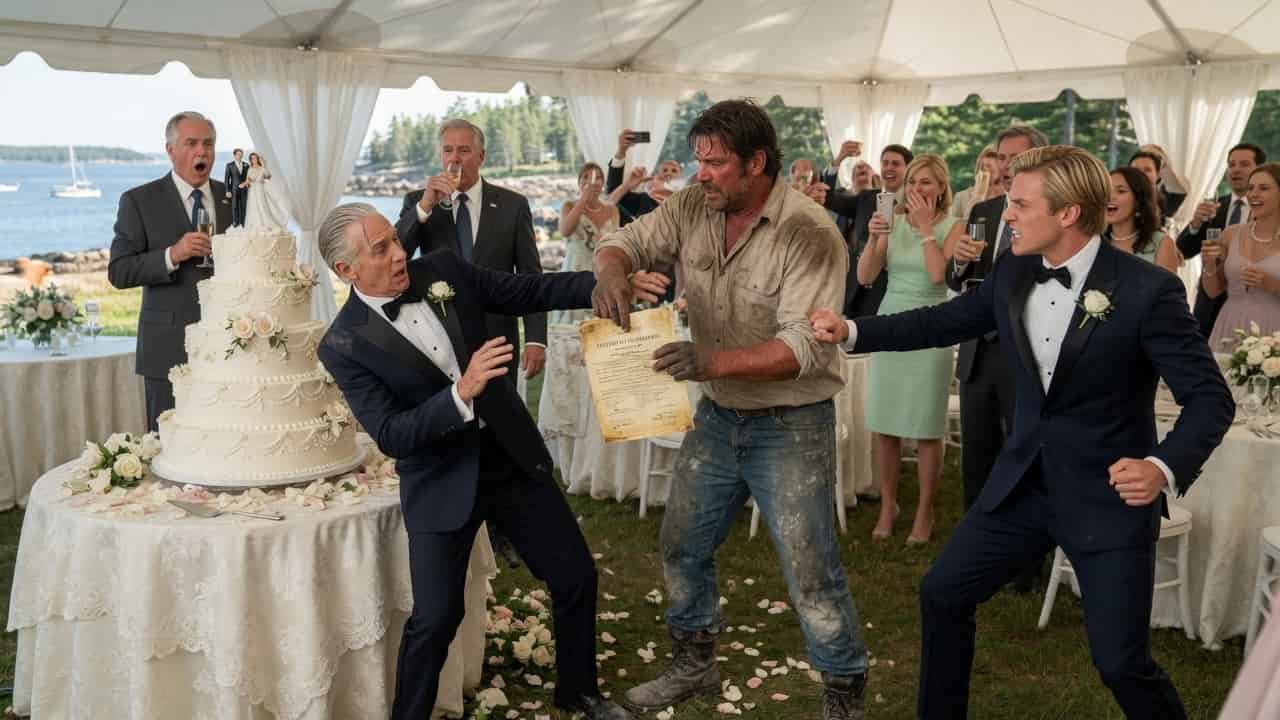
“Get your filthy hands off the table, Gabe. You’re getting dust on the cake.”
I looked down at my hands. They were calloused, stained with grey cement and the grease from the generator I’d been fixing since five this morning. I looked at Julian, the man who was supposed to be my “brother,” though he’d never used that word. He stood there in a three-thousand-dollar tuxedo, looking at me like I was a cockroach that had crawled into his garden party.
Behind him, Harrison—the man the whole town called a visionary, the man I just called “Sir” for fifteen years—didn’t even look at me. He was busy shaking hands with the Governor, laughing about some offshore development.
“I’m talking to you, dirt-mover,” Julian snapped, stepping into my space. He shoved my shoulder, hard. A few of the women in silk dresses gasped. The Governor stopped talking. The whole room went quiet, the kind of quiet that makes your ears ring.
Harrison finally turned around. He looked at my work boots, then at the sweat-ring on my collar. He reached into his pocket, pulled out a gold pen, and started writing on a check.
“Here,” Harrison said, his voice as cold as the Atlantic. “Take the fifty grand. It’ll cover your wife’s hospital bills. Just get this trash out of my sight before the ceremony starts.”
He held the check out like he was feeding a stray dog.
I didn’t take it. Instead, I reached into my back pocket and pulled out the ledger I’d found behind the drywall of my mother’s old house. I pulled out the yellowed paper tucked inside and slammed it onto the white lace tablecloth, right over his signature.
“I don’t want your money, Harrison,” I said, my voice steady even though my heart was hammering against my ribs. “I want you to tell the Governor why this marriage certificate from 1992 says you were already married to my mother when you signed those papers for the merger.”
The color drained out of Harrison’s face so fast I thought he was going to collapse.
Chapter 1: The Weight of the Dust
The humidity in coastal Maine doesn’t just sit on you; it burrows. By two in the afternoon, the salt air had mixed with the pulverized concrete dust on the Vanderbilt site, turning my sweat into a grey, gritty paste that coated my forearms and the back of my neck. I wiped my brow with the back of my glove, leaving a smear of sludge across my forehead. Above me, the skeletal frame of what would eventually be a twenty-million-dollar “cottage” loomed against the pale blue sky.
I’d spent the last six hours on my knees, finishing the pour for the south terrace. It was precision work, the kind of thing Harrison Vanderbilt—the man whose name was on the permits and the paychecks—demanded but never bothered to witness. To him, the terrace just appeared, like a magic trick performed by invisible hands.
“Gabe! Moving day for the generator! Get your ass over here!”
That was Miller, the site foreman. He was a good man, or at least a tired one, which in construction is often the same thing. I stood up, my knees popping like small-caliber gunfire. My lower back throbbed with a dull, familiar ache—the kind that reminds you that thirty-two is the new fifty when you’ve been hauling rebar since you were eighteen.
I headed toward the trailer, my heavy boots crunching on the gravel. As I rounded the corner of the guest house, I saw the black Range Rover. It was polished to a mirror shine, reflecting the jagged pines and the distant, shimmering ocean. It looked like a predatory insect perched on the dirt.
Standing next to it was Julian.
He was twenty-six, lean, and looked like he’d been grown in a lab specifically to model expensive leisurewear. His white linen shirt was crisp enough to cut paper, and his sunglasses probably cost more than my first three trucks combined. He was leaning against the fender, tapping a rhythm on the hood with a manicured fingernail.
“Took your time, didn’t you?” Julian said as I approached. He didn’t look at me. He looked past me, toward the ocean.
“I was finishing the south pour,” I said, keeping my voice level. “It doesn’t wait for conversation.”
Julian finally turned his head, his eyes hidden behind the dark tint of his lenses. He smiled, but it was the kind of smile you give a dog that’s about to be put down. “My father wants the site cleared by four. The rehearsal dinner is tomorrow, and he doesn’t want the guests smelling… well, this.” He waved a hand vaguely toward me, indicating the sweat, the mud, and the general reality of labor.
“We have two days of work left on the exterior, Julian. If we pull the equipment now, the curing won’t be protected if the weather turns.”
Julian stepped closer, his expensive cologne battling the scent of diesel and damp earth. “It’s ‘Mr. Vanderbilt’ to you, Gabe. I thought we’d established that when you started this contract. And I don’t care about the curing. I care about the Governor not seeing a bunch of sub-literate grease monkeys wandering around the property while he’s trying to enjoy his lobster.”
I felt the heat rise in my chest, a familiar, dangerous burn. I’d known Julian since we were kids, back when I was the boy who lived in the cottage at the edge of the estate and he was the prince in the big house. We’d played together once, briefly, until Harrison had seen us and reminded me that some fences aren’t made of wood.
“The equipment stays until the job is done,” I said. “That’s the contract.”
Julian laughed, a sharp, barking sound. He reached out and flicked a piece of dried cement off my shoulder. “The contract is whatever my father says it is. You’re here because he felt sorry for your mother. Don’t mistake charity for a business partnership, Gabe. You’re just the help with a better title.”
I tightened my grip on the wrench in my hand. I could have ended it then. I could have seen how that linen shirt looked with a layer of Maine topsoil on it. But then I thought of Sarah.
I thought of the beige envelope sitting on our kitchen table, the one from the oncology clinic with the red “Past Due” stamp. I thought of the way she looked in the mornings now—pale, translucent, like a photograph left too long in the sun. The insurance company was fighting the latest round of treatments, calling them “experimental.” Experimental was a polite way of saying they didn’t want to pay for her to stay alive.
“Four o’clock,” Julian said, checking his watch. “If the trucks aren’t gone, I’ll have them towed at your expense. Try to wash up, Gabe. You smell like a failure.”
He slid into the Rover and backed out, kicking a cloud of dust over my boots. I stood there for a long minute, breathing it in, tasting the grit.
I spent the next two hours moving the heavy gear, my muscles screaming. Miller helped where he could, but we both knew the score. Harrison Vanderbilt didn’t just own the land; he owned the air over it and the people on it.
When I finally got into my old Ford, the sun was beginning to dip, turning the Atlantic into a sheet of hammered gold. I didn’t go straight home. I couldn’t. I needed to see my mother.
The “Restful Pines” nursing home was neither restful nor surrounded by pines. It was a brick box on the outskirts of town that smelled of industrial floor wax and evaporated hope. I found my mother in the solarium, staring out at a parking lot.
“Hey, Ma,” I said, sitting in the plastic chair beside her.
She turned, her eyes clouded with the fog of early-onset dementia. For a second, she didn’t know me. Then, the fog cleared, just enough for her to reach out and touch my hand.
“Gabe,” she whispered. “You’ve got dust on you.”
“Always do, Ma. It’s part of the job.”
“You shouldn’t be there,” she said, her voice suddenly sharp, a ghost of the woman who used to run the estate’s kitchens with an iron fist. “He’s a cold man, Gabe. He takes things. He took the years. He took the name.”
“Don’t start with that, Ma. We’ve talked about this.”
“The book,” she said, her fingers gripping my wrist with surprising strength. “Behind the vanity, Gabe. In the old house. I told him he couldn’t just erase us. I told him.”
Her eyes went vacant again, the fog rolling back in. She started humming a tune I didn’t recognize, her gaze returning to the parking lot.
I stayed for an hour, talking to a woman who wasn’t entirely there. As I left, I checked with the nurse at the front desk.
“Mr. Thorne,” the nurse said, her voice sympathetic but firm. “The billing department was asking about the payment for next month. The subsidy from the Vanderbilt Foundation hasn’t come through yet.”
I felt a cold chill that had nothing to do with the evening air. “I’ll look into it. There must be a delay with the paperwork.”
“Please do. We’d hate to have to move her to the county facility. It’s… not as comfortable there.”
I walked out to my truck, the weight of the world settling onto my shoulders like a lead vest. I had a wife who was dying in installments and a mother who was being erased by the man who was supposed to be my father.
I drove home in the dark, the headlights of the Ford flickering. Sarah was asleep when I got in, her breathing shallow and rhythmic. I sat at the kitchen table and opened the beige envelope.
Thirty-four thousand dollars. That was the price of her next six months.
I looked at my hands, the grey dust still embedded in the creases of my palms. I’d built the Vanderbilt empire with these hands. I’d poured the foundations, framed the walls, and shingled the roofs. I’d been the loyal soldier, the “good man” who kept his head down and accepted the crumbs they threw him.
The book, my mother had said. Behind the vanity.
The old house was a small, saltbox cottage on the far edge of the Vanderbilt property. It had been empty for years, a relic Harrison kept around because it was cheaper than tearing it down. It was where I’d grown up, where my mother had raised me while she worked the Vanderbilt kitchens and Harrison watched us from the high windows of the main house.
I grabbed my flashlight and my crowbar. I didn’t have a plan. I just had a hunger that wouldn’t go away, a need to find something—anything—that belonged to us.
The cottage was a tomb of dust and cobwebs. I made my way to the master bedroom, the floorboards groaning under my boots. The vanity was still there, a heavy oak piece with a cracked mirror. I pushed it aside, the wood screeching against the floor.
Behind it, the plaster was cracked and crumbling. I tapped the wall with the butt of the crowbar. It sounded hollow.
Three swings and the lath gave way. Behind the wall, tucked between the studs, was a small, leather-bound ledger, wrapped in a plastic sheet.
I sat on the floor and opened it. My hands were shaking.
It wasn’t just a diary. It was a record. My mother had kept everything—bank transfers, letters, and at the very back, tucked into a hidden flap, a piece of parchment that made the air leave my lungs.
It was a marriage certificate. Las Vegas, 1992. Harrison Vanderbilt and Elena Thorne.
But there was something else. A letter from a lawyer, dated three months after the wedding, discussing the “annulment process” and the “financial arrangement” for the Thorne woman to ensure she remained “discreet” about the overlapping dates of Harrison’s upcoming marriage to the daughter of the Senator.
The dates didn’t match. Harrison had married the money while he was still legally tied to the help.
I wasn’t a bastard. I was the heir. And the entire Vanderbilt dynasty was built on a foundation of sand.
I looked out the window toward the main house, where the lights were glowing like a string of pearls against the dark ocean. Tomorrow was the wedding. Julian was getting the crown. Harrison was getting the legacy.
And I was getting even.
Chapter 2: The Price of Silence
The morning after finding the ledger, the world felt different. The air was sharper, the colors of the Maine coast more vivid, as if a layer of grime had been wiped from my eyes. I sat at the kitchen table, watching Sarah sleep. She looked so fragile, her hand resting on the duvet like a fallen leaf. For the first time in months, I didn’t feel the cold dread of the medical bills. I felt a hot, focused fire.
I had spent the night reading every page of that ledger. My mother hadn’t just been a mistress; she’d been a secret wife. Harrison had faked the divorce papers, used his connections to bury the record in a small county in Nevada, and then paid off a local judge to make sure it stayed buried. He’d treated my mother like a line item on a balance sheet—something to be moved, hidden, or deleted.
I tucked the marriage certificate into the inside pocket of my work vest. It felt heavy, like a loaded gun.
“Gabe?” Sarah’s voice was a whisper. She was awake, her eyes searching for me.
“I’m here, babe.” I walked over and sat on the edge of the bed, taking her hand.
“You’re still in your work clothes,” she said, frowning. “Did you sleep at all?”
“A bit. I had some things to take care of at the site.” It wasn’t a lie, exactly. I just hadn’t told her which site I was working on.
“Julian called,” she said, her voice trembling slightly. “He said… he said the foundation isn’t paying for the clinic anymore. He said there was an ‘audit’ and we don’t qualify for the assistance.”
She started to cry then, the silent, hopeless tears that broke me more than any scream could. I pulled her close, smelling the antiseptic scent of her skin.
“Don’t worry about Julian,” I said into her hair. “I’m going to fix it, Sarah. I promise.”
“How? Gabe, we can’t afford the treatment without them. We’ll lose everything.”
“We aren’t going to lose anything,” I said, pulling back to look her in the eyes. “I’m going to talk to Harrison. Today.”
She looked terrified. “Gabe, don’t. He’ll fire you. He’ll make it worse. You know how he is.”
“I know exactly how he is,” I said. “And that’s why it’s going to work.”
I left her with a kiss and a promise I wasn’t entirely sure I could keep. I drove to the main estate, the Ford rattling as I climbed the long, winding driveway. The security guards at the gate hesitated when they saw me, but I had my site pass. They let me through, though they watched the truck like it was a bomb on wheels.
The estate was a hive of activity. Florists were unloading crates of white lilies, and a small army of caterers was setting up a massive white tent on the lawn. It looked like a scene from a movie—everything perfect, everything expensive, everything a lie.
I found Harrison in his study, a room that smelled of old leather and ego. He was standing by the window, a glass of scotch in his hand even though it wasn’t even noon. He didn’t turn around when I walked in.
“I told Julian to handle the site clearing, Gabe,” Harrison said, his voice smooth and disinterested. “I don’t have time for contractor disputes today.”
“This isn’t a contractor dispute, Harrison,” I said.
He turned then, his eyes narrowing. He looked at my dusty vest, my unwashed face, and the way I was standing in the middle of his Persian rug. “It’s ‘Mr. Vanderbilt.’ And you’re pushing your luck, Gabriel. I’ve been generous with you and your mother for a long time, but that generosity has limits.”
“Generosity?” I laughed, the sound harsh in the quiet room. “Is that what you call it? Paying for a cheap nursing home so my mother doesn’t tell the world you were a bigamist?”
Harrison didn’t flinch. He didn’t even blink. He just took a slow sip of his scotch. “I have no idea what you’re talking about. The dementia has clearly affected your judgment as much as it has hers.”
I pulled the marriage certificate from my pocket and held it up. I didn’t let him touch it. I just let him see the names. The dates. The seal.
The silence in the room became absolute. I could hear the ticking of the grandfather clock in the corner, a steady, rhythmic reminder of the time Harrison had stolen.
“Where did you get that?” Harrison asked, his voice low and dangerous.
“Behind the vanity in the old saltbox,” I said. “My mother was smarter than you gave her credit for. She knew you’d try to erase her. She kept the proof.”
Harrison set his glass down on the mahogany desk. He looked older suddenly, the lines around his eyes deepening. “What do you want, Gabe? Money? You want to be a Vanderbilt? Look at yourself. You’re a laborer. You have the hands of a peasant. You wouldn’t know what to do with a legacy if I handed it to you.”
“I don’t want your name,” I said, stepping closer. “And I don’t want your legacy. I want thirty-four thousand dollars for my wife’s treatment. And I want my mother moved to the best private facility in the state. Today.”
Harrison laughed, a cold, dry sound. “And in exchange, you’ll give me that paper?”
“No. In exchange, I won’t give it to the Governor. Or the press. Or Julian’s new bride, whose father happens to be the head of the ethics committee.”
Harrison’s face twisted. He walked over to his desk and pulled out a checkbook. He wrote the numbers with a steady hand, his signature a sharp, jagged line. He ripped the check out and held it toward me.
“Take it,” he said. “Take it and leave. If I see you on this property again, I’ll have you arrested for trespassing and theft. I’ll ruin you, Gabe. I’ll make sure you never work a day in this state again.”
I took the check. It felt greasy in my hand. “You already ruined me, Harrison. You spent thirty years watching me build your houses while you knew I was your son. You let me grow up in the dirt while Julian lived in the light. You can’t ruin a man who has nothing left to lose.”
I walked out of the study, the check tucked into my pocket. I felt a momentary surge of triumph, a sense of relief that Sarah was safe. But as I walked through the house, past the family portraits and the expensive art, the feeling soured.
I saw Julian in the hallway. He was talking to a group of his friends, all of them wearing the same arrogant smirk. When he saw me, he blocked my path.
“Still here, Gabe? I thought I told you to clear out.”
“I’m leaving,” I said, trying to push past him.
Julian grabbed my arm, his grip surprisingly strong. “What were you doing in my father’s study? Did you go in there to beg? Is that it? The little construction worker needs a handout?”
His friends laughed. I looked at Julian, at his perfect hair and his perfect life, and I realized that the check in my pocket wasn’t enough. It was hush money. It was a bribe. It was another way for Harrison to control me.
“Your father and I had a private conversation, Julian,” I said, my voice dangerously quiet. “Maybe you should ask him about 1992. Ask him about Nevada.”
Julian’s eyes flickered with confusion, then settled back into contempt. “You’re pathetic, Gabe. You think you’re one of us just because you work on our dirt? You’re nothing. You’re a footnote. Now get out of here before I have the guards toss you into the ocean.”
He shoved me toward the door, and for the first time, I didn’t feel the urge to fight back. I felt a cold, calm clarity.
I drove straight to the clinic and handed them the check. I watched them process it, watched the “Past Due” flag vanish from Sarah’s file. I went into her room and told her the news. She cried again, but this time they were tears of relief.
But as I sat by her bed that night, I couldn’t stop thinking about the ledger. I couldn’t stop thinking about the way Harrison had looked at me—like I was a bug he could squash with a check.
The money would save Sarah’s life, but it wouldn’t save my dignity. It wouldn’t fix the thirty years of lies.
I looked at the ledger sitting on the bedside table. There was more in there. More names. More transfers. Harrison hadn’t just hidden a marriage; he’d hidden a series of bribes to local officials to secure the permits for his first big development. The development that had made him a millionaire.
The Vanderbilt empire wasn’t just built on a lie; it was built on a crime.
I realized then that I couldn’t just take the money and run. If I did, I was no better than Harrison. I was just another part of the secret.
Tomorrow was the wedding. The Governor would be there. The cameras would be there. The whole world would be watching the crowning of the next Vanderbilt.
And I was going to be there, too. Not as a contractor. Not as a guest.
I was going to be the wrecking ball.
Chapter 3: The Sabotage
The morning of the wedding, the air was heavy with the scent of lilies and the underlying salt-tang of a storm brewing off the coast. I stood in my small kitchen, the ledger open before me. I’d spent the night mapping out the connections. It wasn’t just the marriage; it was the “Foundations Project” from 1995. Harrison had paid off the town council to ignore the environmental reports on the marshland he’d drained. The same marshland that now sat beneath the very estate where the wedding was taking place.
I heard the rumble of a heavy truck outside. I looked out the window and saw a black SUV with the Vanderbilt crest on the door. Two men in dark suits got out.
I didn’t wait for them to knock. I grabbed the ledger and the marriage certificate and went out the back door, slipping into the woods that bordered my property. I knew these woods like the back of my hand—I’d spent my childhood hiding in them, watching the world I wasn’t allowed to be a part of.
I watched from the brush as the men pounded on my door. When nobody answered, they didn’t leave. They went to my truck and started searching it. They were looking for the proof. Harrison wasn’t just going to let me walk away with the money; he was going to make sure the evidence disappeared.
I made my way through the pines, the needles crunching under my boots. My destination wasn’t the estate, not yet. It was the “Restful Pines” nursing home.
When I arrived, the atmosphere was chaotic. A moving van was parked out front, and two orderlies were wheeling a bed toward the exit.
“What’s going on?” I asked, intercepting them.
“Mr. Thorne?” one of the orderlies said, looking at a clipboard. “Your mother is being transferred. Orders from the Vanderbilt Foundation. She’s going to a specialized facility upstate.”
“Upstate? That’s four hours away. I didn’t authorize this.”
“The foundation pays the bills, Mr. Thorne. They have the right to move her to a ‘more appropriate’ level of care.”
I looked at my mother. She was strapped into the bed, her eyes wide and panicked. She didn’t know where she was going. She didn’t know why. She just knew she was being taken away.
“Stop,” I said, my voice cracking like a whip. “She isn’t going anywhere.”
“Sir, we have orders—”
“I don’t care about your orders,” I said, stepping between them and the van. I pulled out my phone and dialed the number Harrison had given me for his “private line.”
He picked up on the second ring. “I told you, Gabe. I ruin people who don’t follow the rules.”
“Move her back, Harrison. Right now. Or I walk into that wedding and I don’t just show the Governor the certificate. I show him the ledger. I show him the names of the councilmen you bought in ’95.”
There was a long silence on the other end. I could hear the distant sound of a harp being tuned—the wedding music was already starting.
“You’re playing a very dangerous game, Gabriel,” Harrison said, his voice dropping an octave. “You have no idea the forces you’re dealing with.”
“I’m dealing with a man who is afraid of a piece of paper,” I said. “Move her back. Now. Or the foundation of your house isn’t the only thing that’s going to collapse today.”
“Fine,” Harrison spat. “She stays. For now. But don’t think for a second this is over.”
He hung up. A minute later, the orderly’s radio chirped. He listened for a second, then nodded. “Transfer cancelled. Take her back to her room.”
I watched them wheel her back inside. I went to her room and sat with her for a few minutes, holding her hand until she fell asleep. She looked so small, so defeated.
“I’m going to finish it, Ma,” I whispered. “I’m going to make him say your name.”
I left the nursing home and drove toward the estate. I didn’t use the main entrance. I used the service road, the one I’d used a thousand times to bring in the concrete trucks. I parked the Ford a half-mile away and walked the rest of the way, staying low in the brush.
As I approached the south terrace—the one I’d finished just two days ago—I saw Julian. He was with a group of workers, but he wasn’t helping. He was barking orders, pointing at a hairline crack in the concrete that only a professional would notice.
“This is unacceptable!” Julian was screaming at Miller. “We’re paying for perfection, not this amateur garbage! Look at this edge. It’s uneven.”
“It’s within the tolerance, Mr. Vanderbilt,” Miller said, his hat in his hand. “Gabe did a fine job.”
“Gabe is a hack,” Julian said, stepping onto the terrace. He was wearing his tuxedo now, but he was holding a heavy sledgehammer he’d taken from one of the tool belts. “And I don’t want his ‘fine job’ under my feet today.”
He swung the hammer down, the steel head smashing into the edge of the terrace I’d spent twelve hours perfecting. The concrete shattered, a chunk of the finished edge falling away into the dirt.
I felt a surge of rage so pure it blinded me. It wasn’t just about the work. It was about the contempt. It was about the way he thought he could destroy anything he hadn’t built.
“What are you doing?” Miller shouted, stepping forward.
“I’m fixing it,” Julian said, swinging again. He was laughing now, a manic, high-pitched sound. “I’m erasing the trash.”
He swung again and again, destroying the terrace, ruining the work, proving that to a Vanderbilt, nothing was sacred if it belonged to someone else.
I watched from the shadows, my heart pounding. I could have stepped out. I could have stopped him. But I didn’t. I watched him destroy it, and I realized that this was exactly what I needed.
Julian was doing the work for me. He was showing everyone exactly who they were.
I made my way toward the main tent. The guests were starting to arrive, a sea of silk and linen flowing across the lawn. The air was filled with the sound of laughter and the clinking of glasses.
I went to the back of the tent, where the caterers were preparing the massive wedding cake. It was a five-tiered monstrosity, covered in white frosting and delicate sugar flowers. It represented everything the Vanderbilts wanted the world to see—purity, wealth, and a perfect future.
I reached into my pocket and pulled out the marriage certificate. I didn’t just want to show it. I wanted it to be the center of the party.
I slipped into the tent, moving through the shadows behind the bar. I saw Harrison. He was standing with the Governor, looking every bit the elder statesman. He looked happy. He looked safe.
I waited until the music started, the soaring notes of the wedding march. The crowd went quiet as the bride started her walk down the aisle.
I didn’t watch the bride. I watched Harrison.
I waited until the moment the priest asked if anyone had any objections. It was a formality, a traditional line that no one ever expected to be answered.
I stepped out from behind the bar. I was still in my work clothes—the grey dust, the sweat, the mud. I looked like a ghost at a banquet.
“I have an objection,” I said.
My voice wasn’t loud, but in the sudden silence of the tent, it sounded like a gunshot.
The entire room turned. I saw Harrison’s face go from confusion to horror. I saw Julian, still holding the sledgehammer, frozen at the edge of the tent. I saw the Governor’s brow furrow.
I walked toward the altar, my boots echoing on the wooden floor. I didn’t look at the guests. I didn’t look at the bride. I looked straight at Harrison.
“This marriage can’t happen,” I said, reaching into my vest. “Because the foundation of this family is built on a lie. And it’s time the world saw the blueprints.”
I pulled out the marriage certificate and held it high.
“Harrison Vanderbilt didn’t just build this estate,” I shouted, my voice ringing through the tent. “He built a prison for the woman he actually married. And he’s been paying for the silence ever since.”
I walked to the cake table and slammed the certificate down onto the white lace, right in front of the Governor.
The room exploded.
Chapter 4: The Exposure
The sound of the crowd was like a physical wave—a mixture of gasps, whispers, and the sharp, jagged edge of a scandal breaking in real-time. I stood by the wedding cake, my chest heaving, the yellowed marriage certificate sitting on the pristine white tablecloth like a stain that wouldn’t wash out.
Harrison moved first. He was fast for a man his age, his face a mask of purple-tinged fury. He reached for the paper, but the Governor—a man who had spent forty years reading people and power—got there first.
The Governor picked up the certificate, his eyes scanning the dates. He looked at Harrison, then at me, then back at the paper.
“Harrison?” the Governor asked, his voice low but carrying a weight that silenced the room. “What is this?”
“It’s a forgery!” Julian screamed, finally dropping the sledgehammer and rushing into the tent. He looked wild-eyed, his tuxedo rumpled. “Gabe is a disgruntled contractor. He’s been trying to shake us down for weeks. He’s insane!”
Julian lunged at me, his fists clenched, but Miller and two of the other site workers stepped in his way. They didn’t say anything; they just stood there, a wall of denim and flannel between the prince and the bastard.
“Stay back, Julian,” I said, my voice surprisingly calm. “The sledgehammer was a nice touch, by the way. Really showed everyone how you handle things you didn’t build.”
Harrison ignored Julian. He was focused on the Governor. “Arthur, please. This is a family matter. The man is clearly disturbed. His mother is in a facility, she’s lost her mind, and he’s followed suit. We can discuss this in private.”
“It’s not a family matter when it involves a legal marriage and the legitimacy of your entire corporate structure, Harrison,” the Governor said, his voice hardening. “This certificate is dated 1992. You married Catherine in 1993. If this is real, your marriage to Catherine—and all the legal mergers that followed—are void.”
The bride, a young woman named Clara whose father was the key to the Vanderbilt’s latest political play, started to sob. Her father stepped forward, his face like flint. “Void? My daughter’s marriage is void?”
“Not just the marriage, Charles,” I said, turning to him. “The permits. The land transfers. Everything Harrison ‘owned’ was built on the capital he got from the merger. Capital he wasn’t legally entitled to.”
I reached back into my vest and pulled out the ledger. I held it up so the whole room could see it.
“This is the ledger my mother kept,” I said. “It’s not just about the marriage. It’s about the bribes. It’s about the town council members who were paid to ignore the environmental hazards of this very land. It’s about the money Harrison funneled through the Thorne Foundation to keep us quiet while he built his empire.”
“Give me that!” Harrison roared, lunging across the table.
I stepped back, but I didn’t need to. The room had already turned. The guests, people who had spent their lives sucking up to the Vanderbilt name, were now pulling away as if the name itself was contagious. They weren’t horrified by the crime; they were horrified by the exposure.
“Check the dates, Arthur,” Harrison pleaded, his voice cracking. “The woman was a mistress. She was never a wife. This paper is a fake.”
“I have the Nevada county records on my phone, Harrison,” I said. “I called them this morning. The original file was ‘misplaced’ in 1994, but the digital backup was never deleted. It took a ten-minute search.”
I turned to the crowd, to the men in tuxedos and the women in silk. “You all wonder why I’m here. Why the ‘dirt-mover’ is ruining your party. I’m here because for thirty years, I was the ghost in the machine. I built your patios. I framed your houses. I fixed your generators. And all that time, Harrison Vanderbilt knew I was his son. He watched me struggle to pay for my wife’s cancer treatments while he spent fifty thousand dollars on a five-tier cake.”
I looked at the cake, then back at Harrison.
“He offered me thirty-four thousand dollars yesterday,” I said. “A check to buy my silence. To save my wife. He thought that was my price. He thought a Vanderbilt always knows what a man is worth.”
I pulled the check from my pocket—the one I’d taken to the clinic—and threw it onto the cake table. It landed in a smear of white frosting.
“I don’t want your money, Harrison. I want the truth. I want you to look at these people and tell them who Elena Thorne was.”
Harrison stood frozen. His silver hair was disheveled, his midnight-blue tuxedo suddenly looking like a costume that didn’t fit. He looked at the Governor, at his future son-in-law, at the cameras that were now flashing from every corner of the tent.
The silence stretched, long and agonizing.
Then, Julian snapped.
“You think you’ve won?” he screamed, pushing past Miller. “You think you’re better than us? You’re a construction worker, Gabe! You’ll always be a construction worker! You’re nothing but a mistake my father made in a Vegas motel!”
Julian grabbed a bottle of champagne from the bar and smashed it against the table. He lunged at me with the jagged neck, his eyes wide with a combination of rage and privilege that had finally been denied.
I didn’t move. I didn’t have to.
One of the security guards—a man I’d shared coffee with for three years on different job sites—grabbed Julian by the arm and twisted it behind his back, forcing him to the floor.
“That’s enough, Mr. Vanderbilt,” the guard said, his voice flat.
Harrison looked down at his son, pinned to the dirt. He looked at the marriage certificate. He looked at the ledger.
He didn’t say a word. He didn’t defend himself. He didn’t try to lie. He just turned and walked out of the tent, his shoulders slumped, his head bowed. He walked toward the ocean, a solitary figure in a dark suit, leaving the wreckage of his life behind.
The Governor handed the certificate to one of his aides. “Get the Attorney General on the phone. And tell the press I’ll have a statement in an hour.”
The party was over. The guests started to flee, rushing toward their cars as if the estate was sinking into the sea.
I stood in the center of the tent, the dust on my boots stark against the white floor. I felt a strange sense of emptiness. I had won. I had burned the dynasty down. I had exposed the lie.
But as I looked at the ledger, I thought of my mother. I thought of the years she’d spent in that cottage, waiting for a man who was never coming back. I thought of the silence she’d endured, the way her mind had slowly fractured under the weight of the secret.
I felt a hand on my shoulder. It was Miller.
“You did it, Gabe,” he said quietly.
“Yeah,” I said. “I did.”
“What now?”
I looked toward the gate, toward the road that led back to my house. Back to Sarah.
“Now,” I said, “I go home and tell my wife that the bills are paid. And that she doesn’t have to be afraid of the name Vanderbilt anymore.”
I walked out of the tent, past the shattered concrete of the terrace, past the expensive cars and the weeping bride. I got into my old Ford and drove down the long, winding driveway.
I didn’t look back. I had thirty years of dust to wash off, and a lifetime of truth to start building.
But as I reached the gate, I saw a black SUV waiting. It wasn’t Vanderbilt’s. It was the Governor’s.
The window rolled down. The Governor looked at me, his face unreadable.
“Gabe,” he said. “The ledger. There were other names in there. Names you haven’t mentioned yet.”
I gripped the steering wheel. “I know.”
“Harrison isn’t the only one who’s going to fall today, is he?”
“No,” I said. “He isn’t.”
“The state needs men who know how to build things on solid ground, Gabe. Not on lies.”
He didn’t wait for an answer. The SUV pulled away, leaving me in the dust.
I drove home, the sun setting behind the pines. I had the ledger. I had the truth. And I realized that the wreckage in the tent was just the beginning.
I had saved Sarah’s life, but I had started a war. And for the first time in my life, I wasn’t the one doing the heavy lifting. The truth was doing it for me.
I pulled into my driveway and saw Sarah standing on the porch. She looked stronger than she had in months. She saw me, and she smiled.
I got out of the truck, the weight of the day finally starting to settle. I was still dusty. I was still tired. But as I walked toward her, I felt something I’d never felt before.
I felt like I belonged. Not to a name. Not to an estate.
I belonged to myself.
And as the first drops of the storm started to fall, I knew that the foundation was finally, for the first time, solid.
Chapter 5: The Silence of the Tides
The morning after the wedding didn’t bring the cleansing rain the storm had promised. Instead, a thick, suffocating fog rolled in off the Atlantic, swallowing the jagged Maine coastline and turning the world into a grey, muffled void. In our small house on the edge of the woods, the silence was heavy, broken only by the rhythmic hum of the oxygen concentrator in the bedroom and the distant, mournful cry of a loon on the water.
I sat at the kitchen table, my hands wrapped around a mug of coffee that had gone cold an hour ago. The ledger was open in front of me, its yellowed pages a map of a life I was only beginning to understand. I had spent the night watching the news cycles—the grainy cell phone footage of me in my work clothes standing over the five-tier wedding cake had gone viral within hours. They were calling it the “Blue-Collar Coup.” To the world, it was a scandalous spectacle, a juicy bit of high-society wreckage. To me, it felt like I’d finally lanced a boil that had been festering for thirty years, and now the infection was everywhere.
Sarah came into the kitchen around eight, wrapped in a thick wool cardigan. She looked pale, but there was a new light in her eyes—a spark of something that looked dangerously like hope.
“The phone hasn’t stopped ringing, Gabe,” she said, leaning against the counter. “Journalists, lawyers, people I haven’t spoken to since high school. Even the clinic called. They wanted to make sure we didn’t need anything.”
“They’re vultures, Sarah,” I said, rubbing my eyes. “They don’t care about us. They care about the car crash.”
“It wasn’t just a car crash,” she said softly, walking over to stand behind me. She rested her hands on my shoulders. Her touch was the only thing that felt real in the fog. “You stood up for your mother. You stood up for yourself. For thirty years, they treated you like a ghost, Gabe. You finally haunted them.”
“I might have haunted us, too,” I muttered, looking at the beige envelope from the clinic. “Harrison’s lawyers will be coming for that money. They’ll call it theft. They’ll say I coerced him.”
“Let them try,” Sarah said, her voice unexpectedly fierce. “The Governor saw that paper. The whole state saw it. If Harrison tries to claw that money back now, he’ll look like even more of a monster than he already is.”
The sound of a car engine cut through the fog—not the rattling hum of a local truck, but the smooth, high-end purr of a luxury sedan. I stood up, my muscles tensing. I checked the window and saw a charcoal-grey Mercedes pulling into the gravel drive.
A man got out. He wasn’t Julian, and he wasn’t one of the goons Harrison had sent the day before. He was older, wearing a sharp grey suit and carrying a briefcase that looked like it cost more than my Ford. He moved with a calculated, unhurried grace that screamed “Old Money.”
“Stay inside,” I told Sarah.
I met him on the porch. The air was damp and tasted of salt.
“Mr. Thorne,” the man said, stoping at the bottom of the steps. He didn’t offer his hand. “My name is Elias Vance. I represent the Vanderbilt Board of Directors. Not Harrison personally, you understand. The Board.”
“The Board,” I repeated, the word tasting like ash. “The people who help him hide the bodies.”
Vance smiled thinly. “The people who protect the investment, Mr. Thorne. And currently, Harrison Vanderbilt has become a significant liability to that investment. The marriage certificate you produced has called into question the legality of every merger, every land acquisition, and every contract the firm has signed since 1993.”
“Good,” I said. “That was the point.”
“The point,” Vance said, “is that the Vanderbilt name is worth approximately four billion dollars in assets. We have no interest in seeing those assets frozen in a decade-long legal battle over bigamy and fraud. We are here to talk about a resolution.”
“A resolution? You mean a payoff.”
“I mean a settlement,” Vance corrected. “One that includes a non-disclosure agreement, the surrender of the ledger, and your immediate relocation from the state. In exchange, the Board is prepared to offer you a sum that would ensure your wife’s medical care and your mother’s comfort for the rest of their lives. A sum significantly larger than the thirty-four thousand dollars Harrison threw at you yesterday.”
I felt the familiar heat in my chest, but this time it wasn’t hot. It was cold. It was the realization that even when the giant fell, the machine kept running. They weren’t sorry. They were just calculating the cost of the cleanup.
“Where is Harrison?” I asked.
Vance’s expression didn’t change. “Mr. Vanderbilt is… on a leave of absence. The Board has effectively stripped him of his voting rights while we conduct an internal audit. His son, Julian, is currently facing several charges related to the incident at the wedding. It’s a mess, Mr. Thorne. A mess we would like to sweep up.”
“I don’t want your money, Vance,” I said. “I’ve spent my life building things on solid ground. You’re asking me to build a future on another lie.”
“Everyone has a price, Gabriel,” Vance said, his voice dropping to a conversational tone. “Even ‘good men.’ Think of your wife. Think of the treatments. If you go to court, we will tie this up until she is long gone. We will question your mother’s sanity. We will bring up your father’s ‘criminal record’—oh, did you forget about the construction theft charges from ten years ago? The ones Harrison made sure disappeared? We can make them reappear.”
He was good. He knew exactly where the pressure points were. He was reminding me that the Vanderbilts hadn’t just given me crumbs; they had kept the leash short.
“Get off my property,” I said.
Vance nodded, unfazed. “I’ll leave my card on the railing. You have forty-eight hours. After that, the Board moves from negotiation to litigation. And I promise you, Gabe, you don’t have the foundations for that kind of war.”
He walked back to his Mercedes and disappeared into the fog. I stood there, looking at the small white card on the railing. My hand was shaking, not from fear, but from the sheer, crushing weight of how hard it was to just be honest in a world built on debt.
I went back inside. Sarah was standing in the hallway, her face pale. She’d heard everything.
“We have to take it, don’t we?” she whispered. “The money. We have to take it so I can stay.”
“No,” I said, grabbing my keys. “We don’t.”
“Gabe, where are you going?”
“To see the only person who actually knows what happened in 1992,” I said. “I need the truth, Sarah. Not a settlement.”
I drove to “Restful Pines.” The facility felt different today—the nurses looked at me with a mix of awe and suspicion. I found my mother in her room. She was sitting by the window, the fog pressing against the glass. She looked small, her skin like parchment paper.
“Ma,” I said, kneeling beside her chair. “Ma, I need you to talk to me. Really talk to me.”
She turned, her eyes searching mine. For a moment, she was lost. Then, she reached out and touched the scar on my chin—the one I’d gotten when I was six, falling off the porch of the saltbox.
“You were always so fast,” she whispered. “Trying to catch up to the big house.”
“Ma, the marriage. In Nevada. Why did you stay quiet for so long? Why did you let him do it?”
Her face crumpled, the years of repressed shame and fear surfacing like a wreck at low tide. “He said he’d take you, Gabe. He said if I ever told anyone, he’d use his lawyers to prove I was an unfit mother. He said a Thorne would never win against a Vanderbilt. I was twenty-one years old, Gabe. I was a cook. He was the world.”
She started to cry—the thin, rattling sob of an old woman who had carried a mountain for thirty years.
“He made me sign things,” she continued. “Papers I didn’t understand. He said it was for your college. For our future. But it was just the exit. He bought my silence with the very thing he owed you.”
I realized then that it wasn’t just about the marriage certificate. Harrison hadn’t just been a bigamist; he’d been a predator. He’d weaponized my existence to keep my mother in a cage.
“The ledger, Ma,” I said. “There are names in here. Judge Halloway. Councilman Reed. Why did you keep it?”
She looked at me, a flicker of the old Elena Thorne returning. “Because I knew you’d need it. I knew one day you’d be a man, and you’d look at that house and realize it was half yours. I couldn’t give you the name, Gabe. But I could give you the truth. Truth is the only thing a man like Harrison can’t buy back once it’s out.”
I hugged her, feeling her fragile bones. I realized that the Board’s “settlement” wasn’t just about protecting the assets. It was about making sure the pattern of abuse and bribery remained a secret. If I took the money, I was letting them win. I was letting the cycle continue.
I left the nursing home and drove to the construction site. It was deserted now—the heavy equipment sat like sleeping beasts in the mud. I walked out onto the south terrace, the one Julian had smashed with the sledgehammer.
I looked at the jagged edges of the concrete. It was broken, but the foundation underneath was still solid. You could build on it again.
I pulled out my phone and called the number the Governor had given me.
“Governor?” I said when he answered. “This is Gabe Thorne.”
“I was wondering when you’d call, Gabe. The Board tell you their offer yet?”
“They did. They want to buy my silence.”
“And?”
“And I’m not for sale,” I said. “But I have the names. The real names. The ones that go beyond Harrison Vanderbilt. The ones that built the system that let him do this.”
“That’s a heavy load to carry, son,” the Governor said. “It’ll break a lot of people.”
“It’s already broken my family,” I said. “It’s time it broke the right people.”
I spent the next four hours in a small diner on the outskirts of town, meeting with two investigators from the State Attorney’s office. I gave them the ledger. I gave them the names. I gave them the history of every bribe, every land deal, and every threat.
When I walked out of the diner, the fog was finally starting to lift. The sun was a pale, watery disc in the sky. I felt lighter than I had in years, but I also felt the cold reality of what was coming.
I drove home, expecting to find Vance’s Mercedes in the drive. But the driveway was empty.
Inside, the house was quiet. Sarah was in the bedroom, but she wasn’t in bed. She was standing by the window, looking out at the woods.
“They came back,” she said, her voice trembling.
“Vance?”
“No. Julian.”
My blood turned to ice. “Where is he?”
“He’s at the old cottage, Gabe. He said… he said if he can’t have the legacy, nobody can.”
I looked out toward the far edge of the property, where the old saltbox cottage stood. A thin plume of smoke was rising into the clearing sky.
Julian wasn’t trying to hide the truth anymore. He was trying to burn it down.
I didn’t think. I just ran. I grabbed my crowbar from the truck and sprinted through the woods, the branches tearing at my work shirt. My heart was a drum in my ears, the rhythm of thirty years of resentment finally reaching a crescendo.
I reached the clearing and saw the cottage. Flames were licking at the dry cedar shingles of the roof. Julian was standing in the doorway, a gasoline can in his hand, his tuxedo shirt torn and stained with soot. He looked like a man who had finally realized the world didn’t belong to him, and he was determined to take everyone else with him.
“Julian!” I shouted. “Get out of there! It’s over!”
He looked at me, a wild, jagged grin on his face. “It’s not over, Gabe! It’s just starting! You think you can just walk in and take what’s mine? You’re a ghost! You don’t exist!”
He splashed the last of the gasoline onto the floor and flicked a lighter.
The interior of the cottage went up in a roar of orange flame. Julian didn’t move. He stood in the center of the fire, a prince in a burning castle.
I lunged forward, not because I loved him, but because I couldn’t let another Vanderbilt die with a secret. I tackled him through the doorway just as the porch roof groaned and collapsed.
We tumbled into the dirt, the heat of the fire searing my skin. Julian struggled, clawing at my face, but I pinned him down.
“Look at it!” I screamed, pointing at the burning cottage. “That’s your legacy, Julian! Ashes! That’s all it ever was!”
Julian stopped fighting. He looked at the flames, and for the first time, I saw the boy I’d played with in the woods. He started to cry, a pathetic, broken sound that was swallowed by the roar of the fire.
I stood up, pulling him with me. The old saltbox—the place where I’d grown up, where my mother had hidden the truth—was gone. But as I watched the roof cave in, I realized it didn’t matter.
The truth wasn’t in the wood. It was in the world now. And there was no way to burn it out.
Chapter 6: The Foundation of Truth
The fire at the cottage took three hours to burn itself out. The local volunteer fire department arrived, but the old cedar was too dry, the gasoline too effective. They managed to keep the flames from spreading to the surrounding pines, but by the time the sun began its final descent into the Atlantic, nothing remained of the Thorne saltbox but a charred stone chimney and a footprint of grey ash.
Julian had been taken away in a cruiser, his face a mask of soot and shock. He hadn’t said a word after the fire started. The arrogance had been cauterized right out of him, leaving behind a hollow shell of a man who didn’t know how to exist without a silver spoon in his mouth.
I stood at the edge of the clearing, my lungs burning from the smoke, my forearms blistered. Harrison was there, too. He’d arrived in a black SUV, but he didn’t get out. He sat in the backseat, the tinted glass reflecting the dying embers of the house he’d used as a prison for my mother. He didn’t look at me. He didn’t look at the ruin. He just stared straight ahead, a man watching his empire dissolve in the rearview mirror.
Elias Vance, the Board’s man, stood by the SUV. He looked at me, then at the smoking remains of the cottage. He didn’t look like he wanted to talk about settlements anymore. He looked like a man who was already drafting the press release for the Vanderbilt bankruptcy.
“You should have taken the money, Gabe,” Vance said, his voice barely audible over the crackle of the embers.
“Money can’t build a house on ash, Vance,” I said. “You should know that better than anyone.”
I walked away, back through the woods toward my own house. I was exhausted, the kind of tired that gets into your marrow and stays there. But for the first time in thirty years, the weight of the big house wasn’t on my back.
When I got home, Sarah was waiting on the porch. She saw me and didn’t ask questions. She just walked down the steps and held me, her head against my chest. We stood there for a long time, the smell of smoke clinging to us like a reminder of the cost of the truth.
“It’s over, isn’t it?” she asked.
“The lie is over,” I said. “The rest… the rest is just work.”
The following weeks were a blur of depositions, legal filings, and public fallout. The Vanderbilt name, once a symbol of prestige, became a punchline in the state’s political circles. The “Bastard’s Ledger” was the lead story in every paper from Portland to Bangor. Harrison was officially indicted on three counts of fraud and one count of bigamy. The Board, in an effort to save the remaining assets, stripped him of every title and every penny that wasn’t tied up in legal fees.
The Governor kept his word. The Attorney General’s office used the names I gave them to launch a sweeping investigation into the local town councils. It wasn’t just Harrison who fell; it was the entire system of quiet handshakes and greased palms that had kept the coast of Maine in the pockets of the elite for decades.
But the real victory wasn’t in the courtrooms. It was in the clinic.
With the Vanderbilt Foundation in receivership, the Board tried to freeze Sarah’s medical payments. But they hadn’t counted on the community. A local union of construction workers—men I’d worked with for years, men who knew the grit in my palms—launched a fundraiser. It wasn’t just a few dollars; it was a movement. People who had been bullied by the Vanderbilt interests for years, people who had been priced out of their own towns, stepped up.
By the time the first snow of November began to fall, Sarah’s treatments were fully funded. Not by hush money, but by the hands of the people who actually built the town.
I took my mother out of “Restful Pines” on a crisp Tuesday morning. I’d found a small, sun-drenched apartment in a private facility near our house. It was paid for by the settlement I’d finally accepted—not a “keep quiet” bribe, but a legal restitution ordered by the court after the fraud was proven.
“It’s a nice place, Ma,” I said as I wheeled her into the new room.
She looked around, her eyes clear for the first time in days. She looked at the window, which opened out onto a small garden, and then at me.
“He’s gone, isn’t he?” she asked.
“He’s gone, Ma. He can’t touch us anymore.”
She smiled, a slow, beautiful thing that reminded me of the woman in the old photographs. “I told you, Gabe. Truth is the only thing he couldn’t buy.”
I spent that afternoon at the construction site. It wasn’t a Vanderbilt site anymore. The land had been seized as part of the settlement, and the state was turning it into a public park and a low-income housing development.
I was the site foreman.
I stood on the south terrace, the one I’d finished twice. It had been repaired, the jagged edges smoothed over, the foundation reinforced. It was solid now. It was real.
Miller walked over, a thermos in his hand. “Looks good, Gabe. Real good.”
“It’ll hold,” I said.
“Hear about Harrison?” Miller asked, looking out toward the ocean.
“No.”
“Heart attack. This morning. They found him in that big study of his. Alone.”
I felt a momentary pang of something—not grief, not pity, but a strange sense of completion. Harrison Vanderbilt had spent his life trying to build something that would last forever, only to find that he was the only thing holding it up. When he fell, there was nothing left but the shadow he’d cast.
“And Julian?”
“Sentenced yesterday. Three years for the arson. He’ll be out in two, probably. But he’ll never be a Vanderbilt again. The name is dead.”
I nodded. I thought of the five-tier wedding cake, the white silk, and the arrogant laughter. It all felt like a dream now, a fever-dream of a life that was never meant for me.
I drove home as the sun was setting, the sky a deep, bruised purple. Sarah was in the kitchen, the smell of roasted chicken filling the house. She looked healthy—her skin had a glow that I’d feared I’d never see again. The latest scans had come back clear. The “experimental” treatment was working.
“Hey, builder,” she said, wrapping her arms around my waist as I walked in.
“Hey, Sarah.”
“You okay?”
I looked around our small, modest house. It wasn’t an estate. It didn’t have a name. But it was ours. Every board, every nail, every coat of paint was earned.
“I’m better than okay,” I said. “I’m home.”
We ate dinner in the quiet of the evening, the only sound the wind in the pines. Afterwards, I went out onto the back porch. I pulled the old leather-bound ledger from my pocket. It was the only thing I’d kept from the fire—I’d had it in my truck when Julian lit the match.
I looked at the last page. My mother had written something there, years ago, in a shaky but determined hand.
For Gabe. So you never have to be a ghost.
I took a lighter from my pocket and touched it to the corner of the page. I watched the flame take hold, the yellowed paper curling and turning to black ash. I didn’t need the record anymore. The truth wasn’t in the book. It was in the way I looked at Sarah. It was in the way my mother breathed in her new room. It was in the solid ground under my boots.
I watched the last of the ledger burn, the embers drifting off into the dark Maine sky.
I was no longer the bastard of the Vanderbilt estate. I was Gabe Thorne. I was a man who knew how to finish a pour, how to frame a wall, and how to love a woman through the dark.
I went back inside and closed the door. The dust was finally gone. And for the first time in my life, I wasn’t catching up to the big house.
I was exactly where I was supposed to be.