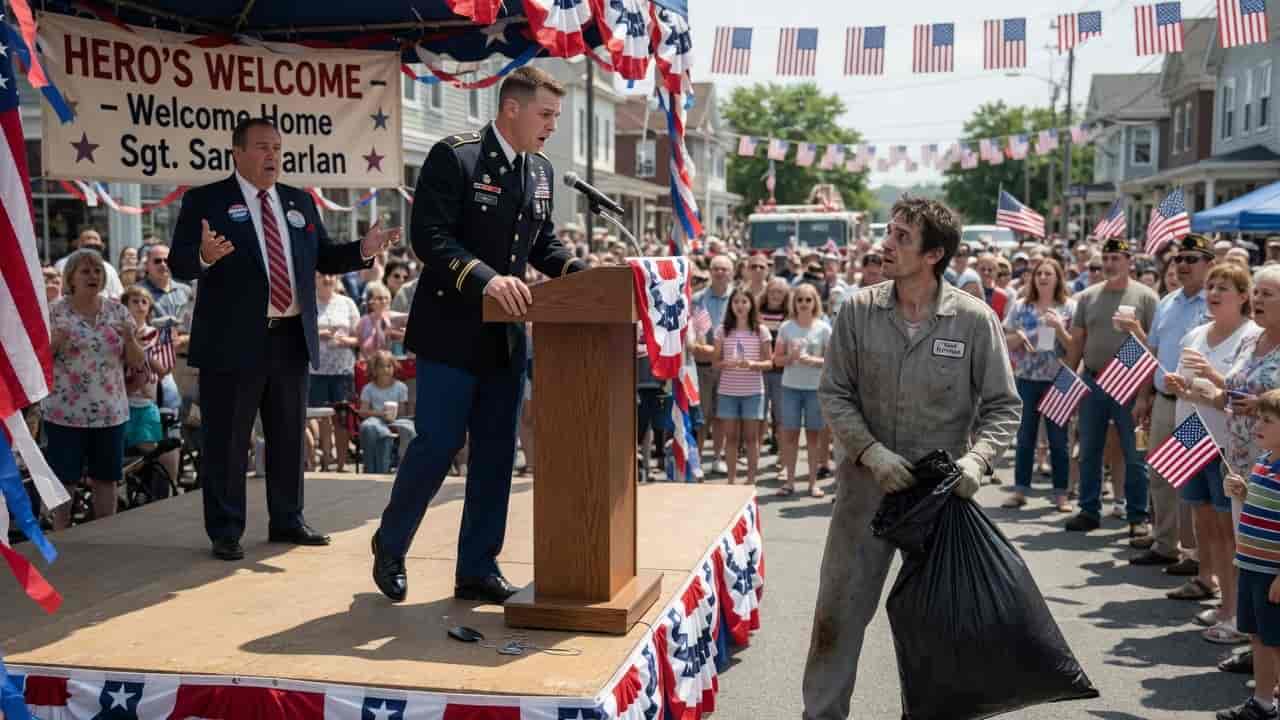
“He’s not gone,” Sam whispered, the microphone carrying his shaking voice across the entire crowded square.
The Mayor reached for his arm, trying to pull him back to the podium. “Sam, get back here. The cameras are rolling. You’re a hero.”
But Sam wasn’t looking at the cameras. He wasn’t looking at his wife’s proud, terrified face in the front row. He was looking at the man in the gray janitor’s jumpsuit—the man the government told him had been lost in an explosion five years ago.
Sam held up the notched silver tag he’d found in the hospital’s dumpster that morning. He knew that notch. He’d made it himself with a pair of pliers in a tent in Kandahar so they’d never confuse their gear.
The whole town watched in a suffocating silence as their “War Hero” jumped off the stage and knelt in the dirt at the feet of a man emptying the trash.
“Ben?” Sam asked, his voice breaking.
The man in the jumpsuit didn’t look up. He just gripped the trash bag tighter, his knuckles white, his body shaking with a fear that didn’t belong in a quiet American town.
The government gave Sam a medal for his brother’s disappearance. Now, Sam is realizing the medal was just a price tag for a secret he was never supposed to find.
Chapter 1: The Silver in the Dust
The garage smelled like old oil, sawdust, and the peculiar, metallic tang of Sam’s own sweat. It was a Saturday morning in Oakhaven, the kind of morning that usually signaled a suburban ritual: lawn mowing, car washing, or standing in line at the hardware store for a specific size of galvanized nail. For Sam, it was the morning of the workbench.
He didn’t like being inside the house when the sunlight hit the kitchen tiles a certain way. It reminded him of the dust motes in the barracks, the way the light had looked through the high, reinforced windows in a world that didn’t exist anymore. In the garage, he could focus on the tangible. He had a 1974 Honda CB750 on the lift, its engine stripped down to the pistons. It was a puzzle that made sense. If a valve was bent, you replaced it. If the timing was off, you adjusted the chain. There were no secrets in a four-cylinder engine.
He was reaching for a 12mm socket when he saw the glint. It wasn’t on the bike. It was in the corner of a plastic bin he’d brought back from the hospital’s loading dock two days ago—a bin he’d scavenged for scrap metal after his shift as a delivery driver. He shouldn’t have had the bin. He shouldn’t have been looking through the trash at the county clinic where he made his drop-offs. But Sam had a habit of looking. He looked at faces in crowds. He looked at the way men walked. He looked for things that didn’t fit the rhythm of a peaceful town.
He picked it up. It was a dog tag, dull and scratched, but the metal was unmistakably military-grade.
Sam felt a coldness settle in his chest, a sensation like swallowing a handful of slush. He turned the tag over in his palm. On the top edge, there was a jagged, V-shaped notch. He’d made that notch himself with a pair of Leatherman pliers in the back of a Humvee outside Kandahar. He’d done it because his brother, Ben, was always losing his gear, and Sam wanted to make sure they could tell their tags apart if things ever got messy.
Ben.
The name felt like a bruise. Ben had died five years ago. An IED had turned their lead vehicle into a vertical pyre of magnesium and diesel. Sam had been in the second truck. He’d seen the flash, felt the shockwave rattle his teeth, and spent the next three hours pulling blackened scrap apart until the Captain told him to stop. They’d given Sam a Silver Star for his “valiant recovery efforts” and sent Ben home in a flag-wrapped transfer case that Sam wasn’t allowed to open.
“Sam? You still out here?”
The voice was Sarah’s. It was light, melodic, and carried the practiced patience of a woman who had spent four years learning how to live with a man who was only two-thirds present. She appeared in the doorway, a mug of coffee in each hand. She was wearing her “Oakhaven Elementary” t-shirt, her blonde hair pulled back in a messy knot.
Sam instinctively closed his hand over the tag. He shoved it into the pocket of his greased work pants. “Yeah. Just the timing chain. It’s being a pain.”
Sarah stepped into the garage, dodging a pile of rags. She set his coffee on the edge of the workbench, her eyes lingering on his face. “You’re sweating. It’s not that hot yet.”
“Just working hard,” he said. He forced a smile. It felt like a tectonic shift in his jaw.
“The Mayor called again,” she said softly. “He wanted to make sure you have your speech ready for Monday. The Memorial Day committee really wants you to lead the parade, Sam. It’s the fifth anniversary of… you know. It’s a big deal for the town.”
Sam picked up a rag and started wiping his hands, though they were already clean of everything but the deep-set grease in his cuticles. “I told him I’d do it. I’ll be there.”
“You don’t have to if it’s too much,” Sarah said, stepping closer. She reached out, her fingers brushing the stiff fabric of his sleeve. “Nobody would blame you. Five years is… it’s a long time, but it’s not forever.”
“I’m fine, Sarah. Really.”
He wasn’t fine. He could feel the notched metal burning against his thigh through the pocket. He wanted her to leave so he could look at it again. He wanted to scream that his brother was buried in the Oakhaven cemetery, and yet his brother’s dog tag was sitting in a bin of medical waste from a local clinic.
“Okay,” she said, her voice trailing off. She knew when the door was being shut. She’d lived behind that shut door for a long time. “Breakfast is on the table when you’re ready. Don’t let it get cold.”
She turned and walked back to the house. Sam waited until the screen door clicked shut. He pulled the tag out. He held it up to the single lightbulb hanging over the workbench.
BENJAMIN R. COLLINS. O POS. CATHOLIC.
The notch was there. The exact same jagged V.
Sam sat down on his rolling stool, his knees suddenly weak. A dog tag didn’t just survive an IED blast and then wander across the ocean to a suburban clinic five years later. Not unless it was around someone’s neck.
He stood up, grabbed his car keys, and walked past the coffee Sarah had made him. He didn’t go to breakfast. He got into his truck and drove toward the downtown area, toward the “Blue Note,” a dive bar where the local veterans congregated.
The bar was dim, smelling of stale beer and the kind of floor cleaner that never quite finished the job. Al, the bartender, was a man in his sixties with a prosthetic leg and a permanent scowl. He looked up as Sam walked in.
“A bit early for you, isn’t it, Hero?” Al asked, sliding a glass of water across the bar without being asked.
Sam didn’t sit. He leaned over the wood, his voice low. “Al, you remember those guys who used to work the night shift over at the County Clinic? The janitorial crew?”
Al squinted. “The private contractors? Why? You looking for a second job? I thought the delivery gig was keeping you busy.”
“Just answer the question.”
“They’re mostly transient,” Al said, shrugging. “Guys from the halfway house or fellas who don’t want to show an ID. Why?”
“I saw someone,” Sam said. His heart was hammering against his ribs like a trapped bird. “A guy. Tall, thin. Looks like he’s seen the bad end of a long decade.”
Al chuckled, a dry, rattling sound. “That describes half this town, Sam. Including the guy in the mirror.”
“This is different,” Sam said. He reached into his pocket, but he didn’t pull out the tag. He couldn’t show it to Al. Not yet. If he showed it, it became real. If it was real, the last five years were a lie. “I think… I think I need to see the night shift roster.”
“The clinic won’t give you that,” Al said, his tone turning serious. “That’s HIPAA or some government nonsense. Besides, those guys are ghosts. They come in at 11:00 PM and they’re gone by 6:00 AM. They don’t talk, and they don’t stick around for the sunshine.”
“I’ll wait,” Sam said.
“Wait for what?”
“For the shift change.”
Sam walked out of the bar before Al could ask anything else. He drove to the clinic and parked in the far corner of the lot, under the shade of a dying oak tree. He sat there for six hours. He watched the nurses come and go. He watched the patients—the old, the broken, the pregnant.
At 10:45 PM, a battered white van with no markings pulled into the loading dock. Three men got out. Two were older, their shoulders slumped under the weight of their own history.
The third man was younger. He was wearing a gray jumpsuit that was two sizes too large. He moved with a strange, hesitant hitch in his gait, his head ducked low, his hair a matted tangle of dark brown. He grabbed a heavy black trash bag from the back of the van and started toward the service entrance.
Sam’s breath hitched. The way that man moved… the specific, slight lean to the left. The way he rolled his shoulders when he adjusted his grip.
It was Ben.
It couldn’t be. Ben was dead. Ben was in a box in the ground under a headstone that said “VALIANT UNTO THE END.”
Sam opened the truck door, his hand trembling. He wanted to call out. He wanted to run across the asphalt and grab the man by the shoulders. But as he stepped onto the pavement, a black SUV with tinted windows pulled into the lot, blocking his path.
The driver’s side window rolled down. A man in a crisp, tan windbreaker looked out. He had a face like a hawk—sharp, observant, and entirely devoid of warmth.
“Mr. Collins,” the man said. It wasn’t a question. “It’s a late night for a man with a parade to lead on Monday.”
Sam froze. “Who are you?”
“A friend of the family,” the man said. He smiled, but it didn’t reach his eyes. “Go home, Sam. Enjoy the breakfast your wife made. Stick to the speech. Some things are better left in the trash.”
The SUV sat there, its engine idling with a low, predatory hum. Sam looked past it, toward the service door. The man in the gray jumpsuit was gone. The door had clicked shut.
Sam looked back at the man in the SUV. “My brother is in that building.”
“Your brother is a hero,” the man said softly. “Don’t ruin a good story, Sam. It’s the only thing this town has left.”
The SUV stayed in the lot until Sam got back into his truck and drove away. He didn’t go home. He drove to the edge of town, parked on a dirt road, and cried for the first time in five years. Not because he was sad. But because he was terrified of the truth he’d just found in a bin of waste.
Chapter 2: The Ghost at the Clinic
The silence in the house was a different kind of pressure. Usually, it felt like a blanket—something Sam could pull over himself to dull the jagged edges of the world. But tonight, it felt like a vacuum, sucking the air out of his lungs. He stood in the hallway, listening to the rhythmic, soft breathing of Sarah in the bedroom. She was sleeping the sleep of the innocent, the sleep of someone who believed that the world was exactly what it appeared to be.
Sam went to the kitchen. He didn’t turn on the light. He sat at the small wooden table, the notched dog tag sitting in front of him like a cursed relic.
He remembered the day they’d enlisted. Their father had been a career man, a sergeant major with a chest like a barrel and a voice that could crack granite. Joining the Army wasn’t a choice; it was an inheritance. Ben had been the one who hesitated. He’d wanted to go to art school in Chicago, wanted to paint things that weren’t camouflaged. But in the end, the weight of the family name had been too much.
“We’ll look out for each other,” Sam had told him on the bus to Fort Benning. “I’m the big brother. That’s the deal.”
He’d failed the deal. He’d watched his brother’s truck turn into a fireball, and he’d accepted the medal they gave him for the failure.
He stood up. He couldn’t stay in the house. The walls felt like they were leaning in, whispering the name of the man in the tan windbreaker.
He drove back to the clinic. He didn’t park in the lot this time. He parked two blocks away, in the gravel behind a closed-down laundromat, and walked through the shadows. He knew the layout. He’d been making deliveries to this place for two years. He knew where the cameras had blind spots and where the service entrance stayed propped open for the night air.
He reached the loading dock at 2:00 AM. The air was cool and smelled of damp earth and medicinal alcohol. He slipped through the heavy steel door, his boots making no sound on the waxed linoleum.
He found the man in the gray jumpsuit in the oncology wing. He was mopping the floor, his movements slow and mechanical. The light from the overhead fluorescents was harsh, washing out the color of his skin until he looked like a figure made of ash.
Sam stayed in the shadows of a supply closet. He watched.
The man stopped mopping. He leaned his forehead against the cool handle of the mop and closed his eyes. His face was gaunt, the cheekbones pushing against the skin. There was a scar running from his temple down into his hairline—a jagged, silver line that looked like a lightning bolt.
Sam felt a physical ache in his throat. It was Ben. The scar was new, the weight loss was devastating, but the way he tilted his head to the left when he breathed… that was the brother Sam had grown up with.
“Ben,” Sam whispered.
The man didn’t move. He didn’t even flinch. It was as if he’d spent years training himself not to react to the sound of his own name.
Sam stepped out of the shadows. He walked slowly, his hands held out in front of him, palms up, the way you approach a wounded animal.
“Ben. It’s Sam.”
The man finally looked up. His eyes were hollowed out, the pupils blown wide. He looked at Sam, but there was no recognition. There was only a deep, primal terror.
“I don’t know you,” the man said. His voice was a rasp, a sound like sandpaper on dry wood. “I’m just the janitor. I’m cleaning. See? I’m cleaning.”
He started mopping frantically, his movements erratic, the soapy water splashing against the baseboards.
“Ben, stop. Look at me.” Sam reached out and grabbed the mop handle, stilling it. “Look at my face. It’s me. It’s Sam. We lived on Miller Road. Dad had that old blue Ford. You used to hide your drawings in the attic so he wouldn’t see them.”
The man froze. His breath started coming in short, ragged gasps. He looked at Sam’s hand on the mop, then slowly, painfully, he raised his eyes to Sam’s face.
A flicker of something passed through those hollow eyes. A spark of memory, quickly followed by an agonizing wave of grief.
“Sam?” the man whispered. “You… you were in the second truck.”
“I was there, Ben. I tried to get to you. I thought you were gone.”
Ben’s face crumpled. He didn’t cry; his eyes stayed dry, but his whole body began to shake. “They took me. The men in the black turbans. They took me into the mountains. I waited for you, Sam. I waited for three years. I told them my brother was coming. I told them you’d bring the whole damn Army.”
Sam felt like his soul was being shredded. “They told me you died, Ben. They gave us a body. We had a funeral. Everyone in town was there.”
“I wasn’t dead,” Ben said, his voice rising, becoming frantic. “I was in a hole. And then… and then the men in the suits came. Not our guys. Not the Army. Different men. They traded me, Sam. They gave those people money and guns, and they told me I was a ‘sensitive asset.’ They brought me here six months ago. They told me if I talked to anyone, if I even looked at you, they’d put me back in the hole. Or they’d hurt Sarah.”
Sam’s blood turned to ice. “The man in the tan windbreaker.”
“Vance,” Ben said, spitting the name like it was poison. “He comes every week. He gives me pills so I don’t dream. He tells me I’m a ghost. He says a ghost doesn’t have a brother.”
“He’s wrong,” Sam said, his voice hardening. “He’s dead wrong. You’re coming home with me. Right now.”
“No!” Ben shrieked. He backed away, tripping over the mop bucket. “You can’t. They’re watching, Sam. They’re always watching. If I leave this wing, the alarms go off. If I talk to you, they’ll end it. They’ll end everything.”
“I don’t care about the alarms,” Sam said, stepping toward him.
“I do!” Ben’s voice was a panicked sob. “I just want to be left alone. I can’t go back to the hole, Sam. Please. Just let me clean. Just let me be a ghost.”
Before Sam could answer, the heavy double doors at the end of the hallway swung open. Two men in dark suits, their faces identical in their lack of expression, stepped into the corridor.
“Mr. Collins,” one of them said. “You’re interfering with a private contractor’s duties. That’s a violation of clinic policy.”
Sam turned, his fists clenching. “He’s my brother. He’s a United States soldier.”
“He’s a janitor with a history of mental instability,” the man said, walking closer. “And you’re a hero who is about to lose his reputation if he doesn’t leave the building.”
They didn’t reach for weapons. They didn’t have to. The way they moved, the casual arrogance of their pace, told Sam everything he needed to know. They owned the room. They owned the town. And they owned the man shaking on the floor behind him.
Ben looked at Sam one last time. There was no hope in his eyes, only a desperate plea for silence. He picked up the mop and started scrubbing a spot on the floor that was already clean.
“Go home, Sam,” Ben whispered, his back turned. “I don’t have a brother.”
The two men escorted Sam to the exit. They didn’t say a word until they reached the loading dock.
“The parade is at 10:00 AM on Monday, Sam,” the taller one said. “Wear your medals. Make the town proud. Don’t make us remind you what happens to people who try to rewrite the official report.”
They pushed him out into the night. Sam stood in the gravel, the taste of copper in his mouth. He looked up at the stars, the same stars that had watched his brother rot in a hole for three years while he sat in a suburban garage drinking lukewarm coffee.
He didn’t drive home. He drove to the hardware store he frequented. He waited in the shadows of the alley until the owner arrived to open up at 5:00 AM.
“Sam? You okay? You look like you’ve been through a meat grinder,” the owner said.
“I need a set of bolt cutters,” Sam said, his voice flat and cold. “And a map of the county’s underground utility tunnels. I know you have them from when the new sewers went in.”
“Sam, what’s going on?”
“The war isn’t over,” Sam said. “It just moved to Oakhaven.”
Chapter 3: The Shadow Man
The “Blue Note” was empty except for the dust motes dancing in the afternoon light. Al was polishing glasses, his prosthetic leg creaking every time he shifted his weight. He looked up as Sam walked in, his eyes narrowed.
“You look like hell, Sam. And you’re late. The Mayor’s been in here twice looking for you. They’re setting up the stage in the square.”
Sam ignored him. He sat at the bar and pulled a crumpled piece of paper from his pocket. It was a list of names—men who had served in the same unit as Ben, men who had been “processed” through the same VA hospital.
“Al, I need you to call Miller. And Jackson. And Big Pete.”
Al stopped polishing. “Why? What’s the play, Sam?”
“I found Ben,” Sam said.
The glass in Al’s hand slipped, shattering against the floor. The sound was like a gunshot in the quiet bar. Al didn’t even look at the shards. He just stared at Sam, his face turning the color of old parchment.
“Ben’s at the cemetery, Sam. We carried the casket.”
“The casket was full of sand and old uniforms,” Sam said, his voice low and dangerous. “I saw him, Al. He’s cleaning floors at the clinic. He’s being held by a man named Vance. CIA, maybe. Or some off-the-books outfit. They traded him for something in Afghanistan, and now they’re keeping him under wraps so the public never finds out the ‘Hero of Kandahar’ was actually a bargaining chip.”
Al sank onto a stool, his breath coming in wheezes. “Jesus. If that’s true… if that’s really true…”
“It is. And they’re threatening Sarah. They’re threatening the whole town’s peace of mind.” Sam leaned across the bar. “I’m not leading that parade to celebrate a lie. I’m going to use it.”
“Use it how?”
“They want a show? I’ll give them one. But I need witnesses. I need men who know what a soldier looks like even when he’s wearing a jumpsuit.”
Before Al could respond, the door to the bar opened. The man in the tan windbreaker—Vance—stepped inside. He looked out of place in the dim, grimy bar, like a shark in a goldfish pond.
Al went stiff. He reached under the bar for the baseball bat he kept there.
“Easy, Al,” Vance said, his voice smooth and conversational. “I’m just here for a drink. And a word with our local legend.”
Vance sat next to Sam. He smelled of expensive cologne and something sterile, like an operating room.
“You’re persistent, Sam. I’ll give you that,” Vance said, signaled for a scotch. Al didn’t move. Vance shrugged and looked at Sam. “But persistence without perspective is just a slow form of suicide.”
“Where did you get the authority to trade a U.S. soldier?” Sam asked. He didn’t look at Vance. He kept his eyes on the mirror behind the bar, watching the man’s reflection.
“Authority is a funny thing,” Vance said. “In the mountains, authority is whoever has the most bullets. In Washington, it’s whoever has the most secrets. Your brother was a secret that became too expensive to keep in a cage, but too dangerous to let out in the yard. We did him a favor, Sam. We brought him back to his hometown. He has a roof over his head. He has food. He’s safe.”
“He’s a prisoner in his own town,” Sam spat.
“He’s a ghost,” Vance corrected. “And ghosts don’t have rights. They don’t have families. They just have the silence. You’re the one trying to wake the dead, Sam. And trust me, nobody likes what happens when a ghost starts talking.”
Vance leaned closer, his voice dropping to a whisper that felt like a blade against Sam’s ear. “Think about Sarah. Think about your kids. They think you’re a hero. They think their uncle died a noble death. Do you really want to tell them he’s a broken, traumatized shell who was sold like a piece of livestock by the government you serve? Do you want them to live the rest of their lives looking over their shoulders?”
“You’re a coward,” Sam said.
Vance laughed. It was a hollow, mirthless sound. “I’m a pragmatist. I keep the world spinning so people like you can play garage-mechanic on Saturdays. On Monday, you’re going to get on that stage. You’re going to give a beautiful, tear-jerking speech about sacrifice and honor. You’re going to accept the key to the city. And then you’re going to go home and forget you ever saw a man in a gray jumpsuit.”
Vance stood up. He reached into his pocket and pulled out a small, leather-bound notebook. He laid it on the bar.
“This is your brother’s medical file from the last three years,” Vance said. “Read it. See what they did to him. See what he said about you during the ‘interrogations.’ Then tell me if you think he’s better off as a hero in the ground or a janitor in the basement.”
Vance walked out, the bell above the door chiming with a cheerful, mocking sound.
Sam picked up the notebook. His hands were shaking so hard he could barely open the cover.
He read the first page.
Subject 44-B (Collins, Benjamin). Day 412 of captivity. Subject continues to call for ‘Sam.’ Subject believes brother is coming. Recommend increased sensory deprivation to break the expectation of rescue.
Sam closed the book. He didn’t cry. He didn’t scream. He just looked at Al.
“Call the guys,” Sam said. “Tell them to bring their gear. Not their uniforms. Their real gear.”
“What are we doing, Sam?”
“We’re going to finish the rescue,” Sam said. “Five years late.”
The rest of the afternoon was a blur of calculated movements. Sam met Miller and Jackson in the woods behind the clinic. They were men he’d bled with, men who had seen the same fire that had supposedly taken Ben.
“You sure about this, Sam?” Miller asked, checking the tension on a set of heavy-duty zip-ties. “This isn’t a combat zone. This is Oakhaven. We do this, there’s no going back. We’ll be the villains in the morning papers.”
“I’d rather be a villain with my brother than a hero with a lie,” Sam said.
He showed them the notebook. He showed them the notched dog tag.
“They traded him,” Jackson whispered, his face darkening with a fury that mirrored Sam’s. “Those bastards traded one of ours.”
“They did,” Sam said. “And on Monday, the whole town is going to watch us bring him home.”
He spent the night in the garage, but he didn’t work on the bike. He sat on the floor, cleaning his old service pistol. He didn’t want to use it. He hoped to God he wouldn’t have to. But he knew men like Vance. They didn’t understand words. They only understood the weight of a hammer.
Sarah came out to the garage at 3:00 AM. She didn’t ask why he was cleaning a gun. She just sat down next to him and put her head on his shoulder.
“You’re going to do something, aren’t you?” she asked.
“I have to, Sarah.”
“I know,” she said. “I’ve seen the way you look at his grave. I’ve always known you didn’t believe he was there. I just… I was too scared to say it.”
“If things go sideways,” Sam said, his voice thick, “take the kids to your mother’s. Don’t stop for anything.”
“Just bring him back, Sam,” she said, her voice steady. “Bring my brother-in-law home.”
Chapter 4: The Parade Ground
Monday morning arrived with a sky so blue it looked painted. Oakhaven was in full bloom, the scent of lilacs and apple blossoms competing with the smell of charcoal grills and diesel exhaust. The town square was a sea of red, white, and blue.
Sam stood in front of the mirror in his bedroom, adjusting the high collar of his Dress Blue uniform. The fabric was stiff, the gold buttons gleaming with a reflected light that felt like an accusation. The Silver Star pinned to his chest felt like a lead weight, pulling his shoulder down.
“You look handsome,” Sarah said, standing in the doorway. She was wearing a simple floral dress, her eyes red-rimmed but her jaw set firm.
“I look like a lie,” Sam said.
He checked the small of his back, making sure the pistol was concealed beneath the tunic. It was a bulky fit, but the heavy fabric hid the silhouette. He took a deep breath, tucked the notched dog tag into his white glove, and walked out the door.
The parade was a cacophony of sound. High school marching bands, the local VFW post, fire trucks with their sirens occasionally chirping. Sam walked at the head of the procession, his back straight, his eyes fixed on the horizon. To the townspeople lining the streets, he was the embodiment of American virtue—the man who had faced the fire and come home with his head held high.
They cheered. They waved small flags. They held up signs that said “WELCOME HOME SAM” and “OAKHAVEN PROUD.”
Every cheer felt like a slap.
He saw Vance standing on the corner of 4th and Main. The man wasn’t wearing his windbreaker today; he was in a sharp gray suit, looking like any other successful businessman. He gave Sam a small, imperceptible nod—a reminder of the contract.
They reached the square. A large wooden stage had been erected in front of the courthouse. The Mayor, sweating profusely in his navy suit, was already at the podium, warming up the crowd.
“And now,” the Mayor shouted, his voice echoing through the PA system, “the man you’ve all been waiting for. A son of Oakhaven. A hero of the Republic. Sergeant Sam Collins!”
The applause was deafening. Sam climbed the steps of the stage. His boots sounded like drumbeats on the hollow wood. He stood behind the podium, looking out at the thousand faces watching him.
He saw his wife in the front row. He saw Al and Miller and Jackson standing near the back, their hands in their pockets, their eyes scanning the crowd for Vance’s men.
And then he saw him.
Near the green metal trash bin at the edge of the square, a man in a gray jumpsuit was emptying a heavy black bag. He was moving with that same hesitant, broken hitch. He looked up, his eyes meeting Sam’s across the distance.
Ben froze. He looked at Sam in his blues, his medals, his glory. He looked at the brother who was being celebrated while he was being erased.
Sam’s hand began to shake. He looked down at the microphone.
“I had a speech prepared,” Sam said, his voice cracking.
The crowd went silent. The only sound was the flapping of the large American flag behind the stage.
“I was going to talk about sacrifice,” Sam continued, his voice growing stronger, colder. “I was going to talk about the ‘fallen.’ About how we owe it to them to live good, quiet lives. But I’m tired of talking about the dead.”
The Mayor stepped forward, his face pale. “Sam, just stick to the script, son.”
Sam ignored him. He reached into his glove and pulled out the notched dog tag. He held it up. The silver metal glinted in the harsh midday sun.
“This tag belonged to my brother, Ben,” Sam said, his voice booming now, carrying to the furthest edges of the square. “He was supposed to have died in a vehicle fire five years ago. That’s what the Army told me. That’s what they told you.”
Vance started moving through the crowd, his face a mask of cold fury. Two of his men began to converge on the stage from the sides.
“But Ben didn’t die,” Sam shouted. He pointed his finger toward the trash bin. “He’s right there! Look at him! Look at the man the government traded for a secret! Look at your hero!”
The crowd turned as one. They looked at the gaunt man in the gray jumpsuit. Ben was trembling, the black trash bag slipping from his fingers, his face a portrait of absolute terror.
“Sam, stay at the mic!” the Mayor hissed, grabbing Sam’s arm.
Sam shoved him back. The Mayor stumbled into the flag, nearly knocking it over. Sam didn’t care. He jumped off the four-foot stage, his boots hitting the dirt with a heavy thud.
The crowd parted for him like the Red Sea. He walked toward Ben, his eyes locked on his brother’s face.
“Ben?” Sam asked, his voice breaking.
Vance stepped into Sam’s path, his hand reaching inside his jacket. “That’s enough, Sam. Stop now, and we can still fix this.”
“Get out of my way,” Sam said. His hand moved to the small of his back.
Al and Miller suddenly appeared, flanking Sam. They didn’t have guns out, but they had the look of men who were ready to die in the street. Vance hesitated. He looked at the thousand witnesses, the cameras from the local news stations, the townspeople who were beginning to realize that something horrific was happening in front of them.
Sam walked past Vance. He reached Ben.
The man in the gray jumpsuit looked up, his hollow eyes filling with tears. “You came,” he whispered. “You really came.”
Sam didn’t say a word. He dropped to his knees in the dirt, the pristine fabric of his Dress Blues staining brown. He took his brother’s scarred, trembling hands in his own and put his forehead against Ben’s chest.
“I’m sorry it took so long,” Sam sobbed. “I’m so sorry.”
The square was silent. No one cheered. No one moved. The “War Hero” was kneeling at the feet of a janitor, and the silence was more powerful than any speech.
Vance looked at the scene, then looked at his men. He knew he’d lost. He couldn’t kill a hero in front of his hometown. Not today. He turned and disappeared into the crowd.
But Sam didn’t watch him go. He just held onto his brother, while the medals on his chest clinked against the buttons of a gray industrial jumpsuit.
Chapter 5: The Perimeter of the Porch
The drive back to the house on Miller Road was a blur of flashing lights and the hollow, ringing silence that follows an explosion. Sam drove with one hand white-knuckled on the steering wheel and the other gripped firmly around Ben’s wrist, as if letting go would cause his brother to evaporate back into the heat haze of the afternoon.
Ben sat in the passenger seat, hunched so low his chin nearly touched his collarbone. He was still wearing the gray industrial jumpsuit, but Sam had draped his own Dress Blue tunic over Ben’s shoulders. The gold buttons and silver medals clinked against each other with every bump in the road—a sound of high-ranking honor resting on the frame of a man who had been treated like garbage.
Sarah followed in the SUV with the kids. Sam could see her in the rearview mirror, her face a pale mask of concentration. She was keeping a tight distance, her eyes darting between the road and the black sedan that had been trailing them since they left the square.
They pulled into the driveway. The house, usually a sanctuary of domestic routine, suddenly looked like a target. The white siding was too bright, the lawn too exposed.
“Get inside,” Sam said, his voice a low rasp. He didn’t wait for Ben to move. He walked around the truck, hauled his brother out, and guided him toward the front door.
“Sam,” Ben whispered, his eyes darting toward the street. “They’re coming. Vance… he doesn’t let things go. He told me the world has to stay the way it is.”
“The world just changed, Ben,” Sam said. “Inside. Now.”
The interior of the house smelled of laundry detergent and the pot roast Sarah had started that morning. It was a smell of a life Ben hadn’t known for five years. He stood in the entryway, his boots muddying the beige carpet, looking around as if he had stepped into a museum of a lost civilization. He reached out a trembling hand and touched a framed photo on the hallway table—a picture of Sam and Ben as teenagers, holding up a stringer of walleye at the lake.
“I remember that day,” Ben said, his voice so thin it barely carried. “You fell in. You lost the net.”
“I did,” Sam said, a lump forming in his throat. “I lost the net, but we kept the fish.”
Sarah came in behind them, ushering the kids toward the kitchen. She looked at Ben—really looked at him for the first time without the chaos of the crowd. Her eyes filled with tears, but she blinked them back. She was a soldier’s wife; she knew that hysterics wouldn’t help a man who had just come back from the dead.
“Ben,” she said softly. “I’m going to make some tea. And some food. You look like you haven’t eaten a real meal in a decade.”
“I had sandwiches,” Ben said, his eyes unfocused. “At the clinic. Ham and cheese. Always on white bread. They tasted like the plastic they were wrapped in.”
He allowed Sarah to lead him to the kitchen table. He sat down, but he didn’t lean back. He sat on the very edge of the chair, his body coiled, ready to run or hide.
Sam walked to the window. The black sedan had parked across the street, just past the neighbor’s mailbox. Two men were sitting inside. They weren’t hiding. They wanted to be seen. It was a classic intimidation tactic—the perimeter of the psyche.
The phone on the counter started ringing. Sam didn’t answer it. Then the cell phone in his pocket vibrated. It was the Mayor. Then a local news station. Then a number he didn’t recognize.
“Sam,” Sarah called from the kitchen. “The kids are in the den. What do we do?”
“We hold,” Sam said.
He went to the gun safe in the hallway closet. He punched in the code, the mechanical clicks echoing in the quiet house. He pulled out his Remington 870. He didn’t load it—not yet—but he felt the weight of it, the cold steel and the pump action. It was a language he knew how to speak.
A few minutes later, the gravel in the driveway crunched. Sam moved to the porch, the shotgun held behind the doorframe. It wasn’t the sedan. It was Al’s old Ford F-150, followed by Miller’s Jeep and Jackson’s silver Silverado.
The three men climbed out. They weren’t wearing their parade clothes anymore. They were in flannel shirts, work boots, and baseball caps. Miller was carrying a heavy canvas bag that clunked with the sound of ammunition boxes.
Al walked up the steps, his prosthetic leg thumping on the wood. He looked at Sam, his face grim. “The town is going crazy, Sam. The police are at the square trying to figure out if you kidnapped a city employee or if you actually found a ghost. The Sheriff is caught between wanting to help you and wanting to follow the ‘federal guidelines’ Vance just dropped on his desk.”
“Vance is across the street,” Sam said, nodding toward the sedan.
Al didn’t even look. “I saw ’em. We parked the trucks to block their line of sight to the windows. If they want to come in, they’re gonna have to go through us.”
“You don’t have to do this, Al,” Sam said. “This is a federal mess. They’ll ruin you.”
Al spat a stream of tobacco juice onto the grass. “They already ruined us, Sam. They sent us to a desert to fight for people who trade our brothers like poker chips. I’ve been looking for a reason to stand my ground for twenty years. I think I finally found one.”
Miller and Jackson took up positions at the corners of the property. They didn’t pull weapons—that would give the feds an excuse to move in—but they sat on tailgates, cleaning fingernails with pocketknives, their eyes never leaving the black sedan. It was a veterans’ picket line.
Inside the house, the atmosphere was thick with the residue of trauma. Sam found Ben in the living room, staring at the television. It wasn’t turned on, but Ben was watching his own reflection in the black glass.
“They gave me names, Sam,” Ben said. He hadn’t touched the tea Sarah made him. “In the hole. They told me I wasn’t Benjamin Collins anymore. They called me ‘Asset Zero.’ They told me if I remembered my old name, it would hurt more. They were right.”
Sam sat on the coffee table in front of him. “Look at me, Ben. You’re home. Nobody is calling you an asset here. You’re my brother. You’re the guy who used to draw dragons on the back of his math homework.”
Ben looked up, a flicker of a smile ghosting across his gaunt face. “I forgot about the dragons.”
“I didn’t,” Sam said. “I kept them. I have a whole folder of them in the attic.”
The moment of connection was shattered by a heavy knock on the door. Not a neighborly knock. A rhythmic, authoritative pounding.
Sam stood up, his hand reflexively going to the small of his back where his pistol was tucked. He walked to the door and opened it just a crack.
It wasn’t Vance. It was Sheriff Miller, a man Sam had known since high school. The Sheriff looked uncomfortable, his hat pulled low over his brow, his badge glinting in the afternoon light.
“Sam,” the Sheriff said. “I need you to step outside.”
“I’m not leaving my brother, Dale.”
“The men in the car… they have paperwork, Sam. They’re claiming the man in your house is a person of interest in a national security matter. They’re saying he’s mentally unstable and needs to be remanded to a federal medical facility for his own safety.”
“You mean the facility where he mops floors at 3:00 AM?” Sam asked, his voice dripping with contempt. “The one where they keep him drugged so he doesn’t remember who he is?”
The Sheriff sighed, a long, weary sound. “Look, I don’t like it any more than you do. I saw what happened at the square. The whole town saw it. But my hands are tied. If I don’t facilitate the transfer, they’re going to bring in a tactical team. They’ll tear this house apart, Sam. And they’ll do it legally.”
“Then let them,” Sam said. “But tell Vance one thing. The news cameras are on their way. Al called the city desk at the Chronicle. Miller called the regional bureau of the Associated Press. If a tactical team moves on this house, the whole world is going to watch them assault a Silver Star recipient and a returned POW.”
The Sheriff froze. He looked back at the black sedan, then at the veterans sitting on the trucks. He knew the math. A quiet kidnapping was one thing. A televised siege was another.
“You’re playing a dangerous game, Sam,” the Sheriff whispered.
“I learned it from the best,” Sam said. He closed the door and locked it.
He went back to the kitchen. Sarah was standing by the sink, her hands shaking. “What did he say?”
“He said they’re scared,” Sam said. He looked at Ben, who was now curled into a ball on the sofa, his eyes closed, his breathing shallow. “They’re scared because the truth is out of the bottle, and they don’t know how to shove it back in.”
But as the sun began to set, casting long, bloody shadows across the living room floor, Sam knew the night would be the real test. Vance wouldn’t wait for the morning news. He would move when the shadows were deepest, when the cameras were blind, and when the town was asleep.
Sam went to the basement and retrieved a box of old flares and a high-powered spotlight he used for night fishing. He began to set them up around the perimeter. He wasn’t just protecting a house anymore. He was protecting the only proof that the last five years of his life hadn’t been a hollow performance.
He looked at Ben, sleeping fitfully on the couch, murmuring words in a language Sam didn’t recognize—the language of the hole.
“I’ve got you, Ben,” Sam whispered to the empty room. “This time, the big brother stays on watch.”
The psychological pressure was a physical weight. Sam could feel it in his joints, in the way his eyes burned from the lack of sleep. He was trapped between the man his brother used to be and the ghost sitting in his living room. And he knew that even if they survived the night, the war for Ben’s soul was only just beginning.
Chapter 6: The Light in the Clearing
The 3:00 AM hour is when the world feels the most fragile. It’s the time when the shadows seem to have substance and the silence feels like a held breath. Sam sat on the front porch, the Remington 870 resting across his knees. The spotlight he’d rigged was off, but his thumb was hovering over the switch.
Across the street, the black sedan was still there, a dark monolith in the moonlight. But Sam noticed a change. There were more shadows now—movements in the tree line at the edge of the property, the faint clinking of gear that didn’t belong to the wind.
Vance was moving.
“Sam.”
He turned. Ben was standing in the doorway, wrapped in a wool blanket Sarah had found. He looked smaller in the dark, his eyes reflecting the pale moon.
“They’re here, aren’t they?” Ben asked.
“They’re trying to be,” Sam said. “Go back inside, Ben. Stay in the hallway, away from the windows.”
Ben didn’t move. He walked out onto the porch and sat on the steps next to Sam. He didn’t look scared anymore. He looked tired. A deep, soul-shattering weariness that made him look eighty years old.
“I remember the trade now,” Ben said softly. “It wasn’t just guns and money, Sam. It was a man. A high-value target we’d captured in the valley. They wanted him back, and our people wanted the valley to stay quiet. So they traded a sergeant for a warlord. And then they realized they couldn’t explain how a ‘dead’ hero suddenly appeared in a prisoner exchange. So they buried me again.”
Sam felt a hot, sharp rage flare in his chest. “They traded you like a piece of equipment.”
“I was a line item on a spreadsheet, Sam,” Ben said. He looked at his hands. “Vance told me I should be grateful. He said I was serving my country one last time by staying dead. He said it was the most patriotic thing I could do.”
“Patriotism isn’t a suicide pact for the truth,” Sam said.
A movement caught his eye—a flash of matte black in the bushes fifty feet away. Sam didn’t hesitate. He flipped the switch on the spotlight.
The yard was instantly bathed in a blinding, artificial noon. Three men in tactical gear, wearing balaclavas and carrying silenced submachine guns, were caught in the beam. They froze, shielding their eyes.
“That’s far enough!” Sam roared.
On the street, Al and Miller scrambled off their trucks, their own lights clicking on. “We see you, boys!” Al shouted. “The cameras are recording! Everything is going straight to the cloud!”
It was a lie—there were no cameras yet—but the tactical team didn’t know that. They hesitated, looking back toward the sedan.
The door of the sedan opened, and Vance stepped out. He wasn’t wearing a suit anymore. He was in a black tactical vest, a radio earpiece snaking up his neck. He walked into the circle of light, his face a mask of cold, bureaucratic iron.
“Sam, put the gun down,” Vance said. His voice was amplified by a bullhorn. “You’re obstructing a federal operation. This is your final warning. Remand the asset to our custody, or we will use force.”
“His name is Ben!” Sam shouted back. “And if you want him, you’re going to have to kill a Silver Star recipient on his own front porch! Do it, Vance! Show the world what your ‘national security’ looks like!”
The air was electric. Sam could feel the vibration of the standoff in his teeth. He knew that one nervous finger, one panicked movement, and the porch would become a kill zone.
Ben stood up. He let the blanket fall to the floor. He stepped into the light, standing right next to Sam.
“I’m not an asset,” Ben said. His voice wasn’t loud, but in the stillness of the night, it carried. “My name is Benjamin Riley Collins. I’m a Sergeant in the United States Army. And I’m going to tell the world what you did.”
Vance stared at Ben. For the first time, Sam saw a flicker of doubt in the man’s eyes. Vance was a creature of the dark; he thrived in the spaces where things were hidden and managed. But Ben was standing in the light, reclaiming his name, and he had a brother who was willing to die for it.
The standoff lasted for what felt like an eternity. Then, the sound of sirens began to wail in the distance—not the Sheriff’s single cruiser, but a chorus of them. And behind them, the bright, roving lights of news vans.
Al had made the calls. The story was too big for Oakhaven to contain.
Vance looked at the approaching lights, then back at Sam. He tapped his earpiece and gave a sharp, downward motion with his hand.
The tactical team melted back into the shadows. The men in the sedan started the engine.
Vance walked to the edge of the driveway. He looked at Sam, his expression unreadable. “You think you won, Sam? You just signed his death warrant. He’ll never be safe. You’ll never be safe. You’ll spend the rest of your lives looking at every car that passes, wondering if it’s us.”
“We’ve been doing that for five years anyway,” Sam said. “At least now we’re doing it together.”
Vance got into the car and drove away, disappearing into the night just as the first news van pulled onto Miller Road.
Six months later, the garage on Miller Road was quiet. The Honda CB750 was finished, its chrome glinting in the afternoon sun. Sam was sitting on his stool, drinking a beer, watching the road.
Ben was in the backyard, sitting under the oak tree with a sketchbook. He wasn’t drawing dragons anymore. He was drawing the house. The porch. Sarah hanging laundry. The mundane, beautiful details of a life that had been returned to him.
The legal battle was still ongoing. The government had officially admitted to a “clerical error” regarding Ben’s status, though the details of the trade remained classified. Vance had disappeared—transferred to a different department or retired to a shadow, Sam didn’t know and didn’t care.
Ben still had bad nights. Sometimes he would wake up screaming, convinced he was back in the hole. Sometimes he would go silent for days, his eyes hollow and distant. But he was there. He was a person, not a ghost.
Sarah came out to the garage, leaning against the doorframe. She looked at Ben in the yard, then at Sam.
“He’s getting better,” she said.
“Slowly,” Sam agreed.
“The Mayor called,” she said with a small smile. “He wants to know if you’ll lead the parade again next year. Both of you.”
Sam looked at the notched dog tag, which was now framed on the wall above his workbench. He thought about the fire in Kandahar, the silence of the clinic, and the cold weight of the shotgun on the porch.
“Tell him we’ll think about it,” Sam said. “But we’re done with parades for a while. We’ve got too much work to do right here.”
He stood up and walked into the backyard. He sat down in the grass next to his brother. Ben didn’t look up, but he shifted his weight, making room for Sam in the shade.
The war was over. The truth was out. And for the first time in five years, Sam Collins didn’t have to look for his brother in the trash. He just had to look to his left.
“That’s a good drawing, Ben,” Sam said.
“It’s not finished,” Ben replied, his pencil moving across the paper. “But the lines are finally starting to connect.”
Sam leaned back against the tree, closed his eyes, and listened to the sound of his brother’s breathing—the most beautiful sound he’d ever heard.
THE END.