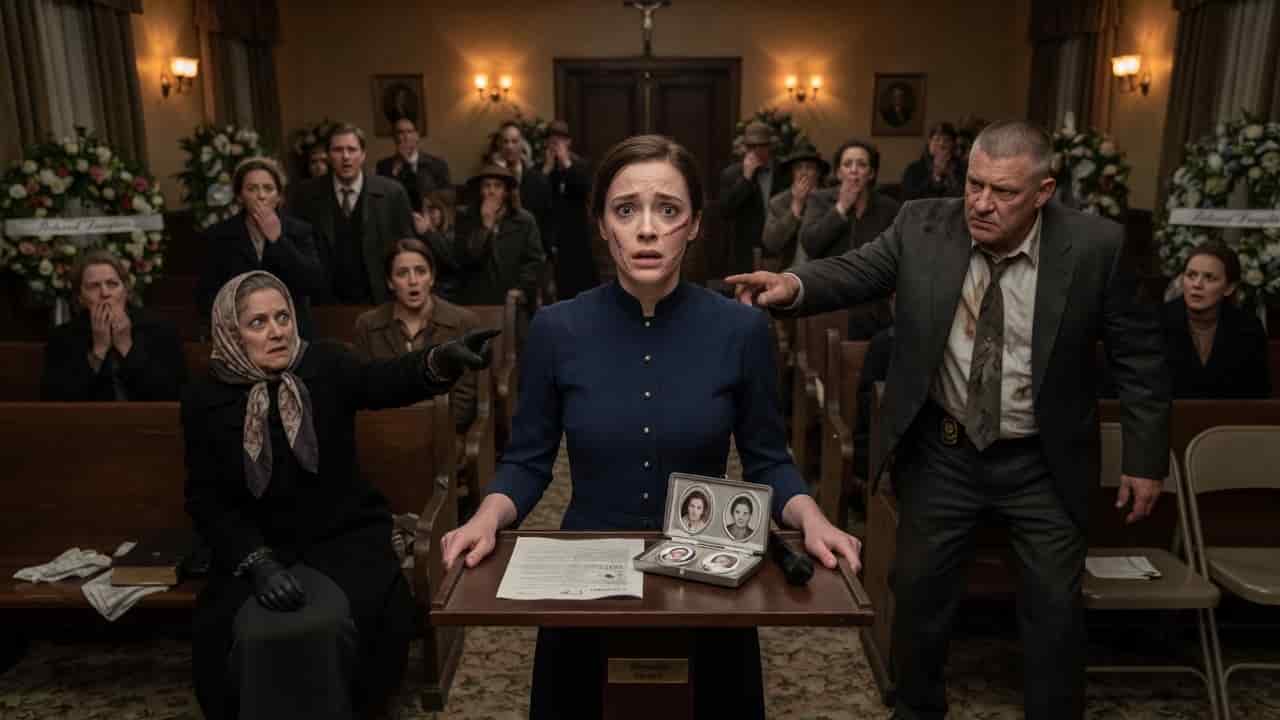
“That isn’t Sarah’s voice. Who is standing at that podium?”
The room went so cold you could hear the heater clicking in the back of the chapel. My hands were shaking so hard the paper in my grip sounded like a thunderstorm. I looked down at my mother—the woman who had spent twenty-eight years memorizing the rhythm of my breath—and I realized I had made a terrible mistake.
Everyone in this town loved Elena. She was the light, the beauty, the one who was supposed to get out. I was just Sarah—the plain one, the quiet one, the one who stayed in the kitchen while Elena danced. When the car flipped and the fire started, I saw my chance to finally be the one who mattered. I swapped our IDs while her heart was still slowing down.
I thought a blind woman wouldn’t know the difference. I thought if I wore the scars and walked with a limp, they’d pity me enough to never look closely.
But as my mother stood up, pointing a finger at my chest in front of the Sheriff and the whole county, I realized you can’t fake the soul of a sister. Now, the man Elena owed money to is sitting in the back row, and he’s starting to smile.
Chapter 1: The Prosthetic Morning
The air in the Blue Plate Diner always smelled like old grease and the kind of desperation that only grows in small Ohio towns where the factory closed ten years ago. It was 5:30 AM, and the fluorescent lights hummed with a sickly yellow vibration that made my head throb. I reached up to touch my left cheek, my fingers grazing the ridge of the scar. It felt like thickened skin, tough and unyielding, but I knew better. It was medical-grade silicone and a masterclass in theatrical adhesive.
“Sarah! Table four needs more coffee, and quit daydreaming,” Shirley barked from behind the counter.
I flinched. The name still felt like a physical blow, even after six months. I was Sarah now. I had to be. Elena was gone—buried under six feet of Ohio clay and a mountain of debt that would have ended me if I’d stayed in my own skin.
I grabbed the glass carafe, my movements slow and deliberate. Sarah had always been the clumsy one, the one who walked with a slight hitch in her hip because of a childhood fall that never quite healed right. I mimicked the limp, feeling the phantom ache I’d spent months perfecting.
Table four was occupied by Detective Miller. He was a man made of right angles and suppressed sighs, his charcoal suit always looking like he’d slept in it to avoid going home to an empty house. He’d been a friend of my father’s, the kind of man who brought over a casserole when the “accident” happened and stayed to help with the paperwork.
“Morning, Detective,” I said, my voice low and raspy. I’d spent hours screaming into a pillow in the weeks following the crash to rasp my vocal cords. Sarah’s voice had always been deeper, humbler than mine.
Miller looked up, his blue eyes narrowing behind his glasses. He didn’t look at my eyes; he looked at the scar. People always did. It was the ultimate social shield. If you have a jagged line across your face, people feel too guilty to look you in the eye long enough to see the lie behind them.
“Morning, Sarah,” he said. He didn’t reach for his cup. He just watched me pour. “How’s your mother doing? I heard the service for Elena is finally set for Thursday.”
The carafe trembled. A drop of coffee splashed onto the laminate tabletop, sizzling. “She’s… she’s holding on. It’s hard for her. Being blind, she says the house feels too quiet. Like the air doesn’t move the same way without Elena there.”
“Elena was a whirlwind,” Miller said, and for a second, a shadow of something—grief? regret?—passed over his face. “Hard to believe she’s gone. You two were so different, yet so much the same. Mirror images, even if you didn’t see it.”
“I was the plain one, Detective. We both knew that.” I wiped the spill with a damp rag, my heart hammering against my ribs.
“You weren’t plain, Sarah. You were just quiet. Elena took up all the oxygen in the room. Some people like to breathe, you know?” He finally took a sip of the coffee, his eyes never leaving my face. “Funny thing, though. I was looking over the preliminary coroner’s report again last night. Just tying up loose ends for the insurance company.”
I froze, the rag still pressed against the table. “Is there a problem?”
“No problem. Just a detail. The report mentioned the survivor had significant bruising on the right shoulder from the seatbelt. But when I saw you at the hospital two days later, you were leaning on your left side. And that scar… it’s healing remarkably well, isn’t it? Almost looks like it’s changed shape since October.”
I felt the sweat prickle under the silicone. The adhesive was rated for twelve hours, but the heat of the diner was a constant enemy. “The doctors said trauma does strange things to the body, Detective. I don’t remember much about the belt. I just remember the fire.”
“The fire,” Miller repeated. He set the cup down. “Right. It was a miracle you got out. A real miracle.”
He didn’t say it like he believed in miracles. He said it like he was looking at a puzzle piece that had been jammed into the wrong slot. I turned away before he could see the panic in my pupils.
I went back to the kitchen, the bell above the door chiming as a regular walked in. My reflection in the stainless steel of the prep fridge was a ghost I didn’t recognize. I was Elena. I was the “pretty” one. I was the one who had stolen five hundred thousand dollars from a man named Viktor because I thought I was smarter than a Russian mobster. I was the one who had been driving that night, high on the adrenaline of a successful heist, while my sister Sarah cried in the passenger seat, begging me to slow down.
Then the deer had jumped. The swerve. The oak tree that didn’t move.
When I’d crawled out of the wreckage, the smell of gasoline and burning rubber thick in the night air, I’d looked at Sarah. She was pinned. Her face was untouched, beautiful in the moonlight, but her chest was crushed. She was dying. And I… I had a bag of money and a death warrant on my head.
I remembered the coldness that had settled over me. It wasn’t malice. It was pure, predatory survival. I’d reached into her purse, pulled out her ID, and tucked it into my pocket. I’d shoved my own wallet into her limp hand. Then I’d dragged myself away, screaming for help as Sarah, the real Sarah, was consumed by the orange glow of the gas tank blowing.
Now, I was a waitress in a town that pitied me. I lived in a house with a mother who didn’t know I was the daughter who had always disappointed her. And every morning, I spent forty-five minutes in front of a mirror, turning myself into a victim so I wouldn’t have to be a corpse.
“Order up, Sarah!” Shirley yelled.
I took the plate of eggs and moved back into the room. I could feel Miller’s eyes on my back. I could feel the weight of the money hidden in the floorboards of the basement. But mostly, I felt the residue of the fire, the way it seemed to follow me, a faint scent of smoke that no amount of soap could ever truly wash away.
Chapter 2: The Sound of Breath
The house I shared with Martha was an old Victorian that had been carved into apartments in the seventies and was now slowly rotting from the inside out. It sat on the edge of the Heights, where the trees were thick and the streetlights were usually broken.
I let myself in through the back door, the hinges groaning.
“Sarah? Is that you, honey?”
Martha was sitting in her armchair by the window. She didn’t have the TV on. She never did. She said the noise was “messy.” She preferred the sounds of the house—the settling of the floorboards, the hum of the refrigerator, the way the wind hissed through the cracks in the window frames.
“It’s me, Mom,” I said, crossing the room to kiss her forehead.
She reached up, her hand finding my face with the unerring accuracy of the blind. Her fingers were thin and cool. She traced the line of my jaw, her thumb hovering near the edge of the scar. I held my breath, my skin crawling. To her, the world was a map of textures. If there was a single bubble in the adhesive, a single edge that felt too smooth to be skin, she would find it.
“You’re tired,” she whispered. “I can hear it in your step. You’re dragging that leg more than usual.”
“Long shift. Miller was there again. Asking questions.”
Martha’s hand dropped. Her face clouded. “That man. He thinks he’s being kind, but he’s just picking at a wound that won’t close. He loved Elena, you know. He looked at her the way a man looks at a sunset he can’t own.”
I sat on the ottoman at her feet. “He asked about the accident. Again.”
“Why can’t they let it be?” Martha’s voice rose, a thin, wavering sound. “We buried her heart months ago. Thursday is just for the town to say goodbye to the girl they thought she was. But you and I… we know the girl she really was.”
I felt a chill. “What do you mean, Mom?”
“Elena was selfish,” Martha said, her sightless eyes fixed on the wall. “She was beautiful, and she knew it, and she used it like a knife. She took things. She took your confidence, Sarah. She took the space you should have grown into. And in the end, she took herself away in a flash of arrogance.”
I winced. Hearing my mother describe me—the real me—with such clinical disdain was a special kind of torture. I had spent my whole life thinking I was the favorite because I was the one people noticed. I never realized that my mother, the one person who truly listened, had seen the rot under the surface.
“She loved you, Mom,” I lied.
“She loved herself. You… you were the one who stayed. You were the one who brought me tea and read the mail. You were the quiet heartbeat of this house.” Martha reached out again, her fingers tangling in my hair. “But lately… the heartbeat sounds different.”
“Different how?”
“Faster. More jagged. Like a bird trapped in a chimney.” She tilted her head. “And you smell different, Sarah. You used to smell like lavender and old books. Now, you smell like… chemicals. And something sharp. Like fear.”
“It’s the diner, Mom. The cleaning supplies. And I’m just… I’m stressed about the service. Everyone will be looking at me.”
“Let them look,” Martha said, her grip tightening on my hair. “They’ll see the sister who survived. They’ll see the one who finally got out from under the shadow.”
She leaned in, her face inches from mine. For a moment, I was terrified she could see right through the milky cataracts, through the silicone and the lies, down to the Elena-shaped hole in my soul.
“Go wash up,” she said abruptly, releasing me. “You have your sister’s locket? The one the police found?”
“Yes. It’s in my room.”
“Wear it on Thursday. It’s the only thing that didn’t burn. It belongs on a survivor.”
I retreated to my bedroom and locked the door. I pulled the locket from the top drawer of the dresser. It was silver, scorched on one side, but the hinge still worked. I flicked it open. Inside were two photos, taken five years ago at the county fair. Two girls, identical in feature, but worlds apart in expression. Elena was laughing, her head tilted back, the sunlight catching the gold in her hair. Sarah was smiling softly, her eyes focused on the camera with a quiet, devastating sincerity.
I looked in the mirror. I looked at the scar. I looked at the dark circles under my eyes.
I wasn’t Sarah. I wasn’t even the Elena in the photo anymore. I was a third thing—a creature of glue and shadows, living in a house of the blind, waiting for the world to catch fire again.
A heavy thud sounded from the basement below. I froze. The basement was supposed to be empty. The outside storm cellar door was rusted shut.
I stayed still, the locket biting into my palm. Another thud. This one was followed by the sound of something metal being dragged across the concrete.
Someone was downstairs. Someone was looking for the money.
Chapter 3: The Shadow in the Cellar
I didn’t call the police. Calling the police was a luxury for people whose names matched their birth certificates. Instead, I grabbed the heavy iron poker from the fireplace in the hall and crept down the back stairs.
The basement was a labyrinth of old coal bins and discarded furniture. The air was damp, smelling of mildew and wet earth. A single bare bulb flickered at the bottom of the stairs, casting long, jerky shadows.
“Who’s there?” I called out, my voice Sarah-weak and trembling.
A man stepped out from behind a stack of old crates. He was tall, wearing a leather jacket that looked too expensive for this neighborhood. He had a face that reminded me of a shark—all lean muscle and cold, dark eyes.
I knew him. His name was Yuri. He was Viktor’s primary collector.
“Elena,” he said, his voice a smooth, terrifying purr. “I must say, the makeup is impressive. The limp is a nice touch, too.”
My heart stopped. I didn’t drop the poker, but it felt like it weighed a hundred pounds. “My name is Sarah. My sister is… she passed away. You have the wrong person.”
Yuri laughed. It was a dry, rattling sound. He walked toward me, unhurried, his boots clicking on the concrete. “The Sarah I knew didn’t have a tattoo of a hummingbird on her left hip. The Sarah I knew couldn’t drive a stick shift. And the Sarah I knew certainly didn’t have the stones to walk into a vault in Cleveland and walk out with a bag that didn’t belong to her.”
“I don’t know what you’re talking about.”
He stopped three feet away. He reached out and, before I could flinch, his fingers gripped my chin. He turned my face toward the flickering light, his eyes scanning the edge of the scar.
“Good work,” he muttered. “Truly. Viktor almost believed the report. He almost let it go. But then, he thought… Elena was always so lucky. And Sarah… Sarah was always the one who paid for Elena’s mistakes. It didn’t sit right with him that the luck finally ran out for the wrong sister.”
I shoved his hand away, the iron poker raised between us. “Get out of my house. My mother is upstairs. She’s blind, but she’s not deaf.”
“I’m not here to hurt the old woman,” Yuri said, his expression hardening. “I’m here for the five hundred thousand. And the interest. Viktor is a very patient man, but even his patience has a price.”
“I don’t have it,” I hissed.
“You have it. You didn’t spend it. You’re working at a diner for six dollars an hour plus tips. You’re playing the long game. Waiting for the heat to die down so you can disappear and become Elena again in some place where the sun actually shines.” He stepped closer, his chest nearly touching the tip of the poker. “But here’s the problem. Thursday is the funeral. A lot of people will be there. A lot of eyes. If the money isn’t in my car by the time the first clod of dirt hits that coffin, I’m going to walk up to that blind woman and tell her exactly what kind of monster is sleeping in her daughter’s bed.”
He leaned in, his breath smelling of peppermint and cold steel. “And then, I’m going to take that prosthetic right off your face in front of the Sheriff. Let’s see how the town likes the ‘pretty’ sister then.”
He turned and walked toward the storm cellar door. To my horror, it swung open easily. He’d broken the lock from the outside.
“Thursday, Elena. At the cemetery. Don’t be late.”
He disappeared into the night. I slumped against the washing machine, the iron poker clattering to the floor. My breath came in ragged gasps.
I was cornered. If I gave him the money, I had nothing. I’d be stuck in this town, in this skin, forever. If I didn’t, he’d destroy the only thing I had left—the lie that kept my mother’s heart beating.
I looked at the floorboards near the furnace. The money was there, tucked away in a waterproof duffel bag. It represented my freedom. It was the price of Sarah’s life.
I went back upstairs, my legs feeling like lead. Martha was still in her chair.
“Sarah? What was that noise?”
“Just a stray cat, Mom. It got into the cellar. I chased it out.”
“You’re shaking,” she said, her voice sharp. “I can hear your bones rattling.”
“I’m just cold. It’s a cold night.”
I went to my room and sat on the bed. I realized then that I wasn’t just being bullied by a mobster. I was being bullied by my own choices. The humiliation Yuri promised wasn’t just exposure; it was the total annihilation of the identity I’d built.
I looked at the locket again. The two sisters. One dead, one a ghost.
I had forty-eight hours to decide which one I wanted to be.
Chapter 4: The Eulogy of the Damned
Thursday arrived with a sky the color of a bruised plum. A light sleet was falling, turning the roads into black glass—a cruel echo of the night of the crash.
The funeral home was packed. It seemed the entire town had come to mourn Elena. They didn’t come because they loved her; they came because she was the most exciting thing that had ever happened to this place, and her death was the final act of a drama they’d been watching for years.
I sat in the front row, Martha’s hand clamped onto my arm like a vice. Detective Miller was a few rows back, his eyes boring into the side of my head. Yuri was there, too, leaning against the back wall, his leather jacket standing out among the sea of black wool. He caught my eye and tapped his watch.
The air in the chapel was stifling, thick with the scent of lilies and floor wax.
“It’s time, Sarah,” the funeral director whispered, leaning over me. “The family tribute.”
I stood up. My knees felt like they were made of water. I limped toward the podium, every eye in the room tracking my progress. I could hear the whispers—the pitying, jagged little comments that had become my daily bread.
“Poor Sarah. She’ll never be the same.”
“Look at that scar. Such a shame.”
“She was always the shadow. Now she’s just a ghost.”
I reached the podium and looked out at the crowd. I saw the girl who had idolized me—a teenager named Cassie who was crying into a lace handkerchief. I saw the shopkeepers I’d charmed and the boys I’d broken. They were all mourning a girl who was currently standing right in front of them, wearing a dead woman’s face.
I opened my notes, but the words were a blur. I looked down at the silver locket I’d set on the wood.
“Elena… Elena was a force of nature,” I began, my voice rasping. “She was the kind of person who didn’t just walk into a room; she redefined it.”
I talked about our childhood. I talked about the way she used to braid my hair—a lie, I was the one who braided hers. I talked about her dreams of leaving this town. I felt the pressure building in my chest, a mixture of guilt and a strange, bubbling resentment. I was eulogizing myself, and all I could feel was how much I hated the person I was describing.
“But Elena was also… she was reckless,” I said, the words slipping out before I could stop them. “She didn’t think about the consequences. She didn’t think about the people she left behind in the smoke.”
The room went silent. The kind of silence that has teeth.
I looked at Martha. She had tilted her head, her sightless eyes widening. Her nostrils flared.
“She was a thief,” I whispered, almost to myself. “She took everything. And now… now I’m the one who has to carry the weight of what she left behind.”
I saw Yuri straighten up in the back. He was frowning. This wasn’t the script.
“But I want you all to know,” I said, my voice growing stronger, more like my own—more like Elena’s. “That Sarah was the better sister. Sarah was the one who deserved to live. Sarah was the one who had a heart that wasn’t made of ice.”
Suddenly, Martha stood up.
She didn’t use her cane. she just rose, her face turned toward me with a terrifying, predatory focus. The chapel went deathly still.
“Stop,” she said. It wasn’t a request. It was a command that sliced through the air.
“Mom, I’m almost done,” I stammered, the Sarah-rasp returning in a panic.
“That’s not Sarah’s voice,” Martha said, her voice ringing out to the very back of the room. She pointed a trembling finger toward the podium. “I’ve been sitting here, listening to the rhythm of your breath. I’ve been listening to the way you hesitate before you say her name.”
“Mom, you’re confused, the stress—”
“I am not confused!” Martha roared. She took a step into the aisle, her sightless eyes fixed exactly on my face. “My daughter Sarah had a soul that hummed like a cello. It was deep, and it was steady. But you… you sound like a tin whistle. You sound like a lie.”
She took another step, her finger never wavering. “Who are you? Who is standing at my daughter’s funeral, wearing her clothes and speaking with her mouth? What did you do with my Sarah?”
A gasp rippled through the room. Detective Miller was on his feet now, his hand moving instinctively toward his belt. Cassie, the fan-girl, let out a small, strangled scream.
I looked at Yuri. He was grinning. He looked like he was watching the best show of his life.
I looked down at the locket. The silver was cold. The faces inside were mocking me.
I was trapped. If I stayed silent, the town would think I was a madwoman or a murderer. If I spoke, I would be Elena, the thief, the daughter who had let her sister burn.
“Mom,” I whispered, and for the first time, I didn’t try to rasp. I didn’t try to limp. I just stood there, the “pretty” twin, stripped bare in a room full of people who had been fooled by a piece of silicone. “Please. Sit down.”
“Tell them!” Martha screamed, her face contorting with a grief so raw it felt like it was stripping the skin off my own body. “Tell them what you did in that car! Tell them whose heart is really in that box!”
I looked at Detective Miller. He was walking toward the podium, his face hard and professional.
“Sarah?” he said, his voice low. “Or whoever you are. We’re going to need you to come with us.”
The residue of the fire was everywhere now. I could smell the gasoline. I could feel the heat.
I looked at the crowd, at the judging, shocked faces of the only people I had left. I realized then that I hadn’t escaped the debt. I had just traded one prison for another, and the walls were finally closing in.
Chapter 5: The Weight of the Living
The silence in the chapel didn’t just hang in the air; it pressed against my eardrums like the weight of a deep-sea dive. I stood behind the mahogany podium, my fingers still dug into the wood, feeling the grain bite into my skin. I looked down at the locket—the silver glinting under the amber lights—and realized that the reflection staring back at me was no longer a waitress from a small town. It was a cornered animal.
Martha was still standing, her finger a bone-white accusation aimed directly at my throat. She wasn’t trembling anymore. She was rigid, a statue of ancient, sightless fury. Behind her, the townspeople of Oakhaven sat in a paralysis of social horror. No one breathed. No one moved. The only sound was the rhythmic, wet twick-twick of the sleet hitting the stained-glass windows.
“Sarah?” Detective Miller’s voice broke the spell, but it wasn’t the voice of a family friend. It was the flat, clipped tone of a man who had spent thirty years watching people lie to him. He stepped into the aisle, his heavy soles squeaking on the polished linoleum. “Let’s step into the back office. Martha, please, sit down. Deputy Vance, help Mrs. Brennan.”
A younger deputy I recognized from the diner—a kid named Hauer who always ordered the steak tips—moved toward Martha. When he touched her arm, she didn’t flinch. She just turned her head toward the sound of my breathing.
“She’s a ghost,” Martha whispered, her voice carrying through the chapel’s acoustics. “My Sarah is in that box, and this creature is standing where she should be.”
Miller reached the podium. He didn’t touch me, but he moved into my personal space, blocking the crowd’s view of my face. He smelled of old tobacco and cold rain. “Office. Now.”
I followed him. I had to. The limp I’d spent months perfecting felt like a lead weight, but I kept it up. I had to keep it up. If I stopped limping now, I was admitting to more than just a vocal shift. I was admitting to the fire.
The funeral director, a man named Mr. Gable who looked like he’d been carved out of grey soap, opened the door to a small side office. It was cramped, filled with the smell of stale coffee and the cloying, sweet scent of formaldehyde that seemed to leak from the walls of the entire building. Miller gestured to a vinyl chair that was cracked down the middle.
“Sit,” he said.
I sat. My navy blue dress felt too tight, the high collar choking me. I reached up to touch the scar on my cheek, my fingers trembling. The silicone felt cold, a foreign slab of plastic glued to my face.
Miller leaned against a filing cabinet, his arms crossed. He didn’t speak for a long time. He just watched me. This was the pressure—the silent, grinding technique that broke people in rooms like this. Outside, I could hear the muffled sounds of the congregation being ushered out of the chapel. The service was over. The performance had failed.
“The seatbelt,” Miller said finally. His voice was quiet. “I mentioned it at the diner. The bruising on the survivor was on the right shoulder. The driver’s side. But you’ve been walking with a hitch in your left hip since you got out of the hospital. You’ve been telling people you were in the passenger seat. That the impact threw you against the door.”
“I was disoriented,” I said, my voice barely a whisper. I tried to find the Sarah-rasp, but it felt like sandpaper in my throat. “The car was upside down. Everything was screaming. I don’t know how I got out.”
“You got out because you were the one behind the wheel,” Miller said. He reached into his jacket pocket and pulled out a small plastic evidence bag. Inside was a piece of scorched leather. “This was found in the footwell of the driver’s side. It’s a heel. From a very expensive Italian pump. Size seven.”
He looked down at my feet. I was wearing Sarah’s old, sensible black flats. Size eight.
“Sarah was an eight,” Miller continued. “Elena was a seven. Elena loved shoes. She loved anything that cost more than a month’s rent in this town.”
I felt the sweat begin to dissolve the adhesive at the edge of my hairline. I could feel the scar starting to itch, a frantic, maddening sensation. “Elena was always trying on my things. You know how she was. She probably had them on for a joke.”
“A joke,” Miller repeated. He stood up straight and walked over to the desk, picking up a telephone. “I’m going to call the state lab. I’m going to ask them to compare the dental records again. Not the ones you provided from the local clinic—the ones from the city. The ones Elena’s ‘associates’ might have tried to scrub.”
I looked at him, and for a second, I saw the man who had loved my sister. Not me. Sarah. He had loved her quietness, her stability. And he was realizing that he had let the light of his life burn to ash while he brought casseroles to the monster who did it.
“She’s blind, Miller,” I said, my voice finally dropping the act. It was clear, sharp, and cold. Elena’s voice. “She’s an old woman whose mind is breaking from grief. You’re going to take her word over the medical reports? Over the fact that I’m sitting right here?”
“I’m taking her word because a mother knows the sound of her own child’s heart,” Miller snapped. He slammed his hand on the desk, making the coffee mugs rattle. “And you… you don’t have one. I’ve been watching you at that diner. I’ve been watching the way you look at the door every time a car pulls up. You aren’t mourning. You’re hiding.”
A sharp knock at the door interrupted him. Mr. Gable poked his head in, his face even paler than before.
“Detective? There’s a man here. He says he’s a cousin from out of town. He’s being very… insistent.”
My stomach dropped. Yuri.
“Tell him to wait,” Miller barked.
“He’s already here, Detective,” a smooth voice said from the hallway.
Yuri pushed past the funeral director. He was smiling, that shark-like grin that didn’t reach his eyes. He looked at me, then at Miller, then back at me. He looked like he was enjoying the theater of it all.
“Detective Miller, I presume?” Yuri said, extending a hand. “I’m Yuri. A close friend of the family. I heard there was a bit of a… scene… in the chapel. I came to see if Sarah was alright.”
Miller didn’t take the hand. He looked Yuri up and down, his instincts screaming. “This is a private matter, Mr. Yuri. You need to leave.”
“Oh, I don’t think so,” Yuri said. He leaned against the doorframe, effectively blocking the exit. “You see, Sarah and I have some unfinished business. Family business. Inheritance, you might say. Isn’t that right, Sarah?”
He looked at me with a terrifying expectation. The message was clear: Fix this now, or the money isn’t the only thing you’ll lose.
I looked at Miller. He was trapped between a suspicious identity and a new, physical threat. I saw the way his hand hovered near his holster. If a gunfight broke out in a funeral home, the story would be over. I’d be dead, Martha would be alone, and the real Sarah would never have justice.
“It’s okay, Detective,” I said, standing up. I didn’t limp. I walked straight to Yuri. “He’s right. We have things to discuss. My mother needs to go home. I’ll go with Yuri and settle this.”
“You’re not going anywhere,” Miller said, stepping toward me.
“On what grounds?” I asked, turning to face him. The silicone scar was flapping slightly now, visible in the harsh office light. I reached up and ripped it off.
The sound was like a Band-Aid being torn from a wound. Underneath, my skin was pale and smooth, untouched by the fire.
The room went silent again. Mr. Gable made a small, choking sound. Miller stared at my cheek, his eyes wide with a mixture of horror and realization.
“I’m Elena,” I said. The words felt like lead in my mouth, but they were the first true things I’d said in months. “And I’m leaving.”
“Elena…” Miller whispered. The name sounded like a curse.
“Don’t follow me, Miller,” I said, my voice trembling now. “If you do, people get hurt. People who are still alive. Unlike my sister.”
I walked out of the office, Yuri trailing behind me like a shadow. As we passed through the foyer, I saw Martha sitting on a bench, her head bowed. She was weeping—quiet, racking sobs that shook her entire frame. I wanted to go to her. I wanted to beg for forgiveness. But I knew that if I touched her, she would know. She would know the skin was the same, but the soul was gone.
I stepped out into the freezing rain, the sleet stinging my bare cheek. Yuri grabbed my arm, his grip like iron.
“That was quite a show, Elena,” he hissed. “But the clock just hit zero. The money. Now. Or we go back inside and finish what your mother started.”
I looked at the black car idling at the curb. I looked back at the funeral home, where the only person who had ever truly loved the “plain” twin was mourning a daughter who had been erased by my vanity.
“I’ll get it,” I said. “It’s at the house.”
“I know,” Yuri said. “I’ve been watching the floorboards.”
We got into the car, the door slamming with a finality that sounded like a coffin lid. The residue of the funeral—the smell of lilies and the sound of my mother’s scream—followed me into the dark, a haunting that no amount of money could ever outrun.
Chapter 6: The Mirror’s Final Truth
The drive back to the Heights was a blur of grey slush and neon signs that seemed to pulse with a sickly, rhythmic light. Yuri drove with one hand on the wheel, the other resting on a heavy, black handgun he’d pulled from his waistband. He didn’t speak. He didn’t need to. The silence was his way of reminding me that I was no longer a person to him; I was a transaction.
We pulled up to the Victorian house. It looked smaller in the rain, more fragile, as if the rot had finally reached the exterior walls. I looked up at the window of Martha’s room. It was dark. She was still at the funeral home, or perhaps Miller had taken her somewhere safe. I hoped she was safe. I hoped she never had to come back here.
“Inside,” Yuri commanded.
We walked through the back door. The house felt cold—a deep, biting chill that seeped into my bones. I led him to the basement stairs. The bare bulb was still flickering, casting those long, jerky shadows that looked like reaching fingers.
I moved to the furnace. My hands were numb as I knelt in the dirt, my fingers fumbling with the loose floorboards. I pulled them up one by one, the wood splintering under my nails.
The duffel bag was there. It was heavy, the fabric stiff with the cold. I dragged it out and shoved it toward Yuri.
“There,” I said. “Take it and go.”
Yuri knelt down, unzipping the bag. The sight of the cash—bundles of hundreds, thousands, the price of a life—didn’t move me. It just looked like paper. Dirty, blood-soaked paper. He ran his fingers over the bills, his face illuminated by the flickering bulb. He looked like a man in prayer.
“Viktor will be pleased,” he muttered. He looked up at me, his eyes dark. “You know, Elena, you almost made it. If you hadn’t stayed for the mother. If you’d just taken the money and run the night of the crash, you’d be in Cozumel by now. Why did you stay?”
I looked at the shadows on the wall. “Because I wanted someone to love me the way they loved her. Even if it was a lie.”
Yuri laughed, a short, sharp sound. “Love. That’s the most expensive thing in the world, Elena. And you couldn’t afford it.”
He stood up, the bag slung over his shoulder. He started toward the stairs, but stopped when a sound echoed from above.
A floorboard creaked. Then another. The slow, deliberate sound of someone walking with a cane.
“Sarah? Sarah, are you down there?”
It was Martha.
My heart hammered against my ribs. “Mom! Stay upstairs! Call the police!”
Yuri’s face went cold. He pulled the gun again. “Shut her up, Elena. Or I will.”
I scrambled up the stairs, my feet slipping on the wooden treads. I burst into the kitchen, nearly knocking Martha over. She was standing by the sink, her coat still damp, her face a mask of confusion and terror.
“Sarah? Why are you shouting? Who is that with you?”
“It’s nobody, Mom. Just a friend. You need to go to your room.”
Yuri stepped into the kitchen behind me. He didn’t look like a friend. He looked like death in a leather jacket. He pointed the gun at Martha’s chest.
“She’s blind, Yuri! She can’t identify you!” I screamed, stepping between them. “Take the money and leave!”
Yuri looked at Martha, then at me. He seemed to be weighing the risk. “She heard my voice. She heard the bag. She’s a witness, Elena.”
“She’s an old woman! No one will believe her! Please!”
Martha stood perfectly still. Her head was tilted, her sightless eyes fixed on the space between us. A strange calm seemed to settle over her.
“He’s the one Elena owed, isn’t he?” she asked. Her voice was steady—as steady as a heartbeat.
Yuri paused. “You’re a sharp one, old lady.”
“I’m not old,” Martha said, her voice dropping into a register I’d never heard before. It was cold. It was precise. “I’m just tired. Tired of the lies. Tired of the daughter who thought I was too stupid to know the difference between a soul and a voice.”
She turned her head toward me. “Did you think I didn’t know the first night you came home from the hospital? Did you think I didn’t feel the way your skin was too tight? The way you flinched when I touched you? Sarah never flinched. Sarah was a part of me.”
I felt a coldness wash over me that had nothing to do with the rain. “You knew? All this time?”
“I knew,” Martha said. “I let you stay because I wanted to see how far you would go. I wanted to see if there was any part of my daughter left in you. But there isn’t. You’re just a shell, Elena. A shell filled with stolen money and rot.”
She reached into the pocket of her coat and pulled out a small, black object. It was a recorder. The kind Miller used for interviews.
“I’ve been recording everything,” she said. “Every conversation. Every time that man came to the cellar. Every time you whispered Elena’s secrets in your sleep.”
Yuri’s eyes widened. He lunged for the recorder, but the back door burst open.
“Police! Drop the weapon!”
Miller and two deputies swarmed into the room, their flashlights cutting through the darkness. Yuri spun, firing a single shot that shattered the kitchen window, but he was tackled before he could fire again. The sound of the struggle—the grunts, the clatter of the gun hitting the linoleum—filled the small room.
I stood frozen, my back against the refrigerator. I looked at Martha. She hadn’t moved. She was still holding the recorder, her face turned toward the chaos with a terrifying, serene detachment.
Miller stood up, his face flushed, his charcoal suit torn at the shoulder. He looked at me, then at Martha. He took the recorder from her hand with a gentle touch.
“It’s over, Martha,” he said.
“Is it?” she asked. “Is my daughter back?”
Miller looked at me. His eyes were full of a pity that felt worse than any accusation. “No. She’s not.”
The deputies led Yuri out in handcuffs. The money bag was seized, the bundles of cash spilling out onto the dirty kitchen floor. The “inheritance” was gone. The freedom was gone.
I looked at my mother. I wanted to say something. I wanted to tell her that I was sorry, that I had tried to be the daughter she wanted. But the words wouldn’t come. I was Elena again. And Elena had nothing left to say.
“Take her,” Martha said, her voice a final, echoing command. “Take her away from this house. She doesn’t belong here.”
Miller walked over to me. He didn’t use handcuffs. He just placed a hand on my arm. “Let’s go, Elena.”
I walked out the door, leaving the house of the blind behind. As I stepped into the back of the police cruiser, I caught my reflection in the window. The scar was gone. The rasp was gone. But as I looked at my own face—the “beautiful” face that had caused so much wreckage—I realized that I was still wearing a mask.
I was the sister who lived. And that was a sentence I would be serving for the rest of my life.
The car pulled away from the curb, the wipers swiping at the sleet with a rhythmic, mocking sound. I looked back at the house one last time. The light in the kitchen was still on, a small, yellow square in the vast, Ohio dark. Inside, my mother was sitting alone, mourning the daughter she had lost twice—once to the fire, and once to the twin who had tried to steal her ghost.
The residue of the night—the smell of gunsmoke, the cold of the basement, and the sound of the truth—settled over me like a second skin. It was heavier than the silicone. It was deeper than the lie. And it would never, ever wash off.