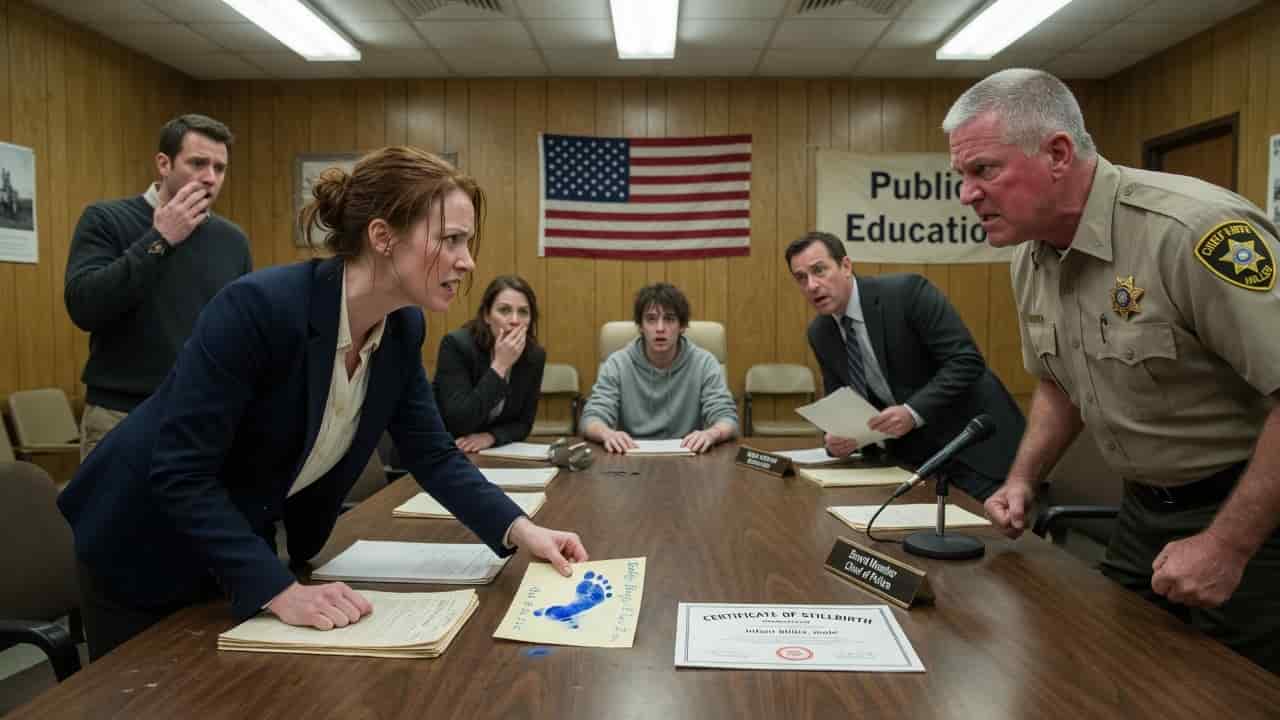
“He’s nothing but a mistake, Claire. A piece of trash we’re finally sweeping out of this town,” Chief Miller sneered, his hand heavy on the table.
I looked at Toby, the boy in the gray hoodie who’d been shuffled through foster homes and labeled a failure since the day he could walk. He was trembling, staring at his shoes while the entire school board watched the man in the tan uniform strip away the last of his dignity. Miller thought he had won. He thought the badge gave him the right to erase a human being.
“He’s not a mistake, Miller,” I said, my voice shaking as I reached into my bag. “And he’s definitely not trash.”
The room went silent. My husband, Mark, grabbed my arm, his eyes pleading with me to stop, to keep the peace, to go back to the life we’d built on top of our grief. But I couldn’t. Not after I’d seen the footprint card. Not after I’d felt the pull in my chest that no amount of time could quiet.
I slammed the weathered paper next to the official expulsion papers. The blue ink smudge of a newborn’s foot sat right next to the certificate that said my child was gone.
“Look at the marks, Chief,” I whispered, leaning in until I could see the sweat on his brow. “He’s not a delinquent you can just throw away. He’s my son. And I think we both know exactly how he ended up in your house.”
The look on the Chief’s face told me everything I needed to know. The war was just beginning, and I didn’t care who I had to burn to bring my boy home.
Chapter 1: The Boy in the Back Row
The air in the classroom always smelled like a mixture of floor wax, adolescent sweat, and the faint, ozone tang of the smartboard that had been glitching since September. It was a sterile, suburban smell—the scent of controlled environments and expected outcomes. I had spent fifteen years in this room, teaching English Literature to the children of North Oak, a town where the lawns were manicured to within an inch of their lives and the secrets were buried even deeper.
I was leaning against my desk, watching the period-four seniors file in. They were a blur of North Face jackets and overpriced sneakers, their conversations centered on college applications and the upcoming winter formal. They moved with the easy confidence of kids who had never been told no by the world.
And then there was Toby.
He was always the last one in, a shadow moving against the bright tide of his peers. He wore the same charcoal-gray hoodie every day, the sleeves frayed and pulled down over his knuckles. He didn’t look at anyone. He didn’t have a backpack—just a single, battered notebook tucked under his arm. He took his seat in the very back corner, as far from my desk as the architecture of the room allowed.
Toby was a transfer, a “project” child sent from the county seat after a string of disciplinary issues that the administration usually whispered about in the breakroom. To the other students, he was a ghost; to the staff, he was a ticking clock. But to me, since the moment he walked into my classroom three weeks ago, he was a vibration I couldn’t tune out.
“Alright, everyone,” I said, my voice sounding thinner than usual. “Open your books to page 142. We’re looking at the transition in The Great Gatsby.”
A chorus of groans and the rustle of paper followed. I began the lecture, the familiar rhythm of the words providing a safety net for my wandering mind. But my eyes kept drifting back to the corner. Toby wasn’t looking at the book. He wasn’t even pretending. He was staring out the window at the gray November sky, his jaw tight, his profile sharp and hauntingly familiar.
I had a “phantom limb” version of my life. In that version, I wasn’t just Mrs. Vance, the reliable English teacher with the quiet husband and the empty house. In that version, I had a seventeen-year-old son. I knew what his birthday was: October 12th. I knew what his name would have been: Leo. But the world told me that Leo had died in the delivery room of a sudden, unexplained complication. They had shown me a tiny, wrapped bundle for a fleeting second before the sedatives took hold, and when I woke up, the world was empty.
My husband, Mark, had moved on. He had processed the grief like a professional, filing it away in a cabinet labeled The Past. He wanted us to adopt, to try again, to “fill the house with life,” as he put it. But I was a hoarder of ghosts.
“Mrs. Vance?”
I blinked, realizing I’d been silent for several seconds too long. Chloe, a girl in the front row with a perfect ponytail, was looking at me with mild concern.
“Yes, Chloe?”
“Is Gatsby’s obsession a form of madness or just extreme romanticism?”
“It’s a choice,” a voice rasped from the back.
The room went still. Toby was looking at us now. His eyes were a startling, piercing blue—the exact shade of my father’s, and the exact shade I saw every morning in the mirror.
“Explain that, Toby,” I said, my heart starting a slow, heavy thud against my ribs.
Toby shifted in his seat, the hoodie rustling. “He’s not mad. He just thinks if he works hard enough, he can undo time. He thinks if he gets enough money and enough power, the thing he lost will magically reappear. But you can’t fix the past by lying about the present. It just makes the crash harder when it finally happens.”
The other students exchanged looks. Some smirked; others looked confused. Chloe looked offended.
“That’s a very… cynical interpretation,” I said, moving down the aisle toward him.
“It’s just how it works,” Toby said, his voice dropping an octave. “People lie. They lie to protect themselves, and they lie to control you. Gatsby was just a guy who believed the wrong lies.”
He went back to staring out the window, effectively ending the conversation. I stood there for a moment, two feet away from him. Close enough to see the small, jagged scar just above his left eyebrow. Close enough to see the way his fingers twitched against the notebook.
When the bell rang, the room exploded into motion. Toby was out of his seat before the sound faded, but I stepped into his path.
“Toby, wait.”
He stopped, his shoulders hunching. He didn’t look up. “I didn’t do anything wrong, Mrs. Vance. I answered the question.”
“You did. It was a good answer. I just… I noticed you don’t have the textbook.”
“Lost it,” he muttered.
“I can get you a replacement from the library. You don’t have to worry about the fee.”
He finally looked at me, and for a split second, the defiance dropped. He looked exhausted. Not just ‘teenager-up-all-night’ exhausted, but a deep, soul-level fatigue. “Why do you care? Most teachers here just want me to stay quiet until I fail out.”
“I don’t want you to fail,” I said, and the intensity in my own voice surprised me. “You’re brilliant, Toby. I can see that.”
He let out a short, dry laugh. “Yeah, well. Tell that to the Chief. He’s the one who thinks I’m a drain on the town’s resources.”
“Chief Miller?”
“He’s my… guardian,” Toby spat the word like it was poison. “For now. Until he finds a reason to ship me back to the state.”
I froze. Chief Miller was the sun around which North Oak orbited. He was the hero of the local paper, the man who kept the streets safe and the ‘riff-raff’ out. He was also a regular at our dinner table; he and Mark had played high school football together.
“I didn’t realize you were staying with the Millers,” I said, trying to keep my voice neutral.
“I’m not ‘staying’ with them. I’m living in the room over their garage like a stray dog they’re waiting for an excuse to put down.” He stepped around me, his movements jagged and quick. “Don’t bother with the book, Mrs. Vance. I won’t be here long enough to finish it.”
He vanished into the hallway, leaving me standing in the middle of the empty classroom. My hands were shaking. I walked back to his desk and saw a discarded soda can sitting on the floor. A red Coca-Cola can, the condensation still clinging to the rim.
I shouldn’t have done it. It was a violation of every professional and ethical boundary I had. But the vibration in my chest was now a roar. I reached down, picked up the can using a tissue from my desk, and tucked it into my bag.
That evening, the house felt too large. Mark was in the kitchen, searing steaks and humming along to a jazz record. He looked happy—a man settled in his skin, content with the silence.
“Miller called today,” Mark said, flipping a steak. “He wants us to come over Friday. Celebratory drinks. He’s officially announcing his run for the state senate.”
I sat at the kitchen island, my bag resting on the stool next to me. The soda can felt like a bomb inside it. “He mentioned Toby today.”
Mark’s humming stopped. He sighed, leaning his hip against the counter. “Claire, don’t get involved in that. Jim is doing the kid a favor. The boy is a nightmare. Shoplifting, truancy, fighting… Jim took him in as a ‘community service’ gesture, but he’s at his wit’s end.”
“He doesn’t seem like a nightmare to me,” I said. “He seems like he’s hurting.”
“They all seem like they’re hurting until they steal your car,” Mark said, his voice tightening. “Let’s not talk about other people’s kids, okay? We have enough of our own… well, you know what I mean.”
“No, Mark. I don’t know what you mean. We don’t have any kids. That’s the point.”
The air between us curdled. This was our dance—the quick step toward the wound, the sharp flinch, and the long, cold retreat.
“I’m going to bed,” I said, standing up.
“You haven’t eaten.”
“I’m not hungry.”
I went upstairs, but I didn’t go to our bedroom. I went to the small, locked room at the end of the hall. The room that was supposed to be a nursery. I opened the door and flipped the light. It was a storage room now—filled with boxes of old books, holiday decorations, and things we didn’t use.
But in the back corner, under a plastic tarp, was the crib. We had never sold it. Mark thought it was in the attic, but I had moved it here years ago.
I sat on the floor and pulled a small, blue-lacquered box from the top shelf of the closet. Inside was the only thing I had left of that day in the hospital. A footprint card. The nurse, a woman named Evelyn who had looked like she’d been crying, had pressed it into my hand right before they wheeled me out.
Patient: Claire Vance. Result: Fetal Demise.
But there, at the bottom, was the smudge. A tiny, perfect blue footprint.
I pulled the soda can out of my bag. I had a friend from college who worked at a private lab in the city. She specialized in “discreet” paternity and kinship testing. I’d called her from the car. She told me what to do.
I used a sterile swab I’d bought at the pharmacy and rubbed it against the rim of the can where Toby’s lips had been. Then I placed the swab in a plastic bag and the footprint card in another.
I wasn’t a scientist. I was a mother who had spent seventeen years wondering why the math of her grief never added up. I remembered the way the doctor wouldn’t look at me. I remembered how quickly the paperwork was signed. And I remembered Jim Miller, a young deputy back then, standing in the hallway of the maternity ward, talking in low tones to the head of the hospital.
I looked at the footprint card. Then I looked at the bag with the swab.
“MADNESS OR ROMANTICISM, CHLOE?” I whispered to the empty room.
I was Gatsby now. I was reaching for the green light. And I didn’t care if the whole world drowned in the process.
Chapter 2: The Whisper of the Willow
The drive to the “Silver Oaks” assisted living facility took forty minutes, most of it through winding backroads where the trees looked like skeletal fingers clawing at the overcast sky. I had called in sick to school—the first time in three years—telling the principal I had a migraine. It wasn’t entirely a lie; my head felt like it was being squeezed in a vise of adrenaline and terror.
I had spent the night scouring old digital archives and physical newspaper clippings at the local library. I was looking for Evelyn. The nurse with the wet eyes. She had vanished from the hospital’s payroll six months after my son was “born.” No forwarding address, no professional record in the state. It had taken me until 3:00 AM to find her married name—Evelyn Thorne—and a tiny obituary for her husband that listed her as a resident of this facility.
The lobby of Silver Oaks smelled of lavender-scented bleach and a heavy, underlying layer of boredom. I signed the visitor log with a hand that wouldn’t stay still.
“I’m here to see Evelyn Thorne,” I told the receptionist. “I’m an old friend. Claire.”
“Room 214,” the woman said, not looking up from her monitor. “She’s usually in the sunroom this time of day, but she’s been having a ‘quiet’ morning.”
I found her in a small, private room at the end of the hall. The curtains were drawn tight, and the only light came from a flickering television showing a silent game show. Evelyn was propped up in bed, her skin like parchment, her breathing shallow and raspy.
I sat in the chair beside her. “Evelyn?”
Her eyes flickered open. They were cloudy with age, but as they settled on my face, a spark of something sharp and terrified ignited in them. She tried to pull her hand away from the railing, her breath hitching.
“I know you,” she whispered, her voice like dry leaves. “The girl with the auburn hair. Room 302.”
“Claire Vance,” I said, leaning closer. “Seventeen years ago, Evelyn. You gave me a footprint card. You told me you were sorry.”
Evelyn closed her eyes, a single tear tracking through the deep wrinkles of her cheek. “I should have said more. I’ve carried it. Every day, I’ve carried it.”
“Tell me now,” I said, my voice cracking. “Tell me what happened to my baby.”
She gripped the sheets, her knuckles white. “It was a bad time. The hospital was failing… they were losing funding. Dr. Aris… he was in debt. And there were people. Powerful people who wanted what they couldn’t have. They called it ‘reallocation.’ They said the babies were going to better homes. Homes where they’d be loved. Homes that could afford to keep the lights on.”
I felt the floor drop away. “Reallocation? You mean they sold them?”
“They told the mothers the babies were stillborn,” she sobbed, the sound muffled by her oxygen mask. “They’d sedate you heavy. By the time you woke up, the baby was already gone. Already registered to a new name. A new life.”
“Who?” I grabbed her arm, more roughly than I intended. “Who took my son, Evelyn? Who was in that hallway?”
“The deputy,” she choked out. “The one with the big shoulders and the cold eyes. Miller. He’d been married ten years, no children. His wife was desperate. He told the doctor he’d make the hospital’s legal troubles go away if they found him a boy. A healthy boy.”
The room seemed to spin. Jim Miller. Our “hero.” The man who sat at my table and ate my food while my son lived in a room over his garage, being treated like an unwanted stray.
“Why Toby?” I asked, the name feeling heavy on my tongue. “Why is he back now?”
“He wasn’t supposed to be,” Evelyn whispered. “They moved away for years. But his wife… she died last year. Cancer. And the boy… he started acting out. Asking questions. Miller couldn’t control him anymore. He brought him back here because he has the power here. He can bury the boy in the system if he has to. He’s trying to break him, Claire. He’s trying to make everyone believe the boy is ‘damaged’ so if the truth ever comes out, nobody will believe a word the child says.”
I stood up, my chest heaving. The rage was so cold it felt like ice in my veins. “I have the DNA, Evelyn. I sent it to a lab this morning.”
“Be careful,” the old woman warned, her voice fading. “He isn’t just a man with a badge anymore. He’s the town. If you strike at him, the town will strike back.”
I left the facility without saying goodbye. I drove back to North Oak, but I didn’t go home. I went to the high school.
It was three in the afternoon. School was letting out. I stood by the main exit, watching the sea of teenagers pour into the parking lot. I saw the shiny SUVs, the laughter, the easy Friday afternoon vibes. And then I saw Toby.
He was walking alone, his gray hoodie pulled up. He was heading toward the far edge of the lot, where an old, rusted pickup truck was parked. It wasn’t one of the Millers’ cars. It was a junker, likely something he’d scavenged to get away from that house.
Before he reached the truck, a black SUV with tinted windows pulled up behind him, blocking his path. The driver’s side door opened, and Jim Miller stepped out.
He looked every bit the pillar of the community—tall, imposing, his uniform pressed and crisp. But as he approached Toby, his posture changed. It wasn’t the posture of a concerned father. It was the posture of a predator.
I stayed in my car, fifty yards away, my heart hammering against my ribs.
Miller grabbed Toby by the back of the neck. It wasn’t a gentle touch. He shoved the boy toward the SUV. Toby tried to pull away, his face contorted in a silent snarl, but Miller was stronger. He slammed Toby against the side of the vehicle, his face inches from the boy’s.
I couldn’t hear the words, but I could see the spit flying from Miller’s mouth. I saw Toby’s face—the fear, the white-hot resentment, and the bone-deep loneliness. Miller reached out and slapped Toby, a hard, echoing crack across the face that made a group of nearby students stop and stare.
Miller didn’t care. He looked at the students with a sharp, warning glare, and they immediately looked away, scurrying to their cars. He was the Chief. Whatever he did to a “delinquent” like Toby was justified in their eyes.
Miller shoved Toby into the passenger seat and climbed in after him, peeling out of the lot.
I sat there, my nails digging into the steering wheel. My son was being beaten in broad daylight by a man who had stolen his life, and the world was watching and doing nothing.
I pulled out my phone. A text message from the lab was waiting.
Results for Case #8821: 99.9% Match. Kinship Confirmed.
I didn’t cry. The time for crying had ended seventeen years ago. I put the car in gear and drove to the one place I knew I could find help, even if it meant blowing my life apart.
I drove to the police station.
Not to see Miller. I knew he was taking Toby back to that room over the garage to “teach him a lesson.” I went to see Sarah, the school counselor who had been trying to get through to Toby for weeks. She was also the daughter of the former mayor, and she hated Miller with a quiet, educated passion.
I found her in her office, packing up for the weekend.
“Claire? I thought you were home with a migraine.”
“I was,” I said, closing her door and locking it. “But it cleared up. Sarah, I need you to listen to me, and I need you to not call the police.”
She looked at me, her brow furrowing. “Claire, you look like you’ve seen a ghost.”
“I have,” I said, leaning over her desk. “I’ve seen my son. And he’s currently being held captive by the Chief of Police.”
The next hour was a blur of documents, DNA results, and Evelyn’s testimony. Sarah didn’t interrupt. She didn’t call me crazy. She just looked at the footprint card and then at the lab report on my phone.
“If this is true,” she whispered, “Jim Miller isn’t just a bully. He’s a kidnapper. A human trafficker.”
“He’s the man who took my life,” I said. “And he’s trying to destroy Toby so he can stay in power. We have to stop him, Sarah. He’s trying to have him expelled at the board meeting on Monday. He wants him gone. Out of the town, back into the system where he can be erased again.”
Sarah looked out the window. “A board meeting is public. There will be witnesses. The mayor, the press, the parents…”
“He’ll use his power to humiliate him first,” I said. “He’ll present Toby as a monster so that when the boy tries to speak, everyone will hear a lie.”
“Then we don’t let the boy speak,” Sarah said, her eyes turning hard. “We let the evidence speak. But Claire… once you do this, there’s no going back. Mark… your job… your reputation in this town…”
“I’ve spent seventeen years being a perfect teacher in a perfect town,” I said, and for the first time in my life, I felt completely, terrifyingly free. “I’d rather be a mother in a war zone than live one more day in this lie.”
Chapter 3: The Weight of the Badge
The weekend was a slow-motion car crash. I stayed at a motel two towns over, telling Mark I needed “space to think.” He didn’t push. Mark was a man who viewed conflict as something that could be managed with a few days of silence. He didn’t know I spent those forty-eight hours in a caffeinated fever, working with Sarah and a retired lawyer she trusted to build a file that would hold up in the light of day.
But more than the paperwork, I was haunted by the image of Toby against that SUV. Every time I closed my eyes, I felt the sting of that slap across my own face.
On Sunday night, I drove past the Miller estate. It was a sprawling Victorian on the edge of the woods, surrounded by a wrought-iron fence. The house was glowing with warmth—the kind of “all-American” home that looked great on a campaign poster. But my eyes went to the detached garage.
A single, dim light was on in the upper window.
I parked a block away and walked through the woods, the damp leaves muffling my footsteps. I reached the fence behind the garage. I could see him. Toby was sitting on the edge of a cot, his head in his hands. He wasn’t wearing his hoodie. Even from the distance, in the flickering light of a desk lamp, I could see the dark bruises blooming across his ribs.
I wanted to climb the fence. I wanted to scream. I wanted to tear that house down with my bare hands. But I knew Miller. If I showed my hand now, Toby would disappear before morning. Miller had friends in high places—judges, state troopers, men who owed him favors. This had to be done in public. It had to be so loud that no one could quiet it.
Monday morning came with a sky the color of lead.
I arrived at the school an hour early. The board meeting was scheduled for 10:00 AM in the central administrative wing. The agenda was “Student Conduct and Community Safety,” a polite euphemism for the public execution of Toby’s future.
I walked into the breakroom to get coffee. The air was thick with gossip.
“Did you hear?” Chloe’s mother, who sat on the PTA, was whispering to the vice-principal. “The Chief found drugs in that transfer student’s locker this morning. After that incident in the parking lot Friday? It’s just too much. We can’t have that element in our school.”
“I heard he threatened a teacher,” the vice-principal added, shaking his head.
My hands tightened around my mug. Drugs. Miller was planting evidence now. He was escalating, moving faster than I’d anticipated. He was making sure the board had no choice but to ship Toby to a juvenile detention center by noon.
I saw Sarah in the hallway. She looked pale, her eyes darting to the clock.
“He’s here,” she whispered. “Miller. He’s in the board room already. He brought the boy in through the side entrance. Toby’s in handcuffs, Claire. He’s treating him like a violent criminal.”
“Handcuffs?” My voice was a low growl. “For a school board meeting?”
“He’s claiming Toby became ‘uncontrollable’ during the search. He’s building a case for immediate remand to state custody.”
I felt the file in my bag. It felt heavy, like a weapon. “Where’s Mark?”
“He’s in the lobby. He looks… confused, Claire. He’s looking for you.”
I took a deep breath. “Let him look. It’s time.”
The board room was a cavernous space with dark mahogany walls and a long, U-shaped table at the front. The gallery was half-full—parents, a few local reporters, and the school staff. The atmosphere was one of grim satisfaction. The “problem” was finally being solved.
I walked in and took a seat in the back row. I saw Mark across the room. He saw me and started to move toward me, his face a mask of worry, but the meeting was called to order before he could reach me.
“This meeting is now in session,” the Board President announced. “We are here to discuss the emergency expulsion of Toby… well, I suppose his legal surname is Miller.”
Jim Miller stood up. He was at the head of the table, looking every bit the grieving, burdened father. He didn’t look like a man who sold babies. He looked like a man who was doing a difficult job for the good of the town.
“Thank you, Mr. President,” Miller said, his voice booming and confident. “It’s with a heavy heart that I stand here today. As many of you know, I took this young man into my home as an act of faith. I wanted to believe that with enough structure and guidance, we could overcome a history of… unfortunate breeding.”
He paused, letting the word breeding hang in the air like a stain.
“But this morning,” Miller continued, his voice dropping into a tone of somber disappointment, “my deputies found a significant quantity of narcotics in Toby’s locker. When confronted, he became physically aggressive. He is a danger to himself, to my family, and most importantly, to your children.”
He turned and pointed at Toby, who was seated in a chair against the wall. Toby was in a gray hoodie, but the hood was down. His face was a map of misery—a split lip, a black eye, and a look of utter, hollow defeat. The handcuffs glinted in the harsh light.
“Look at him,” Miller sneered, his mask slipping just enough for me to see the malice underneath. “This is what happens when we try to salvage what is inherently broken. He is trash, plain and simple. And I will not have this trash infecting North Oak for one more day.”
A murmur of agreement rippled through the room. People were nodding. Someone in the back called out, “Get him out of here!”
Toby didn’t flinch. He just looked at the floor, his shoulders slumped. He had accepted the lie. He believed he was trash because the only world he knew had told him so every day of his life.
The Board President looked at Toby. “Does the student have anything to say in his defense?”
Toby didn’t even look up. “What’s the point?” he whispered. “You’ve already decided.”
“The boy is right,” Miller said, leaning over the table. “There is nothing to say. I have the arrest report here. I have the witness statements. Let’s finish this so we can get him to the county facility.”
I stood up.
The sound of my chair scraping against the floor was like a gunshot in the silent room. Every head turned. Mark stared at me, his mouth falling open.
“I have something to say,” I said, my voice clear and cold.
Miller squinted at me, his eyes narrowing. “Claire? This isn’t the time for ‘teacherly’ sentiment. The boy is a criminal.”
“He’s not a criminal, Jim,” I said, walking down the center aisle. I felt like I was moving underwater, every step slow and deliberate. “And he’s certainly not trash.”
“Sit down, Claire,” Mark hissed, reaching out to catch my sleeve as I passed him. I pulled away.
I reached the table. I didn’t look at the board. I looked at Miller. Up close, I could see the tiny veins of broken capillaries in his nose, the scent of expensive bourbon masking his breath.
“He’s not a Miller, either,” I said.
The room went deathly quiet.
“What are you talking about?” the Board President asked.
I reached into my bag and pulled out the file. I didn’t hand it to the board. I slammed it onto the mahogany table directly in front of Jim Miller.
On top was the blue footprint card. Next to it was the lab report.
“Look at the marks, Chief,” I said, my voice rising. “Look at the ink. That’s a newborn footprint from St. Jude’s Hospital, dated October 12th, seventeen years ago. The same day I was told my son died.”
Miller’s face went from red to a sickly, mottled gray. He looked at the card, and then his eyes flew to mine. For the first time, I saw it—the naked, animal panic of a man who realized the ground had just vanished beneath him.
“You’re hysterical,” Miller barked, though his voice cracked. “President, she’s grieving. Everyone knows she lost a child. She’s projecting…”
“I’m not projecting,” I said, leaning in until I was inches from his face. “I ran the DNA, Jim. Toby’s DNA. Against mine. It’s a 99.9% match. He’s not your ward. He’s not a delinquent you can sweep away.”
I turned to the room, my voice echoing off the high ceilings.
“He’s my son. And this man stole him from the delivery room seventeen years ago.”
The explosion of noise was instantaneous. The board members were shouting, the reporters were scrambling, and the gallery was in an uproar.
In the middle of the chaos, I looked at Toby.
He had finally looked up. He was staring at me, his blue eyes wide and swimming with a confusion so deep it looked like pain. He looked at the footprint card on the table, and then he looked at me again.
“Mrs. Vance?” he whispered, his voice cracking.
“I’m here, Leo,” I said, using the name I’d kept in my heart for half a lifetime. “I’m here, and you’re never going back to that house.”
Chapter 4: The Residue of Truth
The chaos of the board room didn’t subside; it just transformed into a different kind of violence. Miller didn’t go down quietly. He lunged across the table, his hand going for the footprint card, but Sarah was faster. She snatched the file away, tucking it against her chest.
“Don’t touch her!” Mark shouted, finally breaking through the crowd. He stepped between Miller and me, his face a mask of shock and newfound protective rage. Mark might have been a man who avoided conflict, but seeing his friend—the man he’d trusted—reduced to a snarling animal triggered something primal in him.
“She’s lying!” Miller screamed, his finger shaking as he pointed at me. “She stole that boy’s DNA! She’s obsessed! It’s a mental break!”
“Is it?” I asked, my heart hammering a rhythm of pure, cold clarity. “Then let’s call the State Police, Jim. Not your deputies. The real investigators. Let’s do a court-ordered test right now. Let’s look at the records from St. Jude’s. Let’s talk to Evelyn Thorne.”
The name Evelyn Thorne hit him like a physical blow. He staggered back, his hand catching the edge of the table to steady himself. The arrogance drained out of him, replaced by a desperate, calculating stillness.
The Board President, a man who usually spent his time arguing over bus routes, looked like he was having a heart attack. “Someone call the Sheriff’s Department… no, wait… call the State Troopers. Now!”
Two of Miller’s deputies had moved into the room, their hands resting nervously on their holsters. They looked from their Chief to the weeping, handcuffed boy, and then to the crowd of angry parents. They were young men, local boys who had grown up hero-worshipping Miller. But the air in the room had changed. The smell of “hero” had been replaced by the stench of a crime too ugly to ignore.
“Uncuff him,” I said, walking toward Toby.
The deputies hesitated.
“I said, uncuff him!” I screamed, the sound tearing through the room.
One of the deputies, a kid named Riley who I’d taught in tenth grade, looked at Miller. Miller said nothing. He was staring at the floor, his chest heaving. Riley took a breath, stepped forward, and clicked the key into the cuffs.
The metal fell away. Toby didn’t move. He sat with his hands in his lap, staring at his wrists as if he couldn’t believe they were free.
I reached him. I didn’t hug him—not yet. He was too fragile, too coiled with a lifetime of being hit. I just put my hand on his shoulder. His muscles were like iron, vibrating with tension.
“We’re going,” I whispered.
“Claire,” Mark said, coming up behind us. He looked at Toby—really looked at him for the first time—and I saw the realization hit him. The shape of the jaw. The way the hair swirled at the crown. The blue of the eyes. Mark let out a ragged, choking sob. “Oh, God. Claire. He… he has your father’s hands.”
We walked out of that room in a phalanx. Sarah on one side, Mark on the other, and Toby in the center, still hunched in his hoodie. Behind us, the room was a hive of shouting and sirens. Miller was being surrounded, not by friends, but by people who suddenly realized they were standing next to a sinking ship.
We didn’t go home. We went to Sarah’s house, a small cottage on the edge of town with a high fence and a security system. We needed a bunker.
The afternoon was a blur of phone calls and legal maneuvers. The State Police arrived at Sarah’s within the hour. They were professional, grim-faced men who took my statement, took the DNA report, and took Toby’s statement in the kitchen.
I sat in the living room with Mark. The silence between us was different now. It wasn’t the silence of avoidance; it was the silence of a house that had been hit by a tornado and was still waiting for the dust to settle.
“I didn’t know,” Mark whispered, his head in his hands. “I swear to you, Claire. I thought… I thought he was just a good friend. I thought we were just unlucky.”
“He relied on us being ‘unlucky,'” I said. “He relied on our grief making us quiet. He built his whole life on the fact that we wouldn’t look too closely.”
“What happens now?”
“Now,” I said, looking toward the kitchen door where Toby was sitting with an investigator, “we see if he can ever forgive us for being so blind.”
After the police left, the house went quiet. Sarah had gone to the store to get food, and Mark was on the porch, talking to our lawyer. I went into the kitchen.
Toby was sitting at the table, staring at a glass of water. He looked smaller without the handcuffs, less like a “delinquent” and more like the child he actually was.
“You okay?” I asked, sitting across from him.
He didn’t look up. “Why did you do it?”
“Because you’re my son, Toby. Because I’ve been looking for you for seventeen years, even when I didn’t know I was looking.”
“No,” he said, finally lifting his head. His blue eyes were hard, filled with a cynicism that no seventeen-year-old should possess. “Why did you do it today? You had the can. You had the test. You could have come to the house. You could have called the cops on Friday.”
I hesitated. “I was afraid, Toby. I needed the evidence to be perfect. I knew who Miller was. I knew if I missed, he’d kill us both.”
“He’s been hitting me since I was ten,” Toby said, his voice flat and devoid of emotion. “Every time I didn’t act like a ‘Miller.’ Every time I looked too much like… like whatever he was afraid of. He told me my real mother was a drug addict who sold me for a fix. He told me I was lucky he wanted me.”
The physical pain that shot through my chest was so sharp I had to catch my breath. “He lied. He lied about everything.”
“I know that now,” Toby said. He stood up, his chair scraping the floor. “But it doesn’t change the fact that I’ve spent seventeen years in that garage. It doesn’t change the fact that every time I saw you in the hallway at school, I thought you were just another person who looked through me.”
“I never looked through you,” I said, standing up with him. “I felt you. Every single day.”
He looked at me for a long moment, the defiance and the longing warring in his face. For a second, I thought he might move toward me. I thought the seventeen years might vanish.
But then he pulled his hoodie up, hiding his face again. “I’m tired, Mrs. Vance. I just want to sleep.”
“Leo…”
“Don’t,” he said, his voice cracking. “I’m not Leo. I don’t know who that is. I’m just… I’m just the kid from the back row.”
He walked out of the kitchen, leaving me alone in the dim light.
The victory felt like ashes. I had exposed the monster. I had broken the town. I had my son back. But as I listened to his retreating footsteps, I realized that the truth wasn’t a cure. It was just the beginning of a different kind of pain.
The “residue” was everywhere. It was in the way Toby flinched when I moved too fast. It was in the way Mark looked at me with a mixture of awe and terror. And it was in the news report that flickered on the TV in the other room—Jim Miller had been arrested, but his lawyers were already talking about “procedural errors” and “unreliable witnesses.”
The war wasn’t over. It was just moving into the tall grass. And as I sat at the kitchen table, clutching the footprint card, I knew that the hardest part wasn’t going to be the trial. It was going to be convincing my son that he was worth more than the lies that had raised him.
I looked out the window at the dark woods. Somewhere out there, the town of North Oak was waking up to a reality it didn’t want to face. And in the room upstairs, a boy who had been stolen was trying to figure out how to be a son.
I closed my eyes and whispered the name again. “Leo.”
There was no answer. Only the quiet hum of the refrigerator and the weight of seventeen years of silence pressing against the walls.
Chapter 5: The War in the Tall Grass
The morning after the board room explosion, North Oak didn’t wake up to justice; it woke up to a fever. I stood at Sarah’s kitchen window, watching a black sedan idle at the end of the driveway. It had been there since dawn—not a police cruiser, just a car with tinted windows and a driver who didn’t want to be seen. It was the physical manifestation of the town’s collective breath, held in a mixture of scandalized delight and defensive rage.
The local news was a repetitive loop of Miller’s “perp walk”—if you could even call it that. He hadn’t been handcuffed. He’d walked out of the station with his head high, flanked by two lawyers who looked like they cost more than my house. The headline scrolling across the bottom of the screen read: DECORATED CHIEF ACCUSED OF ANCIENT MALPRACTICE: “A TRAGIC MISUNDERSTANDING,” SAYS DEFENSE.
“They’re calling it a misunderstanding,” I whispered, the word tasting like copper in my mouth.
Sarah walked into the kitchen, her hair pulled back in a tight, no-nonsense knot. She set a stack of printouts on the table. “It’s not just the news, Claire. Look at this.”
I looked. It was a printout from a local community forum—the digital heartbeat of North Oak.
“Why now?” one post read. “Mrs. Vance has always been… intense. Is it a coincidence she brings this up right as the Chief is running for Senate?”
“The boy is a known delinquent. Drugs in the locker. Now he’s a long-lost son? Sounds like a plot from a bad movie.”
“I’ve known Jim Miller for thirty years. He’s a hero. This woman is trying to destroy a man’s legacy for a payday.”
The residue of seventeen years of “perfect” living was being washed away by the acid of public doubt. In North Oak, status wasn’t just about money; it was about the stories we agreed to believe. Miller was a story they liked. I was a story that made them look at their own lawns and wonder what was buried underneath.
“The State Police are still processing the hospital records,” Sarah said, sitting across from me. “But the administrator at St. Jude’s—the one who replaced Dr. Aris—is claiming ‘flood damage’ destroyed the physical archives from that year. They’re stonewalling, Claire. Miller’s reach goes deeper than a badge.”
“I have the DNA,” I said, my voice shaking. “I have the footprint. They can’t flood-damage the truth out of his blood.”
“They don’t have to erase the truth,” Sarah said quietly. “They just have to make you look too crazy to tell it. They’re going to dig into everything. Your medical history after the ‘loss.’ The therapy sessions. The time you took off work. They’re going to frame your grief as a long-term delusion.”
I looked toward the stairs. Toby—I still struggled to call him Leo in my head, the two names warring for space—was still in the guest room. He hadn’t come down for breakfast. He hadn’t come down for anything.
“He needs to eat,” I said, standing up. It was a maternal reflex, a desperate attempt to fix the only thing I felt I could control.
I made a tray—toast, eggs, a glass of orange juice. Simple, grounded things. I carried it up the stairs, my heart thudding against my ribs like a trapped bird. I knocked softly on the door.
“Toby? It’s Claire.”
Silence. Then, the creak of floorboards. “Go away.”
“I brought some food. You haven’t eaten since yesterday.”
“I’m not hungry.”
“Please. Just open the door.”
A long pause, then the click of the lock. The door opened a few inches. Toby stood there, his face half-hidden by his hoodie. The bruise on his jaw had turned a sickly shade of yellow-purple. He looked at the tray with a mixture of suspicion and weariness.
“I’m not a kid, you know,” he said. “You don’t have to do the ‘mother’ thing. It’s weird.”
“It’s the only thing I know how to do right now,” I said, stepping into the room.
The guest room was small, filled with Sarah’s old books and a floral quilt that felt out of place with Toby’s sharp, jagged energy. He sat on the edge of the bed, his shoulders hunched. I set the tray on the small desk.
“The police want to talk to you again today,” I said gently. “A special investigator from the Attorney General’s office.”
Toby let out a short, harsh laugh. “What for? So I can tell them again how he used to lock me in the garage when I got a C in math? Or how he told me I was ‘scum’ like my real parents? They don’t care about that. They want to know if I saw him sign any papers. I was a baby, Claire. I don’t remember the ‘transaction.'”
I sat in the chair by the desk, my hands folded in my lap. “I know. But your story matters. Your life in that house… it proves his intent. It proves he didn’t ‘save’ you. He stole you to own you.”
Toby looked at me, his eyes piercing and blue—the eyes that had haunted my dreams. “And what happens when it’s over? Say he goes to jail. Say the whole town realizes he’s a monster. Then what? Do I just… move into your house? Do I start calling that guy ‘Dad’?”
He gestured toward the door, referring to Mark, who was currently in the backyard, pacing and talking to a private investigator.
“We don’t have to rush anything,” I said, though the words felt like a lie. Every cell in my body wanted to grab him and never let go. I wanted to make up for seventeen years in seventeen minutes. “But you have a home, Toby. A real one. With people who actually want you.”
“Miller wanted me,” Toby spat. “He wanted a son he could mold into a mini-version of himself. A legacy. When I wasn’t that, I became a problem. How do I know you don’t just want a version of the kid you lost? What if I’m not him either?”
It was a devastating question. It was the question that stripped away the romanticism of the “lost son” narrative and left us both shivering in the cold reality of trauma.
“I don’t want a version of anyone,” I said, my voice thick. “I want you. The kid who thinks Gatsby was a guy who believed the wrong lies. The kid who sits in the back of the class because he’s smarter than the room. I want the truth of you, Toby. Whatever that looks like.”
He looked away, his jaw working. For a second, the room felt heavy with the things we weren’t saying—the years of silence, the missed birthdays, the bruises I hadn’t been there to stop.
“The car is still out there,” he said, nodding toward the window. “Miller’s people. They’ve been circling the block.”
“The police are watching them,” I said, though I knew the “watching” was a thin shield.
“He won’t let go,” Toby whispered. “He’s like a dog with a bone. He thinks if he loses me, he loses everything. And he’s right. I’m the evidence. I’m the only thing that proves he’s a liar.”
The phone in my pocket buzzed. It was Mark.
Claire, come down. Now. Miller’s lawyer is here.
My blood turned to ice. I looked at Toby. “Stay here. Lock the door.”
“I’m coming with you.”
“Toby, no.”
“It’s about me, isn’t it?” He stood up, his height suddenly imposing. He wasn’t the small, broken boy anymore; he was the young man who had survived Jim Miller for seventeen years. “I’m not hiding in a room while they talk about me like I’m a piece of property. Not anymore.”
We went down the stairs together. In the living room, a man in a slate-gray suit stood by the fireplace. He was holding a leather briefcase, his expression one of professional neutrality that bordered on contempt. Mark was standing by the sofa, his face flushed, his fists clenched at his sides.
“Mrs. Vance,” the lawyer said, nodding slightly. “I’m Arthur Sterling. I represent Chief Miller.”
“You have a lot of nerve coming here,” I said, stepping into the center of the room.
“I’m here to deliver a formal notice,” Sterling said, ignoring my tone. “And to offer a… resolution that serves everyone’s best interests. Especially the young man’s.”
He looked at Toby, his eyes scanning the boy like he was checking for defects.
“There is no resolution that doesn’t involve Jim Miller in a prison cell,” Mark growled.
“That is one perspective,” Sterling said smoothly. “Another is that a high-profile, protracted legal battle will destroy this boy’s life. The media is already circling. His disciplinary record, his… documented struggles with substance abuse and aggression… all of it will become public record. He will be dissected by every tabloid in the country. Is that what you want for him?”
“He doesn’t have a substance abuse problem,” I snapped. “Your client planted those drugs.”
“A claim that will be very difficult to prove,” Sterling countered. “However, Chief Miller is prepared to drop all charges against the boy. He will sign over full legal guardianship to you, Mrs. Vance, provided there is a non-disclosure agreement and a cessation of all civil and criminal complaints.”
The room went silent. It was a bribe. A clean trade: my son’s freedom for Miller’s reputation.
“He wants to buy our silence?” Mark asked, his voice trembling with disbelief.
“He wants to protect the community from a scandal that serves no one,” Sterling said. “If you refuse, we will move forward with a full defense. We have witnesses—doctors, nurses, former neighbors—who will testify that the boy was a legitimate adoption, handled through private channels that were unfortunately… poorly documented due to the hospital’s closure. We will paint this as a tragic clerical error, and we will paint you, Mrs. Vance, as a woman who has suffered a psychiatric break and is now kidnapping a child she has no legal claim to.”
The sheer, calculated cruelty of it took my breath away. They weren’t just fighting the charges; they were gaslighting me in my own living room.
I felt a hand on my arm. It was Toby. He stepped forward, his eyes fixed on the lawyer.
“Tell him something for me,” Toby said, his voice low and steady.
Sterling tilted his head. “Yes?”
“Tell him I remember the basement.”
The lawyer’s professional mask flickered. “I’m sorry?”
“The basement in the old lake house,” Toby said. “The one he sold five years ago. He told everyone it was for storage. But he used to put me down there when I ‘disrespected’ him. There’s a bolt on the outside of the door. And there are marks on the inside of the wood. Scratches. From my fingernails.”
Toby took a step closer to Sterling, his presence suddenly terrifyingly calm.
“And tell him I remember the man who came to the house when I was ten. The one with the briefcase. They talked about ‘the mother.’ Miller told him she was dead, but the man said, ‘She’s still in town, Jim. You’re playing with fire.’ I didn’t know what it meant then. I know now.”
Sterling cleared his throat, his composure visibly rattling. “These are… colorful stories, but without proof—”
“The proof is under the paint in that basement,” Toby said. “And the man’s name was Dr. Aris. I saw it on the envelope.”
Sterling looked at the boy, and for the first time, he didn’t see a delinquent. He saw a witness who was ready to burn the world down. He snapped his briefcase shut.
“I will relay your… comments to my client,” Sterling said, his voice clipped. “But I suggest you consider the offer. This town has a long memory, Mrs. Vance. You have to live here when the cameras leave.”
“We aren’t staying in this town,” I said, my voice ringing with a finality that surprised even me. “And we aren’t taking the offer. Get out.”
Sterling left, his shoes clicking sharply on the hardwood. As the door closed, the room seemed to expand, the air suddenly easier to breathe.
Mark turned to Toby, his eyes wet. “The basement? Leo… he never told us he had a lake house.”
“He didn’t want you to know,” Toby said, the adrenaline fading, leaving him looking hollow again. “He didn’t want anyone to see what happened when the lights went out.”
I reached out and took Toby’s hand. This time, he didn’t pull away. His skin was cold, but his grip was firm.
“We have to go to the lake house,” I said. “Before he sends someone to paint over those marks.”
“The State Police are on their way,” Sarah said, already on the phone. “I’m giving them the address.”
The war was no longer in the tall grass. We were moving into the heart of the monster’s territory. And for the first time in seventeen years, I wasn’t afraid of the truth. I was only afraid of what else we might find beneath the surface of the life we’d been told to live.
As we piled into Sarah’s car, I looked back at the house. The black sedan at the end of the driveway was gone. Miller knew the bribe had failed. He knew the “trash” he’d tried to sweep away was now the fire that was going to consume him.
I looked at Toby, sitting in the passenger seat, his eyes fixed on the road ahead. He wasn’t the boy in the back row anymore. He was the boy who remembered. And in North Oak, memory was the most dangerous weapon of all.
Chapter 6: The Green Light
The lake house sat at the end of a gravel spit, a gray, weathered structure that looked more like a tomb than a vacation home. The water of Lake Solitude was the color of a bruised lung under the darkening sky, slapping rhythmically against the rotted pilings of the dock. It was the kind of place people bought to disappear, a sanctuary for those with things to hide.
The State Police had cordoned off the area, their blue and red lights fracturing the twilight. Two investigators were already in the basement with forensic kits, their flashlights dancing behind the small, street-level windows.
I stood by the car with Mark, the wind whipping my hair across my face. Toby was twenty yards away, standing at the edge of the water, his back to us. He looked small against the vast, dark expanse of the lake.
“He’s not okay, Claire,” Mark whispered, his hand heavy on my shoulder. “Even if we win… even if Miller goes away forever… how do we fix what he did to that boy?”
“We don’t ‘fix’ it,” I said, my voice tight. “We just carry it with him. We stop letting him carry it alone.”
One of the investigators, a tall woman named Detective Vance—no relation, though the irony wasn’t lost on me—emerged from the house. She was peeling off a pair of latex gloves, her expression grim.
“We found them,” she said, walking toward us. “The marks on the door. And something else. There’s a false floor in the pantry. We found a locked metal box. It contains original medical files from St. Jude’s. Not just for Toby. For twelve other children.”
I felt a sickening jolt in my stomach. Twelve. My son wasn’t a singular tragedy; he was part of a harvest.
“Miller wasn’t just ‘reallocating’ for himself,” Vance continued. “He was the middleman. He kept the records as insurance. He had dirt on every ‘adoptive’ parent in the county. Judges, councilmen, doctors. He didn’t just have a badge; he had a leash on the entire power structure of this town.”
The magnitude of the corruption was breathtaking. It wasn’t just one man; it was a system built on the silence of the desperate and the greed of the powerful.
“Is he in custody?” I asked.
“He’s at the county jail. No bail. The Attorney General is taking over the prosecution. This is bigger than North Oak now, Claire. This is a federal kidnapping and racketeering case.”
I looked toward the lake. Toby hadn’t moved. He was staring out at a small, flickering green light on the opposite shore—a buoy marking the channel.
“I need to talk to him,” I said.
I walked down the sloping lawn, the grass wet with evening dew. As I approached, the smell of the lake—fish, silt, and old wood—filled my lungs. Toby didn’t turn around, but his shoulders tightened.
“They found the marks,” I said softly, stopping a few feet behind him.
“I didn’t make them up,” he said, his voice barely audible over the wind. “Sometimes I thought I did. When I was in that garage, and he was being ‘the Chief,’ taking me to baseball games and telling me how proud he was… I’d think maybe I was just a bad kid who imagined the basement. Maybe I deserved the hits.”
“You never deserved them,” I said. “He was a monster who tried to hide behind a uniform. He used your own goodness to make you doubt yourself. That’s the worst kind of theft, Toby. He didn’t just steal your name; he tried to steal your mind.”
Toby finally turned to me. The harsh light of the police cruisers caught the tears tracks on his face. “What do I do now? Everyone is looking at me like I’m a victim. Or a ghost. I don’t feel like a son, Claire. I feel like… like I’m made of glass. Like if one more person touches me, I’m just going to shatter.”
“Then don’t be a son,” I said, stepping closer until I could see the blue of his eyes, so like mine, so full of a history we were only beginning to understand. “Don’t be ‘Leo.’ Just be you. Be the kid who reads the books and sees the lies. We have all the time in the world, Toby. Seventeen years of it, if that’s what it takes.”
He looked at the green light on the water again. “Gatsby thought he could fix it. He thought he could buy the past back. He was a fool, wasn’t he?”
“He was a fool because he thought he could do it alone,” I said. “And because he thought he could do it with money. You don’t buy the past back. You just build a better present on top of the ruins.”
I reached out, hesitantly, and touched his arm. He didn’t flinch this time. He leaned into the contact, just a fraction, but it felt like a tectonic shift.
“Mark and I… we’re selling the house,” I said. “We’re leaving North Oak. There’s a place up the coast, near the university. I can teach there. Mark can consult. It’s near the water. A different kind of water.”
Toby looked at me, a flicker of something like hope—or maybe just the absence of fear—crossing his face. “You’d leave? After all this?”
“This town isn’t a home,” I said. “It’s a crime scene. We’re going to find a place where nobody knows the name Miller. A place where you can just be a kid who likes to stare at the sky.”
A week later, the boxes were packed. The house in Silver Oaks was sold to a young couple who looked at the manicured lawn with the same blind devotion I once had. I didn’t tell them what had happened in the board room. They’d find out soon enough.
Miller’s trial was set for the spring. The “Twelve Families” were already being dismantled, lives collapsing as the truth of their children’s origins came to light. It was a harvest of sorrow, but in the center of it, there was a small, fragile pocket of peace.
We were in the driveway of the new house—a modest cedar-shingled cottage overlooking the Atlantic. The air here was salt and cold, a sharp contrast to the stagnant wax and sweat of North Oak.
Mark was unloading the last of the kitchen boxes. He looked tired, but the haunted look in his eyes had softened. He and Toby had spent the morning working on the rusted pickup truck, their hands covered in grease, their conversation sparse but steady. It wasn’t “Father and Son” yet, but it was “Two Men Fixing a Machine,” and that was a start.
I stood on the back deck, looking out at the ocean. The waves were huge and indifferent, crashing against the rocks with a power that made the drama of the last few months feel small.
Toby came out and stood beside me. He was wearing a new hoodie—dark blue, the color of the deep water. He looked healthier, the bruises gone, though the scar above his eyebrow remained a permanent map of his survival.
“I finished the book,” he said, leaning his elbows on the railing.
“And?”
“Gatsby was wrong about the green light,” Toby said. “It wasn’t a goal. It was a warning. If you spend your whole life looking at the light on the other side, you never notice the boat you’re actually standing in.”
He looked at me and gave a small, genuine smile—the first I’d seen.
“I think I like this boat,” he said.
“Me too,” I whispered.
I reached out and took his hand. We stood there for a long time, watching the sun sink into the Atlantic, the horizon blurring until the sky and the sea were one.
I was no longer reaching for the past. I was no longer the woman in the room at the end of the hall, clutching a footprint card and weeping for a ghost. I was a mother, standing in the cold salt air, holding the hand of the boy who had come home.
The “residue” was still there—the nightmares, the legal battles, the long road of therapy and trust that lay ahead. But as the first stars began to prick through the indigo sky, I realized that we weren’t just survivors. We were the truth. And in a world built on lies, the truth was the only thing that could finally set us free.
I leaned my head against his shoulder. He didn’t move away.
“Welcome home, Leo,” I whispered to the wind.
And this time, in the quiet rush of the waves, I heard him whisper back.
“I’m here, Mom.”