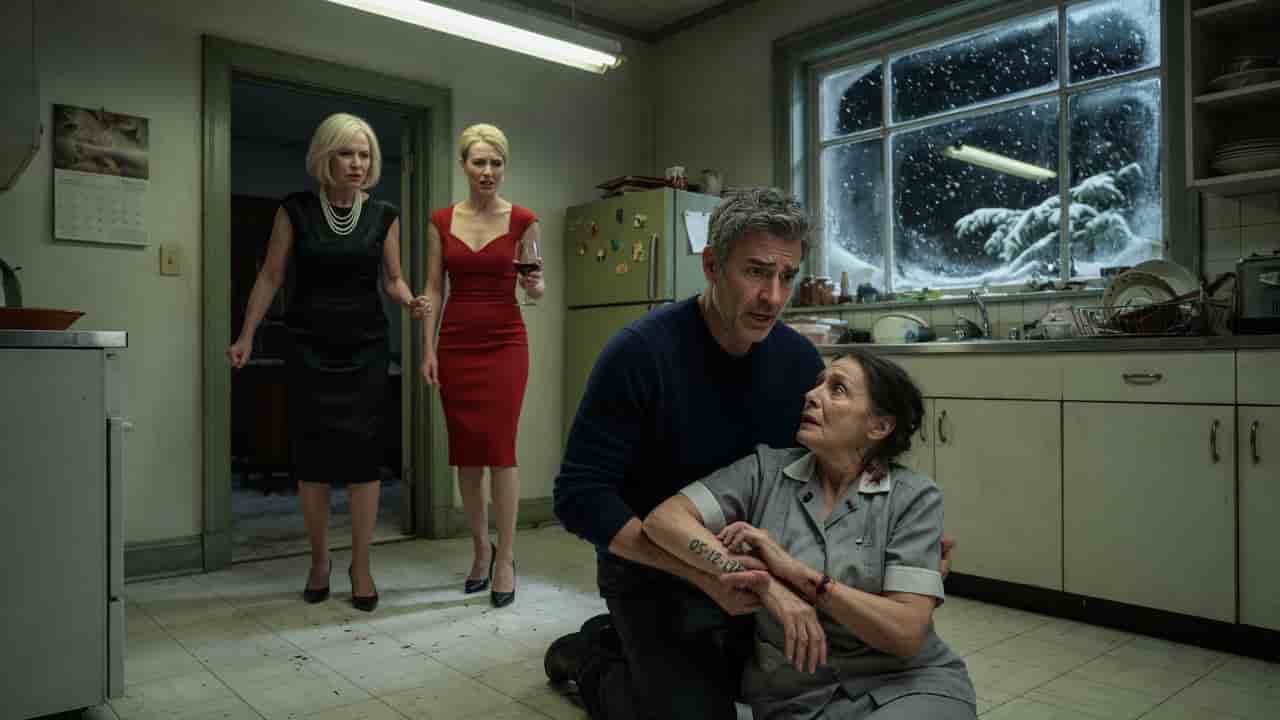
“Get that woman off the floor, David. You’re staining your sweater.”
My mother—or the woman I’d called Mother for forty years—stood in the kitchen doorway, her pearls gleaming under the fluorescent lights. She didn’t look at Maria, who was gasping for air in my arms. She looked at the cost of my cashmere.
Maria had been the shadow in our house since before I could walk. The one who tucked us in while Eleanor was at galas. The one who knew I liked my toast burnt and my secrets kept. She was the ‘Nanny.’ The help.
But as Maria’s breath hitched, the white bandage on her wrist caught on my cuff and unraveled.
Underneath it wasn’t an injury. It was a date. May 12, 1984.
My birthday.
“Look at her wrist, Eleanor,” I said, my voice sounding like it belonged to a stranger. “Look at what you made her hide for forty years.”
My sister Sarah laughed, a sharp, brittle sound that smelled like expensive Merlot. “She’s a servant, David. Stop being so dramatic and call the agency for a replacement.”
The room went ice cold. I looked at the woman on the floor—the woman who had cleaned our toilets and cooked our meals while her own heart was breaking in silence. I looked at the icy socialite in the doorway who had bought my loyalty with a trust fund and a lie.
The will was being read tomorrow. The ‘purity of the bloodline’ clause was the only thing that mattered. If I spoke the truth, I’d lose the firm, the house, and the name.
If I stayed silent, I’d be letting my real mother die as a stranger.
I didn’t choose silence.
Chapter 1
The Sterling estate sat on the highest ridge in Westchester County like a monument to things that didn’t want to be touched. It was a sprawling mass of grey stone and cold glass, designed by an architect who clearly hated the idea of a cozy corner. I should know. I’m an architect myself, though I specialize in buildings that actually invite people to live inside them. Coming back here always felt like walking into a refrigerator that had been unplugged for a week—still cold, but with an underlying scent of something spoiled.
Outside, the first major storm of the season was beginning to lean against the windows. The wind whistled through the gaps in the heavy oak doors, a low, mournful sound that Eleanor usually drowned out with Vivaldi or the sharp clink of silverware against fine china. Tonight, the dining room was set for six, though only four of us were there. The empty chairs felt like silent witnesses, or maybe just placeholders for the people Eleanor had managed to drive away over the decades.
“The salt, Maria,” Sarah said, her voice cutting through the heavy silence of the room.
She didn’t look at Maria. No one in this family ever really looked at Maria, unless they were checking for dust on a sideboard or a smudge on a wine glass. Maria moved from the shadows near the sideboard, her gait heavy and uneven. She was seventy-five, though she looked eighty-five. Her grey domestic uniform, always pressed to a lethal edge, seemed to hang off her shrinking frame like a shroud.
As she reached for the salt cellar, Maria let out a small, wet cough. She immediately pressed a white linen handkerchief to her mouth, her eyes darting toward Eleanor with a flash of pure, instinctual terror.
Eleanor didn’t look up from her poached pear. “If you’re unwell, Maria, the servants’ quarters are heated for a reason. There is no need to bring your germs into the dining room.”
“I am sorry, señora,” Maria whispered. Her voice was a dry rasp, the sound of dead leaves scuttling across pavement. “It is just the dampness. The storm.”
“It’s incompetent,” Sarah snapped. She was on her third glass of Merlot, and her cheeks were flushed a dull, angry red. At thirty-five, my sister had perfected the art of being disappointed in everything that didn’t serve her immediate comfort. “You’ve been slow all evening. The soup was tepid, and you forgot the lemon for the water. If you can’t handle a simple dinner, perhaps it’s time we looked into a facility for you.”
I felt a sharp tug of something hot and uncomfortable in my chest. I looked at Maria. She was staring at the floor, her hand trembling as she set the salt down next to Sarah’s plate. She looked small. So incredibly small. This was the woman who had bandaged my scraped knees in the pantry while Eleanor was hosting bridge clubs. This was the woman who had sat by my bed when I had the croup at seven, humming songs in Spanish that I didn’t understand but felt in my bones.
“She’s sick, Sarah,” I said, my voice sounding louder than I intended in the vaulted room. “Leave her alone.”
Sarah rolled her eyes. “Oh, here we go. Saint David of the Draughting Table. Honestly, David, your sentimental attachment to the help has always been a bit much. She’s paid to be here. She’s paid to be efficient. Currently, she is neither.”
“David is just tired from the drive,” Eleanor said, her tone smooth and final, like a judge closing a case. She finally looked up, her blue eyes as cold as the sleet hitting the glass behind her. “And Maria is fine. She’s been with us forty years. She knows the expectations of this house better than anyone. Don’t you, Maria?”
Maria nodded quickly, her head bowed. “Yes, señora. Forty years.”
“Go to the kitchen,” Eleanor commanded. “Bring the coffee. And try not to make a spectacle of your lungs on the way back.”
Maria turned and retreated. I watched her go, noticing for the first time how much she favored her right side, how her hand clutched the edge of the doorframe for just a second too long before she disappeared. There was a thick white bandage wrapped around her right wrist, peeking out from under her cuff. She’d been wearing it for weeks, ever since I’d come up for the autumn retreat. Whenever I asked about it, she’d just say she’d burned it on the stove or tripped in the garden.
The silence returned, heavier than before. We ate in the way people eat when they are performing the idea of a family. The Sterling name carried weight in New York—old money, old blood, old secrets. My grandfather, the patriarch who had built the fortune on steel and ruthlessness, was currently failing in a hospice bed in the city. The reading of his will was scheduled for Monday, provided he didn’t hang on out of spite.
The main requirement of the inheritance was “purity of the bloodline.” It was a Victorian clause that somehow survived a century of legal challenges. It meant that only the direct, biological descendants of Thomas Sterling could touch the principal of the trust. To the world, that meant Eleanor, Sarah, and me.
“The lawyer called today,” Eleanor said, dabbing her lips with her napkin. “Mr. Henderson. He wanted to ensure all the birth records were in order for the transition. He’ll be here tomorrow morning to ride out the storm with us. He wants to finalize the paperwork before the… inevitable.”
“Is that why we’re all here?” I asked. “To prove we’re Sterlings? To make sure we get our cut of the steel?”
“Don’t be crass, David,” Eleanor said. “It’s about legacy. It’s about making sure the firm stays in the hands of those who built it. You’ve done well with your own practice, but you know as well as I do that the Sterling name is the only reason you get those museum commissions.”
She wasn’t wrong, and that was the part that burned. I’d spent twenty years trying to outrun this house, only to realize I was running on a leash made of my mother’s connections.
From the kitchen, there was a sudden, sharp crash. The sound of porcelain shattering on linoleum.
I was out of my chair before I realized I’d moved.
“David, sit down,” Eleanor said, her voice rising in a rare show of agitation. “She probably just dropped a cup. She’ll clean it up.”
I ignored her and pushed through the swinging door into the kitchen.
The room was vast, all stainless steel and white marble, designed for a staff that no longer existed. Maria was on the floor. She hadn’t just dropped a cup; she’d dropped the entire silver tray. The coffee pot had spilled across the white floor, a dark, steaming lake of brown liquid.
She was slumped against the base of the island, her face the color of wet ash. Her breath was coming in short, terrifying rattles.
“Maria!” I knelt beside her, my knees soaking into the spilled coffee. I didn’t care. I grabbed her shoulders, feeling the terrifying lightness of her bones. “Maria, look at me. Breathe. Just breathe.”
“I… I am sorry,” she wheezed. “The tray… it was so heavy today, David. So heavy.”
She only called me David when we were alone. In front of the others, I was ‘Señor David’ or ‘Mr. Sterling.’
“Forget the tray,” I said. I looked up and saw Eleanor and Sarah standing in the doorway. They looked like they were watching a movie they found slightly distasteful.
“Well,” Sarah said, holding her wine glass to her chest. “That’s the Royal Doulton set. I hope she has insurance.”
“She’s having a heart attack, Sarah!” I shouted. “Call an ambulance!”
“The phones are down because of the storm,” Eleanor said calmly. She stepped into the kitchen, her heels clicking on the tile, avoiding the coffee. She looked down at Maria with an expression I couldn’t quite name. It wasn’t pity. It was more like… calculation. “And the roads are blocked at the bottom of the ridge. No one is coming tonight.”
“Then I’ll drive her,” I said, reaching under Maria’s arms to lift her.
“You’ll do no such thing,” Eleanor said. “You’d end up in a ditch, and then we’d have two bodies to deal with. Carry her to her room, David. Give her some aspirin. She’s survived forty years in this house; she’ll survive a little chest pain.”
Maria’s hand clutched my forearm. Her grip was surprisingly strong, born of a lifetime of scrubbing and lifting. Her right sleeve had pushed up in the fall, and the white bandage on her wrist was starting to unravel, soaked through with coffee and sweat.
“David,” Maria whispered, her eyes wide and fixed on mine. “The pantry… the third shelf… behind the flour.”
“Don’t talk, Maria. Just save your strength.”
“The letters,” she gasped, her voice barely audible over the wind howling outside. “Read the letters.”
“What letters?”
“David!” Eleanor’s voice was like a whip crack. “Stop indulging her. She’s delirious. Carry her to her quarters. Now.”
I looked at my mother. She was standing perfectly still, her hand resting on the marble counter. But I noticed her fingers were digging into the stone so hard the knuckles were white. She wasn’t calm. She was terrified. Not of Maria dying, but of whatever Maria was trying to say.
I lifted Maria. She felt like she was made of balsa wood and old paper. As I carried her down the narrow servant’s hallway toward the small, cramped room she’d occupied for four decades, I felt a strange, cold weight settling in my stomach.
I laid her on the narrow cot. The room smelled of lavender and Vick’s VapoRub. It was a room of someone who owned very little and expected even less. On the bedside table was a small framed photo of me and Sarah as children, standing in the garden. Eleanor wasn’t in the picture.
Maria’s eyes closed, her breathing evening out into a ragged, unconscious snore. I stayed with her for a moment, watching the way her chest rose and fell. Then, I looked at her wrist.
The bandage had fallen away completely.
In the dim light of the single 40-watt bulb, I saw it. It wasn’t a burn. It wasn’t a scar. It was a tattoo. Small, blue ink, blurred by time but still perfectly legible.
05-12-1984
My birthday.
I stared at it for a long time, the sound of the storm outside fading into a dull roar. Why would a nanny have her employer’s son’s birthday tattooed on her wrist? And why would she hide it for forty years?
I stood up and walked back toward the kitchen. The house was quiet, save for the ticking of a grandfather clock in the hall. Eleanor and Sarah had retreated back to the dining room, their voices a low murmur behind the closed door.
I went to the pantry.
The third shelf was stacked with bags of flour and sugar, things Eleanor never touched. I reached behind a heavy ceramic jar of King Arthur flour. My fingers brushed against something cold and metallic.
A small, rusted biscuit tin.
I pulled it out and opened the lid. Inside was a stack of envelopes, yellowed with age and smelling of the same lavender that filled Maria’s room. They were all addressed to me. None of them had stamps. None of them had been mailed.
I picked up the one on top and opened it. The handwriting was shaky, the English slightly formal and labored.
My dearest David, it began. Today you are ten years old. I watched you blow out the candles on the cake that Eleanor bought from the bakery. She told the guests she spent all morning in the kitchen, but you and I know the truth. You looked at me across the room and I wanted to run to you. I wanted to tell you that the blood in your veins doesn’t belong to the stone walls of this house. It belongs to me. I gave it to you in a room Eleanor paid for, but she could not buy the love that came with it. She calls me Maria. She calls me the help. But one day, when the steel is gone, I hope you will call me Mother.
I felt the floor tilt beneath my feet. I leaned against the pantry shelves, the paper trembling in my hand.
From the dining room, I heard Eleanor’s laughter. It was a sharp, crystalline sound, the sound of a woman who owned everything and regretted nothing.
I looked down at the letter again.
She could not buy the love that came with it.
I thought about the coldness of this house. I thought about the “purity of the bloodline.” I thought about the woman dying on a cot in the basement while my “mother” finished her poached pear.
The storm was just beginning.
Chapter 2
The letters were a map of a life lived in the margins. I sat on the floor of the pantry, hidden by the heavy oak door, and read through them one by one. There were twenty-two in total. One for every birthday, and a few for milestones I hadn’t realized anyone had noticed. Graduation. My first job. The day I got married—and the day I got divorced.
Maria had seen it all. She had recorded the history of the Sterlings from the perspective of the shadow that cleaned up their messes.
1992: Eleanor took you to the doctor today because you had a fever. She made me wait in the car. She told the doctor she hadn’t slept in two days, but I was the one who held your hand through the night. I saw her through the window, David. She was checking her reflection in the glass, adjusting her hat. She is a beautiful woman, but she is hollow. She needed a child to secure her place in the will, and she chose me because I was young, alone, and invisible. She promised me a life for you. She promised you would never want for anything. And I believed her. I traded my motherhood for your future. Is that a sin, David? To love someone so much you agree to become a ghost?
The air in the pantry felt thick, like I was breathing in the dust of forty years of lies. I thought about the Sterling fortune. Hundreds of millions of dollars, all tied to the idea of a “pure” line. Eleanor had been the only child of Thomas Sterling. If she hadn’t produced an heir, the entire estate would have defaulted to a distant cousin in Scotland, a man my grandfather had loathed.
Eleanor hadn’t been fertile. The letters spelled it out in brutal, simple terms. She’d hidden her “failure” from the patriarch, and she’d used Maria as a permanent surrogate, a secret vessel. But it went further than surrogacy. Maria hadn’t just carried us; she was the biological source.
I looked at the dates. Sarah’s birthday was there, too, mentioned in a letter from 1990. Your sister is here now. She has Eleanor’s eyes, or so the guests say. But when she cries, she sounds just like my mother did when the winter was hard in the village.
I realized then that my entire existence was a corporate merger disguised as a family. I was a legal loophole with a heartbeat.
A shadow fell across the pantry floor. I shoved the letters back into the tin and slid it behind the flour just as the door swung open.
Eleanor was standing there. She’d changed out of her cocktail dress into a silk robe that looked like flowing liquid silver. She held a glass of water in one hand, but her eyes were sharp, scanning the room.
“What are you doing in here, David?” she asked. Her voice was steady, but there was a tremor in the way she held the glass.
“I was looking for some aspirin for Maria,” I said. My heart was hammering against my ribs, a frantic, trapped bird. “I thought there might be some in the first-aid kit.”
“The kit is in the laundry room,” Eleanor said. She stepped into the pantry, the scent of her expensive, floral perfume clashing with the smell of dry grain. She looked at the shelf where I’d hidden the tin. “You’ve been in here a long time.”
“I got distracted,” I said, trying to keep my voice flat. “It’s a big pantry.”
“Go to bed, David,” she said. It wasn’t a suggestion. “The storm is getting worse. We have a long day tomorrow with Henderson. You need to be sharp.”
“How can you be so calm?” I asked, my anger finally bubbling to the surface. “Maria is dying in the other room, and you’re worried about paperwork.”
Eleanor set the glass of water down on a shelf. She stepped closer to me, her face inches from mine. Up close, the cracks in her mask were visible—the fine lines around her eyes, the tension in her jaw.
“Maria has been a part of this house since before you were born,” she said quietly. “She is well-compensated. She is cared for. But she is a servant, David. And servants die. That is the natural order of things. What is not natural is for a son of this house to be rummaging through cupboards like a common thief. Go. To. Bed.”
I pushed past her, the heat of my rage barely contained. I didn’t go to bed. I went back to the servant’s quarters.
The hallway was freezing. The radiators in this part of the house were old and clotted with rust, barely putting out enough heat to keep the pipes from freezing. I found Maria still on the cot. Her breathing was shallower now, a soft, whistling sound that made my own lungs ache.
I sat on the edge of the bed and took her hand. It was ice cold. I began to rub it, trying to bring some warmth back to the skin.
“Maria,” I whispered. “I found the letters.”
Her eyes fluttered open. They were clouded, the pupils dilated, but she looked at me with a sudden, piercing clarity.
“David,” she breathed.
“Is it true?” I asked. “Are you… are you my mother?”
A single tear rolled down her cheek, disappearing into the deep wrinkles at her temple. She didn’t say yes. She didn’t have to. The way she looked at me—the hunger, the grief, the fierce, protective pride—was an answer no lawyer could refute.
“She made me… sign,” Maria whispered. “In the beginning. A paper. She said… if I ever told… you would lose everything. The school. The name. You would be… nothing.”
“I wouldn’t have been nothing,” I said, my voice breaking. “I would have had you.”
Maria shook her head weakly. “No. In this world… you need the steel, David. You are a Sterling. I made you a Sterling.”
“You made me a lie,” I said.
She clutched my hand, her fingers digging into my palm. “The lawyer… Henderson. He has the original papers. Not the fake ones in the safe. The real ones. He was… your grandfather’s friend. He knew. He kept the secret to protect the family. But he has them.”
“Why are you telling me this now?”
“Because I am going,” she said, her voice fading. “And I cannot take the truth with me. It is too heavy, David. It is too heavy.”
She closed her eyes again, her hand slipping from mine. I sat there in the dark for hours, listening to the house groan under the weight of the snow. The Sterling estate felt like a tomb. Not just for Maria, but for all of us.
I thought about Sarah. Did she know? She treated Maria like dirt, like a disposable object. Was that her way of coping with a truth she couldn’t face, or was she truly as hollow as Eleanor?
As the sun began to bleed a pale, grey light through the frost on the windows, I heard the sound of a heavy vehicle churning through the snow in the driveway. A black SUV. Henderson had arrived.
I stood up, my joints stiff and aching. I looked at Maria one last time. She was still breathing, but her face had a waxen, translucent quality. She didn’t have long.
I walked out of the room and headed for the main hall. I found Eleanor and Sarah already there, dressed in black, looking like they were ready for a funeral that hadn’t happened yet.
“He’s here,” Sarah said, checking her reflection in the hall mirror. “Finally. Let’s get this over with.”
The door opened, and Mr. Henderson stepped inside, shaking snow from his heavy wool coat. He was a man who looked like he was made of old parchment and expensive tobacco. He’d been the family’s counsel for fifty years. He knew where every body was buried, mostly because he’d probably dug the holes.
“Eleanor,” he said, bowing his head slightly. “David. Sarah. A treacherous drive, but I wouldn’t miss this.”
“The will?” Eleanor asked, her voice tight.
“I have the documents,” Henderson said, patting his leather briefcase. “But before we proceed to the formal reading, there is the matter of the verification. As per your father’s instructions, we must confirm the biological validity of the heirs. A formality, of course, given the records on file.”
I looked at Eleanor. She didn’t blink.
“Of course,” she said. “We have everything ready.”
“Good,” Henderson said. He looked at me, and for a second, I saw something in his eyes. Not kindness. Maybe just a weary sort of recognition. “David, you look like you haven’t slept.”
“I spent the night with Maria,” I said. “She’s dying.”
Sarah snorted. “Honestly, David. You’re obsessed.”
“She’s been with the family a long time,” Henderson said softly. “A very long time. It’s only natural for David to feel a connection.”
He said the word ‘connection’ with a strange emphasis. He knew. Of course he knew.
“Let’s go to the library,” Eleanor said, leading the way.
As we walked, I felt the biscuit tin in the pantry calling to me. I felt the weight of the letters. I looked at the portraits of the Sterling ancestors lining the walls—stern men in high collars, women in silk and lace. They all looked back with cold, judgmental eyes.
They weren’t my ancestors.
The realization hit me like a physical blow. I wasn’t a Sterling. I was the son of a woman who cleaned their floors. Every brick in this house, every dollar in the bank, every drop of prestige I’d ever enjoyed was a stolen asset.
We entered the library, a room filled with thousands of books that no one ever read. Henderson set his briefcase on the heavy mahogany desk.
“Before we begin,” I said, “I want to talk about Maria.”
Eleanor turned, her eyes narrowing. “Not now, David.”
“Now,” I said. “I want to know who she is. To this family. To me.”
“She’s the nanny,” Sarah said, exasperated. “She’s the woman who made our beds. What is wrong with you?”
“Is she, Henderson?” I asked, ignoring my sister. “Is that all she is?”
Henderson paused, his hand on the latch of his briefcase. He looked at Eleanor, then at me. The silence in the room was so loud I could hear the snow sliding off the roof.
“Maria is a devoted employee,” Eleanor said, her voice dropping to a dangerous whisper. “And you are being disrespectful to your grandfather’s memory by bringing this up now.”
“I found the letters,” I said.
Eleanor froze. The color drained from her face so completely she looked like a statue.
“What letters?” Sarah asked, looking between us. “What are you talking about?”
“The letters Maria wrote to me,” I said. “The ones you made her hide, Eleanor. The ones that explain why she has my birthday tattooed on her wrist.”
Sarah’s wine glass—she was already drinking, even at ten in the morning—shook in her hand. “A tattoo? That’s disgusting. Why would she do that?”
“Because she’s our mother, Sarah,” I said.
The word hung in the air like a bomb.
Sarah laughed, but it was a high, jagged sound. “That’s… that’s insane. David, you’ve finally lost it. Mother, tell him he’s crazy.”
Eleanor didn’t say a word. She just stared at me, her chest heaving under her silk blouse.
“Henderson,” I said. “Open the briefcase. Show them the real papers.”
Henderson sighed, a long, weary sound. He looked at the briefcase, then at the fire crackling in the hearth.
“The truth is a complicated thing, David,” he said. “Especially when it comes to empires. Your grandfather knew that. Your mother knows that. And if you’re as smart as I think you are, you’ll know it too.”
“Open it,” I said.
He reached for the latch. But before he could click it open, the library door swung wide.
It was one of the local girls Eleanor hired to help during the winter, a teenager named Mia. She was pale, her eyes wide with shock.
“Mrs. Sterling,” she stammered. “It’s… it’s Maria. She’s… I think she’s gone.”
Chapter 3
The news of Maria’s passing hit the room like a physical shock, but the reactions were tellingly fractured. Sarah let out a sharp, annoyed breath, as if Maria had died specifically to inconvenience her. Henderson bowed his head, a gesture of professional solemnity that felt practiced. But Eleanor—Eleanor looked relieved. The tension in her shoulders vanished, and for a split second, a ghost of a smile touched the corners of her mouth. It was gone before anyone else could catch it, but I saw it.
She thought the secret had died with the woman.
“Poor thing,” Eleanor said, her voice back to its polished, melodic cadence. “At least she didn’t suffer long. Mia, please call the local funeral home. Tell them to come as soon as the roads are cleared. And make sure her things are packed. We’ll need the room for the extra staff next week.”
“Packed?” I asked, my voice trembling. “She’s barely cold, and you’re throwing her out?”
“She was an employee, David,” Eleanor said, turning back to Henderson as if I hadn’t spoken. “The room belongs to the estate. Now, Arthur, we were discussing the verification.”
“We were discussing the fact that Maria is my mother,” I said, stepping between Eleanor and the desk.
“David, enough,” Eleanor snapped. “You are having some kind of emotional breakdown. I will not have this nonsense aired in front of counsel. Sarah, take your brother to the morning room. Get him some tea.”
“I don’t want tea,” I said. I looked at Henderson. “Arthur, you were about to open that briefcase.”
Henderson looked at Eleanor. A long, silent conversation passed between them—years of shared secrets, of legal maneuvers, of the quiet, bloodless violence of the wealthy.
“David,” Henderson said softly. “Perhaps we should wait. Out of respect for the… deceased.”
“No,” I said. “No more waiting. My whole life has been waiting. Waiting for Eleanor to love me, waiting for Sarah to stop being a bully, waiting for the truth to come out of the shadows. Open it.”
“There is nothing to open, David,” Eleanor said. She walked over to the fireplace and poked at the logs, sending a shower of sparks up the chimney. “There are no ‘real’ papers. There is only the will, and the birth certificates, and the bloodline clause. You are a Sterling because I say you are. You have the name, the education, and the future because I provided them. Don’t throw it away for a fantasy.”
“It’s not a fantasy,” I said. I reached into my pocket and pulled out the top letter from the tin. I’d kept it with me. “Read it, Sarah. Read what Maria wrote.”
Sarah snatched the paper from my hand, her eyes scanning the lines. As she read, the smug, bored expression on her face began to crumble. Her hand started to shake.
“This… this says she birthed us,” Sarah whispered. “This says Eleanor paid her to stay silent.”
“It’s a lie,” Eleanor said, not turning around. “A bitter old woman’s attempt to feel important in her final days. She was obsessed with you both. She had no life of her own, so she tried to steal mine.”
“She didn’t steal it,” I said. “She gave it to you. She gave you her children so you could keep your father’s money. How much did you pay her, Eleanor? Was it a monthly stipend, or did you just promise not to fire her if she kept her mouth shut?”
Eleanor turned around then. Her face was a mask of cold, concentrated fury. “I saved that woman from a life of poverty in a village that didn’t want her. I gave her a roof, food, and the chance to watch her children grow up in luxury. She would have been a field hand. Instead, she lived in a palace. If anyone was the victim here, David, it was me. I had to endure the sight of her every single day, knowing what she was. Knowing the common blood she brought into this house.”
Sarah dropped the letter. It fluttered to the rug like a dead bird. “Common blood? You mean… we’re not Sterlings? We’re… her?”
The disgust in Sarah’s voice was visceral. She looked at her own hands as if she expected them to turn brown, to show the dirt of the kitchen.
“You are Sterlings in every way that matters,” Eleanor said, stepping toward Sarah and taking her by the shoulders. “You have the breeding, the grace, and the name. Blood is just biology. Legacy is what we build. And we are going to build this legacy, Sarah. We are going to sign those papers, and we are going to take what is ours.”
“But the clause,” Sarah stammered. “The ‘purity’ clause. If the trust finds out…”
“They won’t,” Eleanor said. “Because Arthur is going to do his job. Aren’t you, Arthur?”
Henderson didn’t look at her. He was staring at the briefcase. “The clause is very specific, Eleanor. ‘Direct biological descendants.’ If a challenge is raised, the court will demand a DNA test. Especially now that Maria is dead. Her son is in the city.”
I froze. “Her son? What son?”
Henderson looked at me, a flicker of pity finally crossing his face. “Maria had a son before she came to work for the Sterlings. A boy she left behind in Mexico. She used the money Eleanor gave her to send him to school, to bring him here. He’s a lawyer now. His name is Miguel.”
“She had another son?” I felt a strange, jarring sense of displacement. I had a brother. A real brother.
“And Miguel knows,” Henderson continued. “Maria told him everything. He’s been waiting for her to pass. He’s the one who’s going to file the challenge.”
Eleanor’s grip on Sarah’s shoulders tightened. “Then we buy him off. Everyone has a price.”
“Not Miguel,” Henderson said. “He doesn’t want the money. He wants the truth. He wants his mother’s name restored. He wants the world to know she wasn’t just ‘the help.'”
The storm outside roared, a gust of wind rattling the library windows so hard I thought the glass would shatter. The house felt like it was shrinking, the walls closing in on us.
“I want to see her,” I said.
“She’s dead, David,” Sarah snapped, her voice high and brittle. “What’s the point? She’s just a body now. A body that’s about to ruin our lives.”
“She’s my mother,” I said.
I turned and walked out of the library, leaving them there in the flickering firelight. I walked back down the servant’s hallway, the air growing colder with every step. I pushed open the door to Maria’s room.
Mia had already been in. She’d pulled the sheet over Maria’s face. The room was silent, the only sound the faint ticking of the clock on the bedside table.
I walked over and sat on the edge of the cot. I reached out and pulled the sheet back.
Maria looked peaceful. The lines of pain and exhaustion that had etched her face for years had smoothed out. She looked like she was finally resting.
I looked at her wrist. The tattoo was still there. 05-12-1984.
“I’m sorry,” I whispered. “I’m so sorry it took me this long to see you.”
I stayed there for a long time, just sitting with her. I thought about the life she’d lived—the silent sacrifices, the long hours of labor, the agony of watching her children call another woman ‘Mother.’ I thought about the letters she’d written, the words she’d never dared to say out loud.
A light tapping on the door broke the silence.
It was Henderson. He looked older than he had an hour ago. He held a manila envelope in his hand.
“David,” he said. “I think you should have this.”
“Is that the truth?” I asked, looking at the envelope.
“It’s the evidence,” he said. “The original birth records from the clinic in Switzerland where Eleanor ‘gave birth.’ The names of the doctors who were paid to lie. And the contract Maria signed.”
“Why are you giving it to me?”
“Because I’m tired, David,” Henderson said. “I’ve spent fifty years protecting this family from itself. And look at what it’s become. Your mother is a woman who would step over a corpse to reach a bank vault. Your sister is a shell. And you… you’re the only one who still has a heart.”
“If I use this, the family is finished,” I said. “The fortune, the name, the estate. It all goes.”
“It was never yours to begin with,” Henderson said. “It was built on a foundation of bone and silence. Maybe it’s time it fell.”
He set the envelope on the bedside table and walked out.
I looked at Maria. I looked at the envelope.
Through the thin walls, I could hear Sarah’s voice in the kitchen, sharp and demanding. “Mia! Where is that tea? And get someone to mop up this coffee! This place is a disaster!”
The residue of the Sterling legacy was a stain on the floor and a coldness in the soul.
I picked up the envelope and tucked it under my arm. I knew what I had to do. But first, I had to finish the dinner. One last meal with the family I never really had.
Chapter 4
The final dinner was a masterclass in psychological warfare. Eleanor had insisted on it, a desperate attempt to re-establish the “natural order” of the house before the storm cleared and reality came crashing through the gates. She’d made Mia set the table with the gold-rimmed china, the kind we only used when heads of state or board chairmen were visiting.
Sarah was dressed in a silk cocktail dress that was a shade too tight, her makeup applied with a heavy, frantic hand to cover the signs of her morning binge. She sat across from me, her eyes darting toward the hallway every time she heard a floorboard creak.
Eleanor sat at the head of the table, perfectly composed, as if the woman who had birthed her children wasn’t lying dead in a room fifty feet away.
“The roast is a bit dry,” Sarah said, poking at the meat on her plate. “Mia really isn’t up to Maria’s standards, is she? We’ll have to find someone new by Monday. Someone younger. Someone who doesn’t cough.”
I looked at my sister. The cruelty wasn’t just a habit anymore; it was a shield. She was clinging to her status as a Sterling because without it, she was just an unemployed socialite with a drinking problem and no marketable skills.
“Maria’s standards were built on forty years of being treated like an object, Sarah,” I said. “Maybe give the girl a break.”
“Oh, for God’s sake, David,” Sarah snapped. “Are we really going to do this again? The woman is dead. It’s sad, sure, but she was ninety percent dust anyway. Can we please just have one meal without you acting like a martyr?”
“She was seventy-five,” I said. “And she wasn’t dust. She was the reason you have clean clothes and a full stomach.”
“Enough,” Eleanor said. She didn’t raise her voice, but the room went cold. “We are not discussing the staff. We are discussing the future. Arthur has the papers ready for tomorrow. Once the will is read and the transition is complete, I’m thinking of selling the Westchester property. It’s too big for me now, and the taxes are absurd. We’ll move everything to the city apartment.”
“Selling the house?” Sarah looked panicked. “But where will I go? My gallery project is based here.”
“The gallery project that hasn’t sold a single painting in three years?” Eleanor asked, her tone dry and surgical. “You’ll move to the city with me. Or you’ll find your own place. You’ll have your trust fund, Sarah. Provided everything goes smoothly tomorrow.”
She looked at me when she said the word ‘smoothly.’ It was a threat, plain and simple.
“What if it doesn’t go smoothly?” I asked. “What if the truth comes out?”
Eleanor set her fork down with a precise, metallic click. “There is no ‘truth,’ David. There is only what is documented. And the documents say you are my son. If you choose to challenge that, you aren’t just hurting me. You’re hurting yourself. You’ll lose your firm. You’ll lose your reputation. You’ll be the man who tried to claim he was the son of a maid to avoid his responsibilities.”
“Is that what you think this is about?” I asked. “Avoiding responsibility?”
“I think you’re a sentimentalist who doesn’t understand the world,” Eleanor said. “You think the truth sets you free. In our world, the truth is just leverage. And right now, you have none.”
I felt the manila envelope heavy in my blazer pocket. I thought about the letters. I thought about Miguel, the brother I’d never met, who was waiting in the city to claim his mother’s dignity.
“I have more leverage than you think,” I said.
The door to the dining room swung open. Mia stood there, her face streaked with tears.
“I’m sorry, Mrs. Sterling,” she sobbed. “I can’t… I can’t be in there with her. It’s too cold. And she looks so… so alone.”
“Then go home, Mia,” Eleanor said, not even looking at her. “Oh wait, you can’t. The roads are closed. Go to the kitchen and stay there until you can compose yourself. You’re being paid to work, not to perform a Greek tragedy.”
Mia fled, her sobs echoing down the hall.
“God, she’s useless,” Sarah said, reaching for the wine decanter.
“She’s a human being, Sarah,” I said. “Something you and Eleanor seem to have forgotten.”
“I’m tired of your lectures, David,” Sarah said, her voice rising. “I’m tired of you acting like you’re better than us. You’ve lived off this money just as much as I have. You went to the best schools, you bought your fancy loft with Sterling dividends. You’re just as ‘common’ as I am, if that letter is true. So stop the act.”
“I’m not acting,” I said. I stood up, my chair scraping harshly against the parquet floor. “I’m done.”
“Sit down, David,” Eleanor commanded.
“No,” I said. “I’m going to sit with Maria. Someone should be with her tonight.”
“I forbid it,” Eleanor said, her eyes flashing with a sudden, sharp panic. “You stay in this room until we finish this discussion.”
“Or what?” I asked. “You’ll cut me out of the will? Go ahead. I’ve spent my life building things that stand up. You’ve spent yours building things that hide secrets. I’d rather be the son of a woman who birthed me in secret than the son of a woman who bought me like a piece of furniture.”
I turned and walked out. Behind me, I heard Sarah laugh—a jagged, hysterical sound. “Let him go, Mother! Let him play house with a ghost! He’ll be back when he realizes how much his insurance costs!”
I walked through the dark house, the shadows stretching out to meet me. I went back to the kitchen, intending to pass through to the servant’s wing.
But as I entered the kitchen, I saw Eleanor had followed me. She was standing by the industrial stove, the fluorescent lights making her look old and brittle.
“Give me the letters, David,” she said. Her voice was flat, devoid of its usual polish.
“No.”
“They don’t mean anything,” she said. “They’re just paper. They won’t hold up in court. Henderson will see to that.”
“Henderson gave me the real records, Eleanor,” I said. “The ones from Switzerland.”
She froze. The silence in the kitchen was absolute, save for the hum of the refrigerator.
“He wouldn’t,” she whispered. “He’s loyal.”
“He was loyal to my grandfather,” I said. “And my grandfather wanted the bloodline protected. He didn’t know you’d cheated him. Henderson is just setting the record straight.”
Eleanor stepped toward me, her hand reaching out, claw-like. “David, listen to me. If you do this… if you tell the world… you’ll be a laughingstock. You’ll be the ‘Nanny’s boy.’ You’ll never work again. No museum, no city council, no one will touch you.”
“I don’t care,” I said.
“You say that now,” she hissed. “But wait until the money stops. Wait until Sarah is on the street. Wait until the Sterling name is a joke.”
“The Sterling name is already a joke, Eleanor. It’s a joke told by a woman who’s too afraid to be real.”
I pushed past her and headed for Maria’s room.
The door was ajar. I walked in and stopped.
Sarah was there.
She was standing by the cot, looking down at Maria’s covered body. In her hand, she held the rusted biscuit tin. She was holding a lighter to one of the letters.
“What are you doing?” I shouted, lunging for her.
“I’m saving us, David!” Sarah screamed, her face contorted. “I’m burning the evidence! You want to be a nobody? Fine! But I’m not going back to being poor! I’m a Sterling!”
The paper caught fire, the orange flame licking at the yellowed edges. I grabbed Sarah’s wrist, twisting it until she cried out and dropped the letter. I stamped it out on the floor, the smell of burnt lavender filling the room.
“Get out,” I said, my voice low and dangerous.
“You’re pathetic!” Sarah spat, backing toward the door. “You’re just like her! A servant! A pathetic, weak servant!”
She ran out, her heels clicking frantically on the floor.
I knelt on the linoleum, picking up the charred remains of the letter. It was the one from my tenth birthday. The one where Maria told me she loved me.
I looked at Maria. Her face was still and calm. The humiliation of this house, the cruelty of the women who had used her, could no longer touch her.
But it could touch me.
I realized then that the rescue wasn’t going to be a legal victory or a check from the estate. The rescue was the truth.
I leaned over and kissed Maria’s cold forehead.
“I’m here, Mom,” I whispered. “I’m finally here.”
I didn’t realize Eleanor was standing in the doorway until she spoke.
“You’re staining your sweater, David,” she said. Her voice was empty. “Get that woman off the floor.”
I looked up at her, and for the first time in forty years, I didn’t see my mother. I saw a stranger in a silver robe, standing in a house that was about to fall.
I pulled Maria closer, her head resting against my chest. I looked directly at Eleanor, the woman who had bought my life and sold my soul.
“She’s my mother,” I said, my voice echoing through the cold, hollow house. “And you’re just the woman who paid for the room.”
Eleanor didn’t move. She just watched as I sat there on the white linoleum, cradling the woman who had loved me in the shadows, while the storm raged on outside.
The residue of the lie was finally being washed away by the cold, hard truth of the blood.
Chapter 5
The kitchen lights felt like needles. They were too bright, too sterile for the weight of the woman I was holding. Maria’s body was cooling, that unmistakable shift from person to object happening in my arms, but I couldn’t let go. If I let go, Eleanor won. If I let go, the “natural order” of the Sterling estate—the one where bodies are moved and floors are scrubbed and lies are polished until they shine—would snap back into place like a spring.
Eleanor stood by the industrial refrigerator, her shadow long and sharp on the white tile. She hadn’t moved since she’d told me I was staining my sweater. She was looking at me, but her eyes were fixed on the manila envelope Henderson had given me, which was now lying on the counter where I’d tossed it in my rush to Maria.
“David,” Eleanor said. Her voice was lower now, stripped of the performative matriarchal tone. It was the voice she used when she was negotiating a contract she intended to break. “The girl, Mia, is in the pantry. She’s hysterical. You are sitting on the floor with a dead servant. This is not how we handle things. We are Sterlings. We handle things with dignity.”
“Dignity,” I repeated. The word tasted like copper. I looked down at Maria. Her grey uniform was damp from the spilled coffee, and her hair, usually pinned into a severe, professional bun, had come loose. A few strands of white hair rested against her cheek. I reached up and tucked them back. “You wouldn’t know dignity if it knelt in front of you and begged for its life for forty years.”
“I gave her a life!” Eleanor’s composure finally fractured. She stepped forward, her heels clicking like gunshots on the tile. “I gave her everything! Do you have any idea what she was before I found her? She was a girl with a belly full of a child she couldn’t feed, in a country that would have spit on her. I brought her here. I gave her my name to put on your birth certificate. I gave her a room in the finest house in the county. I paid for her son’s education! I am the reason she died with clean sheets and a full stomach!”
“You gave her a cage,” I said. “And you made me the bars.”
I shifted my weight, my knees screaming from the hard linoleum. I reached for the manila envelope on the counter, my fingers brushing the cool paper. “I’m calling Miguel.”
Eleanor froze. The name hit her harder than any insult. “You will do no such thing. Miguel is a litigious opportunist. He’s been waiting for this moment to bleed us dry. If you bring him into this house, you are signing the death warrant of the Sterling legacy.”
“The legacy is a corpse, Eleanor. Look at it.” I gestured to Maria. “This is the legacy. A woman who died in secret because the woman she served was too proud to be human.”
“You think he cares about her?” Eleanor laughed, a sharp, ugly sound. “He wants the trust. He wants the Westchester property. He’ll use her memory to guilt a jury into handing him the keys to the kingdom. Is that what you want? To see your grandfather’s work sold off to pay for a ‘justice’ that doesn’t exist?”
I didn’t answer her. I reached into my pocket and pulled out my phone. The signal was weak, the storm still battling the towers, but I had one bar. I’d looked up Miguel’s firm months ago, a secret curiosity I’d never acted on until now. I hit the contact.
“David, put the phone down,” Eleanor said. She was moving toward me now, her hand outstretched. “We can talk about this. We can settle with him. A private agreement. He’ll take the money and go away. We can keep the name intact. Sarah needs her inheritance, David. She’s fragile. If the trust is dissolved, she’ll have nothing.”
“She already has nothing,” I said as the call connected.
A man’s voice answered on the third ring. It was deep, professional, and weary. “Vargas.”
“Miguel?” I asked. My voice was a gravelly mess.
There was a long pause on the other end. I could hear the faint sound of city traffic, a world away from the muffled silence of the snow-bound estate.
“Who is this?”
“It’s David. David Sterling.”
The silence that followed was heavy. I could almost feel Miguel’s breath hitch across the miles. “Why are you calling me, David?”
“It’s Maria,” I said. I looked at Eleanor, who had stopped moving, her face a mask of pure, concentrated hatred. “She’s gone. She died about an hour ago.”
I heard a sharp intake of breath, followed by a low, shaky exhale. “Was she… was she alone?”
“No,” I said, my throat tightening. “I was with her. I’m with her now.”
“I’m coming,” Miguel said. There was no hesitation. “I’m at the bottom of the ridge. I’ve been waiting in a motel in Peekskill since the storm started. I knew she was close. I’ll be there in twenty minutes.”
“The gates are locked,” I said.
“I have a truck. I’ll make it through.”
He hung up. I lowered the phone and looked at Eleanor.
“He’s coming.”
“Then you’ve made your choice,” Eleanor said. Her voice was ice. No, it was colder than ice. It was the sound of a vacuum. “You’ve chosen a stranger over your own family. You’ve chosen the help over the blood.”
“He is the blood, Eleanor,” I said, standing up slowly. I had to brace myself against the counter, my legs shaking. I didn’t let go of the envelope. “And so am I.”
I left her there in the kitchen. I didn’t look back to see if she went to Mia or if she just stayed in the dark. I walked back to the main hall, my footsteps echoing in the vast, empty space. I went to the front door and pulled it open.
The wind hit me like a physical blow, a swirl of white needles that blinded me for a second. I stepped out onto the porch, the heavy stone pillars providing a small amount of shelter. Far down the long, winding driveway, I saw the twin beams of headlights cutting through the white curtain of the storm.
They were moving fast, bouncing over the unplowed drifts. I watched as the truck reached the massive wrought-iron gates. They didn’t open. For a second, the truck stopped, and then the engine roared. It slammed into the gates, the sound of twisting metal screaming over the wind. The gates groaned and gave way, swinging back into the snow.
The truck sped toward the house, a dark, powerful shape. It skidded to a halt at the base of the steps, and a man jumped out.
He was younger than me, maybe thirty-five. He was wearing a heavy canvas coat and work boots, his hair damp with melting snow. Even in the dim light of the porch lamps, I could see the resemblance. He had Maria’s eyes—the same deep, liquid brown, the same heaviness in the lids. He had her jawline, too.
He walked up the steps, his breathing heavy. He stopped three feet away from me.
“David,” he said.
“Miguel.”
He looked at the front door, then back at me. “Where is she?”
“In the back. In her room.”
He nodded, a sharp, jerky motion. He looked like he was holding himself together by sheer force of will. “And Eleanor?”
“She’s in the kitchen. She’s not… she’s not happy you’re here.”
“I don’t give a damn about Eleanor Sterling,” Miguel said. He stepped past me into the house, his boots leaving slushy prints on the Persian rugs.
I followed him. We walked through the house in silence, a strange, grim procession. As we passed the library, the door opened. Sarah was standing there, a fresh glass of wine in her hand.
“Who the hell is this?” she demanded, her voice slurred. “David, did you let a contractor in? At this hour?”
Miguel didn’t even look at her. He just kept walking.
“Hey!” Sarah shouted, stumbling into the hall. “I asked you a question! This is private property!”
“Sarah, shut up,” I said, not turning around.
“Excuse me? You don’t tell me to shut up in my own house!”
“It’s not your house, Sarah,” I said. “It never was.”
We reached the servant’s wing. The air was noticeably colder here, the transition from the “public” house to the “working” house marked by a drop in temperature and a change in the quality of the light. Miguel stopped in front of Maria’s door. He stood there for a long time, his hand hovering over the knob.
“She wrote me,” Miguel whispered. “Every week for thirty years. She told me about you. She told me how you liked your drawings, how you were always building things with blocks in the pantry. She said you were the only thing that kept her from losing her mind in this place.”
“I didn’t know,” I said. “I didn’t know any of it.”
“Of course you didn’t,” Miguel said, finally turning the knob. “That was the point of the contract. You were the prize, David. You were the thing Eleanor Sterling bought with my mother’s soul.”
He walked inside and closed the door behind him. I stayed in the hallway, leaning my head against the cold wallpaper. From inside, I heard a sound that broke my heart—a man’s muffled, racking sobs. It was the sound of thirty years of missing a mother, of being the son who was kept in the shadows so the other son could live in the light.
I don’t know how long I stood there. Eventually, the sobbing stopped, and the door opened again. Miguel looked older, his eyes red and swollen, but there was a new hardness in his expression.
“I’m taking her,” he said.
“The roads are still bad,” I said. “Wait until morning.”
“I’m not leaving her here another minute,” Miguel said. “This house has had her for forty years. It’s done.”
“The coroner needs to come, Miguel. There are legal procedures.”
“I am the legal procedure,” Miguel said, pulling a folded set of documents from his coat. “I have a court order signed three days ago. Immediate custody of the body upon death, pending a biological verification. I’ve been preparing for this for five years, David. I knew Eleanor would try to hide her, bury her in a pauper’s grave before the will was read. Not this time.”
“She’s in the kitchen,” I said. “Eleanor. She has the lawyers coming in the morning.”
“Good,” Miguel said, his voice dropping to a dangerous level. “I want them all there. Henderson, too. I want the whole circus to see the tent fall down.”
He walked back toward the main part of the house. I followed him into the kitchen.
Eleanor was sitting at the small breakfast table, a cup of tea in front of her. She looked up as we entered. She didn’t look surprised. She looked like she was watching a play she’d already reviewed.
“Mr. Vargas,” she said. “I see you’ve made quite an entrance. My gates will be on your invoice.”
“Put it on the tab, Eleanor,” Miguel said, leaning over the table. “Right next to the forty years of wages you owe my mother for the ‘overtime’ she spent being a parent to your children.”
“Maria was a nanny,” Eleanor said. “She was compensated as such.”
“She was a surrogate,” Miguel spat. “She was a biological donor. She was a woman you coerced into a fraudulent contract under the threat of deportation and poverty. I have the bank records, Eleanor. I have the receipts for the ‘donations’ you made to the clinic in Switzerland. And I have the testimony of the nurse who saw you hand over the cash.”
Eleanor’s hand trembled as she reached for her tea. “A nurse from forty years ago? Good luck finding her credible.”
“She’s seventy now, and she has a very clear memory of the ‘American socialite’ who didn’t want to ruin her figure or her inheritance,” Miguel said. “She’s waiting for my call.”
Eleanor looked at me, her eyes pleading for a second before they hardened again. “David, tell him to stop. Tell him what this will do to the family.”
“I’m not a Sterling, Eleanor,” I said. I took the manila envelope from my pocket and set it on the table in front of her. “And neither are you. You’re just a woman who ran out of people to lie to.”
The kitchen door swung open, and Sarah stumbled in. She looked like she was on the verge of a total collapse. Her red dress was stained with wine, and her hair was a mess.
“They’re taking her!” Sarah screamed, pointing toward the hall. “The funeral people! They just pulled up!”
“I called them,” Miguel said. “They’re my people. They’re taking her to a chapel in the city. A place where she’ll have a name on the door.”
“You can’t!” Sarah lunged for Miguel, but I stepped in her way, catching her by the arms.
“Sarah, stop,” I said.
“She’s our secret, David!” Sarah wailed, her voice cracking. “If she goes, everyone knows! They’ll take the money! They’ll take my gallery! I’ll have to get a job, David! A real job!”
The sheer, naked patheticness of her words seemed to echo in the room. Even Eleanor looked ashamed for a fleeting second.
“The truth is coming, Sarah,” I said, letting go of her arms. “You might want to sober up for it.”
Miguel looked at me, a flicker of something like respect in his eyes. “The will reading is at ten tomorrow morning. Henderson will try to skip the verification. Don’t let him.”
“I won’t,” I said.
“See you in the morning, brother,” Miguel said.
He walked out, and a few minutes later, I heard the heavy sound of the truck’s engine fading into the storm.
The kitchen was silent. Sarah was slumped in a chair, sobbing into her hands. Eleanor was staring at the manila envelope, her face a mask of cold, dead stone.
The residue of the night was heavy. It smelled of spilled coffee, burnt paper, and the sharp, metallic scent of a dying empire. I walked out of the kitchen and up the grand staircase. I went to my room, but I didn’t sleep. I sat by the window and watched the snow fall, thinking about the woman who had lived in the shadows so I could stand in the sun.
The sun was coming up in a few hours. And for the first time in forty years, I was ready to see what it looked like when it hit the truth.
Chapter 6
The morning light was flat and grey, filtered through a thick layer of clouds that promised more snow. The Sterling estate looked different in the dawn—less like a palace and more like a fortress that had been breached. The broken gates at the end of the drive were a jagged reminder that the world had finally found its way in.
I was in the library by nine. I’d showered and dressed in a dark suit, my movements slow and deliberate. I felt like I was preparing for a surgery I wasn’t sure I’d survive. The manila envelope was tucked into my inner pocket, a heavy, silent weight against my ribs.
Henderson arrived at nine-thirty. He looked like he’d aged a decade in the last twelve hours. His eyes were bloodshot, and his hands shook slightly as he set his briefcase on the mahogany desk. He didn’t look at me.
“A tragic night,” he murmured, his voice like dry leaves. “Truly tragic.”
“It was a night of reckoning, Arthur,” I said. “Let’s not pretend it was anything else.”
He sighed and opened the briefcase. “The requirements of the will are absolute, David. Your grandfather was a man of his word, however harsh that word might have been. If the ‘purity of bloodline’ is challenged, the entire estate defaults to the Scottish trust. There is no middle ground. No settlements. It’s all or nothing.”
“Then it’s nothing,” I said.
The door opened, and Eleanor and Sarah walked in. Eleanor was a masterpiece of defiance. She was wearing a black wool suit with a high collar and a single strand of pearls. Her hair was perfectly coiffed, her makeup flawless. If she was terrified, she wasn’t letting it show.
Sarah, however, was a wreck. She was wearing a black dress that looked like it had been pulled from a hamper, and her eyes were hidden behind large dark glasses. She sat in the chair furthest from the desk, her hands clutching a small beaded purse.
“Shall we begin?” Eleanor asked, her voice steady and cold.
“We’re waiting for one more person,” I said.
“The lawyer from the city?” Eleanor sneered. “I’ve already had security alerted. He is not welcome on this property.”
“Security was relieved of their duties an hour ago,” I said. “I paid them off with my own money. They were happy to avoid the legal fallout that’s coming.”
Right on cue, the library door opened again. Miguel stepped inside. He was dressed in a sharp charcoal suit, his expression neutral and professional. He didn’t look like the grieving son I’d seen in the hallway; he looked like a predator who had finally cornered his prey.
“Mr. Vargas,” Henderson said, his voice cracking. “I assume you have the necessary standing to be here?”
“I am the legal representative for the estate of Maria Vargas,” Miguel said, taking a seat next to me. “And as her biological son, I am a witness to the fraud perpetrated by Eleanor Sterling and the law firm of Henderson & Associates.”
“Fraud is a strong word, Mr. Vargas,” Henderson said.
“It’s the only word,” Miguel replied. He looked at Eleanor. “Good morning, Eleanor. You look well. For someone whose house is on fire.”
“Arthur, read the will,” Eleanor commanded. “Ignore this man.”
Henderson cleared his throat and began to read. It was a long, tedious document filled with “heretofores” and “whereases,” but the core was simple: the Sterling fortune was to be divided equally among the biological heirs of Eleanor Sterling, provided they could prove their lineage to the satisfaction of the board of trustees.
“As the primary heirs,” Henderson said, looking at me and Sarah, “you are required to provide a DNA sample to the board’s medical liaison by Friday. Upon verification, the principal will be released.”
“There will be no verification,” I said.
The room went silent. Even Sarah looked up from her purse.
“David, don’t,” Sarah whispered.
I stood up and pulled the manila envelope from my pocket. I walked over to the desk and laid it on top of the will.
“These are the original records from the clinic in Zurich,” I said. “They list Maria Vargas as the biological mother of David and Sarah Sterling. They include the signature of Eleanor Sterling, acknowledging the transfer of parental rights in exchange for a sum of two million dollars, to be held in an offshore account.”
Eleanor didn’t move. She didn’t blink. She just stared at the envelope as if it were a venomous snake.
“I also have the testimony of Maria’s primary care physician,” Miguel added, sliding a folder across the desk. “Who treated her for years for the psychological trauma associated with her forced silence. And I have the video statement from the nurse in Switzerland.”
“It’s a forgery,” Eleanor said. Her voice was a ghostly whisper. “It’s all a forgery.”
“It’s the truth, Eleanor,” I said. “And you know it. Arthur knows it. That’s why he tried to hide it.”
I looked at Henderson. The old man slumped in his chair, his head bowed. “I told you, Eleanor. I told you it wouldn’t hold forever. The boy has his grandfather’s eyes. He has his grandfather’s sense of order. He was always going to find it.”
“You… you traitor!” Sarah screamed, lunging at Henderson. “You ruined everything! You were supposed to protect us!”
Miguel stood up and caught Sarah by the shoulders, gently but firmly pushing her back into her seat. “Nobody ruined anything, Sarah. The lie just reached its expiration date.”
“The board of trustees has already been notified,” I said. “I sent them a digital copy of the records an hour ago. The Sterling estate is currently under a freeze. The Scottish trust has been activated.”
Eleanor finally looked at me. The hatred in her eyes was so pure it was almost beautiful. “You’ve destroyed us, David. You’ve taken everything we worked for. For what? For a woman who cleaned your toilets?”
“For my mother,” I said. “And for myself. I’m done living in a building with no foundation.”
The rest of the morning was a blur of legal maneuvers and social collapse. Henderson resigned on the spot. Sarah went into a full-blown hysterical fit and had to be sedated by the house doctor. Eleanor—Eleanor just walked out of the room. She went to her bedroom and locked the door, refusing to see anyone.
Miguel and I stayed in the library for a long time after everyone else had left. The house felt different now—lighter, somehow, as if the weight of the secret had been lifted from the rafters.
“What now?” Miguel asked.
“Now we bury her,” I said. “With her name. And then I think I’m going to go to Mexico. I want to see the village she came from. I want to see the life she gave up for us.”
Miguel looked at me, a small, sad smile touching his lips. “It’s a beautiful place, David. Hard, but beautiful. She would have liked that you went.”
“I think she’s already there,” I said.
We buried Maria two days later. The storm had passed, leaving behind a world that was crisp and white and blindingly bright. The funeral was small—just me, Miguel, and Mia. Eleanor and Sarah didn’t come. They were already busy with their lawyers, trying to salvage whatever scraps of the trust they could.
As the casket was lowered into the ground, I looked at the headstone. It didn’t say ‘The Help’ or ‘Nanny.’ It said:
MARIA VARGAS STERLING
Beloved Mother
1951 – 2026
I felt a hand on my shoulder. It was Miguel.
“We should go,” he said. “The lawyers are waiting at the house.”
“I’m not going back to the house,” I said. I looked at the sprawling stone mansion on the ridge, the sun reflecting off its cold glass windows. “I’m never going back there.”
I turned and walked away from the Sterling estate, my boots crunching in the fresh snow. I didn’t look back. I didn’t need to. I knew exactly who I was now.
The residue of the Sterling name was a bitter memory, but the blood in my veins was finally mine. I walked toward the car, toward the city, toward a life that was finally, painfully, and beautifully real.
The truth hadn’t just set me free. It had given me a brother. It had given me a mother. And for the first time in forty years, it had given me a home.
Behind me, the wind picked up, swirling the snow around the headstone. Maria was at rest. And as I drove away, I realized that the “purity of the bloodline” wasn’t about the money or the name. It was about the love that survived the silence.
The Sterling legacy was dead. But I was finally alive.