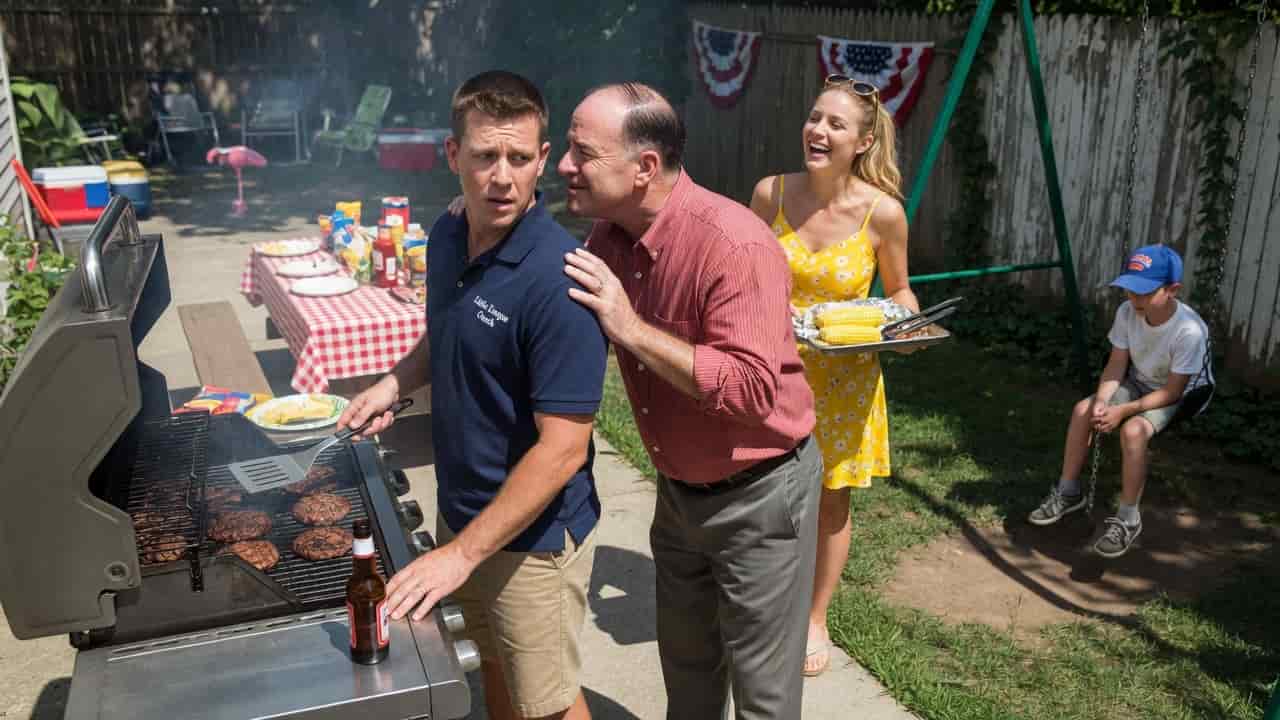
“Silas says the boy is ready, Alpha.”
Mark’s hand froze over the grill, the heat of the coals suddenly feeling like ice against his skin. He didn’t turn around. He didn’t have to. He knew that voice, and he knew that name—the name of the man the world believed had disappeared twenty years ago in a wreckage that left no remains.
For two decades, Mark had played the part of the perfect husband, the dedicated Little League coach, and the man who outran his own shadow. He told his wife his parents were gone. He told himself he was different. But as his neighbor leaned in, smelling of cheap beer and something much darker, the lie he’d been living collapsed.
Across the yard, his eight-year-old son sat on the swing set, staring at the ground with a cold, hollow gaze that Mark recognized from the old news clippings he kept locked in a steel box in the basement. The cult his father built wasn’t gone. They weren’t just watching from the distance. They were his neighbors. They were his friends. And they were waiting for the “Alpha” to take his place.
If Mark stays, he loses his soul. If he runs, he loses his family. And if he fights, the truth about the “Highway Killers” will tear his suburban paradise to the ground.
Chapter 1: The Weight of Perfect Siding
The cedar siding on the house was stained a color called “Autumn Embers,” a shade Mark had spent three weeks choosing. It looked expensive. It looked safe. It looked like the kind of house where nothing bad had ever happened and nothing bad ever would. Mark stood on the lawn with a garden hose, the spray of water catching the late afternoon light and turning it into a temporary, shimmering arc.
This was the ritual. Every Tuesday and Thursday, after coaching the Cubs at the local park, Mark watered the hydrangeas. It was a chore of pure performance. The neighbors, the Millers and the Grahams, would see him—the fit, thirty-eight-year-old father with the firm handshake—and they would think: There is a man who has his life together.
He needed them to think that. He needed it with a desperation that felt like a physical weight in his chest, a constant pressure just beneath his ribs. If the lawn was green and the cars were washed and the kid was in the gifted program, then the blood in his veins didn’t matter. If he was the best man in the zip code, he could outvote his DNA.
“Dad? You’re soaking the sidewalk.”
Mark blinked, the shimmer of the water snapping back into a mundane stream. Toby stood at the edge of the driveway, his oversized baseball glove dangling from his hand. At eight, Toby was all knees and elbows, a pale, quiet boy who seemed to observe the world rather than inhabit it.
“Sorry, bud,” Mark said, his voice practiced and warm. He twisted the nozzle, shutting off the flow. “Just lost in thought. Great practice today. That catch at second? You’re getting faster.”
Toby didn’t smile. He rarely did. He just looked at the wet concrete where the water was darkening the stone. “The bird is back,” the boy said.
Mark felt a small, cold finger of dread trace a line down his spine. “What bird, Toby?”
“The one with the wing. It’s in the bushes by the garage. It can’t fly.”
Mark walked over, his sneakers squeaking on the wet grass. He looked where Toby was pointing. Deep in the shadows of the boxwood, a starling was huddled, its wing pinned at an unnatural angle. It was panting, its tiny chest heaving, one eye fixed on the giant humans above it.
“We should help it,” Mark said, though every instinct in him wanted to turn away. “We’ll call the wildlife rescue in the morning.”
“Why wait?” Toby asked. His voice was flat, devoid of the frantic empathy most kids his age showed toward injured animals. He just watched the bird. “It’s going to be scared all night. Maybe we should just make it stop.”
Mark stared at his son. The boy’s face was a mirror of his own—the same high cheekbones, the same deep-set hazel eyes. But in Toby’s eyes, there was a stillness that terrified Mark. It was a stillness he remembered from the few photos he had managed to find of his father, Silas, before the “Highway Killers” became a household name.
“We don’t ‘make it stop,’ Toby,” Mark said, his voice coming out harsher than he intended. “We protect things. That’s what men do. We protect what’s weak. Remember that.”
Toby tilted his head, a gesture so subtle it was almost feline. “Okay, Dad.”
He turned and walked into the house, leaving the glove on the driveway. Mark stood there for a long time, the silence of the suburb feeling suddenly heavy, like the air before a massive storm. He looked at the bird. He thought about the basement.
Inside, the house smelled of Sarah’s lemon-thyme chicken. It was a “good” smell. A “safe” smell. Sarah was in the kitchen, her blonde hair pulled back in a messy knot, a glass of Chardonnay on the counter. She smiled when he walked in, and for a second, the pressure in his chest eased.
“Long practice?” she asked, leaning over the island to kiss his cheek.
“Toby’s getting the hang of the infield,” Mark said. He leaned against the counter, trying to shed the image of the starling. “He’s a smart kid. Maybe too smart.”
“He’s your son, Mark. Of course he is.” Sarah paused, her smile faltering slightly. “A letter came today. For you. No return address.”
Mark’s heart did a slow, heavy roll in his chest. “Where is it?”
“On the mail pile. Beside the invitations for the BBQ.”
Mark walked to the entryway table. There it was. A plain white envelope. No stamp—it had been hand-delivered. His name was written in a cramped, precise script that he had seen a thousand times in his nightmares.
He didn’t open it in front of her. He couldn’t. He tucked it into his pocket and headed for the basement stairs.
“I’m just going to check the water heater,” he called out. “I thought I heard it knocking.”
The basement was finished, a “man cave” with a pool table and a big-screen TV, but behind the furnace room was a heavy steel door that Mark had installed himself. He told Sarah it was a storm cellar and a gun safe. She never went in there; she hated the smell of oil and the lack of windows.
Mark stepped inside and locked the door. The room was small, lit by a single overhead bulb. The walls were lined with filing cabinets. On the desk sat a laptop that was never connected to the internet.
He sat down and opened the envelope.
Inside was a single sheet of yellowed legal paper. There was no greeting.
The blood doesn’t forget, Marcus. You can paint the walls and mow the grass until your hands bleed, but the soil knows who you are. I see the boy on the swing. I see the way he looks at the world. He has the gift. He has the hunger. Don’t starve him, son. A starved wolf is a dangerous thing.
Beneath the text was a hand-drawn map. It was a perfect overhead view of their neighborhood. Every house was detailed, every tree, every fence. And there, in the center, was their house. On the window of Toby’s bedroom, someone had drawn a small, red ‘X’.
Mark crumpled the paper, his breath coming in ragged gasps. He looked at the filing cabinets—years of research, police reports, and trial transcripts from the nineties. The world thought Silas and Elena Vaughn had perished in a high-speed chase that ended in a fiery explosion off a cliff in Big Sur. The FBI had officially closed the case when “biological matter” was found.
But Mark knew better. He had spent his entire adult life tracking the whispers. Silas hadn’t died. He had disciples. He had a network of people who viewed him not as a monster, but as a prophet of “the true human nature.”
And now, they were in his backyard.
Mark leaned his head against the cold metal of the filing cabinet. He thought about the bird in the bushes. He thought about Toby’s cold eyes.
“I’m not like you,” he whispered to the empty room. “He’s not like you.”
But as he looked at the red ‘X’ on the map, Mark knew that the veneer of his perfect life wasn’t just cracking. It was being stripped away, inch by agonizing inch.
Chapter 2: The Architecture of a Lie
The FBI field office in the city was a bland, glass-and-steel building that felt like a fortress. Mark sat in a small, windowless interview room, the fluorescent lights humming with a low-frequency buzz that made his teeth ache.
Across from him sat Agent Vance. Vance was a man who looked like he had been carved out of old leather and cynicism. He was sixty, with a gray buzz cut and eyes that seemed to be looking for the lie in every sentence.
“You’re a hard man to get a hold of, Coach,” Vance said. He tossed a folder onto the table. “I’ve been watching your Little League games. You’ve got a good arm. A bit stiff on the follow-through, but good.”
Mark didn’t blink. “I’m assuming you didn’t bring me here to talk about my coaching style, Agent Vance.”
“No. I brought you here because another letter showed up. This one wasn’t for you. It was intercepted from a mail drop in Barstow. Addressed to a ‘Brother Thomas’.” Vance pulled out a photocopy of a letter.
Mark read it. His hands stayed flat on the table, but he could feel the pulse jumping in his throat. The letter spoke of “the harvest” and “the Alpha’s return.” It mentioned a town. His town.
“The Highway Killers were supposed to be dead, Mark,” Vance said, leaning forward. “That was the story. It kept the public quiet. It let the Bureau save face after the Big Sur fiasco. But we both know that fire wasn’t hot enough to melt a man like Silas Vaughn.”
“If you know he’s alive, why haven’t you found him?” Mark asked.
“Because he’s not just a killer. He’s a brand. He has followers who would die for him. We call them the ‘Vagabonds.’ They’re ghosts. They move in the shadows of the trucking industry, the roadside motels, the forgotten corners of the interstate. And they’ve been waiting for a signal.”
Vance tapped the photocopy. “We think you’re that signal, Mark. Or rather, your son is.”
“Leave my son out of this,” Mark snapped.
“I wish I could. But Silas is eighty years old. He’s looking for a legacy. He doesn’t want you—you’re the one who ran. You’re the ‘weak’ one who wanted a mortgage and a lawnmower. He wants the third generation. He wants Toby.”
Mark felt a wave of nausea. “Toby is a child. He’s an innocent.”
“Is he?” Vance’s voice was soft, but it cut like a razor. “We got a report from his school last month. A playground incident. A girl tripped and cut her knee. Most kids help. Most kids call a teacher. Toby just stood there and watched her bleed. The teacher said he looked… curious.”
Mark slammed his hand on the table. “He was in shock! He’s a sensitive kid!”
“He’s a Vaughn,” Vance countered. “Look, Mark. I don’t want to lock you up. I don’t think you’ve done anything wrong. Yet. But the Vagabonds are closing in. That neighbor of yours, Miller? We’ve been running a background check. He doesn’t exist before five years ago. His social security number belongs to a man who died in a hospice in Oregon.”
The room seemed to tilt. Miller. The man who lived three houses down. The man who brought over extra zucchini from his garden and talked about the weather.
“What do you want from me?” Mark whispered.
“I want you to be the bait,” Vance said. “The BBQ this weekend. We know they’re planning something. A ‘recognition’ ceremony. We want you to wear a wire. We want you to lead us to the messengers. If we can catch the disciples, we can find the source. We can find Silas.”
“If I do this, my family is in the line of fire,” Mark said. “Sarah doesn’t know. She can’t know.”
“If you don’t do this, they’ll take Toby anyway,” Vance said. “And you know as well as I do, once Silas gets his hands on that boy, there won’t be anything left of the son you love.”
Mark walked out of the FBI building into the bright, uncaring sun. He felt like he was walking through water. He drove home, his mind racing.
He thought about the first time he had met Sarah. It was at a library in San Francisco. He had been using a fake name, trying to build a new identity from scratch. She was reading a book on architecture. She talked about the importance of “structural integrity”—the idea that a building is only as strong as the hidden beams that support it.
He had lied to her from the very first minute. He told her his parents were teachers who died in a car crash. He told her he grew up in a small town in Ohio. Every kiss, every “I love you,” every moment of their ten-year marriage was built on a foundation of rot.
When he got home, the house was quiet. Toby was in his room. Sarah was in the garden, pruning the roses.
Mark went to the garage. He looked at the boxwood bushes. The starling was gone. There was only a small patch of matted feathers and a single drop of dried blood on a leaf.
He went to the basement, to the room behind the steel door. He opened the bottom drawer of the filing cabinet and pulled out a heavy, black handgun. He checked the magazine.
He wasn’t a killer. He had spent his whole life proving that. He was a builder. He was a coach. He was a protector.
But as he looked at the red ‘X’ on the map, he realized that you can’t protect a house from a fire that’s already burning inside the walls.
He hid the gun in the back of the tool bench, under a pile of old rags.
That night, he lay in bed next to Sarah, listening to her breathe. He felt like a stranger in his own life. He thought about Miller. He thought about the BBQ.
He thought about the whisper in the letter: Don’t starve the wolf.
He closed his eyes and saw Toby standing over the bleeding girl on the playground. He saw the curiosity in the boy’s eyes.
“I’ll save you, Toby,” he whispered into the darkness. “Even if I have to burn everything else to do it.”
Chapter 3: The Smoke and the Whisper
The air was thick with the smell of charcoal and expensive marinade. It was the “End of Summer” block party, the kind of event that usually made Mark feel like he had finally achieved the American Dream. There were strings of Edison bulbs hanging from the trees, the sound of laughter, and the clinking of ice in glasses.
Mark stood at the grill, the heat of the fire drying his skin. He was wearing the wire—a tiny, cold lump taped to his chest beneath his polo shirt. He felt like it was broadcasting his heartbeat to the entire world.
“Medium-rare, right, Greg?” Mark said, flipping a burger with practiced ease.
“You know it, Coach,” Greg Graham said, leaning against the deck railing. “Hey, did you see Toby? He’s been sitting on that swing for an hour. Kid’s got some focus. My Joey is running around like a headless chicken.”
Mark looked over. Toby was indeed on the swing. He wasn’t swinging. He was just sitting there, his blue cap pulled low, staring at the ground. He looked like a statue.
“He’s just a thinker,” Mark said, his voice tight.
Sarah came by, looking radiant in her yellow dress. She squeezed his arm. “You’re doing great, honey. Everyone is having such a good time. Even Miller brought that potato salad everyone likes.”
Mark looked at Miller. The man was across the lawn, talking to a group of fathers. He looked perfectly ordinary. He looked like a man who worried about his lawn and his 401k.
As the sun began to dip below the horizon, the shadows stretched across the lawn, long and distorted. The atmosphere shifted. The laughter seemed a little louder, a little more forced.
Vance’s voice crackled in the tiny earpiece Mark had hidden in his canal. “He’s moving, Mark. Miller is moving toward you. Stay calm. Let him talk.”
Mark felt his grip tighten on the spatula. Miller approached the grill, a beer in his hand. He waited until Greg Graham moved away to get a fresh drink.
Miller leaned in. He didn’t look at the burgers. He looked at Mark’s profile. He smelled of woodsmoke and a strange, metallic scent that Mark couldn’t place.
“Good spread, Mark,” Miller said. His voice was a low, gravelly rasp. “The neighborhood is lucky to have a man like you. So… dedicated.”
“Thanks, Bill,” Mark said, his heart hammering against the wire. “Just doing my part.”
Miller stepped closer, invading Mark’s personal space. He leaned down, pretending to look at the heat of the coals.
“Silas says the boy is ready, Alpha,” Miller whispered.
The world stopped. The sound of the party, the music, the laughter—it all turned into white noise. Mark’s hand on the spatula began to shake. He felt a cold, oily dread wash over him.
“Don’t touch my son,” Mark hissed, his voice low and dangerous. He turned his head sharply, staring Miller in the eye.
Miller didn’t flinch. He smiled, a slow, predatory grin that didn’t reach his eyes. “We don’t need to touch him, Marcus. He’s already ours. It’s in the blood. It’s in the way he watches the birds. It’s in the way he looks at you—like you’re a problem he hasn’t solved yet.”
“Keep him talking, Mark,” Vance’s voice urged. “Get a location. Get a name.”
“Who are you?” Mark asked, his voice trembling. “What do you want?”
“I’m a friend of the family,” Miller said. He tapped the side of his head. “And we want what belongs to the Highway. We want the legacy. Silas is waiting, Mark. He’s at the Old Mill roadhouse. Tonight. Bring the boy. If you don’t… well, accidents happen in suburbia. Gas leaks. Brake failures. It’s a dangerous world for a ‘perfect’ family.”
Miller gestured toward Toby. “It’s already in him, Mark. Look at his eyes. He’s not a Cub. He’s a wolf. Stop trying to make him a sheep. It only makes the hunger worse.”
Sarah walked toward them then, her smile bright and oblivious. “Everything okay, boys? You look like you’re discussing world peace over those hot dogs.”
Mark immediately snapped his head back toward the grill, trying to force his features into a mask of normalcy. His vision was blurred, the edges of the yard sparking with adrenaline.
“Just talking shop, Sarah,” Miller said, stepping back and patting Mark’s shoulder with terrifying familiarity. “Mark was just telling me about Toby’s progress. The boy has a real… killer instinct on the field.”
Miller winked at Mark and walked away.
“He’s such a nice man,” Sarah said, leaning against Mark’s shoulder. “A bit odd, but nice.”
Mark couldn’t answer. He felt like he was suffocating. He looked at Toby. The boy had looked up from the ground. He was staring directly at Mark. From across the yard, even in the fading light, Mark could see the lack of emotion in his son’s face. It wasn’t fear. It wasn’t love. It was a cold, analytical observation.
“Mark, stay where you are,” Vance said. “We have units moving on the roadhouse. Do not move the boy. I repeat, do not move the boy.”
But Mark wasn’t listening to Vance anymore. He was listening to the sound of his own pulse, a rhythmic drumming that sounded like boots on a highway.
The residue of the conversation clung to him like soot. He felt filthy. He felt exposed. The “Autumn Embers” siding, the green lawn, the “perfect” wife—it was all a stage set, and the audience was filled with monsters.
He waited until the party began to wind down. He moved like a ghost through his own home, handing out beers, laughing at jokes he didn’t hear.
When the last guest left and Sarah was busy in the kitchen, Mark went to Toby’s room.
The boy was sitting on his bed, still wearing his baseball cap.
“Hey, bud,” Mark said.
“Is Miller gone?” Toby asked.
“Yeah. He’s gone.”
“He told me I was special,” Toby said. He looked at his hands. “He said I don’t have to be afraid of the dark anymore. Because I am the dark.”
Mark felt a sob rise in his throat, but he choked it down. He knelt in front of his son and took his small, cold hands in his own.
“You’re my son,” Mark said. “And I’m going to take you somewhere safe. Away from here. Away from all of them.”
“Will I still be special there?” Toby asked.
Mark didn’t answer. He couldn’t. He just led the boy toward the stairs, his mind already miles away, on a road he had sworn he would never drive again.
Chapter 4: The Red ‘X’ and the Realization
The basement felt like a tomb. Mark stood in the secret room, the handgun heavy in the waistband of his shorts. He was frantically throwing documents into a metal trash can, splashing them with lighter fluid.
He had to erase it. If the FBI failed, if the Vagabonds came for them, he couldn’t leave a trail.
He heard a floorboard creak above him.
“Mark? Are you down there?”
It was Sarah. Her voice was thin, laced with a suspicion she had been trying to suppress for years.
Mark froze. He looked at the map on the desk—the one with the red ‘X’ on Toby’s window. He hadn’t burned it yet.
He walked to the steel door and opened it. Sarah was standing at the bottom of the stairs, her face pale in the dim light of the furnace room. She was holding the yellowed letter—the one Mark thought he had hidden in his pocket. It must have fallen out when he was wrestling with the grill.
“What is this, Mark?” she whispered. Her eyes were red-rimmed. “Who is Silas? And why is there a map of our house with an ‘X’ on Toby’s room?”
Mark felt the last of his strength leave him. The lie was dead. It lay between them like a cold, grey corpse.
“Sarah, listen to me,” he said, stepping toward her. “I was trying to protect you. I was trying to protect both of you.”
“Protect us from what? Who are you?” She backed away, her hands shaking. “I’ve lived with you for ten years. I thought I knew you. But this… this looks like something out of a horror movie. ‘The blood doesn’t forget’? ‘Don’t starve the wolf’?”
She looked at the steel door behind him. “What’s in that room, Mark? Open it.”
“Sarah, please—”
“Open it!” she screamed.
Mark stepped aside. Sarah walked into the room. She saw the filing cabinets. She saw the news clippings of the Highway Killers. She saw the photos of the crime scenes—the roadside rest stops, the cars abandoned in the desert, the signatures carved into the upholstery.
And then she saw the photo of a young boy, barely five years old, standing between Silas and Elena Vaughn. The boy was holding a small, blood-stained knife. He was smiling.
The boy was Mark.
Sarah made a sound—a soft, whimpering noise like a wounded animal. She turned to Mark, her eyes wide with a terror that broke his heart.
“You’re one of them,” she whispered. “You’re his son.”
“I ran away, Sarah! I was a child! I changed my name, I built this life—”
“You built it on a graveyard!” she cried. “Our son… Toby… you’ve been watching him like he’s a bomb about to go off. That’s why you’re so hard on him. That’s why you’re so obsessed with being ‘perfect.’ You were waiting for him to turn into his grandfather.”
“I was trying to stop it!” Mark yelled. “I am stopping it!”
A heavy thud sounded from upstairs. Then the sound of glass shattering.
Mark reacted instantly. He pulled the handgun from his waistband. Sarah screamed, covering her mouth.
“Stay here,” Mark commanded, his voice no longer the voice of a suburban dad. It was cold, sharp, and lethal. “Lock this door. Don’t open it for anyone but me.”
“Mark, don’t—”
He slammed the door and locked it from the outside. He ran up the stairs, his heart a frantic drumbeat in his ears.
The living room was dark. The sliding glass door to the patio was shattered. The curtains were fluttering in the night breeze.
“Toby?” Mark called out.
There was no answer.
He moved through the house, the gun held low and steady. He checked the kitchen. Empty. He checked the entryway. The front door was standing wide open.
He ran out onto the porch. The street was silent. The Edison bulbs from the party were still swaying in the breeze, but the neighborhood felt dead.
Then he saw it.
At the end of the driveway, Miller was standing next to a black SUV. He was holding Toby’s hand. The boy wasn’t struggling. He was looking up at Miller with that same, vacant curiosity.
“Put him down, Miller!” Mark roared, leveling the gun.
Miller didn’t move. He didn’t look scared. “You’re late, Alpha. The Old Man is getting impatient.”
From the shadows across the street, three more figures emerged. They were men Mark recognized—parents from the Little League team, the guy who worked at the local hardware store, the mailman. They all stood there, watching him with cold, expectant eyes.
The realization hit Mark like a physical blow. It wasn’t just Miller. It was the whole town. They hadn’t just found him; they had surrounded him. They had been living alongside him for years, playing their parts, waiting for the moment the “wolf” was ready to be claimed.
“Let him go,” Mark said, his voice cracking. “Take me instead. I’m the one you want.”
“We don’t want you, Mark,” Miller said, his voice echoing in the quiet street. “You’re a broken tool. You have too much ‘integrity.’ But the boy? He’s pure. He hasn’t learned how to lie to himself yet.”
Miller opened the door of the SUV. Toby climbed in without a word.
“Toby! Look at me!” Mark screamed.
The boy looked out the window. His eyes met Mark’s. For a split second, Mark saw a flicker of the son he knew—a flash of fear, a plea for help. And then, it was gone. The stillness returned.
The SUV sped away, the tires screeching on the asphalt. The other men vanished back into the shadows as if they had never been there.
Mark stood in the middle of his perfect driveway, the gun heavy in his hand. He looked up at Toby’s bedroom window.
The red ‘X’ was no longer just on a map. He could see it now, smeared in what looked like red chalk on the glass of the window.
He wasn’t a protector anymore. He wasn’t a coach.
He was a Vaughn. And he was going to have to go to the one place he had spent twenty years avoiding.
He was going to the Highway.
Chapter 5: The Road to the Root
The steel door to the basement room groaned as Mark turned the key. He didn’t want to open it. He wanted to leave her there, safe in the dark, away from the carnage that was coming. But Sarah wasn’t a secret to be filed away, and he couldn’t leave her with the ghosts of his past without a word.
When the door swung open, she didn’t scream. She didn’t rush him. She was sitting on the floor, leaning against a filing cabinet that contained the autopsy reports of a family murdered in 1994. Her eyes were flat, the light in them extinguished by the weight of the truth.
“The SUV is gone,” Mark said. His voice felt like it was coming from a long way off, echoing through a hollow pipe. “They took him.”
Sarah looked up. She didn’t see her husband. She saw the boy with the knife in the photograph. “You let them,” she whispered. “You brought us here. You built this house three miles from a highway so they could find us.”
“I didn’t choose this town because of the highway, Sarah. I chose it because of the schools. I chose it because of you.” He reached out a hand, but she flinched so violently he pulled back as if burned. “I have to go. Vance has units at the Old Mill, but they won’t move until I’m inside. They’re using me as the trigger.”
“You’re not a trigger, Mark,” she said, her voice trembling with a cold, sharp clarity. “You’re a beacon. You always have been. You thought you were hiding, but you were just waiting for them to call you home.”
He couldn’t argue. Every word she spoke felt like a nail being driven into the coffin of their life. He turned and walked out, leaving the door open. He didn’t look back. If he looked back, he would stay, and if he stayed, Toby would become the very thing Mark had spent thirty years trying to kill.
The drive to the Old Mill roadhouse took forty minutes. He drove his silver minivan—the ultimate symbol of his suburban surrender. It felt absurd, a suburban dad in a family car heading toward a den of wolves. He could feel the handgun pressing into his spine, a cold reminder of who he used to be.
The highway was a ribbon of black glass under a moonless sky. Mark felt the old rhythms returning. The way he scanned the overpasses. The way he checked his mirrors every thirty seconds. The way he looked at every passing car not as a person, but as a potential threat or a potential target. The “Highway” wasn’t a place; it was a state of mind, a predatory frequency that his father had tuned him to before he could even read.
The Old Mill was a sagging, two-story structure of rot and corrugated tin, tucked away behind a screen of weeping willows and rusted farm equipment. It had been a local watering hole once, but now the windows were boarded up with plywood, and the parking lot was filled with motorcycles and nondescript white vans.
As Mark pulled in, the headlights of his minivan illuminated Miller standing on the porch. Miller wasn’t wearing his “friendly neighbor” striped shirt anymore. He was in a grease-stained canvas jacket, a heavy chain hanging from his belt.
“Park it over there, Coach,” Miller shouted, gesturing toward a row of dead trucks. “The Old Man is waiting. He’s been waiting a long time.”
Mark stepped out of the car. The air here smelled different—sour, heavy with the scent of unwashed bodies, stale beer, and the metallic tang of gun oil. It was the smell of his childhood.
He walked toward the porch, his hand hovering near the small of his back.
“Vance is watching, Miller,” Mark said, his voice steady. “There are twenty agents in the woods. If I don’t walk out of here with Toby in ten minutes, this place becomes a crater.”
Miller laughed, a dry, rattling sound. “Vance? That old vulture? He’s been trying to catch Silas for forty years. He doesn’t want to save your boy, Mark. He wants the trophy. He’ll let you die, and the kid too, if it means he gets to put Silas in a box.”
Miller stepped closer, his face inches from Mark’s. The public pretense was gone. “Inside, you’re not the ‘Alpha.’ You’re just the runaway. The coward who tried to play house. Remember that when you see him.”
Miller led him through the heavy oak doors. The interior of the roadhouse was cavernous, lit by the flickering glow of several propane heaters and a dozen candles. It looked like a cross between a biker bar and a cathedral.
At the far end of the room, seated in a high-backed wooden chair that looked like a throne of scavenged timber, was Silas Vaughn.
He was smaller than Mark remembered. In Mark’s nightmares, Silas was a giant, a man who could blot out the sun. In reality, he was a frail, eighty-year-old skeleton wrapped in a tattered sheepskin coat. His skin was the color of old parchment, stretched tight over a skull that seemed too large for his neck. But his eyes—those pale, predatory hazel eyes—were exactly the same. They were filled with a terrifying, lucid intelligence.
Toby was standing beside him. The boy was holding a small, silver bowl. He looked pale, but he wasn’t crying. He was watching Silas with an expression of intense, quiet focus.
“Marcus,” Silas said. His voice was a whisper, but it carried to the corners of the room. “You’ve put on weight. The soft life suits you. It’s a shame. You had such a fine edge when you were a boy.”
Mark felt a wave of nausea. He didn’t look at the disciples lining the walls—the “Vagabonds” in their various states of social decay. He only looked at his son.
“Let him go, Silas,” Mark said. “He’s a child. He doesn’t know anything about your ‘highway’.”
“He knows more than you think,” Silas said, patting Toby’s shoulder. The boy didn’t flinch. “He told me about the bird, Marcus. He told me how you wanted to ‘protect’ it, even though it was already dead inside. He saw the truth. He saw that mercy is just a slow way of being cruel.”
Silas leaned forward, his eyes boring into Mark’s. “You tried to starve him. You tried to feed him on Little League and homework and lemon chicken. But look at him. He’s still hungry, isn’t he?”
“He’s hungry for his mother,” Mark snapped. “He’s hungry for a life where he doesn’t have to look at people like you.”
Silas chuckled, a wet, rattling sound in his chest. He looked around at the disciples. “Listen to him. The Great Protector. The man who thinks a lawnmower can change his soul.”
Silas stood up, his joints popping like dry twigs. He gestured for Mark to come closer.
“Kneel,” Silas commanded.
“No,” Mark said.
Miller stepped forward, slamming a heavy hand into the back of Mark’s knees. Mark went down on the cold, dirt-streaked floor. Another disciple grabbed his arms, pinning them behind his back.
The humiliation was sudden and absolute. In front of twenty strangers—people who had been watching his “perfect” life like a reality show—Mark was reduced to a kneeling beggar.
“Look at him,” Silas said to Toby. “This is what happens when you try to be something you aren’t. You become weak. You become a target. Is this the man you want to be, Toby? A man on his knees?”
Toby looked at Mark. His expression didn’t change, but Mark saw a flicker of something—disappointment? Shame? It was the most painful thing he had ever felt.
“I am his father!” Mark roared, struggling against the disciples. “I am the one who raised him!”
“You raised a lie,” Silas said, stepping down from his throne. He walked toward Mark, his gait slow and deliberate. He smelled of mothballs and copper. “I am the one who gave him his life. I am the one who gave you yours. And tonight, we’re going to see if there’s anything left of the Vaughn in you, or if you’re just a suburban ghost.”
Silas reached into his coat and pulled out a long, thin blade. He handed it to Toby.
“The recognition,” Silas whispered. “Show your father what you’ve learned tonight, Toby. Show him that the blood remembers.”
Mark stared at the knife in his son’s hand. It was the same knife from the photograph in the basement. The world seemed to shrink down to that silver blade and the cold, empty eyes of his eight-year-old son.
“Toby, don’t,” Mark said, his voice breaking. “Please. Look at me. Remember the Cubs. Remember the swing set. Remember your mom.”
Toby stepped forward, the knife glinting in the candlelight. He didn’t look at Silas. He didn’t look at the disciples. He looked at the pulse jumping in Mark’s neck.
In that moment, Mark realized that Vance wasn’t coming. The units weren’t moving. They were waiting for the blood to spill. They were waiting for the “Highway Killers” to finish their story so they could close the book forever.
Mark was alone. He was on his knees. And his son was holding a knife to his throat.
Chapter 6: The Residue of the Blade
The silence in the roadhouse was heavy, a physical pressure that seemed to push the air out of Mark’s lungs. Toby stood over him, the tip of the blade resting just below Mark’s jaw. The boy’s hand was steady—terrifyingly steady.
“Do it, boy,” Miller whispered from the shadows. “Take your throne.”
Mark looked into Toby’s hazel eyes. He didn’t see a monster. He saw a child who was being forced to choose between a father who had lied to him for eight years and a grandfather who offered him a terrifying kind of truth.
“Toby,” Mark said, his voice a low, guttural rasp. “I lied to you. I lied about who I was. I lied because I was scared. I was scared that if you knew where I came from, you’d think you had to go there too.”
He felt the blade prick the skin. A single, hot bead of blood bloomed and ran down his neck.
“But you don’t,” Mark continued, ignoring the sting. “You aren’t the dark, Toby. You’re just a kid who likes baseball and hates broccoli. You don’t have to be a wolf. You can just be my son.”
Toby’s eyes flickered. The stillness broke, just for a second. His lower lip trembled.
“He’s lying, Toby,” Silas hissed, leaning in close. “He’s trying to make you small again. He’s trying to put you back in that cage of ‘normal’.”
“It’s not a cage!” Mark yelled. “It’s a life! It’s a life where you don’t have to spend every night looking over your shoulder! It’s a life where people love you for who you are, not for what you can kill!”
Toby looked at Silas, then back at Mark. He looked at the blood on his father’s neck.
Suddenly, Toby didn’t strike. He dropped the knife.
The silver blade clattered on the floor, the sound ringing out like a gunshot in the silent room.
“I want to go home,” Toby whispered. He looked at Mark, his face crumbling into the tears of a terrified eight-year-old. “Dad, I want to go home.”
Silas made a sound of pure, venomous disgust. “Weak. Just like your father. A wasted generation.”
Silas reached for the knife on the floor, his old, claw-like hand moving with surprising speed. But Mark was faster. The moment the disciples’ grip loosened in their shock, Mark lunged forward.
He didn’t reach for his gun. He reached for his son.
He scooped Toby up, shielding the boy’s body with his own as he scrambled backward.
“Now, Vance!” Mark roared. “Now!”
The windows of the roadhouse exploded inward. Flash-bangs detonated in a series of blinding white pops, turning the room into a chaotic blur of smoke and screaming.
Mark didn’t wait to see the FBI agents swarming through the doors. He didn’t wait to see Miller get tackled to the ground or the disciples scattering like rats. He tucked Toby under his arm and ran for the side exit, his heart feeling like it was going to burst through his ribs.
He burst out into the cool night air, the sounds of the raid muffled by the heavy walls behind him. He didn’t stop until he reached the minivan. He shoved Toby into the passenger seat and slammed the door.
He stood by the driver’s side door, his chest heaving, his hands shaking so hard he could barely hold the keys.
Vance stepped out of the shadows of a nearby oak tree. He was holding a radio, his face grim.
“We got Silas,” Vance said. “He didn’t fight. He just sat in his chair and waited for the cuffs.”
“You waited too long,” Mark said, stepping toward the agent. He felt a rage more powerful than anything he had felt in the roadhouse. “You let a child hold a knife to his father’s throat while you watched on a monitor. You wanted the blood, Vance. You wanted the drama.”
“I wanted the conviction, Mark,” Vance said, his voice cold and professional. “And I got it. Silas Vaughn will die in a cell this time. There won’t be any ‘Highway’ left when I’m done.”
“There’s plenty of highway left,” Mark said, gesturing toward the road. “You didn’t fix anything. You just changed the names on the files.”
Mark got into the van and backed out of the lot, the tires throwing gravel against the side of the car. He didn’t look at the roadhouse. He didn’t look at the flashing lights.
The drive back was silent. Toby sat in the passenger seat, staring out the window. He wasn’t crying anymore. He looked exhausted, his small body slumped against the door.
“Dad?” Toby said after a long time.
“Yeah, bud?”
“Is Mom going to be mad?”
Mark gripped the steering wheel until his knuckles were white. “She’s not mad at you, Toby. Never at you.”
When they pulled into the driveway of the “Autumn Embers” house, the lights were on. Sarah was standing on the porch, wrapped in a blanket. She looked older, her face etched with a grief that hadn’t been there twelve hours ago.
Toby scrambled out of the car and ran to her. She caught him, falling to her knees on the manicured lawn, sobbing into his hair.
Mark stood by the van. He watched them—the woman he loved and the son he had tried to save. He felt like a ghost watching his own funeral.
Sarah looked up at him over Toby’s shoulder. There was no relief in her eyes. There was only the “residue.” The knowledge of what he was. The knowledge of what their son had seen. The knowledge that the house wasn’t a fortress; it was a target.
“He’s okay,” Mark said.
“Is he?” Sarah asked. She stood up, holding Toby tightly. “He has blood on his shirt, Mark. Your blood.”
She turned and led the boy into the house. Mark followed, but he stopped at the threshold.
The house felt different. The lemon-thyme smell was gone, replaced by the scent of ozone and fear. The furniture looked like props. The “perfect” life was a hollow shell, the structural integrity gone, the hidden beams snapped by the weight of the truth.
Mark went to the basement. He didn’t go to the secret room. He went to the laundry room and started a load of whites. He watched the water fill the machine, the suds swirling around, trying to wash away the dirt of the roadhouse.
He stayed in the basement for three days. He slept on the sofa in the “man cave.” Sarah brought him food, but she didn’t speak. She didn’t ask questions. She moved through the house like a sleepwalker, her eyes fixed on something Mark couldn’t see.
Toby didn’t go back to school. He spent his days in his room, playing with his Legos in total silence. He didn’t want to go to the park. He didn’t want to play baseball.
On the fourth day, Mark went into Toby’s room. The boy was building a tower out of grey bricks.
“Hey, bud,” Mark said.
Toby didn’t look up. “Dad? Why did you lie about being a teacher?”
Mark sat on the edge of the bed. “Because I wanted to be one. I wanted to be the man I told you I was.”
Toby placed a brick on the top of the tower. He did it with a precision that made Mark’s heart ache.
“Grandpa said that everyone is a liar,” Toby said. “He said that some people lie because they’re scared, and some people lie because it’s fun.”
“Which one do you think I am?” Mark asked.
Toby finally looked up. His hazel eyes were clear, but there was a depth to them that shouldn’t have been there. A knowledge that could never be unlearned.
“I think you were scared,” Toby said. “But you’re not scared anymore, are you?”
“No,” Mark said. “I’m not scared.”
“Good,” Toby said. He reached out and knocked the tower over. He watched the bricks scatter across the floor with that same, analytical curiosity. “Because I’m not scared either.”
Mark walked out of the room and found Sarah in the kitchen. She was staring at the garden. The hydrangeas were wilting; they hadn’t been watered in days.
“We have to leave,” Mark said.
Sarah didn’t turn around. “Where would we go? Every town has a highway, Mark. Every town has neighbors.”
“I know. But we can’t stay here. This house… it’s not ours anymore. It belongs to Silas. It belongs to the Vagabonds.”
“You’re right,” she said. She turned to face him, her face a mask of weary resolve. “But we’re not going together.”
Mark felt the final blow land. It was worse than the knife. It was worse than the kneeling.
“I’m taking Toby,” she said. “I’m going to my sister’s in Vermont. I don’t want you to follow us. I don’t want you to call. I need him to forget your name, Mark. I need him to forget that photograph.”
“Sarah, I saved him—”
“You saved him from your father. But who’s going to save him from you? Who’s going to save him from the look in your eyes every time he does something you don’t like? You’ll always be looking for the wolf, Mark. And eventually, he’ll see you looking. And he’ll become it just to make you stop.”
Mark looked at the floor. He saw the red ‘X’ on the map in his mind. He realized she was right. His love for Toby was tainted by his fear of Silas. He was a guardian who had become a warden.
“Okay,” Mark whispered.
He watched them pack. He helped Sarah load the bags into her car. He kissed Toby on the forehead, the boy’s skin cool and indifferent.
“Be a good boy, Toby,” Mark said.
“I will, Dad.”
He stood in the driveway as the car pulled away. He watched the red taillights until they disappeared around the corner.
The house was silent. The “Autumn Embers” siding looked dull in the afternoon light.
Mark went into the garage. He reached under the tool bench and pulled out the rags. The handgun was still there.
He walked to the edge of the lawn. He looked at the highway in the distance, a silver vein of traffic moving toward the horizon.
He didn’t have a lawn to mow. He didn’t have a team to coach. He didn’t have a lie to protect.
He was just a man with a gun and a history.
He walked back into the house and closed the door. He didn’t lock it. There was no point. The wolves already knew where he lived, and the only thing left to protect was a house full of empty rooms and the fading smell of a life that had never really belonged to him.
He sat in the dark kitchen and waited for the night to come. He thought about the bird in the bushes. He thought about the knife.
He realized that his father had been right about one thing: the blood doesn’t forget.
But as he sat there in the silence, Mark decided that even if the blood remembered, he didn’t have to listen. He could just sit in the dark and be nothing.
And for the first time in his life, that felt like enough.