“A guest who outstays her welcome is just a squatter, dear.”
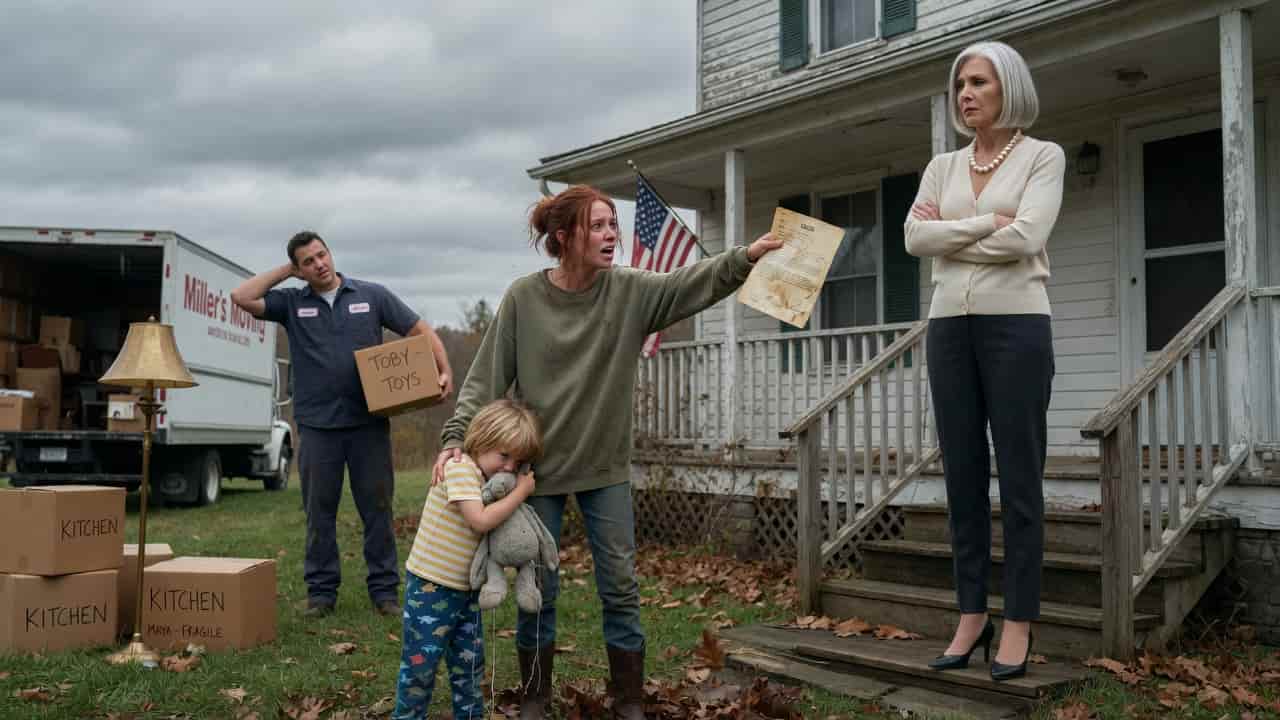
I stood there on the lawn of the house my father built, my feet sinking into the damp Virginia dirt. My five-year-old son, Toby, was shaking against my leg, his knuckles white as he gripped his stuffed rabbit. I looked at the three burly men in work shirts who were currently carrying my dining room chairs—the ones David and I picked out together—and dumping them onto the grass.
Beatrice stood on the porch, looking down at me like I was something she’d found on the bottom of her shoe. She was wearing the pearls David bought her for her sixtieth, looking every bit the grieving mother, while she effectively made her grandson homeless.
“This is a forgery, Beatrice,” I rasped, holding up the paper I’d found tucked in the back of the safe. “I was in the hospital. I was on heavy medication the day this was supposedly signed. You know I didn’t sign this.”
She didn’t even blink. She just adjusted her cashmere sweater and looked at the movers. “Did you hear me? Everything in the master bedroom goes to the curb. The house needs to be cleared for the developers by Monday.”
Neighbors were slowing their cars as they drove past. I saw Mrs. Higgins from the bakery pull her curtains back. The shame was a physical weight, a heat crawling up my neck. I was being evicted from my own life, and the woman who called herself my family was the one holding the door open.
I have the proof. I have the recording of the man who helped her do it. But Beatrice has the money, the lawyers, and the cold heart to use my son as a pawn.
I’m not a squatter. I’m the woman who’s about to take back everything she stole.
Chapter 1: The Weight of Cedar and Dust
The farmhouse didn’t just hold memories; it held a specific, heavy kind of silence that felt like it was made of wool. It was a 1920s Craftsman, a sprawling thing of white clapboard and wrap-around porches that my father had spent thirty years sweating over. He’d replaced every window casing with his own hands, planed the cedar siding until his palms were a map of blisters, and died in the upstairs bedroom with the smell of floor wax in his lungs.
Now, a year after his passing and only three weeks after my husband David’s truck hydroplaned on Route 29, the house felt like it was exhaling. It was shedding its purpose.
I sat at the heavy oak kitchen table, the one with the deep gouge from when Toby dropped a cast-iron skillet last Christmas. My coffee was stone cold. In the other room, I could hear the rhythmic thump-thump of Toby’s heels against the sofa. He was five, and he hadn’t spoken a full sentence since the funeral. He just moved through the house like a small, blonde ghost, clutching a grey stuffed rabbit that had lost most of its stuffing.
The back door creaked open—not a knock, just a proprietary entrance—and Beatrice stepped in.
She didn’t look like a woman who had just buried her only son. She looked like a woman who was about to chair a very important board meeting. Her silver hair was coiffed into a helmet of perfection, and her cream-colored twinset was so pristine it made the kitchen feel suddenly grimy.
“Maya,” she said, her voice like a dry leaf skittering across pavement. She didn’t offer a hug. Beatrice wasn’t a hugger; she was a surveyor. She looked at the stack of unopened mail on the counter, the half-eaten crust of Toby’s peanut butter sandwich, and the faint layer of dust on the windowsill. “This is worse than I thought.”
“It’s been three weeks, Beatrice,” I said, my voice sounding thin even to my own ears. “I’m doing my best.”
“Your best is currently drowning,” she replied, pulling out the chair opposite me. She didn’t sit so much as she perched. “I’ve been looking over the estate’s affairs. David was… well, he was always a bit careless with the paperwork, wasn’t he? It’s a trait he inherited from his father, I’m afraid.”
David hadn’t been careless. He’d been generous. He’d spent the last year trying to keep this farm afloat after my father died, pouring his savings into the roof and the tractor and the taxes. He’d worked himself into the ground to keep my family legacy alive because he knew what it meant to me.
“He was a good man,” I said, a lump forming in my throat that felt like a jagged stone.
“He was a dreamer,” Beatrice corrected. She reached into her leather handbag and pulled out a slim, manila folder. She laid it on the scarred oak table as if it were a holy relic. “Which is why I’ve taken the liberty of handling the transitions. You’re in no state to manage a property of this size, Maya. The taxes alone are predatory in this county.”
“I’ve got the taxes covered for the year,” I said, reaching for the folder, but she kept her hand on it. “David and I had a plan.”
Beatrice’s eyes, a pale, watery blue, didn’t soften. “Plans change when the planner is no longer here. I’ve spoken to Sarah, and we agree. It’s too much for you. The maintenance, the isolation… it’s not healthy for Toby.”
At the mention of my son, I felt a flicker of heat in my chest. The grief usually kept me cold, but the suggestion that I was failing Toby was a spark in the dark.
“Toby is fine. He needs his home. He needs the only place that still smells like his dad.”
Beatrice let out a long, theatrical sigh. “The house doesn’t smell like David, Maya. It smells like rot and old wood. I’ve already contacted a firm in Richmond. They specialize in heritage redevelopment. We can get a very fair price for the land. More than enough to set you up in a nice townhome in Charlottesville. Somewhere with a security gate and a playground.”
I stared at her. “Heritage redevelopment? You want to tear down my father’s house?”
“I want to secure your future,” she said, finally sliding the folder across the table. “And Toby’s. You’re young. You can start over. But you can’t do it while you’re tethered to a sinking ship.”
I opened the folder. My eyes blurred over the legalese—words like conveyance, indemnity, and quitclaim. At the bottom of the second page, I saw a signature. It was mine.
The letters were shaky, the ‘y’ in Maya trailing off into a jagged line, but it was unmistakably my handwriting. Or a very good imitation of it.
“What is this?” I asked, the room starting to tilt.
“The deed transfer,” Beatrice said smoothly. “We handled it the day after the service. Don’t you remember? You were so distraught, dear. You said you couldn’t bear the thought of the responsibility. I had the notary come to the house. You signed it right here, at this very table.”
I felt a cold sweat break out across my forehead. The day after the service. I remembered the heavy, suffocating fog of the sedatives the doctor had given me. I remembered Beatrice sitting by my bed, whispering about ‘safety’ and ‘protection’ while she pressed a pen into my hand. I remembered the taste of metal in my mouth and the way the walls seemed to breathe.
“I was drugged,” I whispered. “I don’t remember signing this because I wasn’t in my right mind.”
“You were grieving,” Beatrice countered, her voice hardening. “There’s a difference. The notary, Mr. Henderson, saw you sign it. He’s a very respected man in town. He wouldn’t have authorized it if he thought you were… incapacitated.”
“I’m not selling this house, Beatrice.”
“You’ve already sold it, Maya. To me. For the sum of one dollar and ‘other valuable considerations,’ which, in this case, is the assumption of all the debts David left behind. Including the private loan he took from my personal accounts to pay for your father’s medical bills.”
The air left my lungs. David had told me he’d handled the hospital bills. He’d told me his business was doing well enough to cover it. He’d lied to protect me, and in doing so, he’d handed his mother the rope she was now using to hang me.
“Get out,” I said, my voice trembling.
“I’ll leave the copies,” Beatrice said, standing up and smoothing her slacks. “But the movers will be here on Thursday. I’ve already rented a storage unit for your personal things. I suggest you start packing the essentials tonight. Toby’s things especially. It’s better if he doesn’t see the heavy lifting.”
She walked to the door, stopping with her hand on the brass knob my father had polished every Sunday.
“And Maya? Don’t make this difficult. For Toby’s sake. A custody battle is a very expensive, very public affair, and I have much deeper pockets than a widow with no income and a house she no longer owns.”
The door clicked shut behind her. The silence returned, but it wasn’t wool anymore. It was lead.
I sat there for an hour, staring at the shaky signature on the page. My signature. My betrayal. Outside, the wind picked up, rattling the cedar shingles my father had planed with such pride. I looked at Toby in the other room. He had stopped kicking the sofa. He was just sitting there, staring out the window at the dying garden, waiting for a father who was never coming home and a mother who was losing the roof over his head.
I reached for the cold coffee and dumped it in the sink. My hands were shaking, but the spark in my chest was growing. It wasn’t just grief anymore. It was the beginning of a cold, sharp rage.
Chapter 2: The Architecture of a Lie
The next three days were a blur of frantic, useless phone calls. Every lawyer I spoke to in the county gave me the same sympathetic, stone-faced answer: “A signed and notarized deed is a very difficult thing to overturn, Mrs. Thorne. Especially when the notary is a pillar of the community like Arthur Henderson.”
I sat on the floor of the hallway, surrounded by half-packed boxes that felt like coffins for my life. I’d spent the morning wrapping my mother’s china in old newspapers, the headlines from six months ago mocking me with their normalcy.
“Mommy?”
I looked up. Toby was standing in the doorway of his bedroom, his grey rabbit trailing on the floor. His eyes were wide, taking in the chaos of the hallway.
“Hey, bug,” I said, wiping my dusty hands on my jeans. I tried to make my voice sound light, but it felt like I was lifting a hundred-pound weight. “We’re just… we’re going on a little adventure. Remember how we talked about staying in a hotel with a pool?”
Toby didn’t look excited. He looked at the boxes. “Is Daddy going to meet us there?”
The question hit me like a physical blow to the stomach. I leaned my head against the wall, closing my eyes. “No, baby. Daddy is… he’s still in the stars. But we have to move some of our things for a while.”
“I don’t want to go,” he whispered. “I like my room. Daddy painted the stars on my ceiling.”
“I know,” I said, pulling him into my lap. He felt so small, so fragile. I could feel his heart beating against my ribs, a fast, frantic rhythm. “I know you do. I’m going to try to keep them there. I promise.”
But as I looked at the manila folder sitting on the hallway table, I knew it was a promise I couldn’t keep. Not yet.
I needed to see Arthur Henderson.
He operated out of a cramped, tobacco-stained office above the hardware store in town. The stairs creaked under my weight, sounding like a warning. When I pushed open the frosted glass door, the smell of stale coffee and old paper hit me.
Arthur was a man who looked like he was made of grey parchment. He was seventy if he was a day, with thick, yellowed fingernails and eyes that wouldn’t quite settle on mine.
“Maya,” he said, clearing his throat. “I figured you’d be by. I’m sorry about David. Truly.”
“If you’re sorry, Arthur, tell me why you let me sign that deed when I couldn’t even tell you what year it was.”
He looked down at his desk, fiddling with a heavy brass letter opener. “You seemed fine, Maya. A bit tired, understandably. But you were lucid. You told me you wanted Beatrice to handle things. You said it would be easier.”
“I was on four milligrams of Ativan and a cocktail of painkillers for my back, Arthur. I couldn’t have operated a toaster, let alone a real estate conveyance. Who called you? Was it Beatrice?”
He didn’t answer. He just kept moving that letter opener back and forth, back and forth.
“She’s been a good friend to this town, Maya,” he said quietly. “She’s helped a lot of people out of tight spots. Including your husband.”
“Is that what this is? A debt collection? You’re helping her steal a five-year-old’s inheritance because she bought you a new roof or paid off your gambling debts?”
Arthur’s head snapped up, his face flushing a deep, angry purple. “That’s enough. I notarized a legal document. The signature is yours. The witness is Sarah. If you want to challenge it, go ahead. But you’ll be calling my character into question, and I’ve been the notary for this county for forty years. Who do you think the judge is going to believe? A grieving, medicated widow or me?”
The confidence in his voice was the scariest part. It wasn’t just Beatrice. It was the whole social fabric of the town. Beatrice was the “Old Money.” She was the one who donated the library wing and the church bells. I was the girl from the farm whose father was a carpenter and whose husband died with more debt than sense.
I walked out of his office, the bells on the door jingling like mocking laughter.
When I got back to the house, Sarah’s car was in the driveway. My sister-in-law was leaning against the porch railing, smoking a long, slim cigarette. She was wearing a silk wrap dress that probably cost more than my car, and she was looking at the old oak tree in the front yard with a calculating expression.
“It’s a shame about the tree,” she said as I climbed out of the car. “The developers say it’s too close to where the new driveway will be. It’ll have to come down.”
“Sarah, please,” I said, walking up the steps. “Talk to your mother. This was my father’s land. It’s Toby’s future. You don’t need the money. You already have the house in the Highlands.”
Sarah flicked her ash onto the porch floor—the floor my father had polished. “It’s not about the money, Maya. It’s about the legacy. David was drowning. Mom saved him. She’s just recouping the investment. Besides, look at this place. It’s a tomb. You’re thirty-two years old. Go find a life that isn’t covered in sawdust and grief.”
“I’m not leaving until I’m forced out,” I said, reaching for the door.
Sarah caught my arm. Her grip was surprisingly strong, her manicured nails digging into my skin. “Thursday, Maya. The movers are coming at eight. Don’t be here. Mom doesn’t want a scene, but she’ll have the sheriff here if she has to. And trust me, nobody in this town is going to take your side over hers.”
I wrenched my arm away and went inside, slamming the door.
I went straight to the safe in the basement, the one my father had bolted to the floor. I’d already taken the deed, but I started pulling out everything else—old tax returns, David’s business ledgers, my father’s old blueprints.
At the very bottom, tucked inside an old leather-bound diary of my father’s, I found a small, digital voice recorder.
I frowned, turning it over in my hand. It was David’s. He used it for memos when he was driving between job sites. I pressed play, expecting to hear his voice talking about lumber prices or weather delays.
Instead, I heard a muffled conversation. The quality was poor, but the voices were unmistakable.
“—can’t keep doing this, Beatrice. He’s my brother.” That was Sarah.
“He’s a fool, Sarah. He’s throwing his inheritance into a dirt patch. If he won’t listen to reason, I’ll have to protect the assets another way. Maya is the key. She trusts me. When the time comes, she’ll do what she’s told.”
“And if she doesn’t?”
“She will. One way or another, that land is coming back to the family name. I won’t have it sold off bit by bit to pay for her father’s failures.”
The recording cut off. I sat there on the cold concrete floor, the recorder vibrating in my hand. David must have recorded this months ago, maybe by accident, maybe because he was finally starting to realize who his mother really was.
It wasn’t enough to stop the eviction. It wasn’t a confession of forgery. But it was a crack in the armor.
I looked up at the ceiling, at the floorboards above me that held the weight of my son and my history.
“I’m still here, Beatrice,” I whispered to the empty basement. “And I’m not going quietly.”
Chapter 3: The Curb of Public Shame
Thursday arrived with a sky the color of a bruised plum. The air was thick and humid, the kind of Virginia morning that makes your clothes stick to your skin before the sun even breaks the horizon.
I was in the kitchen, trying to force Toby to eat a bowl of cereal, when the first white truck rumbled up the gravel driveway. “Miller’s Moving” was emblazoned on the side in aggressive blue letters.
I didn’t open the door. I sat there, clutching my coffee mug, watching through the window as three men in navy work shirts began unloading folded cardboard boxes onto my lawn.
Five minutes later, Beatrice’s black Mercedes pulled in, parking perfectly parallel to the porch. She stepped out, followed by Sarah. They looked like they were attending a garden party, not an eviction.
I heard the heavy boots on the porch, and then the thud of a fist against the wood.
“Maya? Open the door. Let’s do this with some dignity.” It was Beatrice.
I walked to the door and turned the deadbolt. I didn’t open it all the way. I stood in the gap, my heart hammering against my ribs like a trapped bird.
“You’re early,” I said.
Beatrice checked her gold watch. “We’re exactly on time. Move aside, Maya. The men have a schedule to keep.”
“I’m not going anywhere, Beatrice. I’ve called a lawyer in Richmond. He’s filing an injunction.”
It was a lie—the lawyer in Richmond hadn’t even called me back—but I needed to see her flinch. She didn’t. She just looked past me at Toby, who had wandered into the hallway, clutching his rabbit.
“Toby, darling,” Beatrice said, her voice dripping with artificial honey. “Why don’t you go sit in Grandma’s car? It’s nice and cool in there, and I have some of those lemon drops you like.”
Toby looked at me, his eyes wide and pleading.
“He’s staying with me,” I said, my voice cracking.
“Suit yourself,” Beatrice said, her tone snapping back to ice. She looked at the lead mover, a burly man who looked like he’d rather be anywhere else. “Mr. Miller, please begin with the dining room. Then the master suite.”
“Wait!” I shouted as the men pushed past me. “You can’t just—this is my house!”
“It was your house,” Sarah said, stepping into the foyer. She walked over to the hallway mirror—the one my father had carved the frame for—and adjusted her hair. “Now it’s just a project. Honestly, Maya, look at this place. The wallpaper is peeling, and the floors haven’t been sanded in a decade. We’re doing you a favor.”
The next hour was a slow-motion car crash.
I stood on the lawn, holding Toby’s hand so tight my knuckles hurt. I watched as they carried out my father’s armchair. I watched as they hauled out the rug David and I had bought on our honeymoon. One by one, the pieces of my life were dumped onto the damp grass like refuse.
A car slowed down on the road. It was Mrs. Gable from the church. She stayed long enough to see a mover stumble and drop a box of my books, the pages fluttering like dying birds. She didn’t stop. She just drove on, her face a mask of pity and gossip.
The shame was a physical heat, a rash spreading across my chest. I felt exposed, stripped bare in front of the town. This was what Beatrice wanted—not just the land, but the total destruction of my standing. She wanted me to leave this town as a failure, a woman who couldn’t keep her home or her husband’s memory.
“Stop!” I screamed as two men came out carrying the small, hand-painted dresser from Toby’s room. David had spent three weekends painting little blue stars and yellow moons on the drawers.
The movers stopped, looking at Beatrice.
“Put it on the truck,” she commanded.
“No!” I lunged forward, grabbing the edge of the dresser. “This is his! This isn’t part of the ‘estate’! It’s his personal property!”
Beatrice walked down the porch steps, her heels clicking rhythmically. She stopped three feet from me, her presence a cold front.
“Everything in this house was paid for by David’s earnings,” she said quietly, her voice only for me. “And David’s earnings were bolstered by my loans. Therefore, everything in this house is mine until the debt is satisfied. Including this piece of junk.”
“It’s not junk,” I hissed, my eyes stinging. “It’s all he has left of his dad.”
Beatrice looked down at Toby, then back at me. A thin, cruel smile touched her lips.
“A guest who outstays her welcome is just a squatter, dear. And squatters don’t get to keep the furniture.”
She looked at the movers. “Move the rest to the curb. All of it. If it’s not on the truck, it stays on the grass. I want this house empty by noon.”
I let go of the dresser. My hand was shaking so hard I had to tuck it into the pocket of my sweater. I looked around at the lawn. My clothes were in a heap near the hydrangea bushes. My kitchen chairs were scattered like skeletons. Toby was silent, his face buried in my side, his small body trembling with a fear he didn’t have the words for.
“You think you’ve won,” I said, my voice low and vibrating with rage.
Beatrice didn’t even look at me. She was busy directing a mover to be careful with a lamp she liked.
“I don’t think, Maya. I know. Now, if you’ll excuse me, I have a meeting with the demolition crew.”
I turned away, picking up Toby and walking toward my old, battered SUV. I didn’t look back at the house. I couldn’t. The image of it—empty, violated, surrounded by my own discarded life—was burned into my retinas.
As I pulled out of the driveway, the tires crunching on the gravel my father had laid, I saw Sarah standing on the porch, wearing the knitted shawl my mother had made for me. She was waving, a small, mock-regretful gesture.
I drove until I reached the edge of the county, pulling into the parking lot of the Sunset Motel. The sign flickered with a dying neon hum.
I sat in the car for a long time, the engine ticking as it cooled. Toby had fallen into a fitful sleep in the back seat, his rabbit tucked under his chin.
I reached into my pocket and pulled out the digital recorder.
“One way or another, that land is coming back to the family name.”
Beatrice wanted a war. She’d spent forty years building her empire on the backs of people like my father and my husband. She thought she could erase me because I was grieving. She thought she could humiliate me into disappearing.
She was wrong.
The shame was still there, a bitter taste in my mouth, but underneath it was something harder. Something permanent.
I wasn’t just a squatter. I was the daughter of a man who knew how to build things to last. And I was going to tear her world down, brick by lying brick.
Chapter 4: The Ghost in the Machine
The Sunset Motel smelled of industrial bleach and old cigarettes. It was the kind of place where people stayed when they were between lives, the carpet a shade of brown that hid decades of regret.
Toby sat on the edge of the queen-sized bed, his legs dangling. He was staring at the flickering TV, a cartoon playing with the sound turned off. He hadn’t asked for dinner. He hadn’t asked for his pajamas. He was just… waiting.
“I found your dinosaur PJs, bug,” I said, pulling them out of the one suitcase I’d managed to grab before the movers took over.
He didn’t move. “When are we going back, Mommy?”
I knelt in front of him, taking his small, cold hands in mine. “Not for a little while, baby. We’re staying here for a bit. It’s like camping, remember?”
“I don’t like camping,” he whispered. “I want my stars.”
I pulled him into a hug, blinking back tears. “I know. I’m working on it. I promise.”
After Toby finally drifted off into a restless sleep, I sat at the small, laminate desk by the window. I had my laptop open, the blue light reflecting in the dark glass. I’d been scrolling through David’s old emails for hours, looking for anything—a mention of the loan, a hint of Beatrice’s pressure, a name I didn’t recognize.
And then I saw it. An email from three months ago, sent to a private address.
Subject: Regarding the 4th Quarter Ledger
Artie, I saw the discrepancy. I know my mother asked you to ‘adjust’ the dates on the deed filing for the lower pasture. I can’t let this go. If you don’t fix it, I’m going to the DA. I don’t care if she’s my mother. This is Maya’s land.
My heart skipped a beat. Artie. Arthur Henderson.
David knew. He’d found out about the earlier attempts to chip away at the estate. He’d been fighting her long before he died.
I checked the sent folder. There was no reply from Artie. But there was a follow-up from David, dated the night before he died.
Meet me at the Crossroads Bar tomorrow at 6 PM. Bring the original logs. We’re ending this.
David died at 5:45 PM on Route 29, three miles from the Crossroads Bar.
The room suddenly felt very cold. I leaned back in the creaky chair, my breath hitching. It could have been an accident. It was raining. The road was slick. But the timing… the timing was a jagged coincidence that I couldn’t ignore.
I looked at the digital recorder sitting next to my laptop. Beatrice’s voice echoed in my head: “One way or another, that land is coming back to the family name.”
At 2 AM, there was a sharp, authoritative knock on the motel room door.
I froze, my hand flying to my throat. I crept to the door and looked through the peephole.
Two men in tan uniforms stood under the flickering yellow light of the walkway. Sheriff’s deputies.
My heart hammered. I opened the door just a crack, the security chain still engaged.
“Can I help you, officers?”
“Mrs. Thorne?” the older one said. He looked tired, his eyes avoiding mine. It was Deputy Miller—no relation to the movers, but a man who had known my father for twenty years. “We received a call. A welfare check.”
“A welfare check? From who?”
“From Mrs. Beatrice Thorne. She expressed concern about your mental state and the safety of the child. Said you were… erratic this morning during the move. Mentioned you might be a danger to yourself.”
The rage that surged through me was so hot I thought I might actually scream. “I’m perfectly fine, Deputy. I’m just a woman who was illegally evicted from her home today. My son is sleeping right there.”
“We need to see him, Maya,” Miller said, his voice softening. “Just for a second. We have to clear the call.”
I unlatched the chain and stepped back, my face burning with a new, even deeper layer of humiliation. I had to stand there and watch two armed men walk into my cramped, depressing motel room and shine a flashlight on my sleeping son.
Toby stirred, squinting against the light, his face crumpling into terror.
“Mommy?” he cried, reaching out.
“It’s okay, baby,” I said, rushing to the bed and pulling him into my arms. “It’s okay. The nice men are just leaving.”
Deputy Miller clicked off his light. He looked around the room—the half-empty suitcase, the cardboard box of cereal, the overall air of desperation.
“You staying here long, Maya?”
“Until I find a way back home,” I said, my voice trembling with fury. “Tell Beatrice she can stop the theatrics. I’m not going anywhere.”
“Just doing my job,” Miller said, but he wouldn’t look at me as he walked out.
I locked the door and slid down the back of it, clutching Toby to my chest. He was shaking, his small breaths coming in jagged gasps.
“Are the bad men coming back?” he whispered.
“No,” I said, kissing the top of his head. “No, they’re not. I won’t let them.”
But I knew the truth. Beatrice wasn’t just trying to take the house anymore. She was trying to take Toby. She was building a case—a record of ‘erratic behavior,’ ‘unstable housing,’ and ‘mental distress.’ She was going to use my grief as a weapon to strip me of everything I had left.
I stayed awake the rest of the night, sitting by the window, watching the sun crawl over the horizon.
I had the email. I had the recording. But Arthur Henderson was the key. He was the one who held the original logs. He was the one who could prove the forgery.
And I knew exactly where he’d be at 8 AM.
I looked at Toby, who was finally back in a deep sleep. I reached for my phone and dialed the one person I thought might still have a shred of a conscience.
“Sarah?” I said when the line picked up. “I know you’re awake. Don’t hang up.”
“Maya, it’s six in the morning. Mom is already—”
“I don’t care what your mother is doing. I know about the logs, Sarah. I know David was going to meet Arthur the night he died. And I know you were on that recording, worrying about your brother.”
There was a long, heavy silence on the other end of the line. I could hear Sarah’s sharp intake of breath.
“What do you want, Maya?”
“I want the truth. And if you don’t help me get it, I’m taking everything I have—the emails, the recording, all of it—to the State Police. Not the local deputies who work for your mother. The State Police.”
“You don’t know what you’re doing,” Sarah whispered, her voice trembling. “She’ll ruin you. She’ll take Toby and you’ll never see him again.”
“She’s already trying,” I said, my voice cold and hard as flint. “So I have nothing left to lose. Are you in, or am I calling Richmond?”
“Meet me at the old quarry at nine,” Sarah said, and the line went dead.
I looked at Toby. I looked at the grey rabbit. Then I looked at the manila folder Beatrice had left on my kitchen table, which I’d snatched up before we left.
The shaky signature mocked me one last time.
“I’m coming for you, Beatrice,” I whispered. “And I’m bringing the truth with me.”
Chapter 5: The Grit and the Glass
The old quarry was a scar on the landscape of Greene County, a place where the earth had been scooped out and abandoned decades ago. Now, it was just a deep, jagged bowl of grey granite and stagnant, turquoise water that looked more like chemicals than nature. It was the kind of place where people went to disappear things—old tires, stolen cars, secrets that couldn’t survive the light of a kitchen table.
I pulled my SUV onto the narrow access road, the tires crunching over oversized gravel that sounded like bone grinding on bone. My hands were clamped so tightly on the steering wheel that my wrists ached. In the back seat, Toby was slumped against the door, his eyes fixed on the grey rabbit. I’d told him we were meeting “Aunt Sarah” for a quick talk, but he knew the difference between a visit and a desperate rendezvous. He hadn’t looked at me all morning.
Sarah’s white BMW was already there, tucked behind a stand of skeletal pines. She was leaning against the hood, a tiny, shivering figure against the vastness of the rock face. Even from fifty yards away, I could tell she looked frayed. The silk wrap dress was gone, replaced by an oversized trench coat and dark sunglasses that felt like a shield.
I parked and turned to Toby. “Stay in the car, bug. Lock the doors. I’ll be right there.”
He didn’t nod. He just squeezed the rabbit’s ear.
The air at the quarry was ten degrees colder than the road. It smelled of wet stone and gasoline. As I approached Sarah, she didn’t look up. She was staring down into the water, her hands buried deep in her pockets.
“You came,” I said, stopping a few feet away.
“I shouldn’t have,” she whispered. Her voice was thin, stripped of its Highland socialite lacquer. “If Mom finds out I’m here, she’ll cut me off. She’ll take the house. She’ll take everything.”
“She’s already taking everything from me, Sarah. And she’s using your brother’s death to do it. Does that sit well with you? When you’re sitting in that house she bought you, do you think about David hydroplaning into a tree while he was trying to stop her?”
Sarah flinched as if I’d slapped her. She finally looked at me, pulling her sunglasses down. Her eyes were bloodshot and puffy. “You think I don’t know that? You think I don’t see him every time I close my eyes? David was the only one who ever stood up to her. And look where it got him.”
“It got him killed because he was alone,” I said, stepping closer, ignoring the bite of the wind. “You’re the only one who can make sure it wasn’t for nothing. Tell me about the logs, Sarah. Tell me what David found.”
Sarah looked around nervously, her eyes darting to the pines. “It’s not just the deed, Maya. Mom has been funneling money out of David’s accounts for years. She told him it was for ‘management fees’ for the farm, but she was using it to pay off the developers who are buying the land. She’s selling the land to pay back the money she stole from him.”
The circularity of the greed made my head spin. It was a closed loop of theft.
“And Arthur Henderson?”
“Arthur is a gambler,” Sarah said, her lip curling in a mix of pity and disgust. “He owes money all over the state. Mom paid his debts. In exchange, he became her personal rubber stamp. He didn’t just notarize the forged deed, Maya. He’s been falsifying the property lines for months, carving out the road access before you even knew David was gone.”
I felt the grit of the quarry under my boots. Every step I took felt like I was walking over the wreckage of my husband’s trust. “Where are the original logs? The ones David mentioned in the email?”
“Arthur keeps a double set,” Sarah whispered. “The official ones are in his office, cleaned up and perfect. The real ones—the ones with the actual dates and the notations of who was present—are in his house. In a safe in his basement. He’s terrified Mom will burn them once the deal is finalized, so he’s keeping them as insurance. He thinks it’s his ‘get out of jail free’ card if the feds ever come knocking.”
“I need those logs, Sarah.”
“You can’t get them. Arthur’s house is like a fortress. And even if you got them, Mom has the Sheriff, the Mayor, and half the county council in her pocket. You’re just a widow in a motel room.”
“I’m the widow of the man who died trying to stop this,” I said, my voice dropping an octave, becoming something cold and dangerous even to myself. “And I’m the mother of the boy sitting in that car who has no home because of your mother’s pearls and twinsets. Do you know what she did last night? She sent the deputies to my motel room for a ‘welfare check.’ She’s trying to take Toby, Sarah. She’s trying to declare me unfit so she can have a clean slate.”
Sarah’s face went pale. “She… she wouldn’t.”
“She already did. Now, you have a choice. You can keep hiding behind those sunglasses and wait for her to decide you’re ‘useless’ too, or you can help me.”
Sarah looked at the water for a long time. The silence stretched out, filled only by the distant caw of a crow. I could see the battle in her face—the lifelong habit of obedience fighting against the raw, jagged edge of her grief for her brother.
“Arthur goes to the Elks Lodge every Friday night at seven,” she said, her voice barely audible. “He’s there for the poker game until midnight. His wife is in a nursing home in Waynesboro. The house will be empty.”
“And the safe?”
“It’s an old Sentry. Floor-mounted in the pantry, under a loose board. The code is his granddaughter’s birthday. 10-14-16.”
She looked at me then, and for the first time, I saw David in her eyes—the same stubborn streak of justice that had eventually cost him everything.
“If you do this, Maya, and you get caught… I’ll deny we ever spoke. I’ll tell her you’ve gone completely insane.”
“I know,” I said. “I’d expect nothing less.”
I turned to walk back to my car, but Sarah called out to me.
“Maya? David really did love that farm. He used to tell me it was the only place he felt like he wasn’t being measured. He wasn’t ‘Beatrice Thorne’s son’ there. He was just a man with a hammer.”
“He was more than that,” I said, not looking back. “He was my husband.”
I got back into the SUV. Toby was still in the same position. I started the engine, the vibration of the car felt like it was coming from inside my own bones. I looked at the motel key on the dashboard, the number ’14’ mocking me.
We drove back to the motel in a silence that felt heavy enough to sink the car. I spent the afternoon in a fever dream of preparation. I called a lawyer I’d found in Richmond—not a local one, but a pit bull who specialized in white-collar crime and estate fraud. His name was Elias Thorne—no relation, which I took as a sign.
“If you get me those logs, Mrs. Thorne, I can have an emergency stay issued by tomorrow morning,” Elias said over the phone. “But without them, we’re whistling in the wind. A notary’s word is gold in Virginia.”
“I’ll get them,” I said.
At six, I fed Toby a lukewarm grilled cheese from the diner next door. I felt like a criminal already, my skin buzzing with adrenaline. I looked at my son, his small face illuminated by the harsh fluorescent light of the motel room.
“I have to go out for a little while, bug. Mrs. Higgins from the bakery—remember her? She’s going to sit here with you. She brought some of those ginger cookies you like.”
Toby looked at me, his eyes searching mine. “Are you going to find the stars?”
“I’m going to find the truth,” I said, kissing his forehead. “And the stars come with it.”
Mrs. Higgins arrived at 6:45. She was a kind, round woman who smelled of cinnamon and sympathy. She didn’t ask why I was wearing a dark hoodie and work boots. She didn’t ask why I looked like I was about to jump out of my skin. She just sat down on the bed next to Toby and opened a book of fairy tales.
I walked out of the motel room and into the cooling night air. The sun was dipping behind the Blue Ridge, casting long, skeletal shadows across the highway. I drove toward town, parking three blocks away from Arthur Henderson’s modest brick ranch house.
The street was quiet, the kind of quiet that feels like it’s holding its breath. I sat in the shadows of a large oak tree, watching as Arthur’s silver sedan pulled out of the driveway at exactly 7:02 PM.
I waited another ten minutes, my heart thumping a frantic rhythm against my ribs. Then, I stepped out of the car.
The grass was damp, soaking into my boots. I moved toward the back of the house, my breath coming in short, shallow puffs. The back door was locked, but the window in the laundry room was a cheap, sliding thing that my father would have scoffed at. I took a deep breath, slipped a flathead screwdriver into the frame, and heaved.
The window gave with a sickening crack of dry wood. I froze, waiting for the sound of a neighbor’s door opening, for the scream of a siren. Nothing. Just the wind in the trees and the distant hum of the highway.
I scrambled through the window, landing on a pile of dirty towels. The house smelled of stale cigar smoke and peppermint. It was the smell of a man who was rotting from the inside out, held together by lies and cheap whiskey.
I found the pantry easily enough. It was a cramped space off the kitchen, lined with canned peaches and boxes of crackers. I knelt on the linoleum floor, my flashlight beam dancing over the baseboards.
There it was. A slightly raised board near the back, under a heavy bag of flour. I shoved the flour aside and pried up the wood.
The safe was small, grey, and looked like it hadn’t been touched in years. My fingers were shaking so hard I missed the first two numbers of the code.
10. 14. 16.
The handle clicked. The door swung open with a heavy, metallic groan.
Inside were stacks of cash, a few gold watches, and a thick, leather-bound ledger. I grabbed the ledger, flipping it open.
My eyes landed on the entry for October 24th. The day after David’s funeral.
Property: Thorne Farm. Parties: Beatrice Thorne, Maya Thorne (signee). Note: Signee heavily sedated. Arthur H. witnessed. Fee: $5,000 (Paid in cash by BT).
There it was. The proof. The residue of a life sold for five thousand dollars and a debt of shame.
I tucked the ledger under my hoodie and was halfway to the window when the kitchen light flooded the room.
“Looking for something, Maya?”
I froze. Standing in the doorway, her silhouette sharp against the light, was Beatrice.
She wasn’t wearing pearls tonight. She was wearing a dark trench coat, and in her hand, she held a small, silver cell phone, the screen glowing like a malevolent eye.
“I thought you might try something desperate,” she said, her voice calm, almost disappointed. “Arthur called me the second you left his office the other day. He was worried you’d become… unstable. I told him I’d handle it.”
“You forged it, Beatrice,” I said, my voice coming out as a rasp. I clutched the ledger to my chest. “It’s all right here. The fee, the sedation. You’re going to jail.”
Beatrice laughed. It was a short, sharp sound that didn’t reach her eyes. “In whose world, Maya? You’ve just broken into a man’s home. You’re a grieving widow with a history of ‘erratic behavior’ and a son who is currently being watched by a woman who will testify that you left him in a motel room to commit a felony.”
She stepped into the kitchen, the light catching the cruel lines around her mouth.
“Give me the ledger, Maya. Give it to me, and I’ll tell the Sheriff to let you go. You can take Toby and leave this state tonight. I’ll even give you enough money to start over somewhere where nobody knows your name.”
“You think I’d leave my father’s land with you?” I said, stepping back toward the laundry room. “You think I’d let you win after what you did to David?”
“David was weak!” Beatrice snapped, her composure finally breaking. “He was a Thorne in name only. He would have let this family legacy rot into the dirt for a few acres of cedar. I’m the one who preserved it. I’m the one who made sure the name still meant something.”
“The name means nothing if it’s built on a grave,” I said.
I didn’t wait for her to answer. I lunged toward the laundry room, my boots skidding on the linoleum. Beatrice tried to grab my arm, her nails scratching against the fabric of my hoodie, but I was faster. I dived through the open window, hitting the ground hard, the ledger digging into my ribs.
I didn’t look back. I ran through the dark backyards, my heart feeling like it was going to burst. I reached my SUV, threw the ledger onto the passenger seat, and floored it.
As I sped away, I saw the headlights of a black Mercedes in my rearview mirror. Beatrice was behind me. And she wasn’t just coming for the ledger. She was coming for everything.
I reached the motel, my tires screeching as I pulled in. I ran to the door of room 14, fumbling with the key.
“Mrs. Higgins! Get out! Now!”
The door flew open. Mrs. Higgins looked terrified, clutching Toby’s hand.
“Maya? What’s happened? There was a woman on the phone, she said—”
“Go!” I shoved a hundred-dollar bill into her hand. “Just go home. Thank you for everything.”
She didn’t argue. She saw the look in my eyes and fled.
I grabbed Toby, who was half-asleep and crying. “We have to go, bug. We have to go right now.”
I threw him into the car, the ledger hidden under his seat. I pulled out of the parking lot just as the black Mercedes turned the corner.
I didn’t head for the highway. I headed for the one place Beatrice wouldn’t expect me to go. The one place where the truth was buried in the garden.
I headed for the farmhouse.
Chapter 6: The Stars in the Soil
The farmhouse looked like a ghost in the moonlight. The developers had already put up a silt fence around the perimeter, a bright orange plastic wound that felt like a slap in the face. The movers had left the lawn a mess of tire tracks and flattened grass, but the house itself stood silent and stubborn, a white monument to a man who wasn’t there to defend it.
I pulled the SUV into the shadow of the old barn, dousing the lights. My heart was a frantic drum against my ribs. Beside me, Toby was silent, his small hand gripping the grey rabbit so hard the seams were starting to pop.
“We’re home, baby,” I whispered, though it felt like a lie.
I grabbed the ledger and a heavy flashlight from the glove box. I knew Beatrice was close; her headlights had been a constant, predatory flicker in my rearview for the last ten miles. She knew this terrain as well as I did, but she didn’t know the house. Not the way my father had taught me.
“Stay low, Toby. We’re going inside.”
We ran across the damp grass, the air smelling of pine and the coming rain. I had the key—the one my father had hidden under the loose stone in the foundation, a secret Beatrice didn’t know. The heavy oak door groaned as I pushed it open, the smell of cedar and dust rushing out to meet me like a familiar embrace.
The house was empty. The echoing hollowness of it was a physical weight. Every footstep on the hardwood sounded like a gunshot. I led Toby to the pantry—the one place with no windows—and sat him down on a pile of old moving blankets.
“Don’t move, bug. No matter what you hear. I’m just going to talk to Grandma, okay?”
Toby nodded, his eyes wide and glassy. He looked like he’d aged five years in a single night.
I walked back into the foyer, my flashlight beam cutting through the dark. I didn’t have to wait long.
The front door was kicked open. The light from the porch flooded in, silhouetting Beatrice. She was alone, her chest heaving, her silver hair finally out of place. She looked less like a socialite and more like a cornered animal.
“Give it to me, Maya,” she rasped. Her voice echoed off the bare walls, sounding brittle and thin. “Don’t make me call the Sheriff. He’s already on his way. I told him you broke into Arthur’s house and kidnapped your son from the motel.”
“The Sheriff isn’t coming, Beatrice,” I said, stepping into the light. I held the ledger up. “I called Elias Thorne on the way here. He’s already contacted the State Police. He’s sending them the digital copies of the entries I photographed before I left the motel.”
Beatrice froze. The color drained from her face, leaving her looking old and grey. “You… you’re lying.”
“Am I? David warned you, didn’t he? He told you he’d go to the DA. You thought his death would solve your problem, but all it did was leave a trail. You stole from your own son, Beatrice. You forged a widow’s name while she was grieving. Do you think the ‘Heritage Development’ board is going to want to be associated with a woman who’s about to be on the front page of the Richmond Times-Dispatch for elder fraud and forgery?”
“I am this town!” Beatrice screamed, her voice cracking. She lunged forward, grabbing the banister of the stairs. “I built the church! I paved the roads! You’re nothing but a carpenter’s daughter who lucked into a name!”
“A name you’ve dragged through the mud,” I said, my voice steady, gaining strength from the house around me. “My father built this house to last. He built it for Toby. And you thought you could just throw us out like trash? You’re the squatter, Beatrice. You’re the one who doesn’t belong here.”
Suddenly, the gravel driveway erupted with the sound of multiple cars. Blue and red lights began to dance against the white clapboard of the house, strobing through the windows like a fever dream.
Beatrice turned, her eyes wide with terror. She ran to the window, clutching the sill.
“The Sheriff…” she whispered.
But it wasn’t the local Sheriff’s cruiser. Three dark SUVs with “State Police” emblazoned on the sides pulled into the yard. A tall man in a charcoal suit stepped out, followed by a woman carrying a briefcase.
It was the rescue force I’d been praying for—not a fantasy savior, but the cold, hard machinery of the law that Beatrice couldn’t buy.
“Beatrice Thorne!” the man shouted through a megaphone. “We have a warrant for your arrest on charges of forgery, estate fraud, and grand larceny. Step out of the house with your hands visible.”
Beatrice slumped against the window. She looked at me, her face a mask of pure, unadulterated hatred. “You’ve ruined us. You’ve ruined the Thorne name.”
“No,” I said, walking toward the door. “I just saved it.”
The next few hours were a blur of flashbulbs, statements, and the cold reality of handcuffs. I watched from the porch as they led Beatrice away. She didn’t look at me. She didn’t look at the house. She looked at her feet, her pearls catching the moonlight one last time before she was shoved into the back of the SUV.
Sarah arrived twenty minutes later. She didn’t come to the house. She stayed by the silt fence, watching the police work. When our eyes met, she gave a single, almost imperceptible nod. She was free, too, even if she didn’t know it yet.
By 3 AM, the house was quiet again. The police were gone, taking the ledger and the recording as evidence. Elias Thorne had promised me a preliminary injunction by noon the next day. The eviction was over. The land was safe.
I went back to the pantry. Toby was still sitting on the blankets, his head nodding.
“It’s over, bug,” I said, picking him up. “We’re staying. We’re really staying.”
I carried him upstairs to his room. The movers had taken the bed, but the stars were still there, painted on the ceiling by a father who had loved him enough to fight for him from beyond the grave. I laid him down on a nest of blankets on the floor, and for the first time in weeks, his breathing went deep and regular.
I walked to the window, looking out over the garden. The rain had started, a soft, steady Virginia drizzle that would wash away the tire tracks and the silt.
My father was gone. David was gone. The house was empty, its furniture scattered across the county in storage units and on curbs. We had nothing but the walls and the floorboards.
But as I stood there in the dark, I felt the residue of the night—the fear, the shame, the raw, jagged victory. It wasn’t a clean win. The legal battle would take years. The town would gossip. Beatrice would fight from a prison cell.
But I looked at the floorboards my father had planed, the ones that had held the weight of my life and would now hold the weight of my son’s. I felt the grit of the quarry still in my boots, and the weight of the truth in my chest.
I sat down on the floor next to Toby, leaning my head against the wall. I wasn’t a guest anymore. I wasn’t a squatter.
I was the owner. And for the first time since the hydroplaning truck and the forged signature, I closed my eyes and actually slept.
The stars on the ceiling didn’t move. They just waited for the morning.