“See? I told you she was too stupid to find us.”
I stood in the doorway of my mother-in-law’s pristine kitchen, my shoes still covered in the red clay of the driveway I’d just sprinted up. My husband was supposed to be in Chicago for a three-day conference. His mother, Glenda, was supposed to be at a prayer retreat.
But there they were.
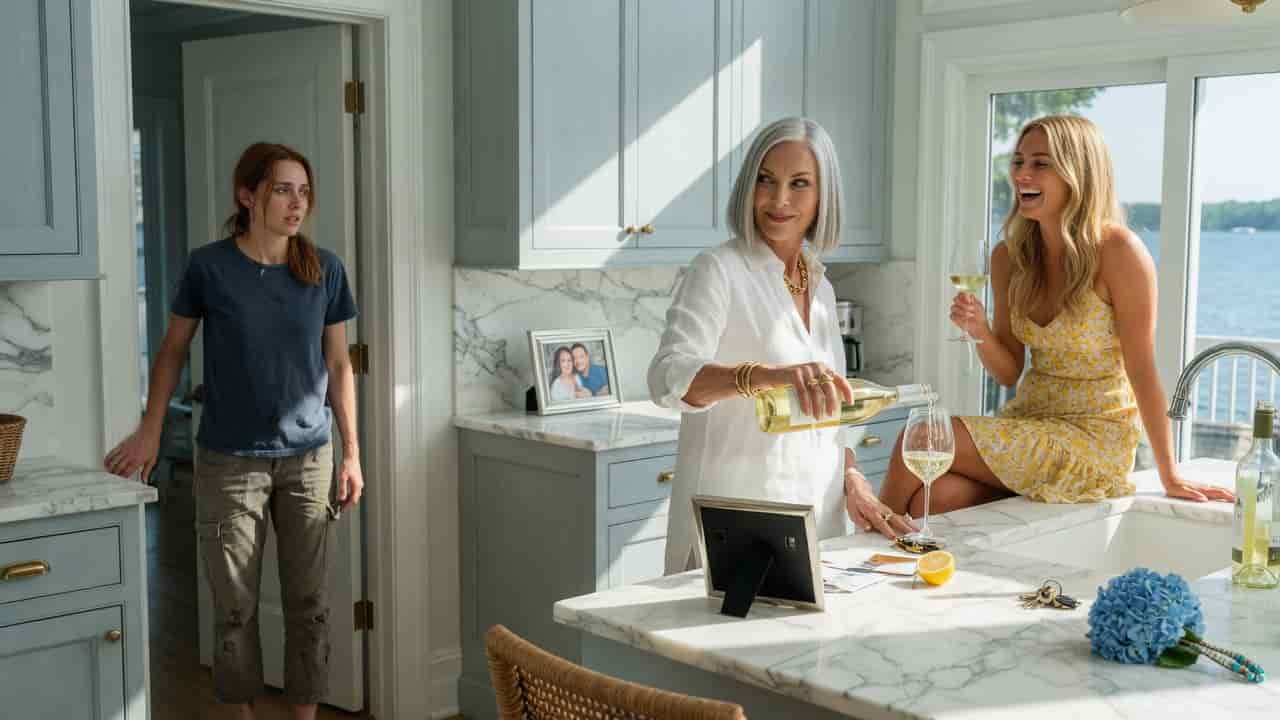
Glenda wasn’t praying. She was pouring expensive Chardonnay for a girl who couldn’t have been more than twenty-four—a girl wearing the exact same smile I used to have before ten years of marriage to Glenda’s “perfect” son wore me down to the bone.
The worst part wasn’t the girl. It was the way Glenda looked at me. There was no shame. No panic. Just the cold, sharp satisfaction of a woman who had finally succeeded in replacing the daughter-in-law she never wanted. She had been facilitating their “getaways” for months, lying to my face every single Sunday at dinner, while I thanked her for being such a supportive mother-in-law.
She didn’t even put the bottle down. She just watched me break, right there in front of the woman she’d chosen to take my place. I found the keys she “lost” last week, but I never expected them to open a door to this kind of betrayal.
Chapter 1
The humming of the refrigerator was the only thing keeping the silence from swallowing the kitchen whole. Hannah sat at the small pine table, a cup of tea gone cold in her hands, watching the digital clock on the stove. 11:14 PM. Mark’s flight from O’Hare would have landed two hours ago. By now, he should have been in the back of an Uber, texting her that he’d made it to the Hilton, complaining about the humidity or the lack of legroom.
Her phone sat facedown on the Formica. It hadn’t vibrated once.
Mark had been traveling more lately. “Project expansion,” he called it. He was a mid-level architect at a firm in Charlotte, a man whose life was measured in blueprints and site visits. For ten years, Hannah had been the one to keep the foundation of their actual life level. She managed the bills, the garden, the leak in the basement, and the increasingly sharp moods of his mother, Glenda.
Glenda lived four miles away in a house that smelled of lemon polish and unaddressed resentment. She had never quite forgiven Hannah for being the girl from the wrong side of the county—the girl whose father had disappeared into a bottle and whose mother had worked two jobs at the textile mill. To Glenda, Hannah was a temporary lapse in Mark’s judgment that had somehow stretched into a decade.
The back door creaked, and Hannah jumped, her heart hammering against her ribs. But it wasn’t Mark. It was the wind, pushing against the loose latch she’d been meaning to fix.
She stood up, her knees popping in the quiet house. She walked to the window, looking out at the dark North Carolina woods. They’d bought this house because Mark loved the privacy, but tonight, the privacy felt like a weight.
Her mind drifted, as it often did when she was alone, to the “old wound.” She was seven years old, sitting on the porch of a trailer, watching her father pack a cardboard box into the trunk of a rusted Chevy. He’d told her he was going to buy cigarettes. He’d looked her right in the eye and promised he’d be back before the cartoons started. He never came back. That look—that steady, practiced lie—had become the yardstick by which she measured every man since.
Mark wasn’t like her father. Mark was steady. Mark was predictable. Mark worked forty-five hours a week and came home to eat her pot roast and watch the news.
Then why didn’t he text?
She picked up her phone and scrolled through their messages.
Mark: Leaving for the airport now. See you Friday.
Hannah: Love you. Have a safe flight.
Mark: You too.
“You too.” It was a typo, she’d told herself. He was rushed. He was distracted. But it felt like a door being shut.
The next morning, the heat was already a physical presence by 8:00 AM. Hannah was out in the garden, pulling weeds with a ferocity that left her fingers cramped. She heard the familiar crunch of gravel—a heavy, expensive sound. Glenda’s Mercedes.
Hannah wiped her forehead with the back of a gloved hand, bracing herself.
Glenda emerged from the car looking like she’d stepped out of a catalog for Southern Matriarchs. Her silver hair was perfectly coiffed, her white linen trousers didn’t have a single wrinkle, and her eyes were hidden behind oversized designer sunglasses.
“Hannah, dear,” Glenda called out, her voice a practiced lilt that never quite reached the level of warmth. “Still digging in the dirt, I see.”
“It’s a garden, Glenda. Things grow in it.” Hannah stood up, feeling the sweat trickling down her spine. “Mark’s in Chicago. I told you that on Sunday.”
“I know where my son is,” Glenda said, walking toward the porch. She didn’t invite herself in; she simply occupied the space as if she owned the deed. “I actually came by because I think I left my spare house keys here during the cookout. The ones with the blue hydrangea keychain? I’ve looked everywhere.”
Hannah frowned. “I haven’t seen them. I cleaned the patio yesterday.”
“Well, look again,” Glenda said, her tone sharpening just a fraction. “They’re very important. They have the keys to the lake house on them. I’m thinking of heading up there this weekend for a little… spiritual realignment. The church council has been so taxing lately.”
Hannah felt a flicker of something she couldn’t name. The lake house. It was Glenda’s sanctuary, a three-bedroom cedar-sided place on Lake Norman that Mark’s father had left her. Hannah and Mark hadn’t been invited there in over a year. Glenda always claimed the plumbing was “temperamental” or she had “guests from the guild” staying over.
“I’ll check the couch cushions,” Hannah said.
“Do that. And Hannah?” Glenda paused, her hand on the car door. “You look tired. You really should put on some cream. The sun in this county is unkind to women of a certain… background.”
Hannah watched the Mercedes pull away, the dust settling on her wilted tomatoes. She went inside and began to search. She didn’t expect to find the keys. Glenda was meticulous; she didn’t lose things. She placed them.
She checked the patio. She checked the mudroom. Finally, she went to the guest bedroom, where Glenda had spent twenty minutes “freshening up” during the Sunday cookout. She reached under the bed, her fingers brushing against something cold and metallic.
She pulled it out.
It was the brass ring. The blue hydrangea keychain. But it wasn’t under the bed by accident. It was tucked into the corner of the baseboard, hidden behind the leg of the nightstand.
Hannah held the keys in her palm. They felt heavy. Significant.
Her phone buzzed in her pocket.
Mark: Sorry, meeting ran late. Phone died. In the hotel now. Miss you.
Hannah looked at the keys, then at the text. Mark’s phone didn’t die. He carried a portable charger in his briefcase like it was a vital organ. He was a man of redundancies. He had two sets of everything.
She sat on the edge of the guest bed, the blue hydrangea petals staring back at her. Why would Glenda hide her own keys in Hannah’s house? Why would she pretend they were lost?
The silence of the house felt different now. It wasn’t empty; it was waiting. Hannah looked at the keys and felt the first true crack in the foundation. She wasn’t the girl from the trailer anymore, but she knew the smell of a lie when it started to rot.
Chapter 2
The keys sat on the kitchen counter for three hours. Hannah stared at them while she folded laundry, while she ate a sandwich she couldn’t taste, and while she stared at the empty space in the driveway where Mark’s truck usually sat.
She knew what a normal person would do. A normal person would call Glenda and say, “Found them! They were under the guest bed.” Then Glenda would come over, make a snide comment about Hannah’s housekeeping, take the keys, and drive off to her lake house.
But Hannah wasn’t feeling normal. She was feeling the residue of ten years of being “the girl from the mill.” She was feeling the way Mark had stopped looking at her when he spoke, his eyes always drifting to his laptop or his watch.
She picked up the keys and walked to her car.
She didn’t drive to Glenda’s. Instead, she drove to the local florist, a tiny shop run by a woman named Martha who had been in the town since before the roads were paved. Martha was the unofficial keeper of the county’s social ledger.
“Hannah Markson,” Martha chirped, clipping the stems of some wilting carnations. “You looking for something for the kitchen? I got some lovely sunflowers just in.”
“Actually, Martha, I was wondering about those arrangements Glenda ordered. For the lake house? I think she forgot to give me the delivery time, and I wanted to make sure someone was there to let you in.”
It was a gamble. A lie built on a hunch.
Martha paused, her shears mid-air. She looked at Hannah over her spectacles. “Oh, honey, those were delivered yesterday morning. Gorgeous spread. Lilies, white roses, the works. Your mother-in-law was real specific. Said it had to be ‘celebratory’ for her son’s homecoming.”
The air in the shop suddenly felt very thin.
“Homecoming?” Hannah managed to say, her voice steady even as her heart began to gallop.
“That’s what she said. Said Mark was taking a few days off to celebrate a big win at the firm. I thought you’d be up there already.” Martha’s expression shifted from professional to curious, then to something that looked a lot like pity. “You okay, Hannah? You look a bit peaked.”
“I’m fine,” Hannah said, backing toward the door. “Just… allergies. Thanks, Martha.”
She got back into her car and sat in the heat until the interior felt like an oven. Mark was in Chicago. Mark was at a Hilton. Mark was at a conference.
Except Mark’s mother had ordered “homecoming” flowers for the lake house twenty-four hours ago.
Hannah didn’t go home. She drove to the outskirts of town, to a small, cluttered house with a porch full of rusting birdfeeders. This was the home of Mrs. Gable, Glenda’s neighbor at the lake. Mrs. Gable was ninety, mostly blind, but she heard everything that moved on the private road.
Hannah found her on the porch, rocking in a chair that groaned with every movement.
“Mrs. Gable? It’s Hannah. Mark’s wife.”
“I know who you are, child,” the old woman wheezed. “You’re the one who brings the lemon bars to the Fourth of July bash. Though you haven’t been around much lately.”
“No, I haven’t. I was wondering… has the lake house been busy? Glenda mentioned she might have some guests, and I wanted to make sure they weren’t bothering you.”
Mrs. Gable chuckled, a dry, rattling sound. “Bothering me? No. But that little yellow car is a bit loud. Constant back and forth. And the music… Glenda never was one for jazz, but someone over there sure is.”
“A yellow car?”
“Little sporty thing. Same one that’s been there the last three weekends Mark came up. I thought you’d be the one driving it, but I figured you’d have better taste than to get a car that color.”
The world tilted. The last three weekends. Mark had been “at the office” for two of those. He’d been at a “leadership retreat” for the third.
Hannah felt a cold, hard clarity settle over her. It was the same clarity she’d felt when she realized her father’s Chevy wasn’t coming back up the gravel drive. It wasn’t a secret anymore. It was a map.
“Thank you, Mrs. Gable. I’ll tell Mark you said hello.”
“You do that, honey. And tell him to fix that dock. It’s starting to rot.”
Hannah drove away, her hands steady on the wheel. She went to the grocery store. She bought a gallon of water, a pack of crackers, and a pair of binoculars from the hardware aisle. She went home and packed a small bag. She didn’t pack like someone going on vacation. She packed like a soldier.
She looked at the brass keys on the counter. The blue hydrangea.
Glenda hadn’t lost those keys. She had left them. It was a taunt. Or perhaps it was a test. Glenda wanted to see if Hannah was “too stupid” to find the truth, or if she was weak enough to find it and stay silent.
Hannah thought about the photo Glenda had in her hallway—a picture of Mark as a boy, sitting on Glenda’s lap. Glenda had always treated him like a prize she’d won, not a human being she’d raised. And Hannah was the thief who had stolen the prize.
If Glenda wanted a game, Hannah would play. But she wouldn’t play by the rules of a Southern lady. She would play by the rules of a girl who had learned to survive on nothing but her own grit.
She checked her phone one last time.
Mark: Going to dinner with the clients. Don’t wait up. Love you.
“Love you,” Hannah whispered to the empty kitchen.
She picked up the keys and walked out the door. She didn’t lock it. There was nothing left in that house worth protecting.
Chapter 3
The drive to Lake Norman took two hours. Hannah stayed in the right lane, her speed exactly five miles over the limit. She didn’t listen to the radio. She didn’t think about the “what-ifs.” She thought about the architecture of the betrayal.
Mark couldn’t have done this alone. He was too cautious, too worried about his reputation. He needed a facilitator. He needed someone to provide the space, the alibi, the “homecoming” flowers. He needed Glenda.
And Glenda… Glenda would do anything to have her son back under her thumb. If that meant providing a younger, “prettier,” more “suitable” woman to replace the mill girl, Glenda would consider it a holy crusade.
As the sun began to dip below the treeline, casting long, orange shadows across the water, Hannah turned onto the private gravel road that led to the lake house. She doused her headlights and rolled slowly, the car coasting on the downhill slope.
She parked three houses away, tucked behind a thicket of overgrown rhododendrons.
She stepped out of the car. The air was thick with the scent of pine needles and lake water. It was peaceful. It was the kind of place where people came to forget their troubles.
She pulled the binoculars from her bag and crept through the woods, her movements careful and practiced. She’d spent her childhood hiding in the brush to avoid the bill collectors; she knew how to be a ghost.
The lake house came into view. It was a beautiful structure—tall windows, a wraparound porch, and a dock that stretched out into the glassy water like a finger.
And there, parked in the gravel turnaround, was Mark’s black SUV.
Next to it sat a bright yellow convertible.
Hannah felt a sharp, stabbing pain in her chest, but she didn’t let it stop her. She raised the binoculars.
The lights were on in the kitchen. She could see figures moving behind the glass.
She saw Glenda first. The silver hair was unmistakable. She was wearing a tunic that looked like silk, moving with an effortless grace that made Hannah’s stomach churn. She was laughing. Glenda didn’t laugh like that with Hannah. With Hannah, Glenda’s smiles were thin, defensive things. This was a deep, genuine sound of triumph.
Then, a girl walked into the frame.
She was young. Late twenties, maybe. Long blonde hair that caught the light, a yellow sundress that looked expensive and effortless. She looked like the kind of girl Mark used to point out in magazines—the “natural” ones who spent three hours on their makeup to look like they’d just woken up.
The girl put an arm around Glenda’s shoulders. They looked like mother and daughter. They looked like a family.
Hannah felt a wave of nausea so strong she had to lean against a tree to keep from vomiting. It wasn’t just an affair. It was a replacement. Mark hadn’t just found someone else; he had found a version of a life that Glenda approved of.
Where was Mark?
She waited. Ten minutes. Twenty.
Then he appeared. He was wearing a t-shirt Hannah had bought him for his birthday—a soft, grey cotton one he said was his favorite. He walked up behind the blonde girl and kissed the top of her head. He didn’t look like a man at a business conference. He didn’t look like a man carrying the weight of a ten-year lie. He looked… happy.
He looked relieved.
Hannah lowered the binoculars. The silence of the woods was suddenly deafening. She thought about her childhood—the way she’d waited on that porch for a man who never came back. She realized she’d been doing the same thing for the last two years. She’d been waiting for Mark to come back to her, not realizing he had already left. He’d just forgotten to take his clothes.
The betrayal was total. It wasn’t a mistake. It was a construction. Glenda had built a “Third Bed” in this house—a place where Mark could play at being a different man, a man who didn’t come from a mill town, a man who belonged to the kind of woman Glenda could brag about at the church guild.
Hannah looked at the keys in her hand. The brass hydrangea.
She knew why Glenda had left them. It wasn’t a test. It was an invitation to witness her own execution. Glenda wanted Hannah to see this. She wanted Hannah to walk in, realize she was nothing, and disappear into the night like her father had.
Glenda wanted the satisfaction of seeing Hannah’s spirit break.
Hannah straightened her shirt. She wiped the sweat and dirt from her face. She thought about the “mill girl” Glenda so despised. The mill girls were tough. They knew how to work until their fingers bled. They knew how to survive the winter with no heat.
And they knew how to take back what was theirs.
She didn’t go back to her car. She walked toward the house. She didn’t sneak this time. She walked right up the center of the gravel drive, her footsteps crunching loud and clear in the evening air.
She reached the porch. She could hear the music now—the jazz Mrs. Gable had mentioned. It sounded like a celebration.
She put the key into the lock. It turned with a smooth, oiled click.
Hannah took a deep breath, the air tasting of ozone and iron. She pushed the door open.
Chapter 4
The interior of the lake house smelled of expensive candles and the white lilies Martha had delivered. The jazz was coming from a sleek Sonos system in the corner, a smooth, brassy sound that felt like a slap in the face.
Hannah didn’t stop in the foyer. She walked straight into the open-plan kitchen and dining area.
The scene froze the moment she entered the light.
Glenda was standing by the marble island, a bottle of Chardonnay in her hand. Tiffany—the blonde girl—was perched on a barstool, a half-full glass in her hand, her head tilted back in a laugh that died mid-breath.
Mark wasn’t in the room. He must have gone to the back deck or the bedroom.
For a heartbeat, there was only the sound of the saxophone and the hum of the air conditioning.
Glenda didn’t flinch. She didn’t drop the bottle. She didn’t even look surprised. She slowly finished pouring the wine into Tiffany’s glass, her eyes fixed on Hannah with a cold, terrifying amusement.
“See?” Glenda said, her voice cutting through the jazz like a razor. “I told you she was too stupid to find us.”
Tiffany’s eyes widened. She looked at Hannah, then back at Glenda, her face pale. “Glenda, stop, she’s right there.”
“Let her listen,” Glenda snapped, setting the wine bottle down on the marble with a deliberate thud. The sound echoed off the high ceilings. “It’s the first time she’s been useful all year. Maybe now she’ll finally understand what everyone else has known for months.”
Hannah felt the air leave her lungs. The humiliation was physical, a weight pressing down on her shoulders. She looked at Tiffany—this girl who was wearing a sundress that probably cost more than Hannah’s car payment. Tiffany looked uncomfortable, but she didn’t look guilty. She looked like she was watching a movie she didn’t quite enjoy.
“Months?” Hannah’s voice was a whisper, a ragged thing she barely recognized.
“Nearly a year, dear,” Glenda said, leaning against the island, crossing her arms over her white linen tunic. The gold on her wrists caught the light. “Mark tried to tell you, in his own way. But you were always so… persistent. So determined to play the role of the devoted wife. It was embarrassing, really. Watching you scrub his floors while he was up here, finally breathing.”
“Glenda, please,” Tiffany said, her voice small. “Maybe we should go.”
“Go? Why?” Glenda turned her gaze to Tiffany, her expression softening into something maternal and predatory. “This is your house, Tiffany. It will be, anyway. Once the lawyers finish cleaning up the mess Mark made ten years ago.”
The “mess.” That was Hannah. Ten years of life, of building a home, of supporting Mark through his exams and his father’s death—all of it was just a “mess” to be cleaned up.
Hannah looked at the counter. Next to the sink sat a framed photo. It was the one from their wedding day. Hannah remembered that day—she’d been so proud, so sure she had finally escaped the shadow of her father’s trailer. But the photo was turned face down on the marble.
In its place sat a new photo. A digital frame showing a slideshow of Mark and Tiffany at the lake. Laughing on the boat. Toasting with champagne. Mark looking at the camera with a light in his eyes Hannah hadn’t seen in half a decade.
“Where is he?” Hannah asked.
“He’s on the dock,” Glenda said, picking up her own glass. She took a slow, deliberate sip. “He’s waiting for the sun to go down so he can take Tiffany out on the water. It’s their anniversary, you see. One year since they met at the firm’s holiday party. The one you were ‘too tired’ to attend.”
Hannah remembered that party. She hadn’t been too tired. Mark had told her it was “associates only.” He’d told her it would be boring.
He’d lied. He’d lied for a year. And Glenda had held the flashlight so he could see where he was going.
“You did this,” Hannah said, looking at Glenda. “You set this up. The ‘business trips.’ The ‘conferences.’ You hosted them here.”
“I provided my son with the life he deserved,” Glenda said, her voice dropping the lilt and becoming hard as flint. “He was drowning with you, Hannah. You’re a mill girl. You’re a reminder of everything he wanted to leave behind. Did you really think you could keep him? A man like Mark needs a woman who understands his world. Not someone who thinks a big night out is a trip to the local diner.”
Hannah looked at the brass keys in her hand. She felt the cold metal biting into her palm.
“The keys,” Hannah said. “You left them on purpose.”
Glenda smirked. “I wanted to see if you had even a shred of dignity left. I wanted to see if you’d finally take the hint and walk away without making a scene. But here you are. Stinking of sweat and desperation, standing in my kitchen like a stray dog.”
Tiffany stood up from the barstool. “I… I’m going to go find Mark.”
“Stay right there, Tiffany,” Glenda commanded. “She needs to see this. She needs to see exactly what she’s losing.”
Hannah looked at Glenda—this woman who had sat at her table and prayed over their food. This woman who had hugged her when Mark’s father died.
The anger came then. It wasn’t the hot, screaming anger of a fight. It was the cold, lethal anger of someone who has nothing left to lose.
“You think you’ve won,” Hannah said, her voice steadying. “You think you’ve replaced me.”
“I haven’t replaced you, Hannah,” Glenda said, walking around the island, her heels clicking on the hardwood. She stopped three feet from Hannah, the scent of her expensive perfume clashing with the smell of the lake. “I’ve simply corrected a mistake. Now, give me my keys and get out of my house before I call the sheriff and tell him you’ve broken in.”
Hannah looked at the keys. Then she looked at the glass doors leading to the dock. She could see the silhouette of a man standing by the water. Mark.
She didn’t give Glenda the keys. She didn’t scream.
She turned to Tiffany. “Do you know about the other ones?”
Tiffany blinked, confused. “What?”
“The other girls,” Hannah said, her voice loud enough to carry over the music. “Glenda’s very good at this. She did it to Mark’s father, too. She helped him hide his ‘distractions’ for years, just so she could keep control of the money. She’ll do it to you, too. The moment you stop being ‘suitable.’ The moment you have a bad day or put on five pounds, Glenda will find a younger version of you to sit on this barstool.”
“That’s a lie!” Glenda hissed, her face contorting with rage.
“Is it?” Hannah looked back at her. “Mark’s father didn’t die of a heart attack at his desk, Glenda. He died in a motel room in Gastonia. And you paid the manager to keep it out of the papers. I found the receipts in the attic three years ago. I kept them because I thought I was protecting the family name.”
The room went deathly quiet. Even the saxophone seemed to fade.
Glenda’s hand trembled. For the first time, the mask of the Southern Matriarch slipped, revealing the hollow, bitter woman underneath.
“You… you wouldn’t,” Glenda whispered.
“I’m a mill girl, Glenda,” Hannah said, her voice cold and clear. “We don’t just dig in the dirt. We know how to bury things. And we know how to dig them back up.”
Hannah turned and walked toward the door.
“Hannah!” Glenda shouted. “Give me those keys!”
Hannah stopped at the threshold. She looked at the brass hydrangea. She threw the keys over her shoulder. They skittered across the marble floor, hitting the wine bottle with a sharp clink.
“Keep the house, Glenda,” Hannah said. “It’s already rotting.”
She walked out into the night. She didn’t look back at the dock. She didn’t look back at the light in the windows. She walked down the gravel drive, her heart beating a new rhythm.
She wasn’t the girl on the porch anymore. She was the one who had walked away.
But the residue was there. The weight of the year-long lie. The image of Mark’s favorite t-shirt on another woman’s floor.
The story wasn’t over. It was just starting to burn.
Chapter 5
The gravel of the driveway didn’t just crunch under Hannah’s boots; it felt like it was grinding the last decade of her life into dust. She didn’t run. Running was for people who still had something to lose, and as the humid night air hit her face, she realized she had been stripped clean. The smell of the lake—damp, fishy, and deceptively peaceful—seemed to cling to her skin like a second, unwanted layer of clothing.
She was ten yards from her car when the screen door of the lake house slapped shut. It was a sharp, domestic sound that should have signaled a husband coming out to greet his wife.
“Hannah! Wait! Just—dammit, Hannah, stop!”
Mark’s voice was ragged. It wasn’t the voice of the confident architect who gave presentations to city councils. It was the voice of a man who had just seen the floorboards of his carefully constructed life give way.
Hannah didn’t stop. She reached her car, her fingers fumbling with the door handle. The metal was cool, slick with the evening’s rising dew.
“Hannah, look at me!”
He caught up to her just as she got the door open. He grabbed the edge of the frame, preventing her from swinging it shut. He was breathing hard, his face flushed in the dim light of the overhead dome lamp. In the grey t-shirt she’d bought him, he looked smaller than she remembered. Or maybe she was finally seeing him at his true scale.
“Don’t touch the car, Mark,” she said. Her voice was flat, devoid of the vibrance he’d spent years dampening. “Just get your hand off the frame.”
“We need to talk. You can’t just… you can’t just walk in here and then disappear into the night. It’s not safe for you to drive like this.”
“Safe?” Hannah let out a short, jagged laugh that felt like a splinter in her throat. “You’re worried about my safety now? After a year of letting your mother hide your mistress in her guest house while I was at home wondering why you wouldn’t pick up the phone?”
Mark winced. He looked back toward the house, toward the windows where Glenda and Tiffany were undoubtedly watching. The cowardice in that glance was a revelation. He wasn’t worried about Hannah; he was worried about the audience.
“It’s complicated, Han. It wasn’t… it’s not what it looks like.”
“It looks like a betrayal,” she said, finally turning to face him. She stood her ground, her height nearly matching his, her eyes hard and dry. “It looks like a year of calculated lies. It looks like you found someone who fits your mother’s ‘social requirements’ and decided to keep me around as a backup plan until the paperwork was ready. Is that the ‘complicated’ version, Mark? Or is there a more creative blueprint I’m missing?”
“I didn’t want to hurt you,” he whispered, and the sheer banality of the statement made her want to scream. “I just… things got so heavy at home. You were always so stressed, always so focused on the house, on Leo, on the bills. Tiffany… she made things feel light again.”
“She made things feel light because she didn’t have to carry anything,” Hannah snapped. “I carried the weight. I was the foundation, Mark. I was the one who made it possible for you to even have a home to be stressed about. You didn’t find ‘lightness.’ You found a way to let someone else pay the emotional rent while I did the work.”
He reached out, his hand hovering near her shoulder, but he didn’t dare make contact. “My mother… she just wants me to be happy. She saw how much I was struggling.”
“Your mother wants a doll,” Hannah said, her voice dropping to a dangerous, low register. “She wants a son she can parade around the country club, and she wants a daughter-in-law who doesn’t remind her that she married for money and spent forty years pretending it was love. She hates me because I know exactly who she is. And now, Mark, I know exactly who you are, too.”
“What are you going to do?” There it was. The fear. The practical, selfish concern of a man who lived for his reputation.
“I’m going to go get our son,” Hannah said. “And I’m going to go home. To the house I maintain. To the life I built. And you? You stay here. Stay in the Third Bed. Stay with your mother and your ‘lightness.’ See how long that foundation holds up when there’s no one left to do the repairs.”
She shoved his hand off the car door with a strength that surprised them both. She slid into the seat, the leather warm against her legs. She didn’t look at him as she cranked the engine. She didn’t look at him as she backed out of the rhododendrons, the gravel flying beneath her tires.
She drove.
The two-hour trip back toward the suburbs was a blur of highway lights and the rhythmic thumping of the tires over the expansion joints. She didn’t cry. The tears were there, hovering just behind her eyelids, but she refused to let them fall. If she started crying now, she might never stop, and she had a job to do.
She had to protect Leo.
Leo was eight. He was a quiet, sensitive boy who spent his Saturday mornings drawing elaborate maps of imaginary worlds. He adored his father, but he worshipped his grandmother. Glenda was the woman who brought him expensive Lego sets and took him to “high tea” at the Ritz, treating him like a little prince. To Leo, Glenda was the hero of every story.
Hannah pulled into her sister Sarah’s driveway at 11:30 PM. Sarah was already on the porch, a cigarette glowing in the dark—a habit she only indulged in when she was worried.
“Hannah?” Sarah stood up as Hannah killed the engine. “What happened? You said you were just going to check on something.”
Hannah stepped out of the car, her legs feeling like lead. “He’s at the lake house, Sarah. With her. And Glenda.”
Sarah dropped the cigarette and crushed it under her heel. “That bitch. I knew it. I told you three months ago that his ‘late nights’ smelled like perfume and lies.”
“Is Leo asleep?”
“Out like a light. He’s on the couch.” Sarah walked over and pulled Hannah into a fierce, bone-crushing hug. “What do you need? You want me to call a lawyer? You want me to drive up there and burn that cedar shack to the ground?”
“I need to think,” Hannah said into her sister’s shoulder. “I need to go home and find the box.”
“The box from the attic? Hannah, that was years ago. Are you sure?”
“I’ve never been surer of anything in my life. Glenda thinks she can treat me like disposable trash because I’m from the mill. She thinks I don’t have the stomach for a real fight.” Hannah pulled back, her face set in a grim mask of determination. “She’s about to find out that when you grow up with nothing, you learn how to hold onto the truth until it’s time to use it like a knife.”
Hannah didn’t wake Leo. She let him sleep at Sarah’s, promising to come back in the morning. She couldn’t have him see her like this—not yet. She needed to be the architect for one more night.
She drove to her own house. The suburban street was quiet, the lawns perfectly manicured, the porch lights glowing with a false sense of security. She walked through her front door and didn’t turn on the lights. She knew the layout by heart. She knew every creak in the floorboards, every scuff on the baseboards.
She went to the hallway closet and pulled down the folding stairs to the attic.
The air up there was stale and hot, holding the trapped heat of the North Carolina afternoon. She moved past the Christmas decorations, past the boxes of Mark’s old college textbooks, to the very back, under the eaves.
She found it. A small, grey metal lockbox covered in a thick layer of dust.
She didn’t have the key anymore, but she had a hammer from the toolbox downstairs. She didn’t hesitate. She struck the lock with a singular, focused violence. Clang. Clang. On the third strike, the latch snapped.
She sat on the dusty floor and opened the lid.
Inside were the receipts she’d mentioned to Glenda. The death certificate for Mark’s father, Arthur Markson. The official cause of death was listed as a myocardial infarction. But tucked behind it was the private investigator’s report Glenda had tried to burn. The report that detailed the motel room in Gastonia. The photos of the woman Arthur had been with—a waitress half his age.
And then, the real prize. A series of canceled checks, signed by Glenda Markson, made out to “Cash” in increments of five thousand dollars, dating back to the month after Arthur’s funeral. On the memo lines of the later ones, in Glenda’s elegant, looping script, were the words: Consultation fees.
Hannah knew what they were. They were hush money. Glenda had spent a decade paying off the motel manager and the woman to ensure that Arthur’s “legacy” remained untarnished. She had built the family’s social standing on a foundation of paid silence.
Hannah held the papers in her hand. The residue of the secret felt like grease on her fingertips. For years, she had kept this box hidden, thinking she was protecting Mark from the truth about his father. She had thought she was being a “good wife” by sparing him the shame.
Now she realized she hadn’t been protecting Mark. She’d been protecting Glenda. She’d been keeping the very weapon Glenda would eventually use to destroy her.
Her phone vibrated in her pocket. It was a text from Glenda.
Glenda: You are making a grave mistake, Hannah. Mark is distraught. If you attempt to use those pathetic lies to embarrass this family, I will ensure you never see a dime of child support. I have the best lawyers in the state. You have nothing. Don’t come back to this house. Your things will be sent to your sister’s in garbage bags, where they belong.
Hannah looked at the screen. She didn’t reply. She didn’t feel fear. She felt a strange, cold peace.
She looked at the canceled checks. She looked at the motel photos.
“Garbage bags,” Hannah whispered.
She stood up, clutching the box to her chest. She wasn’t going to her sister’s. She wasn’t going to hide.
Sunday morning was the Annual Heritage Fundraiser at the First Presbyterian Church. Glenda was the chairwoman. The entire “suitable” world of the county would be there—the lawyers, the judges, the families who decided who belonged and who was a “mistake.”
Hannah went downstairs and began to iron her best dress. It wasn’t silk, and it wasn’t from a catalog. It was a simple black sheath she’d bought on sale at a department store. But as the steam rose from the fabric, she knew it was the most important thing she would ever wear.
She was going to the fundraiser. And she was bringing the box.
Chapter 6
The sun rose on Sunday with a brutal, unyielding heat that made the air shimmer over the asphalt of the church parking lot. It was the kind of morning where the humidity felt like a physical hand pressing down on your chest, forcing you to breathe slowly, carefully.
Hannah sat in her car, the engine idling, the air conditioning blasting. She looked at herself in the rearview mirror. Her auburn hair was pulled back into a tight, professional bun. Her makeup was minimal, but her eyes were sharp, the pupils dilated with a steady, cold adrenaline.
On the passenger seat sat a manila envelope. Inside were the contents of the grey metal box—neatly organized, photocopied, and ready.
She watched the parade of luxury SUVs and sedans pull into the lot. The First Presbyterian Church was a fortress of red brick and white steeples, a place where the air always smelled of floor wax and old money. This was Glenda’s domain. Here, she wasn’t just a mother-in-law; she was a pillar. She was the woman who organized the charities, who chose the altar flowers, who decided which families were “in” and which were quietly nudged toward the back pews.
Hannah saw the black SUV pull in. Mark was driving. He looked exhausted, his shoulders hunched even through the fabric of his suit jacket. In the passenger seat sat Glenda, looking regal in a pale violet dress and a wide-brimmed hat.
Tiffany wasn’t with them. Even Glenda knew that bringing the mistress to the Heritage Fundraiser was a bridge too far, even for a “corrected mistake.”
Hannah waited until they had walked up the stairs and disappeared through the heavy oak doors. She took a deep breath, grabbed the envelope, and stepped out into the heat.
The sanctuary was packed. The sound of the organ filled the space, a deep, rumbling vibration that Hannah could feel in the soles of her feet. She slipped into the very back row, staying in the shadows of the vestibule.
Glenda was on the dais, sitting next to the pastor. She looked perfect. She looked untouchable.
The service was a blur of hymns and prayers, but the main event was the “Heritage Presentation.” Glenda stood at the mahogany lectern, her voice amplified by the hidden speakers, sounding like honey and polished silver.
“We are here today to honor the foundations of our community,” Glenda said, her smile beaming out at the congregation. “Families like the Marksons, who have built this town with integrity and hard work. My late husband, Arthur, always said that a man’s legacy isn’t measured in bricks, but in the truth he leaves behind.”
Hannah felt a bitter taste in her mouth. The audacity of it—the sheer, unadulterated gall of Glenda invoking Arthur’s “truth”—was the final spark.
The presentation ended, and the congregation moved toward the fellowship hall for the fundraiser brunch. This was the moment of maximum social density. Everyone who mattered was in that room, balancing mimosas and quiche, waiting to congratulate Glenda on another successful event.
Hannah walked into the hall.
The room didn’t go silent immediately. It happened in waves. A few people noticed the “mill girl” in the black dress first, their whispers rippling through the crowd. Then Mark saw her. He froze, a glass of orange juice halfway to his lips.
Glenda saw her last. She was surrounded by a circle of the town’s most influential women. When she spotted Hannah, her expression didn’t change, but her eyes turned into chips of ice.
“Hannah,” Glenda said, her voice loud enough to carry. “I believe you’ve mistaken the venue. This is a private event for the Heritage members.”
Hannah didn’t stop until she was five feet away from the circle. She didn’t look at Mark. She kept her eyes locked on Glenda.
“I’m here to contribute to the ‘Heritage’ discussion, Glenda,” Hannah said. Her voice was calm, steady, and remarkably clear. “I thought the congregation might be interested in the full scope of the Markson legacy. The parts you forgot to mention in your speech.”
“Mark,” Glenda snapped, “get her out of here. She’s clearly unwell.”
Mark stepped forward, his face pale. “Hannah, please. Don’t do this. Let’s go outside.”
“I’m not going anywhere, Mark,” Hannah said, side-stepping him. She held up the manila envelope. “I have some ‘consultation fees’ I’d like to discuss. And some motel records from Gastonia.”
The word motel hit the room like a gunshot. The ladies in Glenda’s circle shifted, their eyes darting between the two women.
“You’re pathetic,” Glenda hissed, leaning in so only Hannah could hear. “You think these people will believe a girl like you over me? I built this town. You’re nothing.”
“I might be nothing to you, Glenda,” Hannah said, her voice rising just enough to ensure the surrounding tables could hear. “But the bank records don’t lie. Neither do the photos of the woman your husband was with when he died. The woman you’ve been paying five thousand dollars a month to stay quiet for the last ten years.”
Hannah opened the envelope and pulled out the first canceled check. She didn’t hand it to Glenda. She handed it to Mrs. Sterling, the oldest and most fearsome member of the church board, who happened to be standing right next to them.
“This is from the Markson estate account, Mrs. Sterling,” Hannah said. “Note the memo line. ‘Consultation.’ It’s a very expensive word for silence, isn’t it?”
Mrs. Sterling put on her glasses, her face turning into a mask of shock as she read the name and the amount. The check was passed to the next woman. And the next.
“And here,” Hannah continued, pulling out the investigator’s report, “is the truth about Arthur’s ‘legacy.’ He didn’t die at his desk. He died in Room 14 of the Pine Tree Motor Inn. Glenda knew. She’s known for a decade. She’s been facilitating lies for her husband just like she’s been facilitating them for her son.”
The silence in the room was now absolute. Even the catering staff had stopped moving. Mark looked like he wanted to vanish through the floorboards. Glenda was shaking—not with grief, but with a pure, impotent fury.
“How dare you,” Glenda breathed, her face turning a mottled red. “After everything we gave you. After we let you into this family.”
“You didn’t let me into anything, Glenda,” Hannah said. “You tried to lock me in a closet. You tried to make me an accomplice to your hypocrisy. But I’m done. I’m done carrying your secrets.”
Hannah turned to the room, to the faces of the people who had looked down on her for ten years. “My husband spent the last year at his mother’s lake house with another woman. Glenda hosted them. She bought the flowers. She told me he was on business trips while she was helping him replace me with someone ‘suitable.’ That is the Markson heritage. Lies, payoffs, and a total lack of spine.”
She looked at Mark. He looked broken. He looked like the small, hollow man he had always been under the surface.
“I’m filing for divorce tomorrow, Mark,” Hannah said. “And I’m taking Leo. He doesn’t need to learn how to build his life on top of a crime scene.”
She didn’t wait for a response. She didn’t need one. She could see the residue of the truth settling over the room. Glenda’s social standing was dissolving in real-time, the whispers starting up again, sharper this time, aimed directly at the woman in the violet hat. The “suitable” world was already closing its doors.
Hannah walked out of the fellowship hall. She walked through the heavy oak doors and out into the blazing North Carolina sun.
She went to her car and sat for a moment, her hands resting on the steering wheel. She felt a strange lightness—the real kind, the kind that comes from shedding a burden you were never meant to carry.
She drove to Sarah’s house.
Leo was in the yard, running through the sprinkler, his laughter a bright, clean sound that cut through the heavy afternoon. When he saw Hannah’s car, he stopped and waved, his face lighting up with a pure, uncomplicated joy.
Hannah stepped out of the car. She felt the residue of the morning—the anger, the shame, the adrenaline—starting to fade, replaced by a deep, quiet resolve.
“Mom! Look!” Leo shouted, pointing at a rainbow forming in the mist of the sprinkler. “It’s a perfect one!”
“It is, Leo,” Hannah said, walking toward him. “It’s perfect.”
She picked him up, his wet t-shirt dampening her black dress. She didn’t care. She held him tight, breathing in the scent of grass and sunshine.
The life she had known was gone. The house, the marriage, the “family” she had tried so hard to belong to—it was all ash. But as she looked at her son, she realized she hadn’t lost her heritage. She had claimed it.
She was a mill girl. She was a survivor. And for the first time in her life, she was free.
She walked into Sarah’s house, leaving the heat behind. She had a lot of work to do. She had a new life to architect. And this time, she was building it on solid ground.
The phone in her purse buzzed—a call from Mark.
Hannah didn’t answer. She reached into her bag, pulled the phone out, and turned it off.
The silence wasn’t deafening. It was exactly what she needed.