
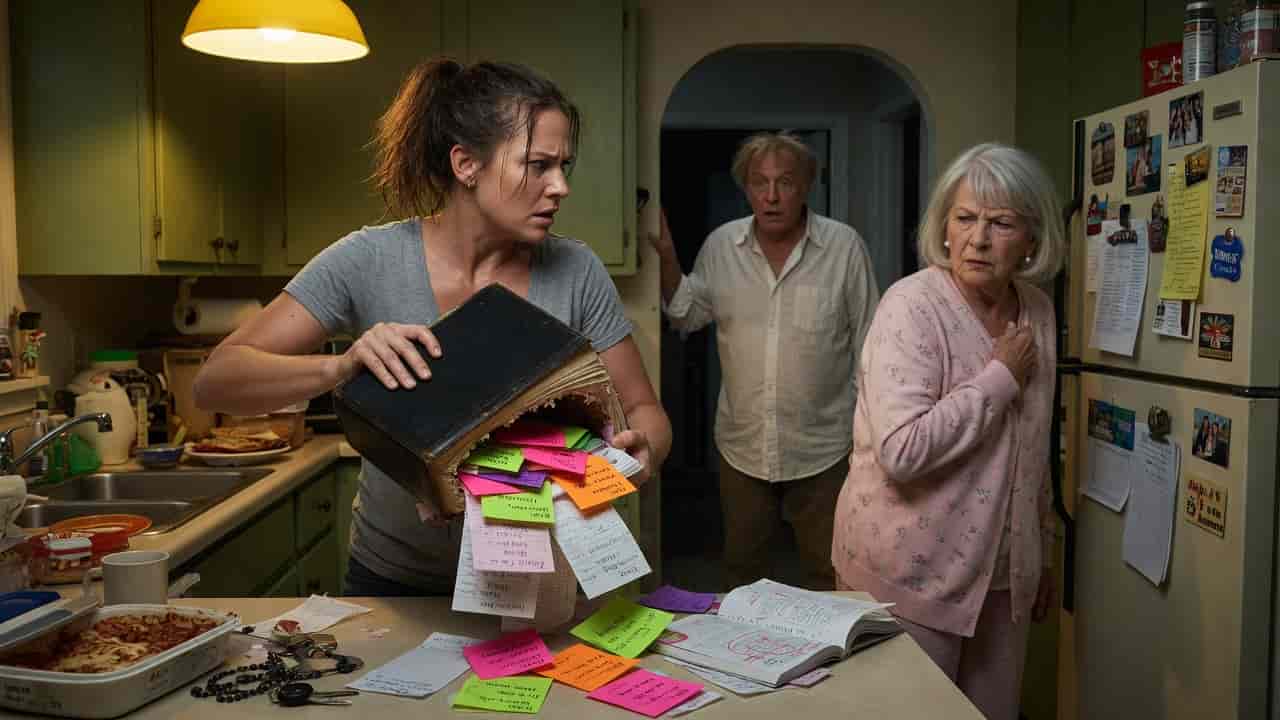
“You really think Mark is going to choose you?”
Mary didn’t even look at the betting slips I’d just pulled out of her ‘prayer’ Bible. She didn’t look at the evidence that proved she was the one who emptied our joint savings account to pay off her secret debts. She just looked at me like I was something she’d found on the bottom of her shoe.
My husband was standing right there in the hallway. He saw the neon slips. He saw the hollowed-out book. But Mary just smiled that sweet, grandmotherly smile that had fooled everyone for years and pointed at my chest.
“Look at where you came from, Lena,” she whispered, her voice loud enough for Mark to hear every word. “Your father was a drunk who lost his house to the bank. Your brother is on probation. It’s in your blood to be a failure. You’re just trying to tear this family apart because you can’t handle that we have something you never will.”
I looked at Mark, waiting for him to say something. Waiting for him to look at the slips. But he just looked at the floor. My brother is sitting in a cell right now because of her, and my own husband is letting her walk all over me because he’s too afraid to see his mother for the monster she really is.
I’m not the girl who hides anymore. If they want to treat me like a criminal, maybe it’s time I start acting like one.
Chapter 1
The blue and red lights didn’t just illuminate the street; they sliced through the humid July evening like a rhythmic strobe, turning the familiar neighborhood into something alien and hostile. Lena stood on the edge of her driveway, her arms wrapped so tightly around her chest that her fingernails dug into the denim of her jacket. She felt the eyes of the neighborhood—the Miller family from three doors down, old Mrs. Gable with her hand over her mouth—pressing against her back.
In the center of the spectacle was her brother, Leo. He was being pushed toward the back of a squad car, his head ducked, his gray hoodie pulled low. The handcuffs glinted every time the light hit them.
“I didn’t do it, Lena!” Leo’s voice cracked. It was the same voice he’d had when he was ten and accused of breaking a window he hadn’t even been near. “I swear to God, I didn’t touch it!”
“Shut up, Leo,” the officer said, not unkindly, just with the practiced exhaustion of a man who had heard it all before. He put a hand on Leo’s head and guided him into the plastic-molded seat.
Lena took a step forward, but her husband, Mark, caught her by the elbow. His grip was firm, a silent plea for her to stay back. Mark’s face was a map of confusion and grief. He looked like he’d aged ten years in the twenty minutes since the police had arrived.
“Mark, he’s on probation,” Lena whispered, her voice sounding like it was coming from a long way away. “If they charge him with this… if that money is really gone… he’s never coming out.”
“The money is gone, Lena,” Mark said. He sounded hollow. “A hundred thousand dollars. Our entire future. And the bank records show the withdrawals were made from the branch right next to the garage where he works. The security footage… they said it was someone in a gray hoodie.”
“Everyone has a gray hoodie!” Lena snapped, tearing her arm away. She looked toward the porch, where her mother-in-law, Mary, sat on a wicker chair.
Mary looked every bit the grieving matriarch. She held a damp tissue to her nose, her small frame trembling slightly in her floral cardigan. She looked fragile, a woman whose world had been shattered by the betrayal of a family member she had supposedly welcomed with open arms. When she caught Lena’s eye, she let out a soft, shuddering sob and looked away.
Lena felt a cold, sharp prickle at the base of her neck. It was a sensation she hadn’t felt since she was a teenager, back when her father would come home with that specific, glazed look in his eyes—the look of a man who had gambled away the electricity money and was already practicing the lie he’d tell her mother.
“Detective!” Lena called out, ignoring Mark’s protest as she hurried toward the man in the rumpled suit overseeing the scene. Detective Vance was a man who looked like he’d been carved out of old cedar—lined, hard, and mostly indifferent to the drama of the suburbs.
“Not now, Mrs. Thorne,” Vance said, checking a clipboard.
“My brother didn’t do this. He’s been working double shifts. He’s finally getting his life together.”
Vance finally looked at her. His eyes were a pale, watery blue. “We found three thousand in cash under the mattress in his room, Mrs. Thorne. And the keys to your house were in his pocket. No signs of forced entry. Just a clean drain of your joint savings over the last two weeks. He’s the only one with the access and the motive.”
“Three thousand isn’t a hundred thousand,” Lena argued, her heart hammering against her ribs. “Where’s the rest? If he stole it, where is the rest of our down payment?”
“Usually,” Vance said, turning back to the squad car, “the rest is already in a hole that can never be filled. Gamblers, addicts, debts… pick your poison. Your brother’s record doesn’t exactly scream ‘financial responsibility.’”
The squad car door slammed shut. The sound was final. It felt like a gavel hitting a block. Lena watched the taillights fade as the car pulled away, leaving the neighborhood in a sudden, oppressive silence that was worse than the sirens.
“Lena, come inside,” Mark said softly from behind her. “My mother is in shock. We need to… we need to figure out what to do.”
Lena looked at the house—the house they were supposed to be leaving for a better one, a house that was now a prison of lost dreams. She looked at Mary, who was now standing up, leaning heavily on the porch railing. Mary looked like a saint in the porch light.
“I’m going to the station,” Lena said.
“It’s late,” Mary’s voice drifted down, sweet and melodic, despite the supposed trauma. “Lena, dear, you need to rest. It’s been a horrible shock for everyone. To think, after everything we did for that boy…”
“Everything we did?” Lena turned, her eyes narrowed. “Leo has worked for his own keep since he moved into the guest room, Mary. He’s paid rent. He’s fixed your car. He’s been a better son to this family than I think you deserve.”
The air between them curdled. Mark stepped between them, his hands up. “Lena, stop. She’s upset. We’re all upset.”
“I’m not upset, Mark,” Lena said, her voice dropping to a dangerous, flat tone. “I’m terrified. And I’m starting to wonder why the only person who looks comfortable in this mess is the one who didn’t lose a dime.”
Mary’s face didn’t change, but her eyes did. For a split second, the fragility vanished. It was replaced by something sharp, something ancient and calculating. Then, as quickly as it appeared, the mask of the victim was back. She leaned into Mark, sobbing into his shoulder.
Lena didn’t wait to hear the comfort Mark would inevitably offer. She turned and walked toward her car, the residue of the neighborhood’s pity sticking to her skin like grease. She knew that look. She’d grown up in it. The look of a girl from a ‘bad’ family. The look of a girl who was lucky to have married into the Thornes.
As she pulled out of the driveway, she glanced in the rearview mirror. Mary was standing on the porch, no longer leaning on Mark. She was perfectly still, watching Lena leave. And she wasn’t crying anymore.
Chapter 2
The police station smelled of Floor Wax No. 5 and desperate, unwashed men. It was a smell Lena knew in her marrow. She spent an hour in the waiting room, her eyes fixed on a cracked linoleum tile, before they let her see him.
Leo looked small in the interrogation room. The gray hoodie made him look like a child, despite the faded ink on his forearms and the sharp line of his jaw. He didn’t look up when she sat down.
“Tell me the truth, Leo,” she whispered.
“I told you,” he said, his voice a jagged edge. “I didn’t touch it. I didn’t even know where the account password was kept. I thought it was on Mark’s computer.”
“The police found cash under your bed.”
Leo finally looked up. His eyes were red-rimmed. “That was my tip money, Lena. I was saving it to buy you a housewarming gift. I didn’t want to put it in the bank because I was afraid my PO would think I was making money under the table. It was only two thousand, not three. I don’t know where the other thousand came from.”
Lena felt a chill. “They found three, Leo. They were very specific.”
“Then someone put it there,” he said, leaning forward. “Lena, think. Who was in the house today? Who has the keys?”
“Just us. And Mary.”
The name hung in the air like a bad smell. Leo let out a short, harsh laugh. “Sweet Mary. She’s been in my room twice this week, Lena. Saying she was ‘tidying up.’ I told her I didn’t need help, but she just smiled and kept doing it.”
“She’s a sixty-four-year-old woman with a heart condition, Leo. Why would she steal a hundred thousand dollars and frame you?”
“Because she’s a Thorne,” Leo said, his voice dropping. “And she knows no one will ever believe the ‘jailbird’ over the ‘saint.’”
Lena wanted to argue, but the image of her father’s betting slips flashed in her mind. The way he would hide them in his shoes, in the back of the freezer, in the pages of the phone book. The way he would look at her with such love while he was lying straight to her face.
A knock on the door signaled the end of their time. As Lena stood up, Leo grabbed her hand. His grip was frantic.
“Don’t let them do this to me, Lena. I can’t go back. I won’t survive it this time.”
Lena walked out of the room, her chest feeling like it was being crushed by a slow-motion vise. In the hallway, she ran into Mary.
The older woman was sitting on a wooden bench, her hands folded over her purse. She looked like she was waiting for a bus, not a criminal update. When she saw Lena, she stood up and walked over, her face a mask of concern.
“Is he alright?” Mary asked.
“He’s terrified,” Lena said.
Mary sighed, a soft, whistling sound. She reached out and took Lena’s hand. Her skin was thin as parchment, but her grip was surprisingly strong. She leaned in, her perfume—a cloying, heavy lily scent—filling Lena’s lungs.
“You have to let him go, Lena,” Mary whispered.
Lena froze. “What?”
“He’s just a loser anyway,” Mary said, her voice devoid of its usual sweetness. It was cold, clinical. “He’s been a weight around your neck since the day he was born. Let him take the fall. The insurance might cover some of it if he’s convicted. We can save the house. My house.”
Lena pulled her hand back as if she’d been burned. “You… you’re joking.”
“I’m being practical, dear,” Mary said, her eyes boring into Lena’s. “Mark is already half-convinced. If you keep pushing, you’ll just lose him, too. Is a brother like that really worth your marriage? Think about where you came from, Lena. You worked so hard to get out of the dirt. Don’t let him drag you back down into it.”
Lena stared at her. This wasn’t a woman in shock. This was a woman who had calculated the cost of a human life and found it lacking.
“Where’s the money, Mary?” Lena whispered.
Mary didn’t blink. She just patted her hair and turned toward the exit. “I’m going to go find Mark. He’s in the parking lot. He needs his mother right now.”
Lena watched her walk away, the floral cardigan swaying with each graceful step. The residue of that conversation felt like a film of oil over Lena’s entire body. She realized then that she wasn’t fighting a misunderstanding. She was fighting a predator who had spent forty years perfecting the art of being the prey.
Chapter 3
The next three days were a blur of bank statements, phone calls to lawyers who wanted retainers she no longer had, and a silence in her own home that was louder than any argument.
Mark was in a state of catatonic denial. He went to work, he came home, and he sat in front of the television, staring at the screen without seeing it. Every time Lena tried to talk about Leo, Mark would just shake his head.
“The evidence is there, Lena,” he’d say, his voice thick with a misery that made Lena want to scream. “I want to believe him, too. But the money is gone. And my mother… she’s heartbroken. She loved him like a grandson.”
“She called him a loser, Mark! At the station, she told me to let him take the fall!”
Mark finally looked at her, his eyes red and glassy. “She was probably just overwhelmed, Lena. People say things when they’re stressed. She doesn’t mean it. She’s just… she’s old, and she’s scared.”
“She’s not scared,” Lena muttered, turning away. “She’s the only one who isn’t.”
Lena waited until Mark went to the grocery store on Saturday morning. She knew Mary was at her weekly bridge club—or so she said. Lena let herself into Mary’s small, pristine house three blocks away. She still had the spare key from when Mary had the ‘flu’ last winter.
The house smelled of lilies and lemon polish. It was the kind of house that looked like it had never seen a speck of dust or a moment of true passion. Lena felt like a thief, her heart racing as she moved through the living room.
She started in the kitchen. She checked the canisters, the back of the pantry, the hollow space under the sink. Nothing. She moved to the bedroom, her hands trembling as she went through Mary’s silk scarves and organized sock drawers. It was all so perfect, so staged.
She was about to leave, convinced she was being paranoid, when she saw it on the nightstand.
Mary’s Bible. It was a massive, old-fashioned thing with gilded edges and a heavy black leather cover. Lena remembered Mary carrying it to church every Sunday, a symbol of her unimpeachable character.
Lena picked it up. It felt wrong. It was too light for its size.
She opened the cover. The first fifty pages were intact—Genesis, Exodus, the familiar verses of her childhood. But after that, the pages had been neatly cut away, creating a deep, rectangular well in the center of the book.
Inside the well weren’t wads of cash. They were betting slips.
Dozens of them. Neon green, bright pink, printed on thermal paper that was starting to curl. There were handwritten ledgers on the back of grocery receipts, columns of numbers next to names like ‘Big Tony’ and ‘The Palace.’
The dates went back months. The amounts were staggering. Five hundred here, two thousand there. And the most recent one, dated only four days ago, was for fifty thousand dollars.
Lena felt a wave of nausea. This wasn’t just a habit; it was a hemorrhage. Mary wasn’t just gambling; she was losing on a scale that was almost hard to comprehend.
Lena heard the front door click.
She froze, the Bible still open in her hands. The sound of low, measured footsteps echoed in the hallway. Lena looked around the room—there was nowhere to hide, no back exit.
“I thought I heard someone in here,” a voice said.
Lena turned. Mary was standing in the doorway. She wasn’t wearing her cardigan. She was in a simple black dress, her face devoid of any expression at all. She looked at the Bible in Lena’s hands, and then she looked at Lena.
“You shouldn’t have done that, Lena,” Mary said softly.
“A hundred thousand dollars, Mary? You threw our life into a hole for a horse race?”
Mary walked into the room, her movements slow and deliberate. She didn’t look ashamed. She looked annoyed, like Lena was a child who had interrupted a serious conversation.
“Do you know what it’s like to be seventy and realize that you’ve spent your whole life being ‘sweet’ for people who don’t even see you?” Mary asked. “Your father-in-law left me with a pension that barely covers the taxes on this house. I deserve a life, Lena. I deserve more than sitting on a porch waiting to die.”
“So you steal from your own son? You ruin my brother’s life?”
“Leo was already ruined,” Mary said, stepping closer. “He’s a stain. I just moved him to a place where he belongs. And as for Mark… he’ll get over it. He’s a Thorne. We endure.”
“I’m taking this to the police,” Lena said, her voice shaking. She started toward the door, but Mary stepped into her path.
“And tell them what? That you broke into an old woman’s house and planted those? Who do you think they’ll believe, Lena? The girl whose father was a known gambler, or the woman who has lived in this town for forty years without so much as a parking ticket?”
Mary leaned in, her eyes cold and hard. “You think you’re so different from your father, but you’re not. You’re desperate. You’re grasping. And the moment you walk out that door with that book, I’ll call the police and tell them you attacked me. I’ll tell them you’ve been looking for a way to get the money back and you’re trying to frame me.”
“Mark will know,” Lena said.
“Mark,” Mary laughed, a dry, rattling sound. “Mark is my son. He’s spent thirty years believing what I tell him to believe. You think he’s going to choose a girl from the trailers over his own mother? You’re a guest in this family, Lena. Don’t ever forget that.”
Lena felt the weight of the Bible in her hands. It felt like a stone. She realized Mary was right. The social geometry of the town was weighted entirely in her favor. Lena was the outsider, the risk, the bad blood.
Mary reached out and took the Bible from Lena’s hands. Lena was too stunned to resist. Mary tucked it under her arm and smiled—the sweet, grandmotherly smile that made Lena’s skin crawl.
“Now,” Mary said. “Why don’t you go home and make my son some dinner? He’s had a very hard week.”
Chapter 4
The residue of that confrontation followed Lena home like a physical weight. Every time she looked at Mark, she felt a surge of pity followed by a wave of white-hot rage. He was a good man, but he was a man built on a foundation of lies, and she didn’t know if he was strong enough to survive the truth.
Two days later, the pressure escalated.
Lena was in the kitchen, trying to figure out how to pay for a private investigator, when there was a knock on the door. It wasn’t the polite, rhythmic knock of a neighbor. It was three heavy thuds that made the glass in the door rattle.
Lena opened it to find two men she didn’t recognize. They weren’t police. They wore expensive, ill-fitting suits and had the kind of stillness that only comes with people who are comfortable with violence.
“Is Mary Thorne here?” the larger one asked. His neck was as wide as Lena’s thigh.
“No, she lives three blocks down,” Lena said, her heart starting to race.
The man looked past her into the house. “We checked there. She isn’t answering. And since this is the family home, we figured we’d start here.”
“Who are you?”
“Friends of the family,” the man said. He smiled, but it didn’t reach his eyes. “Mary owes some people a lot of money, Mrs. Thorne. A hundred and fifty thousand, to be exact. We were told the house down payment would cover most of it, but we’re still waiting on the transfer.”
Lena felt the air leave her lungs. “A hundred and fifty? I thought it was a hundred.”
“Interest is a bitch,” the man said. He stepped onto the threshold, forcing Lena to take a step back. “We don’t want to cause any trouble. We really don’t. But the people we work for… they’re starting to lose their patience. They’re starting to think Mary is trying to stiff them.”
“I don’t have the money,” Lena said, her voice trembling.
“Maybe not. But you have a husband. And he has a job. And Mary has a house.” The man leaned in, his voice dropping. “Tell Mary that Mickey is tired of waiting. Tell her that if the money isn’t in the account by Friday, we’re going to start looking for other ways to settle the debt. And we’d hate to involve the rest of the family.”
They turned and walked away, their footsteps heavy on the porch. Lena watched them get into a black SUV and drive off. She stood in the doorway for a long time, the silence of the house pressing in on her.
That night, she insisted on a family dinner. She called Mary and told her it was important. She told Mark it was about Leo.
They sat around the mahogany dining table—the table that had been in the Thorne family for three generations. Mary was in high spirits, talking about the garden club and the upcoming bake sale. She acted as if the conversation in her bedroom had never happened.
“Lena, dear, you’re not eating,” Mary said, her eyes twinkling.
Lena looked at her husband. Mark was picking at his mashed potatoes, his face drawn.
“Mickey stopped by the house today, Mary,” Lena said.
The silence that followed was instantaneous. Mark looked up, confused. Mary’s fork stopped halfway to her mouth.
“Who is Mickey, honey?” Mark asked.
“He’s a friend of your mother’s,” Lena said, her eyes fixed on Mary. “He said she owes him a hundred and fifty thousand dollars. He said he’s tired of waiting.”
Mark turned to his mother. “Mom? What is she talking about?”
Mary didn’t flinch. She slowly lowered her fork and let out a long, weary sigh. She looked at Mark with an expression of profound disappointment.
“Oh, Mark,” Mary whispered. “I didn’t want to tell you. I was trying to protect you.”
“Protect him from what?” Lena snapped.
Mary looked at Lena, and for the first time, there was a flicker of genuine malice in her eyes. “From your family, Lena. I didn’t want Mark to know that your brother didn’t just steal the money for himself. He stole it to pay off your father’s old debts. He was being pressured, Mark. And when I found out, I tried to help. I reached out to these… people… to try and negotiate for Leo’s safety.”
Lena gasped. “That is a lie! You’re lying!”
“I have the records, Mark,” Mary said, her voice rising in a pitch-perfect imitation of a woman pushed to the brink. “I have the notes Leo left me, begging me for help. I was going to use my own savings to pay them off, but then the police arrested him, and now these men think I’m involved.”
“Where are the notes?” Lena demanded. “Show them to him!”
“I burned them, Lena,” Mary said, her eyes filling with tears. “I didn’t want them to be used against him in court. I was trying to be kind! But you… you’ve always been so suspicious. So bitter.”
Mary turned to Mark, her hand trembling as she reached for his. “She’s been hounding me, Mark. She came into my house while I wasn’t there. She’s trying to blame me for what her brother did. She can’t accept that she comes from a family of thieves and gamblers.”
Mark looked between them, his face a mask of agony. “Lena, is that true? Did you go into her house?”
“I found her betting slips, Mark! She has a Bible hollowed out with thousands of dollars in gambling debts!”
“I don’t have any betting slips,” Mary said, her voice steady. “But I do know that Lena’s father died owing half the bookies in the county. It’s in her blood, Mark. She’s desperate to save her brother, and she’ll say anything to do it. Even attack your own mother.”
Mary stood up, her face pale. “I think I should go. I don’t feel safe here anymore.”
“Mom, wait,” Mark said, standing up.
“No, Mark,” Mary said, her voice cracking. “If you want to believe her, that’s your choice. But I won’t stay in a house where I’m treated like a criminal after forty years of being a good mother to you.”
She walked out of the room, her head held high. Mark started to follow her, then stopped and turned to Lena.
“Why would she lie about this, Lena?” he asked, his voice sounding broken. “What would she possibly have to gain?”
“A hundred thousand dollars, Mark! Her life! She’s a gambler!”
“You’re the one whose father was the gambler,” Mark said quietly. “You’re the one who knows how to hide things. You’re the one whose brother is in jail.”
He turned and walked out of the house, following his mother into the night.
Lena sat at the table, the remains of the half-eaten dinner staring back at her. She realized then that Mary hadn’t just stolen her money; she had stolen her credibility. She had used Lena’s own trauma, her own history, as a weapon to bury her.
The residue of the evening felt like ash in her mouth. She was alone in a house she couldn’t afford, with a husband who didn’t believe her, and a brother who was rotting in a cell for a crime he didn’t commit.
Lena looked at the empty chair where Mary had sat. She realized that the only way to beat a woman who played the saint was to become the devil she was already being accused of being.
She picked up her phone and dialed a number she hadn’t called in ten years.
“Hey, Tony,” she said when the voice answered. “I need to know about a woman named Mary Thorne. And I need to know exactly who she’s been betting with.”
Chapter 5
The neon sign for The Rusty Hub flickered with a rhythmic hum that Lena felt in her teeth. It was a dive bar on the edge of the county line, a place where the air was thick with the scent of stale beer, sawdust, and the kind of secrets that didn’t stay buried for long. Lena sat in a corner booth, the vinyl seat cracked and taped over with duct tape that scratched against her jeans.
She hadn’t seen Tony in a decade. He was a ghost from her father’s life, a man who had survived the gambling rings by knowing exactly when to walk away and who was holding the cards. When he finally walked in, he looked exactly the same—wiry, gray-haired, and wearing a windbreaker that smelled like cheap cigars.
“Lena,” he said, sliding into the booth. He didn’t offer a hug. People like Tony didn’t do physical affection; they did information. “You look just like him. You have that same look in your eyes he had right before he bet the house.”
“I’m not betting anything, Tony,” Lena said, her voice flat. “I’m trying to get back what was stolen.”
Tony leaned back, his eyes scanning the room out of habit. “Mary Thorne. It’s a name I’ve heard more than I should lately. People call her ‘The Widow.’ She’s got a system, or she thinks she does. She plays the high-stakes rooms at the casinos across the border, and when she runs out of credit there, she moves to the basement games. She’s been on a cold streak for six months, Lena. A deep one.”
“I know about the money she took from us,” Lena said, leaning forward. “I know about the betting slips. But I need more. I need something Mark can’t explain away. I need something the police can’t ignore.”
Tony reached into his jacket and pulled out a small, leather-bound ledger. It wasn’t a Bible. It was a dirty, salt-stained notebook. “This belongs to a guy named Sal. He runs the books for the games Mary’s been frequenting. He doesn’t like being stiffed, and Mary owes him fifty large on top of what she already paid out. She told him she had a ‘silent partner’ who was handling the disbursements. She gave him your brother’s name, Lena.”
The rage that flared in Lena’s chest was so cold it felt like ice water. “She used Leo as her fall guy for the debt collectors, too.”
“Not just that,” Tony said, tapping the ledger. “She signed over a lien on her house to Sal three weeks ago. But the house is still in her and Mark’s name, isn’t it? She forged his signature, Lena. She’s not just a gambler; she’s a predator who’s eating her own young.”
Lena took the ledger, her fingers trembling. This was it. The forgery was a felony. The debt was real. It wasn’t just Lena’s word against Mary’s anymore. It was Mary’s signature against the law.
“Why are you giving this to me, Tony?” Lena asked. “My father owed you money when he died.”
Tony looked at her for a long time. His face softened for a fraction of a second, a flicker of something that might have been regret. “Your father was a fool, Lena. But he loved you. And I hate seeing a Thorne get away with what ruined a better man. Just be careful. The men Sal sends to collect aren’t like your husband. They don’t care about ‘sweetness.’”
Lena left the bar and drove home in a trance. The residue of the dive bar—the smoke, the desperation—clung to her. When she pulled into the driveway, she saw Mark’s car. He was sitting on the front porch, his head in his hands. He looked small, broken by a conflict he didn’t understand.
“Where have you been?” he asked as she walked up the steps. He didn’t look up.
“Getting the truth, Mark.”
“I talked to my mother today,” Mark said, his voice hollow. “She’s moving out. She says she can’t stay in the same town as someone who treats her like a monster. She’s going to live with her sister in Ohio.”
“Of course she is,” Lena said, sitting on the step beside him. “Because the debt collectors are coming for her house, Mark. And she knows the police are close to finding out what she did.”
“Stop it, Lena! Just stop!” Mark turned to her, his eyes raw with grief. “She’s my mother! She raised me alone after my dad died. She worked two jobs to put me through college. She’s not a gambler. She’s a lonely old woman who made a mistake and tried to help your brother.”
Lena looked at the man she had married. She loved him, but at that moment, she felt a profound sense of distance, as if they were standing on opposite sides of a canyon. He was clinging to a version of his mother that didn’t exist, a ghost he’d built to protect himself from the reality of his own life.
“She forged your signature on a lien for her house, Mark,” Lena said softly. She pulled the ledger out and handed it to him. “Open it to the last page. Look at the date. Look at the signature.”
Mark stared at the book like it was an explosive device. He didn’t want to touch it. He didn’t want to know. But Lena didn’t move. She waited, the silence between them stretching until it was unbearable.
Finally, Mark took the book. He flipped to the back, his eyes scanning the columns of numbers, the names of horses, the dates. When he reached the last page, he froze. His face went pale, a sickly, grayish color.
“That’s… that’s not my writing,” he whispered. “But it looks just like it.”
“She’s had thirty years to practice, Mark. She’s been managing your finances since you were twenty-two. She knows exactly how you loop your ‘M’ and how you cross your ‘t’s. She didn’t just steal our money. She stole your credit, your house, and your name.”
Mark closed the book and dropped it on the porch. He looked out at the street, at the perfectly manicured lawns and the quiet suburban peace that was now revealed as a lie.
“Why?” he asked. It was a small, child-like question.
“Because she’s an addict, Mark. And addicts don’t have families. They have resources.”
The front door opened, and Mary stepped out. She was wearing a beige traveling suit, her hair perfectly coiffed. She held a small suitcase in one hand and her Bible in the other. She looked like a woman going on a well-deserved vacation.
“Mark, dear,” she said, her voice like honey. “The taxi will be here in a few minutes. I just wanted to say goodbye.”
She looked at Lena, and the mask didn’t slip, but the temperature on the porch seemed to drop ten degrees. “I hope you’re happy, Lena. You’ve finally managed to drive a wedge between a mother and her son. I hope your brother is worth the cost of your soul.”
“The taxi isn’t coming, Mary,” Lena said, standing up.
Mary’s eyes narrowed. “What are you talking about?”
“I called the company. I told them there was a change of plans. And then I called Mickey. I told him you were trying to skip town without paying Sal.”
Mary’s face went white. The suitcase slipped from her hand and hit the porch with a dull thud. For the first time, Lena saw the cracks in the foundation. The saint was gone. In her place was a trapped animal.
“You… you wouldn’t,” Mary hissed.
“I already did,” Lena said. “And I called Detective Vance. He’s on his way with a warrant for the ledger Mark is holding. The one with your forged signatures and the records of the house money you laundered through Sal’s games.”
Mary turned to Mark, her hands reaching out in a frantic, clawing gesture. “Mark! She’s lying! She’s trying to scare me! Tell her to stop! Tell her to leave me alone!”
Mark stood up, but he didn’t move toward her. He looked at her as if he were seeing her for the very first time. He looked at the Bible she was clutching, the book that Lena knew was hollowed out and filled with the debris of a ruined life.
“Is it true, Mom?” Mark asked. His voice was steady, but there was a tremor of absolute devastation underneath. “Did you sign my name?”
“I was doing it for us, Mark!” Mary cried, her voice rising into a shrill, desperate peak. “I was trying to make enough so we wouldn’t have to worry! I wanted to give you everything! I just needed one big win!”
“You stole from Lena,” Mark said, his voice dropping to a whisper. “You framed Leo. You let him sit in a cell so you could keep playing.”
“He’s nothing!” Mary screamed, the facade finally shattering into a thousand jagged pieces. She stepped toward Lena, her face contorted with a rage that was terrifying to behold. “He’s a piece of trash from a family of losers! He was always going to end up in jail anyway! I just gave him a reason!”
She lunged at Lena, her hands reaching for Lena’s throat, but Mark caught her. He held her back, his arms wrapped around her small, shaking frame. Mary struggled against him, cursing and sobbing, a torrent of vitriol pouring out of her mouth that made the neighborhood windows seem to rattle.
She called Lena a trailer-park whore. She called Mark a weak, pathetic excuse for a man. She screamed about the money, about the luck that had turned on her, about the unfairness of a world that would dare to judge a woman like her.
Lena stood on the porch and watched. She felt no triumph. She felt no joy. She just felt a profound sense of residue—the ash of a family that had burned to the ground.
The black SUV pulled into the driveway first. Mickey and the other man got out, their faces grim. They didn’t look at Lena or Mark. They looked at Mary.
“Mary,” Mickey said, his voice a low rumble. “Sal wants to talk.”
A second later, the police cruiser pulled up behind them. Detective Vance stepped out, his pale eyes taking in the scene with the weary indifference of a man who had seen a hundred families collapse in a hundred different ways.
“Mrs. Thorne,” Vance said, looking at Mary. “I think we need to have a conversation about some financial irregularities.”
Mark let go of his mother. He stepped back, his hands hanging limp at his sides. Mary stood alone on the porch, the SUV on one side and the police on the other. She looked at Lena, and for a split second, the cold, predatory light was back in her eyes.
“You haven’t won, Lena,” Mary whispered. “You still have to live with yourself. And you still have to look at him every day and know that you’re the one who broke him.”
She turned and walked toward Vance, her head held high, the Bible still tucked under her arm like a weapon she refused to surrender.
Chapter 6
The release of Leo was not the cinematic moment Lena had imagined. There were no cameras, no cheering crowds. Just a gray morning outside the county jail and a brother who looked like he’d been hollowed out from the inside.
When Leo walked through the gates, he didn’t run to her. He walked slowly, his eyes fixed on the cracked pavement. He was carrying his belongings in a plastic bag. He looked twenty years older than he had a week ago.
“It’s over, Leo,” Lena said, reaching out to touch his arm.
He flinched, then caught himself. He looked at her, and the look in his eyes was one of profound, unbridgeable exhaustion. “Is it? Everyone in this town still thinks I’m the guy who stole the house money. They think I got off on a technicality. They don’t care about the ledger, Lena. They care about the story. And the story was that I’m a loser.”
“The truth is out there, Leo. Mary is being charged. The house is being sold to cover the debts. We’re moving.”
“Where?” Leo asked. “Back to the trailers? Because that’s all we have left, right? The hundred thousand is gone. The ‘future’ is gone. We’re right back where we started.”
Lena didn’t have an answer. The residue of Mary’s crime was a permanent stain on their lives. The money was indeed gone—spent at blackjack tables and horse tracks, funneled into the pockets of men like Sal and Mickey. The insurance wouldn’t cover it because it was a family matter, a civil dispute that had turned criminal.
They drove back to the house in silence. The “For Sale” sign was already in the yard, a white-and-red scar on the lawn. Mark was inside, packing boxes.
The house was quiet, but it wasn’t peaceful. It was the silence of a tomb. Mark and Lena moved around each other like strangers, their conversations limited to the logistics of the move. Every time they looked at each other, they saw the ghost of Mary standing between them—the mother he’d lost and the monster she’d revealed.
“I’m going to stay with Leo for a while,” Lena said that evening, standing in the kitchen where it had all started. “He needs help getting back on his feet. And I think… I think we need some space, Mark.”
Mark stopped taping a box. He looked at her, his eyes filled with a hollow, echoing sadness. “I know. I can’t look at you without thinking about what I didn’t see. I can’t look at this house without seeing her everywhere.”
“It wasn’t your fault, Mark.”
“Wasn’t it?” He let out a short, bitter laugh. “I’m a financial analyst, Lena. I look at numbers for a living. And I let my mother steal a hundred thousand dollars right out from under my nose because I wanted to believe she was a saint. I chose her over you. Every single time you tried to tell me, I chose her.”
“You were being a son,” Lena said, but the words felt thin.
“I was being a coward,” Mark corrected. “And I don’t know if I can forgive myself for that. I don’t know if I can look at you and not feel the shame of what I let happen to Leo.”
Lena walked over to him and put her hand on his chest. His heart was beating slow and heavy. She remembered the way they used to talk about the house they would buy—the wrap-around porch, the garden, the room for a nursery. It felt like a story from another life, a book she’d read a long time ago and forgotten the ending of.
“We earned this pain, Mark,” Lena whispered. “We let her into our lives because we wanted to believe in the family we didn’t have. We were both desperate for something that wasn’t real.”
She left the house that night with two suitcases and her brother. They moved into a small, cramped apartment on the edge of town, the kind of place where the walls were thin and the sirens were constant. It was a step back, a regression into the world they had tried so hard to escape.
A month later, the news hit the local paper. Mary Thorne had pleaded guilty to multiple counts of fraud and forgery. Due to her age and “failing health”—a heart condition that she weaponized until the very end—she was given a suspended sentence and five years of house arrest in a state-run facility. She wouldn’t spend a day in a real cell.
Lena read the article sitting at her small kitchen table. She looked at the picture of Mary being led out of the courthouse. Even then, she looked dignified. She looked like a victim of a cruel system, her Bible tucked under her arm, her floral cardigan buttoned to the chin.
There was a knock on the door. It was Detective Vance.
“I thought you should know,” he said, leaning against the doorframe. “We recovered about twelve thousand from a safe deposit box Mary had in her sister’s name. It’s not much, but the court ordered it returned to you and Mark.”
“Twelve thousand,” Lena said, the number sounding absurdly small. “That’s about ten cents on the dollar for what she took.”
“It’s something,” Vance said. He looked at her, his pale eyes searching hers. “How’s your brother?”
“He’s working at the garage again. He doesn’t talk much. He’s waiting for the world to turn on him again. It’s a habit he can’t break.”
Vance nodded. “And your husband?”
“We’re finalizing the divorce next week,” Lena said. The words didn’t hurt as much as she thought they would. They just felt heavy, like a stone she was finally setting down. “He’s moving to Chicago. He says he needs a city where no one knows his name.”
“I’m sorry, Lena,” Vance said. “You did the right thing. But I know that doesn’t make the house feel any warmer.”
“The right thing is just a story we tell ourselves so we can sleep at night, Detective,” Lena said. “The truth is just the damage that’s left over when the lies stop working.”
Vance left, and Lena sat in the quiet of her apartment. She looked at the check for twelve thousand dollars. She thought about her father, about the way he’d look at a winning ticket with such hope before losing it all on the next race. She thought about Mary, who was probably even now trying to figure out how to run a poker game in her assisted living facility.
She picked up the phone and called Leo.
“Hey,” she said. “I have some money. It’s not a hundred thousand. But it’s enough for a down payment on a small place for you. Something clean. Something away from here.”
“I don’t want her money, Lena,” Leo said, his voice crackling over the line.
“It’s not her money, Leo. It’s ours. It’s the residue of what she couldn’t burn.”
She hung up and walked to the window. The sun was setting over the town, casting long, sharp shadows across the streets. She could see the Thorne house in the distance, the windows dark, the lawn overgrown. It looked like a ghost ship drifting in a sea of suburban peace.
Lena realized she wasn’t the girl from the trailers anymore. She wasn’t the girl who was lucky to be a Thorne. She was just Lena. And for the first time in her life, she didn’t owe anyone an explanation for the blood in her veins or the choices she’d made to survive.
She turned away from the window and started to pack. She didn’t know where she was going, but she knew she wasn’t staying. The story of the Thornes was over, and the final sentence had already been written in the silence of an empty house.
She left the key on the counter and walked out the door. She didn’t look back. The residue of the past was still there, a faint scent of lilies and wood smoke, but the air in front of her was cold, clear, and finally, mercifully, her own.



