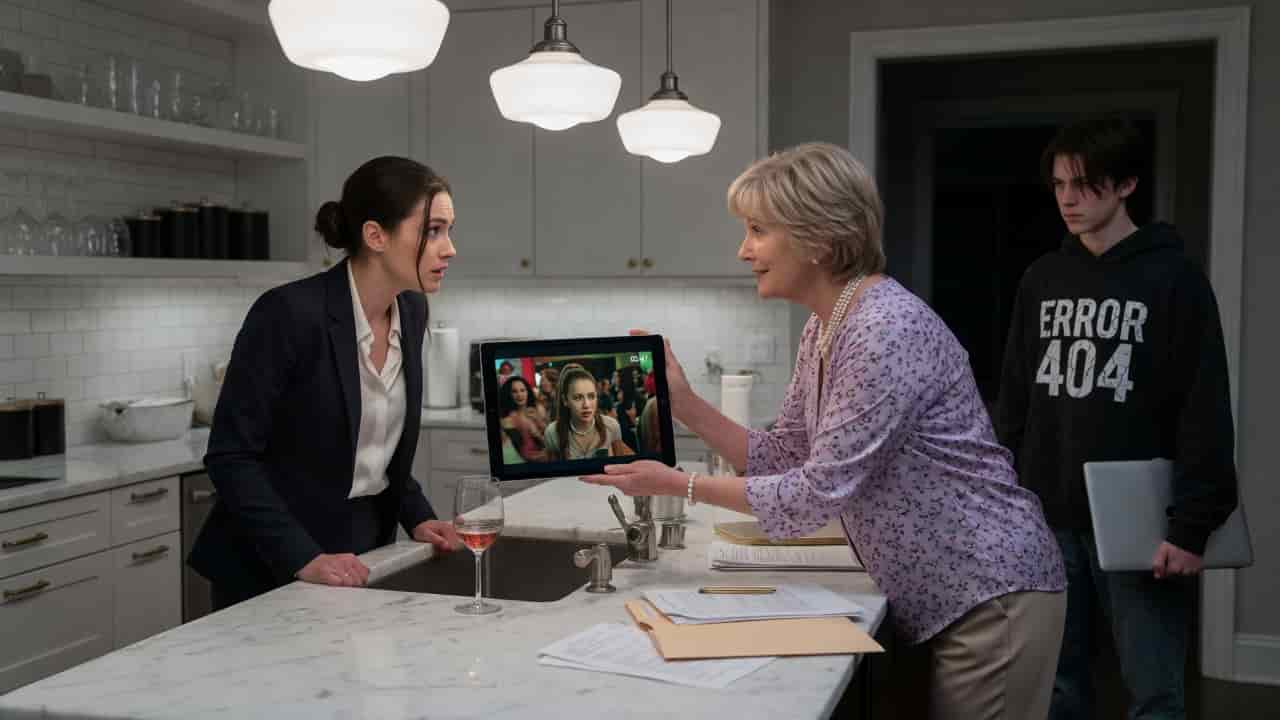
“You have until Monday morning, Mia. Don’t make me click ‘send’ on this.”
I stared at the tablet Shirley had shoved in my face. The video was grainy, a decade old, and edited to look like something it wasn’t. It showed me at a protest I’d long since moved past, but in Shirley’s hands, it looked like a career-ending scandal for a high school principal.
“You’re really doing this?” I whispered. My hands were shaking so hard I had to grip the edge of the granite island just to stay upright. “Over a job, Shirley? We’re family.”
She didn’t even blink. She just straightened her pearls and gave me that soft, practiced smile she used at church. “We’re family, dear. That’s why I’m doing this. My son deserves a wife who is home for dinner, and my grandchildren deserve a mother who isn’t obsessed with property taxes and school board meetings. You’ve become… difficult. This is just a way to help you find your way back to what matters.”
The room felt like it was shrinking. Behind her, in the shadows of the hallway, I saw my student, Leo, watching us. He was supposed to be there for a tutoring session, but he’d seen everything. He saw the way she looked at me—like I was a problem to be solved, a piece of laundry that needed to be scrubbed clean.
I had fifteen years of a spotless reputation. I had a school full of kids who looked up to me. And I had a mother-in-law who was willing to burn it all down just to get her way.
Chapter 1: The Weight of the Walk
The walk from the parking lot to the front doors of Oak Ridge High was exactly three hundred and forty-two steps. I knew because I’d counted them every morning for six years, usually while mentally triaging the day’s disasters. At 7:15 AM, the air in the valley was still damp, smelling of cut grass and the faint, metallic tang of the nearby interstate. It was the kind of crisp, suburban morning that felt stable, even if the building waiting for me was anything but.
I was Mia Vance, the principal of a school with twelve hundred teenagers, a faculty that ran on caffeine and resentment, and a school board that treated every dip in test scores like a declaration of war. I liked my job. I liked the chaos of it. I liked the way the students looked at me—not as a friend, but as a fixed point. A woman who wore tailored blazers and kept her hair in a bun that didn’t allow for loose strands. I was the authority. I was the one who held the line.
But as I stepped onto the linoleum of the main hallway, the air felt different. Thicker.
“Morning, Principal Vance,” Janie, the front office secretary, said. She didn’t look up from her monitor. Her voice had a clipped, brittle edge to it that made my internal radar ping.
“Morning, Janie. Everything okay?”
“The coffee’s fresh,” she said, which wasn’t an answer.
I walked into my office, dropping my leather satchel on the mahogany desk that had belonged to three principals before me. On top of my blotter sat a manila envelope. No return address. Just my name printed in a font that looked like it came from a cheap laser printer.
I didn’t open it immediately. I sat down, smoothed my skirt, and took a breath. I looked at the framed photo of my husband, David, and our two girls, Chloe and Maya. They were smiling on a beach in South Carolina, the kind of photo that looked perfect because the wind had hidden the fact that Maya had been crying five minutes before it was taken. David was a good man, a steady man, but he was Shirley’s son. And Shirley was a woman who believed that perfection wasn’t a goal; it was a requirement.
I opened the envelope.
Inside was a single sheet of paper. A screenshot of an email thread. The sender’s name was redacted, but the recipient was the President of the School Board, Arthur Sterling.
“Subject: Concerns regarding leadership at Oak Ridge. Are we sure Principal Vance represents our community values? Attachment: 2012_Incident_Report.pdf”
My stomach didn’t just drop; it turned into a cold, hard knot. 2012. I was twenty-four. I was a different person then—angry at the world, loud, convinced that if I yelled loud enough at a protest, the system would actually listen. There had been an incident. A misunderstanding at a rally that resulted in a night in a holding cell and a charge that was eventually dropped. I’d disclosed it during my initial hiring, of course. It was buried, ancient history.
But the screenshot wasn’t about the incident. It was about the rumor of it. It was about the way it was being framed. “Community values.” That was the dog whistle of the suburbs. It meant I wasn’t one of them. It meant I was a guest who had overstayed her welcome.
A knock at the door startled me. I slid the paper into my desk drawer just as the door pushed open.
It was Sarah Miller. She’d been an English teacher here for ten years until last spring, when she’d suddenly resigned. The official story was that she wanted to spend more time with her aging parents. The unofficial story, the one whispered in the breakroom, was that someone had started a whisper campaign about her private life, and she’d broken under the pressure.
“Mia,” she said. She looked tired. She was wearing an old cardigan and holding a stack of books she must have been returning to the library. “I was in the neighborhood. I wanted to… I heard things.”
“Heard what, Sarah?” I kept my voice professional, even. My heart was thumping against my ribs.
“The emails,” she said, stepping inside and closing the door. Her voice dropped. “They’re starting again. The same way they started with me. Anonymous tips to the board. Little comments in the grocery store. Someone is trying to dig a hole for you, Mia.”
“I’m not you, Sarah,” I said, and immediately regretted the cruelty of it.
Sarah didn’t flinch. She just looked at me with a pity that made me want to scream. “I know you’re not. You’re stronger. But you have more to lose. You have the house on the cul-de-sac. You have the husband who works for the city. You have the MIL who runs the historical society. Be careful.”
“Who did it to you, Sarah? Truly?”
Sarah looked at the floor. “I never found out. But every time I walked into a room, I felt like I was being measured and found wanting. It starts small. A comment about your clothes. A question about why you aren’t at the PTA bake sale. Then, suddenly, you’re the woman who ‘isn’t a fit.’”
After she left, the silence in the office felt predatory.
I spent the morning in a haze of budget meetings and student disciplinary hearings. I disciplined a sophomore for vaping in the bathroom, but I could barely focus on his excuses. All I could think about was the redacted email.
At noon, my phone buzzed. A text from Shirley.
“Coming over this evening to bring some of that pot roast David likes. Also, I think the girls’ hair is getting a bit long. We should discuss. See you at six, dear.”
I didn’t reply. I couldn’t.
Shirley lived three streets over. She was the unofficial mayor of our neighborhood. She knew whose lawn had crabgrass and whose marriage was hitting a rough patch. She’d been “helping” me since the day I married David. She’d helped me choose our wedding china (which I hated), she’d helped me navigate my first pregnancy (by telling me I was eating too much salt), and she’d helped me with my career by reminding me, at every promotion, that “it’s a lot of stress for a mother.”
By 3:00 PM, I was standing in the hallway during a passing period. The noise was a physical wall—lockers slamming, teenagers shouting, the rhythmic beat of sneakers on tile.
I saw Leo Vance. No relation to me, just a coincidence of name. He was a senior, a brilliant kid who spent more time in the computer lab than at lunch. He was wearing his usual black hoodie, looking like he wanted to vanish into the wall.
“Leo,” I called out.
He stopped, his shoulders tensing. He looked at me with eyes that seemed too old for his face. “Yeah, Mrs. Vance?”
“You’re still coming over for the tutoring session at five? Chloe needs help with her coding project.”
“Yeah. I’ll be there.” He hesitated. “Mrs. Vance? The server was acting weird today. Someone was trying to access the staff portal from an external IP. A lot.”
“The IT department handles that, Leo.”
“I know,” he said, his voice dropping. “But the IP was local. Like, really local. Same node as your house, actually.”
He walked away before I could ask what he meant. I stood there, the students swirling around me like a river, and felt a sudden, sharp chill. The same node as my house.
The walk back to my car at 4:30 PM was three hundred and forty-two steps. They felt like miles. I drove home, the familiar streets of the suburb looking like a film set—too perfect, too quiet, too green.
As I pulled into my driveway, I saw Shirley’s pristine silver Lexus parked at the curb. She was already there. She was always already there.
I sat in the car for a moment, gripping the steering wheel. My life was built on this foundation—the job, the house, the family. It was a good life. I had earned it. I had worked through the shame of my youth and built a fortress of respectability.
But as I looked at the front door of my house, I realized the fortress had windows. And someone was looking in.
I checked my makeup in the rearview mirror. I straightened my blazer. I smoothed my hair.
Then I got out of the car and walked toward the house where my mother-in-law was waiting with a pot roast and a secret.
Chapter 2: The Soft Squeeze
The house smelled like slow-cooked beef and the expensive, floral perfume Shirley had worn for as long as I’d known her. It was a heavy scent, one that lingered on the curtains and the girls’ clothes long after she’d left. It felt like a claim.
“Mia! You’re home late,” Shirley called from the kitchen. She appeared in the arched doorway, wiping her hands on an apron she’d brought from her own house. My kitchen, but she was the one in the apron.
“The school doesn’t exactly close at four, Shirley,” I said, setting my satchel on the hallway bench. I went to the girls, who were sitting at the kitchen table, supposedly doing homework but mostly poking at a bowl of grapes.
“Mommy!” Maya, the six-year-old, jumped up and hugged my waist. Chloe, the ten-year-old, gave me a distracted wave. She was staring at her laptop, her brow furrowed.
“Hi, sweetie. How was school?” I kissed Maya’s head.
“Good. Grandma made us snack,” Maya said.
“I’m sure she did.” I looked at Shirley. She was smiling that serene, impenetrable smile.
“David called,” Shirley said, moving back to the stove. “He’s stuck at the office. Some budget hearing for the city. I told him not to worry, that I’d stay and help with the girls. You look tired, Mia. Really, those dark circles are getting quite pronounced.”
“It’s been a long day,” I said, pouring myself a glass of water. My hand was steady, but my chest felt tight. I thought about the manila envelope in my desk drawer. I thought about Leo’s comment about the IP address.
“I imagine so,” Shirley said. Her voice was conversational, light as air. “Especially with all those… rumors flying around. I was at the market today, and Mrs. Gable mentioned something about an email she’d heard about. Something about the school board? Honestly, people have such active imaginations.”
I froze, the water glass halfway to my lips. Mrs. Gable was the wife of the school board vice-president. If she was talking at the market, the leak wasn’t just an email; it was a flood.
“What exactly did Mrs. Gable say?” I asked, keeping my voice neutral.
“Oh, just nonsense,” Shirley said, waving a hand. “Something about a past indiscretion. I told her, I said, ‘Mia is a professional. I’m sure whatever happened when she was a girl was just… youthful exuberance.’ But people do worry about the influence on the children. You know how this town is.”
Youthful exuberance. Shirley knew about my past. I’d told her and David years ago, shortly after we got engaged. I’d wanted everything on the table. She’d patted my hand and told me it didn’t matter, that I was part of the family now.
But hearing her say it now, in my kitchen, felt like a threat.
“It’s not a rumor, Shirley. It’s a targeted attack,” I said.
“Well, regardless,” Shirley said, turning the heat down on the pot roast. “It’s a lot of pressure. I’ve always said, a woman in your position… it’s a lot to carry. Maybe too much. If you were home more, these things wouldn’t matter so much, would they? The community would see you as a mother first. It’s hard to attack a mother.”
I didn’t answer. I couldn’t. The logic was too twisted, too suffocating.
The doorbell rang. It was 5:00 PM.
“That’ll be Leo,” I said, grateful for the interruption.
Leo was standing on the porch, his black hoodie pulled up, his laptop bag slung over his shoulder. He looked out of place in our neighborhood, like a shadow that had accidentally wandered into a floodlight.
“Hey,” he muttered.
“Come in, Leo. Chloe’s in the kitchen.”
As he walked past me, he leaned in slightly. “I checked that IP again before I left. It’s definitely coming from this street, Mrs. Vance. Maybe even closer.”
I felt a jolt of adrenaline. “What do you mean closer?”
“The signal strength was maxed,” he whispered. “Whoever is sending those emails is using a mesh network that’s overlapping with yours. It’s basically coming from inside the house or the one right next door.”
I looked back at the kitchen. Shirley was showing Maya how to fold a napkin. She looked so wholesome, so domestic.
“Can you prove it?” I asked.
“I can trace the MAC address,” Leo said. “Every device has a unique ID. If I can get close enough to the source device, I can match it to the logs I pulled from the school server.”
“Do it,” I said. “Tonight.”
The next hour was a blur of domestic performance. We sat down to dinner—Shirley’s pot roast, which was, as always, perfectly seasoned and slightly too heavy. Shirley talked about the upcoming Garden Club social. She talked about the library’s new wing. She talked about everything except the shadow hanging over my career.
Leo and Chloe were in the den, their heads bent over the laptop. Every so often, I’d hear Leo’s low voice explaining a line of code.
“He’s a strange boy, isn’t he?” Shirley said, watching them from the table. “A bit… unkempt. Is he really the best influence for Chloe? I’m sure there are other tutors. More… appropriate ones.”
“He’s the smartest kid in the school, Shirley. And he’s good with her.”
“If you say so,” Shirley said. She sipped her tea, her pinky finger extended. “But reputation is everything, Mia. Who we let into our homes, who we associate with… it all adds up. Especially now.”
After dinner, David finally came home. He looked exhausted, his tie loosened, his face pale in the entryway light. He kissed my cheek, then kissed his mother’s.
“Smells good in here,” he said.
“Your mother made roast,” I said.
“Thanks, Mom.” David sat down, rubbing his eyes. “Mia, I got a call from Sterling today. The board wants an informal meeting on Wednesday. Just a ‘chat,’ he said.”
Shirley stood up and began clearing the plates. “A chat. That sounds lovely. Better to clear the air, don’t you think? Tell them the truth, Mia. Tell them you’re ready to focus on what really matters.”
David looked at me, then at his mother. He looked confused, caught between the two women who defined his world. “What do you mean, Mom?”
“I just mean that Mia has been working so hard,” Shirley said, her voice dripping with artificial sympathy. “Maybe it’s time she had a break. For the girls’ sake. For yours.”
“I’m not taking a break, Shirley,” I said, my voice cold.
The room went silent. The only sound was the hum of the refrigerator and the distant click of Leo’s keyboard in the den.
“Well,” Shirley said, her smile broadening. “We’ll see, won’t we?”
She finished the dishes, kissed the girls goodbye, and gathered her things. David walked her to the car, leaving me alone in the kitchen.
I went into the den. Leo was packing his laptop. Chloe was already upstairs, getting ready for bed.
“Did you find it?” I asked.
Leo looked at me. He didn’t say a word. He just opened his laptop and turned the screen toward me.
It was a list of hardware identifiers. At the top was a highlighted string of numbers.
“That’s the device that sent the emails to the board,” Leo said. “And this…” He clicked another tab, showing a local network scan. “This is the device currently connected to the guest Wi-Fi in this house.”
The MAC addresses matched perfectly.
“Whose device is it, Leo?”
“It’s registered as ‘S-PAD-01,’” Leo said. “And based on the signal strength when she was in the kitchen… it belongs to your mother-in-law.”
I stared at the screen. The betrayal was so precise, so calculated, that I couldn’t breathe. Shirley wasn’t just gossiping. She was the source. She was the one trying to dismantle my life, brick by brick, from the inside.
“She’s been using your own Wi-Fi to send the leaks,” Leo said, his voice quiet. “She probably thought you’d never look. Or that if you did, it would look like you were the one sending them. Self-sabotage.”
“Why?” I whispered.
“I don’t know,” Leo said. “But there’s more. I found a folder on the school server she was trying to access. A folder labeled ‘Archive_2012.’ She’s looking for the original police video, Mrs. Vance. The one the department never released.”
I felt a cold shiver of terror. The video. The night of the protest. It wasn’t just an arrest. It was a moment of absolute, raw vulnerability—a video of me, screaming at an officer, my face distorted with rage and grief, looking like a person who should never, ever be in charge of a school.
If Shirley got that video, the “informal meeting” on Wednesday wouldn’t be a chat. It would be an execution.
“Can you stop her?” I asked.
Leo looked at his laptop, then back at me. “I can block her MAC address. I can bury the file deeper. But she’s already got something, Mrs. Vance. I saw her tablet screen when she was in the kitchen. She’s got a paused frame. I think she already found it.”
I thanked him and let him out. I stood on the porch, watching him walk away into the dark.
The neighborhood was silent. The streetlights cast long, distorted shadows on the manicured lawns. It looked like peace. It looked like safety.
But as I went back inside, I knew the war had already begun. And the enemy wasn’t at the gates. She was in my kitchen, eating my food, and kissing my children goodnight.
Chapter 3: The Sunday Dinner Trap
The next three days were a masterclass in psychological warfare. I went to school, I sat through meetings, I answered emails, but I felt like I was operating through a thick pane of glass. Every time I saw a member of the school board in the hallway, I wondered what they’d seen. Every time Janie looked at me, I wondered if she was the one who would eventually be told to pack up my office.
Shirley called every day. She was “checking in.” She wanted to know if I’d “thought about our talk.” She sounded like a doting grandmother, but her voice had the cold, metallic ring of a sharpened blade.
Saturday night, the pressure finally boiled over. David and I were in bed, the lights off, the only sound the distant hum of the central air.
“Mia,” David said into the dark. “My mom called again today. She’s really worried about you. She said you looked like you were on the verge of a breakdown at dinner the other night.”
I sat up, the sheets pooling around my waist. “A breakdown? David, your mother is the one causing the stress.”
“She’s just looking out for us,” David said, his voice defensive. “She thinks the job is too much. And honestly, with this board meeting coming up… maybe she’s right. Maybe you should take a leave of absence. Just until this blows over.”
“It’s not going to blow over, David! Someone is leaking my past to the board. Someone is trying to get me fired.”
“Who would do that?”
“Your mother.”
The silence that followed was absolute. I could feel David’s shock, followed by a wave of disbelief.
“That’s insane, Mia. Why would she do that? She loves you. She loves this family.”
“She wants me to be a stay-at-home mom. She’s said it a thousand times. She thinks if she ruins my career, I’ll have no choice but to do what she wants.”
“She wouldn’t,” David whispered. “She’s a grandmother. She’s a pillar of the community.”
“Ask her about the tablet, David. Ask her why she was accessing the school’s server from our Wi-Fi.”
David didn’t answer. He turned away from me, pulling the covers up. I lay there, staring at the ceiling, feeling the distance between us grow into a chasm.
Sunday dinner was at Shirley’s house. It was a tradition we couldn’t break without it becoming a declaration of war.
The house was a shrine to suburban success. Heavy mahogany furniture, oil paintings of local landscapes, and a dining room that felt like it belonged in a museum. Shirley had set the table with her finest linens.
“Sit, sit!” Shirley chirped, ushering us into the room. “I made a crown roast. It’s a special occasion, after all.”
“What’s the occasion?” I asked, sliding into my chair.
“The board meeting on Wednesday,” Shirley said, pouring the wine. “I thought we should celebrate the beginning of a new chapter. For everyone.”
The dinner was agonizing. Shirley directed the conversation with the skill of a conductor. She talked about the upcoming school play, the local elections, and then, with a casualness that made my skin crawl, she turned to the girls.
“Chloe, wouldn’t it be nice if Mommy was home more? If she could take you to your dance classes instead of the sitter?”
Chloe looked at me, then back at her plate. “I guess.”
“And Maya,” Shirley continued, “imagine all the crafts we could do together. Every afternoon.”
“Stop it, Shirley,” I said. My voice was low, vibrating with suppressed rage.
“Stop what, dear?” Shirley asked, her eyes wide with fake innocence. “I’m just talking about the future. A future where we’re all together. Where there’s no… scandal. No tension.”
She reached down into her bag, which was sitting on the floor beside her chair. She pulled out the black tablet.
“David, dear, I was going to show you this later, but I think now is better. While we’re all here.”
She slid the tablet across the table. It stopped right in front of David.
“What is this, Mom?” David asked.
“It’s the video everyone is talking about,” Shirley said. Her voice had dropped the maternal mask. It was cold, sharp, and triumphant. “The one that proves Mia isn’t the woman we thought she was. The one the school board is going to see on Wednesday morning if she doesn’t do the right thing.”
David looked at the screen. I saw his face go pale. I saw the way his jaw tightened.
“Where did you get this?” David asked.
“It doesn’t matter where I got it,” Shirley said. “What matters is that it exists. And it’s not just a protest, David. Look at the three-minute mark. Look at the way she talks to that officer. Look at the things she says about ‘tearing down the institutions.’ Is that the woman you want leading our children? Is that the woman you want as a mother to my granddaughters?”
I stood up. My chair scraped against the hardwood floor like a scream.
“You’re blackmailing me,” I said.
“I’m giving you an out, Mia,” Shirley said, standing up to face me. She was smaller than me, but in that room, surrounded by her things, she felt like a giant. “Resign by Monday morning. Tell them the stress is too much. Tell them you want to focus on your family. If you do that, this video stays in this bag. It never sees the light of day. Your reputation stays intact. You can be the woman this community thinks you are.”
“And if I don’t?”
Shirley smiled. It was the cruelest thing I’d ever seen. “Then the entire town sees the real Mia Vance. The one who hates the law. The one who screams at men in uniform. The one who is a liar and a fraud. You’ll be ruined. Not just here, but anywhere you try to go. No school will touch you. You’ll be a pariah.”
I looked at David. He was still staring at the tablet. He looked broken.
“David,” I said. “Tell her she’s wrong.”
David didn’t look up. “Mia… the video… you never told me you said those things.”
“I was twenty-four! I was angry! It doesn’t change who I am now!”
“It changes how people see you,” David whispered.
I realized then that I was alone. My husband was a man who lived and died by the opinions of his mother and his community. He couldn’t see the woman standing in front of him; he could only see the shadow on the screen.
“I’m leaving,” I said.
“The girls stay here,” Shirley said. “It’s late. They’ve already seen enough of this… drama.”
“They are my children!”
“And they are my grandchildren,” Shirley said, her voice like iron. “And right now, they are in a home where they are safe. Go home, Mia. Think about it. You have until Monday morning. One email, and it all goes away. Or one click, and it all burns down.”
I walked out of that house into the cold night air. I didn’t wait for David. I didn’t look back. I drove home, my vision blurred with tears, my heart hammering a frantic rhythm against my ribs.
I sat in my dark living room, the silence of the house weighing down on me. I had fifteen years of a career. I had a reputation. I had a life.
And in twelve hours, I had to decide if I was willing to let it all burn just to keep my soul.
Chapter 4: The Archive of Ruin
Monday morning arrived with a grey, oppressive sky that seemed to sit right on top of the school’s chimney. I hadn’t slept. I’d spent the night in my office at home, staring at the wall, waiting for the sun to rise as if it might bring some kind of clarity. It didn’t.
I drove to the school at 6:30 AM. The parking lot was empty, the building looking like a ghost ship in the fog. I walked the three hundred and forty-two steps, but I didn’t count them. I didn’t care.
I went straight to the computer lab.
Leo was already there. He was sitting in the back corner, the glow of three monitors reflected in his glasses. He looked like he hadn’t slept either.
“You’re early,” he said.
“I need your help, Leo. One last time.”
I told him what had happened at dinner. I told him about the video and the ultimatum.
“She’s got it,” Leo said, his voice flat. “I saw the server logs this morning. She managed to bypass the final encryption layer at 11:45 PM last night. She has the full file.”
“Is there any way to delete it? To wipe her device?”
Leo shook his head. “If she’s smart—and she is—she’s already uploaded it to a cloud drive. Deleting the local copy won’t do anything. But…” He paused, his fingers hovering over the keyboard. “There’s something else. When I was digging through the server to see what she accessed, I found a secondary folder. It wasn’t in the archive. It was in the ‘Human Resources – Sealed’ section.”
“What is it?”
“It’s a file on Sarah Miller,” Leo said. “The teacher who quit last year.”
“Why would that be in my server?”
“Because the person who sent the complaints about Sarah didn’t send them to the board. They sent them to the previous principal. And they weren’t anonymous.”
He clicked a few keys, and a document appeared on the screen. It was a formal letter of complaint, dated eighteen months ago. It was detailed, cruel, and signed with a flourish that I recognized instantly.
“Subject: Moral turpitude in the English Department. As a concerned citizen and a donor to the library fund, I feel it is my duty to inform you of Miss Miller’s late-night visitors…”
The signature at the bottom was Shirley Vance.
“She did this to Sarah,” I whispered. “She ruined her career because she didn’t like her ‘influence.’”
“There’s more,” Leo said. “Look at the date on this one.”
He opened another file. It was an IP log from five years ago. The year I was hired.
“Someone was checking the background check systems,” Leo said. “Repeatedly. From the same MAC address as the tablet. She’s been sitting on this for five years, Mrs. Vance. She didn’t just find it. She’s been holding it like a hostage, waiting for the right moment to use it.”
The calculation of it was staggering. Shirley hadn’t just reacted to my career; she had been preparing to dismantle it from the moment I became a threat to her vision of our family.
“What do you want to do?” Leo asked.
I looked at the screen. I saw the evidence of five years of surveillance, of a woman who treated her family like a chess board.
“Can you get me Sarah Miller’s phone number?” I asked.
Thirty minutes later, I was sitting in a booth at a diner three towns over. Sarah was already there, clutching a mug of coffee like it was a lifeline.
“You found it,” she said, her voice trembling as I showed her the printed letter Leo had pulled.
“She destroyed your life, Sarah. Not because you did anything wrong, but because she could.”
Sarah looked at the letter, her eyes filling with tears. “I thought I was crazy. I thought I’d imagined the way she looked at me at the grocery store. I lost my pension, Mia. I lost my reputation. I’m working at a call center now.”
“I’m going to the board meeting on Wednesday,” I said. “But I’m not going to resign. And I’m not going to let her win.”
“What are you going to do?”
“I’m going to show them the real ‘community values,’” I said. “I need you there, Sarah. I need you to stand with me.”
Sarah looked at the letter again. A spark of something—anger, maybe, or just the long-buried need for justice—flickered in her eyes. “I’ll be there.”
I drove back to the school, the weight in my chest shifting. It wasn’t lighter, but it was sharper.
At 9:00 AM, I sat in my office and opened my email. I drafted a message to Arthur Sterling and the rest of the school board.
“Regarding the informal meeting on Wednesday. I look forward to discussing the future of Oak Ridge High. I will be bringing several witnesses who can speak to the ongoing efforts to destabilize this administration.”
I hit send.
Ten minutes later, my phone rang. Shirley.
I didn’t answer.
She called again. And again. Then a text:
“I see you’ve made your choice, Mia. It’s a shame. I’ll see you Wednesday. I’ve already sent the first clip to Arthur. He’s… disappointed.”
I looked out my window at the students filling the quad. They were laughing, pushing each other, oblivious to the storm. I thought about the younger Mia in that video—the one who wanted to tear down the institutions.
Maybe she wasn’t entirely wrong. Some institutions were built on lies. And some families were built on shadows.
The walk back to my car that afternoon was three hundred and forty-two steps. I counted every single one. Each step felt like a drumbeat.
When I got home, the house was empty. David was still at work, and the girls were still at Shirley’s. I sat in the quiet kitchen and waited.
The battle lines were drawn. On one side, a video of a girl who had been lost and angry. On the other, a digital archive of a woman who was cold and cruel.
I wasn’t the girl in the video anymore. But I wasn’t the victim Shirley wanted me to be either.
Wednesday was coming. And for the first time in five years, I wasn’t afraid of what the neighbors would think. I was only afraid of what I’d have to become to win.
I picked up my laptop and started a new file.
Title: The History of the Cul-de-Sac.
I had forty-eight hours to build my own archive. And I had the best hacker in the county on my side.
The silence in the house didn’t feel predatory anymore. It felt like a countdown.
Chapter 5: The Architecture of Isolation
Tuesday morning didn’t break; it merely curdled. The fog from the previous day had settled into a low, grey ceiling that made the fluorescent lights of the high school feel aggressive. I sat at my desk, my fingers tracing the grain of the wood, watching the digital clock on my computer monitor. 8:02 AM. Every minute felt like a grain of sand dropping into a glass that was already full.
The school was buzzing, but the frequency was wrong. It wasn’t the usual chaotic energy of teenagers; it was the sharp, jagged static of a community that had caught the scent of a scandal. I could see it in the way the teachers hovered in the doorways of their classrooms, their conversations dying the moment I rounded a corner. I could see it in Janie’s eyes, which refused to meet mine when I asked for the morning attendance reports.
I was being erased before the meeting had even begun.
At 10:00 AM, Arthur Sterling, the President of the School Board, walked into my office without knocking. He didn’t sit down. He stood by the window, looking out at the football field as if he were inspecting a property he was about to sell. Arthur was a man of sixty, with silver hair and a wardrobe of expensive, unstructured suits that signaled “approachable authority.”
“Mia,” he said, his voice a low rumble. “We’ve known each other a long time. I hired you because I thought you had the steel this district needed.”
“I still have it, Arthur.”
He turned to look at me, and for the first time, I saw the genuine disappointment Shirley had promised. “The video Shirley shared… it’s difficult. It’s not just the arrest, Mia. It’s the things you said. The contempt for the very structures we are trying to uphold here. People are calling my office. Parents are asking if we’ve been harboring a radical.”
“That video is fourteen years old, Arthur. It was edited. I was a kid reacting to an injustice. You know the work I’ve done here. You know the test scores, the graduation rates—”
“I know the optics,” he interrupted, his voice sharpening. “And the optics are that our principal is a woman who, in her heart, might despise the system she leads. Shirley is… she’s very concerned. She’s suggested a quiet exit. For the sake of the girls. For the sake of the town’s peace.”
“Shirley is a blackmailer, Arthur. She’s the one who sent those emails. She’s the one who’s been digging through sealed HR files.”
Arthur sighed, a sound of profound weariness. “Those are heavy accusations, Mia. Do you have proof? Because right now, all I have is a very disturbing video and a community that is starting to turn.”
“I’ll have proof tomorrow,” I said.
After he left, the silence in the office felt like a weight. I realized then that Arthur wasn’t a villain; he was just a man who valued the absence of conflict over the presence of truth. And Shirley knew that. She had weaponized the town’s desire for “peace” against me.
I left school early, something I never did. I needed to see David. I needed to know if there was anything left of the life we had built that wasn’t owned by his mother.
I found him in our kitchen, staring at a cup of coffee that had gone cold. He looked smaller than he had on Sunday. The domesticity of the room—the magnetic alphabet letters on the fridge, the pile of mail on the counter—felt like a mockery.
“David,” I said, standing in the doorway.
He looked up, his eyes bloodshot. “She’s not stopping, Mia. She’s already talking to the girls about ‘Mommy’s long vacation.’ She’s moving things into the guest room at her house. She thinks you’re going to resign tomorrow morning before the meeting even starts.”
“And what do you think?”
David stood up, his hands trembling. “I think… I think you should just do it. Give her what she wants. We can move. We can start over somewhere else where no one knows about 2012. I can get a transfer. My mom… she’ll pay for the move. She said she’d set up a trust for the girls if you just stop fighting her.”
The betrayal hit me like a physical blow. It wasn’t the anger I expected; it was a cold, hollow realization. My husband wasn’t my partner; he was a hostage who had developed an affection for his captor.
“You want me to let her win,” I whispered. “You want me to admit to being something I’m not just so you don’t have to deal with her temper.”
“I want my life back!” David shouted, his voice cracking. “I want to be able to go to the grocery store without people whispering. I want my mother to stop calling me crying every night. Why does it have to be a war, Mia? Why can’t you just be… quiet?”
“Because if I’m quiet now, David, I’ll be quiet for the rest of my life. And so will our daughters. They’ll learn that the only way to survive in this family is to disappear.”
I walked out of the kitchen. I didn’t go to our bedroom. I went to the garage, where Leo was waiting.
He had set up a temporary workstation on an old workbench, surrounded by boxes of Christmas decorations and lawn tools. The blue light of his laptop was the only thing illuminating the space. He looked up as I entered, his expression unreadable.
“I’ve got the full chain of custody on the Sarah Miller emails,” Leo said, his voice low. “I tracked the originating IP to a secondary router Shirley has hidden in her guest house. She was smart—she used a VPN—but she didn’t realize the VPN client logs were being backed up to the main household account. I have every timestamp, every recipient. I even have the drafts she didn’t send.”
“What drafts?”
Leo clicked a file. It was an email addressed to the local newspaper. The subject line was ‘The Radical in the Principal’s Office.’ It contained the video, along with a list of “anonymous” allegations about my leadership. It was scheduled to be sent on Thursday morning—the day after the board meeting.
“She’s not just trying to make me resign,” I realized. “She’s trying to ensure I never work again. Even if I give in, she’s going to release it.”
“She’s thorough,” Leo said. He hesitated, then pulled up another screen. “There’s one more thing. I found her personal notes folder on the cloud drive. She’s been keeping a log of every time you were late, every time you missed a school event, every time you and David had an argument that she could hear through the walls. She was building a case for a custody challenge, Mrs. Vance. In case the resignation wasn’t enough to ‘fix’ the family.”
The room seemed to tilt. Shirley hadn’t just been trying to control me; she had been planning to replace me. The “more time for grandchildren” wasn’t a request; it was a hostile takeover.
“Can you package this?” I asked, my voice sounding like it was coming from a long way off. “The emails, the logs, the link to her devices? I need it to be undeniable. I need it to be a story that even Arthur Sterling can’t ignore.”
“I already have,” Leo said. “I’ve put it on three separate drives. One for you, one for Sarah Miller, and one… well, one for me. Just in case.”
“Thank you, Leo. Truly.”
“Don’t thank me yet,” he said. “The board is going to hate this. They hate being shown that they were manipulated. They might turn on you just for being the one to bring the mess into the room.”
“I know,” I said. “But the mess is already there. I’m just turning on the lights.”
I spent the rest of the night with Sarah Miller. We sat in my darkened living room—David had gone to his mother’s, a move that felt like a final desertion—and we went through her story. Sarah was terrified, her hands shaking as she looked at the evidence of her own undoing.
“She called my landlord,” Sarah whispered, looking at a log Leo had recovered. “She told him I was ‘unstable.’ That’s why he didn’t renew my lease. It wasn’t just the school. She took my home, Mia.”
“She’s not taking anything else, Sarah. Not from you. Not from me.”
As the sun began to rise on Wednesday morning, I felt a strange, cold clarity. I didn’t feel like a principal. I didn’t even feel like a wife. I felt like a woman who had been stripped of everything except her shadow, and I was finally ready to see how long that shadow could cast.
I put on my best suit—a charcoal grey that felt like armor. I pinned my hair back so tight it pulled at my temples. I looked in the mirror and didn’t recognize the woman staring back. Her eyes were hard, her mouth a thin, uncompromising line.
The walk from the parking lot to the school board office was exactly four hundred and twelve steps. I counted every one. They weren’t steps toward a job anymore. They were steps toward a reckoning.
Chapter 6: The Residue of Truth
The board room was a paneled chamber that smelled of lemon wax and old paper. It was designed to feel prestigious, a place where “serious people” made “serious decisions.” Usually, these meetings were dull affairs about bus schedules and roofing contracts. But today, the air was electric.
There were six board members present, sitting behind a long, curved table. Arthur Sterling sat in the center. To his left was Mrs. Gable, whose husband was already looking at me with a mixture of pity and distaste.
And in the front row of the small gallery sat Shirley.
She looked perfect. She was wearing a soft cream-colored sweater set and her pearls. She had a small, leather-bound notebook in her lap, looking like the concerned citizen she pretended to be. When I walked in, she didn’t look away. She gave me a small, sad nod, as if to say, I’m so sorry it had to come to this, dear.
David was not there. He had chosen the ultimate cowardice: absence.
“This is an informal administrative review,” Arthur began, his voice echoing in the quiet room. “Principal Vance, we are here to discuss concerns regarding your professional conduct and your suitability to continue in your role. Specifically, new information has come to light regarding your past and your… current relationship with the community’s values.”
He looked at Shirley. “Mrs. Vance, as the primary complainant, you may present your concerns.”
Shirley stood up gracefully. Her voice was steady, filled with the practiced tremor of a grandmother in pain. “It breaks my heart to be here. Mia is family. But my first loyalty is to this town and to my grandchildren. I found a video—a video that shows a side of Mia I never knew existed. A side that is violent, radical, and fundamentally dishonest. She has hidden this from us for years. If she can lie about this, what else is she lying about? How can we trust her with our children?”
She turned to the board, her eyes moist. “I asked her to resign. I wanted to handle this privately, to protect her dignity. But she refused. She chose this… this public spectacle over the well-being of her own family. I believe, for the safety and moral health of Oak Ridge High, Principal Vance must be removed immediately.”
She sat down. A heavy silence followed. Mrs. Gable nodded slowly, her mouth set in a grim line.
“Principal Vance?” Arthur asked. “Do you have a response?”
I stood up. I didn’t look at the board. I looked at Shirley.
“I do,” I said. My voice was calm, a sharp contrast to Shirley’s emotional performance. “But before we discuss a fourteen-year-old video of a protest, I’d like to discuss the recent history of this board. I’d like to discuss how ‘concerns’ are manufactured in this town.”
I opened my folder and pulled out the first drive. “Arthur, if you’ll look at the screen.”
Leo, sitting in the back of the room with his laptop, hit a key. The large monitor on the wall flared to life.
“These are the IP logs for every anonymous email sent to this board over the last six months,” I said. “They weren’t sent by concerned parents or teachers. They were all sent from a single device—a tablet registered to Shirley Vance. Most of them were sent from my own guest Wi-Fi while she was ‘helping’ with my children.”
The room went deathly still. Shirley’s face didn’t change, but her knuckles whitened around her notebook.
“That’s a lie,” Shirley said, her voice dropping the maternal lilt. “I don’t even know what an IP log is. This is a desperate attempt to deflect—”
“I’m not finished,” I said. “Leo, show the HR files.”
The screen changed. It showed the letter Shirley had written eighteen months ago about Sarah Miller.
“This is the letter that destroyed Sarah Miller’s career,” I said. “A woman who gave ten years to this district. Shirley didn’t like Sarah’s influence, so she invented rumors of ‘moral turpitude.’ She hounded Sarah out of her home and her job. Sarah is here today.”
The back door opened, and Sarah Miller walked in. She looked terrified, but she walked to the front of the room and stood beside me.
“Is this true, Sarah?” Arthur asked, his voice barely a whisper.
“Every word,” Sarah said. “She called my landlord. She called the parents of my students. She made it impossible for me to stay. And she did it all under the guise of ‘protecting the community.'”
The shift in the room was physical. The board members, who had been leaning away from me, were now leaning toward the screen. They saw the timestamps. They saw the deliberate, year-long campaign of surveillance Shirley had conducted against me.
“And finally,” I said, “the video. The one Shirley has been using as a weapon.”
I looked at Shirley. “You didn’t ‘find’ that video, Shirley. You’ve had it for five years. You’ve been holding it, waiting for the moment I became too ‘difficult’ to control. You didn’t care about the community. You cared about the kitchen. You wanted me home, and you were willing to burn my life down to get your way.”
I turned to the board. “I am the woman in that video. I was twenty-four, I was angry, and I spoke poorly. I’ve never denied it. But I am also the woman who has led this school to its highest rating in a decade. I am the woman who has protected my teachers from bullies—both in the hallways and in the neighborhood. The question isn’t whether I represent your values. The question is whether this—” I gestured to the screen, to the evidence of Shirley’s cruelty “—is what you want defining Oak Ridge.”
Shirley stood up. She wasn’t crying anymore. Her face was a mask of cold, concentrated rage. “You think you’ve won? You think people will forget who you really are? I am the Vance family in this town! I built the library! I—”
“You’re a harasser, Shirley,” I said, my voice cutting through hers. “And as of this morning, Sarah and I have filed a joint civil suit for defamation and tortious interference. Everything on that screen has been handed over to the county sheriff.”
The word sheriff landed like a bomb. Arthur Sterling looked at Shirley as if he were seeing a stranger. The “pillar of the community” had cracked, and all that was visible underneath was the rot.
“Shirley,” Arthur said, his voice hard. “I think you should leave.”
“Arthur, you can’t be serious—”
“Leave,” he repeated. “Now.”
Shirley looked around the room. She looked at Mrs. Gable, who was looking at her with a mixture of horror and revulsion. She looked at Sarah, who was finally standing tall. And she looked at me.
She didn’t say another word. She gathered her bag and her notebook and walked out of the room. The click of her heels on the hardwood was the only sound in the world.
The meeting didn’t last much longer. The “concerns” were dismissed. Arthur apologized—not a deep apology, but enough to save his own face. Sarah Miller was offered a meeting with HR to discuss a possible return to the district.
When I walked out of the school board office, the sun was finally breaking through the clouds. The air felt thin, sharp, and clean.
Leo was waiting by my car. He looked tired but satisfied. “You did it,” he said.
“We did it, Leo. Thank you.”
“What happens now?”
“Now,” I said, looking at the school, “I go back to work.”
But the return wasn’t simple.
The residue of the week was everywhere. When I got home, David was there, his bags packed. He couldn’t stay, he said. He couldn’t be in a house where his wife had “destroyed” his mother. He didn’t see the irony. He didn’t see that his mother had destroyed herself. I let him go. The silence he left behind wasn’t heavy anymore; it was just space. Space for me and the girls.
At school, the atmosphere changed. It wasn’t the jagged static of scandal; it was something quieter, more respectful. The teachers looked at me differently—not just as a principal, but as a woman who had stood in the fire and didn’t burn.
A week later, I was walking the three hundred and forty-two steps from the parking lot. I stopped halfway and looked at the building. It was just a school. It was just a job. But it was mine.
I thought about Shirley. She had moved to her sister’s house in another county. The social circles she had dominated had closed their ranks against her. In a town like Oak Ridge, reputation was a fortress, but once the walls were breached, the weather came for everyone.
I reached the front doors and pulled them open.
“Morning, Principal Vance,” Janie said. She looked up and smiled. A real smile. “The coffee’s fresh.”
“Thanks, Janie,” I said.
I walked into my office and sat at my mahogany desk. I looked at the photo of my girls. David was gone from the frame now—I’d tucked a new photo of just the three of us over the old one. We were at the park, messy-haired and laughing, not a single pearls-and-lilac floral print in sight.
I opened my laptop and began to work. I wasn’t the radical from the video anymore, and I wasn’t the victim from the kitchen. I was just Mia. And for the first time in fifteen years, that was enough.