“This should get you a motel for the night.”
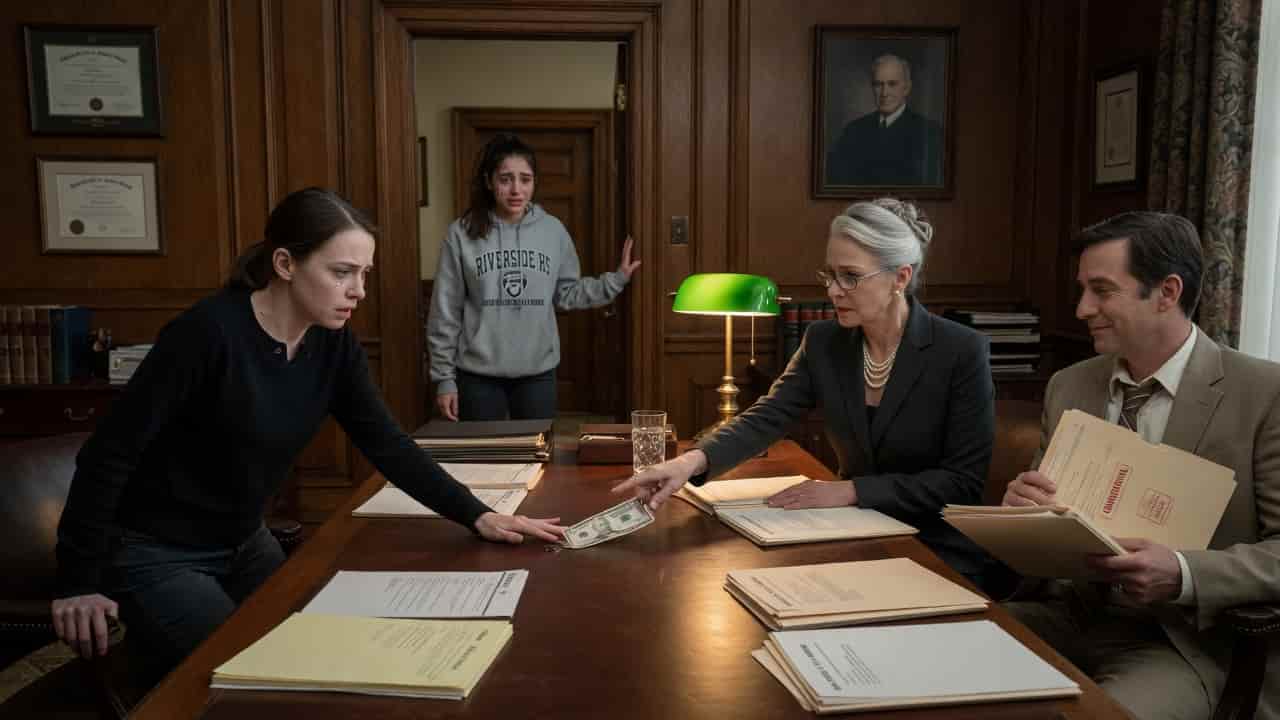
Tess stared at the fifty-dollar bill like it was a venomous snake. She couldn’t breathe. Just three days ago, she’d stood in the rain as they said goodbye to David, and now his mother was sitting across from her in a charcoal suit that cost more than Tess’s car, effectively erasing her life.
“You’re throwing us out?” Tess’s voice cracked, and she hated herself for the weakness in it. She looked at Whittaker, the family lawyer, but he wouldn’t meet her eyes. He just toyed with his gold signet ring, staring at the thick stack of papers David was supposed to have updated.
“The house belongs to the estate, Tess,” Victoria said, her voice devoid of anything resembling sympathy. “And according to the document we have, the estate belongs to me. I’ve been more than patient with your… presence in this family.”
In the doorway, Tess’s daughter, Maya, let out a small, strangled sob. The sound cut through Tess deeper than any of Victoria’s insults. Her daughter was watching her mother be treated like a beggar in the very room where David had promised they would always be safe.
Victoria leaned forward, her pearls clinking against the mahogany. “I want you out by morning. Don’t make me call the sheriff to escort you off the property. It would be such a shame for the neighbors to see.”
Tess looked at the money, then at the woman who had just signed a warrant for their homelessness. She didn’t know yet about the burnt scrap she’d find in the fireplace, or the old GoPro buried in David’s gym bag. All she knew was the cold, hard weight of a betrayal she never saw coming.
Chapter 1: The Silence of Lilies
The house didn’t feel like a home anymore; it felt like a museum dedicated to a life that had been abruptly canceled. David had been gone for exactly six days, and the silence he left behind was a physical weight, pressing against Tess’s chest every time she moved through the kitchen. The air smelled of wilting funeral lilies and the metallic tang of the industrial-strength cleaner the “sympathetic” neighbors had used when they came over to scrub floors they thought were dirty.
Tess sat at the small breakfast nook, a chipped mug of coffee cooling in her hands. She was thirty-six, but in the reflection of the microwave, she looked fifty. Her hair was a matted nest of chestnut strands she hadn’t brushed since the morning of the service, and her black sweater was covered in fine, white cat hair from David’s old Himalayan, Barnaby, who was currently pacing the hallway and howling at a door that would never open again.
The back door creaked open without a knock. Tess didn’t turn around. Only one person felt entitled enough to enter David’s house like a ghost returning to its haunt.
“The place smells of rot, Tess. You really should open a window.”
Victoria’s voice was a crisp, sharp blade. She walked into the kitchen, her heels clicking against the linoleum with a rhythmic precision that made Tess’s teeth ache. She was dressed in a navy wool coat, her silver hair perfectly coiffed, not a single strand out of place despite the damp Pennsylvania drizzle outside.
“It’s the flowers,” Tess said, her voice raspy. “People keep bringing them. I don’t have the heart to throw them out yet.”
Victoria walked to the counter, picked up a vase of drooping white roses, and dumped the entire thing into the trash can. Water splashed onto Tess’s feet. Victoria didn’t apologize. She set the empty crystal vase down with a sharp clack.
“Sentimentality is a luxury you can’t afford right now,” Victoria said. She didn’t sit down. She stood over Tess, radiating a cold, institutional authority. “I’ve spoken with Whittaker. We’re meeting at the office at two o’clock. Maya needs to be there as well.”
Tess finally looked up. “Why does Maya need to be there? It’s just the will, Victoria. David told me everything was set. He said we wouldn’t have to worry.”
Victoria’s lips thinned into a line that might have been a smile on a kinder woman. “David said many things, Tess. He was always a dreamer. Unfortunately, the law doesn’t care about what a man says over dinner. It cares about what is signed and witnessed.”
“What is that supposed to mean?”
“It means put on something respectable and make sure my granddaughter isn’t wearing that hideous sweatshirt. We have a great deal to discuss regarding the future of this property.”
Victoria turned and left as abruptly as she’d arrived. Tess sat in the renewed silence, her heart hammering a frantic rhythm against her ribs. The future of this property. It was a small house—a three-bedroom Cape Cod on the edge of town—but it was theirs. Or it was supposed to be. David had spent the last three years renovating it, his hands perpetually stained with sawdust and wood glue. He’d promised Tess that the mortgage was almost cleared, that the “new” will he’d drafted after his father died would protect them from Victoria’s reach.
Tess reached for her phone on the table. She needed to check the balance on their joint account. She’d tried to buy groceries the night before, and the card had been declined. She’d told herself it was a bank error, a glitch in the system caused by the sudden notification of David’s passing.
She logged into the app with trembling fingers. The screen loaded slowly.
Account Status: Frozen.
A cold sweat broke out across her neck. She tried the savings account.
Balance: $0.00. Transfer Pending to Estate Holding.
“No,” Tess whispered. “No, no, no.”
She stood up so quickly her chair screeched across the floor. She ran to the hallway, toward David’s small office—a converted closet off the living room. She began tearing through his desk, looking for the blue folder he’d shown her six months ago.
“Everything’s here, Tess,” he’d said, kissing her forehead. “If anything happens, you just take this to Whittaker. It’s all updated. Victoria can’t touch a dime.”
She found the folder. It was empty. Not just empty of the will, but empty of everything—the house title, the life insurance policy, even the deed to the burial plot.
The panic was a living thing now, clawing at her throat. She looked toward the fireplace in the living room. There was a pile of gray ash from the night after the funeral when Victoria had insisted on staying over to “help.” Victoria had spent hours by that fire, claiming she was cold, feeding it old magazines and “clutter” David had left behind.
Tess knelt by the hearth. Her hands were shaking so badly she could barely sift through the debris. Most of it was unrecognizable—charred paper and melted plastic. But there, tucked into a corner beneath the iron grate, was a jagged triangular scrap of heavy bond paper. It was singed black at the edges, but she could still see the embossed seal of a notary public and a fragment of David’s loopy, distinctive signature.
Below the signature, two words were still legible in the unburnt center: “…sole beneficiary…”
Tess stared at the scrap until her eyes blurred. Victoria hadn’t been cold. She’d been cleaning.
“Mom? What are you doing on the floor?”
Tess jerked her head up. Maya was standing in the hallway, her school bag slung over one shoulder. She looked so much like David—the same high cheekbones, the same inquisitive tilt of the head—that it felt like a physical blow to Tess’s chest.
“Nothing, honey,” Tess said, surreptitiously shoving the scrap into her pocket. “Just… looking for Barnaby. Your grandmother wants us at the lawyer’s office at two. Go get changed, okay? Wear the dress we bought for the spring formal.”
“Why? Is something wrong?”
“I don’t know yet,” Tess lied, her voice cracking. “I just want us to look nice for your dad.”
She watched Maya walk away, her movements heavy with a grief she shouldn’t have to carry at sixteen. Tess stayed on the floor for a long moment, her hand gripping the burnt scrap in her pocket. She felt a flicker of something she hadn’t felt since the accident: not grief, but a cold, hard coal of resentment. Victoria thought she’d finished it. She thought a few hours of fire had erased fifteen years of David’s love.
Tess stood up and walked to the bathroom. She splashed cold water on her face, watching the gray circles under her eyes in the mirror. She didn’t look like a victim. She looked like someone who was about to be pushed off a cliff. And as she watched her own reflection, she realized she had two choices: she could scream on the way down, or she could start looking for something to grab onto.
She went to David’s gym bag, sitting by the door where he’d dropped it the night before he died. She reached inside, her fingers brushing against his sweaty wristbands and an old water bottle. At the very bottom, tucked into a side pocket, her fingers hit something hard and rectangular.
The GoPro. David used it for his mountain bike runs, but lately, he’d been using it to record his “progress” on the house renovations, making little time-lapse videos for a YouTube channel he’d never actually started.
She pulled it out. The battery was dead.
“Two o’clock,” she whispered to the empty room.
She plugged the camera into the wall charger and watched the small red light flicker to life. It was a tiny, glowing eye in the dark house. She didn’t have the will, and she didn’t have the money. But she had the ash in her pocket and a dead man’s camera on the charger.
It wasn’t enough. Not yet. But as she heard Victoria’s car pull back into the driveway—the low, predatory hum of a woman coming to collect her spoils—Tess realized the war hadn’t ended at the grave. It was only just beginning.
Chapter 2: The Price of a Motel
The office of Whittaker & Associates felt like a tomb designed by an interior decorator who hated poor people. Everything was too quiet, too expensive, and smelled faintly of lemon oil and old money. Tess sat on a leather sofa that felt like it was trying to swallow her, while Maya sat stiffly beside her, her fingers picking at a loose thread on her dress.
Victoria sat in the armchair across from them, looking like she’d been born in the room. She was reading a Wall Street Journal, her eyes flicking across the pages with clinical detachment. She hadn’t spoken a word to them since they’d arrived.
“Mr. Whittaker will see you now,” a receptionist said, her voice a hushed whisper.
They were led into a large corner office. Whittaker was standing behind a desk the size of a small boat. He was a man of indeterminate age, with a tan that suggested he spent more time on a golf course than in a courtroom. He offered a practiced, mournful nod to Tess, but his eyes immediately shifted to Victoria.
“Victoria,” he said, rounding the desk to pull out a chair for her. “Thank you for coming. Tess, Maya. Please, sit.”
Tess sat. Her pocket felt heavy with the burnt scrap of paper. She looked at the desk, expecting to see the blue folder David had promised her. Instead, there was a thin, yellowing document in a plastic sleeve.
“I’ll get straight to the point,” Whittaker said, leaning back and joining his fingers into a steeple. “We’ve spent the last few days conducting a thorough search of David’s filings. As you know, David was… meticulous, but perhaps a bit disorganized in his final months.”
“He wasn’t disorganized,” Tess said, her voice sharper than she intended. “He had an updated will. He showed it to me.”
Whittaker sighed, a sound of practiced pity. “Tess, I understand this is difficult. But the only legally binding document we have on file—the only one that was ever properly executed and witnessed in this office—is a will David signed twelve years ago. Shortly after he married you, but before the house was fully in his name.”
Tess felt the blood drain from her face. “Twelve years ago? That’s impossible. We weren’t even living in the Cape Cod then. He didn’t even own his father’s business yet.”
“Precisely,” Victoria chimed in, her voice smooth as silk. “That was back when David still understood the importance of family legacy. Before he got distracted by… other things.”
Whittaker cleared his throat. “According to this document, the entirety of David’s estate—including the property on Miller Road, the business holdings, and all liquid assets—reverts to his primary benefactor. His mother, Victoria.”
“What about Maya?” Tess asked, her voice rising. She felt Maya’s hand grip her arm. “He has a daughter! You’re saying he left his child nothing?”
“The will predates Maya’s birth,” Whittaker said gently. “Under the law, without a codicil or an updated filing, the original instructions stand. Victoria is the sole heir.”
The room began to spin. Tess looked at Victoria, who was watching her with the same expression a scientist might give a specimen under a microscope.
“You know this isn’t right,” Tess said, leaning across the desk. “You were there, Victoria. You saw him working on the new papers. You were in the house.”
“I saw my son struggling with his finances,” Victoria said. “I saw him trying to keep a roof over the head of a woman who never understood the value of what he worked for. I’m simply Step One in a long process of righting the ship.”
“Step One?” Tess whispered.
Victoria stood up. She didn’t look at Whittaker. She looked directly at Tess. She reached into her leather handbag, pulled out a crisp, folded fifty-dollar bill, and slid it across the mahogany table. It stopped inches from Tess’s hand.
“This should get you a motel for the night,” Victoria said.
The words felt like a physical slap. Maya let out a small, choked sound of horror.
“You’re throwing us out?” Tess’s voice was barely a breath.
“The house is mine now,” Victoria said. “I’ve already arranged for the locks to be changed tomorrow afternoon. I suggest you spend the evening packing what is yours. Anything left behind—the furniture, the appliances, the decor—will be considered part of the estate and disposed of accordingly.”
“You can’t do this,” Tess said, her hand finally reaching for the money, not to take it, but to crumple it. Her fingers shook. “Whittaker, tell her she can’t do this. There’s a grace period. There’s… something.”
Whittaker looked at his nails. “Legally, as the sole owner of the property, Mrs. Thorne has the right to take possession immediately. I’ve advised her to be… charitable, but her mind is made up.”
“Charitable?” Tess laughed, a harsh, jagged sound. “She’s giving me fifty dollars for fifteen years of marriage. She’s making her granddaughter homeless.”
“Maya is always welcome at the estate,” Victoria said, looking at the girl for the first time. “Provided she follows the rules of my house. But you, Tess? You’ve always been a temporary fixture. And your time is up.”
Victoria turned and walked toward the door. She paused at the threshold, her hand on the brass handle. “Be out by ten A.M. If the driveway isn’t clear, I’ll have the sheriff come by to assist you. It would be such a shame for the neighbors to see you hauled away in a cruiser.”
She left, the click of her heels echoing down the hallway like a countdown.
Tess sat in the silence, staring at the fifty-dollar bill. She felt Maya’s tears hitting her shoulder. The humiliation was so thick she could taste it—the copper tang of blood where she’d bitten her cheek. She looked at Whittaker.
“How much is she paying you?” Tess asked quietly.
Whittaker didn’t look up. “I’m a professional, Tess. I follow the law.”
“You follow the money,” Tess said. She stood up, pulling Maya with her. She didn’t take the fifty dollars. She left it sitting on the mahogany, a small, green insult in a room full of expensive lies.
They walked out of the office and into the gray afternoon. The rain had turned into a steady downpour. As they walked to the car—an old SUV that was technically part of the “estate”—Tess felt the burnt scrap in her pocket again.
She wasn’t just a “temporary fixture.” She was the woman David had loved. She was the woman who had held his hand while he died in that hospital bed, while Victoria was busy calling her lawyer to see which accounts she could freeze first.
“Mom?” Maya asked as they got into the car. “Where are we going to go?”
Tess gripped the steering wheel so hard her knuckles turned white. She thought about the GoPro sitting on the charger at home. She thought about the way Victoria’s eyes had narrowed when Tess mentioned the new will. Victoria wasn’t just greedy; she was afraid. You don’t burn papers unless you’re terrified of what they say.
“We’re going home,” Tess said. “And we’re going to pack. But we aren’t leaving everything behind, Maya. Not the things that matter.”
“But she said—”
“I don’t care what she said,” Tess snapped, then immediately softened. “I’m sorry, baby. I just… I need you to trust me. Your dad didn’t leave us with nothing. He wouldn’t.”
She backed the car out of the spot, her eyes catching Whittaker watching them from his window. She didn’t wave. She didn’t cry. She just drove, the image of that fifty-dollar bill burned into her retinas like a brand. Victoria thought she’d bought a victory for the price of a cheap motel room. She was about to find out that some things were significantly more expensive.
Chapter 3: The Residue of a Life
Packing a life into fifteen hours is a form of psychological torture. Every object Tess touched was a memory that had been weaponized. The cast-iron skillet David used for Sunday pancakes. The crooked bookshelf he’d built for Maya’s tenth birthday. The framed photo of their wedding day in the Catskills, both of them looking young and ridiculously certain that the world was theirs for the taking.
By midnight, the living room was a graveyard of cardboard boxes and black plastic trash bags. Tess had moved with a frantic, mechanical energy, her mind refusing to settle on the reality of what was happening. Maya was in her room, the sound of rhythmic thumping as she tossed shoes into a trunk the only noise in the house besides the wind rattling the windowpanes.
Tess stood in the kitchen, staring at the empty cabinets. She’d left the dishes—Victoria could have the chipped plates. But she’d taken the spices, the little jars of cumin and paprika that still smelled like the meals they’d shared. It felt small, petty, and entirely necessary.
She walked into the living room and sat on the floor by the fireplace. The ash was still there, cold and gray. She reached into her pocket and pulled out the burnt scrap. “…sole beneficiary…”
She looked at the GoPro sitting on the coffee table. The light was green now. Fully charged.
She picked it up, her hands trembling. She’d used the camera a dozen times, but now it felt like she was holding a live grenade. She pressed the power button. The small screen flickered to life, showing the last frame David had recorded.
It was a shot of the back deck, sunlight filtering through the trees. David’s face appeared, sweaty and grinning, his thumb over the lens for a second before he adjusted it.
“Okay, testing, testing,” David’s voice filled the quiet room. It was so vibrant, so him, that Tess had to cover her mouth to keep from screaming. “Tess, if you’re watching this, it means I finally figured out how to use the editing software. Or I’m dead. Hopefully the first one.”
He laughed—that short, barking laugh that always made his shoulders shake. He was sitting at his desk in the office, the same blue folder she’d found empty earlier that day spread out in front of him.
“Anyway,” David continued, his expression turning serious. “I’m recording this because my mother is being… well, she’s being Victoria. She’s been hovering, asking about the business, asking about the house. She thinks I haven’t noticed her looking through my files when she ‘stops by’ for tea.”
He held up a document. Even on the tiny screen, Tess could see the title: LAST WILL AND TESTAMENT OF DAVID THORNE.
“I’m signing the updated version today,” David said. “Whittaker is coming over tonight to witness it privately. He says he doesn’t want Victoria to know yet because she’s still a major client of his firm, and he doesn’t want the drama. But I want it on record. Everything goes to Tess. The house, the business, the accounts. Maya’s college fund is locked in a separate trust she can’t touch until she’s twenty-one. If my mother tries to fight this, Tess, show her this video. Show the world.”
He turned the camera toward the window as a car pulled into the driveway. “That’s Whittaker now. I’m going to leave this running on the shelf. Just in case.”
The video continued for another twenty minutes. Tess watched in stunned silence as Whittaker entered the room. She watched them talk—not like a lawyer and a client, but like two men making a deal.
“You’re sure about this, David?” Whittaker’s voice was clear. “Your mother won’t be happy. She sees this house as her husband’s legacy.”
“It’s my legacy now,” David replied. “And I want my wife to have it. Sign the damn thing, Greg.”
She watched Whittaker sign. She watched him stamp it with his notary seal. And then, most importantly, she watched David tuck the document into the blue folder and place it inside the floor safe beneath the desk—a safe Tess hadn’t even known existed because it was hidden under a loose floorboard.
The video ended with David walking back to the camera and winking. “Love you, Tess. See you at dinner.”
Tess sat on the floor, the GoPro gripped in her hands. The room was dark, the only light coming from the tiny screen. She felt a surge of grief so sharp it felt like a physical wound, followed immediately by a white-hot, purifying rage.
Victoria hadn’t just burned papers. She’d conspired with a licensed attorney to defraud a widow and an orphan. They hadn’t just been “cleaning” the night of the fire; they had been hunting.
“Mom?”
Maya was standing in the doorway, her face pale. “I heard Dad’s voice. I thought… I thought I was going crazy.”
Tess looked up at her daughter. She held out the camera. “He’s here, Maya. He’s right here.”
Maya sat beside her, and they watched the video again. And again. They watched David defend them from beyond the grave. They watched the man they loved stand up to the woman who was currently trying to erase them.
“We have to go to the police,” Maya whispered.
“No,” Tess said, her voice cold. “Whittaker has the local cops in his pocket. He does their pro bono work. He handles the Mayor’s taxes. We go to the police, and that camera disappears before we ever see a courtroom.”
“Then what do we do? She’s coming at ten.”
Tess looked at the fireplace. She thought about the fifty-dollar bill. She thought about the way Victoria had looked at her—like she was something dirty she’d finally managed to scrub off the floor.
“We let her come,” Tess said. “We pack the car. We act like we’re beaten. We let her feel the full weight of her victory.”
“But Mom—”
“And then,” Tess said, her eyes narrowing, “we go to the one place Victoria hates more than anything else. We go to the public.”
Tess spent the rest of the night not packing, but preparing. She used David’s old laptop to backup the video in four different cloud drives. She sent a copy to an old friend from college who was a producer for the city’s investigative news team. And then, she went to the desk in the office.
She moved the rug. She found the loose floorboard.
The safe was there. It was empty, of course—Whittaker or Victoria must have emptied it after the fire—but they had missed one thing. In their haste to grab the folder, a small, silver thumb drive had rolled into the corner of the safe’s interior, hidden by the lip of the metal frame.
Tess pulled it out. It was labeled: “FOR THE WIN.”
She plugged it into the laptop. It wasn’t more legal documents. It was David’s personal ledger—the real one. The one that showed the “loans” Victoria had been taking from the family business for years to cover her gambling debts at the casinos in Atlantic City.
It was a roadmap of Victoria’s desperation. It was the reason she needed the estate so badly. She wasn’t protecting a legacy; she was drowning, and she was using David’s death as a life raft.
By dawn, the rain had stopped, leaving the world dripping and gray. Tess stood on the front porch, watching the sun rise over the trees David had planted. She felt exhausted, but the fog of grief had been replaced by a crystalline, predatory focus.
The residue of the last few days wasn’t just sadness. It was a hardening. She wasn’t the woman who had sat crying in the lawyer’s office anymore. She was the woman who knew exactly how much Victoria’s “prestige” was worth.
And she was about to call the debt due.
Chapter 4: The Midnight Bar
Tess didn’t wait for ten o’clock.
At 8:00 A.M., she drove Maya to her friend’s house, kissed her forehead, and told her to stay off social media until she called. Then, she drove to a small, divey bar on the edge of the county line called The Rusty Nail.
It was the kind of place where the air always smelled of stale beer and regret, even in the morning. It was also where Greg Whittaker went when he didn’t want to be a “prestige” lawyer.
She found his car in the lot—the same tan Mercedes he’d been driving yesterday. He was inside, sitting in a back booth with a glass of something amber and a plate of greasy eggs. He looked different without the mahogany desk in front of him. He looked smaller, his tan appearing sallow under the flickering fluorescent lights.
Tess slid into the booth across from him. He jumped, nearly spilling his drink.
“Tess? What the hell are you doing here?”
“I think you know, Greg,” she said. Her voice was calm, which seemed to scare him more than if she’d been screaming.
“Look, I told you yesterday. My hands are tied. The law is—”
“The law is a video of you witnessing a will you then helped Victoria burn,” Tess said.
Whittaker froze. The color left his face so quickly he looked like a ghost. “I don’t know what you’re talking about.”
Tess pulled the GoPro from her bag and set it on the table. She didn’t play it. She just let it sit there, a small, black witness to his ruin.
“David recorded the whole thing, Greg. The signing. The conversation about Victoria. The way you looked when you stamped it. He even caught the part where you told him you’d keep it safe from her.”
Whittaker’s eyes darted toward the door.
“Don’t,” Tess said. “The video is already with a friend of mine. If I don’t check in by noon, it goes live. Along with David’s ledger. You know, the one where he tracked all the money Victoria was skimming from the firm? The money you helped her hide?”
Whittaker leaned back, his chest heaving. “Tess, listen to me. Victoria is… she’s a powerful woman. She can make things very difficult for you.”
“She already did,” Tess said. “She gave me fifty dollars to find a motel for her granddaughter. She threw me out of my own home while I was still wearing my funeral clothes. She’s already done her worst, Greg. Now it’s my turn.”
“What do you want?” he whispered.
“I want the truth. In writing. I want a sworn affidavit that the will you produced yesterday was a fraud. I want the estate restored to its rightful heirs. And I want it done before Victoria shows up at my house at ten o’clock.”
Whittaker laughed, a shaky, hysterical sound. “She’ll kill me. She’ll ruin my career.”
“Your career is already over, Greg. The only question is whether you go to jail for fraud and conspiracy, or whether you just lose your license. If you help me, I might forget to mention your name to the D.A. for twenty-four hours. Long enough for you to get a head start.”
She leaned forward, her face inches from his. “You think she’s loyal to you? You think she won’t throw you under the bus the second the heat gets too high? She’s a Thorne, Greg. They don’t have friends. They have tools. And you’re just a tool that’s lost its edge.”
Whittaker looked at the GoPro, then at his drink. He looked like a man who had finally realized the floor he’d been standing on was made of thin ice.
“She’s at the house now,” Whittaker said. “She went early to ‘inspect’ the inventory. She’s probably going through your jewelry right now, Tess.”
The rage flared in Tess’s chest, but she kept it cold. “Then we better get moving. I have a court reporter waiting at my house. And I think it’s time Victoria had an audience.”
“Tess, wait,” Whittaker said, reaching out to touch her arm. She flinched away like his skin was toxic. “She’s desperate. You don’t know how much she owes. She’s not just going to hand over the keys.”
“I’m not asking for the keys, Greg. I’m taking the house back.”
They walked out of the bar together—the widow and the lawyer who had tried to bury her. The drive back to Miller Road was silent. Tess watched the familiar landscape roll by, the rolling hills and the weathered barns of the Pennsylvania countryside. It was a beautiful place, but it felt tainted now, poisoned by the greed of a woman who thought she could own people like property.
As they pulled into the driveway, Tess saw Victoria’s car. And next to it, a large white truck with a logo on the side: ESTATE LIQUIDATORS & AUCTIONEERS.
Victoria was standing on the front lawn, talking to a man in a jumpsuit who was holding a clipboard. She was pointing at the house, her gestures wide and predatory.
Tess stepped out of the car. She felt the weight of the GoPro in her hand and the thumb drive in her pocket. She felt the ghost of David behind her, his hand on her shoulder.
“Victoria!” Tess shouted.
The older woman turned, her expression shifting from irritation to a cold, smug triumph. “You’re late, Tess. I told you ten o’clock. The movers are already starting in the basement.”
“Tell them to stop,” Tess said, walking toward her. Whittaker followed a few steps behind, looking like he wanted to vanish into the grass.
“I don’t think so,” Victoria said. “You’ve had your time. Now, please, take your things and leave. I don’t want to have to call the sheriff.”
“You won’t have to,” Tess said, stopping a few feet away. She held up the GoPro. “Because Greg has something he’d like to say. Don’t you, Greg?”
Victoria’s eyes shifted to Whittaker. Her expression didn’t change, but her hand gripped her pearls so hard the string looked like it might snap.
“Greg? What is she talking about?”
Whittaker stepped forward, his voice trembling but clear. “Victoria… it’s over. David recorded the signing. He recorded everything.”
The silence that followed was absolute. Even the movers stopped, sensing the shift in the air. Victoria looked at the camera, then at Tess. For the first time in her life, the mask of aristocratic calm flickered. Underneath, there was something jagged, ugly, and profoundly afraid.
“You’re lying,” Victoria hissed. “He wouldn’t know how.”
“He knew enough,” Tess said. “He knew you were coming for us. He knew you were stealing from the business to pay off the casinos. He knew everything, Victoria. And now, so do I.”
Tess looked at the man with the clipboard. “Get your truck off my property. Now.”
The man looked at Victoria, then at Tess’s cold, hard stare. He didn’t ask questions. He turned and started yelling at his crew.
Tess turned back to Victoria. The older woman was shaking now, her face a mask of pale fury.
“You think this changes anything?” Victoria spat. “I am the head of this family. I am the Thorne name. You are nothing but a girl from a trailer park who got lucky.”
“I’m the woman David loved,” Tess said. “And I’m the woman who’s going to watch you lose everything. Now, get off my lawn. Before I decide that twenty-four-hour head start I promised Greg doesn’t apply to you.”
Victoria stared at her for a long, agonizing moment. She looked at Whittaker, who looked away. She looked at the house—the house she’d tried to steal. And then, without a word, she turned and walked to her car.
She didn’t look back. She drove away, her tires spitting gravel onto the grass.
Tess stood on her lawn, watching the car disappear. She felt the adrenaline beginning to fade, replaced by a hollow, aching exhaustion. She’d won the house. She’d won the money. But the silence was still there. David was still gone.
She looked at Whittaker, who was standing by his car, looking lost.
“Go,” Tess said. “Before I change my mind.”
He didn’t need to be told twice.
Tess walked up the porch steps and into her house. It was a mess—boxes everywhere, the air smelling of dust and stress. She sat on the floor in the middle of the living room and let out a long, shuddering breath.
She had the house. But the residue of the humiliation, the memory of that fifty-dollar bill hitting the table, was still there. It was a stain that wouldn’t wash out.
She reached into her pocket and pulled out the burnt scrap of paper one last time. She walked to the fireplace, struck a match, and watched as the last piece of the fraudulent past turned into real smoke.
She wasn’t a victim anymore. But as she looked around the empty rooms, she realized that winning didn’t mean the damage was gone. It just meant she was the only one left to clean it up.
Chapter 5: The Weight of the Win
The victory didn’t taste like champagne; it tasted like the lukewarm dregs of a pot of coffee that had been sitting on the burner for three hours. After the movers had retreated and Victoria’s sedan had kicked up the last of the driveway gravel, the house on Miller Road didn’t feel reclaimed. It felt hollowed out, a carcass of a home that had been picked over by vultures.
Tess sat on the bottom step of the staircase, the GoPro still gripped in her hand until her knuckles ached. She stared at the front door, half-expecting Victoria to burst back through it with a legion of lawyers or a sheriff in tow. The silence of the house was different now—it wasn’t the heavy, grieving silence of the week before. It was a vibrating, high-tension quiet, the kind that follows a lightning strike.
She had the house. She had the proof. But as she looked at the boxes piled in the living room, she realized she was sitting in a wreckage of her own making.
The phone in her pocket buzzed. It was a text from Miller, her college friend who worked at the local news affiliate. “Tess, I’ve watched the file. This is nuclear. But you need to understand what happens if we run this. It isn’t just about the will. If Whittaker was involved in fraud, every case he’s touched for the last decade is going to be scrutinized. And Victoria… the Thorne name will be mud by morning. Are you ready for the fallout?”
Tess didn’t reply immediately. She looked up as Maya’s friend dropped her off at the end of the driveway. Maya walked up the porch steps slowly, her eyes scanning the yard for the liquidators’ truck. When she saw it was gone, she didn’t run inside. She stopped at the threshold, looking at her mother.
“Is it over?” Maya asked. Her voice was small, stripped of the teenage bravado she’d tried to maintain at the lawyer’s office.
“For today,” Tess said. She stood up, her joints popping. “The house is ours, Maya. The movers are gone. Your grandmother is… she’s gone.”
Maya stepped into the foyer, her eyes landing on the coffee table where the GoPro sat next to the burnt scrap of paper. “What happens now? Does she go to jail?”
“I don’t know,” Tess admitted. She walked over and pulled her daughter into a hug. Maya was stiff at first, then she collapsed against Tess’s shoulder, a sob breaking out of her that she’d clearly been holding since the reading of the will. “We have to decide how far we want to take this.”
“She tried to make us beggars, Mom,” Maya muffled into Tess’s sweater. “She sat there and gave you fifty dollars like you were a piece of trash on the street. I want her to feel what that felt like.”
Tess held her tighter, but she felt a cold shiver of dread. Revenge was a seductive thing, but she knew Victoria. A woman like that didn’t just crawl into a hole and die because she’d been caught. She was cornered, and a cornered Thorne was a dangerous animal.
The rest of the afternoon was spent in a blur of mechanical labor. They didn’t unpack everything—it felt premature—but they moved the essential boxes back into the kitchen and bedrooms. Tess found herself constantly checking the windows, her eyes drawn to the road.
At five o’clock, a knock came at the door. It wasn’t the predatory click of Victoria’s heels. It was a heavy, hesitant thud.
Tess opened the door to find Whittaker. He wasn’t in his tan suit anymore. He was wearing a rumpled polo shirt and khakis, looking like a man who had spent the last three hours vomiting. He held a thick manila envelope in his hand.
“I can’t stay,” he said, his voice a low, frantic whisper. “The affidavit is in here. Sworn and notarized by my associate who wasn’t involved. It details the existence of the updated will and Victoria’s instructions to suppress it.”
Tess took the envelope. It felt surprisingly light for something that could end a man’s career. “Why are you giving me this now, Greg? Why not yesterday?”
Whittaker looked past her into the house, his eyes landing on a photo of David on the mantel. “Because David was my friend, Tess. Long before he was a client. And because Victoria called me twenty minutes ago. She didn’t ask how I was. She didn’t ask how we were going to fix this. She told me to find a way to make the GoPro disappear, or she’d tell the Bar Association that the fraud was my idea from the start.”
He let out a jagged, dry laugh. “She was going to burn me to save herself. Just like she burned that will. I’m an idiot, Tess. I thought being in her inner circle meant I was safe. But there is no inner circle. There’s just Victoria, and then there’s everyone else.”
“What are you going to do?” Tess asked.
“I’m going to my sister’s place in Ohio,” he said. “My keys are on the desk in the office. The firm is going to collapse by Monday. I suggest you get your own representation—someone from out of the county. Someone Victoria can’t buy.”
He turned to leave, then paused. “She’s desperate, Tess. Those casino debts… they aren’t just to the house. She’s been using the Thorne family foundation as a personal piggy bank. If the estate doesn’t settle in her favor soon, the feds are going to be knocking on her door for embezzlement. That’s why she was so cold. It wasn’t just greed. It was survival.”
He walked down the steps and got into his car, disappearing into the twilight.
Tess took the envelope to the kitchen table and spread the documents out. It was all there. The confession. The timeline. The confirmation of the “residue” of David’s life that Victoria had tried to incinerate.
But as she read through the affidavit, a new detail jumped out at her. Victoria hadn’t just been skimming from the business. She’d taken out a secondary mortgage on the family estate—the big Thorne mansion—and David had found out. He’d been planning to confront her the week he died.
The accident.
The thought entered Tess’s mind like a drop of ink in clear water. David was a careful driver. He knew those roads. He’d been on his way to his mother’s house when the truck hit him. The police had called it a tragic intersection of bad weather and a distracted driver, but David didn’t get distracted. Not when he was on a mission.
“Mom? You’re shaking,” Maya said, coming into the kitchen with a glass of water.
“I’m fine,” Tess lied, her fingers gripping the edge of Whittaker’s affidavit. “I’m just… I’m realizing that fifty dollars wasn’t an insult, Maya. it was a distraction. She wanted me to be so angry about the money that I wouldn’t look at the why.”
Tess stood up and went to the laptop. She pulled up the ledger from the thumb drive again. She looked at the dates of the casino withdrawals. They spiked in the months leading up to the accident. Victoria was losing hundreds of thousands of dollars. She was hemorrhaging money that didn’t belong to her.
And David was the only one with the keys to the kingdom.
The realization was a sickening weight in Tess’s stomach. She looked at the GoPro. David had recorded that video because he felt his mother hovering. He’d felt the pressure. He’d known she was looking through his files.
Did he know she was capable of more than just theft?
The evening turned into a long, dark night of the soul. Tess sat in David’s office, the small lamp casting long, distorted shadows against the walls. She went through every file, every digital footprint he’d left behind. She wasn’t looking for money anymore. She was looking for fear.
She found it in a sent email, tucked away in his “Drafts” folder, dated the night before the crash.
To: Victoria Thorne
Subject: This ends tomorrow.
“Mom, I saw the bank statements for the Foundation. I know about the mortgage on the estate. I don’t know how you thought you could hide this from me. I’ve updated the will and moved the primary executor rights to Tess. I’m coming over tomorrow morning to discuss how we’re going to report this. Don’t try to call Greg. He already knows I’ve seen the signatures. We’re going to handle this as a family, but you’re stepping down from the board effective immediately.”
He never sent it. He’d probably intended to say it to her face. He was always better at the direct approach. He believed in the “family” even when the family was rotting from the inside out.
Tess closed the laptop and leaned back, her heart thudding a slow, painful beat. Victoria hadn’t just bullied her in that lawyer’s office. She hadn’t just humiliated her with a fifty-dollar bill. She had potentially stood by and watched her son drive into his grave to keep her secrets buried.
The residue of the confrontation was gone, replaced by a cold, clinical clarity. This wasn’t a story about a will anymore. It was a story about a predator who had worn the face of a mother for thirty-six years.
At 3:00 A.M., the phone rang. Tess didn’t recognize the number, but she knew the voice before the first word was spoken.
“You think you’ve won, don’t you?” Victoria’s voice was thin, brittle, like dry parchment. There was no aristocratic polish left, just a raw, jagged desperation.
“I have the affidavit, Victoria,” Tess said. She kept her voice flat, emotionless. “I have the ledger. And I have the draft email David wrote to you the night before he died.”
There was a long, sharp intake of breath on the other end of the line. For a moment, the only sound was the static of the connection.
“David was weak,” Victoria hissed. “He was always soft. Just like his father. He didn’t understand that a legacy requires sacrifice. He was going to destroy everything I’ve built because of a few bad months at the tables.”
“A few bad months?” Tess felt the rage rising, but she pushed it down. “You stole from his child’s future. You tried to make us homeless. You sat there and watched me cry at his funeral, knowing you’d burned his last wishes in my own fireplace.”
“I gave you fifty dollars, Tess. More than you were worth when he met you. You should have taken the money and disappeared. Now… now there’s nothing left to save.”
“You’re right,” Tess said. “There’s nothing left to save for you. I’m calling Miller in the morning. The video, the affidavit, the ledger… it’s all going out. Every casino receipt, every forged signature. I’m going to make sure that the Thorne name is synonymous with trash. I want you to feel the eyes of this town on you when you’re being escorted out of that mansion. I want you to remember that fifty-dollar bill every time you have to ask a guard for a tray of food.”
“You won’t do it,” Victoria whispered. “It would ruin Maya’s name too. She’s a Thorne.”
“No,” Tess said, looking at the door to her daughter’s room. “She’s a David. And she’s mine. And she’s never going to have to worry about your legacy again.”
Tess hung up. She didn’t feel the rush of triumph she’d expected. She just felt tired. The weight of the win was heavy, but the weight of the truth was almost unbearable.
She walked into Maya’s room and sat on the edge of the bed. Her daughter was asleep, her face peaceful in the moonlight. Tess smoothed a strand of hair back from her forehead.
“We’re going to be okay,” Tess whispered, though she wasn’t sure who she was trying to convince.
She went back to the living room and began to unpack. Not the spices or the clothes, but the photos. She put David back on the mantel. She put the crooked bookshelf back in the corner. She reclaimed the space, inch by inch, until the house started to feel like a home again.
But as the sun began to peek over the horizon, casting a pale, gray light over the town, Tess knew that the real battle was still coming. Victoria was a woman with nothing left to lose, and those were the people who left the deepest scars. The residue of the $50 bill was just the beginning; the real cost of the Thorne inheritance was about to be paid in full.
Chapter 6: The Residue of Truth
The end didn’t come with a bang or a courtroom drama like a television special. It came with a slow, grinding inevitability, a series of clicks and shutters as the world finally looked at Victoria Thorne without her armor.
Three days after the confrontation, the local news ran the story. Miller hadn’t sensationalized it—he didn’t have to. The video of David, vibrant and determined, speaking from beyond the grave, did the work for him. Then came the leaked documents: the ledger of casino debts, the forged signatures, and the affidavit from a fleeing Greg Whittaker.
The public reaction was a tidal wave of outrage. In a small town like theirs, the Thornes had always been the untouchable elite, the family that owned the banks and the foundations. Seeing the matriarch reduced to a common fraud—a woman who would steal from her own widowed daughter-in-law—was a social explosion.
Tess stayed inside the house on Miller Road. She kept the curtains drawn and the doors locked. She didn’t want to see the reporters parked at the end of the driveway, and she didn’t want to hear the whispers of the neighbors who were suddenly “so sorry” for what she’d been through.
Maya sat at the kitchen table, her laptop open. She was reading the comments on the news article.
“They’re calling her a monster, Mom,” Maya said. Her voice didn’t have the spiteful edge it’d had a few days ago. It just sounded hollow. “People who used to go to her garden parties are posting photos of the fifty-dollar bill and making jokes. They’re saying the Thorne name is cursed.”
“It’s not cursed, Maya,” Tess said, stirring a pot of soup she didn’t really want to eat. “It’s just human. People love to see the high and mighty fall, especially when they were cruel on the way up.”
“Is she really going to lose the mansion?”
“The bank started foreclosure yesterday,” Tess said. “The embezzlement from the Foundation was enough for the state attorney to freeze everything. She doesn’t have a dime left that isn’t under a lien.”
The irony wasn’t lost on Tess. Victoria had tried to make them homeless to save her own skin, and in doing so, she’d accelerated her own ruin. The fifty dollars she’d slid across the table had been the spark that lit the fire she couldn’t put out.
A week later, the doorbell rang. Tess checked the security camera David had installed years ago. It wasn’t a reporter. It was a black town car, and a woman was standing on the porch.
She wasn’t wearing a charcoal suit or pearls. She was wearing a plain, beige raincoat and slacks. She looked older, her silver hair no longer perfectly coiffed, but hanging in limp, stressed strands around a face that had aged ten years in ten days.
Victoria.
Tess opened the door, but she didn’t step back to let her in. She stood in the doorway, her hand on the frame, blocking the entrance just as Victoria had once blocked her path to the law office.
“I came to get my things,” Victoria said. Her voice was thin, the authority gone, replaced by a weary, defensive pride. “The movers said you blocked them from taking the heirlooms.”
“The heirlooms are part of the estate, Victoria,” Tess said. “And since the estate is currently under a legal freeze pending the restoration of David’s real will, nothing leaves this house. Not the silver, not the rugs, and certainly not the jewelry you tried to take from my dresser.”
Victoria’s eyes flared for a second, a ghost of the old fire, but it died quickly. She looked past Tess into the hallway.
“I have nowhere to go,” Victoria whispered. It was the first time Tess had ever heard her admit a weakness. “The club has revoked my membership. My friends… they don’t answer the phone. Even the hotel in town refused my credit card.”
“That’s a shame,” Tess said. She reached into her pocket and pulled out a single, crumpled fifty-dollar bill. She’d kept it in her jeans as a reminder. She held it out. “This should get you a motel for the night. Though you might want to try the one by the interstate. They’re less picky about their clientele.”
Victoria stared at the bill. She didn’t take it. Her hands began to shake, her eyes filling with a bitter, impotent rage. “You think this makes us even? You think humiliating me like this brings him back?”
“Nothing brings him back,” Tess said, her voice dropping to a low, dangerous growl. “But it makes the world a little more honest. You sat in that office and treated me like a beggar while you were the one who had robbed us blind. You watched your son’s life fall apart because you couldn’t stop pulling handles at a slot machine. This isn’t about being even, Victoria. This is about you finally being who you really are.”
Tess dropped the fifty-dollar bill. It fluttered to the porch floor, landing between Victoria’s expensive, worn-out loafers.
“Pick it up,” Tess said. “Or don’t. But get off my porch. If you come back here again, I’m calling the sheriff. And unlike last time, I have the papers to prove you’re the intruder.”
Tess closed the door. She didn’t wait to see if Victoria picked up the money. She didn’t want to see the woman’s face anymore. She walked into the kitchen and sat down, her heart racing.
“Did you give it back to her?” Maya asked from the table.
“I did,” Tess said.
“How did it feel?”
Tess thought about it. She thought about the weight she’d been carrying since the accident, the shame of the rejection, the fear of the future. She thought about the $50 bill sitting on the mahogany table and the way Whittaker had looked at his nails.
“It felt like nothing,” Tess said. “It didn’t make me feel better. It didn’t make the house feel warmer. It just felt like finishing a chore.”
That was the truth of revenge that no one ever told you. It didn’t heal the wound; it just cauterized it. The residue remained—the knowledge of what people were capable of, the memory of the cruelty, the empty seat at the dinner table.
A month later, the legal dust began to settle. The court-appointed executor had restored the updated will. The house was officially in Tess’s name, and the life insurance—the real policy Victoria had tried to hide—was paid out into a trust for Maya.
Victoria Thorne had disappeared. Some said she’d moved to Florida to live with a distant cousin who didn’t read the news; others said she was living in a state-subsidized apartment three counties over. Tess didn’t look for her. The woman was a ghost in a beige raincoat, a cautionary tale for the town’s elite.
It was a Tuesday afternoon when Tess finally went into the backyard to deal with the garden. David had been planning to put in a stone patio, and the pallets of pavers were still sitting under a blue tarp by the shed.
She pulled the tarp back. The stones were heavy, gray and solid. She picked one up, her muscles straining. It was a good weight. A real weight.
Maya came out of the back door, carrying a pair of work gloves. “What are you doing, Mom?”
“I’m finishing it,” Tess said. “The patio. Your dad wanted it done before the summer.”
Maya looked at the stones, then at her mother. She put on the gloves and knelt down. “He wanted the pattern to be diagonal, remember? He said it made the yard look bigger.”
“Diagonal it is,” Tess said.
They worked together for hours, moving the stones, leveling the sand, fitting the pieces of their life back together in a new configuration. It wasn’t perfect. There were gaps between the stones, and their backs ached from the unaccustomed labor. But they were doing it themselves.
As the sun began to set, casting long, golden shadows across the lawn, Tess stopped and wiped the sweat from her brow. She looked at the house. It looked smaller than it used to, less like a fortress and more like a shelter.
She thought about the GoPro, now tucked away in a safe deposit box along with the ledger. She thought about the burnt scrap of paper she’d watched turn to ash. She thought about David, and the way he’d smiled at the camera, knowing he was protecting them.
The residue of the last few weeks was still there—the grief, the anger, the shock of the betrayal. It would always be there, a layer of dust on the furniture of her mind. But as she looked at Maya, who was laughing at a stubborn stone that wouldn’t fit, Tess realized that they had earned their peace.
They weren’t “temporary fixtures.” They weren’t a legacy to be managed or a debt to be paid. They were just two people in a house on Miller Road, building a patio out of the wreckage.
Tess picked up another stone and set it into the ground. It clicked into place, solid and true.
The inheritance wasn’t the house, the business, or the money. It was the strength to stand up when the world told you to sit down. It was the knowledge that you were worth more than a fifty-dollar bill and a motel room.
And as the first stars began to appear in the Pennsylvania sky, Tess Thorne finally felt like she was home.