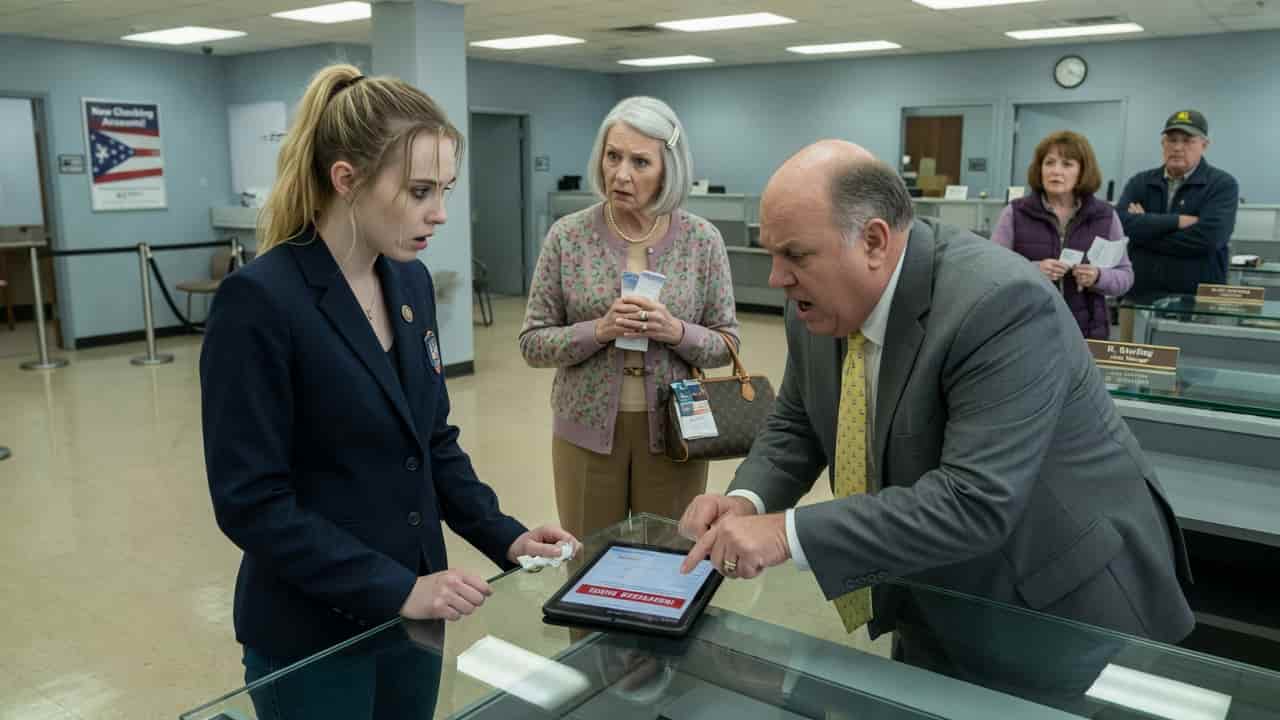
“Chloe, honey, don’t make a scene. It’s embarrassing for everyone.”
I stood in the center of the First National Bank lobby, the air conditioning humming like a low-grade migraine. Mr. Sterling, a man who looked like he enjoyed denying loans, was practically shouting. He didn’t care that the people in the teller line were staring. He didn’t care that my reputation in this town was all I had.
“Eighty thousand dollars, Ms. Miller,” he said, sliding the statement across the glass. “Spent at casinos, high-end boutiques, and five-star restaurants. And you’re telling me you didn’t notice?”
“I don’t even own a designer bag!” I gasped, my voice cracking. “I drive a ten-year-old Civic and I pack my lunch every single day. Look at my history!”
That’s when my mother-in-law, Sylvia, stepped in. She looked so frail, so sweet in her floral cardigan. She looked like the kind of woman who would never hurt a fly. She gripped my arm—hard—and looked at the manager with a sad, knowing smile.
“She’s been under a lot of stress,” Sylvia told him. Then she looked at me, her eyes as cold as a frozen lake. “Just admit you made a mistake, Chloe. We can help you pay it back. There’s no need to lie.”
I felt the floor drop out from under me. I had found the cards in her room. I knew the truth. But in that lobby, surrounded by witnesses, she wasn’t the thief. I was the fraud.
Chapter 1
The vibration of the phone against the wood of my desk felt like a bone-deep tremor. It was 10:15 AM, the middle of my prep period at Benjamin Franklin Elementary, and the screen read UNKNWN. I knew who it was. I’d known for three weeks, even if I hadn’t answered a single one of the twenty-four calls currently logged in my history.
I stared at the phone until it went silent, only for the little red notification bubble to tick up. My stomach did a slow, nauseating roll. I was a third-grade teacher. I was the person who organized the school’s “Financial Literacy for Kids” month. I had a credit score of 815, a number I guarded with the kind of religious fervor usually reserved for saints.
Because I knew what it was like to be at zero.
Ten years ago, my own father had used my social security number to take out a series of payday loans that had nearly drowned me before I’d even finished my student teaching. I’d spent three years eating ramen and working three jobs to scrub my name clean. I’d promised myself I would never, ever be that vulnerable again.
The phone buzzed again. This time, I answered.
“This is Chloe Miller,” I said, my voice tight.
“Ms. Miller, this is Miller from the recovery department at First National,” a voice raspily intoned. It was a man, sounding like he’d spent the last twenty years smoking and yelling at people who didn’t have money. “I’m calling regarding the delinquent balance on the Emerald Preferred account ending in 4492. We haven’t received the minimum payment of four thousand dollars.”
I felt the air leave the room. “I don’t have an Emerald Preferred account with First National. I have a basic checking and a low-limit savings. That’s it.”
“The account was opened fourteen months ago, Ms. Miller. The current balance is twenty-two thousand dollars. And that’s just one of the five.”
I stood up so fast my chair hit the blackboard with a dull thud. “Five? What are you talking about?”
“Look, lady, I’ve heard it all. You want to claim identity theft, you need a police report and a lot more than a surprised voice on the phone. Otherwise, we’re moving to the next stage of collection. Your husband’s name is on the secondary line for three of these.”
“My husband?” I whispered. Leo. Leo worked sixty hours a week at the HVAC warehouse and spent his weekends doing side jobs for neighbors. He didn’t even like using a debit card; he carried cash in a worn leather clip. “There’s been a mistake. A massive mistake.”
“The bank manager at the Main Street branch is expecting you at noon,” the man said, and then the line went dead.
The drive to the bank was a blur of suburban strip malls and grey April slush. I felt like I was vibrating out of my skin. When I pulled into the lot, I saw a familiar tan Buick parked near the entrance. My heart skipped. Sylvia.
My mother-in-law was standing near the heavy glass doors, looking small and confused. She’d been staying with us for the last six months after her “hip surgery,” though the surgery seemed to have healed much faster than her desire to move back to her apartment.
“Chloe! Thank goodness,” she said, clutching her purse. “I got a call too. Some man being so rude, asking about accounts and money. I didn’t know what to do, so I came straight here.”
“It’s okay, Sylvia,” I said, trying to steady my breath. I reached out and squeezed her hand. It felt cold, but her grip was surprisingly firm. “It’s a mistake. We’ll get it sorted.”
Inside, the bank was quiet except for the muffled chime of the entrance bell. We were led to the desk of a Mr. Sterling. He didn’t stand when we approached. He was a man with a thick neck and a shirt that strained at the buttons, his eyes already narrowed with a practiced cynicism.
“Ms. Miller,” he said, indicating the chair across from him. He didn’t offer one to Sylvia, but she pulled a chair over anyway, settling in beside me like a protective shadow.
“There’s been some kind of fraud,” I started, leaning forward. “I was told there are five accounts in my name. I didn’t open them. I don’t have the cards. I’ve never seen the statements.”
Sterling didn’t look at me. He looked at the tablet on his desk, tapping his pen against the side. “The statements were sent to your home address, Ms. Miller. 142 Oak Street. They’ve been delivered there for over a year.”
“I… I check the mail every day,” I said. “I’ve never seen a statement from First National that wasn’t for my savings.”
“And the charges?” Sterling asked, turning the tablet around. “A four-thousand-dollar charge at the Buckeye Casino. Six hundred dollars at a steakhouse in Columbus. Three thousand dollars for a ‘wellness retreat.’ These aren’t the kind of charges identity thieves usually make, Ms. Miller. Usually, they buy electronics or gift cards they can flip. This looks like a lifestyle.”
The room felt like it was shrinking. I looked at the list of charges. They were all local. They were all within a fifty-mile radius. And the dates… they matched the weekends Leo was working double shifts.
“I didn’t do this,” I said, my voice rising. I could feel the eyes of the tellers on the back of my neck. “I’m a teacher. I make forty-five thousand a year. I don’t go to casinos. I don’t go to Columbus for steaks. Someone stole my information.”
Sterling sighed, a heavy, wet sound. “We see this a lot, Ms. Miller. People get in over their heads. They think they can gamble their way out or buy a little happiness, and when the bill comes due, they claim ‘theft.’ But the signatures on the digital applications match your driver’s license record. The IP addresses used for the online payments match your home network.”
“That’s impossible,” I gasped.
“Chloe,” Sylvia whispered. She leaned in, her floral perfume suddenly cloying. “Maybe… maybe you just forgot? You’ve been so stressed lately with the school board. Sometimes people do things when they aren’t themselves.”
I turned to her, my jaw dropping. “Forgot? Sylvia, I’m talking about eighty thousand dollars in debt! How could I forget eighty thousand dollars?”
“Don’t raise your voice, dear,” Sylvia said, her eyes flitting to the people watching us. “You’re making a scene. Mr. Sterling is just doing his job.”
Sterling nodded at her, his expression softening for the ‘sweet’ older woman. “Your mother-in-law is right, Ms. Miller. Making a scene isn’t going to erase the debt. We have security footage of someone using the cards at several ATMs. We’re currently reviewing it. If we find you on those tapes, we won’t just be talking about debt. We’ll be talking about a felony.”
I felt a cold sweat break across my forehead. “Show me. Show me the footage.”
“It’s being processed by corporate security,” Sterling said, standing up. He loomed over me, his shadow falling across the glass desk. “In the meantime, the bank is freezing your savings account to offset the losses. It’s in the fine print of your member agreement.”
“You can’t do that!” I cried out. “That’s our mortgage money! That’s everything we have!”
“We can, and we have,” Sterling said. He looked past me at the line of customers, his voice loud enough for the whole lobby to hear. “Next time, try living within your means instead of trying to scam the institution that holds your mortgage.”
The humiliation was a physical weight, a hot flush that burned from my chest to my ears. I looked around the lobby. Mrs. Gable, whose grandson was in my class, was staring at me from the teller window, her mouth a small ‘o’ of judgment.
“Let’s go, Chloe,” Sylvia said, her voice dripping with pity. She stood up and tugged at my arm, her small hand like a lead weight. “We’ll talk about this at home. I’m sure Leo will understand. He’s such a forgiving boy.”
I allowed myself to be led out, my legs feeling like they belonged to someone else. As we stepped into the bright, harsh sunlight of the parking lot, Sylvia let go of my arm. She didn’t look pitying anymore. She looked bored.
“I need to go to the grocery store,” she said, checking her reflection in the Buick’s window. “We’re out of that nice cream I like.”
“Sylvia, didn’t you hear what he said?” I choked out. “Our savings are gone. Everything I’ve worked for since the last time this happened… it’s gone.”
“Well,” she said, opening her car door. “Money comes and goes, Chloe. You’re young. You have plenty of time to earn it back. I’m old, and I don’t have much time left to enjoy myself. You should try to be more grateful for what you do have.”
She pulled the door shut and drove away, leaving me standing in the middle of the asphalt, the smell of exhaust and the sound of my own frantic heartbeat the only things left in the world.
Chapter 2
The house felt like a stranger’s property when I walked through the front door. It was a modest ranch-style home, the kind of place we’d bought with a thirty-year fixed mortgage and dreams of a nursery that was still used for storing Leo’s old camping gear. Now, every piece of furniture, every framed photo on the mantel, felt like it was being held for ransom.
Eighty thousand dollars.
I sat at the kitchen table, the silence of the house pressing against my ears. I needed to see it. I needed to find the physical evidence because my brain was refusing to accept the digital reality Sterling had shoved in my face.
If the statements were being sent here, where were they? I was the one who checked the mail. Every afternoon, after school, I’d grab the bundle from the box at the end of the driveway. I’d sort it on the counter: bills in the blue folder, junk in the recycling bin, coupons in the drawer.
I went to the recycling bin in the garage. It was nearly full. I spent the next hour on my knees on the cold concrete, tearing through weeks of junk mail, grocery circulars, and political flyers. Nothing. No First National envelopes. No “Emerald Preferred” branding.
I went back inside and walked toward the guest room. Sylvia’s room.
She’d moved in six months ago, bringing three suitcases and a “temporary” attitude that had slowly solidified into a permanent occupation. She’d decorated the room with lace doilies and porcelain figurines of cats with oversized eyes. It always smelled of lavender and something slightly sour, like old milk.
I felt like a criminal as I pushed the door open. My heart was hammering against my ribs, a frantic, irregular rhythm. I shouldn’t be here, I thought. This is her private space. But then I thought of Sterling’s red face and the “lifestyle” charges, and the guilt vanished, replaced by a cold, sharp clarity.
I started with the nightstand. Nothing but a bottle of melatonin and a paperback romance with a creased spine. The closet was full of her floral blouses and sensible slacks. I checked the pockets of her coats. I felt like a ghoul, my fingers brushing against lint and old tissues.
Then I saw it. Under the bed, tucked far back against the baseboard, was her old wooden sewing kit. It was a heavy, accordion-style box that had belonged to her mother. Sylvia didn’t sew. She’d told me once that she found the repetitive motion “mind-numbing.” So why was it here?
I pulled it out. It was heavy. When I unlatched the top and pulled the tiers apart, I didn’t find spools of thread or pin cushions.
I found plastic.
Stacked neatly in the bottom compartment were five credit cards. Two were the deep, metallic green of the First National Emerald Preferred. One was a Gold Amex. Two were store cards for high-end boutiques in the city.
I picked one up. CHLOE MILLER. My name, embossed in crisp, clean letters.
I felt a wave of nausea so strong I had to lean my forehead against the edge of the bed. It wasn’t just identity theft. It was an execution. She hadn’t just used my name; she’d watched me every day for a year. She’d sat across from me at dinner, complimented my cooking, asked about my day, all while carrying my life in her pocket and spending it like water.
Beneath the cards were the statements. Dozens of them, rubber-banded together. I snapped the band and started flipping through.
March: $4,200.
February: $3,800.
January: $5,100.
The charges weren’t just for the casino. There were charges for the “Blue Water Spa.” There were charges for “Elegant Interiors.” I looked around the room. The lace doilies, the figurines, the new silk curtains—I had paid for all of it. I had been paying for her “recovery” in more ways than one.
And then I saw the letters from the collection agencies. They weren’t addressed to Chloe Miller. They were addressed to Sylvia Miller. She’d tried to open them in her own name first, and when the denials came back—likely due to her own ruined credit—she’d simply pivoted.
She knew my social security number because I’d helped her fill out her medical forms after the surgery. I’d sat at this very kitchen table, carefully writing out my information as her emergency contact, while she’d watched my pen move.
I heard the sound of a garage door opening. Leo was home.
I scrambled to put the statements back, my hands shaking so hard I nearly dropped the box. I slid the sewing kit back under the bed, smoothed the duvet, and practically ran out of the room, closing the door just as the mudroom door creaked open.
“Chloe? You home?”
Leo looked exhausted. There were dark circles under his eyes that never seemed to fade, and his work shirt was stained with grease and grit. He looked like a man who was carrying the world on his shoulders, and I realized with a fresh stab of pain that he was. He was working himself to death to pay a mortgage on a house that was about to be taken from us.
“Hey,” I said, my voice sounding brittle. I stayed in the hallway, the shadow of Sylvia’s door behind me.
“Rough day?” he asked, dropping his keys on the counter. He walked over and tried to kiss my forehead, but I flinched. Not because of him, but because I felt like I was covered in the filth I’d just found.
“Leo, we need to talk. About the bank. About your mom.”
Leo’s expression immediately shifted from exhaustion to a wary, defensive posture. It was a look I’d seen a lot lately. Whenever I brought up the cost of Sylvia’s groceries or the way she took over the living room, Leo would withdraw into a shell of filial loyalty.
“Look, if this is about the dishes again—”
“It’s not about the dishes, Leo. The bank called. We’re eighty thousand dollars in debt. They froze the savings account.”
Leo froze, his hand halfway to the refrigerator door. “What? Eighty thousand? That’s impossible. We don’t even have that much credit.”
“I found them, Leo. In her room. The cards. The statements. She used my SSN. She’s been spending it for a year.”
The silence that followed was long and heavy. Leo didn’t explode. He didn’t cry. He just stood there, looking at the floor, his shoulders sagging further until he looked like he might actually collapse.
“She… she told me she had some old debts,” he whispered. “She said she was handling it. She asked me to sign some papers a few months ago. She said it was for her pension.”
“Leo, did you sign credit applications?” I asked, my heart sinking.
“I don’t know! I didn’t look! She’s my mother, Chloe! She said she needed help with the paperwork because her eyes were bad.”
“She’s not your mother,” I said, the words coming out cold and sharp. “She’s a predator. And she just destroyed us.”
The front door opened, and the chime of the bell felt like a death knell. Sylvia walked in, carrying two bags of groceries and wearing a bright, triumphant smile.
“Oh, good! You’re both here,” she chirped, seting the bags down. “I got the salmon on sale. We should have a nice dinner. We all need to relax after that unpleasantness this morning.”
I looked at her—really looked at her. The way she moved with such ease, the way she didn’t even flicker when she saw the look on my face. She was a master of the mask.
“I found the sewing kit, Sylvia,” I said.
The smile didn’t disappear. It just… changed. It became something harder, something more intentional. She didn’t look at me. She looked at Leo.
“Leo, honey,” she said, her voice dropping into that soft, manipulative trill. “I told you she wouldn’t understand. I told you she was always looking for a reason to kick me out.”
“Kick you out?” I yelled. “You stole my identity! You stole eighty thousand dollars!”
“I didn’t steal anything,” Sylvia said, calmly pulling a carton of cream from the bag. “I’m part of this family. And families share. You’re young, Chloe. You have years of earning ahead of you. I’m an old woman who gave everything to raise that boy. Consider it your rent for being in this family. You should be grateful I didn’t ask for more.”
She turned back to the groceries as if the conversation was over, and I realized with a sickening jolt that this wasn’t a mistake. This was a war.
Chapter 3
The “rent” comment hung in the kitchen like a toxic fog. I looked at Leo, waiting for the explosion, waiting for him to stand up and tell her to pack her bags. But Leo was staring at the salmon on the counter, his face a mask of paralyzed indecision.
“Leo,” I said, my voice barely a whisper. “Did you hear her? She just admitted it. She admitted to committing a felony against your wife.”
Leo finally looked up, but his eyes weren’t on me. They were on Sylvia, who was humming a soft tune as she put the milk in the fridge. “Mom… you can’t… you shouldn’t have done that.”
“Oh, hush,” Sylvia said, patting his cheek as she walked past him. “I did what I had to do. Your father didn’t leave me with much, and I wasn’t about to spend my golden years in some dusty apartment eating cat food. Chloe’s a teacher. She’s got a pension. She’s got security. What do I have?”
“You have a roof over your head because I work two jobs!” I snapped. “You have food in your stomach because I budget every cent! You didn’t ‘have’ to do anything. You wanted luxury, and you were too lazy to earn it.”
Sylvia stopped. She turned to face me, her posture suddenly rigid. The “sweet old lady” act vanished completely. “Lazy? I raised a son who took care of me. You? You can’t even give him a child. You spend your days babysitting other people’s kids while my son works himself into a grave. The least you can do is contribute to the family’s well-being.”
The air felt like it had been sucked out of the room. The infertility was a wound we rarely touched, a quiet ache that lived in the corners of our marriage. To have it weaponized so casually, so cruelly, felt like a physical blow to the stomach.
“Don’t you dare,” I said, my voice shaking. “Don’t you dare use that.”
“Mom, stop,” Leo said, finally stepping between us. “That’s enough. Chloe, let’s just… let’s go to the bedroom. Let’s talk about this privately.”
“Privately?” I laughed, a harsh, jagged sound. “There is no private anymore, Leo! The bank manager knows. The tellers know. The debt collectors are calling my work! There is no room in this house that isn’t stained by what she did.”
I turned and walked out, slamming the bedroom door behind me. I didn’t cry. I was past crying. I was in the territory of cold, hard calculation. I sat on the edge of the bed and pulled out my laptop.
I started a spreadsheet.
I needed to know the full extent of the damage. I logged into every credit monitoring site I knew. I pulled my reports from all three bureaus. It was worse than Sterling had said. It wasn’t just five cards. There were two personal loans I hadn’t even known about. Total debt: $84,200.
My credit score hadn’t just dipped; it had plummeted to 540. In one year, she had erased a decade of my life.
A knock came at the door. Leo walked in, looking like he’d aged five years in the last hour. He sat on the foot of the bed, his head in his hands.
“I talked to her,” he said.
“And?”
“She says she’s sorry. She says she didn’t realize how much it was. She thought the interest rates were lower.”
I stared at him. “Leo, she doesn’t care about the interest rates. She doesn’t care about the debt. She cares that she got to live like a queen while we lived like peasants. Did she offer to pay it back? Did she offer to sell her car? Her jewelry?”
“She doesn’t have anything, Chloe. You know that. Her car is ten years old. Her jewelry is costume.”
“The ‘Blue Water Spa’ charges say otherwise, Leo. The boutique charges say otherwise. She’s hiding things.”
Leo sighed, a sound of pure defeat. “What do you want me to do? She’s sixty-two. If you call the police, she’ll go to prison. Do you really want that on your conscience? Sending an old woman to a cell?”
“She put me in a cell, Leo! I can’t buy a car. We can’t refinance the house. We might lose the house! Why is her freedom more important than our survival?”
“Because she’s my mother!” Leo shouted, finally breaking. He stood up, his face flushed. “She’s the only family I have left! My dad died when I was twelve, and she worked three jobs to keep me in school. I can’t just throw her to the wolves, Chloe. I can’t.”
I looked at him, and for the first time in our seven-year marriage, I saw a stranger. I saw the little boy who had been groomed to be his mother’s retirement plan. I saw the man who would watch me drown if it meant his mother stayed dry.
“So that’s it?” I asked, my voice flat. “I just… I just accept eighty thousand dollars in debt? I work for the next twenty years to pay for her ‘wellness retreats’ and casino runs?”
“We’ll figure it out,” Leo said, his voice softening into a plea. “I’ll take a third job. I’ll talk to the bank. Maybe they’ll let us do a payment plan.”
“They won’t, Leo. They already froze the savings. They think I’m the one who did it.”
“Then we’ll tell them it was a misunderstanding. We’ll tell them I authorized it.”
I felt a chill run down my spine. “You’d lie for her? You’d take the fall for her?”
“I’m doing it for us, Chloe. To keep the peace.”
“There is no peace, Leo. There’s only debt.”
He didn’t have an answer for that. He just turned and walked out, leaving me alone in the dark room.
I didn’t sleep. I spent the night listening to the sounds of the house. I heard Sylvia’s television humming in the guest room—some late-night shopping channel. I heard Leo tossing and turning on the couch.
Around 3:00 AM, I got up and went to the guest room. I didn’t knock. I just opened the door.
Sylvia was sitting up in bed, a glass of wine on the nightstand and a tablet in her hand. She was scrolling through a clothing website, her face illuminated by the blue light of the screen.
“I want the password to the casino account,” I said.
Sylvia didn’t look up. “I don’t know what you’re talking about.”
“The Buckeye Casino. You have a ‘player’s club’ card. I saw the charges. I want to see the win/loss statement.”
“It’s private information, Chloe. A lady’s recreation is her own business.”
“You used my name to open the account, didn’t you? That makes it my business.”
Sylvia finally looked at me. She smiled—a slow, cruel tilt of the lips. “Even if I did, what are you going to do? Leo already told me he won’t let you call the police. He knows which side his bread is buttered on. He knows who really loves him.”
“He loves a ghost, Sylvia. He loves a woman who doesn’t exist.”
“He loves the woman who made him,” she countered. “And you’re just the woman who’s keeping his bed warm until I decide I’m bored of this little house. Now, go back to sleep. You have a big day of teaching children how to count pennies tomorrow. You’ll need your rest.”
I walked out, my blood boiling. She was right about one thing: Leo wouldn’t help me. If I wanted to survive this, I had to stop acting like a victim and start acting like a teacher. I had to gather the evidence. I had to build a case that even Leo couldn’t ignore.
I went back to my laptop and started searching. I didn’t search for debt relief. I searched for the Buckeye Casino’s rewards program. I searched for the dates of the charges.
And then I saw something that made my heart stop.
Every single charge at the casino happened on a Tuesday. The day I stayed late for faculty meetings. The day Leo worked his late shift at the warehouse.
But there was one charge from three weeks ago. A five-thousand-dollar “cash advance” at 2:00 PM on a Wednesday.
Three weeks ago, on a Wednesday, Sylvia had told us she was at a doctor’s appointment in the city. She’d even brought home a “summary” of the visit.
I looked at the bank statement again. The cash advance had been processed at an ATM inside the casino.
She wasn’t just gambling. She was addicted. And she was getting sloppy.
Chapter 4
The neon lights of the Buckeye Casino felt like a direct assault on my senses. It was a Tuesday evening, the air thick with the smell of stale tobacco and artificial cherry scent pumped through the vents to keep people awake. This was a world of desperate hope and quiet ruin, a place where people came to trade their futures for a few seconds of spinning color.
I stood near the entrance, feeling entirely out of place in my sensible beige trench coat. I wasn’t here to play. I was here to hunt.
I’d tracked the most recent charge. Another “maintenance fee” for her player’s club card had hit the Emerald Preferred statement this morning. I knew she’d be here. Tuesday was her “luncheon with the church ladies.”
I walked past rows of penny slots, the bells and whistles blending into a dissonant roar. I saw elderly women with glazed eyes methodically pressing buttons, their oxygen tanks tucked beside their chairs. It was heartbreaking, and for a moment, I felt a flicker of pity for Sylvia. Was this what she’d become?
Then I saw her.
She was in the high-limit area, a section roped off with velvet cords and guarded by a bored-looking man in a suit. She wasn’t looking frail. She wasn’t looking like a woman recovering from surgery. She was wearing a new silk wrap-dress—one I recognized from the boutique statements—and she had a cocktail in one hand and a stack of black chips in the other.
She was at a slot machine called “The Royal Treasury.” Each spin was twenty dollars.
I watched her for ten minutes. I watched her lose three hundred dollars in the time it took me to count my breaths. She didn’t flinch. She just tapped the screen, her eyes fixed on the spinning reels with a terrifying intensity.
When the machine finally hit a small win—maybe fifty dollars—she didn’t smile. she just pressed the button again.
“Having fun with my mortgage, Sylvia?”
She jumped, nearly spilling her drink. When she saw me, her face didn’t go pale. It went red with fury.
“What are you doing here? Are you following me?”
“It’s easy to follow someone when they’re using your credit card for the GPS,” I said, stepping closer. I noticed the people at the neighboring machines were glancing our way. A pit boss started to drift toward us. “You told Leo you were at church.”
“I am a member of the congregation,” Sylvia hissed, her voice low and dangerous. “And I don’t appreciate being accosted in public. This is a private club.”
“It’s a public disgrace,” I said. “You’ve spent more in the last ten minutes than I make in a week of teaching. Give me the cards, Sylvia. Right now.”
“I don’t have them on me,” she lied, her eyes darting to her designer bag sitting on the chair beside her.
I didn’t hesitate. I reached for the bag.
Sylvia lunged at me, her small hands surprisingly strong as she grabbed my wrist. “Don’t you touch my things! You have no right!”
“I have every right! This bag is mine! This dress is mine! Everything you’re wearing was bought with my stolen credit!”
The pit boss arrived, a tall man with a name tag that read VANCE. “Is there a problem here, ladies?”
“Yes,” Sylvia said, her voice instantly shifting back to that of a victim. She let go of my wrist and began to tremble. “This woman is harassing me. She’s… she’s my daughter-in-law, and she’s had a breakdown. She thinks I’ve stolen from her. Please, help me.”
Vance looked at me, his expression hardening. “Ma’am, you’re going to need to step back. We don’t tolerate harassment of our guests.”
“She’s not a guest!” I shouted, the frustration finally boiling over. “She’s a thief! She’s using my name and my credit to gamble away my life! Look at her card! Ask to see her ID!”
Vance looked at Sylvia. She didn’t blink. She reached into her bag and pulled out a card. She handed it to him with a shaky hand.
“Here you go, dear,” she said.
Vance looked at the card, then back at me. “The card is in the name of Chloe Miller. Is that you?”
“Yes! That’s me!” I said.
“And you’re saying she’s using it without your permission?”
“Exactly!”
Vance looked at Sylvia again. She looked up at him, her eyes brimming with tears. “I’m so sorry. My name is Chloe. My daughter-in-law… she’s confused. She has the same name. She thinks I’m her.”
I felt my heart stop. “What? No. No, my name is Chloe. She’s Sylvia!”
“Do you have ID, ma’am?” Vance asked me.
I reached into my pocket, but then I remembered. My wallet was in the car. I’d been so frantic to catch her that I’d left it in the center console.
“I… I have it in the car,” I stammered.
“Of course you do,” Sylvia said, her voice full of mock pity. She turned back to the pit boss. “Can you please just escort her out? I don’t want to have her arrested. She’s family, after all.”
Vance put a hand on my shoulder. It wasn’t a gentle touch. It was a directive. “Let’s go, ma’am. Before I have to call the police.”
I looked at Sylvia. She was smiling at me—a tiny, triumphant smirk that only I could see. She’d outplayed me again. She’d used my own name, my own identity, to turn the world against me.
As I was led through the ringing, flashing chaos of the casino floor, I realized that I couldn’t win by playing her game. I couldn’t win with logic or truth in a place built on lies.
I was pushed through the revolving doors and out into the cold night air. I stood on the sidewalk, the sound of the casino muffled but still present, a constant, mocking heartbeat.
I walked back to my car, my mind racing. I needed proof. Physical, undeniable proof that she was Sylvia and I was Chloe. I needed to show the world the face of the woman who was erasing me.
I sat in the driver’s seat and pulled out my phone. I didn’t call Leo. I didn’t call the bank.
I called the one person I’d been avoiding for ten years.
“Dad?” I said when he answered.
“Chloe? Is that you? It’s been a long time.”
“I need to know how you did it,” I said, my voice cold. “I need to know how you stole my name and how you got away with it. Because someone else is doing it now, and I’m going to make sure they don’t.”
The line went silent for a long moment. Then, my father sighed—the same heavy, wet sigh I’d heard from Mr. Sterling.
“You don’t want to go down that road, Chloe. It’s a dirty business.”
“I’m already in the dirt, Dad. I’m just looking for a shovel.”
“Come over,” he said. “We’ll talk.”
I put the car in gear and pulled out of the lot. I didn’t look back at the neon lights. I was done being the target. It was time to become the hunter.
Chapter 5
The drive to my father’s apartment took forty minutes, cutting through the parts of the county where the streetlights were spaced further apart and the houses looked like they’d been built by people who had run out of money halfway through the job. My father, David, lived in a complex called The Terraces—a name that implied a grandeur the peeling beige siding and rusted balcony railings couldn’t support.
I hadn’t seen him in three years. The last time we’d spoken, he’d tried to borrow five hundred dollars for “an investment opportunity” that sounded suspiciously like a parlay bet on a college football game. I’d hung up on him, and we’d existed in a cold, silent orbit ever since. But now, as I climbed the concrete stairs to the third floor, I realized I was coming to him not for a reconciliation, but for a post-mortem. I needed to understand the mind of a person who could look at their own child—or in Sylvia’s case, her own daughter-in-law—and see nothing but a line of credit.
The door opened before I could knock. David looked older, thinner. He was wearing a threadbare flannel shirt and smelled faintly of menthol cigarettes and cheap coffee. He didn’t look surprised to see me. He just stepped back and gestured toward a sagging plaid recliner.
“You look like hell, Chloe,” he said, his voice a gravelly rasp.
“I’m eighty-four thousand dollars in debt, Dad. Someone stole my life.”
He sat on the edge of a coffee table littered with racing forms and empty soda cans. He didn’t offer me a drink. He didn’t ask how I was. He just leaned forward, his eyes—eyes I’d inherited—narrowing with a sharp, predatory interest. “Who did it?”
“My mother-in-law. Sylvia.”
David let out a short, dry laugh. “The church lady? The one Leo was always bragging about? I told you, Chloe. The ones who wrap themselves in lace are usually hiding the most rot. How’d she do it?”
I told him everything. The sewing kit, the casino charges, the “rent” comments, and the way she’d hijacked my identity at the high-limit slots. I told him about Mr. Sterling at the bank and how the system was designed to protect the institution, not the victim.
David listened in silence, nodding at specific points—the Tuesday casino runs, the cash advances. When I finished, he stood up and paced the small, cramped room.
“She’s a pro,” he said, sounding almost admiring. “She didn’t just steal your name; she built a parallel life. She used your habits to mask her own. The reason the bank won’t believe you is because she’s given them a story that makes sense. A stressed-out teacher who cracks and starts gambling? That’s a cliché. A sweet grandmother who’s a serial identity thief? That’s a headache for their legal department. They’ll always take the cliché over the headache.”
“So how do I stop her?” I asked, my voice cracking. “Leo won’t let me call the police. He thinks we can just ‘work it out.’ He’s going to take a third job to pay for her crimes.”
David stopped pacing and looked at me. For a second, I saw a flicker of something that looked like regret in his eyes, but it was quickly replaced by a cold, technical clarity. “You can’t stop a person like that with the truth, Chloe. You stop them with a bigger headache. You have to make it more expensive for the bank to keep the debt than to discharge it. And you have to make it impossible for Leo to stay in the dark.”
“How?”
“Identity theft isn’t just about numbers. It’s about physical presence. Sylvia’s been careful, but she’s an addict. And addicts always have a secondary cache. She isn’t just spending that money at the casino, Chloe. No one loses eighty thousand dollars on slot machines in a year without hitting a jackpot at least once. She’s hiding the wins. She’s building a nest egg in case you ever actually do kick her out.”
I thought of the sewing kit. “I found the cards. I found the statements.”
“That’s the bait,” David said, pointing a finger at me. “That’s what she wants you to find so you’ll fight with her and look like the crazy daughter-in-law. You need to find the real stash. Look for a key. A small, brass key. Probably for a locker or a safe-deposit box she opened in your name. That’s where the proof is. Not just the spending, but the having.”
“I don’t know if I can go back in that room, Dad. I feel like I’m losing my mind every time I look at her.”
“Then lose it,” he said, his voice hardening. “Use the anger. She’s counting on your ‘teacher’s sensibility’ to keep you polite. She’s counting on you being a good girl. Stop being a good girl, Chloe. Be a Miller.”
I left his apartment an hour later, the “Be a Miller” line ringing in my ears like a curse. I drove home in the dark, my mind churning.
When I walked into the house, it was quiet. Sylvia was in the living room, the glow of the television flickering against the walls. Leo was sitting at the kitchen table, a stack of bills in front of him and a calculator in his hand. He looked like he’d been crying, but he wiped his eyes the moment he saw me.
“Where were you?” he asked, his voice flat.
“Out.”
“I talked to Mr. Sterling again,” Leo said, ignoring my brevity. “He says if we can come up with fifteen thousand by Friday, they won’t report the delinquency to the credit bureaus yet. I can pull from my 401k. It’ll be a huge penalty, but it buys us time.”
I looked at him—my husband, the man I’d promised to build a life with—and I felt a wave of profound exhaustion. “You’re going to empty your retirement to pay for her gambling, Leo? After what she said about me? About us?”
“She was upset, Chloe! She didn’t mean it.”
“She meant every word. She views me as an ATM with a pulse. And she views you as a shield.”
I didn’t wait for his response. I walked past him and went straight to the guest room. I didn’t care if Sylvia heard me. I didn’t care if she came in and found me. I pushed open the door and turned on the overhead light.
The room was pristine. The lace doilies were perfectly aligned. The porcelain cats stared at me with their dead, glass eyes. I went to the closet first. I tore through the shoe boxes, the bins of winter sweaters, the hangers of floral blouses.
I found nothing.
I went to the nightstand. I emptied the drawers onto the bed. Pens, old receipts, a half-used pack of mints. No key.
“Looking for something, dear?”
Sylvia was standing in the doorway, her arms crossed over her floral cardigan. She looked calm, almost bored. Behind her, Leo appeared, his face a mask of horror.
“Chloe, what are you doing?” Leo gasped. “Stop this! You’re acting like a crazy person!”
“I’m looking for the rest of it, Leo! The part she hasn’t shown us yet!” I shouted, pulling the mattress off the frame.
“There is nothing else,” Sylvia said, her voice dripping with artificial sweetness. “I’ve told you everything. I made some mistakes, yes. I spent some money. But this… this is just cruel. Leo, look at what she’s doing to my things.”
Leo stepped into the room and grabbed my arms, pinning them to my sides. “Chloe, stop! You’re scaring her! Look at her, she’s shaking!”
“She’s not shaking, Leo! She’s performing!” I struggled against him, but he was stronger. He dragged me toward the door, his face twisted with a mixture of anger and pity.
“Go to the living room,” he commanded. “Stay there. I’m going to help Mom clean this up.”
He pushed me out and closed the door. I stood in the hallway, my chest heaving, the taste of copper in my mouth. I had failed. I had looked like the “crazy daughter-in-law” exactly as David had predicted.
I walked into the kitchen and sat on the floor, my back against the refrigerator. I felt defeated. I felt erased. I looked at the mudroom door, the small pile of mail I’d brought in earlier sitting on the bench.
Wait.
I stood up and grabbed the mail. Most of it was junk, but there was a small, neon-yellow flyer for a local dry cleaner. I’d seen it a dozen times, but this one was different. There was a handwritten note on the back in Sylvia’s elegant, loopy script: Pick up Tuesday. Locker 412.
Dry cleaners didn’t have lockers. But the transit station downtown did.
I didn’t say a word. I grabbed my keys and walked out the front door. I heard Leo call my name from the guest room, but I didn’t stop. I got in the car and drove toward the city center, my hands death-gripped on the steering wheel.
The transit station was a cavernous, echoing space that smelled of diesel and damp concrete. The locker bank was in a dim corridor near the back, away from the main ticket counters. I found 412. It was a standard grey metal box, the kind used by commuters to store bags they didn’t want to carry across the city.
I didn’t have a key. But I had a heavy-duty lug wrench in my trunk.
I looked around. The station was nearly empty. A janitor was mopping the floor at the far end of the terminal, his back to me. I took a deep breath, wedged the flat end of the wrench into the seam of the locker door, and leaned back with everything I had.
The metal groaned. I shifted my weight, my boots slipping on the linoleum. Crack.
The lock mechanism snapped with a sound like a gunshot. I pulled the door open, my heart hammering against my teeth.
Inside the locker was a single, black leather briefcase. It wasn’t one I recognized. I pulled it out and sat on the floor, the cold concrete seeping through my jeans. The briefcase wasn’t locked.
When I opened it, the world went silent.
It wasn’t just cash, though there were stacks of twenties and fifties—at least ten thousand dollars’ worth. It was the paperwork.
There were three more credit cards, these ones in the name of Leo Miller. There was a lease agreement for a small apartment in Columbus, signed three months ago. And there was a passport.
I opened the passport. It was Sylvia’s face, but the name on the ID wasn’t Sylvia Miller. It was Eleanor Vance.
And then I saw the ledger. A small, spiral-bound notebook. Inside, in that same loopy script, was a meticulously kept record of every lie she’d told for the last year.
Oct 12: Told Leo the heater broke at the apartment. He gave me $800 cash. Spent $600 at Buckeye. Saved $200.
Jan 15: Chloe asked about the mail. Redirected to the school board stress. She’s so easy to rattle.
March 4: Opened the third card in Leo’s name. He signed the ‘pension’ forms without looking. God, he’s a dull boy.
I felt a cold, sharp stone settle in my chest. It wasn’t just a gambling addiction. It was a planned exit. She was milking us dry, building a life as “Eleanor” in a different city, and she was doing it while laughing at the “dull boy” who was working sixty hours a week to keep her comfortable.
I closed the briefcase. I didn’t cry. I didn’t scream. I felt a strange, terrifying calm.
I checked my watch. 11:30 PM.
I picked up the briefcase and walked back to my car. As I drove home, I didn’t think about the debt. I didn’t think about my credit score. I thought about the look on Leo’s face when he’d pinned my arms. I thought about the “sweet grandmother” in her floral cardigan.
The war wasn’t over. But for the first time, I was the one with the high-limit hand.
Chapter 6
The house was dark when I returned, save for the single porch light that cast a long, sickly yellow shadow across the driveway. I walked through the front door, the black briefcase feeling heavier than ten thousand dollars should. It felt like a casket.
Leo was asleep on the couch, his breathing heavy and ragged. He’d left a glass of water on the coffee table, a small coaster neatly tucked underneath it. Even in his exhaustion, he was still the man who tried to keep things orderly, who tried to be “good.” My heart ached for him, but it was a distant, dull ache, like an old injury. I knew what I had to do would break him, but staying silent would bury him.
I didn’t wake him. I went into the kitchen, sat at the table, and laid out the contents of the briefcase. I arranged them like a teacher preparing a lesson plan. The cash on the left. The “Eleanor Vance” passport in the center. The ledger on the right, flipped open to the page where she’d called him “dull.”
Then I went to the guest room door. I didn’t knock. I just turned the handle.
Sylvia was awake. She was sitting in the dark, the blue light of her tablet reflecting in her eyes. She looked up as I entered, her expression shifting from surprise to that practiced mask of weary patience.
“Chloe, really. It’s nearly midnight. Can we not do this—”
“Get up, Sylvia. Or Eleanor. Whichever you’re feeling like tonight.”
The tablet light flickered as her hand jerked. She didn’t move for a long second, then she slowly set the device on the nightstand. “I don’t know what you’re talking about.”
“I found the locker at the transit station. Locker 412.”
The mask didn’t just slip; it disintegrated. The softness in her face vanished, replaced by a sharp, angular bitterness that made her look twenty years older. She stood up, smoothing her floral nightgown. She didn’t look like a victim anymore. She looked like a cornered animal.
“You had no right,” she hissed.
“I have eighty-four thousand ‘rights,’ Sylvia. Now, walk into the kitchen. Leo’s waiting.”
“He won’t believe you,” she said, though her voice lacked its usual confidence. “He’ll think you planted it. He loves me.”
“He loves a mother who doesn’t exist. Let’s see if he loves Eleanor.”
I led her into the kitchen. I turned on the overhead fluorescent lights, the harsh glare making both of us squint. Leo stirred on the couch, groaning as he sat up. He squinted at us, his eyes red-rimmed and confused.
“Chloe? Mom? What’s going on?”
“Sit down, Leo,” I said. My voice was steady, the sound of a woman who had finally found the bottom of her fear.
Leo walked over, his gaze falling on the kitchen table. He saw the cash. He saw the passport. He saw the loopy handwriting in the ledger. He reached out, his hand trembling as he picked up the “Eleanor Vance” ID. He looked at the photo, then at his mother, then back at the ID.
“Mom?” he whispered. “Who is this?”
Sylvia didn’t answer. She sat in the chair across from the evidence, her chin tilted up, her eyes fixed on the window.
“Read the ledger, Leo,” I said. “Read what she thinks of the ‘pension forms’ you signed. Read what she thinks of your ‘dull’ loyalty.”
Leo picked up the notebook. I watched his eyes move across the pages. I watched the moment the realization hit him—not just that she’d stolen money, but that she’d stolen him. He read for a long time, the only sound in the room the ticking of the clock over the stove and the heavy, wet sound of Sylvia’s breathing.
When he finally looked up, his face was pale, his mouth a thin, jagged line. He looked at Sylvia, and for the first time in his life, he didn’t see a woman who needed protection. He saw a predator who had been eating him alive.
“You were leaving?” he asked, his voice a low, dangerous rumble. “You were taking our money, my 401k, Chloe’s name… and you were just going to go to Columbus and be Eleanor?”
Sylvia finally looked at him. She didn’t cry. She didn’t apologize. She let out a short, sharp laugh. “I wasn’t ‘taking’ anything, Leo. I was surviving. You have no idea what it’s like to be my age and have nothing. To be at the mercy of a girl like her, who counts every penny and looks at me like I’m a burden.”
“You are a burden!” Leo shouted, his hand slamming into the table. The cash fluttered, a few twenties drifting to the floor. “You’re a thief! You’re a liar! I worked three jobs for you! I lied to my wife for you!”
“And look where it got you,” Sylvia snapped. “A tiny house, a boring life, and a wife who spends her time digging through lockers like a common criminal. I wanted more. I deserved more.”
“You deserve a cell,” I said, leaning over the table.
Sylvia turned to me, her eyes burning with pure, unadulterated hatred. “You think you won, Chloe? You think this fixes anything? The debt is still in your name. The bank still has your signatures. Even if you send me to prison, you’ll be paying for my ‘wellness retreats’ for the next twenty years. You’re ruined. And you’ll always know that I’m the one who did it.”
The silence that followed was heavy, thick with the residue of her malice. She was right. The legal system was a slow, grinding machine, and the burden of proof for identity theft was a mountain I still had to climb. My credit was destroyed. Our savings were gone. The damage was irreversible.
But then I looked at Leo. He was standing by the mudroom door, his hand on the handle. He didn’t look at Sylvia. He looked at me.
“I’m calling the police,” Leo said.
“Leo, honey, you wouldn’t,” Sylvia said, her voice wavering for the first time. “I’m your mother. You can’t do that to your mother.”
“My mother is a memory, Sylvia,” Leo said, his voice cold and final. “You’re just a woman who’s staying in my guest room. And your stay is over.”
He walked out into the mudroom and picked up the phone.
The next three hours were a blur of flashing blue lights, sterile statements, and the sound of handcuffs clicking into place. The officers were professional, but they looked tired—just another domestic disaster in a long line of them. Sylvia didn’t go quietly. She screamed at the neighbors who watched from their porches. She cursed my name until the car door slammed shut and the sirens faded into the distance.
When the house was finally quiet again, the sun was just beginning to peek over the horizon, casting a grey, uncertain light across the kitchen.
Leo was sitting at the table, his head in his hands. The briefcase was empty now, the evidence taken as part of the report. The “Eleanor Vance” passport was in a plastic evidence bag somewhere in the back of a cruiser.
I walked over and put a hand on his shoulder. He flinched at first, then he reached up and gripped my hand. He didn’t say anything. There was nothing left to say.
“What now?” he finally asked, his voice a ghost of itself.
“Now we start the paperwork,” I said. “I have the ledger. I have the location of the locker. The bank investigator will have to listen now. It won’t be fast, Leo. It’ll take years to fix the credit. We might still lose the house.”
“I don’t care about the house,” Leo said, looking up at me. His eyes were hollow, the light in them extinguished. “I just want to be able to look in the mirror again.”
I sat down beside him. I wanted to tell him it would be okay. I wanted to tell him we’d be stronger. But I was a teacher, and I knew that some lessons were too expensive to ever truly recover from.
We sat there as the world woke up around us. I thought about the “Financial Literacy” month I had planned for my students. I thought about the way I’d taught them that numbers don’t lie. I realized now that was only half the truth. Numbers don’t lie, but people can make them scream.
My credit score was still a disaster. My savings account was still a zero. I was still eighty thousand dollars in the hole. But as I looked at the empty guest room door, I felt a strange, cold peace.
I wasn’t the target anymore. I was just the one left standing in the wreckage.
I got up and started the coffee maker. The machine hummed, a low, domestic sound that felt absurdly normal given the carnage of the night. I looked out the window at the suburban street, at the neighbors walking their dogs and the school buses beginning their routes.
Life would go on. The debt would be paid, one way or another. But the “Chloe Miller” who had believed in the sanctity of a credit score and the inherent goodness of family was gone. In her place was someone harder, someone who knew the exact weight of a black leather briefcase and the precise sound of a lock snapping.
I poured two mugs of coffee and set one in front of Leo.
“Drink,” I said. “We have a lot of phone calls to make.”
He took the mug, his fingers brushing mine. We were still a “we,” for now. But as I watched the steam rise from my coffee, I knew that the residue of Sylvia’s betrayal would never truly wash away. It would be there in every bank statement, every credit application, and every moment of silence between us.
We had survived. But survival wasn’t the same thing as winning. It was just the ability to keep walking through the ruins.