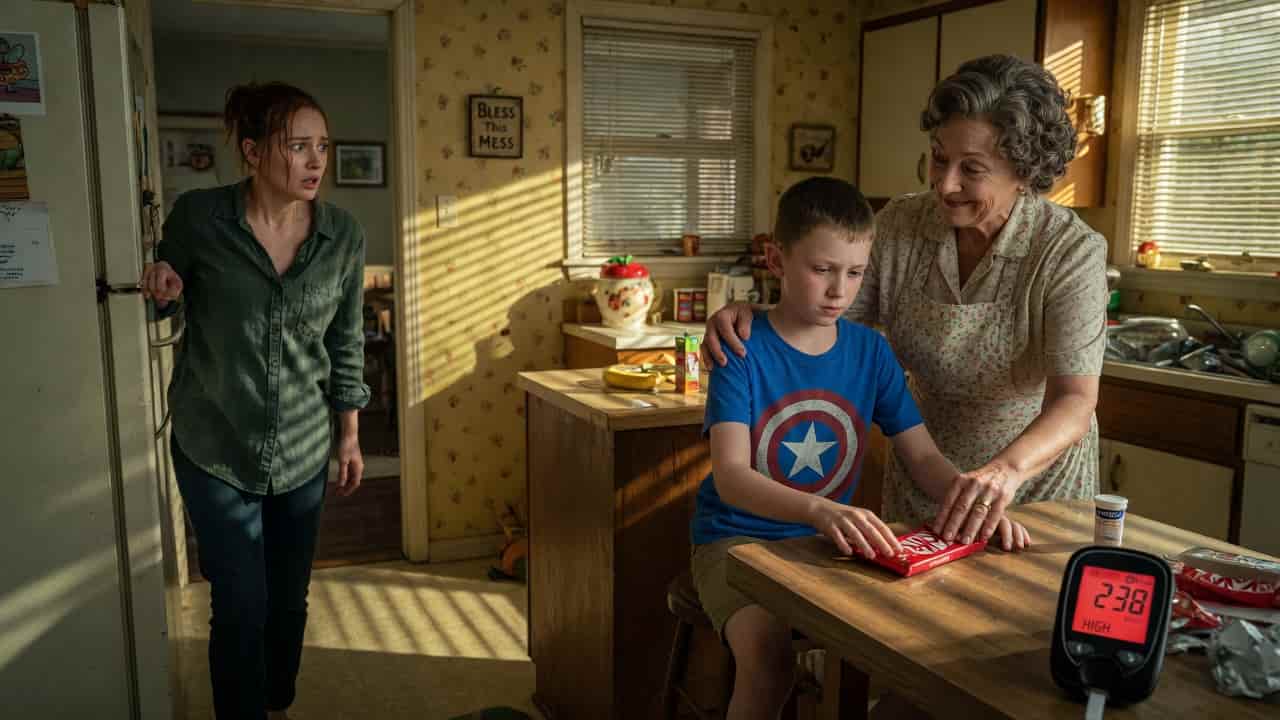
“Eat it, Toby. Your mother doesn’t need to know everything. She just likes the attention of having a sick child.”
I stood in the hallway, my hand over my mouth, watching the grainy footage on my phone. My mother-in-law, Martha, was unwrapping a chocolate bar and handing it to my six-year-old son—the same son whose blood sugar had been spiking into the danger zone for weeks despite my frantic efforts to manage his Type 1 diabetes.
For months, Martha had whispered to our neighbors that I was “high-strung” and “making it all up.” She told my husband, Tom, that I was suffocating our son with “needless” finger pricks and “imaginary” dietary rules. She called me a controlling mother in front of our entire church group, laughing about how I was “obsessed with science projects” instead of just letting a boy be a boy.
But seeing her slide that sugar across the table while whispering that I was the villain? That wasn’t just an insult. It was a deliberate attempt to cause a medical crisis just to win an argument. She wanted him to get sick so she could prove I was the one failing him.
I walked into that kitchen with the video still playing on my screen. The room went dead silent. The look on her face when she realized I’d seen everything wasn’t guilt—it was pure, unfiltered rage that she’d been caught.
Chapter 1
The kitchen smelled of burnt toast and the sterile, metallic tang of the alcohol swabs Sarah kept in a jar by the sink. It was 6:45 AM, the gray light of a Pennsylvania Tuesday filtering through the blinds, casting slatted shadows across the linoleum. Sarah sat at the small breakfast nook, her fingers trembling as she scrolled through the data on her phone.
Toby’s numbers were high again. 342.
It didn’t make sense. She had weighed the oatmeal. She had counted every gram of fiber, every blueberry. She had calculated the insulin dose with the precision of a jeweler, watched the pump deliver the bolus, and tucked him in at 8:30 PM with a reading of 110. A perfect curve. And yet, somewhere in the dead of night, his body had rebelled. Or something had.
“Toby, honey, come here,” she called out, her voice sounding thin and brittle to her own ears.
A moment later, Toby shuffled into the room, his blond hair standing up in sleep-matted tufts. He looked small in his oversized pajamas, his skin possessing a translucent, waxy quality that made Sarah’s throat tighten. That was the look. The “high” look. It was a subtle puffiness around the eyes, a sluggishness in his step that most people wouldn’t notice, but Sarah saw it like a neon sign.
“I don’t want to poke, Mommy,” Toby mumbled, rubbing his eyes.
“I know, baby. Just a quick check. The sensor might be off.”
She reached for his hand, her thumb tracing the callouses on his tiny fingertips. This was their ritual, a dance of pain and necessity that had defined their lives since the week of Toby’s fourth birthday. That was the week Sarah almost lost him—the week he spent four days in the PICU in a state of diabetic ketoacidosis, his blood turned to acid because his pancreas had simply decided to stop working. She still had nightmares about the smell of that hospital room, the rhythmic beeping of the monitors that sounded like a countdown.
The lancet clicked. Toby didn’t even flinch anymore. A bead of dark red blood bloomed on his skin. Sarah pressed the strip to it, heart hammering against her ribs.
358.
“What did you eat last night, Toby?” she asked, her voice a low, urgent whisper. “After I put you to bed. Did you get into the pantry?”
Toby looked at the floor. “No, Mommy. I stayed in bed. I promise.”
“Toby, it’s okay if you did. I just need to know so I can fix it. I’m not mad.”
“I didn’t!” His voice rose, a tiny crack of frustration. “I didn’t eat nothing.”
The door from the garage creaked open, and Tom walked in, smelling of cold air and diesel. He worked at the local machine shop, ten-hour shifts that left him perpetually tired and smelling of industrial grease. Behind him, like a silent, looming shadow, was Martha.
Martha lived three houses down. She had a key, a privilege Sarah had fought against for years and lost. Martha was a woman of “common sense” and “traditional values,” which, in the context of a chronic autoimmune disease, meant she thought Sarah was a neurotic mess who read too many internet forums.
“Goodness, Sarah, are you picking at that boy again?” Martha asked, her voice a sing-song lilt that carried a razor-sharp edge. She set a basket of muffins on the counter—homemade, heavy with sugar and white flour.
“His blood sugar is three-fifty-eight, Martha,” Sarah said, not looking up. “He’s dangerously high.”
“Oh, those machines,” Martha sighed, waving a hand dismissively. She walked over to Toby and pulled him into a suffocating hug, smoothing his hair. “They probably just need new batteries. Or maybe he’s just stressed out because his mother is constantly hovering over him like a hawk. Stress raises the sugar too, doesn’t it?”
Sarah felt the familiar heat rising in her chest. It was a dull, thumping pressure behind her eyes. “It’s not stress, Martha. And the batteries are fine. He had a massive spike at 2 AM.”
Tom stood at the counter, pouring a cup of coffee. He stayed out of it. That was his role—the neutral party who let his mother treat his wife like a failing intern. “Maybe the insulin is bad, Sarah? A bad batch?”
“I opened a new vial yesterday,” Sarah said, her voice Tightening. “It’s not the insulin. It’s something else.”
Martha leaned down, whispering loud enough for the whole room to hear. “Don’t you worry, Toby. Grandma knows you’re a healthy boy. You don’t need all these needles and gadgets. In my day, we just let kids run around and burn it off.”
“Martha, please don’t tell him that,” Sarah snapped. “He needs the needles to stay alive. It’s not a choice.”
Martha straightened up, her face instantly shifting from grandmotherly sweetness to cold, pinched condescension. “You always were one for the drama, Sarah. I remember when Tom had the croup, I didn’t call the National Guard. I just gave him some honey and sat in the bathroom with the steam. You? You want everything to be a tragedy. It makes you feel important, doesn’t it? Being the only one who can ‘save’ him.”
The insult landed with the weight of a physical blow. Sarah looked at Tom, silently pleading for him to say something—anything—to defend her. But Tom just blew on his coffee and stared out the window at the morning mist.
“I’m taking him to school,” Sarah said, her voice trembling. “Toby, get your backpack.”
As she ushered Toby out the door, she heard Martha’s voice trailing after her. “Poor little thing. Growing up in a house where everything is a sickness. It’s a wonder he can even breathe without a permit from his mother.”
The residue of the confrontation followed Sarah into the car. She sat in the driver’s seat, her hands gripped so tight on the steering wheel that her knuckles turned white. It wasn’t just the insult. It was the doubt. Martha had spent two years eroding Sarah’s credibility, painting her as a Munchausen-by-proxy case to the rest of the family. And because Toby looked fine on the outside—because he wasn’t in a wheelchair or covered in bandages—people believed her. They saw a tired, stressed woman and a smiling, “healthy” grandmother, and they chose the easier story.
Sarah pulled out of the driveway, her eyes catching Martha’s reflection in the rearview mirror, standing on the porch, watching them leave with a look of smug, quiet triumph.
Chapter 2
The school nurse, Mrs. Gable, was a woman who had seen thirty years of scraped knees and faked stomach aches, but Toby’s case was different. She stood in her small office, surrounded by posters of the food pyramid and jars of tongue depressors, looking down at Sarah with a mixture of pity and confusion.
“He was lethargic in second period, Sarah,” Mrs. Gable said. She was a foil to Sarah’s frantic energy—calm, clinical, and increasingly worried. “I checked him. He was at 410. He’s been oscillating like this for three weeks. Is everything okay at home? Any changes in routine?”
Sarah felt the familiar shame wash over her. It was the “look”—the subtle implication that she was doing something wrong, that she was failing at the one job she had. “Nothing has changed. We weigh everything. We track everything. It’s like he’s getting sugar from somewhere I can’t see.”
“Could he be trading lunches?”
“I’ve talked to his teacher. She watches him like a hawk. He eats what I pack.”
Mrs. Gable sighed, crossing her arms. “Look, I know how hard this is. But 400 is DKA territory if it stays there. If we can’t get this under control, I’m going to have to recommend a formal review with his specialist. They might want to admit him for observation.”
The word admit felt like a threat. Sarah nodded, her throat too tight to speak. She took Toby home early, his head lolling against the car seat, his breath smelling faintly of overripe fruit—the scent of ketones.
When they got home, the “Sunday Dinner” preparations were already in full swing. This was Martha’s territory. Every Sunday, the extended family gathered at Sarah’s house, but Martha ran the kitchen. It was a power play Sarah had long since given up on contesting.
The house was full of the smell of roasting pork and yeast rolls. Sarah’s sister-in-law, Janie, was there with her two rowdy boys, and Tom’s cousin, Mike, was nursing a beer in the living room.
“Look at him,” Janie said, gesturing to Toby as he slumped onto the sofa. “He looks like he’s had the life sucked out of him. Sarah, are you sure you aren’t over-medicating him? I read an article about how too much insulin can make them sluggish.”
“It’s not the insulin, Janie. His sugar is high. He needs more insulin, not less.”
Martha stepped out of the kitchen, wiping her hands on her apron. She had a bowl of mashed potatoes in her hand—loaded with butter, milk, and enough starch to send Toby’s numbers into orbit.
“Now, now,” Martha said, her voice ringing out across the living room. “Let’s not start the science fair again. Sarah, you’re making everyone uncomfortable. It’s Sunday. Let the boy have a nice meal with his family. He’s pale because you keep him cooped up and poke him every five minutes. A boy needs fuel.”
“He has a disease, Martha!” Sarah’s voice cracked, the volume drawing every eye in the room toward her. The silence that followed was heavy, judgmental.
“We all know he’s ‘sick,’ dear,” Martha said, her voice dripping with mock-patience. She looked around at the guests, a silent conspiratorial shrug shared with Janie. “But some of us think he’d be a lot less sick if he wasn’t being treated like a lab rat. I saw you weighing the green beans earlier. Green beans! Honestly, Tom, I don’t know how you live with it.”
Tom looked up from the TV, his face reddening. “Mom, leave it alone. Sarah’s just worried.”
“Worried? It’s an obsession,” Martha declared. She walked over to the coffee table and picked up Toby’s insulin pump, which was sitting next to his testing kit. She held it up like a piece of garbage. “This little machine… it’s a leash. That’s what it is. You’ve got him on a leash because you’re afraid to let him grow up.”
“Put that down,” Sarah said, her voice dangerously low.
“Or what? You’ll call the doctor? You’ll tell everyone how ‘brave’ you are for dealing with such a tragic situation?” Martha laughed, a sharp, barking sound. “You love this, Sarah. You love the pity. You love the way people look at you when you talk about ‘carbs’ and ‘units.’ It’s the only thing that makes you interesting.”
The room felt small. Sarah could feel the sweat on the back of her neck. Her own husband wouldn’t meet her eyes. Her sister-in-law was whispering to Mike. She was the “crazy” one. The “controlling” one. The woman who was making her son sick for attention.
“Toby, go to your room,” Sarah said.
“But I’m hungry, Mommy,” Toby whined.
“Go. Now.”
As Toby hurried away, Sarah turned back to Martha. “If you ever touch his medical equipment again, you are never coming back into this house. Do you understand me?”
Martha’s eyes narrowed, the mask of the sweet grandmother slipping entirely. “It’s my son’s house, Sarah. And he’s my grandson. You can play-act at being a nurse all you want, but you can’t keep the truth hidden forever. He’s fine. And everyone here knows it.”
The residue of that dinner was a cold, hard knot in Sarah’s stomach. Long after the guests had left and Martha had retreated to her own home with a final, pitying look at Tom, Sarah sat in the dark kitchen. She wasn’t just angry. She was terrified. Because Martha was right about one thing: everyone did believe her.
And if everyone believed Martha, then no one was watching Toby.
Chapter 3
The idea came to Sarah at 3 AM, born from the kind of desperate clarity that only arrives after three days of no sleep. She was sitting in Toby’s room, watching the glow of his continuous glucose monitor (CGM) receiver. 280. Up again.
She had checked the pantry. She had checked his toy box. She had even checked the vents in his room. Nothing. No hidden candy, no stolen juice boxes.
But then she remembered the way Martha had whispered to Toby at the dinner table. “Don’t worry, Grandma knows…”
Sarah pulled her laptop onto her lap and began searching. Not for medical advice this time. She searched for “hidden audio recorders” and “GPS trackers for children.”
The next morning, while Tom was at work and Martha was at her bridge club, Sarah went to the local electronics store. She bought a device no larger than a thumb drive—a voice-activated recorder with a forty-hour battery life.
She felt like a criminal as she sat on the floor of Toby’s closet, sewing a small, discreet pocket into the lining of his favorite superhero backpack. Her hands shook so badly she pricked her finger twice, the small drops of blood staining the fabric.
What am I doing? she thought. If Tom finds out, he’ll leave me. He’ll think his mother was right. He’ll think I really have lost my mind.
But then she thought of Toby’s waxy skin. She thought of the 410 reading at school. She thought of the PICU and the smell of acid.
“Toby,” she said, as she helped him get ready for his afternoon at “Grandma’s house”—the three hours twice a week while Sarah worked her part-time shifts at the library. “I put a special charm in your bag. To keep you safe. Don’t show anyone, okay? It’s our secret.”
Toby nodded, his eyes wide. “Is it magic, Mommy?”
“Something like that,” Sarah whispered, kissing his forehead.
The three hours at the library were a blur of alphabetizing and returned books. Her phone sat on the counter next to her, a silent tether to the life she was trying to protect. Every twenty minutes, she checked the CGM app.
Normal. Perfectly normal.
Then, at 4:15 PM: 140.
4:30 PM: 195.
4:45 PM: 260.
A straight line up. A vertical climb that could only be caused by one thing: a massive, un-bolused intake of simple sugar.
Sarah didn’t finish her shift. She told her boss there was an emergency and ran to her car. She drove the six blocks to Martha’s house, her heart hammering against her teeth.
When she pulled into the driveway, she saw them through the large bay window in the living room. Martha and Toby were sitting on the sofa, the television humming in the background. Martha was smiling, her face illuminated by the flickering light of a cartoon.
Sarah didn’t go in. Not yet. She sat in the car, watching.
She saw Martha reach into a bowl on the side table. She saw her hand something to Toby. She saw Toby eat it.
Sarah’s vision blurred. She felt a roar in her ears like a freight train. She stayed there for ten minutes, documenting the readings on her phone, watching the spike hit 310.
When she finally walked through the door, Martha didn’t even look up.
“Oh, back early, are we? I suppose you just couldn’t help yourself,” Martha said, her voice smooth as silk. “Toby was just telling me how much he enjoyed his sugar-free gelatin. See? He’s perfectly fine.”
Toby looked at Sarah, his mouth stained with something dark.
“Toby, go to the car,” Sarah said. Her voice was flat, devoid of the usual tremor.
“But Mommy—”
“Go. Now.”
Martha stood up, smoothing her skirt. “Really, Sarah. The dramatics. He’s had a lovely afternoon. We went for a walk, we played blocks—”
“I know what you did, Martha,” Sarah said.
Martha’s face hardened. “I don’t know what you’re talking about. I’ve done nothing but help you with a child you’re clearly too unstable to raise.”
“We’ll see,” Sarah said.
She drove home in total silence. She didn’t say a word to Toby as she tested him—345—and gave him the correction dose. She didn’t say a word as she made him a plain salad for dinner.
When Tom came home, he found her sitting at the kitchen table with the backpack in front of her.
“What’s going on?” Tom asked, looking from Sarah to Toby’s closed bedroom door. “Mom called. She said you burst in there like a lunatic and snatched him away without a word.”
Sarah didn’t answer. She reached into the backpack, pulled out the recorder, and plugged it into her laptop.
“Sarah, what is that?” Tom’s voice was rising, a mix of anger and genuine fear. “Are you spying on my mother? Are you serious?”
“Listen,” Sarah said.
She hit play.
Chapter 4
The audio was grainy at first—the rustle of fabric, the muffled sound of a television. Then, Martha’s voice came through, clear and unmistakable.
“Here you go, Toby. A little Kit-Kat. You like these, don’t you?”
“Mommy says I can’t,” Toby’s voice, small and hesitant.
“Mommy doesn’t know everything, sweetheart. She’s just a little bit sick in the head. She wants you to be sick so she can feel like a hero. But Grandma knows you’re a big, strong boy. Eat it quickly. Don’t tell your mean mommy. She just wants to ruin our fun.”
There was a pause, the sound of a wrapper crinkling.
“Is it going to make my tummy hurt, Grandma?”
“No, baby. That’s just a story she tells you to keep you scared. She wants you to stay her little baby forever. But if you eat this and you feel fine, then we’ll know she’s been lying, won’t we? We’ll show everyone that you’re just a normal boy.”
Tom sat down heavily in the chair opposite Sarah. The color had drained from his face, leaving him looking gray and old in the harsh kitchen light. He stared at the laptop as if it were a ticking bomb.
“She… she was testing him,” Tom whispered. “She was using him to prove you wrong.”
“She was risking his life, Tom,” Sarah said, her voice cold and precise. “She was intentionally causing him medical distress to satisfy her own ego. That’s not ‘grandparenting.’ That’s assault.”
“Sarah, she’s an old woman. She doesn’t understand the science—”
“She understands a ‘no,’ Tom! She understands that I told her he would get sick. She just didn’t care. She wanted him to get sick so she could call me a liar.”
The residue of the audio hung in the air, a poisonous vapor that settled over everything. The trust that had been fraying for years finally snapped. Sarah felt a strange sense of calm. The “crazy” label had been stripped away, leaving only the truth.
“I’m going to her house,” Sarah said, standing up.
“Sarah, wait. Let’s talk about this. We can’t just—”
“You can stay here and watch our son, or you can come with me and watch me end this. But it ends tonight.”
Sarah didn’t wait for him. She walked out the door and across the dark lawns, her boots crunching on the gravel. She didn’t knock. She walked straight into Martha’s house.
Martha was in the kitchen, pouring a glass of sherry. She looked up, her expression one of bored irritation. “Back for more, Sarah? Honestly, don’t you have a hobby? Or a support group for ‘warrior mamas’ to go to?”
Sarah didn’t say a word. She walked to the guest room—the room where Toby stayed when he napped. She flung the door open.
“What are you doing?” Martha shrieked, following her. “Get out of there!”
Sarah went straight to the small trash can by the bed. She tipped it over. Out fell a dozen wrappers. Kit-Kats. Snickers. Juice boxes.
“These were from months ago,” Martha stammered, her face turning a blotchy, panicked red. “I forgot to empty it.”
“They’re fresh, Martha. I can smell the chocolate.” Sarah turned to her, her eyes burning. “I recorded you. I heard every word. I heard you tell my son I was ‘sick in the head.’ I heard you tell him to lie to me.”
Martha’s posture shifted. The frantic denial vanished, replaced by a cold, hard arrogance. She stepped closer to Sarah, her finger pointed at her chest.
“So what if I did?” Martha hissed. “He’s perfectly fine, isn’t he? He hasn’t dropped dead. You’re the one making him miserable with your scales and your numbers. I was giving him a childhood! I was showing him that he doesn’t have to be a victim of your imagination!”
“He’s 345 right now, Martha. He’s vomiting. His blood is turning to acid.”
“Oh, stop it! You probably gave him something just so you could come over here and yell at me. You’re pathetic, Sarah. You’re so desperate to be right that you’d actually be disappointed if he was healthy.”
Tom appeared in the doorway then. He was holding the laptop.
“Mom,” he said, his voice trembling. “I heard it. I heard what you said about Sarah.”
Martha turned to her son, her face instantly softening into a mask of maternal concern. “Oh, Tommy, don’t listen to her. She’s manipulated that recording. She’s trying to drive a wedge between us. She’s always hated that we’re close.”
“You fed him sugar, Mom,” Tom said, tears welling in his eyes. “You knew what it would do, and you did it anyway. You lied to me for months. You let me think Sarah was losing her mind.”
“I did it for you!” Martha shouted, her voice echoing off the tile walls. “I did it so you wouldn’t have to live in a house of gloom! I did it so my grandson could have a normal life!”
“A normal life?” Sarah stepped forward, her face inches from Martha’s. “You almost killed him, Martha. And the worst part isn’t even the sugar. It’s that you did it to humiliate me. You used my son’s body as a battlefield to prove you were the boss of this family.”
“You were never part of this family,” Martha spat.
The room went deathly quiet. The social mask was gone. The “sweet grandmother” was dead, replaced by a woman whose pride was more important than her grandson’s breath.
“Get out,” Tom said.
“What?” Martha blinked, her mouth falling open.
“Get out of our lives, Mom. Give me the key. Now.”
“Tom, you can’t be serious. Over a candy bar? I raised you! I gave you everything!”
“Give me the key,” Tom roared.
Martha slowly reached into her pocket and pulled out the brass key. She threw it on the floor with a clatter.
“Fine,” she said, her voice trembling with rage. “Go on then. Live in your little hospital house. See how long it takes before she turns on you, too. You’ll be back. When that boy realizes his mother is a warden, you’ll be back.”
She marched out of the room, slamming the door so hard the pictures on the wall rattled.
Sarah stood in the center of the room, the wrappers scattered at her feet. She felt a wave of nausea, a crushing exhaustion that made her knees buckle. Tom caught her, pulling her against his chest.
“I’m sorry,” he whispered into her hair. “I’m so, so sorry.”
But the apology felt hollow. The damage was done. Toby’s numbers were still high. His trust in “Grandma” was shattered. And Sarah knew, with a chilling certainty, that this wasn’t the end. Martha lived three houses down. And a woman like Martha didn’t go away quietly.
She looked down at the Kit-Kat wrapper, the bright red plastic reflecting the harsh light. It was such a small thing. A “little treat.”
But as Sarah felt the residue of the night’s violence settle over her, she realized that the sugar wasn’t the poison. The poison was the woman who gave it to him.
And the fight to keep Toby safe was only just beginning.
Chapter 5
The silence in the house following the confrontation was not peaceful; it was a heavy, vibrating thing, like the air in the seconds after a lightning strike. Sarah sat on the edge of Toby’s bed, the glow of his nightlight—a small, plastic turtle that projected stars onto the ceiling—casting long, distorted shadows across the room. Toby was asleep, but it was a fitful, shallow slumber. His breathing was heavy, rhythmic but labored, and every few minutes his small frame would twitch, his brow furrowed in a dream-state struggle Sarah couldn’t reach.
She held the glucose monitor in her lap like a holy relic. 312. It was coming down, but slowly. The “correction” dose of insulin was working, but the damage of the spike remained. She could smell the ketones on him—that sickly-sweet, chemical odor that always signaled his body was eating itself from the inside out because the sugar was locked in his blood, unable to enter his cells.
The bedroom door creaked open. Tom stood in the sliver of light from the hallway, his shoulders slumped, his face a map of exhaustion and shame. He didn’t come in. He stayed in the threshold, a man caught between two lives: the one he thought he had, and the one his mother had just burned to the ground.
“He okay?” Tom whispered.
“No,” Sarah said. She didn’t look at him. She kept her eyes on the stars on the ceiling. “He’s not okay, Tom. He won’t be okay for a long time. This isn’t just about a number on a screen. He thinks I’m a villain. He thinks his grandmother is his only friend, and that friend just fed him something that makes him feel like his blood is made of lead.”
Tom walked in then, his footsteps heavy on the carpet. He sat on the floor at the foot of the bed, leaning his head against the wooden slats. “I didn’t know, Sarah. I swear to God, I didn’t think she was capable of that. I thought… I thought she was just old-fashioned. Annoying, sure. Stubborn. But I never thought she’d hurt him.”
“Because you didn’t want to see it,” Sarah said, her voice devoid of heat. The anger had burned out, leaving only a cold, hard clarity. “You wanted to believe I was the problem because if I was the problem, you didn’t have to do anything. You could just call me ‘stressed’ and go to work. But if she’s the problem? If she’s the one hurting him? Then you have to choose. And you’ve spent thirty-five years never having to choose against her.”
“I chose tonight,” he said, his voice cracking. “I told her to leave. I took the key.”
“You did,” Sarah acknowledged. “But she’s still three houses down. And she’s not going to just sit there and knit, Tom. You heard her. She thinks she’s the victim. She thinks I’ve brainwashed you.”
They sat in the quiet for a long time, the only sound the hum of the humidifier and Toby’s ragged breathing. Sarah felt the residue of the night clinging to her like soot. She thought about the backpack, the small recorder still plugged into her laptop in the kitchen. She felt a wave of nausea at what she’d had to do—the fact that she’d had to become a spy in her own family to prove she wasn’t insane. It was a victory, but it felt like a violation.
The next morning, the reality of the social fallout arrived with the sunrise.
Sarah was in the kitchen, packing Toby’s “emergency” kit for school—extra strips, glucose tabs, a backup vial of Humalog—when the first text came through. It was from Janie, Tom’s sister.
What is wrong with you? Mom is hysterical. She says you attacked her and stole her keys. Tom needs to grow a spine and stop letting you alienate his family.
Sarah stared at the screen, her heart beginning that familiar, erratic thumping. She didn’t reply. Five minutes later, another one from a neighbor, a woman Sarah had considered a friend.
Hey Sarah, just checking in. Martha called me crying. She’s worried about Toby. She said you’re having some kind of breakdown and won’t let her see him? Hope everything is okay.
“She’s already started,” Sarah said, tossing the phone onto the counter.
Tom, who was nursing a cup of lukewarm coffee, looked at the screen. “I’ll call them. I’ll tell them the truth.”
“It won’t matter,” Sarah said. “She’s been laying the groundwork for two years, Tom. She’s the ‘sweet, concerned grandmother’ and I’m the ‘unstable, controlling mother.’ People love that story. It’s a classic.”
She took Toby to school, but she couldn’t leave him. She sat in the parking lot for two hours, watching the CGM app on her phone. She felt like a sentry, a soldier guarding a border that had already been breached. Every time the line on the graph ticked up, her stomach lurched. Every time it dipped, she held her breath.
When she finally went home to try and sleep, she saw Martha.
Martha wasn’t in her yard. She was sitting in her car, parked at the end of Sarah’s driveway. She didn’t move. She just sat behind the glass, her hands on the steering wheel, staring at the front door. It was a silent, predatory display of presence.
Sarah pulled into the garage and slammed the door, her hands shaking. She locked the door to the kitchen, then the deadbolt, then the chain. She felt like she was being hunted.
The phone rang. It was an unknown number. Sarah usually ignored them, but something told her to pick up.
“Hello?”
“Is this Sarah Miller?” The voice was professional, clipped. “This is Detective Vance with the County Sheriff’s Office. I’m calling regarding a report of elder abuse and harassment filed this morning by a Mrs. Martha Miller.”
Sarah felt the world tilt. She grabbed the edge of the counter, the wood grain digging into her palm. “Elder abuse? I… I haven’t abused anyone. I found out she was poisoning my son.”
“The report states you physically intimidated her, took her property by force, and are currently withholding a minor from his legal caregivers as part of a psychological crisis. We’d like you to come down to the station to give a statement.”
“My son has Type 1 diabetes,” Sarah said, her voice rising, losing its edge of control. “She was feeding him candy bars to prove the disease wasn’t real. I have audio of it. I have blood sugar readings. I have medical records.”
“You can bring those with you, Mrs. Miller,” Vance said, his tone unmoved. “But right now, there’s a formal complaint. And because there’s a child involved, we’ve also had to notify Child Protective Services. They’ll likely be reaching out to you this afternoon.”
Sarah hung up the phone and sank to the floor. The linoleum was cold against her legs. She looked around the kitchen—the jars of alcohol swabs, the scales, the organized bins of medical supplies. To her, this was a fortress of safety. To the rest of the world, through Martha’s lens, it was evidence of her madness.
Martha hadn’t just fed Toby sugar. She had weaponized the very system Sarah relied on to keep him safe. She was going to try and take him.
The afternoon was a blur of panic and preparation. Tom came home early, his face ashen when Sarah told him about the police. He tried to call his mother, but she didn’t answer. She was “unavailable.”
“She’s going to do it, Tom,” Sarah said, pacing the living room. “She’s going to tell them I’m the one hurting him. She’ll say I’m the one spiking his sugar to get attention. It’s called Munchausen by Proxy, and it’s exactly the kind of thing people believe when they don’t understand how diabetes works.”
“I have the audio, Sarah,” Tom said, his voice firming up. “We have the proof. They can’t take him if we have proof.”
“Proof only works if people listen,” Sarah said. “And she’s already spent years making sure no one listens to me.”
The knock at the door came at 4:00 PM.
It wasn’t the police. It was a woman in a sensible navy blazer holding a clipboard. Behind her stood two uniformed officers. Sarah saw Martha’s car still idling at the end of the street, a silent witness to the destruction she’d set in motion.
“Mrs. Miller?” the woman asked. “I’m Angela Reed with CPS. We’ve received a report of medical neglect and potential child endangerment. We need to see Toby.”
“He’s at school,” Sarah said, her voice sounding like it was coming from a long way off.
“We know. We’ve already spoken with the school nurse. She expressed some… concerns about his recent readings. She said you’ve been bringing him in with numbers over 400.”
Sarah felt the trap snap shut. The nurse—the one who was supposed to be her ally—had unknowingly provided the evidence Martha needed. The high numbers, the ones Martha had caused, were now being used to prove Sarah was the negligent one.
“My mother-in-law was the one giving him the sugar,” Sarah said, gesturing wildly toward the street. “She’s right there! She’s been doing it for weeks!”
The officers looked toward the end of the street. Martha waved a small, frail hand from behind her windshield, the picture of a concerned, heartbroken grandmother.
“We need to conduct an interview,” Angela said. “And given the nature of the report, we’re going to need to take Toby into temporary protective custody until a medical evaluation can be completed.”
“No,” Tom said, stepping forward. “No, you’re not taking my son.”
“Mr. Miller, please don’t make this more difficult,” the officer said, his hand resting on his belt. “We have a court order for a 48-hour observation period at the county hospital.”
The residue of the confrontation at Martha’s house had been anger. The residue of this was pure, unadulterated terror. Sarah watched as they walked into her house, looking at the scales, the bins, the “science project” of her life, and saw not a mother’s love, but a crime scene.
She looked out the window one last time. Martha was gone. She’d seen enough. She’d won the first round.
Chapter 6
The pediatric wing of the county hospital was a place of muted colors and the constant, rhythmic shushing of air filtration systems. Toby lay in a high-railed bed, his arm tethered to an IV pole. He looked smaller than he ever had, swallowed by the white sheets and the sterile blue of the hospital gown. He wasn’t crying anymore; he was just quiet, his eyes fixed on a cartoon playing silently on the wall-mounted TV.
Sarah and Tom were allowed to stay, but they were being watched. A social worker sat in a chair by the door, ostensibly to “support” them, but Sarah knew she was a witness. Every time Sarah checked Toby’s pump, every time she whispered to him, the woman’s pen moved across her legal pad.
“I want to go home, Mommy,” Toby whispered.
“I know, baby. We’re just staying here to make sure your numbers stay perfect. The doctors want to help.”
“Is Grandma coming?”
Sarah felt a sharp, jagged pain in her chest. “No, Toby. Grandma isn’t coming.”
“She said I was her favorite,” Toby said, his lip trembling. “She said you were mean for making me sick. Did you make me sick, Mommy?”
Sarah closed her eyes, the tears finally breaking through. This was the ultimate cruelty. Martha hadn’t just poisoned his body; she had poisoned his memory of his own mother. She had planted a seed of doubt in a six-year-old’s heart that might take a lifetime to pull out.
“No, Toby,” Tom said, his voice low and vibrating with a new kind of authority. He leaned over the bed, taking his son’s hand. “Mommy is the reason you’re okay. Grandma was… Grandma was confused. She didn’t tell the truth.”
The door opened, and Dr. Aris, the head of pediatric endocrinology, walked in. He was a man Sarah had seen only twice before—a busy specialist who usually left the day-to-day management to his nurse practitioners. He held a thick file in his hand, and his face was unreadable.
“Mr. and Mrs. Miller,” he said. He looked at the social worker. “Could you give us a moment? I’d like to speak with the parents privately.”
The social worker hesitated, then nodded and stepped into the hall.
Dr. Aris sat on a rolling stool and looked at the data on his tablet. “We’ve been monitoring Toby for twelve hours now. We’ve kept him on a controlled hospital diet. No outside food. We’ve used the exact same insulin ratios Mrs. Miller provided in her logs.”
Sarah held her breath.
“His numbers are perfect,” Dr. Aris said. “A flat line at 105. He hasn’t spiked once.”
“See?” Sarah said, a desperate laugh escaping her. “I told you. I told them!”
“But,” the doctor continued, “we also ran a comprehensive toxicology and metabolic panel when he was admitted. We found something interesting. Toby has high levels of a specific artificial flavoring and a certain red dye in his system—components found in American-market chocolate bars. We also found traces of a high-fructose corn syrup variant that isn’t present in any of the ‘diabetic-friendly’ foods you listed in your pantry logs.”
He looked at Sarah, then at Tom. “This wasn’t a metabolic failure. This was an exogenous administration of glucose. Someone was feeding him sugar, and they were doing it in large quantities.”
“We know who,” Tom said. He pulled the laptop from his bag and set it on the bedside table. “We have the audio. We have the proof.”
Dr. Aris listened to the recording in silence. As Martha’s voice filled the sterile room—the whispering, the manipulation, the direct instruction to lie—the doctor’s jaw tightened. When it finished, he didn’t look at Sarah with pity. He looked at her with a grim, professional respect.
“Mrs. Miller,” he said. “In my field, we see a lot of parents who struggle. We see neglect. We see confusion. But what I just heard… that’s not confusion. That’s malice.”
He turned to the door and called the social worker back in. “Angela, you can cancel the observation. I’m filing a medical report of intentional endangerment against Martha Miller. I’m also recommending a permanent restraining order. This child is in danger as long as that woman has access to him.”
The relief that washed over Sarah was so violent it made her dizzy. She slumped into the chair, her head in her hands, sobbing with the sound of a woman who had been holding her breath for two years.
But it wasn’t over.
The climax of the week didn’t happen in the hospital. It happened two days later, when they returned home.
As they pulled into the driveway, Sarah saw a crowd. It was the neighborhood. Martha was standing on her front lawn, surrounded by Janie and several other women from the church. She was holding a handkerchief to her eyes, gesturing toward Sarah’s house. She was playing her final card: public shaming.
“There she is!” Janie shouted as Sarah stepped out of the car. “The woman who’s keeping a grandmother from her grandson! You should be ashamed of yourself, Sarah! Using a hospital to hide your own failures!”
The neighbors looked on, their faces filled with judgment and whispers. Martha wailed louder, a sound of practiced, theatrical grief.
Sarah didn’t retreat. She didn’t hide in the house. She walked to the trunk of the car, pulled out a stack of papers—the hospital discharge summary, the toxicology report, and a transcript of the audio recording—and walked straight toward the crowd.
“Sarah, don’t,” Tom said, grabbing her arm.
“No,” Sarah said, pulling free. “She wants a witness? She’s got one.”
She stopped at the edge of Martha’s lawn. The crowd went quiet. Martha looked up from her handkerchief, her eyes flashing with a brief, sharp flick of fear before the mask of the victim slid back into place.
“Sarah, dear,” Martha sobbed. “Please, just let me see him. I don’t know why you’re doing this to me. I only ever loved him.”
Sarah didn’t speak to Martha. She looked at the neighbors. She looked at Janie.
“My son spent forty-eight hours in the hospital,” Sarah said, her voice clear and carrying across the quiet street. “He was there because he had toxic levels of sugar in his blood. Not because his body failed him. Because someone fed it to him. Someone who told him I was ‘sick’ so he wouldn’t tell me he was dying.”
She held up the toxicology report. “This is the medical proof. And this…” She pulled out her phone and hit the Bluetooth speaker she’d brought from the car.
The street filled with Martha’s voice.
“Don’t tell your mean mommy. She just wants to ruin our fun.”
The silence that followed was absolute. Janie stepped back from Martha as if she’d been burned. The neighbors looked at the ground, at the sky, anywhere but at the woman standing in the center of the lawn.
Martha’s face changed. The tears stopped. The frailty vanished. She stood up straight, her features twisting into a mask of pure, unadulterated hatred.
“You think you’re so smart,” Martha hissed, her voice low and venomous. “You think a few papers change anything? He’s my blood! You’re just the woman who walked into this family and started counting beans! You’ll never be one of us!”
“You’re right, Martha,” Sarah said, her voice calm and cold. “I’ll never be like you. I would never hurt my child to win an argument. And you’re never going to see him again.”
The police car pulled up then—the formal result of the hospital’s report. Detective Vance stepped out. He didn’t go to Sarah’s house. He walked straight to Martha.
“Martha Miller? You’re under arrest for child endangerment and filing a false police report. You have the right to remain silent.”
As the handcuffs clicked into place, Martha didn’t scream. She didn’t cry. She just stared at Sarah with a look of such concentrated loathing that it felt like a physical weight.
Sarah watched them lead her away. She watched the neighbors disperse, their heads down, the “sweet grandmother” myth shattered on the pavement.
The aftermath was quiet.
Inside the house, Sarah and Tom sat at the kitchen table. Toby was in the living room, playing with his blocks, the star-projector turtle sitting on the rug beside him.
“What now?” Tom asked.
“Now we heal,” Sarah said.
She looked at the kitchen—the scales, the monitor, the jars. It didn’t look like a crime scene anymore. It looked like a home. But she knew the residue would remain. She would still jump every time the phone rang. She would still check Toby’s backpack every day for the rest of his childhood. She would still see Martha’s face in the shadows of the street.
The damage to a family isn’t something you can fix with a correction dose. It leaves a scar, a hardening of the spirit.
But as she looked out the window at the empty driveway, Sarah felt a new sensation. It wasn’t happiness. It wasn’t even peace. It was the heavy, solid weight of safety.
She walked into the living room and sat on the floor next to Toby. He looked up at her, his eyes searching hers for a moment before he leaned his head against her shoulder.
“Mommy?” he whispered.
“Yeah, baby?”
“Can we go for a walk tomorrow? Just us?”
Sarah pulled him close, her chin resting on his hair. The smell of the hospital was gone, replaced by the scent of laundry detergent and childhood.
“Yeah, Toby,” she said. “Just us. Forever.”
The stars from the turtle light spun slowly across the walls, indifferent to the violence that had passed. In the quiet of the American suburb, the fight was over. The mother had won. But as Sarah held her son, she knew the real work—the work of teaching him how to trust again—was only just beginning.