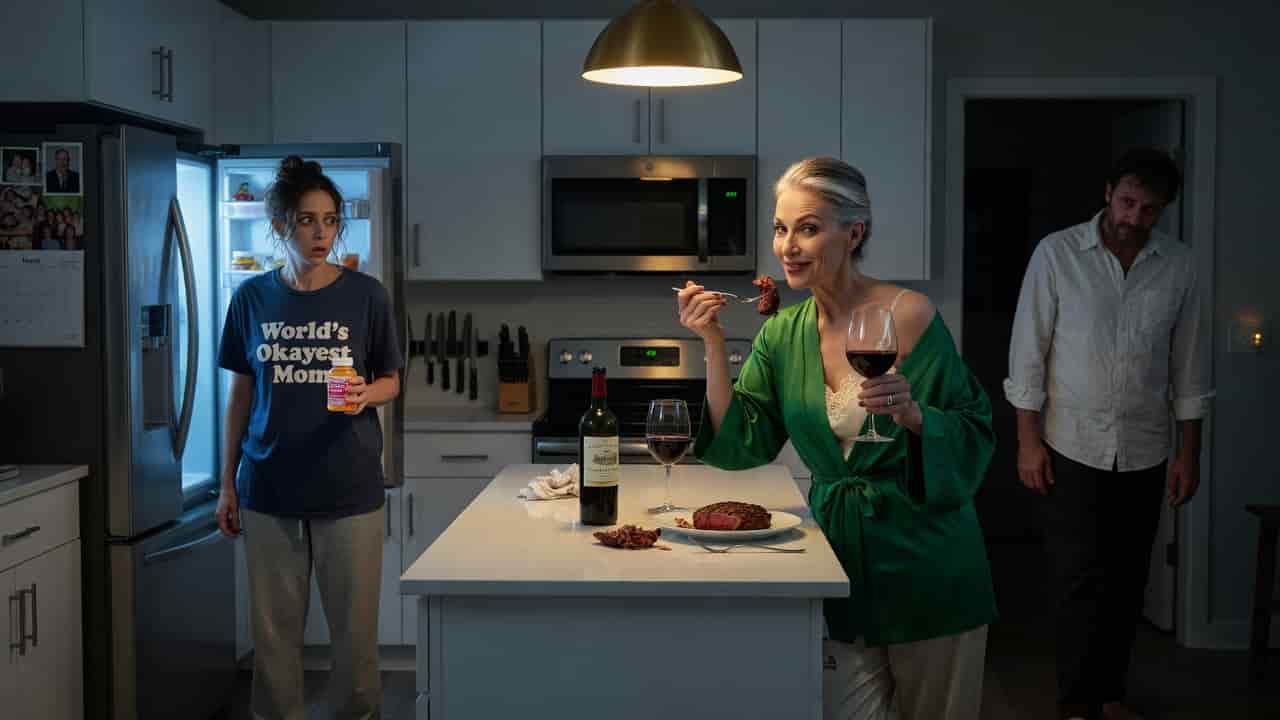
“If I’m not dying, he’s leaving. And I won’t let that happen.”
I stood there in the dark, my fingers still gripping the bottle of multivitamins I’d found hidden in the back of the pantry. Across the kitchen island, Beatrice—the woman who supposedly had three months to live—was cutting into a medium-rare ribeye. She wasn’t pale. She wasn’t shaking. She looked better than I did.
For twelve months, I’d been the “good girl.” I gave up my promotion, I packed our bags for a move that never happened, and I watched my husband, Tom, cry himself to sleep every night because he thought he was losing his mother. I’d become a servant in my own house, carrying trays of broth up the stairs while Beatrice groaned about the “pain” in her bones.
But as she took a sip of Cabernet and looked me dead in the eye, I realized the only thing terminal about her was her need for control. She wasn’t sick. She was a master actress, and she’d just turned our lives into her personal stage.
“Go ahead, Nina,” she whispered, the silver fork glinting in the low light. “Tell him. Go wake him up and tell him his dying mother is eating a steak. See who he believes. See who he chooses.”
I looked at the hallway where Tom was sleeping, his heart breaking for a lie. I realized then that Beatrice didn’t just want to stay in this house. She wanted to destroy me for trying to take her son away.
Chapter 1: The House of Slow Breaths
The oxygen concentrator hummed in the corner of the master bedroom, a rhythmic, mechanical sigh that had become the heartbeat of the house. It was a rhythmic whir-click, whir-click that filled the silences between Tom’s muffled sobs and the clinking of Nina’s medicine spoons. Nina sat on the edge of the floral-patterned armchair, her back aching in a way that had become permanent. She looked at the tray in her lap—lukewarm chicken broth, a stack of saltines, and a small dish of crushed pills.
She had been in this house for three hundred and forty-two days. She knew the number because she had a calendar in the kitchen where she crossed off the days she should have been in London. She was supposed to be a Senior Creative Director at the firm’s flagship office. Instead, she was the primary caregiver for Beatrice Vance, a woman who, according to the folders of medical reports on the nightstand, was being eaten alive by Stage IV small cell carcinoma.
“Beatrice?” Nina whispered, her voice raspy from lack of use. “I have your lunch.”
The woman in the bed shifted. Beatrice was sixty-eight, but in the dim, filtered light of the heavy velvet curtains, she looked a century old. Her skin was a translucent grey, her hair a thin silver halo against the silk pillows. She let out a soft, rattling groan that made Nina’s stomach twist with a familiar, toxic mix of pity and resentment.
“I can’t… Nina,” Beatrice breathed, her eyes remaining closed. “The nausea. It’s like a tide.”
“Just a few sips. Tom will be home for his break soon. He’ll want to see you’ve eaten.”
At the mention of her son, Beatrice’s eyelids fluttered. “My boy. He’s doing too much. You both are.” She reached out a trembling, claw-like hand, fumbling for Nina’s wrist. Her grip was surprisingly cold, the skin feeling like damp parchment. “You’re an angel, Nina. I know I’m a burden. I know you had… plans.”
Nina felt the familiar sting behind her eyes. Plans. It was such a small, sterile word for the life she’d fought ten years to build. “It doesn’t matter, Beatrice. We’re family.”
“You say that,” Beatrice whispered, a single tear tracking through the wrinkles at the corner of her eye. “But I see how you look at the luggage in the hallway. I’m sorry I’m taking so long to go.”
It was a classic Beatrice move—the verbal barb wrapped in a shroud of martyrdom. It left Nina feeling like a monster for even thinking about her own career. Every time Nina felt a surge of independence, Beatrice would drop a line like that, a reminder that Nina’s desires were selfish in the face of death.
The door downstairs creaked open, followed by the heavy, hurried footsteps of Tom. Nina stood up, her joints popping. She met him at the top of the stairs. Tom looked terrible. His face was sallow, his eyes rimmed with red, and his tie was crooked. He worked as a middle manager at a logistics firm, a job he hated but kept because the insurance was the only thing keeping them afloat.
“How is she?” Tom asked, his voice low and urgent.
“The same,” Nina said, trying to keep the flatness out of her tone. “She says she’s nauseous. She hasn’t touched the broth.”
Tom pushed past her into the room, his face crumpling the moment he saw his mother. He dropped to his knees by the bed, taking Beatrice’s hand and pressing it to his forehead. “Mom. I’m here. I’m right here.”
Nina stood in the doorway, a ghost in her own marriage. She watched Tom whisper to his mother, watched Beatrice offer him a weak, saintly smile that seemed to revitalize him even as it drained Nina. This was the routine. The London promotion had been declined six months ago. The deposit on the flat in Chelsea was gone. Their furniture was in a storage unit two towns over, gathering dust while they lived in the house Beatrice refused to sell.
“Nina, can you get the cool cloth?” Tom asked without looking back. “She’s got a fever.”
Nina went to the bathroom, wrung out a washcloth with trembling hands, and brought it back. As she leaned over to place it on Beatrice’s forehead, she noticed something. The oxygen concentrator was humming, but the tubing snaking toward Beatrice’s nose wasn’t actually seated in her nostrils. It was tucked under her chin, resting against her neck.
Nina reached down to adjust it, but Beatrice’s hand shot up—not with a tremble, but with a quick, reflexive strength—and caught Nina’s wrist.
“I can do it, dear,” Beatrice said, her voice suddenly much clearer. She tucked the tubing into place herself, her eyes locking onto Nina’s for a split second. There was a spark there—a sharp, calculating glint that didn’t belong to a dying woman. Then, as quickly as it appeared, the light vanished. Beatrice slumped back into the pillows, her breath becoming ragged again. “Thank you, Nina. So kind.”
Tom didn’t see it. He was busy checking the morphine drip that a private nurse had set up earlier that morning. “The nurse said we might need to increase the dosage tonight,” Tom muttered. “She’s been having breakthroughs.”
“Tom,” Nina said, her heart starting to beat a little faster. “Did the doctor actually come by today? While I was at the grocery store?”
“No, just the assistant. Sarah. She brought the new vials.” Tom stood up, rubbing his face. “Why?”
“I don’t know. It’s just… she seems so different when you’re here. More… present.”
Tom’s expression hardened into a look Nina had seen too often lately. It was a look of tired disappointment. “She’s fighting for us, Nina. She’s trying to stay awake because she knows how much it kills me when she slips away. Can we not do this? Can we not analyze her ‘presence’ like she’s a science project?”
“I’m not. I’m just tired, Tom. I’m so tired.”
“We’re all tired,” Tom snapped, then immediately softened, pulling Nina into a brief, wooden hug. He smelled like office coffee and stale stress. “I’m sorry. I just… I can’t lose her yet. I’m not ready.”
Nina let him hold her, but she didn’t close her eyes. She looked over his shoulder at Beatrice. The older woman was watching them through half-closed lids, a tiny, almost imperceptible tuck at the corner of her mouth. It wasn’t a smile of peace. It was the look of a person who had just won a very small, very private bet.
That night, Nina lay awake in the guest room they’d been sharing to give Beatrice the master suite. The house felt heavy, as if the walls were saturated with the smell of antiseptic and old floral perfume. She thought about the oxygen tubing. She thought about the grip on her wrist.
She got up to get a glass of water, moving silently down the hallway. She passed Beatrice’s door. The oxygen concentrator was still humming, but there was another sound beneath it. It was faint, almost buried by the mechanical noise. It sounded like a rhythmic tapping.
Nina leaned her ear against the wood. Tap, tap, tap-tap-tap.
It was the sound of someone’s foot tapping along to a beat. Nina frowned. Beatrice was supposed to be too weak to lift her own head. She reached for the door handle, her heart hammering against her ribs, but stopped. If she went in and Beatrice was just restless, Tom would never forgive her for waking her.
She turned away, heading toward the kitchen. She needed to breathe. She needed to feel like a person who wasn’t waiting for someone to die. But as she passed the hall closet, she saw Beatrice’s handbag sitting on the bench. It was an old, structured leather bag Beatrice insisted on keeping near her.
Nina didn’t know why she did it. Maybe it was the tubing. Maybe it was the tap-tapping. She opened the bag. Inside, tucked beneath a lace handkerchief and a rosary, was a small, amber plastic bottle. There was no pharmacy label on it. Nina opened it. Inside were dozens of small, round, bright yellow tablets.
She took one out and held it to the light. It was marked with a ‘C’ and a ‘V’.
She knew those pills. They weren’t morphine. They weren’t even specialized oncology meds. They were high-potency multivitamins, the kind sold at the organic market three blocks away.
Nina stood in the dark hallway, the tiny yellow pill feeling like a hot coal in her palm. The silence of the house suddenly felt like a scream.
Chapter 2: The Silent War
The next morning, the sun hit the kitchen linoleum in harsh, unforgiving squares. Nina sat at the table, a cold cup of coffee in front of her. She hadn’t slept. She had spent the hours between 3:00 AM and dawn staring at the yellow pill on her nightstand. She’d looked it up online. It was exactly what she thought: a Vitamin C and B-complex supplement.
“Morning,” Tom said, stumbling into the kitchen. He looked like he’d aged five years in the last twelve hours. He went straight for the coffee pot, his movements jerky and uncoordinated.
“Tom,” Nina said, her voice steadier than she felt. “I found something in your mom’s bag last night.”
Tom paused, the pot mid-pour. He didn’t look at her. “Her bag? Why were you in her bag, Nina?”
“It doesn’t matter why. I found a bottle of multivitamins. There’s no label on them. And I haven’t seen her actual medication in a week. Not since Sarah, the doctor’s assistant, started bringing them in those unlabeled vials.”
Tom sighed, a long, weary sound that made Nina feel small. “Nina, she’s on a complex regimen. Some of it is experimental. Sarah handles the compounding. My mother is dying of cancer. Why are you acting like this is a detective novel?”
“Because she held my wrist yesterday, Tom. She held it with the strength of a healthy woman. And the oxygen—”
“Stop,” Tom said, finally turning to face her. His eyes were hard. “Just stop. I know you’re frustrated. I know London was a big deal. But my mother is in that room, fading away, and you’re standing here accusing her of… what? Faking it? Do you know how insane that sounds?”
“I’m just asking questions, Tom. Why won’t she let me go to the appointments with her anymore? Why does Sarah only come when I’m out of the house?”
“Because you make her feel judged! You walk into that room like you’re waiting for her to stop breathing so you can catch a flight to Heathrow. She feels it, Nina. Everyone feels it.”
The words cut deeper than a blade. Nina felt the familiar, hot rush of shame. She was the one doing the laundry. She was the one cleaning the bedside commode. She was the one who had spent her savings on the specialized bed Beatrice insisted on. And yet, she was the villain because she was the only one looking closely.
“I’m going to work,” Tom said, grabbing his briefcase. “Try to be kind today. Just for a few hours. Please.”
He left without kissing her. Nina sat in the silence, the echo of the front door slamming vibrating in her chest. She felt a presence behind her. She turned.
Beatrice was standing in the doorway of the kitchen.
She wasn’t using her walker. She wasn’t leaning on the wall. She was standing upright, her green silk robe cinched tight at her waist. Her face was still pale, but the lethargy was gone. Her eyes were sharp, bright, and filled with a cold, terrifying intelligence.
“He’s very protective of me, isn’t he?” Beatrice said. Her voice wasn’t a whisper anymore. It was a smooth, melodic alto.
Nina froze, her hand flying to her throat. “Beatrice. You… you’re up.”
“I felt a sudden burst of energy,” Beatrice said, walking toward the island. She moved with a grace that was impossible for someone with bone metastases. She reached for the coffee pot and poured herself a cup. “It’s a miracle, really. Though I’m sure you have another word for it.”
Nina stood up, her chair screeching against the floor. “What is this? What are you doing?”
Beatrice took a slow, appreciative sip of the coffee. “I’m keeping my family together, Nina. It’s what mothers do. You wouldn’t understand that, would you? You’re so focused on your ‘career.’ Your ‘projects.’ You were going to take him three thousand miles away. You were going to leave me here in this big, empty house to rot.”
“You’re faking it,” Nina whispered, the reality of it hitting her like a physical blow. “The reports, the weight loss, the nurse… you’re faking all of it.”
“Am I?” Beatrice smiled, a slow, cruel baring of teeth. “The doctor’s assistant is an old friend’s daughter. She needs the money I give her. The weight loss? Well, a few weeks of water and crackers can do wonders for the silhouette. And the rest… the rest is just performance. And I’ve always been a very good actress, Nina. Better than you, certainly. You can’t even hide how much you hate me.”
“I don’t hate you,” Nina said, her voice trembling. “But Tom… he’s breaking, Beatrice. He’s crying every night. He’s losing his mind because he thinks he’s losing you. How can you do that to your own son?”
Beatrice stepped closer, her perfume—something heavy and cloying, like lilies—filling Nina’s lungs. “Because as long as he’s crying for me, he’s mine. If I’m healthy, he moves to London. He starts a life with you. He forgets about his poor, old mother. But if I’m dying… he stays. He’ll always stay.”
“I’ll tell him,” Nina said, backing away toward the door. “I’ll tell him everything. I have the vitamins. I’ll show him the tubing.”
Beatrice laughed. It was a dry, hollow sound. “Go ahead. Tell him. He’s already decided you’re the one who’s unstable. He thinks your grief for your career has turned into a delusion. Who is he going to believe? His devoted, dying mother? Or the woman who’s been complaining about his mother since the day they got engaged?”
She leaned in, her face inches from Nina’s. “You’re a ‘good girl,’ Nina. That’s your problem. You think the truth matters. But in this house, only loyalty matters. And he is loyal to me.”
Beatrice turned and walked back toward the stairs. Halfway there, she suddenly slumped. Her knees buckled, and she caught herself on the banister, her breath becoming a wheezing rattle again.
Nina watched from the kitchen as the front door opened. Tom was back—he’d forgotten his phone.
“Mom!” Tom cried, rushing forward as Beatrice “collapsed” onto the bottom step.
“I… I just wanted… some water…” Beatrice gasped, her eyes rolling back. “Nina… she was… she was shouting at me, Tom. I couldn’t… I couldn’t breathe…”
Tom looked back at Nina, and for the first time in their seven years together, Nina saw true hatred in his eyes. “Get out,” he hissed. “Get out of the hallway, Nina. Now.”
Nina stood in the kitchen, her hands over her mouth, as Tom carried his “dying” mother back up the stairs. She could hear Beatrice’s fake, labored breathing all the way from the kitchen. It was the sound of a trap snapping shut.
Chapter 3: The Midnight Steak
The house was a tomb by midnight. Tom had spent the evening in Beatrice’s room, refusing to speak to Nina. He had called Sarah, the assistant, who had arrived with a fresh “sedative” that had put Beatrice into a deep, peaceful sleep—or so it appeared.
Nina sat in the dark of the guest room, staring at the wall. The residue of the afternoon’s confrontation felt like a layer of oily soot on her skin. She felt humiliated. Not just by Beatrice’s words, but by her own helplessness. She had been played so perfectly that even the truth felt like a lie.
She thought about the way Beatrice had looked in the kitchen—vibrant, healthy, predatory. The memory of it flickered in her mind like a film strip. She needed proof. She needed something Tom couldn’t ignore.
She got up and grabbed her phone. She moved through the house like a shadow, avoiding the floorboards she knew creaked. She didn’t go to Beatrice’s room this time. She went to the kitchen.
She had noticed something earlier. The trash can had been emptied, but there was a smell lingering in the air. It wasn’t the smell of broth. It was the heavy, charred scent of seared meat.
Nina opened the refrigerator. The drawer where she kept the groceries for her and Tom was mostly empty, but in the back, behind a carton of eggs, she found a plastic container from a high-end steakhouse. It was empty, but the grease was still fresh.
Then she heard it.
The sound of the stairs creaking. It wasn’t the heavy, clumsy step of Tom. It was light, rhythmic, and deliberate.
Nina ducked into the pantry, pulling the door shut until only a sliver of light remained. She held her breath, her heart drumming a frantic rhythm against her ribs.
The kitchen light flickered on.
Through the crack in the door, Nina saw Beatrice. She was wearing her emerald robe again. She looked radiant. She walked to the refrigerator, pulled out a bottle of wine, and set it on the island. Then, she reached into a hidden compartment in the back of the spice rack and pulled out a fresh, uncooked ribeye steak.
Nina watched, her mouth dry, as Beatrice seasoned the meat with salt and pepper, her movements quick and efficient. She turned on the stove, the blue flame illuminating a face that was entirely devoid of suffering.
Beatrice hummed to herself as she seared the steak. It was a jaunty, upbeat tune. She poured a glass of wine and leaned against the counter, taking a deep, satisfied drink.
This was the hook. This was the moment the mask didn’t just slip; it was thrown away.
Nina pulled out her phone and hit record. She captured the sizzle of the meat. She captured Beatrice’s easy, graceful movements. She captured the woman taking a large, greedy bite of the steak, juice running down her chin, a look of pure, animalistic pleasure on her face.
Nina felt a surge of cold fury. This woman had let her son weep for months. She had let Nina sacrifice her future, her savings, and her sanity. All for a ribeye and a glass of wine.
Nina pushed the pantry door open.
The sound was loud in the quiet kitchen. Beatrice didn’t flinch. She didn’t even look surprised. She slowly chewed her mouthful of steak, swallowed, and took another sip of wine. Then, she turned toward the pantry.
“You really are a persistent little thing, aren’t you?” Beatrice said. She didn’t drop the glass. She didn’t hide the steak. She stood there, basking in the glow of the overhead light.
“I have it on video,” Nina said, her voice shaking with rage. “I have everything. The steak, the wine, the way you’re standing. It’s over, Beatrice.”
Beatrice set the wine glass down with a soft clink. She walked toward Nina, her silk robe rustling. She didn’t stop until she was inches away. “Is it? You think a video changes the script?”
“He’ll see this and he’ll know. He’ll know you’re a monster.”
“A monster?” Beatrice smiled, and for the first time, Nina saw the true depth of the woman’s pathology. “I’m a mother who loves her son. You’re the one who wants to take him away. You’re the one who wants to isolate him in a city where he has no one but you. I’m just giving him a reason to stay where he belongs. With me.”
“You’re sick,” Nina whispered. “But not the way you told him.”
“If I’m not dying, he’s leaving,” Beatrice said, her voice dropping to a low, dangerous hiss. “And I won’t let that happen. Not now. Not ever.”
She reached out and gripped Nina’s chin, forcing her to look up. Her fingers were like iron. “You think you’re so smart. But you’ve already lost, Nina. Look at the doorway.”
Nina’s heart stopped. She turned her head.
Tom was standing in the shadows of the hallway. He looked like a man who had been hollowed out. His eyes were fixed on Nina, not Beatrice.
“Tom,” Nina gasped, holding up the phone. “Tom, look. Look at her. She’s eating a steak. She’s drinking wine. I caught her.”
Tom didn’t look at the phone. He didn’t look at the steak. He walked into the kitchen, his gaze never leaving Nina’s face.
“I heard you screaming,” Tom said. His voice was flat, dead. “I came down and I heard you… I heard you talking to yourself, Nina. Accusing her of things. Shouting about steaks and monsters.”
Nina froze. “What? No. She’s right there! Look at her!”
Nina turned back to Beatrice.
In the space of a heartbeat, the woman had transformed. The steak was gone—shoved into the sink and covered with a dishcloth. The wine glass was tipped over, the red liquid spilling across the white marble like a bloodstain. Beatrice was slumped against the island, her face pale, her breath coming in jagged, terrifying gasps.
“Tom…” Beatrice wheezed, her hand clutching her chest. “She… she came into my room… she dragged me down here… she said… she said if I didn’t get up, she’d… she’d hurt me…”
“No!” Nina shrieked, looking at the sink. “She’s lying! Tom, look in the sink!”
Tom grabbed Nina’s arm, his grip so tight it left a bruise. “Enough! I’ve had enough of your delusions, Nina! You’re sick. You’ve let the stress turn you into someone I don’t recognize.”
“I have the video!” Nina screamed, fumbling with her phone. “Look at the video!”
She hit play.
The screen was black. There was only the sound of Nina’s own heavy breathing and a faint, muffled rustle of fabric. Beatrice had been standing in the one spot in the kitchen where the shadows were deepest, and the angle of the pantry door had obscured everything but the refrigerator light.
Nina stared at the screen, her world tilting. Beatrice had known. She had known exactly where Nina was, and she had staged the entire thing to look like a one-sided confrontation.
“Get out of the kitchen,” Tom said, his voice trembling with a mix of grief and fury. “Go to the guest room and stay there. I’m calling the doctor. Not for her. For you.”
Nina looked at Beatrice. The older woman was tucked into Tom’s side, her head resting on his shoulder. Over his arm, she looked at Nina.
She didn’t smirk this time. She just blinked, a slow, deliberate movement that said everything. I own him.
Nina backed out of the room, the multivitamin bottle still clutched in her hand. She felt a cold, hard knot of resolve forming in her stomach. The “good girl” was gone. The residue of this night wasn’t shame—it was war.
Chapter 4: The Social Trap
The next three days were a blur of enforced silence and psychological pressure. Tom had moved Nina’s things into the small office downstairs, claiming she needed “space to recover.” He had brought in a second nurse—a woman named Elena who was sharp-eyed and professional, a foil to the easily bribed Sarah.
Nina was trapped. Every time she tried to speak to Tom, he would look at her with a mix of pity and fear, as if she were a glass vase about to shatter. Beatrice, meanwhile, had entered her “final decline.” She stayed in bed, surrounded by a rotating cast of neighbors and church members who brought casseroles and spoke in hushed, reverent tones about her “bravery.”
“It’s just so tragic,” Mrs. Gable, the nosy neighbor from across the street, whispered in the kitchen. She didn’t see Nina standing in the shadows of the hallway. “To see a woman so vibrant reduced to this. And with Nina… well, you know. Poor Tom. He’s carrying so much.”
“I heard she had a breakdown,” another woman murmured. “Tried to tell him Beatrice was faking it. Can you imagine? The cruelty.”
Nina leaned against the wall, her eyes closed. The humiliation was public now. It wasn’t just happening inside the house; it was the talk of the neighborhood. Beatrice had turned Nina into a pariah, the “unstable wife” who couldn’t handle the reality of death.
But Nina wasn’t broken. She was watching.
She watched Elena, the new nurse. Elena was different from Sarah. She actually checked Beatrice’s vitals. She actually looked at the charts. And Nina noticed that every time Elena entered the room, Beatrice’s “symptoms” became more pronounced, more theatrical.
One afternoon, Nina caught Elena in the hallway. The nurse was looking at a chart, her brow furrowed.
“Is something wrong?” Nina asked, her voice low.
Elena looked up. She had a no-nonsense face, the kind that had seen too much real death to be easily fooled. “It’s… unusual. Her heart rate is incredibly stable for someone with this level of systemic failure. And her muscle tone… it doesn’t match the cachexia I’m seeing.”
“Cachexia?”
“Wasting,” Elena said. “She looks thin, but when I move her for the bedbath, her limbs are… strong. Unusually strong.”
Nina felt a spark of hope. “She’s faking it, Elena. I know how it sounds. I know everyone thinks I’m crazy. But she’s faking all of it to keep Tom from moving to London.”
Elena didn’t scoff. She didn’t call Nina unstable. She just looked at the closed door of the master bedroom. “I’ve seen a lot of things in twenty years, Mrs. Vance. Power is a powerful drug. But I need more than a feeling to go to the board or the family.”
“There’s a party,” Nina said, the idea forming in her mind. “Tom is throwing a ‘Farewell’ gathering this Friday. A chance for everyone to say their goodbyes before she… before the end. Everyone will be here. The neighbors, his boss, even Sarah.”
“And what are you planning?”
“I’m not planning anything,” Nina said, her voice hardening. “I’m just going to give Beatrice exactly what she wants. A stage. And then, I’m going to change the lighting.”
The rest of the week was a masterclass in domestic theatre. Nina became the “dutiful wife” again. She apologized to Tom, claiming the “stress” had finally broken her. She even went into Beatrice’s room and sat by the bed, enduring the woman’s smug, whispered taunts.
“You’re learning, dear,” Beatrice whispered when Tom was out of the room. “The best way to survive a storm is to bow your head. But don’t think for a second I’ve forgotten that video.”
“I wouldn’t dream of it,” Nina said, her voice devoid of emotion. “I just want things to be peaceful for the party. Tom needs this.”
“He does,” Beatrice agreed, her eyes gleaming. “He needs to see me surrounded by love. He needs to see what he’d be leaving behind.”
Friday arrived, and the house was filled with the smell of lilies and expensive catering. Tom had spent a fortune he didn’t have, desperate to give his mother a “perfect” send-off. The living room was packed with people in dark suits and Sunday dresses.
Beatrice was carried down the stairs by Tom and a family friend, looking like a frail, tragic queen in a bed of white silk pillows on the sofa. She held court, her voice a barely audible rasp as she thanked everyone for their “kindness.”
Nina stood in the corner, a glass of untouched sparkling water in her hand. She watched Tom. He looked like a man who was finally letting go, his grief turning into a quiet, resigned acceptance. He looked at his mother with such pure, unadulterated love that it made Nina’s heart ache.
Sarah, the doctor’s assistant, was there too. She looked nervous, hovering near the buffet, her eyes darting toward Beatrice every few minutes.
Nina waited until the room was at its quietest, until Tom stood up to give a toast.
“I… I don’t have the words,” Tom began, his voice cracking. “My mother has always been my rock. And to see her face this… this journey with such grace… it’s been the honor of my life to care for her.”
He looked at Nina, and for the first time in weeks, there was a flicker of the old Tom. “And I want to thank my wife. I know it hasn’t been easy. I know we’ve had… our struggles. But we’re here. Together.”
Beatrice squeezed his hand, her eyes welling with tears. “My beautiful boy,” she whispered. “I only wish… I only wish I could see you in London. I only wish I had the strength to see you fly.”
It was the perfect line. The ultimate act of manipulation. The room erupted in soft sobs.
Nina stepped forward.
“I have a surprise,” Nina said, her voice clear and ringing through the room. “Since Beatrice is so worried about London, I thought I’d bring a little piece of her medical journey to the party. A celebration of the ‘miracle’ meds that have kept her with us this long.”
Tom frowned. “Nina? What are you doing?”
Nina reached into her pocket and pulled out a small, white envelope. She didn’t look at Tom. She looked at Sarah.
“Sarah, you’ve been so dedicated. Bringing those special, unlabeled vials every week. I actually took one of them to a friend of mine. A lab tech at the university.”
The color drained from Sarah’s face. She backed toward the door.
“Nina, sit down,” Tom hissed, his face turning a deep, angry red. “You’re making a scene.”
“I am making a scene, Tom,” Nina said, her voice rising. “Because this scene has been running for a year, and I’m ready for the credits to roll.”
She turned to the room, holding the envelope high. “In this envelope is a lab report. It’s not for morphine. It’s not for chemotherapy. It’s for a high-dose solution of glucose, B-vitamins, and a mild stimulant. It’s a cocktail designed to make a healthy person feel ‘energized’ while looking pale.”
She looked down at Beatrice. The older woman’s eyes were wide, the “dying” mask beginning to crumble.
“And I have one more thing,” Nina said. She looked at Elena, the nurse, who was standing by the stairs.
Elena stepped forward, holding a tablet. She hit play.
It wasn’t a video of a kitchen. It was a high-resolution, night-vision recording from a camera Nina had hidden in the master bedroom’s ceiling fan two days ago.
The room went silent.
On the screen, Beatrice was sitting up in bed. She wasn’t wheezing. She wasn’t groaning. She was doing a series of vigorous yoga stretches. Then, she reached under her pillow, pulled out a hidden cell phone, and started laughing as she typed a message.
The audio was crystal clear. “He’s staying, Sarah. The ‘collapse’ on the stairs worked perfectly. Keep the vials coming. I’ll double the payment next month.”
The silence that followed was deafening. It was a physical weight, pressing down on everyone in the room. Tom stood frozen, his hand still holding his mother’s, his face slowly draining of all color until he looked more like a ghost than Beatrice ever had.
Nina looked at the residue of her life—the broken marriage, the lost career, the house filled with lies. She looked at the woman on the sofa, who was now staring at the screen with the wide, panicked eyes of a cornered animal.
“The full story is in the comments,” Nina whispered to herself, the habit of her old life surfacing for a second.
But she didn’t need comments. She just needed Tom to look at her.
And finally, he did.
Chapter 5: The Weight of the Unmasked
The silence that followed the video wasn’t the kind that felt empty; it was the kind that felt heavy, like the air right before a transformer blows. It was a thick, suffocating pressure that made the floral arrangements on the coffee table look like funeral wreaths for a living woman. Nina stood by the wall, her phone still clutched in a hand that wouldn’t stop shaking. She didn’t feel like a victor. She felt like someone who had just detonated a bomb in her own living room and was now standing in the settling ash.
Tom hadn’t moved. He was still holding Beatrice’s hand, but his fingers were limp, his grip forgotten. He was staring at the blank tablet screen as if he expected the night-vision footage to retract itself, to tell him it was all a digital glitch. His face was a mask of grey, porous shock.
Beatrice was the first to break.
The “gasping” stopped. The “rattle” in her chest vanished. She didn’t look at the screen, and she didn’t look at Nina. She looked at her son. Her eyes, which had been filmed with the fake dullness of the dying just minutes ago, were now sharp and burning with a frantic, desperate calculation.
“Tom,” she whispered. It wasn’t the raspy voice of the terminal. It was her voice—the clear, commanding alto of the woman who had run the local school board for twenty years. “Tom, look at me. It’s not what it looks like. Nina… she’s been tampering with things. She’s been trying to drive me out. She staged that. She hired someone to—”
“Mom,” Tom said. It was just one word, but it sounded like a glass bone snapping. He finally looked down at her. He didn’t pull his hand away, but he didn’t squeeze back either. “The video was live, Mom. You were doing yoga. You were laughing.”
Across the room, Mrs. Gable let out a small, sharp sound—part gasp, part sob—and grabbed her coat. It was the signal the rest of the room needed. The neighbors and church members, the people who had brought casseroles and offered prayers, began to move all at once. They didn’t offer condolences. They didn’t say goodbye. They shuffled toward the door with their heads down, their faces twisted with a mix of embarrassment and genuine disgust.
“I think we should go,” Mr. Gable muttered, avoiding Nina’s eyes.
The room emptied in less than sixty seconds. The expensive catering—the tiny quiches and the smoked salmon—sat untouched on the lace tablecloths. The front door clicked shut, leaving the three of them, and Sarah, who was backed into the corner by the buffet.
Sarah was trembling so hard the plate she was holding rattled. “I… I have to go. I have a shift.”
“Sit down, Sarah,” Nina said. Her voice sounded strange to her own ears—cold, distant, and utterly finished. “You’re not going anywhere until we talk about the vials.”
“I didn’t know!” Sarah cried, her voice rising to a shrill peak. “She told me she was in pain! She said the doctors weren’t listening! She said she just needed something to keep her spirits up while she waited for the end!”
“And the money?” Nina asked, stepping into the center of the room. “The double payments? Was that for her spirits too?”
Sarah collapsed into a chair, burying her face in her hands. The silence returned, but it was sharper now. Tom finally let go of Beatrice’s hand. He stood up slowly, his joints creaking. He looked around the room—at the hospital bed that cost four thousand dollars, at the oxygen concentrator that hummed pointlessly in the corner, at the mountain of greeting cards on the mantle.
He walked over to the oxygen concentrator and flipped the switch. The mechanical sigh died instantly.
“Tom, please,” Beatrice said. She stood up from the sofa. There was no stumble. There was no reaching for a banister. She stood up with the effortless strength of a woman who had been eating steak and doing yoga while her son worked twelve-hour shifts to pay for her ‘comfort.’ “I did it for you. I did it because I saw you slipping away. I saw her taking you to a city where you’d be a stranger. I couldn’t lose my only son. I couldn’t let her win.”
“Win?” Tom turned to her, his voice low and vibrating with a rage Nina had never seen. “You think this was a game, Mom? You watched me cry. You watched me sit by your bed and hold your hand while I thought I was losing the only person who’d been there for me since Dad died. You watched me give up the best opportunity of my life. You watched Nina give up everything. And you did it for us?”
“You were happy here!” Beatrice shouted, her mask finally falling away to reveal the raw, jagged entitlement underneath. “You were safe! In London, you’d be nothing! You’d be a cog in a machine, and she’d be the one making all the decisions. I was protecting your future!”
“You were protecting your house,” Nina said, her voice cutting through Beatrice’s outburst. “You were protecting your servant. You didn’t want a son, Beatrice. You wanted a tenant who owed you his life.”
Beatrice turned on Nina, her face contorted. “You shut up! You’ve been a cancer in this house since the day you moved in! Always whispering, always checking your watch, always looking at the door. You never loved him. You just wanted to own him.”
“I loved him enough to stay,” Nina said. “I loved him enough to change your bedpans when I thought you were dying. I loved him enough to lose my career because I thought it was the right thing to do. What did you love him enough to do, Beatrice? Lie to him for a year? Make him mourn a woman who was sitting right in front of him?”
Tom walked to the hallway and grabbed Beatrice’s handbag—the one Nina had searched days before. He dumped it out on the dining table. The rosary clattered. The lace handkerchief fell. And then the amber bottles of multivitamins spilled out, rolling across the mahogany.
“Sarah,” Tom said, not looking at the assistant. “Leave. If I ever see you near my mother again, I’ll call the police and the medical board. I have the bank statements Nina found. I have the video. Go.”
Sarah didn’t wait. She bolted out the door, her heels clicking frantically on the pavement outside.
Tom looked at the vitamins. He picked up one of the yellow pills and crushed it between his thumb and forefinger. It turned into a fine, bright dust.
“I want you out,” Tom said to Beatrice.
Beatrice froze. “What?”
“This is my house, Mom. We bought it from you so you’d have the money for ‘treatment.’ The deed is in our names. I want you out by tomorrow morning.”
“Tom, you can’t be serious,” Beatrice said, her voice dropping back into a manipulative quaver. “I’m your mother. I have nowhere to go. My friends… they all saw that video. You’ve ruined me.”
“No,” Tom said, finally meeting her eyes. “You ruined yourself. You can stay at the Hilton tonight. I’ll pay for a week. After that, you’re on your own. Call your ‘old friends’ daughter.’ Maybe she’ll take you in.”
Beatrice looked at him, searching for the soft spot, the guilt she’d been mining for thirty years. But Tom’s face was a wall of granite. For the first time in his life, he wasn’t looking for her approval. He was looking at her as a stranger.
She stood up, pulling her silk robe tight around her. She didn’t cry. She didn’t plead again. She realized the stage had burned down, and there were no more lines to speak. She walked toward the stairs, her back straight, her head high.
“You’ll regret this,” she said, pausing on the third step. “When she leaves you—and she will, Tom, because she’s a climber—you’ll realize I was the only one who stayed.”
She disappeared into the upstairs hallway.
Nina and Tom stood in the wreckage of the party. The silence returned, but it wasn’t the heavy silence of the revelation. It was the hollow, echoing silence of a vacuum.
“Tom,” Nina said, reaching out to touch his shoulder.
He flinched. It wasn’t a violent movement, just a small, instinctive pull away. He looked at her, and Nina saw the residue of the night in his eyes. He wasn’t grateful. He was shattered.
“You knew,” he said. “For how long?”
“I suspected for weeks. I knew for sure about four days ago.”
“And you let me give that toast tonight,” Tom said, his voice trembling. “You let me stand up in front of everyone we know and tell the world how much I loved her. You let me humiliate myself like that.”
“I had to, Tom! If I’d told you, you wouldn’t have believed me. You didn’t believe me! You called me unstable. You called the doctor on me!”
“I know,” Tom whispered, dropping into a chair. He put his head in his hands. “I know I didn’t believe you. But did you have to do it like that? Did you have to make it a show? Did you have to record her yoga and put it on a tablet in front of my boss?”
“I needed witnesses, Tom! I needed people to see what she was doing so she couldn’t spin it again. If it was just us, she would have found a way to make you doubt me.”
“Maybe,” Tom said. “But now… everyone knows. Everyone saw me being a fool. Everyone saw my mother being a monster. How do we live here now, Nina? How do we walk down the street?”
Nina looked at him, and she realized the victory was bitter. She had saved him from a lie, but in doing so, she had exposed the core of his weakness. She had rescued him, but she had also seen him at his most vulnerable and his most foolish.
“We don’t live here,” Nina said softly. “We leave. We go to London. I’ll call the firm. I’ll tell them it was a family emergency that’s been resolved. We can still make it work.”
Tom looked up at her. His eyes were dry now, but they were empty. “London? Nina, I don’t even know who I am anymore. I spent a year mourning a woman who was eating steak in the kitchen while I cried. I spent a year thinking my wife was losing her mind. I can’t just… pack a bag and move to London.”
“Why not? There’s nothing left for us here.”
“I know,” Tom said. He stood up and walked toward the kitchen. “That’s the problem. There’s nothing left.”
He didn’t go to the bedroom. He went to the basement, where his old tools were stored. Nina heard the sound of a hammer hitting wood—the rhythmic, violent sound of someone trying to break something that was already broken.
Nina sat on the sofa, surrounded by the white silk pillows Beatrice had used as a throne. She picked up one of the multivitamins from the table. It was small and yellow, bright as a warning light. She realized then that the truth didn’t just set you free. Sometimes, it just left you standing alone in the dark, wondering if the lie had been easier to carry.
Chapter 6: The Residue of Truth
The sun rose on a house that felt like a crime scene. Beatrice was gone by 8:00 AM. She hadn’t said a word as she came down the stairs with two suitcases, her face a mask of cold, aristocratic fury. She didn’t look at Nina, who was sitting in the kitchen with a cup of black coffee. She didn’t look at the door to the basement where Tom had been all night. She just walked out the front door, her heels clicking on the porch, and got into a waiting town car.
Nina watched the car pull away. She expected to feel a surge of relief, a lightness in her chest. But there was only a dull, aching throb in her temples.
The house was quiet now. No more mechanical hum. No more rhythmic coughing. But the ghost of the lie was everywhere. It was in the hospital bed that was still in the living room, a skeletal reminder of the fraud. It was in the smell of the lilies that were starting to wilt in their vases.
Nina started to clean.
She did it methodically, her movements robotic. She threw away the quiches. She dumped the wilted flowers into the trash. She packed up the medical supplies—the gauze, the antiseptic, the stacks of adult diapers Beatrice had insisted on “just in case.” She did it all with a grim, focused energy, trying to erase the last twelve months one garbage bag at a time.
Tom came up from the basement around noon. He was covered in sawdust and grease. He looked exhausted, his eyes sunken and dark.
“She’s gone,” Nina said, not looking up from the counter she was scrubbing.
“I know,” Tom said. “I heard the car.”
He sat down at the kitchen table, the same place where he’d sat a year ago and told Nina they had to stay. He looked at his hands, his knuckles raw from whatever he’d been doing downstairs.
“I called the rental company,” Tom said. “They’re coming for the bed and the equipment this afternoon.”
“Good.”
“And I called a realtor. A friend of a friend. He thinks we can sell the house quickly. The market is still hot here.”
Nina stopped scrubbing. She looked at him. “Sell it? Where would you go, Tom?”
“I don’t know,” he said. He finally looked at her. “But I can’t stay here. Every time I look at that staircase, I see her ‘collapsing.’ Every time I go into the kitchen, I think about her eating that steak. I can’t breathe in this house, Nina.”
“Then come with me,” Nina said, moving toward him. “I called the firm this morning. My old boss… she was surprised, but she hasn’t filled the position yet. The person they hired fell through. It’s still there, Tom. London is still there.”
Tom didn’t answer for a long time. He looked out the window at the suburban street, the quiet, safe world where he’d been a ‘good son’ for thirty years.
“I can’t go to London, Nina,” he said softly.
“Why? Tom, it’s a fresh start. We can leave all of this behind.”
“Can we? You look at me, and you see the man who believed a transparent lie for a year. You see the man who chose his mother over his wife’s sanity. You see the man who called you unstable.”
“I see the man I love,” Nina said, her voice breaking. “I see the man who was manipulated by a professional. It’s not your fault, Tom.”
“But it is,” Tom said, standing up. “Because deep down… I think I wanted to believe it. I was scared of London. I was scared of the new job, the new city, the life where I wasn’t ‘Tom the local guy.’ She gave me an out, and I took it. I let myself be fooled because it was easier than being brave.”
He walked over to her and took her hands. His grip was gentle, but there was no strength in it. “You’re a climber, Nina. My mother was right about that. You’re meant for big things. You’re meant for the city and the career and the life that moves fast. But I’m… I’m just a guy who got lost in his own house. If I go with you now, I’ll just be the weight you’re dragging behind you. And eventually, you’ll start to resent me for that too.”
“I won’t,” Nina whispered, the tears finally coming. “Tom, don’t do this. Don’t let her win this too.”
“She already won,” Tom said, a sad, crooked smile touching his lips. “She didn’t keep me in the house, but she broke the thing that made the house worth staying in. She broke the trust, Nina. And I don’t know how to fix it.”
They spent the rest of the day in a strange, polite dance of separation. The rental company came and took the bed. The house looked even bigger and emptier without it. They packed Nina’s bags together—the suitcases that had been sitting in the hallway for a year.
As the sun began to set, the house felt cold. The residue of the confrontation was still there, a thin layer of bitterness over everything they said. They didn’t fight. They didn’t scream. They were just two people who had survived a disaster and realized they were no longer the same people who had entered it.
“I have a flight at 10:00 PM,” Nina said, standing in the entryway with her luggage.
“I’ll drive you,” Tom said.
“No. I called a car. I think… I think it’s better if we say goodbye here.”
Tom nodded. He looked around the entryway, at the faded wallpaper and the scuff marks on the floorboards. “I’m sorry, Nina. For everything.”
“I know,” Nina said. She reached out and touched his cheek. “I’m sorry I had to be the one to show you.”
“I’m glad you did,” Tom said. “I would have spent the rest of my life mourning a ghost. At least now, I know what I’m actually losing.”
Nina walked out onto the porch. The night air was cool and crisp, smelling of damp earth and coming rain. She got into the waiting car and didn’t look back. She didn’t want to see Tom standing in the doorway of a house that was no longer a home.
As the car drove toward the airport, Nina looked at her phone. She had a dozen missed calls from her mother-in-law. She didn’t delete them. She didn’t block the number. She just let them sit there—a record of a woman who had tried to build a kingdom out of a lie and ended up with nothing but a phone that no one would answer.
Nina leaned her head against the window. She thought about her new flat in London. She thought about the office on the thirtieth floor, the glass walls, the fast-paced world that was waiting for her. She felt a surge of something she hadn’t felt in a year. It wasn’t joy. It was just… movement.
The weight was gone. The “good girl” was buried somewhere back in that suburban house, somewhere under the wilted lilies and the crushed vitamins.
In her bag, she still had the small, yellow pill she’d taken from the table. She pulled it out and looked at it one last time. It was just a supplement. It didn’t cure anything. It didn’t change the truth. It just gave you a little more energy to keep going.
She rolled down the window and tossed the pill into the night. It vanished into the darkness, a tiny, insignificant dot against the asphalt.
Nina closed her eyes and listened to the hum of the tires. It was a different kind of hum than the oxygen concentrator. It was the sound of a life starting to breathe again, slow and steady, without the help of a machine.
She wasn’t sure what would happen to Tom. She wasn’t sure if they’d ever find their way back to each other. But as the plane took off and the lights of the city began to shrink below her, Nina realized that for the first time in a long, long time, she wasn’t waiting for anyone to die.
She was just living. And for now, that was enough.