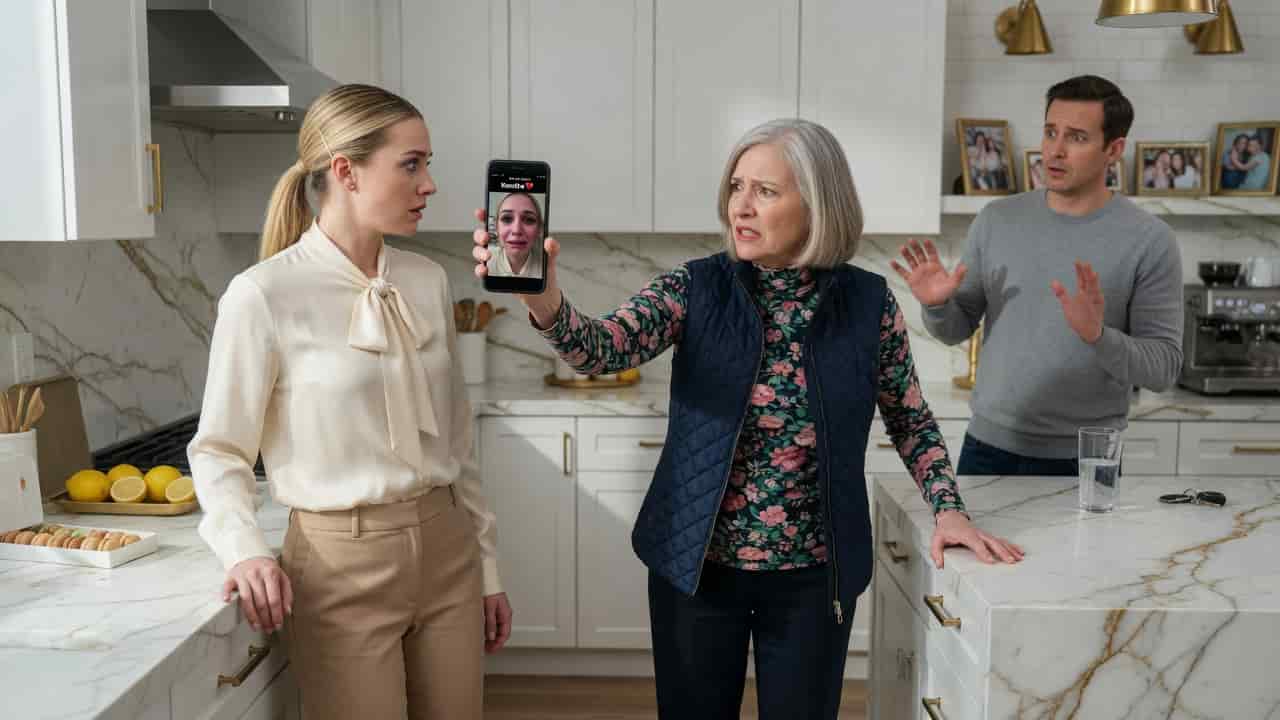
“You think you’re so special, don’t you, Mia? You think these people actually love you?”
My mother-in-law, Sheila, held her phone out like it was a weapon. I could see the screen. It was a photo of me from six months ago, taken through the bathroom door when I was having a panic attack on the floor. A photo I didn’t even know existed. A photo that had just been posted to the ‘TruthAboutMia’ account for fifty thousand people to see.
“Sheila, give me the phone,” I whispered, my voice shaking. My husband, Marc, was standing by the stove, looking back and forth between us like he couldn’t understand the language we were speaking. He’d always told me I was being paranoid. He’d told me his mother didn’t even know how to use Instagram.
“I’m just showing them the real you,” Sheila said, her voice loud enough to be picked up by the Live Stream I’d forgotten was still running. “The one who hides in the dark. The one who’s still that same pathetic, insecure girl from high school. You don’t deserve any of this.”
I looked at the tripod in the corner. The little red light was blinking. My followers were watching the woman I’d trusted with my child tear my life apart in real-time.
Marc finally stepped forward, but he didn’t grab the phone. He looked at me with a terrifying kind of doubt in his eyes. “Mia, what is she talking about? Is that really you?”
The betrayal wasn’t just coming from Sheila anymore. It was everywhere.
I had the IP logs in my office. I had the proof that every single leak had come from her router. But as the comments scrolled by—thousands of people calling me a fraud—I realized that being right wouldn’t save me.
Chapter 1: The Glow-Up Facade
The light in the kitchen was perfect at 7:45 AM. It was that soft, buttery California gold that made the marble countertops look like they cost twice what they actually did. I stood there, holding a mug of lukewarm matcha latte, waiting for the precisely timed moment to hit ‘record.’ To the world, I was Mia Vance, the face of “GlowUpMia,” a lifestyle brand built on the pillars of intentional motherhood, organic wellness, and the kind of effortless beauty that actually takes two hours of prep.
I adjusted the ring light, feeling the familiar hum of anxiety in the pit of my stomach. It was a physical weight, a leaden ball that hadn’t left me in three weeks. Ever since the first post from TruthAboutMia had appeared.
“Hey, everyone,” I said to the lens, my voice slipping into that bright, melodic register I used for the public. It was a voice that didn’t sound like it had spent the night crying in a walk-in closet. “I’ve been getting so many questions about my morning routine lately, so I thought I’d take you along for the first hour of my day.”
I moved through the motions—the vitamin organization, the aesthetic pouring of the green juice, the gentle waking of my three-year-old, Leo. It was a choreographed dance. Every gesture was designed to be clipped into a fifteen-second reel that would make a woman in Ohio feel like she just needed a specific brand of blender to fix her life.
But while I smiled at the camera, my eyes kept darting to the black screen of my personal phone sitting on the counter.
When I finally finished the segment and hit save, the mask dropped. My face felt heavy, the muscles aching from the forced cheer. I picked up the phone. My heart did a slow, painful roll in my chest.
TruthAboutMia had posted again.
It wasn’t a blurry pap shot or a vague rumor. It was a screenshot of a text message I’d sent to Marc last Tuesday. ‘I can’t do this today. I feel like I’m suffocating. I just want to pack a bag and drive until the gas runs out.’
The caption on the post was biting: “Authentic Mia? Or Abandonment Mia? While she’s selling you ‘The Joy of Presence,’ she’s actually plotting her escape from her own son. How much of the Glow-Up is just a cover for a woman who can’t handle her own life?”
The comments were already a bloodbath.
‘I knew she was fake.’
‘Poor Leo.’
‘Someone should call CPS if she’s that unstable.’
A cold sweat broke out across my shoulder blades. That text had been private. It was a moment of weakness, a flare-up of the old darkness I’d been fighting since I was fifteen. I’d sent it to my husband while he was at the office, a cry for help that he’d responded to with a generic ‘Hang in there, babe.’
“Morning, Mia.”
I jumped, nearly dropping the phone onto the marble. Marc was standing in the doorway, rubbing his eyes. He looked tired in the way successful architects always looked—overworked and slightly bothered by the intrusion of domesticity.
“You’re up early,” he said, heading for the espresso machine.
“I was filming,” I said, my voice tight. I walked over to him, holding the phone out. “Marc, look at this. It happened again.”
He didn’t take the phone. He didn’t even look at it. He just waited for the machine to hiss and drip. “The troll account? Mia, I told you. Stop looking at it. It’s just some bored person in a basement. You’re giving them exactly what they want.”
“It’s not just a troll, Marc. They have my texts. My private texts to you. How did they get that?”
He sighed, a long, weary sound that made me feel like a hysterical child. “I don’t know. Maybe you synced your messages to the shared iPad? Maybe Leo was playing with it and accidentally screenshotted it? Technology is glitchy.”
“This isn’t a glitch. This is a targeted hit. They’re trying to destroy the brand. My manager called me yesterday—SunBloom Organics is ‘reviewing’ our contract. That’s sixty percent of our quarterly revenue, Marc.”
He finally turned, taking a sip of his coffee. He looked at me with that calm, rational expression that used to make me feel safe but now just felt like a wall. “Then be more careful. Change your passwords. And for God’s sake, stop letting it ruin our breakfast. My mother is coming over at ten to take Leo to the park, and I don’t want her walking into a war zone.”
“Sheila is coming?” I felt a fresh spike of irritation. “I didn’t know that.”
“She called last night while you were in the bath. She said she missed her grandson.” Marc checked his watch. “I’ve got a meeting. Just… breathe, okay? You look tense. It doesn’t look good for the ‘Glow-Up’ thing.”
He kissed my cheek—a dry, perfunctory brush of skin—and left.
I stood in the perfect kitchen, surrounded by the expensive things my “fake” life had bought us, and felt the walls closing in. I wasn’t just Mia the Influencer. I was Mia the girl who used to eat lunch in the library to avoid the girls who called her ‘Pudgy Mia.’ I was the girl who had spent a decade building a suit of armor out of filters and curated joy, only to realize that someone had found the seam.
I looked at the counter. A stray crumb sat on the pristine marble. I swiped it away with a shaking hand.
I needed to know who was doing this. Not just for the money, but because the voice in those captions sounded so familiar. It sounded like the voice in my own head—the one that told me I was a fraud every time I put on concealer.
I went to my office and locked the door. I’d hired a digital forensics guy, a man named Leo—coincidentally the same name as my son—who specialized in ‘reputation management.’ He was expensive, and I was paying him out of a secret account Marc didn’t see.
I opened my laptop and hopped on the encrypted chat.
Mia: Anything yet?
Leo: I tracked the latest login for the TruthAboutMia account. The IP is local.
Mia: How local?
Leo: Within a three-mile radius of your house. Whoever this is, they aren’t in a basement in another country, Mia. They’re in your neighborhood.
I stared at the screen. A three-mile radius. That included the organic grocery store, the pilates studio, and my best friend’s house. It also included my mother-in-law’s condo.
A knock at the front door startled me. It was ten o’clock.
I closed the laptop and took a deep breath, smoothing my hair in the mirror. I needed to be the woman on the screen. I needed to be “Glow-Up Mia.”
I opened the door to find Sheila standing there, wearing a sensible navy blue vest and a smile that didn’t reach her eyes. She was holding a bag of sugar-laden cookies that I’d asked her a dozen times not to give to Leo.
“Hello, dear,” she said, stepping past me without waiting to be invited. “You look a bit peaked. Are you sleeping? I saw your little video this morning. You looked so tired, I almost commented to tell you to take a nap.”
“I’m fine, Sheila,” I said, my voice practiced. “Just a lot on my plate.”
“I’m sure. It must be so exhausting, pretending to be perfect all day for a bunch of strangers.” She patted my arm, her hand feeling like a cold weight. “Don’t worry. I’m here now. I’ll take care of everything.”
She walked toward the kitchen, her sensible shoes clicking on the hardwood, and I realized with a jolt of pure, cold terror that the IP radius didn’t just include her condo.
It included my own living room.
Chapter 2: The Digital Shadow
The forensics expert, Leo, called me three hours later. I was in my car, parked in the lot of a Target two towns over, just so I could have a conversation without the risk of Sheila or Marc overhearing. The air conditioning was blasting, but I was still sweating.
“I ran the deep-layer diagnostics on the screenshots,” Leo said, his voice flat and clinical. “The metadata was stripped, but not perfectly. There’s a digital fingerprint left behind by the editing software used to crop the photos.”
“And?” I gripped the steering wheel so hard my knuckles turned white.
“It’s a specific, older version of Photoshop. The kind that comes bundled with mid-range laptops from about five years ago. And Mia, I found something else. I did a cross-reference of the login times for the hate account against your own posting schedule.”
“What did you find?”
“They’re almost perfectly inverse. Every time you go quiet for more than two hours, the account posts. But there’s one anomaly. Last Thursday, when you were doing that Live event at the mall? The account logged in from an IP address assigned to a residential router. Your router, Mia.”
The world seemed to tilt. “That’s impossible. I was at the mall. Marc was at the office. Only Sheila and the nanny were at the house.”
“The nanny has an iPhone 14. This login came from a Windows-based desktop using a wired connection. Do you have a PC in the house?”
“In the guest room,” I whispered. “Marc uses it sometimes for gaming, but it mostly just sits there. Sheila uses it to check her email when she stays over.”
“Well, someone was on it last Thursday at 2:14 PM. They spent forty minutes logged into the TruthAboutMia Instagram dashboard.”
I hung up without saying goodbye. The silence in the car was heavy, filled with the ghost of every passive-aggressive comment Sheila had ever made.
‘You’re so lucky Marc is such a provider, dear. My generation didn’t have the luxury of playing house on the internet.’
‘Are you sure about that outfit? It’s a bit… loud for a mother, isn’t it?’
‘I just want what’s best for my son. He needs a partner, not a brand.’
I’d always brushed it off as generational friction. Sheila was a woman of the old school—potlucks and silent endurance. She’d never liked me, but I thought it was just because I’d taken her only son away. I never imagined she would be capable of this kind of calculated cruelty.
I drove home in a daze. When I walked through the door, the house was quiet. Sheila was in the backyard with Leo. I could hear them laughing. It was a beautiful, wholesome sound—the kind of sound I usually recorded for my ‘Midweek Mindset’ posts.
I went straight to the guest room. The door creaked as I opened it. The room was perfectly staged, as always—neutral linens, a stack of unread coffee table books, a decorative candle. The PC sat on a small desk in the corner.
I sat down and turned it on. My heart was hammering against my ribs. I felt like a spy in my own home. I looked at the browser history.
It was clean. Too clean. It had been cleared recently.
But Sheila wasn’t as tech-savvy as she thought. She’d cleared the history, but she hadn’t cleared the cache. I opened the file folders and started digging through the temporary internet files.
My stomach dropped into my shoes.
There were hundreds of files. Photos of me—some from my own Instagram, but others that were private. A photo of my scale from three years ago when I was at my lowest weight. A photo of a lawyer’s business card I’d had on my desk when Marc and I were going through a rough patch last year.
And then I saw it. A folder labeled ‘RESOURCES.’
Inside were dozens of Word documents. They weren’t just captions. They were scripts.
‘Post 1: The fraud of the organic kitchen.’
‘Post 2: The truth about the ‘natural’ birth (Mention the epidural).’
‘Post 3: The body dysmorphia history.’
She’d been studying me. She’d been collecting my weaknesses like pressed flowers, waiting for the right moment to burn them.
“Looking for something, dear?”
I spun around. Sheila was standing in the doorway. She was holding a tray of sliced apples. She looked perfectly normal, perfectly grandmotherly. But her eyes were different. They were sharp, cold, and utterly devoid of the warmth she performed for Marc.
“Sheila,” I said, my voice cracking. “What is this?”
I pointed to the screen, where a particularly cruel caption about my parenting was highlighted.
She didn’t flinch. She didn’t look guilty. She just walked into the room and set the tray down on the bed. “It’s the truth, Mia. Someone has to tell it. You’ve spent three years lying to the world, making young women feel like failures because they can’t look like you or live like you. I’m just balancing the scales.”
“You’re destroying my life! You’re leaking my private medical information! Do you have any idea what this is doing to me? To Marc?”
“Marc is better off without your circus,” she said, her voice dropping to a low, venomous hiss. “He was a respected man before he became ‘Mia’s husband.’ You’ve turned him into a prop. You’ve turned my grandson into a marketing tool. I’m not destroying your life, Mia. I’m saving theirs.”
“I’m calling Marc,” I said, reaching for my phone.
“Go ahead,” she said, a small, terrifying smile touching her lips. “Tell him his mother is a ‘cyber-bully.’ Tell him I’m the one who’s been posting those things. Do you think he’ll believe you? Or will he think you’re finally having that breakdown I’ve been telling him was coming?”
She stepped closer, the scent of her floral perfume suddenly suffocating. “I have a lot more than just texts, Mia. I have the videos from the nursery monitor. The ones where you’re crying so hard you can’t pick up the baby. The ones where you look like a woman who’s completely lost her mind. If you try to expose me, I’ll post those next. And then I’ll help Marc get full custody.”
I felt the blood drain from my face. I couldn’t breathe. The woman I’d invited into my home, the woman who held my son, was a monster.
“Get out,” I whispered.
“I’m going,” she said, smoothing her vest. “But remember, Mia. I’m watching. I’m always watching. And I think it’s time for your followers to see what you really look like when the filters are off.”
She turned and walked out, leaving me in the cold, neutral room with the evidence of my own ruin glowing on the screen.
Chapter 3: The Dinner of Ghosts
The house felt like a tomb that evening. Marc came home late, smelling of expensive bourbon and the city. He was in a good mood, having closed a deal on a new museum project. He didn’t notice the way I flinched when he touched my shoulder. He didn’t notice that the “Glow-Up” dinner I’d prepared was mostly just things I’d pulled from the freezer and plated to look expensive.
“Mom said she had a great time with Leo today,” Marc said, stabbing a piece of asparagus. “She mentioned you seemed a bit stressed, though. Maybe we should take that weekend in Ojai? Just the two of us?”
I looked at him across the candlelit table. My husband. The man who was supposed to be my partner. And yet, I felt a thousand miles away from him. Sheila’s threat sat between us like a physical object.
‘Do you think he’ll believe you?’
I knew the answer. Marc hated drama. He hated “messiness.” He loved the version of me I presented to the world—the one who was managed, polished, and successful. If I told him his mother was a sociopath running a hate account, he wouldn’t see a victim. He would see a liability.
“Marc,” I said, my voice steady. “I need to tell you something about Sheila.”
He stopped chewing. His expression shifted instantly from content to guarded. “Mia, please. Not tonight. I just had a huge win. Can we not do the mother-in-law thing?”
“It’s not ‘the mother-in-law thing.’ It’s about the account. The TruthAboutMia account.”
He put his fork down with a deliberate click. “I thought we agreed you were going to stop looking at that. You’re becoming obsessed, Mia. It’s not healthy.”
“The logins are coming from this house, Marc! I have proof. Someone was on the guest room PC last Thursday while I was out. It was Sheila.”
Marc stared at me for a long beat. Then, he started to laugh. It wasn’t a mean laugh, which was almost worse. It was a pitying one.
“Mia, honey. My mother thinks the internet is just a place where you look at pictures of cats and buy overpriced yarn. She can barely navigate the DVR. You think she’s some kind of master hacker? It’s ridiculous.”
“I saw the files on the computer, Marc! I saw the folders!”
“And you don’t think it’s possible that you were the one who put them there? In a moment of… I don’t know, stress? You’ve been under a lot of pressure lately. People do strange things when they’re spiraling.”
I felt a surge of cold fury. “Are you seriously suggesting I’m bullying myself?”
“I’m suggesting that your reality is a bit skewed right now,” he said, his voice dropping into that ‘calm architect’ tone. “You’ve built your whole world on perception. Maybe you’re just projecting. Look, I’ll talk to the tech guys at work. We’ll get the security updated. But leave my mother out of it. She’s the only one helping us keep things together right now.”
He went back to his dinner, effectively ending the conversation. I sat there, my throat tight with unspoken words. I realized then that I was completely alone. My husband was a witness to my life, but he wasn’t a participant in my reality.
I waited until he fell asleep that night, then I went back to my office. I called Leo.
“I need a favor,” I said, my voice a whisper in the dark. “A big one.”
“I’m a forensics guy, Mia. Not a hitman.”
“I don’t want a hitman. I want a trap. I’m doing a Live Stream tomorrow afternoon. A ‘Family Baking’ special. Sheila is going to be there. I want you to mirror her phone to my tablet. Everything she does, every notification she gets—I want it to show up on my screen while the camera is rolling.”
There was a long silence on the other end of the line. “That’s highly illegal, Mia. Privacy laws, wiretapping—”
“She’s destroying my life, Leo. She’s threatening to take my son. She’s using my own house to bury me. I don’t care about the laws. I care about the truth.”
“It’ll cost you.”
“I’ll pay double. Just do it.”
I hung up and stared out the window at the suburban quiet of our neighborhood. I thought about the girl I used to be—the one who would just take the hits and hide in the library. That girl was gone.
If Sheila wanted to show the world the “real” me, then I was going to return the favor. I was going to show the world the real her.
But as I sat there, I felt a flicker of something else. Something darker. I realized that by doing this, I was becoming exactly what she said I was. I was choosing the brand over the family. I was choosing the “Live” over the living.
And I didn’t care.
The residue of our dinner—the cold asparagus, the half-empty wine glasses—sat on the table in the other room, a reminder of the life that was already dead. Tomorrow, the Glow-Up was going to get very, very ugly.
Chapter 4: The Live Execution
The kitchen was staged with bowls of organic flour, vibrant berries, and antique copper measuring cups. I’d spent three hours setting the lighting, making sure the shadows didn’t hit the dark circles under my eyes. Today was the ‘Family Traditions’ Live Stream. It was supposed to be the centerpiece of my comeback, a way to show my sponsors that “GlowUpMia” was still the gold standard of domestic bliss.
Marc was at work, but Sheila was there, wearing an apron that said ‘World’s Best Grandma.’ She was acting the part perfectly, humming as she prepped the dough. To anyone watching, we were the picture of multi-generational harmony.
“Are we ready, dear?” Sheila asked, her voice sweet as syrup. She glanced at the tripod, her eyes flickering with a hidden triumph. I knew what she was thinking. She was waiting for the moment to drop another bomb.
“Almost,” I said. I had my tablet propped up behind a stack of cookbooks, out of view of the camera. Leo had come through. A small icon in the corner of the screen told me that Sheila’s phone—sitting in her vest pocket—was now synced to the tablet.
“And… we’re live!” I said, flashing my megawatt smile at the lens.
“Hi everyone! Welcome back to the Glow-Up kitchen. Today is so special because I have my wonderful mother-in-law, Sheila, here to help me make her famous honey-lavender shortbread.”
The comments started flooding in immediately.
‘So sweet!’
‘Love seeing the family together.’
‘Mia looks so much better today!’
We moved through the first twenty minutes of the stream with practiced ease. I talked about the importance of family roots, about the “authentic” connection that comes from baking together. Sheila played her role to a tee, sharing ‘helpful’ tips that were subtly designed to make me look incompetent.
“Now, Mia, you’re over-working the dough,” she said, her voice dripping with maternal concern. “You have to be gentle. It’s like a marriage—if you press too hard, it just becomes tough.”
I forced a laugh. “Spoken like a pro, Sheila.”
I glanced at the tablet. A notification had just popped up.
Instagram: TruthAboutMia just posted a new photo.
My heart hammered. This was it.
I kept my hands in the dough, my eyes on the camera. “You know, Sheila, I’ve been thinking a lot about honesty lately. About how hard it is to be truly yourself in a world that’s always judging.”
“Oh, I agree, dear,” Sheila said, her eyes narrowing slightly. “Most people are just wearing masks, aren’t they?”
I reached over and subtly swiped on the tablet, opening the notification. The tablet screen mirrored Sheila’s phone exactly. I could see her wallpaper—a photo of Marc and Leo. And I could see the Instagram app.
She had the TruthAboutMia account open.
The latest post was a photo of me from that morning, taken through the kitchen window. I was sitting at the table, my head in my hands, looking utterly broken. The caption read: “The calm before the fake storm. Catch the Live Stream at 2 PM to see the fraud in action. #TheTruthAboutMia.”
“Sheila,” I said, my voice dropping the influencer lilt. It was flat now. Cold. “Can you pass me the honey?”
“Of course, dear.”
As she reached for the jar, her vest pulled tight, and I saw the silhouette of the phone in her pocket.
“You know,” I said to the camera, “I’ve had a lot of people asking about the hate account that’s been targeting me. And I wanted to address it here, with the person I trust most.”
Sheila froze. The smile didn’t leave her face, but it turned brittle. “Mia, I don’t think this is the time—”
“I think it’s the perfect time,” I said. I reached behind the cookbooks and grabbed the tablet, turning it so the screen was visible to the camera.
“This is a live mirror of a phone in this room,” I said, my voice shaking with a cocktail of terror and adrenaline. “As you can see, the user is currently logged into the TruthAboutMia dashboard. They just posted a photo of me from four hours ago. A photo taken from inside my own house.”
The comment section on the Live went insane. The text was moving so fast I couldn’t read it.
Sheila’s face went from pale to a mottled, angry red. She realized what was happening, but she couldn’t stop the momentum. She reached into her pocket and pulled out her phone, her thumb frantically swiping.
On the tablet, everyone saw her trying to log out. Everyone saw the ‘Delete Post’ confirmation pop up.
“What are you doing?” Sheila hissed, forgetting the camera. “You’re a crazy person! Marc was right, you’ve finally lost it!”
“You’re the one who’s lost it, Sheila,” I said, stepping closer to her, into the center of the frame. “You’ve spent months trying to destroy me. You’ve been leaking my private life, my medical records, my marriage struggles. All while sitting at my table and eating my food.”
Sheila’s mask didn’t just crack—it shattered. She shoved the phone toward my face, her voice rising to a screech. “I’m just showing them the real you! You’re not a star! You’re just a lucky brat who needs to be humbled! You think these people love you? They love a ghost, Mia! They love a filter!”
She grabbed my wrist, her grip like iron. “Look at it! Tell them who really took this!”
She turned her phone toward the tripod, showing the screen to the ten thousand people watching. It was the photo of me crying on the bathroom floor.
“She’s a fraud!” Sheila screamed at the lens. “She’s weak! She’s always been weak!”
The room went silent, except for the heavy, ragged breathing of two women who had finally stopped pretending.
I looked at the tripod. I looked at the little red light. I realized that my life was over. The “Glow-Up” was dead. The brand was ashes. Marc would never forgive me for this public execution of his mother, regardless of what she had done.
But as I looked at Sheila—her face twisted with a hate so pure it was almost beautiful—I felt a strange, cold peace.
For the first time in three years, I wasn’t performing.
“I might be a fraud, Sheila,” I said, my voice steady. “But at least I’m not you.”
I reached over and hit ‘End Stream.’
The silence that followed was deafening. Sheila let go of my wrist and stepped back, her chest heaving. She looked around the kitchen—the copper cups, the organic flour—and for the first time, she looked afraid.
“You’ve ruined everything,” she whispered.
“No,” I said, walking toward the door. “I just turned the lights on.”
I walked out of the kitchen, leaving her standing in the perfect gold light of a life that no longer existed. I didn’t know what was coming next, but I knew one thing for certain: the residue of this moment would never wash off.
I went to my son’s room and sat on the floor, waiting for the sound of Marc’s car in the driveway. The world was about to explode, and for once, I wasn’t going to try to filter the blast.
Chapter 5: The Shattered Glass
The sound of the front door opening was heavy, a mechanical thud that seemed to vibrate through the floorboards and into the soles of my feet. I was still sitting on the floor of Leo’s room, my back against the primary-colored toy chest. Leo was asleep, his chest rising and falling with the rhythmic, enviable peace of a child who didn’t yet know that his world had just been bifurcated into “before” and “after.”
I didn’t get up. I couldn’t. The adrenaline that had carried me through the Live Stream had evaporated, leaving behind a cold, viscous exhaustion that felt like it had turned my blood to lead.
“Mia?”
Marc’s voice wasn’t loud, but it carried a serrated edge I’d never heard before. It wasn’t the voice of the supportive husband or even the frustrated architect. It was the voice of a man who had just seen his private life turned into a digital coliseum.
I heard his footsteps on the hardwood—fast, heavy, heading straight for the kitchen. Then, silence. A long, suffocating silence that I knew was him taking in the scene: the scattered flour, the abandoned tablet, and his mother, who I assumed was still standing in the ruins of her own making.
I forced myself to stand. My legs felt like they belonged to a stranger. I walked down the hallway, the shadows of the house feeling longer, sharper. When I reached the kitchen doorway, the air felt different—charged with the kind of ozone scent that precedes a lightning strike.
Marc was standing by the marble island, his back to me. His shoulders were bunched under his suit jacket. Sheila was sitting at the breakfast nook, her apron lopsided, her face a mask of crumpled, wet tissue. She was sobbing—not the quiet, dignified sob of a victim, but the loud, performative wail of someone who had been caught and was now trying to drown out the evidence with noise.
“Marc,” Sheila gasped, reaching out a hand as if to grab his sleeve. “She’s… she’s insane. She set me up. She used some kind of… electronic black magic. She made it look like I was the one, but she’s the one who’s been posting those things to get attention! She’s addicted to the drama, Marc! She’s destroying us for clicks!”
Marc didn’t move. He didn’t take her hand. He didn’t even look at her. He was staring at the tablet, which was still glowing on the counter, the comments section a frozen waterfall of vitriol.
“I saw it, Mom,” Marc said. His voice was terrifyingly quiet. “I was in the middle of a client meeting. My phone started vibrating so hard I thought it was an amber alert. I stepped out to check it. I saw the last three minutes. I saw the mirror.”
“It’s a lie!” Sheila shrieked, her voice cracking. “She’s a professional liar, Marc! That’s what she does for a living! She edits things! She makes things up!”
Marc finally turned around. His face was gray. He looked ten years older than he had that morning. He didn’t look at Sheila. He looked at me.
“Why?” he asked. Just that one word. It wasn’t a question about Sheila’s guilt. It was a question about the method.
“Because you didn’t believe me,” I said. My voice was raspy, stripped of its usual melodic polish. “Because she was going to take my son. Because I was drowning, Marc, and everyone was standing on the shore telling me how pretty the water looked.”
“You did it on a Live,” Marc said, his voice rising now, the quiet mask finally slipping. “Ten thousand people, Mia. Ten thousand people just watched my mother break down. They watched us… this… this trash.”
“She is the trash!” I snapped, the fire finally returning to my gut. I pointed at Sheila, who was now hiding her face in her hands. “She’s been stalking me in my own home! She’s been posting my medical records! She’s been calling me a fraud and a failure for months! Where was your outrage then, Marc? Where was your ‘this is trash’ when she was leaking our private arguments?”
“I didn’t know!” Marc roared, slamming his hand down on the marble. The sound was like a gunshot. Sheila jumped, a genuine whimper escaping her. “I thought you were stressed! I thought you were imagining things because of the brand pressure! You should have come to me with the proof! We could have handled this privately! We could have gotten her help!”
“I did come to you!” I stepped into the kitchen, into the light, my hands balled into fists at my sides. “I told you the logins were coming from the house. I told you I saw the files. You laughed at me. You told me your mother was too tech-illiterate to use a DVR. You chose her version of reality over mine because it was easier for you.”
“So you decided to execute her in front of the whole world?” Marc’s eyes were bloodshot, filled with a mixture of shame and fury. “Do you have any idea what this does to my career? To our reputation? I’m an architect in this city, Mia. People hire me because I’m stable. Because I’m ‘old money’ adjacent. Tomorrow, I’m the guy whose wife dorks out on her mother-in-law on Instagram Live. We’re a joke.”
“Oh, is that what this is about?” I felt a cold, jagged laugh bubble up in my throat. “Your career? Your stability? Your mother was trying to dismantle my entire life piece by piece, but heaven forbid someone thinks you’re ‘unstable’ at the country club.”
Sheila looked up then, her eyes red-rimmed and venomous. The sobbing had stopped as soon as she saw the fracture between Marc and me. “You see, Marc? She doesn’t care about you. She doesn’t care about this family. She only cares about her ‘followers.’ She’d burn this whole house down if she thought she could get a sponsorship from the matches.”
“Shut up, Mom,” Marc said, not even looking at her. “Just… get out.”
Sheila blinked, her mouth hanging open. “What? Marc, honey, you can’t be serious. It’s dark out, and I’m so upset—”
“Get out!” Marc yelled, the sound echoing off the high ceilings. “I don’t care where you go. Go to a hotel. Go to your condo. Just get out of this house before I call the police and report what you’ve actually been doing on that computer.”
Sheila scrambled to her feet, her dignity finally a discarded rag on the floor. she didn’t look at me as she grabbed her purse and her navy blue vest. She moved toward the door with a frantic, shuffling gait. But as she passed me, she leaned in, her voice a low, toxic thread of sound.
“He’s never going to look at you the same way again, Mia,” she whispered. “You won. But look what you won.”
Then she was gone, the front door slamming behind her for the second time that hour.
The kitchen was silent again, but it wasn’t a peaceful silence. It was the silence of a battlefield after the last shot has been fired. Marc stood by the island, his head bowed, his hands still gripping the marble as if it were the only thing keeping him upright.
“I’m calling a lawyer,” he said after a long time.
“To sue her?” I asked, a faint hope flickering.
“No,” he said, finally looking at me. The look in his eyes was worse than the anger. It was a cold, clinical distance. “For the separation. I can’t do this, Mia. I can’t live in a house where everything is a trap. I can’t look at you without seeing that tablet screen.”
“Marc, she was the one who—”
“I know what she did!” he shouted, then immediately lowered his voice, glancing toward the hallway where Leo was sleeping. “I know what she did. And I’ll never forgive her for it. But I’ll also never forgive you for making me watch it. You could have stopped the stream. You could have turned the camera off the second you had the proof. But you didn’t. You stayed in it. You leaned into the drama. You enjoyed it.”
“I didn’t enjoy it,” I whispered, though a small, dark part of me wondered if that was a lie. “I was surviving.”
“No,” Marc said, picking up his keys from the counter. “You were ‘content creating.’ There’s a difference.”
He walked past me, not touching me, not even brushing against my silk blouse. I heard the garage door rumble open, then the roar of his engine.
I was left alone in the perfect kitchen, surrounded by the organic flour and the copper cups and the lingering scent of my mother-in-law’s floral perfume. My phone, sitting on the counter, began to buzz. Then again. And again.
I picked it up.
New Email: Notice of Contract Termination – SunBloom Organics.
New Direct Message: You’re a monster, Mia. How could you do that to an old woman?
New Direct Message: Queen! Thank you for exposing that toxic witch!
New Email: Media Inquiry – TMZ.
I looked at the screen until the words blurred into meaningless shapes. I’d spent three years building a world where I was the hero, the light, the “Glow-Up.” In ten minutes, I’d become a villain to half the world and a spectacle to the rest.
I walked over to the trash can and dumped the honey-lavender dough inside. It hit the bottom with a dull, heavy thud.
The residue was everywhere. It was in the air, in the floorboards, in the way my own skin felt against my bones. I had won the war against Sheila, but as I looked around my empty, beautiful house, I realized she was right about one thing.
I’d burned it all down. And the matches were still warm in my hand.
Chapter 6: The New Authenticity
Ten days later, the “Glow-Up” brand was officially a corpse.
The legal team at SunBloom had been the first to cut ties, citing a ‘morality clause’ that was as vague as it was effective. Within forty-eight hours, four other major sponsors had followed suit. My manager, a woman named Sarah who used to call me her “shining star,” had stopped returning my texts, sending a formal email instead that stated her agency was “moving in a different direction.”
I was sitting in my office, but it didn’t feel like an office anymore. It felt like a bunker. The ring light was pushed into a corner, covered in a thin layer of dust. The camera tripod was folded up, looking like a skeletal remains of a previous civilization.
The house was quiet. Too quiet. Leo was at his preschool, and Marc was… well, Marc was living in a corporate apartment downtown. We spoke through lawyers now, mostly. The “separation” was moving at a clip that suggested he couldn’t wait to excise me from his life like a malignant tumor.
A knock at the door startled me. I wasn’t expecting anyone. I checked the security camera. It was Sheila.
She wasn’t wearing the navy vest or the sensible bob. Her hair looked thin, unstyled, and she was wearing a shapeless gray tracksuit. She looked like what she was: a woman whose son had stopped taking her calls and whose reputation in her small social circle had been incinerated.
I opened the door, but I didn’t step back to let her in. I stood in the threshold, my arms crossed.
“What do you want, Sheila?”
She looked at me, and for the first time, I didn’t see the predator. I saw the wreckage. Her eyes were sunken, the skin around them papery and grey.
“Marc won’t talk to me,” she said. Her voice was thin, stripped of its righteous vibrato. “He sent me a legal notice. I’m not allowed to be alone with Leo. I’m not allowed to come within a hundred yards of his office.”
“That sounds like Marc,” I said, my voice flat. “He’s very good at boundaries when they’re reinforced by a law firm.”
“I just… I wanted to say…” She trailed off, looking down at her sensible shoes. “I didn’t think it would go that far. I thought I was just… taking you down a peg. I thought if people saw the real you, he’d come back to me. He’d see that he didn’t need you.”
“You didn’t want him to see the real me, Sheila. You wanted to create a version of me that was easy to hate. There’s a difference.”
“I’m losing everything,” she whispered. “My bridge club… the girls at the church… they all saw it. They all saw me screaming like a… like a common person.”
I felt a strange, cold flicker of pity, but it was quickly extinguished by the memory of that bathroom photo. “You’re losing your social status, Sheila. I lost my career, my husband, and my sense of safety in my own home. We aren’t the same.”
“I can help you,” she said, looking up suddenly, a desperate glint in her eyes. “I can go on a video. I can say I was having a medical episode. A reaction to new medication. I can tell them it was all me, that you were the victim. We can fix the brand, Mia. We can get the sponsors back.”
I looked at her—this broken, manipulative woman who was still trying to “produce” a reality even as she stood in the ruins of one.
“No,” I said.
“But the money! The lifestyle! You worked so hard for it!”
“I worked hard for a lie, Sheila. And you were right about one thing—it was exhausting. I don’t want the sponsors back. I don’t want the ‘Glow-Up.’ I don’t want to spend four hours a day making sure my matcha latte is the right shade of green for a bunch of strangers who will turn on me the second things get messy.”
“Then what are you going to do?” she asked, looking genuinely baffled.
“I’m going to be a mother,” I said. “And I’m going to be a person. A real, messy, flawed person who sometimes cries on the bathroom floor and doesn’t feel the need to broadcast it. And I’m going to do it without you.”
I started to close the door.
“Mia, wait!” she grabbed the edge of the door, her fingers trembling. “Please. Tell Marc… tell him I’m sorry. Tell him I love him.”
“Tell him yourself,” I said. “If he ever decides to answer the phone again. But I wouldn’t hold your breath. Marc doesn’t like things that are ‘unstable,’ remember? And you’re the most unstable thing in his life right now.”
I closed the door and locked it. I stood there for a moment, listening to the silence of the foyer. I heard her footsteps retreat down the driveway, the sound of her car door closing, the engine fading away.
I went back to my office and sat down at the desk. I opened my laptop. I didn’t go to Instagram. I didn’t check the comments. I went to a blank document and started typing.
It wasn’t a script. It wasn’t a caption. It was a list of things that were actually true.
1. My kitchen is messy when the camera is off.
2. I’m not sure if I ever actually loved Marc, or if I just loved the way he looked in my photos.
3. I’m terrified of being alone.
4. I’m relieved that the brand is dead.
I felt a strange lightness in my chest as the words hit the screen. It wasn’t the “glow” of a filter. It was the sharp, cold clarity of a winter morning.
The phone buzzed on the desk. A text from Marc’s lawyer. Settlement proposal attached. Please review with your counsel.
I didn’t open it. Not yet.
I looked at the ring light in the corner. I stood up, walked over to it, and unplugged it from the wall. I carried it out to the garage and set it next to the recycling bin.
When I came back inside, the house felt larger. The light coming through the windows was natural—uneven, casting long shadows, highlighting the dust on the floorboards. It wasn’t perfect. It wasn’t “Instagrammable.”
It was just a house.
I went to the kitchen and made myself a cup of coffee. I didn’t use the expensive matcha. I didn’t worry about the froth. I just drank it while looking out at the backyard, where the grass was a little too long and the patio furniture was slightly faded.
The residue of the last two weeks was still there, but it was changing. It wasn’t a weight anymore. It was a foundation.
I was Mia Vance. I was twenty-six years old. I was a mother. I was a divorcee-in-waiting. I was a woman who had been humiliated and who had humiliated in return.
I was finally, painfully, authentically real.
I picked up the phone one last time. I didn’t look at the messages or the emails. I went to my “GlowUpMia” account, with its millions of followers and its grid of polished lies.
I hit Deactivate.
The screen went black, reflecting my own face back at me. No filters. No ring light. Just me.
I put the phone face down on the counter and went to pick up my son from school. The air outside was cool and smelled of rain, and for the first time in three years, I didn’t feel the need to tell anyone about it.