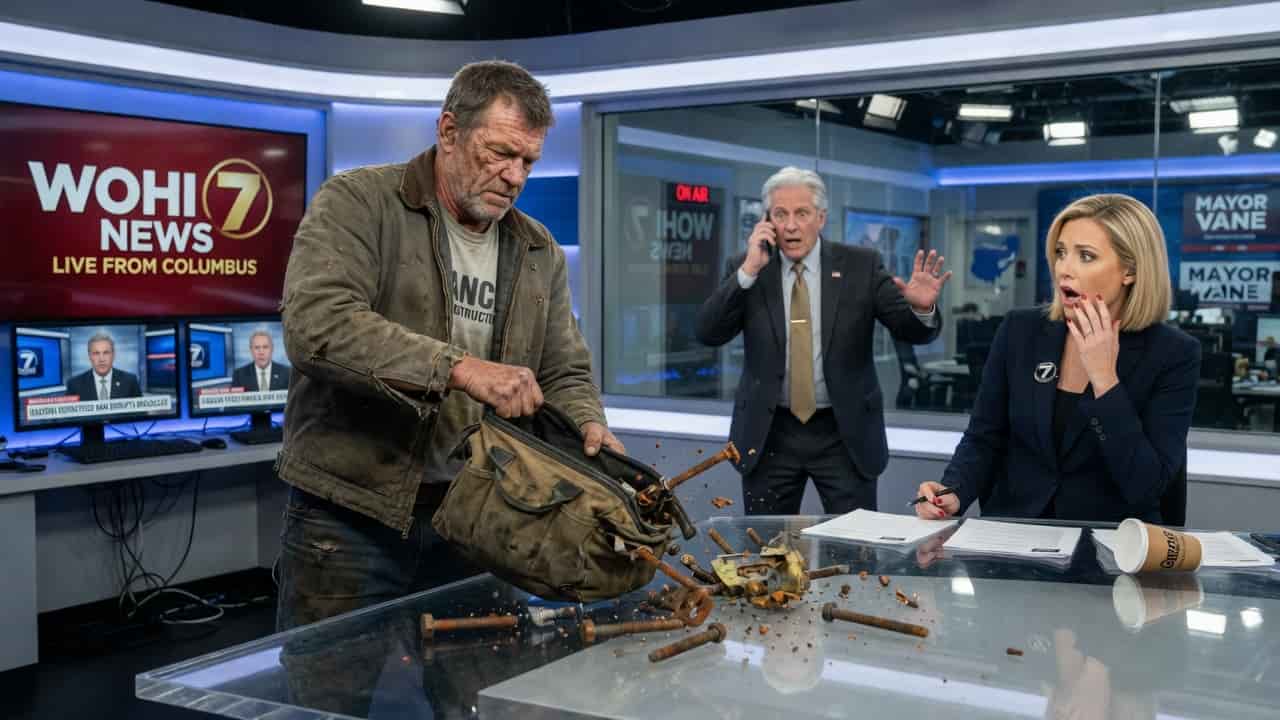
“You said these didn’t exist, Julian. You told the families there was nothing left to find.”
Caleb Vance didn’t look like a man who belonged in a multi-million dollar television studio. He smelled of industrial solder and old resentment, his work jacket a sharp contrast to the polished glass and navy blazers of the news team. But when he slammed that heavy canvas bag onto the desk, the sound was louder than any headline.
Sarah Miller, the city’s top anchor, froze. She looked down at the twisted, orange-rusted metal spilling across her script. These weren’t just bolts; they were the teeth of a monster that had swallowed a bridge and forty-two lives three years ago.
Through the glass of the producer’s booth, Mayor Vane was already on his feet. The man who had signed the checks and buried the reports looked like he was watching his own empire catch fire. He was screaming for the cameras to be cut, but the red light stayed on.
“There are five thousand more where these came from,” Caleb said, his voice flat, his eyes locked on the camera. “And I’m going to show the world exactly whose name was on the inspection logs you pretended to lose.”
The room went silent, the kind of silence that only happens right before a world ends.
Chapter 1: The Weight of Steel
The arc of the welder hissed, a blinding neon violet that ate into the shadow of the garage. Caleb Vance didn’t wear a top-tier mask; he used an old, scratched Miller that smelled of ten years of sweat and ozone. Through the dark glass, the world was reduced to a singular point of liquid heat. He guided the rod with a hand that had developed a permanent tremor three years ago—a hitch in the nerves that only smoothed out when he was joining two pieces of steel.
When he pulled the trigger and the light died, the silence of the Ohio night rushed back in, heavy and damp. He flipped the hood up. The shop was a graveyard of rusted bicycle frames, lawnmower decks, and the skeletal remains of a 1978 Shovelhead he’d been “fixing” since the world was still whole.
His hands were black with soot and grease, the kind that got under the fingernails and stayed there, no matter how hard he scrubbed with the orange pumice soap. He reached into his pocket and pulled out the bolt.
It was a Grade 8 structural fastener, or it had been once. Now it was a mangled hunk of iron, its threads flattened, its body curved into a grotesque ‘S.’ It looked like a piece of ginger root made of rust. It was the physical manifestation of a lie.
“Uncle Caleb?”
The voice was small, filtered through the hanging plastic sheets that partitioned his living space from the workspace. He shoved the bolt back into his pocket, his heart doing a slow, heavy roll in his chest.
Lily stood there, holding a headless Barbie and wearing a pair of oversized pajamas with faded cartoon stars. She was seven, with eyes that looked too much like her mother’s—Caleb’s sister, who was currently working a double shift at the county hospital because the Vance name didn’t carry much credit in this town anymore.
“Hey, Lil,” Caleb said, his voice gravelly from the fumes. “Thought you were out. It’s nearly eleven.”
“I heard the buzzing,” she said, stepping over a pile of scrap iron. She looked at the motorcycle. “Is it going to run tomorrow?”
“Not tomorrow,” Caleb said, wiping his hands on a rag that was already saturated with oil. “Maybe not ever. It’s just parts, kiddo.”
“Mom says you’re a genius with parts,” Lily said. She sat on a milk crate, swinging her legs. “She says you can make anything talk if you listen to it long enough.”
Caleb felt a sharp, familiar jab of guilt. He wasn’t a genius. He was a structural engineer who had missed the math. That was the official story, anyway. The one that was printed in the Cleveland Plain Dealer and the Akron Beacon Journal. Local Engineer’s Negligence Leads to Tragedy. Forty-two names. One bridge. A million tons of concrete and steel settling into the silt of the Cuyahoga River like a downed beast.
“Your mom is being nice,” Caleb said. “I’m just a welder now. Go on back to bed. The fumes aren’t good for you.”
“Are you sad about the bridge again?”
The question was direct, the way only children can be. Caleb froze, his hand resting on the cold, jagged edge of a steel plate.
“I’m not sad, Lil. I’m just working.”
“The man on the TV was talking about it,” she persisted. “The Mayor. He said the new bridge is a symbol of hope. He said the old one was built by people who didn’t care.”
Caleb’s jaw tightened until his teeth ached. Julian Vane. A man who wore four-hundred-dollar silk ties and had never had a callus on his palm in his life.
“The Mayor says a lot of things,” Caleb said, his voice dropping an octave. “Most of them don’t mean much.”
He walked her back to the plastic curtain, his boots clumping on the concrete. He watched her disappear into the small, cramped room they called a home—a converted warehouse office with a space heater that rattled like a dying man’s breath.
When she was gone, he went back to the workbench. He didn’t pick up the welder. He picked up a thick, weathered folder hidden beneath a stack of technical manuals. Inside were the blueprints for the Vane Expressway—the “new” bridge.
For three years, Caleb had been a ghost. He had stayed in the shadows, taking cash jobs, welding trailers and fixing tractors, letting the town forget his face. But he hadn’t stopped being an engineer. Every night, while the city slept, he dissected the new construction. He studied the stress points. He looked at the procurement records he’d managed to skim from the trash bins of the city’s private security firm.
And he had the bolts.
He’d spent months diving into the river, long after the recovery teams had finished. He’d gone down in the dark, in freezing water, feeling through the silt with numb fingers until he found them. The fasteners that had failed. The ones the official report said were “vaporized by the kinetic energy of the collapse.”
They hadn’t vaporized. They had sheared. Because they were sub-standard steel, bought from a subsidiary of Vane’s own holding company.
Caleb pulled the bolt from his pocket and set it on the table. It looked small under the flickering fluorescent light. It looked insignificant. But it was the proof of forty-two murders.
He looked at the blueprints again. He wasn’t just looking for flaws anymore. He was looking for the heart of the structure. He knew how to build things, which meant he knew exactly where to place the charges to bring them down.
The moral problem wasn’t the bridge. The bridge was just concrete. The problem was the bus.
According to the Mayor’s schedule, the ribbon-cutting ceremony would involve a ceremonial first crossing. A bus full of “Inner City Youth” and “Local Heroes.” It was a PR masterstroke. And Julian Vane would be right there in the front seat, waving to the cameras, standing on the very spot where the steel would give way.
Caleb leaned his head into his hands. His skin felt too tight for his face. He could feel the pressure of the city outside, the weight of the people who spat on the ground when they saw his old truck. He could feel the silence of the forty-two graves.
He wasn’t a killer. He was a man who liked math. He liked things that balanced.
But for three years, nothing had balanced. The scales were tipped so far toward Vane that the truth was buried under ten feet of mud.
He stood up and walked to the back of the shop, to a heavy steel locker secured with a high-end Abloy lock. He turned the key. Inside, nestled in foam-lined cases, were the sticks of high-grade demolition explosives he’d walked off with, piece by piece, from the bridge site where he’d worked as a night-shift welder.
They looked like oversized sticks of modeling clay. Innocent. Stable. Until they weren’t.
He touched the plastic casing. If he did this, he wasn’t Caleb Vance anymore. He was the monster the newspapers said he was. He would be erasing the only thing he had left—the memory of the man his wife had loved.
His wife, Elena. She had been on the bridge that day. She’d been coming home from the library with a stack of books and a smile that always made Caleb feel like he’d finally figured out the right equation for a life.
He remembered the phone call. He remembered the sound of the river on the news. He remembered the way the Mayor had hugged him at the memorial service, whispering, “We’ll get through this, Caleb. Even if the investigation finds your firm was at fault, we’ll take care of you.”
A threat disguised as a comfort.
Caleb closed the locker. The metal door rang with a hollow, final sound.
He went to the sink and splashed cold water on his face. He looked at himself in the cracked mirror. He looked old. He looked like a man who was already dead, just waiting for the paperwork to catch up.
He wouldn’t kill the kids on the bus. He wasn’t that far gone. But he would kill the lie. Even if he had to burn the whole city down to do it.
He sat back down at the workbench and reached for the phone. It was an old burner, bought with cash at a gas station on Route 20. He dialed a number he’d memorized weeks ago.
“Miller,” a voice answered. It was tired, sounding like it had been dragged through a mile of gravel.
“Detective,” Caleb said.
There was a long pause. He could hear the scratch of a lighter, the exhale of smoke.
“I told you not to call this line, Caleb,” Miller said. “The department is still looking for a reason to put you in a cage.”
“They don’t need a reason, Miller. They have a Mayor.”
“What do you want?”
“I have the bolts,” Caleb said. “All of them. The ones from the south pylon. The ones that ‘didn’t exist’.”
Another silence, longer this time.
“Keep your head down, Caleb,” Miller whispered. “The ribbon-cutting is in three days. Vane is on a warpath. If he thinks you’re still digging, he won’t just ruin your name this time.”
“He already took everything that matters, Miller. The only thing left is the math. And the math says he’s a dead man.”
Caleb hung up before the detective could respond. He picked up the mangled bolt and gripped it so hard the rust bit into his skin. He didn’t feel the pain. He only felt the weight of the steel.
Chapter 2: The Mayor’s Pride
The morning air in Oakhaven was thick with the smell of damp pavement and the low-hanging industrial fog that never quite cleared from the valley. Caleb sat in his 1994 Ford F-150, the engine idling with a rough, rhythmic lope that suggested a vacuum leak he’d never bothered to fix. He was parked two blocks away from the new bridge, positioned in the shadows of a defunct textile mill.
From here, the bridge looked like a shimmering white needle piercing the grey sky. It was a cable-stayed design, sleek and modern, a “triumph of engineering” according to the banners draped over the entrance. To Caleb, it looked like a tombstone.
He watched through a pair of battered binoculars as the preparation for the ribbon-cutting ceremony hit full swing. Men in orange vests moved like ants, setting up the stage, testing the PA system, and arranging the chairs for the dignitaries. In the center of it all, Julian Vane stood with his back to the river, gesturing grandly to a group of men in suits.
Even from three hundred yards, Caleb could see the arrogance in the man’s posture—the way he tilted his head, the proprietary way he touched the white-painted steel of the bridge railing. Vane didn’t just build this bridge; he owned the narrative of its resurrection.
Caleb’s grip tightened on the binoculars. He could feel the bolt in his pocket, a cold, jagged reminder of the truth.
A sharp rap on the passenger window made him jump. He instinctively dropped the binoculars into his lap and reached for the heavy iron pipe he kept under the seat.
It was Detective Miller. He was wearing a rumpled tan windbreaker and a look of profound exhaustion. He didn’t wait for an invitation; he opened the door and slid into the cab, bringing the smell of stale coffee and menthol cigarettes with him.
“You’re going to get yourself arrested just for loitering, Caleb,” Miller said, not looking at him. He stared out the windshield at the bridge. “You’re like a sore thumb in this neighborhood.”
“I grew up three streets over, Miller. I belong here more than that bridge does.”
“The town doesn’t see it that way. To them, you’re the guy who dropped the last one. They want a celebration today, not a ghost story.”
Caleb turned to look at him. Miller was fifty-five, with deep bags under his eyes and a pension that was only eighteen months away. He was a good cop who had seen too many things and done too little about them. He was the mirror of Caleb—the man who stayed inside the system and got his soul eaten piece by piece.
“Did you look into the procurement files I sent you?” Caleb asked.
Miller sighed, a sound of pure defeat. “I looked. I saw the names. Vane Steel, Ohio Concrete, Allied Inspections. It’s a closed loop, Caleb. It’s all legal on paper.”
“It’s not legal when the steel is Grade 2 dressed up in Grade 8 stamps. I have the metallurgy reports from the samples I took from the river. I have the proof.”
“Proof doesn’t matter if nobody will hear it,” Miller said, finally turning to face him. “Vane owns the DA. He owns the Chief. He owns the damn news station. You go public with this, and they’ll have you committed or buried before the first bus crosses that span.”
“I’m not going to the DA,” Caleb said, his voice flat.
Miller narrowed his eyes. “Then what are you doing here? Don’t be a fool, Caleb. I know what’s in your shop. I know about the missing inventory from the demolition site.”
Caleb didn’t blink. “You’ve known for two weeks. Why haven’t you arrested me?”
Miller looked away, his jaw working. “Maybe because I was at the river three years ago too. I was the one who had to tell the families we couldn’t get to the cars in time. I remember your wife’s face, Caleb. She was a teacher. She taught my youngest daughter how to read.”
The mention of Elena hit Caleb like a physical blow. He felt the air leave his lungs.
“If you remember her,” Caleb said, his voice trembling, “then help me. Give me the security codes for the bridge’s internal maintenance corridors. The ones they changed last night.”
Miller froze. The silence in the cab became suffocating.
“I can’t do that,” Miller whispered. “That’s domestic terrorism, Caleb. If you bring that bridge down, you’re no better than the people who built it wrong the first time.”
“I’m not bringing it down with people on it,” Caleb said. “I’m going to show them. I’m going to make it fail while Vane is standing right there, but before the bus gets to the mid-span. I’ll trigger the structural alerts. The sensors will go red. The whole world will see the ‘perfect’ bridge scream for mercy.”
“And if you’re wrong? If your math is off again?”
“My math was never off, Miller. That’s the point. I told them the south pylon was shifting. I told them the bolts were failing. They fired me and signed the completion certificate anyway.”
Caleb reached into his pocket and pulled out the mangled bolt. He held it out to Miller.
“Look at the shear pattern. That’s not a stress fracture from weight. That’s a manufacturing defect. It’s a bubble in the casting. These things were hollow, Miller. Like his promises.”
Miller didn’t take the bolt. He stared at it as if it were a live grenade.
“They’re calling for the first crossing at noon,” Miller said, his voice barely audible. “The Mayor’s son, Julian Junior, is driving the lead bus. It’s a family affair.”
Caleb felt a cold shiver. Julian Junior. A thirty-year-old carbon copy of his father, arrogant and untouchable. The stakes were rising, turning from a technical exposure into a family bloodbath.
“Then tell him to stay off the bridge,” Caleb said.
“He won’t listen. He thinks he’s a god. Just like his old man.”
Miller opened the door and stepped out into the damp air. He leaned back into the cab, his eyes dark with a mixture of pity and fear.
“I can’t give you the codes, Caleb. But I can tell you that the security cameras on the north maintenance hatch have a blind spot between 2:00 and 4:00 AM because of the fog-lights’ glare. And the guard on that shift… he’s a heavy sleeper who likes his podcasts.”
Miller shut the door without waiting for a thank you. He walked away, his shoulders hunched, disappearing into the grey mist of the mill district.
Caleb sat in the truck for a long time, the engine still humming. He looked at the bridge. It was beautiful. It was a lie.
He thought about the Mayor’s son. He thought about the bus full of kids. He thought about the residue of the last three years—the way he couldn’t walk into a grocery store without people whispering, the way his niece had to lie about her last name at school.
The humiliation wasn’t just his. It was a social contagion. The city had been bullied into believing that their safety was a privilege granted by a man who was stealing the very foundation from under their feet.
He shifted the truck into gear. He had work to do. He needed to prep the charges, not for total destruction, but for a surgical strike—a moment of undeniable mechanical failure that would force the world to look at the rust beneath the paint.
As he drove back to his shop, he passed a billboard. It featured a giant photo of Julian Vane, smiling, with the words: A STABLE FUTURE FOR OAKHAVEN.
Caleb spat out the window. Stability was just another word for the weight you were willing to carry. And he was done carrying it.
He spent the rest of the day in a fever of activity. He wasn’t welding bicycle frames now. He was assembling the triggering mechanism. It was a masterpiece of simplicity—a radio-frequency detonator linked to a series of pressure sensors.
He worked with the precision he’d once used to design skyscrapers in Chicago. Every wire was stripped to the perfect length. Every solder joint was clean.
At 6:00 PM, Lily came into the shop. She didn’t say anything at first. She just stood by the workbench, watching him.
“You’re making something important,” she said.
“Yeah, Lil. Something important.”
“Is it going to fix the bridge?”
Caleb looked at her. Her face was so innocent, so full of the belief that things could be fixed.
“It’s going to tell the truth about it,” Caleb said. “Sometimes, to fix something, you have to show people it’s broken first.”
“Does it hurt?” she asked. “To be broken?”
Caleb reached out and tucked a stray hair behind her ear. His hand was steady now. The tremor was gone.
“Yeah, kiddo. It hurts. But the silence hurts worse.”
He watched her go back to the house. He knew that after tonight, he might never see her again. He might be in a cell, or he might be part of the river.
But as he packed the charges into the canvas bag, he felt a strange sense of peace. He wasn’t a ghost anymore. He was a man with a plan.
And the math was finally on his side.
Chapter 3: The Gathering Storm
The midnight air was a cold, wet shroud as Caleb moved through the undergrowth near the bridge’s north abutment. He was a shadow among shadows, dressed in dark work clothes, the heavy canvas bag slung over his shoulder. The weight of the explosives was a familiar pressure, a solid counterpoint to the racing rhythm of his heart.
He reached the maintenance hatch. It was a heavy steel door, tucked away beneath the massive concrete skirt of the bridge. As Miller had promised, the fog-lights above created a brilliant, blinding halo that left the door itself in a pocket of absolute black.
Caleb pulled a small set of picks from his pocket. He wasn’t a professional thief, but he understood the mechanics of locks—the way pins resisted, the way the shear line felt when it was aligned. It was just more math.
He felt the click. The door groaned softly, a sound that seemed like a thunderclap in the stillness. He froze, pressed against the cold metal, listening.
Nothing but the distant hum of the city and the rhythmic slapping of the river against the pylons.
He slipped inside. The maintenance corridor was a narrow, rib-like tunnel of reinforced concrete, smelling of damp earth and curing lime. It ran the length of the bridge, a secret spine that allowed inspectors to check the tension of the cables.
Caleb moved with practiced ease. He knew this layout. He’d helped draft the original specifications before Vane’s firm had “optimized” the design by stripping out half the redundant supports.
He reached the first target point: the anchor assembly for the primary southern cable.
Under the beam of his hooded flashlight, the assembly looked monstrous—a cluster of steel tendons thick as a man’s waist, held in place by a massive forged plate. Caleb ran his hand over the steel. He could feel the vibration of the wind above, a low-frequency thrum that resonated in the concrete.
He began to set the charges. He wasn’t trying to sever the cable. He was placing the explosives against the secondary dampeners. If they blew, the cable wouldn’t snap, but it would lose its tension, causing the bridge deck to whip and groan. It would be terrifying. It would trigger every structural alarm in the city.
As he worked, his mind drifted to Sarah Miller.
He’d met her two days ago in a dive bar on the edge of town. She was the one journalist who hadn’t bought into the Vane narrative. She was young, hungry, and had been demoted to the “community interest” beat because she’d asked too many questions about the bridge’s budget overruns.
“You’re the ghost,” she’d said, sliding into the booth across from him. “The man who dropped the bridge.”
“I’m the man who told them it was falling,” Caleb had corrected her.
He’d shown her the bolts then. He’d shown her the metallurgy reports. He saw the shift in her eyes—the moment the story changed from a tragedy of errors to a conspiracy of greed.
“If I run this, Vane will kill it,” she’d warned. “He owns the station. He’s the biggest advertiser. My producer will pull the plug before I even finish the intro.”
“Then don’t go to your producer,” Caleb had told her. “Go live. Do a field report from the bridge tomorrow. I’ll give you something they can’t ignore.”
Now, in the bowels of the bridge, Caleb finished the first set of charges and moved to the next. He was creating a sequence. A crescendo of failure.
He heard a sound. A rhythmic tapping.
He doused his light and pressed himself against the wall. The sound grew louder. Footsteps.
A flashlight beam cut through the darkness of the corridor, sweeping the walls.
“Hello?” a voice called out. It was young, nervous. The night guard.
Caleb held his breath. He reached for the heavy wrench in his belt, his knuckles white. He didn’t want to hurt anyone. This wasn’t about the guard.
The light moved closer. Caleb could see the glint of a badge, the dark uniform. The guard was a kid, maybe twenty, with a face full of acne and a flashlight that shook in his hand.
He was standing ten feet away from the first charge.
“Just a rat,” the guard muttered to himself, his voice trembling. “Just a big, Ohio rat.”
He turned and started walking back toward the hatch. Caleb waited until the sound of his footsteps faded before he exhaled. The residue of the moment—the sheer, cold terror of being caught—lingered in his limbs, making his hands shake.
He finished the placement at 3:30 AM. He had four minutes before the shift change.
He exited the hatch and melted back into the woods. He didn’t go back to the shop. He drove to a motel on the outskirts of the city, a place where the clerk didn’t ask for ID and the air smelled of burnt hair and Pine-Sol.
He sat on the edge of the bed, the detonator on the nightstand. He looked at the clock.
Six hours until the ceremony.
His phone buzzed. A text from an unknown number.
Vane found the leak. He knows someone was in the corridors. He’s moving the ceremony up by thirty minutes. He wants the bus on the bridge before anyone can stop him. He’s desperate, Caleb. Be careful.
Miller.
Caleb felt a surge of adrenaline. Vane was panicking. That was good. A panicked man made mistakes. But a desperate man was dangerous.
If Vane moved the ceremony up, Caleb’s timeline was blown. He had to get to the news station now. He had to force the narrative before the bus even hit the ramp.
He grabbed the canvas bag—now filled with the remaining rusted bolts—and headed for the door.
He drove through the predawn streets of Oakhaven. The city was waking up, unaware that it was about to witness the collapse of its favorite lie. He saw the morning news vans heading toward the bridge. He saw the police cruisers setting up the perimeter.
He pulled into the parking lot of the local NBC affiliate. He didn’t go through the front door. He went through the loading dock, using a keycard he’d “borrowed” from a disgruntled janitor months ago.
The station was a hive of activity. Everyone was focused on the bridge broadcast.
Caleb moved through the hallways, his head down, his work jacket blending in with the technicians and grips. He reached the door to Studio A.
Inside, Sarah Miller was sitting at the anchor desk, having her makeup touched up. She looked nervous. Her hands were gripping the edge of the desk so hard her veins were popping.
Through the glass of the control booth, Caleb saw the producer, a harried man in a headset, shouting into a microphone. And standing next to him, looking over his shoulder, was Julian Vane.
The Mayor was here. In the station. Ensuring the coverage was perfect.
Caleb felt a cold, hard knot form in his stomach. He wasn’t just exposing a bridge. He was walking into a lion’s den.
He waited for the count.
“Three minutes to air!” the producer yelled.
Sarah Miller looked toward the door. She saw Caleb. Her eyes widened, a flash of recognition and terror.
Caleb nodded once.
He stepped into the studio. The bright lights hit him like a physical weight, blinding and hot. He felt the eyes of the crew turn toward him. He heard the murmur of confusion.
“Who is that? Hey, you can’t be in here!”
Caleb didn’t stop. He walked toward the desk. He could see Vane through the glass. The Mayor had frozen. He was staring at Caleb, his face turning a sickly shade of grey.
“Caleb Vance?” Sarah whispered, her voice caught in her throat.
“I have the bolts, Sarah,” Caleb said, his voice carrying through the quiet studio. “Tell the cameraman to stay on me.”
“Security!” Vane’s voice boomed over the studio speakers. “Get him out of there! Now!”
The producer was frantic, gesturing wildly. Two security guards started moving from the edges of the room.
“We’re live in thirty seconds!” someone yelled.
Caleb reached the desk. He swung the heavy canvas bag.
THUD.
The sound of the bag hitting the glass desk was the most satisfying thing Caleb had heard in three years.
“You said these didn’t exist,” Caleb said, looking directly into the red light of Camera One.
The studio went dead silent. The guards froze. The producer stopped yelling.
Sarah Miller looked at the bag. She looked at Caleb. She saw the truth in his eyes—the raw, unvarnished pain of a man who had been buried alive and had finally clawed his way out.
She reached for her microphone.
“Welcome to Oakhaven News,” she said, her voice steady, her eyes locked on the lens. “I’m Sarah Miller. And today, we’re going to talk about the weight of a lie.”
Caleb looked at the glass booth. Vane was screaming, pounding his fist against the pane, but the sound was muffled, distant.
The math was finally beginning to balance.
Chapter 4: The Exposure
The red light on Camera One was a tiny, glowing eye that refused to blink. Caleb could feel the heat of the studio lamps baking the sweat into his neck, the air tasting of static and expensive perfume. He didn’t look at Sarah Miller. He didn’t look at the frantic floor director. He looked into that red eye, knowing that in living rooms across the county, his face was suddenly replacing the morning weather report.
“You’re seeing this live,” Sarah said, her voice gaining a sharp, clinical edge. “I am joined at the desk by Caleb Vance. Three years ago, he was the lead engineer on the project that took forty-two lives. Today, he has brought us something the Mayor’s office claimed was lost to the river.”
Caleb reached into the bag. His hand didn’t shake. He pulled out the mangled ‘S’ bolt and held it up. The camera zoomed in, the macro lens capturing every flake of orange rust, every flattened thread.
“This is a Grade 8 structural bolt,” Caleb said. He didn’t sound like a hero. He sounded like a man giving a lecture on a subject that bored him. “It’s supposed to hold fifty thousand pounds of shear force. This one failed at twenty. Because it was cast with slag in the center. It’s trash, dressed up in a stamp.”
“Mr. Vance,” Sarah said, “the official report stated that all recovery efforts for the structural components were completed within six months. Where did you get this?”
“I went down myself,” Caleb said. “While the Mayor was giving speeches about ‘moving on,’ I was in the silt. I have five thousand more of these in the back of my truck. All of them from the south pylon. All of them failed.”
Through the glass of the control booth, the scene was pure chaos. Julian Vane was no longer just screaming; he was trying to shove past the producer to get to the studio door. Two station security guards were already at the booth’s exit, looking confused, waiting for a command that wasn’t being countermanded by the sheer shock of the moment.
“Cut the feed!” Vane’s voice cracked over the intercom. “That man is a fugitive! He’s mentally unstable!”
The producer, a man named Henderson who had spent twenty years being Vane’s PR lapdog, hesitated. He looked at the monitors. The ratings spike was a vertical line. Every phone in the station was lighting up.
“We can’t cut, Julian,” Henderson’s voice came back, shaky. “The network feed is locked. If we go dark now, it looks like a confession.”
Caleb turned his head slightly toward the booth. He saw Vane’s face—a mask of pure, aristocratic rage. This was the bullying force of Oakhaven, the man who had used the city’s grief as a footstool.
“Julian,” Caleb said, his voice calm, “the new bridge is built with the same steel. From the same foundry. I’ve seen the manifests.”
Vane burst through the studio doors. He didn’t look like a statesman anymore. His hair was disheveled, his tie pulled loose. He marched toward the desk, flanked by two guards who looked like they wanted to be anywhere else.
“This is a stunt!” Vane shouted, his voice echoing in the rafters. “This man is a criminal! He stole materials from the construction site! He’s trying to extort the city!”
Caleb stood up. He was a head taller than Vane, and broader. He didn’t move toward the Mayor. He just stood his ground, the heavy canvas bag between them.
“I didn’t steal them, Julian. I rescued them. Someone had to.”
Vane stopped three feet from the desk. He was breathing hard, his chest heaving under the charcoal wool of his suit. He looked at the bolts on the desk, and for a split second, Caleb saw it—the flicker of genuine, soul-deep terror.
“You have no proof of where those came from,” Vane hissed, his voice dropping to a low, dangerous snarl. “You’re a disgraced drunk who couldn’t keep his wife alive, so you’re looking for someone to blame.”
The studio went cold. Even the cameramen flinched. It was a line so cruel, so targeted at Caleb’s wound, that it felt like a physical strike.
Sarah Miller gasped. “Mayor, that is completely inappropriate.”
Caleb didn’t flinch. He leaned forward, his hands resting on the glass desk.
“You’re right about one thing, Julian,” Caleb said, his voice a low vibration. “I do blame someone. I blame the man who signed the change order to use Vane Steel instead of Bethlehem. I blame the man who fired the inspectors when they raised the red flags. I blame the man who is about to put fifty school kids on a bridge he knows is hollow.”
Vane’s eyes bulged. “That bridge is a masterpiece! It’s been vetted by every agency in the state!”
“Vetted by people you paid,” Caleb countered. “But the math doesn’t take bribes, Julian. The physics of that span are screaming. I’ve placed sensors on the southern anchors. Right now, as the morning sun hits those cables and the steel expands, the tension is hitting the red line. If that bus crosses at noon, the harmonic vibration will shear the secondary dampeners.”
“You’re lying!” Vane screamed. “Security, take him! Take the bag! Take everything!”
The guards moved in. One grabbed Caleb’s arm, the other reached for the bag of bolts. Caleb didn’t resist. He let them pull him back, his eyes never leaving Vane’s.
“Check your phone, Julian,” Caleb said. “The structural alerts should be hitting your office right about now. I didn’t just place sensors. I placed a mirror. Every time that bridge groans, your phone is going to ring.”
Vane instinctively reached for his pocket. He pulled out a sleek, black smartphone. As if on cue, the screen lit up. A bright red notification banner. STRUCTURAL ANOMALY – SECTOR S-4.
Vane’s face went white.
“What did you do?” he whispered.
“I told the truth,” Caleb said.
The guards shoved Caleb toward the exit. Sarah Miller stood up, her microphone still live.
“We are seeing a live structural alert on the Mayor’s own device,” she told the camera, her voice breathless. “This is no longer a debate about the past. This is an immediate public safety crisis.”
Vane looked at the camera, then at the phone, then at Caleb. He looked like a man standing on a trapdoor.
“It’s a glitch!” Vane yelled, but his voice lacked conviction. It sounded like a plea. “He hacked the system! It’s a trick!”
“Then prove it,” Caleb shouted as he was dragged through the doors. “Send the bus across, Julian! Put your son in the driver’s seat! If the math is wrong, he’ll be fine! If I’m a liar, he’ll make it to the other side!”
The studio doors slammed shut, cutting off the sound.
Caleb was shoved into the hallway, his face pressed against the cold cinderblock wall. A guard’s knee was in the small of his back, and he could hear the frantic chatter of police radios in the distance.
He didn’t care. He could still feel the residue of the moment—the way Vane had looked when the phone rang. The way the lie had finally cracked.
He had lost his job. He had lost his wife. He had lost his dignity.
But as the handcuffs clicked into place, biting into his wrists, Caleb Vance felt a weight lift off his chest that had been there for three years.
The bridge was still standing. For now.
But Julian Vane was already falling.
And Caleb knew, with the absolute certainty of a man who understood the laws of the universe, that once a collapse started, there was no way to stop the gravity.
“You’re in a lot of trouble, Vance,” the guard muttered, tightening the cuffs.
“Yeah,” Caleb said, a grim smile touching his lips. “But for the first time in three years, I’m not the one who’s trapped.”
Beyond the walls, he could hear the sirens. Not for him, but for the bridge. The city was finally listening to the steel.
Chapter 5: The Glass Cage
The interrogation room at the Oakhaven Precinct smelled of floor wax and the metallic tang of old radiator steam. It was a small, windowless box designed to make a man feel the weight of every breath he took. Caleb Vance sat at the bolted-down steel table, his hands cuffed to a ring in the center. The metal was cold against his wrists, a constant, biting reminder of his new status.
He didn’t look at the two-way mirror. He knew who was behind it. He could almost feel the heat of Julian Vane’s gaze through the glass, a predatory stare that had spent three years trying to blink him out of existence.
Detective Miller sat across from him, looking like he’d aged a decade in the last two hours. He had a cardboard tray of lukewarm coffee and a file folder that looked too thin to be a legal defense.
“You really did it, Caleb,” Miller said, his voice a low, tired rasp. “You didn’t just kick the hornet’s nest. You set the whole goddamn tree on fire.”
“The tree was rotten, Miller. I just provided the light,” Caleb replied. His voice felt thin, his throat raw from the studio lights and the adrenaline crash.
The door opened, and a man in a charcoal suit—sharper than Vane’s, if that was possible—stepped in. This was Arthur Sterling, the city’s lead counsel and Vane’s personal legal hatchet man. He didn’t sit. He stood in the corner, radiating a curated, professional contempt.
“Mr. Vance,” Sterling began, his voice like silk over a razor blade. “Let’s be very clear about your situation. You have committed multiple felonies this morning. Breaking and entering, theft of high-grade explosives, industrial espionage, and now, public endangerment and inciting a riot. The Mayor is currently being treated for a mild cardiac event brought on by your little performance.”
“I hope the hospital used the cheap bolts for his heart monitor,” Caleb said.
Sterling didn’t flinch. He leaned over the table, his shadow falling across Caleb’s face. “The ‘sensors’ you claim to have placed. We’ve sent a tactical engineering team to the southern anchor points. They found nothing. No sensors, no mirrors. Just a few pieces of duct tape and some scrap wire.”
Caleb felt a flicker of a smile. “I’m a structural engineer, Arthur. If I wanted you to find them, I would have painted them neon pink. They aren’t on the outside. They’re inside the dampener housings. Deep in the grease. You’d have to disassemble the primary pylon to see them. Which is exactly what you should be doing right now instead of talking to me.”
“There is no alert, Caleb,” Sterling hissed. “The notification on the Mayor’s phone? We’ve traced it to a localized hack. You didn’t trigger a structural failure; you triggered a fake text message.”
Caleb leaned back as far as the cuffs would allow. “Is that what you told the bus driver? Is that what you told Julian Junior?”
Sterling’s composure slipped for a fraction of a second. A twitch in the jaw. “The ceremony is proceeding at noon. To show this city that we will not be held hostage by the delusions of a disgraced, grieving man. We are going to prove that bridge is safe by putting the Mayor’s own flesh and blood on it.”
“Then you’re a murderer,” Caleb said, his voice dropping to a whisper that filled the room. “And so is everyone in that booth who doesn’t pull the plug.”
Miller cleared his throat, shifting uncomfortably. “Sterling, maybe we should at least delay until the wind dies down. The gusts at the river are hitting forty.”
“The wind is within design specs!” Sterling snapped, turning his back on Miller. He looked back at Caleb. “Here is the deal. You sign a confession stating that the bolts you produced were stolen from a scrap yard and planted by you. You admit the sensors are a hoax. In exchange, the Mayor will personally see to it that your niece, Lily, stays in her current school placement instead of being moved to a state-managed foster facility while your sister is investigated for her ‘unstable’ living environment.”
The air in the room suddenly felt like it was made of lead. Caleb’s heart hammered against his ribs, a frantic, trapped bird. This was the bullying he had expected—the slow, methodical grinding of his life until there was nothing left but dust. They weren’t just coming for him; they were coming for the only thing he had left to protect.
“You touch my family,” Caleb said, his voice shaking with a cold, jagged rage, “and the bridge will be the least of your problems.”
“Is that a threat, Mr. Vance?” Sterling asked, a small, triumphant smile playing on his lips. “Because it sounds like a confession of intent to do harm.”
Sterling turned and walked toward the door. “Think about it. You have until 11:45. That’s when the lead bus starts its engine. If you haven’t signed by then, I make the call to Child Protective Services. And then I go watch the Mayor’s son cut a ribbon on a perfectly stable bridge.”
The door clicked shut, leaving Caleb alone with Miller.
The silence was heavy, filled with the hum of the overhead lights. Miller wouldn’t look at him. He was staring at the coffee tray, his hands folded.
“They’ll do it, Caleb,” Miller whispered. “Vane doesn’t lose. He’s spent thirty years making sure of that. He’ll take that kid and he’ll put her in the system, and you’ll never see her again.”
“The math doesn’t lie, Miller,” Caleb said, his voice tight. “I didn’t hack the phone. I mean, I did, but only to make sure the alert got through the firewall. The sensor is real. It’s an acoustic emission sensor. It listens for the sound of steel fibers snapping inside the concrete. It’s been pinging for two hours.”
“Is it going to go?” Miller asked, finally looking up.
“It’s not a question of if. It’s a question of frequency. Every car that crosses adds a vibration. If they put a loaded bus on that span with the wind hitting forty knots… it’ll hit the resonant frequency of the failed pylon. It won’t snap like a twig. It’ll shake itself apart from the inside out.”
Caleb closed his eyes. He saw the bridge in his mind—not as a symbol of hope, but as a complex web of vectors and forces. He saw the weakness in the south pylon, the place he called Grave 42. It wasn’t just where Elena had died; it was where the soul of the city had been buried.
He thought of Lily. Her headless Barbie. Her belief that he could make things talk.
He had to make a choice. Save his family and let forty people die, or let the bridge take his family too.
“Miller,” Caleb said, his eyes opening. They were clear, the tremor in his hands finally subsiding. “I need you to do something. Not for me. For Elena.”
“Caleb, I can’t let you out of here.”
“I don’t need to get out. I need you to go to my truck. In the glove box, there’s a remote. It looks like an old garage door opener. It’s not. It’s the override for the sensor’s broadcast. If you turn it on, it’ll broadcast the raw acoustic data directly to every news frequency in the city. Not a text message. Not a hack. The actual sound of the bridge failing.”
Miller hesitated. “If I do that… Vane will know it was me. I’m eighteen months from a pension, Caleb. I have a mortgage. I have a wife who’s finally stopped crying every night.”
“And you’ll have forty-two more ghosts following you home every day for the rest of your life,” Caleb said.
Miller stood up. He didn’t say yes. He didn’t say no. He just picked up his coffee tray and walked to the door. At the threshold, he stopped.
“The keys to your truck are in the evidence locker,” Miller said, his back to Caleb. “And the locker has a faulty latch. If someone were to lean on it just right, it might pop open.”
Miller left.
Caleb sat in the silence. He looked at the ring in the table. He thought about the math. He thought about the weight of steel. He thought about the forty-two people who had been erased because men like Vane thought they could bargain with gravity.
The minutes ticked by on the wall clock. 11:15. 11:20.
He could hear the distant sounds of the precinct—the phones, the shouting, the mundane business of a world that didn’t know it was about to tilt.
At 11:30, the door opened again. It wasn’t Sterling. It was two uniformed officers Caleb didn’t recognize. They didn’t speak. They uncuffed him from the table and pulled him to his feet.
“Where are we going?” Caleb asked.
“Mayor wants you at the bridge,” one of them said. He was a thick-necked man with eyes like flat stones. “He wants you to have a front-row seat for the ‘collapse’ that isn’t happening. He wants you to see his son drive across that span so you can feel exactly how much of a liar you are before you go to the state pen.”
They led him out of the room, through the precinct, and into the bright, cold sunlight. The air felt like a slap.
They threw him into the back of a black SUV. As they pulled out of the parking lot, Caleb saw Miller’s old Crown Vic peeling out of the other side of the lot, heading toward the river.
Caleb leaned his head against the glass. He could see the bridge in the distance. It was beautiful. It was a masterpiece of human vanity.
He felt the residue of the last three years—the shame, the isolation, the crushing weight of being the man who failed. He realized then that he wasn’t just fighting Vane. He was fighting the part of himself that believed he deserved to be punished.
He looked at his hands. They were steady.
“The math is right,” he whispered to the empty air of the SUV. “It has to be right.”
The SUV sped toward the river, toward the ribbon, and toward the final, terrible truth of Grave 42.
Chapter 6: The Resonance of Truth
The riverfront was a sea of umbrellas and raincoats, a thousand people huddled against the biting Ohio wind to witness the rebirth of their city. The air was charged with a frantic, artificial energy, the kind that precedes a storm or a disaster. On the massive stage erected at the foot of the Vane Expressway, a brass band was playing a march that sounded thin and tinny against the roar of the Cuyahoga.
Caleb was led from the SUV by the two officers, his hands cuffed behind his back. They positioned him at the edge of the VIP riser, just behind the line of local dignitaries and high-level donors. He was a jarring sight—the grease-stained pariah in the middle of a sea of silk and wool.
He saw Julian Vane at the podium. The Mayor looked rejuvenated, his face flushed with the triumph of a man who had successfully stared down the truth. He was wearing a bright red tie and a smile that looked like it had been carved out of stone.
“Citizens of Oakhaven!” Vane’s voice boomed over the speakers, amplified by a dozen subwoofers that made the ground tremble. “Today, we don’t just open a bridge! Today, we silence the ghosts of the past! We prove that our spirit is stronger than any storm, and more durable than any lie!”
Vane looked directly at Caleb, his eyes shining with a cruel, mocking light. He gestured toward the ramp.
“And to prove our absolute faith in this structure, the first vehicle to cross will not be a limousine. It will be the Oakhaven Youth Ambassador Bus, driven by my own son, Julian Vane Junior!”
The crowd erupted in cheers. From the staging area, a bright yellow school bus, decorated with streamers and “OAKHAVEN PROUD” banners, began to crawl toward the ramp. Caleb could see the faces of the children through the windows—excited, waving, oblivious. He saw Julian Junior in the driver’s seat, wearing a pilot’s headset and a confident grin.
Caleb’s stomach turned. He tried to move forward, but the thick-necked officer slammed a hand into his chest, shoving him back.
“Stay put, Vance,” the officer hissed. “Enjoy the show.”
The bus reached the first pylon. The wind gusted, catching the side of the vehicle and making it rock slightly.
Caleb looked at the pylon. He didn’t see the white paint. He saw the stress lines. He saw the way the cables were vibrating—a high-frequency shiver that was visible even from a hundred yards.
The resonance, Caleb thought. It’s starting.
Suddenly, the speakers on the stage crackled. The brass band’s music was cut off by a harsh, grinding sound. It was the sound of a giant bone being snapped in slow motion.
CRRR-ACK. THUMMM.
The crowd went silent. Vane froze at the podium, his hand still raised in a wave.
The sound came again, louder this time, broadcasting through the massive PA system. It wasn’t music. It wasn’t a speech. It was the raw, acoustic output of Caleb’s sensors.
“What is that?” someone shouted from the crowd.
“It’s the bridge,” Caleb yelled, his voice tearing through the silence. “That’s the sound of the pylon shearing! Stop the bus!”
Vane turned toward the sound booth, his face turning a panicked purple. “Shut it off! Henderson, shut it off!”
But the sound didn’t stop. It escalated into a rhythmic, terrifying groan.
On the bridge, the bus stopped mid-span. The driver, Julian Junior, was no longer smiling. He was looking out the side window, his face pale as he felt the deck beneath him begin to sway. Not a normal sway. A violent, twisting motion that made the cables scream like dying animals.
Caleb saw Miller standing near the sound booth, holding the remote. He’d done it. He’d bypassed the station’s filters and plugged the raw data directly into the event’s audio feed.
“The bus!” a woman screamed. “Get them off the bus!”
The crowd, once a cheering mass, became a frantic tide. People began to run away from the bridge, sensing the impending violence of the steel.
Vane was paralyzed. He looked at the bus, then at the sound booth, then at the bridge. His empire was vibrating itself to pieces in front of a live audience.
“It’s fine!” Vane screamed into the dead microphone. “It’s just the wind! Stay in your seats!”
But the bridge didn’t care about his orders.
With a sound like a thunderclap, the first secondary dampener on the south pylon exploded. A massive steel plate, the size of a car door, was launched into the river, sending a plume of water fifty feet into the air.
The bridge deck dipped. The bus slid toward the railing, its tires screeching against the concrete.
Caleb didn’t wait. He threw his weight against the officer who was holding him, catching the man off guard and knocking him into the VIP table. Caleb scrambled to his feet and ran toward the ramp.
“Vance! Get back here!”
Caleb ignored the shouts. He ran toward the bridge, his hands still cuffed. He reached the foot of the ramp just as the second dampener gave way.
The bridge was whipping now, a terrifying, serpentine motion. The kids on the bus were screaming, their faces pressed against the glass.
Julian Junior opened the door and tried to step out, but the motion of the deck threw him back inside.
Caleb reached the bus. He couldn’t use his hands, but he used his shoulder to slam into the emergency release on the exterior of the door.
“Get out!” Caleb yelled. “Everyone out! Now!”
The children began to pour out, terrified and sobbing. Caleb stood at the door, using his body as a shield against the wind, counting them as they ran past him toward the safety of the solid ground.
One. Five. Ten.
The bridge groaned again, a deep, earth-shaking sound. The pylon was tilting.
Julian Junior was the last one off. He looked at Caleb, his eyes wide with a mixture of shock and shame. He didn’t say a word; he just ran.
Caleb was alone on the deck. He looked back toward the stage.
Julian Vane was still standing there. He was alone. The donors, the dignitaries, the police—everyone had fled. He was standing at the podium, his hand clutching the wood so hard his knuckles were white. He was watching his son run to safety, and he was watching the bridge—his bridge—tear itself apart.
The final cable snapped with a sound like a gunshot.
The south pylon buckled.
Caleb felt the deck drop beneath him. He didn’t run. He just stood there, looking at the water below. He thought of Elena. He thought of Grave 42. He thought of the forty-two people who were finally, finally being heard.
The bridge didn’t collapse entirely. The pylon settled into the riverbed, the deck hanging at a precarious, twisted forty-five-degree angle. It was a ruined, mangled skeleton.
Caleb slid down the incline, his back hitting the concrete as he came to a stop near the pylon’s base. He was covered in dust and grit, his lungs burning.
He looked up.
Sarah Miller was there, her cameraman right behind her. They were filming the wreckage. They were filming the Mayor’s son hugging his mother. And they were filming Caleb Vance, sitting in the ruins of the lie.
Detective Miller walked down the ramp. He didn’t have his coffee. He had a key.
He reached Caleb and knelt down, silently unlocking the handcuffs.
“The math held up, Caleb,” Miller said, his voice thick with emotion.
Caleb rubbed his wrists. He looked at the mangled steel around him. He didn’t feel like a hero. He felt like a man who had finally finished a very long, very painful calculation.
“Forty-two,” Caleb whispered.
“What?”
“The number of bolts that didn’t fail today,” Caleb said. “I reinforced the emergency supports last night when I was in the corridors. I knew the pylon would go, but I didn’t want the deck to take the bus with it.”
Miller stared at him. “You saved them. You saved Vane’s son.”
“I saved the kids,” Caleb said. “Vane’s son just happened to be driving.”
In the aftermath, the city changed. Julian Vane was arrested two hours later, caught trying to board a private jet at the county airport. The procurement records, the metallurgical reports, and the raw acoustic data were enough to bury him and his entire administration.
The Vane Expressway was renamed the Elena Vance Memorial Bridge, though it would be years before it was rebuilt. For now, it stood as a twisted monument to the cost of a lie.
Caleb didn’t go to the trial. He didn’t give interviews.
He went back to his shop.
He spent his days welding, but not bicycle frames. He was commissioned to build a memorial sculpture for the forty-two victims—a massive, intricate web of steel that used the very bolts he had recovered from the river.
One evening, Lily came into the shop. She was holding her Barbie, which now had a new, 3D-printed head Caleb had made for her.
“Uncle Caleb?” she asked.
“Yeah, Lil?”
“The bridge is quiet now,” she said.
Caleb looked out the window at the silhouette of the ruined span against the setting sun. The wind was blowing, but there was no groan, no scream of failing steel.
“Yeah,” Caleb said, picking up his welding torch. “The truth is finally heavy enough to stay still.”
He flipped down his hood. The arc hissed into life, a brilliant, focused point of heat. He wasn’t fixing the past. He was building something new.
And for the first time in three years, the math was perfectly, beautifully balanced.