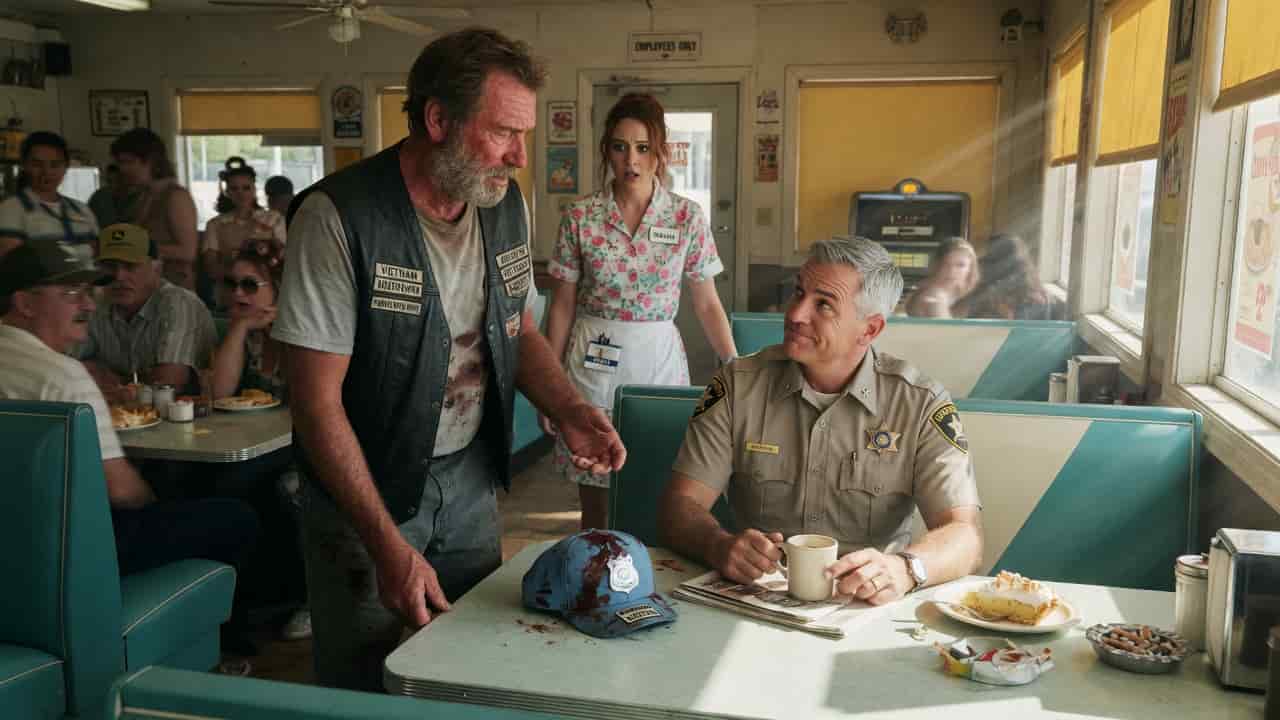
“You forgot this at the execution, Chief.”
The diner went so quiet you could hear the hum of the refrigerator in the back. Dutch Miller stood there, his hand shaking—not just from the Parkinson’s he’d been hiding, but from the raw, jagged weight of a year’s worth of silence. He wasn’t supposed to have that hat. It was supposed to have disappeared along with his son’s reputation.
Chief Halloway didn’t even flinch. He just looked at the stained brim, then up at Dutch with that same polished, heroic smile that graced the front page of the county paper every week. He leaned back, making sure the people in the neighboring booths could hear every word.
“Take your trash and go home, Dutch,” Halloway said, his voice dripping with a pity that felt like a slap. “We all know you haven’t been right in the head since the accident. Don’t make me have the boys haul you out of here in front of Sarah.”
Dutch’s daughter-in-law froze by the coffee station, her face turning ashen. She needed the job. She needed the Chief’s “charity” to keep the lights on and pay for little Leo’s treatments. Halloway knew it. He was using her like a shield, turning the whole room against a father who just wanted the truth.
But Dutch wasn’t just there to talk. He had something buried under his garage floor that would change everything, and for the first time in a year, the Chief looked into Dutch’s eyes and saw that the old man wasn’t just grieving. He was hunting.
Chapter 1
The tremors started in Dutch Miller’s left thumb, a rhythmic, maddening hitch that felt like a misfiring spark plug. He tucked the hand into the pocket of his grease-blackened Carhartt’s and used his right to tighten the bolt on the Shovelhead’s carburetor. The desert heat was already pushing ninety at ten in the morning, the air in the garage thick with the smell of old oil, oxidized chrome, and the dry, metallic tang of Arizona dust.
Outside, the town of Ocotillo Wells was preening itself for Hero’s Day. He could hear the distant clatter of the city crews erecting the stage in the park, the rhythmic thwack-thwack of hammers against plywood. There would be bunting. There would be a parade. And at the center of it all, Chief Silas Halloway would stand in his pressed tan uniform, accepting a plaque for his “distinguished service in the face of tragedy.”
Dutch spat a glob of tobacco juice into a plastic Gatorade bottle. Tragedy. That was the word they used for what happened to Ben. It was a clean word. It didn’t mention the three bullets in the back of a rookie’s head or the way the internal affairs report had been signed, sealed, and buried before the body was even cold.
“You’re working it too tight, Dutch.”
Dutch didn’t look up. He knew the voice. It was Miller, a kid barely twenty-four with a “Live Fast” tattoo crawling up his neck and a temper that ran hotter than an overheated radiator. Miller was the unofficial sergeant-at-arms for what was left of the Iron Brotherhood, a club that used to mean something before the mines closed and the meth moved in.
“I’m working it until it’s right,” Dutch said, his voice like gravel grinding together. “If you want it fast, take it to the dealership in Phoenix. If you want it to run when the world ends, leave it here.”
The kid leaned against the tool chest, lighting a cigarette. “People are talking, Dutch. The Chief’s been asking around about the clubhouse property taxes again. Says the county might be looking to seize the land for the new municipal expansion. Unless, you know, some of the ‘older elements’ decide to retire and move on.”
Dutch finally looked up. His eyes were the color of sun-bleached denim, recessed deep in a face that looked like it had been carved out of a canyon wall. “Halloway’s been asking, or he sent a deputy to do his barking for him?”
“He came by himself. Stood right there in the lot, looking at the bikes like they were piles of scrap. Said it’d be a shame for a man of your age to lose his shop over a simple misunderstanding.”
Dutch felt the tremor migrate from his thumb to his forearm. He gripped the wrench harder, the metal biting into his palm. He knew what the “misunderstanding” was. It was the fact that Dutch Miller was still breathing. It was the fact that every time Halloway looked at Dutch, he saw the ghost of the man he’d murdered.
“Tell the boys to keep their mouths shut and their bikes off the main drag during the parade,” Dutch said. “I’ll handle the Chief.”
“How? You can barely hold a wrench today, Dutch.”
The kid didn’t mean it as an insult—it was just the cold, hard truth of the desert—but it landed like a punch. Dutch looked at his hand. It was shaking visibly now. He shoved it back into his pocket.
“I said I’ll handle it. Get out of here, Miller.”
When the kid was gone, Dutch walked to the back of the shop. Past the rows of gaskets and the rusted-out frames, there was a heavy steel door that led to a small, windowless office. He didn’t turn on the light. He didn’t need to. He walked to the corner, knelt down, and pulled back a section of oil-stained plywood.
Underneath, the concrete was different. Rougher. He’d poured it himself six months ago, working through the night with a headlamp and a bottle of rye. He sat on the floor, leaning his back against the wall, and let his head drop.
Ben had been twenty-six. A good cop. The kind of kid who still called his father ‘sir’ and helped the old ladies in the trailer park with their groceries. He’d joined the force in Ocotillo Wells because he thought he could do some good. He thought being a “Legacy” meant something. Dutch had been a deputy for twenty years before the Iron Brotherhood had become his full-time life, and he’d pinned the badge on Ben’s chest himself.
He remembered the last time he’d seen Ben alive. The boy had come over, looking pale, his hands twitching just like Dutch’s were now. “Dad, something’s wrong at the precinct. There’s money moving that shouldn’t be. Halloway… he’s not who everyone thinks he is.”
Dutch had told him to be careful. He’d told him to gather proof.
Three days later, Ben was found in a ditch near the border. The official story was a cartel ambush. The unofficial story was that Ben had been “unreliable.”
Dutch reached into the pocket of his vest and pulled out a small, folded piece of paper. It was a medical bill for Leo, Ben’s four-year-old son. Three thousand dollars for the latest round of specialists. Sarah was working double shifts at the diner, her face getting thinner every time Dutch saw her. She didn’t know the truth about the money, or the cartel, or Halloway. She just knew her husband was gone and her son was sick.
He tucked the bill away and stood up. He walked over to a workbench and picked up a faded blue police service cap. It was Ben’s. There was a dark, stiff stain on the brim that would never come out.
He didn’t know why he’d kept it. Or rather, he did. It was the only piece of the truth he had left that wasn’t buried under six inches of concrete in the center of his garage.
Under that concrete sat the man who had pulled the trigger. A man named Martinez, one of Halloway’s “special” deputies. Dutch had found him three nights after the funeral. He hadn’t meant to kill him—not at first. He’d wanted names. He’d wanted the paper trail. But Martinez had laughed. He’d laughed and told Dutch that Ben had cried at the end.
Dutch didn’t remember much after that. Just the sound of a shovel hitting dirt and the heavy, wet thud of the concrete mixer.
He looked at his shaking hand. The Parkinson’s was the clock. Halloway was the wolf. And Ben was the ghost.
He put the hat in a brown paper bag. He didn’t have much time left before his hands became completely useless, before the tremors took the last of his dignity. If he was going to clear Ben’s name, if he was going to save Sarah and the boy, he couldn’t play it safe anymore.
He walked out of the shop, locked the roll-up door, and climbed onto his old Heritage Softail. The engine roared to life, a deep, guttural vibration that settled into his bones. He kicked the kickstand up and headed toward the center of town. The Hero’s Day banners were flapping in the wind, bright red, white, and blue against the unforgiving Arizona sky.
Chapter 2
The Wagon Wheel Diner was the social heart of Ocotillo Wells, a place where the air always smelled of burnt coffee and cheap bacon. Today, it was packed. The “Hero’s Day” committee was having a late lunch, and at the center table—the one with the best view of the street—sat Chief Silas Halloway.
He looked every bit the part of the savior. His tan uniform was crisp enough to cut glass, his silver badges gleaming under the fluorescent lights. He was laughing at something the Mayor said, a deep, practiced sound that made people in the other booths smile.
Dutch stepped through the door, the bell chiming above him. The sound of the diner didn’t stop immediately, but it began to fray at the edges. One by one, heads turned. The old biker in the grease-stained vest didn’t belong in the “Hero” narrative.
Sarah was behind the counter, her hair pulled back in a tight, tired bun. When she saw Dutch, her eyes flickered with a mixture of affection and pure, unadulterated terror. She knew Dutch didn’t come here unless something was wrong.
“Dutch,” she whispered as he passed the counter. “Don’t. Please.”
Dutch didn’t stop. He walked straight to Halloway’s table. The Mayor stopped talking. The City Councilwoman sitting next to him pulled her purse closer to her hip.
Halloway looked up. He didn’t lose the smile, but it changed. It went from “public servant” to “apex predator” in the span of a heartbeat.
“Dutch Miller,” Halloway said, his voice smooth as polished stone. “A bit far from the garage, aren’t you? We were just talking about your boy. Such a loss for this community.”
Dutch felt the tremor in his left hand. He shoved it into his pocket and reached into the brown paper bag with his right.
“You talk a lot, Silas,” Dutch said. The room was falling into a heavy, suffocating silence. Even the clatter of silverware in the kitchen seemed to die out. “But you have a short memory.”
He pulled the police cap out of the bag. The faded blue fabric looked cheap and small under the bright lights of the diner. He placed it on the table, right next to Halloway’s plate of steak and eggs. He made sure the stained brim was facing the Chief.
“You forgot this at the execution,” Dutch said.
The silence that followed wasn’t just quiet; it was a physical weight. The Mayor gasped. The Councilwoman looked like she wanted to crawl under the table.
Halloway didn’t move. He looked at the hat, then back at Dutch. The smile stayed, but his eyes were like two chips of dry ice.
“Dutch,” Halloway said softly, the kind of softness that preceded a strike. “We’ve talked about this. The grief… it does things to a man’s mind. Especially a man with your… medical history.”
He leaned back, his chair creaking. He looked around the room, making sure every eye was on them.
“Look at your hand, Dutch,” Halloway said, his voice rising just enough to reach the back booths. “You’re shaking like a leaf in a gale. You can’t even hold a conversation without vibrating. You want to talk about executions? You want to talk about ‘truth’? You’re a broken-down mechanic who can’t accept that his son wasn’t the hero everyone thought he was.”
Dutch’s hand was indeed shaking. It was rattling against the formica table now, a rhythmic tap-tap-tap that felt like a death knell.
“Ben was a better man than you’ll ever be,” Dutch said, his voice low and dangerous.
“Ben was a coward who got caught in the crossfire of his own bad choices,” Halloway snapped. He stood up, towering over Dutch. He was younger, stronger, and he had the backing of every person in that room who didn’t want to believe their town was built on a graveyard.
“Take your trash and go home, Dutch,” Halloway said, leaning in so close Dutch could smell the mint on his breath. “You’re embarrassing yourself. You’re embarrassing Sarah. Look at her.”
Dutch looked. Sarah was standing by the register, her face bone-white, tears brimming in her eyes. She wasn’t looking at Halloway with anger; she was looking at Dutch with a desperate, pleading sort of shame. She needed this town to like her. She needed the Chief to keep “checking in” on her.
“She’s the widow of a traitor, Dutch. And you’re just a ghost waiting to happen,” Halloway whispered. He picked up the cap with two fingers, looking at it with disgust, and dropped it into Halloway’s half-eaten eggs. “Now get out of my sight before I have you committed for your own safety.”
A few people in the back booths started to murmur. Someone let out a nervous laugh. The power in the room had shifted, anchored firmly to the man in the tan uniform.
Dutch looked at the hat, sitting in the yellow yolk of the eggs. He looked at Halloway. He didn’t argue. He didn’t shout. He reached out, his shaking hand hovering over the table for a second before he gripped the edge of the table to steady himself.
“The thing about ghosts, Silas,” Dutch said, his voice steady even if his body wasn’t, “is that they don’t stay buried. Not when you build your house right on top of them.”
He turned and walked out. He didn’t look at Sarah. He couldn’t. He could feel the eyes of the town on his back—pitying eyes, mocking eyes, eyes that saw a crazy old man who had finally lost his grip.
He climbed onto his bike, but he didn’t start it immediately. He sat there, the sun beating down on his leather vest, his heart hammering against his ribs. He’d poked the bear. He’d done it in public, in front of the witnesses Halloway prized so much.
Now, the wolf would come to the door. And Dutch had to be ready to let him in.
Chapter 3
The Iron Brotherhood clubhouse was a converted corrugated metal warehouse on the outskirts of town, tucked behind a screen of rusted machinery and salt cedars. In the seventies, it had been a fortress. Now, it looked like a monument to better days.
When Dutch pulled in, the yard was full. Six bikes, all older models, maintained with more love than money. The “boys” were sitting on the porch—men in their fifties and sixties with grey ponytails and backs ruined by decades of hard riding. And then there was Miller and his crew, the younger ones, looking like they were waiting for a reason to burn something down.
Dutch shut off the engine. The silence of the desert rushed back in, broken only by the ticking of the cooling metal.
“You really did it,” Miller said, hopping down from the porch. “Word’s already halfway across the county. You threw a bloody hat in the Chief’s breakfast?”
“It wasn’t just a hat,” Dutch said, swinging his leg over the seat. His left leg felt heavy, almost numb. The tremors were worse after the adrenaline spike of the diner.
“It was a death warrant,” said a man named Doc. He was the club’s elder, an ex-military medic who had spent thirty years patching up road rash and gunshot wounds. He walked over to Dutch, his eyes scanning Dutch’s face with professional concern. “You’re grey, Dutch. And you’re vibrating like a downed power line. Come inside.”
The interior of the clubhouse was cool and smelled of stale beer and sawdust. Dutch sat at the long wooden bar, his hands heavy on the scarred surface.
“Halloway’s going to move on us now,” Doc said, pouring Dutch a glass of water. “He’s been looking for an excuse to clear this land. You just handed it to him on a silver platter.”
“He was going to move anyway,” Dutch said. “He’s been squeezing Sarah. He’s been asking about the taxes. He wants me gone because he knows I’m the only one who remembers what Ocotillo Wells looked like before he started selling it off to the cartels.”
“We can’t win a war with the cops, Dutch,” one of the older members, a man named Preacher, said from the corner. “We’re too old, and these kids are too stupid. They’ll just send in the SWAT team and call it a drug bust. Nobody in this town will shed a tear for a bunch of bikers.”
Miller slammed a fist onto a table. “So we just sit here? We let him insult Ben? We let him take the clubhouse?”
“We wait,” Dutch said.
“Wait for what?” Miller demanded. “For your hands to stop working? For them to put you in a home?”
Dutch looked at the kid. The anger was real, but it was shallow. Miller wanted a fight because he didn’t know what a real loss felt like. He thought violence was a solution, not a consequence.
“I have leverage,” Dutch said.
The room went quiet.
“What kind of leverage?” Doc asked, his voice low.
“The kind that doesn’t go away,” Dutch said. He didn’t tell them about the body under the floor. Not yet. Loyalty in the Brotherhood was a strong thing, but everyone had a breaking point, and Halloway was an expert at finding it. “I need you to do something for me, Doc. I need you to find out who Martinez was talking to before he disappeared. Not just Halloway. I mean the money. Where was it going?”
Doc nodded slowly. “I still have a few friends in Phoenix. P.I.s who don’t mind digging in the dirt. But Dutch… if you’re going down this road, there’s no turning back. Halloway isn’t just a cop. He’s the law in this county. You strike at him, and the whole system strikes back.”
“The system already took my son,” Dutch said. “What else is it going to take? My life? I’m already losing that bit by bit.”
He stood up, his knees popping. He felt the weight of the room, the collective fear and weariness of men who had spent their lives on the fringe of society. They were tired. They wanted peace. But Dutch knew there was no peace to be had as long as Halloway was breathing the desert air.
He walked back out to his bike. As he was leaving, Miller caught up to him.
“I’m with you, Dutch,” the kid said, his voice dropping. “The old guys… they’re scared. But the rest of us? We remember Ben. He treated us like people. If you need someone to do the dirty work, you just say the word.”
“Keep your head down, Miller,” Dutch said. “This isn’t a street fight. It’s a chess match. And Halloway’s been playing it a lot longer than you have.”
Dutch rode back to his garage. The sun was setting, painting the sky in bruised purples and oranges. He didn’t go inside the house. He went into the shop.
He sat in the dark for a long time, listening to the desert wind whistle through the gaps in the corrugated metal. He thought about the concrete under his feet. He thought about the man buried there.
Martinez had been a father, too. Dutch knew that. He’d seen the photo in the man’s wallet before he’d burned it. It was a cycle of blood that never ended. But Ben’s name was still dirt in this town. People still whispered that he’d been on the take, that he’d been a “disgrace to the badge.”
Dutch couldn’t die with that being the last word on his son.
He heard a car pull into the gravel lot. A late-model sedan, the engine purring quietly. Not a cop car.
He stood up, reaching for the heavy iron pipe he kept behind the door. He moved into the shadows, his heart racing, his hand doing that frantic, rhythmic dance in his pocket.
The door creaked open. A man stepped in, silhouetted against the moonlight. He was wearing a suit that cost more than Dutch’s house.
“Mr. Miller?” the man asked. He sounded nervous. “My name is Elias Thorne. I’m a lawyer. We have a mutual friend… a man named Martinez.”
Dutch didn’t move. He felt the cold realization settle into his stomach. Martinez hadn’t just been a deputy. He’d been a link in a much longer chain.
“Martinez is gone,” Dutch said from the shadows.
“I know,” Thorne said, stepping further into the shop. “That’s why I’m here. Halloway thinks Martinez ran for the border with the ledger. But I think you know exactly where he is. And I think you know what’s on that ledger.”
Dutch stepped out of the shadows, the iron pipe visible in his hand. “I don’t know anything about a ledger. I just know what happens to people who come onto my property without an invitation.”
Thorne looked at the pipe, then at Dutch’s shaking hand. He smiled, but there was no warmth in it. It was the smile of a man who saw an opportunity.
“Halloway is going to burn this town to the ground to find what Martinez took,” Thorne said. “He’s already started. Have you checked on Sarah lately, Dutch? Or the boy?”
The pipe felt heavy in Dutch’s hand. Too heavy.
“What did you do?” Dutch growled.
“I didn’t do anything,” Thorne said. “But Halloway just ordered a ‘wellness check’ on your grandson. Social services are on their way to the diner as we speak. Something about an unfit mother and a family history of criminal activity.”
Dutch felt the world tilt. He dropped the pipe and lunged for his keys.
“If you want to save them,” Thorne called out as Dutch kicked his bike to life, “you’re going to need more than an old police hat, Dutch! You’re going to need the truth!”
Chapter 4
The blue and red lights were already flashing in the diner parking lot when Dutch arrived. Two SUV’s with the County Social Services logo on the side were parked near the entrance, flanked by three Ocotillo Wells police cruisers.
A small crowd had gathered on the sidewalk—neighbors, shop owners, the same people who had been in the diner during the confrontation. They were watching with a morbid, silent curiosity.
Dutch shoved his way through the crowd. “Sarah!” he shouted.
He was blocked by a young deputy he didn’t recognize—a kid with a buzz cut and a chest puffed out with unearned authority.
“Back off, Miller,” the deputy said, hand resting on his holster. “This is a private matter.”
“Private? You’ve got half the town watching!” Dutch roared. “Where’s my grandson?”
“The child is being processed for temporary placement,” the deputy said, his voice flat. “The mother is being questioned regarding a controlled substance found in her locker.”
“Locker? She doesn’t use!” Dutch’s hand was shaking so violently now he had to hook his thumb into his belt loop to keep from swinging it. “Halloway planted it. You know he did!”
“Careful, old man,” the deputy sneered. “Slander is a crime. And so is resisting an officer.”
From inside the diner, a scream tore through the air. It was Sarah.
Dutch didn’t think. He didn’t plan. He lowered his shoulder and drove into the deputy’s chest, catching the kid off guard. He surged past him, his boots heavy on the pavement, and burst through the diner doors.
The scene inside was a nightmare. Sarah was on her knees, being held back by two female officers. She was reaching for Leo, who was being carried toward the back exit by a woman in a grey suit. The boy was wailing, his small hands clutching at the air, his face red and terrified.
Chief Halloway was standing by the counter, calmly sipping a cup of coffee. He looked at Dutch with a bored expression.
“You’re trespassing, Dutch,” Halloway said.
“Give her the boy,” Dutch said, his voice trembling with a rage that transcended his illness. “You want me, Silas. You want the shop. You want the land. Leave them out of it.”
“I don’t know what you’re talking about,” Halloway said. “I’m just a concerned citizen. When an anonymous tip came in about drugs on the premises of a local establishment… well, I had to act. For the safety of the child. It’s a shame, really. First the father, now the mother. It seems the Miller family is just fundamentally broken.”
“You son of a bitch,” Sarah sobbed, her face pressed against the floor. “He’s all I have. Dutch, please!”
Dutch looked at Sarah, then at Leo, who was being bundled into the back of a Social Services vehicle. He looked at the townspeople peering through the windows, their faces pale reflections in the glass. They were watching a mother lose her child, and they were doing nothing. They were too afraid of the man with the silver badge.
Halloway walked over to Dutch, stopping inches away. He reached out and tapped Dutch’s shaking hand.
“You see that?” Halloway whispered. “That’s the sound of a clock ticking, Dutch. You’re failing them. You failed Ben, and now you’re failing the boy. Because you can’t let go of a dead lie.”
“It’s not a lie,” Dutch said, the words catching in his throat.
“Then prove it,” Halloway said, his voice dropping to a low, lethal hum. “Bring me the ledger Martinez stole. Bring it to me by tomorrow morning, or the boy goes into the system. And we both know what happens to ‘unreliable’ kids in the system, don’t we?”
Halloway turned away, signaling to the officers. “Clear the room. We’re done here.”
Dutch stood in the center of the diner as the police dragged Sarah toward a cruiser and the Social Services van pulled away. The room felt cold, the smell of bacon and coffee now nauseating.
He was alone.
He walked out of the diner, his legs feeling like they were made of lead. The crowd parted for him, but no one spoke. No one offered a hand. The stigma of the “drug-addict mother” and the “crazy biker grandfather” had already taken hold. Halloway had won the social war.
Dutch rode back to his garage in a daze. He didn’t turn on the lights. He went straight to the office, pulled back the plywood, and stared at the concrete.
He didn’t have a ledger. Martinez hadn’t been carrying anything but a gun and a mouth full of insults when Dutch caught him. Thorne had been lying—or he was looking for something that didn’t exist.
But Dutch had something else.
He went to his workbench and pulled out his heavy-duty masonry hammer. He felt the tremor in his arm, the rhythmic shaking that made every movement a struggle. He gripped the hammer with both hands, his knuckles white.
I’m sorry, Ben, he thought. I’m sorry I couldn’t save you the right way.
He swung the hammer. The impact vibrated up his arms, sent a jolt of pain through his shoulders. He swung again. And again.
The concrete began to crack.
He worked for hours, the sweat stinging his eyes, his breath coming in ragged gasps. He didn’t stop until he reached the plastic tarp buried beneath. He peeled it back, the smell of decay hitting him like a physical blow.
He reached into the pocket of the man’s jacket—the jacket Martinez had been wearing. He hadn’t searched him thoroughly that night; he’d been too consumed by the red haze of Ben’s death.
His fingers brushed against something hard. Something metallic.
He pulled it out. It wasn’t a ledger.
It was a digital voice recorder. Small, silver, and caked in grit.
Dutch sat back on the dirt floor, his body failing him, his breath sobbing in his chest. He clicked the play button.
The recording was scratchy, distorted by the sound of wind and a running engine. But the voices were unmistakable.
“He’s just a rookie, Silas. He doesn’t have to die.”
“He saw the manifests, Martinez. He knows the shipments are coming through the precinct. He’s a Miller. They don’t take buyouts. They take stands. And stands get people buried.”
A gunshot. Then silence.
Dutch closed his eyes. He had the proof. He had the truth that would clear Ben’s name and put Halloway in a cage.
But he also knew Halloway. The Chief wouldn’t go to jail. He’d burn the whole county down first. He’d kill Sarah. He’d kill the boy.
Dutch looked at his shaking hand. He had one move left. It wasn’t a legal move. It wasn’t a “hero” move. It was the move of a man who had nothing left to lose and a debt that could only be paid in blood and iron.
He stood up, tucked the recorder into his vest, and walked out to the garage. He picked up his phone and dialed Miller.
“Get the boys,” Dutch said. “All of them. And tell them to bring their gear. We’re going to the parade.”
Chapter 5
The morning of Hero’s Day arrived not with a fanfare, but with the low, ominous hum of cicadas vibrating in the salt cedars. Dutch Miller sat on the edge of his cot in the back of the garage, his head in his hands. His left arm was jumping rhythmically now, a steady, mechanical twitch that felt like a piston firing out of sequence. He looked at the digital recorder sitting on the scarred workbench. It looked like a toy—a small, silver sliver of plastic and circuitry—but it held the weight of a dozen lives and the rot of a whole county.
He hadn’t slept. He’d spent the night cleaning the grease from under his fingernails with a stiff brush and a bucket of kerosene, an old habit he couldn’t quite shake. If he was going to face the town, he wanted to look like a man who still had some pride left, even if his nervous system was short-circuiting.
The door to the shop creaked open. It was Doc. He was carrying two thermoses of black coffee and a small white paper bag from the bakery. He looked at the pile of broken concrete in the center of the floor, then at the plastic-wrapped shape Dutch had moved to the cooling unit in the back.
“You really dug him up,” Doc said, his voice quiet. He didn’t sound shocked. He sounded tired, the way a man sounds when he’s seen the same tragedy play out in three different wars.
“I didn’t have a choice,” Dutch said. He stood up, his knees cracking like dry kindling. He took one of the thermoses, his hand shaking so much the hot liquid slopped over the rim. He didn’t flinch. “Halloway took the boy, Doc. He took Leo.”
Doc pulled a chair over and sat down. He didn’t look at the coffee. He looked at Dutch’s hand. “The tremors are moving to your shoulder. You’re hitting the wall, Dutch. You won’t be able to ride a bike in a week. Maybe less.”
“Then I’ll ride today,” Dutch said. “I’ve got the recording. It’s Silas and Martinez. They’re talking about Ben. They’re talking about the manifests. It’s all there.”
“Give it to the Feds,” Doc said. “I have a contact in Phoenix. We can get you out of town, get Sarah and the boy into a safe house.”
Dutch shook his head. “Halloway owns the highway between here and the city. If we try to run, we’re just targets in a moving car. He needs to be dismantled here. In front of the people who think he’s a god. If I leave, the truth leaves with me, and Ben stays a traitor in the history books of Ocotillo Wells.”
He walked over to the workbench and picked up the recorder. His fingers fumbled with it, nearly dropping it twice. The frustration bubbled up in his chest—a hot, jagged lump of shame. He was a man who had spent forty years fixing the most delicate engines, and now he couldn’t even press a button without a fight.
“I need a favor, Doc,” Dutch said. “The kind you can’t walk back from.”
“I’m seventy-two years old, Dutch. I’ve been walking back from things since Saigon. Speak your piece.”
“I need you to get into the sound booth at the park,” Dutch said. “The city uses that big PA system for the speeches. It’s all digital now, runs off a central board in the back of the stage. You still know your way around a wire?”
Doc’s eyes sharpened. A slow, grim smile spread across his face. “I was a radio tech before I was a medic. I can make those speakers scream if I have to.”
“Good. Miller and the boys are going to provide the distraction. We’tll ride in right as Halloway starts his keynote. He’ll try to have the deputies pull us off the bikes, and that’s when you patch this in. Don’t play it until I give the signal.”
“What’s the signal?”
Dutch looked at his son’s blood-stained police cap, now sitting on a clean cloth near the door. “When I put the hat back on the table.”
Doc stood up, taking the recorder from Dutch’s trembling palm. He held it for a moment, weighing it. “You know they’ll arrest you for Martinez, Dutch. Even if Halloway goes down, that body in the back… it doesn’t just disappear.”
“I know,” Dutch said. “I’m not looking for a way out. I’m looking for a way through.”
By noon, the heat was a physical presence, shimmering off the asphalt of Main Street. The town was a sea of red, white, and blue. Families sat on folding chairs along the curb, kids licking melting ice cream cones, the local high school band tuning their instruments in the distance. To an outsider, it looked like the quintessential American dream. To Dutch, it looked like a funeral.
He met the Brotherhood at the edge of the industrial district. There were twelve of them now. Some of the older guys had stayed home, but Miller had recruited a few more from the neighboring county—younger guys with loud pipes and a deep-seated resentment for the Ocotillo Wells PD.
Dutch sat on his Softail, the engine idling with a rhythmic, heavy thrum. He felt the vibration through his seat, a mirror to the shaking in his own limbs. He had his son’s hat tucked into the front of his vest, right over his heart.
“Everyone knows the plan?” Dutch asked.
Miller nodded, his eyes hidden behind dark aviators. “We circle the park. Keep the deputies busy. Don’t engage unless they draw first. We’re the noise, Dutch. You’re the message.”
“Let’s go,” Dutch said.
They moved as one, a wall of black leather and chrome cutting through the celebratory air of the town. People turned as they roared past, their expressions shifting from festive to wary. This wasn’t the usual parade entry. There were no streamers on these bikes. No smiles.
As they reached the town square, the crowd was already gathered around the permanent stage. Chief Halloway was standing at the podium, his voice amplified by the massive speakers hanging from the oak trees.
“…and as we remember the sacrifices of those who came before,” Halloway was saying, his voice rich with practiced emotion, “we must also remain vigilant against the elements that seek to undermine our peace. Ocotillo Wells is a sanctuary because we refuse to let the darkness in.”
Dutch kicked his bike into gear and led the Brotherhood straight toward the barricades. A deputy at the perimeter held up a hand, his face pale as he realized they weren’t stopping.
“Hey! You can’t be here! Move it along!”
Dutch didn’t even look at him. He steered the bike around the sawhorses, the rest of the club following in a tight formation. They didn’t go fast, but they went steady, the collective roar of twelve V-twins drowning out Halloway’s speech.
Halloway stopped talking. He leaned over the podium, his eyes searching the crowd until they landed on Dutch. The mask of the “Hero” didn’t slip, but Dutch saw the tension in his jaw. He saw the way Halloway’s hand drifted toward the radio on his belt.
Dutch pulled his bike to a stop directly in front of the stage. He shut off the engine. One by one, the other bikers did the same. The silence that followed was more deafening than the engines had been.
Dutch climbed off the bike. His left leg almost buckled, but he caught himself on the handlebars. He walked toward the stairs of the stage. Two deputies moved to block him, their hands on their batons.
“Let him up,” Halloway’s voice boomed over the PA.
The deputies hesitated, then stepped aside. Halloway was playing the room. He wanted the town to see him being “reasonable” with the local crazy man. He wanted to humiliate Dutch one last time before he had him hauled away for good.
Dutch climbed the stairs, every step a battle against his own body. He reached the podium and stood across from Halloway. The Chief was smiling, a thin, cruel line that didn’t reach his eyes.
“Dutch,” Halloway said, not into the microphone this time. “I told you what would happen if you didn’t bring me what I asked for. Where’s the boy?”
“The boy is safe because you don’t have him yet,” Dutch said, his voice carrying to the front rows. “And you’re never going to touch him again.”
“You’re delusional, Dutch. You’re a sick old man who’s lost his family and his mind. Why don’t you go sit down before you fall down?”
Dutch reached into his vest. He pulled out Ben’s police cap. He placed it on the podium, right next to the Chief’s prepared speech. The blood stain was a dark, ugly blotch against the white paper.
Halloway laughed, a short, barking sound. “Still with the hat? Give it a rest, Dutch. Nobody cares about your son’s ‘accidents’ anymore.”
“It wasn’t an accident, Silas,” Dutch said. He looked out at the crowd. He saw the Mayor, the shopkeepers, the families. He saw the fear in their eyes, the way they were looking at Halloway as if waiting for permission to breathe.
Dutch raised his shaking left hand. He pointed it toward the sound booth in the back of the square.
“Tell them about Martinez, Silas,” Dutch said.
“Martinez moved to Mexico,” Halloway said, his voice projecting through the speakers again. “He couldn’t handle the pressure of the job. Just like your son.”
“Martinez is in my garage,” Dutch said. “Under the floor. I dug him up this morning.”
A gasp went through the crowd like a gust of wind through dry grass. Halloway’s face finally went white. He stepped toward Dutch, his hand going to his holster.
“You’re under arrest,” Halloway hissed. “Right now. On the stage.”
“Play it, Doc,” Dutch whispered.
For a second, there was only static. Then, the speakers crackled to life.
“He’s just a rookie, Silas. He doesn’t have to die.”
The voice was Martinez’s. It was thin, panicked, and unmistakably real. The crowd went bone-still.
“He saw the manifests, Martinez. He knows the shipments are coming through the precinct. He’s a Miller. They don’t take buyouts. They take stands. And stands get people buried.”
Halloway’s voice echoed through the trees, through the square, bouncing off the brick walls of the town he had spent ten years conquering. It wasn’t the voice of a hero. It was the voice of a killer.
The recording ended with the sharp, final crack of a gunshot.
Halloway froze. He looked out at the townspeople. He saw the shift. It wasn’t just anger—it was the realization of a decade of betrayal. The “sanctuary” was a cage, and he was the one holding the keys.
“It’s a fake!” Halloway shouted, grabbing the microphone. “It’s a digital forgery! Miller is a criminal! He just admitted to murder!”
But nobody was listening to Halloway anymore. They were looking at Dutch. And Dutch was looking at the horizon, his hand finally, for one brief moment, standing perfectly still.
Chapter 6
The aftermath of the recording didn’t happen in a flurry of action. It happened in a slow, agonizing slide into chaos. Halloway tried to command his deputies, but they were looking at each other, their hands hovering uncertainly over their belts. They had heard the Chief’s voice. They knew the truth of the manifests. Some of them had likely been part of it, and those were the ones who were already backing toward the cruisers, looking for an exit.
“Arrest him!” Halloway screamed, pointing at Dutch. “He’s a murderer! He admitted it on the stage!”
Miller and the Brotherhood didn’t wait. They stepped between the stage and the police, a wall of leather and grey hair. They didn’t draw weapons; they just stood there, arms crossed, their presence a silent challenge.
“Nobody’s arresting anybody today, Silas,” Miller said, his voice booming.
The crowd began to surge. It wasn’t a riot—not yet—but the parents were pulling their children away, and the Mayor was frantically calling someone on his cell phone, his face red with panic. The “Hero’s Day” banner behind Halloway tore loose at one corner, flapping in the wind like a wounded wing.
Halloway looked at Dutch. The polished mask was gone now. His eyes were wide, the pupils blown with a desperate, cornered rage. He realized he wasn’t going to talk his way out of this. He wasn’t going to be the hero anymore.
He lunged for Dutch, his fingers clawing for the old man’s throat. Dutch didn’t have the strength to fight back, but he didn’t have to. The momentum of the crowd and the sudden intervention of Miller sent Halloway sprawling onto the wooden planks of the stage.
“Get him off me!” Halloway shrieked.
Two state trooper vehicles, their sirens wailing, tore into the square. They hadn’t been part of the parade. Doc had made a second call that morning, not to the local precinct, but to the Attorney General’s office in Phoenix. He’d sent a snippet of the audio file over an encrypted line.
The troopers moved with a surgical precision that the Ocotillo Wells PD lacked. They swarmed the stage, their rifles held at low ready.
“Hands in the air! Nobody move!”
Dutch sat down on the edge of the stage. He felt a strange, hollow sense of peace. The tremors were back, worse than ever, his whole body humming with the exhaustion of the last forty-eight hours. He watched as the troopers zip-tied Halloway’s hands behind his back. He watched as they took the badges off the deputies who had been standing guard.
“Dutch Miller?” a trooper asked, kneeling beside him. “We’re going to need you to come with us. There’s a lot of questions about this Martinez fellow.”
“I know,” Dutch said. “I’ll tell you everything. Just… tell me Sarah is okay.”
“She’s at the station in the next county,” the trooper said. “The boy is with her. We intercepted the Social Services transport an hour ago. They’re safe, Dutch.”
Dutch closed his eyes. He let the sun beat down on his face one last time. He had done it. He had cleared the name.
The ride to the state facility was long and quiet. Dutch didn’t look out the window. He sat in the back of the cruiser, his hands cuffed in front of him. He didn’t mind the cuffs. They felt honest. He had killed a man. Even a man like Martinez deserved a reckoning, and Dutch wasn’t a man who believed in shortcuts.
He spent the next three months in a medical wing of the county jail. The lawyers called it a “complex case.” There was the matter of the murder, but there was also the overwhelming evidence of Halloway’s corruption, the cartel ties, and the cold-blooded execution of a police officer.
In the end, Dutch took a plea. Voluntary manslaughter. Given his health and the circumstances of the revelation, the judge gave him ten years, suspended. He was to be remanded to a long-term care facility under house arrest.
It was a mercy. Or a sentence, depending on how you looked at it.
A year later, the desert was blooming. A rare spring rain had turned the brown hills of Ocotillo Wells into a vibrant, fleeting green.
Dutch sat in a wheelchair on the porch of a small cottage on the outskirts of town. His hands were mostly still now, thanks to a heavy regimen of medication that left him feeling like he was living underwater. He couldn’t fix engines anymore. He couldn’t ride. But he could watch the sun set.
A dusty SUV pulled into the gravel drive. Sarah stepped out, followed by Leo. The boy was five now, his hair a shock of blonde, his eyes bright and full of a health that had once seemed impossible.
“Grandpa!” Leo shouted, running across the yard.
Dutch reached out with his right hand, the one that worked better than the left. He caught the boy and pulled him into a hug. Leo smelled like sunshine and laundry detergent.
“Hey there, little man,” Dutch whispered.
Sarah walked up the steps, carrying a basket of peaches. She looked different. The hollow look in her eyes was gone. She was working at the library now, and she’d moved into a small house near the park. The town had tried to apologize to her in a hundred small ways, but she’d accepted only what was necessary for the boy.
“You look good today, Dutch,” she said, leaning down to kiss his cheek.
“I feel alright,” Dutch said. “Miller came by yesterday. Said the clubhouse is officially back in the club’s name. They’re turning the back half into a youth center. Naming it after Ben.”
Sarah smiled, but there was still a trace of sadness in it. The residue of the past never truly washed away. You just learned to live with the stains.
“He’d like that,” she said. “He always wanted people to have a place to go.”
They sat on the porch for an hour, talking about nothing and everything. Leo played in the dirt with a small plastic motorcycle, making engine noises that sounded remarkably like Dutch’s old Softail.
When they left, the silence of the desert returned. But it wasn’t the heavy, suffocating silence of a secret. It was the quiet of a debt paid in full.
Dutch looked down at his hands. They were starting to shake again, a low-level vibration that signaled the end of the day’s strength. He didn’t fight it. He just folded them in his lap and watched the first stars begin to poke through the purple velvet of the Arizona sky.
He thought about the garage. He thought about the concrete he’d broken and the man he’d buried. He thought about the blood on the hat.
He had lost almost everything. His son, his health, his shop, his freedom. But as he sat there in the cooling air, he realized he’d kept the only thing that mattered. He’d kept the promise he’d made to a twenty-six-year-old kid who thought he could change the world.
The world hadn’t changed, not really. Ocotillo Wells still had its problems. There were still men like Halloway waiting in the shadows of other towns, other precincts. But for one afternoon, the truth had been louder than the lies. And for a man like Dutch Miller, that was enough.
He closed his eyes and listened to the wind. It didn’t sound like ghosts anymore. It just sounded like the desert, vast and indifferent and finally, mercifully, at peace.