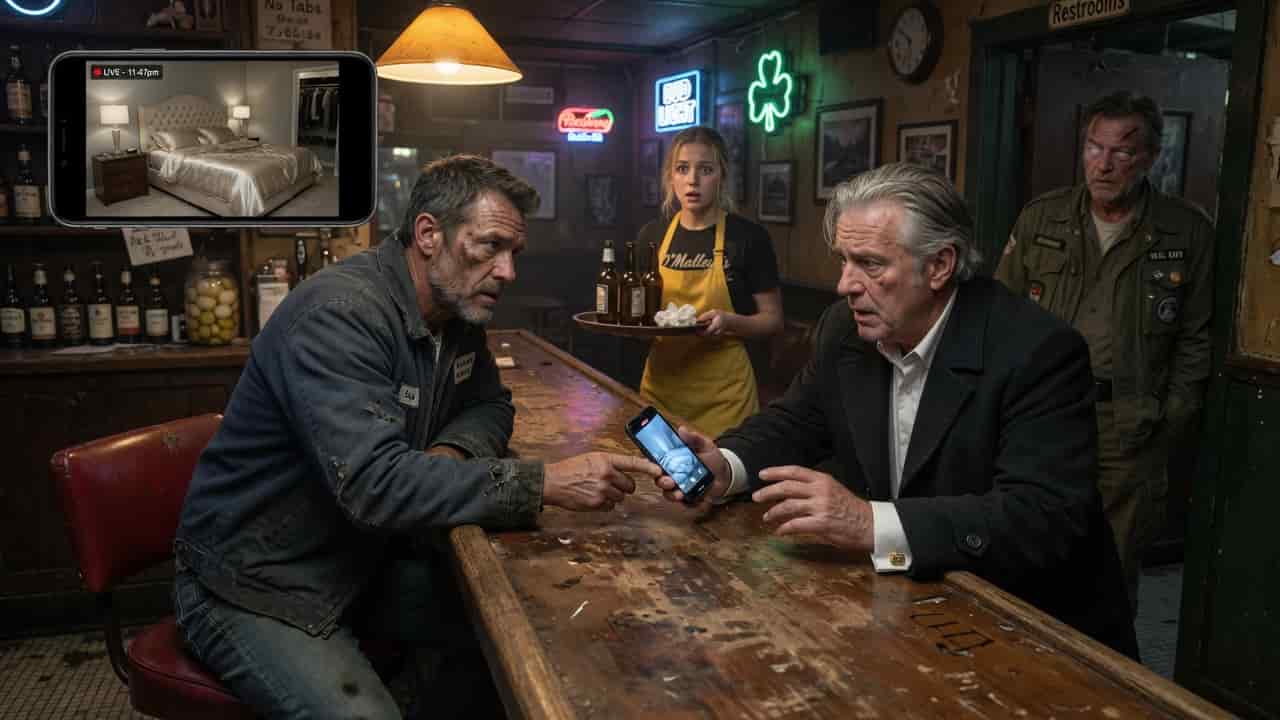
“Look at the screen, Vance.”
Elias didn’t raise his voice. He didn’t have to. The noise of the harbor—the distant groan of cranes and the salt-heavy wind—felt a thousand miles away from the dead air inside the bar.
Commissioner Vance looked down at the phone sliding across the wood. He was used to being the man who gave the orders. He was used to Elias Thorne being the man who took them, the “unfortunate” widower who kept the containers moving and the secrets buried.
Then Vance saw the video.
It was his own bedroom. The high-thread-count sheets he’d slept in an hour ago. The gold watch on the nightstand. The silence of a home that was supposed to be a fortress.
“You’re out of your mind, Thorne,” Vance stammered, his silver hair catching the dim light as he looked around the room, desperate for a witness, for a guard, for anyone to stop the sudden, terrifying shift in the room’s gravity.
Elias leaned in, the grease on his knuckles a sharp contrast to the Commissioner’s manicured life.
“I’m not in your house yet,” Elias said, his voice flat and clinical. “But I can be. Five years, Vance. Five years I’ve watched you walk these docks like you owned the souls on them. Now, you’re going to tell me where they took the girls. Or I’m going to show you exactly what five years of training looks like.”
The whole bar went quiet. The waitress stopped mid-step. The power didn’t just tip—it shattered.
The Foreman’s verdict had been reached. And the sentencing was just beginning.
Chapter 1
The humidity in Savannah didn’t just sit on you; it owned you. It was 5:00 AM, and the fog was rolling off the Savannah River in thick, grey blankets that smelled of salt, diesel, and rotting marsh gas. Elias Thorne stood on the edge of Pier 17, his boots planted on the oil-slicked concrete. He watched the massive Gantry cranes reach into the mist like the skeletal fingers of a buried giant.
He was forty-five years old, and his body felt every second of it. His lower back was a constant, low-grade thrum of ache from twenty years on the docks. His hands were a map of scars—crush injuries from heavy cables, burns from slipping ropes, and the deep, permanent stains of hydraulic fluid that no amount of Gojo soap could ever truly lift.
“Thorne! Container 402 is hanging! Get the crew on it!”
The voice belonged to Miller, the night superintendent. Elias didn’t look back. He just raised a hand, a blunt signal of acknowledgment. He was the union foreman, the man who kept the blood flowing through the port’s veins. It was a job that required him to be part diplomat, part drill sergeant, and part ghost.
He walked toward the stack, his pace steady. He passed Jimmy, a kid barely twenty-one with a face that still looked like it belonged in a high school yearbook. Jimmy was leaning against a forklift, his eyes darting toward a black SUV idling near the Authority building.
“Eyes on the load, Jimmy,” Elias said. His voice was a low rasp, the product of too many cigarettes in his twenties and too much yelling in his thirties.
“Sorry, Elias. It’s just… the Commissioner’s here early, isn’t he? They say he’s checking the manifests personally today.”
Elias stopped. He didn’t look at the SUV. He looked at the kid. “The Commissioner doesn’t check manifests, Jimmy. He checks bank accounts. You worry about the crane. If that spreader snaps, your head’s the first thing it’s going to find.”
The kid straightened up, his face paling. Elias moved on, but the mention of the Commissioner, Arthur Vance, sent a cold ripple through his chest that had nothing to do with the morning fog.
Five years.
Five years since Sarah had walked out of their small house on Liberty Street to pick up a shift at the diner and never came home. The police had called it a disappearance. They’d talked about “runaways” and “voluntary departures.” They’d looked at Elias’s rough hands and his quiet temper and hinted that maybe she’d had a reason to leave.
But Elias knew. He’d seen the black SUV on the security footage of the gas station three blocks from the diner. He’d seen the way the Port Authority police had “lost” that footage forty-eight hours later.
He didn’t go to the bars and drown his grief. He didn’t move away. He stayed right here, in the heart of the machine that had swallowed her.
When the shift ended at 2:00 PM, the other men headed for O’Malley’s or home to their wives. Elias drove his beat-up Ford F-150 to a dilapidated VFW hall on the outskirts of the city. The sign out front was missing half its letters, and the paint was peeling in long, jaundiced strips.
Inside, the air smelled of stale sweat and old floor wax. In the basement, away from the prying eyes of the bingo players upstairs, was a small, matted room.
Silas was waiting for him. Silas was seventy, with a glass eye that stared fixedly at the wall and a right arm that was mostly scar tissue from a jungle in 1968. He was also the man who had taught Elias how to disappear while standing in plain sight.
“You’re late, Elias,” Silas said. He didn’t look up from the heavy bag he was stabilizing.
“Shift ran over. Vance was at the pier.”
Silas went still. The glass eye seemed to gleam in the fluorescent light. “Did he see you?”
“He looked through me,” Elias said, stripping off his work jacket. Beneath it, his grey Henley was damp with sweat. He looked leaner than he had five years ago. Harder. Like a piece of driftwood that had been tumbled by the tide until only the core remained. “To him, I’m just part of the equipment. Part of the overhead.”
“Good,” Silas grunted. “Let’s work. The elbow strike. Again. You’re leading with your shoulder, and you’re losing the leverage. If you hit a man like Vance, you don’t want to hurt him. You want to break the mechanism.”
For the next three hours, there was no foreman. There was no missing wife. There was only the sound of bone hitting padding, the sharp intake of breath, and the clinical repetition of violence. Elias practiced Krav Maga not as a sport, but as a trade. He learned how to use a man’s weight against him, how to find the soft spots behind the ear and under the jaw, and how to stay calm when the adrenaline tried to turn his blood to fire.
“Enough,” Silas finally said, breathless. He wiped his face with a rag. “You’re getting faster. But your head is messy. You’re thinking about the ‘why.’ In the moment, there is no ‘why.’ There is only the ‘how.’”
“I found something today,” Elias said, his voice tight. He walked over to his bag and pulled out a small, grainy photo he’d printed from a hidden camera he’d installed six months ago in the port’s secondary security gate. “This container. Number 402. It wasn’t on the public manifest. It came off the Caledonia at midnight, but the logs say the Caledonia didn’t dock until four.”
Silas leaned in, squinting with his good eye. “The ghost shift.”
“Vance was there to meet it,” Elias said. “He didn’t see me because I was in the crane cab, two hundred feet up. But I saw him. He didn’t look like a Commissioner. He looked like a man checking his mail.”
Elias felt the weight of the secret in his gut. For five years, he had been a shadow. He had used an alias to buy surveillance equipment, spent nights sitting in his truck with a parabolic mic, and learned the intricate dance of the port’s corruption. He knew which guards were paid to look at their phones at 1:00 AM. He knew which containers were never X-rayed.
And he knew that Vance was the architect of it all.
“You’re close,” Silas warned. “When you get this close, the floor starts to get slippery. Don’t go looking for her in a container, Elias. You might find something else.”
“I’m not looking for her anymore, Silas,” Elias said, and for the first time, his voice cracked just a little. “I’m looking for the people who took her. There’s a difference.”
He left the VFW as the sun was beginning to dip, turning the Savannah sky a bruised, angry purple. He didn’t go home. He drove back toward the docks, parking a mile away in a residential lot. He pulled a backpack from behind the seat—a pack filled with a high-end laptop, a radio scanner, and a pair of suppressed binoculars.
He climbed a water tower that overlooked the port’s northern perimeter. From here, he could see the “Holding Pen”—a cluster of administrative trailers that sat behind three layers of chain-link fence and a private security detail that didn’t wear Port Authority patches.
He adjusted the binoculars. He watched the trailers for two hours, his breath steady, his mind recording every movement. He saw a girl—maybe eighteen, maybe younger—being led from a trailer to a waiting van. She was wearing a thin sundress that fluttered in the salt wind. She looked small. Terrified.
Elias gripped the railing of the water tower so hard his knuckles turned white. He closed his eyes for a second, seeing Sarah’s face—the way she laughed at his bad jokes, the way she smelled of vanilla and coffee.
He opened his eyes. The girl was gone. The van was driving toward the gate.
He reached into his pocket and pulled out his phone. He opened an app that displayed a live audio feed. He’d spent three months getting a bug into Vance’s private office, hidden inside a trophy for “Civic Excellence.”
The audio was scratchy, but the voice was unmistakable.
“…inventory is moving tonight. The buyer from Atlanta is losing patience. Make sure 402 is cleared by midnight. And tell the foreman if he asks questions, he’s replaceable. Thorne’s been around too long anyway. He’s starting to look like he’s actually thinking.”
Elias stared out at the dark water. The Commissioner was right. Elias was thinking. And for the first time in five years, he knew exactly what he was going to do.
Chapter 2
The next morning, the “Holding Pen” wasn’t just a place on a map for Elias; it was a physical weight in his chest. He arrived at the docks at 6:00 AM, his eyes gritty from lack of sleep, but his mind sharp.
He was overseeing the unloading of a freighter from Rotterdam when he saw her.
She was huddled behind a stack of rusted pallets near the employee breakroom. At first, he thought it was a trick of the light, just another stray cat or a shadow. But then he saw the flash of a dirty white t-shirt and a pair of trembling hands.
Elias checked his surroundings. The crew was busy with a jammed winch fifty yards away. He moved toward the pallets, his heart hammering a rhythm he hadn’t felt in years.
“Hey,” he said softly.
The girl bolted. She was fast, but Elias was faster. He didn’t grab her; he simply stepped into her path, his hands raised in a universal sign of peace.
“I’m not one of them,” he said.
She stopped, her chest heaving. She was maybe sixteen. Her hair was a matted nest of brown curls, and her face was streaked with grease and dried tears. She looked exactly like the girl he’d seen through the binoculars the night before.
“They’re coming,” she whispered. Her voice was thin, like paper tearing. “The men with the black vests. They’re coming for me.”
Elias looked toward the main gate. A Port Authority patrol car was cruising slowly toward their sector.
“Get in the truck,” Elias said, pointing toward his Ford. “Under the seat. There’s a blanket. Don’t make a sound.”
“Why?” she asked, her eyes searching his face for the lie she expected to find.
“Because I know who’s looking for you,” Elias said. “And I’ve been waiting for a reason to stop them.”
She didn’t argue. She scrambled into the cab and disappeared.
Ten minutes later, the patrol car pulled up. Two officers got out. They weren’t the regulars. These were Vance’s “specialists”—men who spent more time at the Commissioner’s private estate than they did on the beat. One of them, a man named Miller with a neck like a bull and a sneer that seemed permanent, walked right up to Elias.
“Morning, Thorne,” Miller said. He didn’t look at Elias’s face; he looked at his hands. “Seen anything unusual? We had a breach at the North fence. One of the… guests got out.”
Elias didn’t blink. He leaned against the forklift, pulling a crumpled pack of cigarettes from his pocket. “Just the usual rats, Miller. And the fog. Why? You losing track of your inventory?”
Miller’s eyes narrowed. He stepped closer, invading Elias’s personal space. He was taller than Elias, and he used the height to try and loom. It was a classic bully’s tactic, one Elias had seen a thousand times.
“Watch your mouth, Union,” Miller said, his voice dropping to a low hiss. “The Commissioner is in a foul mood today. He’s coming down here for the 10:00 AM briefing. If I were you, I’d make sure everything is ship-shape. Including your attitude.”
“The Commissioner knows where to find me,” Elias said, blowing a cloud of smoke into the damp air.
Miller spat on the concrete, inches from Elias’s boot, and walked back to the car.
Elias waited until they were out of sight before he let out a breath. He walked back to his truck, tapped on the window twice, and then drove. He didn’t go home. He went to the VFW. Silas would know what to do with her.
When they arrived, the girl—who said her name was Mia—was still shaking. Silas took one look at her and didn’t ask a single question. He just led her to the small kitchen in the back and started heating up a pot of soup.
“She’s a witness, Silas,” Elias said, standing in the doorway of the mat room. “She came out of the Pen. If Vance finds out I have her…”
“He won’t,” Silas said, his back turned. “Not if you do what you’re supposed to do today. You have a briefing, don’t you?”
“Yeah. 10:00 AM.”
“Then go,” Silas said. “Be the foreman. Be the man who doesn’t know anything. Let him humiliate you. Let him think he’s won. That’s when a man like Vance gets sloppy.”
Elias drove back to the port. The 10:00 AM briefing wasn’t just a meeting; it was a performance. All the foremen and senior staff were gathered in the main conference room, a glass-walled box that overlooked the shipping lanes.
Commissioner Vance was already there. He was dressed in a suit that probably cost more than Elias’s truck. Beside him stood the Port Director and a few local politicians. Vance was holding a stack of papers, his face a mask of disappointment.
“The numbers for Pier 17 are down,” Vance said, his voice carrying through the room with practiced authority. He didn’t look at the group; he looked at the water. “Efficiency is at an all-time low. And I think we all know why.”
He turned then, his eyes locking onto Elias. The room went silent. The other foremen—men Elias had worked with for decades—looked at their shoes.
“Thorne,” Vance said, walking toward him. “I’ve been looking at your file. You’ve been with us a long time. Too long, perhaps. You’ve become… distracted.”
Elias stood with his arms crossed, his face a blank slate. “The fog slowed the cranes, Commissioner. Safety protocols—”
“Safety?” Vance laughed, a cold, sharp sound. “Is that what you call it? Or is it just that you’re spent? I know about your wife, Elias. I know how you’ve been moping around these docks for five years like a wounded dog. It’s embarrassing.”
A few of the younger staff members chuckled. The sound felt like a razor against Elias’s skin. He felt the heat rising in his neck, the urge to lunge forward and use the strike Silas had taught him—the one that would collapse Vance’s trachea in a single second.
But he stayed still. He felt the weight of Mia’s fear in his mind. He felt the memory of Sarah.
“My wife has nothing to do with the pier’s numbers,” Elias said, his voice level.
“Doesn’t it?” Vance stepped closer, so close Elias could smell his expensive cologne and the faint scent of scotch. Vance lowered his voice, but not enough that the front row couldn’t hear. “Maybe if you’d been as diligent at home as you are with your union rules, she wouldn’t have felt the need to run off with whoever it was. What was his name? Or was there more than one?”
The room was deathly quiet now. This wasn’t a business meeting anymore. It was a public execution of dignity.
“She didn’t run,” Elias said.
“Of course she did,” Vance sneered, turning back to the room. “Look at him. A man who can’t even keep his own house in order trying to tell us how to run a port. You’re a relic, Thorne. You’re a ghost of a man. If I see one more dip in the numbers, you’re gone. And I’ll make sure the union doesn’t give you a cent of your pension. You can go join your wife in whatever gutter she ended up in.”
Vance walked out, his entourage trailing behind him.
Elias stood in the center of the room. He could feel the eyes of his men on him—pity, embarrassment, and fear. He didn’t say a word. He walked out of the conference room, through the office, and back into the salt air.
He went to his locker and pulled out his phone. He opened the surveillance app.
He listened to the recording of Vance’s office from ten minutes after the briefing.
“…he didn’t break,” Vance was saying. He sounded annoyed. “I pushed him as hard as I could, and he just stood there. He’s hiding something. Check his truck. Check his house. If Thorne is involved with that girl who went over the fence, I want him at the bottom of the river by sunset.”
Elias closed the app. He looked at his hands. They were steady.
He wasn’t a wounded dog. He wasn’t a ghost.
He was the foreman. And he had just been given his verdict.
Chapter 3
The sun didn’t so much set in Savannah as it drowned in the marsh. By 8:00 PM, the air was a thick, humid soup, and Elias was back on the water tower.
He’d spent the afternoon moving Mia. Silas had a friend, a former nurse who lived out in the country, miles from any port influence. He’d seen the look on Mia’s face when she realized she was safe—the way her shoulders finally dropped, the way she clutched a glass of water like it was made of gold.
“They have more,” she’d told him before he left. “In the back of 402. There’s a false wall. They keep the younger ones there because the X-rays don’t go through the lead lining.”
Now, Elias watched through his binoculars as Container 402 sat on the edge of the loading zone, isolated under a single floodlight. It was scheduled to be loaded onto a private freighter at midnight—a ship called the Vanguard, owned by a shell company that Elias had traced back to Vance’s brother-in-law.
His phone buzzed. It was a text from Silas.
They’re at your house.
Elias didn’t panic. He’d expected it. He’d left the lights on and his old truck in the driveway, but he was currently sitting in a rented sedan three miles away.
He opened his laptop and keyed into the bug in Vance’s office. He needed the final piece—the “where.” Mia knew about the containers, but she didn’t know where the girls were taken before they reached the port. She’d described a “big house with white pillars and a red door” somewhere near the river.
The audio from Vance’s office was frantic.
“What do you mean he’s not there?” Vance was shouting. “The truck is in the drive! The TV is on! Break the damn door down!”
There was a pause, the sound of a phone being muffled, and then Vance’s voice came back, lower this time.
“Listen to me. If Thorne has the girl, we’re compromised. Move the rest of the shipment to the estate. Use the marsh road. The Vanguard will wait. I’m going there now to oversee the transfer. And tell Miller to burn the Thorne house. I want him to have nowhere to come back to.”
Elias felt a cold, sharp clarity wash over him. The estate. Vance’s private property on the edge of the Ogeechee River. White pillars. Red door.
He climbed down from the tower, his movements fluid and efficient. He didn’t head for his house. He didn’t head for the estate.
He headed for Container 402.
The port was a maze of steel and shadow. Elias knew every blind spot in the security cameras, every gap in the patrol schedules. He moved like a part of the machinery, slipping between stacks of containers, his dark clothes blending into the rust and salt-crust.
He reached 402. It was a standard forty-foot box, painted a dull, industrial green. The seal was still intact, but Elias didn’t need to break it. He’d stolen a master key from the maintenance shed months ago.
He slid the bolt and stepped inside.
The heat was stifling. The air smelled of sweat, cheap plastic, and fear. He clicked on a small red-lens flashlight.
The container looked empty. But as he moved toward the back, he saw the seam. It was a professional job—a lead-lined partition that looked like the back of the container.
He found the release lever hidden behind a bracket. The wall swung open.
He didn’t find girls.
He found a small, wooden crate. Inside the crate, resting on a bed of velvet, was a collection of jewelry. Dozens of wedding rings. Gold bands. Diamond engagement rings.
Elias felt the world tilt. He reached out and picked up a simple gold band. He turned it over in the red light.
Sarah & Elias. Always.
The breath left his lungs in a jagged sob. He fell to his knees on the corrugated metal floor, clutching the ring to his chest.
She hadn’t run. She hadn’t been “inventory.”
She had been a trophy.
Vance didn’t just traffic people; he collected the pieces of the lives he destroyed. He kept them like stamps in an album.
Elias didn’t know how long he stayed there, kneeling in the dark, surrounded by the ghosts of a hundred broken families. But when he finally stood up, the grief was gone. In its place was something much older. Something clinical.
He stepped out of the container and locked it.
He walked back to his rented car. He reached into his bag and pulled out a small, black device—a GPS tracker he’d intended for Vance’s SUV.
Instead, he walked back to the security gate. He didn’t hide this time. He walked right up to the guard shack.
Jimmy was on duty. The kid looked terrified when he saw Elias’s face.
“Elias? What are you doing? Miller said—”
“Give me the keys to the Authority SUV, Jimmy,” Elias said.
“I can’t. I’ll lose my job.”
Elias stepped into the light of the shack. He looked at the kid—really looked at him. “Jimmy, look at my eyes. Do I look like a man who cares about your job?”
Jimmy swallowed hard. He reached out and handed Elias the keys.
“Go home, Jimmy,” Elias said. “Tell them I took it by force. Tell them I hit you. It won’t matter by morning.”
Elias drove the SUV straight to the O’Malley’s Tap. It was a bold, reckless move, the kind of move a man makes when he no longer has a house to be burned down.
He knew Vance would be there. It was the Commissioner’s “public house,” the place where he sat in a back booth and played the part of the man of the people before heading to his estate.
Elias walked into the bar. The smell of frying grease and cheap beer hit him like a physical blow.
He saw Vance in the corner booth, surrounded by two of his “specialists.” Miller wasn’t there; he was presumably busy burning Elias’s life to the ground.
Elias didn’t hesitate. He walked straight to the booth.
The guards stood up, their hands moving toward their waistbands.
“Sit down,” Vance said, his voice smooth as silk. He looked at Elias with a mocking grin. “Elias. I heard you were having some trouble at home. A fire, I believe? Terribly tragic.”
Elias didn’t answer. He pulled out a barstool and sat down across from the Commissioner.
The bar went quiet. The waitress, the same girl who had served Elias for years, froze with a tray of bottles.
Elias reached into his pocket. He pulled out his phone.
“You like collections, don’t you, Arthur?” Elias asked.
Vance’s grin didn’t falter. “I don’t know what you’re talking about.”
“I found the ring,” Elias said.
The grin vanished. For a split second, the mask slipped, and the predator underneath peaked out.
“You’re a dead man, Thorne,” Vance whispered.
“Maybe,” Elias said. He slid the phone across the bar. “But look at the screen first.”
Vance looked down. His face went from pale to ghostly white.
“I’m not in your house yet, Arthur,” Elias said, his voice loud enough for the whole bar to hear. “But I can be. And I think the police might be interested in what’s under the floorboards of that master bedroom. Or maybe I’ll just let the fathers of the girls you’ve taken find out where you live.”
Vance grabbed the edge of the bar, his knuckles white. “What do you want?”
“I want the location of the Holding Pen,” Elias said. “The real one. Not the trailers. The one where you’re keeping the girls from the Caledonia.”
“I’ll kill you,” Vance hissed.
“You already did,” Elias said. He stood up, leaning over the table until he was inches from Vance’s face. “Five years ago. You just forgot to bury me.”
Elias turned and walked out of the bar.
He knew what was coming. He knew the guards would follow him. He knew Miller would be waiting.
But as he stepped into the humid Savannah night, he felt Sarah’s ring in his pocket, a cold circle of truth against his leg.
He wasn’t the foreman anymore.
He was the verdict.
Chapter 4
The rain started as Elias reached the marsh road, a sudden, violent downpour that turned the world into a blur of grey water and black mud. He was driving the Authority SUV, the blue and red lights off, his eyes fixed on the rearview mirror.
He saw the headlights behind him—two sets, moving fast.
He wasn’t heading for the estate. Not yet.
He turned onto a narrow dirt track that led toward the old abandoned turpentine mill. This was his territory. He’d spent months scouting these backroads, mapping every ditch and every dead end.
He pulled the SUV into the shadow of the mill’s rusted boiler house and killed the engine.
He stepped out into the rain, the water soaking through his Henley in seconds. He reached into the back seat and pulled out a heavy wrench and a roll of industrial zip-ties. It wasn’t the sophisticated gear of a spy; it was the toolkit of a dockworker.
The first car—a black sedan—screeched into the mill yard. Two men got out. They were the guards from the bar. They were young, arrogant, and they didn’t know that the man they were hunting had spent three hours a day for five years learning how to end a life in silence.
Elias didn’t wait for them to find him.
He moved through the shadows of the machinery, his boots making no sound on the wet earth.
One of the guards walked past a rusted vat. Elias stepped out behind him.
It wasn’t like the movies. There was no witty one-liner. There was only the dull thud of the wrench against the back of the man’s skull and the heavy sound of a body hitting the mud.
The second guard turned, his gun clearing his holster.
Elias didn’t retreat. He lunged.
He used the leverage Silas had taught him, catching the man’s wrist and twisting it until the bone snapped with a sound like a dry branch. The gun fell into the muck. Elias followed up with a palm strike to the chin that sent the man’s head snapping back against the vat.
The guard slumped.
Elias stood over them, his chest heaving, his blood singing with a dark, cold joy. He looked at his hands. They were shaking, but not from fear.
He zip-tied them both to the rusted piping of the boiler. He didn’t kill them. He needed them to be found. He needed the trail to be clear.
He went back to the SUV and pulled out his phone.
The live feed of Vance’s bedroom was still active. But now, there was movement.
He saw Vance enter the room. The Commissioner was frantic, throwing clothes into a suitcase, his silver hair disheveled. He was shouting into a burner phone.
“…I don’t care about the shipment! Get the girls into the trucks and move them to the pier! We’re burning the estate! Now!”
Elias closed the app.
He’d lied to Vance at the bar. He hadn’t bugged the floorboards. He’d bugged the ceiling fan. But the bluff had worked. Vance was panicked, and a panicked man makes mistakes.
He drove back toward the estate.
The property was a sprawling colonial-style mansion hidden behind a forest of live oaks draped in Spanish moss. The red door stood out like a wound against the white siding.
Elias parked the SUV at the end of the long driveway and walked the rest of the way.
He saw the trucks. Two large, unmarked box vans idling near the back entrance. Men were hurrying back and forth, carrying crates and leading small, huddled figures into the vans.
Elias moved toward the perimeter fence. He saw Miller.
The big man was standing by the lead van, a shotgun cradled in his arms. He looked bored, like he was overseeing a routine shipment of lumber.
Elias felt a surge of rage so pure it threatened to blind him. This was the man who had burned his house. This was the man who had likely been driving the SUV five years ago.
He reached into his pocket and touched the ring.
Always.
He didn’t use the wrench this time.
He picked up a heavy piece of discarded rebar from a construction pile near the fence.
He moved toward Miller.
The rain muffled the sound of his approach. He was ten feet away when Miller turned.
The big man’s eyes widened. He started to bring the shotgun up.
Elias didn’t hesitate. He swung the rebar with everything he had.
The impact shattered Miller’s collarbone. The shotgun discharged into the air, the roar echoing through the trees.
Miller screamed, falling back against the van.
Elias was on him before he could recover. He dropped the rebar and used his hands. He hit Miller in the ribs, the kidneys, the throat. He hit him for Sarah. He hit him for Mia. He hit him for every girl who had ever passed through this gate.
“Where is he?” Elias roared, his voice cracking.
Miller coughed up blood, his face a mask of agony. “Inside… he’s… in the study… burning the manifests…”
Elias left him in the mud.
He walked toward the red door.
He didn’t knock. He kicked it open.
The house was beautiful. Crystal chandeliers, oil paintings, polished mahogany. It was a palace built on the bones of the desperate.
He found the study at the end of the hall.
Vance was there. He was standing over a fireplace, feeding handfuls of paper into the flames. He looked up when Elias entered, his eyes wide with a mixture of terror and disbelief.
“Elias,” Vance said, his voice trembling. “Let’s be reasonable. I have money. More than you can ever earn on those docks. I can give you a new life. I can tell you where she is.”
Elias stopped. “You know where Sarah is?”
Vance nodded frantically. “She’s not… she wasn’t inventory. She was special. I sent her to a friend in New Orleans. She’s alive, Elias. I swear.”
Elias looked at the man. He looked at the silver hair, the expensive suit, the shaking hands.
He remembered the gold ring in the container.
He remembered the “collection.”
“You’re lying,” Elias said softly.
“No! I’ll give you the address! Just let me go!”
Elias walked toward him.
Vance backed away, his heels hitting the edge of the desk. He reached for a letter opener—a sharp, silver blade.
Elias didn’t stop.
Vance lunged.
Elias caught the man’s arm, twisted it, and heard the shoulder pop out of the socket. Vance screamed, the letter opener falling to the rug.
Elias pinned him against the desk, his forearm against Vance’s throat.
“She’s dead, isn’t she, Arthur?” Elias asked.
Vance struggled, his face turning a dark purple. “She… she wouldn’t… stay quiet… she kept… fighting…”
Elias felt a sudden, hollow coldness in his chest. The hope he hadn’t even known he was still carrying finally flickered out.
“Where is she?”
“The… the marsh,” Vance gasped. “Behind the… old mill. Under the… cypress tree.”
Elias closed his eyes.
He could have killed him then. He could have finished it.
But he heard the sirens in the distance.
He’d called Silas before he left the mill. Silas had called the FBI—not the local cops, but the ones from Atlanta.
Elias let go.
Vance slumped to the floor, sobbing and clutching his shoulder.
Elias didn’t look back. He walked out of the study, through the house, and out the red door.
He walked past the vans where the girls were being led out by the arriving federal agents. He walked past Miller, who was being zip-tied by a woman in a tactical vest.
He walked to the SUV and drove.
He drove back to the abandoned mill.
He walked behind the rusted vats, through the tall grass, and toward the lone cypress tree that stood on the edge of the black water.
He knelt in the mud.
He pulled the ring from his pocket and pressed it into the earth.
“I’m here, Sarah,” he whispered.
The rain continued to fall, washing the grease and the blood from his hands.
He was the foreman. And the sentencing was over.
Chapter 5
The rain had stopped by the time the floodlights arrived, but the air remained a heavy, suffocating drape of humidity that clung to the skin like a shroud. The marsh behind the old turpentine mill was no longer a place of quiet decay; it had been transformed into a theater of clinical, fluorescent light. Yellow crime scene tape fluttered against the blackened trunks of the cypress trees, and the low hum of portable generators drowned out the night-sounds of the Ogeechee.
Elias Thorne stood thirty yards back from the excavation site, leaning against the rusted fender of a federal SUV. He was still wearing the navy-blue union jacket, now soaked through and smeared with the grey-black mud of the riverbank. His hands were tucked deep into his pockets, his fingers curled around the gold wedding ring he had pulled from the earth an hour before.
He watched the forensics team—men and women in white Tyvek suits who looked like astronauts exploring a dead planet. They moved with a practiced, agonizing slowness, using small trowels and brushes to peel back the layers of silt and peat.
“They’re going to find her, Elias.”
The voice was low, gravel-on-gravel. Silas had appeared beside him without making a sound, his M65 field jacket dark with rain, his one good eye fixed on the white-suited figures.
“I already found her, Silas,” Elias said. His voice was flat, drained of the jagged rage that had carried him through the estate. “The moment I saw that tree, I knew. I’ve lived in this city forty-five years. You learn how the ground looks when it’s been disturbed and then smoothed over by a man who thinks he’s smarter than the earth.”
“Vance is in custody,” Silas said, ignoring the comment. “The FBI took him to the field office in Savannah. They’re bringing in the Marshals to handle the transport. The Port Authority is in a full-scale panic. Half the Board of Directors is ‘unavailable’ for comment, and the other half is busy shredding manifests.”
Elias didn’t look at him. He was watching a technician stop and gesture for a photographer. The strobe of the camera flash cut through the dark, illuminating the gnarled roots of the cypress tree for a fraction of a second.
“The girls,” Elias said. “The ones in the vans. Where are they?”
“Memorial Health. They’ve got a floor locked down. Mia is there. She’s asking for you.”
Elias felt a small, uncomfortable pressure in his chest. He didn’t want to go to a hospital. He didn’t want to be the man people asked for. He wanted to stay right here, in the mud and the dark, until the clinical white suits finished their work and he could take Sarah home.
“She’s sixteen, Elias,” Silas said, his voice softening just a fraction. “She’s spent the last year being treated like a piece of freight. She thinks the world is made of men like Vance and Miller. You’re the only piece of evidence she has that says otherwise.”
“I’m not a hero, Silas. I hit a man with a piece of rebar and I bugged a Commissioner’s bedroom. I’m a dockworker who lost his temper.”
“You’re a man who did the work,” Silas countered. “Now go finish it. I’ll stay here. I’ll make sure they treat her with respect. I know the lead tech. He was in my unit in ’70. He knows what a soldier owes his own.”
Elias hesitated, then nodded once. He walked back to the SUV, the mud sucking at his boots.
The drive to the hospital was a blur of neon signs and empty streets. Savannah felt different to him now. The Spanish moss hanging from the oaks didn’t look romantic anymore; it looked like tattered bandages. The historic squares felt like stage sets. He realized that for five years, he had been living in a version of the city that didn’t exist for anyone else—a map of secrets and shadow-movements. Now that the secret was out, the city felt hollow.
At Memorial Health, the atmosphere was tight. Armed federal agents stood at the elevators. Elias was stopped twice, his union ID checked against a list. When he finally reached the fourth floor, he was met by a woman in a sharp grey suit. Special Agent Koster. She was the one who had taken the lead at the estate.
“Mr. Thorne,” she said, her eyes scanning his muddy clothes with a neutral, professional curiosity. “You look like you’ve had a long night.”
“Is she okay?” Elias asked, skipping the pleasantries.
“Mia is physically stable. Traumatized, but stable. The others… it’s going to be a long road. We found records in Vance’s study. This wasn’t just a local operation. He was a hub. A logistics expert for people who don’t show up on any radar.”
“I want to see her.”
“In a moment. First, I need to know about the phone. The live feed.” Koster leaned against the nurses’ station, her voice dropping. “My tech teams are looking into it. That wasn’t a standard bug, Mr. Thorne. The encryption was sophisticated. Where did a union foreman learn to bounce a signal off a private satellite?”
Elias looked her in the eye. “I read a lot of manuals, Agent Koster. The port has very complex communication systems. You’d be surprised what you can pick up when you’re bored on a night shift.”
Koster didn’t believe him, and they both knew it. But she also knew that without Elias, she’d be looking at an empty container and a smug Commissioner.
“Go in,” she said, gesturing toward Room 412. “But keep it short. We need to start formal depositions tomorrow. Your name is going to be all over the news by noon, Elias. You might want to think about where you’re going to sleep tonight. Your house is a crime scene.”
“I’ll find a place,” Elias said.
He stepped into the room. The lights were dimmed. Mia was sitting up in the bed, looking impossibly small against the white sheets. She had a tray of food in front of her that she hadn’t touched.
When she saw Elias, her whole body seemed to loosen. It wasn’t a smile—she wasn’t ready for that yet—but the frantic, bird-like vibration in her hands stopped.
“You came,” she whispered.
“I told you I would,” Elias said. He pulled a plastic chair over to the bed, the legs screeching against the linoleum. He felt out of place—too big, too dirty, too heavy for a room meant for healing.
“They told me they found them,” Mia said. “The other girls. They said everyone is out.”
“Everyone is out,” Elias confirmed.
“And the man? The one in the suit?”
“He’s in a cell. He’s not coming back, Mia. Not to the port, not to the estate. He’s done.”
Mia looked down at her hands. She was picking at a loose thread on the hospital blanket. “The woman in the suit… she said you’ve been looking for your wife for a long time. She said that’s why you helped me.”
Elias felt a lump form in his throat, a hard, dry knot that made it difficult to swallow. “I looked for her for five years. I thought if I could just find the right door, or the right manifest, I could bring her back.”
“Did you find her?”
Elias reached into his pocket and pulled out the ring. He didn’t show it to her, but he held it tight. “I found the truth, Mia. Sometimes that’s the only thing left to find.”
They sat in silence for a long time. The hospital hummed around them—the beep of monitors, the muffled voices of nurses, the distant siren of an ambulance. It was the sound of the world continuing to move, a reality that Elias found almost offensive.
“What happens now?” Mia asked.
“Now, you tell them everything,” Elias said. “You tell the people in the suits every name you heard, every place they took you. You make sure Vance never sees the sun again. And then, you find a life. A real one.”
“I don’t have anywhere to go,” she said. The fear was back, sharp and cold. “My parents… they’re back in Ohio. They think I ran away. They think I’m… I’m what Vance called me.”
Elias leaned forward, his voice dropping into the rasp that usually commanded a dock crew. “Listen to me. Vance is a liar. He built a world out of lies so he could feel big. You aren’t what he called you. You’re the one who survived. You’re the witness. That makes you more powerful than any Commissioner.”
He stood up, his joints popping. He felt a hundred years old. “I have to go back to the mill. There are things I need to finish.”
“Will I see you again?”
Elias looked at her. He saw the same haunting hollowness in her eyes that he saw in the mirror every morning. He saw the residue of the “Holding Pen,” the way the shame of being treated like an object leaves a stain that no soap can reach.
“I’ll be at the docks,” he said. “If you ever need a man who knows how to move things out of the way, you know where the foreman sits.”
He walked out of the room without looking back. He couldn’t afford to look back.
He drove back to the mill. The sun was starting to bleed over the horizon, a pale, sickly yellow that didn’t do anything to warm the air. The forensics team was still there, but the activity had shifted. They were bringing out a long, black bag.
Elias stopped the SUV. He didn’t get out. He watched as four men carried the bag toward a waiting van. They moved with a quiet, somber grace.
Silas walked over to the window of the SUV. He looked tired. The glass eye was fixed on the horizon.
“It’s her, Elias,” Silas said. “Dental records will have to confirm, but the locket… the one with the ‘E’ on the back. It was still there.”
Elias gripped the steering wheel so hard the leather groaned. He didn’t cry. He didn’t scream. He just stared at the black bag until the doors of the van clicked shut and it drove away.
“What now, Silas?”
“Now comes the residue,” Silas said. “The lawyers. The reporters. The men who will try to make this about politics or labor unions or ‘unfortunate lapses in oversight.’ They’re going to try to bury the truth under a mountain of paper.”
Elias shifted the SUV into gear. He looked at the cypress tree, its roots exposed and raw, a wound in the earth that would never truly heal.
“Let them try,” Elias said. “I’m a foreman. I know exactly how to handle a mountain of garbage.”
He drove away from the mill, leaving the light behind. He had spent five years as a ghost, hunting for a ghost. Now, he was a man again. A man with a ring in his pocket and a name to defend.
The verdict had been reached, but the sentencing—the real, long-term cost of the truth—was only just beginning. He could feel it in the air, the way the city was bracing for the fallout. Savannah was about to wake up, and for the first time in a century, the docks wouldn’t be the only thing moving in the dark.
Chapter 6
The trial of Arthur Vance didn’t happen in a courtroom; it happened in a series of sterile, windowless rooms in the federal building, where the air smelled of ozone and expensive coffee. The “system” didn’t want a public spectacle. A public spectacle would mean talking about the Port Authority’s budget, the city’s kickbacks, and the way three different law enforcement agencies had managed to miss a human trafficking hub operating in plain sight for a decade.
Elias Thorne spent three weeks sitting in those rooms. He wore his only suit—a cheap, charcoal-grey polyester blend he’d bought for a union funeral three years ago. It pinched at the shoulders and smelled of mothballs, but he wore it like armor.
Opposite him sat a phalanx of lawyers. They weren’t Vance’s personal attorneys; they were the “damage control” team for the city and the port. They didn’t look like villains. They looked like fathers and husbands, men who played golf on Sundays and donated to the arts.
“Mr. Thorne,” one of them said, a man named Henderson with a soft, southern lilt and eyes like cold marbles. “We all recognize the… personal tragedy you’ve endured. It’s harrowing. Truly. But we have to be precise. You claim you found the jewelry in Container 402. Jewelry that wasn’t on any manifest.”
“I didn’t ‘claim’ it,” Elias said, his voice flat. “I showed it to the FBI. Along with the wedding ring that belonged to my wife.”
“And how did you know to look in that container, Elias?” Henderson leaned forward, his hands clasped on the mahogany table. “We have reports of unauthorized surveillance. We have logs of an Authority SUV being taken by force. We have a young guard, Jimmy, who says you threatened him. You see the problem here? A man who breaks the law to find a criminal is still a man who breaks the law.”
Elias looked at the man. He felt the weight of the five years he’d spent in the dark. He felt the memory of the “Holding Pen.”
“The problem,” Elias said, “is that you’re worried about the SUV. You’re worried about the union rules. But you aren’t worried about the girls who were being moved like car parts through your docks. You aren’t worried about the fact that Sarah was under a tree for five years while you were having lunch with the man who put her there.”
“That’s an inflammatory statement, Mr. Thorne,” Henderson said, but he didn’t look away.
“I’m not a lawyer,” Elias said, leaning in. He didn’t raise his voice, but the room went quiet in that specific way it did when a foreman was about to shut down a pier. “I don’t care about the inflammatory part. I care about the residue. You can try to make me the villain. You can take my pension. You can even try to put me in a cell next to Vance. But the truth is already out of the container. You can’t put it back in.”
He walked out of the deposition before they could ask another question. He didn’t care about the consequences. He had already lost everything the “system” could take from him.
He went back to the docks.
The Port Authority had tried to put him on “administrative leave,” but the union had shut that down within twenty-four hours. Every dockworker from Charleston to Jacksonville had heard the story. When Elias walked onto Pier 17 for his first shift back, the silence was absolute.
Five hundred men stopped what they were doing. The cranes went still. The forklifts idled.
Elias stood on the edge of the pier, his boots on the concrete. He looked at the men—men he’d bled with, argued with, and led for twenty years.
He didn’t make a speech. He didn’t have to.
He just raised his hand, the same blunt signal he’d used for decades.
“Load ‘em up,” he said.
The docks roared back to life. It was the only tribute he wanted.
A month later, the funeral for Sarah was held. It wasn’t a large affair. Elias didn’t want the cameras or the politicians. He wanted the people who had stood in the mud with him.
Silas was there, looking like a monument in his old field jacket. Mia was there, too. She looked different—her hair was cut short, and she was wearing a simple blue dress. She was living with Silas’s friend now, going to school, trying to remember how to be sixteen.
They stood in the small cemetery on the edge of the marsh, under the shade of a massive live oak. The air was sweet with the scent of blooming jasmine and the faint, lingering smell of the river.
Elias stood by the grave long after the others had left. He held a small, wooden box in his hands. Inside was the ring. He’d thought about keeping it, but the weight of it felt wrong. It belonged to a life that had been stolen.
He knelt and placed the box on the fresh earth.
“I did it, Sarah,” he whispered. “I broke the mechanism.”
He felt a hand on his shoulder. It was Mia.
“They’re saying he’s going to plead out,” she said softly. “Vance. He’s going to take a life sentence to avoid the death penalty.”
Elias stood up, his knees aching. “It doesn’t matter what he takes. He’s already lost. He’s a man with a name that means nothing now. That’s a harder prison than any cell.”
“And you?” she asked. “What are you going to do?”
Elias looked out toward the horizon, where the massive silhouettes of the shipping vessels were moving slowly toward the sea.
“I’m going to work,” he said. “There’s a shipment of steel coming in at midnight. And someone needs to make sure it gets where it’s going.”
He walked Mia back to the car and watched her drive away. He felt a strange, hollow peace. The rage was gone, replaced by a quiet, steady resolve.
He drove back to his new apartment—a small, clean place near the historic district. His old house was gone, the charred remains cleared away by a crew he’d hired personally. He didn’t want the memories of the fire. He wanted a clean slate.
He sat on his balcony, watching the lights of the city twinkle in the humid air. He thought about the men in the suits, the lawyers, the politicians. He knew they were still out there. He knew that Vance was just one head of a very long, very old snake.
But he also knew that he wasn’t alone.
His phone buzzed. It was a message from Silas.
Jimmy’s back on the gate. He’s asking for the foreman.
Elias smiled, a small, genuine thing that felt foreign on his face.
He picked up his union jacket and his keys. He didn’t look in the mirror. He didn’t need to.
He was Elias Thorne. He was a dockworker. He was a widower. He was a witness.
But mostly, he was the man who kept the blood flowing through the veins of the city.
He arrived at the port at 11:30 PM. The fog was rolling in again, thick and grey. Jimmy was at the gate, looking nervous but determined.
“Evening, Elias,” the kid said, standing a little straighter.
“Evening, Jimmy,” Elias said. He stopped the truck and leaned out the window. “Anything unusual on the manifest?”
Jimmy grinned, a quick, bright flash in the dark. “Clean as a whistle, boss. Everything is exactly where it’s supposed to be.”
“Good,” Elias said. “Keep it that way.”
He drove onto the pier. The cranes were reaching into the mist, their lights cutting through the grey. The sound of the harbor—the groan of steel, the slap of water against the pilings—felt like music to him now.
He climbed into the crane cab, two hundred feet above the world. He looked down at the stacks of containers, the maze of steel and shadow.
He reached for the controls.
The Foreman’s Verdict was final. But the work… the work never ended.
And for Elias Thorne, that was enough.