“You don’t even remember their names, do you, Sterling?”
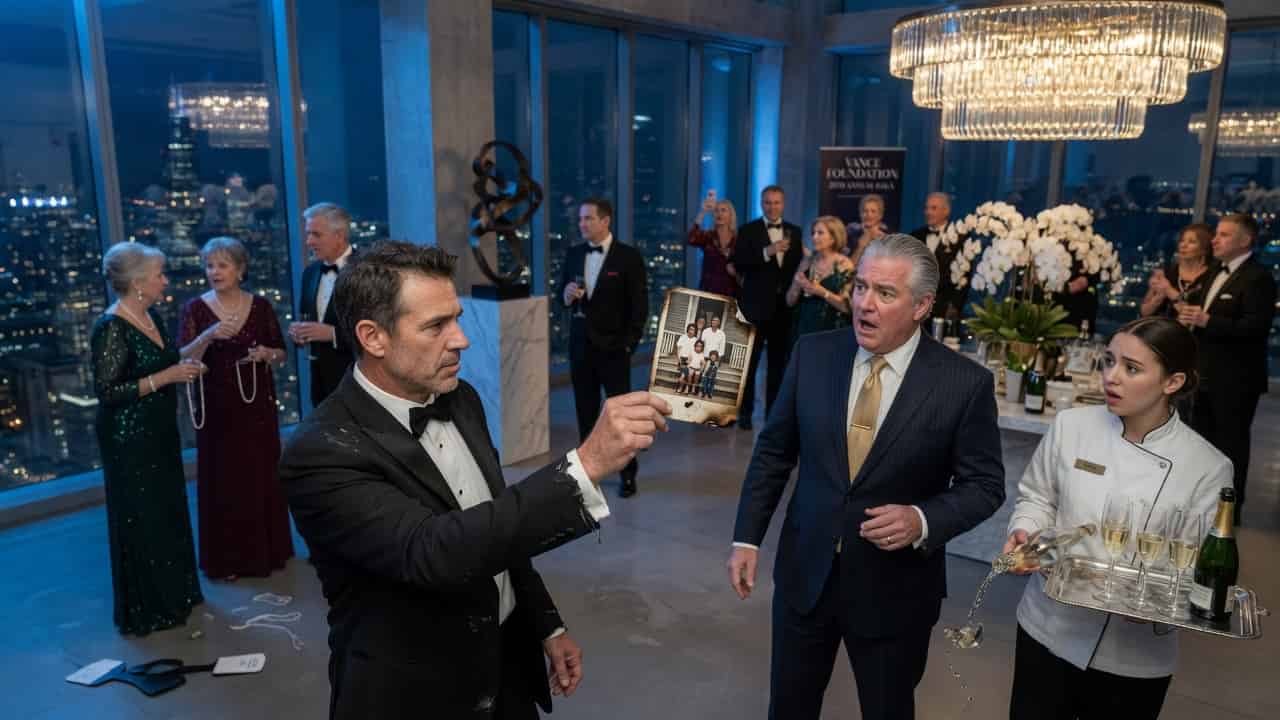
The ballroom went silent, the kind of quiet that feels like a physical weight. Marcus Reed stood in the center of the glass-and-steel empire he had helped design, but he wasn’t there as a guest. He was wearing a tuxedo that smelled like the dust of the crawlspaces he’d been living in for months, and his eyes were fixed on the man who had ordered the end of his world.
Sterling Vance didn’t miss a beat. He looked at Marcus with the same casual contempt he used for a stain on his rug. “I don’t keep track of the people I’ve stepped over to get here, Marcus. Especially not the failures. Security, get this man out of my sight before he ruins the evening.”
The crowd shifted, a low murmur of scandal rippling through the city’s elite. But Marcus didn’t flinch. He reached into his jacket and pulled out a single, soot-blackened photograph—the only thing he had salvaged from the wreckage of the life Sterling had taken from him.
“You told the papers it was a tragic accident,” Marcus said, his voice cutting through the room like a blade. “But we both know why the alarms didn’t go off. We both know who cut the lines.”
He shoved the charred proof toward Sterling’s chest. The billionaire’s hand shook, the champagne in his glass nearly spilling onto his bespoke navy suit. For the first time in years, the most powerful man in Chicago looked small.
“Tell them the truth, Sterling. Tell them about the foundation this building is actually sitting on.”
The secret Marcus is holding isn’t just about the past—it’s about the very room they’re standing in. And he’s not leaving until everything falls.
Chapter 1: The Ghost in the Walls
The dust in the crawlspace didn’t smell like ordinary house dust. It smelled like insulation, old copper, and the peculiar, metallic tang of high-end HVAC systems. It was a sterile, expensive kind of filth. Marcus Reed lay on his side, his cheek pressed against a cool steel beam, listening to the muffled rhythm of Sterling Vance’s life vibrating through the floorboards above him.
He had been living in the interstices of the Vance mansion for three months. To the world, Marcus Reed was a disgraced architect who had suffered a nervous breakdown after his wife and daughter were lost in a “senseless home invasion.” To the police, he was a tragic footnote. To Sterling Vance, he was a ghost that had finally stopped haunting the periphery of his business deals.
But Marcus was very much alive, tucked into the three-foot gap between the master suite and the library. He knew the schedule of the house staff better than the head butler did. He knew that Sterling drank two fingers of Macallan 25 at 11:15 PM every night, and that he always left the bottle on the mahogany side table, never quite capping it tightly enough.
The physical reality of his existence was a series of cramped, agonizing maneuvers. His muscles stayed in a perpetual state of knotted tension. Every movement had to be calculated, silent, and slow. He’d learned to breathe in a way that didn’t rattle his ribcage against the ductwork. He’d learned to eat protein bars with the slow, methodical precision of a machine so the crinkle of the foil wouldn’t carry.
Tonight, the vibrations were different. They were heavier, more frantic. The charity gala was only forty-eight hours away, and the house was teeming with caterers and event planners. Through a gap in the crown molding near the library ceiling, Marcus watched Sterling Vance pace the floor.
Sterling looked exactly like the man the city council adored: silver-haired, robust, radiating the kind of confidence that only comes from owning the land everyone else stands on. But from this angle, Marcus could see the sweat on the back of Sterling’s neck.
“I don’t care what the zoning board says, Ted,” Sterling barked into his phone. He stopped pacing and stood over his desk, his heavy frame casting a shadow that stretched across the Persian rug. “We break ground on the Riverfront project Monday. If they want to talk about ‘structural integrity,’ tell them to talk to my legal team. I’ve already paid for the silence I need.”
Marcus felt a familiar, cold spike of adrenaline in his chest. Structural integrity. It was a phrase they had used a lot four years ago, back when Marcus was the lead architect for Vance Industries. Back when he had been foolish enough to point out that the materials Sterling was using for the low-income housing projects were substandard—dangerous, even.
He remembered the meeting in Sterling’s office. He remembered the way Sterling had put a heavy, paternal hand on his shoulder and told him that “innovation requires compromise.” Two weeks later, Marcus’s home had been broken into. The “intruders” hadn’t taken the jewelry or the electronics. They had just set the fire.
The residue of that night was always with him. It was in the way his lungs felt slightly tight whenever he thought about it, a phantom sensation of smoke. It was in the way his hands shook if he stayed still for too long. He looked down at his palms now, visible in the dim light of the crawlspace. They were calloused and gray with industrial grime. These were the hands of a man who had built empires, now reduced to scraping a living out of the shadows of his enemy.
He shifted his weight, his knee popping with a sound that felt like a gunshot in the quiet of the wall. He froze, his heart hammering against his sternum.
Above him, Sterling stopped talking. The silence in the library became absolute. Marcus could hear the ticking of the grandfather clock in the hallway, each second a hammer blow.
“Who’s there?” Sterling’s voice was low, sharp.
Marcus didn’t breathe. He closed his eyes and visualized the blueprints he had drawn for this house. He was currently six inches away from a load-bearing pillar. If Sterling called security, there was nowhere to go but down into the basement, and the basement was a trap.
He heard the heavy thud of Sterling’s footsteps approaching the library wall. The man was close enough that Marcus could hear the faint whistle in his nostrils. Sterling tapped on the wood—three sharp, inquisitive raps.
“Is someone in there?” Sterling muttered.
Marcus gripped the charred family photo he kept in his inner pocket. He felt the rough, brittle texture of the burnt edges. This was his anchor. This was the reason he hadn’t jumped from the top of the Sears Tower three years ago.
A moment later, Sterling’s phone buzzed again. “Yeah, what?” he snapped, his attention diverted. He walked back toward his desk, the immediate danger passing. “No, I told you, the guest list is final. I want the Mayor at the head table. I want him to see exactly what kind of power he’s dealing with.”
Marcus let out a slow, silent exhale. He reached out and touched the cool steel of the HVAC duct. He had designed this house. He had designed the “impenetrable” panic room Sterling took so much pride in. He knew every flaw, every shortcut Sterling had forced him to take to save a few thousand dollars.
He wasn’t just a ghost. He was the architect of Sterling’s downfall, and he was already inside the foundation.
He waited until Sterling turned off the lights and left the room, the heavy click of the door signaling the end of the day. Marcus remained in the dark for a long time, the silence of the mansion settling around him like a shroud. He thought about his mother, tucked away in that clean, sterile memory-care facility, asking him when Claire and Lily were coming to visit.
The shame of those visits was a different kind of fire. He would sit there, smelling the lemon-scented floor wax, and lie to the woman who had raised him because the truth would kill her faster than the dementia ever could.
They’re just tied up at work, Ma. They’ll be here soon.
He pushed the thought away. Emotion was a luxury he couldn’t afford in the crawlspace. He needed to be precise. He needed to be steel.
He reached into his bag and pulled out a small, modified tablet. He tapped the screen, and the blueprints of the mansion glowed in a soft, dim blue. He navigated to the panic room—Vance’s “Safe Haven.”
Sterling thought he was safe because the walls were reinforced with three inches of steel and the door was biometric. But Sterling didn’t understand the physics of air pressure. He didn’t understand that if you mess with the ventilation intake in a very specific way, the most secure room in the world becomes a vacuum.
Marcus stared at the digital lines, his eyes reflecting the blue light. He had the power to make Sterling Vance beg for air in the dark. He had the power to watch the man who took everything from him realize that his wealth couldn’t buy a single breath.
But tonight wasn’t about the panic room. Tonight was about the residue of the past surfacing. He needed to make sure the gala was perfect. He needed the witnesses.
He began the slow crawl back toward his main “nest” near the service elevator. His joints screamed, and his back felt like it was being stitched together with rusted wire, but he didn’t stop. He moved through the darkness with the practiced ease of a predator.
When he reached the small, tucked-away corner behind the elevator shaft, he sat up and leaned his head back against the concrete. The elevator groaned, moving someone—a late-shift maid or a security guard—between floors.
Marcus pulled the charred photo out again. He couldn’t see the faces in the dark, but he didn’t need to. He knew Claire’s smile, the way her eyes crinkled at the corners. He knew the exact shade of Lily’s hair, the way it caught the light in the park.
He pressed the photo to his chest. The soot came off on his fingers, a black stain that wouldn’t wash away. He didn’t mind. He had been stained for a long time.
He closed his eyes and tried to sleep, but the image of Sterling Vance’s sweat-slicked neck stayed with him. Sterling was afraid of something. He was pushing the Riverfront project too hard, too fast. He was desperate for the gala to be a success.
Marcus smiled in the dark. It was a thin, jagged expression that held no warmth.
“Sleep well, Sterling,” he whispered to the empty air. “The foundation is shifting.”
Chapter 2: The Foundation of Lies
The memory hit Marcus as he was tightening a bolt on the ventilation bypass. It wasn’t a soft memory; it was a jagged piece of glass.
Four years ago. Sterling’s private jet. The interior had been all cream leather and polished walnut, smelling of expensive tobacco and the faint, ozone scent of high altitude. Marcus had been sitting across from Sterling, a stack of blueprints between them.
“The load-bearing specs are off, Sterling,” Marcus had said, his voice steady despite the way his heart was racing. “The concrete in the East Tower… it’s not what we agreed on. It’s a lower grade. If there’s a significant seismic event, or even just high-wind fatigue over twenty years—”
Sterling had laughed, a deep, booming sound that felt like it should have been friendly, but wasn’t. He had leaned forward, his face inches from Marcus’s.
“Marcus, look out that window. What do you see?”
“Clouds, Sterling. We’re at thirty thousand feet.”
“No. You see a world built by people who knew when to stop asking questions. You’re a brilliant architect, maybe the best I’ve ever hired. But you’re an amateur at business. Business is about the margin. That ‘lower grade’ concrete is going to save us eight million dollars. Do you know what I can do with eight million dollars?”
“I know what that concrete can’t do,” Marcus replied. “It can’t hold the weight of two thousand people safely.”
The change in Sterling’s face had been instantaneous. The warmth evaporated, replaced by a cold, predatory stillness. “I’m not asking you to like it, Marcus. I’m telling you to sign off on it. You have a beautiful wife. A daughter who’s starting private school in the fall. You have a very comfortable life. Don’t make the mistake of thinking you’re indispensable.”
Marcus had looked at the blueprints, then at Sterling. He had felt the first stirrings of a shame that would eventually consume him. He hadn’t walked away. He hadn’t gone to the press. He had gone home to Claire and Lily, and he had stayed silent. He had tried to convince himself that he could fix it later, that he could find a way to reinforce the structures without Sterling knowing.
The residue of that choice was the fire. He was certain of it. The fire hadn’t been about the money; it had been about the silence. Sterling didn’t just want Marcus to be quiet; he wanted Marcus to be gone, a broken man who no one would believe.
In the present, Marcus pulled himself out of the memory and back into the narrow service corridor behind the kitchen. It was 3:00 AM. The house was finally quiet.
He moved toward the kitchen, his footsteps silent on the industrial tile. He needed water. His throat felt like it had been scraped with sandpaper.
He saw a figure standing by the massive sub-zero refrigerator. He froze, his hand instinctively going to the small, sharpened screwdriver he kept in his waistband.
It was Silas, the head butler. Silas was seventy if he was a day, a man who had spent forty years pretending not to see the ugliness of the families he served. He was wearing a grey dressing gown, his thin silver hair mussed. He was staring at a bowl of fruit on the counter, his expression one of profound, weary sadness.
Marcus watched him from the shadows. He felt a strange, misplaced surge of empathy. Silas was just another part of the foundation, a man whose life had been built on the requirement of silence.
Silas sighed, a sound that seemed to vibrate through the entire room, and then he turned and walked slowly back toward the staff quarters. He never saw Marcus. He never looked toward the dark corner by the pantry.
Marcus stepped out and grabbed a bottle of water from the fridge, his movements quick and efficient. As he turned to leave, his eyes caught a glimpse of a document on the kitchen island. It was the final seating chart for the gala.
He leaned over, the blue light of his tablet illuminating the names. Sterling Vance at Table One. The Mayor. Two City Council members. The CEO of a major construction firm.
And then, at Table Twelve, tucked away in the back near the service entrance: Estate of Marcus Reed (Unfilled).
It was a cruel, petty gesture. Sterling wasn’t just celebrating his new project; he was celebrating the erasure of the man who had tried to stand in his way. He was inviting Marcus’s ghost to the party just to show it who still held the power.
Marcus felt a cold, hard knot of rage tighten in his stomach. The humiliation wasn’t new, but seeing it written down, seeing his life reduced to an “unfilled” seat at a billionaire’s table, made it feel visceral.
He heard a noise from the hallway—the heavy, rhythmic tread of the night security guard. Marcus ducked back into the pantry, pulling the door shut just as the beam of a flashlight swept across the kitchen.
He pressed his back against a shelf of expensive olive oils and aged vinegars. The guard lingered in the kitchen, the clink of his belt and the faint static of his radio filling the small space.
“Anything?” a voice crackled on the radio.
“Quiet,” the guard replied. “Just the old man getting a snack earlier. Place is a tomb tonight.”
A tomb. Marcus liked that.
The guard moved on, the light fading. Marcus waited five minutes before slipping back into the crawlspace.
He spent the next four hours working on the gala’s lighting system. He wasn’t going to kill Sterling tonight. That would be too quick. He wanted Sterling to experience the same thing Marcus had: the slow, public realization that everything you’ve built is a lie.
He tapped into the house’s central server, bypassing the security protocols he had helped establish years ago. He uploaded a series of files—the original load-bearing specs for the East Tower, the emails from Sterling dismissing the safety concerns, and the photographs of the substandard materials.
And then, he added the final touch: the footage from the neighbor’s security camera the night of the fire. The police had said it was too grainy to be useful. They said the figures were unrecognizable.
But Marcus had spent three years cleaning up the frames. He knew the gait of the men in the video. He knew the way one of them had checked his watch—a gold Rolex with a distinctive blue face. A watch Sterling Vance had given to his “personal fixer,” a man named Miller, as a Christmas bonus that same year.
The residue of the fire was finally going to be brought into the light.
As the sun began to rise, casting long, pale streaks of light through the library windows, Marcus returned to his nest. He was exhausted, his body aching in ways he had stopped trying to quantify.
He looked at the charred family photo one more time.
“Tomorrow,” he whispered.
He thought about the “unfilled” seat at Table Twelve. He thought about the way Sterling would look when Marcus walked through those glass doors, not as a ghost, but as the man who held the keys to the kingdom.
The moral choice was still there, looming in the back of his mind. He could just release the files and disappear. He could take the evidence to the Feds and let the system handle Sterling.
But Marcus knew the system. Sterling Vance was the system. The Feds would take the files, there would be a long, drawn-out investigation, and Sterling would eventually settle for a fine that didn’t even touch his net worth.
That wasn’t justice. Justice was the look on a man’s face when the floor he’s standing on starts to crumble.
Marcus closed his eyes and drifted into a fitful sleep, dreaming of falling buildings and the smell of lemon-scented floor wax.
Chapter 3: The Witness and the Anchor
The memory-care facility, The Willows, always smelled of false hope. It was a combination of industrial lavender and the underlying, sharp scent of bleach. Marcus sat in the sunroom, his hands tucked into the pockets of a borrowed, clean windbreaker. He’d spent two hours in a public gym locker room scrubbing the crawlspace grime from under his fingernails, but he still felt like he carried the scent of the walls with him.
Across from him, his mother, Margaret, sat in a high-backed armchair. Her hair was a soft, white cloud, and her eyes, once as sharp as Marcus’s, were clouded with the fog of a world that no longer had a timeline.
“Marcus,” she said, her voice fragile but warm. “You’re late. Did the office keep you?”
“Just a bit, Ma,” Marcus said, his throat tightening. He reached out and took her hand. Her skin felt like parchment, thin and translucent. “Big project. You know how it is.”
“I do. Your father was the same way. Always building things.” She looked past him, toward the window where a cardinal was perched on a birdfeeder. “Where are the girls? Where’s Claire? I thought she was bringing that lemon cake today.”
This was the residue of his life—the recurring debt of a lie he had to pay every time he saw her. He couldn’t tell her. He had tried once, a year ago, and the resulting breakdown had nearly stopped her heart. The doctor had been very clear: Maintain the reality she lives in. It’s the only place she’s safe.
“Claire had a meeting with the school board, Ma. And Lily has soccer. You know how it is.”
“Soccer,” Margaret mused, a small smile playing on her lips. “She’s so fast, that girl. Just like you.”
Marcus looked down at his shoes. They were cheap, bought at a thrift store, a far cry from the Italian leather he used to wear. He felt like a fraud, a man playing at being a son while he lived like a rat in the walls of a murderer’s house.
“Ma, I might be away for a little while,” he said, his voice dropping. “A long business trip. I won’t be able to visit for a few weeks.”
Margaret’s focus drifted back to him. For a second, the fog seemed to lift, and her eyes sharpened. She squeezed his hand with surprising strength.
“Marcus, are you in trouble?”
The question hit him like a physical blow. He looked at her, searching for the mother who used to know his every secret just by the way he held his shoulders.
“No, Ma. Just work. Everything’s fine.”
“Don’t lie to me, boy,” she whispered, her voice suddenly stern. “I might not know what day it is, but I know when my son is carrying a weight that’s going to break him. Your father had that look once. Before the bank took the old hardware store. It’s a heavy look, Marcus. It’s the look of a man who’s stopped looking for a way out and started looking for a way through.”
Marcus couldn’t meet her gaze. He felt the shame rising in him, hot and thick. He was a 42-year-old man, a disgraced architect, a shadow in the walls, and he was being seen by a woman who couldn’t remember what she’d had for breakfast.
“I’m fine, Ma. I promise.”
He stood up, unable to bear the weight of her clarity. He kissed her forehead, the scent of lavender-scented soap momentarily drowning out the smell of bleach.
“I have to go. I’ll call when I can.”
As he walked out of the facility, the cold Chicago wind whipped at his face. He felt exposed, raw. He needed to get back to the shadows. He needed to get back to the plan.
He met Sarah in a dive bar on the South Side. The place was dim, smelling of stale beer and old regrets. Sarah was twenty-four, with dyed-black hair and a cynical edge that had been honed by a decade on the streets. She was a genius with a motherboard and had a standing grudge against the city’s elite.
“You look like hell, Marcus,” she said, sliding a thumb drive across the scarred wooden table.
“I’ve been living in a wall, Sarah. What do you expect?”
“I expect you to pay me the rest of what you owe,” she said, her eyes narrowing. “This was a big lift. Bypassing Vance’s internal security? That’s not a hobbyist’s job. He’s got military-grade encryption on his personal servers.”
Marcus pushed an envelope across the table. It contained the last of the cash he had stashed in a safety deposit box before the fire—the “rainy day” fund that Sterling’s lawyers hadn’t found.
“It’s all there,” Marcus said. “What’s on the drive?”
“The override for the gala’s AV system,” Sarah said, her voice dropping. “It’s a worm. Once you plug it into the main console, it’ll take over every screen and speaker in the ballroom. You’ll have about five minutes before their IT team can kill it. After that, the whole system will fry.”
“Five minutes is more than I need,” Marcus said.
Sarah leaned back, watching him with a mix of curiosity and pity. “You’re really going to walk into that room, aren’t you? You know he won’t just let you walk out.”
“He doesn’t have a choice,” Marcus said. “The witnesses are the protection. He can’t kill me in a room full of the people he’s trying to impress.”
“People like Sterling Vance don’t care about witnesses, Marcus. They just buy them later.” Sarah shook her head. “You’re a smart guy. You could have taken this stuff to the papers. You could have been a whistleblower.”
“The papers would have buried it on page ten. Sterling owns the papers, Sarah. He owns the land, the buildings, and the people who write the news. The only way to hurt a man like that is to do it in front of his peers, where he can’t control the narrative.”
The residue of his choices was a cold, hard certainty. He wasn’t looking for a legal victory. He was looking for a collapse.
“Good luck, Architect,” Sarah said, standing up. “If you don’t make it out, I’m keeping the thumb drive as a souvenir.”
“If I don’t make it out, the drive won’t matter,” Marcus said.
He left the bar and began the long walk back toward the Vance mansion. He stopped at a construction site along the way, standing in the shadows of a half-finished skyscraper. He looked at the crane reaching toward the dark sky, a skeletal finger pointing at the moon.
He thought about the “Estate of Marcus Reed” at Table Twelve.
He thought about Sterling’s “impenetrable” panic room.
The moral choice was still there, a dull ache in his chest. He could still stop. He could still take the evidence and run. He could take his mother and move somewhere far away, where the name Sterling Vance was just a sound in the wind.
But then he remembered the smell of smoke. He remembered the way Lily’s room had looked, the white canopy bed turned into a charred skeleton.
He turned away from the construction site and kept walking. The residue of his past was a trail of ashes, and he was going to lead Sterling Vance right to the center of it.
He slipped back into the mansion through the service entrance, moving with the practiced stealth of a man who had become part of the house. He climbed back into the crawlspace, the familiar scent of insulation and steel welcoming him home.
He had twenty-four hours.
He spent the night checking the connections, ensuring the worm was ready to deploy. He watched Sterling through the gap in the library ceiling one last time. The billionaire was drinking his Macallan, looking out at the city he thought he owned.
Marcus gripped the charred photo in his pocket.
“Almost time, Sterling,” he whispered. “The foundation is gone.”
Chapter 4: The Gala and the Humiliation
The Grand Ballroom of the Vance Plaza was a masterpiece of architectural arrogance. Floor-to-ceiling glass overlooked the Chicago River, reflecting the city’s lights like a thousand diamonds scattered on black velvet. The air was thick with the scent of expensive lilies, aged scotch, and the subtle, sharp ozone of high-stakes power.
Sterling Vance stood at the center of it all, a king in a navy bespoke suit. He was holding a crystal flute of champagne, laughing with the Mayor and a woman in a gown that probably cost more than Marcus’s first house.
Marcus watched from the service corridor, his heart a steady, heavy drum in his chest. He was wearing the tuxedo he’d spent the last three hours meticulously cleaning. It was slightly too large for him now—the crawlspace diet had taken its toll—but it was sharp enough to blend in. He’d shaved his stubble, leaving his face looking gaunt and pale, his eyes sunken and shadowed.
He looked like a man who had just stepped out of a grave.
He waited until the first course was being served, the clatter of silver against china providing a rhythmic backdrop to the hushed conversations. He stepped out of the shadows and began to walk across the ballroom floor.
The transition was jarring. For months, he had been a creature of the walls, unseen and unheard. Now, the light felt like a physical assault. The heat of the room, the press of bodies, the overwhelming sensory input—it made his head swim.
He reached Table One.
The conversation at the table faltered as he approached. The Mayor looked up, a frown of confusion on his face. Sterling Vance, however, didn’t look up immediately. He was busy telling a joke, his voice booming with confidence.
“…and I told him, the only thing more expensive than a good architect is a bad one!”
The table erupted in polite laughter. Sterling finally turned, his eyes sweeping across the room with a practiced air of boredom. They landed on Marcus.
The silence that followed was absolute. It started at Table One and radiated outward, a cold wave of realization as guest after guest recognized the man standing in front of the city’s most powerful developer.
Sterling’s face didn’t change at first. He simply stared, his champagne glass frozen halfway to his lips. Then, a slow, cruel smile spread across his face.
“Well, well,” Sterling said, his voice loud enough to carry to the neighboring tables. “The ghost has finally decided to join us. Marcus Reed. I must say, you’ve seen better days. That tuxedo looks like it’s been through a war.”
Marcus didn’t move. He stood rigid, his jaw tight. “I didn’t come here for the food, Sterling.”
“Clearly,” Sterling mocked, leaning back in his chair. He looked at the Mayor. “Mr. Mayor, you remember Marcus. Our brilliant, if somewhat… unstable, former lead architect. I believe he’s been taking an extended sabbatical to deal with some… personal tragedies.”
The humiliation was direct, a calculated strike at the very wound Marcus had been nursing for three years. Sterling wasn’t just acknowledging his presence; he was weaponizing Marcus’s pain in front of the people who mattered most.
“I’m sorry for your loss, Marcus,” the Mayor said, his voice dripping with insincere pity. “But this isn’t really the time or the place—”
“It’s exactly the time,” Marcus said, his voice cutting through the Mayor’s dismissal. He turned his gaze back to Sterling. “I wanted to see the building you’re so proud of. I wanted to see the foundation.”
Sterling laughed, a sharp, barking sound. “The foundation is solid, Marcus. Unlike yours. Security, please escort Mr. Reed out. He’s clearly not well. Give him a few dollars for a cab and some dinner. It looks like he hasn’t eaten in months.”
Two large men in black suits began to move toward Marcus.
“Wait,” Marcus said, his voice dropping an octave. He reached into his inner pocket.
The security guards hesitated. In this room, in this atmosphere, any sudden movement was a threat.
Marcus pulled out the charred family photo. He didn’t hand it to Sterling. He held it up, the soot-stained frame catching the light of the chandeliers.
“You told the city this was a tragic accident, Sterling,” Marcus said, his voice echoing in the sudden, hollow silence of the ballroom. “You told them the home invasion was a random act of violence. But you forgot one thing.”
Sterling’s face went from smug contempt to a pale, sickly gray. He looked at the photo, then at Marcus. The arrogance in his eyes was replaced by a flickering, desperate panic.
“What is that?” the woman in the red gown asked, her voice a hushed whisper.
“This is the residue of the truth, Sterling,” Marcus said. He stepped closer, shoving the photo toward Sterling’s chest. The billionaire recoiled, nearly knocking over his champagne. “Tell them who sent Miller. Tell them about the gold Rolex with the blue face.”
“You’re insane,” Sterling hissed, his voice cracking. “Security! Now!”
The guards grabbed Marcus’s arms, but he didn’t struggle. He kept his eyes locked on Sterling’s.
“You built your house on my family’s bones, Sterling,” Marcus said, his voice low and steady as the guards began to drag him back toward the service entrance. “Now, let’s see how the foundation holds when the lights go out.”
He looked toward the AV booth at the back of the room. He nodded once.
At that exact second, every light in the Grand Ballroom died.
The darkness was total, a sudden, suffocating weight. A split second later, the massive LED screens that had been displaying the Vance Industries logo flickered to life.
But they weren’t showing logos.
They were showing blueprints. The original, un-redacted blueprints for the East Tower, with Marcus’s handwritten notes in the margins: WARNING: SUBSTANDARD MATERIALS. STRUCTURAL INTEGRITY AT RISK.
And then, the audio kicked in. It wasn’t music. It was Sterling Vance’s voice, recorded by the hidden microphones Marcus had installed in the mansion months ago.
“I don’t care what the zoning board says, Ted… I’ve already paid for the silence I need.”
The ballroom erupted in a chaos of screams and shouting. People were scrambling for their phones, the small, glowing screens casting eerie, flickering light on the panicked faces of the elite.
Marcus felt the security guards’ grip loosen as they, too, were distracted by the screens. He pulled his arms free and slipped into the darkness.
He didn’t head for the exit. He headed for the service elevator.
He had one more stop to make. The panic room.
As he stepped into the elevator, he looked back at the ballroom. Sterling Vance was standing at Table One, illuminated by the cold blue light of the screens displaying the evidence of his crimes. He looked small. He looked broken.
The residue of the fire was finally everywhere.
The elevator doors closed, and Marcus began his ascent. He felt a strange, cold calm settling over him. The humiliation was over. The rescue had begun, but it wasn’t a rescue for Marcus. It was a rescue for the truth.
And the truth was about to become very, very heavy.
Marcus gripped the screwdriver in his waistband. He thought about Claire. He thought about Lily.
“The foundation is gone, Sterling,” he whispered to the empty elevator. “And the vacuum is waiting.”
Chapter 5: The Mechanical Lungs
The service elevator didn’t hum; it rattled, a rhythmic, industrial vibration that Marcus felt in the marrow of his teeth. It was a stripped-back cage of galvanized steel, far removed from the velvet-lined capsules that carried the donors and the politicians. As it climbed toward the 88th floor, Marcus leaned his forehead against the cold metal wall. The adrenaline from the ballroom was beginning to recede, leaving behind a hollow, shaking exhaustion that felt like it might actually snap his bones.
He watched the floor numbers flicker on the small, grease-smudged display. 40… 50… 60.
Below him, the empire was screaming. He could still imagine the strobe-light chaos of the ballroom—the frantic glow of a thousand iPhones, the Mayor’s panicked retreat, the sound of Sterling Vance’s voice being played back to him like a funeral dirge. But up here, in the vertical arteries of the building, there was only the wind whistling through the shaft and the heavy thud of the counterweights.
The elevator shuddered to a halt at the maintenance level. Marcus slid the manual gate open and stepped out into a world of concrete and humming machinery. This was the “Penthouse Mechanical,” a three-story cavern of massive HVAC units, water pumps, and electrical transformers that kept the glass-and-steel behemoth alive. It smelled of ozone, lubricating oil, and the dry, recycled air of the sky.
He moved toward the central core, his footsteps echoing on the diamond-plate catwalks. He knew this floor better than anyone alive. He had fought Sterling for weeks over the placement of these units, arguing that the vibration would settle into the structural joints of the residential suites below. Sterling hadn’t cared about the vibration; he’d cared about the square footage.
Marcus reached a heavy steel door labeled H-7: Life Safety Systems. He pulled a master keycard—another relic from his former life—and swiped it. The lock clicked with a heavy, satisfying thunk.
Inside, the air was warmer, vibrating with the low-frequency thrum of the emergency air filtration system. This was the umbilical cord for the “Safe Haven,” Sterling’s multi-million dollar panic room located directly beneath this deck.
Marcus sat on a crate of spare filters and opened his tablet. The screen glowed, reflecting in his sunken, tired eyes. He tapped into the building’s internal comms. He didn’t have to wait long.
A frantic sequence of biometric pings echoed through the system. Someone was at the panic room door on the 87th floor.
Identity Confirmed: Vance, Sterling.
Retinal Scan: Verified.
Pressure Plate: Verified.
Status: Secured.
Marcus watched the digital representation of the panic room door sliding shut. In the silence of the mechanical room, he could almost hear the heavy bolts engaging—three inches of reinforced titanium alloy sealing Sterling Vance into his private fortress.
“You’re in,” Marcus whispered, his voice raspy.
He tapped the intercom icon. The system crackled.
“Sterling? Can you hear me?”
For a long moment, there was only the sound of heavy, ragged breathing coming through the speaker. Then, Sterling’s voice, stripped of its ballroom bravado, filled the small room.
“Reed? You son of a bitch. Where are you?”
“I’m exactly where I need to be,” Marcus said. He leaned back, his eyes fixed on the massive air intake valves to his left. “How’s the air in there, Sterling? It’s supposed to be the purest in the city. Triple-filtered. Hospital grade.”
“You think this changes anything?” Sterling spat. Marcus could hear him pacing the small, luxurious space. He could imagine him looking at the monitors, seeing the chaos still unfolding eighty-seven floors below. “So you leaked some tapes. You showed some old blueprints. My lawyers will have those suppressed by morning. They’ll call it a deep-fake. They’ll call you a disgruntled, mentally ill former employee—which you are.”
“Maybe,” Marcus said. “But the people in that room tonight… they didn’t look like they were waiting for a legal brief. They looked like they were looking at a ghost. And ghosts are hard to sue, Sterling.”
“You’re dead,” Sterling growled. “The moment I walk out of this room, I will hunt you into the ground. I should have finished the job four years ago. I was too soft. I thought the fire would be enough to break you.”
Marcus felt a cold, sharp stillness settle in his chest. The admission didn’t hurt; it just clarified the world. It was the final piece of the foundation, the one that made the whole structure of his revenge stable.
“You weren’t soft, Sterling. You were arrogant. You thought I was part of the building. Something you could just renovate or tear down. But an architect doesn’t just build the walls. He knows what’s inside them.”
Marcus stood up and walked toward the primary ventilation manifold. It was a massive steel lung, connected to the panic room by a series of high-pressure ducts. He placed his hand on the manual override lever.
“I designed the Safe Haven to be airtight, Sterling. You remember that? You insisted on it. You wanted a room that could survive a chemical attack, a dirty bomb, a total societal collapse.”
“It’s the most secure room in North America,” Sterling bragged, though his voice had a slight tremor now.
“It is,” Marcus agreed. “But ‘airtight’ is a dangerous word. It means the environment is entirely dependent on the machinery. If the intake stops, and the scrubbers fail… the room doesn’t just get stuffy. It becomes a vacuum.”
Marcus pulled the lever.
A heavy metallic clang echoed through the mechanical room as the primary intake shutters slammed shut. The hum of the filtration system changed pitch, rising to a thin, strained whine.
“What was that?” Sterling demanded. “Reed? What did you do?”
“I’m just checking the margin, Sterling,” Marcus said, his voice flat. “Like you taught me. Innovation requires compromise, right? Well, I compromised the outflow valves. They’re still running. They’re pulling air out of that room at three hundred cubic feet per minute. But the intake? That’s closed.”
In the background of the intercom, Marcus heard a soft, persistent whistling sound. It was the sound of air being sucked through the tiny gaps in the door seals.
“You’re bluffing,” Sterling said, but he sounded like he was gasping. “The system has redundancies. There are manual overrides in here.”
“I disabled them three months ago, Sterling. I’ve been living in your walls, remember? I’ve had plenty of time to play with the wiring.”
Marcus sat back down on the crate. He felt a strange sense of residue—not the soot of the fire, but a clean, cold clarity. He wasn’t the man who designed buildings anymore. He was the man who understood how they failed.
“The pressure is going to start dropping now,” Marcus said. “Your ears will pop first. Then your head will start to ache. In about ten minutes, you’ll find it very hard to catch your breath. In twenty, you’ll be unconscious. In thirty… well, thirty is the margin.”
“Reed! Open the vents! I’ll give you whatever you want! Money, the company—I’ll confess! I’ll go to the police!”
“You already confessed, Sterling. The whole city heard you.”
Marcus watched the pressure gauge on the manifold. The needle was moving slowly, steadily, into the red.
He thought about the “unfilled” seat at Table Twelve. He thought about his mother’s parchment-thin skin and the way she asked for a lemon cake that would never come.
The humiliation of the last four years wasn’t being erased. It was being balanced. It was a cold, mathematical equation, and for the first time since the fire, the numbers were starting to add up.
“Reed, please!” Sterling’s voice was becoming thin, high-pitched. The air in the panic room was thinning, changing the way sound traveled. “I have children! I have a legacy!”
“Your legacy is substandard concrete and a fire that wouldn’t go out,” Marcus said. “And as for your children… they’ll be fine. They’ll have the money you stole. They just won’t have you to tell them how to spend it.”
Marcus closed his eyes. He could hear the frantic scratching of Sterling’s fingernails against the titanium door, a desperate, animal sound that vibrated through the intercom.
The mechanical room hummed on, indifferent to the life and death struggle happening just a few feet below the floorboards. Marcus stayed there in the dark, a ghost in the machinery, listening to the man who built an empire on lies finally run out of air.
Chapter 6: The Weight of the Air
The silence on the intercom was more profound than the noise had been. It wasn’t the silence of a quiet room; it was the heavy, pressurized silence of a tomb.
Marcus sat in the dark for what felt like hours, though the clock on his tablet told him it had only been twelve minutes since Sterling had stopped screaming. The needle on the pressure gauge had bottomed out. The “Safe Haven” was now a literal void, a steel box containing nothing but the high-priced furniture and a man who had finally stopped trying to buy his way out of the inevitable.
His finger hovered over the intake override.
This was the moral choice he had been carrying through the crawlspaces and the dive bars. He could leave it. He could walk out of this mechanical room, take the service elevator to the basement, and disappear into the Chicago night. By the time security breached that door—and it would take them hours, given the specs Marcus had designed—Sterling Vance would be a memory.
But as he sat there, the scent of the ozone and the oil filling his lungs, he realized that killing Sterling wasn’t the end of the story. It was just another fire. It was more residue, more black soot that would never wash off his hands.
If he killed Sterling, Marcus Reed would stay a ghost forever. He would be the monster in the walls, a mirror image of the man he hated.
He thought of his mother. He thought of the way she looked at him in the sunroom, her eyes momentarily clear, warning him about the weight that was going to break him.
“It’s the look of a man who’s stopped looking for a way out and started looking for a way through.”
Marcus gripped the override lever. His knuckles were white, his hands shaking with a decade’s worth of repressed rage. He wanted to pull it. He wanted to hear the air rush back in, not to save Sterling, but to force the man to face the ruins of his life.
He slammed the lever forward.
The mechanical room roared. The intake shutters shrieked as they swung open, and the massive fans kicked back into high gear, forcing pressurized, filtered air back into the Safe Haven. Through the intercom, Marcus heard a violent, wet gasping sound—the sound of a man’s lungs being forcibly re-inflated.
Sterling was alive. But he was no longer a king.
Marcus stood up and packed his tablet into his bag. He felt a strange lightness, a lack of pressure that had nothing to do with the HVAC system. He walked to the service elevator and pressed the button for the ground floor.
The descent was faster this time. When the doors opened in the basement, the building was swarming with police and emergency responders. The gala guests were being funneled out of the main entrance, their faces pale and drawn in the flickering blue and red lights of the sirens.
Marcus walked past a line of officers, his head down, his tuxedo jacket buttoned tight. He looked like just another traumatized guest, another wealthy man whose night had been ruined by a scandal he didn’t understand.
He walked out the service door into the biting April wind. The Chicago River was a dark, churning ribbon below the bridge. He stopped at the railing and pulled the charred family photo from his pocket.
He looked at it one last time. The soot-stained faces of Claire and Lily seemed to watch him, not with judgment, but with a weary kind of peace.
“It’s done,” he whispered.
He let the photo go. It fluttered in the wind for a second, a small, dark scrap of paper, before it was swallowed by the shadows above the water.
He didn’t go to a hotel. He didn’t go to the police. He walked for miles, through the Loop and into the North Side, until the sun began to peek over the lake, turning the sky a bruised, icy purple.
He ended up at The Willows.
The night shift nurse looked up from her desk, her eyes widening at the sight of a man in a rumpled tuxedo standing in the lobby at 6:00 AM.
“Mr. Reed? Is everything okay?”
“I just wanted to see my mother,” Marcus said, his voice soft.
“It’s a bit early, but… go ahead. She’s been restless tonight anyway.”
Marcus walked down the lemon-scented hallway to the sunroom. His mother was already awake, sitting in her usual chair, watching the first light hit the birdfeeder.
He sat at her feet and leaned his head against her knee. She didn’t seem surprised to see him. She reached out and ran her thin, parchment-dry hand through his salt-and-pepper hair.
“You’re back,” she said.
“I’m back, Ma.”
“You look different,” she mused, her voice drifting. “The weight… it’s gone.”
“I found the way through,” Marcus said.
He stayed there for a long time, listening to her breathe.
Outside, the world was waking up to the total collapse of Vance Industries. The news would be full of the recordings, the blueprints, and the miraculous survival of Sterling Vance, who had been found unconscious in his own panic room, a man who would soon be trading his titanium fortress for a concrete cell.
The “Estate of Marcus Reed” was no longer an unfilled seat at a table. It was a name that would be associated with the truth, even if that truth was messy and painful.
As the sun rose higher, Marcus felt the cold residue of the last four years finally beginning to fade. He wasn’t a hero, and he wasn’t a ghost. He was just a man who had designed a building with a flaw, and had finally found the strength to fix it.
He closed his eyes and, for the first time in a long time, he slept without dreaming of fire.
The foundation was finally quiet.